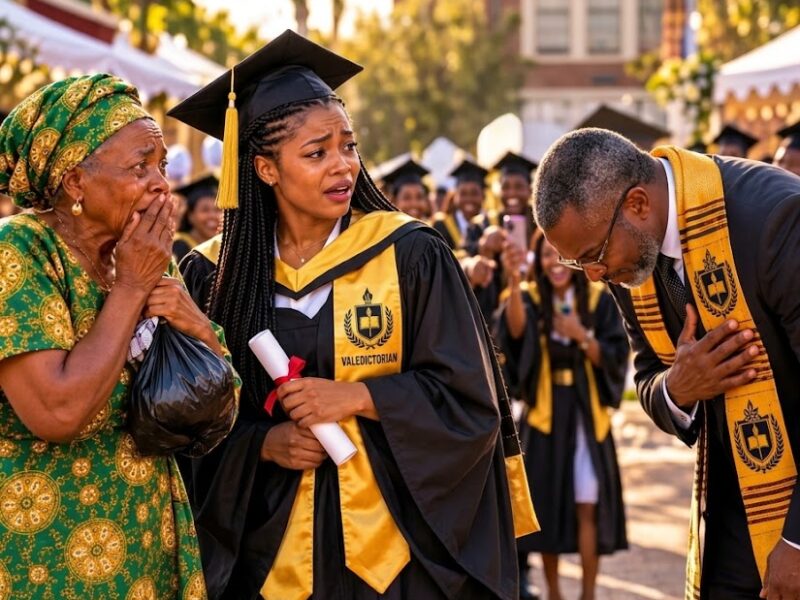
Everyone Mocked the Scholarship Student’s Poor Grandmother—Then the Dean Walked Over and Bowed Before Her
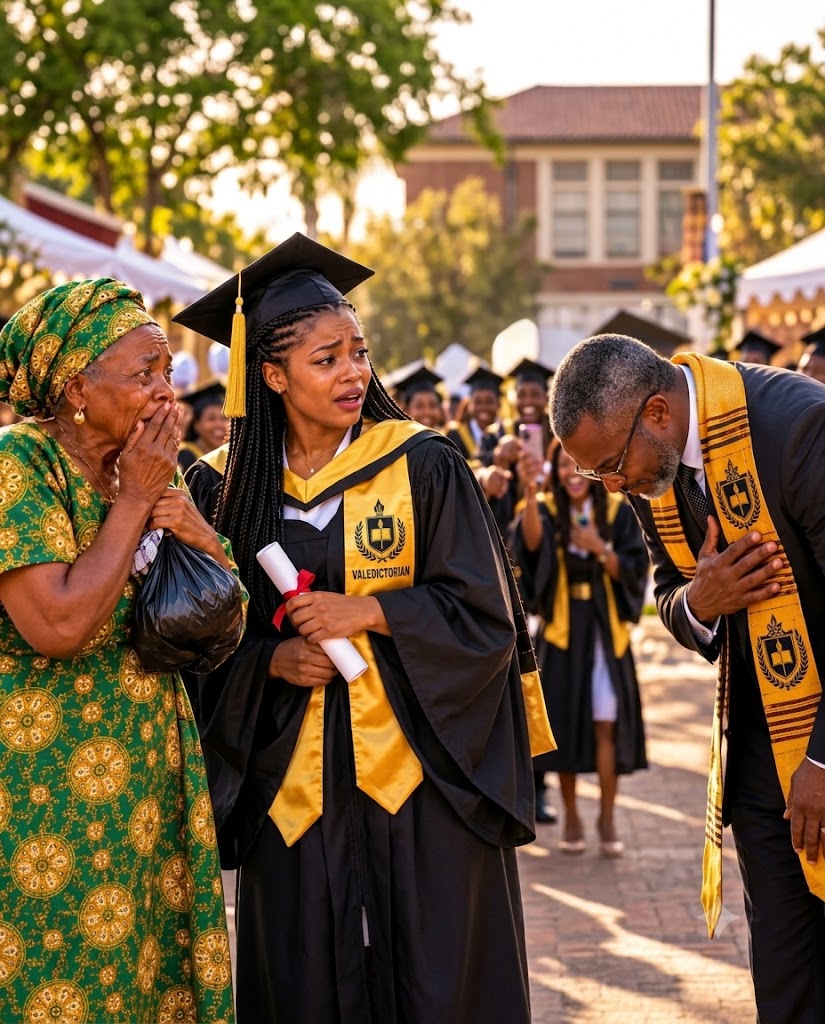
“Hey, look at the entrance. Somebody’s grandmother just walked in wearing rubber slippers.”
The whisper started somewhere in the third row and spread through the auditorium like wildfire.
I was standing near the back, phone already recording, because this was exactly the kind of content my followers ate up.
“Security, please. Is this a graduation ceremony or a flea market? Who invited a street vendor?”
I zoomed in on the old woman shuffling through the double doors, her worn rubber sandals slapping against the polished marble floor.
Her dress was faded, patched in three places, and she carried a plastic bag that looked like it had been reused a hundred times.
“This is Essie’s grandmother,” I whispered into my phone, my voice dripping with fake sympathy. “The one who supposedly sent her here with one suitcase. Four years, and she still shows up dressed like this. Drop a laughing emoji if you can’t believe it.”
The comments were already flooding in.
*💀💀💀*
*No way this is real*
*Grandma couldn’t afford shoes?*
The old woman stopped in the middle of the aisle, her eyes scanning the crowd of graduates in their black gowns and gold hoods.
“Please, my son,” she said softly to the security guard approaching her. “I’m not here to cause any trouble. I only came to see my granddaughter Antui. I walked from the station because I didn’t want to miss the moment they call her name.”
The security guard hesitated, clearly unsure what to do.
That’s when Professor Safo, our dean, stood up from his seat on the stage.
“Ladies and gentlemen,” he said, his voice echoing through the microphone. “I must stop this ceremony for one moment.”
Everyone turned to look at him.
“That woman standing at the entrance—is that really you?”
My best friend Kelvin leaned over and whispered, “Prof, are you okay? It’s just some old woman who walked into the wrong event. Security will take her out. Come on, everybody. Let’s keep going. Some of us have families waiting for photos.”
But Professor Safo raised his hand.
“No. Nobody touches her. Nobody moves.”
The auditorium went silent.
“I’ve stood on this stage for twenty years, and I’ve never asked this crowd for anything. Today, I’m asking for two minutes of silence because I know that face.”
The old woman’s hands were trembling.
“Please, sir, I didn’t come to disturb anyone. I only came to watch my granddaughter walk. I’ll stand at the back. I promise. I’m used to standing. I’ve been standing my whole life.”
My phone was still recording, but my hand had started to shake.
—
## Part 2
Professor Safo stepped down from the stage, his expensive shoes clicking against the floor as he walked toward the entrance.
“Every coin became a prayer,” the old woman continued, her voice barely above a whisper. “Every sunrise brought a new set.”
The dean stopped a few feet away from her.
“No father. No shoes. No food,” she said, her eyes glistening.
He removed his glasses.
“Every morning I stood by the road. Come here, little one. Don’t be shy. Nobody’s going to chase you away from my fire.”
The words seemed to hit Professor Safo like a physical blow.
“Take it,” the old woman said, miming the motion of handing something over. “It’s hot. Blow on it first. And don’t thank me. Eat. I was once hungry, too.”
Someone in the crowd laughed nervously, unsure what was happening.
“She never asked my name,” Professor Safo said, his voice cracking. “She never asked for a single coin.”
The old woman nodded slowly.
“On rainy days, she still gave me half of the little she had. For two years, that fire was the only warm place I knew. Then I lost her.”
Professor Safo turned to face the stunned audience.
“Little Quadro who used to hide his feet in the sand.”
I stopped recording.
My thumb hovered over the screen, but something told me I shouldn’t be filming this.
“My child,” the old woman said, looking past the dean toward the graduates. “I prayed for you every single night. I thought that city had swallowed you.”
A girl in the front row stood up.
Her gown was the same as everyone else’s, but her shoes were worn, scuffed at the edges.
“Grandma, you came,” she said, tears streaming down her face. “You walked all the way here in those slippers.”
She ran down the aisle and threw her arms around the old woman.
“This is my grandmother,” she announced, turning to face the crowd. “She sold her wedding cloth so I could come here. She’s the reason I’m standing.”
The auditorium erupted in whispers.
“Grandma, you came. You walked all the way here.”
Professor Safo was still standing there, his face pale.
“Professor Safo,” the girl said, her voice shaking. “You knew her. All this time, you knew my grandmother. Four years, and you never said a word.”
The dean looked at the old woman, then at the girl, then back at the old woman.
“Please, somebody tell me what’s happening,” the girl begged.
The old woman reached up and touched Professor Safo’s face.
“Mommy, you fed a hungry boy and never asked his name,” he said, his voice breaking. “Today, in front of every person who laughed at you, I want the whole world to know who you really are.”
—
## Part 3
The ceremony was supposed to resume after that, but nobody moved.
I was still standing near the back, my phone now tucked into my pocket, my face burning with shame.
“Guys, see this?” Kelvin whispered, nudging me. “She came to university with one suitcase and a sandal that’s already given up. My sister, is the suitcase also on scholarship? Please don’t let the gate security see you. They’ll think you’re selling something.”
He was trying to make me laugh.
I didn’t.
“My sandal is torn,” the girl—Essie—said, turning to face him. “Yes, but I didn’t come here to show shoes. I came to learn. You can keep laughing. It doesn’t cost me anything. Excuse me. I have to register before the office closes.”
The memory hit me like a truck.
That was four years ago.
I had been there.
I had laughed.
And now, watching her stand with her grandmother, I felt something I hadn’t felt in a long time.
Shame.
“Scholarship’s gone,” Kelvin muttered, still trying to get a reaction out of me. “Library jobs gone. So, we’re helping out. Here’s lunch, Gary girl. Enjoy it. Your grandmother will be proud. Everybody say thank you to the dean for her new diet plan.”
A few people laughed.
But most just stared at him.
“And that’s the face of a girl who thought she could buy her way to the top,” Kelvin continued, pulling out his phone. “Guys, part two is going up tonight. Link in my bio. Don’t forget to share it with anyone who still believes her sob story.”
I grabbed his arm.
“Kelvin, stop.”
He looked at me like I’d grown a second head.
“What? It’s just content.”
“No. It’s not.”
—
## Part 4
The ceremony eventually resumed, but something had shifted.
Professor Safo sat on the stage with the old woman beside him, her rubber sandals visible for everyone to see.
When they called Essie’s name, she walked up to receive her diploma with her head held high.
“First in the entire faculty,” the announcer said. “Summa cum laude.”
The applause was deafening.
But not everyone was clapping.
“Look at the top,” Kelvin muttered, still bitter. “First place in the entire faculty. Everyone. You see that name at the top? That’s the Gary girl you’ve all been laughing at. Somebody take a picture, please.”
“There’s no way,” someone behind him said. “Nobody gets a perfect score in Safo’s class. Not in twenty years. She works in his library. She’s in his office every week. Come on, people. Use your heads. Something is going on there.”
Essie turned to face them.
“I read every night until the library closes,” she said, her voice calm. “While you were at parties, I was studying by the light of a phone that barely works. If you think my score is a lie, ask for a remark. I’ll wait right here.”
“A remark?” the guy said. “That’s not what I’m questioning. Why does Professor Safo suddenly know everything? He gives you a job, then calls you to his office. Now you get the first perfect score in his class. Tell me I’m the only one.”
I stepped forward.
“Be careful, Kelvin. You’re accusing a professor and insulting Essie just because she scored higher than you. You didn’t see the nights she slept over books.”
He turned to me, shocked.
“Ni, what are you doing?”
“Then request the review,” Essie said. “Check my script. Check the marking scheme. Check every answer I wrote. But Professor Safo didn’t give me a single mark I didn’t earn. I hope you have enough courage to apologize.”
—
## Part 5
The graduation reception was supposed to be a celebration.
But for me, it was a reckoning.
“Everyone, look,” Kelvin announced as Essie walked into the hall. “The top student has arrived. Same dress from the first day of school. At least she ironed it this time. Somebody find her a seat near the kitchen. She’ll feel more at home there with the staff.”
I wanted to disappear.
“It’s the only nice dress I own, and I’m proud to wear it,” Essie said. “My grandmother sewed it by hand, stitch by stitch. You wear what money bought you. I’ll sit anywhere.”
Professor Safo appeared at her side.
“Miss Antui will not sit near the kitchen. She’ll sit at the high table beside me as this faculty’s top student. And Mr. Lampy, see me on Monday. We’ll talk about the difference between money and class.”
Kelvin’s face went red.
“High table, of course,” he sneered. “First the library job, then the perfect score, and now a seat beside you. Professor, forgive me, but doesn’t anyone else find this strange? Every door seems to open for Essie whenever you’re around.”
The room went silent.
“Professor, please let him talk,” Essie said. “Ni has spent years looking at my dress, my sandals, and my grandmother’s Gary. Maybe that’s why he never noticed the books in my hand.”
“Fine, then I’ll prove it,” Kelvin said. “There’s something between you and Professor Safo that nobody knows about. Essie, and when I find out what it is, everyone in this university will hear about it.”
—
## Part 6
That night, I couldn’t sleep.
I kept thinking about the old woman in rubber slippers, standing at the entrance while everyone laughed.
I kept thinking about Essie, who had come to this university with nothing and was now at the top of her class.
And I kept thinking about myself.
The next morning, I went to Professor Safo’s office.
“Aduma, put this in her library locker tomorrow morning,” he was saying to his secretary. “No name, no signature. It’s enough for new shoes. I watched that boy mock her sandals tonight.”
“Professor,” I said, stepping inside. “With respect, you’re the dean. If anyone sees you giving money to one student, people will talk. Especially a young woman. People will talk.”
He looked at me, surprised.
“Why not just tell her the truth about the photograph?”
“Because I’m not sure yet,” he admitted. “And if I’m wrong, I’ll embarrass an old woman who owes me nothing. And if I’m right, then I’ve been searching for her for forty years, and I don’t know how to face her.”
“Forty years?”
He pulled out a worn photograph from his desk drawer.
“This was taken at a roadside market in Ghana. I was eight years old. She fed me plantain every morning for two years. I never knew her name.”
I stared at the photograph.
The woman in it was young, her face bright with a smile I recognized.
“That’s her,” I whispered. “That’s Essie’s grandmother.”
—
## Part 7
I didn’t deliver the envelope.
Instead, I watched from a distance as Professor Safo’s secretary placed it in Essie’s locker.
“Yara, there’s so much money in here,” Essie said later, showing the envelope to her roommate. “Please tell me the truth. Was it you? Because if it was, I can’t take this. Your family isn’t rich either.”
“I swear on my mother, Essie, it wasn’t me,” Yara said. “If I had that money, I’d buy us lunch. Somebody is watching over you. Somebody who knows how it feels.”
“Then whoever it is, I’ll thank them one day. But I’m not buying shoes. My sandals can wait. My grandmother is still standing over a fire every evening at seventy-four.”
I felt something crack inside my chest.
—
## Part 8
The video went up that night.
“Scholarship girl’s secret deal with the dean,” Kelvin narrated, his voice gleeful. “By morning, the whole country will be talking.”
I watched it in horror.
Two million views overnight.
The comments were brutal.
*No wonder she’s top of the class. The dean is doing her homework for her.*
*This is what happens when you let charity cases into real universities.*
Essie, you’re famous now. Isn’t that what every village girl dreams of?
“You know it’s a lie,” Yara said, standing in front of Essie’s door. “Did you live with me? You’ve seen me reading at two in the morning. You’ve seen me eat Gary for dinner five nights a week. How could anyone buying their way through school still be this hungry?”
“Get away from her door,” Yara snapped at the crowd gathering in the hallway. “All of you go and find something useful to do with your mornings. Essie, don’t read the comments. Don’t read anything. Come with me right now. We walk to class together. Heads up.”
“No, Yara. I’m done hiding.”
—
## Part 9
The disciplinary hearing was held in the main hall.
I sat in the back, my hands sweating.
“Miss Antui, this council has seen the photographs,” the chairman said. “Cash in your locker from the dean’s office. A perfect score. We should believe any of this was innocent?”
“Everyone saw a poor girl working,” Essie said. “I was in his office because I worked in his library. I came back late because I was reading. Yes, I sent the money home, every coin to a grandmother standing over a fire. Test me any exam today.”
“Honorable members, I lived with her,” a voice said.
I turned.
It was Yara.
Wait, no.
It was Diddy—one of Kelvin’s friends.
“She came in with nothing and suddenly she had money to send home. She was always in his office, always coming back late.”
“Honorable,” Professor Safo said, standing. “I sent the money. It said, ‘For new sandals from someone who was once hungry, too.’ I’ve worked here twenty-two years and I’d swear it on my life.”
“A personal reason,” the chairman said. “How convenient. But the scholarship is withdrawn. Full fees paid within thirty days, or she’s removed. Professor Safo remains on leave. We’re done here.”
—
## Part 10
I found Essie sitting alone outside the building.
“I’m sorry,” I said.
She looked up at me, her eyes red.
“For what? You didn’t do anything.”
“That’s the problem. I didn’t do anything. I stood there and laughed while Kelvin mocked your grandmother. I recorded it. I posted it. I’m part of this.”
She was quiet for a moment.
“The money,” she said finally. “It was from Professor Safo, wasn’t it?”
“Yes.”
“Why didn’t he just tell me?”
“Because he’s been looking for your grandmother for forty years. He didn’t want to embarrass her if he was wrong. And if he was right…” I paused. “He didn’t know how to face her.”
Essie stared at me.
“Forty years?”
“He was a hungry boy at a roadside market. Your grandmother fed him every morning for two years. He never knew her name.”
Her hands were shaking.
“The fire,” she whispered. “She always talked about a little boy who used to hide his feet in the sand. She prayed for him every night.”
—
## Part 11
The next morning, Essie was gone.
“She left,” Yara told me, her voice hollow. “She said she couldn’t pay the fees. No job, no room, and her face is on every phone in the country. She said if she stays, they’ll destroy the dean, too.”
“Where did she go?”
“Home. To her grandmother.”
I ran to the bus station.
I got there just as the bus was pulling out.
“Essie!”
She turned, her face pressed against the window.
I held up my phone.
“I found something. Please. You need to see this.”
—
## Part 12
I had spent the entire night digging.
The video of Kelvin telling his friend where to find the evidence.
The photograph of Professor Safo as a child, standing next to a young woman at a roadside fire.
The bank ledger from Quanta—twenty years of records showing money moving from the scholarship fund to a political campaign.
“I didn’t come to fight you, Dad,” I said, standing in my father’s study. “I came to give you a chance.”
My father stared at me, his face pale.
“This is the original bank ledger from Quanta with your signature. And Diddy has a video of your voice telling Kelvin where to find the deed. Tomorrow the inspector gets both.”
He didn’t say anything.
“For the lorry boy, Dad. The one who cried behind our stall. She fed you. You built a fund in her name. That was the best thing you ever did. I’m giving you one night to go to the police yourself. Please be that boy again.”
—
## Part 13
The council meeting was packed.
“The fund didn’t close,” I announced, holding up the ledger. “The money was moved. Every dollar of it went into one place. Your first election campaign.”
Joseph Lampty—my father—sat in the front row, his hands trembling.
“These are from the Enquanta Fund’s old account. Twelve years ago, the money was moved. Every dollar went into one place.”
“Those papers are old,” my father said, his voice cold. “Old papers disappear.”
“Then explain this,” I said, playing the video on my phone.
My father’s voice filled the room.
“The briefcase is in the living room under the side table. Tell the officers exactly where to look.”
He stood up.
“You’ve been digging in the wrong grave, Quadro.”
“Actually,” Professor Safo said, “we’ve been digging in the right one.”
—
## Part 14
The truth came out.
All of it.
The scholarship fund that was supposed to help poor children from Quanta, emptied into a political campaign.
The forged documents that framed Professor Safo.
The threats, the bribes, the silence.
“Miss Antui,” the chairman said, his voice shaking. “I owe you an apology. I followed orders when I should have followed my conscience. I sent your grandmother into the rain at midnight. Your suspension is lifted. I was wrong.”
“I accept it,” Essie said. “My grandmother taught me that anger is too heavy to carry. But please, when the next poor girl walks through that gate, open the door for her before anyone has to fight for it.”
—
## Part 15
Graduation day.
This time, I wasn’t recording.
This time, I was standing at the entrance, waiting.
The old woman came on the morning bus, just like she said she would.
Her rubber sandals were the same ones from four years ago.
But this time, when she walked through the gates, nobody laughed.
“Everybody look at the entrance,” someone whispered.
But it wasn’t cruel.
It was reverent.
“The valedictorian’s grandmother has arrived.”
Professor Safo met her at the door.
“Mommy Akosua,” he said, bowing. “Is that really you?”
—
## Part 16
The ceremony was different this time.
When Essie walked up to receive her diploma, the entire auditorium stood.
“Four years ago,” she said, standing at the podium, “I came to this university with one suitcase and a torn sandal. People laughed at me. They called me the Gary girl. They said I was buying my way to the top.”
She paused.
“Poverty isn’t a lack of intelligence. It’s a lack of access. My grandmother never went to school. She gave everything so I could have a chance.”
The old woman in the front row was crying.
“She sold her wedding cloth so I could come here. She stood over a fire for fifty years so I could stand on this stage. And I want to say something to everyone who ever laughed at me.”
The room was silent.
“I forgive you.”
—
## Part 17
After the ceremony, I found Kelvin standing alone.
“I’m sorry,” he said. “I called your grandmother a joke in front of thousands of people. I wanted views so badly that I forgot you were human. I deleted the video. It doesn’t undo anything. But I couldn’t leave today without saying sorry.”
“It wasn’t her fault,” I said. “I planned it. For three years, I blamed Essie for my own mistakes. I realized my grandmother would be ashamed. I have no excuse. I’m sorry.”
The old woman appeared beside us.
“I brought these from this morning,” she said, holding out a bag. “Still warm. I was keeping them for Essie, but she can wait. Take them, both of you. You look like children who haven’t eaten.”
—
## Part 18
The stall was built in the center of Quanta.
“Mommy’s Fire,” the sign read.
Inside, there was a kitchen that would feed every hungry person who walked down the road.
And a center where every young person could apply for a scholarship with her name on it.
“Fifty years at that fire,” she said, looking at the building. “I never dreamed of more than feeding one more person each day. Now look. My name on a building.”
Essie stood beside her.
“You’ll have to read it to me,” her grandmother said.
“I will. Every day.”
—
## Part 19
The bank was called Meridian Capital.
And Essie was its youngest CEO.
“Poverty is expensive,” she said, standing in front of the board. “My grandmother borrowed at forty percent interest from money lenders because no bank would see her. That’s why I’m here.”
She built a fund for market women.
Loans at ten percent instead of forty.
Repaid daily through mobile money.
“The poor don’t lack effort,” she said. “They lack access.”
—
## Part 20
Five years later, a girl walked into the Meridian Capital office.
She was wearing a worn coat and carrying a plastic bag.
“I saw the notice for cleaning staff,” she said. “I’ll clean anything. I just need honest work.”
Essie looked up from her desk.
“Diddy?”
The girl’s face crumpled.
“I’m sorry. I’ll leave. I’ll leave right now. You’ll never see me again.”
“Did Diddy Quay? Your mother told me you were fine. Very busy, very successful. What happened to you? Where’s the boutique? Where’s Jerome?”
“Gone. All of it. He took everything and disappeared. I sell clothes on a mat under your billboard in the day and clean your floors at night. I didn’t apply here to find you. I swear.”
“Laugh at you?” Essie said. “I know exactly what it’s like when the whole world laughs at you. I’d never do that to anyone. Not even to you. Come inside, please. Let’s talk.”
—
## Part 21
“I filmed your grandmother,” Diddy said, tears streaming down her face. “I poured a drink on you at the ball. And I told my followers you were sleeping with the dean. Every terrible thing I did is still online somewhere.”
“Because the night the dean was arrested, you came to my door with a video that saved his life and mine. You didn’t have to. You lost everything for it.”
“But after graduation, I went right back to being that girl. I wanted to prove I was better than you. Everything. I don’t deserve your kindness. I don’t deserve anything.”
“Listen to me. A person isn’t what they did on their worst day. You made mistakes and paid for them. Now it’s time to stop paying. I forgive you. Completely. Let’s talk about what comes next.”
—
## Part 22
The old woman was sitting by the fire when Diddy arrived.
“So, you’re the girl with the phone,” she said. “The one who filmed my Gary and tore the blue dress. My child, sit down. Eat this first, then we’ll talk.”
“Mommy, I don’t deserve to sit at your fire. I laughed at you in front of two million people. I tore the only dress she had from home. Please, I’m so sorry.”
Grandma handed her a plantain.
“I was once hungry, too,” she said. “And so were you.”
—
## Part 23
Diddy stood in front of two hundred market women.
“That’s my daughter up there,” her mother whispered, tears in her eyes.
“Two hundred market women trained to sell online by my child. I stood at that stall two years ago. I was cleaning floors and selling on a mat under a billboard. The woman on that billboard, I’m sorry I was ever ashamed.”
Grandma watched from the front row.
“Grandma, look at them,” Essie said. “Two hundred women. And Diddy standing up there with her head high next to her mother.”
“Forgiveness built more than any of us ever could alone.”
—
## Part 24
Sixty years ago, a woman fed one hungry boy at a roadside fire.
Today, a whole market was eating from it.
“That’s the thing about a fire,” Grandma said. “It never goes out.”
She looked at Essie, at Diddy, at the crowd of women learning to build their own futures.
“I was once hungry, too,” she said. “And now I’m full.”
—
## Epilogue
The fire still burns in Quanta.
Every morning, children come to the stall with empty stomachs and hopeful eyes.
And every morning, Grandma is there.
“Come here, little one. Don’t be shy. Nobody’s going to chase you away from my fire. Take it. It’s hot. Blow on it first. And don’t thank me. Eat. I was once hungry, too.”
The words echo through generations.
Through scholarship girls and CEOs.
Through deans and bankers and market women.
Through everyone who ever needed a reminder that kindness is never wasted.
And somewhere, a little boy hides his feet in the sand, ashamed of his poverty.
But he won’t be ashamed for long.
Because Grandma sees him.
And she’s already reaching for a plantain.
—
*The End*









