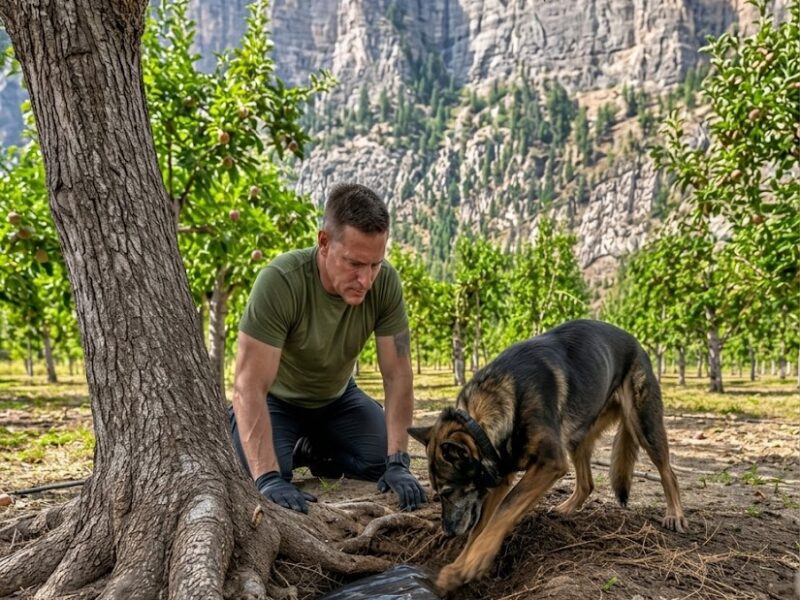
Everyone Mocked the Navy SEAL for Buying a Dead Orchard—Then His K9 Dug Beneath the Oldest Tree
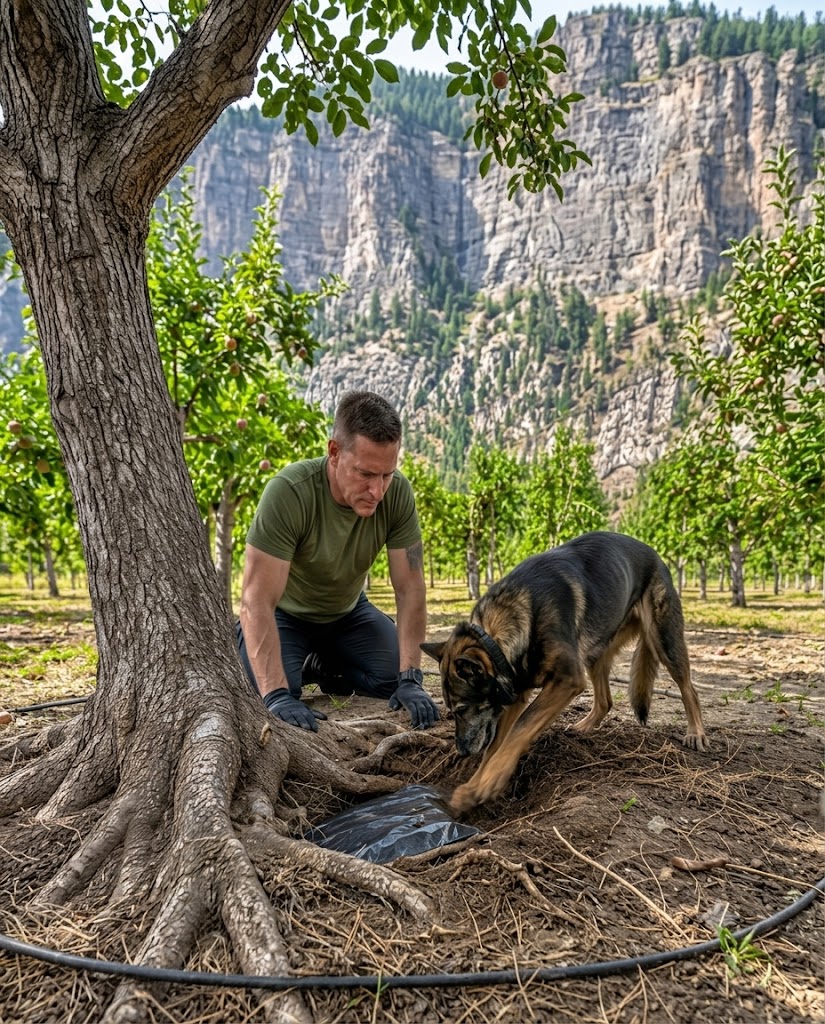
The locals of Yakima Valley called him a fool, a broken Navy SEAL sinking his life savings into 70 acres of rotting apple trees.
They laughed and mocked him behind his back until his German Shepherd started digging beneath the oldest stump on the property, unearthing a terrifying local secret.
Chief Petty Officer David Miller did not return from the Syrian border with a hero’s parade.
He returned with a shattered left femur, a titanium plate in his jaw, and a quiet, suffocating ghost sitting heavy in his chest.
After 12 years in the Navy SEAL teams, navigating the most violent corners of the globe, the abrupt transition to civilian life felt less like a retirement and more like being thrown out of a moving vehicle.
He needed silence.
He needed a place where the loudest sound was the wind, where nobody would ask him about the scars wrapping around his neck.
His search for isolation led him to the Yakima Valley in Washington State, a region famous for its sprawling, fertile orchards.
But David didn’t buy a thriving farm.
Instead, he walked into the office of a local real estate agent named Brenda Wallace and slapped down a cashier’s check for the old Sullivan property.
Brenda had stared at him across her desk, adjusting her glasses as if she had misheard him.
The Sullivan property was a local eyesore.
It was 73 acres of dead, blighted apple trees that hadn’t borne fruit in over a decade.
The soil was notoriously bad, choked with a mysterious fungal rot that had bankrupted the previous owners.
“Mr. Miller,” Brenda had said, her voice laced with genuine pity.
“I cannot in good conscience let you buy this land without a warning. It’s a graveyard. The irrigation lines are shot.”
She snorted.
“The soil needs years of chemical treatment, and the trees are just waiting for a match. You’re throwing your pension into a bottomless pit.”
“I like the quiet,” David had replied simply, sliding the contract back toward her.
Word traveled fast in small agricultural communities.
By the time David moved his meager belongings into the drafty, dilapidated farmhouse at the edge of the property, he was already the town’s favorite punchline.
Down at the Valley Diner, the local farmers would watch his beat-up Ford F-150 roll past and shake their heads.
George Mitchell, a third-generation grower whose pristine orchards bordered David’s dead land, was the loudest critic.
“He’s a shell-shocked idiot,” George had loudly proclaimed one morning while David was picking up coffee.
“Selling dead wood to a dead man. I give him six months before he goes bankrupt and shoots himself.”
David had heard it all.
He didn’t care.
He hadn’t come here to grow apples.
He had come here to rebuild his mind.
And he wasn’t entirely alone.
By his side, a constant, silent guardian was Titan.
Titan was a 90-pound German Shepherd K9, a former military working dog trained in explosive ordnance disposal and tracking.
Like David, Titan had been retired due to injury.
A piece of shrapnel had permanently scarred his left flank.
The dog was intensely loyal, fiercely protective, and shared David’s hyper-vigilance.
Together, the two veterans formed an unspoken bond of mutual rehabilitation.
Their daily routine was rigorous.
Every morning at 0500, David would wake up, brew bitter black coffee, and strap on his work boots.
He and Titan would walk the perimeter of the 73 acres.
David carried a chainsaw and a heavy axe, spending hours systematically cutting down the dead, twisted apple trees.
It was grueling, bone-aching work, but the physical exertion kept the nightmares at bay.
Titan would patrol the brush, chasing off coyotes and keeping a watchful eye on the tree line.
For three months, this was their life.
A cycle of sweat, sawdust, and silence.
The mockery from the town continued, but David ignored the smirks when he went to the hardware store for fuel and chainsaw chains.
He was making progress, clearing out the rot, one dead tree at a time.
Then came the second Tuesday in October.
The autumn air was biting, carrying the scent of wood smoke from the neighboring farms.
David had worked his way to the far northeastern corner of the property.
This area was strange.
It was nestled against a steep, rocky ravine that made it practically inaccessible by tractor.
In the center of this forgotten patch sat a massive dead oak tree.
It was an anomaly.
There were no other oaks on the property.
Its sprawling, skeletal branches reached up like gnarled fingers against the gray sky, and its trunk was thicker than a small car.
David set his chainsaw down to wipe the sweat from his brow.
He reached for his canteen.
Suddenly, a low, guttural growl vibrated through the air.
David froze.
His military instincts, honed over a decade of combat, instantly overrode his civilian relaxation.
He dropped his hand from the canteen and looked at Titan.
The German Shepherd was standing 20 feet away near the massive roots of the dead oak.
Titan’s posture had completely transformed.
This wasn’t his relaxed, playful stance, nor was it his alert posture for a wild animal.
The dog’s ears were pinned flat against his skull.
The hair on his spine was standing straight up, and his tail was rigid.
He was staring intently at a patch of sunken earth between two thick roots.
“Titan,” David whispered, his voice sharp and commanding.
“Talk to me.”
Titan didn’t bark.
He let out another vibrating growl, then stepped forward and began to dig furiously.
Dirt and dead leaves flew into the air as the dog’s massive paws tore into the hard-packed earth.
David approached cautiously, his eyes scanning the tree line for threats.
In the military, a K-9 acting this way meant one of two things: an explosive device or a concealed enemy.
But this was Washington State, not the Middle East.
“Hold,” David commanded.
Titan stopped digging instantly, stepping back, but keeping his eyes locked on the hole.
He let out a sharp, singular whine.
David knelt beside the hole.
The soil here was different.
It wasn’t the hard, unbroken clay of the rest of the orchard.
It was loose.
It had been disturbed—perhaps years ago, but definitely moved by human hands.
David brushed aside the remaining dirt, his fingers scraped against something hard, cold, and definitively unnatural.
It was thick, heavy industrial plastic.
The town of Yakima was about to find out that the dead orchard wasn’t a graveyard for trees.
It was a graveyard for secrets.
The cold wind whipped through the barren branches as David stared at the exposed edge of the plastic.
His heart, previously calm, now hammered a familiar, steady rhythm against his ribs.
The adrenaline was a cold fire in his veins.
He stood up, patted Titan on the head to keep him steady, and jogged back to the truck to grab his folding entrenching tool and a heavy crowbar.
When he returned to the oak tree, Titan was sitting perfectly still, standing guard over the hole.
David drove the edge of the shovel into the earth.
The ground fought him, interwoven with tough, dead roots.
But years of digging fighting positions in hostile territory had taught him efficiency.
Ten minutes later, the object was fully exposed.
It was a heavy-duty, military-style Pelican transport case, completely wrapped in thick black industrial tarp and bound with rotting nylon ropes.
The case was large, roughly three feet long and two feet wide.
Judging by the density of the dirt packed around it, it had been buried for at least 10 to 15 years.
David used his pocketknife to slice through the nylon ropes and peel back the tarp.
The Pelican case was covered in mud, but the heavy steel padlocks on the front were heavily rusted.
He jammed the edge of the crowbar under the first lock, applying his body weight until the rusted steel gave way with a sharp crack.
He repeated the process on the second lock.
Titan whined again, taking a half step back.
“Easy, buddy,” David muttered.
He unlatched the heavy clasps.
With a deep breath, preparing himself for anything from narcotics to a decaying body, he threw the lid back.
A musty chemical smell wafted up, but the interior of the case was remarkably dry, protected by a thick rubber O-ring seal.
David stared at the contents, his brow furrowing in deep confusion.
It wasn’t drugs.
It wasn’t a bomb.
The left side of the case was neatly stacked with thick, leather-bound ledger books.
Beside them lay a bulky, vintage 1990s police radio scanner, its battery pack heavily corroded.
But it was the right side of the case that made David’s breath catch in his throat.
Money.
Neat, tightly bound stacks of faded $100 bills.
They were wrapped in rubber bands that had long since dried and snapped.
Just eyeballing it, David knew he was looking at hundreds of thousands of dollars.
But David Miller hadn’t survived 12 years in the SEALs by being naive.
Free money in a buried box never meant freedom.
It meant a target on your back.
He reached out and carefully lifted the top ledger.
The pages were filled with handwritten columns of dates, names, and massive dollar amounts.
The dates ranged from 1996 to 2002.
As he scanned the names, a chill ran down his spine.
He recognized some of them.
Mitchell, Abernathy, Wallace—local families, prominent families.
Next to several names were notations: “foreclosure forced,” “water rights acquired,” “deed transferred.”
Beneath the ledger was a thick manila envelope.
David opened it and slid out a stack of Polaroid photographs.
They were pictures of houses and farms around the Yakima Valley.
Some were taken at night, illuminated by harsh flash.
Others were taken from a distance.
But what made David’s blood run cold were the red X’s drawn on specific properties, including a photo of the very farmhouse David was currently living in.
At the bottom of the envelope, heavy and cold, was a tarnished silver badge.
It belonged to the Yakima County Sheriff’s Department.
The badge number was partially obscured by tarnish, but the implication was glaringly clear.
The previous owner of this land—or whoever buried this box—was orchestrating a massive illegal land grab scheme backed by dirty money and local law enforcement.
Suddenly, Titan barked fiercely, spinning around to face the dirt road that led to David’s property.
David slammed the Pelican case shut, threw the tarp over it, and kicked dirt frantically to conceal it.
He grabbed his shovel and stood up just as a vehicle crested the hill.
It was a white SUV with the Yakima County Sheriff’s Department logo painted on the side.
The cruiser rolled slowly down the rutted dirt path, coming to a stop about 50 yards from the dead oak tree.
The driver’s side door opened and a tall, broad-shouldered deputy stepped out.
He was wearing dark aviator sunglasses and had his hand resting casually on his utility belt, right next to his sidearm.
David’s muscles coiled.
He recognized the man from his trips into town.
Deputy Ray Willis, the town’s senior law enforcement officer, known for his overly friendly demeanor that never quite reached his eyes.
“Afternoon, Miller,” Willis called out, his boots crunching loudly on the dead brush as he approached.
He stopped about 10 feet away, eyeing Titan cautiously as the massive dog let out a low warning rumble.
“Call off the beast, will you?”
“He’s fine as long as you don’t make any sudden moves,” David said, leaning casually on his shovel, putting himself directly between the deputy and the freshly disturbed earth.
“What brings the sheriff’s department out to the dead lands?”
Willis smiled, but it was a tight, plastic expression.
“Just doing a routine perimeter check. We had some reports of teenagers trespassing out this way, looking to party in the old orchard. Thought I’d swing by and make sure nobody was giving you trouble.”
“Haven’t seen anyone,” David said, his voice flat.
Willis’s head tilted slightly, his sunglasses reflecting the gray sky.
He took a deliberate step to the left, trying to look past David’s shoulder.
“Doing some deep digging today, chief? Looked like you were wrestling with something heavy over here.”
“Just pulling out stubborn roots,” David lied smoothly, his heart rate steady. “Trying to clear this corner before the ground freezes.”
Willis lingered for a moment too long.
The silence stretched, heavy and suffocating.
The deputy’s eyes scanned the disturbed dirt, the heavy crowbar resting on the ground, and finally David’s face.
“Well,” Willis said slowly, his tone dropping an octave, “you be careful out here, Miller. Some roots run deep, and sometimes it’s better to just leave them buried.”
“You never know what kind of rot you might stir up.”
Willis tipped his hat, turned around, and walked back to his cruiser.
David watched the SUV kick up dust as it drove away.
As soon as the tail lights vanished, Titan nudged David’s leg and whined, turning back to the oak tree.
The dog wasn’t looking at the spot where the first box was buried.
He was looking at the opposite side of the massive trunk.
He started digging again.
There was a second box.
The cold Washington wind howled through the barren branches as David stood frozen, his eyes locked on Titan.
The German Shepherd’s front paws were already a blur, tearing through the compacted dirt on the opposite side of the massive oak’s trunk.
The first box had contained a fortune in dirty money and ledgers documenting a massive land theft scheme.
The sheer panic in Deputy Ray Willis’s eyes during his routine patrol confirmed that the local sheriff’s department was up to its neck in the conspiracy.
But Titan’s frantic digging suggested the secrets buried here ran much deeper than stolen real estate.
David secured the first box, burying it beneath a thick layer of dead brush and heavy rocks.
He couldn’t risk Willis circling back and catching him exposed.
He grabbed his entrenching tool and moved to Titan’s side, helping the dog excavate the second site.
The soil here was denser, laced with thick, fibrous roots that David had to hack apart with his axe.
Thirty minutes later, the shovel scraped against metal.
This container was different.
It wasn’t a modern Pelican case.
It was an olive-drab military surplus ammunition crate, heavily sealed with industrial cork and wrapped in degraded chains.
It took David 10 minutes of grueling labor with the crowbar to snap the rusted padlock and pry the lid open.
A pungent, metallic odor wafted into the autumn air.
Inside, carefully wrapped in oilcloth, were three distinct items.
The first was a series of topographic maps of the Yakima Valley, heavily annotated in red ink.
The second was a collection of micro-cassette tapes, the kind used in old dictaphones, labeled with dates spanning from 1998 to 2004.
The third item made David’s breath catch in his throat.
It was a stainless steel sampling canister bearing the faded warning label of the Environmental Protection Agency.
David unrolled the largest topographic map.
It detailed the exact boundaries of the Sullivan property—the 73 acres he now owned.
Red arrows pointed from a neighboring industrial zone directly into the underground aquifer beneath David’s orchard.
The notes scribbled in the margins detailed a massive illegal dumping operation.
Thousands of gallons of highly toxic chemical runoff from a clandestine manufacturing operation had been pumped directly into the local water table, intentionally directed beneath the Sullivan farm.
The pieces slammed into place with sickening clarity.
The soil wasn’t choked by a natural fungal rot.
The orchard hadn’t died from bad luck.
It had been intentionally poisoned.
The corrupt local officials, including the sheriff’s department, had allowed an illicit chemical operation to use this land as a toxic waste dump in exchange for massive bribes.
The very money sitting in the first box.
When the Sullivan family went bankrupt from the dead soil, the syndicate forced them out, keeping the land abandoned to ensure nobody ever dug too deep.
And now David Miller had bought the crime scene.
Titan let out a low warning rumble, his ears swiveling toward the main road.
The sun was beginning to dip below the horizon, casting long, skeletal shadows across the dead orchard.
David knew Willis hadn’t bought his story about pulling roots.
The deputy had seen the disturbed earth.
He had seen the crowbar.
The syndicate knew the clock was ticking.
David packed the evidence back into the crates, hauling them into the bed of his F-150 and covering them with a heavy tarp.
He drove back to the drafty farmhouse, his mind racing through tactical contingencies.
Calling the local police was a death sentence.
He needed federal intervention, and he needed it before midnight.
Once inside the farmhouse, David locked the doors and pulled the heavy blackout curtains closed.
He retrieved an encrypted satellite phone from his military go-bag, a piece of hardware he had kept for absolute emergencies.
He punched in a memorized number.
The line rang twice before a gruff voice answered.
“Speak.”
“Richard,” David said, his voice deadly calm. “It’s Miller.”
On the other end of the line, Richard Hayes, David’s former SEAL team commander, who now worked as a senior investigator for the FBI’s regional anti-corruption task force in Seattle, paused.
“David, I thought you fell off the map. You buying a farm was the punchline of the month at the Pentagon.”
“The farm is a graveyard, boss,” David replied. “I need you to mobilize a tactical unit to Yakima Valley. I’ve uncovered a massive illegal dumping operation and a countywide extortion ring. The local sheriff’s department is the enforcement arm. I have ledgers, cash, and EPA samples.”
Richard’s tone instantly shifted from friendly to operational.
“Who knows you have it?”
“Deputy Ray Willis. He did a drive-by a few hours ago. He knows I found something. They aren’t going to let me see the sunrise.”
“Seattle is three hours away by road, Miller,” Richard warned, the tension audible in his voice. “I can scramble a helicopter, but it’s going to take time to get federal warrants signed and a tactical team in the air. You’re looking at 90 minutes minimum.”
“Understood,” David said, checking the magazine of his customized Sig Sauer P226. “Tell your boys to look for the dead orchard. I’ll leave the porch light on.”
David terminated the call.
He looked down at Titan.
The German Shepherd was sitting by the front door, his posture rigid, his nose twitching as he sensed the air seeping through the cracks.
The dog knew the shift in atmosphere.
He knew they were going back to war.
“All right, buddy,” David whispered, sliding a fresh magazine into his sidearm and racking the slide. “Let’s welcome the neighbors.”
Outside, the last rays of sunlight vanished, plunging the dead orchard into total darkness.
David began to systematically unscrew the light bulbs inside the farmhouse, plunging the interior into pitch black.
He dragged heavy oak furniture in front of the front and back doors, creating fatal funnels.
In the SEAL teams, they taught you that a superior force could be broken by environmental control.
David knew every creaking floorboard of this dilapidated house.
The deputies didn’t.
At 9:45 p.m., the distinct crunch of heavy tires rolling over the gravel driveway echoed through the silent night.
No headlights, no sirens—just the stealthy approach of predators coming to silence a problem.
David crouched in the shadows of the hallway, his hand resting on Titan’s tactical harness.
“Track and hold,” David whispered the command.
Titan’s muscles coiled like steel springs.
The siege of the dead orchard had begun.
Four men stepped out of the two unmarked SUVs parked near the tree line.
Through the tactical night-vision monocular strapped to his head, David watched them move.
They were heavily armed with shotguns and tactical rifles, moving with a loose, arrogant coordination that told David they were used to intimidating unarmed civilians, not engaging in a firefight.
Deputy Ray Willis was leading the pack, communicating with hand signals that were laughably sloppy.
They split into two teams.
Willis and a heavyset deputy moved toward the front porch while the other two circled around toward the rear kitchen door.
David retreated into the deeper shadows of the living room, positioning himself perfectly within the fatal funnel of the front entrance.
He unclipped Titan’s leash.
The dog didn’t make a sound, vanishing into the darkness of the kitchen to intercept the flanking team.
Crack.
The front door splintered inward as Willis kicked it open, his shotgun raised.
“Miller!” Willis shouted, his voice echoing in the pitch-black house. “Sheriff’s department, come out with your hands up.”
They didn’t wait for a response.
The heavyset deputy swept his flashlight across the room, the beam cutting through the dust.
David waited until the beam passed over his position.
Then he moved with terrifying speed.
David stepped out of the blind spot.
He didn’t use lethal force.
He needed them alive for Richard’s investigation.
He drove the butt of his pistol squarely into the heavyset deputy’s sternum, dropping the man to his knees instantly.
Before Willis could pivot his shotgun, David grabbed the barrel, twisting it violently upward while sweeping Willis’s legs out from under him.
The shotgun discharged into the ceiling, a deafening roar that rained plaster down on them.
Willis hit the floor hard, the wind knocked out of his lungs.
David drove a knee into Willis’s chest and pressed the cold muzzle of his Sig Sauer against the deputy’s forehead.
“I told you I was just pulling up roots, Ray,” David whispered, his voice ice cold.
Suddenly, a blood-curdling scream echoed from the kitchen.
The two deputies who had breached the back door hadn’t accounted for a 90-pound military working dog trained for close-quarters combat.
Titan had ambushed them in the dark.
By the time David dragged Willis into the kitchen, the scene was already secure.
One deputy was on the floor, frantically clutching his forearm where Titan’s jaws were locked in a vice grip, pinning him to the linoleum.
The fourth man had dropped his rifle and was backed into a corner, trembling as Titan growled low and menacingly, daring him to move.
“Stand down, Titan,” David commanded.
The German Shepherd instantly released the man’s arm, taking two steps back, but keeping his teeth bared, holding the perimeter.
David zip-tied the wrists of the four corrupt officers, lining them up against the kitchen wall.
Willis was bleeding from a cut above his eye, glaring at David with a mixture of hatred and profound shock.
“You’re a dead man, Miller,” Willis spat, struggling against the plastic cuffs. “You think you can take on the whole county? The sheriff knows we’re here. You’ll be in a body bag by morning.”
David simply pulled a chair up, sat down, and checked his watch.
“I’m not fighting the county, Ray. I’m just holding the fort.”
Ten minutes later, the unmistakable rhythmic thumping of heavy rotor blades shattered the silence of the Yakima Valley.
The low hum grew into a deafening roar as an FBI Sikorsky UH-60 Black Hawk helicopter descended over the dead orchard.
Powerful searchlights cut through the darkness, illuminating the farmhouse and the unmarked SUVs.
Seconds later, a convoy of heavily armored federal vehicles roared up the dirt driveway, red and blue lights flashing brilliantly against the dead trees.
The cavalry had arrived.
Richard Hayes kicked the remaining half of the front door open, flanked by heavily armed federal tactical agents.
He stepped into the kitchen, taking in the sight of the four beaten deputies, the zip ties, and Titan sitting calmly by David’s side.
Richard shook his head, a wry smile crossing his face.
“Twelve years in the teams and you still can’t have a quiet weekend, can you, Miller?”
“Just doing some landscaping, boss,” David replied, standing up and holstering his weapon. “The fertilizer is in the truck. The trash is on the floor.”
The aftermath was a seismic event that shook Washington State to its core.
The evidence David and Titan had unearthed triggered a massive federal investigation.
Sheriff Sullivan and over a dozen county officials were indicted on charges ranging from extortion and racketeering to environmental terrorism.
The syndicate’s assets were frozen, and the corrupt empire they had built on poisoned land came crashing down.
National news outlets swarmed the Yakima Valley, turning the story of the broken Navy SEAL and his hero dog into a sensation.
The locals who had mocked David at the Valley Diner now looked at him with quiet, reverent awe.
George Mitchell, the loudest critic, even offered a public apology, recognizing that David had saved the entire region’s water supply from further contamination.
But David didn’t care about the cameras or the apologies.
The EPA launched a massive, federally funded cleanup operation on the Sullivan property.
Over the next two years, the toxic soil was neutralized.
The deadwood was cleared, and the earth was finally allowed to breathe again.
On a crisp spring morning, David stood on the back porch of his fully renovated farmhouse.
The dead orchard was gone.
In its place, neat rows of newly planted, healthy saplings stretched out toward the horizon, their leaves vibrating with the promise of life.
Titan trotted up the steps, dropping a well-worn tennis ball at David’s feet.
David smiled, picking up the ball and looking out over his land.
He had come here looking for a place to hide from the ghosts of his past.
Instead, he had found a new mission, a new purpose, and a home.
The silence he had sought was no longer suffocating.
It was peaceful.
David threw the ball into the tall grass, and Titan bolted after it, barking joyfully.
The roots ran deep in Yakima Valley.
But finally, they were growing something good.
What would you have done if you dug up a deadly secret in your own backyard?
David and Titan proved that true heroes never really retire.
They just find a new battlefield.
If this incredible true-to-life story of justice, loyalty, and redemption kept you on the edge of your seat, hit that like button.
Don’t forget to share this video with fellow dog lovers and thriller fans, and subscribe to our channel for more intense, jaw-dropping stories every single week.









