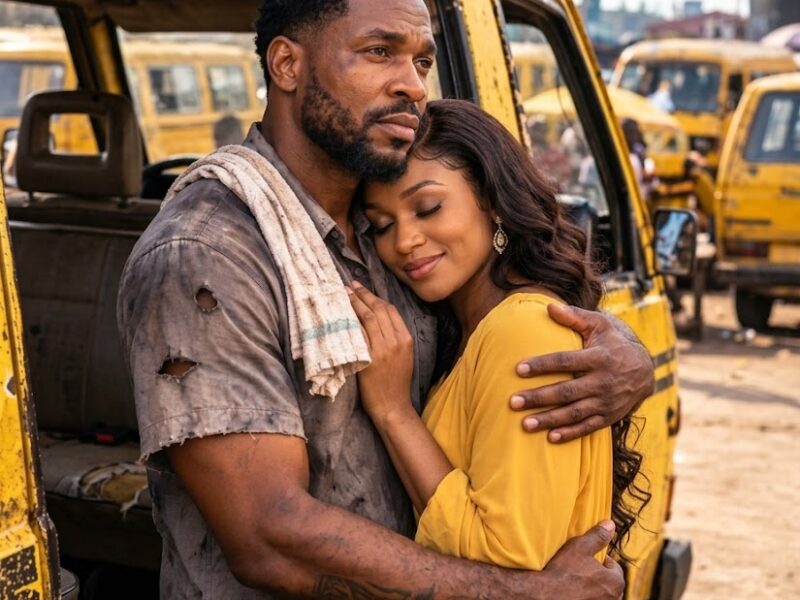
Everyone Mocked Her for Choosing a Danfo Driver Over a Wealthy Suitor—Then His Secret Changed Everything
The rain in Houston that night didn’t just fall. It pounded against the windshield of the yellow city bus like a thousand tiny fists, turning the streetlights into blurred, watercolor smears. I was on my way to a dinner I had no business attending, a corporate event for my company, where I was expected to smile and nod while my mother’s voice echoed in my head about “optics” and “the future of the business.” My car, a sensible sedan that suddenly felt like a symbol of my predictable life, had just died on a side street, leaving me stranded in a part of town where a woman in a silk dress and heels stuck out like a diamond in a coal mine.
I didn’t know it then, but a small situation at a parking lot, a threadbare suit, and a man named Kichi were about to unravel everything I thought I knew about love, loyalty, and the true value of a human being. People would mock me for the choice I was about to make, but they had no idea what was coming. None of us did.
“Ladies and gentlemen, pardon the interruption,” a voice boomed from the hotel’s sound system. “We have a small situation at the car park.” The voice, dripping with forced pleasantry, continued, “There is a yellow city bus outside that looks like it has survived every pothole in Houston. The vehicle is blocking a Lexus. So, if you’re the proud owner of that historic piece of public transportation, kindly step outside and repark it.”
A ripple of laughter went through the room. I felt my face burn. I knew that bus. I had just climbed out of it, my rescuer having driven me all the way here after my car gave up. “Who invited the 1998 oversized collection?” a man at the next table snickered, loud enough for everyone to hear. “Look at the shoulders on that thing. He can shelter three people inside that suit.”
The mocking continued, a chorus of privileged cruelty. “Wait, is this a corporate dinner or his uncle’s wedding in 2002?” another woman whispered, her diamond earrings sparkling under the chandelier. I couldn’t stay silent. “Stop,” I said, my voice trembling with a sudden, fierce anger. “You’ll make me choke.” I turned to face them, these people who were supposed to be my peers. “Who is this in an oversized suit? Leave him alone. Maybe they told him the bigger the suit, the richer you look.”
“That’s enough,” I said, my voice rising. The table fell silent. “You may not like his suit, but don’t disrespect him. That man has more character than most people I’ve met in expensive suits.” My colleague, a woman named Jessica, looked at me with wide eyes. “Amara, we were only joking.” I held her gaze. “Then find something else to joke about. He’s my guest.”
The memory of that moment is still sharp, the feeling of all those eyes on me, the weight of my defiance. It was a small rebellion, but it was mine. I didn’t know it was the first step on a path that would lead me away from everything I had ever known and toward a man who would change my life.
Earlier that evening, the mood was entirely different. I was in my office, staring at my phone, a knot of dread tightening in my stomach. A message from my boyfriend, Tunday, glowed on the screen. *We need to talk. Tonight.* It was eight in the morning. You don’t send a message like that unless you want someone to spend the whole day imagining the worst. I called my best friend, a whirlwind of energy named Chika, who always knew when something was wrong.
“Tell me I am imagining it,” I pleaded.
“Amara,” she said, her voice soft.
“No, don’t say my name like that. That’s the voice you use when you’re about to disappoint me politely.” I knew what was coming. Tunday and I had been the picture-perfect couple for years, a union of two powerful families and a promising business merger. But the picture had been cracking for a while. “Can we please talk tonight?” he had texted.
“Is this a breakup conversation?” I asked Chika, my voice barely a whisper.
“I didn’t say that,” she replied, but we both knew.
“He said some things deserve to be said face to face,” I told her.
“That’s convenient,” she scoffed. “He gets to keep the difficult things in his mouth until he’s sitting across from you. I don’t want to fight over the phone.”
“Neither do I,” I said. “I just want to know whether I should wear lipstick tonight or prepare for a funeral.”
We agreed to meet at 7:30. People change. Or maybe they just get tired of pretending. I spent the rest of the day in a fog, presenting a new marketing campaign to a room full of executives, my own words sounding hollow to my ears. I was talking about trust and loyalty, while my personal life was built on a foundation that was crumbling. My colleague, a sharp-eyed man named David, pulled me aside afterward. “You just made a room full of executives clap for an idea,” he said. “But you become completely blind when it is your own life. Are you talking about Tunday?”
“I’m talking about the man whose name makes you check your phone every ninety seconds,” he said. “He said we need to talk and you haven’t asked him what about.”
“I know what it is about,” I admitted.
“Then why are you pretending not to?”
“Because sometimes knowing something and being ready to hear it are two different things.” I looked at him, feeling utterly lost. “Do you trust him?”
“That’s a strange question.”
“No, it’s the only question that matters.”
“I trust the person I thought he was,” I said. “That’s not the same answer.”
That night, sitting across from Tunday in a quiet restaurant, the answer became painfully clear. “I don’t know how to start this,” he began, avoiding my eyes. “Start with the truth. It will save us both time.” He took a breath. “There is someone else. It started a few months ago.” The words hung in the air, heavy and suffocating. “And you were going to tell me when?” I asked, my voice dangerously calm. “I was trying to understand what I was feeling.” I almost laughed. “So, while you were understanding your feelings, I was dating a man who was already dating another woman.”
He claimed it wasn’t that simple. He said he made a mistake. “Did you wake up one morning and accidentally become unfaithful?” I snapped. He told me he didn’t plan to hurt me. “But you planned everything else.” He said he was confused. “Confusion doesn’t book hotel rooms, Tunday.” He said he was comfortable. “That’s worse.” I finally asked him what he wanted from me. “The truth,” I said. “I stopped feeling the same way,” he admitted. “When?” He didn’t know. “You’re giving me the version of the truth you think I can survive,” I said, my heart shattering into a thousand pieces. “I would rather be destroyed by the truth than comforted by a lie.”
He had come home to me afterward, he said, because he didn’t know how to tell me. “If you loved me, you would have been afraid to lose me,” I said. He didn’t want to throw away everything they had built. “You already did. You just wanted me to carry the rubbish.” He said he cared about me. “Maybe you did, but caring about somebody is not the same as choosing them.” I stood up, my hands shaking. “Why are you making this sound so final?” he asked. “Where are you?” “Outside.” “Do you want me to come?” “No. Don’t do that thing where you become strong.” “I’m not embarrassed.” “Then let yourself cry,” I said, my own tears finally spilling over. “I don’t want to cry over a man who couldn’t even be honest with me.” But I was crying, not because he deserved my tears, but because of the terrifying question that now haunted me: “What if I could be wrong about him? What else am I wrong about?”
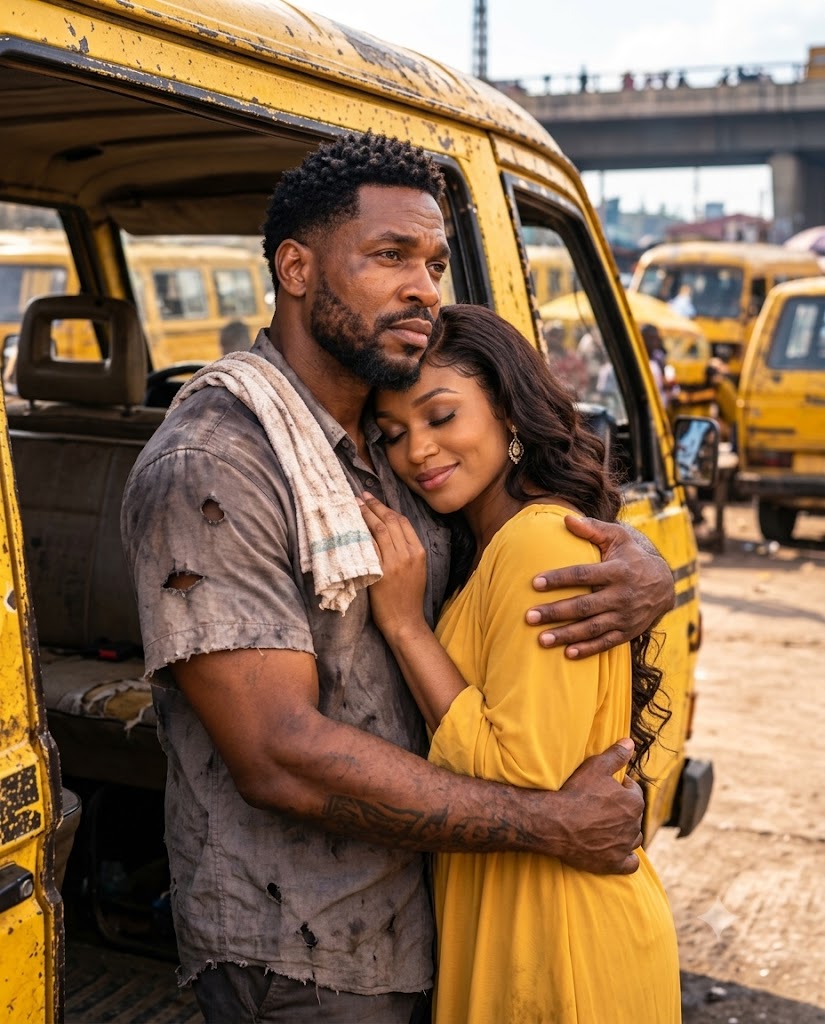
I walked out into the pouring rain, my silk dress clinging to my skin, my heels sinking into the wet pavement. I was miles from home, and my car was a useless hunk of metal a few blocks away. I found a small, covered bus stop and sank onto the bench, shivering. The world felt like it was ending. I didn’t notice the yellow bus pull up, its engine coughing and sputtering. The driver, a man I would later know as Kichi, leaned over and rolled down the window. “Madam, you need help?” he asked. His voice was deep, calm. I looked up, my face a mess of tears and rain. “No, thank you. I’m waiting for someone.” He didn’t look convinced. “At this time, on this road? I said I’m waiting for someone.” He nodded slowly. “Okay. Wait. But lock your doors.”
He was about to pull away when another bus driver shouted from across the street. “I beg, shift! This woman no dey alone. Enter your side and continue your journey.” Kichi looked back at me, his expression unreadable. “You see those two men?” he said, pointing to a shadowy corner. “Don’t open your door for anybody.” A cold dread washed over me. He saw the fear in my eyes. “There is a mechanic two streets away. I can take you there. In that bus?” I asked, incredulous. “Yes, madam. The bus has not killed anybody today.” “That’s supposed to make me feel better?” “It was my best attempt.”
I had no other choice. I climbed onto the bus, the smell of stale rain and worn vinyl filling my senses. The engine groaned as he started it again. “What is the issue?” he asked, nodding toward my car. “I think the water from the rain has touched the plug. You must be joking.” He shook his head. “I wish I was.” “So, what happens now?” “Now, madam, we wait.” I sighed, a heavy, defeated sound. “I hate this night.” He glanced at me. “You’re not the only one.”
We sat in silence for a while, the rain drumming a steady rhythm on the roof. “So, your mechanic is not coming,” I said, stating the obvious. “He said he was coming.” “That was forty minutes ago.” He chuckled. “Madam, Houston mechanics don’t operate with Swiss timing.” I couldn’t help but smile, a tiny, unexpected crack in my armor. “This is not funny.” “I know. I’m only trying to stop you from crying.” He was quiet for a moment. “But wait, are you fine?” “I’m fine,” I lied. “You people like saying ‘I’m fine’ when everything is clearly on fire.” “And you people like talking too much.” “Fair enough.”
The mechanic eventually arrived, a gruff man who confirmed my car was dead for the night. I was stranded. Kichi, who had stayed with me the entire time, offered a solution. “There is a small guest room behind my mother’s shop. You can stay there until morning.” I stared at him. “With people I don’t know?” He shrugged. “So, I have three options now. Sleep in a guest house where I don’t know anybody, sleep in the car, or go to your place. These are terrible options.” I thought for a moment. “A known devil is better than the unknown angel. Let’s go to your place.” A slow smile spread across his face. “So, I am the devil now.” “It is just a saying. Don’t take it personal. You have saved my life this night. And you have had the chance to hurt me, but you didn’t.”
That was the first time I saw him truly smile. He drove me to a modest neighborhood, far from the glittering high-rises of my world. His mother’s shop was a small, brightly lit eatery, closed for the night. He led me to a clean, simple guest room at the back. “You can leave the door locked from inside,” he said. “And where will you sleep?” “Outside.” “Outside?” He grinned. “Madam, I am a gentleman. I may be troublesome, but I am not a fool. I have my own room. Do you want to check?” “Check your room? No, please.” “I thought as much.”
I locked the door and leaned against it, my heart pounding. How did I feel so safe and comfortable around a stranger I just met today? For a minute, I even forgot about how Tunday broke my heart. It was like my worries stopped existing. I didn’t think he was my type. He was a bus driver with a worn-out suit and a beat-up bus. I was an executive heiress. But as I drifted off to sleep, the memory of his calm, steady voice was a strange and unexpected comfort.
The next morning, the sun was shining, and the world felt new. I walked out to find Kichi’s mother, a warm, bustling woman, setting a plate of food in front of me. “Good morning,” Kichi said, his smile bright. “How was your night?” “One of the best I have had so far. Thank you so much, Kichi. You are a perfect gentleman.” He raised an eyebrow. “That is interesting. And what made your night so good?” “I don’t know exactly. I just felt at peace.” He puffed out his chest playfully. “I don’t want to brag, but maybe I have something to do about that.” “Don’t feel yourself too much, Mr. Kichi.”
His mother, who I learned was named Mama Ngozi, insisted I join them for breakfast. His younger sister, a spirited girl named Chika, was there too, firing questions at me. “So, are you rich?” she asked, blunt as a hammer. “Chika!” Kichi scolded. “It’s okay,” I laughed. “Comfortable?” I offered. Her eyes went wide. “Wow. Comfortable means you are super rich.” Her mother chimed in, “I didn’t say that. You implied it. Plus, you smell so rich.” Kichi groaned. “Chica, leave her.” But his sister just grinned. “I like her.” “You haven’t known me for ten minutes.” “I don’t need ten minutes.”
After breakfast, Kichi drove me back to my car, which had been fixed. “So that’s it,” I said, a strange sense of disappointment washing over me. “Your car is fixed, and you’re happy to get rid of me.” “I didn’t say that.” “You didn’t have to.”
When I got home, my mother was waiting for me. She had heard about Tunday. “You cannot throw away a relationship because of one mistake,” she said, her voice firm. “It wasn’t one mistake, Mom. It was months of lying.” She sighed, a look of profound disappointment on her face that had nothing to do with Tunday and everything to do with me. “I understand, but sometimes, Amara, what is best for us is not always what feels best in the moment.” I knew what was coming next. “And what exactly is that supposed to mean?” “It means you should think beyond what happened between you and Tunday. The DuPonts are our number one business partners. The future of our companies depends on our relationship with them.”
There it was. The business. The family legacy. The pressure. “So now I’m responsible for protecting the company by marrying a man I no longer trust?” “I’m not asking you to decide today. I’m asking you not to close the door yet.” “And none of that gives Tunday the right to lie to me.” “No, it doesn’t. But if you walk away from him completely, there may be consequences for the business, too.” I felt like I was being sacrificed on an altar of corporate strategy. “That’s not a choice, Mom. It’s pressure.” “Sometimes pressure comes from people who are afraid of losing everything they’ve worked for.” “And I’m supposed to be the sacrifice?” Her eyes softened. “No, my daughter. I’m hoping you can find a way to protect your heart without destroying your future.” “What if protecting my future means walking away from Tunday?” I asked. “Then you will have to deal with your father.” The unspoken threat hung in the air. My father was a man who did not tolerate failure, and in his world, a broken engagement was a failure.
I felt more trapped than ever. My phone buzzed. It was Kichi. *Did you get home safely?* A small, simple question, but it meant the world to me. *Yes, I just got in.* *Good. I was wondering if everything went smoothly.* *Everything is fine now.* *I’m glad. You really didn’t have to call.* *I know. Then why did you?* *I just wanted to know you were okay.* *You worry about everyone like this?* *Not everyone.* *Oh. Don’t read too much into it.* *I wasn’t.* *Good.* *Thank you, Kichi.* *You’re welcome. It’s nice hearing from you.* *It’s nice hearing from you, too.*
His words stayed with me. This girl has actually gotten into my head, I thought. But if I make any move now, it would seem like it’s because of her money. I have heard about love at first sight, but I never believed it. Why am I acting like someone? This is not me.
A few days later, I found myself in a busy garage, feeling utterly out of place. I was looking for him. I had no reason to be there, no excuse. I just wanted to see his face. I approached a group of drivers. “Good afternoon, please. Do you know anyone bearing Kichi in this garage? He is tall, chocolate skin, with a beard.” One of the men grinned. “See this fine girl forming Cinderella for the garage. Oh boy, God dey create.” Another one was more helpful. “The one and only Kichi. I know him. Follow me.” But as I followed him, a different driver, a burly man with a suspicious glare, stepped in my path. “Where you dey take him? He dey look for one of my friends now. Where would they go be that? Which of your friends? You got the wrong person. Now disappear from this place immediately.”
Just then, Kichi appeared. “And what are you doing here?” he asked, his face a mixture of surprise and concern. “Why are you smiling, Amara? You could have been hurt.” “Relax. It is not a big deal. I was just in the neighborhood to see a friend. So I said, let me drop and say hi to you.” “A male friend,” he stated, his jaw tightening. “Yes, a male friend. Is there anything wrong with that?” “I never said there was.” But his countenance had changed. His cheeks had turned a darker shade of brown. “Your cheeks have turned orange like you are jealous,” I teased. “Jealous? Why would I be jealous? Anyways, you have to be careful around men. Men are scums.” “But you are not.” “Of course I am not. I am a gentleman.”
I took a breath. “Kichi, are you doing anything on Friday evening?” He looked at me, his eyes narrowing playfully. “Depends. Is this a normal question or one of those questions where you’ve already made plans for me?” “Can you just answer the question?” “I’m listening.” “There’s a dinner I’m attending. Nothing too serious, just some people from work, a few business partners, that kind of thing.” “Okay. And why are you telling me?” “Amara, wait. You want me to accompany you to a business dinner?” “You’re making it sound like I’m inviting you to negotiate an oil deal.” “Dinner with your colleagues and business partners. People who probably discuss mergers while eating dessert.” “Can you just answer the question, Kichi?” He sighed. “I’m a damn driver, Amara. Imagine you walking into that place with me. Wouldn’t that be awkward?” “Awkward for who? Maybe for you. If I thought I’d be embarrassed to be seen with you, would I be asking you to come?” He was quiet for a moment. “That’s a good answer. It’s also the truth. But you still haven’t answered my question. Why did you invite me?” “Because I want you to be there.” “Why me?” “You’re easy to talk to. You don’t pretend. And I think the evening would be less boring if you were there.” “So, I’m entertainment now.” “Don’t push your luck.” “I’m only trying to understand my job description.” “Your job description is very simple. Come with me. Sit beside me. Eat good food. And try not to interrogate me every five minutes.” “And if people start wondering what I’m doing beside you, let them wonder. You really want me to come?” “Must I beg you? A little begging wouldn’t hurt.” “In your dreams. Are you coming or not?” “Fine, I’ll come. But one condition. You don’t abandon me there and start speaking big corporate English.” “Deal. I’ll stay close.” “How close, Kichi?” “I’m only asking.” “Good night. Wait, what am I wearing?” “Something nice. And don’t try too hard. Just come as yourself.” “Is that enough to impress you?” “To impress you? Who said anything about impressing me?” “Your silence did. Good night, Kichi.”
The night of the dinner, I was a nervous wreck. I had chosen a simple but elegant black dress, and I waited by the entrance of the hotel, my heart hammering against my ribs. When Kichi walked in, my breath caught in my throat. He was wearing a suit. It was a little too big, the shoulders a bit wide, the sleeves a touch long. He looked like he had borrowed it from a larger, more successful uncle. He held a single rose, looking like somebody’s confused best man. I knew people would stare. And they did.
The whispers started the moment we walked into the banquet hall. “Who invited the 1998 oversized collection?” a man at the next table snickered. “Look at the shoulders. He can shelter three people inside that thing.” “Wait, is this a corporate dinner or his uncle’s wedding in 2002?” “Stop. You’ll make me choke.” I felt a surge of protective anger. “Leave him. Maybe they told him the bigger the suit, the richer you look.” “That’s enough,” I said, my voice cutting through the laughter. “You may not like his suit, but don’t disrespect him. That man has more character than most people I’ve met in expensive suits.” My colleagues looked at me, stunned. “Amara, we were only joking.” “Then find something else to joke about. He’s my guest.”
Kichi leaned in, his voice low. “I knew this was a bad idea. Everybody is looking at me.” “Let them look,” I said, my voice fierce. “Easy for you to say. You look like you belong here. Me? I look like I borrowed my uncle’s suit.” I softened. “Okay, the suit is a little ambitious. But I told you to come as yourself. Remember, I didn’t invite the suit. I invited you.” He looked at me, a new respect in his eyes. “You defended me back there.”
Just then, the announcement about the yellow bus came over the speakers, followed by a fresh wave of snickers. I saw Kichi’s face flush with embarrassment. “That would be me,” he said, starting to rise. “Okay, let’s go and repark.” I stood up with him. “Amara, you don’t have to come with me.” “I told you I wouldn’t leave you alone tonight, didn’t I?” “You actually meant that.” “Every word.”
We walked out into the parking lot together, the eyes of the entire room on our backs. He moved the bus, a lumbering, ugly beast among the sleek sports cars. When he came back, he looked at me, his expression serious. “You surprised me tonight,” he said. “How?” “The way you stood up for me. Those people are your colleagues, your business associates, people you see every day. But you didn’t hesitate.” “Why would I?” “Because I was standing there in a suit two sizes too big, holding a rose like somebody’s confused best man.” I laughed. “Okay, we’re definitely getting you another suit.” But he wasn’t laughing. “I’m serious, Amara. You could have pretended you didn’t know me. You could have let me go outside and move that bus alone. But you came with me.” “I told you I wasn’t going to abandon you.” “I know. I just didn’t expect you to mean it like that. And that’s why I don’t want to hide behind jokes tonight. I like you, Amara. And I don’t mean as a friend I enjoy talking to. I think about you when you’re not around. I look forward to hearing your voice. You’re successful. You’re surrounded by people who have things I don’t have. And I’m still trying to figure my own life out. But I’m not going to pretend I don’t feel something because I’m afraid I don’t belong in your world.”
My heart was pounding. “Kichi,” I began, but he kept going. “I’m falling for you.” I took a deep breath. “Do you know why I wasn’t embarrassed tonight? Because there’s nothing about you I’m ashamed of. And if we’re confessing things tonight, I feel it, too.” He looked at me, his eyes wide with disbelief. “You do?” “Somewhere between your endless questions, your terrible jokes, and making ordinary conversations last for hours, I started looking forward to you, too.” “So, what are you saying?” “I’m saying I don’t know exactly where this will lead, but I wouldn’t mind finding out.” “You mean us?” “Yes, Kichi. Us.”
The next few weeks were a whirlwind of secret dates and stolen moments. We were in a bubble, a perfect, happy bubble. But the real world was waiting to burst it. Tunday, humiliated and vengeful, started a campaign to undermine me. He cornered me at work one day. “I heard you brought a man to the dinner yesterday,” he said, his voice dripping with condescension. “And so?” “Nothing. People just had a lot to say. The oversized suit, the down-home bus he came in. Apparently, he became the entertainment of the evening. Is there a reason you’re telling me this?” “Amara, I’m not trying to insult him. I’m just surprised. You and I both know that’s not exactly the kind of man you usually go for.” “Don’t,” I said, my voice cold. “You don’t know what kind of man I want anymore. You lost the privilege of knowing that when you broke my heart.”
He tried to apologize, to explain, but I was done. “You’re wasting your time. He carried himself with dignity.” Tunday’s eyes narrowed. “You sound like you really like this guy.” “I do.”
Later that day, a young intern in my office, a guy named Mark, saw Kichi dropping off lunch for me. He pulled Kichi aside. “Are you here to see Amara? Let me give you some free advice. Don’t waste your time. Amara is probably the hottest woman in this company. Half the men here have tried their luck with her. And she used to date our managing director. Do you understand? That’s the level we’re talking about. So, whatever gift you brought, save your money. Flowers, perfume, whatever is inside there. It’s not going to impress a woman like Amara.” Kichi just smiled. “You think I came here to impress her?” “I’m just trying to save you from heartbreak.” “Thank you. But I think I’ll take my chances.” “Don’t say nobody warned you.”
That evening, Kichi showed up at my office with a container of food. “I was just driving past the neighborhood, so I decided to drop this off for your lunch.” I opened it and my eyes widened. “Wait, is this food from your mom’s restaurant?” He grinned. “Mama sent it. Jollof rice, chicken, and that sauce you liked the last time.” “She remembered.” “Of course. The moment I told her I was coming to see you, she packed everything. At least pretend you’re happy to see me first.” “I am very happy to see you, but I’ve tasted your mother’s food before, so you understand the competition.” He laughed. “Wow. Barely started dating and I’m already competing with my own mother.” “And you’re losing badly.”
We were laughing, happy, when Tunday walked in. He saw the food, the easy intimacy between us, and his face twisted with contempt. “Well, this is unexpected. I didn’t realize the floor had become a stop for drivers.” I stood up, my body tense. “Tunday.” “No offense. I’m just surprised. Yesterday it was a danfo at a corporate dinner and today it’s takeaway food in an executive office. You certainly know how to make yourself comfortable. Amara, you do realize people are watching, don’t you?” “And what exactly are they supposed to be watching? You, a senior executive, entertaining a driver.” Kichi started to get up. “Maybe I should leave.” “No, sit down,” I commanded. “If anyone here should leave, it’s the person who walked into my office without being invited.” Tunday’s face flushed with anger. “You’re really going to embarrass me in front of him?” “You’re doing a perfectly good job of that yourself.” “Because of him?” “No, Tunday. Because of you. And since you’re so interested in what people said about Kichi, here’s what they didn’t say. He carried himself with dignity.” Tunday stared at me, his eyes full of a cold fury I had never seen before. “You sound like you really like this guy.” “I do.”
The news of my relationship with Kichi spread like wildfire. My mother was horrified. My father was silent, which was somehow worse. The pressure from my family became unbearable. My father, a man who built his empire from nothing, sat me down in his study, a room that smelled of old books and expensive cigars. “Amara, you are my only child. Everything I have worked for, everything I have built, will eventually become yours. And Kichi is not that man. It is not because he is poor. It is more complicated than that. You and Kichi come from two completely different worlds. Sometimes two worlds are so far apart that forcing them together only creates problems.”
I had never begged my father for anything. But I got down on my knees. “Dad, all my life have I ever asked you for anything you couldn’t give me? You chose the schools I went to. You wanted me to study abroad, I went. You wanted me involved in the company, I came back. I have tried to be the daughter you could always be proud of. I am not asking you for money. I am not asking you for property. I am only asking you not to stand between me and the man I love.” He pulled me up. “Get up, Amara. I don’t want to see my daughter kneeling and crying because of a man. I have heard you. I cannot promise that I suddenly agree with you, because I don’t. But I will think about what you’ve said. That’s all I can promise you tonight.”
Meanwhile, a different kind of destiny was unfolding for Kichi. One rainy afternoon, he was driving his route when he saw an elderly woman struggling with heavy bags of groceries. Passengers on his bus were grumbling, telling him to hurry up. Some even got off, unwilling to wait. But Kichi didn’t hesitate. He pulled over, got out, and helped the old woman, Mama Ngozi, carry her bags and get her safely home. He lost a bus full of passengers, but he didn’t care. “Mama, passengers will come again. Money will come again. But if money makes me ignore someone, then the money is already controlling me.” The old woman was deeply moved. “My son, if only you knew what you just did today. What is your name, my son?” “Kichi, Mama.” “Kichi. I will remember that name.”
The next day, Kichi was summoned to the office of Chief Odubad, one of the most powerful businessmen in the city. He was terrified. The chief’s assistant led him into a sprawling office. The chief, a man with a commanding presence, stood up and shook his hand. “My mother told me what happened yesterday. She came home and told us about the driver who stopped to help her. She said you gave up your passengers just to make sure she got home safely. You didn’t have to do that.” Kichi was confused. “Sir, I didn’t do anything special. Mama needed help. I only did what I thought was right.”
The chief smiled. “Let me tell you a story. Yesterday morning, I received information that some people were watching my movements. They believed I was moving a large amount of money for one of my projects. One hundred million naira, Kichi. One hundred million. So I changed the plan. I sent the usual convoy ahead as a distraction. There was nothing inside. Then my mother said, ‘Everyone will notice your big cars, but who will notice an old woman carrying ordinary bags?’ The money was with my mother. It was inside one of the bags you carried yesterday.” Kichi’s jaw dropped. “Sir, the bag I carried yesterday…” “Yes, Kichi. Your passengers were complaining. Some even left your bus. But you still stayed and helped her. But that’s not why I’m impressed. You didn’t know who she was. You weren’t expecting anything from her. You simply chose to help. Mother asked me to do something for you.” “I don’t need anything, sir. That’s enough for me.”
The chief leaned forward. “Tell me something, Kichi. A man like you, why don’t you have a proper job?” Kichi pulled out a worn certificate. “Most places won’t even give me a chance without the qualification they’re looking for. So, I drive the bus.” The chief nodded. “I run a transportation business that’s struggling. Idle buses, bad routes, rising costs, and falling revenue. My executives understand transportation on spreadsheets. My mother says you understand the people inside the buses. I have an offer for you. Come work for me. Study the routes. Ride with the drivers. Talk to passengers. Find what we’re missing and tell me what should change. Let’s find out what you can do.” “I won’t disappoint you, sir.” “Don’t promise me that. Show me.”
That night, Kichi called me, his voice shaking with excitement. “Amara, you won’t believe this. I just got a job.” “What? Kichi, how?” “Chief Odubad offered it to me himself.” “The same Chief Odubad? How do you know Chief Odubad?” “Yesterday, I helped an elderly woman get home. I didn’t know she was his mother.” I was speechless. “Kichi, this is huge. Congratulations. I’m so happy for you.”
His first day at the company was a trial by fire. He stood before a room of skeptical executives, men with years of experience and impressive degrees. “Good morning,” he began, his voice steady. “I know I don’t have the academic qualifications many of you have. I won’t pretend that I do. But I have spent years where this business actually happens. On the road, at the terminals, and with the passengers. I know what the numbers don’t always show. Our problem isn’t simply the number of buses we own. It’s how we use them. We’ve been managing buses. I believe we should start managing movement. My plan is simple. Redesign our routes, deploy vehicles according to demand, and measure passenger movement every day. Give me six months. Don’t judge my certificate, judge my results.”
One of the senior executives, a man named Adi, scoffed. “Twenty years in this industry, a PhD in transport management, and this young man thinks street experience has taught him what we don’t know.” The chief silenced him. “He made some solid points. But don’t worry, this business has a way of humbling even the best ideas.” But Kichi was not humbled. He was empowered. He implemented his plan with a relentless drive. He was up before dawn, riding the buses, talking to drivers, observing passenger patterns. He discovered that they were sending equal buses to unequal demand. One would leave half empty while another left passengers behind. He learned that demand wasn’t fixed; it changed with markets, offices, traffic, and closing hours. He saw that every trip needed to reconcile its revenue, that every bus needed to be maintained proactively, and that the key to profit was not just carrying passengers, but collecting every fare. He found where they were losing money and moved idle buses to cover the new demand.
Six months later, he stood before the board again. The numbers were undeniable. Passenger volume was up. Daily revenue had multiplied. The new routes were beating every projection. Kichi had not just met his targets; he had exceeded them. The chief stood up, a proud smile on his face. “Six months ago, I gave a young man an opportunity. Some people called it a risk. Tonight, I can confidently say the greatest risk would have been never giving him that opportunity. Kichi didn’t just meet our targets, he exceeded them. The board has therefore approved Kichi’s appointment as the new managing director of Ekanm Global Logistics. And I’m giving you one hundred brand new buses to begin the next chapter under your leadership. And because a man who spends his life moving people deserves something good to move himself, this is yours.” He tossed Kichi a set of keys. “A fully furnished mansion in the heart of the city. Welcome home.”
The applause was thunderous. I was in the audience, my heart bursting with pride. Then, Kichi took the microphone. “Six months ago, I walked into this company wondering whether a man like me even belonged in the room. When I was afraid I wasn’t good enough, one person kept reminding me that what life had taught me was worth something. She believed in me before any of these things existed. Amara, please come up here.” My legs were shaking as I walked to the stage. “Chief Odubad has changed my life tonight. But there’s one thing I want to change myself.” He took my hand, his eyes shining. “Amara, you believed in me when all I had was a dream. I don’t want to build this new life without you. Amara, will you marry me?” Tears streamed down my face. “Yes, Kichi, I will marry you.”
A few days later, Kichi came to my parents’ house to ask for their blessing. My mother was hesitant, still clinging to the idea of Tunday and the business merger. But Kichi, dressed in a new, perfectly tailored suit, looked my father in the eye. “My mother and I have come to respectfully ask for another. My son has spoken of Amara with great love. I have not come to take your daughter away.” My father, a man who valued strength and character above all else, was silent for a long time. “Love sounds beautiful when life is easy,” he said finally. “I cannot promise that Amara will never experience difficult days, sir, but I promise she will never face any of them alone.” My father nodded slowly. “When Amara first introduced you to us, we allowed appearances to speak before your character had the opportunity. A father sometimes closes his gate too quickly. In my caution, I nearly left the right man standing outside. Kichi, you have shown us that a man’s true value is found in his character. You have our blessing to marry our daughter.”
We were married a month later. The wedding was a blend of two worlds, but it was perfect. At the reception, I was surrounded by my family and friends, who had all come to see the woman who chose a bus driver over a rich man. They saw the new car, the mansion, the hundred buses, and they called it a fairy tale. They called it a lucky break.
But they missed the real story. The real story wasn’t about the money or the mansion. It was about a man who, when he had almost nothing, still chose to be kind. It was about a man who was mocked for his oversized suit but carried himself with dignity. It was about the bags his mother carried, which held a secret destiny he couldn’t see. The real story was about the day I was stranded in the rain, and a yellow bus, the same one that had been mocked, pulled up and offered me a ride. Meeting the chief changed Kichi’s life. But meeting his mother, and helping her without knowing who she was, changed ours. The real story was that a small act of kindness, a detour on a rainy afternoon, was the most valuable investment he ever made.









