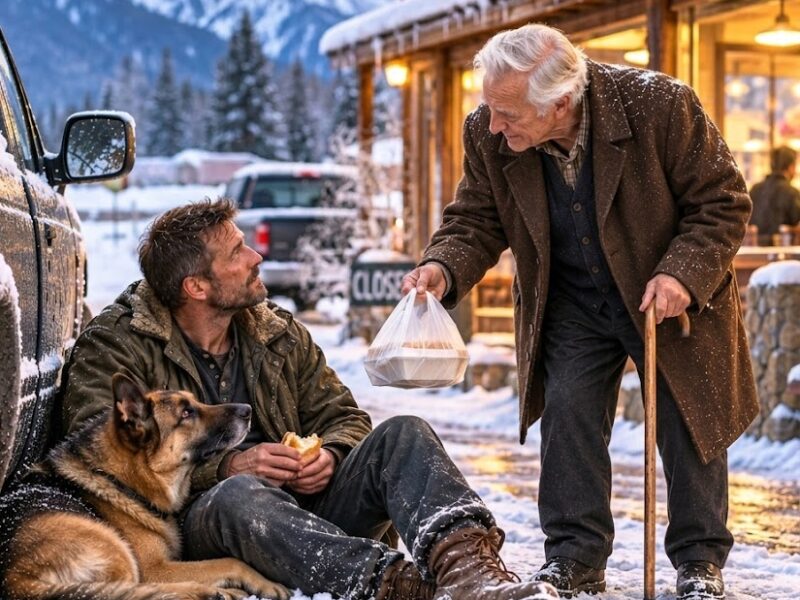
Everyone ignored the Marine and his starving K9—until an old man made him an unexpected offer.
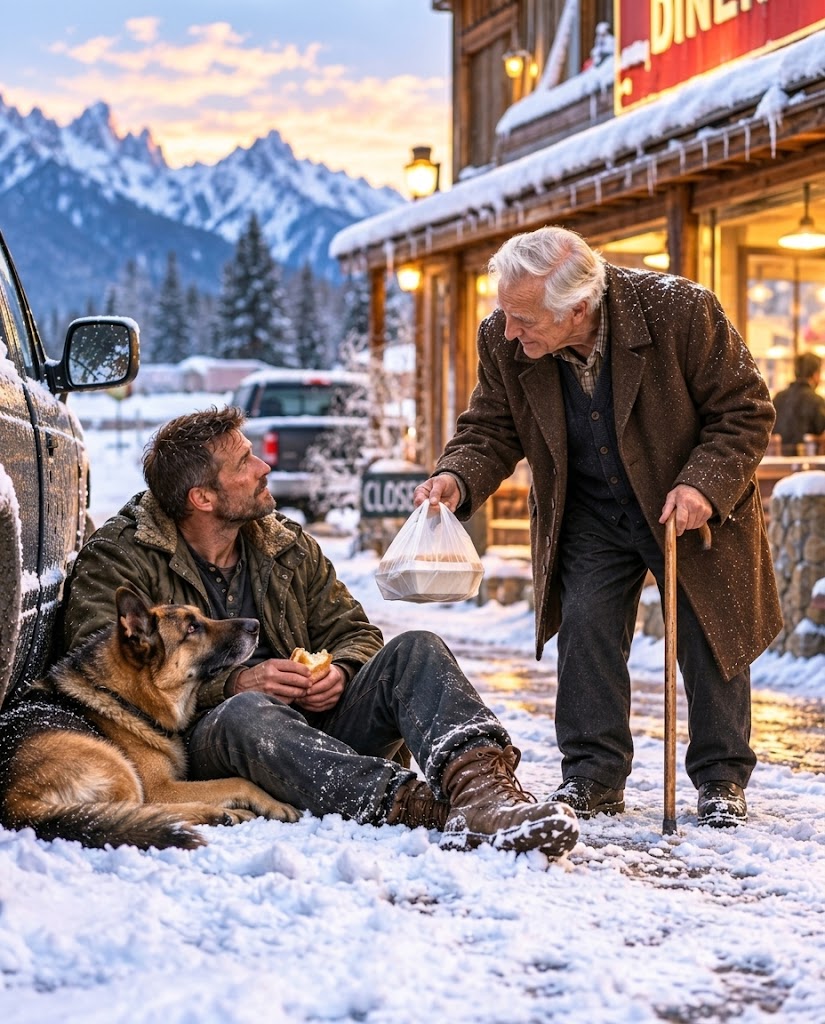
The cold had teeth in Lander, Wyoming, the kind that bit through denim and settled deep in the bone.
Late November had draped the town in fresh snow, and the mountains beyond had vanished beneath a low gray ceiling that pressed down like a held breath.
Everett Shaw sat against the brick wall of a roadside diner, both hands wrapped around a paper cup of coffee that had long since surrendered its warmth to the Wyoming air.
At thirty-nine, the former Marine still carried the frame of the staff sergeant he had once been.
Six foot one, broad-shouldered despite the weight he had lost, with an angular face and a strong jaw darkened by several days of stubble.
His short brown hair was touched with gray at the temples, and his steel-gray eyes rarely stopped moving.
Two combat deployments had trained those eyes to measure doors, windows, hands, distances.
Civilian life had never taught them how to stop.
Even now, Everett had chosen a spot with brick behind him, the diner entrance to his left, and the highway visible beyond the parking lot.
Months earlier, he had stopped pretending the pickup was temporary.
A duffel of clothes sat behind the passenger seat, a sleeping bag filled the back, and an old toolbox rested beneath it.
Everything Everett still owned could leave a town in five minutes.
After leaving military service, he had tried to build an ordinary life.
But sleepless nights became bad mornings, bad mornings became missed shifts, and apologies slowly replaced conversations at home.
Sudden noises still tightened his muscles before his mind understood what he had heard.
Eventually, his marriage ended, his work disappeared, and Everett discovered that leaving first hurt less than waiting for someone else to decide he was too difficult to keep around.
Everyone except Bishop.
The six-year-old German Shepherd lay against Everett’s boot, his black saddle contrasting with a rich tan coat now dulled by road dust and melting snow.
Bishop’s amber eyes remained alert despite the ribs beginning to show beneath his winter fur, and a small notch along his right ear gave him a permanently weathered appearance.
Once a military working dog, Bishop had served alongside Everett during the final years of his service.
When accumulated wear ended Bishop’s working career, Everett completed the process to adopt him.
Since then, Bishop had become the one living thing Everett had never walked away from.
Everett unwrapped their last sandwich.
Bishop lifted his head.
“Don’t start.”
The dog’s ears moved forward.
Everett tore off a small piece for himself, hesitated, then placed nearly everything else between Bishop’s paws.
“Eat.”
Bishop looked at the food, then back at him.
Everett nodded.
Only then did Bishop lower his head.
Everett watched for a moment before turning away.
Even hungry, Bishop still waited for permission, still trusted him to make the right decision.
Everett wasn’t sure what hurt more—that trust or knowing how little he currently deserved it.
People crossed the parking lot around them.
A couple slowed before entering the diner.
A trucker glanced through the window.
Another man came outside, saw Everett and Bishop, then quickly found something interesting across the road.
Nobody stopped.
Everett told himself he preferred it.
Being invisible required nothing from him.
The pickup heater had failed that morning.
He suspected the blower system, perhaps damaged wiring, but tonight’s temperature would fall well below freezing before he could do much about it.
A faint tremor passed through his fingers.
Not cold—never just cold.
Bishop finished eating and leaned against his leg.
Then the diner door opened.
An old man stepped outside carrying two covered containers.
Harold Voss was eighty-six, short and lean, his shoulders curved slightly by age.
Thinning white hair was combed neatly back from a deeply lined narrow face, while pale blue eyes remained surprisingly clear.
A wooden cane supported his right side, though the deliberate way he moved suggested a man who disliked depending on it.
Since losing his wife, Evelyn, Harold had lived alone outside Lander, preserving familiar routines because they made the silence of an empty house easier to bear.
Everett watched him approach.
Harold noticed.
“You always watch people that closely?” he asked.
“Usually useful habit.”
“Used to be.”
Harold pulled out the empty chair opposite Everett and sat down.
Everett waited for the questions.
Where are you from?
What happened?
Why don’t you find work?
None came.
Harold placed one container before Everett—hot beef stew.
The other held plain cooked meat for Bishop.
“I didn’t ask for anything,” Everett said.
“I noticed.”
“I can’t pay you.”
“Didn’t ask.”
Everett’s jaw tightened.
“I don’t take charity.”
Harold ignored the challenge.
His attention shifted to Bishop, who had moved closer to Everett without making a sound.
“That dog still looks at you like you’re his whole world.”
Harold met Everett’s eyes.
“So you haven’t lost everything yet.”
The words slipped past defenses Everett had spent years building.
He looked down.
Bishop was watching him.
Of course he was.
Everett pushed the second container toward him.
“Go ahead.”
Only after Bishop began eating did Everett lift the spoon.
The stew was almost painfully hot, and the warmth reaching his stomach made him realize how cold he had become.
Harold deliberately looked toward the highway instead of watching him eat.
That small courtesy mattered.
Later, Harold noticed Everett testing the dead heater through the open driver’s door.
“That’s where you’re sleeping?” Harold asked.
“That’s where I’m staying.”
Harold glanced at the thickening snow.
“I’ve got an old workshop behind my house. Stove still works.”
“No.”
“Didn’t finish.”
“Still no.”
Harold leaned on his cane.
“One night. You and the dog stay warm. Tomorrow you disappear. If that’s what you’re determined to do.”
“I told you I don’t take charity.”
“And I’ve got enough broken machinery in that workshop to keep your pride employed.”
Everett almost smiled.
Then Bishop stood.
A faint tremor passed through the dog’s hindquarters before he steadied himself.
Everett saw it.
So did Harold.
Neither mentioned it.
One night could become questions.
Questions could become familiarity.
Familiarity could become expectations.
Everett knew where that road ended, but Bishop leaned lightly against his leg.
Everett looked at him for several seconds.
“One night.”
Harold nodded.
“One.”
—
Hours later, Bishop slept beside an iron stove inside Harold’s weathered workshop, belly full and breathing deeply.
Everett lay awake on an old canvas cot, surrounded by dusty tools, machine parts, and shelves untouched for years.
Wind pushed snow against the windows, but for the first time in weeks, Bishop wasn’t shivering.
Everett placed his pickup keys beside his hand—his escape route.
One night, he reminded himself.
The workshop smelled of old pine, machine oil, iron, and the faint smoke of a stove that had not been used regularly in years.
To Everett, it should have felt temporary.
Everything in his life had become temporary.
A parking lot, a truck stop, a roadside pullout, a place to sleep until sunrise.
Yet the room held traces of permanence everywhere he looked.
Pencil marks on a workbench, coffee rings on a shelf, a row of hand tools worn smooth by decades of use.
Bishop dreamed beside the stove.
One paw twitched.
His breathing stayed deep and even.
Everett watched the rise and fall of the dog’s ribs and felt a familiar nod of guilt.
He had promised Bishop food, warmth, and a safe place after service.
Somewhere along the road, survival had become the best he could offer.
Bishop had never complained.
That made it worse.
Near midnight, footsteps crossed the snow outside.
Everett’s hand went instinctively toward the keys.
The workshop door did not open.
Harold only left a folded wool blanket on the covered porch, knocked once against the frame with his cane, and walked back toward the house.
No questions, no speech, no attempt to turn kindness into a debt.
Everett waited several minutes before retrieving the blanket.
It smelled faintly of cedar.
He draped half over himself and folded the rest near Bishop in case the stove cooled before morning.
For the first time in months, Everett fell asleep without listening for the sound of another vehicle entering a parking lot.
Even then, his hand remained close to the keys.
—
At dawn, pale light entered through the workshop window.
Bishop raised his head.
Everett opened his eyes and instinctively reached toward the keys.
His hand stopped.
Outside waited his pickup, the highway, and every reason he had used for months to keep moving.
Yet the keys were still exactly where he had left them.
Morning came clear and bitter after the storm, sunlight turning the snow outside Harold’s workshop almost painfully white.
Everett dressed before the old house showed signs of waking, rolled his sleeping bag tight, and returned the canvas cot to the wall.
Bishop stretched beside the stove, stronger after food and warmth, then watched Everett carry his duffel toward the pickup.
Everett had already decided what came next.
Thank Harold.
Check the truck.
Leave Lander.
Staying one night because Bishop needed warmth was necessity.
Staying another required an explanation Everett didn’t want to give.
He had almost reached the workshop door when a rough metallic coughing came from the far corner.
Everett stopped.
An old gasoline generator sat beneath a dusty cover, vibrating unevenly as its engine stumbled through an irregular cycle.
He listened for several seconds before setting down the duffel.
Harold appeared in the doorway soon afterward, coat buttoned over his clothes.
“Been doing that for months,” Harold said.
“Then why are you running it?”
“Because sometimes old things still have work to do.”
Everett glanced at him.
“You talking about the generator?”
Harold’s expression remained innocent.
“What else would I be talking about?”
Everett crouched beside the machine.
He removed the cover, checked the fuel line and connections, then reached for several tools hanging above the bench.
His movements became precise almost immediately.
Harold noticed something Everett did not.
The faint instability that sometimes lived in Everett’s fingers was gone.
With a wrench in his hand and a mechanical problem in front of him, there was no uncertainty—only sequence.
Inspect.
Isolate.
Correct.
“You a mechanic?” Harold asked.
“No.”
“Could have fooled me.”
Everett found a worn connection in a badly seated component.
“Worked on cars before I enlisted. Later, I spent some time helping maintain vehicles and equipment when people were short-handed.”
Twenty minutes later, the generator settled into a clean, even rhythm.
Harold listened.
“Dean needs help.”
Everett wiped his hands.
“Who’s Dean?”
—
That question took him across Lander less than an hour later.
Hollowell Auto and Repair occupied a low cinder block building near the edge of town.
Inside, the air smelled of oil, rubber, and hot metal.
Dean Hollowell, fifty-seven, emerged from beneath the raised hood of a Ford pickup.
He was a thick-built man around five foot ten with powerful forearms, a square weathered face, close-cropped salt-and-pepper hair, and a dense gray beard trimmed short along his jaw.
A pale scar crossed one knuckle, and his dark brown eyes carried the skeptical patience of someone who had spent three decades learning that both machines and people usually revealed their problems eventually.
Dean was blunt rather than cruel, generous only after trust had been earned, and years of customers promising to pay next week had made him suspicious of stories.
He looked Everett over once.
“Harold says you can work.”
“I can.”
“He says you’re a Marine.”
Everett’s expression changed slightly.
“Wasn’t aware that was part of the interview.”
Dean’s mouth twitched.
“It isn’t.”
Good, Everett thought.
Dean pointed toward a Subaru on the second lift.
“Customer says there’s a vibration above fifty. Find it.”
Everett removed his coat.
The test wasn’t complicated.
Dean wasn’t asking for brilliance.
He was asking whether Everett knew the difference between confidence and guessing.
Everett checked the obvious causes first instead of trying to impress him, eventually identifying uneven tire wear and play that warranted closer inspection.
Dean watched without interrupting.
“You always this quiet when there’s nothing useful to say?”
This time Dean actually smiled.
By noon, Everett had rotated tires, changed oil, cleaned a workbench, and helped trace an electrical fault in an aging pickup.
Nobody asked about deployments.
Nobody asked why he slept in a truck.
Machines arrived broken and left better than they came in.
That simplicity felt almost merciful.
A bad alternator did not resent you.
A stripped bolt did not remember something cruel you had said three years earlier.
A broken wire did not ask why you hadn’t been able to become the person you promised you would be.
Machines had causes.
Everett understood causes.
People were harder.
At closing time, Dean tossed a rag onto the bench.
“I can use you tomorrow.”
Everett hesitated.
“I might not be here long.”
“I didn’t ask for forever.”
Dean nodded toward the workbench.
“Show up at seven. Work. Get paid. Don’t show up—I’ll know your answer.”
—
Everett arrived at 6:47 the next morning.
One day became four.
Four became ten.
The first wages Dean paid him were not much—$320 in folded bills that Everett stood outside a grocery store holding longer than necessary.
Money earned by work felt different from money counted down in a wallet.
It meant tomorrow had not already been spent.
He bought Bishop a large bag of proper dog food, meat, rice, and a new rubber bowl because the old metal one in the truck had a split along the rim.
He also bought coffee for Harold, then nearly put it back.
Buying something for the old man felt suspiciously like admitting there would be another evening at the workshop.
He left the coffee in the cart anyway.
Dean never asked Everett to explain himself.
He only kept finding work that required patience.
A corroded ground wire, a seized brake caliper, an engine noise that disappeared whenever the hood was open.
Everett discovered that concentration quieted parts of his mind nothing else seemed able to reach.
In the garage, problems had edges.
A thing was loose, worn, dirty, misaligned, overheated, or broken.
You found the cause, corrected what you could, and admitted what you could not.
At the end of the tenth day, Dean watched Everett clean the tools he had borrowed and return each one to its place.
“You know you’re allowed to leave those for morning.”
“I know.”
Dean looked at the spotless bench.
“You always this cheerful?”
Everett glanced at him.
“This is cheerful.”
Dean grunted.
“Terrifying.”
It was the first time Everett laughed at work.
The sound surprised him enough that he stopped halfway through it.
Dean pretended not to notice.
—
By the third week, a routine had formed without Everett ever agreeing to one.
He worked at the garage during daylight, bought groceries and dog food with his own wages, filled the pickup’s tank himself, then returned each evening to Harold’s workshop.
Bishop began putting weight back on slowly.
Everett repaired his pickup heater, but somehow the completed repair did not lead to departure.
Instead, he found other broken things.
A loose porch step at Harold’s house became solid one evening.
A window that leaked cold air was sealed the next.
Everett repaired a sticking workshop latch without mentioning it.
Harold noticed everything and thanked him for almost nothing.
That helped.
One evening, Everett entered Harold’s kitchen to return a screwdriver and noticed an old framed photograph on a shelf.
Harold stood in it, decades younger, wearing a military uniform beside a smiling, dark-haired woman.
Everett looked toward him.
“You served. Long time ago.”
“You never asked.”
Everett studied the photograph.
“Your wife. Evelyn.”
Harold sat at the table, his eyes resting on the picture rather than Everett.
“When I came home, I spent a while thinking silence made me strong. Evelyn knew better.”
Everett said nothing.
“I tried pushing her away once. Thought she deserved somebody easier.”
“What did she do?”
“Got angry.”
A faint smile touched Harold’s face.
“Then she stayed.”
Everett’s gaze returned to the photograph.
Harold continued quietly.
“Took me years to understand I wasn’t protecting her. I was protecting myself from being seen when I wasn’t the man I thought I should be.”
The room seemed smaller.
Everett set the screwdriver down.
“I should check on Bishop.”
Harold didn’t stop him.
Outside, the cold sharpened everything.
Everett stood beneath the workshop light while Bishop drank from the fresh water Harold had left.
Harold’s words followed him through the door.
For years, Everett had told himself a simpler version of what had happened after service.
He had been difficult.
The marriage had failed.
Work had failed.
Therefore, leaving spared everyone the trouble of asking him to go.
It was a clean explanation, and clean explanations were easier to carry.
Harold had just made it messier.
Maybe silence could look like strength from the inside while feeling like rejection to everyone standing outside it.
Maybe disappearing before someone could be disappointed was not mercy.
Maybe it was only another way of choosing the ending before anyone else had a voice in it.
Everett crouched and ran a hand along Bishop’s shoulder.
The dog leaned into him without hesitation.
“You make this look easy,” Everett murmured.
Bishop’s ear turned toward his voice.
The dog had known fear, noise, exhaustion, and separation.
Yet Bishop still accepted a warm floor when one appeared.
He still ate when food was offered.
He still allowed a safe person to become familiar one day at a time.
Bishop did not confuse vigilance with loneliness.
Everett wondered when he had started doing exactly that.
From the house, Harold turned off the kitchen light.
Everett remained outside another minute, listening to the quiet.
He did not suddenly forgive himself.
He did not decide to stay forever.
He only went back into the workshop instead of reaching for the truck keys.
For Everett, that was enough movement for one night.
—
By the end of the third week, Everett’s pickup was repaired, his fuel tank was full, and $1,600 sat folded inside his wallet—enough to carry him well beyond Wyoming.
Nothing mechanical kept him in Lander anymore.
Dean expected him at seven the next morning.
Harold had a porch rail Everett had noticed was beginning to loosen.
Bishop now walked toward the workshop each evening without waiting for direction.
Everett stood beside the pickup after dark, keys in his palm, staring toward the highway.
He could leave tonight.
That had always been the plan.
Instead, he slipped the keys into his pocket and turned toward the warm square of light coming from Harold’s workshop.
Tomorrow, he told himself.
He would leave tomorrow.
—
By mid-December, winter had tightened around Lander until the mountains disappeared behind driving snow and afternoon light could turn to darkness in minutes.
Everett had learned enough about Wyoming weather to respect how quickly an ordinary road could become dangerous.
The storm worsened shortly after three.
Wind hammered the garage doors while snow swept sideways across the windows, erasing buildings on the opposite side of the road.
Dean had already decided to close early when the front door opened and a woman stumbled inside carrying a blast of snow with her.
Rachel Mercer, forty-four, was a slender local woman with wind-reddened fair skin, shoulder-length chestnut hair escaping beneath a knitted cap, and anxious hazel eyes that kept darting toward the road.
Normally composed and practical from years of helping run her family’s small feed store, she now struggled to keep her hand steady as she gripped her phone.
“My father’s missing.”
Dean stepped around the counter.
“Who?”
“Caleb. He drove north before the weather turned. He was supposed to be home two hours ago.”
Rachel explained that Caleb Mercer, seventy-two, a lifelong Wyoming resident known for stubborn independence and an unwillingness to admit when age had begun slowing him, had taken his pickup along an isolated county road to check equipment stored on a friend’s property.
His last phone call had dropped when the signal disappeared.
Search and rescue had been contacted, but multiple crashes and stranded motorists had stretched available crews across the county.
Everett had remained near the workbench until Rachel mentioned the road.
“Where exactly?”
She showed him the last location on her phone.
Everett recognized it immediately.
Harold had driven him through that area the previous week while showing him a shorter route around town.
The road narrowed beyond a treeline before bending along exposed ground where drifting snow could hide the shoulder completely.
Everett looked through the garage window.
Every instinct told him the weather was getting worse.
Another instinct told him exactly how dangerous that road could become.
He didn’t grab his coat and play hero.
Instead, he asked Rachel for Caleb’s vehicle description, direction of travel, approximate departure time, and anything he might have been carrying.
Dean contacted the sheriff’s office again while Everett retrieved Bishop from the heated back room where the dog often rested during his shifts.
Forty minutes later, a county search and rescue vehicle pulled into the garage lot.
Deputy Mara Ellison, forty-one, stepped out wearing a snow-covered winter duty jacket.
She stood about five foot seven with an athletic build, olive-toned skin, dark brown hair braided tightly beneath a wool cap, and a narrow, serious face dominated by observant brown eyes.
Twelve years working rural patrol and volunteer search and rescue had given Mara a calm that was neither cold nor careless.
She listened before speaking and distrusted improvisation in bad weather because she had seen rescuers become victims when confidence outran preparation.
Everett gave her the information he had.
Mara glanced at Bishop.
“Harold says he was a working dog. Military tracking experience, environmental work.”
“He’s not civilian SAR certified.”
“Good answer.”
Everett understood what she meant.
Pretending Bishop was qualified for work he had never formally trained for would have ended the conversation.
Mara studied the map.
“We have a team approaching from the east, but they’re tied up with another vehicle. You know this section.”
“I’ve been through it once.”
She considered him.
“Then Bishop stays under my direction. If I say we’re done, we’re done.”
Everett nodded.
“Understood.”
Before leaving the paved road, Mara stopped the vehicle and made Everett repeat the rules.
They would not separate without radio contact.
They would not enter terrain she considered unstable.
If Bishop showed fatigue, they would pull him.
If visibility dropped below what the team could safely manage, the search would change or stop.
Everett accepted every condition without argument.
He knelt beside Bishop and checked the dog’s harness, paws, and breathing.
The old working posture had returned to Bishop, but Everett could also see the years in him now.
Six was not ancient for a German Shepherd, yet accumulated strain had ended his military career for a reason.
Everett would not ask loyalty to become recklessness.
“Easy work,” he told him quietly.
“We do it clean.”
Bishop held his gaze.
Mara noticed the exchange but said nothing.
She only handed Everett a radio and had him confirm the channel again.
—
The search began methodically.
They checked the most likely route first, stopping at bends where a driver might have slid from the road.
Everett used the map, visible fence lines, and wind direction to keep himself oriented.
Bishop was allowed to investigate protected pockets where scent might survive the blowing snow, but Mara kept the overall search pattern deliberate.
That discipline mattered to Everett.
It kept the night from becoming a test of courage.
Nobody needed courage without judgment.
The goal was not to prove he could endure the storm.
The goal was to bring a missing man home without creating another person who needed rescue.
As the daylight disappeared completely, Everett realized something else.
Mara was not treating him like a broken veteran or a hero.
She was treating him like a useful member of a team who still had limits.
He could work with that.
They loaded radios, GPS equipment, flashlights, first aid supplies, thermal blankets, and additional cold-weather gear.
Bishop wore a working harness, but Everett made no attempt to present him as something he wasn’t.
They entered the search area as daylight collapsed.
Visibility narrowed until the world existed only within the reach of their lights.
Mara maintained radio contact while Everett watched terrain markers he remembered from the earlier drive.
Bishop moved close, conserving energy, occasionally lowering his muzzle toward areas protected from the wind.
They had been searching less than an hour when a tree limb cracked somewhere beyond the road.
The sound was enormous.
A rescue light swung through the snow at the same instant.
For Everett, Wyoming vanished.
Heat, dust, a violent flash.
Someone shouting where no one should have been shouting.
His chest locked.
The flashlight in his hand stopped moving.
Snow became smoke at the edges of his vision, and for several seconds his body responded to a place thousands of miles and years away.
“Everett.”
Mara’s voice sounded distant.
He couldn’t answer.
Then something struck his leg.
Not hard—certain.
Bishop pressed his shoulder against Everett’s thigh and stayed there.
Everett’s hand found the dog’s neck automatically.
Warm fur, muscle, breathing.
Bishop.
He forced air into his lungs.
Snow touched his face.
Cold.
Wyoming.
Bishop.
Everett whispered.
The dog’s amber eyes remained fixed on him.
Mara’s voice returned clearly.
“You with me?”
Everett swallowed.
“Yeah.”
She watched him carefully.
“We can turn back.”
He looked at Bishop, then at the road.
“No. I’m good.”
Mara did not accept the answer immediately.
Only after Everett correctly repeated their position and radio channel did she nod.
They continued.
Twenty minutes later, Bishop stopped.
His posture changed.
Everett recognized it instantly.
“He’s got something.”
Bishop angled toward the downhill side of the road where wind had nearly erased a set of impressions in the snow.
They followed carefully and found the rear corner of a pickup protruding from a drift below the road.
The cab was empty.
Mara opened the driver’s door.
“He left the vehicle.”
Everett’s stomach tightened.
Bishop circled near the truck, then pulled toward a line of scrub and scattered pines.
This time, Mara nodded.
“Let him work.”
They followed.
Several hundred yards away, Bishop suddenly accelerated toward a dark shape beside a fallen tree.
Caleb Mercer was curled against the trunk, conscious but confused, his heavy winter coat crusted with snow.
He had apparently tried to reach an old utility structure he remembered nearby before becoming disoriented.
Mara dropped beside him.
“Caleb, I’m Deputy Ellison. We’re getting you out.”
Everett helped shield the older man from the wind while Mara assessed him.
They removed wet outer layers where possible, wrapped him in thermal insulation and blankets, and reported their location to the approaching team.
Caleb’s eyes opened weakly.
“Rachel,” Everett said.
“She’s waiting for you.”
The old man tried to rise.
“Don’t.”
“I can walk.”
Everett almost smiled.
“I’ve met Harold Voss. Apparently, Wyoming builds all of you the same.”
Caleb gave something close to a laugh.
The rescue team reached them soon afterward and transported Caleb toward medical care.
—
By the time Everett reached Harold’s property, the adrenaline had drained out of him and left only exhaustion.
His gloves were stiff with melted snow that had frozen again.
Bishop moved more slowly getting out of the truck, and Everett immediately checked his paws before allowing him near the stove.
Harold was awake.
He took one look at Everett’s face, another at Bishop, and asked only, “Found him alive?”
Harold closed his eyes for a second.
“Good.”
Everett expected questions about the search.
Harold asked none.
He warmed leftover stew, set it on the workbench, and sat in the old chair while Everett checked Bishop again.
The dog ate, drank, circled twice beside the stove, and dropped heavily onto his blanket.
Only then did Everett realize his own hands were shaking.
Harold noticed that, too.
“Cold?” the old man asked.
Everett stared at his hands.
“Some of it.”
Harold nodded as though that answer required no explanation.
Later, when Harold had returned to the house, Everett sat with his back against the cot and one hand resting on Bishop’s side.
The memory of the branch cracking still existed.
So did the heat and dust that had flooded his senses afterward, but another memory now stood beside it.
Bishop’s shoulder against his leg.
Mara’s voice making him identify the radio channel.
The buried pickup.
The dark shape near the fallen tree.
Caleb breathing beneath the blankets.
For years, Everett had believed the past could only ambush him.
Tonight, parts of that same past had also taught him what to notice, how to move, when to listen, and how to function under pressure.
That did not make the pain good.
It did not make the old memories necessary.
It simply meant they were not the only meaning his life could carry.
That distinction was small.
It felt enormous.
—
The next morning, Everett arrived at Hollowell Auto and Repair before seven.
He parked, climbed out, and opened Bishop’s door.
Only after taking several steps toward the garage did Everett glance back at the pickup.
He stopped.
Every morning since arriving in Lander, he had parked facing the road, ready to leave.
Today, without thinking about it, he’d backed into the opposite side of the lot.
The truck faced the garage.
Everett stared at it for a moment.
Then Bishop nudged his hand.
Everett looked down.
“Don’t make a thing out of it.”
Bishop walked toward the garage.
After a moment, Everett followed.
—
January arrived in Lander beneath hard blue skies and nights cold enough to turn every breath into frost.
Everett no longer counted how many mornings he had awakened in Harold’s workshop, though he still refused to call the arrangement permanent.
At Hollowell Auto and Repair, the weeks following the whiteout settled into an almost ordinary rhythm.
Everett arrived before seven, opened the bays with Dean, worked until closing, and rarely needed to be told what required attention.
The rescue of Caleb Mercer became local conversation for a few days, but Everett discouraged every attempt to make him the center of it.
When customers mentioned the story, he redirected credit toward Mara, the search and rescue team, or Bishop.
Dean noticed that, too.
One afternoon, after Everett finished diagnosing an electrical problem another shop had missed, Dean wiped his hands and leaned against the workbench.
“I’ve got a proposition.”
Everett kept sorting sockets.
“That usually costs me something.”
“Regular position. Full schedule, steady pay.”
Everett stopped.
Dean continued before Everett could answer.
“You’re good. More important—you show up. I can teach a man things he doesn’t know. Can’t teach him to be dependable.”
The old instinct rose immediately.
Don’t promise anything.
Don’t let people plan around you.
“I haven’t decided how long I’m staying.”
“I know.”
Dean picked up his coffee.
“That’s why I didn’t ask for an answer today.”
Everett watched him walk away.
Weeks earlier, he would have said no simply to keep the door open behind him.
This time, the answer remained unfinished.
That unsettled him more.
—
Bishop had changed, too.
Regular meals had restored muscle along his shoulders and ribs, while the dullness had disappeared from his coat.
One Sunday morning, Everett was repairing a loose section of Harold’s porch rail when Harold stepped outside with coffee and lowered himself carefully into an old wooden chair.
Bishop lay near Everett, watching the yard.
Harold didn’t call him.
He never did.
After several minutes, Bishop stood, crossed the porch, and stopped beside the old man.
Harold kept both hands around his cup.
Bishop studied him.
Then, without invitation, he lowered his head onto Harold’s knee.
Everett’s hammer stopped.
Harold slowly placed one weathered hand against the back of Bishop’s neck.
“Well,” he murmured.
“Took you long enough.”
Bishop closed his eyes.
Everett looked away before either of them could notice what the moment had done to him.
Bishop had once trusted almost no one except Everett.
Yet trusting Harold had not weakened what existed between them.
Bishop still slept near Everett’s cot.
Still checked his face when unfamiliar sounds came.
Still followed the smallest hand signal.
There had been room for another person all along.
Maybe Everett was the one who had decided there wasn’t.
—
Then Harold fell.
Everett returned from the garage one evening to find an ambulance outside the house and Bishop rigid beside the workshop door.
A neighbor explained that Harold had stepped onto a thin layer of ice near the porch, lost his footing, and landed hard on his side.
Everett’s stomach dropped.
At the ER, a physician explained that nothing appeared broken.
Harold had bruising along his hip and shoulder, but because he was eighty-six, they wanted to observe him overnight.
It should have been reassuring.
It wasn’t.
Everett spent hours walking the corridor outside Harold’s room.
Bishop, permitted to remain in a designated waiting area with Everett for part of the evening, lay close to his boots and followed each turn with his eyes.
Everett wasn’t remembering explosions.
He wasn’t somewhere else.
He was completely present.
That made the fear worse.
Harold could die someday.
Not tonight, probably.
Not from this fall.
But someday.
Everett suddenly understood how thoroughly he had constructed his life around avoiding that sentence.
His marriage had mattered, so he had withdrawn until there was almost nothing left to lose.
Friendships had required vulnerability, so he stopped answering calls.
Towns became temporary because temporary places couldn’t become homes.
Leave first.
It had felt like control.
Now it looked like fear.
—
Harold came home the following afternoon, moving more carefully and complaining about hospital coffee.
Everett had already cleared every patch of ice around the porch and installed additional grip strips on the steps.
Harold examined them.
“You planning to cover the whole state in those?”
“Thinking about it.”
“I’m bruised, Everett. I’m not made of glass.”
“I know.”
Harold looked at him.
Everett busied himself with the railing.
“You didn’t sleep.”
“I’m fine.”
“That’s not what I said.”
Everett’s hands stopped.
Harold lowered himself into the porch chair.
“I’m eighty-six. Something will get me eventually.”
Everett’s jaw tightened.
“That’s supposed to help?”
“No.”
Harold’s voice softened.
“But you can’t spend your life leaving people before they get the chance to leave you.”
Everett looked at him.
Harold didn’t offer reassurance.
He didn’t promise another ten years or even another winter.
“You think keeping people outside saves you grief?” Harold continued.
“Mostly, it just gives grief a head start.”
Everett looked at Harold for a long time.
The old man was not promising that attachment would end well.
That was what made the conversation impossible to dismiss.
Harold had already lost Evelyn.
He knew exactly what staying could cost.
Yet he still kept her photograph in the kitchen.
He still used the coffee mug she had once bought him.
He still spoke her name with grief and gratitude living in the same sentence.
Everett had spent years trying to avoid one half of that equation.
He looked toward Bishop again.
The dog was nosing through snow near the fence, following a scent with the seriousness of someone performing official business.
Someday, Everett would lose Bishop, too.
The thought landed hard enough to make him want to look away.
He didn’t.
Leaving early would not save him from that future.
It would only steal time from the present.
Harold tapped one finger against the arm of the chair.
“You know what Evelyn used to say?”
Everett waited.
“She said worrying about tomorrow was a fine way to ruin a perfectly usable Tuesday.”
Everett glanced at him.
“That sounds like something you deserve to hear often.”
“Daily.”
A reluctant smile pulled at Everett’s mouth.
The fear did not disappear.
Harold was still eighty-six.
Bishop was still mortal.
Jobs could end.
People could disappoint one another.
A town could become important enough to hurt.
But for the first time, Everett saw that risk from the other side.
A place could also become important enough to matter.
When Bishop trotted back toward the porch, Everett reached down and rubbed the notch in the dog’s right ear.
“Stay badly for a while,” he muttered.
Harold heard him.
“Exactly.”
Everett looked toward the yard where Bishop was investigating tracks in the snow.
“What if you’re not good at staying?”
“Then stay badly for a while.”
Everett gave a short laugh despite himself.
Harold smiled.
“Most things worth learning look ugly at first.”
—
Two days later, Mara Ellison arrived at the garage.
She waited until Everett finished with a customer’s truck before approaching.
“I’ve been talking with our SAR coordinator.”
Everett wiped his hands.
“About you and Bishop.”
His expression sharpened.
Mara raised a hand.
“Not what you’re thinking. Nobody’s pretending one search makes Bishop a certified SAR dog.”
“Good.”
“But we saw enough to want an evaluation.”
Everett glanced toward Bishop resting near the office.
Mara explained that joining the volunteer canine program would mean structured assessment, obedience standards, search exercises, handler training, and learning procedures very different from military work.
Bishop’s background was valuable, but both dog and handler would have to prove they could adapt.
“No shortcuts,” she said.
“I wouldn’t want one.”
“Then think about it.”
She handed him a folder.
Everett stared at it after she left.
A month earlier, he would have rejected the offer immediately.
Commitments created roots.
Roots made leaving harder.
Now Dean was waiting for an answer about permanent work.
Harold expected nothing from him, yet Harold had somehow become someone Everett feared losing.
Bishop walked into the workshop each evening as though it were already home.
And somewhere inside that folder was another reason to be in Lander next week, next month, maybe longer.
That evening, Everett sat alone on the workshop cot with the SAR paperwork beside him.
Bishop rested his head on Everett’s thigh.
Everett ran his hand slowly behind the dog’s ear.
“I don’t know if we’re doing this.”
Bishop looked up.
Everett stared at the application again.
The frightening part wasn’t failing the evaluation.
He knew how to fail.
The frightening part was succeeding.
Because if he said yes to this, yes to Dean, yes to Harold, then Lander would stop being somewhere he had gotten stranded.
It would become somewhere he had chosen.
Everett closed the folder without signing it, but he didn’t throw it away.
—
By late winter, the snow banks along Lander streets had begun to shrink beneath longer afternoons, revealing patches of frozen earth that had been hidden for months.
Everett still called everything temporary, although the word no longer sounded convincing even to him.
Dean’s offer remained open.
The search and rescue folder remained on the workbench beside Everett’s cot.
His pickup ran perfectly now, heater included, the fuel tank rarely dropping below half.
Nothing mechanical kept him in Wyoming.
Nothing financial trapped him there.
Everett could have loaded his duffel, called Bishop, turned onto the highway, and been two counties away before anyone realized he had gone.
Yet every morning he drove toward Hollowell Auto and Repair.
Every evening he drove back.
One night, Harold entered the workshop carrying two mugs of coffee and found Everett reorganizing a drawer of sockets he had already organized twice.
“You know those aren’t going anywhere,” Harold said.
“Wrong sizes mixed together. Tragedy.”
Everett shut the drawer.
Harold lowered himself into a chair beside the stove.
His bruises from the fall had faded, and he was moving normally again, though Everett had noticed he now tested icy steps before committing his weight.
“You still leaving?” Harold asked.
Everett leaned against the bench.
“Eventually.”
“When?”
“I don’t know.”
Harold nodded toward Bishop asleep beside the stove.
“Funny thing.”
“What?”
“For a place you’re always leaving, you sure do work hard to get back here every night.”
Everett had no answer.
His gaze moved around the workshop.
Tools he had cleaned now hung in orderly rows.
A cracked shelf had been replaced.
His spare jacket hung from a hook he had installed himself.
Bishop’s water bowl sat beside the stove as though it belonged there.
Everett looked toward the crate beside his cot.
The pickup keys weren’t there.
He couldn’t remember the last time he had slept with them beside his hand.
The realization frightened him less than it should have.
—
The following morning, Everett walked into Dean’s office before the first customer arrived.
Dean looked up from an invoice.
“Something broken?”
“No.”
“Then this is unusual.”
Everett placed both hands on the desk.
“That position still open?”
Dean studied him for a second.
“Depends on what. Whether you’re asking for yourself or some guy who’s planning to disappear Tuesday.”
Everett almost retreated behind a joke.
Instead, he said, “For me.”
Dean leaned back.
“Then yes.”
Everett nodded once.
“I’ll take it.”
There was no handshake worthy of a movie.
No speech about second chances.
Dean simply slid employment paperwork across the desk.
“Good. Now get out there. You’re already on the clock.”
Everett smiled as he left.
One decision.
Not forever.
Just one.
—
The second came a week later.
Mara met Everett and Bishop at a county training field where snow still clung to the shaded edges.
She made the terms clear again.
Bishop’s military experience did not guarantee certification.
Everett’s service did not exempt him from learning civilian procedures.
They would be evaluated for obedience, search drive, environmental stability, and handler communication before progressing further.
Everett listened.
Then he signed the application.
Their first exercise was deliberately simple.
Bishop followed Everett’s commands through a controlled search pattern while Mara observed from a distance.
There were mistakes.
Everett occasionally gave direction too quickly.
Bishop anticipated one command before receiving it.
Strangely, Everett enjoyed that.
Nobody expected them to arrive already whole.
They were allowed to learn.
—
By early spring, Everett made the third decision.
The house was small—a single-story rental on a quiet street several minutes from Harold’s property.
Its paint had faded, the kitchen was outdated, and one bedroom window stuck halfway open until Everett fixed it during the viewing.
Nora Bell, the sixty-two-year-old owner, was a compact woman with curly silver-brown hair, warm brown eyes, and a practical manner shaped by years of managing several modest rentals after her husband’s death.
She asked for references, employment verification, and whether Bishop destroyed furniture.
“No.”
“Every dog owner says that.”
“Bishop’s better behaved than I am.”
Nora looked at the German Shepherd sitting silently beside him.
“I believe that.”
Everett signed the lease.
Bishop inspected the rental with more confidence than Everett did.
He moved from room to room, nose low, paused at the front window, then returned to the living room and sat as if waiting for Everett to make the obvious decision.
Everett stood in the middle of the empty floor holding the keys.
The house was not impressive.
The refrigerator hummed too loudly.
One kitchen cabinet sagged.
The heater clicked before starting.
The bedroom barely fit a bed and a dresser.
Yet there was a strange weight in having a door that belonged to him for longer than one night.
His first purchases were practical—groceries, cleaning supplies, a second water bowl for Bishop, and a cheap floor mat for the entry.
Then, without planning to, he bought a small wooden table with two chairs from a used furniture shop.
Two chairs.
He noticed that only after carrying them inside.
The first evening in the house, Everett ate at the table while Bishop slept nearby.
Silence filled the rooms, but it was not the same silence as a truck cab or a motel.
This silence did not feel like hiding.
It felt unfinished.
Everett placed his pickup keys in a ceramic bowl near the door.
Halfway to the bedroom, he stopped and looked back at them.
For months, he had slept with those keys close enough to grab in the dark.
Now they were across the room.
The truck was outside, repaired and fueled.
Nothing prevented him from leaving.
That was the difference.
A cage had no open door.
A home could.
Everett turned off the light and went to bed.
Bishop followed, circled once beside the bed, and settled down.
In the morning, the keys were still in the bowl.
So was Everett.
—
Healing did not arrive with the keys to the house.
Some nights Everett still woke suddenly, heart hammering, one hand reaching for danger that wasn’t there.
Bishop would rise from his bed and come close until Everett could feel warm fur beneath his palm.
Sometimes a sharp metallic crash at the garage still tightened every muscle in Everett’s body.
The difference came afterward.
He stayed.
He breathed.
He went back to work.
The next morning, he didn’t pack.
—
Harold remained Harold.
He refused unnecessary help, drove himself when the roads were clear, drank coffee with old friends, and complained whenever Everett treated eighty-six like a medical diagnosis.
Everett still visited several times each week.
Sometimes he repaired something.
Sometimes he brought groceries.
Sometimes he did absolutely nothing except sit on the porch while Harold talked and Bishop slept between them.
The debt Everett once imagined between them had disappeared.
He came because he wanted to.
—
Several months passed.
One late-season snowfall dusted the fields outside Lander without enough force to close the roads.
Harold sat on his porch beneath a heavy coat, watching Bishop rest comfortably beside his boots.
The dog no longer monitored every movement of the old man’s hand.
He simply trusted it.
A few yards away, Everett repaired a section of fence weakened by winter.
Harold watched him drive the final nail.
“Thought you were only staying one night?”
Everett looked over for a moment.
He remembered the workshop as it had been that first evening.
The cot, the stove.
Bishop finally warm.
Pickup keys positioned within reach so he could disappear before sunrise.
He looked back at Harold.
“Yeah,” Everett said.
“So did I.”
Everett stood and rested the hammer against the fence post.
Beyond the property, the road stretched toward the mountains.
His pickup sat nearby—repaired, fueled, and completely capable of taking him anywhere he wanted.
Once, every road had looked like an escape.
Now it was simply a road.
Bishop lifted his head, then settled again beside Harold.
Everett looked toward the distant lights of Lander.
He was not cured.
He wasn’t suddenly untouched by everything that had happened before.
The past still belonged to him.
It simply no longer owned everything that came next.
Harold had not saved Everett with money, promises, or some grand act.
An eighty-six-year-old man had seen a Marine and his starving dog in the snow and offered them one warm night.
Everything after that had required Everett to choose, to work, to trust, to stay.
Sometimes grace did not carry a man somewhere new.
Sometimes it simply gave him enough time to recognize that he had finally found somewhere worth staying.
—
The workshop had not changed much since that first night.
The same iron stove squatted in the corner, though now it burned regularly through the winter months.
The same canvas cot remained folded against the wall, though Everett rarely used it anymore.
Harold had stopped calling it “the workshop” somewhere along the way.
Now he just called it “the back room,” as though it had always been part of the house.
Everett noticed that.
He noticed a lot of things now.
The way Harold’s hands shook slightly when he poured coffee, though the old man would never admit it.
The way Bishop had begun sleeping closer to Harold’s chair than to Everett’s cot during evening visits.
The way the town had stopped looking at him like a stranger and started looking at him like a neighbor.
These were small things.
They added up to something larger.
—
One evening in late spring, Everett sat on Harold’s porch watching the sun drop behind the Wind River Range.
Bishop lay stretched across the wooden planks, his coat glossy again, his ribs long since hidden beneath healthy muscle.
Harold sat in his usual chair, a blanket across his knees despite the mild weather.
“You ever think about going back?” Harold asked.
“Back where?”
“Anywhere. Everywhere. All those places you were always leaving for.”
Everett considered the question.
“Sometimes.”
“And?”
“And I think about how tired I was. All the time. Not just physically. Tired of moving. Tired of not knowing where I’d sleep. Tired of watching Bishop go hungry because I couldn’t get my act together.”
Harold nodded slowly.
“That’s not an answer.”
“It’s the beginning of one.”
Everett leaned forward, elbows on his knees.
“I spent years telling myself I was protecting people by leaving. That if I disappeared first, nobody would have to deal with me.”
“And now?”
“Now I think I was just scared. Scared of being known. Scared of being seen when I wasn’t the man I thought I should be.”
Harold was quiet for a moment.
“Evelyn used to say fear was just a sign that something mattered.”
Everett looked at him.
“She was right.”
“She usually was.”
They sat in silence as the sky turned orange, then pink, then a deep purple that bled into the mountains.
Bishop sighed in his sleep.
Everett reached down and rested a hand on the dog’s side, feeling the steady rise and fall of his breathing.
“You know what I keep thinking about?” Everett said.
“What?”
“That first night. When you came out of the diner with those two containers. I kept waiting for the catch. The question. The thing you wanted from me.”
“I didn’t want anything.”
“I know. That’s what messed me up.”
Harold smiled.
“Good.”
“You wanted me messed up?”
“I wanted you to stop and think. Sometimes that’s the best thing you can give somebody—a reason to pause.”
Everett was quiet.
“You gave me more than that.”
“I gave you one night.”
“No. You gave me a chance to decide.”
Harold looked at him.
“And what did you decide?”
Everett looked toward the mountains, then toward the lights of Lander flickering on in the valley below.
“I decided to stay.”
—
That night, Everett drove back to his rental house with Bishop in the passenger seat.
The windows were down, and the spring air smelled of sage and melting snow.
He pulled into the driveway, killed the engine, and sat for a moment in the dark.
The porch light was on.
He had left it on that morning, something he never would have done in the truck.
The house looked small and ordinary.
It was small and ordinary.
But it was his.
Everett climbed out, opened Bishop’s door, and walked toward the front porch.
He unlocked the door, stepped inside, and set his keys in the ceramic bowl.
Bishop padded past him into the living room and circled twice before settling onto his bed.
Everett stood in the doorway for a moment, listening to the quiet.
The refrigerator hummed.
The heater clicked.
The house settled around him.
He wasn’t cured.
He would probably never be cured, not in the way people meant when they used that word.
The memories were still there.
The nightmares still came sometimes.
The flinch at sudden sounds had not disappeared.
But he was here.
He had stayed.
And that, he had learned, was its own kind of victory.
—
Mara called the following week.
“Evaluation’s scheduled for Saturday. You and Bishop ready?”
Everett looked at Bishop, who was sprawled across the living room floor, one paw twitching in his sleep.
“Ready as we’ll ever be.”
“Good. Don’t be late.”
“We won’t.”
He hung up and sat down at the small wooden table with two chairs.
Bishop woke, stretched, and wandered over to rest his head on Everett’s knee.
“We’re doing this,” Everett told him.
Bishop’s tail thumped once against the floor.
“Yeah. I know. You’ve been ready for a while.”
Everett looked around the room.
The second chair sat empty across from him.
He thought about filling it someday.
He thought about what that would mean.
He thought about Harold’s words, about staying badly, about how most things worth learning looked ugly at first.
He thought about Bishop, who had trusted a safe person one day at a time without ever confusing vigilance with loneliness.
He thought about himself.
And for the first time in years, the thinking didn’t feel like running.
—
Saturday morning arrived clear and cold.
Everett loaded Bishop into the truck and drove to the county training field.
Mara was waiting with two other volunteers and a clipboard.
“Rules are the same as before,” she said.
“We’ll assess obedience first, then search patterns, then environmental stability. If at any point I say stop, you stop.”
“Understood.”
Everett knelt beside Bishop.
The dog was alert, focused, ready.
“You remember what I said? Easy work. We do it clean.”
Bishop held his gaze.
Everett stood.
“Let’s go.”
—
The evaluation lasted three hours.
Bishop followed commands through a series of controlled exercises—recall, sit, stay, directional commands, search patterns through fields and tree lines.
He made mistakes.
So did Everett.
Once, Bishop broke formation to investigate a rabbit trail.
Once, Everett gave a command before Mara finished explaining the scenario.
But they corrected.
They adjusted.
They kept working.
At the end, Mara called them over.
“You passed.”
Everett blinked.
“That’s it?”
“That’s it. You’re not certified yet—you’ll need more training, more evaluations. But you’re in the program.”
Everett looked at Bishop.
Bishop looked at Everett.
“Good boy,” Everett said.
Bishop’s tail wagged.
—
That evening, Everett drove to Harold’s house with a bottle of whiskey and two glasses.
Harold raised an eyebrow when he saw the bottle.
“Celebrating something?”
“Bishop passed his first evaluation.”
Harold’s face creased into a smile.
“Well. That calls for a drink.”
They sat on the porch as the sun set, Bishop asleep between them.
“You know,” Harold said, swirling the amber liquid in his glass, “I didn’t think you’d stay.”
“I know.”
“I figured you’d be gone by Christmas.”
“I almost was.”
“What changed?”
Everett thought about it.
“Bishop.”
Harold waited.
“He kept looking at me like I was worth something. Even when I didn’t believe it. Even when I was ready to leave. He just… kept looking at me like that.”
Harold nodded slowly.
“Dogs are good at that.”
“They are.”
They sat in silence for a while.
“I want to thank you,” Everett said finally.
“You already did.”
“No. I mean… for stopping. That night. You didn’t have to.”
“I know.”
“You could have kept walking.”
“I know.”
“But you stopped.”
Harold looked at him.
“Everett, I’ve been where you were. Not exactly. But close enough. After Evelyn died, I spent a long time wondering what the point was. Why keep going. Why keep getting up in the morning.”
“What changed for you?”
“Nothing dramatic. Just… time. And people. I had friends who didn’t let me disappear. I had neighbors who kept showing up. I had a routine that kept me moving.”
He sipped his whiskey.
“You had a dog.”
Everett looked at Bishop.
“Yeah. I had a dog.”
“And now you have more.”
Everett looked at Harold.
“Yeah. I do.”
—
The months passed.
Spring turned into summer, and summer into fall.
Everett worked at the garage six days a week, sometimes more when Dean needed him.
He trained with Bishop on weekends, working through the SAR certification program with the patience of someone who had finally learned that rushing never helped.
He visited Harold several times a week, sometimes for dinner, sometimes just to sit on the porch and watch the mountains.
He went to the grocery store and the hardware store and the diner where it had all started.
People knew him now.
They waved.
They asked about Bishop.
They asked about Harold.
Everett found himself answering.
—
One evening in October, Everett sat on his own porch—the rental house that had become a home—and watched Bishop chase fireflies in the yard.
His phone buzzed.
A text from Harold: “You coming for dinner Sunday?”
Everett typed back: “Wouldn’t miss it.”
A moment later: “Good. I’m making stew.”
Everett smiled.
He remembered the first time Harold had placed a container of stew in front of him.
The same stew, probably.
Some things didn’t change.
—
He looked out at the yard.
Bishop had stopped chasing fireflies and was now rolling in the grass, legs kicking in the air, thoroughly pleased with himself.
Everett laughed.
The sound surprised him.
Not because it was unusual anymore, but because it still felt new.
He pulled out his phone and took a photo of Bishop mid-roll.
Then, without thinking too hard about it, he sent it to Mara.
“SAR dog hard at work,” he captioned it.
Her reply came quickly: “Very professional. He’ll go far.”
Everett laughed again.
—
Later that night, he sat at the small wooden table with two chairs.
Bishop lay at his feet, exhausted from the firefly chase.
The second chair sat empty across from him.
Everett looked at it for a long time.
Then, quietly, he said, “Maybe someday.”
Bishop’s ear twitched.
“Yeah,” Everett said.
“Maybe.”
—
The past still belonged to him.
It showed up in his dreams, in his flinches, in the moments when a loud noise made his heart race and his hands shake.
But it was no longer the only thing that belonged to him.
He had a job.
He had a house.
He had a dog who trusted him.
He had an old man who had refused to look away.
He had a woman with a clipboard who treated him like a useful member of a team.
He had a town that had slowly, quietly, become home.
And he had a future that was not yet written.
—
In November, one year after that first night at the diner, Everett drove to Harold’s house for Thanksgiving dinner.
He brought a pie from the bakery in town and a bottle of wine.
Bishop wore a new collar, a gift from Dean.
Harold had set the table for three.
The third chair was for Everett.
They ate and talked and laughed and watched football, and Bishop lay by the fire with a full belly and a contented sigh.
At the end of the night, as Everett was getting ready to leave, Harold stopped him.
“One year,” Harold said.
“One year.”
“Still here.”
“Still here.”
Harold nodded.
“Good.”
Everett looked at him.
“Thank you.”
“For what?”
“For giving me a chance.”
Harold smiled.
“I didn’t give you anything, Everett. I just stopped.”
“That was enough.”
Harold reached out and clasped his hand.
“That’s all any of us can do.”
—
Everett drove home with Bishop in the passenger seat.
The roads were clear.
The stars were bright.
He pulled into his driveway, killed the engine, and sat for a moment.
Bishop looked at him.
“Come on,” Everett said.
“Let’s go home.”
They walked up to the porch together.
Everett unlocked the door and set his keys in the ceramic bowl.
Bishop padded inside and circled twice before settling onto his bed.
Everett stood in the doorway for a moment, listening to the quiet.
The heater clicked.
The refrigerator hummed.
The house settled around him.
He wasn’t cured.
He would probably never be cured.
But he was here.
He had stayed.
And that was enough.
—
Sometimes grace did not arrive with thunder.
Sometimes it came quietly, through an ordinary person who chose to stop when everyone else kept walking.
Harold could not erase Everett’s past.
He could not heal every wound the Marine carried.
He simply offered warmth, dignity, and one safe night.
The rest began with Everett choosing to stay.
Every day, we pass people carrying battles we cannot see.
A meal, a conversation, a little patience, or simply refusing to look away may seem small to us.
But in the right hands, even the smallest act of kindness can become the beginning of someone’s miracle.
Everett Shaw found his miracle in a bowl of stew, a warm workshop, and an old man who refused to look away.
Bishop found his in a second chance.
And Lander, Wyoming, found a new neighbor who had finally stopped running.
The road still stretched toward the mountains.
But now it was simply a road.
Not an escape.
Not a promise.
Just a way home.
—
**THE END**









