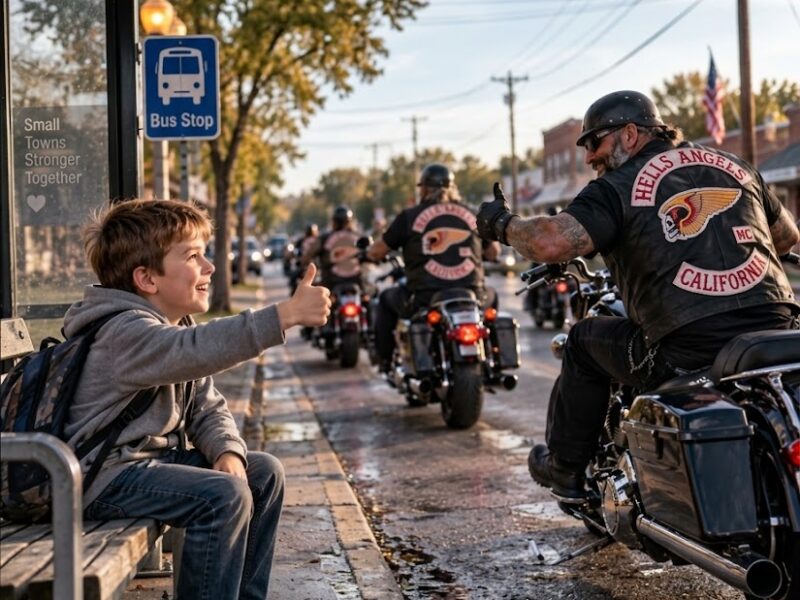
Every single day, a little boy waited at the same bus stop for a biker who never came — until one day, he finally did.
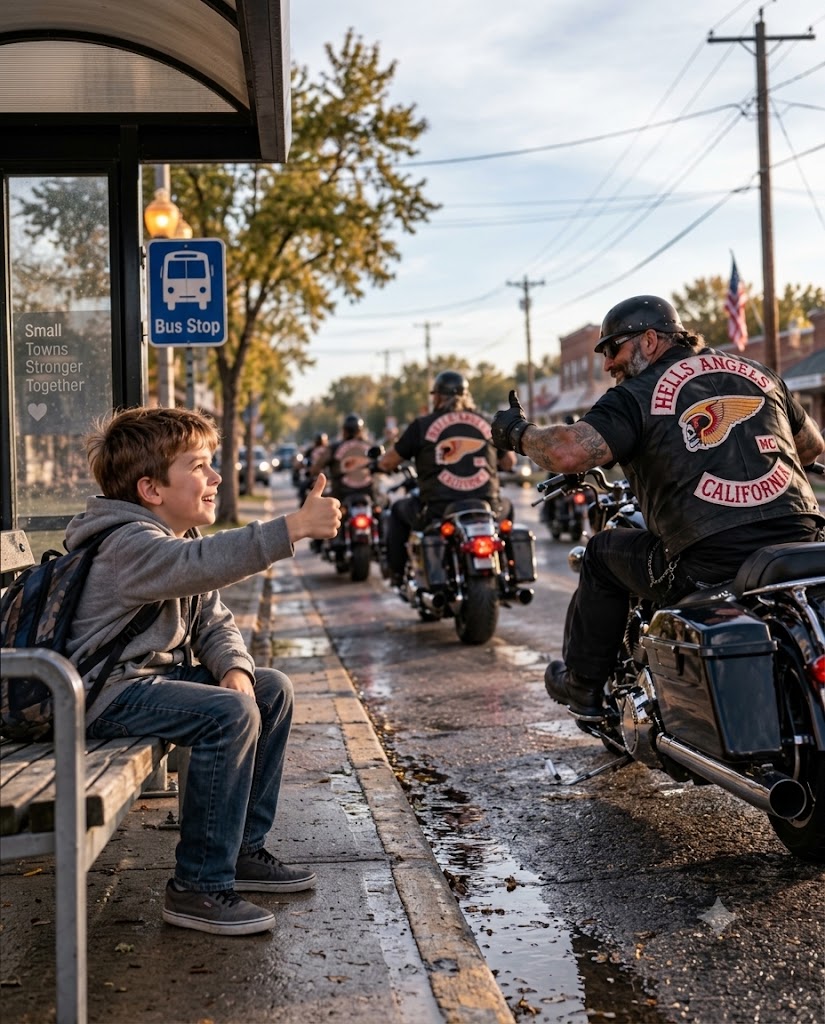
The boy had been sitting at that same bus stop bench for 431 days, and he could still recognize the sound of one specific engine among a thousand others.
Everyone told him to stop waiting.
His own mother had started to believe the man was never coming back, but Christopher kept showing up anyway, notebook in hand, watching every motorcycle that passed the corner of Haywood Road.
What nobody knew, not the boy, not the growing community of riders who had quietly stepped in to fill the silence, was exactly what had pulled Brian Kesler away so suddenly, or whether the reason would ever be enough to explain 14 months of unbroken silence.
Then, on an ordinary Tuesday, an engine slowed at the corner.
Christopher Whitfield was 7 years old the first time Brian Kesler stopped his motorcycle at the corner of Haywood Road and Clingman Avenue, right where the number 12 bus let out kids from Vance Elementary.
It was late September, the kind of Asheville afternoon when the mountains behind the rooftops turned a hazy blue-purple and the air smelled like wet leaves and diesel exhaust.
Christopher was sitting alone on the bench, his backpack too big for his small frame, watching the other kids get picked up one by one until the sidewalk emptied out.
He did this most days.
His mother, Michelle Whitfield, worked two jobs, mornings at a diner off Patton Avenue and evenings restocking shelves at a grocery store near the interstate.
There was rarely anyone free to meet him right when school let out.
Christopher had learned to wait.
He’d learned the particular loneliness of a bus stop bench when the last other kid disappeared around the corner and the street went quiet except for the traffic lights clicking through their colors for no one.
That was the day Brian rolled up on his old Harley-Davidson Sportster, the engine rattling low, and pulled over not because he needed to, but because he noticed the boy sitting there alone for the third day in a row.
Brian was 34 then, broad-shouldered with a beard going premature gray at the edges and forearms marked with faded tattoos he’d gotten in his twenties and mostly regretted.
He worked at a motorcycle repair shop two blocks from the bus stop, and he’d been riding past this corner for years without paying it much attention.
But something about the kid, the stillness of him, the way he sat with his hands folded in his lap like he was used to being patient, made Brian cut his engine.
“You waiting on somebody?” Brian asked, pulling off his helmet.
Christopher looked up, startled, then shrugged.
“My mom’s still at work.”
“She know you’re out here by yourself?”
“She knows I wait at the bench. It’s fine. I’m not supposed to talk to strangers, though.”
Brian laughed at that, a short surprise bark of a laugh.
Smart kid.
“I’m Brian. I fix motorcycles at the shop right there.”
He pointed down the block at Kesler’s Cycle Repair, the faded sign visible from where they sat.
“I’m not that much of a stranger. You can ask anybody on this street. They’ll tell you I’m harmless.”
Christopher studied him for a long moment, the way children do when they’re deciding whether an adult is trustworthy, weighing things adults have long forgotten how to notice.
“Is that your motorcycle?”
“Sure is.”
“It’s loud.”
“That’s the point,” Brian said, grinning.
They talked for maybe ten minutes that day about nothing important.
The motorcycle, the mountains, whether Christopher liked school, he did mostly except for math.
Then Brian looked at his watch and said he had to get back to the shop, but that he’d see him around.
Christopher watched him ride off, and something in the boy’s chest loosened just slightly, the way a held breath finally lets go.
It became a habit neither of them planned.
Brian would take his break around 3:30, right when Christopher’s bus dropped him off, and he’d ride the two blocks to the corner just to check that the boy wasn’t alone for too long.
Sometimes he’d wait with him for five minutes, sometimes twenty, until Michelle’s neighbor, Mrs. Alvarado, came to walk Christopher the rest of the way home, or until Michelle herself managed to slip away early enough to meet him.
Brian never made it a big production.
He’d just show up, cut the engine, ask about the boy’s day, tell him something about the bikes he was fixing that week, and then head back to work.
Michelle found out about it after a month.
When Christopher mentioned “my friend Brian, who has the loud motorcycle” so many times at dinner that she finally asked who he meant, she was cautious at first, any mother would be.
But when she walked down to the corner herself one afternoon and saw the way Brian talked to her son, patient and easy, never overstepping, never asking for anything, she softened.
She thanked him.
Brian just shrugged it off the way men who don’t know how to accept gratitude tend to do and said the kid was good company.
For the better part of a year, Brian Kesler became a fixture in Christopher’s life the way a street lamp becomes a fixture on a corner.
Not something anyone plans for, but something that once it’s there makes the whole block feel different.
Christopher started keeping a small spiral notebook where he wrote down facts about motorcycles that Brian taught him.
The difference between a Sportster and a Softail, why chrome needed to be polished a certain way, what it meant when an engine knocked.
He didn’t understand all of it, but he liked having something that was his and Brian’s.
Then on a Tuesday in November, Brian didn’t come.
Christopher waited on the bench for forty minutes, watching every motorcycle that passed, certain each one would slow down at the corner.
None of them did.
He told himself Brian was busy at the shop, that something had come up, that tomorrow he’d be there and everything would be normal again.
But the next day, Brian didn’t come either, or the day after that.
By the end of the week, Christopher had started asking anyone who passed the bus stop whether they knew Brian Kesler, whether they knew what happened to him.
Most people just shook their heads and kept walking.
It was Michelle who finally walked down to Kesler’s Cycle Repair to ask and found the shop dark, a hand-lettered sign taped to the door.
Closed. Family emergency.
No explanation, no timeline, no way to reach him.
Christopher didn’t stop waiting.
Every day after school, whether his mother had time to pick him up or not, he asked to sit at the bench for at least ten minutes before going home.
He told himself it wasn’t really waiting.
He was just sitting, just resting his legs before the walk.
But everyone who knew him understood exactly what he was doing.
He was listening for one particular engine sound among all the traffic noise of Haywood Road, hoping that today would be the day it slowed down at the corner again.
Weeks became months.
Winter came and went, and the mountains around Asheville went from bare branches to the first green haze of spring.
And still Christopher sat on the bench most afternoons, notebook in his backpack, waiting for a man who had simply vanished from his life without a word of explanation.
Nobody in the neighborhood knew what had happened to Brian Kesler.
Some said he’d moved away.
Some said there’d been a death in the family.
A few, less kindly, suggested he’d simply gotten tired of the responsibility of a kid who wasn’t his and found it easier to disappear than to say goodbye.
Christopher refused to believe that last version, though he was young enough that he couldn’t yet articulate why.
He just knew, in the stubborn way children know things, that Brian wouldn’t have left without a reason.
And so he kept sitting at that bench, holding on to a version of the story that nobody could confirm, waiting for an ending nobody could promise him.
It was Daniel Reyes, no relation to anyone in the story except that he happened to ride his motorcycle down Haywood Road every single afternoon on his way home from his job managing a hardware store, who first noticed the boy sitting alone at the bus stop with what seemed like unusual persistence.
Daniel was 51, a longtime member of the Blue Ridge Riders, a local motorcycle club that met on weekends for rides up into the Pisgah National Forest and occasionally organized charity runs for the children’s hospital.
He’d seen plenty of kids waiting at bus stops before, but something about this one, the way he watched every passing bike with unmistakable hope, the way his shoulders sank slightly each time the bike passed without stopping, struck Daniel as different.
He mentioned it to his riding buddy, Steven Marsh, one Saturday morning at their usual coffee stop before a group ride.
“There’s a kid down on Haywood,” Daniel said, stirring sugar into his coffee. “Sits at the bus stop every day, watches every bike that goes by like he’s looking for someone specific. Been seeing it for weeks now.”
Steven, who had two grandkids of his own and a soft spot for exactly this kind of thing, frowned.
“Maybe he just likes bikes.”
“Maybe,” Daniel said. “But it’s not the bikes he’s looking at. It’s like he’s checking faces, like he’s expecting someone.”
That Monday, on a whim, Daniel slowed down as he passed the corner and gave the boy a small wave.
Christopher, startled, waved back automatically, then looked crestfallen when Daniel’s bike kept moving.
It wasn’t Brian.
Of course it wasn’t Brian.
But something about the exchange lodged itself in Daniel’s mind, and the next day he did it again, and the day after that, until it became a small ritual.
Daniel slowing down, giving a nod or a wave.
Christopher waving back with a hope that dimmed a little more each time, but never fully went out.
Eventually, Daniel stopped his bike altogether.
It was a cold February afternoon, the kind where Asheville’s mountain air turns sharp and the streetlights come on early.
He pulled over at the bus stop, cut his engine, and asked the boy directly, “You waiting on somebody, son?”
Christopher hesitated.
The same caution he’d shown Brian all those months ago rising up in him again.
But there was something in Daniel’s weathered, kind face that reminded him a little of Brian, and he found himself answering honestly.
“My friend Brian. He used to ride his motorcycle here every day after school, but he stopped coming.”
“Brian who?”
“Brian Kesler. He fixed motorcycles at the shop right there.”
Christopher pointed down the block, though the shop had been dark and shuttered for months by then.
Daniel’s expression shifted.
Recognition, then something like concern.
“I know Brian. Haven’t seen him around in a while myself. You’ve been waiting for him this whole time?”
Christopher nodded, and something about the simple honesty of the gesture, a child’s unwavering faith in someone who had disappeared without a word, hit Daniel harder than he expected.
He thought about his own kids, grown now, and how easily a small act of kindness could become the center of a child’s whole world.
He thought about how cruel it was, even if unintentional, for that world to be upended with no explanation at all.
“Tell you what,” Daniel said. “I ride this way every day around this time. How about I stop and keep you company till your mom or whoever gets here? Can’t promise I’m as good as Brian, but I know a thing or two about bikes myself.”
Christopher considered this seriously, the way he considered most things.
“Okay,” he finally said. “But I’m still going to wait for him, too.”
“Fair enough,” Daniel said.
And something about the boy’s stubborn loyalty made him smile, despite the sadness of the situation.
Daniel told Steven about the conversation at their next coffee stop, and Steven in turn mentioned it to a few others in the Blue Ridge Riders.
A rotating cast of mechanics, truck drivers, a schoolteacher named David Ferris who rode on weekends, and a retired army medic named Christopher.
No, they made sure not to confuse names.
Everyone was careful about that once they realized the coincidence of the boy sharing a first name with one of their own members, David Ferris’s cousin.
Word spread through the club the way word spreads through any tight community, not as gossip, but as something closer to a call to action.
Within two weeks, it wasn’t just Daniel stopping at the bus stop.
It became something the whole club took turns doing, informally at first, and then with the kind of quiet organization that men who ride together in formation tend to develop naturally.
Someone would always be there when Christopher’s bus pulled up, idling at the corner, ready to talk to him for a few minutes, ask about his day, tell him about their bikes, wait with him until his mother or Mrs. Alvarado came to walk him home.
Michelle Whitfield was startled the first time she arrived to find not one but three motorcycles parked at the corner, their riders chatting easily with her son like old friends.
She’d heard about Brian’s disappearance from Christopher in halting, worried fragments, and she’d worried more than she let on about her son’s fixation on a man who’d vanished without explanation.
But watching these strangers, because that’s what they were, strangers to her, treat her son with such unforced warmth, she felt something in her chest unclench for the first time in months.
“You don’t have to do this,” she told Daniel one afternoon, watching Christopher show off his notebook full of motorcycle facts to Steven, who was nodding along with genuine interest.
“We know,” Daniel said simply. “That’s kind of the point.”
Over the following months, the Blue Ridge Riders became something like an extended family for Christopher.
They took turns at the bus stop.
But it didn’t end there.
Someone organized a small birthday celebration for him at the clubhouse when he turned 8, complete with a miniature leather vest that said Junior Rider on the back, which Christopher wore constantly, even to school, until Michelle had to explain to his teacher why a second grader was showing up in biker gear.
David Ferris, who taught shop class at the local high school, started letting Christopher hang around the garage on weekends, teaching him actual mechanical skills.
How to check oil, how to identify basic engine parts, small things that made the boy feel like he was continuing something Brian had started.
And yet, through all of it, Christopher never stopped watching for one specific motorcycle among the others.
Every new engine sound made his head turn, hope flickering before disappointment settled back in.
He kept his notebook updated, adding new facts he learned from Daniel and David and Steven, but he kept a section reserved just for what Brian had taught him, refusing to mix the two, as though preserving that particular knowledge preserved something of the man himself.
“He’s not gone,” Christopher told Daniel one evening, nearly a year after Brian had first disappeared. “He’s coming back. I know it.”
Daniel didn’t have the heart to tell the boy that most people who vanish that suddenly, that completely, don’t come back.
That adults sometimes disappear from children’s lives for reasons that have nothing to do with the child and everything to do with problems too large and complicated for a boy to understand.
Instead, he just nodded and said, “Well, when he does, he’s going to owe us all a drink for covering his shift.”
Christopher laughed at that.
A real laugh, the kind that made the whole club feel like they’d done something right, even if they couldn’t fix the actual wound at the center of it.
What none of them knew, what Christopher couldn’t have guessed, and the Blue Ridge Riders couldn’t have imagined, was that Brian Kesler had spent that entire year 300 miles away in a hospital room in Richmond, Virginia, watching his younger brother, Steven Kesler, slowly die of a degenerative illness that had progressed faster than any of the doctors had predicted.
Steven had been diagnosed 18 months before Brian ever met Christopher at that bus stop.
Though Brian had kept the news mostly private, unwilling to burden his small community in Asheville with a problem that felt at the time distant and manageable.
Steven lived in Richmond with his wife and had insisted for a long time that he didn’t need his older brother hovering, that the treatments were working, that things would be fine.
Brian had believed him, or wanted to, the way people believe things they desperately need to be true.
Then in November, everything collapsed at once.
Steven’s condition worsened dramatically over a single week, and his wife called Brian in a panic that he could hear even through the phone static.
Brian closed the shop that same day, taped the hastily written sign to the door, and drove straight to Richmond without stopping to explain himself to anyone.
Not to his neighbors, not to his handful of regular customers, and devastatingly, not to the boy who had become, without either of them fully realizing it, one of the most important relationships in his solitary life.
He told himself, in the chaos of that first week, that he’d call Michelle as soon as things settled.
But things never settled.
Steven’s illness took a brutal, grinding path through the following months.
Periods of false hope followed by devastating setbacks.
Hospital stays that stretched from days into weeks.
Medical decisions that fell entirely on Brian’s shoulders once Steven became too weak to make them for himself.
Brian barely slept.
He barely ate.
He spent his days in hospital corridors and his nights in a cheap motel near the medical center, and somewhere in the exhausting blur of it all, the phone call he owed to a woman and a boy in Asheville kept getting pushed to tomorrow, and tomorrow, and tomorrow.
There was guilt in the delay, too.
A guilt that compounded on itself the longer it went unaddressed.
Brian knew somewhere in the back of his mind that Christopher was probably still going to that bus stop, still watching for him.
The longer he stayed silent, the harder it became to imagine calling and explaining himself, the more he told himself that the boy would forget him eventually, move on, find other things to occupy his afternoons.
It was easier to believe that than to confront what his silence might actually be doing to a child who trusted him.
Steven died in early October, nearly 11 months after Brian had first left Asheville.
The funeral was small, just family and a handful of close friends.
And Brian found himself standing at his brother’s graveside, feeling like a man who had lost not only a sibling but an entire year of his own life, swallowed whole by grief and hospital fluorescent lighting and the particular exhaustion of watching someone you love disappear slowly instead of all at once.
It took him another two months to settle his brother’s affairs.
The house, the finances, the endless paperwork that death leaves behind, and the emotional weight of it all, which proved far heavier and slower to carry than any legal document.
He barely thought about Asheville during this period, not because he’d forgotten, but because he’d built a kind of numbness around himself as a survival mechanism, and thinking about the shop, the bus stop, the boy, threatened to crack that numbness open in ways he wasn’t ready to face.
It was his brother’s widow, Laura, who finally pushed him to reckon with it.
In late December, as Brian was preparing to finally drive back to Asheville, Laura sat him down and asked him plainly what he was planning to do about “that boy you used to tell Steven about.”
Brian had, in fact, mentioned Christopher to his brother during the good months, back before the illness accelerated.
Small stories about the kid at the bus stop, the notebook full of motorcycle facts, the easy companionship that had crept up on him without his intending it.
Steven had found it endearing, had told Brian more than once that he ought to think seriously about what he owed that child.
“You can’t just show back up like nothing happened,” Laura told him. “Not after disappearing on a seven-year-old with no explanation. You need to think about what you’re going to say, and you need to be ready for him to be angry or hurt or not to trust you anymore. That’s fair. That’s what you earned.”
Brian sat with that for a long time before he finally made the drive back to Asheville in the first week of January, more than 14 months after he’d last cut his engine at that corner on Haywood Road.
He didn’t go straight to the bus stop.
He went first to his shop, which he’d been paying rent on the whole time, out of some combination of guilt and denial, and spent two days simply sitting in the empty space, trying to figure out how to face what he’d left behind.
It was Daniel Reyes who found him there, having noticed the shop lights on for the first time in over a year.
Daniel walked in expecting almost anyone else.
And when he saw Brian Kesler sitting on an overturned crate in the middle of his own shop, looking older and more hollowed out than the man he remembered, he felt a rush of complicated emotion.
Relief that Brian was alive, and a sharp protective anger on behalf of the boy who had spent over a year waiting for him.
“You have any idea what that kid’s been through?” Daniel said before even a greeting.
Brian’s face crumpled in a way that told Daniel everything he needed to know about how much guilt the man had already been carrying.
“I know,” Brian said quietly. “I know I don’t have an excuse that’s good enough.”
“Try me,” Daniel said, crossing his arms, though his voice had softened slightly.
And so for the first time since it had all happened, Brian told someone the whole story.
His brother’s illness, the sudden collapse, the year of hospital corridors and grief, the guilt that kept compounding the longer he stayed silent, until silence itself felt like the only option left.
Daniel listened without interrupting.
And when Brian finished wiping at his eyes with the back of a scarred hand, Daniel let out a long breath.
“That’s a real reason,” Daniel finally said. “Doesn’t undo the hurt, but it’s real. You need to tell him all of it in whatever way a kid his age can understand. He deserves that much.”
“I don’t know if he’ll even want to see me,” Brian said.
Daniel gave him a look that was almost pitying.
“Brian, that kid has been at that bus stop nearly every single day for over a year waiting for you. You have no idea how much he wants to see you.”
Christopher was 8 and a half years old on the January afternoon that changed everything, sitting on the same bus stop bench he’d occupied hundreds of times over the past 14 months.
His notebook open on his lap even though he’d stopped adding to Brian’s section months ago, not because he’d given up hope exactly, but because there was nothing new to add about a man he hadn’t seen.
Daniel had told him three days earlier that there was something important he needed to talk to him about, but had refused to explain further, only saying, “Just keep coming to the bus stop like you always do. Trust me on this one.”
Christopher had learned to trust Daniel over the past year, the way he’d learned to trust David Ferris and Steven Marsh and the dozen other members of the Blue Ridge Riders who had, without ever officially deciding to, become his community.
But he’d also learned more painfully that trust didn’t guarantee outcomes, that people you cared about could disappear without warning, regardless of how much you believed in them.
So he sat on the bench that Tuesday with a cautious, guarded hope, the kind that braces itself for disappointment even while wanting badly to believe.
The sound reached him before he consciously registered what it was.
An engine distinct from the others, with a particular rattle in its idle that he would have recognized anywhere, that he’d spent over a year listening for in every passing motorcycle, only to be disappointed again and again.
His head snapped up.
Down the block, turning onto Haywood Road, was a motorcycle he knew instantly, the paint slightly more weathered than he remembered, but unmistakably the same bike.
He stood up so fast his notebook slid off his lap onto the sidewalk, forgotten.
The motorcycle slowed as it approached the corner, and Christopher could see the rider now, a man with a beard grayer than he remembered, his face etched with something that looked like exhaustion and fear in equal measure.
The bike came to a stop right where it always used to stop, and the engine cut off, and for a moment neither of them moved, as if the year and a half between them had created a kind of invisible wall that neither knew how to cross.
“Christopher,” Brian said, his voice rough.
The boy’s face went through several expressions in rapid succession.
Disbelief, then something like anger, then a kind of overwhelming relief that seemed to buckle his knees slightly.
“You came back,” he said so quietly Brian almost didn’t hear it over the traffic noise.
“I’m sorry,” Brian said, climbing off the bike, his hands trembling slightly as he pulled off his helmet. “I’m so sorry, Christopher. I should have called. I should have found some way to let you know what was happening. There’s no excuse good enough for how long I let this go. But I need you to know it wasn’t because of anything you did. It was never that.”
“Then why?” Christopher’s voice cracked on the word, and all the composure he’d built up over 14 months of forced patience seemed to crack along with it. “Why didn’t you just tell me? I waited every day. Every single day, I thought—”
He stopped, unable to finish the sentence, unable to say out loud the fear that had lived in him for over a year, that he’d done something wrong, that he wasn’t worth coming back for, that he’d simply been forgotten the way unwanted things get forgotten.
Brian crouched down to the boy’s eye level, the way he used to when Christopher was younger and needed things explained simply and honestly.
“My brother Steven got very sick,” he said. “Sicker than anyone expected. I had to go take care of him. And it happened so fast I didn’t have time to think straight about anything except getting to him. And then once I was there, the days just kept running into each other. And I kept telling myself I’d call tomorrow, and tomorrow, until so much time had passed that I didn’t know how to call anymore. That’s not a good reason for how long I stayed silent. It’s just the truth of what happened. My brother died in October, Christopher. I lost him. And somewhere in all of that grief, I lost track of how much you needed me to at least tell you something, anything, instead of just disappearing.”
Christopher was crying now, the tears he’d held back for over a year finally breaking loose.
But he didn’t pull away when Brian reached out and gently rested a hand on his shoulder.
“I’m sorry about your brother,” Christopher said between sobs.
“Thank you,” Brian said, his own eyes wet. “And I’m sorry about what I put you through. You didn’t deserve that. You deserved someone who would tell you the truth, even if the truth was hard, instead of someone who just vanished.”
They stayed like that for a long moment.
The boy crying and the man holding his shoulder.
Cars passing on Haywood Road.
The mountains in the distance holding their same blue-purple color they’d held on the very first day this had all begun.
It was Daniel who finally approached, having watched the reunion from a respectful distance along with Steven Marsh and David Ferris, all three of them on their bikes, parked a little way down the block to give Brian and Christopher privacy for the hardest part of the conversation.
“Everything okay over here?” Daniel asked gently, though his eyes were on Brian, still carrying a residue of the protective anger from their conversation in the shop three days earlier.
Christopher wiped his face with his sleeve and looked between Brian and the three other riders who had become over the past 14 months something like a second family to him.
“This is Brian,” he told them, though of course they already knew. “He’s back.”
“We can see that,” Steven Marsh said, his weathered face breaking into a smile. “Good to see you, man. Been a long time.”
Brian stood up, still holding a hand lightly on Christopher’s shoulder, and looked at the three riders with an expression of genuine gratitude that seemed to catch him off guard, as though he hadn’t expected to feel this specific emotion.
“I heard what you all did,” he said. “While I was gone. Daniel told me. I don’t know how to thank you for looking out for him when I couldn’t.”
“Wasn’t really a choice,” David Ferris said with a shrug. “Kid needed people showing up for him. We just showed up.”
And then that evening, once Michelle had been told the whole story and had cried her own tears of relief and lingering hurt on Brian’s behalf and Christopher’s, the Blue Ridge Riders organized an impromptu gathering at their clubhouse, a low brick building off Riverside Drive with a gravel parking lot that filled up with more motorcycles than usual that night.
It wasn’t a celebration exactly.
The grief of Brian’s lost brother was too fresh, too raw for anything that felt like pure celebration.
But it was something adjacent to it, a recognition that something broken had been, if not fully repaired, at least honestly addressed.
Christopher sat between Brian and Daniel that night, his notebook open again for the first time in months, adding new entries in Brian’s section, while the man himself, sitting close enough that their shoulders touched, watched with an expression that mixed grief and gratitude in equal measure.
In the months that followed, Brian Kesler reopened Kesler’s Cycle Repair, though he approached the work differently than before.
More deliberate about the relationships he built, more careful about the promises he made and the silences he allowed.
He never again let more than a day pass without checking in with Christopher, even during weeks when work at the shop ran long or personal obligations pulled at his time.
He had learned in the hardest possible way what a single unexplained absence could do to a child who had already learned too early that adults could disappear without warning.
The bus stop at Haywood Road and Clingman Avenue became something different than it had been before.
Not just a place where a boy waited alone, but a genuine meeting point for an entire community that had formed around one small act of attention paid to a lonely child.
Daniel Reyes, Steven Marsh, and David Ferris continued stopping by regularly, not out of obligation now, but out of the kind of habit that forms when people have shared something meaningful together.
The Blue Ridge Riders started referring to Christopher, half-jokingly but with genuine affection, as their youngest member, and made sure he was included in club gatherings, charity rides, and the small rituals that had come to define their community.
Michelle Whitfield, who had spent over a year watching her son’s hope slowly erode while feeling powerless to fix the wound left by Brian’s disappearance, found herself unexpectedly grateful for how the whole ordeal had unfolded, painful as it had been.
She watched Christopher’s confidence in the world rebuild itself piece by piece, not because the initial hurt had never happened, but because he’d learned something perhaps even more valuable than uninterrupted trust.
He’d learned that community could catch you when one person let you down.
That love wasn’t limited to a single source.
And that broken things could sometimes be honestly repaired rather than simply discarded.
Brian, for his part, carried the lesson of that year forward in ways that changed how he moved through the world entirely.
He started talking more openly with the people around him instead of retreating into silence during hard times, having learned firsthand how much damage unexplained absence could cause to the people who depended on him.
He visited his sister-in-law Laura regularly, grateful for the honesty that had pushed him to finally face Christopher, and he kept a photograph of his brother Steven in the shop, a quiet reminder of the loss that had shaped the hardest chapter of his own life.
On the one-year anniversary of his return, Brian organized a small ride for the Blue Ridge Riders up into the Pisgah National Forest, inviting Christopher, now 9 years old, to ride along in the sidecar Brian had specially fitted to his bike for exactly this purpose.
Christopher wore his old Junior Rider vest, now slightly too small for him, and spent the entire ride pointing out landmarks he remembered from stories Brian had told him over the years, narrating the trip with the kind of enthusiasm that made the whole club laugh.
At the overlook near the top of the ride, where the whole valley of Asheville spread out below them in a patchwork of autumn color, Brian pulled Christopher aside for a moment while the others admired the view.
“I want you to know something,” Brian said, crouching down slightly, even though the boy had grown enough that he barely needed to anymore. “What happened to us. Me leaving, you waiting, all of it. That wasn’t your fault, and it never will be. Sometimes people who love you go through things that make them disappear for a while, even when they don’t want to. But the difference between someone who’s really gone and someone who’s just going through something hard is whether they come back and tell you the truth once they can. I should have found a way to do that sooner. But I want you to know I’m not going anywhere again. Not without telling you exactly what’s happening and why.”
Christopher nodded, taking this in with the same serious consideration he’d given most important things in his young life.
“I know,” he said. “Daniel told me that too, actually. About people going through hard things.”
“Daniel’s a smart man,” Brian said, smiling.
“He said the whole club would have kept coming to the bus stop, even if you never came back,” Christopher said. “He said that’s just what you do for people you care about.”
Brian looked out at the valley, thinking about how a chance decision to stop his motorcycle at a bus stop two years earlier had somehow grown into an entire community wrapped around a boy who had once simply been sitting alone, waiting.
“He’s right about that, too,” Brian said. “That’s exactly what you do.”
They rode back down into Asheville that afternoon as the sun began its descent behind the mountains, the whole procession of motorcycles moving together through the golden autumn light.
And at the corner of Haywood Road and Clingman Avenue, where it had all begun with one boy waiting alone on a bench for someone who never came, the whole club stopped together just for a moment, engines idling before heading home.
It wasn’t necessary anymore, this particular ritual.
Christopher no longer needed to wait there, no longer needed to search every passing engine sound for the one he remembered.
But they stopped anyway, because some places earn the right to be remembered, and this corner, more than any other in the whole city, had become a monument to what happens when people choose again and again to show up for each other.
—
The years that followed carried their own quiet transformations.
Christopher grew from the small boy on the bench into a teenager who still wore his old Junior Rider vest on special occasions, even though it no longer fit and hung in his closet like a relic from another life.
He learned to ride his own motorcycle at 16, taught by Brian in the empty parking lot behind the shop on Sunday mornings, the same way Brian had once taught him the difference between a Sportster and a Softail.
The Blue Ridge Riders watched him grow up the way a village watches one of its own, a collective investment of attention and care that had started as a response to one boy’s loneliness and had become something none of them could have predicted.
Daniel Reyes retired from the hardware store but never stopped riding.
He still took his coffee every Saturday morning with Steven Marsh and David Ferris, still led the occasional charity run for the children’s hospital, and still told the story of the boy at the bus stop whenever new members joined the club and needed to understand what the Blue Ridge Riders were really about.
Brian Kesler kept the photograph of his brother Steven on the wall of the shop, next to a picture of Christopher at 8 years old, sitting on his motorcycle for the first time, grinning with a gap-toothed smile that made everyone who saw it smile back.
He never fully forgave himself for the 14 months of silence, not completely, but he learned to carry it differently over time, not as a wound but as a reminder.
A reminder that showing up mattered.
That saying the hard thing was better than saying nothing at all.
That the people who depended on you deserved to know when you couldn’t be there, even if the reason was something as simple and terrible as grief.
Michelle Whitfield eventually remarried, a kind man named Robert who worked at the same grocery store and who learned to ride a motorcycle at 45 just so he could join the club rides on weekends.
She watched her son grow into someone who trusted people, not naively, but with the kind of clear-eyed hope that comes from having been let down and then caught by a whole community.
Christopher graduated high school with a plan to study mechanical engineering at UNC Asheville, and when he told Brian about it, Brian just nodded like he’d known all along.
“You’re going to build better engines than I ever fixed,” Brian said.
“Maybe,” Christopher said. “But I’ll still know how to polish chrome the right way. You taught me that.”
They laughed, and it was the kind of laugh that held years inside it, the whole complicated history of a man who’d disappeared and a boy who’d waited and a corner where they’d found each other again.
The bus stop bench itself was eventually replaced by the city, worn down by weather and time, swapped out for a newer model with a metal frame and a small awning that provided shade on hot Carolina afternoons.
Christopher went down to watch them install it, standing on the corner with his hands in his pockets, remembering all the hours he’d spent on that spot.
The new bench didn’t have the same history, the same grooves worn into the wood, the same faint scratches from where he’d carved his initials one summer when he was 10 and bored.
But it was still a bus stop, still a place where kids waited for their parents and parents waited for their kids, and that felt like enough.
Some places carried their meaning forward regardless of what they were made of.
On the day Christopher turned 18, the Blue Ridge Riders threw him a party at the clubhouse that was bigger than any birthday he’d ever had.
There were balloons and a cake shaped like a motorcycle, and a new leather vest that actually fit him, with his name embroidered on the back above the words Full Member, which made him laugh and then get quiet in a way that everyone understood.
Brian gave him a small box wrapped in plain brown paper, and inside was a vintage motorcycle tool kit, the kind that hadn’t been made in decades, with a note tucked into the lid in Brian’s rough handwriting.
For the kid who waited. You taught me more than I taught you.
Christopher read the note three times before he could say anything.
Then he hugged Brian, something he hadn’t done since he was 9 years old and still small enough that his head fit under Brian’s chin.
“Thank you,” he said. “For everything. For coming back.”
“I should be thanking you,” Brian said. “For waiting long enough for me to figure out how.”
The party went late into the night, and at some point, someone put on the old stories again, the ones about the boy at the bus stop and the man who disappeared and the club that stepped in to fill the silence.
Christopher listened to them now the way you listen to stories about your own life, with a kind of distant wonder that so much had happened in so few years, and that all of it had led to this, a room full of people who had chosen, again and again, to show up for each other.
He still had the notebook, of course.
The original spiral notebook, filled with motorcycle facts and engine diagrams and two separate sections, one for Brian and one for everyone else.
He kept it on a shelf in his room, and sometimes when he couldn’t sleep, he’d take it down and flip through the pages, remembering the boy he’d been and the man he’d become.
There was one page near the back that he’d written on the night Brian came back, the words shaky and tear-stained but still legible.
He came back. I knew he would. Some people are worth waiting for.
He still believed that, even now, even after everything.
Maybe more than ever.
Because waiting wasn’t just about the person who was gone, it was about the person you became while they were away.
It was about learning that hope was not the same thing as foolishness, and that trust, even when broken, could be rebuilt.
It was about the corner of Haywood Road and Clingman Avenue, and the sound of one specific engine among a thousand others, and the moment when the waiting finally ended and something new began.
The Blue Ridge Riders still rode every weekend, weather permitting, up into the mountains where the air was thin and clean and the whole world seemed to stretch out below them.
Christopher rode with them now, on a bike he’d rebuilt himself with Brian’s help, and sometimes when they passed the corner of Haywood and Clingman, he’d slow down just a little, just enough to feel the history of that spot.
He’d think about the boy he used to be, sitting alone on a bench with a backpack too big for his shoulders.
He’d think about the man who stopped, not because he had to, but because he noticed.
He’d think about all the people who came after, the ones who filled the silence when one person couldn’t, the ones who proved that community was not a place but a practice.
And he’d think about how lucky he was, how impossibly lucky, to have been the boy at the bus stop who waited long enough to see what happened next.
The story didn’t end there, of course.
Stories like this never really end, they just change shape, becoming something you carry with you instead of something you live through.
Christopher carried it with him when he went to college, and when he graduated, and when he got his first job at a motorcycle design firm in Charlotte, and when he came home every few months to visit his mother and Brian and the whole sprawling family that had formed around him.
He carried it when he met someone, a woman named Elena who worked as a nurse at the hospital and who listened to the story of the bus stop with tears in her eyes and said, “That’s the most beautiful thing I’ve ever heard.”
He carried it when they got married, in a small ceremony at the clubhouse with the Blue Ridge Riders as his groomsmen, Brian standing next to him with a look on his face that was equal parts pride and disbelief.
He carried it when he had a son of his own, a boy named Steven, after Brian’s brother, and when that boy was old enough to ask about the notebook on the shelf, Christopher sat him down and told him the whole story.
About the bus stop, and the man who disappeared, and the club that stepped in to fill the silence.
About the 431 days of waiting, and the one Tuesday when the waiting finally ended.
About the corner of Haywood Road and Clingman Avenue, where a boy had once sat alone, and where a community had formed, and where something broken had been, if not fully repaired, at least honestly addressed.
Steven listened with wide eyes, the way Christopher had once listened to Brian, with the kind of attention that children give to stories they know will matter.
And when Christopher finished, Steven asked the question that Christopher had been waiting for.
“Did you ever stop waiting?”
Christopher thought about it for a moment, the way he thought about most things.
“No,” he said finally. “I don’t think I ever did. But I learned that waiting isn’t always about the person you’re waiting for. Sometimes it’s about the person you’re becoming while you wait. And sometimes, if you’re lucky, the waiting ends and something better begins.”
Steven nodded, taking this in with the same serious consideration Christopher had once given to Brian’s explanations of engine parts.
“Can we go see the bus stop?” he asked.
Christopher smiled.
“Yeah,” he said. “We can go see the bus stop.”
They drove down to Haywood Road the next weekend, Christopher and Elena and little Steven, and they stood on the corner where it had all begun.
The bench was different now, newer, but the corner was the same.
The mountains were the same.
The sound of motorcycles passing on the road was the same.
Christopher pointed out where Brian’s shop used to be, now a coffee shop, and where the number 12 bus still stopped, letting out kids from Vance Elementary.
He told Steven about the notebook, and the Junior Rider vest, and the birthday party at the clubhouse.
He told him about Daniel and Steven Marsh and David Ferris, about the whole community that had formed around one small act of attention.
And when a motorcycle passed, slowing slightly at the corner out of habit, Christopher waved.
The rider waved back.
And for a moment, it was like no time had passed at all.
Like he was still that boy on the bench, still waiting, still hoping, still learning that the world was full of people who would show up if you gave them the chance.
He looked down at his son, who was watching the motorcycle disappear down the road with the same focused attention Christopher remembered from his own childhood.
“Did you ever find him?” Steven asked. “The man who disappeared?”
Christopher nodded.
“Yeah,” he said. “I found him. Or maybe he found me. Either way, we found each other.”
And that, he thought, was the whole story.
Not the waiting, not the disappearance, not the silence.
But the finding.
The showing up.
The choosing, again and again, to be there for each other.
They stayed on the corner for a while longer, watching the traffic pass, listening to the engines, feeling the history of the place settle around them like a familiar coat.
And when they finally left, heading home in the fading light of another Asheville afternoon, Christopher looked back one last time at the bus stop bench, empty now, waiting for whoever would sit there next.
He hoped they would find what he had found.
He hoped they would learn what he had learned.
That waiting was not passive, but active.
That hope was not naive, but necessary.
And that the corner of Haywood Road and Clingman Avenue, like so many corners in so many cities, was not just a place where people waited, but a place where people could be found.
The story of the boy at the bus stop didn’t end with him.
It continued in the lives of everyone who had been part of it, in the community that had formed around one small act of attention, in the lessons that had been learned and passed on.
Brian Kesler, who had disappeared and come back, who had learned the hard way that silence could wound as deeply as absence, spent the rest of his life making sure that no one in his orbit ever had to wonder where he was.
He became the kind of man who called, who showed up, who said the hard things even when they were difficult to say.
He never married, but he had a family, a sprawling, complicated, motorcycle-riding family that had formed around a bus stop on Haywood Road and had never really disbanded.
Daniel Reyes died at 78, peacefully, in his sleep, after a long ride through the mountains he loved.
The Blue Ridge Riders organized a memorial ride in his honor, and Christopher, now in his thirties with a son of his own, rode at the front of the procession.
They stopped at the corner of Haywood and Clingman, engines idling, and Christopher got off his bike and stood on the spot where Daniel had first noticed a boy sitting alone on a bench.
He said a few words, the kind that don’t sound like much until you realize how much they mean.
“Daniel taught me that showing up is the whole thing. Not the grand gestures, not the big moments. Just being there, again and again, for the people who need you. He showed up for me when I was a kid, and I’ve spent my whole life trying to show up for other people the same way. That’s his legacy. That’s what he gave us.”
The riders nodded, and then they rode on, up into the mountains, where the air was thin and clean and the whole world seemed to stretch out below them.
Michelle Whitfield lived to see her son become a father, to see him become the kind of man who showed up for his own kids the way Brian had shown up for him.
She died at 72, surrounded by family, and Christopher held her hand at the end and told her he loved her, and she smiled and said, “I know. You always came back. That’s all a mother can ask.”
Brian Kesler lived to be 81, long enough to see Christopher’s son Steven graduate high school, long enough to teach Steven how to polish chrome and check oil and listen for the particular rattle of an engine that needed attention.
When Brian died, Christopher was by his side, holding his hand the way he’d held his mother’s, and he said the words he’d been carrying for decades.
“Thank you for coming back. Thank you for showing me that people can change, and that waiting is worth it, and that love isn’t just a feeling but a practice.”
Brian smiled, the same crooked smile he’d worn the first day he’d stopped at the bus stop, and said, “You taught me that, kid. You taught me all of it.”
And then he was gone, leaving behind a shop that Christopher would eventually take over, renaming it Kesler and Whitfield Cycle Repair, a tribute to the two men who had built it and the boy who had waited.
The bus stop at Haywood Road and Clingman Avenue still stands, and people still wait there, not knowing the history of the place, not knowing that once, a boy sat on that bench for 431 days, listening for the sound of one specific engine among a thousand others.
But sometimes, on quiet afternoons, when the traffic slows and the mountains turn blue-purple in the fading light, you can almost feel it.
The waiting.
The hoping.
The moment when the engine slowed at the corner, and the boy looked up, and the man he’d been waiting for finally came back.
Some places earn the right to be remembered.
Some corners become monuments.
And some stories, if you’re lucky enough to live them, never really end.
They just change shape, becoming something you carry with you forever.
The notebook still exists, by the way.
Christopher kept it all his life, and when he was old, he passed it on to his son Steven, who passed it on to his daughter, who read it one rainy afternoon and understood, for the first time, what her grandfather had meant when he said that waiting was not passive, but active.
That hope was not naive, but necessary.
That love was not a feeling, but a practice.
And that the corner of Haywood Road and Clingman Avenue, like so many corners in so many cities, was not just a place where people waited.
It was a place where people were found.
The end.









