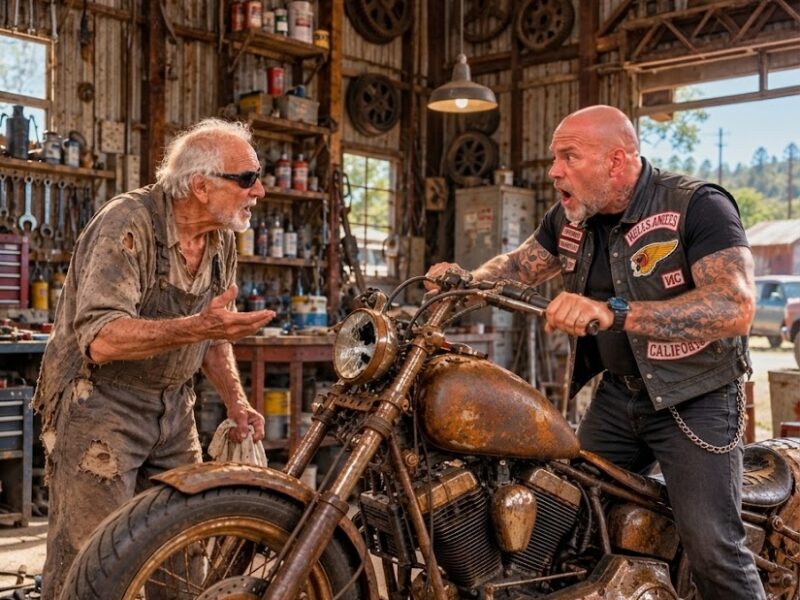
Every shop refused to touch a Hells Angel’s 1972 Harley—until a blind old mechanic said four words: “I’ll fix it.”
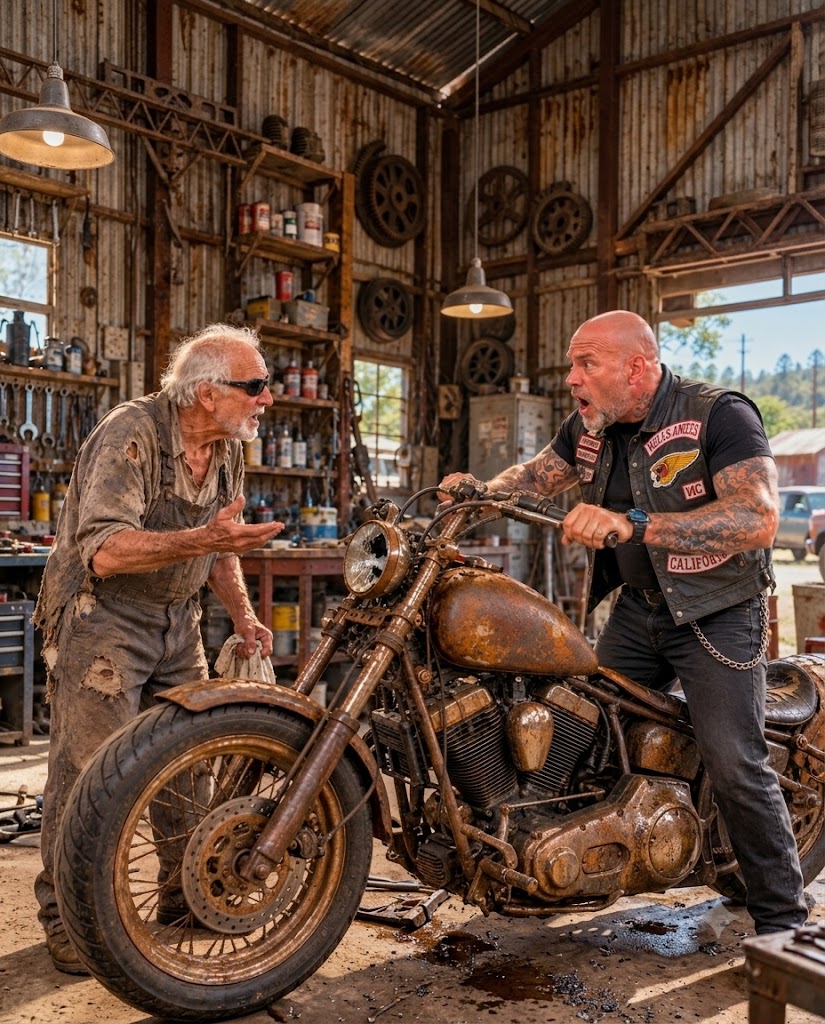
The front wheel jerked hard left, and 300 pounds of iron and man lurched into oncoming traffic on Highway 58 just outside Barstow, California.
A horn blasted — long, angry, the kind that means somebody’s already standing on the brakes.
Boots scraped asphalt as Dutch Ferraro fought the handlebars.
The bike bucked and screamed, trying to throw him under the grille of a passing semi.
He muscled it onto the shoulder and killed the engine before it killed him.
His hands shook — not from fear, but from the knock.
That deep, sick knock in the motor.
The kind that means something inside is coming apart.
A California Highway Patrol cruiser pulled up behind him, lights flashing, and the officer got out slow, hand resting easy on his belt.
“Sir, you okay? That was close.”
“I’m fine,” Dutch said. “Bike’s not.”
The officer looked at the patch on Dutch’s back, then at the faded blue shovelhead, then at the 108-degree heat shimmering off the asphalt.
“You need a tow?”
“I need a mechanic.”
The officer almost said something else, then didn’t. He just nodded and drove off, and Dutch stood there in the heat with his hands still shaking.
He was 61 years old. He’d been on the road since before dawn. He had 2 days to cover 400 miles, and right now he wasn’t covering 400 feet.
He stood over the bike — a 1972 Harley-Davidson FLH shovelhead, faded blue paint, 86,000 miles on the odometer, and a rod bearing that was trying to exit the engine case the hard way.
Big man. Gray beard down to his sternum. Arms like fence posts.
On the back of his leather cut was a patch every mechanic in San Bernardino County would recognize and wave away.
A small brass bell hung from the frame near the oil tank, swinging on a zip tie.
A guardian bell. Riders give them to each other — the idea being it catches the road gremlins, the bad luck, so it can’t follow you home.
A man can’t buy his own. Somebody has to give it to him.
This one had hung on Dutch’s bike for 30 years.
It rang soft now in the August heat — a little tin voice in all that sun.
Dutch Ferraro was 61 years old.
He’d done things he wasn’t proud of, and some he was.
But he’d learned long ago that the patch on his back did his talking before his mouth got the chance.
People saw it and filled in the rest.
Dangerous. Criminal. Trouble.
He’d stopped arguing with it around the time his hair went gray.
He didn’t ride it the last mile. He couldn’t.
A motor that knocks like that, you don’t trust its speed.
So Dutch walked it.
He pushed 300 pounds of iron down the main drag of a town that didn’t want him.
One boot in front of the other, the sun hammering his neck.
Barstow in August.
He’d been on the road since before dawn, and he had somewhere to be.
That mattered more than the heat, more than the bike.
He had 2 days to cover 400 miles, and the first shop was a chain place with a kid behind the counter who looked like he was 19 and already tired of the world.
Dutch stood in the doorway, polite, hat in his hand.
“I’ve got a knock in the bottom end,” he said.
“I can pay cash. Today.”
The kid looked at the beard, the boots, the leather.
“We don’t do bikes,” he said.
A lie. There were two Hondas up on lifts behind him, oil pans underneath, tools scattered on the bench.
But Dutch had heard that lie in a hundred towns, and he knew the shape of it.
He nodded once and walked out.
Here’s the thing about Dutch.
He was 61 years old.
He’d done things he wasn’t proud of, and some he was.
But he’d learned long ago that the patch on his back did his talking before his mouth got the chance.
People saw it and filled in the rest.
Dangerous. Criminal. Trouble.
He’d stopped arguing with it around the time his hair went gray.
The second shop was the big one.
Dillard Custom Cycles. Chrome in the windows. A line of $20,000 baggers out front like trophies.
A man came out before Dutch reached the door.
Sunglasses. Pressed shirt with the shop name on the pocket.
Royce Dillard. He owned half the block and acted like he owned the other half, too.
“Help you?” Royce said in a voice that meant the opposite.
“Got a sick motor,” Dutch said.
“72 shovelhead. The knock’s getting worse. I need it running by tomorrow.”
Royce walked a slow circle around the bike. He didn’t touch it.
He looked at the patch and something curled at the corner of his mouth.
Two customers stood nearby — a husband and wife looking at a touring bike — and Royce raised his voice so they’d hear every word.
“We don’t work on outlaw trash here,” he said.
“You and your club ride these things into the ground and then come crying when they break. I run a clean shop. Clean customers. You understand me, old man? Push it somewhere else.”
A younger Dutch would have put Royce through that showroom window.
The old Dutch felt it rise, hot and familiar. His hand even tightened.
But he looked past Royce at the wife, at the way she’d stepped back behind her man, scared of him, and he let the breath out slow.
“All right,” Dutch said quietly, and he turned the bike around.
Down by the oil tank, the little brass bell swung on its zip tie and rang once, soft.
Dutch thought about the man who’d given it to him.
He had 2 days to get where he was going.
He was going to see that man’s father.
He just didn’t know it yet.
Shop 3 laughed in his face — actually laughed, a big guy in a cutoff shirt who said, “Man, you’re kidding, right?” and went back to his sandwich.
Shop 4 was closed. A handwritten sign in the window, though he could hear a radio inside.
Shop 5, a tire place, told him to try the dealership.
And when he said the dealership had turned him away, the man behind the counter just shrugged.
“Then I guess you’re out of luck, friend.”
By then it was past 3:00, and Dutch had been pushing that bike the better part of a day.
His bad knee had gone. Every few hundred feet, he had to lean on the bars and let the shaking in his arms settle.
He was 61. The bike weighed more than he did.
And the knock, every time he nudged it forward, seemed to say the same thing.
Done. Done. Done.
He pulled into a gas station to get out of the sun.
Sat on the curb in a sliver of shade with a warm bottle of water and let his head drop.
An old mechanic was working the single bay. A man about Dutch’s age with grease to his elbows.
He came over, not fast, and looked at the shovelhead a long moment.
Not at Dutch. At the bike.
“That’s a beautiful old machine,” he said. “Shame what’s happening to it.”
“You work on Harleys?”
“I used to. Hands are shot now.”
He held them up — bent and swollen at every knuckle.
“Bottom end like that, you’re splitting the cases. That’s a real mechanic’s job, and there ain’t one in this town who will do it for you.”
He said the last part carefully, and Dutch understood he meant the patch.
Dutch started to get up.
“Hold on,” the man said.
He looked west to where the buildings gave out and the desert started.
“There’s one more. End of the old highway, past the dry wash. Crane’s Garage. 40 years.”
He paused.
“But nobody sends anybody out there anymore.”
“Why not?”
“Elias Crane went blind. 10, 11 years back. Diabetes took his eyes. Folks figure a blind man’s got no business near an engine.”
He shrugged.
“Place is falling down. But he was the best there ever was around here. Before. If any man alive would put his hands on that bike for you, it would be Elias. On account of he can’t see what he’d be putting them on.”
Dutch almost laughed. A blind mechanic.
But he was out of shops, out of daylight, out of road.
So he thanked the man and pushed the bike west toward the edge of everything, the little bell ringing with every step.
The garage sat alone past the dry wash, just like the man said.
Cinder block gone pale. A roof that sagged in the middle.
A yard full of dead cars and iron that hadn’t moved in years.
And a hand-painted sign, the letters almost gone, Crane, hanging crooked over the open bay.
It looked abandoned.
Dutch leaned the bike on its stand and stood there, too tired even to call out, deciding whether to start the long walk back.
And a voice came out of the dark of the bay before he said a word.
“That’s a shovelhead.”
Dutch turned.
“71, 72,” the voice went on, closer now. “And somebody let the bottom end go to hell. You’ve got a rod knock, son. Lower end. I could hear it from my bench when you were still back at the wash.”
A man came out into the light.
Thin, stooped, white hair, dark glasses over eyes that didn’t track.
He wiped his hands on a rag out of pure habit and stopped a few feet short of the bike, head tilted, listening to a thing that wasn’t even running.
“How long’s it been making that noise?”
“Two days,” Dutch said, rough. “Everybody in town turned me away.”
Elias Crane smiled a little, like that didn’t surprise him one bit.
“Everybody in town can’t hear,” he said. “Roll it in here, son. I’ll fix it.”
Dutch didn’t move for a second.
Nobody had said yes to him in two days.
And the first man who did couldn’t even see the patch that made everyone else say no.
He rolled it in.
The inside surprised him.
From outside, it was a ruin. Inside, every tool had a place — a nail, a hook, a slot in a wooden rack — and Elias moved through it all without hesitation because he didn’t need his eyes.
He built the whole room in his head, and he lived there.
“Center stand,” Elias said, and Dutch put it up.
“Now get out of my way, and tell me things when I ask. Don’t tell me things I don’t ask.”
He knelt by the engine, and his hands went to it the way another man’s eyes would.
Light. Vast. Reading.
He found the drain plug by feel and caught the oil in a pan set exactly where it needed to be.
His fingers walked the cases, the fins, the bolt heads, pausing at each one like he was listening through his skin.
“Somebody over-torqued this,” he murmured. “Primary cover. Ham-fisted.”
He found a loose exhaust bolt Dutch hadn’t known about, and a seep at a gasket by rubbing the dried oil between two fingers and smelling it.
“How bad?” Dutch asked.
“Bad. But not dead. Your rod bearing’s gone. We’re going to split the bottom and put it right. Take me the evening and some of the morning.”
He pulled the canvas tool roll down off the bench, and when he spread it on the floor, every wrench inside was worn smooth and bright from 40 years of one man’s hands.
“You in a hurry, son?”
Dutch looked at the bell.
“I’ve got to be somewhere by tomorrow night. 200 miles up the road. It’s important.”
“Then we’d best not waste the light I don’t use,” Elias said, and almost smiled again.
And for a while, that’s how it went.
The old man worked and the big man handed him things and kept his mouth shut when he wasn’t asked.
Elias talked low to the engine, coaxing, scolding.
He pulled the primary. He dropped the pan.
He found the cracked bearing with his fingertips and held the pieces up and said, “There’s your knock.”
Like a doctor showing you the thing that had been hurting you.
The sun went down.
Elias flicked on a work light he didn’t need.
“For you,” he said, and put a pot of coffee on a hot plate in the corner.
He poured two cups, found Dutch’s hand with the second one without fumbling, and told him to sit.
Dutch sat.
His knee stopped aching. His shoulders came down for the first time in two days.
The bike was in pieces, but they were the right pieces, laid out in rows on a clean rag, and the man taking them apart knew exactly how they went back.
A cricket started up.
The coffee was good.
Dutch thought, It’s going to be all right. I’m going to make it.
He let himself breathe.
The worst, he figured, was behind him.
He was wrong about that.
Because that was the moment Elias Crane’s hand, moving over the bare engine case, went still.
His fingers had found something low on the left side, down where the number stamps go, where a man might scratch a mark nobody ever sees.
The old man’s thumb moved across it once, twice, slow, like a blind man reading a word he knew.
The coffee cup stopped halfway to Dutch’s mouth.
“Where did you get this motor?” Elias said, all the easy warmth gone out of his voice.
It came out flat and low and shaking at the very bottom.
The way the ground shakes before you hear the thing that’s coming.
“It’s mine,” Dutch said. “Had it 30 years.”
“That’s not what I asked.”
Elias stood off his bad knees, slow.
Both hands flat on the case like he was holding the bike down or holding himself up.
“This motor, where did it come from? Before you. 30 years ago. Who built it?”
“I don’t—”
“Answer me.”
Dutch set the cup down.
“I don’t know who built it. A buddy of mine had it before me. I never knew where he got it.”
Elias turned his face toward Dutch.
Those dark glasses aimed at a man he couldn’t see.
“I built it,” he said.
“I cast this case half myself and I stamped my mark down here with a punch I ground by hand because I was a young fool and I was proud and no two of my marks were ever the same.”
His thumb pressed the spot.
“I see. 1972. I built this engine for my son.”
The whole garage went quiet.
Even the cricket quit.
“I built it for my boy Cole,” Elias said, and the name cracked right down the middle.
“For his 21st birthday. Three weeks after I put it in his hands, he patched into that club and put that leather on his back. And he and I had words a man shouldn’t say to his own son. And he rode out of this yard on this motor. And I never saw him again.”
Dutch sat very still.
“He died somewhere out on the road. 30 years ago. Somebody drove out here one day and told me my boy was dead. And then they were gone, and I never got the body back, never got the bike back, never got the truth of it. Just gone.”
Elias’s voice was steady now, and that was worse.
“I spent 10 years looking for this motor. I had people calling swap meets, calling clubs, calling everybody. And then my eyes went, and I quit. Because what’s a blind man going to do? Find a thing by looking?”
He laughed, and it was an awful sound.
“And here it rolls into my own bay. Making the exact noise I’d know in my sleep.”
He leaned on the case.
“So, you tell me, son. You wearing that same patch my boy wore. You knew him, didn’t you? You knew my Cole.”
The old man wasn’t fixing a stranger’s engine.
He was holding the last living piece of his dead son.
And the man in his garage wore the colors that took that son away.
“Yeah,” Dutch said, his voice gone to gravel. “I knew him.”
Elias’s hands tightened on the engine.
“I rode with Cole for 2 years. He gave me my road name. He taught me how to work on these old motors, though he always said he had a better teacher once, and I never knew till right now who he meant.”
He reached out slow and touched the little brass bell.
“And this bell — Cole gave me this bell the night before he died. Off his own bike. Told me a man can’t buy his own luck. Somebody’s got to hand it to him. I’ve carried it 30 years.”
His hand was shaking now.
“I never knew his daddy was alive. He never talked about home. I swear to you, I never knew.”
Elias had both hands over his mouth.
“You said nobody told you how he died.”
Dutch stood up.
“They should have. It was wrong letting you sit out here 30 years not knowing. So, I’m going to tell you right now because I was there.”
And here is where I have to slow down and tell it the way Dutch told it, because the old man deserved to hear it whole.
“We were coming down out of the mountains,” Dutch said. “Six of us. It was raining, and the road up there is bad in the rain. No shoulder, big drop on the right. There was a kid riding with us, a prospect, 19 years old, first real run. His back tire let go on a wet patch and he went down right in the middle of the lane and he slid and he stopped in the middle of a blind curve. Flat on the road. Couldn’t move. Bike on his leg.”
Elias stood there not breathing.
“And there was a truck coming. We could hear it. Downshifting, coming around that curve and no way the driver was going to see that kid until he was right on top of him. We all froze. Every one of us. Big tough men and we froze.”
He swallowed.
“Except Cole. Cole dumped his own bike in the ditch and ran out into that lane in the rain and grabbed that kid under the arms and dragged him. He got him clear. All the way to the edge.”
Dutch stopped.
His jaw worked.
“He got the kid clear,” he said again, quieter. “He just didn’t get himself clear. He turned back for his own bike because it was his daddy’s bike. I know that now and he couldn’t leave it in the road. And the truck came around the curve. And that was it. It was fast. I want you to know it was fast, Elias. He never knew.”
The old man made a sound Dutch would hear for the rest of his life.
He sank down on the floor next to the engine he’d built and he put both arms around the bare case the way you’d hold a child and he wept.
Great silent shakes. 30 years of it.
“That kid he saved,” Dutch said, his own eyes running now and he didn’t care. “That kid lived. He’s 50 years old. He’s got grandchildren. He named his first boy Cole. And every year on that day the brothers that are left ride up to that curve and we stand there and we say his name. So, he’s not just some outlaw that died on a mountain. He’s the man that ran toward the truck. That’s who your son was, Elias. You raised a man who ran toward the truck when the rest of us froze.”
Elias lifted his face.
The dark glasses had slid down and behind them his eyes were open, pale and sightless and streaming, aimed at a ceiling he couldn’t see.
“I told him he threw his life away,” the old man whispered. “The last thing I ever said to my son. I told him that patch would be the end of him. That he’d die a worthless outlaw in a ditch and no one would even know his name.”
He pressed his forehead to the engine.
“And he died saving a child. And I sent him off cursed.”
“He knew,” Dutch said. “Listen to me. He talked about his old man. Not the fight. The engine. He used to put his hand on this motor and say, ‘My father built this. There’s not a better built motor on this whole road. My father’s got hands like nobody living.’ That’s what he carried of you. Not the words you threw. The thing you built. He kept it till the second he died. And I’ve kept it 30 years since.”
For a long time, neither man said anything.
The work light hummed. The desert cooled outside.
Then Elias wiped his face with his greasy rag, put his glasses back up, and set both hands flat on the engine one more time.
But gentle now.
“Then we’re going to finish this,” he said, and his voice had steadied into something like iron.
“We’re going to put my boy’s motor back together right, you and me, tonight. And in the morning it’s going to run the way it ran the day I handed it to him. And you’re going to ride it up to that curve tomorrow and say his name. And this year—”
He stopped.
“This year, you’re going to say it for me, too.”
They worked all night.
The blind man and the outlaw in a falling-down garage at the edge of the desert under one work light neither of them needed by the end.
Elias’s hands never once faltered.
He pressed the new bearing he had Dutch fetch from a drawer of parts organized by feel alone.
He torqued every bolt by the sound and the give of it, counting under his breath.
And Dutch, who had turned wrenches his whole life, watched a blind man do things he couldn’t do with two good eyes, and understood for the first time what Cole had meant about his father’s hands.
Past 3:00 in the morning, Elias talked about Cole as a boy, about teaching him to ride in this very lot.
About the wife he’d lost before any of it, and how the boy was all he’d had, and how pride had cost him the only thing he loved.
Dutch didn’t try to fix any of it.
He just listened.
That’s a thing you learn on the road, too.
When to keep your mouth shut and be there while a man says the thing he’s needed to say for 30 years.
Near dawn, they slid the rebuilt bottom end back into the frame and buttoned up the cases.
Elias ran his hands over the whole machine one last time — slow, nose to tail — like he was saying goodbye and hello at the same time.
“Fire it,” he said.
Dutch swung a leg over.
He hit the switch. He kicked it once, twice, and on the third kick the shovelhead caught and roared and settled into a long, deep, even idle.
No knock. Not a trace.
Just that old V-twin heartbeat, strong, the way it had sounded the day a young father handed it to his son.
Elias stood in the middle of his bay with his hands out, feeling the engine shake the air, and he laughed — a good sound this time, the best sound.
A man hearing his own boy’s voice come back to him out of 30 years of silence.
And that is exactly when the trouble that had followed Dutch all day caught up to the garage.
A truck pulled into the dirt lot. Then another.
Headlights in the gray morning.
Royce Dillard climbed out of the first one with two of his shop hands, a folder of papers in his fist, already talking before his boots hit the ground.
“Crane!” Royce shouted over the idling engine. “You know why I’m here. The bank signed the paper. This whole lot’s mine end of the month. I’ve been more than patient with you, old man.”
Then his eyes landed on Dutch, on the patch, on the running shovelhead, and his face twisted.
“And what’s this? You let outlaw trash sleep in a building that’s half mine already. Figures. Birds of a feather.”
Here’s what Royce didn’t know.
He didn’t know what the last 12 hours had been.
He didn’t know whose engine that was.
And he didn’t know what was coming up the old highway behind him.
Because Dutch had made one phone call at midnight to tell his brothers he’d be late to the memorial and why.
And his brothers do not take that kind of why sitting down.
They came up the road in a line.
You heard them before you saw them.
A dozen headlights, then two dozen, then more.
The thunder of them rolling in off the desert until the ground hummed.
Harleys three abreast, filling the whole old highway, turning into Elias Crane’s dirt lot one after another until the yard that had sat empty for 10 years was packed wall to wall with iron and leather.
And the noise was like the sky clearing its throat.
Royce Dillard went white.
His two shop hands drifted back toward the truck.
The riders shut their engines down all at once, and the silence after was enormous.
A big man with a gray beard longer than Dutch’s swung off the lead bike and walked over.
He didn’t even look at Royce.
He walked straight to Elias, took the old man’s hand in both of his, and bowed his head.
“Your Cole’s father,” he said. “Dutch called us. Sir, it is an honor. We have been saying your son’s name for 30 years. We didn’t know you were out here. That ends today.”
One by one, the brothers came and took the blind man’s hand.
30 of them. 40.
Each one quiet, each one saying the same thing.
“We knew your boy. Your boy was a good man. Your boy saved a life.”
Elias stood in the middle of it with tears running down under his dark glasses, holding on to hand after hand.
A man who thought he was alone in the world finding out he’d had a family the whole time and never knew it.
And Royce Dillard stood off to the side with his bank papers going soft in his sweating hand — forgotten, small.
In a yard full of the men he’d spent a lifetime sneering at, watching them treat the blind old mechanic he’d been trying to run off his land like he was the most important man in California.
Because that morning, he was.
“You.” Dutch finally turned to him.
He didn’t raise his voice. He didn’t have to.
“Yesterday, you wouldn’t put a wrench to my bike because of what’s on my back. This man did it blind, overnight, for a stranger. You want to know the difference between you and him, Royce? He’s got no eyes and he saw me just fine. You’ve got two good ones and you’ve never once seen a single soul standing in front of you.”
He nodded at the papers.
“And now about that lot.”
It didn’t come to anything ugly.
It didn’t need to.
One of the brothers ran a software company, if you can believe it.
And another had a cousin at the bank.
And before the sun was full up, there were quiet arrangements being made that meant Elias Crane would own his garage free and clear for the rest of his days.
And Royce Dillard would be finding somewhere else to expand.
The papers in Royce’s hand were an offer to buy the lot for $7,000 — a lowball so insulting it was practically a joke.
The brothers countered with a number that made Royce’s jaw drop, and a lawyer who made him sign.
Royce got in his truck and drove off, and nobody watched him go.
He’d stopped mattering the second the engine shut off.
They rode up to the curve that afternoon.
All of them.
And Elias Crane rode too — on the back of his son’s bike, his arms around Dutch’s waist, feeling the motor he’d built with his own hands carry him up out of the desert and into the mountains for the first and only time.
At the curve they parked in a long line and shut the engines down.
And stood at the edge where the road dropped away.
The kid Cole had saved was there. 50 years old now. Gray himself.
And he brought Elias forward by the arm to the guardrail.
Dutch untied the little brass bell from the frame — the one Cole had handed him the night before he died.
And pressed it into the old man’s palm and closed his fingers around it.
“This is yours now,” Dutch said. “It was always coming back to you. You just had to wait on it.”
Elias held the bell up and gave it one small shake, and that thin tin voice rang out over the mountains.
The same sound that had followed Dutch down 10,000 miles of road.
The sound of a man’s luck being handed to him by someone who loved him.
And then one by one, every rider on that mountain said the name out loud.
“Cole Crane.”
40 voices.
The father last of all, in a whisper.
The name he’d cursed 30 years ago, said now the way it should have been said then.
With pride.
Elias lived nine more years.
The garage never sat empty again.
Riders came from three states to have the blind man lay his hands on their motors, because word gets around, and because there’s not a man alive who wouldn’t rather be seen by someone who looks with his hands than waved off by someone who only looks with his eyes.
Dutch came through every chance he got.
They’d sit in the bay with the coffee going and not say much, which is its own kind of talking.
And when Elias passed, they buried the bell with him.
Dutch said it was right.
“A man can’t buy his own luck,” he said. “Somebody’s got to hand it to him.”
And the old man had been handed back the only thing he’d ever really wanted at the very end.
By the last person in the world you’d expect.
Carried to his door by a dying engine and a patch everybody else had turned away.
The first shop said no.
One blind man said, “Roll it in here, son. I’ll fix it.”
He fixed a lot more than the bike.









