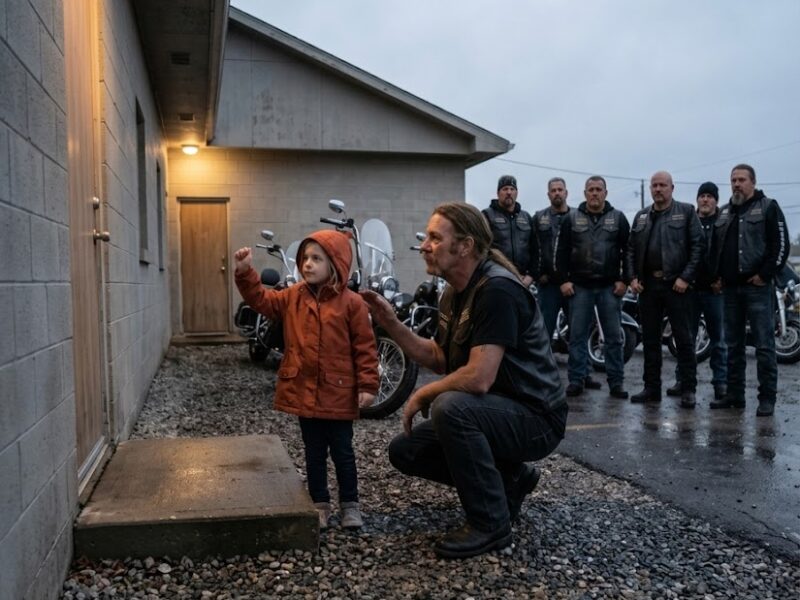
Every night at nine, a little girl knocked on the shelter door. But by the time she arrived, 400 bikers were already there at eight.
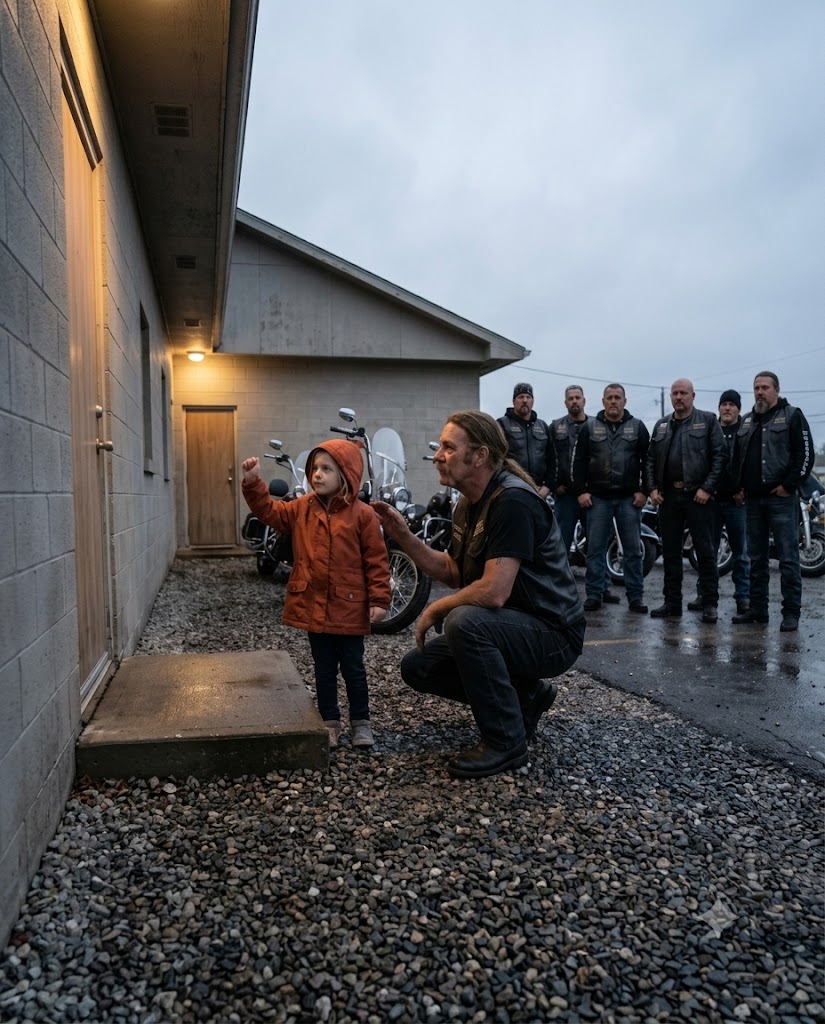
Forty-one nights in a row, and not one of them ended the way it should have. That was the number Harlon Doss carried in his chest by the time it was over. Forty-one, worn smooth as river stone from the handling, turned over so many times it had lost its edges but none of its weight.
You would need to understand what forty-one nights looks like on a child’s face before you could understand what four hundred men on motorcycles looked like arriving at dawn. And the reason none of them could have explained, not even Harlon, was the part nobody was ready for.
The amber glow of the shelter’s porch light against the black desert sky. A little girl, eight years old, standing at a locked door at exactly nine o’clock. Every single night for forty-one nights without fail.
And none of them knew why until they did. The four hundred came first. The reason came after. That is where this story begins.
The first Monday of October in the high desert north of Flagstaff comes in hard and flat. The light arriving low and copper-colored from the east, scraping across the creosote flats like a blade laid on its side. The air has already dropped twenty degrees from its September self and carries the smell of cooling basalt and something older underneath — the dry mineral breath of a landscape that has been burning and freezing in alternation for a thousand years without asking permission of anyone.
By six in the morning, the sky above the mesa was the exact gray of old anvil iron. By six-fifteen, the Ash Creek Riders were already in the gravel lot behind the fuel stop on Route 89, engines cooling, breath fogging, coffee traveling hand to hand in a single thermos nobody had remembered to cap properly.
There were eleven of them that morning, not counting the two who were pulling a late shift at the aggregate yard and would roll in by noon. Thirteen men total — a small number for a club that had once stood sixty strong in the early years, back when the founding chapter had ridden out of Prescott and established the Northern Chapter on a handshake and a map drawn on a paper bag.
Thirteen was what remained after the road took what it took. After some men aged out and some moved south for work, and some simply dissolved into the ordinary world and stopped coming to meetings, the club had contracted the way things do when the reasons that built them become harder to hold on to.
But the men who stayed were the ones who could not imagine being anything else. Harlon Doss was among them. He was fifty-four years old, six-foot-one, built in the way that manual labor and desert living build a man — wide through the shoulders and thick through the forearms, with hands that looked like they had been assembled from parts meant for heavier use than hands generally get. His beard was iron gray and full, trimmed close enough not to catch in a visor but left long enough to mean something.
He had a scar along his left jawline that he had stopped explaining years ago, not because the story was bad, but because it had ceased to matter. He was the club’s president, the last of the four men who had helped plant the flag for the Northern Chapter nineteen years before, and he wore that fact the way a beam wears a load. Not proudly, not reluctantly — just structurally.
He was holding the thermos when Tommy Briggs nodded toward the main road and said, “Shelter’s got a new intake coordinator.” Harlon did not look up. “I know. Young woman comes from the Cottonwood office.”
Harlon handed the thermos to the man on his left, a broad-shouldered rider everyone called Patchwork on account of a decade-old story involving a tent and a lightning storm that nobody told correctly anymore. “She called the club,” Harlon said. “Day before yesterday.”
The October light laid itself thin and hard across the gravel, and nobody said anything else for a moment, which was the Ash Creek Riders’ way of agreeing that a thing was worth paying attention to.
The Cottonwood Family Shelter had operated out of a converted ranch house eleven miles north of the Flagstaff city limits for going on sixteen years. It was a long, low-slung building the color of bleached adobe sitting back from the highway behind a line of drought-stripped junipers with a porch light that burned amber twenty-four hours a day because the director, a woman named Cecilia Montoya, had made a rule in the shelter’s second year that the light would never go dark.
It was a rule she could not have explained in procedural terms, but understood in the way you understand things that have kept their shape through difficulty. The shelter served women and children in transition — a term that sounded provisional and brief, the way terms always do when they are standing in for something more complex. Which is to say it served people in the specific kind of pain that comes from having had a home and no longer having one, and from needing the next thing to hold before the last thing fully let go.
On the morning Harlon Doss received the call from the intake coordinator, the shelter had fourteen residents — nine women and five children — and a waiting list of seven more families whose circumstances had not yet reached the threshold of official emergency, which meant they were still in the hallway between bad and worse, which is a very particular and exhausting place to wait.
The intake coordinator’s name was Renata Cruz. She was thirty-one, had driven up from Cottonwood eight weeks before with two suitcases and a working knowledge of Arizona’s emergency housing statutes, and she had placed the call to the Ash Creek Riders after finding a year-old flyer tacked to the bulletin board outside Cecilia’s office.
The flyer was faded, its edges curled from the dry air, but the number was still legible. Harlon had answered on the second ring. Renata had introduced herself, explained the shelter’s situation, hesitated, then said the thing she had actually called to say, which was not about plumbing repairs or firewood deliveries or any of the practical requests the club had historically fielded from places like this one.
“There’s a child,” she said. “She’s been doing something, and I don’t know what to do about it.” Harlon waited. “Every night at nine o’clock,” Renata said, “she comes to the front door and knocks. And then she waits.”
Harlon said, “What does she want?” Renata was quiet for a moment. “That’s the part I can’t figure out,” she said. “She won’t say.”
Her name was Petra. Eight years old, dark-haired, wearing the same pair of knockoff canvas sneakers every day in a size that was already a half-size too small, the toes pressing white crescents into the fabric from the inside. She had arrived at the shelter thirty days before with her mother, a woman named Sylvie Gyos, who had driven them north from Prescott in a borrowed Civic with a cracked taillight and a single black garbage bag of belongings split between them.
Sylvie was twenty-nine and had the careful stillness of someone who had learned to take up as little space as possible as a matter of survival. She spoke to Renata in the measured, document-ready way of someone who has been through intake before — answering each question fully and without elaboration, neither performing suffering nor concealing it.
She signed the forms. She arranged her daughter’s things on the narrow shelf beside the bunk. She thanked Cecilia for the toothbrushes. And then that first night, when the clock in the hallway read nine o’clock, Petra stood up from her bunk, walked to the shelter’s front door, and knocked on it from the inside.
Renata was still at her desk. She heard the knock, thought for a moment it was someone outside, went to the door, and found Petra standing in the entry hall in her socks, her hands clasped in front of her in the particular way children clasp their hands when they are trying to be taken seriously.
“Can I knock on the door?” Petra said. “You just knocked on it,” Renata said, keeping her voice even. “I need to knock on the outside part,” Petra said. “Just for a minute.”
Renata opened the door and Petra stepped out onto the porch in the amber light, turned to face the desert, and stood there for exactly what Renata would later estimate was three minutes. She did not speak. She did not look around. She stood with her eyes fixed on the middle distance — the direction of the highway — and then she turned, walked back inside, and said, “Thank you.”
She went to bed without any further explanation. Renata stood in the doorway for a long moment after the girl disappeared down the hall. The junipers were black against a black sky. The highway was a distant gray line. She closed the door.
The next night at nine o’clock, Petra did it again. And again the night after that. By the fourth night, Renata had taken to being near the door at ten minutes to nine without quite acknowledging to herself that she was waiting. By the seventh night, she had asked Petra quietly during the afternoon whether she would like to talk about the knocking.
Petra had looked at her with an expression that was not evasive, but was very settled — the way a child looks when they have decided something, and do not expect the decision to be challenged. “Not yet,” Petra said.
By the thirtieth night, Renata called the Ash Creek Riders.
Harlon drove out to the shelter on a Tuesday morning alone, the road empty at seven a.m., the light coming in level and cold from the southeast. He parked the bike on the gravel shoulder, not in front of the door, which he had learned years ago was a detail that mattered more than most people thought. Where you left the bike told people what kind of visit you intended.
He walked up to the porch and knocked, and Renata Cruz opened the door in the same motion, as if she had seen him coming through the window. She was a small woman, dark-eyed, with the posture of someone who stood at counters and tables more than she sat behind them. She shook his hand without hesitation.
Most people, meeting Harlon for the first time, had a visible moment of recalibration. His size did that. His beard did that. The club colors did that — the Ash Creek Riders patch on the back of his cut, the president’s bar underneath, the chapter rocker below that. Renata Cruz recalibrated in about one second and then moved past it, which told him something about her.
She led him to a small office off the entry hall and offered him a chair that was slightly too small and coffee in a mug that said “World’s Best Runner.” He took the coffee and sat. She told him about Petra, about the thirty nights, about the nine o’clock knocking, about the way the girl stood facing the desert as if she were listening for something.
Harlon held the coffee mug in both hands and did not speak until she finished. “Where’s the mother?” he said. “Work,” Renata said. “Cecilia helped her find a breakfast shift at a place on Route 89. She’s usually back by two.”
“The mother know the girl does this?” “Yes.” “What does she say about it?” Renata folded her hands on the desk. “She says Petra will explain when she’s ready.”
Harlon looked at the mug. The coffee was good, dark, and had been made by someone who understood that the first thing of the morning should be solid. He thought about explaining and readiness and the distance between them. He said, “Can I meet her?”
They found Petra in the common room, sitting cross-legged on the floor with a construction paper project in her lap. Four colors of crayon laid out to her left in a row. She was making something that might have been a map or might have been a building or might have been something only she could name.
She looked up when Renata brought Harlon in and did not flinch, which surprised him. Most children flinched. He crouched down so he was not a tower standing over her. Up close she was small even for eight, with dark circles under her eyes that had the quality of geography — as if they had been there long enough to belong.
“I’m Harlon,” he said. “I know,” she said. “Renata told me.” “She said you know how to knock on a door,” he said.
Petra looked at him carefully. Not guardedly — carefully, in the way of someone taking a measurement. “I have to do it every night,” she said. “Why nine o’clock?” he asked.
She picked up a blue crayon and made one mark on the paper. “Because that’s when he’ll come,” she said. Harlon did not ask who. Not yet. He looked at what she was drawing. It was a door. She had drawn a door with a porch light over it, amber-colored, and outside the door she had drawn a long road going off the edge of the paper into nothing.
“Can I see that tomorrow?” he said. She handed it to him immediately, without hesitation, as if she had been holding it for him all along. He stood up and the movement was careful in the way large men are careful around fragile things.
He said goodbye and she went back to her crayons, and he walked out to where Renata was standing in the hallway and said, “Find out when the grandfather went missing.”
Harlon was back in his truck. He had left the bike at the fuel stop, the wind having come up cold from the north, and he was fifteen minutes down Route 89 when Renata called his cell. He put it to his ear and drove.
“Two months ago,” she said. “His name is Delgos. Petra’s mother’s father. He was living rough somewhere between Flagstaff and Williams after the VA lost his file in a system transition and his housing voucher got suspended. He called Sylvie twice in September. Then the calls stopped.”
Harlon’s hand tightened on the wheel. Not a fist — just a tightening. The kind that happens before the rest of the body knows what the hands have already decided. “She’s knocking,” he said, “because she thinks he’ll come.”
Renata said yes. That was her understanding. That Petra had told her grandfather in one of those September calls which shelter they were at. That she had told him to come at nine because nine was after dinner and before lights out and she would be there. That she had told him she would knock on the door every night so he could hear it from the road and know the shelter was open, so he could find it in the dark.
Harlon sat with that for the length of three highway miles. A man somewhere between Flagstaff and Williams, a VA file, a housing voucher, a system transition. He knew that language. He knew the particular bureaucratic gravity of a system transition, which was the phrase institutions used when they meant that records had been moved between databases and some of them had not survived the crossing.
He knew it the way a man knows a thing that has happened to someone he loved. His younger brother, Marcus, had come back from two tours in the Gulf with paperwork that was supposed to follow him and did not. Had spent fourteen months in a corridor of appeals and case numbers and incorrect addresses before Harlon had finally driven to Phoenix and sat in a waiting room for six hours and then said with great and level courtesy exactly what would happen next if the file was not found.
The file had been found. But Marcus had spent those fourteen months in a place that was not a home, and something in him had contracted during that time in a way that did not fully open back up. And Harlon had never forgiven himself for taking so long to go to Phoenix and sit in that chair.
That was the loss he carried. Marcus was still alive, still riding, but smaller inside than he should have been. And Harlon knew that some of that was the corridor, and some of that was the waiting room, and some of that was the brother who had not come sooner.
He pulled off the highway onto a dirt track and sat in the truck with the engine running, and let that land in him again, fresh, the way old grief will do when it finds new geography to settle into. A little girl knocking on a door at nine o’clock in the dark so her grandfather could hear it from the road.
He called Tommy Briggs. “Get everybody,” he said. “And start calling the chapters.”
By Thursday morning, the Ash Creek Riders had thirteen men in the lot and a plan that had been mapped on the back of a laminated menu from the diner on Cedar Street, where they had held the meeting. Harlon stood at the head of the table and laid it out in the plain operational language he used when the work was specific and the margin for drift was zero.
They needed to locate one Delgos, approximately sixty-two years old, U.S. Army veteran, last known position somewhere in the corridor between Flagstaff and Williams on or near U.S. Route 66, who had stopped communicating approximately six weeks prior. They also needed, in parallel, to engage with the Northern Arizona Veterans Services Office in Flagstaff to locate his suspended housing voucher file, to find whoever had administrative authority over the system transition error, and to begin the formal process of file reinstatement before the end of the fiscal quarter, which was twenty-three days out.
After the fiscal quarter, the reinstatement path required a second-level appeal that could take an additional sixty to ninety days. Twenty-three days. Harlon said it once and did not repeat it.
Patchwork, who had done two years of paralegal work at a Prescott firm before the road pulled him back full-time, wrote down the case terminology Renata had given Harlon and said he would handle the front office. A rider named Gus Salter, who ran a vehicle recovery service out of Bellemont, said he had three spotters he could put on Route 66 by Friday morning with photographs.
A man named Cord Ellery, youngest of the chapter, twenty-eight years old and still earning his full patch, said his uncle drove long haul between Flagstaff and Winslow and knew every unofficial camp and pull-off in a forty-mile radius. Harlon listened to all of it and said, “The girl knocks at nine. We need him found before she has to knock a forty-second time.”
That was a Thursday. By Thursday afternoon, Cord Ellery had a list of eleven locations from his uncle. By Thursday evening, Gus Salter’s spotters had been to three of them. The Veterans Services Office had received a written inquiry signed by the club’s attorney of record, a Flagstaff woman named Bernadette Shiao, who had been doing pro bono work for veterans housing cases since 2018 and who had called Harlon back within an hour of receiving his message and said, “I know this file type. Give me the name.”
Harlon gave her the name. She said, “Patchwork will call me tomorrow.” And then, because the phone calls were made and the spotters were out and the attorney was working and the morning was going to require more people than thirteen, Harlon called the Albuquerque chapter, then the Holbrook chapter, then the Sedona Riders, who were loosely affiliated but always answered.
He said the same thing to each of them. “We need numbers. We need eyes on Route 66. We need bodies in a waiting room. And we need to find a veteran named Delgos before his granddaughter runs out of nights to wait.”
He did not explain anything else. He did not need to. By Sunday, three hundred twelve riders had confirmed. By Monday morning, the number was four hundred seven.
Four hundred seven. Harlon wrote it down on the corner of the laminated menu and then put the menu in his jacket pocket and rode out toward Williams in the gray four-thirty light. The desert still black on either side of the road. The stars going out one by one overhead like the world was turning something off for the day.
The Veterans Services Office on Elden Street in Flagstaff was a two-story building with a parking lot designed for ordinary traffic and a Tuesday morning that was not ordinary. Forty-one bikes stood in rows in the lot with the geometric precision of something that had been arranged rather than parked.
Inside, in the waiting area, another thirty men sat in the narrow plastic chairs and stood along the walls with their arms folded and their cuts showing the Ash Creek Riders patch and the patches of three other chapters. They were not loud. They were not menacing in any active sense. They were simply present in numbers, with a stillness that had the weight of something load-bearing.
The office manager, a man named Robert Farel, who had worked federal intake for eleven years and believed himself to have seen most things, came out from behind the reception desk at eight fifty-two in the morning, looked at the room, and then looked at Patchwork, who had been designated the point of contact and was sitting in the front chair with a folder of printed documents on his knee.
Robert Farel said, “Which of you is here about the GGO’s file?” “All of us,” Patchwork said. Robert Farel went back behind the desk and picked up a phone.
Bernadette Shiao arrived at nine-fifteen with a laptop bag and a voice recorder and a manner so precise it had the quality of a tool that has been used many times and maintained carefully. She shook Robert Farel’s hand and said, “The reinstatement is possible within the standard window, and here is the documentation that establishes that.”
She laid papers on his desk in order, each one numbered in the corner. The file had been suspended due to an address discrepancy created during the database transfer in August. The correct address was documented in the pre-transfer record. The discrepancy was a system artifact, not a circumstantial change.
Reinstatement required a supervisor’s signature and a supporting affidavit from someone with personal knowledge of the applicant’s continuous residency intent. Harlon signed the affidavit. He had never met Delgos. He signed it on the basis of the phone calls Delgos had made to his daughter in September, which Sylvie had written down in a statement that Renata Cruz had notarized the day before.
The supervisor’s name was Janet Aldakoa. She was a woman of fifty-eight who had processed veterans housing files for twenty years and who had spent the last four days hearing from Bernadette Shiao’s office by phone, email, and a written letter sent certified. She came out to the waiting room at ten-forty and looked at the men in the plastic chairs and along the walls and said, “Mr. Doss.”
Harlon stood. She handed him a signed copy of the reinstatement authorization. She did not explain herself. She looked at him for a moment and then said quietly, “Tell me his name again.” “Delgos,” Harlon said. She nodded once, as if she were writing it somewhere internal, and went back to her office.
Outside in the parking lot, Patchwork called Bernadette Shiao’s cell and said, “We have the authorization.” There was a pause on the line. And then Bernadette said very quietly, “Good.” The word carried something in it that was not professional.
Patchwork relayed the news inside and there was no cheer, no celebration — just forty-one men breathing differently. The authorization was a document. Delgos was still somewhere on Route 66.
He was found on the forty-first morning, which was a Friday, by Cord Ellery’s uncle, Perez Ellery, who drove his long-haul Kenworth out to a pull-off two miles east of the park’s exit before his first run of the day on a route tip that had come through Gus Salter’s network the night before.
Delgos was in a sleeping bag behind a stand of piñon pines, alive, with a chest infection that had been working on him for ten days and had left him without enough voice to call anyone. He was sixty years old, not sixty-two as Harlon had guessed, lean and weathered, with the particular kind of stillness in his eyes that comes from having spent time in places where stillness was the difference between safe and not.
He had Petra’s drawing of the door. He had cut it from a letter Sylvie had mailed to a camp address in September before the calls stopped, and he had kept it folded in his shirt pocket through six weeks of cold nights in the high desert, and the paper had gone soft at the folds from being opened and closed so many times.
He could not speak above a whisper when Perez Ellery found him, but he held up the drawing when Perez crouched next to him — held it up the way a person holds up something that explains everything. And Perez, who was not a man who cried in the ordinary course of things, looked at the amber-colored light drawn in crayon over the door and did not say anything for a moment and then said, “We’ve been looking for you.”
Delgos’s chest infection required two days at Flagstaff Medical Center — a course of antibiotics, fluids, and oxygen, and the presence of Sylvie Gyos, who arrived on Friday afternoon and sat in the chair beside his bed and held his hand without speaking for a long time. She had taken the afternoon off from the breakfast shift without asking, and her manager had said nothing because something about her expression when she got the call had made questions feel unnecessary.
Renata Cruz drove Petra to the hospital on Saturday morning, and the girl walked into her grandfather’s room in her two small canvas sneakers and stood at the side of the bed and said, “I knocked every night.” Delgos, still hoarse, looked at his granddaughter with an expression that could not be adequately measured by any vocabulary available for the task. He said, “I heard it.”
He had not heard it — not literally, not from two miles east of the park’s exit. But he had heard something, which is different and also true. And Petra nodded as if this was the only confirmation she had required, and then climbed up onto the bed beside him, and that was that.
Outside in the corridor, Harlon Doss leaned against the wall with his arms folded and looked at the linoleum floor and felt the thing in his chest that had been waiting for nineteen months since the day he had understood what the corridor of appeals had cost his brother shift in a way that did not eliminate it but changed its character. It did not lift. It redistributed.
That is what some things do when they find the right occasion. They do not go away. They become part of the bearing, which is a different function than a wound and more sustainable over time.
The housing voucher was reinstated and processed in sixteen days, which was seven days under the fiscal quarter deadline. Delgos was discharged from the hospital on a Tuesday. And on the following Monday, he had a room at the Flagstaff Veterans Housing Facility on Route 89, four miles from the Cottonwood Family Shelter — close enough that Sylvie could drive the borrowed Civic from one to the other in eleven minutes.
Cecilia Montoya held a small gathering at the shelter on the last Friday of October, which she called, with characteristic restraint, a meal, but which involved a folding table of food that was by any measure a celebration. The Ash Creek Riders sent seven men, which was the number the shelter’s common room could accommodate without requiring people to eat in the hallway.
And those seven men ate plates of posole and green chile rice and said almost nothing, because they were men who understood that their presence at a table was a more complete statement than any conversation they might attempt to have. Petra sat across from Harlon and drew on a piece of paper while she ate, which was her way of doing two things at once.
And partway through dinner, she slid the paper across the table to him. He picked it up. It was a row of motorcycles drawn in profile, blue crayon, each one the same size, lined up with the precision a child achieves when the thing they are drawing matters to them.
She had drawn fourteen of them, and then stopped. Underneath she had written, in the large serious printing of a child who is still deciding how much space letters deserve, the words: *They came.*
Harlon looked at the drawing for a long time. Then he folded it carefully — the way you fold something that is going into a shirt pocket for keeps — and put it in his inside jacket pocket, where it made a slight rectangular shape over his sternum. He said thank you. Petra said, “You’re welcome,” and went back to her posole.
In the months that followed, the Ash Creek Riders established what they called the Route 89 Fund — a small monthly pooling of dues that went directly to veterans emergency housing cases in Yavapai and Coconino counties, administered through Bernadette Shiao’s office, which handled the paperwork at cost.
In the first year, the fund processed nine cases. In the second year, seventeen. By the fourth year, the Northern Arizona Veterans Services Office had a laminated protocol posted inside its front door titled *Emergency Contact: Veterans Housing Reinstatement*. And the first name on the contact list was Patchwork’s, with a cell number that rang to a man who answered in two rings every time because he had made a personal rule of it.
The shelter hung a photograph in its entry hall near the door with the amber porch light — taken on the Monday Delgos moved into his room. In the photograph, he is standing at the door of his unit with Petra beside him, her hand in his, both of them looking at the camera with the particular expression of people who have been cold for a long time and have recently come inside.
Behind them in the parking lot, visible over Delgos’s shoulder, there are motorcycles — too many to count in a photograph. But the number was four hundred seven. Four hundred seven men who came because a child had decided that if you knock on a door long enough and steady enough and without fail, whatever is lost in the dark will find its way to the light.
They had come at eight, an hour before the nine she always kept, so that when Petra stepped out onto the porch for the forty-second time, she would not be standing in the desert alone. And what she found instead of silence and a dark road was four hundred seven engines still warm from the ride, and the smell of desert and exhaust, and the amber light above the door turning every face the color of something kept burning.
The roar that had always frightened strangers off the highway was, when you knew what it meant, the oldest kind of knock. The sound of a door thrown open from the outside, as wide as it will go, by hands that had no intention of letting it close again.
That photograph stayed in its place on the wall for four years before Cecilia Montoya had it reframed because the original frame had begun to bow at the corners from the dry heat cycling through the entry hall every summer, and she would not let it warp. The new frame was plain oak, the kind that does not announce itself.
And when she rehung it, she stood back and looked at it for a moment and decided it was exactly right — not better, exactly the same thing it had always been, only held more firmly.
Harlon drove out to the shelter on the day she rehung it, not because he had been called, but because he had been in the area and had made a small and private habit of passing the driveway on his way up Route 89. He had not always pulled in, but that afternoon he did, and Cecilia showed him the reframed photograph without ceremony, and he stood in the entry hall and looked at it with his arms at his sides and said nothing for long enough that Cecilia went to put the kettle on, because she understood that some silences needed a reason for the other person to leave the room.
Delgos attended the second annual Route 89 Fund gathering at the fuel stop on the first Saturday of November, which had become the date they kept because it was close to the anniversary of the Tuesday morning in the Veterans Services waiting room, and because November in the high desert had a particular quality of light that seemed right for the occasion — low and golden and slightly stern, the kind of light that does not flatter anyone but makes everything look true.
Delgos came with Sylvie, who brought posole in a pot wrapped in a towel, and they sat at the folding tables the club had set out in the gravel lot and ate with the men who had ridden for them without knowing them, which is its own category of generosity and deserves its own name, though nobody had found one that fit yet.
Petra was twelve by then. She sat beside her grandfather and ate and watched the riders with the calm, assessing attention she had always had, which had not diminished with age but had acquired more patience. At some point during the meal, she produced a notebook from her jacket pocket — a small one with a green cover — and wrote something in it, and then put it away without showing anyone.
Harlon noticed, because he noticed most things. And after the meal, when the tables were being folded, he asked her what she had written. She looked at him with the same measuring quality she had used at eight when she had handed him the drawing of the door. “I’m keeping track,” she said.
“Of what?” he said. “Of the numbers,” she said. “So I remember them right.”
He thought about the drawing in his shirt pocket — the one she had made at the shelter dinner four years before, which he had transferred from jacket to jacket with the same care other men applied to wallets and keys, so that it was with him most days without requiring a decision. He thought about fourteen motorcycles in blue crayon and the words *They came* in the large printing of a child who knew what she was recording.
“Four hundred seven,” he said. She wrote it down. He watched her write it and felt something in his chest settle the rest of the way — the last fraction of a fraction of the weight he had been redistributing since the corridor of the hospital, coming finally to its place of rest. Not gone, but load-bearing, as he had known it would be.
Tommy Briggs came up behind him and handed him a coffee from the diner across the road and said, “Next year we should get a bigger pot.” Harlon said, “Sylvie’s pot was the right size.” Tommy looked at the pot, which was in fact not large, and said, “I meant for coffee.”
Harlon drank the coffee and looked out at the highway. The October light lying flat and copper across the asphalt the same way it had the first Monday of the month when this had all begun — when the thirteen of them had stood in this lot, and the thermos had gone around uncapped, and nobody had known yet what the next forty-one nights would require of them.
The road ran north from where he stood, into the scrub and the basalt and the distance, and it looked in that light the same as it had always looked — open in both directions, indifferent to the intentions of whoever traveled it, carrying whatever came. He had ridden that road for thirty years. He had been afraid of very little on it.
But he had learned something in the past four years that the road had not taught him, which was that the distance between a person who is lost and a person who has been found is sometimes exactly the length of a child’s knock on a door repeated without fail in the dark for as many nights as it takes.
Bernadette Shiao’s office sent the fund’s annual report in December of that fourth year. Thirty-one cases processed in the calendar year. Twenty-nine successful reinstatements. Two cases still pending, both with strong documentary foundations and timelines within the appeal window.
The report was two pages and used the vocabulary of case management and fiscal review, which was the right language for what it was. And at the bottom, Bernadette had written by hand in the margin the thing she did not include in the official text — the number of people who were sleeping inside because of the fund’s work that year. It was forty-four.
Harlon read the number at his kitchen table in the early morning. The desert outside his window still dark. The wood stove making its low ticking sound as the metal expanded in the heat. Forty-four.
He folded the report and put it on the stack of papers he kept weighted down by an empty coffee can near the door, where he would remember to bring it to Patchwork, who maintained the fund’s binder. He sat for a moment with his hands around his mug and the ticking of the stove and the dark outside the window, and he thought about knocking — about the specific faith required to knock on a door in the dark when you do not know who is behind it or whether anyone is there or whether the sound will carry far enough to reach the person you are making it for.
He thought about Petra standing on the porch in her two small sneakers in the amber light, her eyes on the middle distance, the highway, a gray line at the edge of visibility. He thought about Delgos in a sleeping bag behind piñon pines with a piece of paper soft at the folds tucked against his chest.
He thought about his brother Marcus and the fourteen months and the waiting room in Phoenix, and the way some contractions do not reverse completely but can, with enough time and the right occasion, be lived around. He did not think any of these things in sequence or with any attempt to make them resolve into a conclusion. He simply let them sit with him in the kitchen in the early morning while the stove ticked and the dark outside began almost imperceptibly to give way at the eastern edge to something that was not yet light but was the beginning of the direction that light would come from.
That was enough. That had become enough.
Four hundred seven riders had come to a shelter door on a high desert morning in October and had arrived an hour early so a child would not have to stand alone in the dark. They had not known, most of them, anything beyond what Harlon had told the chapters on those phone calls. A veteran, a file, a granddaughter waiting. That had been sufficient.
It had always been sufficient, which was the thing the world kept forgetting and the road kept proving mile by mile in the particular way that evidence accumulates — not in courtrooms or offices, but on open highway at dawn, when the engines are warm, and the direction is clear, and the number of people willing to ride toward someone else’s trouble turns out again and again to be larger than anyone thought to expect.
The amber light above the shelter door burned through every night it was needed. It was still burning. It would keep burning for as long as someone remembered to change the bulb. And someone always did.
Because some lights, once you have seen what they can guide home through the dark, you do not allow yourself to let go out.









