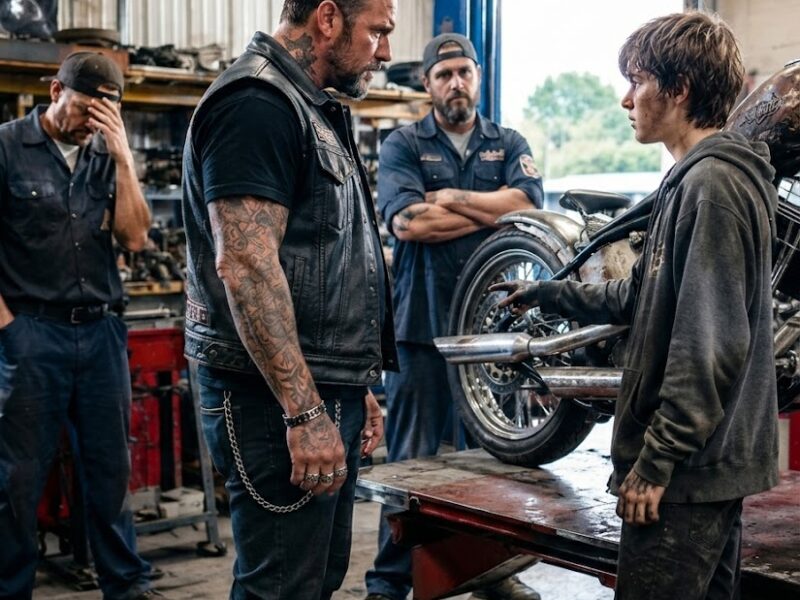
Every mechanic in town gave up on a 50-year-old Hells Angels bike. Then a homeless boy stepped forward and said four words: “I’ll fix it.”
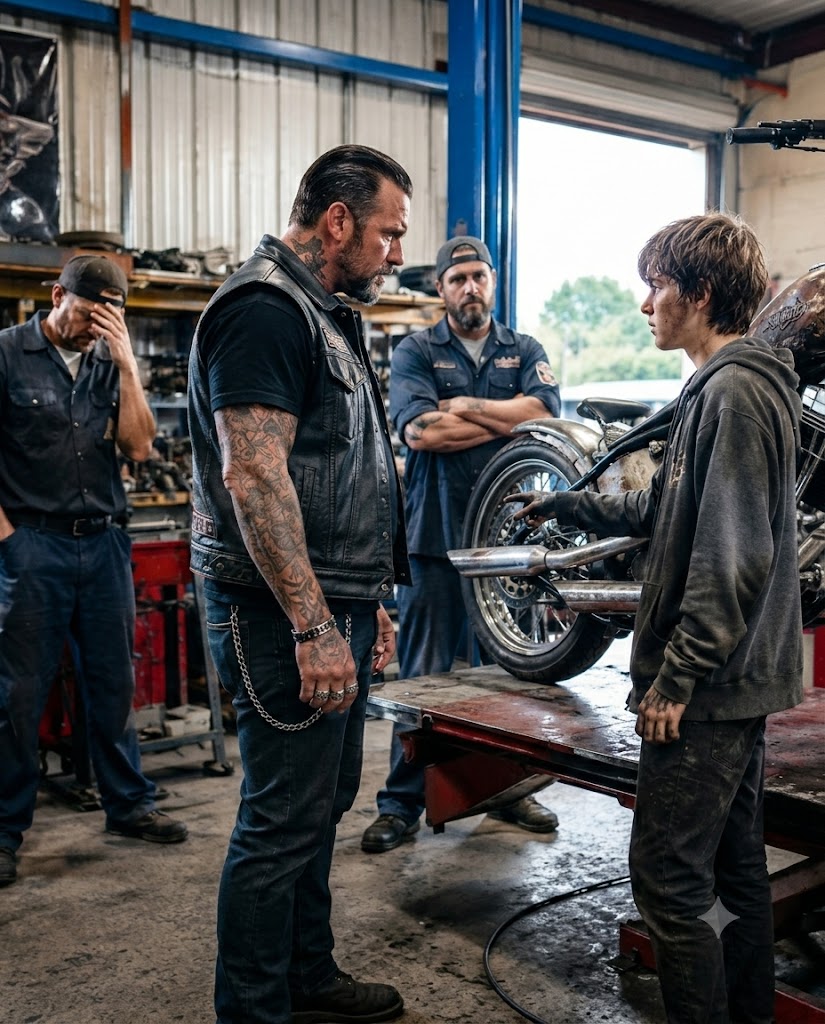
The greatest mechanics in Oakland walked away from a legendary 1974 Harley Shovelhead, swearing the machine was cursed.
Its owner, a ruthless Hell’s Angels Enforcer, was completely out of options.
Then, a 16-year-old runaway living in a cardboard box made a promise that should have gotten him killed.
“I’ll fix it.”
The air inside Iron and Oil Custom Garage tasted of stale cheap beer, vaporized engine degreaser, and impending violence.
Sitting dead center on the hydraulic lift was a ghost made of steel and chrome.
A 1974 Harley-Davidson FX Superglide boasting a massive Shovelhead engine, a custom coffin gas tank, and fifty years of brutal history.
To the untrained eye, it was just a rusted antique.
But in the underworld of Oakland, California, it was a holy relic.
The bike had belonged to Wild Bill Henderson, an original legendary member of the Hell’s Angels Motorcycle Club who had perished in a highway wreck decades ago.
Now the bike was the property of Frankie “Knuckles” Callahan.
Frankie was a towering, heavily scarred enforcer for the Oakland charter.
A man whose reputation was paved with shattered teeth and unbroken loyalty to the death’s head patch on his leather cut.
For three weeks, Frankie had demanded the bike be resurrected for the upcoming fiftieth anniversary memorial run.
And for three weeks, the best mechanics on the West Coast had failed miserably.
Jerry, the gray-bearded, grease-covered owner of the shop, wiped his shaking hands on a shop towel.
He stared at the Shovelhead as if it were a bomb counting down to zero.
Around him stood two of his top wrenches, men who had built award-winning choppers from the ground up.
Both of them looked defeated.
“I’m telling you, Jerry, the block is cursed,” whispered Pete, a mechanic with knuckles bruised from slipping wrenches.
“We rebuilt the top end, replaced the pistons, rewired the whole damn ignition system.
But every time we try to turn it over, it locks up.
The engine cases are warped.
It’s impossible.”
Jerry closed his eyes, hearing the unmistakable thunderous roar of a heavy V-twin engine pulling into the gravel alleyway outside.
The rumble vibrated through the corrugated metal walls of the shop.
Frankie had arrived.
The heavy bay door rattled as Frankie Callahan stepped inside.
He was a mountain of a man, clad in heavy denim, steel-toed boots, and his prized Hell’s Angels vest.
His cold, pale blue eyes locked immediately onto the bike on the lift.
“Tell me she’s breathing, Jerry,” Frankie’s voice was a low, dangerous gravel.
“The memorial run is in exactly four days.
I’m leading the pack on Bill’s iron.
Tell me it’s done.”
Jerry swallowed hard, stepping into Frankie’s path.
“Frankie, I don’t know how to say this.
We gave it everything.
We’ve had three guys on it day and night.
The crank is out of true.
The timing gears keep slipping.
And the cases are micro-fractured.
If we force it, the engine is going to grenade itself.
The bike is a paperweight.
Frank, it’s dead.”
Frankie didn’t yell.
He didn’t throw a punch.
Instead, a terrifying, suffocating silence fell over the garage.
He walked slowly to the lift, running a calloused, massive hand over the dusty leather of the solo seat.
“A paperweight,” Frankie repeated, his voice dropping an octave.
“You’re telling me that the bike that carried Wild Bill through the riots of ’79, the bike that has more club history in its oil pan than you have in your entire miserable life, is a paperweight.”
“Frankie, nobody can fix this,” Jerry pleaded, stepping back.
“Not me, not the dealership, nobody.
The old manuals don’t even cover half the custom modifications on this thing.
It’s a Frankenstein.”
“The cases aren’t warped.”
The voice was small, raspy, and entirely out of place.
Frankie snapped his head around.
Jerry and his mechanics froze.
Stepping out from the shadowed corner near the scrap metal bins was Dustin.
He was sixteen years old, painfully thin, swimming in a stained oversized gray hoodie.
His hands were black with soot, and his face was bruised from the harsh reality of living on the streets of Oakland.
Dustin was a stray, a homeless runaway Jerry allowed to sleep on a pile of moving blankets in the back room in exchange for sweeping the floors and hauling out the heavy trash.
“What did you just say?” Frankie demanded, his eyes narrowing at the boy.
Jerry immediately stepped between them, waving his hands frantically.
“Frank, ignore him.
Dusty, shut your mouth and get back to the brooms.
You don’t know who you’re talking to.”
Dustin didn’t retreat.
His eyes, sharp and unnervingly calm, stayed locked on the motorcycle.
“I said the cases aren’t warped, and the crank isn’t out of true.
You guys have been kicking yourselves in the teeth for three weeks because you’re trying to time the engine using the factory marks.”
Frankie pushed Jerry aside effortlessly, towering over the skinny teenager.
“And who the hell are you, kid?”
“My name is Dustin, and I know why that engine won’t turn over.”
Pete let out a scoffing laugh.
“Yeah, right.
A street rat who sweeps up our cigarette butts is going to diagnose a custom fifty-year-old Shovelhead.”
Dustin ignored the mechanic, speaking directly to the Hell’s Angel.
“In 1982, whoever owned this bike blew out the bottom end.
They couldn’t afford Harley parts, so they swapped in a set of early S&S flywheels.
The timing mark stamped on the window is a decoy.
It’s off by exactly thirty-five degrees.
Every time your guys try to kickstart it, the spark is firing while the intake valve is still wide open.
It’s vapor-locking the cylinders.
It’s not broken.
It’s just misunderstood.”
Frankie stared at the boy.
The heavy silence returned, thick with tension.
Jerry looked like he was about to have a heart attack.
“And how exactly would a kid who lives in a cardboard box know about a customized S&S flywheel swap from 1982?” Frankie asked, his tone dangerously quiet.
Dustin didn’t blink.
“Because my dad was the one who built it.
He used to run a shop down in San Jose before the bottle took his hands and then his life.
He taught me everything about Panheads and Shovelheads before I was ten years old.
I know this bike, Mr. Callahan.
I’ll fix it.”
Jerry grabbed Dustin’s arm, his grip bruising.
“Frankie, he’s lying.
He’s a junkie kid trying to hustle you for a twenty-dollar bill.
Don’t listen to him.”
Frankie slowly reached out, his massive fingers wrapping around Jerry’s wrist.
He squeezed until the mechanic gasped in pain and released the boy.
“The best wrenches in California just told me my brother’s bike is dead,” Frankie said, never taking his eyes off Dustin.
“This kid is the only one in the room offering me a heartbeat.”
Frankie leaned down, bringing his scarred face inches from Dustin’s.
The smell of leather, stale tobacco, and expensive cologne washed over the teenager.
“You have three days, Dustin,” the Hell’s Angel said, his voice a lethal promise.
“You get this bike running for the memorial on Sunday.
I’ll pay you ten thousand dollars cash, enough to get you off the concrete and into a real life.
But if you’re wasting my time, if you touch Bill’s bike and you fail—”
Frankie let the threat hang in the air, heavy and absolute.
“I will hold you personally responsible.
Do we have an understanding?”
Dustin swallowed the lump of absolute terror in his throat.
He looked at the bike, then back to the imposing biker.
“I’ll need the keys to the tool crib,” Dustin said.
“And nobody touches the bike but me.”
The first twenty-four hours were a blur of grease, sweat, and sheer exhaustion.
Jerry and his mechanics had locked up and gone home, leaving Dustin alone in the cavernous, dimly lit garage.
The only sounds were the rhythmic dripping of a leaky faucet and the heavy clanking of steel tools against the concrete floor.
Dustin worked like a man possessed.
He didn’t sleep.
He barely stopped to drink from the lukewarm tap in the utility sink.
His small, nimble fingers maneuvered through the cramped spaces of the engine block, dismantling what Jerry’s elite team had incorrectly assembled.
As he pulled the primary cover off the left side of the engine, the heavy smell of transmission fluid brought a rush of painful memories.
He remembered his father, a brilliant mechanic whose genius was eventually eclipsed by a crippling addiction to cheap whiskey.
His father had taught him that motorcycles weren’t just machines.
They were living things.
“You don’t force the metal, Dusty,” his father’s slurred voice echoed in his mind.
“You listen to it.
The iron will tell you what hurts.”
By the morning of the second day, Dustin had successfully retimed the engine, ignoring the factory marks and calculating the piston stroke purely by sight and feel.
He had rewired the antiquated magneto, stripping away the modern, overly complex wiring harness the other mechanics had installed.
But as he drained the oil tank to check for metal shavings, his heart sank.
The oil ran out thick, metallic, and glittering with silver flakes.
Dustin wiped his brow with a greasy sleeve, his stomach growling furiously from two days of starvation.
He grabbed a flashlight and peered into the transmission housing.
The main drive gear was shattered.
Three teeth were cleanly sheared off.
It wasn’t just a timing issue anymore.
The bike had violently thrown a gear the last time the other mechanics had forced it.
Panic gripped his chest.
A 1974 Shovelhead four-speed main gear wasn’t something you could just buy at a local auto parts store.
It had to be ordered from a specialty vintage dealer.
A process that took weeks.
He had less than forty-eight hours.
“Looks like the little rat bit off more than he can chew.”
Dustin spun around, dropping his wrench.
Standing in the shadows near the bay door was a man Dustin had never seen before.
He wasn’t as massive as Frankie, but he was wired with lean, coiled muscle.
He wore a pristine Hell’s Angels cut, the patches stark against the black leather.
His face was covered in a heavy, untamed beard, and a vicious jagged scar ran down his neck.
“My name’s Mick,” the man said, stepping into the dim light.
He kicked a loose lug nut across the floor, his heavy boots making a hollow thud.
“Frank’s second in command.
I hear you’re the miracle worker going to bring Wild Bill’s iron back from the grave.”
“I’m trying,” Dustin said, instinctively stepping back, putting the motorcycle between himself and the biker.
Mick walked slowly around the lift, his eyes raking over the disassembled transmission.
“Trying ain’t going to cut it, kid.
But honestly, I think it’s better if you fail.”
Dustin frowned, confused.
“Frankie said he needs it for the memorial run.”
“Frankie is living in the past,” Mick sneered, leaning against the toolbox.
“Wild Bill was a legend.
Yeah, but his time is done.
Frank is holding on to a ghost, trying to keep the old guard in charge.
There’s a new era coming to the Oakland charter, kid.
An era that doesn’t need to be dragging fifty-year-old scrap metal down the highway just to prove a point.”
Mick reached into his leather jacket and pulled out a thick stack of hundred-dollar bills.
He tossed it onto the workbench.
It landed with a heavy, muffled thud.
“There’s five grand right there,” Mick said, his eyes locking onto Dustin’s.
“More money than a street rat like you has ever seen.
You walk away right now.
You tell Frankie the engine is cracked, that it can’t be saved.
You take the cash, you buy a bus ticket out of Oakland, and you never look back.”
Dustin stared at the money.
Five thousand dollars.
It was food.
It was a motel room with a hot shower.
It was safety.
He looked up at Mick, whose smile was cold and predatory.
“And if I don’t?” Dustin asked, his voice trembling slightly.
Mick’s smile vanished.
He stepped forward, grabbing Dustin by the front of his dirty hoodie and slamming him hard against the side of the tool cabinet.
The breath rushed out of Dustin’s lungs in a violent gasp.
“Then I make sure you don’t live long enough to see Sunday,” Mick whispered, the smell of stale tobacco and peppermint gum hot on Dustin’s face.
“This club is a brotherhood, kid, but brotherhoods have politics.
Frank is trying to use this bike to cement his power.
I’m not going to let that happen.
And I’m certainly not going to let a homeless piece of trash stand in my way.”
Mick shoved Dustin to the floor.
The teenager scrambled backward, coughing, his hands scraping against the oily concrete.
Mick picked up the stack of bills and shoved them into Dustin’s pocket.
“You have until tonight to disappear.
If I see you in this garage tomorrow morning, they won’t find enough of you to bury.”
Mick turned and walked out of the garage, the heavy bay door slamming shut behind him, leaving Dustin in deafening silence.
Dustin sat on the floor, his ribs aching, his breathing ragged.
He pulled the thick stack of bills from his pocket.
The green paper felt heavy, alien.
He looked at the money, then up at the fractured, broken motorcycle on the lift.
He was terrified.
Mick was a killer.
Dustin didn’t need to know the club’s history to see that in the man’s eyes.
Taking the money and running was the smart play.
It was the only play.
He could pack his trash bag of belongings, hike to the Greyhound station, and vanish.
Frankie would be furious, but Frankie would blame the bike, not him.
Dustin slowly stood up, walking over to the workbench.
He tossed the five thousand dollars onto the greasy wood.
He looked at the shattered drive gear in his hand.
He looked at the motorcycle that everyone had given up on.
A machine that was broken, discarded, and deemed worthless by the people who were supposed to understand it.
“Just like me,” Dustin whispered.
He didn’t grab his bags.
He didn’t run for the bus station.
Instead, Dustin grabbed his jacket and a heavy flashlight.
He knew of an abandoned motorcycle salvage yard on the edge of the Oakland docks, a place guarded by razor wire and junkyard dogs.
If there was a ’74 main gear left anywhere in the Bay Area, it was buried in that rusted graveyard.
Dustin checked the clock on the wall.
It was 2:00 a.m. on Friday.
He had exactly forty-eight hours to find a needle in a stack of razor blades, rebuild a shattered transmission, and outlive a Hell’s Angel’s assassin.
He pulled his hood over his head and stepped out into the cold, unforgiving Oakland night.
The rusted chain-link fence of Ali’s Industrial Salvage stood ten feet high, crowned with a vicious tangle of razor wire that glinted under the sickly yellow glow of a nearby street lamp.
The air blowing off the Oakland docks tasted of salt, diesel exhaust, and rotting kelp.
Dustin stood shivering at the base of the fence, staring into the sprawling, unlit labyrinth of crushed cars, oxidized shipping containers, and discarded machinery.
Somewhere deep inside the junkyard, a massive Rottweiler barked, the sound echoing off the corrugated metal walls like a gunshot.
Dustin pulled a thick pair of leather work gloves from his hoodie pocket, a discarded pair he had scavenged from Jerry’s trash bins weeks ago.
He had forty-five hours left until the memorial run.
Every second he spent freezing on the asphalt was a second closer to Mick fulfilling his lethal promise.
Taking a deep, shuddering breath, Dustin leaped up, driving the toe of his worn sneaker into the diamond-shaped links, and began to climb.
At the top, the razor wire tore viciously through his heavy jacket, slicing a shallow, burning line across his left shoulder.
Dustin bit his lip to stifle a cry of pain, tumbling over the precipice and landing hard on a pile of shredded truck tires.
He lay there for a moment in the suffocating darkness, listening over the frantic hammering of his own heart.
The dog had stopped barking.
The yard was eerily silent.
Clicking on his heavy flashlight, Dustin shielded the beam with his fingers, allowing only a narrow sliver of light to pierce the gloom.
He navigated through towering canyons of crushed sedans and gutted delivery vans, moving with the silent, desperate grace of a boy who had spent his entire life avoiding detection.
He was looking for a specific section of the yard, a notorious overgrown corner where old wrecked motorcycles were unceremoniously dumped to rot beneath the merciless California sun.
It took him nearly an hour of creeping through the rusted maze before his flashlight beam caught the unmistakable curve of a Harley-Davidson fender protruding from a patch of dense dead blackberry bushes.
Dustin fell to his knees, tearing away the thorny vines with reckless urgency.
Buried beneath a tangled heap of bent handlebars and cracked fiberglass fairings was the skeletal remain of a 1970s FLH Electra Glide.
The frame was twisted violently, hinting at a horrific highway collision decades past, but the engine block and transmission housing remained relatively intact, heavily caked in fifty years of hardened grease and dirt.
Working purely by instinct and the dim, flickering light clutched between his teeth, Dustin pulled a rusted wrench and a heavy flathead screwdriver from his pockets.
His fingers were numb from the cold, his knuckles bleeding from the thorns, but he did not slow down.
He attacked the transmission housing, fighting against bolts that had been fused tight by decades of corrosive ocean air.
He used a heavy rock to hammer the wrench, breaking the rust seal on the primary cover with a loud metallic crack that made him freeze in terror, waiting for the junkyard dog to attack.
When no attack came, he pried the cover off.
The smell of ancient rancid gear oil flooded his senses.
He reached into the dark, greasy cavity, his fingers blindly probing the gear cluster.
His breath hitched in his throat.
The main drive gear was intact.
The teeth were worn, scarred by miles of hard riding, but they were not broken.
It was a perfect, miraculous match.
Extracting the gear took another agonizing hour.
By the time Dustin finally pulled the heavy, oil-soaked piece of forged steel free, the sky to the east was beginning to bleed into a bruised charcoal gray.
Morning was coming.
Mick’s deadline had expired.
The journey back to Iron and Oil Custom Garage was a blur of paranoia and exhaustion.
Dustin took the back alleys, jumping at every shadow, terrified that Mick’s heavy boots would suddenly step out from behind a dumpster.
He slipped in through the loose back window of the garage just as the sun crested the Oakland skyline.
The garage was exactly as he had left it.
The five thousand dollars still sat on the workbench, untouched, mocking his desperate poverty.
Dustin ignored the money.
He walked straight to the utility sink, washed the grit and blood from the salvaged gear, and immediately walked over to the motorcycle lift.
For the next twenty-four hours, Dustin existed in a state of absolute hyper-focused obsession.
He completely rebuilt the transmission, carefully shimming the salvaged main gear to ensure it meshed flawlessly with the cluster.
He meticulously reset the timing, bypassing the deceptive factory marks and aligning the S&S flywheels by calculating the exact piston stroke through the spark plug holes.
He flushed the oil lines, cleaned the carburetor jets with fine wire, and painstakingly adjusted the pushrods until they sat with zero lash.
He didn’t eat.
He barely drank.
His shoulder throbbed with a sickening heat from the razor wire cut, and his vision swam with dark spots of fatigue.
But every time he wanted to collapse on the concrete floor, he looked at the gleaming chrome of the Shovelhead.
He remembered his father’s hands.
He remembered the feeling of being discarded.
He tightened the final bolt on the primary cover just as the clock struck midnight on Saturday.
The bike was whole, but Dustin had no idea if it would actually run.
And he knew with chilling certainty that Sunday morning would bring a reckoning.
Sunday morning arrived with the heavy, low-frequency rumble of a hundred V-twin engines vibrating through the streets of Oakland.
The air inside the garage was thick with tension, smelling of high-octane fuel and impending violence.
Dustin stood beside the motorcycle lift, his clothes soaked in grease, his face pale and hollowed out by three days of starvation and sleep deprivation.
He leaned heavily against the toolbox, trying to keep his trembling legs from giving out.
The heavy bay doors rolled open with a deafening clatter.
Frankie “Knuckles” Callahan walked in, flanked by a half-dozen towering, leather-clad Hell’s Angels.
The men moved with a dangerous, synchronized swagger.
Their eyes scanned the garage with predatory intent.
Jerry, the shop owner, cowered near the office door, sweating profusely.
Bringing up the rear of the pack was Mick.
His cold eyes instantly locked onto Dustin, his jaw clenching in fury when he realized the boy hadn’t run.
Mick’s hand subtly drifted toward the heavy hunting knife sheathed on his belt.
Frankie stopped directly in front of the lift.
He looked at the 1974 Shovelhead.
The bike looked identical to how it had three days ago, sitting silently on the hydraulic ramp.
“Well, kid,” Frankie’s voice was a low rumble that commanded absolute silence in the room.
“Is my brother’s iron breathing, or are we going to have a very serious problem?”
Dustin swallowed hard.
His throat felt like sandpaper.
“She’s ready, Mr. Callahan.
The timing was off because of the custom flywheels, and the main drive gear was shattered.
I replaced the gear and rebuilt the transmission.
She’ll run.”
Mick let out a loud, mocking laugh, stepping forward from the pack.
“You’re listening to a junkie street rat.
Frankie, look at him.
He’s shaking.
He’s lying to your face to buy time.
Kick it over, Frankie.
Show the boy what happens when you disrespect this club.”
Frankie stared at Dustin for a long, heavy moment.
He stepped up to the motorcycle, flipped the ignition toggle switch, and pulled the choke.
He positioned his heavy steel-toed boot on the kickstarter.
The room held its breath.
Jerry squeezed his eyes shut.
Mick smirked confidently.
Frankie threw his massive weight down on the pedal.
Clunk.
Hiss.
The engine didn’t catch.
It barely sputtered.
It sounded dead.
Mick’s smirk widened into a cruel grin.
He took a step toward Dustin, unfastening the clasp on his knife sheath.
“Like I said, Frankie, the kid lied.
The bike is junk.
Let me take the garbage out.”
“Wait!” Dustin yelled, his voice cracking with desperation.
He stepped between Mick and the motorcycle, pointing a greasy finger at the custom coffin gas tank.
“The engine is perfect.
The transmission is flawless.
But it’s not getting fuel.”
Frankie frowned, his eyes narrowing.
“I filled that tank myself last week, kid.”
“I know,” Dustin said, his heart hammering against his ribs.
“And the petcock valve was open when I left it last night.
But look at it now.”
Dustin pointed to the small brass fuel valve tucked under the gas tank.
It was turned to the closed position.
“Somebody shut off the fuel line.
And they didn’t just shut it off.”
Dustin grabbed a wrench from the table, quickly loosening the fuel bowl at the bottom of the carburetor.
He caught the draining liquid in a glass jar and held it up to the overhead fluorescent lights.
The gasoline wasn’t clear.
It was cloudy and thick, swirling with a heavy granular substance.
“Sugar,” Dustin breathed, staring directly at Mick.
“Somebody sneaked in here early this morning, shut the fuel valve so the engine wouldn’t suck it in immediately, and poured sugar into the gas tank.
They tried to seize the engine block.
They tried to murder the bike.”
A deadly, suffocating silence dropped over the garage.
Frankie’s pale blue eyes slowly moved from the glass jar in Dustin’s hand to Mick’s face.
Mick’s confident smirk instantly vanished.
The color drained from his cheeks.
“The kid is lying, Frankie.
He screwed up the rebuild, and he’s trying to blame me.
He’s a rat.”
“I never said it was you, Mick,” Dustin said quietly.
Frankie’s massive hands balled into fists.
The leather of his gloves creaked loudly in the silent room.
“Mick,” Frankie growled, his voice vibrating with a terrifying, contained rage.
“You told me you came down to the shop this morning to check on the security locks.
You were the only one here.”
“Frankie, listen to me—” Mick started, taking a panicked step backward.
Frankie didn’t let him finish.
He moved with a speed that defied his massive size, his heavy fist connecting with Mick’s jaw with the sickening sound of a sledgehammer hitting a cinder block.
Mick collapsed to the concrete, unconscious before he even hit the ground.
Frankie didn’t look at him again.
He gestured to two of his men.
“Get this traitor out of my sight.
Strip his patches.
He’s done.”
The two bikers dragged Mick’s limp body out the bay doors, leaving a trail of scuffed boots on the greasy floor.
Frankie turned back to Dustin.
He didn’t smile, but the dangerous edge in his eyes had softened into something resembling respect.
“Can you clear the line?”
Dustin nodded frantically.
“Yes, sir.
The sugar didn’t make it past the petcock screen because the valve was closed.
I just need to drain the tank and flush the carburetor bowl.
Give me ten minutes.”
Ten minutes later, Dustin had reattached the fuel line, filled the tank with fresh high-octane gasoline from a red plastic jug, and stepped back.
He looked at Frankie and gave a single, firm nod.
Frankie stepped up to the Shovelhead.
He flipped the ignition, checked the fuel valve, and drove his boot down on the kickstarter.
Chug, chug, chug, boom.
The 1974 Shovelhead erupted into life.
The sound was deafening, a violent, ground-shaking thunder that rattled the heavy tools on the workbenches and sent a vibration straight up through the soles of Dustin’s sneakers.
Flames spat from the straight exhaust pipes, a beautiful, terrifying mechanical roar of pure, unfiltered power.
It was the sound of history resurrected.
It was the sound of Wild Bill riding again.
Frankie revved the throttle, the engine responding with absolute crisp perfection.
A massive, genuine smile broke across the scarred enforcer’s face.
He killed the engine, letting the ringing silence return to the garage.
Frankie walked over to Dustin.
He reached into his heavy denim jacket and pulled out a thick envelope, pressing it hard into Dustin’s bruised, grease-stained hands.
“Ten thousand dollars,” Frankie said, his voice ringing with absolute authority.
“And an apprenticeship.
Jerry here is going to hire you full-time, put you in an apartment, and teach you how to weld.
If Jerry has a problem with that, Jerry is going to have a problem with me.”
Jerry vigorously shook his head, looking terrified.
“No problem, Frankie.
None at all.
The kid’s a genius.”
Frankie looked down at the teenage boy who had just saved his legacy.
“You ride with the pack today, Dustin, in the chase truck.
You earned your seat.”
Dustin gripped the envelope, tears cutting clean tracks through the thick black grease on his cheeks.
He looked at the gleaming motorcycle, then at the man who had just changed his destiny.
For the first time in his life, he wasn’t broken.
He wasn’t discarded.
He was exactly where he belonged.
The memorial run that Sunday was more than a procession; it was a rolling monument of chrome and thunder, a hundred bikes snarling down the I-580 corridor with Wild Bill’s resurrected Shovelhead leading the pack.
Frankie rode at the front, his face split by a grin that looked almost boyish beneath the scars, and Dustin sat in the chase truck beside Jerry, watching the rearview mirror fill with the slow-motion riot of the club’s history.
The kid who had slept in a cardboard box behind a liquor store on International Boulevard was now wearing a clean denim jacket, holding a paper cup of gas-station coffee, and listening to Jerry complain about the price of vintage main gears.
The five thousand dollars Mick had tried to use as a bribe still sat in an evidence bag in the Oakland Police Department’s property room, tagged as part of an assault investigation that Frankie’s lawyer had promised to “handle quietly.”
Mick was gone—stripped of his patches, his name scrubbed from the charter roster, his Harley sold to a collector in Sacramento.
The club didn’t tolerate traitors, and word travels fast in the East Bay.
Three months later, Dustin stood in the same garage, now wearing a proper work shirt with his name stitched over the pocket.
Jerry had kept his word; the apartment above the shop was small but clean, with a window that faced the bay and a radiator that clanked like a tambourine.
Dustin had enrolled in a night welding course at Laney College, paid for by the ten thousand dollars that Frankie had pressed into his hands.
He still worked on bikes during the day, his small, nimble fingers moving through engine blocks with the same quiet precision his father had taught him.
He kept the shattered main drive gear on a shelf above his workbench, a reminder of the night he crawled through razor wire and blackberry bushes to find a needle in a stack of razor blades.
One afternoon, a kid walked into the shop—skinny, nervous, wearing a hoodie that was two sizes too big, his hands black with soot.
He asked if he could sweep the floors in exchange for a place to sleep.
Jerry started to say no, but Dustin stepped forward and handed the kid a broom.
“You listen to the iron,” Dustin said, repeating his father’s words.
“It’ll tell you what hurts.”
The kid looked at him like he was speaking a foreign language, but he took the broom.
Dustin smiled, turned back to the Shovelhead on the lift—a different bike now, a 1972 Sportster that needed a new clutch—and got back to work.
The shop smelled of grease and coffee and the faint, lingering ghost of stale beer.
The tools clanked against the concrete.
The leaky faucet dripped its steady rhythm.
And somewhere in the back of Dustin’s mind, a sixteen-year-old boy in a cardboard box heard the thunder of a V-twin engine and knew, for the first time, that the sound wasn’t a threat.
It was a promise.
The same promise he had made to a scarred enforcer in a leather vest: I’ll fix it.
And he had.
Not just the bike, but the broken pieces of a life that everyone else had given up on.
The razor wire scar on his shoulder faded to a thin white line, but Dustin never forgot the cold Oakland night, the barking Rottweiler, the shattered gear he pulled from a rusted Electra Glide.
He kept the five thousand dollars in a shoebox under his bed, untouched, a monument to the moment he chose the hard road over the easy cash.
Sometimes, late at night, when the shop was quiet and the only sound was the hum of the neon sign outside, Dustin would sit on the lift and run his hand over the leather seat of whatever bike he was rebuilding.
He’d think about Wild Bill, about his father, about Frankie Callahan and the ten thousand dollars that bought him a future.
And he’d whisper the same words his father had whispered to him, the words that had carried him through the razor wire and the sugar in the gas tank and the knife in Mick’s sheath.
“You listen to the iron.
It’ll tell you what hurts.”
The iron had told him.
And Dustin had listened.
That was the whole story.
That was the fix.









