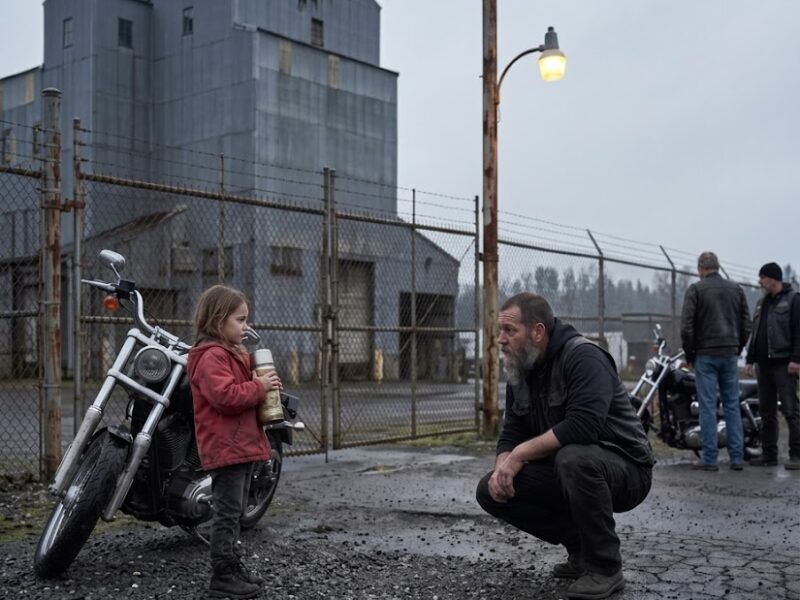
Every dawn, a little girl walked to the mill gate carrying the same empty thermos. She never asked for anything. She just stood there, hoping someone would notice. Then 400 bikers showed up — and they didn’t just fill her thermos. They filled her entire life.
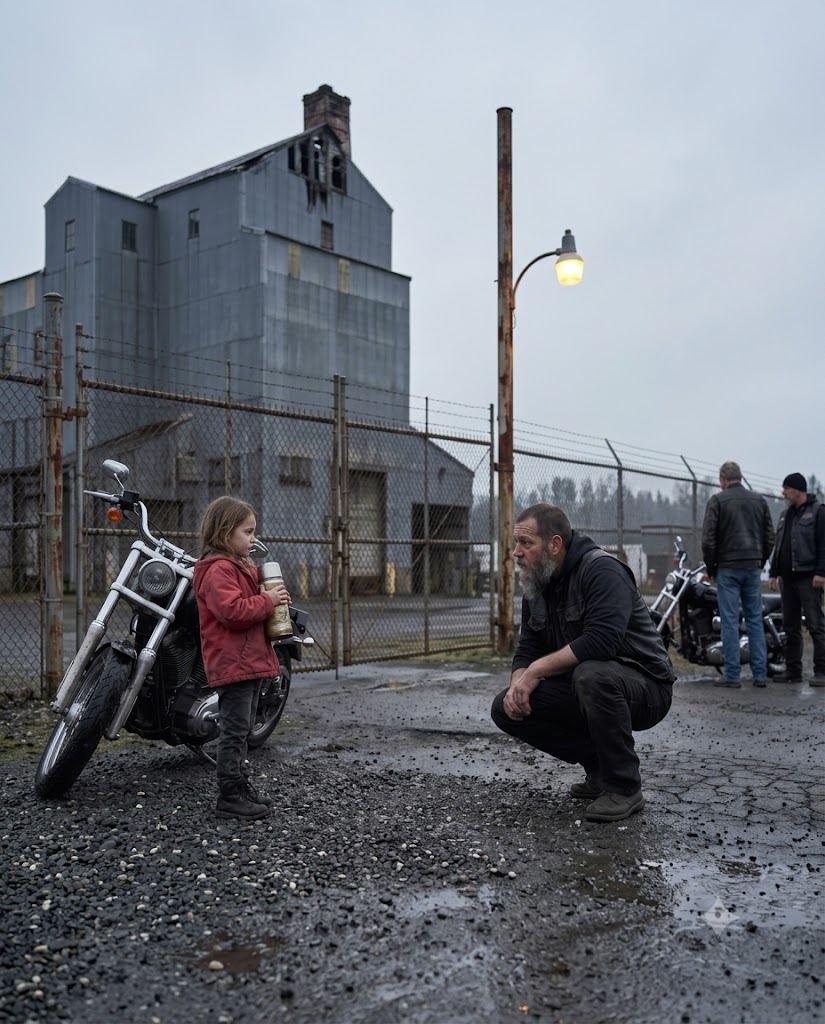
The thermos was dented on one side, the silver paint worn to bare aluminum along the seam, and every morning for eleven days, it had come back empty.
That was the detail Garrett noticed first—not the child herself, but the object swinging at her side as she crossed the gravel lot in the gray before sunrise.
He was forty-nine years old, two hundred and thirty pounds, and had not moved quickly toward anything small and quiet in a long time.
But something about the way she carried that thermos stopped him at the gate.
Boots crunched frost-stiffened gravel.
The engine of his Road King ticked behind him in the cold November air.
She was perhaps eight.
She wore a canvas jacket two sizes too large, the cuffs folded back three times.
And she set the thermos down on the concrete barrier at the entrance to the Halverson Mill as if placing an offering on an altar.
And then she sat beside it and waited.
Eleven mornings, the same gate, the same hour—4:47 in the morning.
The temperature had dropped nine degrees in the last week, and she had never once asked anyone for anything.
The mill workers who passed her going in assumed someone was coming.
The county road crew that rolled through at five assumed she belonged to a mill family.
Nobody asked.
Nobody filled the thermos.
And nobody who saw her that first morning understood yet that four hundred riders would one day converge on a single November dawn because of a child who never said please and never said help and never said a word about what that empty thermos meant.
The reason was the part none of them were ready for.
—
The cold came down off the Kaibab that first week of November like something that had made up its mind.
It moved through the high desert scrub in the dark before dawn and pressed itself against every surface it could reach.
And on the morning that Garrett first turned his Road King off the state road and into the gravel lot of the Halverson Mill, it was already deep in the low twenties.
Frost painting every flat rock and fence post a dull white that would be gone by eight.
He rode out of Ash Creek before four most mornings.
He had done it for years.
The mill road was not his route to anywhere.
But the mill road was quiet and straight, and in the season before the days fully died—which was what November was in the high desert—quiet and straight were what a man like Garrett needed before he opened the shop.
He ran a machine repair business out of a corrugated building at the south end of Ash Creek, the kind of work that left the knuckles cracked and the forearms permanently darkened with grease that no amount of pumice soap fully lifted.
He had started the business at thirty-one.
He had been the Ash Creek Riders president for the last nine years, the last of the four founding members still on a bike.
And the patch on the back of his vest was the same patch he had worn since the club’s first year, though the leather had been replaced twice and the stitching updated once by a woman in Flagstaff who did not ask what the club was and charged accordingly.
He was not handsome.
His nose had been broken in his thirties and had set at a slight angle, and his beard was gray-black and long enough to catch frost on cold mornings, which it did.
His eyes were a flat, unremarkable brown.
People who did not know him looked at him once and found somewhere else to look.
People who did know him tended not to look away.
He had come around the bend in the mill road and seen the gate barrier and the child in the same moment—the way you see two things that your brain takes a half second to arrange and to sense.
The child was sitting on the low concrete barrier with her legs dangling.
Her jacket bunched at the collar against the cold, and the thermos was beside her, silver and dented, its black lid screwed tight as if what was inside still mattered.
Nothing was inside.
He did not know that yet.
He pulled to the edge of the lot and cut the engine and sat on the bike a moment watching.
The child did not look at him.
She was looking at the mill gate, at the light above the security booth fifty yards in, where a man in a reflective vest was moving behind fogged glass.
She was not crying.
Her face was still and composed in the particular way that children’s faces are composed when they are doing something that feels like work.
She had come to do a thing and she was doing it and she did not need to be watched.
Garrett swung off the bike.
His boots came down on the gravel and he felt the cold through the soles immediately—the way cold in the high desert finds every gap and tests it.
He walked toward her and stopped about six feet away, far enough that he was not looming, which took effort at his height, and he put his hands in his jacket pockets and said, “You waiting on somebody inside?”
She looked at him then.
Her eyes were dark and very direct, and she considered him for a moment with the kind of frank assessment that children give large unknown men, quick and complete, before she said, “My dad. He’s on the early shift. He works nights. He should have come out at four.”
She said it the way you would say a train schedule, the way a fact is just a fact.
And she looked back at the gate.
Garrett looked at the gate, too.
The light in the security booth was still moving.
He looked at the thermos beside her, the silver curve of it reflecting the distant booth light in a smear of white.
“What’s in the thermos?”
“Nothing,” she said. “It’s for coffee.”
“He left without it yesterday,” she said.
“Yesterday?”
And Garrett understood in the way you understand something that bypasses the thinking part of the brain and lands directly in the chest that this was not the first morning she had come.
He said, “How many mornings have you brought it?”
She counted silently, moving her lips just slightly.
“Eleven.”
The word settled between them in the cold.
Eleven mornings before five in the morning at a mill gate in the high desert, a child waiting for her father to come off nights with a thermos of coffee she had kept refilling and he had kept not appearing to collect.
And she had said nothing to no one and had not stopped coming.
Garrett said, “What’s your name?”
“Petra.”
“I’m Garrett. Can I stand here with you a minute while you wait?”
She looked at him again, measuring.
“You don’t have to,” she said.
“I know I don’t,” he said.
She moved the thermos six inches to the side to make room on the barrier and he sat down next to it.
—
The security guard came out of the booth at 4:52 and walked down to the gate and stopped when he saw Garrett, which was the reaction Garrett was accustomed to.
The guard was a heavyset man in his fifties with a name tag that said Birch and the look of someone who had been at this job long enough to have seen several things he preferred not to have seen.
He looked at Garrett, then at Petra, then back at Garrett.
“Morning,” he said, careful.
“Morning,” Garrett said. “This young lady’s waiting on her dad. Comes off nights. She says he should have been out at four. His name’s Vance Kodrescu.”
Petra looked at him.
He had not asked her the name.
He had simply repeated the name she had told him a few moments before—she had told him quickly, quietly, the way children give necessary information to adults they have provisionally decided to trust.
Birch’s face shifted.
It was the shift of a man locating something he had been hoping to stay away from.
“Kodrescu’s on a leave,” he said. “Medical.”
Petra said, “Since when?”
It was not a question.
It was a demand delivered in a voice that was perfectly flat and perfectly calm.
And Birch looked at her and then looked at Garrett.
And Garrett said nothing because this was not the moment for him to say anything.
“Since last Thursday,” Birch said. “He had an episode on the floor. They took him to Flagstaff Medical.”
Petra did not move.
She sat with the thermos in her lap where she had placed it without seeming to notice, and she looked at the gate, and for a long moment the only sound was the wind picking up along the fence line and something metallic ticking in the booth behind Birch.
Then she said, very quietly, “Nobody told me.”
The cold was sitting on everything by then, heavy and still.
And Garrett looked at the thermos in her lap and felt the weight of eleven mornings—the way you feel a stone placed on your sternum.
Birch said they had called the house number on file.
He said it apologetically because he was a man who was correctly following a procedure that had produced a cruelty and he knew it.
The number on Vance Kodrescu’s employee record was a landline at an address on Route 173 that had been his address for three years.
But his address for three years was also his sister’s house.
And his sister—Garrett would learn forty minutes later, parked outside a double-wide with the engine idling—had left for a seasonal job in Nevada the previous week and had not left anyone any information about a child who came home from school to an empty house and made her own soup and set the thermos by the door each night before she slept, because she had come to understand, in the wordless, systematic way of a serious child, that her father needed the coffee in the mornings and she was the one who would bring it.
Nobody at the mill had a secondary contact on file.
Nobody had thought to ask the child directly.
The procedure had been followed and the procedure had produced eleven mornings of a thermos going back empty.
Birch gave Garrett the name of the unit at Flagstaff Medical, and he gave it quietly because he could feel what was moving in that conversation, even if he could not name it.
And then he went back to his booth, and Garrett sat on the barrier next to Petra Kodrescu, age eight, and the frost was lifting off the ground in thin white vapor as the light changed, and neither of them said anything for a minute.
Then Garrett said, “Your dad is at a hospital in Flagstaff. He got sick at work.”
He paused.
“He didn’t leave on his own.”
Petra looked at the thermos in her hands.
“Is he going to be okay?”
“I don’t know yet. I’m going to find that out.”
“Okay,” she said.
“Do you have somewhere warm you’re supposed to be right now?”
“School starts at 7:50.”
“It’s not yet six. You eaten anything?”
She thought about it.
“Toast,” she said. “Yesterday.”
Garrett stood up.
He was stiff from the cold and from the barrier and from something else that had nothing to do with either.
He looked down at her, this child with the empty thermos and the folded cuffs and the face that was still composed in that working way.
“All right,” he said. “I know a diner that’s open. You’re going to eat something, and I’m going to make some calls.”
She looked at him one more time, measuring, then slid off the barrier and tucked the thermos under her arm.
She did not put it down the entire morning.
Garrett noticed that—the way you notice a thing and file it somewhere you do not look at directly.
—
The diner was three miles back toward Ash Creek, a low building with a propane heater by the door that hit you in the face when you entered, and a counterwoman named Dolores who had been opening the place since five a.m. for twenty-two years and who took one look at Petra and set a mug of cocoa on the counter without being asked and said, “Booth in the back’s warmer.”
Dolores was not the kind of woman who required explanations.
She had a daughter of her own, grown now, and she understood what a child looked like when a child had been managing alone for too long.
And she set a plate of eggs and toast on the table twelve minutes later and said, “Eat all of it,” in a tone that was not unkind.
Petra ate all of it.
The thermos sat beside her on the booth seat.
Garrett took his phone to the counter and made three calls in twenty minutes.
The first was to Flagstaff Medical Center, where he navigated two automated menus before a night shift nurse with a voice that sounded like the end of a long shift told him that Vance Kodrescu had been admitted eight days ago with a cardiac event, was stable, was in the cardiac care unit, and that next-of-kin visiting was restricted to family.
He wrote down the unit extension on a paper napkin.
The second call was to a woman at Coconino County Child and Family Services whose cell number he had from a situation two years ago—a different situation—and who answered on the fourth ring, sounding like she had been awake for a while.
Her name was Imagene Tras, and she was the kind of person who processed information by going very quiet, and she went very quiet when Garrett told her about Petra and the mill gate and the eleven mornings.
And then she said, “Is the child in a safe location right now?”
And Garrett said, “She’s eating eggs at a diner and I’m standing three feet away.”
And Imagene said, “Good. Don’t move her. I’ll make some calls.”
The third call Garrett made was the one that was not about logistics at all.
He stepped outside the diner where his breath came out in clouds in the cold air, and he called a number he knew without looking.
And when it answered, he said, “Need the chapter. All of it. Tuesday morning.”
And the voice on the other end said, “How many?”
And Garrett said, “Everyone riding.”
—
Inside, Petra had finished the eggs.
She was looking out the diner window at the Road King parked outside, studying it with the same frank attention she had given Garrett at the gate.
And when he came back in, she said, “Is that a ’78 or a ’79?”
He stopped.
He said, “’81.”
“My dad has a picture of a ’78 in his room,” she said. “He says he’s going to get one when he gets caught up.”
She said it without weight, just information.
And she looked back at the thermos.
Garrett sat down across from her.
He looked at his hands on the table, the cracked knuckles, the permanent dark in the lines of the palms.
He said, “Can I ask you something?”
She nodded.
“Why didn’t you tell someone at the mill earlier? On the first morning or the second?”
She thought about this seriously, the way a careful person considers a fair question.
“I thought he’d come out,” she said. “Every morning I thought today he’d come out.”
She looked at the thermos.
“And I didn’t want anybody to think he was bad at his job.”
Garrett looked at her for a moment.
Then he picked up his coffee cup and drank from it and set it down and said nothing, because there was nothing to say to that which would not cost something he did not have change for.
—
Imagene Tras arrived at the diner at 7:15 in a county sedan with a car seat in the back that she did not use because Petra was eight and did not need one—a detail that seemed to briefly embarrass Imagene.
She was a trim woman in her early forties with reading glasses pushed up on her head and a manner that was professionally warm, which meant it was warm, but you could feel the professionalism underneath it, like rebar in concrete.
She sat with Petra for ten minutes while Garrett stayed at the counter with Dolores, who poured him a second coffee without asking.
And at some point Garrett heard Petra tell Imagene in that same flat, informational voice that she had been doing the shopping on Sundays, that there was still bread and soup at the house, and that she had her school ID and her bus pass in her jacket pocket.
Imagene wrote things down in a small notebook.
She did not look happy.
Not unhappy exactly—just the look of a person encountering a weight they intend to carry correctly.
At 7:40, Imagene walked Petra to the county sedan to drive her to school.
And Petra stopped at Garrett’s bar stool and looked up at him and said, “Will you find out if he’s going to be okay?”
She said it the way she had said everything—no excess in it, just the question.
“Yes,” Garrett said.
She nodded once, picked up the thermos from where she had set it on the counter, and walked out.
Garrett watched the thermos go out the diner door, that dented silver shape, and felt the eleven mornings in his chest like a fist that had not yet decided whether to open.
Imagene came back in.
She said, “Child’s been alone for at least eight days. Father is an adult patient. He has rights about contact and disclosure, but with a minor child in the picture, it gets complicated fast. Legally, the hospital isn’t obligated to reach out beyond the emergency contact on file.”
She paused, which was the sister who was currently in Nevada.
“I know,” Garrett said.
“The father may not even know the child has been going to that gate.”
That stopped him.
He had not considered that.
Vance Kodrescu, eight days in a cardiac unit, might have believed his daughter was at his sister’s.
Might have been lying in a hospital bed thinking the child was covered.
Might have had no idea at all.
Garrett set down his coffee cup.
“I need to get into that unit.”
“You’re not family,” Imagene said.
“I know that, too.”
She looked at him for a moment.
Then she said, “I’m going to make some calls about the child’s placement and status. If the father is stable and oriented, the hospital social worker needs to know there’s a minor living independently. That’s a different pathway than a family visit.”
She pushed her glasses up her forehead.
“What exactly is your connection here?”
Garrett looked at the door where Petra had gone out.
“She sat next to my bike,” he said.
Imagene looked at him, and then she did something he did not expect.
She picked up her notebook and she almost smiled and she said, “I’ll see what I can do about the unit.”
—
The calls Garrett made that Tuesday went through Ash Creek like weather moves through high desert—fast, low, and without asking permission.
By eight in the morning, there were seven members of the club at the machine shop on the south end of town, sitting on bikes or on the tailgate of the flatbed or on the shop steps.
And Garrett stood in front of them in the cold morning light and told them what he knew and what he did not know and what he needed.
The light was coming from the east, thin and direct, the kind of November light that cuts rather than warms, and it caught the chrome on the handlebars and threw small white shapes across the gravel.
He told them about Petra and the gate and the thermos and eleven mornings.
And he told them about Vance Kodrescu in the cardiac unit.
And he told them that a child had been going to that gate every morning in the dark cold because she had not wanted anyone to think her father was bad at his job.
And when he said that last part, he watched it move through the seven of them the way a stone moves through water, each face changing in sequence, and nobody said anything for a moment.
Then a man named Dell Burchmore, who was forty-four and had ridden with the club for eleven years and had arms like structural beams, said, “What do you need from us?”
And Garrett said, “Everything.”
He told them about the thermos, that Petra brought it every morning because her father had left without it, and that it had gone back empty for eleven days.
And he looked at Dell and he said that thermos should not go back empty tomorrow morning.
Dell said, “It won’t.”
Garrett said, “I need somebody to ride Flagstaff today. I need somebody to talk to county about placement. I need somebody to go by the house on Route 173 and check the situation there. Quiet. No noise. And I need the word to go out to every chapter that can make it for Saturday.”
He paused.
“All of them.”
A man named Curtis Reed, who was fifty-one and kept a notebook in his vest and was the person the club depended on to remember what everyone had promised, opened the notebook and clicked a pen.
“How far out are we calling?”
“As far as it goes,” Garrett said.
Curtis wrote.
Dell was already on his phone.
A younger member named Tommy Cybert, twenty-seven, who had joined the club two years ago and still had the quality of needing to prove his usefulness at every turn, said, “I know somebody at Flagstaff Medical. Respiratory tech. She can at least tell us the ward layout.”
Garrett looked at him.
“Then call her,” he said.
By 9:30, Dell was on the highway to Flagstaff.
Curtis had the chapter network rolling through texts and calls, a chain that would move through five chapters and two informal riding groups before noon.
Tommy had his contact at the hospital on the phone and was taking notes on a paper bag because he had forgotten his notebook.
Garrett went into the shop and turned on the lights and the compressor and stood in front of a disassembled pump housing he was supposed to have finished yesterday.
And he put his hands on the bench and looked at the parts and did not see them.
He saw instead a thermos on a concrete barrier in the frost dark, a child’s legs swinging, the gate light smeared in silver on the side of it.
He thought about his own daughter.
He did not do that often.
She would have been fifteen this November, and she was not anywhere that could be reached by phone or by highway.
And that was a thing he had carried for six years without putting down—the way Petra had carried the thermos carefully every morning because putting it down did not seem like something you did.
He picked up a socket wrench and found the first fastening and began to work.
And the compressor ran and the shop filled with the smell of oil and metal and cold morning air coming through the vent.
And he worked and did not think about Flagstaff because Dell would handle Flagstaff because that was what the club was.
That was the only thing it had ever been.
Not fear, not noise.
Hands that knew what to do with a weight.
—
Dell called at 11:47.
Garrett had the pump housing back together by then and was on his second cup of terrible shop coffee and was listening to Curtis run the chapter count out loud from the doorway, the numbers climbing as the calls came back in.
Dell’s voice on the phone was measured, which was how Dell sounded when he was carrying something.
He said, “Got to the social worker first. Her name is Patricia Anand. She’s young, maybe thirty. She came out to the waiting room like she was ready to defend a position and I just let her talk.”
Garrett said, “And?”
And Dell said she didn’t know about the child.
The emergency contact was the sister.
The sister’s gone.
The father listed next of kin as sister and nobody had flagged that there was a minor in the household situation.
“She was—she was upset. Not at us. At the gap.”
Garrett said, “What happens now?”
Dell said she’s going into the unit.
She’s going to talk to Kodrescu.
She said if he’s oriented and stable, he needs to know about his daughter’s situation.
That’s her job, and she’s going to do her job.
He paused.
“She also said that a man from a motorcycle club waiting in her lobby did not exactly make her morning easier, and she wanted me to know that.”
Garrett said, “What did you tell her?”
Dell said, “I told her I had nowhere else to be.”
There was a pause and then Dell said quietly, “Garrett, he didn’t know. He thought the sister was home. He had no idea.”
Garrett stood in the shop with the phone against his ear and the compressor cycling and the smell of oil around him, and he thought about a man in a hospital bed in Flagstaff, believing his daughter was fed and warm at his sister’s house while his daughter was making toast by herself and walking to a mill gate in the dark with an empty thermos.
He thought about the eleven mornings.
He thought about how long a person can go not knowing something that is happening to the person they love most, and how that particular not knowing is its own kind of wound.
And he said, “How is he? Stable?”
“They got him early enough. There’ll be restrictions, medication, cardiac rehab, but he’s going to be upright.”
Dell paused again.
“He cried, Garrett. When the social worker told him about the gate, Patricia Anand came out and told me that herself. She didn’t have to. She came out and told me.”
Garrett said, “Okay.”
Dell said, “I’m going to stay a while.”
Garrett said, “Stay.”
He ended the call and stood in the shop, and the compressor ran, and the cold came under the door in a steady, low current, and he put the phone in his pocket and picked up the next job on the bench.
—
By Thursday, the chapter count was at 219 confirmed riders.
Curtis kept the number on a whiteboard at the back of the shop, updating it each time a call came in, and every time Garrett passed it, the number was larger.
By Friday afternoon, it had reached 340.
Riders from as far as the Utah border and the New Mexico high country were confirming.
The calls had a particular quality, Garrett noticed.
Not excitement exactly, but a kind of gravity, the way people sound when they understand what they are going toward.
Dell came back from Flagstaff on Wednesday evening and reported that Patricia Anand had reached Imagene Tras and that the two of them had arranged a temporary placement situation with a neighbor family on Route 173 named Orosco who had three children of their own and a mother who had apparently opened her door to Imagene and said, “Of course, bring her,” before the sentence was finished.
Petra was in school.
Petra was eating.
The thermos, Imagene had told Dell, was sitting on the Orosco kitchen counter, still in Petra’s custody.
Saturday was four days away, and the number was still climbing, and Garrett went home each evening to the small house at the edge of town and sat in the kitchen with a cup of coffee and looked at the window over the sink and thought about nothing in particular, which was what he did when he was thinking about something very particular.
On Friday evening, Imagene Tras called him directly.
She said Petra had asked if it would be all right if she came to the mill gate on Saturday morning.
Garrett said it would be all right.
Imagene said she wants to bring the thermos.
Garrett said tell her yes.
Imagene said she also wanted me to ask you something.
There was a brief pause.
She wanted to know if she could bring coffee for the bikers.
Garrett put the phone down on the table for a moment and looked at the window.
Then he picked it up and said, “Tell her we’ll bring our own.”
—
Saturday morning, the temperature was twenty-three degrees at 4:30 a.m. when the first bikes came down off the state road and turned onto the mill road, their headlights cutting through the dark in long pale beams that swept across the frost on the gravel and the scrub brush and the chain-link fence line.
By 4:47, when the security booth light came on and Birch walked down toward the gate, there were 407 riders lined across the mill lot and along the road shoulder and partway into the turnout to the west.
The engines running in a collective low vibration that you felt in your back teeth and your sternum, and the exhaust in the cold morning air rose in a pale cloud above the line of machines that went further back than the headlights could reach.
407.
Curtis had counted.
The number on the whiteboard had been updated at eleven the previous evening to 389.
And then riders had kept arriving through the night, pulling into Ash Creek’s two motels and the diner parking lot and the machine shop yard, and the final count was 407.
Birch came down to the gate and stopped and looked at what was in front of him and stood very still for a moment, and then he took off his reflective vest cap and held it and did not put it back on.
Garrett was at the front.
He was on the Road King, engine idling, and beside him on the concrete barrier sat Petra Kodrescu, eight years old, in her canvas jacket with the cuffs folded back, and she was holding the thermos in both hands, and it was not empty.
She had filled it that morning at the Orosco house at 4:15 a.m.
And she had been waiting on the barrier when Garrett arrived, the same way she had been waiting every morning, because this was her place and her time, and she had not stopped coming.
The thermos was full.
Garrett had pulled up and cut the engine, and she had looked at the line of headlights coming down the road behind him, four hundred and more of them stretching back into the dark, and she had been quiet for a moment, and then she had said, “Are all of those for my dad?”
Garrett had said, “Yes.”
She had looked at the lights.
“He doesn’t know them,” she said.
“He doesn’t need to,” Garrett said.
She had thought about that.
Then she had nodded and sat with the thermos in her hands and waited for 4:47, which was the time she had always come.
And so that was the time the Ash Creek riders came too.
407 of them.
Birch came to the gate and stopped and looked and then did something nobody expected.
He opened the gate.
Not all the way.
He slid the chain clear of the post and pushed the gate open a few feet and stood beside it, and he said to Garrett, “The shift supervisor said if you want to come up to the lot, you can.”
He glanced at Petra.
“So she can see,” he said.
The supervisor would say later that he had come in early that morning because word had traveled the way word does in small towns and mill towns and places where people work at four in the morning.
He had come in early and stood in the supervisor’s booth window and watched the lights come down the road and had picked up his radio and said nothing into it for a long moment and then had called the main gate and said, “Let them in.”
The riders moved forward slow in low gear through the gate and into the mill yard, and they arranged themselves in the lot in a shape that was not planned and could not have been planned, but was somehow orderly the way a large body of people who are all trying to do the same respectful thing naturally arranges itself into something that looks like intention.
They shut their engines—not on a signal.
One, then two, then a dozen, then the rest, until the only sound was the cold wind coming down off the Kaibab and the faint creak of the fence and the distant machinery of the mill operating on the other side of the building.
407 engines, quiet.
The exhaust cloud hung in the cold air and thinned slowly against the dark sky.
Birch stood at the gate with his cap in his hands.
Petra sat on the barrier with the thermos.
The shift supervisor came out of his booth and walked down the lot and stopped a few yards from Garrett and looked at the assembled riders and then looked at the child, and he said to nobody in particular, “This is for Kodrescu.”
And Garrett said, “His daughter’s been at this gate eleven mornings.”
He said just that.
The supervisor stood with his hands at his sides and worked his jaw once and looked at the line of machines stretching back into the lot and out through the gate and along the road shoulder.
He said, “He’s going to be all right, you know. They got him in time.”
Petra said, “I know.”
She said it quietly, with the same composure she brought to everything.
And she looked at the thermos.
The supervisor said, “He’s going to want to know about this morning.”
“Yes,” Petra said.
There was a silence, and in the silence, Garrett heard Dell, somewhere in the second rank of riders, clear his throat.
That was all.
The sky was beginning to go from black to the very deep blue that precedes gray, the first announcement of a sun still forty minutes below the horizon, and the frost was standing on every surface in the yard, and the chrome along the rows of bikes caught the booth light and the first pale skylight in small cold points.
Garrett looked at the thermos in Petra’s hands, and he thought, not for the first time, of another morning and another November and a child he had not been there for, and the thought moved through him and he let it move and it came out the other side as something that was not pain in the ordinary sense but was adjacent to it—the way two things can occupy the same space if one of them has had time to change its shape.
He did not cry.
His eyes went wet at the outer corners and he did not move his hands from where they rested on the tank.
He had learned in six years that grief does not ask permission and does not wait for the convenient moment, and the only thing to do with it was to hold still and let it pass like weather.
It passed.
The sky went another degree lighter.
Curtis had worked his way to the front of the line and stood beside the Road King, and he said quietly, “407, Garrett,” the way you report a number when the number is the point.
Garrett said, “I know.”
Curtis said, “Want me to let the network know it held?”
Garrett said, “Yeah.”
He looked at Petra.
“You warm enough?”
She considered this.
“No,” she said.
And for the first time since the gate at the mill, she looked like an eight-year-old instead of a person doing a job.
And Garrett shrugged off his outer vest without taking off the patch vest underneath and set it over her shoulders, and it covered her to the knees, and she accepted it without comment and pulled it tighter and held the thermos in both hands and sat looking at the gate.
And the sky went from deep blue to gray, and 407 riders sat with their engines quiet in the frost cold of a November morning in the high desert, and nobody said anything because there was nothing that needed to be said.
—
Vance Kodrescu came home from Flagstaff Medical on the fourteenth of November, a Thursday, driven by Patricia Anand in her own car because she said the discharge coordinator’s hands were full, which was professionally accurate and possibly not the entire reason.
He was thinner and moved carefully and had a list of medications and follow-up appointments that his daughter had already transferred to a paper calendar she had taped to the kitchen wall.
He stood in the doorway of the Route 173 house and looked at the calendar and then at Petra, who had come from the Orosco house to be there when he arrived and who was standing in the kitchen holding the thermos with both hands, and he could not speak for a moment, and she crossed the kitchen and put her arms around him carefully, the way you hold something you know is fragile, and he held her, and the thermos was between them, pressed against his ribs.
He said, “I’m sorry I didn’t come out.”
She said, “I knew you would when you could.”
The thermos had fresh coffee in it.
She had made it at the Orosco house and carried it the half mile to the door and it was still warm.
—
The Ash Creek Riders held a formal meeting on the first Saturday of December.
Twenty-two members in the shop with the heater running, and they voted unanimously on three items.
The first was a fund—eighteen hundred dollars assembled in six days from the chapter network, held in trust for Kodrescu’s medical costs not covered by the mill’s plan.
The second was a standing offer of mechanical assistance should Kodrescu, as his cardiologist recommended, need to transition from night shift work to something less demanding, and three members with relevant trades had already identified two leads.
The third item was a patch.
Dell had designed it, and the Flagstaff embroiderer had finished it in four days.
A small secondary emblem, two inches across, showing a thermos outlined in thread the color of brushed aluminum on a background of high desert blue.
No words, no date.
It went on the vest of every rider who had been at the gate on Saturday morning.
407 patches.
The vote was unanimous and nobody argued about the design.
Patricia Anand came to the shop on a Tuesday to pick up the check for the fund.
She came in the front door and looked around at the machines and the benches and the members present and said, “I’ve been a hospital social worker for eight years and I’ve seen a lot of people step up for families.”
She looked at Garrett.
“407 is new.”
She left the check in Garrett’s hand with a photocopy of the hospital financial advocate’s information and said, “Tell him we’re routing through the advocacy office. It’ll take the pressure off the family directly.”
Garrett said, “I will.”
She said, “And tell him his daughter is extraordinary.”
Garrett said, “He knows.”
She shook her head.
“Tell him anyway.”
—
Dolores at the diner put a photograph on the wall above the coffee station.
A wide shot someone had taken from the road on Saturday morning.
The mill lot visible in the pre-dawn gray with the rows of bikes and riders filling it wall-to-wall and along the road outside, the headlights still burning in the frost dark, the exhaust cloud pale above the line.
The photo was taken from far enough back that you could not see individual faces clearly.
You could see the number.
You could see the scale.
Dolores framed it without asking anyone and put it next to the monthly specials board.
And for a while, customers stopped and looked at it.
And some of them asked what it was, and some of them looked at it and understood without asking and went back to their coffee.
The photo stayed on the wall through winter.
Dolores did not take it down.
The bikers came in on Tuesday mornings as they always had, filling the counter stools and the booths in the back, and Dolores poured coffee and did not make a speech about it because she was not that kind of woman, but she filled the cups before they were empty, which was her way.
—
Petra Kodrescu started coming to the diner on Tuesday mornings in January.
She came with her father, who had transferred to a day position in the mill’s maintenance department at a slight pay cut and who walked with a careful deliberateness that had nothing to do with arrogance and everything to do with a heart that had been reminded of its limits.
They sat at the counter, Vance on a stool and Petra on the one beside him, and Dolores put cocoa in front of Petra without asking, because that was already established.
And Vance wrapped both hands around a coffee mug and looked at the photograph on the wall and said nothing.
He looked at it every Tuesday.
He never commented on the size of the crowd in it or the number of machines or the frost on the ground.
He just looked at it the way you look at evidence of something you are still absorbing.
The thermos was at home on the kitchen counter.
It was not empty.
In the mornings before school, Petra filled it and set it by the door.
And her father took it when he left and brought it back in the evening and rinsed it out and set it on the drain board.
And in the morning, she filled it again.
This was the system.
It had always been the system.
The only difference now was that it worked both ways.
—
By March, 112 of the riders who had come to the gate that Saturday had organized an informal convoy that ran the mill road on the first Saturday of every month at 4:47 in the morning.
The engines low and the lights on.
No stopping, just the passage of machines through the dark—a moving count that the night shift workers at the mill had come to recognize by sound from inside the building and would sometimes stop what they were doing and listen to until it passed.
Not all 112 came every month.
But enough came.
The thermos patch on the vests became a thing that people in Ash Creek recognized without necessarily knowing the story behind it.
And when someone asked, the person who was asked told it plainly, the way you tell a story about something real.
A girl brought a thermos to a gate every morning because her dad had left without it, and she wanted him to have coffee.
And the club found out.
And 407 riders came at the time she always came because that was the time she had chosen and the place she had chosen.
And a collective that the world had largely decided to fear had nothing more important to do on a cold November morning in the high desert than be where a child was already waiting.
—
You have driven past the kind of person this story is about.
You have seen them on the road or at a stoplight and felt the thing that the world teaches you to feel, which is distance.
You have looked away.
What this November morning knew, and what 407 engines said in the cold before dawn without a single word, was that the most dangerous thing about a man who carries grief quietly is not what he might do to you.
It is what he will do for a child he met forty minutes ago who is sitting on a concrete barrier in the frost with an empty thermos and a composure that should never have been required of her.
The road out of the mill lot turns toward the Kaibab, and in the mornings now the light comes over the high desert scrub the same way it always has—indifferent and enormous and cold.
But at 4:47 on the first Saturday of each month, the lights that move down that road are not indifferent at all.
They are counted.
They have always been counted.
And an empty thermos, which was once the loneliest object in the high desert, has not been empty since.









