Elton John SHOWED UP at Michael Jackson’s Concert — What Michael Did SHOCKED 70,000 People
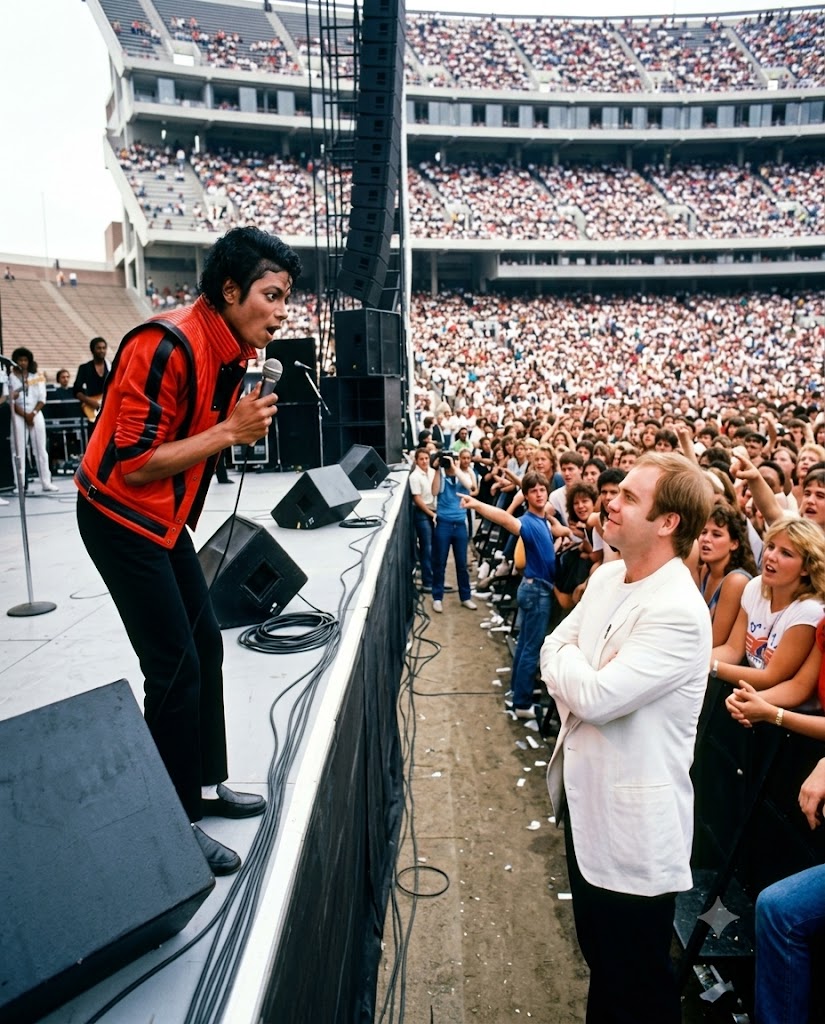
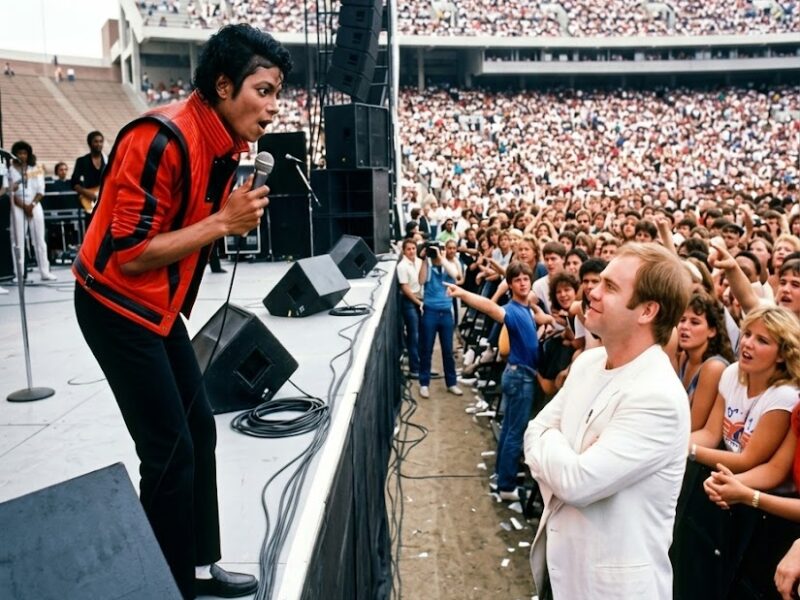
August 1988, late summer in London.
The kind of heat that sits on a city and refuses to let go, even after the sun has long since disappeared behind the rooftops.
Wembley Stadium was packed wall-to-wall with 70,000 people who had come out for one of the biggest nights of the Bad Tour.
Michael Jackson was 29 years old that summer, sitting on top of a career most performers could only dream about.
Thriller had already rewritten the record books.
Bad was doing the same thing all over again.
He had built an empire out of a voice, a pair of feet that moved like they didn’t obey the same laws of physics as everybody else’s, and more discipline than people ever really gave him credit for.
That night’s show was the third of a multi-night Wembley run, something the promoters had been chasing for months.
Tickets gone in hours.
Scalpers outside the gates asking for more money than some people made in a month.
Michael liked these big shows.
He liked the scale of it, the way a stadium full of people could somehow feel, if you did it right, like one single room breathing together.
“I know it don’t feel like a small room,” Michael told his band before the tour started.
“But that’s the trick of it. You got to make 70,000 people feel like it’s just them and you. That’s the whole job.”
Nobody in that stadium, least of all Michael himself, had any idea that before the night was over, he would be sharing that stage with one of the biggest names in music history.
A man who had been quietly watching his career from a distance for years.
If you already love Michael Jackson, hit that subscribe button because this story is a wild one.
Elton John was 41 that summer, deep into a decade that had seen him climb, stumble, and climb back again more times than most performers survive once.
By 1988, he had already sold more records than almost anybody alive.
Already written songs that had become part of the wallpaper of an entire generation’s lives.
Already built a reputation for being unpredictable, for showing up places nobody expected, for doing exactly what he wanted, regardless of what anybody thought he should do instead.
Magazine covers called him a legend.
Critics called him a genius, sometimes a mess, depending on the year.
He built his whole career on refusing to sit still, refusing to be just one thing.
And by 1988, that refusal had made him one of the most respected musicians on the planet, even on the nights when his personal life was falling apart behind the scenes in ways the public only half understood.
What most people didn’t know was that Elton had a quiet, genuine fondness for Michael’s music that went back further than anybody would have guessed.
He had first heard the Jackson 5 on the radio back in the early ’70s, a skinny kid from England, still figuring out who Elton John was even going to be.
And something about that voice, that impossible, soaring voice coming out of a child who couldn’t have been more than 11, had stopped him cold in his car.
“I remember thinking, ‘That boy is already better than most grown men will ever be,'” Elton said once years later, remembering that afternoon.
“Didn’t know his name yet. Just knew I needed to hear it again.”
Over the years, he had followed Michael’s career from a distance, respecting him the way one enormous talent respects another.
Even while the industry kept trying to paint the two of them as rivals for column inches, two of the biggest stars alive, supposedly locked in some invisible competition neither one of them had actually signed up for.
That August, Elton was in London between sessions, working on material that would eventually make its way onto a later record.
Restless, the way he always got between projects, needing something to shake the stillness out of him before he went a little stir crazy sitting in a studio all day.
His assistant mentioned, almost in passing, that Michael was playing Wembley that Thursday night.
Elton sat with that a moment, something flickering behind his eyes that his assistant couldn’t quite read.
“Get me a ticket,” he said.
“Not backstage, just a ticket. I want to actually watch the show.”
His assistant looked at him carefully.
“You want anybody to know you’re there?”
“No,” Elton said.
“For once, I just want to watch somebody else be the whole show.”
This next part is where the whole night takes a turn nobody in that stadium expected.
So stick with me.
He arrived quiet, dressed down about as much as Elton John ever dressed down.
A plain jacket, a flat cap pulled low, sunglasses he kept on even once the sun had gone all the way behind the stadium walls.
He had a seat about 15 rows back, close enough to see everything clearly, far enough that in a crowd that size, most people were too busy watching the stage to notice one more face in the dark.
He sat alone, no entourage, nobody flanking him the way they usually did wherever he went.
It felt strange, he would admit later, sitting in a crowd without anybody managing the space around him, without a single person checking to see if he was comfortable or recognized or safe.
Just a man in a flat cap waiting for a show to start, same as everybody else around him.
Michael opened the show the way he always did, an explosion of light and sound.
The whole stadium erupting the second his silhouette appeared behind the scrim.
The roar so loud it physically moved through your chest before you even saw him properly.
He tore through the opening numbers, every step landing exactly where it needed to.
The choreography so sharp it looked less like dancing and more like some kind of controlled detonation happening over and over again.
Elton, sitting 15 rows back, found himself smiling without quite meaning to.
That same feeling from all those years ago in the car creeping back over him.
That sense of watching something that simply operated on a different level than everything around it.
He hadn’t expected that.
Not exactly.
He had expected spectacle.
Had known going in it would be spectacle.
That was the whole point of a Michael Jackson stadium show in 1988.
What he hadn’t expected was how much of it still felt personal, even from 15 rows back in a crowd of 70,000.
How every single movement seemed aimed directly at you specifically, like the boy from that radio all those years ago had never once lost the ability to make a stranger feel seen.
Michael tore through the hits, the crowd roaring along on every chorus.
And by the middle of the set, the whole stadium was on its feet, swaying, screaming, completely given over to the night.
Elton found himself singing along, too.
Quiet, half surprised at how many words he still remembered from records he hadn’t put on a turntable in years.
If you’re already hooked on this story, this is a great time to hit that subscribe button.
Then, about an hour in, Michael slowed things down.
The band eased into something quieter, the lights dropping to something warmer and more intimate.
And Michael stepped up to the mic, his voice dropping into that softer, more careful register he used for the songs that mattered to him most.
“I want to do something a little different right now,” Michael said, his soft voice somehow still carrying to the very last row of that enormous stadium.
“I want to sing something about believing there’s still good in people, still love in the world, even when everything around you tries to convince you otherwise.”
“And there’s somebody out there in the world right now who spent his whole life writing songs that taught me that same thing.”
“Don’t know if he’s ever heard me say that, but I’ve always admired him more than he probably knows.”
The crowd murmured, curious, and Michael eased into a slower, more stripped down version of one of his own ballads.
Something about hope, holding steady, even when the world gives you every reason to let it go.
Keep watching because what happens next, nobody in that stadium could have predicted.
Somewhere around the second verse, a ripple started working through the crowd near where Elton was sitting.
It began small.
A few heads turning, somebody nudging the person next to them.
A teenager rose slightly, turned around, squinted through the dark, turned back to his friend, and whispered something urgent.
That friend turned too.
By the time the song reached its bridge, the whole section around Elton had begun to stare, whispering, pointing, the flat cap and the sunglasses doing absolutely nothing to hide who he actually was.
Once enough people had gotten a good look at that face they’d grown up hearing on the radio their entire lives.
Michael, up on that stage, felt the shift, the way he always felt shifts in a crowd.
That particular sense a performer develops over years of reading a room, even from a hundred yards away under blinding stage lights.
He kept singing, but his eyes tracked toward the disturbance, trying to make sense of what was pulling attention away from the song.
He finished the verse, and in the pause before the next one, he shielded his eyes against the lights and squinted out into the stands.
“Now, what in the world is going on out there?” Michael said into the mic, soft but carrying, genuinely curious.
“Somebody want to tell me what’s more interesting than what’s happening up here?”
A ripple of nervous laughter went through the crowd.
A voice called out from somewhere in the crowd, loud enough to carry over 70,000 people.
“It’s Elton John. Elton John’s here.”
The whole stadium seemed to catch its breath at once.
Michael’s eyebrows lifted under the stage lights, surprise playing across his face, quickly followed by something that looked almost like delighted disbelief.
“Now hold on,” Michael said into the mic, that soft laugh creeping into his voice.
“Somebody’s pulling my leg.”
“It’s true,” the voice called back, joined now by half a dozen others confirming it, the whisper spreading outward like fire catching dry grass.
70,000 people turned at once, craning to see, and Elton, caught dead center in that enormous wave of attention, slowly pulled off his sunglasses and gave a small, resigned wave.
The stadium exploded.
This next part is the reason people still talk about that August night.
“Well, I’ll be,” Michael said into the mic, laughing now, shaking his head.
“Elton John’s been sitting out there 15 rows back this whole time like he’s just any old body come to watch the show.”
The crowd roared with laughter, the tension breaking into pure delight.
“Mr. John,” Michael called out, still shielding his eyes.
“You going to sit way back there all night, or are you going to come on up here and say hello proper?”
Elton, sunglasses now dangling from one hand, shook his head and mouthed something that looked like, “I’m just watching. Keep going.”
“Oh, no, sir,” Michael said, one hand on his hip now.
“I don’t perform for guests who won’t come up and say hello. That’s not how I was raised.”
“You get on up here or I’m going to have my whole crew come down there and carry you up themselves.”
The crowd erupted into chanting, 70,000 voices calling his name.
And Elton, seeing there wasn’t any graceful way out of it, finally stood, laughing despite himself, and started making his way toward the aisle.
If you’re hooked on this exchange, this is a real good time to hit subscribe.
Security cleared a path as he moved down toward the stage.
People reaching out along the way, calling his name, a few holding out programs and pens he promised to get to later.
A young girl held up a lighter, grinning wide, and he tipped his cap toward her without breaking stride.
He kept moving, clearly a little embarrassed at the sudden spotlight, clearly amused by the whole situation, too.
When he reached the stage, Michael reached down and helped pull him up.
And the two of them stood there a second, sizing each other up in front of 70,000 witnesses.
“Now, what in the world are you doing sneaking into my show?” Michael asked, grinning, still holding on to his hand.
“Wasn’t trying to sneak,” Elton said into the mic, his voice carrying easy and rich through the massive stadium.
“Just wanted to watch somebody else be the star for one night. Guess that plan didn’t work out too well.”
“Well, you sure picked a funny way to stay hidden,” Michael said, and the crowd laughed again.
“In a stadium this size, you’re about as easy to hide as the sun.”
Elton laughed too, shaking his head.
“I should have known better.”
“Do you know I first heard you on the radio when you were what, 11 years old?”
“Sitting in my car, completely stopped in traffic because I couldn’t believe what I was hearing.”
“Been following your voice ever since. Guess some part of me forgot I couldn’t just blend into a crowd listening to it live.”
The stadium went quiet with surprise at that admission.
70,000 people, not expecting Elton John of all people to talk about being stopped cold by Michael’s voice decades earlier.
“You heard me that young?” Michael asked, genuinely touched, something soft crossing his face.
“Every young musician in London knew that voice,” Elton said.
“We used to argue about it, actually, a whole group of us, whether a kid could really be that good or whether it was some kind of studio trick.”
“Then I saw you perform live for the first time years later, and there wasn’t any trick to it at all.”
“Just talent nobody your age should have had.”
“Well, I’ll be,” Michael said softly.
“That’s about the nicest thing anybody’s told me all year.”
This next part is what nobody expected, even after everything that had already happened that night.
“Can I ask you something?” Michael said, turning to Elton.
“Go on.”
“You know how to play piano on somebody else’s song? Something you’ve never actually rehearsed?”
Elton raised an eyebrow, something sparking behind his eyes now.
“I can hold my own.”
“Good,” Michael said, turning to his band.
“Let’s clear the stage a bit. I want to try something.”
He turned back to Elton.
“You know ‘Man in the Mirror.’ Not the record, live, just piano, real stripped down.”
Elton’s expression shifted, something more serious passing over his face.
“I know it. I’ve listened to it more than I’d probably admit.”
“You want to try it with me? Just you at the keys, me on vocal. Feel our way through it.”
“I can do that,” Elton said quiet.
Something passed between them then, unspoken but understood.
The kind of moment that happens between two people who’ve both spent their lives being misunderstood by folks who only ever saw the surface of what they were.
One of them wrapped in sequins and controversy the whole world loved to speculate about.
The other wrapped in enormous glasses and outrageous stage costumes that made it easy for people to overlook the actual songwriting underneath.
Michael’s band cleared back and a piano was wheeled forward, and Elton settled himself at the keys, testing a few chords quiet while the stadium held its breath, waiting.
Keep watching because this is where the whole night turns into something nobody in that stadium will ever forget.
Elton started the intro slow, feeling his way into the chord progression, finding the shape of a song he’d clearly listened to plenty of times but never once played himself.
His hands moved carefully across the keys, building the melody up from almost nothing.
Michael closed his eyes and began to sing, his voice soft at first, then building, that unmistakable falsetto climbing up into the night sky over Wembley, carrying words about starting with the man in the mirror, about making a change, about looking at yourself honestly before you go asking the world to change around you.
The stadium, already electric with the shock of Elton’s arrival, went completely silent.
70,000 people leaning in, watching two performers from two entirely different corners of music find something true together in the middle of a song that had already become an anthem for anybody who’d ever needed to look honestly at their own reflection.
By the second verse, Elton had found something in the chords nobody had ever heard in that song before.
A little more space between the notes, a little more weight sitting underneath Michael’s voice.
The two of them building the song together in a way that felt less like a performance and more like a conversation happening in real time in front of 70,000 witnesses.
When they hit the chorus, Michael’s voice rising, Elton’s playing swelling underneath it, more than a few people in the crowd were openly crying, moved by something in that combination neither one of them could have fully predicted walking into that stadium that night.
An older man near the front, arms folded tight across his chest the whole show, had tears running freely down his face now.
When Michael caught sight of him from the stage, something in his own voice caught too, just for a second, before he pushed through it and kept singing.
The song ended, and for a long moment, nobody made a sound.
Then the applause started, and it didn’t stop, building into something enormous.
70,000 people on their feet.
“Well,” Michael said, a little breathless.
“I don’t believe I’ve ever heard that song played quite like that before.”
“Neither have I heard it sung quite like that,” Elton admitted, wiping quickly at the corner of one eye before anybody could get too good a look.
Stay with me, because what happens next is the reason this night became legend.
Michael turned to the crowd, still holding Elton’s hand.
“Now, I don’t know about the rest of y’all, but I don’t think I’m letting Elton John walk off this stage after just one song.”
“What do you think?”
The roar that answered him nearly shook the stadium walls.
Elton laughed, shaking his head.
“Michael, this is your show. I didn’t come here to take it over.”
“You ain’t taking nothing over,” Michael said.
“You’re just going to stay right up here with me a while, and we’re going to have ourselves a good time.”
“That all right with you?”
Elton looked out at that sea of faces, 70,000 people waiting, hopeful, and something in him, some old instinct toward careful control and calculated image, seemed to let go all at once.
“All right,” he said.
“All right, let’s do it.”
For the next 20 minutes, the two of them traded songs and stories.
Elton teaching Michael a piano riff here and there.
Michael surprising the crowd with how much of Elton’s catalog he actually knew by heart, humming along even to the deeper cuts most casual fans wouldn’t have recognized.
“You really know that many of my records?” Elton asked at one point, genuinely surprised.
“I grew up on them,” Michael said.
“Between recording sessions with my brothers, I used to sit in the back of the studio with a set of headphones and just listen to everything I could get my hands on.”
“Your records were always in that stack.”
Elton considered that.
“I think some part of me has spent my whole career worried nobody was really listening that closely, that it was all just spectacle to people.”
“The glasses, the outfits, the piano I’d set on fire if I could get away with it.”
“Maybe part of that was me making sure people couldn’t ignore me, even if they weren’t really hearing the songs underneath it all.”
Michael nodded slow.
“I understand that more than you’d probably guess.”
“Sometimes the bigger the show gets, the harder it is to trust that people actually see what’s underneath it.”
“How do you handle that?” Elton asked.
“Trusting people see past the surface.”
Michael thought about it seriously.
“Honestly, some days I don’t.”
“Some days I just have to trust that the ones who really hear it will find their way to it eventually, even if the noise around it gets loud enough to drown things out for a while.”
If this story is teaching you something already, that’s your cue to hit that like button.
Michael asked the crowd if they wanted to hear one more together, and the answer came back so loud it practically registered as a physical force moving through the stadium.
“All right,” Michael said, grinning.
“Let’s do something a little different this time.”
“Elton, you got anything of yours you want to try together? Something we can find our way into.”
Elton thought a moment, then named one of his own songs, something slower, something with more room in it than his usual big anthemic material.
A ballad most of his fans knew well but that rarely got the spotlight it deserved live.
“Never sang this one with anybody else’s voice on it before,” Elton admitted.
“Never quite trusted anybody enough to try.”
“Well, there’s a first time for everything,” Michael said.
“Let’s find out what it sounds like.”
The band worked out the arrangement quick, following Elton’s lead at the piano, and the two of them tried it together, stumbling through the first attempt, laughing at each other when the phrasing didn’t quite land right.
Elton’s fingers pausing a half beat too early.
Michael coming in a hair too late on the second line.
“Try it a beat slower,” Michael suggested, and the band adjusted, and this time it clicked.
Michael’s voice weaving in underneath Elton’s melody in a way nobody in that stadium had ever heard before.
Something unexpected and genuinely beautiful emerging out of a familiar song re-imagined right there in front of 70,000 people.
The crowd, sensing they were watching something being invented in real time, cheered through every fumble and every fix, completely given over to the spontaneity of it.
When they finished, Elton sat there at the piano a moment, something like genuine wonder crossing his face.
“I’ve never done anything like that before,” he admitted.
“Never just made something up on the spot in front of this many people. Not without weeks of rehearsal behind it.”
“Best way to make something,” Michael said.
“Can’t plan out everything. Sometimes you just have to jump and see what catches you.”
“I usually plan everything,” Elton said.
“Every show, every costume, every word between songs.”
“Feels strange doing something this unplanned in front of this many people and not being terrified.”
“Why aren’t you terrified?” Michael asked, curious.
Elton thought about it.
“Because you made it feel safe somehow.”
“Like there wasn’t any wrong answer up here. Just two people trying something together.”
“That’s about the whole secret to it,” Michael said.
“Ain’t no wrong answer in a duet. Just two voices finding each other.”
This next part is what nobody expected, even after everything that had already happened.
Near the end of their time together, Michael turned serious for a moment, looking out at the crowd, then back at Elton sitting beside him at the piano.
“You know,” he said, “I’ve watched you for years from a distance, doing things your own way, no matter what anybody said about it.”
“Took some real nerve to be who you are in this business, all the way out loud. No apology in it at all.”
“I know something about being watched close, but I don’t know if I ever had that kind of nerve.”
“You’ve got a different kind,” Elton said gently.
“You did it quiet mostly. Let the work speak. Let the dancing and the voice carry everything you weren’t saying out loud.”
“I did it loud. Dared people to have an opinion about every single thing.”
“Two different roads, I reckon. Ending up in about the same place.”
Michael sat with that a moment.
“I think I respect the loud way more than I ever let myself admit.”
“Took me a long time to understand that being quiet isn’t the only way to survive this business.”
“And I think there’s something to be said for your way, too,” Elton said.
“Sometimes loud isn’t brave. It’s just noise covering up something scared underneath.”
“Took nerve to build what you built. Staying that controlled, that private, with the whole world trying to pry every corner of your life open.”
“There were nights it didn’t feel brave,” Michael admitted.
“Felt more like hiding some days. All that control, all those walls I built up around myself.”
“There were nights I wondered if I’d built so many walls I couldn’t find my own way back in.”
Elton’s expression softened.
“I think we all wonder that. The ones of us who built something enormous out of what the world expected us to shrink about.”
“Question is whether you still recognize yourself when the noise dies down.”
“Do you still recognize yourself?” Michael asked.
Elton thought about it a long moment, genuinely considering the question instead of offering a rehearsed answer.
“Tonight, sitting 15 rows back, watching you sing something I’ve loved my whole career, that’s the first time in a long while I felt like myself instead of like the idea of myself everybody argues about.”
“Well then,” Michael said, squeezing his hand.
“I reckon tonight did exactly what it was supposed to do.”
The crowd, sensing the genuine weight passing between the two of them, had gone quiet and reverent.
70,000 people leaning into a moment that felt far more intimate than a stadium show had any right to feel.
“Thank you,” Elton said finally, “for pulling me up here tonight.”
“I came to watch, ended up remembering something about myself I think I’d forgotten.”
“Well, I’m awful glad you did,” Michael said.
“This is about the most fun I’ve had on a stage in a long while.”
Stay with me because what happens after the show closes out this whole story.
They finished out that portion of the set together, one last song, voices blending one final time before Elton finally stepped back to let Michael close out the rest of the show the way he’d planned it all along.
The applause when Elton finally exited the stage went on and on.
The crowd not quite ready to let the moment end.
And Michael, watching him go, gave a small nod that seemed to say more than words could have managed in that moment.
The rest of the show tore forward with all the fire and precision Michael’s audiences had come to expect.
But something in the air had shifted.
Something warmer running underneath all the spectacle for the remaining hour, like the whole stadium had been let in on something private that had somehow still happened right out in the open.
Backstage after, in Michael’s dressing room, the two of them sat together, the adrenaline of the night slowly settling into something quieter.
A crew member brought them both tea, and they sat there sipping it like two old friends instead of two of the biggest names in music sitting in a trailer behind Wembley Stadium.
“I mean it,” Elton said, “about hearing you that first time. I don’t talk about that much.”
“Feels strange admitting something that soft in front of that many people.”
“Nothing wrong with soft,” Michael said.
“Took me a long time to understand that myself. World tries to convince you soft is weak. It isn’t. Soft is just honest.”
“I think I needed to hear that,” Elton admitted.
“You doing all right?” Michael asked, something careful in his voice, like he already suspected there was more underneath the question than either one of them had said out loud yet.
Elton was quiet a moment.
“Some days better than others, if I’m honest.”
“Been a rough few years, personally, the kind of rough that doesn’t show up in the reviews, just sits quiet underneath everything else.”
“I understand that better than you might think,” Michael said.
“This business. It chews at a person in ways nobody outside it ever really sees.”
“How do you stay steady through it?” Elton asked.
“You always seem so composed, even in the middle of all this,” he gestured vaguely at the stadium beyond the trailer walls, at the lights, at everything Michael’s career had become.
Michael thought about that seriously.
“I’m not always steady. I just learned a long time ago to keep most of the unsteady parts private.”
“That doesn’t mean they aren’t there.”
“That’s a heavier answer than I expected,” Elton said.
“You asked a heavier question than most people bother asking,” Michael said.
They sat quiet together a moment, something like real understanding settling between them.
The kind that doesn’t need a lot of words to carry its full weight.
If this story left an impact on you, please hit that like button before we finish.
“Can I ask you something?” Elton said.
“Of course.”
“Was it hard becoming what you’ve become?”
“I mean, I know the outside of it looks like nothing but triumph, but was it hard underneath all that?”
Michael was quiet a moment, considering the question with more weight than a casual answer would have required.
“Harder than most people know,” he said finally.
“I’ve been performing since I was 5 years old. Never really had the kind of childhood other kids get to have.”
“My father pushed us hard, real hard, rehearsals until our hands hurt, until our voices gave out.”
“Fame doesn’t fix what’s missing in a person. Sometimes it just gives the missing parts a bigger stage to show up on.”
“I’m sorry,” Elton said quiet.
“Don’t be sorry,” Michael said.
“I’m working through it best I can. Got my music, got a few people around me who genuinely care, even if the world doesn’t always see that part.”
“But I tell you that so you know, whatever you’re carrying, whatever this business has thrown at you over the years, you don’t have to face it thinking you’re the only one who’s ever struggled with it.”
“Plenty of us have walked some version of that road.”
Elton sat with that a long moment, something shifting behind his own eyes, a recognition of something he hadn’t quite expected to find in common with a man he’d only just properly met.
“You know,” Elton said slowly, “I nearly lost myself a few times over the years.”
“Not just once, more times than I’d like to admit publicly. The drinking, the chaos, all of it.”
“Music was the one place that still made sense, even when everything else around it felt like it was falling apart.”
“That makes sense to me,” Michael said.
“Music’s like that. It’ll hold you steady when everything else in your life is shaking.”
“I think that’s part of why we both ended up here tonight doing this, even with everything that comes with it.”
They sat quiet together for a moment, the noise of the stadium slowly dying down beyond the thin walls of that dressing room.
The last of the crowd filing out into the London night.
Before he left, Elton gave Michael a way to reach him.
Told him to call anytime, whether it was about music or just needing somebody who understood what this strange business could do to a person from the inside out.
“I mean it,” he said.
“This industry chews people up plenty. Good to have someone who understands, who you can ring up when it gets to be too much.”
Michael held on to that number like something precious.
“I’ll remember that. Thank you for tonight, for all of it.”
“Thank you,” Elton said, standing, settling his cap back on his head.
“For reminding me why I love this business in the first place. Been a while since a night felt like that one did.”
“I needed that more than I realized walking in here.”
That night at Wembley never got fully captured the way people wished it had.
A few grainy photos surfaced later, taken by fans far off in the crowd.
Nothing close enough to really show what had happened on stage that night.
The moment too unexpected for the official cameras to properly catch.
What existed, same as so many nights like it, were the memories of everybody who’d been lucky enough to be standing in that stadium.
Memories that got passed around and retold for years afterward.
Each telling adding a little more color, a little more detail, the way stories do when they’re loved enough to be told again and again.
Years later, when Michael brought it up in interviews, he told it the same simple way.
“I looked out into that crowd and there he was,” Michael said once.
“Just sitting there 15 rows back trying to watch somebody else’s show for once.”
“I couldn’t let that go by. Turned out to be one of the finest surprises of my whole career.”
“Getting to sing with somebody whose records raised me in a way long before I ever met him properly.”
And Elton, asked about it in a rare interview years down the road, kept his answer short the way he often did with things that had actually mattered to him.
“I went to that show trying to disappear into a crowd for one night,” Elton said.
“Instead, I ended up remembering exactly why I fell in love with music in the first place, standing on a stage with one of the greatest voices this world’s ever produced.”
“Sometimes the best things happen exactly when you’re not looking for them at all.”
If this story about two legends, two different paths, and one unforgettable night moved you even a little, go ahead and hit that subscribe button because there’s a lot more where this came from.









