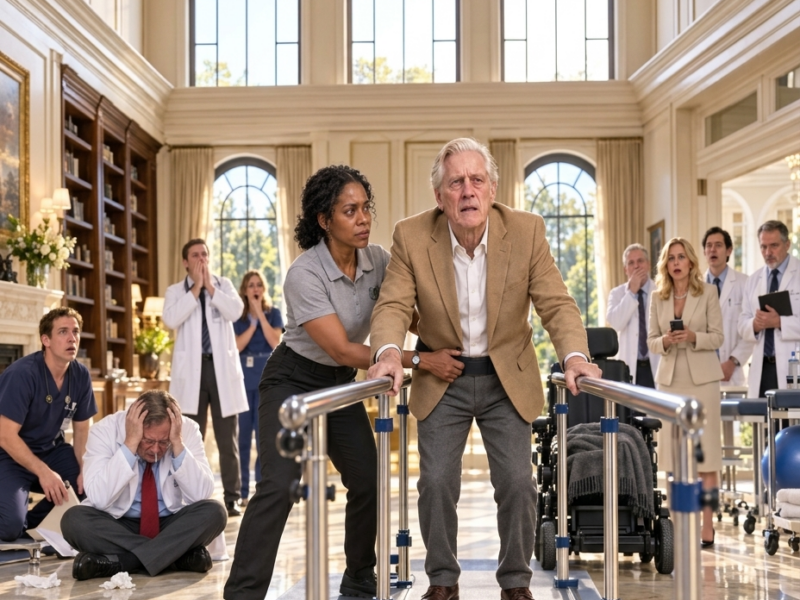
Eight Doctors Laughed When a Black Maid Said She Could Make the Billionaire Walk—Until She Stood Up
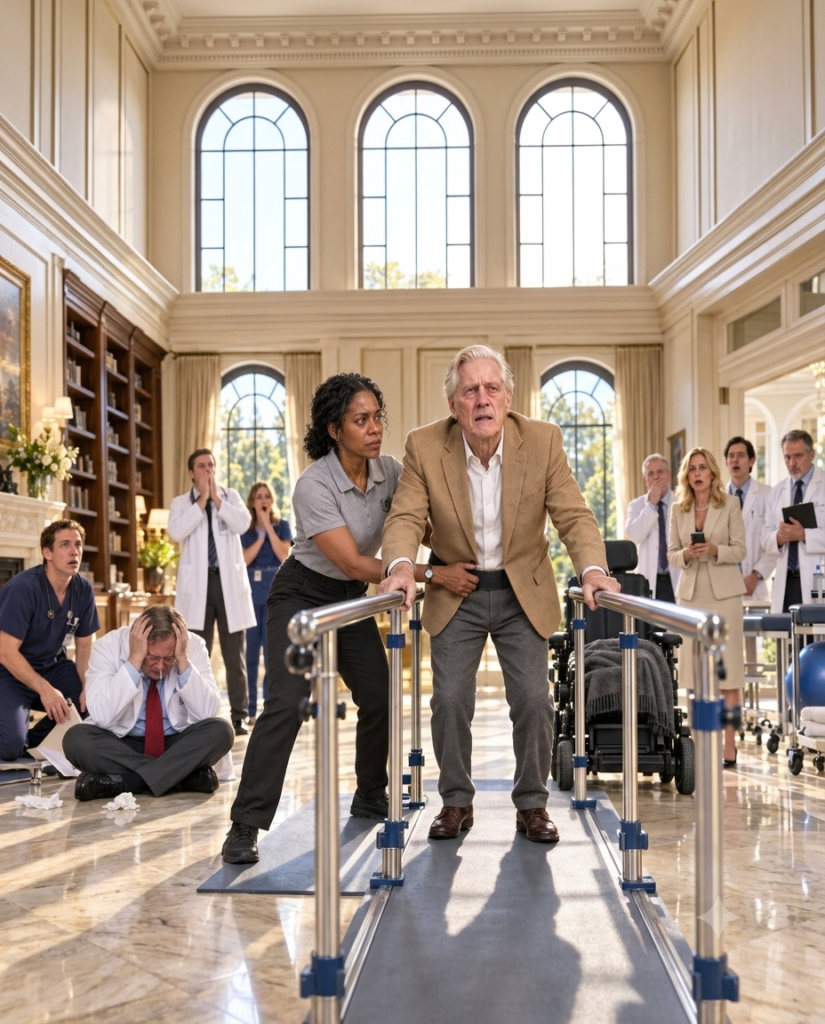
The marble hallway of the Whitmore estate carried sound the way a cathedral carries hymns, and Bridget Sanders had just made the mistake of whispering the truth.
She was on her knees, gray uniform pressed against polished stone, white apron bunched at her waist, when she said it loud enough for the wrong person to hear.
“That’s not right.”
Victoria Chase’s heels clicked toward her like a countdown, and Bridget knew before the woman even opened her mouth that three years of invisibility had just ended.
“What did you say?”
Bridget’s hand tightened on the mop handle. “Nothing. I was just—”
“You were listening to a private medical consultation.” Victoria’s phone was already rising, her eyes narrowing with the particular hunger of someone who’d been waiting for this moment. “Doctors, you need to hear this.”
The great room went quiet when Victoria pushed her through the doorway.
Eight physicians and one billionaire watched a maid stumble into their midst, mop still in hand, floor cleaner still damp on her fingers.
—
This was not how Bridget Sanders had planned to spend her Tuesday morning.
Three years ago, she’d arrived at the Whitmore estate with a single suitcase, a gray uniform, and a past she’d buried so deep she sometimes forgot it was there.
She mopped corridors at 6:00 a.m. She folded Conrad Whitmore’s shirts with military precision. She spoke only when spoken to.
No one asked why a woman with steady hands and perfect posture worked as a maid.
No one noticed that she read the medical journals left on hallway tables, her eyes moving across pages with the fluency of someone who’d once written them.
No one saw her pause outside the West Wing suite during consultations, her mop going still, her breath catching at words drifting through the door.
Twelve years. That’s how long Dr. Bridget Sanders had practiced neurology at Johns Hopkins, spinal cord injury rehabilitation, epidural stimulation protocols.
She’d published nine peer-reviewed papers. She’d restored partial mobility to patients three other hospitals had sent home in wheelchairs.
Then one patient had an adverse reaction to an experimental protocol, a drug interaction no model had predicted.
The family sued. The hospital needed a shield. And Bridget, the youngest attending, the only Black woman in the department, was the easiest one to sacrifice.
The medical board revoked her license. No hearing that mattered. No appeal that changed anything.
Five years ago, Dr. Bridget Sanders became just Bridget, the maid.
—
Conrad Whitmore had built Whitmore Pharmaceuticals from a single patent into a $12 billion empire.
He’d walked five miles every morning before dawn. He’d climbed Kilimanjaro at 59.
Then a head-on collision on the Merritt Parkway shattered his T10 and T11 vertebrae, and the man who’d conquered boardrooms across three continents couldn’t cross his own bedroom without a wheelchair.
He’d spent $4.2 million on the best medical team money could buy.
Eight physicians led by Dr. Garrett Nolan.
Nolan arrived at the estate six months ago with a Harvard medical diploma framed in mahogany, a handshake that lingered three seconds too long, and a vocabulary designed to impress rather than inform.
Fifty-five years old, silver temples, a Patek Philippe on his left wrist.
He wore his lab coat even at dinner. Collar starched so stiff it could cut paper.
The other seven doctors deferred to him without question. Harvard team leader. The hierarchy was understood.
What none of them knew, what no one in the medical world had discovered in 25 years, was that Garrett Nolan’s Harvard degree rested on a plagiarized thesis.
A dead graduate student’s research, copied nearly word for word.
The diploma was real. The knowledge behind it was stolen.
And for a quarter century, Nolan had survived by choosing cases he couldn’t lose, burying mistakes in paperwork, and relying on the unearned authority of three syllables.
Harvard. Veritas. Trust.
Conrad’s case was different. Conrad’s case paid $200,000 a month.
—
The consultation began at 9:00 a.m. in the great room.
Eight doctors arranged themselves around an oak table that had once hosted senators and foreign dignitaries.
Conrad sat at the head in his wheelchair, a wool blanket across his legs, hands folded on the armrest. His jaw was set. His eyes were tired.
Fourteen months of tired.
Dr. Nolan stood. He clicked a remote. A projection screen descended from the ceiling, and Conrad’s spinal imaging filled the wall in blue and white.
“Mr. Whitmore,” Nolan began, adjusting his cuffs. “After six months of comprehensive evaluation, our team has reached a consensus.”
He paused. The pause was rehearsed.
“The damage to your thoracic spine at T7 to T8 is complete and irreversible. There is no surgical intervention, no experimental therapy, and no rehabilitation protocol that will restore motor function to your lower extremities.”
He said it the way a sommelier describes a wine. Smooth. Polished. Final.
“Our recommendation is to transition to long-term adaptive care. We can optimize your quality of life within your current physical parameters.”
Within your current physical parameters.
Conrad’s fingers tightened on the armrest.
Dr. Perry Wells, 46, wire-rimmed glasses, the kind of man who agreed with whoever held the most authority in any room, nodded along.
“Dr. Nolan is correct. The imaging is conclusive.”
The other six doctors murmured agreement, heads bobbing like buoys in a calm harbor.
Outside the great room, Bridget pushed her mop in slow circles.
The door was open three inches. Enough.
She heard every word, and every word was wrong.
T7 to T8. They were still saying T7 to T8.
She’d checked the imaging four separate times. The primary lesion was at T10 to T11, two vertebrae lower.
A different injury. A different prognosis. A different future.
Her hand stopped on the mop handle.
“That’s not right,” she whispered.
—
Nolan raised a palm. His smile contained no warmth at all.
“A cleaning woman correcting a Harvard neurologist.” He let the words hang. “This is exactly what happens when you let the help wander unsupervised.”
Dr. Wells leaned back in his chair. “Maybe she read a WebMD article and thinks she’s qualified.”
Laughter. Not all of them, but enough.
Dr. Alan Crawford, 51, orthopedic specialist, chuckled into his fist.
Dr. Sandra Pard covered her mouth, but her shoulders shook.
Victoria held up her phone, recording.
Bridget tried again. “The imaging shows an incomplete lesion at T10 to T11. There’s preserved sacral sensation. That means the neural pathways below the injury are still—”
Nolan’s voice cut like a scalpel.
He stepped toward her, close enough that she could smell his cologne. Something expensive that covered nothing.
“You mop floors. You don’t read MRIs. You don’t interpret neural pathways. And you certainly don’t interrupt a medical team with half a century of combined experience.”
He reached for the towel draped over Bridget’s shoulder, pulled it free, dropped it on the floor at her feet.
“Here.” His voice dropped to a register meant to humiliate. “This is your instrument, not a stethoscope.”
Victoria stepped forward. “Get on your knees and clean this floor now in front of everyone. That’s what you’re paid to do.”
The room was silent. Not the silence of objection. The silence of permission.
Bridget looked around.
Dr. Helen Aldridge, 49, neurologist from Columbia, stared at her own hands.
Wells examined his cufflinks. Crawford studied the ceiling.
Not one of the seven opened their mouth.
Bridget knelt.
Her knees pressed into marble that she’d polished that morning. The cold seeped through the thin fabric of her uniform. She could feel every grain of dust she’d missed.
She picked up the towel. She wiped in a slow circle.
Her back was to eight doctors and one billionaire. The sound of damp cotton on polished stone was the only noise in the room.
Her hand trembled once, then steadied.
Victoria filmed, her phone angled low to capture the full frame. A Black woman on her knees, surrounded by white coats, cleaning a floor she’d already cleaned.
But from his wheelchair, Conrad Whitmore watched something else entirely.
He watched Bridget’s lips move as she knelt, mouthing words to herself. Not prayers. Something clinical. Something precise.
Incomplete lesion. Preserved sacral sensation. Epidural stimulation.
A maid who talked like a surgeon.
Conrad’s eyes moved from Bridget to Nolan. From the woman on her knees to the man who’d put her there.
Something shifted behind his gaze. Not pity. Something colder. Something that calculated.
He said nothing. Not yet.
But he didn’t look away from Bridget for the rest of the session.
And when the eight doctors filed out, confident they’d delivered their final verdict, not one of them noticed that Conrad hadn’t agreed to a single thing they’d said.
—
The estate went dark at 11:00 p.m. Staff quarters at 11:30.
Bridget’s room, barely wide enough for a single bed and a dresser, was the last one at the end of the service corridor. Farthest from everything. Closest to nothing.
She lay awake. The notebook was under her pillow.
The words she hadn’t been allowed to finish cycled through her mind like a song stuck on repeat.
T10 to T11. Incomplete. Reversible.
She pressed her palms against her eyes and tried to forget that she’d been on her knees six hours ago.
The intercom buzzed at 2:14 a.m.
“Bridget. My study. Now.”
Conrad’s voice. No explanation.
Staff didn’t get explanations at 2:00 a.m. They got orders.
She pulled on her uniform, crossed the dark hallway, climbed the back stairs.
Conrad’s study was lit by a single desk lamp. He sat in his wheelchair behind a mahogany desk covered in medical files. His reading glasses sat low on his nose.
He looked like a man who’d been studying for an exam he was determined to pass.
“Close the door.”
She did.
“Sit down.”
She didn’t move. Maids didn’t sit in the study.
“I said sit.”
She sat on the edge of a leather chair that probably cost more than her car.
Conrad removed his glasses. “Where did you learn those words? Incomplete lesion. Sacral sensation. No maid talks like that.”
Bridget’s hands pressed flat on her knees. “Mr. Whitmore, I shouldn’t have spoken out of turn. I apologize.”
“I don’t want an apology. I want an answer.”
Silence. The desk lamp hummed.
“I used to work in medicine,” she said finally. “A long time ago.”
“How long?”
“Twelve years.”
Conrad leaned forward. His wheelchair creaked. “Twelve years doing what?”
Another silence, longer this time.
Bridget stared at the carpet, a Persian rug worth more than her annual salary.
“Neurology. Spinal cord rehabilitation.”
The air between them gained weight.
Conrad studied her the way he studied quarterly reports. Line by line. Looking for the number that didn’t fit.
“Where?”
“Johns Hopkins.”
He exhaled through his nose. “Johns Hopkins.” He let the words sit. “And now you mop my floors.”
“Yes, sir.”
“Why?”
The question hung.
Bridget could have lied. Could have deflected. Could have protected the small, safe life she’d built from the wreckage of the one she’d lost.
“My license was revoked five years ago. A patient had an adverse reaction to an experimental protocol. A drug interaction no one predicted. The family sued. The hospital needed someone to blame.”
She paused.
“I was the easiest target.”
“Were you negligent?”
“No. The protocol had been approved. The reaction was a statistical outlier. But someone had to fall, and I was the youngest attending, the only Black woman in the department, the one with the least protection.”
Conrad pulled a file from the stack on his desk. His own MRI.
He slid it across the mahogany toward her.
“Show me what you see.”
Bridget’s fingers hesitated over the film. Five years since she’d held medical imaging. Five years since anyone had asked her medical opinion on anything.
Her hand shook for one second. Then it didn’t.
She lifted the film to the lamp.
“Here.” Her index finger traced the spine. “Your team identified damage at T7 to T8. But look at this shadow. This is your actual lesion. T10 to T11. See how the signal intensity changes? That’s edema, not structural destruction.”
And here—she pointed lower—”Sacral segments S2 through S4. You still have sensation in these dermatomes, don’t you? Pressure? Maybe temperature?”
Conrad’s jaw tightened. “Yes. Sometimes I feel something like warmth. The doctor said it was phantom sensation.”
“It’s not phantom. It’s real. Your nervous system below the injury isn’t destroyed. It’s suppressed. The neural pathways are intact but dormant. They can be reactivated.”
“How?”
“Epidural spinal stimulation. Targeted electrical impulses at the lesion site, combined with intensive guided physiotherapy. There are published protocols. Peer-reviewed. Replicated.”
“Eight doctors missed this.”
“They followed one diagnosis. Dr. Nolan’s diagnosis. No one verified it independently. They trusted the Harvard credential and the team leader title, and they all landed on the same wrong answer.”
Conrad was quiet for a long time.
He looked at the MRI. He looked at Bridget. He looked at his own legs under the blanket.
“I’ve spent $4 million on eight doctors who can’t fix me. They’re out of ideas. They told me today to accept this chair for the rest of my life.”
He folded the MRI and placed it back on the desk.
“I have nothing left to lose.”
He met her eyes.
“Tomorrow morning. 9:00 a.m. You’re going to stand in that room and tell them exactly what you just told me.”
Bridget’s stomach dropped. “Mr. Whitmore, they’ll—”
“I know what they’ll do. That’s my problem, not yours.”
He rolled his chair back from the desk.
“Get some sleep. You’re going to need it.”
She stood, walked to the door, stopped with her hand on the brass handle.
“Mr. Whitmore?”
“What?”
“If I’m wrong—if the stimulation doesn’t work—they’ll use it to bury me. And you.”
Conrad’s mouth curved. Not quite a smile. Something harder. Something a man learns after 50 years of corporate warfare.
“Then don’t be wrong.”
The door clicked shut behind her, and in the silence of the study, Conrad Whitmore picked up his phone and dialed his personal attorney.
He hadn’t survived $12 billion worth of business by trusting eight men who all told him the same comfortable lie.
—
9:00 a.m. The great room. Same oak table. Same eight doctors. Different morning.
Nolan arrived first, as always. He arranged his notes with the precision of a man who believed his own authority was the most important thing in any room.
Wells followed. Then Aldridge. Crawford. Pard. And the others.
Dr. James Hartwell. Dr. Katherine Trent. Dr. Lawrence Booth.
Eight white coats. Eight clipboards. Eight salaries that could fund a small clinic for a year.
Conrad rolled in at 9:02. Two minutes late. Deliberate.
A man who’d built a pharmaceutical empire understood the power of making people wait.
“Gentlemen. Dr. Aldridge. Dr. Pard. Dr. Trent.”
He nodded to each. Then he stopped.
“Before we continue, I’ve asked someone to present an alternative assessment.”
Nolan’s pen paused mid-click. “Alternative assessment? From whom?”
The door opened.
Bridget walked in.
She wore the same gray uniform, same white apron, same flat shoes. But she carried Conrad’s MRI in one hand and a small leather notebook in the other.
Her back was straight. Her face was still.
The silence in the room developed teeth.
“No.” Nolan’s chair scraped back. “Absolutely not.”
“Sit down, Garrett.”
Conrad’s voice was low. The voice of a man who signed checks.
“Mr. Whitmore, you cannot be serious. You’re letting the maid present a medical assessment? This is beyond inappropriate. This is—”
“She’s not practicing medicine. She’s presenting observations. And I’m the patient. I decide who speaks in my house.”
Wells shifted in his seat. “This is insulting to everyone in this room with an actual medical degree.”
“Then leave.” Conrad’s eyes didn’t move from Nolan. “Any of you. The door is right there.”
No one moved.
$200,000 a month per doctor. The door stayed closed.
“Bridget.” Conrad gestured toward the projection screen. “Go ahead.”
She walked to the front of the room. Her shoes didn’t squeak.
She could feel Victoria’s camera phone pointed at her back from the doorway. She could feel eight sets of eyes cataloging every thread of her uniform, every reason she didn’t belong here.
She held the MRI to the light panel.
“This is Mr. Whitmore’s most recent thoracic imaging.”
Her voice was steady. Clinical. The voice of a woman who’d presented at medical conferences before some of these doctors had finished residency.
“Dr. Nolan’s team has identified the primary lesion at T7 to T8 and classified it as a complete spinal cord injury. I disagree with both the location and the classification.”
Nolan crossed his arms. His jaw worked like he was chewing glass.
“The lesion is here.” She pointed. “T10 to T11. Not T7 to T8. The shadow at T7 to T8 is post-traumatic edema, not structural cord damage. It’s been resolving over the past 14 months, which is consistent with edema, not with permanent injury.”
She opened her notebook.
“Mr. Whitmore retains sensation in sacral dermatomes S2 through S4. Pressure. Temperature. This was documented in his initial intake but classified as phantom sensation. It’s not phantom. Preserved sacral sensation in the presence of a thoracic lesion indicates an incomplete injury under the ASIA Impairment Scale, grade B or possibly C.”
“This is absurd,” Nolan said. “She’s reading from a notebook. She has no credentials.”
“An incomplete lesion at T10 to T11,” Bridget continued, not raising her voice, “is responsive to epidural spinal stimulation. Three published clinical trials. Angeli et al., 2018, New England Journal of Medicine. Gill et al., 2018, Nature Medicine. Wagner et al., 2018, Nature. All three demonstrated recovery of voluntary motor function in patients with chronic incomplete spinal cord injuries.”
She closed the notebook.
“The protocol requires four to six weeks. The expected outcome is partial to significant recovery of lower limb motor function. Not a miracle. Science.”
Silence. The kind that fills a courtroom before a verdict.
Nolan recovered first. He stood, buttoned his coat.
“Those studies are experimental. Unproven in clinical practice. The sample sizes are—”
“Peer-reviewed. Replicated in three independent trials. Published in the top two medical journals in the world.”
Bridget didn’t flinch.
“Which of your papers has appeared in Nature, Dr. Nolan?”
The temperature in the room dropped five degrees.
Nolan’s mouth opened. Closed. Opened again.
“Who are you to question eight certified physicians? You’re a housekeeper. You clean toilets.”
“I’m someone who read the MRI correctly.”
Conrad spoke from his wheelchair.
“She’s also the only person in this room who’s actually explained what’s wrong with my spine. In six months, not one of you told me why I can feel heat on my right foot but can’t move my toes. She just did in four minutes.”
Wells looked at Nolan, then at Bridget, then at his own hands.
Dr. Aldridge hadn’t moved, but her pen was poised over her notepad, and she’d written two words: T10 to T11.
Victoria stepped forward from the doorway. “Mr. Whitmore, this is a mistake. She’s manipulating you. She probably looked up medical terms on the internet.”
“Quiet.”
One word. Victoria went pale and retreated to the wall.
Nolan drew himself up. His final card.
“Mr. Whitmore, I must be direct. If you allow this unqualified, unlicensed individual to lay hands on you, every physician in this room will withdraw from your case immediately. And I will personally ensure that no reputable medical professional in the Northeast takes you on.”
The ultimatum landed like a grenade on the oak table.
Conrad looked at Nolan for a long time. Then at Bridget. Then at his legs beneath the blanket.
Then walk.
Nolan blinked. “Excuse me?”
“I said walk out that door. All of you. If eight Harvard-trained doctors can’t do what a woman in an apron thinks she can, then what am I paying you for?”
Nobody walked.
$200,000 a month held them in their seats like gravity.
Nolan’s face cycled through four shades of red before settling on a purple that matched his ego.
“Fine,” Nolan said through his teeth. “Let the maid have her little experiment. When it fails—and it will—I’ll be here to manage the consequences.”
“You’ll be here,” Conrad said, “because I want witnesses.”
Bridget gathered her MRI and her notebook. Her hands were steady. Her heart was not.
As she turned toward the door, she caught Dr. Aldridge’s eye.
The older woman gave the smallest nod. Almost invisible. Almost nothing.
But nothing had ever felt more like enough.
—
Bridget started that afternoon.
Conrad gave her full access to the West Wing Medical Suite, a room equipped with more diagnostic technology than most rural hospitals.
Hydraulic examination table. Portable MRI. Nerve conduction monitors. Electrical stimulation units.
All purchased over the past 14 months. All operated by a team that had used them to confirm the wrong diagnosis.
She changed into scrubs from the supply closet. Gray cotton exchanged for blue.
The transformation was quiet. The way muscle memory returns. Not with fanfare, but with the body remembering what the mind never forgot.
She washed her hands at the surgical sink, counted to 60, dried them with a technique so ingrained it was unconscious.
She organized instruments on the tray—electrodes, conductive gel, stimulation leads, assessment tools—with the speed of someone who’d done it 10,000 times.
She didn’t notice Dr. Helen Aldridge standing in the doorway.
Aldridge watched for 11 minutes without speaking.
She watched Bridget’s hands. Precise. Economical. Never reaching for something that wasn’t where she expected it.
She watched her calibrate the nerve conduction monitor without consulting the manual.
She watched her position electrodes with spacing accurate to the millimeter.
“That’s not how a maid moves,” Aldridge said quietly.
Bridget looked up.
“That’s muscle memory. Years of it.”
Aldridge stepped into the room. “Where did you train?”
Before Bridget could answer, her past answered for her.
Victoria Chase burst through the door, phone in hand, triumph on her face. Behind her, Nolan.
“I found it.”
Victoria held up the screen.
A Johns Hopkins faculty page. Archived but still cached.
Dr. Bridget Sanders, Department of Neurology, Spinal Rehabilitation Division.
The photograph showed a younger Bridget in a white coat, stethoscope around her neck, standing in front of a lab filled with the same type of equipment she’d just finished calibrating.
“She’s a fraud.” Nolan’s voice filled the suite. “A disgraced doctor pretending to be a maid. Her license was revoked. She hurt a patient and the medical board stripped her credentials.”
Victoria scrolled further. “There’s more. Lawsuit. Malpractice. Patient suffered irreversible—”
“That’s enough.”
Bridget’s voice was calm but carried a weight that hadn’t been there before. The voice of someone who’d held a truth for five years and was tired of holding it alone.
She looked at Conrad, who’d rolled himself into the suite at the commotion. She looked at Nolan. She looked at Aldridge.
“Yes. I was a neurologist at Johns Hopkins. Twelve years, spinal cord injury rehabilitation. I published nine peer-reviewed papers on epidural stimulation protocols. I developed treatment plans that restored motor function to patients who’d been told they’d never walk again.”
She paused. Not for drama. For breath.
“Five years ago, a patient enrolled in an experimental treatment trial had an adverse drug reaction. An interaction between the stimulation protocol and a medication his primary physician prescribed without informing my team. The reaction was severe. The family sued. The hospital needed a name to attach to the settlement. Mine was the one they chose.”
Her voice didn’t waver. Her eyes were dry.
“The board revoked my license based on the hospital’s internal report. A report that omitted the undisclosed medication. I appealed. The appeal was denied. No one wanted to reopen a case the hospital had already paid to close.”
Nolan stepped forward. “So you admit you lost your license because you were incompetent.”
“I lost my license because I was convenient.”
Conrad’s wheelchair rolled three inches forward. “Were you negligent?”
“No.”
“Can you prove it?”
“The original trial data exists. The patient’s undisclosed medication history exists. The pharmacy records exist. No one has looked at them because no one had a reason to look.”
Conrad turned to Nolan. “And your credentials, Garrett? Have you ever had them questioned?”
Nolan stiffened. “My credentials are impeccable. Harvard Medical School. Twenty-five years of practice.”
“Impeccable.” Conrad repeated the word as if tasting it, finding it hollow. “So was hers. Until it wasn’t.”
He turned back to Bridget.
“I don’t care about a piece of paper. I care about whether you can do what you say.”
“I can.”
“Then prove it.”
Nolan stood in the doorway, his face carved from something between fury and fear.
Victoria’s phone was still recording.
Aldridge stood by the equipment tray, arms folded, her expression unreadable.
And Bridget Sanders pulled on a pair of surgical gloves with a snap that echoed off the tile walls like a starting pistol.
—
The first session began at 4:00 p.m. on a Tuesday.
Bridget started with what every good neurologist starts with. Assessment. She needed her own data, not Nolan’s.
She tested Conrad’s reflexes methodically. Patellar absent bilaterally. Ankle absent left, trace response right.
She ran a pinwheel along dermatomes from T8 to S5, marking sensation on a body chart with the precision of a cartographer.
Conrad reported dull pressure at L3 on the right. Sharp-dull discrimination at S2 and S3 bilaterally. Temperature sensation at S4.
“Your doctors called this phantom,” she noted the findings. “It’s not. These are functioning neuropathways. Your spinal cord is injured, but it isn’t severed. The circuits are still there. They just need a signal strong enough to switch them back on.”
She positioned the epidural stimulation electrodes along his lower thoracic spine using surface-mounted leads for the initial phase.
The stimulator hummed to life. Frequency at 25 hertz. Amplitude at 2.5 milliamps. Low. Exploratory.
“You’ll feel tingling. Maybe warmth. Tell me everything.”
Conrad felt nothing for 40 minutes.
Nolan, watching from a chair in the corner with his arms folded, smiled.
“Day one,” he announced to no one in particular. “And already nothing.”
Bridget adjusted the electrode placement by three millimeters. Changed the frequency to 30 hertz. Increased amplitude to 3.1 milliamps.
Conrad’s right foot twitched.
Involuntary. A reflex arc firing for the first time in 14 months.
It lasted less than a second, but Bridget saw it. She noted the exact parameters.
She didn’t announce it to the room. Some battles are won in silence.
—
Days two and three produced nothing visible.
Nolan made sure everyone knew.
He ate lunch in the great room with the other doctors and narrated Bridget’s failure like a sports commentator.
“Still no results. Who’s surprised? Show of hands.”
Wells laughed. Crawford shook his head. Victoria texted updates to contacts she wouldn’t name.
Day four. Bridget increased stimulation to 90 minutes. She added passive range of motion exercises, manually moving Conrad’s legs through walking patterns while the electrodes fired.
Retraining the circuits. Telling the nervous system: This is what walking feels like. Remember?
Day five. 9:47 a.m.
Conrad lay on the treatment table, electrodes active, Bridget performing passive extension of his right knee.
The morning sun cut through the blinds and laid stripes across the examination table. The stimulator hummed at 32 hertz.
Bridget’s fingers rested lightly on Conrad’s ankle, feeling for the faintest tremor beneath the skin.
His big toe moved.
Not a twitch. Not a reflex. A deliberate, voluntary dorsiflexion. Tiny. Trembling. But controlled.
Conrad stared at his foot. “Did I just—”
“Yes.” Bridget’s voice was steady, but her eyes were bright. “Do it again.”
He concentrated. The toe rose. Fell. Rose again.
“That’s voluntary motor activation.”
She recorded the parameters. The time. The date.
Inside, five years of silence were breaking apart like ice in a spring river.
She didn’t tell Nolan.
—
Day seven. 2:17 a.m.
Bridget was reviewing stimulation logs when she noticed something wrong.
The parameters had been changed.
Amplitude reduced from 4.2 milliamps to 0.8. Frequency dropped from 35 hertz to 15.
Settings that would produce no therapeutic effect. Settings designed to make the treatment fail.
She checked the access log. Someone had modified the parameters at 3:17 a.m.
The log showed the user code assigned to the treatment suite door.
Nolan’s code.
She found him in the hallway the next morning, waited until they were alone.
“I know what you did.”
Nolan examined his cuffs. “I don’t know what you’re talking about.”
“The stimulator logs every parameter change with a timestamp and an access code. You entered the suite at 3:17 a.m. and reduced the amplitude to sub-therapeutic levels.”
His face didn’t change. Decades of deception had given him excellent control.
“You have no proof that would hold up.”
“The machine logs everything. Dr. Nolan, every access. Every modification. Every code.”
She stepped closer.
“If you touch my equipment again, I’ll show Conrad the logs. And then I’ll show them to the Connecticut Medical Board.”
Nolan’s composure cracked for half a second. A tremor at the corner of his mouth. Then it sealed shut.
“This won’t end the way you think it will,” he said.
“Maybe not. But it’ll end.”
He walked away. His shoes echoed down the marble corridor.
He didn’t enter the treatment suite again.
—
Day 10. Full protocol parameters.
Conrad could now generate voluntary contractions in his right quadriceps. Weak. Shaking. But real.
Bridget introduced weight-bearing exercises on the parallel bars.
Conrad gripped the rails and pressed his feet against the floor. His right leg bore partial weight for four seconds.
He wept silently, his shoulders shaking under the fluorescent light, his grip white on the parallel bars.
A 68-year-old billionaire weeping because his foot pressed against a floor for the first time in 14 months.
The sound he made wasn’t loud. It was the sound of a man who’d stopped believing this moment would come.
Bridget handed him a towel and said nothing. Some moments don’t need narration.
Day 12. Left leg activation. Weaker than the right, but present. Both legs could generate enough force to partially support his weight with assistance.
Bridget documented everything. Photographs. Videos. Nerve conduction measurements.
Every data point a brick in a wall that was getting harder to deny.
Day 14. Bridget told Conrad it was time.
“Time for what?”
“Time to stand up.”
She invited every doctor. Conrad insisted.
Nolan came because refusing would look like fear. The others came because the money still mattered and the curiosity was becoming impossible to ignore.
The parallel bars were set up in the treatment suite. Chrome rails bolted to the floor, three feet apart, six feet long.
The distance between a wheelchair and a life.
Eight doctors lined the wall. Victoria stood in the corner, phone raised. Aldridge stood closest to the bars, her arms folded tight.
Bridget positioned Conrad’s wheelchair at the end of the bars, locked the wheels, fastened support straps around his waist.
Not to hold him up. To catch him if he fell.
“When you’re ready,” she said. “Grip the bars. Push with your legs. I’ll be right here.”
Conrad looked at the bars. Looked at his legs. Looked at eight doctors who’d told him these legs were finished.
He gripped the rails. His knuckles went white.
He pushed.
His arms took most of the weight at first, shoulders trembling, veins standing out on his forearms. Bridget’s hand hovered at his waist.
His right foot pressed flat against the tile. Then his left.
His knees shook so violently the parallel bars vibrated.
“Hold,” Bridget said. “Breathe.”
He held.
Three seconds. Five. Seven.
And then Conrad Whitmore stood.
Not tall. Not straight. Not gracefully. He stood the way a man stands after 14 months of being told he never would.
With everything he had, balanced on legs that had forgotten what they were for and were remembering right now in front of every person who’d said it couldn’t happen.
Ten seconds. Fifteen.
The room was silent in the way a room is silent when the world rearranges itself.
Dr. Aldridge pressed her hand over her mouth. Her eyes filled.
Wells gripped the back of his chair so hard the wood groaned.
Crawford’s clipboard slid from his fingers and clattered on the floor. He didn’t pick it up.
Nolan’s face went white. Not pink. Not pale. White. The color of a man watching his foundation crack.
Conrad’s arms trembled. His legs trembled. His breath came in short, sharp pulls.
But he didn’t sit down.
“Fourteen months,” he said, his voice shaking. “Fourteen months in that chair. And the maid got me up in two weeks.”
Bridget stood beside him. She didn’t smile. She didn’t celebrate. She held the strap at his waist and let him stand for as long as his body could hold.
Twenty-three seconds.
Then she guided him back into the chair. Gently. Precisely.
Conrad looked at Nolan.
“Well, doctor. Nothing to say?”
Nolan’s mouth moved, but no sound came out.
For the first time in 25 years, the man who’d built a career on words had none left.
And the machine in the corner beeped quietly, recording what eight doctors had declared impossible.
—
Conrad took his first steps 20 minutes later.
Bridget positioned herself beside the parallel bars. Conrad gripped the rails.
This time when he pushed up, his legs responded faster. The neural circuits that had fired for the first time 10 days ago were learning. Each repetition carved the pathway deeper.
Right foot forward. Three inches. His heel touched down first, then the ball of his foot. The way a person walks when they’re learning it all over again.
Left foot. Two inches. Slower. Weaker. But forward.
Six steps.
Each one a war between damaged nerves and stubborn will.
Each one witnessed by eight physicians who’d collected $4.2 million for declaring it impossible.
Nolan found his voice at last. “This is temporary. A spinal reflex. It won’t sustain.”
“Shut up, Garrett.”
Dr. Aldridge. The first time any of them had challenged Nolan in front of Conrad.
She turned to Bridget. “The sacral preservation. You were right. We should have caught it.”
“You should have looked for it,” Bridget said. Not cruel. Factual.
Conrad reached the end of the bars. He turned, assisted, shaking but turning, and faced the room.
“$4 million.” His voice carried the weight of a man who’d spent a lifetime making cost-benefit analyses. “That’s what I paid for your consensus. Your confident, unanimous, wrong consensus.”
He pointed at Nolan. “Starting with him.”
He picked up his phone. Speed-dialed. The call connected in three seconds.
“Thomas. It’s Conrad. I need a full credential audit on every physician currently employed at this estate. Start with Dr. Garrett Nolan. Harvard Medical School.”
He looked at Nolan. “What year, Garrett?”
Nolan didn’t answer.
“Run them all.”
Conrad hung up.
Nolan’s composure fractured visibly. The smooth, unshakable facade that had carried him through 25 years of impersonation developed cracks you could see from across the room.
“That’s unnecessary. My credentials are impeccable.”
“Then you have nothing to worry about.”
Victoria’s phone was still recording. She’d stopped smiling three minutes ago.
She looked at the footage she’d captured. Bridget on her knees. Bridget being mocked. Bridget being ordered to clean.
And her face went the color of old milk.
That footage wasn’t evidence of a maid’s humiliation anymore. It was evidence of her own cruelty toward the woman who’d just done what eight doctors couldn’t.
“Don’t bother deleting anything,” Conrad said without looking at her. “My security system has cameras in every room of this estate. The footage has been backed up since the day I started suspecting my medical team was more interested in my money than my spine.”
Victoria’s phone lowered to her side.
Nolan stood in the center of the room, surrounded by seven colleagues who were each quietly calculating how much distance they could put between themselves and the man they’d been following for six months.
And Bridget Sanders removed her surgical gloves, folded them neatly, and set them on the instrument tray.
The same hands that had held a mop that morning had just made a man walk.
But the credential audit hadn’t started yet.
And what it would uncover would make Conrad’s six steps look like the least remarkable thing that happened inside these walls.
—
The audit took 72 hours.
Conrad’s attorney, Thomas Whitfield, senior partner at Whitfield & Associates, a man who had dismantled corporations the way surgeons remove tumors, started with Nolan’s Harvard diploma.
The verification request went to the registrar’s office on a Wednesday.
The answer came back on a Friday.
Garrett Nolan had graduated from Harvard Medical School. The diploma was genuine.
But the thesis that earned it was not.
A forensic analysis of Nolan’s doctoral thesis revealed a 94% textual match with a dissertation submitted three years earlier by a graduate student named Alan Prescott.
Prescott had died in a car accident six months before his defense date. His work had never been published.
Nolan had accessed it through the university archive, rewritten 6% for cosmetic variation, and submitted it as his own.
Twenty-five years. Twenty-five years of medical practice built on a dead man’s stolen words.
The dominoes fell fast.
The Connecticut Medical Board opened an emergency investigation. Nolan’s license was suspended within 48 hours.
Federal prosecutors filed preliminary charges of healthcare fraud. Twenty-five years of billing insurance companies, Medicare, and private patients using credentials obtained through academic theft.
Every patient Nolan had treated in two and a half decades became a potential case review. Every diagnosis. Every surgery he’d supervised. Every family he’d told there was nothing more to be done.
Conrad’s case was the first reopened.
The audit confirmed what Bridget had identified. Nolan had misread the MRI. T7 to T8 instead of T10 to T11.
A fundamental error. The kind of mistake a first-year resident would catch if they had the training to look.
Nolan didn’t. He’d never had it. His entire medical knowledge was built on performance, not practice. On confidence, not competence.
And seven doctors had followed his lead because questioning the man from Harvard felt like questioning Harvard itself.
Three had their hospital privileges reviewed. Two faced malpractice inquiries for failing to independently verify imaging.
All seven were dismissed from Conrad’s care with the kind of quiet termination that leaves no reference letter and no forwarding address.
Victoria Chase was fired on a Thursday morning. She cleared her desk in 14 minutes and walked out the service entrance, the same door Bridget had used for three years.
—
Bridget’s case moved faster than anyone expected.
Conrad retained a second legal team, healthcare law specialists from Washington, to petition for license reinstatement.
They obtained the pharmacy records from five years ago.
The record showed that Bridget’s patient had been prescribed a contraindicated medication by his primary care physician without notifying Bridget’s team. The adverse reaction was pharmacologically predictable given the drug combination.
The hospital’s internal investigation had omitted this evidence entirely.
The reinstatement hearing lasted one day.
The medical board restored Bridget’s license with a formal letter of apology that used the word “regrettable” four times without once using the word “wrong.”
Bridget framed the license. Not the apology.
—
Six months later, the numbers told the rest.
Conrad Whitmore walked without assistance. Not far. Not fast. But on his own legs, under his own power, across the garden of his Connecticut estate to a building he’d commissioned the week after he first stood up.
The Sanders Neurological Recovery Center.
Funded entirely by the Whitmore Foundation. Staffed by Dr. Bridget Sanders, medical director.
Twelve treatment bays. A research wing. A waiting list of patients whose doctors had told them the same thing Nolan had told Conrad.
And in a federal courthouse in Hartford, Garrett Nolan sat behind a defendant’s table, hands folded, staring at a wall of cameras and reporters.
The headline ran on every network that evening.
“Renowned Harvard Doctor Exposed as 25-Year Fraud. Billionaire’s Maid Was the Real Physician All Along.”
Nolan’s attorney entered a plea of not guilty.
The evidence entered a response of its own.
—
They asked Conrad once in an interview why he trusted a maid over eight doctors.
He leaned forward in his chair. Not a wheelchair. A chair.
And said three words.
“She was right.”
Not because she was humble. Not because she was kind. Not because she had a story that made for good television.
Because she was right.
And eight men with diplomas and titles and expensive watches were wrong.
And not one of them had the integrity to question whether their leader actually knew what he was talking about.
—
The world likes simple stories.
Rich man meets poor woman. Woman saves rich man. Justice prevails.
But this story isn’t simple.
This story is about what happens when credentials replace competence. When authority replaces accuracy.
When a man’s reputation carries more weight than a woman’s knowledge.
Because his coat is white and hers is gray.
Because his name sits on a diploma and hers sits on a mop bucket.
Because his skin gives him the benefit of the doubt and hers takes it away before she opens her mouth.
Bridget Sanders didn’t lose her career because she was a bad doctor.
She lost it because she was an easy target.
A woman whose hands still smelled of floor cleaner when she held up an MRI that proved eight men wrong.
And Garrett Nolan didn’t keep his career because he was a good one.
He kept it because no one thought to check.
That’s not medicine. That’s theater.
And for 14 months, Conrad Whitmore was the audience member who finally walked behind the curtain.
—
What changed wasn’t the science.
The science was always there. In published journals. In clinical trials. In the MRI that eight doctors read wrong because they trusted the man pointing at it instead of looking for themselves.
What changed was that one man in a wheelchair ran out of reasons to trust the people he was paying and decided to listen to the one person nobody was paying attention to.
What would you have done if you were Bridget, on your knees, holding a towel, surrounded by people laughing at you, knowing you were right, and knowing that speaking up could cost you the only job you had left?
Would you have stayed silent?
Or would you have stood up?
—
*The towel. The mop. The license. The bars.*
*She picked them all up. One at a time. Until she didn’t have to kneel anymore.*









