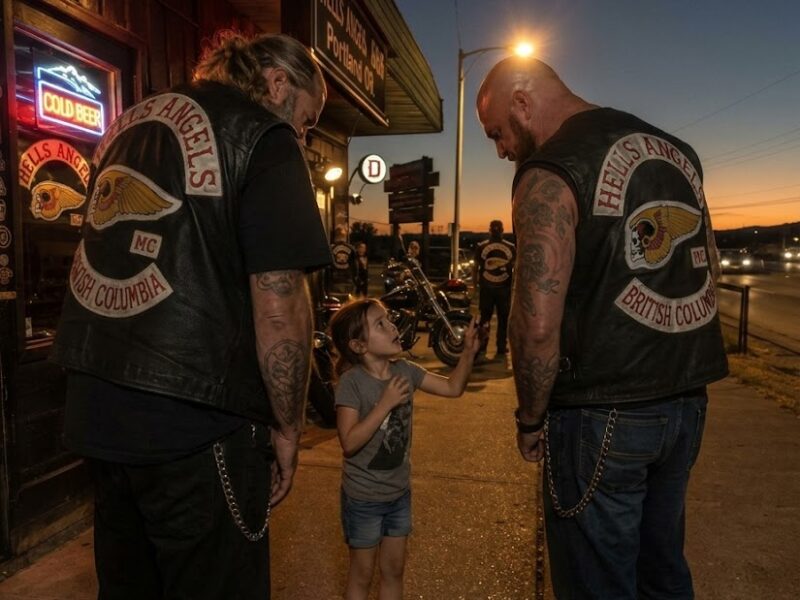
“Don’t take that road tonight,” a little girl warned the bikers. They laughed it off—until sunrise proved her right.
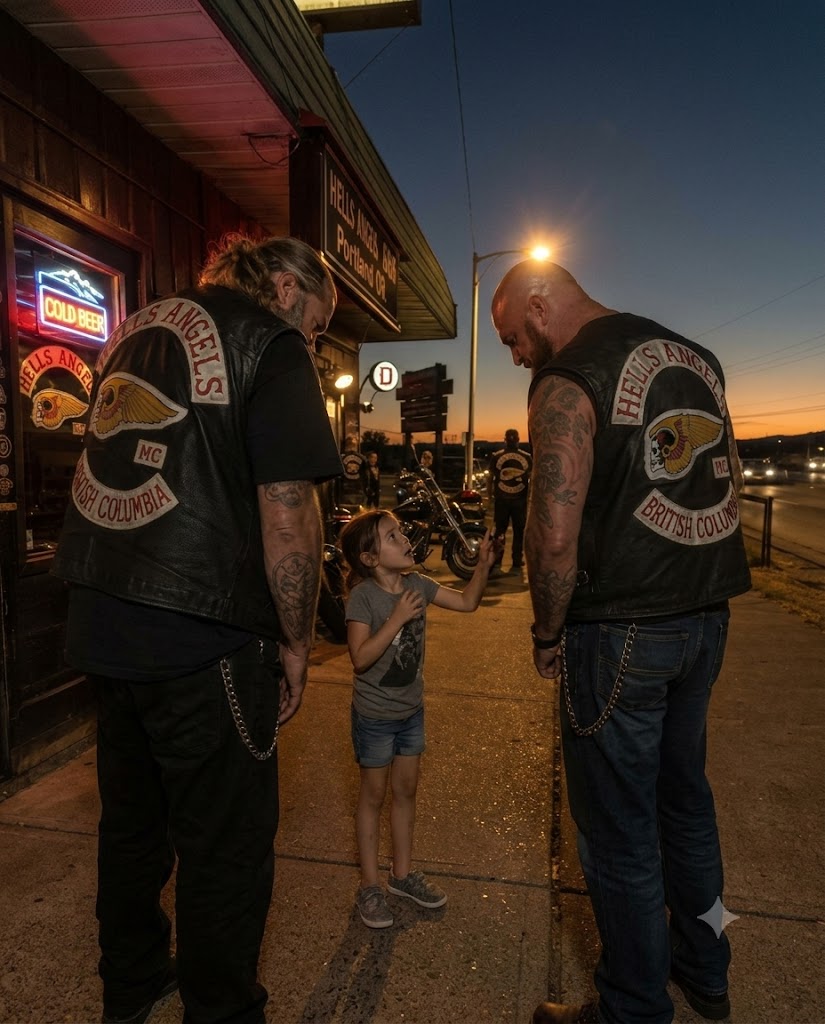
She was seven years old, small enough that the men towering over her blocked the streetlight, shaking before she opened her mouth.
Seven years old, standing between two parked motorcycles and a road that had already taken someone she loved.
Seven years old, refusing to move when the bigger stranger told her to step back.
Seven years old, the only one who understood what the mountain did after a week of hard rain.
Everyone watching had already judged these men before either said a word—the ink, the scarred knuckles, the cracked leather. A reputation walking in ahead of them.
Three years since that road took someone from her family. Four hours before their engines carried them into what she was trying to stop.
Nobody could explain how a child would know. Nobody knew what she’d seen, not yet.
Roland Beckett smelled the rain before he saw it—a mineral wetness riding low over the tree line as he and Dutch Coleman throttled down off Highway 30 into Corbett, Oregon.
A town that amounted to a gas station, a church, and a tavern with a busted neon sign that read cold beer in letters brighter than everything else on the block.
It was a Thursday in the second week of October, the kind of Pacific Northwest evening where the sky didn’t so much darken as get slowly erased.
Gray folded into gray until the headlights of passing trucks were the only proof the world still had edges.
Roland was 64 years old, gray-bearded, built like a man who had spent three decades doing physical work outdoors and refused to soften with age.
He rode a matte black Road King with saddlebags older than some of the men who stared at it.
Dutch, 58, bald as a river stone and twice as hard looking, rode beside him on a stripped-down Softail, the Iron Wolves patch on his cut faded at the edges from 12 years of weather.
They pulled into the gravel lot beside the tavern—a place called The Trailhead—the kind of roadhouse bar that fed loggers and rafting guides and the occasional lost tourist who’d taken a wrong turn off the historic Columbia River Highway.
They killed their engines under the buzzing street lamp.
Inside, six regulars turned on their stools like a single organism.
A man behind the bar—thick-armed, silver-haired, wiping the same six inches of counter for the third time—watched them cross the gravel with the particular stillness of someone deciding whether to reach for something under the register.
“We’re not looking for trouble,” Roland said as the door swung shut behind them, rain already starting to tap against the windows. “Just gas, coffee, and a dry place to sit for twenty minutes.”
The bartender didn’t answer right away.
His name was Gus Whitlock, and he had owned The Trailhead for 26 years—long enough to remember exactly what kind of men rode through Corbett wearing patches like that one.
A different club a decade back had left three men in the hospital and a permanent scorch mark on Gus’s opinion of anyone who rode in packs.
“You can sit,” Gus said finally. “Don’t need to like it.”
Dutch huffed something under his breath about small towns and long memories, but Roland put a hand on his shoulder and steered him toward a corner booth instead of the bar.
He’d learned, over a lot of years and a lot of rooms exactly like this one, that arguing with a locked door rarely got you through it faster than just waiting for someone to notice you weren’t going to kick it down.
That was when he first saw the girl.
She was maybe seven, thin as a fence post, with a gap in her front teeth and hair scraped back into a ponytail that had mostly given up on being neat.
She sat behind the register on an overturned milk crate doing homework with the focus of a much older kid.
And every few seconds her eyes would flick up—not toward Roland’s tattoos or Dutch’s eyes, the way everyone else’s had, but toward the window. Toward the dark road outside. Toward the rain.
“That’s my girl, Wren,” said the waitress who came to take their order—a tired-looking woman in her thirties with the same gap-toothed smile. Her name tag read Paige. “Don’t mind her staring. She does that with the weather.”
“With the weather?” Dutch asked.
Paige’s smile thinned out at the edges, just barely—the kind of expression that told Roland there was a story behind it nobody planned on telling two strangers on a Thursday night.
“She doesn’t love rain,” Paige said, and left it there and went to get their coffee.
Roland watched the girl a moment longer.
She had gone back to her homework, but her pencil had stopped moving and her eyes kept drifting to a spot on the laminated county map taped up behind the register—a spot circled in faded red marker up along the stretch of road that climbed past Crown Point toward Larch Mountain.
On the radio behind the bar, low under the hum of conversation, a weather announcer was reading out a hillside advisory for Multnomah County.
“Saturated soils, possible localized flooding. Motorists urged to use caution on unlit rural routes after dark.”
Outside, in the gravel lot, rain had started coming down harder, drumming against the tavern’s tin roof.
And somewhere under that sound—so faint that Roland told himself later he’d probably imagined it—was something that might have been the low groaning creak of very old, very wet ground beginning ever so slightly to move.
He didn’t think anything of it, not yet. That was still four hours away.
But some old, buried part of him—a part he hadn’t used in nine years—had already lifted its head and started listening.
He’d spent 31 years reading ground for a living before he ever rode a motorcycle for one.
And there were sounds a hillside made that never showed up in a weather advisory—sounds you only learned by standing on enough failing slopes in enough downpours with enough survey stakes driven into soil that was quietly deciding whether to hold.
He told himself it was nothing. Wet trees creaked in any storm.
He ordered a second coffee, black, and tried to let the warmth of the tavern do what it always did for him after a long ride—make the outside world feel very far away and none of his business anymore.
It didn’t work tonight.
Some part of him kept one ear pointed at the window the way a man keeps one hand near a door he used to walk through every day of his working life, even nine years after he swore he never would again.
Dutch was talking to Gus about gas prices and the fastest way through to Latorre, oblivious.
And for a moment Roland envied him that. Dutch had never had to learn what Roland had learned.
Dutch’s only job out here was to ride and to trust the man beside him to know when trouble was real.
Roland glanced once more toward the girl on her milk crate, toward the red-circled stretch of road on the map behind her, and felt something settle into his chest that he recognized from a long time ago and hadn’t missed at all.
The particular unglamorous dread of a man who suspects he is about to be right about something terrible.
Deputy Colin Ashby’s cruiser pulled into the gravel lot forty minutes later, headlights sweeping across the two motorcycles parked outside The Trailhead like a spotlight looking for something to accuse.
He came in shaking rain off his jacket—34 years old, built lean and watchful, the kind of small-town deputy who knew every license plate in a thirty-mile radius and treated any plate he didn’t recognize as a personal insult.
“Those your bikes out front?” he asked before he’d even sat down.
“They are,” Roland said.
“Mind if I run your plates?”
“Wouldn’t matter if I did.”
Ashby ran them anyway, standing just inside the doorway with his radio crackling low while Gus watched from behind the bar and the six regulars pretended not to watch at all.
There’d been a string of tool thefts out of construction trailers up and down the gorge the last two weeks, Ashby explained when he came back.
Radio silent, plates clean. Nothing on these two.
But he’d keep an eye out, he said, in a tone that made clear the eye wasn’t going anywhere.
“We’re just passing through,” Dutch said, jaw tight. “Meeting up with the rest of our club at a campground past Latourell. We’ll be gone by morning.”
“Tonight?” Ashby asked. “In this?”
“Storm’s not supposed to hit hard till after midnight,” Roland said. “We’ll beat it.”
Behind the register, Wren had gone very still.
It was Paige who explained it later, quietly, refilling Roland’s coffee while Dutch argued road conditions with the deputy at the bar.
Three years back, her husband—Wren’s father, a lineman for the county utility—had been driving home from a late repair call on Larch Mountain Road during a rainstorm not unlike this one.
A section of hillside above the road, weakened years earlier by a wildfire that had stripped the slope of the root systems holding it together, had let go without warning.
He never made it home. Wren had been four years old.
She still asked some nights whether the road remembered what it did.
“She gets like this every October,” Paige said, not quite meeting Roland’s eyes. “Every time it rains hard enough. I used to think she’d grow out of it. She just got quieter about it instead.”
Roland set his coffee down slowly.
Something in his chest had gone tight and strange—a sensation he recognized even though he hadn’t felt it in nine years, the particular unwelcome alertness of a man whose old profession had just tapped him on the shoulder from across a room.
He didn’t say what that profession had been. Not yet.
Instead, he watched Wren slide off her milk crate, cross the tavern floor in wet socks, and plant herself directly between him and the door.
Her chin tilted up, her small hands balled into fists at her sides, the whole of her seven years of certainty aimed at a man built like a bear.
“Please don’t take that road tonight,” she said.
The bar went quiet enough that Roland could hear the rain.
“Sweetheart,” Dutch started, not unkindly, “we ride in worse than this all the—”
“Not that road,” Wren said, and her voice cracked down the middle. “Not tonight. I can feel it.”
Gus set down his rag. Ashby’s hand drifted unconsciously toward his radio.
And Roland Beckett, who had spent 31 years reading hillsides the way other men read faces, looked at this shaking gap-toothed child standing between him and the door and felt the old buried part of himself sit up fully awake for the first time in nearly a decade.
“How do you know what it feels like?” he asked her very quietly, and meant it as a real question.
Wren didn’t answer with words.
She just pointed out the window toward the dark shape of the ridge rising up behind the tavern—invisible now except for the place where the trees stopped moving in a way the trees moving normally in wind did not move.
And she said the only thing that made Ashby’s hand finally close all the way around his radio.
“It sounds like right before,” she whispered. “It sounds exactly like right before.”
Ashby crouched down to her eye level, the suspicion draining out of his face for the first time since he’d walked in, replaced by something more careful.
“Before what, honey?”
Wren didn’t answer. She looked at her mother instead.
And Paige’s hands had gone still on the coffee pot, and in that silence Gus Whitlock came around the bar for the first time all night and crouched down beside the girl, too—his 61 years creaking audibly in his knees, his gruffness gone soft at the edges.
“She means before her daddy,” he said quietly, to the room more than to anyone in particular. “Corbett doesn’t forget easy. None of us do.”
Dutch shifted his weight, glancing toward the window, toward the rain, toward the phone in his jacket pocket that had buzzed twice already with messages from Mac Delany.
The Iron Wolves road captain was already twelve miles up Highway 30 with four other riders and a rented cabin waiting past Latourell. They were behind schedule.
Mac wanted to know if Roland and Dutch were still coming tonight or bunking in Corbett and catching up at first light.
“We could wait it out,” Roland said slowly, watching the girl’s face rather than the deputy’s. “Storm might ease by morning.”
“Storm’s not the problem,” Ashby said, standing back up, his tone changed now—no longer a lawman running plates but a local who’d lived through the same three years as everyone else in that room.
There’d been talk for a while about that stretch past Crown Point, ever since the Eagle Creek burn scar crept over the ridge a few years back.
Half the hillside up there didn’t have roots left to hold water the way it used to. County put up warning signs, never closed the road though—budget, mostly.
There was nothing wrong with it most nights.
“Most nights,” Roland repeated.
“This isn’t most nights,” Wren said.
And nobody in the tavern argued with her, though nobody yet believed her enough to change course, either.
That would take longer. That would take the rain getting worse, and the radio changing its tone, and one more hour of a seven-year-old refusing to let this go before the adults in the room stopped treating her fear as a symptom of grief and started treating it as information.
Roland pulled his phone out and studied the county road advisory page in silence.
The small buried part of him that used to build those exact pages for a living scanned past the vague language—heavy rainfall, use caution—toward the numbers underneath it that mattered more.
Rainfall totals over the last 72 hours. Soil saturation percentages. A flag icon beside the historic highway corridor that had been sitting on yellow, not red, for six days running.
Yellow meant watch. Red meant close it.
He knew better than almost anyone left in the state how much daylight and political will separated those two colors, and how often the gap between them had cost someone their life.
He didn’t say any of that out loud. Not yet.
He told himself there would be time later, once they were past the worst of it, to explain who he used to be.
Outside, the rain kept coming steady and patient—exactly the way it had come three years ago on the night this town had already lost someone to that hillside, and exactly the way it would keep coming for the four hours it would take Roland Beckett to finally stop pretending he didn’t already know the answer to the question this child kept asking.
By 9:30, the rain had stopped being weather and started being an event.
It came down in sideways sheets that turned the gravel lot into a shallow black lake, and the tavern’s old gutters, never meant for this kind of volume, spat water against the windows in ragged bursts that made the whole building sound like it was under attack.
The power flickered once, held, flickered again, and the jukebox in the corner stuttered through half a Merle Haggard song before catching itself.
Gus Whitlock lit two emergency candles behind the bar without being asked—the gesture of a man who had lived through enough Gorge autumns to know exactly how this particular kind of night tended to end.
Wren had not moved from the spot near the door in almost twenty minutes.
She stood with her back against the frame, arms crossed tight over her chest, watching Roland with the unwavering focus of a kid who has decided an adult is her last chance and isn’t going to waste it being polite.
“You’re not listening,” she said for maybe the fourth time. “Everyone always says they’re listening and then they go anyway.”
“I hear you,” Roland said, and meant it more than she knew, though he still hadn’t found the words to tell her why.
It was Deputy Ashby who broke the fragile truce building in the room.
His radio crackled with a description matching a wanted flyer out of Troutdale—a heavy-set bald man, leather cut, facial scarring, last seen on a black and chrome motorcycle.
Close enough to Dutch Coleman that Ashby’s hand drifted to his belt and his voice dropped into a register that had nothing friendly left in it.
“Sir, I need you to step outside with me.”
“For what?” Dutch said, going still in the particular way big men go still right before they either comply or don’t.
“For a conversation,” Ashby said. “Now.”
Gus Whitlock, of all people, was the one who stepped between them.
“Colin, that man’s been sitting in my booth for an hour drinking coffee and talking about gas mileage,” he said, voice sharp enough to cut through the rain hammering the roof.
“The feller on your flyer robbed a pharmacy in Troutdale forty minutes ago. Forty minutes in this storm from here to there. You do that math.”
It was a small thing—a bar owner doing arithmetic out loud in defense of a stranger he’d been ready to throw out two hours earlier—but it was the first crack in 26 years of Gus Whitlock deciding what a man was worth by the leather he wore.
And Roland noticed it even in the middle of everything else happening in that room.
Ashby ran the plate on his radio, waited through thirty seconds that felt considerably longer, and finally exhaled and stepped back, muttering something that wasn’t quite an apology but wasn’t nothing either.
Dutch didn’t say a word. Just rolled his shoulders once, the way a man does when he’s deciding not to be angry about something he has every right to be angry about—because he’s used to it, because it happens often enough that getting angry every time would burn him out inside a year.
Paige set a fresh mug in front of him without being asked, and for a moment the two of them just stood there—a waitress and a stranger twice her size—letting the storm outside do the talking.
“People around here aren’t cruel,” she said finally, like she owed him some kind of explanation. “They’re scared. Been scared of that mountain a long time, and scared men look for something they can point at instead. You two just happened to be standing in the doorway when the pointing started.”
“We’re used to being the thing people point at,” Dutch said, not unkindly. “Doesn’t make it feel better. Just makes it familiar.”
He’d spent two years of his twenties in an army engineer battalion attached to the peacekeeping mission in Kosovo, clearing washed-out roads and shoring up collapsed culverts for villages that had never once thanked him for it.
And he’d learned back then that the men doing the most necessary work were rarely the ones anybody bothered to look at twice.
He didn’t mention any of that to Ashby. It wasn’t the deputy’s business, and Dutch had long since stopped expecting strangers to ask.
Paige nodded slowly, glancing toward her daughter, who had gone back to the window—forehead nearly pressed to the glass, watching the tree line the way other kids watched cartoons.
“She’s been like that every hard rain since the funeral,” Paige said. “Doctor called it hypervigilance, said it might fade with time. It hasn’t faded. If anything, it’s gotten more specific. Like she’s not just scared of rain anymore—she’s listening for something particular inside it.”
She wrapped both hands around her own coffee, not drinking it.
“I used to hate that road. Now I think maybe she just hears it better than the rest of us ever bothered to.”
Roland watched all of it from the booth, and underneath the tension of the moment, something older and heavier was working through him.
Nine years ago, on a hillside forty miles from here, he had stood with a clipboard and a set of soil saturation readings and told his supervisor at the Oregon Department of Transportation that a slope above a rural access road needed to be closed immediately pending stabilization work that would cost the district money it didn’t have budgeted that fiscal year.
He had been overruled.
Eleven days later, that hillside let go in the middle of the night and took a delivery truck and its driver down with it—a 31-year-old man named Everett Bragg.
Nobody had ever gotten the chance to warn him personally, because warning people wasn’t Roland’s job. Filing reports was his job, and he had filed his, and it hadn’t mattered.
He had resigned four months after the funeral and never gone back to a desk with his name on it again.
He had told himself, riding away from that life, that the world simply didn’t want to hear things like that from men like him anymore—not soon enough, not in time—and that it was easier not to try.
He had been running from that specific kind of helplessness for nine years, and here it was again in a girl’s face instead of a survey report, asking him the same question his own conscience had never stopped asking.
What good was knowing if nobody with the power to act would listen in time?
“We should go,” Roland said abruptly, standing, reaching for his jacket. “Storm’s only getting worse the longer we wait. Better to get through before it peaks.”
Dutch frowned at him. “You feeling all right?”
“I’m feeling like a man who’s spent enough of his life not doing anything,” Roland said, low enough that only Dutch caught it—and it came out sharper than he meant it to, aimed less at the room than at himself.
Wren’s face crumpled.
“Please,” she said again, smaller this time, the fight going out of her voice and something closer to pleading taking its place. “Please don’t.”
But Roland Beckett—a man who had spent nine years convincing himself that walking away was the only thing that had ever worked—zipped his jacket, nodded once to Gus, and walked out into the rain with Dutch a step behind him.
The door swung shut on the sound of a child crying and a mother’s hand on her shoulder.
And neither man looked back to see it.
The historic Columbia River Highway climbed out of Corbett in long deliberate switchbacks—old stonework guardrails slick with runoff, headlights catching sheets of water sliding across the asphalt in patterns that looked, to anyone who didn’t know better, exactly like ordinary rain doing what ordinary rain always did on a mountain road.
Roland rode in front, Dutch close behind, both men soaked through within the first two miles despite their gear, the world reduced to a cone of white light and the roar of engines fighting the storm for dominance.
Past Crown Point, the road narrowed, the drop-off on the right side falling away into darkness toward the river far below, and the tree line on the left pressed close enough that branches occasionally slapped wet against Roland’s shoulder.
It was 11:47 p.m. that Thursday in October when Roland saw the first sign.
And every year of his old career arrived in his chest at once, like a held breath finally released.
Water was surfacing across the road in a place it had no business surfacing—not runoff sheeting downhill the way rain does, but a clean steady seep pushing straight up out of a hairline crack that split the asphalt corner to corner.
The unmistakable signature of groundwater finding a new path because the ground above it no longer held together the way it used to.
He’d seen that exact pattern four times in his career. Three of those four times, the hillside above had failed within the hour.
He threw his hand up—the old signal from a life he thought he’d buried—and Dutch braked hard behind him, both bikes fishtailing to a stop on the shoulder with the rain screaming past them sideways.
“What?” Dutch shouted over the storm.
“Kill your engine. Listen.”
Roland was already off the bike, crouched at the crack in the road, running two fingers along its edge the way he’d run them along a hundred cracks just like it a lifetime ago.
Above them, faint under the rain, came a sound like a very large door swelling shut in a very old house—wood and root and packed earth complaining under a weight that had finally become too much to bear.
“That hillside’s coming down,” Roland said. “Not might. Is. Maybe minutes.”
“Mack and the others are two miles past this point,” Dutch said, already fumbling for his phone. No signal. Nothing. The storm eating every bar. “They’ll ride right into it.”
“Then we ride ahead of it,” Roland said, already back on the bike, “and hope we’re faster than a mountain.”
They rode into the dark at a speed neither man would have attempted sober-minded on a dry road in daylight.
Roland’s headlight swept the crumbling shoulder for every sign he half remembered and half relearned in real time.
A second seep, wider than the first. A stand of alder leaning three degrees further off vertical than trees should ever lean. A smell rising off the slope that he would later struggle to describe to anyone as anything other than the smell of something enormous about to let go.
He thought of the delivery driver from nine years ago—Everett Bragg, 31 years old, a name he had made himself learn and never forgotten.
And he thought, riding flat out through freezing rain toward five men who had no idea what was catching up behind them, that he was not going to let this hillside take anyone else without a fight this time.
They found Mac Delany and the other three riders stopped at a pullout near Latourell, arguing over a cracked phone screen about which fork in the unlit road led to the cabin—engines idling, headlights aimed uselessly into the downpour.
Roland didn’t slow to explain. He simply rode his bike sideways across the mouth of the road ahead of them, cutting off the route back the way they’d have gone, and screamed the only sentence that mattered over the wind.
“That road’s coming down! Everybody off, now! Uphill, move!”
What happened next took less than ninety seconds, though it would live much longer than that in every account given afterward.
The seven riders scrambled their machines twenty yards up a gravel forest service turnout above the grade—boots slipping, someone’s bike going down hard on its side and staying there because nobody had time to right it.
And then the hillside that had been holding its breath for six days of steady rain and years of root rot finally let go.
A heavy grinding roar swallowed the sound of the storm itself—a wall of mud and root ball and broken fir sliding across both lanes of the historic highway in the exact spot where five motorcycles would have been riding if Roland Beckett had arrived ninety seconds later than he did.
When the sound finally settled into something closer to ordinary rain again, nobody spoke for a long moment.
Dutch found Roland standing at the edge of the turnout, staring down at a road that no longer existed in any recognizable shape—rain running off his beard in ropes, his hands shaking in a way Dutch had never once seen from him in twelve years of riding together.
“How do you know?” Dutch asked quietly. “Really know. Not a hunch. You read that road like you’d built the thing yourself.”
Roland was quiet for a long moment, watching mud settle where a highway used to be.
“I used to,” he said. “Geotechnical engineer. State DOT. Thirty-one years. Slope stability, mostly. Reading hillsides for a living. Telling the state which ones were about to do exactly what that one just did.”
He looked up toward Corbett—toward a tavern with a busted neon sign, and a seven-year-old girl who had been trying to tell grown men something true all night while every one of them decided what she was based on the size of the men standing over her.
“Flagged one once, nine years back. Almost the same time of year. Got overruled. It came down eleven days later and killed a man who never got the chance to hear my warning secondhand, let alone in time to matter.”
His jaw tightened.
“I quit the state. Started riding instead. Told myself the world didn’t want to hear it from men like me anyway. Turns out a little girl heard it just fine. She heard it better than I did, and she’s not even old enough to know what a soil saturation report looks like.”
Somewhere behind them, headlights swept up the road from the direction of Corbett—a county cruiser moving fast, Deputy Colin Ashby’s radio already crackling with a dispatch call about a reported slide on the historic highway near Latourell.
A call that had gone out four minutes earlier from a tavern payphone, placed by a girl who refused to stay quiet a second longer once her mother finally believed her.
Morning came in gray and reluctant, the rain finally thinning to a drizzle by seven.
And by nine, The Trailhead’s gravel lot held two things it had never held together before in 26 years: seven mud-splattered motorcycles parked in a neat row, and an Oregon Department of Transportation survey truck with its hazards blinking beside them.
Word travels fast in a town of four hundred people, and by the time Roland walked back into the tavern for coffee that hadn’t gone cold yet, half of Corbett had already heard some version of what happened on the mountain overnight—most of it wrong in the particulars and entirely right in the shape.
A county geotechnical engineer named Patricia Osay—thirty years into her own career and visibly unsettled by the size of the failure zone—found Roland at his booth an hour later with a set of preliminary field notes in her hand and a question in her eyes.
She asked him without preamble how he’d known to move seven riders off that grade with less than two minutes of warning and no instrumentation.
He answered her plainly—the seepage pattern, the crack orientation, the lean on the alders, thirty-one years of pattern recognition that no field manual fully explained but every experienced slope engineer eventually developed anyway.
She listened to all of it, then read him three lines off her own overnight readings that matched his account of the crack almost to the foot, and told him flatly that whoever had trained him had trained him well.
When he told her where he’d worked and for how long, she went quiet for a second.
Then she said she’d heard of the case he was talking about—the one from nine years back—and that half her department still argued the district should have listened to that original report.
It wasn’t absolution. It wasn’t supposed to be.
But it was the first time in nine years another engineer had said his name back to him like it still meant something.
Deputy Ashby found him not long after, standing just inside the tavern door with his hat in his hands, looking younger than he had the night before.
“I ran you like a suspect for two hours,” he said. “You saved five men’s lives with information the county’s own instruments didn’t catch until this morning.”
He held out his hand, and Roland shook it, and something passed between the two men that neither one bothered putting into more words than that.
Gus Whitlock didn’t say much of anything at first.
He simply set two full breakfast plates down in front of Roland and Dutch without being asked, and refused—for the first time in the memory of anyone in that bar—to let a customer pay.
When Dutch tried to argue, Gus cut him off with a look that had 26 years of stubbornness behind it and none of the suspicion from the night before.
“A man rides into my bar wearing patches I’ve hated on principle for a decade,” Gus said, “and turns out he’s the only reason there’s still a road up there worth arguing about opening again. I can be wrong about people. Not often. Last night, I was.”
It was Wren who Roland found last, sitting on the same overturned milk crate behind the register, drawing something on the back of a paper placemat with a stub of pencil.
He crouched down beside her the way Ashby had the night before—his 64 years complaining a little at the knees—and looked at what she’d drawn.
Two motorcycles, a mountain, and a small figure standing in front of both of them with its arms out wide.
“You did the hardest part,” he told her. “You knew something true and you said it out loud even when nobody wanted to hear it. That’s harder than anything I did on that road last night. I just finally remembered how to listen.”
Wren studied him for a long moment—the particular unflinching study of a child deciding whether an adult has earned her trust.
“Everybody looked at you like you were bad,” she said finally. “Before. When you walked in.”
“People do that,” Roland said. “They see the outside of a thing and decide they already know the inside. Took your whole town one long night to learn different about me, and it took me nine years to learn it about myself.”
He nodded toward the placemat.
“Judging a book by its cover is a lot faster than actually reading it. Doesn’t make it right, and it sure doesn’t make it accurate. I spent thirty-one years reading hillsides for a living, and not one hillside in Oregon was ever as hard to read honestly as the two of us were, sitting in this bar before either one of us said a word.”
She thought about that for a while—the way seven-year-olds think about things adults say that are a size too big for them, turning it over slowly until it fit.
Then she went back to her drawing, adding a third motorcycle to the row, and didn’t say anything else because she didn’t need to.
Later, while Dutch settled up a tab Gus still refused to charge him for, Roland found himself standing at the county map behind the register.
Looking at the red circle Paige had drawn around that stretch of the historic highway three years earlier—a small private ritual of grief nobody had ever asked her to explain.
He thought about the thirty years he’d spent believing that expertise only mattered when it came stamped with a title under a department badge, and how wrong that belief had turned out to be on a night when the only person willing to say a hard truth out loud early enough for it to matter had been a child too young to spell the word geotechnical.
He thought about Everett Bragg, and about the eleven days that had separated one ignored report from one funeral.
And he understood, standing in that tavern with mud still drying under his fingernails, that he had spent nine years punishing himself for a silence that had never really been his to carry alone.
The system had failed to listen. He had simply been the only one standing close enough to take the blame for it.
Roland and Dutch stayed through the afternoon while the survey crew finished marking the failure zone and county crews began the long process of clearing the highway.
And by the time the light went gold and low over the gorge, the two of them were back on their bikes, engines idling in the same gravel lot where a scared little girl had once stood between them and a door.
Paige came out to say goodbye and hugged Roland without asking first, which he let her do.
Ashby lifted two fingers off his hat brim from across the lot—no longer a man running plates, but a man saying so long to somebody he respected.
Wren didn’t cry this time. She just waved, both arms, the way kids wave when they’ve decided a thing is going to be fine.
They rode north out of Corbett as the sky finished clearing, past a hillside now marked with orange caution flags where a highway used to run clean through.
And neither man looked back—though this time it wasn’t because they were running from anything.
Behind them, inside The Trailhead, Gus Whitlock finished wiping down the same six inches of counter he’d been wiping the night before.
He walked to the front window and flipped the buzzing neon sign back on for the evening, the way he had every night for 26 years.
The red glow of cold beer spilled out across a gravel lot that had, for one long October night, held something a great deal larger than beer.
—
The following spring, the county closed that stretch of the historic highway for six weeks and rebuilt it with a reinforced retaining wall and a drainage system designed by a woman named Patricia Osay, who mentioned a certain retired engineer’s field notes in her final report.
Roland Beckett never went back to a desk.
But he did start answering his phone again when the state called—which, after word got around about what happened on Larch Mountain Road that October, turned out to be more often than he’d expected.
Dutch still tells the story in clubhouses from Portland to Pendleton, and he always ends it the same way.
“Seven years old,” he says, holding up seven fingers. “She stood in that doorway and told a bar full of grown men the mountain was going to come down, and every single one of us looked at her like she was just a scared kid.”
He lets the silence sit a moment.
“Turns out she was the only one in that room who was actually paying attention.”
And in Corbett, Oregon, where the population is still around four hundred and the tavern still has a busted neon sign that reads cold beer, a girl named Wren keeps a paper placemat taped to her bedroom wall.
Two motorcycles. A mountain. And a small figure standing in front of both of them with its arms out wide.
She doesn’t need to explain it to anyone who visits.
Everybody in town already knows what it means.









