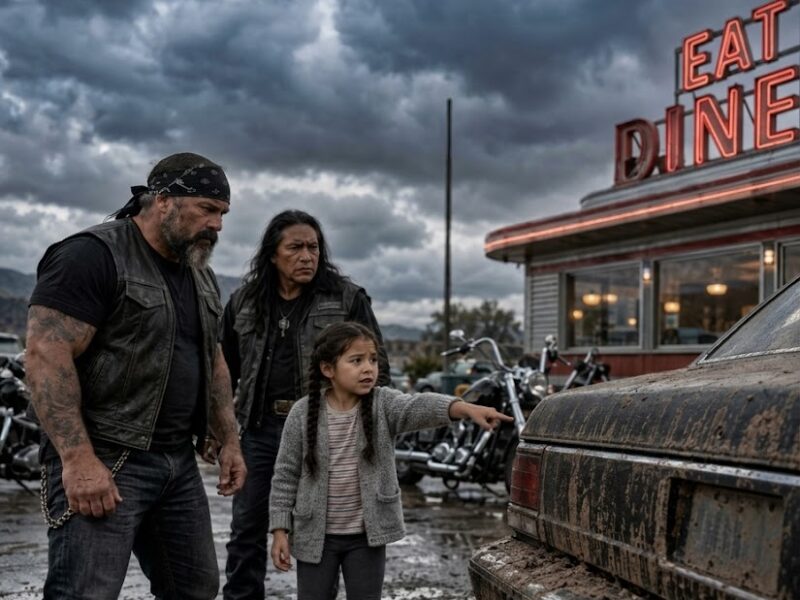
“Don’t open the trunk,” a little girl whispered to 300 Hells Angels. They didn’t listen—until they saw what was inside.
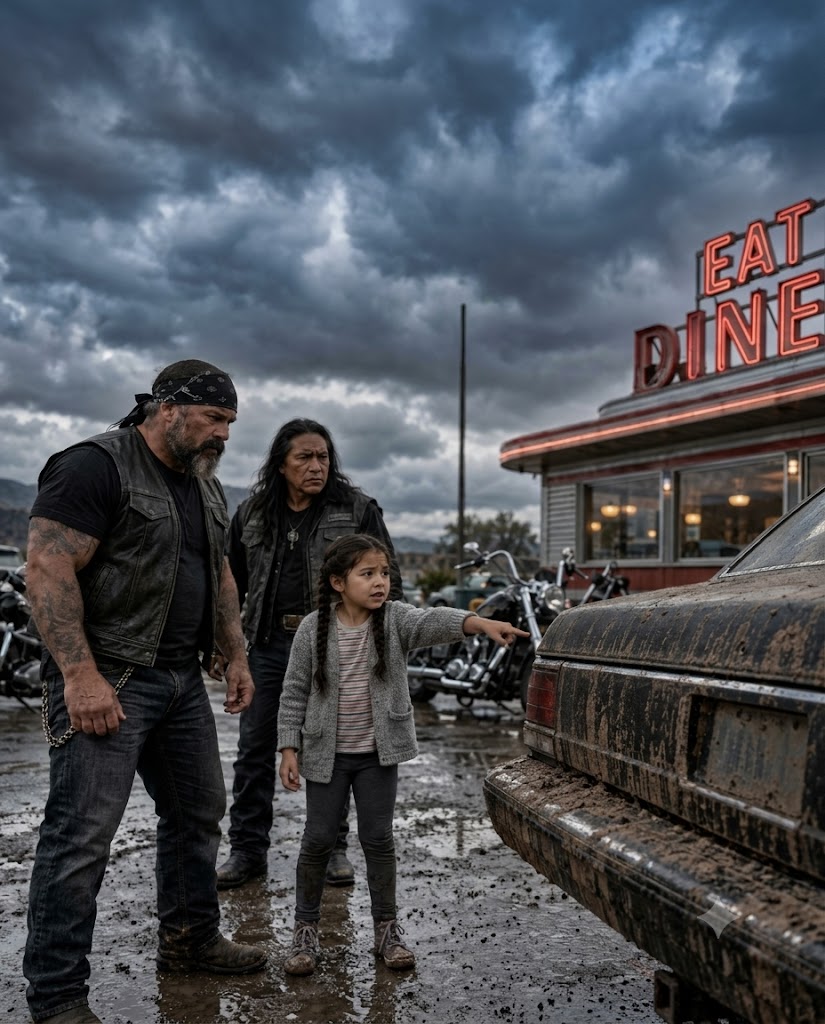
She had been trapped inside the trunk for 40 minutes before anyone heard her, seven years old and barely breathing in the heat. Everyone standing in that gravel lot had already decided who the real danger was.
Three hundred leather vests. Three hundred sets of scarred, ink-covered knuckles. Three hundred reasons, the crowd whispered, to grab their children and lock their car doors.
No one asked why the biggest one dropped to his knees in the mud. No one asked why the gray-bearded one, silent and still, ordered everyone back from the latch.
No one thought to ask what he used to carry in his coat pocket thirty years before he ever owned a motorcycle. They were about to find out.
Winslow, Arizona, smelled like diesel and hot asphalt the Saturday the motorcycles came through, and seven-year-old Ruby Beay decided that was the best smell in the world. She stood on the low concrete curb outside the Wagon Wheel Diner on Second Street, one hand shading her eyes against the glare bouncing off three hundred chrome gas tanks, and counted them the way other kids counted stars.
She had gotten to sixty-one before her grandfather’s hand settled on her shoulder. “You’ll lose count,” Roman Beay said. “Everybody does. Just watch them roll in instead.”
Roman was seventy-four years old, built lean and quiet, with a gray beard trimmed close and a face the desert sun had spent decades working on. He wore the same weathered leather vest he’d worn to every one of these rides for the last twenty years, patches gone soft and cracked at the edges, the word ELDER stitched small beneath the chapter rocker.
People in town had strong opinions about that vest. Ruby had heard most of them, muttered across grocery store aisles, hissed behind cupped hands at the post office, and none of the opinions matched the man who read her bedtime stories in a voice barely above a whisper because he said some things deserve to be said quietly.
The Route 66 Ride for the Missing came through Winslow every June. A rolling caravan of motorcycle chapters from four states, raising money for a nonprofit that tracked down children who had vanished from truck stops and highway shoulders and never came home. It always stopped at the Wagon Wheel for lunch before the long haul up toward Flagstaff, and it always turned the sleepy stretch of Second Street near the old Santa Fe tracks into a river of leather and noise and diesel smoke.
Ruby loved it. Her mother, Faith, tolerated it. Half the town, Ruby had noticed, did neither.
They looked scary, she told her grandfather, not for the first time, watching a mountain of a man swing off his bike near the propane tanks. He had forearms like fence posts, ink crawling from wrist to shoulder, a black bandana knotted at his throat, and a face that hadn’t smiled at anybody yet.
“That’s Rhett,” Roman said. “Runs the Phoenix chapter’s road patrol. He once drove four hours in a hailstorm to bring insulin to a diabetic kid stuck at a broke-down rest stop outside Kingman. Didn’t tell a soul until the boy’s mother called the club to say thank you.”
He still looked scary. “People are allowed to look like one thing and be another,” Roman said, and something in his voice made Ruby glance up at him. The way you glance up when a grown-up says a sentence that sounds like it’s about more than what it’s about.
But he was already moving toward the diner steps, favoring his left knee the way he did on long-standing days, and the moment passed.
Faith Beay came out onto the porch, wiping her hands on her apron. She picked up shifts at the Wagon Wheel most Saturdays on top of teaching third grade the rest of the week, and she told Ruby to come sit before Vera ran out of pancake batter arguing with the delivery truck driver about who owed who for last month’s flour.
Ruby went, but slowly, because something across the gravel lot had caught her eye. It was a car, an old brown Cutlass, mud-caked up past the wheel wells even though it hadn’t rained in Navajo County in eleven days, parked crooked at the far edge of the lot near the propane cage, half in the shade of a dying cottonwood.
Out-of-state plates, Colorado, bent at one corner. A man leaned against the driver’s door, smoking, watching the bikes roll in with an attention that didn’t match a man just waiting on lunch. He was maybe forty-five, thin through the shoulders, wearing a collared shirt too clean for a man driving a car that dirty.
Every few seconds, his eyes went to the trunk, then back to the crowd, then to the trunk again. Ruby didn’t know why she stopped walking. She just did.
There was a sound, small, muffled, almost lost under three hundred idling engines and Vera’s voice rising through the screen door. A soft, rhythmic thump, like a fist against carpeted metal, followed by something that might have been a moan, or might have been nothing at all.
Might have been the diner’s ice machine two buildings over. Might have been her own imagination working overtime the way her mother said it sometimes did.
The man by the Cutlass turned his head and looked directly at her. Ruby’s stomach dropped the way it did on the swings when the chain went slack at the top of the arc. She didn’t look away fast enough.
For one long second, the man’s face did something strange. Not annoyance, not the mild irritation of an adult catching a kid staring. Something colder.
Then he flicked his cigarette into the gravel, turned his back on the Cutlass without so much as a glance at his own trunk, and walked off toward the far side of the diner, hands in his pockets, moving like a man trying hard to look like he wasn’t hurrying. He never once looked back at the car he’d left behind, which was a strange thing to do, Ruby thought, if there was nothing in it worth worrying about.
She looked for her grandfather. He was already at the top of the diner steps, holding the screen door for an elderly biker with a cane, laughing at something Griffin Hale, the ride’s chapter president, a stout silver-bearded man everyone called Preacher, though he’d never preached a sermon in his life, had said about the weather.
Ordinary, unbothered, a hundred feet away from whatever Ruby had just felt crawl up the back of her neck. She almost let it go. Almost decided it was nothing, the way her mother would have told her it was nothing.
The way most of Winslow assumed the worst about the wrong people in that parking lot every single June. Then the thumping came again, closer this time, more urgent, and Ruby Beay, seven years old, ninety-three days from turning eight, standing alone on a gravel lot full of the very men half the town had already decided to fear, turned around and ran straight toward them instead of away.
“Don’t open the trunk!” Ruby’s voice cracked across the parking lot louder than she meant it, loud enough that Rhett Cullpepper, who was three strides from the Cutlass with a tire iron already loose in his hand, actually stopped mid-step.
He and two other riders had noticed the same thing Ruby had. The crooked parking. The mud on a car in a county that hadn’t seen rain in eleven days. And worst of all, the corner of a small pink sneaker wedged in the gap where the trunk lid didn’t quite close.
Rhett’s read on it had been simple and fast. Somebody dumped something back there, and it needed looking at before three hundred people sat down to eat forty feet away.
“Whoa. Easy, sweetheart.” Rhett crouched to Ruby’s eye level, tire iron still hanging from one fist, ink-covered forearm resting on his knee. Up close, he smelled like engine oil and spearmint gum, and his eyes, Ruby noticed for the first time, were kind in a way his face hadn’t advertised.
“We’re just going to take a look. Might be nothing.”
“There’s someone in there. I heard them. Don’t hit it with that.” Ruby pointed at the tire iron like it was a snake.
“Ruby.” Faith had come off the porch at a dead run, apron still on, flour on one cheek. She grabbed her daughter’s shoulders, more out of reflex than anger, the particular panic of a mother whose child has planted herself between a stranger’s car and a three-hundred-pound man holding a metal bar.
“Baby, come here. Let the grown-ups—”
“Mom, I smell gas.” Ruby’s voice wobbled but held, real strong by the back of it. “I smelled it before he even drove away.”
That stopped everyone within earshot, because it was in fact true. A thin, unmistakable ribbon of gasoline hung in the air around the Cutlass’s rear bumper, sharp enough now that Rhett’s nose caught it too, and a big man with a tire iron and a smell like that in front of him does not generally keep moving toward the thing he was about to hit with metal.
That was when Roman arrived. He didn’t run. Ruby would remember that later, how her grandfather, seventy-four years old with a bad knee, crossed forty feet of gravel at a pace that looked almost lazy and somehow beat everyone else there.
He put himself between Rhett and the trunk without seeming to decide to do it, the way a man steps in front of a swinging door out of habit rather than thought.
“Nobody touches that latch,” Roman said, quiet, not loud at all. And yet three hundred idling engines seemed to matter less than his voice, for exactly as long as it took him to say it.
Rhett straightened, tire iron lowering on its own. “Roman, smell that? That’s not spilled gas from a bad hose. That’s a can sitting somewhere close to the latch, probably tipped or cracked. You force that lid the wrong way, with metal, you could spark it.”
Roman’s eyes moved over the trunk seam the way a man reads a page he’s read a thousand times before. The fresh scratch marks on the paint near the lock. The mismatched screw on the taillight housing. Details Ruby wouldn’t have known to look for if she’d stood there all day.
“And if there’s someone inside, we do this slow or we don’t do it at all.”
Nobody asked him how he knew what a fresh pry mark looked like versus an old one. Nobody in that moment thought to ask why a seventy-four-year-old biker who ran the parts counter at a Flagstaff salvage yard on weekdays spoke about gas cans and ignition sources like he’d studied the subject somewhere other than a garage.
Griffin Hale, Preacher, came down off the porch steps two at a time, silver beard swinging, and for the first time all morning his easy diner-conversation voice dropped into something flatter, more commanding.
“Everybody back now. I mean it. Kill your engines. Kill anything with a spark near this end of the lot.”
It was Deputy Trent Wickham who arrived next, siren silent but lights turning lazy blue and red off three hundred windshields, and it took him exactly four seconds to size up the scene in a way that made his hand drift instinctively to the grip of his sidearm.
Three hundred bikers, one frightened little girl, a beat-up car with an open-trunk situation nobody had explained to him yet. Wickham had grown up two towns over hearing the same stories everybody in Navajo County had grown up hearing about clubs like this one, and every one of those stories arrived in his chest at once.
“Everybody step away from the vehicle, hands where I can see them.” His voice cracked slightly on the last word, the particular strain of a thirty-eight-year-old deputy who has never once had to control a parking lot with three hundred motorcycles in it.
“Sir, step back from that car right now.”
“There’s a person in the trunk, Deputy,” Roman said, not moving. “And there may be a fuel hazard at the latch. We were about to call it in ourselves.”
“You’ll call it in when I tell you to call it in.” Wickham’s eyes swept the crowd of leather and ink and old road-worn faces and landed predictably on the largest and most tattooed man present, Rhett, tire iron still loose in one hand, which did nothing to help matters. “Drop that. Drop it now.”
Rhett dropped it into the gravel with a clatter, hands raised, jaw tight. It was, Ruby thought, the single most unfair thing she had seen an adult do to another adult in her whole life, and she was old enough now to have an opinion about fairness, even if nobody had asked for it.
“He wasn’t going to hurt anybody,” Ruby said, stepping half in front of Rhett the way Roman had stepped in front of the trunk. “He was trying to help. The bad man’s the one who drove off. Ask my grandpa. He’ll tell you the truth. He always tells the truth.”
“Mom, I need you to take your daughter and step back,” Wickham said to Faith, not unkindly but firmly, already reaching for his radio to call for backup, for County Fire, for anyone who could tell him what exactly he’d rolled up on.
Behind him, the man from the Cutlass, the one Ruby had watched walk off toward the diner not five minutes earlier, was nowhere in sight, and the longer that fact sat unnoticed in the chaos of the parking lot, the further away he got.
By 2:30, the temperature gauge on the bank sign across Second Street read 103 degrees, and Roman Beay was doing arithmetic he did not want to be doing. A car trunk in Arizona sun climbed past dangerous within twenty minutes and passed deadly well before an hour.
Whoever was inside that Cutlass had already been there, by Ruby’s count, and Ruby’s count was the only one anybody had, closer to forty minutes than thirty.
“I understand you’ve got a scene you don’t like the look of,” Roman said, keeping his voice level the way he’d learned to keep it level decades ago in rooms far worse than a gravel parking lot. “I don’t blame you. But there’s a child in that trunk running out of time. And every minute we spend deciding whether I’m a threat is a minute she doesn’t have.”
“You don’t know there’s a child in there.” Wickham had his radio up near his shoulder, county dispatch crackling something about backup being nine minutes out. Nine minutes in Roman’s arithmetic was too long.
“You’ve got a scared-kid story and a smell of gasoline. That’s it.”
“I’ve got thirty years of knowing the difference between a scared kid’s imagination and a scared kid who’s right,” Roman said, and something in the flatness of it made Wickham’s eyes narrow, some old cop instinct in the deputy recognizing a cadence he couldn’t quite place.
The particular economy of a man who has said hard things to frightened people before and learned not to waste words doing it.
Griffin Hale had gotten the crowd back a full twenty yards, engines cut, the Sunday quiet strange after so much noise. Rhett stood with his hands still raised, humiliation sitting ugly on a face that didn’t wear humiliation well, and it was Faith who broke first, dragging Ruby bodily back toward the diner porch despite her daughter’s furious squirming.
“That’s enough. That’s enough. You’ve done your part. You told them. Now we are done.” And Faith’s voice shook in a register Ruby had heard only twice before in her life. Once when her father left. Once when Roman’s own heart had scared them all in a Flagstaff emergency room three winters back.
“I am not losing you over somebody else’s car.”
“Mom, they’re not listening.”
“They’re the sheriff’s department, baby. It’s not your job to make them listen. It’s not—” Faith stopped, pressed the heel of her hand hard against one eye, and in that unguarded second Ruby saw something she rarely let herself see in her mother’s face.
The particular fear of a woman who had already once lost something she loved to a stranger’s carelessness and would not survive doing it twice. Faith’s own younger brother, Ruby’s uncle, a name spoken maybe four times a year in that house, had wandered off from a county fair at nine years old and come home safe six terrified hours later, and nobody in that family had ever fully unclenched from the memory since.
Roman heard it too, the strain in his daughter’s voice thirty feet away, and for one long moment something old and heavy moved behind his eyes. He was remembering a different afternoon, decades gone, a different Arizona heat, a girl about Dia’s age whose name he had not said out loud in twenty years, because saying it still cost him something.
He had been younger then, faster, certain of his own competence in a way this particular memory had permanently corrected. He had been four minutes too slow once. Just four. He had spent half his life since then making sure four minutes never happened to him again.
And here he was, an old man with a bad knee, watching a deputy’s radio crackle nine more minutes into existence while a child cooked in a trunk twenty feet away.
“You’re going to need to believe me faster than this,” Roman said quietly, mostly to himself, and Wickham, misreading the words as aimed at him, straightened with fresh suspicion.
“Is that a threat?”
“No.” Roman reached, slow and deliberate, two fingers only, into the inside pocket of his vest. An old habit, hands visible, movements telegraphed, the posture of a man who had spent a career making sure nervous people with weapons could see exactly what he was doing before he did it.
He drew out a worn leather badge case, cracked at the fold, and held it out at arm’s length rather than approaching. “Phoenix Police Department, retired homicide division, badge number 4471. Thirty years on the job before I ever bought a motorcycle. Run it if you don’t believe me, but run it fast, because that girl doesn’t have nine minutes.”
Wickham didn’t take the case. He stared at it the way a man stares at a math problem that refuses to balance, then keyed his radio with a hand that had gone almost against his will a little less certain.
“Dispatch, I need a name run. Beay, Roman, Phoenix PD, retired, badge 4471, homicide. Copy that. I need it now, not whenever.”
The radio crackled its acknowledgement. Nine minutes suddenly felt like it might not be nine minutes after all.
Rhett lowered his hands an inch, watching Roman with an expression Ruby had never seen on him before. Not fear exactly, and not surprise either, but something more like recalculation, the look of a man revising thirty years of assumptions about somebody he thought he already knew completely.
Griffin Hale’s silver eyebrows had climbed halfway up his forehead. Even Vera Hutton, who had come out onto the diner porch ringing a dish towel and muttering that she’d never once trusted a Cutlass with Colorado plates, went quiet.
Ruby, still held fast by her mother’s arm, watched her grandfather standing very still in the heat with an old leather case held out at arm’s length, and understood, the way children sometimes understand things a full beat before the grown-ups around them catch up, that whatever was about to happen next was going to be about more than a trunk, and more than a car, and more even than the girl who was running out of time inside it.
Tanner Argyle, the youngest rider in the Phoenix contingent at twenty-nine, had spent the whole ride down from Flagstaff privately deciding that little kids exaggerated, that a scared seven-year-old smelling gasoline probably meant a lawn mower two lots over, and that grown men shouldn’t rearrange an entire afternoon around a child’s imagination.
He’d said as much to Rhett over breakfast, half joking, and Rhett had told him to shut up and eat his eggs. Watching Roman hold that badge case steady in the heat while a deputy’s radio worked through its slow official arithmetic, Tanner felt the shape of his own certainty come apart in real time, one assumption at a stretch, and found he didn’t much like what was left standing in its place.
Behind the diner’s propane cage, forty yards off and mostly forgotten in the standoff, a thin man in a too-clean collared shirt was edging, unhurried and unnoticed, toward the tree line at the edge of the lot.
The radio broke the silence at 2:41 in the afternoon, a Saturday in the second week of June. Dispatch’s voice flattened by distance and static but unmistakably clear.
“Copy, Deputy Wickham. Beay, Roman D., confirmed retired Phoenix PD homicide division, thirty years of service, badge 4471, checks decorated twice. Advisory notes commendation for the Alvarez case, 1998, and a special note from the department. This officer trained the current cold case unit before he retired. Copy.”
Wickham lowered the radio slowly. Something moved through his shoulders that Ruby could see even from thirty feet away, held tight in her mother’s grip, a kind of unclenching, the posture of a man setting down a weight he hadn’t fully realized he was carrying.
His hand drifted away from his sidearm entirely, and when he looked at Roman again it was with the particular respect one professional offers another after mistaking him for something he wasn’t.
Three months out of the academy back in Prescott, a training sergeant had told Wickham that the job would hand him exactly enough shame to make him better at it, provided he was willing to notice the shame when it arrived instead of arguing with it. He noticed it now, standing in a gravel lot in 103 degrees of dry June heat, looking at an old man in a cracked leather vest who had spent thirty years doing the very job Wickham had sworn an oath to do himself. He filed the shame away to sit with later. Right now there wasn’t time for it.
“Detective,” Wickham said, and the word came out different than sir had. “Tell me what you need.”
“I need everyone with a spark near that trunk pulled back thirty more feet. Engines off, cigarettes out. I need somebody with wire cutters and steady hands, not strong hands. And I need two minutes nobody argues with me.”
Roman was already moving toward the Cutlass, his bad knee forgotten, thirty years of training rising up through an old man’s body like something that had never really left. “Rhett, with me. You’ve got the steadiest hands of anyone here who isn’t holding a badge.”
Rhett came without a word, tire iron left forgotten in the gravel where he’d dropped it. Up close, Roman could see exactly what Ruby’s nose and his own thirty years had already told him.
A plastic gas can, likely used to top off the tank somewhere off the highway, had been shoved into the trunk’s rear corner and left uncapped, its cap rattling loose against the spare tire well. The jostle of driving, or maybe just the tilt of the car on uneven gravel, had tipped it enough to soak the carpet beneath the trunk lid’s latch mechanism, the exact spot a tire iron, forced fast and hard by a well-meaning man, would have struck metal against metal and thrown a spark directly into fumes that had been building in that closed space for the better part of an hour.
“Cut here first.” Roman guided Rhett’s hand to a thin wire visible at the seam, one that ran from the trunk light to a taped-over splice near the latch. Nothing sinister, just a dome light some previous owner had wired sloppily years before this car ever carried anything worse than groceries. But Roman wasn’t taking chances on assumptions today. Not with a life on the other side of that lid.
“Good. Now the battery under the hood. Negative terminal first. No sparks reach that trunk if there’s no circuit left to spark from.”
Rhett’s hands, the same hands that had been ready to swing a tire iron twenty minutes earlier, moved now with a careful slowness that surprised even him. He had spent fifteen years being the biggest, loudest, least-questioned man in whatever room he walked into, and it had never once occurred to him that the gentlest thing he’d do all year would be following the quiet instructions of a seventy-four-year-old man half his size.
Griffin Hale kept the crowd back with both arms spread wide like a man holding a gate shut against weather, and Vera Hutton stood frozen on the diner porch with a dish towel pressed flat against her mouth, watching a version of that motorcycle club she had never once let herself imagine.
Somewhere behind them, near the tree line, Wade Corrigan made his decision. He ran. He hadn’t run more than fifteen yards before Tanner Argyle, twenty-nine years old, fastest rider in the Phoenix chapter, and freshly furious at his own morning’s worth of doubt, put him on the ground in the gravel with a tackle that knocked the wind clean out of both of them.
Griffin Hale reached them four seconds later, one boot planted firm on Corrigan’s outstretched wrist, and it was Rhett, glancing up from the battery terminal at the commotion, who recognized the collared shirt and the too-clean look of a man who didn’t belong to any of the cars that mattered in that lot.
“That’s him,” Rhett said. “That’s the one that walked off.”
Wickham had him in cuffs inside thirty seconds, reading rights nobody in that parking lot particularly cared about hearing, because every eye that mattered was back on the trunk, where Roman Beay, seventy-four years old, knelt in the gravel with steady hands and worked the latch by feel, slow and patient, the way a man defuses something he has spent a career learning to be patient with.
At 2:47 in the afternoon, the trunk lid came up. The smell hit first, gasoline and heat and the particular staleness of trapped air, and then the sight of her.
A girl, maybe fourteen, wrists bound loosely with rope gone soft from sweat, blinking against sunlight so bright after an hour of dark that she flinched from it like something physically struck her. Her lips were cracked. Her breathing came shallow and fast. But her eyes, when they found Roman’s face bent close over hers, focused and held and stayed.
“You’re out,” Roman said, voice gone soft in a way it hadn’t been all afternoon, the voice Ruby recognized from bedtime stories. “You’re out. You’re safe. Help is coming. I need you to breathe slow for me. Can you do that?”
The girl, Dileia, though nobody in that lot knew her name yet, nodded and cried and reached for the first hand that came toward her, which happened to be a seventy-four-year-old man’s hand, weathered and steady and marked with thirty years of a life half of Winslow had never once bothered to ask him about.
Faith finally let go of Ruby’s shoulder. Ruby ran the last twenty feet across the gravel and pressed herself against her grandfather’s side, and Roman, without looking away from the girl in his arms, dropped one hand to rest on his granddaughter’s head the way he had a thousand times before, as if nothing unusual had happened at all.
In the distance, still faint but closing fast down Second Street, a siren rose that wasn’t Wickham’s. County Fire, an ambulance, the backup that had once been nine minutes out and was now, by Roman’s careful arithmetic, close enough to matter.
He kept two fingers pressed light against the girl’s wrist, counting a pulse the way he’d counted a hundred pulses before, in a career nobody in that parking lot had known about an hour earlier, and said nothing else, because for the first time all afternoon there was nothing left that needed saying out loud.
The ambulance took Dileia Marsh to the regional hospital in Flagstaff with Faith riding along in the back because somebody official-sounding had to be present, and Faith Beay, third-grade teacher and reluctant Saturday waitress, turned out to be exactly the kind of steady the paramedics wanted in that role.
Wade Corrigan sat handcuffed in the back of Wickham’s cruiser, silent, staring at nothing, while a second deputy ran his plates and came back with a record long enough that Wickham read halfway through it twice before he trusted what he was seeing. Two prior warrants, one out of New Mexico, a name flagged on a regional trafficking bulletin that had gone out to every department in three states the week before.
Dileia had been missing eleven days. Her family, it turned out, lived four hundred miles away and had nearly stopped believing anyone would find her.
Faith called from the hospital in Flagstaff a little after five, her voice thick with the particular exhaustion of a day that had asked far more of her than any Saturday shift should. Dileia was stable, rehydrating, talking in short careful sentences to a caseworker, and eventually to her own mother on a borrowed phone, the two of them crying too hard at first to say much of anything useful.
It would be weeks before the full shape of the eleven days became clear. A ride offered at a truck stop outside Gallup that had never been what it claimed to be, a route east that had somehow bent west instead, small warning signs a frightened fourteen-year-old had noticed too late to act on.
None of that mattered yet, standing in a hospital hallway. What mattered was that Dileia Marsh was alive and asking for water and complaining in a raw and wonderful voice that the hospital gown was itchy.
Roman didn’t leave the parking lot until the last cruiser pulled out, and even then he stayed another hour sitting on the diner’s porch steps with his bad knee stretched out in front of him, saying very little. Ruby sat beside him close enough that their shoulders touched, and for a long while neither of them said anything at all.
It was Griffin Hale who finally broke the quiet, lowering himself onto the step below them with the particular grunt of a sixty-one-year-old man who had spent the day standing. “Thirty years, Roman. Thirty years riding with half of us, and not one word.”
“Wasn’t anybody’s business,” Roman said. “I left it behind on purpose. Didn’t look left behind today.”
Roman was quiet a moment, watching the last of the ambulance lights fade toward the highway. “There was a girl once. 1998. Younger than Dileia, even. I was four minutes too slow finding her, and four minutes turned out to matter more than anything else I did in thirty years put together. I retired eleven years after that, and I told myself I was done.”
He looked over at Ruby, who was watching him with the fierce, complete attention only a seven-year-old gives a story she senses is important. “Turned out I wasn’t done. Turned out you don’t put a thing like that down. You just carry it different. Today, I wasn’t four minutes too slow. That’s the only part that matters to me right now.”
Rhett Cullpepper came around the corner of the diner, still smelling faintly of gasoline and gravel dust, tire iron nowhere in sight, and lowered himself onto the porch rail across from them. He hadn’t said much since the trunk opened. When he finally spoke, it came out rougher than he meant it to.
“You knew I was about to do something stupid with that tire iron. Could have gotten that girl killed. And me besides. And you didn’t say a word about it after. You just fixed it quiet, like it was nothing.”
“Wasn’t nothing. Was just what needed doing.” Roman shrugged, then allowed himself something close to a smile. “You want to know the truth, Rhett? Most of this town spent thirty years crossing the street when they saw men like you and me coming. Funny thing about people who cross the street. They never stick around long enough to find out who actually comes running when something’s wrong.”
Deputy Wickham approached last, hat in hand, looking younger and more uncertain than he had all afternoon. He stopped a few feet off, the old instinct to keep distance from a leather vest not entirely gone even now.
“I owe you an apology, Detective. I saw three hundred motorcycles and a scared kid, and I made up my mind before I had a single fact in front of me. That’s not good police work. My sergeant’s going to hear about what you did today. All of you. Whether you want the credit or not.”
“Don’t need the credit,” Roman said. “Wouldn’t say no to you calling me Roman, though. Retired eleven years now. Detective’s a long time gone.”
Wickham extended his hand, and Roman shook it, and something passed between the two men that Ruby didn’t fully understand yet but suspected she would understand better in a few more years. The particular respect of two people whose jobs had once been the same, finding each other on opposite sides of a bad first impression, and choosing in the end not to stay there.
By the time the sun dropped low and orange behind the mesa west of town, most of the three hundred bikes had rolled on toward Flagstaff, the Route 66 Ride for the Missing running two hours behind schedule, and not one rider, as far as Ruby could tell, in any hurry to complain about it.
Rhett stopped by the porch on his way to his bike and crouched down to Ruby’s level one more time, working something loose from his own vest. A small, worn club patch, a spare he’d carried for years without quite knowing why.
“For the girl who smelled trouble before any of us grown-ups did,” he said, pressing it into her palm. “Don’t let anybody ever tell you seven’s too young to know what you know.”
Ruby turned the patch over in her hands the whole ride home in her grandfather’s truck, saying nothing, thinking about smells and sounds and the particular kind of scary that turns out on closer look to be exactly the opposite of what it seemed.
Somewhere past the Second Street railroad crossing, headlights sweeping the dark shoulder where the highway curved north out of town, she asked her grandfather if he was going to tell people now about the badge, about the girl from 1998, about all thirty years he’d kept folded up quiet in a leather case in his vest pocket.
“Some of it, maybe,” Roman said, both hands steady on the wheel, the truck’s old engine humming under the question the way it hummed under most things. “The parts that help somebody. Rest of it’s mine to carry how I want. That’s not the same as hiding, Ruby. Man can keep a thing private and still let it show up when it’s needed. That’s most of what being a grown-up turns out to be, if you want the honest answer.”
Ruby thought about that for the rest of the drive and decided somewhere around the turnoff for their own street that it was probably the truest thing anybody had told her all year.
The next morning, before the diner officially opened, Vera Hutton set two extra plates at the counter, right at the end stool where the biggest, most tattooed riders always sat, stacked high with pancakes nobody had ordered, and told the delivery driver, when he asked who they were for, that some folks had earned a free breakfast, and she wasn’t in the business of explaining herself before eight in the morning.
—
The story traveled faster than the motorcycles did. By Monday it had reached the *Arizona Daily Sun* in Flagstaff, and by Tuesday a reporter with a notebook and a voice recorder was standing in the Wagon Wheel asking Vera Hutton questions she answered mostly by pointing at the end stool and saying, “You want to know about that day, you sit right there and order the blueberry stack, and I’ll tell you what I saw.”
What she saw, she told him, was a town that had spent twenty years deciding what those vests meant and a seven-year-old girl who hadn’t been old enough to learn the lesson yet.
The reporter wrote that down. He wrote down a lot of things that week. He wrote about Wade Corrigan, whose full name turned out to be connected to a network of disappearances stretching across four states, and he wrote about Dileia Marsh, who went home to her family in Colorado eleven days after the trunk opened and slept in her own bed for the first time in twenty-two nights.
But the part of the story that got picked up by the wire services, the part that ran in papers as far away as Chicago and Seattle, was the part about the retired homicide detective who had spent three decades keeping his badge in his vest pocket and his past to himself, and the seven-year-old granddaughter who had smelled gasoline and heard a thump and refused to be told she was imagining things.
Roman Beay gave exactly one interview. He gave it to the *Winslow Mail*, the weekly paper with a circulation of about two thousand, and he gave it on the condition that the reporter not make him sound like a hero.
“I was a police officer for thirty years,” he said, sitting on his own porch with a glass of iced tea and Ruby playing in the yard behind him. “That’s not heroism. That’s a job. The hero of that Saturday was a little girl who trusted her own ears, and a big man with a tire iron who listened when she told him not to use it. Everything else is just arithmetic.”
The reporter asked him about 1998. Roman was quiet for a long time. Then he said, “There’s a girl I didn’t find in time. Her name was Angela. I think about her every day. I think about her more on days like that Saturday, when the arithmetic works out different. I don’t know what that adds up to. I just know I’m grateful the numbers came out the way they did this time.”
The reporter wrote that down too, and the *Winslow Mail* ran it above the fold with a photograph of Roman and Ruby on the porch, the old man’s hand resting on his granddaughter’s head the way it had rested in the gravel lot.
The photo hung in the Wagon Wheel for years. Vera Hutton taped it to the wall beside the register, right above the end stool, and when people asked about it she told them the same thing every time: “That’s the man who kept his badge in his pocket. And that’s the girl who smelled the trouble first. You want to know what this town is really like, you look at that picture and you figure out which one of them you’d have been.”
Most people, she noticed, didn’t answer right away. Most people looked at the photo for a while and then ordered their breakfast and sat quiet at the counter, and Vera Hutton let them sit, because she had been in the diner business long enough to know that some questions need coffee and time, and not necessarily in that order.
Ruby Beay went back to school that September with a club patch in her backpack and a story she mostly kept to herself. She had learned, somewhere between the gravel lot and the first day of second grade, that being right about something scary didn’t make you popular, and that being brave usually meant being scared and doing the thing anyway.
Her mother, Faith, went back to teaching third grade and waitressing Saturdays and not losing her temper when the delivery driver argued about the flour bill. But something had shifted in her too, some old unclenching, the way her shoulders dropped an inch when she drove past the gravel lot and saw it empty.
She started letting Ruby sit at the counter on Saturdays instead of on the porch, and when the motorcycles came through the next June, she was the one who brought out a pitcher of iced tea before anyone asked.
Rhett Cullpepper came back to Winslow that next June too, and the June after that, and every June for as long as the ride ran. He always parked in the same spot near the propane cage, always ordered the blueberry stack, always left a tip big enough to make Vera Hutton raise her eyebrows.
And every year he made sure to find Ruby, wherever she was standing, and ask her the same question: “Smell any trouble lately?”
Ruby always thought about it. She was a kid who thought about things. Then she always shook her head and said, “Not today,” and Rhett always nodded and said, “Good. Keep listening anyway.”
Griffin Hale, Preacher, kept riding until his knees made it impossible, and when he finally sold his bike he gave the proceeds to the nonprofit that tracked missing children, and he told the *Winslow Mail* that he did it for “a girl named Dileia and a man named Roman and a kid named Ruby who taught me something about judging vests.”
Tanner Argyle, the youngest rider, went to the police academy the next fall. He said later that it was Deputy Wickham’s apology that did it, the way the man had stood in the gravel lot and owned his mistake in front of three hundred bikers and a scared little girl. Tanner wanted to be that kind of cop. He wanted to be the kind of cop who noticed the shame when it arrived.
Deputy Wickham made sergeant two years later. He kept a copy of the incident report from that June Saturday in his desk drawer, not because he was proud of how he’d handled the first four minutes but because he never wanted to forget the last forty.
Roman Beay lived eleven more years. He saw Ruby turn eighteen and graduate high school. He saw her go to Northern Arizona University and come home for Christmas with a tattoo on her forearm—a small club patch, the one Rhett had given her, inked permanent—and he laughed when he saw it and said, “Your mother’s going to have opinions.”
Faith Beay did have opinions. She also, eventually, admitted that it was a good tattoo.
Roman died on a Tuesday in October, in his sleep, in his own bed. He was eighty-five years old. The funeral was small and quiet, the way he had been, and the motorcycles came from four states and lined up outside the church with their engines off, and when the priest said his name, three hundred leather vests went still and stayed still for exactly as long as it took to honor him.
Ruby spoke at the funeral. She was twenty-nine years old, a social worker in Phoenix, wearing a gray dress and the club patch tattoo on her arm where everyone could see it.
“He kept his badge in his pocket for thirty years,” she said. “He told me once that a man can keep a thing private and still let it show up when it’s needed. I’ve been thinking about that my whole life. I think what he meant was that being a hero isn’t about what you carry. It’s about knowing when to take it out.”
She looked at the crowd of leather and ink and old road-worn faces, the same faces that had frightened a whole town on a Saturday in June, and she said, “He told me the numbers worked out different that day. I think the numbers work out different because of who shows up. He showed up. You all showed up. And a little girl smelled gasoline and wouldn’t stop talking about it. That’s the whole story. That’s the whole point.”
After the funeral, Rhett Cullpepper found Ruby in the church parking lot, older now, grayer, his forearms still like fence posts but softer at the edges. He gave her a hug that lifted her off her feet, and when he set her down he said, “You still smell any trouble lately?”
Ruby laughed and said, “Not today.”
Rhett nodded and said, “Good. Keep listening anyway.”
The Route 66 Ride for the Missing still comes through Winslow every June. The Wagon Wheel Diner still has the photo of Roman and Ruby taped to the wall beside the register. Vera Hutton’s granddaughter runs the place now, and she still sets two extra plates at the counter at the end stool every June, stacked high with pancakes nobody ordered, and when the delivery driver asks who they’re for, she tells him the same thing her grandmother always told him.
Some folks have earned a free breakfast. And she isn’t in the business of explaining herself before eight in the morning.









