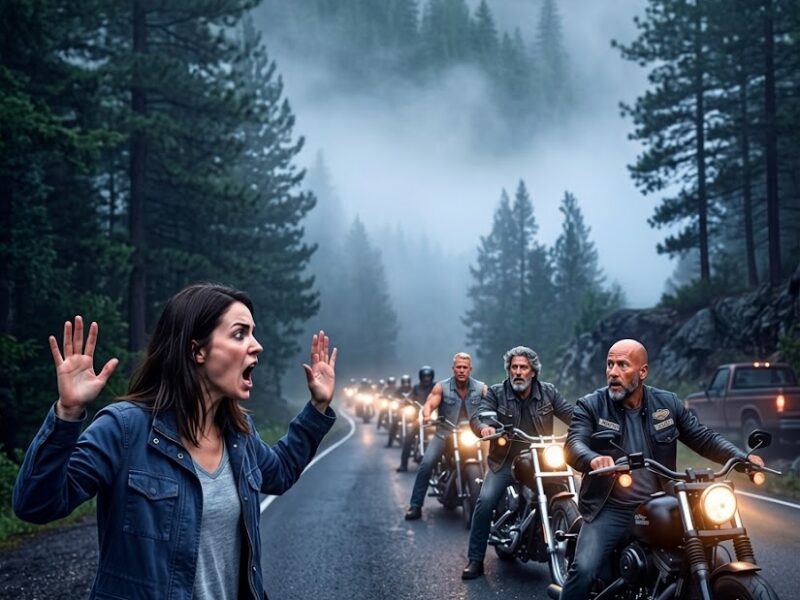
“Don’t Go In—It’s a Trap!” a Night Clerk Warned 14 Hells Angels—What Happened Next Changed Her Life
Dana Whitfield knocked twice on the door of Room 114, a stack of fresh towels pressed against her chest like a shield she hadn’t chosen.
Nobody answered.
The television inside cut to silence, and through the gap where the curtain didn’t quite meet, she saw three men leaning over a rifle case laid open on the bed like a body on a table. A voice, low and flat, repeated a line she would never forget.
“Widow’s Curve. When the first headlight turns.”
Dana didn’t move. Her knuckles stayed pressed to the wood, frozen mid-knock. A truck outside idled with its lights off. A duffel bag zipped shut somewhere past the parking lot. A chain of headlights was already climbing toward the Mountain Road, unaware that the curve ahead had already been chosen for them.
She backed away one step at a time, memorizing the plate number on the truck without writing a single digit down.
Most nights at the Bitterroot Motor Inn ended the same way. Dana finished the 10 p.m. towel run, restocked the coffee station behind the front desk, and spent the long hours after midnight listening to the highway outside settle into the particular quiet of a mountain town where almost nothing moved after dark except the wind through the pines and the occasional long-haul truck downshifting on the grade.
Tonight was supposed to be one of those nights.
The gravel lot outside had been still enough at ten that she’d almost convinced herself she could finish her rounds early. The hallway of the Bitterroot Motor Inn smelled of bleach and old coffee. The fluorescent tube overhead hummed a note that never resolved. The carpet under Dana’s shoes had gone thin and gray in a path worn by three years of the same nightly rounds.
She kept walking, the towels still crushed against her ribs. She didn’t remember picking them up. She didn’t run. Running was what guilty people did, and she had learned once in a much colder office than this one that a nervous woman gets noticed twice as fast as a calm one.
Behind the door of Room 114, the voice kept talking.
Fragments carried through the thin wall. A road name. A distance. A phrase that sounded rehearsed, like it had been said before. Maybe more than once. Maybe in front of a mirror.
“Widow’s Curve. Fourteen riders. When the first headlight turns.”
She pressed closer to the wall for one more second than was wise. Close enough to catch the smell of gun oil seeping under the door frame. Close enough to hear a second voice answer the first in a tone flat with practice.
“Fourteen bikes. One column. No stragglers to worry about.”
Through the gap in the curtain, she could just make out a road map spread flat across the second bed. One section circled in red marker so many times the paper had worn thin under the ink. She didn’t need to read the label printed beside the circle to know it marked a curve.
She had balanced enough loan ledgers in her life to recognize a plan that had been revised more than once before the men executing it ever felt satisfied with it.
Dana reached the front desk and lifted the telephone with a hand that would not hold still. The receiver was cold and slightly greasy against her palm, the same way it always was at this hour, when the desk had been wiped down once at the start of the shift and not touched since.
A number for the rally’s logistics office was taped under the counter, left there months ago by a dispatcher who never came back for it. She dialed from memory, palm slick against the plastic. The line rang and rang and rang, then rolled into a voicemail box nobody had checked in a long while.
She hung up.
She tried the county line instead, and a recording told her dispatch was currently handling multiple calls, that her call mattered, that someone would be with her shortly.
Nobody had time for shortly. Not tonight.
Through the front window, she watched the duffel bag get zipped shut in the bed of a pickup truck parked at the edge of the lot. Headlights dark. Engine idling low enough to sound like breathing. One of the men stepped out to check a tarp covering something long and narrow. He glanced toward the office.
Dana dropped below the counter without deciding to, her heartbeat filling the small room louder than the ice machine humming down the hall.
She counted to ten. She counted to twenty. When she looked again, he had turned his back to the building, lighting a cigarette against the wind. The smell of it drifted faintly through the propped front door.
This was the moment she understood that nobody else was coming to fix this tonight. The sheriff’s line was on hold. The taped-up number belonged to a man who quit in the spring. Curtis was asleep at home, and tomorrow he would only ask why she couldn’t leave well enough alone.
Would you have picked up the phone at all? Or would you have told yourself it wasn’t your business, the way half the people in that parking lot would have?
Dana took her own car keys from the drawer where she kept her purse during a shift. The keys stopped halfway to her hand for one held breath. She was only a night clerk. Twenty-nine years old. Three years into a job she took because nobody else would hire a woman who had once called her own employer a thief in front of a state examiner.
She could set the keys back in the drawer. She could return to the counter and wait for a call back that might come in twenty minutes, might come in two hours, might come long after the Mountain Road had already done what somebody built it to do tonight.
She picked up the keys.
Past the tree line, a low sound rolled down out of the dark. Mechanical and steady, growing instead of fading. The first far growl of motorcycle engines, still miles off, still climbing toward a curve with her name nowhere on it and her decision already made.
She didn’t know yet who was leading them. She didn’t know what he carried with him onto that road, or why a stretch of asphalt called Widow’s Curve would matter to him more than it should to any stranger passing through.
To understand why it mattered, the story had to go back first.
Seven years earlier, Dana Whitfield sat at a metal desk in the back office of Frontier Ledger Title Loans in Casper, reconciling a column of numbers that refused to reconcile. The office smelled of toner and burnt drip coffee. A copier two desks over hummed its own tired rhythm, jamming every forty pages like clockwork.
The sound of it was so constant that new hires stopped noticing it within a week. Dana never stopped noticing it. She noticed everything that repeated in a pattern, because a pattern is the only kind of truth that can’t lie to her twice.
She was hired at Frontier Ledger straight out of a two-year accounting program. The kind of job her mother called steady and her father called a good place to disappear into for thirty years if she kept her head down. For the first eight months, she did exactly that. Filing loan applications and running credit checks in a cubicle that smelled permanently of hand sanitizer, learning the names of coworkers who would later pretend, once the fraud came out, that they had barely known her at all.
Her supervisor, a soft-spoken man named Gordon Pierce who wore the same navy tie every Monday, called the discrepancy a rounding error three separate times before she stopped asking him about it out loud. He had a way of tilting his head when he explained numbers to her, the particular tilt of a man used to being believed simply because he sounded tired of the question.
“You’re a sharp girl, Dana,” he told her the third time, folding his hands on the desk between them. “But sharp doesn’t always mean right. Some things just look strange until you’ve been here longer.”
She nodded, said nothing else that day, and started writing things down instead. Loan file numbers. Dates. The exact figure that went missing each month. Always small enough to look like an accident. Always steady enough to be a pattern.
Eight hundred forty dollars in March. Nine hundred ten in April. A little more each time, like whoever was taking it had stopped being careful, the way a man gets careless once he decides nobody is watching closely enough to catch him.
She kept a small spiral notebook in the bottom of her purse for months, filling it in during her lunch hour in a break room that smelled faintly of vending machine coffee and microwaved soup. Writing just enough each day that no single page would ever look damning on its own.
She told no one. She had learned that much from watching two other employees get quietly reassigned to branch offices three states away right after they’d started asking their own questions.
When the state examiner came through for the annual review, Dana sat across from a stranger in a gray suit and slid her notebook across the table without saying a single word about Gordon Pierce’s name. The examiner read it twice, asked her three questions, each one shorter than the last, and wrote something down on a form she never saw.
Two weeks later, she was called into a small office that smelled like carpet cleaner and told that her position was being eliminated due to restructuring. Nobody said the word retaliation. Nobody had to.
She carried a cardboard box out to her car in the rain that afternoon. One framed photograph and a coffee mug rattling against a stapler. Gordon Pierce watched from his office window without coming down.
He kept his job for another eleven months before the fraud finally caught up to him in a courtroom two counties over, convicted on evidence built from the same notebook Dana handed over on her way out the door. She read about the verdict in a three-paragraph wire story that never once mentioned her name, sitting in the parking lot of a different job on her lunch break, and felt nothing so simple as satisfaction.
What she felt instead was closer to confirmation. The particular quiet relief of watching a number finally land where it belonged all along.
By then, though, she had already learned the only lesson that mattered. Speak too soon and you lose the job. Speak with nothing solid in your hand and nobody believes a woman over a man with a title on his door. So she stopped speaking until she was certain of everything first.
She started watching instead. Reading a room the way she used to read a ledger, waiting for the number that didn’t belong before she ever opened her mouth about it.
She spent the following winter sending out application after application to firms within driving distance of Casper and heard the same version of the same answer every time. Overqualified. Not quite the right fit. A phrase once from a hiring manager who clearly hadn’t meant to say it out loud: “We don’t need anyone else asking questions right now.”
She waited tables for four months at a diner off the interstate, folding napkins into precise triangles during the slow hours, before she finally saw a listing for a night clerk position two hundred miles northwest in a town called Miner’s Gap. A job small enough and far enough away that nobody there would ever think to ask why an accountant wanted it.
She took it the same week it was posted, packed her car with everything that still fit in it, and told herself the night shift at a roadside motel was small enough that nothing there could ever matter the way that ledger once did.
That is the woman who, seven years and one small mountain town later, stood at the edge of a motel parking lot in Miner’s Gap, Wyoming, with no pen in her purse and a truck’s plate number she could not afford to forget.
She found an eyeliner pencil instead, the only writing tool she had on her, and pressed it hard against her palm. One worn character at a time, spelling the plate out in her own private shorthand, because there was no paper close enough and no time to look for any.
Her hand stopped moving for exactly as long as it took to make sure every character was right. The parking lot was silent except for a moth beating itself against the office light and the distant clink of a loose gutter shifting in the wind.
She didn’t know yet that the number on her palm belonged to a man who was once patched into the very club now riding toward him. She only knew it belonged to somebody who had planned this too carefully to be doing it for the first time.
She still didn’t need to know his name to know what he intended to do with that curve.
Curtis Beale called the front desk at 11:40 that night, his voice thick with the particular irritation of a manager who has been woken for nothing before and assumes tonight is no different.
“Dana, if this is about that long-term guest in 114 again, I already told you, leave him be. Man’s been paying cash a week at a time. That’s not a crime. That’s just how some people live out here.”
“There are three of them in there, Curtis. And a rifle case.”
“Rifle cases aren’t illegal in Wyoming, last I checked. This is hunting country. You want me driving out at midnight because a guest owns a gun?”
“I’m telling you what I heard through that wall.”
“And I’m telling you to go back to the desk and let people rent their rooms in peace. You keep this job by learning which fights are yours to pick and which ones aren’t.”
The line went dead before she could answer.
Dana set the receiver down slower than she picked it up, the plastic cold against her palm where the eyeliner ink had already started to smear with sweat. She stood at the counter a long moment, listening to the ice machine cycle down the hall, weighing a decision that had no good version of itself.
Then she took the spare key ring from the drawer, locked the office door behind her for the first time in three years of shifts, and walked out into a night cold enough to fog her breath.
She drove her own car out to the head of Route 26 anyway.
She parked it sideways across both lanes at the narrowest point before the guardrail curved out of sight and switched her hazard lights on. It was not a plan. It was the only thing she had.
The mountain air outside the car smelled of pine sap and cold asphalt, sharp enough to sting the back of her throat. Fog sat low over the guardrail, thick enough that the far side of the curve had disappeared entirely, swallowed whole the way this whole mountain seemed to swallow anything careless enough to trust it after dark.
The radio in her car played static where a country station used to be. She left it on anyway, because the silence without it felt worse.
Three separate kinds of waiting happened on that mountain at the same time, none of them aware of the other two.
Dana sat behind her wheel with both hands still trembling faintly against the horn she hadn’t decided whether she’d need. Above the guardrail gap, Bo Tackett lay flat against cold stone, checking a watch that seemed to be running slower than the night around it. And two miles down the grade, fourteen riders rolled steadily closer, engines echoing off rock walls on either side of the road, utterly unaware that anyone on that mountain was waiting for them at all.
Only one of the three knew the others existed. It was not yet any of the men holding rifles.
Nearly two miles up the grade, at the front of a column of fourteen motorcycles moving in loose formation through the dark, Walt Sutton, the man the road called Ledger, though nobody at that motel had ever heard that name, lifted one gloved hand off his handlebar without slowing his speed.
Behind him, thirteen riders read the signal instantly and began shedding speed in a wave that moved backward through the pack like a held breath finally released.
Ahead, impossibly, a single sedan sat crosswise in the road with its hazards blinking into the fog, blocking a curve that had no business being blocked by anybody at this hour.
For three full seconds, nobody on that road moved. Fourteen engines idled in a low, unbroken hum. The fog held still around the headlights like something waiting to be told what happens next.
Ledger sat with both boots planted on the asphalt, studying a car he had never seen before in a place he had never ridden before tonight, and felt the same cold certainty settle into his chest that had told him more than once in his life that something had already gone wrong before anyone explained it to him.
The riders called him Ledger for a reason that had nothing to do with money and everything to do with the small waterproof notebook he had carried in his jacket for over twenty years, logging every mile, every mechanical failure, every stretch of road that ever gave a rider trouble, in handwriting so careful that younger members sometimes mistook it for a printed form.
He started the habit as a young rider after a mechanical failure nearly cost him his own life on a road nobody had bothered to log as dangerous, and he had never stopped since. It was, in its own way, the same instinct that once filled a spiral notebook in the bottom of Dana Whitfield’s purse.
Neither of them had ever met the other’s ledger, and neither of them yet knew how much they had in common.
He wasn’t planning to ride Route 26 at all until nine months ago. Before that, this road wasn’t on any map he cared about.
Nine months ago, Walt Sutton buried Dale Hargrove, the man who taught him to read a curve before he ever learned to read a road atlas, on a stretch of two-lane blacktop forty miles east of here that the club still wouldn’t name out loud in casual conversation.
Dale went down on a night ride when a rockslide nobody had flagged took the whole shoulder out from under his front wheel without warning. Walt was riding second that night, close enough to reach him in under a minute and not close enough to change what that minute cost.
At the funeral, standing in a cemetery that smelled of cut grass and diesel exhaust from thirty idling bikes parked along the access road, Dale’s widow, a small steady woman named Ruth, took Walt’s hand between both of hers and told him the one thing she needed him to hear.
“He trusted every one of you with his life on every ride he ever took,” she said. “Somebody has to keep checking the roads he can’t check anymore.”
Walt made his promise to her that afternoon, quiet enough that only she heard it, and had kept it on every long haul since. Riding point. Checking every mile twice. Refusing to let any curve on this earth keep a secret from him again the way that rockslide did.
Tonight’s ride wasn’t ceremonial. It was the anniversary run, the chapter took every year to the small chapel where Dale was buried. And Walt didn’t yet know that keeping his promise tonight was about to save fourteen lives on a road he had never ridden before.
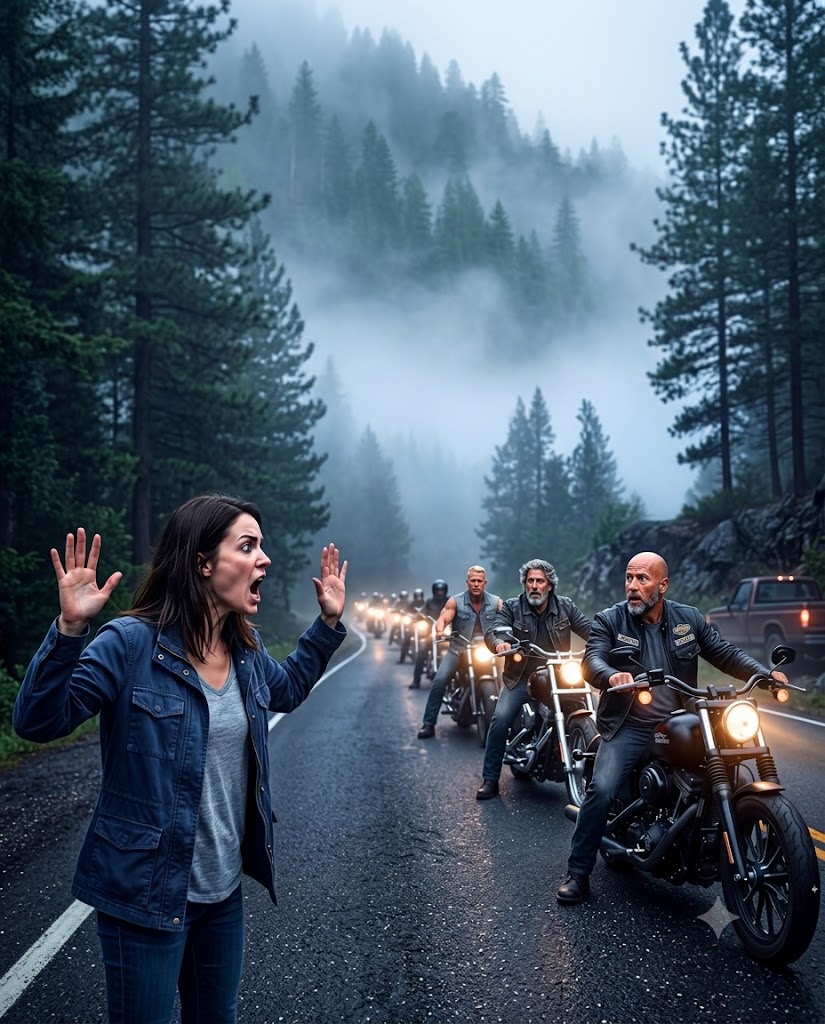
He raised his hand a second time, and the column rolled to a full stop one hundred yards short of the blocking car. Engines idling. Headlights washing the fog white.
Behind him, thirteen riders sat in a loose staggered line, breath fogging in the cold, chrome fuel tanks throwing back fractured reflections of their own headlights. Nobody spoke. Nobody had to. Every rider in that column had learned over years of riding behind Ledger that his raised hand meant something worth taking seriously before anyone asked him why.
People imagine courage as motion. A fist thrown. A voice raised loud enough to fill a room. Tonight, on a fogged-in mountain road in Wyoming, it looked like a woman standing alone in her own headlights, waiting to find out if fourteen strangers would believe her before it was too late to matter.
A woman climbed out of the sedan with both hands raised where he could see them, walking toward fourteen idling motorcycles alone in the dark like it was the most natural thing in the world.
“Don’t go in,” she said, before he could ask her a single question. “It’s a trap.”
Ledger didn’t reach for anything. He didn’t raise his voice. He studied her face for exactly as long as it took to decide she wasn’t lying, then answered with four words.
“Show me. Fast.”
Now Dana talked in short bursts, the way a person does when every second feels borrowed against a debt she isn’t sure she can pay. Three men. A motel two miles back. A rifle case. A road name. A phrase repeated like scripture.
“Widow’s Curve.”
She pointed up the grade toward a bend where the guardrail had been peeled back for repair and never replaced. A gap wide enough to put a man through if he stood at the wrong angle at the wrong moment.
Behind Ledger, Duce Ferro, a broad quiet man with forearms scarred pale from an old training accident and a stillness to his movements that most people mistook for slowness until they watched him move, had spent eleven years as an army sniper before he ever put on a cut. He was already off his bike and moving toward the treeline above the gap without being told to.
Wick Delaney, the club’s forward scout, lean and sun-weathered with the permanent squint of a man who had spent thirty years reading distant horizons for trouble before it arrived, pulled a pair of binoculars from his saddlebag and started sweeping the ridge on the far side of the curve. The one nobody would think to check unless they already knew to look for it.
Rooster Gantry, a heavyset man with forearms the size of most men’s calves and a beard gone mostly gray, stayed with the column, one boot braced against the asphalt, watching the road behind them in case anyone else was coming up from the same direction Dana did.
Farther back in the formation, Milo Prentice, barely out of his teens and still riding a bike two sizes too heavy for his frame, kept both hands steady on his handlebars and his eyes on Ledger, waiting for whatever came next the way a man waits when he trusts the people ahead of him more than he trusts his own judgment yet.
Would you have recognized a rifle case description well enough to point a stranger at the exact ridge holding it?
Dana had spent seven years learning how to notice the detail nobody else thought worth mentioning, and tonight that habit was the only weapon fourteen men had.
“Second shooter,” Deuce said, voice flat, pointing to a shape pressed flat against the rock twenty yards up the slope. “Above the gap.”
It was exactly where Dana said a hunting rifle case had been checked twice under a tarp that never should have needed checking twice.
Bo Tackett took the job from Roy Sennett for eleven thousand dollars cash, enough to cover a truck repossession notice and three months of a daughter’s tuition he’d stopped being able to explain away. He told himself, driving up from Billings two nights earlier, that a man defending his own family had every right to take a paycheck. He didn’t ask too many questions about that.
Certainty had thinned out considerably over three cold nights on this mountain, replaced by something closer to the specific dread of a man who had started to suspect the job was never quite what he was told it was.
Above that ridge, lying flat against cold stone with a rifle he had cleaned three times since dusk, Bo Tackett checked his watch and waited for headlights that were taking far longer to arrive than the plan promised.
He was told this would be simple. Wait for the column. Take the first clean shot at the lead rider. Let the second position finish anyone who scatters. Nobody told him there would be a second stranger’s car blocking the road before the column ever reached him. And nobody told him what to do when the plan stopped matching what he could see through his scope.
He didn’t know yet that the second position above him belonged to a man his own employer never intended him to walk away from.
Roy Sennett had counted on one thing above every other when he built this plan. That nobody outside a hotel room would ever know to look for him before his column of enemies rode straight into the curve he’d chosen months in advance.
He never counted on a night clerk who had already spent one lifetime learning to notice the number that didn’t belong.
Roy Sennett wore the Miner’s Gap patch himself once, nine years ago, back when the chapter still trusted him to run its funeral fund. The account members paid into so no brother’s family would ever bury him without help.
He drained eighteen thousand four hundred dollars out of that account over three years, one careful withdrawal at a time, the same way Dana’s old supervisor once skimmed a title loan ledger. And when the club finally caught the pattern, they didn’t call the police. They pulled his patch in front of the whole chapter and told him to ride out of Wyoming and never wear their name again.
He left. He didn’t stay gone.
Quiet inside his own head for nine years, he told himself a story where he was the wronged man rather than the thief. Where the club had humiliated him over a debt he’d meant to repay eventually. Where Walt Sutton in particular, who’d voted first to strip him, owed him a reckoning that had been building interest longer than any bank account ever could.
When he heard the anniversary run would pass through Miner’s Gap this year, on the exact stretch of Route 26 the club had never ridden before, he didn’t see an accident of geography. He saw an invitation nine years in the making.
He hired two men out of Billings who didn’t ask questions as long as the cash was real, checked into Room 114 under a name that wasn’t his, and spent three nights walking the curve at dusk, memorizing sight lines until the plan felt less like revenge and more like inevitability finally arriving on schedule.
He never told either hired man about the second position on the ridge. He’d planned, once the ambush was done, to make sure there were no loose ends left standing who could ever place his name at the scene. Not even the men he’d paid to help him build it.
That detail, the one piece of the plan Roy Sennett trusted to nobody, is the same detail that left a cell phone pinging off a tower above Widow’s Curve for three consecutive nights in a row. A pattern the county sheriff’s office would later use to put him on that ridge before he ever fired a single shot.
A man who plans to betray everyone around him leaves twice as many footprints as one who doesn’t.
Back at the head of the column, Ledger keyed his radio once. Four words, spoken low enough that only his own riders caught them over the idling engines.
“Hold position. Call it in.”
Wick relayed the coordinates to dispatch in a voice as steady as if he were reading off a delivery address, while Deuce kept his flashlight trained on the shape above the gap, waiting for the moment it decided to move.
It didn’t.
Bo Tackett had already understood, faster than his employer ever would, that the plan died the second a stranger’s headlights swept across the ridge instead of the curve. He lowered his rifle to the rock beside him before a single deputy ever reached him.
Fifteen minutes later, the first county cruiser lights came up the grade behind the stopped motorcycles, red and blue washing across fourteen chrome tanks and one ordinary sedan parked crosswise in the road like the strangest roadblock any deputy on shift that night had ever radioed in.
Two deputies worked their way up the slope on Deuce’s direction, flashlights low, boots slipping once on loose scree before catching, and took the rifle off a man who never got a shot at anything but a spotlight in his own eyes.
Bo Tackett didn’t run. There was nowhere on that ridge left to run to. Only more mountain and more fog and the sound of his own breathing suddenly very loud in his ears.
Higher up the slope, past the gap Bo Tackett was paid to watch, a second deputy team found Roy Sennett crouched behind a boulder with a rifle of his own, still cold from disuse, waiting for a shot he had rehearsed in his head for nine years and would now never get to take.
He didn’t reach for the weapon when the flashlight found him. He simply stood, hands already lifting before anyone told him to raise them, as if some part of him had been waiting nine years to finally be caught.
Down at the motel, two more cruisers pulled into the lot at the same time. Curtis Beale, roused from bed by a phone call he wouldn’t forget for the rest of his working life, arrived in his own truck still in his pajama shirt, the manager’s badge on his key ring suddenly heavier than it had ever felt before.
“She told me,” Curtis said to the first deputy through the window, before anyone asked him a single question. “Hours ago. I told her to mind her own desk.”
His voice didn’t shake so much as flatten out, the way a man’s voice does when he’s replaying his own words back to himself and finding them smaller than he remembered them being at the time.
Inside Room 114, the remaining hired man was taken without a struggle. The duffel bag zipped shut exactly the way Dana described it. The rifle case exactly where she said it would be. Deputies photographed the road map on the second bed, its worn red circle still visible under the evidence tag, before folding it into a paper sleeve.
He started talking before the deputy finished reading him his rights, already working out which version of tonight made him look less guilty than the man who hired him.
Rooster Gantry stayed out by the treeline the whole time the deputies worked the motel, walking a slow perimeter with a flashlight of his own in case anyone connected to Sennett was still out there watching from the dark.
Nobody was.
By the time the sky started turning gray over the ridge, he was the one who finally said out loud what everyone else on that stretch of road had been thinking since the column first stopped.
“Fourteen of us on bikes trained to watch a road for trouble,” he said to no one in particular. “Took a woman with a stack of towels to actually see it coming.”
Roy Sennett was brought down off the ridge in handcuffs an hour before sunrise, walked past the same guardrail gap he’d spent three nights studying, past a curve he would never get to use for anything again.
A deputy asked him, almost as an afterthought, why here. Why this road. Why tonight of all nights.
Sennett didn’t answer for a long moment. When he finally spoke, his voice had none of the certainty it had carried nine years of rehearsal to build.
“I used to be one of them,” he said. “I told myself for nine years that they owed me this. Standing up here in the cold with a rifle I paid cash for, that’s when I finally heard how it sounded out loud.”
He didn’t say another word for the rest of the walk down.
At the bottom of the slope, Walt Sutton stood beside his idling bike while a deputy walked Sennett past on the way to the waiting cruiser. Sennett stopped when he saw him, restraints rattling against the cold morning air, and for a moment the nine years of rehearsed justification came rushing back into his voice all at once.
“You people never forgive a debt,” Sennett said, jaw tight, chin lifting. “Nine years. I’m the one going to prison, and you get to ride home like nothing happened. Where’s the justice in that math?”
Walt looked at him for a long moment, the same unhurried look he gave a road he didn’t trust yet, and answered without raising his voice at all.
“You always were terrible at math.”
He turned back to his bike before Sennett could find anything to say to that, and the deputy led Sennett the rest of the way to the cruiser in silence.
Three days later, at the Fremont County Courthouse, Wick Delaney sat in the gallery through the arraignment, arms crossed, saying nothing until a reporter outside on the steps asked him what kind of man ambushes his own former brothers.
“The kind who forgets a patch means something after you lose the right to wear it,” Wick said. “Dale Hargrove’s been gone nine months. We rode that anniversary run for him. Sennett almost turned it into a second funeral before it even started.”
The prosecutor laid out the timeline for the judge in a flat, methodical voice. Three nights of cell tower pings above Widow’s Curve. A rifle purchased with cash in a neighboring county. A motel guest registered under a name that traced back through two aliases to a man the club expelled nine years earlier.
Sennett’s own attorney asked for a recess before the second hour was through. The judge denied it.
Bo Tackett, facing a separate hearing three weeks later, took a plea deal his public defender called the only sensible option on the table and testified against Sennett in exchange for a lighter sentence.
On the stand, when the prosecutor asked him why he agreed to walk away without warning, he answered without hesitation.
“He never told me about the second shooter,” Bo said. “Man hired me to watch a curve. Didn’t tell me he’d already planned for me not to walk off that mountain either.”
The courtroom stayed quiet long enough that the judge had to ask the next question twice.
In the county jail, in the weeks between arraignment and sentencing, Sennett spent most of his hours in a cell that smelled of industrial cleaner and old cigarette smoke baked into the walls from decades before the building went smoke-free.
A guard mentioned once in passing that another inmate recognized the Hells Angels name from the news coverage and asked whether Sennett used to ride with them. Sennett didn’t answer that question for three straight days.
When he finally did, it was to no one in particular, staring at a wall he had already memorized every crack in.
“I told that story so many times I actually believed the version where I was owed something,” he said. “Man convinces himself of a debt long enough, he stops checking whether the math ever worked in the first place.”
Nobody responded. There wasn’t anyone in the cell to hear it but him.
Sennett’s own sentencing came four months later, in a courthouse hallway that smelled of floor wax and old paperwork, packed with more Miner’s Gap residents than the local paper had ever bothered to cover a hearing for before. The Gazette ran a single photograph the next morning, Sennett being led out a side door in restraints, with a caption that named no victim and no hero. Only a date and a charge.
Dana never read it. Curtis clipped it anyway and kept it folded behind the framed photograph at the front desk, for reasons he never quite explained to anyone who asked.
Curtis Beale gave his own statement two weeks later at a chapter safety meeting he wasn’t invited to but showed up to anyway, standing at the back of a garage that smelled of engine oil and cut grass drifting in through the open bay door.
“I told an employee to mind her own desk the night she was the only person paying attention,” Curtis said, turning his cap over in his hands. “I’ve thought about that phone call every night since. I don’t plan on making that mistake again. With her or with anybody else working under me.”
Deuce Ferro, standing near the garage’s open bay door with his arms crossed, added only a few words when the room turned to him.
“Spent eleven years learning to find a man who doesn’t want to be found,” he said. “Took me under a minute up on that ridge, because she’d already told us exactly where to look before I ever raised my scope. That’s not luck. That’s somebody paying attention.”
Milo Prentice, the youngest rider in the column that night, spoke up from the back row without being asked.
“I was nineteen when I patched in. First real ride, and it almost ended in a ditch nobody would have found till spring. I don’t ever want to hear anybody laugh off a night clerk’s phone call again.”
The chapter changed one of its own longstanding habits after that night too. Every future anniversary run now included a scout sent ahead a full day early to walk the route and check in with any business along it. Motels included. A small procedural shift that cost the club almost nothing and that nobody argued against even once.
Wick Delaney volunteered to run that scout position himself for the first several runs, partly out of guilt for not having thought of it sooner and partly because, as he put it to Rooster one evening in the garage, some lessons only need learning the hard way a single time.
Ledger didn’t wait around for either statement. By the time the second cruiser pulled away from Widow’s Curve that first night, he was already back on his bike at the head of the column, engine idling, waiting for his riders to fall back into formation behind him.
He didn’t ask Dana her last name before he left. He didn’t thank her out loud, not the way people expect thanks to sound. What he did was stop his bike level with hers on his way past, pull one glove off, and rest his bare palm flat against the roof of her car for exactly three seconds.
The same gesture, she would learn much later, that riders use at a roadside memorial when they can’t find the words for what a moment costs.
Then he rode on, and thirteen motorcycles followed him up through the fog toward a chapel forty miles east and a curve that, for the first time in nine years, held no secret at all.
Dana drove back down to the motel alone as the sky over the ridge turned from black to the particular gray that comes before actual light. Her hands didn’t stop shaking until she was parked back in her usual spot behind the office, engine off, both palms pressed flat against her own knees until the tremor finally worked its way out through her fingers.
She sat like that for a long while before she went back inside to finish a shift that technically never ended. Wiped the eyeliner smear off her palm with a wet paper towel from the housekeeping cart. Started the coffee station fresh for whichever guest checked out first that morning. Same as every other day she had worked this desk for three years running.
She didn’t tell Curtis the rest of the details until he showed up in person, still in his pajama shirt, standing in the doorway of the office like a man who wasn’t sure whether he was allowed inside his own building anymore.
That same week, in his own waterproof notebook, Walt Sutton wrote a single new entry under the date of the anniversary run, in the same careful handwriting he had used for twenty years.
“Route 26, Miner’s Gap, Wyoming. Guardrail gap above Widow’s Curve. Confirmed hazard. Confirmed once by a rockslide investigation and a second time by a woman who noticed what three trained riders had not yet had reason to look for.”
He underlined the second half of that sentence twice, closed the notebook, and put it back in his jacket where it had ridden with him for twenty years and would keep riding for as long as he did.
Six months later, on a warm evening in early autumn, the whole chapter rode back through Miner’s Gap on its way home from a charity run. This time, the column stopped in the Bitterroot Motor Inn parking lot on purpose.
Ledger walked into the office alone, set a small folded patch on the counter in front of Dana, silver thread on black canvas reading “Miner’s Gap Watch,” and slid it across without a speech to go with it.
“Not one of us,” he said. “But you’ll always ride safe through here.”
Dana turned the patch over once in her hands, felt the stitching under her thumb, and said the only thing that felt true enough to say back.
“I just didn’t like the math.”
He almost smiled at that, the closest thing to one anybody at the motel had ever seen cross his face, and walked back out to his bike without another word needed between them.
The motel had a new sign out front now too. Nothing official, just a small plaque bolted beside the office door that read “Rider Rest Stop. Fuel and Coffee Always On.” A gift from a chapter that treated the little building in Miner’s Gap as a standing waypoint on its Wyoming runs.
Dana still worked the night desk, though these days she trained the newest hire, a young clerk named Joanna who wanted to know why Dana always wrote plate numbers down the second she saw anything that looked even slightly wrong, long before there was any proof it mattered.
“Because the wrong number never announces itself,” Dana told her, leaning against the counter under the same humming fluorescent tube. “It just sits there quiet, waiting for somebody to actually look.”
Joanna asked her once, during a slow shift in early winter, whether she ever thought about how differently that night could have gone if she had decided to put the keys back in the drawer instead of picking them up.
Dana considered the question longer than Joanna expected her to.
“Every single night I work this desk,” she finally said. “That’s exactly why I still pick them up.”
Curtis Beale kept a framed photograph behind the front desk now, of fourteen motorcycles parked in a loose row across the lot on the night the club first came back to say thank you in person. He didn’t say much about it to guests who asked. He just told them a woman on this exact night shift once knew something worth listening to, and that he almost didn’t listen in time himself.
The county finally replaced the guardrail above Widow’s Curve that same autumn, after Walt Sutton submitted a formal request through the chapter, citing both the original rockslide report and the ambush investigation as reasons the gap had gone unrepaired for far too long. The work cost the county eleven thousand six hundred dollars, paid out of a road maintenance fund that had somehow found room for smaller repairs on busier streets for years, and took just under three weeks to finish.
Ledger rode out to see it once it was done, alone, and sat on his idling bike at the curve for a long moment before continuing on toward the chapel forty miles east. The same one he visited every year on the same date.
The town itself settled back into its usual quiet, the way small towns do once the novelty of a headline wears off. The diner two blocks from the motel still served the same coffee it always had. The gas station on the corner still closed at nine most weeknights.
But the sheriff’s office kept a laminated card taped inside the dispatch room now. A short list of details worth flagging on any call that came in about a long-term guest paying cash. A list Dana helped a deputy write out from memory one afternoon over coffee she didn’t have to pay for.
Roy Sennett was currently awaiting trial in Fremont County on charges that would very likely keep him from ever walking free again. And the club’s funeral fund, the one he once drained one careful withdrawal at a time, had since been rebuilt twice over. This time, audited every quarter by a volunteer nobody had to convince to look closely at a number that didn’t add up.
Her name was Dana Whitfield, and she still kept a spare notebook in the bottom of her purse. The same habit that once cost her a job in Casper and, seven years later, helped save fourteen lives on a fogged-in mountain road she had come to think of as simply the curve, without ever needing to say its full name out loud.
There is a particular kind of courage that never once raises its voice. It writes a plate number in eyeliner because there’s no pen close enough. It parks a single car sideways across two empty lanes of mountain highway at nearly midnight, not because it’s certain of anything, but because waiting for certainty would have cost fourteen lives it could never get back.
Nobody in that motel had ever mistaken Dana Whitfield for someone whose attention mattered. It turned out to be the only thing standing between a quiet mountain road and a tragedy nine years in the making.
If you or someone you know ever notices something that doesn’t add up, a stranger paying too carefully in cash, a story that doesn’t quite hold together, a feeling you can’t name but can’t shake either, trust it enough to say something. You can report suspicious activity to your local police non-emergency line or to the FBI’s tip line at tips.fbi.gov.
You don’t have to be certain. You only have to be willing to make the call.









