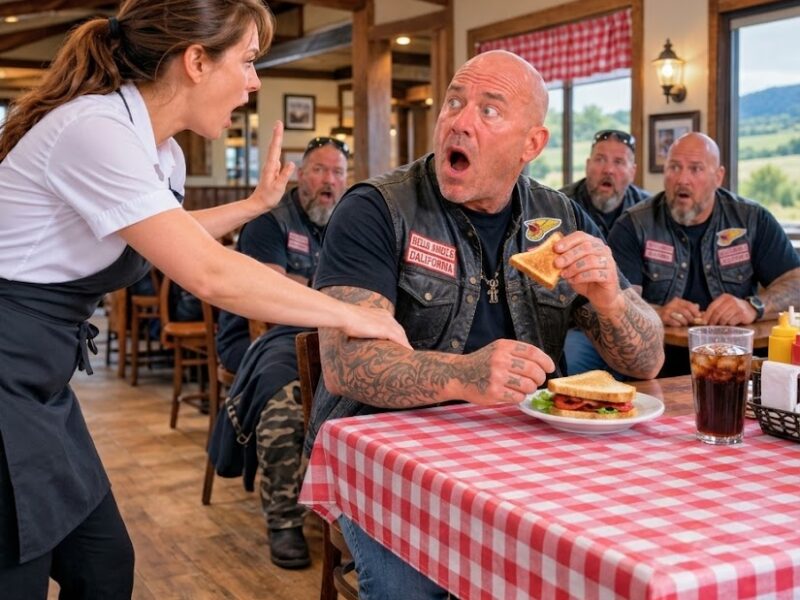
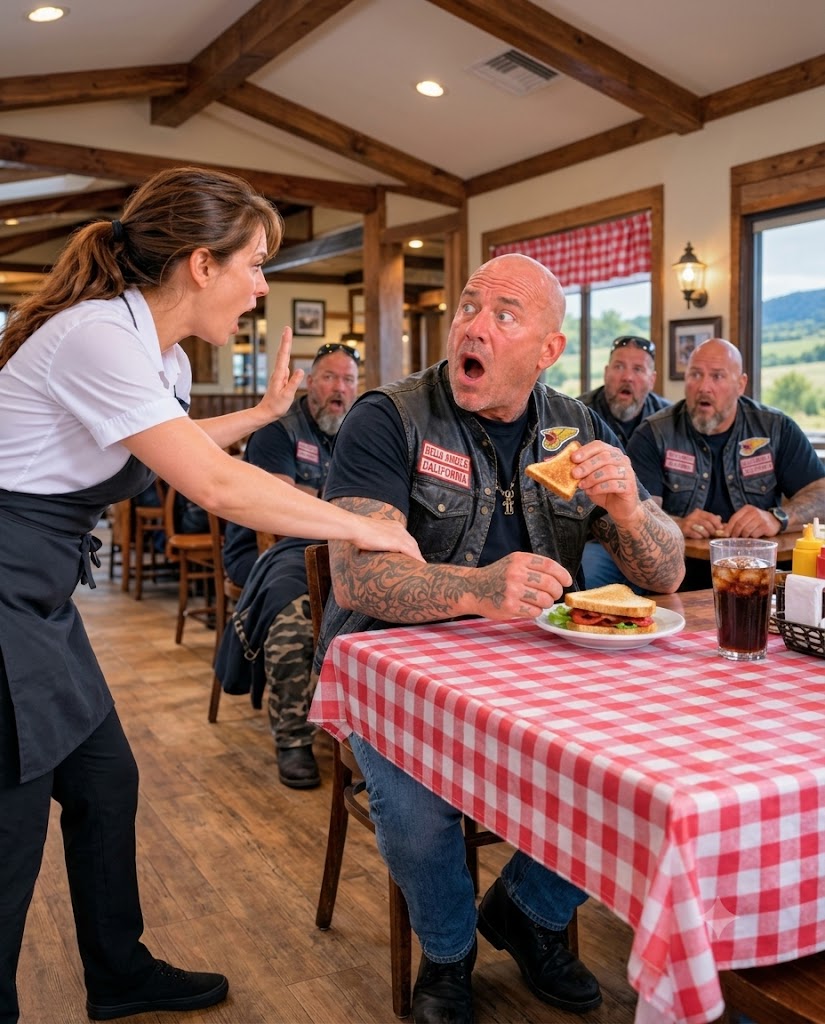
“Don’t eat that!” the old waitress screamed, slapping the toast out of a Hells Angel’s hand. She had just saved 30 lives.
**Part 1**
A metal tray crashed to the floor, plates shattered, and toast scattered across the tile like a deck of cards thrown in a fit.
A small hand had slapped that tray clean out of the air, and now that same hand was shoving a man twice her size back against the counter.
Glass crunched under heavy boots, and thirty chairs scraped back at once as thirty big men rose to their feet.
Somebody shouted to grab her, and a coffee pot tipped over and spilled brown across the floor, but she did not run.
She planted both feet and threw her arms wide in front of the long table, blocking every single plate with her own body.
Her name was Fern, sixty-eight years old, barely five feet nothing, wearing an apron stained with syrup, and she was screaming one word at a room full of outlaw bikers.
“Don’t eat that!”
Why would an old waitress risk her life to ruin their breakfast?
Stay with me, and let me take you back about twenty minutes to before any of that happened, because to understand why a little old woman would throw herself at thirty grown men, you have to understand the woman first.
The Copper Kettle sat all by itself off Route 66, a few miles out of Barstow, California, one of those low brick diners with a tin roof that ticked when the sun came up.
Fern Dalloway had worked that counter for close to thirty years, and she opened it most mornings before the sky even went pink.
She knew the squeak of every stool, she knew which booth rocked if you leaned wrong, and she knew that the coffee urn needed a smack on the left side or it ran weak.
She had a cat too, a fat gray tomcat named Biscuit with one eye and half an ear who slept on top of the register like he owned the place.
Truth is, he kind of did.
Fern found him in the parking lot years back, half dead, and she nursed him back with warm milk and bits of bacon.
Biscuit never forgot it, and he followed her up and down the counter all day long.
When a stranger walked in, that one good eye would open and size them up before anybody else got the chance.
Now, Fern was not a soft woman, and people got that wrong because she was small and old and smiled easy.
But she had hands like worn leather and eyes that missed nothing.
She had buried a husband, she had raised a boy who moved to Phoenix and called on Sundays, and she had seen just about every kind of person come through those doors.
She had a gift, and the gift was this: she could read a room.
She could tell you who was about to skip out on a check, who was crying behind their menu, and who was carrying trouble in under their jacket.
That morning, she was not alone in the kitchen, because there was a new fella back at the grill.
His name was Ray, young, maybe twenty-five, hired two weeks earlier because the regular cook threw his back out.
Ray kept to himself, and he was quiet, but not the easy kind of quiet, the nervous kind, the kind where a man checks the clock too many times.
Fern noticed it, because she always noticed.
But she had bigger things on her plate that morning, because the Copper Kettle was not open to just anybody.
The place was booked, the whole diner closed to the public, reserved for one group.
The Iron Saints, a motorcycle club out of the high desert, thirty riders strong, and they were coming in for a memorial breakfast.
One year to the day since their founder passed, a man they called Cutter.
From what Fern had heard, he built that club from four guys and a trailer into something that carried weight across three counties, and every year his brothers gathered to eat the breakfast he used to love.
Eggs, bacon, and a tall stack of buttered toast in the middle of the table that everybody tore from with their hands.
Fern had taken the booking herself, because she did not scare easy and a paying room was a paying room.
She spent the morning lining up the long tables, setting out the heavy white mugs, and keeping half an eye on Ray, who kept wiping his hands on his apron like they would not come clean.
Then a little after six, she heard them.
You hear the Iron Saints before you see them, thirty engines rolling in off the highway, a sound that shakes the windows in their frames.
Biscuit lifted his head, and Fern wiped her hands and walked to the door.
They came in heavy and loud and smelling of road dust, leather vests and gray beards and tattoos up to the jaw.
At the front walked a mountain of a man, shaved head, thick neck, a silver beard down his chest.
The president, they called him Deacon.
He took off his sunglasses, looked around the quiet little diner, and gave Fern a nod, respectful enough.
These were hard men, but they had come to mourn, and even hard men go gentle at a grave.
Fern poured coffee down the line, and she did not flinch at the patches or the knives on their belts, she just worked.
And the whole time in the back of her mind, a small voice kept whispering about the cook, because Ray had gone pale when the bikes rolled up.
Now back at that grill, his hands were shaking.
Fern told herself it was nerves, a young kid with thirty outlaws in his dining room, anybody would sweat.
But the voice kept whispering, keep your eyes open, Fern, something is wrong in this room.
She did not know yet how wrong.
She only knew the toast was going out next, the big shared stack, the heart of the whole memorial, and she knew that Ray had just carried that platter to the pass, set it down, and looked at the door like a man planning to run.
Here is where it turns.
Fern picked up the coffee pot to make another round, and on her way past the pass-through window, she glanced in at the toast platter sitting under the heat lamp, golden and buttered and stacked a foot high.
And she saw Ray do something that stopped her cold.
He had his back half turned, like he was shielding his own hands, and between two fingers he held a little paper packet.
White.
He tore the corner with his teeth, then he tipped it out slow over the butter melting on top of that toast.
A fine white powder, not salt, not sugar.
He spread it with the back of a spoon, folding it into the warm butter so it disappeared, and then he set the spoon down and stepped back fast, wiping his mouth, eyes darting.
Now, a lot of people would have froze, and a lot of people would have told themselves they imagined it.
Surely not, surely that was flour, seasoning something, nobody poisons a plate of toast in a diner off Route 66 at six in the morning.
Fern did not tell herself any of that.
She had read this room an hour ago, she knew the cook was wrong, and now she knew why.
The server, a young girl named Casey, had already lifted the platter and was carrying it out toward the long table, right to the center, right where thirty men were reaching with their coffee and their quiet talk of their dead friend.
Deacon had a slice halfway to his mouth from the warm-up basket, and two of his men already had fingers on the fresh stack.
Fern did not have time to explain, she did not have time to be polite, and she did not even have time to be afraid.
She dropped the coffee pot and it smashed on the floor, and she crossed that dining room faster than she had moved in twenty years.
She hit the platter with both hands and knocked it clean out of Casey’s grip.
Toast flew, butter smeared the table, the tray clanged and rolled, and Fern threw herself in front of the long table with her arms out wide, screaming that one word you already heard.
“Don’t eat that!”
For one second, the whole room went dead silent.
Then it exploded.
Thirty chairs scraped back, thirty men stood, somebody grabbed her arm, and somebody shouted that she was crazy.
A big rider with a scar through his eyebrow got right in her face and demanded to know what in God’s name she thought she was doing, ruining a brother’s memorial, throwing their food on the floor like a lunatic.
And Deacon, the president, slowly set down his slice.
He stood to his full height and the whole room went quiet around him, because that is how it worked with these men.
He looked down at this tiny shaking woman in a syrup-stained apron, and his voice came out low and cold.
“Who,” he said, “do you think you are, old woman, to put your hands on our breakfast?”
Fern was breathing hard, her heart was slamming, but she did not back up.
She pointed one finger at the kitchen, at the empty space behind the grill, and she said three words.
“Ask the cook.”
Except the cook was gone.
The back door was swinging, and Ray had bolted the second the tray hit the floor.
That changed things, because a man does not run from a diner over spilled toast.
Two of the riders went out the back after him, boots pounding, and Deacon stared at the swinging door, then down at the buttered toast smeared across his table, and something behind his eyes shifted from anger to doubt.
He crouched, he picked up a slice off the floor careful, and he brought it close to his nose.
Then he set it down like it had bitten him.
The whole room was watching Fern now, and she explained it plain and fast.
She told them what she saw, the packet, the white powder, the way Ray folded it into the butter and stepped back and watched the door.
She did not dress it up, she did not cry, she just told them the way you tell a man a bridge is out ahead.
And slowly you could feel the room change its mind.
The scarred rider let go of her arm, somebody muttered a curse, and Deacon looked at the toast and at the back door and at this little old woman who had just thrown her whole body between thirty men and a plate.
And he did something nobody expected.
He pulled out a chair and told her to sit down.
Then the two riders came back in from the alley out of breath.
They had not caught Ray, but they came back with his apron and tucked in the front pocket were three more of those little white paper packets, unopened.
The room went quiet in a different way now, a heavy way.
Deacon told everybody to stand down, he told them nobody eats anything, nobody touches a thing until they sort this out.
He had one of his men pour the suspect toast and butter into a to-go box to hang on to, and he thanked Fern stiff and awkward the way a proud man thanks you when you have just made him feel foolish.
The danger, it seemed, had passed.
The cook was gone, the bad food was in a box, nobody got hurt.
Fern let out a long breath, and her hands finally stopped shaking.
Casey brought her a glass of water and she took a slow sip and set it down on the counter next to the register.
Biscuit climbed down into her lap and pushed his head under her chin, purring like he knew, and she scratched his one good ear.
Around the room, the men settled, and somebody laughed low, the nervous laugh of men who just dodged something.
Deacon sent two riders to the kitchen to cook a fresh breakfast themselves, from the sealed eggs and the sealed bread, and the smell of bacon started up again.
It was over, everybody believed it was over.
Then the front door opened.
**Part 2**
A man walked in slow, filling the whole doorway, and he was not an Iron Saint.
Different vest, different patch, a grinning skull with wings swept back, and underneath it the word Vultures.
He had two more behind him, and he was holding Ray by the back of the neck, dragging the cook along like a sack of grain, and dropping him on the floor in the middle of the diner.
“Well now,” the man said, looking around at all those spilled plates and that to-go box on the counter, “looks like somebody spoiled breakfast.”
And just like that, this stopped being about a nervous cook and a packet of powder.
It became something a whole lot bigger.
The big man in the Vultures vest stepped over Ray like he was furniture, and his name, we would learn, was Rance Coyle.
He ran a crew out of the far side of the desert that had been circling Iron Saints territory ever since Cutter died.
See, a club is only as strong as the man holding it together, and for a year now, the word on the road was that the Iron Saints had gone soft without their founder.
Rance had come to test that.
And he had figured, why fight thirty men in a parking lot when you can put them all in one room on one sad morning and kill them with a plate of toast?
That was the plan, pay a scared kid to do it quiet, thirty funerals in one shot.
A whole club wiped off the map and nobody left to hold the territory, no war, just an empty chair where the Iron Saints used to sit.
And it had almost worked, it would have worked if a sixty-eight-year-old waitress had not been watching a cook’s hands.
Rance looked at the toast on the floor, then he looked at the thirty very alive bikers now rising all around him, and the grin slid off his face just a little.
Because this was not the room he had been promised.
He had come to collect bodies, instead he had walked into thirty angry men who had just figured out exactly what he tried to do.
Deacon stood up slow, and he asked the question the whole room was thinking.
He asked how a man like Rance knew the toast was already spoiled, how he knew to show up right now dragging the cook unless he had been parked outside the whole time waiting for the diner to go quiet, waiting for his poison to do its work.
Rance did not even bother to lie.
He shrugged, he said the kid lost his nerve and now they would just have to do it the loud way, and he opened his vest and there was a gun on his hip and the two men behind him let their hands drift down to theirs.
That was the first real payoff of the morning, and I want you to sit with it.
Because right there in front of everybody, the truth landed.
Fern had not ruined a breakfast, Fern had not embarrassed anybody.
Fern Dalloway had saved thirty lives.
Every single man in that room was breathing because a little old woman believed her own eyes and moved faster than her fear.
Thirty wives, not widows, thirty kids with fathers, and every rider in that diner knew it now, all at once.
And they turned and looked at her with something close to awe.
If you are still with me, and I hope you are, do me one favor and hit that subscribe button, because stories like this one, about the quiet people who turn out to be the strongest in the room, are exactly what this channel is here for.
Now, let me tell you what happened next, because this is where it gets good.
Deacon stepped in front of Fern without even thinking about it, thirty men closed ranks behind him, and the standoff began.
Here is the thing Rance did not understand.
He thought these men were soft because their leader was gone, but grief does not make men soft.
Grief makes men dangerous, because a man with nothing left to lose fears nothing at all, and he had just tried to spit on their dead brother’s memorial with a sack of rat poison.
The scarred rider, the one who had grabbed Fern earlier, moved to the windows, calm, quiet, and he slid the blinds shut one by one.
Another man stepped to the front door and turned the lock and flipped the little sign to closed.
And I promise you, Rance felt that lock turn in his stomach.
He had come here to trap the Iron Saints, and now the trap had him inside it.
Rance tried to talk his way sideways, he said there was no need for anybody to get hurt, he said the territory was going to change hands one way or another.
He said the Saints were done, that Cutter was a year in the ground, and the desert belonged to whoever was strong enough to take it.
And then he made a mistake.
He kicked Ray, the cook, lying there on the floor, and he laughed.
And he called Cutter an old fool who should have stayed dead the first time.
The whole room went still, and that is when the second big thing happened, the thing that turned the story on its head.
Because Fern, who had been sitting quiet at the counter with Biscuit in her lap, stood up.
And she walked out from behind that counter, slow, past Deacon, right up toward the center of the room, close enough to Rance that one of his men put a hand out to stop her.
Deacon said her name, low, a warning.
“Fern. Stay back.”
But Fern was not looking at Rance anymore.
She had turned, and she was looking at the register, at the old cork board on the wall behind it, half hidden under thirty years of receipts and postcards and a faded photo nobody ever bothered to look at.
She reached up, and she pulled that photo loose, and she held it out, not to Rance, but to Deacon.
“Take a look,” she said. “You never did ask who I was.”
Deacon took the photo in his huge hand, and the color drained right out of his face.
It was a picture, old and cracked, the colors gone soft the way they do.
A young woman on the back of a motorcycle, arms wrapped around the waist of a man with a wild grin and a leather vest.
The woman was laughing, head thrown back, red hair whipping in the wind, and on the back of that man’s vest was a patch, a young version of a patch every man in that room was wearing right now.
The Iron Saints, four guys in a trailer back at the start.
The man on that bike was Cutter, and the laughing, red-haired woman holding onto him was Fern.
Deacon looked up from the photo, he looked at the little old waitress in the syrup-stained apron, and he whispered a name.
Not Fern, an older name, a road name, one the old-timers still spoke with respect around a fire.
“Firecracker.”
Fern gave a small, sad smile, and she said she had not heard that name in forty years.
Now here is the whole story, and it is the reason she never once feared that room.
Back at the very beginning, before the Iron Saints were anything, before the patches and the territory and the memorials, there were a handful of kids on cheap bikes, and two of them were Cutter and a wild, red-haired girl named Fern.
She rode with the founding crew, she was there the night they voted on the name, and she was Cutter’s girl, his first and his best.
The one who stitched the very first patches by hand on a sewing machine in the back of that trailer.
And then life did what life does.
A bad wreck on a mountain road took the use of her left leg for a year, and Cutter wanted her off the bikes, safe, and they fought and they partied, both too proud to bend.
She married a quiet man, a good man, and she settled by the highway and opened a diner, and Cutter built his club into a legend.
They never spoke again, but every year for forty years, Cutter sent one thing to the Copper Kettle on the same date.
A single white rose, no note.
And Fern kept every dried one of them in a box under the register.
She did not know until the booking came in that the memorial breakfast was for him, she did not know Cutter was gone until these men walked in wearing the patch she sewed by hand.
And when she realized whose brothers these were, whose table this was, she decided she was going to take care of them.
For him, because they were the last living piece of the only man she ever truly rode with.
That was why she watched the cook, that was why she threw herself at that table.
She was not just saving thirty strangers, she was guarding Cutter’s family with the last of her strength.
The room understood all of it in about ten seconds flat, and the temperature changed.
Thirty outlaw bikers looked at the woman who sewed their first patches, who loved their founder, who had just saved all their lives, and they stopped seeing an old waitress.
They saw one of their own, an original, family.
**Part 3**
Rance Coyle did not understand what had just happened.
He only knew the room had turned colder and harder, and that the odds he came in with were long gone.
He went for his gun, and he never cleared the holster.
The scarred rider was on him before the metal moved, two more came off the wall, and the man who had locked the door caught the first Vulture across the jaw and put him on the floor among the broken plates.
The second Vulture got maybe one swing in before a wall of leather folded over him.
It was not a long fight, thirty against three never is, but it was not cruel either, and that is worth saying.
Deacon called it the whole time, sharp and clear, no guns, no knives.
He wanted them breathing, he wanted them to answer for what they tried to do, not get an easy way out of it.
They got Rance down and held him there, and Deacon crouched over him with that old cracked photo still in his hand.
He held it up in front of Rance’s face, and he told him to look at it.
He told him that the woman he had just walked past, the one he figured for nobody, was the reason his whole plan was lying on the floor in pieces.
He told him that she was Firecracker, that she rode with Cutter when Rance was still in diapers, and that Cutter was not an old fool.
Cutter was the man whose family had just beaten him without drawing a single weapon.
Then Deacon stood up and did the thing that mattered most.
He turned to Fern in front of everybody, and he bowed his head to her.
This giant of a man, president of the Iron Saints, bowed his head to a sixty-eight-year-old waitress.
And one by one, every man in that room did the same.
They did not hurt the cook, and that surprised me when I first heard it, and maybe it surprises you.
But Fern asked them not to.
She crouched down next to Ray, who was shaking and crying on the floor, waiting to die, and she asked him one quiet question.
“Why?”
And it came pouring out of him.
The Vultures had his little sister, they told him if he did not do it, she would disappear.
He was a terrified kid who had been handed an impossible thing, and he had tried at the last second to warn nobody and just run.
Fern looked at Deacon, and Deacon, who understood loyalty and family better than most, made a decision.
The Vultures were going to answer for the girl, and for all of it, to people far above a diner floor.
They called it in, not to the police, to people who settle these things the way the clubs have always settled them.
Rance Coyle and his two men were handed over to a council of clubs across the region, with the box of poisoned toast as evidence and thirty sworn witnesses to what he tried to do.
Trying to wipe out an entire chapter at a memorial is the kind of thing that ends a man in that world.
Rance Coyle was never seen riding again, his crew was broken up and scattered before the month was out, and Ray’s little sister was found two days later safe and brought home.
The Iron Saints made sure of it.
But the real ending of this story is not about the men who lost, it is about the little woman who won.
So, let me tell you how it ended for Fern.
The fresh breakfast finally came out of that kitchen, cooked by the riders themselves.
Eggs and bacon, and a tall stack of good buttered toast in the middle of the table.
And before anybody ate, Deacon stood and raised his coffee mug.
He said a few words for Cutter, like they did every year, but then he said he wanted to add something new to the memorial.
He turned to Fern and asked her to sit, not at the counter, but at the head of the table.
In Cutter’s chair, the empty chair they left for him every year.
Fern cried then, first time all morning.
She sat down in that chair with Biscuit in her lap, and thirty men she had just met and already loved raised their mugs to her.
To Firecracker.
And they tore into that toast with their hands, the way Cutter used to, and the diner filled up with the sound of men laughing and telling old stories.
Stories she had been part of before any of them were born.
The Iron Saints did not forget her, and that is the part that gets me.
Men like that remember who stood up for them.
They patched the diner’s leaking roof that same week, the whole crew up there on a Saturday with hammers and beer.
They repaved the cracked lot, and a rider sat in that diner quietly every single morning after that, just having coffee, keeping an eye, so no trouble ever found the Copper Kettle again.
They never asked for a thing, they just took care of her, the way she had taken care of them, the way family is supposed to.
And they gave her something too.
A few weeks later, Deacon came in alone and set a small bundle on the counter.
It was a vest, her own size, small.
On the back was the Iron Saints patch, the one she had sewn by hand forty years before, and under it, a new rocker with one word on it.
Firecracker.
They had voted, he said, unanimous.
She was not an honorary anything, she was a full member, the first woman to wear the patch in the club’s whole history, and the only person alive who rode at the very start.
She hung that vest on the wall behind the register, right where the photo used to be, where she could see it every morning.
Fern worked that counter a good many years more, and she never did ride again, her leg would not allow it.
But every year, on the same day, thirty engines rolled in off Route 66 and shook the windows, and thirty men came through her door for a memorial breakfast.
Only now there were two names spoken over the toast.
Cutter, and Firecracker.
And Fern poured the coffee and sat in the head chair, and told the young ones stories about four kids and a trailer and a girl who stitched the first patches by hand.
Biscuit lived to a ripe old age on top of that register, watching the door with his one good eye, sizing up every stranger who walked in.
Same as the woman who saved him off the parking lot pavement all those years ago.
The two of them, the throwaway cat and the forgotten founder, guarding a little brick diner in the desert like it was the most important place in the world.
Because to the Iron Saints, it was.
Remember how this started.
A tray crashing to the floor, toast scattered across the tile, an old woman with her arms thrown wide, screaming at a room full of men who did not know her name.
It looked for one second like the craziest thing anybody had ever seen.
But it was not crazy.
It was the oldest thing in the world.
It was love and loyalty and a promise kept to a man forty years gone.
She threw her body in front of that table because that table was the last of him, and she was not about to lose him twice.
So, the next time you walk into some quiet little diner off the highway and some small old woman in an apron pours your coffee without a word, you be kind.
You say thank you, because you have no idea who she used to be.
You have no idea what she rode through to get here, and you sure have no idea what she would do for the people she loves.
That was Firecracker Fern.
Sixty-eight years old, five feet nothing, and the strongest person in any room she ever walked into.
Thank you for staying with me till the end, and I will see you on the next one.









