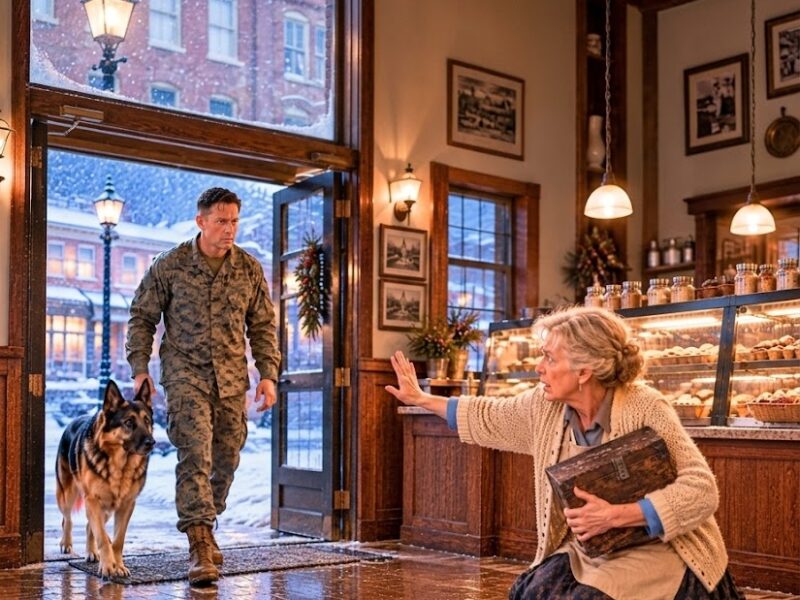
“Don’t Come In!” an Elderly Baker Warned the Marine—But His K9 Knew Someone Was Still Inside
The snow had been falling for three hours by the time Gunnery Sergeant Bram Sutter realized he had missed his exit.
Not badly. Not the kind of mistake that cost a man more than ten minutes on a quiet Idaho highway. But enough to remind him that even careful men grow tired, and tired men miss things.
Behind him, Cinder stood.
The seven-year-old German Shepherd had been asleep for most of the drive, curled in the back seat with his nose tucked beneath his tail. Now he was upright, ears forward, body rigid as a fence post.
Bram watched him in the rearview mirror.
“What is it?”
Cinder didn’t answer. He never did. But his stare had fixed on something outside the passenger window, and that stare did not move.
—
Bram eased off the accelerator.
They were passing through Coeur d’Alene now, or what remained of its downtown after 8 p.m. on a late November night. Storefronts stood dark and shuttered. The streets had emptied early, the way small-town streets always did when the first real snow arrived.
Nothing appeared wrong.
No smoke. No one waving for help. No vehicle stranded on the shoulder with its hazards blinking.
Bram continued another half block.
Cinder shifted to the opposite side of the rear seat and looked backward through the glass.
Bram exhaled.
“You’re sure about this?”
The dog’s stare never moved.
Bram signaled, turned around, and parked along the curb.
—
The building Cinder had alerted on was narrow and two stories tall, built from brick that had weathered a century of Idaho winters. A faded hanging sign creaked above the door.
Barlow’s Bakery.
The front windows were dark except for a warm light burning somewhere behind the counter. A closed sign hung against the glass, but someone had forgotten to turn off the inside lamp.
It looked like a place that had finished a normal day.
It did not look like a place in trouble.
Bram stepped into the cold, boots crunching through a thin crust of snow. Cinder climbed out after him and immediately faced the bakery, ears forward, tail low.
Up close, the place looked old but cared for. Painted window trim worn smooth at the corners. Small cafe tables stacked neatly behind the glass. Handwritten pastry cards still arranged beside empty trays.
Then Bram saw movement.
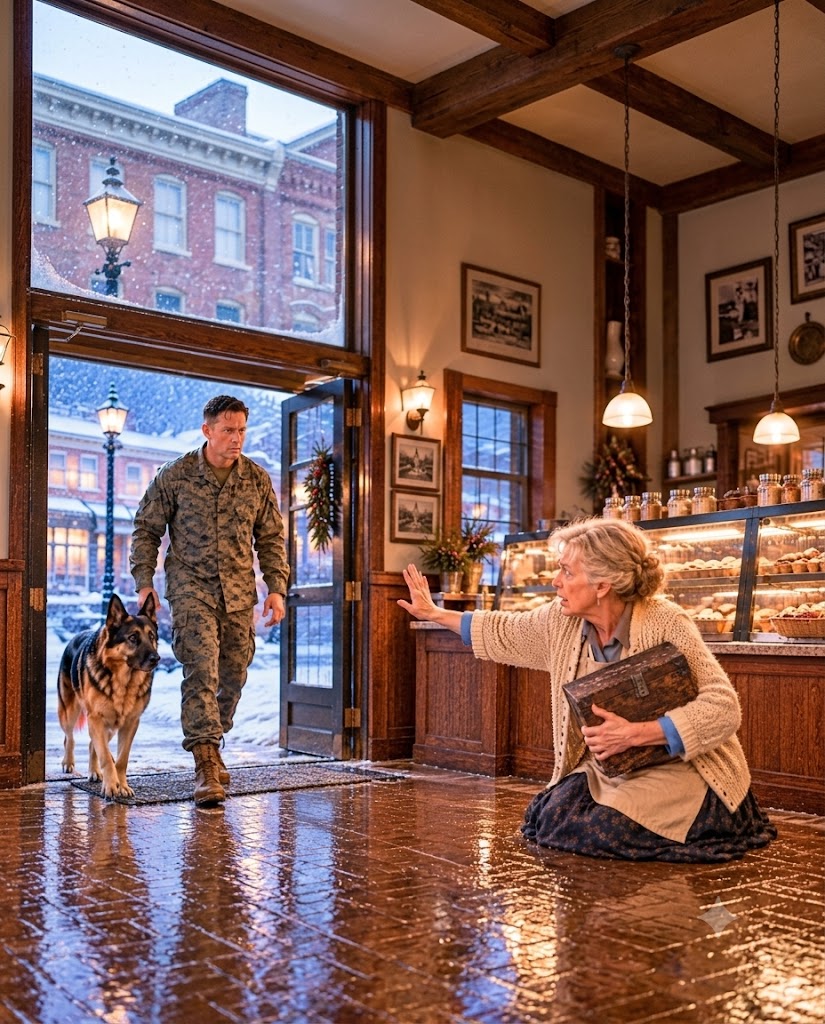
Behind the counter, partly hidden by its wooden front, an elderly woman was sitting low to the floor.
—
He moved quickly to the door.
Her name was Winifred Barlow, though nearly everyone who knew her called her Winnie. She was seventy-eight years old, a widow with a slight, narrow frame that made her seem almost swallowed by the thick cream cardigan around her shoulders.
Her silver-white hair had been gathered into a loose bun, several wisps falling around a pale, finely lined face. She had clear hazel eyes and thin hands marked by flour, age, and decades of work.
There was nothing helpless in her expression.
Even sitting on the floor, she possessed the stubborn composure of someone accustomed to opening her own doors before sunrise and solving her own problems before anyone knew they existed.
In both arms, she held an old wooden box against her chest.
Bram knocked twice.
Winnie startled and looked up.
“Don’t come in.”
—
Bram’s hand stopped inches from the door handle.
“I’m not here to cause trouble, ma’am. My dog alerted on the building.”
“I said, don’t come in.”
This time, Bram heard something beneath her sharpness. Not fear of him.
Urgency.
Cinder stepped closer to the glass. Strangely, he barely looked at Winnie. His ears had turned toward the narrow hallway behind the counter leading into the bakery kitchen.
Bram noticed it, too.
A steady rushing sound.
Water.
“Ma’am, is there a leak back there?”
Winnie’s eyes flicked toward the hallway.
“A pipe went. I was trying to find the shutoff.”
That was enough.
—
Bram entered only after confirming the front section remained dry. He kept Cinder near the doorway and moved no farther than necessary.
Beyond the counter, water was spreading from the kitchen across the old tile, reflecting the ceiling lights in trembling streaks. Worse, it was creeping toward a low wall outlet where the surrounding trim showed its age.
“Stay exactly where you are,” Bram said.
Winnie bristled. “Young man, I’ve owned this building longer than—”
“And I’d like you to keep owning it.”
Something in his tone ended the argument.
—
Bram did not touch the broken pipe. He did not pretend to know more than he did.
Instead, with Winnie directing him from the dry area, he located the electrical panel through a safe side access, cut power to the affected area, then found the main water valve and shut it down.
The violent rushing behind the kitchen wall weakened to a gurgle and finally stopped.
In the sudden quiet, the bakery felt strangely larger.
Cinder remained at the edge of the dry floor, watching.
Bram pulled out his phone.
“You’ll need a plumber and someone qualified to inspect the electrical system before the power goes back on.”
“I know. I can make the calls.”
“I said I know.”
Her voice was proud, but exhaustion had begun to show through it.
—
Then Winnie looked past him.
The wooden box was no longer in her arms. She had set it near the edge of the counter when Bram entered, dangerously close to where the floor was wet.
She stepped toward it.
Bram moved between her and the water.
“No.”
Her eyes hardened. “Excuse me?”
“Whatever’s in that box can wait.”
For the first time, Winnie’s composure changed. Not much. Just enough.
She stared at the weathered box as though Bram had mistaken it for an object when to her it was something closer to a room full of people.
“No,” she said quietly. “It already waited long enough.”
—
Bram studied her but did not ask.
There were questions a stranger had no right to force open.
Instead, he retrieved the box only after making sure he could do so safely, and placed it well away from the wet floor.
Winnie rested one hand on its lid.
“Do you have family nearby?”
A pause.
“My nephew.”
“Can I call him?”
Another pause, longer this time.
Finally, she gave him a number.
—
Gideon Barlow was forty-seven and lived in Boise. Bram knew almost nothing else about him yet, except that Winnie’s mouth tightened when she said his name.
Not with dislike, Bram thought.
But with the reluctance of an independent woman who hated giving someone proof that they had been right to worry.
Bram made the call.
Before leaving, he confirmed that Winnie would not sleep upstairs until the electrical system had been inspected. She agreed to stay with a neighbor two houses down.
Only then did some of the tension leave his shoulders.
—
At the doorway, Cinder stepped into the snow. Bram followed, then glanced back.
Winnie stood alone behind the counter, the wooden box pressed against her again. Without the kitchen lights, half the bakery had disappeared into darkness.
“You sure you’ll be all right tonight?” Bram asked.
Winnie looked toward the blackened kitchen. A tired little smile touched her face, but it held no humor.
“Tomorrow was supposed to be the last day anyway.”
Bram stopped.
“The last day?”
Winnie lowered her eyes to the box.
She offered nothing more.
—
Outside, Cinder waited in the falling snow while Bram stood with one hand on the open door, suddenly aware that the burst pipe was not the reason sadness had been sitting in this bakery before he arrived.
He still did not know why Winnie Barlow intended to close its doors.
He did not know why an old wooden box mattered enough for her to step toward a flooded floor.
And he could not possibly know that something small had left this bakery many years before, passed quietly through another man’s life, and was already finding its way back.
—
Morning came cold and colorless over Coeur d’Alene.
The snowfall had stopped before dawn, leaving the sidewalks edged in white, and Barlow’s Bakery dark behind its front windows. Its usual warmth replaced by the faint smell of wet wood.
Bram returned shortly after 8 a.m. with Cinder beside him.
A plumber’s van was already parked near the curb, and behind it sat a dark blue SUV dusted with road salt. Through the bakery window, Bram could see Winnie moving slowly behind the counter while a man he had never seen before stood near the kitchen entrance with both hands braced on his hips.
The man turned when Bram entered.
—
Gideon Barlow was forty-seven, about five foot eleven, solidly built through the chest with sandy brown hair cut short and beginning to thin at the crown. A neatly trimmed beard, darker than his hair and threaded with gray along the chin. A sharpened but otherwise approachable face.
His brown eyes looked tired from the drive from Boise, and the creases between them suggested that worry had become a familiar expression over the past few years.
Gideon worked with numbers for a living, and it showed in the way he approached problems. Identify the risk. Reduce it. Move forward.
That practical instinct had intensified after watching his aunt grow older while repeatedly refusing offers of help.
He was not impatient with Winnie because he wanted her bakery.
He was impatient because he loved a woman who had made self-reliance into a fortress.
—
“You’re the one who called?” Gideon extended his hand immediately. “Thank you.”
Bram shook it.
“I mean that,” Gideon added. “If you and your dog hadn’t stopped last night—”
His gaze traveled toward the kitchen and stopped there.
He did not finish.
Cinder quietly moved toward the dry side of the room while Winnie, apparently determined to behave as if the previous night had been a minor inconvenience, was stacking undamaged paper bags.
“Those were already organized,” Gideon said.
“They were wet underneath.”
“They’re paper bags, Aunt Winnie.”
“And wet paper bags are generally considered undesirable in bakeries.”
Bram lowered his eyes, hiding the beginning of a smile.
—
The plumber emerged from the back with a second tradesman who had been checking the affected electrical area.
The news was better than the room looked. The frozen section of pipe could be replaced without opening an entire wall, and the electrical damage appeared limited because power had been cut early.
But water had soaked the flooring near the kitchen entrance and reached the wooden base beneath part of the service counter. Those sections would need time to dry before damaged material could be replaced.
Several days.
Not several hours.
Winnie stopped sorting bags.
“How many?”
“Could be four,” the plumber said. “Maybe five before I’d want anyone running a business through here.”
Gideon exhaled through his nose.
“Then that settles it.”
Winnie turned toward him. “Settles what?”
“You said tomorrow was supposed to be the last day.”
“It was.”
“So let it be.”
Her face went still.
—
Gideon softened his voice.
“You don’t need one ceremonial day just to prove you can still do it.”
“I’m not proving anything.”
“You’re seventy-eight years old, Aunt Winnie. You live alone above an old commercial building. Last night a pipe burst beside aging electrical work, and you were down here trying to handle it by yourself.”
“I have handled this building by myself for years.”
“That is exactly what scares me.”
The words landed harder because Gideon did not raise his voice.
Bram busied himself moving a dry stack of trays away from the repair area. This was family territory, and he had no intention of occupying it.
—
After a moment, Winnie said, “Then I’ll wait until the repairs are finished.”
Gideon stared at her.
“And next Friday,” she continued, “I will open one final time.”
“Aunt Winnie.”
“One Friday. What difference could one more day possibly make?”
Winnie did not answer immediately.
Bram had assumed the bakery was closing because it could no longer survive.
Gideon’s next words corrected him.
“You don’t owe anybody money. The building is yours. You don’t have a landlord standing over you. You could lock that door today, go upstairs, sleep until noon for the first time since Eisenhower, and nobody could stop you.”
“Gideon.”
“I’m serious.”
So that was it.
No foreclosure. No debt collector. No owner forcing Winnie out.
She was choosing to close.
And somehow that made the sadness in the room harder to understand.
—
Later, while the tradesmen worked, Bram helped carry undamaged supplies to the far side of the bakery.
He noticed an old wooden chair near the front window. Unlike the cafe chairs, it had padded arms and a worn indentation in the seat. No one had stacked anything on it.
Winnie noticed him looking.
“That was Otis’s.”
Bram waited.
“My husband.”
Her voice changed when she said the name. Not breaking. Only becoming quieter.
—
Otis Barlow had been gone for several years.
He and Winnie had spent most of their marriage inside these walls, waking before sunrise, arguing over ovens, sharing coffee between batches, and remembering customers long after customers had forgotten them.
Winnie touched the edge of a flour tin.
“Otis believed Friday was a dangerous day to be hungry.”
Bram glanced at her.
“He said people could survive being hungry on Tuesday because Tuesday admitted it was miserable. Friday made everyone else look happy.”
Despite himself, Bram smiled. “Sounds like he had theories.”
“Oh, endless ones.”
Then she explained the Friday loaf.
—
Every Friday, they baked more bread than they expected to sell. Not dozens. Just enough.
If someone came through the door hungry, exhausted, grieving, newly unemployed, stranded, or simply carrying the unmistakable look of a person whose day had become too heavy, Otis offered bread.
Winnie poured coffee.
No forms. No questions. No proof.
“What if somebody lied?” Bram asked.
Winnie shrugged. “Then they got bread they didn’t deserve.”
“And that didn’t bother you?”
“It bothered Otis less than the possibility of refusing someone who did.”
For years, Friday loaf had been as ordinary to them as cleaning the ovens.
After Otis died, Winnie continued it alone.
But the town changed. Old customers moved away or died. New cafes opened. People ordered food without ever stepping through a doorway. Fewer familiar faces came past the window.
And Otis’s chair remained empty Friday after Friday.
Eventually, Winnie began wondering whether she was preserving kindness or merely repeating a ritual because stopping it would make his absence permanent.
—
Gideon had been listening from across the room. His eyes went to the empty chair.
“You’re not keeping a bakery open, Aunt Winnie.”
Winnie’s fingers stopped against the flour tin.
Gideon swallowed.
“You’re keeping Uncle Otis from leaving.”
Silence spread through the bakery.
Bram looked toward him, but there was no cruelty on Gideon’s face. Only the pain of someone who had rehearsed softer versions of the same truth and watched them fail.
Cinder crossed the room without prompting. He reached Otis’s chair, circled once, then lowered himself onto the floor beside it.
Winnie watched him.
Her eyes remained dry. That somehow made the moment heavier.
“Maybe,” she said.
Gideon looked down.
Winnie rested one hand on the back of her husband’s chair.
“But this was the last place where I still knew what I was useful for.”
—
Bram felt something inside him tighten.
Not because she sounded defeated.
Because she didn’t.
She sounded like a woman admitting that usefulness had become the final language she still knew how to speak to the man she had lost.
No one answered.
After a while, Winnie straightened, wiped her hands against her apron, and looked toward the damaged kitchen.
“Next Friday.”
Gideon closed his eyes briefly.
“One last Friday loaf,” she said. “Then I close the bakery.”
This time Gideon did not argue.
He still believed the bakery should close.
But as Cinder rested beside Otis Barlow’s empty chair, Gideon finally understood that his aunt was not fighting to keep an old building alive.
She was trying to decide who she would be after she turned off its lights.
—
For three days, winter sunlight flashed cold against the snow outside Barlow’s Bakery while the inside slowly returned to order.
The ovens remained silent, but the sounds of drying fans, tools, and shifting furniture gave the old building a temporary pulse.
Gideon stayed in Coeur d’Alene rather than returning to Boise. He booked a room nearby, arrived at the bakery early each morning, and took on the unremarkable jobs no one would ever praise him for.
Carrying ruined trim outside. Labeling boxes of supplies. Bringing Winnie lunch when she forgot to eat. Making calls to coordinate the repair schedule.
Bram noticed something important in those small acts.
Gideon never once asked about ownership papers, the value of the building, or what Winnie planned to do with it after closing.
His concern had never been the bakery itself.
It was the woman inside it.
Winnie complained about nearly everything he did for her, which appeared to be the arrangement both of them understood best.
—
Bram stopped by when he could, usually with Cinder, partly because he wanted to make sure the repairs were progressing safely, and partly because he had begun thinking about Winnie’s answer beside Otis’s chair.
He understood the need to feel useful more than he cared to admit.
On the third afternoon, a carpenter began removing the swollen wooden trim beneath the service counter. The water had warped a section badly enough that it could not be saved.
Winnie stood several feet away, watching each piece come loose with the expression of someone witnessing a minor surgery performed on a member of the family.
“Mrs. Barlow?”
The carpenter, a lean middle-aged man with weathered hands and sawdust clinging to his work jacket, reached behind the exposed base.
“There’s something back here.”
He pulled out a flattened brown envelope.
Winnie frowned. “That isn’t mine.”
Gideon looked at her. “It was behind your counter.”
“That does narrow the suspects.”
—
The envelope had been trapped between the old wood and the wall long enough for its edges to turn brittle.
When Winnie opened it, dozens of small slips of yellowed paper spilled across the counter.
Bram picked one up.
A name had been written in faded blue ink.
Marlene Dorsey.
Beneath it was a month and a year from decades earlier.
Another read: Samuel Pike.
Another: Ruth Calder.
Some contained only first names. Others included a town, an old telephone number, or a date.
Bram looked at Winnie. “People who owed you money?”
For the first time since he had met her, Winnie laughed hard enough to put a hand against the counter.
“Oh, Otis would love that.”
Bram raised an eyebrow.
“We didn’t keep debts for Friday loaf.”
“Then what are these?”
Her laughter faded into something gentler.
“People.”
—
She carried the envelope to a nearby table, then reached beneath the shelf and brought out the wooden box Bram had first seen in her arms the night of the burst pipe.
This time, she opened it.
Inside were hundreds of slips, much like the ones from the envelope.
Bram stared.
The box did not contain money, deeds, jewelry, or some private treasure he had imagined during the previous days.
It contained names.
“Otis wrote them down,” Winnie said. “Not all of them. Sometimes we were too busy. Sometimes people wouldn’t give a name.”
Gideon picked up one slip carefully. “Why?”
Winnie smiled faintly. “Your uncle said every loaf had somewhere to go, and every name was worth remembering.”
The envelope, she explained, must have slipped behind the counter years ago before she began keeping the papers together in the box.
Otis had never used the list to ask for repayment. He never contacted anyone afterward. He simply disliked the idea that a person could enter the bakery on one of the worst days of their life, disappear again, and become nothing more than “that hungry man” or “that crying woman.”
—
Bram began reading.
Most names meant nothing to him.
Then his thumb stopped.
He read the slip again.
Ephram Vale.
For several seconds, the room around him seemed to recede.
“You know him?” Winnie asked.
Bram looked up. “I do.”
—
Ephram Vale had been a senior Marine when Bram was young enough to believe silence was the same thing as strength.
He had been in his late forties then, tall and rangy with close-cropped iron-gray hair, a long, angular face, dark eyes, and the permanently broken bridge of a nose that made him look more severe than he actually was.
He rarely raised his voice. He had discovered early in his career that frightened young Marines often heard more from a quiet sentence than a shouted one.
By the time Bram knew him, Ephram had already spent years watching good people carry burdens they could not name. That experience had made him patient rather than sentimental.
There had been a period in Bram’s younger years when something inside him had gone quiet. He still worked. Still followed orders. Still showed up.
But Ephram had noticed the difference.
He never demanded an explanation. He simply sat near Bram one evening and remained there.
Later, he had given him a principle Bram never forgot.
Do not make a hurting man explain his wounds before deciding whether he deserves help.
—
Bram looked again at the yellowed slip.
“How old is that?”
Winnie studied the handwriting. “More than twenty years, I’d guess.”
Bram took out his phone.
Ephram answered on the fourth ring. His voice had aged, roughened around the edges, but Bram recognized it immediately.
“Sutter?”
“Sir.”
“If you’re calling me ‘sir’ after all these years, you either broke something or need money.”
Bram smiled despite himself. “Neither.”
Across the bakery, Winnie watched him.
Bram told Ephram where he was.
There was silence. Not confusion.
Recognition.
“Barlow’s Bakery?” Ephram finally asked.
Bram’s eyes moved to Winnie. “You remember it?”
Another pause. “Is it still there?”
—
Bram put the call on speaker after asking permission.
Ephram told them what he remembered.
Years ago, during a difficult stretch in his Marine career, he had been driving through Idaho with no particular destination. He had spent so many years measuring himself by duty, discipline, and usefulness that he had begun wondering who he was when none of those things seemed enough.
He was not homeless. He was not starving. He had not left the Marines.
He was simply a man carrying more uncertainty than he knew how to admit, even to himself.
One Friday, he stopped in Coeur d’Alene.
He walked into Barlow’s Bakery looking bad enough that Otis apparently understood something without being told.
“He asked if I wanted coffee,” Ephram said.
Winnie covered her mouth.
“I said I didn’t have much cash.”
“And Otis?” Bram asked.
“He said that wasn’t what he asked me.”
Winnie closed her eyes.
—
Ephram remembered her, too.
She had placed coffee and warm bread in front of him without asking where he had been, why he looked exhausted, or what he planned to do next. They let him sit by the window for nearly two hours.
Nothing miraculous happened. He walked out with the same problems he had carried in.
But he walked out remembering what dignity felt like.
Then Ephram’s voice changed.
“Sutter?”
“Yeah?”
“Remember what I used to tell you?”
“Don’t make a hurting man explain himself before you help him.”
Bram stared at the name between his fingers. “I remember.”
A quiet breath came through the speaker. “I learned that in that bakery.”
—
No one moved.
Bram slowly looked across the room. Winnie was staring at the phone as if a voice from decades ago had just opened a door she had believed permanently closed.
Beside Otis’s chair, Cinder lifted his head.
Bram looked down at the box.
Hundreds of names.
Until that moment, he had seen them as records of kindness.
Now he understood they might be something else entirely.
Paths.
One small act had left this bakery with Ephram, traveled through years Winnie knew nothing about, and eventually reached a young Marine who had never heard the name Barlow.
Bram touched the next slip, then another.
If one name had traveled that far, he wondered what had happened to the others.
And for the first time since opening the box, Bram knew exactly what question he wanted to answer.
—
The days before Friday turned colder, but Coeur d’Alene stayed clear beneath a pale winter sky.
Inside Barlow’s Bakery, the repaired floor dried, fresh trim replaced the warped wood, and the ovens waited to be lit one final time.
Bram began with twelve names.
By the second day, he understood how little twelve names could mean after twenty or thirty years.
Two addresses no longer existed. Three others proved too outdated to provide any reliable way of reaching the people who had once lived there. One telephone number belonged to a family who had never heard of the person he was looking for.
Several names were too common to trace responsibly. Others offered nothing beyond faded ink and an approximate date.
Ephram helped from a distance, searching only where old information gave them a reasonable lead.
Bram refused to post photographs of the slips online. He would not turn Winnie’s private kindness into a public hunt. And he certainly would not advertise an elderly woman as someone who needed saving.
The message he sent to the few people they could verify was simple.
Winnie Barlow is making the Friday loaf one last time.
Nothing about money. Nothing about keeping the bakery open. Nothing asking anyone to come.
—
Gideon discovered the calls two days before Friday.
“You did what?”
Bram lowered his phone. They were alone near the counter except for Cinder, who was stretched beneath the table while Winnie worked upstairs.
“I contacted a few names.”
“You had no right.”
“You’re probably right.”
That answer stopped Gideon more effectively than an argument.
His jaw tightened. “Don’t turn her grief into some kind of reunion.”
“I’m not trying to.”
“What do you think happens when people walk through that door and tell a seventy-eight-year-old woman how much this place meant to them? You think she won’t feel responsible for keeping it alive?”
Bram considered that before answering.
“She can close Friday night exactly like she planned.”
Gideon searched his face.
“I don’t want anyone telling her she owes them another year,” Bram continued. “I want her to know what happened after a few of those names left this room. That’s all.”
Gideon looked toward Otis’s empty chair.
Finally, he said, “No pressure. No money. Nobody tells her she has to stay.”
“Agreed.”
Something shifted between them then. Neither man surrendered his position. They simply realized they were protecting the same thing.
Winnie’s right to choose what came next.
—
One week after Cinder had made Bram turn the car around, the lights of Barlow’s Bakery came on before sunrise.
By 7 a.m., the windows were fogged from the ovens.
Winnie worked with an energy Bram had not seen in her before, shaping dough with practiced hands while Gideon handled trays and pretended not to watch the clock.
Bram arrived with Cinder shortly before opening. He said nothing about the messages.
At 8:43, the bell over the door rang.
A man in his late fifties entered wearing a heavy canvas jacket.
Calvin Rusk had a thick neck, large work-worn hands, thinning gray hair, and a ruddy face shaped by decades behind the wheel of long-haul trucks. A slight hitch remained in his left leg from an old highway accident.
He stood inside the doorway clutching his cap as though uncertain whether he belonged there.
Winnie looked up.
“Mrs. Barlow?”
“Yes.”
“My name’s Calvin.”
Nothing.
“Years ago, my truck got stranded north of town during a storm.”
Winnie’s hands stopped.
Calvin smiled awkwardly. “Your husband gave me coffee until the tow came. You wrapped two loaves in paper and told me one was for the road.”
Recognition came slowly.
“Oh,” Winnie whispered.
—
Calvin did not hug her. He did not produce an envelope of cash.
He simply bought a coffee, sat near the window, and told her that years later he had found a young driver stranded outside Missoula and stayed with him until help arrived because he remembered a bakery where strangers had once done the same for him.
The bell rang again.
Marion Keen entered next.
She was sixty-two, slender and straight-backed with cropped auburn-gray hair, light skin, and green eyes that still carried an alertness suggesting she had spent much of her life refusing to be underestimated.
She had worked for years as a school librarian, a profession that suited her measured voice and habit of choosing words carefully.
Decades earlier, on the afternoon her marriage ended, Marion had walked through this door because she could not bear to go home.
“I cried into your coffee,” she told Winnie.
Winnie stared at her.
“You pretended not to notice.”
“I probably noticed.”
“You absolutely noticed.”
Marion laughed, then her eyes filled. “You gave me bread and never asked what I’d done.”
Years later, Marion said, she had seen a woman sitting alone in a hospital cafeteria with the same hollow expression she remembered wearing that day.
Marion bought the stranger dinner.
“I didn’t fix anything for her,” she said. “I just remembered you didn’t try to fix me.”
—
By noon, only four people from the old Friday loaf names had come.
Bram was relieved. Thirty would have turned the morning into spectacle. Four allowed Winnie to sit with each person and listen.
The third was a retired machinist who had once been unemployed with two children at home.
The fourth was a woman who remembered Otis quietly sliding a loaf across the counter after her mother’s funeral.
Neither claimed the bread had changed their destiny. They remembered something smaller and somehow more believable.
Being treated with dignity on a day when dignity felt difficult to hold.
Then came the people who could not return.
A photograph arrived from Oregon showing three generations of one family around a dinner table. A letter from Arizona described Friday loaf being remembered every time its writer donated groceries anonymously before Thanksgiving.
Another message came from someone too far away to make the trip.
Winnie placed each one beside the wooden box.
—
As the afternoon passed, a few regular customers drifted through as well, unaware at first of everything unfolding around them.
Among them was Lena Harrow, a younger local woman who had been buying Winnie’s bread for years. She lingered near the counter longer than usual, quietly listening as Winnie heard what Friday loaf had meant to people she had not seen in decades.
Before leaving, Lena asked Winnie a question in a low voice that Bram could not quite hear.
Winnie gave her a skeptical look, then shook her head as though the young woman had suggested something mildly ridiculous.
Lena only smiled and told her she would ask again tomorrow.
—
In the afternoon, Bram set his phone on the counter for a video call.
Ephram appeared on the screen. Age had softened the severity Bram remembered. His hair was almost completely white now, his face leaner, the old crooked bridge of his nose unchanged.
He sat in a modest room with daylight behind him and smiled when Winnie leaned toward the screen.
“You got old,” she said.
Ephram laughed. “You didn’t.”
“That’s a terrible lie.”
“I learned manners eventually.”
Then his expression grew serious.
He told Winnie what he had never told her all those years ago. During that difficult stretch in his Marine career, he had begun wondering whether discipline and usefulness were enough to tell a man who he was.
At Barlow’s, no one demanded an explanation before offering him a place to sit.
“You and Otis didn’t solve anything for me,” he said. “That mattered.”
Winnie frowned slightly.
Ephram continued. “You showed me I could give a man room without abandoning him. Later, when I worked with younger Marines, I tried to remember that.”
Winnie glanced toward Bram. “What Marine?”
Ephram became quiet. Then his eyes shifted on the screen toward Bram.
Winnie followed his gaze.
—
Bram stood at the end of the counter, Cinder beside his leg.
For several seconds, she said nothing.
Bram did not explain. He did not need to.
Winnie looked from him to Ephram, then down at the wooden box. Her fingers touched its worn lid.
All those years, she had believed the loaves disappeared when the door closed behind the people carrying them.
Now she understood. The bread had disappeared. The kindness had not.
It had traveled without her permission, without Otis’s supervision, without anyone keeping score.
Sometimes it became a meal bought for a stranger. Sometimes it became a driver refusing to leave another man alone on a frozen highway. And sometimes it became an older Marine sitting silently beside a younger one who could not yet explain what hurt.
When he opened the box, hundreds of slips rested inside.
Yesterday they had been names.
Today they were lives.
—
Morning arrived quietly over Coeur d’Alene with thin clouds above the lake and yesterday’s footprints still pressed into the snow outside Barlow’s Bakery.
Inside, the chairs had been straightened, the letters stacked neatly, and the wooden box rested beside Otis’s empty chair.
Bram expected Winnie to be different after Friday.
He was wrong.
She came downstairs at 7 a.m., made coffee, complained that Gideon had put the clean mugs on the wrong shelf, and inspected the bakery with the same critical eye she had used all week.
Gideon was sorting the letters from the previous day when Winnie set her cup down.
“I’m still closing.”
His hand stopped.
Bram, standing near the front counter, looked at her.
Gideon recovered first. “Okay.”
Winnie frowned. “That’s all?”
“You’re seventy-eight. I’ve learned not to celebrate too early.”
A reluctant smile touched her mouth. “I said I’m closing. I didn’t say I’m disappearing.”
She looked around the bakery.
Friday had given her something she had not expected. It had not made her younger. It had not repaired her knees after hours on her feet or returned the strength she once had before dawn.
And it had not made Gideon wrong about the danger of running an aging building almost entirely by herself.
“I can’t keep getting up at 4:30 six mornings a week,” she said. “I can’t bake, run the counter, order supplies, clean everything, keep the books, and then climb those stairs pretending I’m only tired because I worked hard.”
Gideon said nothing.
“I thought closing this place meant I was letting Otis go.” Her gaze moved to his chair. “Turns out I was doing something much more foolish.”
“What?”
“Trying to prove I could still be both of us.”
The admission seemed to cost her something.
But once spoken, it also appeared to lighten her.
—
A bell sounded above the front door.
The young woman who entered was Lena Harrow. The same regular customer who had lingered near the counter the previous afternoon and promised Winnie she would ask her question again.
At twenty-nine, Lena was medium height and lean with warm brown skin, thick black curls usually tied high behind her head, and dark expressive eyes that made it nearly impossible for her to hide enthusiasm.
She worked mornings at the local library and had been buying Winnie’s rye bread for years. She possessed the kind of cheerful persistence Winnie publicly found exhausting and privately seemed to tolerate more than most.
Lena walked directly to the counter.
“I told you I’d ask again.”
Winnie folded her arms. “I was hoping you’d forget.”
“Will you teach me?”
“Teach you what?”
“You know what.”
“I know many things.”
“Your bread.”
“My bread is not a thing.”
“Exactly. That’s why I need you to teach me.”
Gideon turned away to hide a smile.
—
Lena was not asking to buy the bakery. She was not proposing a partnership or presenting Winnie with some grand business plan.
She simply wanted to learn the recipes before decades of knowledge disappeared with the closing of an oven door.
Hearing the Friday loaf stories the previous afternoon had only made her more certain that what Winnie knew was worth carrying forward.
And she was not the only person offering something small.
Winnie’s neighbor from two houses down had already said she could help at the counter a few mornings each week.
Gideon offered to handle bookkeeping remotely from Boise and return regularly to check the building. An arrangement Winnie accepted only after making him promise not to turn every receipt into a family conference.
By late morning, the shape of something new had emerged.
Not Bram’s plan. Not Gideon’s.
Winnie’s.
—
Barlow’s Bakery would close as she had known it. No more six-day weeks. No more pre-dawn starts every morning. No more pretending one seventy-eight-year-old woman could perform the work once shared by two people.
Instead, after a short break, the bakery would open three mornings each week.
Winnie would bake what she wanted to bake. Lena would learn. Her neighbor would help at the counter. Gideon would take the books off Winnie’s kitchen table and onto his computer.
“And Friday?” Bram asked.
Winnie looked at him as though the answer should have been obvious.
“Friday is Friday.”
A few extra loaves would still be set aside. No proof required. No questions necessary.
Friday loaf would continue.
—
Bram’s leave ended the following morning.
There was no ceremony attached to that fact. His orders had not changed because an old bakery had become important to him. And the Marine Corps was not interested in whether he had finished saying goodbye.
Snow had begun falling lightly when Bram and Cinder stopped at Barlow’s one final time.
The bakery was closed to customers. Winnie was waiting inside.
Cinder went immediately toward Otis’s chair and lowered himself beside it.
Winnie watched him settle. “I think he likes that chair more than Otis did.”
“He has good taste.”
“Otis did not.”
She reached for the wooden box. Then she held it toward Bram.
He stared at it.
“What am I supposed to do with that?”
“Keep it.”
Bram shook his head. “No.”
Winnie’s eyebrows rose. “You telling me no in my own bakery?”
“Yes, ma’am.”
“That’s brave.”
“That box belongs here.”
For a moment, she continued holding it between them. Then Bram gently pushed it back toward her.
Winnie looked down at the worn wood and finally placed it on the counter.
—
Bram noticed a stack of unused slips beside it.
He took one. From his pocket came a pen.
He wrote carefully.
Bram Sutter and Cinder.
Winnie leaned forward. “What are you doing?”
Bram opened the box and placed the slip among names written years before either he or Cinder had ever entered Coeur d’Alene.
Winnie laughed. “But I never gave you a loaf.”
Bram looked toward Cinder. The German Shepherd had rested his chin against his paws beside Otis’s chair, perfectly content.
Bram turned back to Winnie.
“No, ma’am.” He closed the box. “You passed it on.”
Winnie’s smile disappeared.
Not because the words hurt. Because she understood them.
—
Otis and Winnie had given something to Ephram without knowing where it would go. Ephram had carried it forward through his years in the Marines. Later, when Bram needed someone who would sit beside him without demanding an explanation, that same lesson had reached him.
There had never been a debt. Only movement.
Bram extended his hand.
Winnie ignored it and hugged him briefly.
“Don’t make a habit of this,” she muttered.
“Yes, ma’am.”
—
Outside, Cinder climbed into the vehicle. Bram got behind the wheel and raised one hand through the window.
No promise to return. No dramatic farewell.
Winnie stood beneath the bakery awning while the vehicle moved down the street and disappeared beyond the falling snow.
—
That evening, she closed Barlow’s alone.
She washed the final cup, checked the ovens, turned off the kitchen light, then the rear light.
At the front window, her fingers reached for the final switch.
She stopped.
Otis’s chair sat where it always had. Beside it rested the wooden box.
Winnie opened the lid and found the newest slip among all the faded ones.
Bram Sutter and Cinder.
For years, she had left this light burning because coming upstairs to darkness made the bakery feel too empty after Otis died.
Tonight was different.
She was not leaving it on for him. She was not leaving it on because she expected Bram and Cinder to turn around.
Winnie closed the box and returned it beside the chair.
—
Outside, snow moved softly beneath the street lights.
Somewhere, perhaps tomorrow or next month, someone might walk down this street carrying a burden no stranger could see.
Someone hungry. Someone exhausted. Someone ashamed to ask. Someone having the worst day they had known in years.
Winnie left the final light burning.
Not for the people who had already come through the door.
For the next one who hadn’t.
So that if they looked toward Barlow’s Bakery, they would know there was still a place where a door might open before anyone asked them to explain why they needed it.
—
Sometimes the miracles God sends into our lives do not arrive with thunder, bright lights, or answers to every prayer.
Sometimes they look like a loaf of bread offered without questions, a chair beside someone who is hurting, a Marine who chooses to turn his car around, or a faithful dog who refuses to look away.
Winnie and Otis never knew how far their kindness would travel. They simply helped the person standing in front of them.
And years later, that kindness found its way back home.
Maybe that is how many of God’s quietest miracles work. We may never see what becomes of the meal we share, the stranger we encourage, the lonely person we sit beside, or the small mercy we offer on an ordinary day.
But kindness does not always end where we leave it. Sometimes it keeps moving through lives we will never meet.
So today, keep one light on for someone. Be the reason another person remembers that goodness still exists.
If this story touched your heart, please share it with someone who may need its message. Leave a comment telling us where you’re listening from, and subscribe to The Last Patrol for more stories of courage, loyalty, and kindness.
May God bless you, protect your family, and place kind hearts along your path when you need them most.









