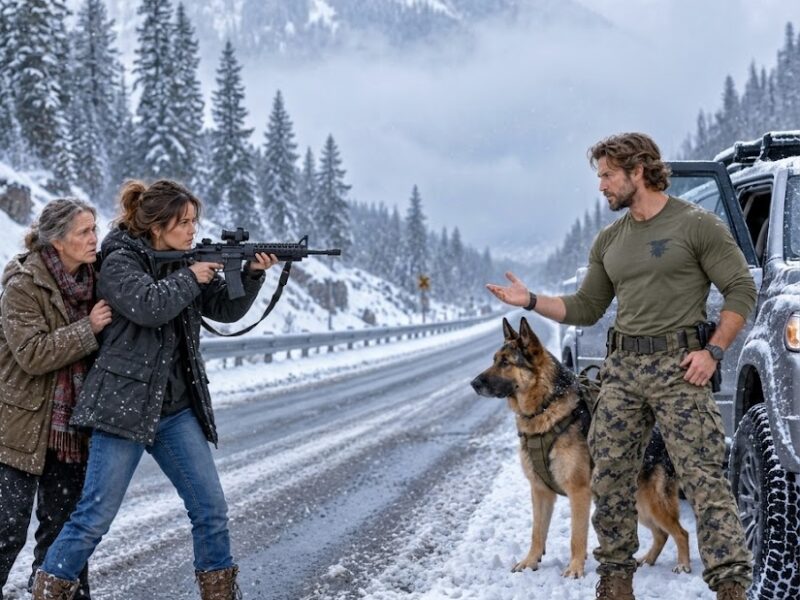
“Don’t come closer!” she screamed, holding something sharp in her shaking hand. The former Marine didn’t back away. He just said five words: “Your mother needs help.”
Grant Sullivan was halfway down Wolf Creek Pass when Diesel suddenly stood up in the back of the truck.
Two women were struggling along the snow-covered highway.
The older one could barely walk.
The younger one carried a black rifle, and her eyes were locked on every vehicle that passed.
Grant pulled over anyway.
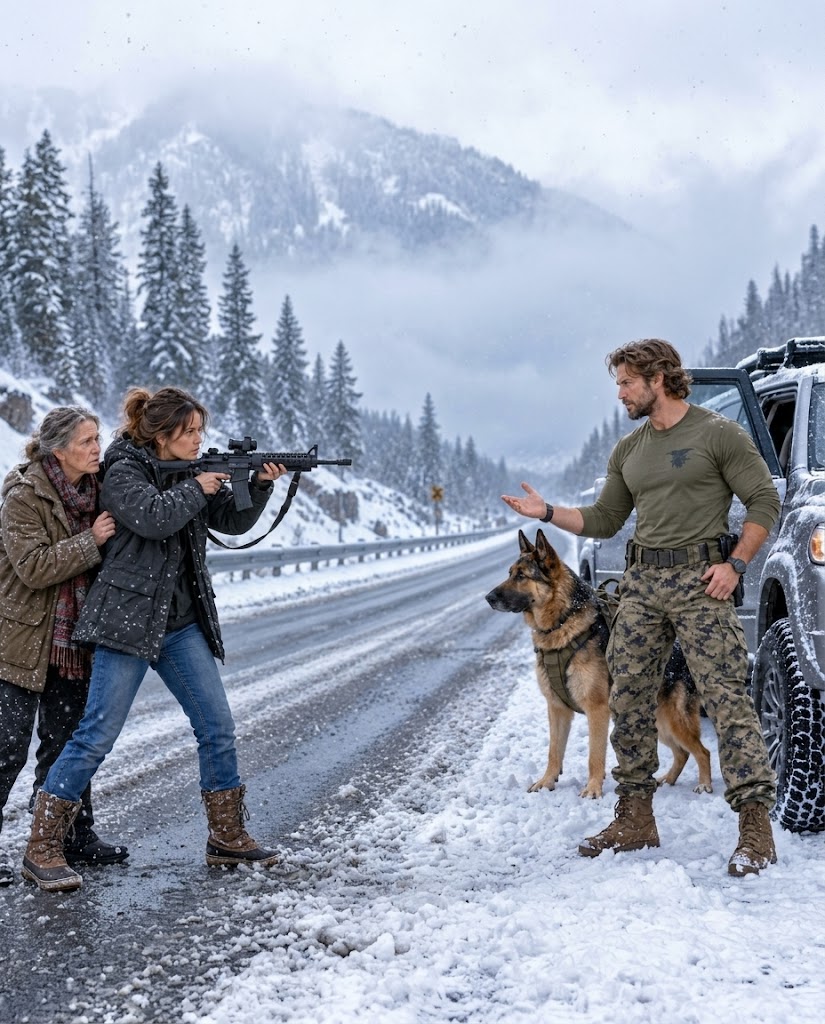
“Stay back!” she shouted, raising the rifle straight at his chest.
The former U.S. Marine slowly lifted both hands.
“Easy. I’m not here to hurt you. Your mother needs warmth, and I’ve got a cabin down the road.”
Beside him, Diesel stood perfectly still.
Then Grant noticed the dark SUV rounding the bend behind them.
The young woman saw it, too, and the color drained from her face.
Grant thought he was rescuing two stranded strangers.
He had no idea what they were running from.
Snow was falling across Wolf Creek Pass, turning the Colorado mountains into a pale wilderness of frozen pine trees and empty roads.
By late afternoon, the highway had nearly disappeared beneath a fresh layer of white.
Grant Sullivan was forty-five, a retired gunnery sergeant in the United States Marine Corps.
He had broad shoulders, wavy brown hair going gray at the temples, and a short beard that made him look older whenever he forgot to shave.
He wore an olive green shirt beneath his winter jacket, camouflage trousers, and worn leather boots.
Years of service had taught him to stay calm when a situation turned uncertain.
Living alone had taught him something different.
Silence could become a habit if a man let it.
He was driving his black Chevrolet Silverado toward a cabin outside Pagosa Springs, where he had lived since his divorce.
A grocery bag rested on the passenger floor, and two bags of dog food sat in the back.
He had meant to be home before sunset.
Diesel had other plans.
The nine-year-old German Shepherd stood up behind the passenger seat, his black and tan coat thick around his shoulders.
Gray had begun creeping in beneath his muzzle, and his left hind leg had grown stiff over the previous winter.
He was a retired military working dog now, and he rode along on occasional volunteer search assignments.
He was still sharp and still attentive, but he no longer moved with the effortless speed of his younger years.
Grant glanced in the rearview mirror.
“What is it, old man?”
Diesel stared through the windshield.
Several hundred yards ahead, two women were walking along the narrow shoulder beside a metal guardrail.
The younger one held the older one up with her left arm.
Her other hand carried a black rifle.
Both of them had snow collecting on their coats, and neither looked dressed for a long walk through the mountains.
Grant eased off the gas.
He noticed the older woman’s uneven steps first.
Then he noticed how often the younger woman looked back over her shoulder.
He pulled into a roadside turnout and stopped.
The younger woman reacted at once.
Before Grant had gone more than a few steps from his truck, she turned and raised the rifle.
“Stay back. Don’t come any closer.”
Grant stopped.
He lifted both hands, slow and open.
“All right. I’m staying right here.”
She stood with her boots planted in the snow, though her knees looked unsteady.
Her name was Tessa Monroe, and she was thirty-four.
Dark brown hair was escaping from a loose bun beneath her winter hood.
Her face was narrow, her eyes a sharp gray-green, and her hands carried the rough skin of someone who worked with tools for a living.
She had spent years repairing commercial vehicles, a trade that rewarded patience and precision.
Lately, patience had become hard to find.
For three days, she had been watching for unfamiliar vehicles.
Victor Hail, the owner of her former workplace, had given her every reason to believe that speaking up could bring trouble down on her family.
A dark SUV had been parked near their home more than once.
Now a stranger had stopped beside them on a mountain road.
“Get back in your truck,” she said.
Grant looked briefly at the older woman.
Eleanor Monroe was sixty-eight, slender, with silver-gray hair pinned beneath a knitted hat.
Her brown coat was soaked through at the sleeves, and a faded red scarf hung loose around her neck.
She had spent most of her adult life working, raising her daughter, and solving problems without asking anyone for help.
Even now, she looked more annoyed by her failing knee than frightened by the storm.
One hand gripped Tessa’s sleeve.
The other held a faded canvas bag tight against her chest.
Grant turned back to Tessa.
“I’m not looking for trouble. I saw two people walking in weather nobody should be walking in.”
“We’re fine.”
“Your mother doesn’t look fine.”
Eleanor lifted her chin.
“I’m standing right here, young man.”
Grant nodded.
“That’s a good start.”
Eleanor almost smiled.
Tessa did not.
Behind Grant, Diesel appeared at the open truck door.
His ears were up, but he stayed beside the vehicle, waiting.
Tessa noticed him.
“Is that your dog?”
“That’s Diesel. He’s nine, and he believes everybody on this mountain needs his supervision.”
“Keep him away.”
“He’s staying with me.”
Grant gave the shepherd a quiet signal, and Diesel settled against his leg without a sound.
Tessa studied the dog.
She had expected barking, maybe something worse.
Instead, the animal simply waited.
A gust of wind pushed loose snow across the pavement.
Eleanor shifted her weight and winced.
Tessa turned to her instantly.
“Mom?”
“It’s just my knee.”
“You’re shaking.”
“I noticed.”
Grant looked toward the darkening road.
The temperature was dropping fast, and the wet snow on Eleanor’s boots had already begun to freeze around the edges.
“There’s a cabin about twenty minutes from here,” he said. “Wood stove, hot food, dry blankets. You can warm up and leave whenever you want.”
“We don’t know you.”
“That’s true.”
“And you expect us to climb into a stranger’s truck?”
“No. I’m giving you a choice.”
For a moment, Tessa had no answer.
Her eyes drifted back to the highway.
Grant noticed.
He had seen frightened people during his years in uniform.
Some got loud, and some went quiet.
Tessa had chosen vigilance.
Every passing engine demanded her attention, as though something behind them mattered more than the cold ahead.
That was the moment he understood the rifle wasn’t really pointed at him.
His phone buzzed inside his jacket.
He glanced at the screen.
It was Maddie, his sixteen-year-old daughter, who had inherited his blue eyes and her mother’s straight, dark blonde hair.
She was clever, independent, and increasingly reluctant to call him first.
Since the divorce, their conversations had grown shorter, usually ending before either of them said what they meant.
Her text was simple.
“I’m home. You don’t need to worry.”
Grant read it and didn’t answer.
There would be time later, he told himself.
It was something he had been telling himself far too often.
Eleanor suddenly stumbled.
Tessa dropped the rifle to her side and reached for her mother with both arms.
“Mom, sit down.”
“I’m trying not to.”
Grant stayed where he was until Tessa looked at him.
“Can you help her?”
“Of course.”
He came forward carefully and helped Eleanor onto the edge of the roadside barrier.
Her breathing was shallow, and her damp gloves offered almost no protection against the cold.
Diesel followed only when Grant called him.
The shepherd stood close by, tail low, eyes steady.
Eleanor looked down at him.
“Well, you’re certainly better behaved than most men I’ve met.”
Grant glanced at the dog.
“Don’t encourage him. He’s already convinced he’s in charge.”
This time, Tessa allowed herself a small, exhausted smile.
It vanished almost immediately.
Grant brought a spare wool blanket from the truck.
As Eleanor pulled it around her shoulders, the canvas bag slid from her lap.
The corner of an old notebook showed, its pages crowded with handwritten dates and vehicle numbers.
Eleanor tucked it away quickly.
Grant noticed, but he said nothing.
“Your boots are soaked,” he told her. “You need somewhere warm.”
Eleanor looked up at her daughter.
“Honey, I think we’ve walked far enough.”
Tessa stared at the truck, then at Diesel.
Finally, she looked at Grant.
“One night. That’s all. And no questions about where we came from.”
“You can tell me whatever you want, or nothing at all.”
Tessa hesitated, then let him take Eleanor’s other arm.
A few minutes later, both women were inside the warm Silverado.
Eleanor sat in the back with the canvas bag resting on her knees.
Diesel settled beside her, leaving her plenty of room without being asked twice.
Tessa sat up front, the rifle tucked safely away, though her shoulders stayed rigid.
Grant turned the heater all the way up.
Nobody spoke as the truck pulled back onto the highway.
Then Tessa glanced into the side mirror.
Far behind them, a dark SUV slid around the same snowy bend where Grant had stopped.
It moved slowly, keeping its distance.
Her fingers tightened on the edge of her coat.
Grant caught the change in her face.
He checked the mirror himself, but he said nothing.
He had offered two strangers a warm place for the night.
Now he was beginning to wonder what had driven them onto that mountain road in the first place.
The dark SUV stayed in sight for another half mile before vanishing behind a curtain of falling snow.
Grant checked the mirror twice more.
Beside him, Tessa sat stiff in the passenger seat, one hand flat against the door and the other twisting the hem of her coat.
Behind them, Eleanor had closed her eyes, and Diesel lay stretched across the remaining space, his thick coat pressed against her blanket.
The road narrowed as Grant turned off the main highway.
Tall pines crowded both sides, their branches bowed under fresh snow.
After fifteen more minutes, a small wooden cabin appeared between the trees.
Warm light glowed in two front windows, and a thin thread of smoke rose from the chimney.
A stack of firewood stood beneath a patched blue tarp beside the porch.
It wasn’t an impressive place, but everything about it suggested someone had spent a lot of years keeping it standing.
Grant parked close to the steps.
“Wait here. I’ll get the stove going.”
Tessa watched him disappear through the front door.
For three days, she had questioned every stranger in every unfamiliar vehicle.
Now she was sitting outside a cabin that belonged to a man she had pointed a rifle at less than an hour earlier.
She still couldn’t decide what to make of him.
When Grant came back out, he helped Eleanor first.
Diesel climbed down carefully, favoring his left hind leg for the first few steps before following them inside.
The cabin smelled like pine, old coffee, and the steady warmth of a wood stove.
A scratched dining table stood near the kitchen, and a brown leather sofa faced the fire.
Fishing photographs hung beside a narrow bookshelf.
Nothing matched, but everything looked useful.
Before they settled in, Grant turned to Tessa.
“One thing. The rifle stays secured while we’re inside. Nobody needs it near the dinner table.”
She hesitated.
Then she nodded and set it away from the living area.
Grant didn’t ask her a single question about it.
He handed Eleanor two dry towels and showed her to the guest bedroom.
Tessa got a clean flannel shirt, a thick sweater, and directions to the bathroom.
Grant had barely finished warning her about the temperamental hot water when Eleanor looked around the kitchen.
“You live here alone?”
“Mostly.”
“That explains the furniture.”
Grant glanced at the sofa.
“What’s wrong with the furniture?”
“Nothing. If comfort wasn’t part of the original plan.”
Diesel flopped down beside the stove.
Grant looked at him.
“He likes it.”
“That poor dog has very low expectations.”
For the first time since leaving the highway, Tessa laughed.
Grant started dinner with the confidence of a man who knew exactly four recipes and had spent years rotating through them.
He filled a pot with chicken broth, potatoes, carrots, and whatever vegetables were left in the fridge.
Eleanor sat nearby with a blanket over her knees, watching him work.
When he poured coffee into a mug, she studied the color.
“Good heavens. Is that coffee or motor oil?”
“It’s coffee.”
“Are you certain?”
“I’ve been drinking it for years.”
“That doesn’t make it safe.”
Tessa covered another smile with her hand.
Grant shook his head and went back to the stove.
The small exchanges softened the room, bit by bit.
Outside, snow ticked against the windows.
Inside, Diesel drifted between the kitchen and Eleanor’s chair, weighing which spot offered better odds of a dropped piece of food.
Dinner was nearly over when Eleanor mentioned where she used to work.
“Alpine Crown Transit. Twenty-two years in dispatch.”
Grant looked up.
“The mountain shuttle company.”
Eleanor nodded.
She had been a slender, energetic woman for most of her life, known among the drivers for remembering schedules better than the computers assigned to track them.
Retirement had slowed her steps, but it had done nothing to dull her memory.
She had always believed that careful records protected people from careless decisions.
“Tessa worked maintenance there,” she added.
Tessa set down her spoon.
She had joined the company seven years earlier, starting on the smaller vehicles before taking over inspections for the whole mountain shuttle fleet.
She liked machines because their problems usually had explanations.
People were a lot harder.
Grant waited.
“Something happened there.”
Tessa looked toward the window.
“Some of the inspection records weren’t right.”
She explained that several vehicles had been marked as repaired while the necessary work sat unfinished.
One in particular, Shuttle 12, had developed recurring brake problems.
Tessa had recommended keeping it out of service until the system could be properly evaluated.
Instead, the company paperwork showed the repairs as complete.
The invoice for those repairs read $18,400, paid in full to a shop that, as far as Tessa could tell, had never touched the bus.
“The owner wanted my signature,” she said. “I wouldn’t give it.”
Victor Hail was fifty-two, a polished businessman with neatly combed silver hair, expensive dark coats, and a measured voice that rarely revealed his anger.
He had built Alpine Crown into a successful regional carrier.
His employees respected his business sense, though many had learned that questioning his decisions came with a price.
When Tessa refused to approve the paperwork, Victor suspended her.
Soon afterward, he accused her of mishandling company documents.
Eleanor placed her canvas bag on the table and drew out the old notebook.
“These are my dispatch notes.”
The pages were filled with dates, vehicle numbers, and carefully handwritten schedules.
Several entries showed buses on the road on days when the maintenance logs said they had been sitting in the garage.
Grant looked only at the pages she offered him.
“Have you shown these to anyone?”
“Not yet,” Tessa said. “We were trying to reach someone who could look at everything properly.”
She explained that they had meant to report the discrepancies to the proper authorities, but their car had gotten a flat tire on the mountain road.
While they waited for help, a dark SUV had appeared farther back, one that looked a lot like the vehicle she had noticed outside their house.
She couldn’t prove anyone was following them.
Fear had just made waiting beside the dead car unbearable.
With her phone dropping signal and her mother’s condition getting worse, she had talked Eleanor into walking toward a place where they might find help.
“Then you stopped,” she said.
Grant leaned back in his chair.
“You don’t have to convince me of anything tonight. We can start with what you know.”
Tessa studied him.
“And then what?”
“I help you contact the sheriff’s office and the people who oversee commercial vehicle safety. You let them examine the records.”
“You wouldn’t go after Victor yourself?”
Grant shook his head.
“I’m a retired Marine, Tessa. Not a judge.”
The answer surprised her.
She had expected another man offering to take control of everything.
Instead, Grant seemed perfectly willing to let her make the important decisions.
Later, while Eleanor rested in the guest bedroom, Tessa noticed a cabinet door hanging crooked near the kitchen counter.
She checked the loose hinge, found a screwdriver in Grant’s toolbox, and fixed it.
Grant watched from the doorway.
“You didn’t have to do that.”
“I know.”
“Was it bothering you since I walked in?”
He looked at the cabinet.
“It’s been like that six months. That’s embarrassing.”
She also noticed the warning light on his backup heater.
After reading the manufacturer’s label, she told him the unit needed servicing before he relied on it in another winter outage.
Grant accepted the advice without an argument.
Near the fireplace, Tessa found two framed photographs.
In the first, a younger Grant in Marine camouflage stood beside a lean, dark-haired fellow serviceman.
Between them sat Diesel, much younger, ears sharp, expression deadly serious.
The second showed Grant beside a smiling little girl with straight dark blonde hair and bright blue eyes.
She wore an elementary school graduation gown and held a certificate nearly as big as her chest.
“My daughter,” Grant said quietly. “Maddie. She’s sixteen now.”
Tessa looked from the picture to him.
“She lives near Durango with her mother.”
Grant explained that his marriage had ended after years of long absences, hard adjustments after the service, and disagreements neither parent had handled well.
His ex-wife had wanted a more predictable home.
Grant had tried to give her one, but his volunteer rescue calls and his habit of withdrawing whenever life got difficult had made everything worse.
Maddie had grown tired of hearing that he’d make the next school event.
There was always another call, another obligation, another reason.
“I thought I was helping people,” Grant admitted. “Sometimes I forgot who was waiting for me.”
Tessa looked at the photograph again.
“Maybe she’s still waiting.”
Grant said nothing.
His phone sat on the table, Maddie’s earlier message still unanswered.
Outside, wind moved through the pines.
Eleanor was sleeping comfortably, and Diesel had claimed the warmest patch of floor beside the stove.
Finally, the cabin settled into silence.
The next morning, Grant stepped onto the porch with an armful of firewood.
The storm had weakened overnight, leaving the trees heavy with fresh snow.
Tessa stood near the kitchen window with a mug of coffee Eleanor had insisted on making properly.
Diesel rose from his blanket to follow Grant.
Halfway across the room, the old shepherd paused.
His hind leg stayed stiff for several seconds, and he carefully shifted his weight before moving on.
Grant noticed immediately.
He set the wood down, went back, and knelt beside the dog.
“Easy, buddy. No rush.”
Diesel leaned into his shoulder while Grant gently checked the leg.
The dog’s breathing stayed steady, and after a short rest, he seemed more comfortable.
Tessa watched from the doorway.
“Is he all right?”
“Getting older,” Grant said. “Long searches are harder on him now. Maybe he deserves a little rest.”
He stroked the dog’s neck.
“I know,” he murmured, though the way he said it suggested knowing and accepting were two different things.
Diesel had stood beside him through years Grant rarely talked about.
When his marriage ended and the cabin grew too quiet, the dog had stayed.
Grant wasn’t sure how to picture his life without that familiar presence.
Tessa looked at the man kneeling in the morning light, one hand resting on the aging shepherd’s coat.
Yesterday, she had seen a stranger beside a black truck and believed he might be dangerous.
Now she understood something she hadn’t expected.
Grant Sullivan was afraid of losing someone, too.
And maybe that was why he had never driven past two strangers standing alone in the snow.
By morning, the snow had stopped over the San Juan Mountains, leaving the forest under a pale blue sky.
Sunlight touched the frozen branches outside Grant’s cabin, and the road toward Pagosa Springs had been cleared enough for ordinary traffic.
Inside, Tessa stood beside the kitchen table, arranging documents into a canvas folder.
For the first time in three days, she was getting ready to face the problem she had been running from.
Grant had already warmed up the Silverado.
Diesel waited by the front door, his thick tail brushing the floor whenever someone reached for a coat.
Eleanor sat at the table, checking the old dispatch notebook page by page.
She had slept well, though her knee still complained whenever she stood too fast.
Grant had insisted she take her time, which Eleanor considered an unnecessary amount of supervision from a man whose breakfast was burnt toast and black coffee.
They left a little after nine.
Tessa rode up front with the folder across her knees, and Eleanor sat in back beside Diesel.
The mountain roads were quieter than usual.
Snowplows had pushed heavy banks against the guardrails, and the occasional pickup rumbled past with clumps of dirty ice hanging beneath its wheel wells.
Nobody mentioned the dark SUV from the day before.
Grant saw Tessa watching the mirrors, but he let the silence stand.
The Archuleta County Sheriff’s Office was a plain, practical building in Pagosa Springs, with a row of patrol vehicles parked under the winter sun.
Inside, a receptionist pointed them toward a small interview room.
Deputy Daniel Reeves arrived a few minutes later.
He was forty-three, broad through the shoulders, with close-cropped sandy hair going gray and a weathered face that rarely showed surprise.
He had spent fifteen years in law enforcement, long enough to know that people sometimes walked in frightened before they had the evidence to explain why.
He greeted Eleanor first and pulled out a chair for her.
“Take your time. Start wherever you’re comfortable.”
Tessa opened the folder.
She had brought copies of maintenance reports, photographs of the condition of several commercial vehicles, and emails about Alpine Crown Transit.
One report involved Shuttle 12, a passenger bus that regularly carried visitors between the mountain resorts and Pagosa Springs.
According to the company’s records, its brake problems had been resolved.
According to Tessa’s own inspections, the required follow-up work had never been confirmed.
Daniel studied the pages without offering an opinion.
“Who authorized that vehicle to go back into service?”
“That’s what I’ve been trying to find out.”
She explained how Victor Hail had asked for her approval, how she had refused, and how her employment had been suspended soon afterward.
She did not exaggerate.
Where the records were incomplete, she said so.
Then Eleanor opened her notebook.
Her handwriting was small but remarkably consistent.
She had recorded vehicle assignments, departure times, and driver changes throughout her final months at Alpine Crown.
Forty-one entries showed buses operating during periods when the maintenance paperwork said they were unavailable.
Daniel compared the dates, one against the other.
“These will need independent verification,” he said. “But they’re worth examining.”
He explained that the information would be referred to the state agencies responsible for commercial vehicle safety.
Investigators would need to review the original records, speak with employees, and inspect the vehicles before deciding whether any violations had occurred.
Tessa looked disappointed.
“So they can keep running those buses.”
“I can’t promise what happens before the review,” Daniel said. “But I can make sure your concern reaches the people responsible for checking.”
Eleanor turned another page.
“There’s something else.”
She pointed to a scheduled trip out of Silver Pine Lodge.
Shuttle 12 was booked to carry eighteen passengers back toward town before the next winter storm.
Tessa recognized the assignment immediately.
“That vehicle shouldn’t be on a mountain route until somebody checks it again.”
Daniel copied down the details and added the scheduled trip to his referral.
Grant had stayed mostly silent.
When Tessa glanced over, he only nodded.
He had promised to help her reach the right people, not to speak for her.
For the first time since leaving Alpine Crown, she felt like someone was listening without trying to take ownership of her decisions.
Across town, Victor Hail was learning that questions were being raised about his maintenance records.
At fifty-two, Victor had the composed look of a successful executive.
His silver hair was always neatly arranged, his winter coats expensive, and his voice controlled even when he was displeased.
He had built Alpine Crown through years of competitive contracts, earning a reputation for keeping vehicles moving when smaller operators couldn’t.
He had also grown used to treating delays as problems for someone else to solve.
Victor called his operations manager and asked for a revised departure schedule for Shuttle 12.
The bus would leave Silver Pine Lodge earlier than planned, before any inspection could interfere with the company’s holiday commitments.
The driver assigned to that trip was Ben Ortega, fifty-six, a sturdy, broad-faced man with graying black hair and hands worn from decades behind the wheel.
Ben was patient with nervous passengers and especially careful on mountain roads.
Earlier that week, he had mentioned that Shuttle 12’s brakes didn’t feel consistent on a long descent.
His supervisors had assured him that maintenance had completed every necessary check.
Ben had accepted that explanation.
He had no way of knowing that Tessa had refused to sign off on the same vehicle.
By early afternoon, Grant had driven the women back to the cabin.
Eleanor went inside to rest while Tessa stayed on the porch, studying the tree-lined driveway.
She had expected the visit to the sheriff’s office to end with a clear answer.
Instead, she had learned that doing the right thing sometimes meant waiting while other people examined what she already knew.
A familiar blue Subaru came into view between the pines.
Grant looked up from the firewood stack.
“That’s Maddie.”
His ex-wife, Natalie Sullivan, stepped out first.
She was forty-four, with shoulder-length auburn hair and a reserved expression.
A school administrator in Durango, Natalie had always valued predictability, the very thing her marriage to Grant had slowly lost.
She greeted him politely and opened the rear door.
Maddie climbed out with a backpack and a small equipment case.
At sixteen, she was tall and slender, with straight dark blonde hair, bright blue eyes, and her father’s habit of examining something carefully before speaking.
She loved electronics and amateur radio, and she repaired devices that other teenagers would have thrown away.
“Hey, Dad.”
“Hey, sweetheart.”
The greeting ended there.
Natalie explained that Maddie would stay through part of winter break, then left after trading a few practical details with Grant.
Maddie watched the Subaru disappear down the road before following her father inside.
Diesel greeted her with far more enthusiasm than he had shown anyone else.
“At least somebody missed me,” she said, kneeling beside him.
Grant pretended not to hear.
Tessa introduced herself in the kitchen.
Maddie quickly noticed the open toolbox and the repaired cabinet hinge.
“You fixed that?”
“Your dad said it had been broken six months.”
Maddie looked across at Grant.
“That’s actually fast for him.”
Eleanor laughed from the living room.
Within an hour, Maddie had become fascinated by the backup heater Tessa had flagged for service.
The two of them examined its warning light, then moved on to Grant’s communication equipment stored under the workbench.
Grant volunteered with a local search and rescue support group, and he kept radios, battery packs, and emergency supplies ready for winter calls.
Maddie knew the gear almost as well as he did.
Together, she and Tessa wrote a simple checklist for the backup power and the radios.
Grant watched them work.
“I used to have a system.”
Maddie looked at the crowded shelf.
“Having equipment isn’t a system, Dad.”
“Everybody’s suddenly an expert.”
“Somebody has to be.”
Their conversation stayed light until Diesel rose from his blanket.
The shepherd walked toward Maddie, moving carefully on his stiff hind leg.
She noticed immediately.
“You’re still taking him on searches?”
“Only when he’s comfortable.”
“Dad, he’s nine.”
“I know how old my dog is.”
Maddie lowered her voice.
“Maybe you should let him rest.”
Grant looked at Diesel.
He had heard that advice before, but coming from his daughter made it harder to wave away.
He wanted to tell her the dog still enjoyed having a purpose.
Instead, he remembered how slowly Diesel had stood that morning.
“We’ll see,” he said.
Maddie went back to the equipment without answering.
Later that evening, snow began gathering against the windows again.
A weather report warned of a stronger storm moving toward the higher mountain roads.
Tessa stood near the kitchen window, trying to confirm Shuttle 12’s location through Alpine Crown’s public contact number.
After several transfers, an employee told her only that schedules were being adjusted, and gave her no confirmed information about the vehicle.
She ended the call.
Eleanor had been reviewing her notebook beside the stove.
Suddenly she stopped turning pages.
“Tessa. Look at this.”
An older entry showed that Shuttle 12 had returned to service just hours after being flagged for additional inspection.
Tessa compared it with a maintenance report saved on her laptop.
The recorded completion time overlapped with a period when the bus had supposedly been out on the road.
It wasn’t proof of everything she suspected, but it was another discrepancy worth sending to Daniel Reeves.
Eleanor tapped the date.
“I remember Ben driving that morning.”
She had known Ben Ortega for years.
He was the kind of man who checked on elderly passengers and waited until everyone was seated before pulling out.
Eleanor could not imagine him knowingly putting anyone at risk.
Tessa closed the laptop.
“If nobody checks that bus, he may not even know there’s a problem.”
Across the room, Maddie finished writing the equipment checklist.
Grant set another piece of wood in the stove, and Diesel settled beside Eleanor’s chair.
Outside, the first stronger gusts moved through the pines.
Eighteen people were scheduled to ride Shuttle 12 out of Silver Pine Lodge.
Somewhere in the mountains, that bus was still expected to finish its trip, and Tessa was beginning to fear that the people responsible for its safety were running out of time to make the right decision.
The next afternoon, the San Juan Mountains vanished behind a thick wall of gray clouds.
Snow swept across the highway outside Pagosa Springs, covering the pavement faster than the plows could clear it.
The temperature was falling, and weather warnings had begun scrolling across every local radio station.
Tessa had gone back into town with Grant to give Deputy Reeves more information about Shuttle 12.
The record she had reviewed the night before contained another unexplained discrepancy, and Daniel had asked her to point out the dates in person.
Eleanor stayed at the cabin with Maddie, where the two had spent the morning organizing the old dispatch notebook and checking Grant’s backup radios.
The meeting wrapped up shortly after two.
Tessa stepped out of the county building carrying her canvas folder.
Grant was waiting beside the Silverado, brushing snow off the windshield.
Across the parking lot sat a dark luxury SUV.
Tessa recognized it instantly.
Victor Hail stepped out wearing a charcoal wool coat and polished leather shoes that looked completely unsuited to a Colorado winter.
His silver hair was neatly combed, and his face carried the practiced patience of a man used to having hard conversations on his own terms.
“Tessa. We need to talk.”
She stopped at the bottom of the steps.
“Everything concerning Alpine Crown goes through the authorities now.”
Victor glanced at the building.
“That’s exactly why I’m here. You’ve misunderstood the maintenance records, and now you’re creating problems that could cost this company millions.”
Tessa held her folder closer.
“I reported what I found.”
“You reported half the story.”
His voice stayed perfectly controlled.
He explained that Alpine Crown employed dozens of people whose families depended on the company’s contracts.
A long investigation, he said, could hurt drivers, mechanics, and resort employees who had nothing to do with the disagreement.
Then he made his offer.
He would restore her position, pay her $60,000 for the suspension and her inconvenience, and arrange a private settlement if she withdrew her complaints.
Tessa looked at him for several seconds.
Three days earlier, that offer might have frightened her into reconsidering.
Now she remembered sitting across from Daniel Reeves, watching someone examine her documents without dismissing her concerns.
“I’m not withdrawing anything.”
Victor’s expression tightened.
“Think about your mother, Tessa. Eleanor doesn’t need a long legal fight at her age.”
That was the moment something inside her went quiet and solid.
For years, Victor had dressed up his demands as favors.
When he wanted extra shifts, he called it loyalty.
When employees questioned expenses, he called it protecting jobs.
Now he was using Eleanor’s health to make surrender sound responsible.
“My mother made her own decisions,” Tessa said. “And so did I.”
Grant walked over from the truck but stopped several feet away.
He looked at Tessa, not at Victor.
“Everything all right?”
Tessa took a slow breath.
“Victor, I want you to leave.”
She turned her head slightly.
“Grant, would you stay here with me?”
“Of course.”
Grant moved beside her without another word.
Victor looked from one to the other, adjusted his coat, and stepped back.
“If Alpine Crown loses those contracts, remember that I tried to prevent it.”
He climbed into the SUV and drove away.
Tessa watched until the vehicle disappeared around the corner.
Grant opened the passenger door for her.
“You handled that.”
She looked at him.
“I was terrified.”
“Didn’t say you weren’t.”
For some reason, that made her feel a lot better.
They had barely pulled out of the lot when Daniel called.
Shuttle 12 had left Silver Pine Lodge earlier than its original schedule.
The bus was supposed to reach a designated checkpoint along its return route, but no arrival had been logged.
Dispatchers had tried to reach the driver and gotten nothing.
“How long overdue?” Tessa asked.
“Long enough that we’re checking the route,” Daniel said. “Do you know anywhere they might have diverted?”
Tessa closed her eyes for a second.
Then she remembered an older service road.
Alpine Crown sometimes used it when traffic backed up on the main highway.
It ran along a wooded slope with several narrow sections and almost no places to turn around.
Even in clear weather, she considered it unsuitable for a loaded passenger shuttle.
She described the road to Daniel, including its western junction and the maintenance gate near a small creek crossing.
He passed it all along to the emergency coordination team.
Tessa stared through the windshield after the call ended.
“Ben’s driving that bus.”
Grant remembered the name from Eleanor’s notebook.
“Ortega.”
She nodded.
“He’s careful. If he took that road, somebody told him it was safe.”
Grant didn’t speculate about what had happened.
He just turned the truck toward the cabin while emergency crews began checking the possible routes.
By the time they pulled in, the snowfall had grown heavier.
Maddie was sitting at the kitchen table with a notebook full of radio frequencies and equipment notes.
Her hair was tied back, and a pencil rested behind one ear.
She had spent most of the afternoon testing batteries and sorting supplies, an activity she preferred to waiting without knowing what was happening.
Eleanor stood beside her, reading glasses low on her nose.
When Tessa told them Shuttle 12 was overdue, Eleanor reached for her old dispatch book without a word.
“Ben never misses a checkpoint without a reason.”
Grant’s phone rang before anyone could answer.
The caller was Captain Leah Ortiz, forty-one, a compact, dark-haired search and rescue coordinator with a calm voice and a reputation for steady decisions under pressure.
Grant had worked beside her on several winter searches.
She knew how well he understood the mountain roads and the radio equipment he kept in his truck.
Leah explained that official crews were organizing a search along the possible detour.
They needed experienced volunteers to help with navigation supplies and with locating the missing vehicle.
Grant accepted, pending the team’s safety briefing.
Tessa reached for her jacket right away.
“I’m going with you.”
Grant looked at her.
“That road could be rough, and the weather’s getting worse.”
“I know those vehicles.”
“I know you do.”
He paused.
“You could help more from the coordination point. They may need someone who understands Shuttle 12’s equipment and its maintenance history.”
Tessa considered it.
For months, other people had told her where she belonged and what she should do.
This time, the choice was hers.
She called Daniel, explained her experience, and asked where her knowledge would be most useful.
He arranged for her to assist the team at a safe coordination location away from the affected road.
“I’ll stay there,” she told Grant. “But I’m not sitting around doing nothing.”
“Wouldn’t expect you to.”
Eleanor, meanwhile, began comparing the passenger information supplied through the coordination team against the eighteen names in her dispatch records.
She noticed that one family had booked three seats under a single reservation, and she circled the entry so no one would overlook the extra passengers in the final count.
Maddie organized the approved volunteer radio contacts and checked the backup power supply.
She found the small handwritten frequency notebook Grant had given her two summers earlier.
He had taught her how important clear information could be during an emergency.
She had never imagined needing those lessons while he was the one leaving.
Grant packed his cold-weather gear, extra blankets, and insulated supplies.
For Diesel, he brought a protective coat and a warm resting mat.
The aging shepherd watched from beside the door, recognizing every familiar piece of preparation.
Grant knelt in front of him.
“We’re taking it easy tonight, partner.”
Diesel rested his muzzle on Grant’s arm.
Grant knew the dog might still be useful.
But he had already decided that no assignment, however urgent, was worth pushing Diesel past his strength.
As darkness approached, Grant got ready to meet the rescue team while Tessa arranged her ride to the coordination point.
Maddie stood near the front door.
She had been unusually quiet since the call.
Grant reached for his keys, then noticed she hadn’t moved.
“Something wrong, sweetheart?”
She looked up at him, her blue eyes bright.
Then she stepped forward and wrapped both arms around him.
“Just come home this time, Dad.”
Grant held her for a moment.
“I’ll do everything I can to get back safely.”
For once, neither of them tried to turn the moment into a joke.
Eleanor stayed behind with Maddie, where their organized records and volunteer radio contacts could support the coordination team if needed.
Outside, the storm had swallowed the last traces of daylight.
Grant joined Leah’s convoy near the edge of town.
Several emergency vehicles moved slowly toward the forest road, their headlights lighting up the snow drifting across the pavement.
At the coordination point, Tessa stood beside Daniel Reeves while teams tried to establish contact with Shuttle 12.
For several minutes, nothing came through.
Then one of the search vehicles picked up a faint transmission and relayed it to the command post.
The voice belonged to Ben Ortega.
His words broke apart in the static, but he managed to report that Shuttle 12 had slid off the roadway.
The passengers had been moved to a safer area nearby, though he couldn’t yet say exactly where they were.
Daniel leaned toward the radio.
“Ben, can you confirm your passenger count?”
A long pause followed.
Then Ben answered.
“Seventeen accounted for.”
The line crackled.
“One passenger is missing.”
And somewhere beyond the snow-covered trees, the rescue teams were still trying to find the bus.









