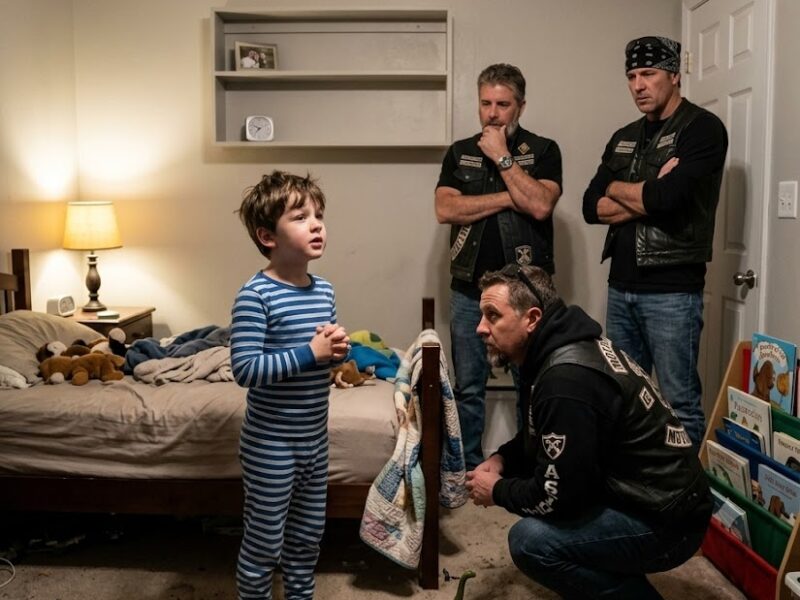
“Don’t Check Under My Bed,” a Little Boy Begged a Biker—When 500 Hells Angels Learned Why, Everything Changed
The August heat in rural Missouri didn’t just sit on you; it pressed down like a physical weight. The asphalt of the two-pump gas station shimmered, creating mirages that made the horizon look liquid. Wyatt Callaway felt the heat through the thick leather of his vest, but he barely noticed. He was 42 years old, and he carried his years the way old leather carries its creases—visibly, unapologetically.
His Harley-Davidson Road King rumbled beneath him, a low, steady heartbeat that had been his only companion for the last 300 miles. His vest bore the patches of 23 years with the Iron Wolves Motorcycle Club. The road name stitched above his left pocket read “Cal.” It was a name more people knew than the one his mother had given him.
His knuckles were scarred from fights he barely remembered, and his arms were sleeved in tattoos that told stories he rarely shared. But beneath the armor of ink and leather, Wyatt Callaway carried a hollow space where purpose used to live. He had been riding for three days straight from Tulsa, heading to the annual Iron Wolves gathering in St. Louis.
Five hundred brothers, maybe more, would converge there. It was the kind of event that made the evening news for all the wrong reasons, though the truth was simpler. It was family. Loud, rough-edged, imperfect family, but family nonetheless. His fuel gauge dipped toward empty somewhere past the Lake of the Ozarks, and the GPS pointed him toward a town called Eldon, population just under 5,000.
It was the kind of place where everyone knew everyone, and strangers were noticed before they even cut their engines. He pulled into a gas station on the edge of Main Street. The sign was hand-painted and read “Buck’s Fuel and Feed.” The air smelled like cut grass and diesel. A wind chime made from old spark plugs clinked lazily from the overhang. Wyatt swung his leg off the bike and stretched his back, pulling off his sunglasses. That was when he saw the boy.
He was sitting on the curb near the air pump, knees drawn to his chest. His arms were wrapped around shins so thin they looked like they might snap. He couldn’t have been older than seven. His hair was the color of dry wheat, unwashed and tangled.
His T-shirt, faded blue with a logo too cracked to read, hung off his frame like a sail with no wind. But it was his eyes that stopped Wyatt mid-step. They were enormous, the pale gray-green of river stones, and they watched Wyatt with an alertness that didn’t belong on a child’s face. It was the look of something small that had learned to be very, very still in the presence of something large. Wyatt had seen that look before.
He had seen it in shelters and in the rearview mirrors of gas stations in towns just like this one. He had seen it in his own reflection 40 years ago, in a bathroom mirror in a house he tried never to think about. He nodded at the boy, but the boy didn’t move. Wyatt filled his tank, went inside, and paid for the gas and a bottle of water.
When he came back out, the boy was still there, still watching. “Hot day to be sitting on concrete,” Wyatt said, keeping his voice even, the way you’d speak near a bird you didn’t want to startle. The boy said nothing. Wyatt unscrewed the water bottle and held it out. “You thirsty?” A pause. Then, slowly, the boy reached out and took it.
He drank like someone who hadn’t had enough in a while—fast, desperate, then suddenly self-conscious. He pulled the bottle away and wiped his mouth with the back of his hand. “What’s your name, kid?” Another long pause. Then, barely above a whisper, “Jace.”
“Jace, that’s a solid name.” Wyatt crouched down to the boy’s level, his knees cracking like old wood. “You live around here?” Jace’s eyes flicked toward the road behind the station, toward a row of houses half hidden behind overgrown hedges. Then he looked back at Wyatt and nodded once. “Somebody waiting for you at home?” The boy’s jaw tightened. It was a small movement, almost imperceptible, but Wyatt caught it. It was the kind of tightening that said more than any answer could. “My uncle,” Jace said quietly. And then, as if the words themselves were dangerous, he looked down at his shoes—sneakers with holes worn through the toes—and went silent. A woman emerged from the station behind Wyatt. She was tall, mid-50s, with silver-streaked hair pulled back in a loose bun. Her name tag read Nancy. “That boy’s been sitting there since 7:00 this morning,” she said, her voice low enough that Jace couldn’t hear. She stood beside Wyatt, arms crossed, watching the child with an expression caught between concern and resignation. “He does that. Sits there until his uncle remembers to come get him, or doesn’t.” Wyatt looked at her. “Where’s his parents?” Nancy shook her head. “Mother passed two years ago. Car accident on Route 54. Father was never in the picture. Glenn Whitmore, that’s the uncle, got custody by default. He’s the only family left.” She paused. “He’s not a good man. But he’s not the kind of bad that gets people arrested. Just the kind that makes a kid sit on a curb all day in 90-degree heat.” Wyatt looked back at Jace. The boy had set the water bottle beside him carefully, as if it were something precious. Something shifted in Wyatt’s chest, a gear he thought had rusted into place years ago. He didn’t have a word for it then. Later, much later, he would understand that it was the first turn of something that would change the rest of his life.
Wyatt told himself he would stay one night. Just long enough to make sure the kid had a meal and a safe place to sleep. He checked into the only motel in Eldon, the Lakeside Motor Lodge, which had neither a lake view nor much of a lodge. He spent the evening at a clapboard building three blocks from Main Street called Nan’s Kitchen. Nancy was the kind of woman who fed people whether they asked for it or not. She set a plate of meatloaf in front of Wyatt without him ordering and poured coffee before he could reach for the menu. She had owned the diner for 19 years, since her husband passed, and she knew the pulse of Eldon the way a doctor knows a heartbeat. Every flutter, every skip, every silence that meant trouble. “Glenn Whitmore drinks,” Nancy said, settling into the booth across from Wyatt with the authority of someone who had earned the right to sit wherever she pleased. “Not the falling-down kind. The quiet kind. The kind that makes a house go cold.” Wyatt chewed slowly. “And nobody does anything?” Nancy’s mouth thinned into a line. “People have tried. Sandra Oaks, she’s the social worker assigned to the county. She’s been out to that house three times. But Glenn keeps the place clean enough, keeps food in the fridge, keeps Jace enrolled in school. On paper, everything checks out.” She wrapped her hands around her own mug. “But paper doesn’t sit on a curb all day waiting for someone who isn’t coming.” Wyatt knew the system. He had grown up inside it, bounced between foster homes and relatives who treated him like an obligation rather than a child. He knew exactly how a kid could fall through the cracks while everyone watched and shrugged and said there wasn’t enough evidence.
The next morning, Wyatt found Jace at the gas station again. Same curb, same posture. This time, Wyatt brought breakfast—two egg sandwiches wrapped in foil from the motel vending area. They ate in silence side by side, and something about the quiet felt more honest than any conversation Wyatt had had in years. Over the next two days, a routine formed. Wyatt would find Jace in the mornings, and they would spend hours together walking along the creek behind the gas station. They skipped stones across the shallow water and talked about small things that neither of them would have shared with anyone else. Jace was careful with his words the way some people are careful with money—spending only what was necessary, saving the rest. But slowly, in fragments, like a door opening an inch at a time, the boy began to open up. He talked about his mother. Her name had been Christine. She used to sing while she cooked, old country songs she had learned from her own mother. Melodies that Jace could still hum but no longer remember the words to. She called him Little Bear. She had brown eyes and a laugh that made the whole room feel warm, like sunlight coming through a kitchen window on a winter morning. When she died, the warmth left and never came back. The house became something else. Not a home, but a structure with walls and a roof, and nothing inside worth protecting. Wyatt recognized the pattern. He had lived inside it himself. The slow erosion of safety. The gradual realization that the adults who were supposed to shield you from the world had become the thing you needed shielding from. He didn’t press Jace for details. He didn’t need to. The boy’s body told the story his words wouldn’t. The way he flinched at sudden sounds. The way he always sat with his back against something solid. The way he watched every car that passed as if cataloging threats. One afternoon, while they sat on the creek bank watching dragonflies skim the surface, Jace said something that lodged in Wyatt’s chest like a splinter. “Do you think some people just aren’t supposed to be happy?” Wyatt looked at him. “No,” he said. “I think some people just haven’t been given the chance yet.” Jace considered this for a long time, turning a smooth stone over in his fingers. Then he nodded once, as if filing the information away for later examination.
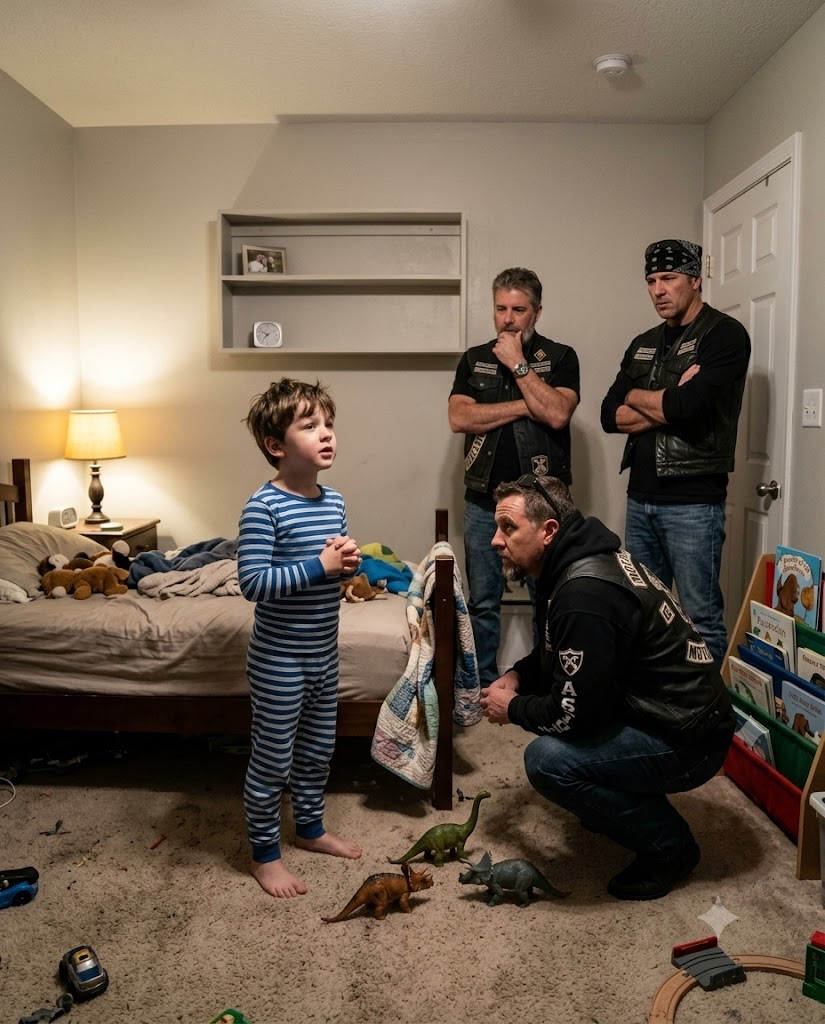
On the third day, something changed. Wyatt was walking Jace home, something he had started doing each evening to make sure the boy got inside before dark. The house was a small single-story ranch on Poplar Street. Paint peeling, yard unmowed, blinds drawn tight. Glenn’s truck was in the driveway, but there were no lights on inside. Jace stopped at the front porch and turned to Wyatt with an expression that made the biker’s stomach drop. It was fear. Raw, unfiltered. The kind that lives in the body before the mind can name it. “Mr. Wyatt,” Jace said, his voice barely a thread, “if you ever come inside, please don’t check under my bed.” The words hit Wyatt like a physical blow. “What do you mean, buddy?” Just promise me. Jace’s hands were trembling. Please don’t look under my bed. Promise. Wyatt knelt down. He looked into those gray-green eyes and saw something that made every instinct in his body fire at once. Not just fear. Something deeper. Something protective. “I promise,” Wyatt said, because in that moment, the boy needed to hear it. Jace nodded, turned, and disappeared inside the dark house without another word. That night, Wyatt couldn’t sleep. He lay on the motel bed staring at the water-stained ceiling, and every time he closed his eyes, he saw Jace’s trembling hands. He called Dean Hargrove, his vice president, his closest friend, the one person in the club who knew about Wyatt’s childhood. “Something’s wrong with this kid, Dean.” “You’ve known him three days, Cal.” “I’ve known him my whole life. He’s me, 35 years ago, sitting on a curb, waiting for someone to see what nobody wanted to look at.” Dean was quiet for a long time. “What do you need?” “I don’t know yet. But I’m not leaving.”
The next afternoon, Glenn Whitmore came home early. Wyatt was walking Jace back from the creek when they saw the truck pull sharply into the driveway. Glenn stepped out. He was a thin man with hard angles and harder eyes, wearing a stained work shirt and an expression that said the world owed him something it would never pay. “Who the hell are you?” Glenn said, looking at Wyatt’s vest, his tattoos, his size. “A friend,” Wyatt said calmly. “Jace doesn’t have friends. Get off my property.” Jace had gone rigid. His hand, which had been loosely holding Wyatt’s sleeve, tightened into a fist around the fabric. Wyatt looked down at the boy. He looked at Glenn. He measured the distance between what the law could do and what it should do and found the gap as wide as an ocean. “I’ll be at the diner if you need anything, Jace,” Wyatt said evenly. Then, to Glenn, “Take care of that boy.” Glenn’s lip curled. He grabbed Jace by the shoulder, not gently, and steered him inside. The door slammed. Wyatt stood on the sidewalk for a full minute, fists clenched, heart hammering. He had promised not to look under the bed, but promises made to frightened children sometimes have to bend in the direction of truth. He had to know.
Two more days passed before Wyatt found his way inside the Whitmore house. It happened by accident, or by the kind of design that disguises itself as accident. Glenn had left for a night shift at the feed mill, and Jace had appeared at the motel parking lot just after sundown. He was barefoot and breathing hard. His feet were dirty from the road, and there was a red mark on his forearm that he kept pulling his sleeve over. “He forgot to leave food again,” Jace said, and the word “again” carried the weight of a hundred identical nights. Wyatt felt something tighten behind his ribs. He knelt down and looked at the boy’s face. The sharp cheekbones that shouldn’t be visible on a seven-year-old. The dark circles beneath his eyes. The careful way he held himself, as if every movement had been rehearsed for minimum visibility. This was a child who had learned to take up as little space as possible in a world that had made it clear his space was unwelcome. Wyatt drove the boy to the diner, where Nancy fed him until he couldn’t eat another bite. Mashed potatoes, fried chicken, cornbread, and a slice of peach cobbler that Jace ate so slowly it was clear he was trying to make it last. Nancy watched from behind the counter, her jaw set, her eyes bright with the kind of anger that good people feel when they are forced to witness what they cannot fix. She packed a bag of food for Jace to take home without being asked. Then Wyatt walked Jace home. The streets of Eldon were empty at that hour. The only light came from porch lamps and the blue flicker of televisions behind curtained windows. Crickets sang from the ditches. The air smelled like cut hay and the faint chemical tang of the feed mill on the edge of town. At the front door, Jace hesitated. He stood with one hand on the doorknob and looked up at Wyatt with an expression that was equal parts trust and terror. As if he were about to show someone a wound he had been hiding for years, unsure whether the showing would heal it or make it worse. “You can come in,” Jace said quietly. “But you promised.” “I remember.”
The house smelled like stale air and neglect. Not filth exactly, but the absence of care. It was the smell of a place where no one had opened a window in months, where food was an afterthought and comfort was a foreign concept. The furniture was sparse and functional. There were no photographs on the walls, no toys on the floor, no evidence that a child lived here at all. The kitchen was bare. A few cans in the cabinet, a carton of expired milk in the fridge. The living room had a single recliner positioned in front of a television, an ashtray on the armrest, and nothing else. Jace’s room was at the end of a narrow hallway. The door had a lock on the outside. The kind you buy at a hardware store. The kind meant for sheds, not for a seven-year-old’s bedroom. Wyatt stared at that lock for a long time. Inside the room, Jace’s bed was a mattress on the floor covered with a single blanket. There was no pillow. A small pile of library books sat in the corner. Adventure stories, mostly, about explorers and ships and places far from Eldon, Missouri. The window had been nailed shut. Jace sat on the mattress and pulled the blanket around his shoulders, even though the room was warm. He watched Wyatt with those careful, measuring eyes. “You promised,” Jace said again. Wyatt sat down on the floor across from the boy. “I know, buddy. I know.” But then he heard it. A sound so small it could have been a mouse or a settling foundation or nothing at all. Except it wasn’t nothing. It was a breath. A tiny, shuddering breath coming from beneath the mattress. Jace’s eyes went wide. His body tensed. He shook his head slowly, desperately. “Please,” the boy whispered. “Please don’t.” Wyatt’s heart broke. Not cracked. Broke like a dam that had been holding back decades of water that was never his to carry but that he had carried anyway. He looked at Jace and he saw himself at seven years old, hiding in a closet, covering his ears, trying to make himself small enough to disappear. “Jace,” Wyatt said softly. “I need to help. Whatever it is, I need to help.” Tears spilled down the boy’s cheeks. He didn’t wipe them. He just sat there trembling. And then, slowly, as if surrendering something he had guarded with every ounce of his small, fierce heart, he nodded.
Wyatt gently lifted the edge of the mattress. Beneath it, curled into a space no larger than a suitcase, was a little girl. She was maybe four years old, with the same wheat-colored hair as Jace and the same gray-green eyes. She was wearing a nightgown that was two sizes too big and yellowed from washing in cold water. She was clutching a stuffed rabbit with one ear missing, its fabric worn smooth from years of desperate holding. She looked up at Wyatt with an expression of absolute terror. But also with something else. Something that made Wyatt’s breath catch in his throat. Recognition. She had seen men before, and her body had already decided what men meant. She pressed herself deeper into the corner, making herself as small as physics would allow. “That’s Lily,” Jace said, his voice cracking like thin ice. “She’s my sister. Our mom, she had Lily right before the accident. Nobody knows about her. Glenn doesn’t. He doesn’t want her. When he got custody of me, he told the state it was just me. Said if anyone ever found out about Lily, they’d both go to foster care and they’d be separated.” The boy’s voice broke entirely, and with it, the last wall of composure he had been building brick by brick for two years. “She’s all I have. I can’t lose her, too. I can’t.” Wyatt’s vision blurred. He blinked hard. The little girl stared at him from her hiding place, motionless, silent, trained by years of invisibility to make no sound. The full picture assembled itself in Wyatt’s mind with terrible clarity. Glenn Whitmore had taken custody of Jace because he had to. It was that or the state would get involved. But Lily was different. Lily was a burden he hadn’t signed up for. So he had made a decision. She didn’t exist. He didn’t register her. Didn’t enroll her. Didn’t acknowledge her. And Jace, seven years old, orphaned, alone, had become her entire world. He fed her from his own portions. He hid her when Glenn was home. He read to her from library books at night. He kept her alive through sheer, impossible, heartbreaking love. A child raising a child in a locked room, in a town that looked the other way.
Wyatt sat on that floor for a long time. He didn’t speak. He didn’t move. He just let the gravity of it settle into his bones. Then he pulled out his phone and called Dean Hargrove. “I know what I need,” Wyatt said, his voice steady as a blade. “I need the family.” “How many?” “All of them.” The call went out at midnight. Dean Hargrove, sitting in a motel room in Jefferson City, 60 miles east, sent the message through every chapter president in the Iron Wolves network. He didn’t ask questions. He didn’t need to. He had heard the sound in Wyatt’s voice. The sound of a man who had found the hill he was willing to die on. By dawn, the message had reached Kansas City, Springfield, Memphis, Little Rock, Oklahoma City, Omaha, and Des Moines. By noon, it had crossed into chapters in Nashville, Indianapolis, Louisville, and Chicago. Men who had jobs called in sick. Men who had plans canceled them. Men who had been retired from the road for years pulled covers off bikes that hadn’t seen daylight in a decade. The message was simple. Cal needs the family. Eldon, Missouri. Come now. In the culture of the Iron Wolves, those words carried the weight of an unbreakable oath. “Cal needs the family” meant one of their own was in a situation that transcended the ordinary. Not the kind of trouble that involved bail money or lawyers, but the kind that required presence. Physical, undeniable, overwhelming presence. Numbers. The kind of show of force that communicated a single, unmistakable message to anyone watching. This child is not alone anymore, and the people standing behind him do not leave.
They began arriving the next afternoon. First in pairs, then in groups of 10 and 20. The sound of their engines rolled through Eldon like approaching thunder, shaking windows and turning heads. They parked along Main Street, in the lot behind the feed store, along the shoulders of Route 54. Leather and chrome and the rumble of idling V-twins filled the air until the town of 5,000 found itself hosting an army it never expected. Nancy Pemberton’s Diner became the command center. She brewed coffee by the gallon and set out every chair she had. And when those ran out, men stood along the walls and leaned against the counter and sat on the floor. Wyatt stood at the front beside Dean and told them everything. He told them about Jace, about the curb and the water bottle and the trembling hands. About the lock on the outside of the bedroom door. About a four-year-old girl named Lily who had lived under a mattress like a secret the world wasn’t supposed to know. The room went silent. Five hundred men who had seen bar fights and highway crashes and the worst that life could throw at a person, and the silence that filled that diner was the loudest thing any of them had ever heard. A man named Ray Buchanan, president of the Kansas City chapter, was the first to speak. “What’s the play, Cal?” “Legal,” Wyatt said firmly. “We do this right. Sandra Oaks, the county social worker, she’s been trying to help, but she doesn’t have the evidence she needs. We’re going to give it to her, and we’re going to make sure that when the system looks at these kids, it can’t look away.”
The plan came together with military precision. Dean coordinated with Sandra Oaks, who had nearly wept when Wyatt told her about Lily. She had suspected something was wrong for months but had never been able to get past Glenn’s carefully maintained facade. Now, with Wyatt’s testimony and the evidence of a hidden child, she had what she needed to act. The next morning, Sandra arrived at the Whitmore house with a police escort and a court order for emergency custody removal. Glenn Whitmore opened the door in his undershirt, bleary-eyed and reeking of the previous night. He found not just the social worker and two officers on his porch, but a wall of leather and steel lining both sides of the street as far as the eye could see. Five hundred bikers. Silent. Unmoving. Watching. Glenn’s face went white. “Mr. Whitmore,” Sandra said, her voice calm and professional despite the tremor in her hands. “We have a court order to inspect the premises and take temporary custody of any minors found in this household.” Glenn tried to argue. He stepped forward, his voice rising, gesturing at the street full of bikers as if their presence were the violation, not his. He tried to close the door. He tried the same deflections that had worked for two years. The clean kitchen. The enrolled child. The checkbox version of guardianship that looked fine from the outside. He cited his rights. He demanded to see a lawyer. He said the word “harassment” four times in 30 seconds. But today, the outside was watching, and it had 500 pairs of eyes that had seen every version of cowardice a man could display and were not impressed by any of them. One of the officers placed a firm hand on the door before it could close. The court order was read aloud. Glenn’s objections dissolved into the kind of silence that comes when a man realizes that the walls he has built around his secrets are no longer standing.
The officers entered the house. Sandra followed. The minutes stretched like hours. Somewhere inside, drawers were opened, doors were checked. The lock on the outside of a child’s bedroom was photographed. The nailed-shut window was documented. Twelve minutes later, Sandra emerged carrying Lily in her arms. The little girl was blinking in the sunlight, clutching her one-eared rabbit, seeing the outside world for what might have been the first time in her memory. Jace walked out behind them, holding Sandra’s hand. He looked at the street, at the rows of motorcycles, at the men in leather who had come from places he couldn’t even imagine for a reason he couldn’t yet comprehend. His eyes found Wyatt standing at the front of the line. The boy ran. He sprinted across the lawn and collided with Wyatt’s legs with a force that nearly knocked the big man off his feet. Wyatt dropped to his knees and wrapped his arms around Jace. And for the first time in three days, for the first time in years, if he was honest, Wyatt Callaway cried. Not for himself. For the boy who had carried an impossible weight with impossible courage. For the little girl who had learned to exist in silence. For every child who had ever hidden under a bed and prayed for someone to come, and for every child for whom no one ever did. Around him, 500 men stood in the morning sun, and not one of them spoke. Some removed their sunglasses. Some looked away. Some didn’t bother hiding the tears that ran down their own weathered faces. Glenn Whitmore was escorted from the house in handcuffs 30 minutes later. The charges would come in waves over the following weeks: neglect, endangerment, failure to report a dependent minor. He would not return to Poplar Street.
The weeks that followed were a blur of courtrooms, paperwork, and the slow machinery of a system that moved at its own pace, regardless of urgency. Sandra Oaks worked with a tenacity that bordered on relentless, filing motions and coordinating with family court to ensure that Jace and Lily would not be separated. That had been Wyatt’s one condition when he walked into the county courthouse on the first day. “They stay together. Whatever it takes, they stay together.” Jace and Lily were placed in temporary foster care with a couple named Roger and Beth Ashford. Roger was a retired school teacher, and Beth was a pediatric nurse. They lived on a small property outside of Eldon with a garden, two dogs, and a porch swing that overlooked a meadow. It was the kind of home that existed in the stories Jace read to Lily from his library books. The kind he had never believed was real. Lily spoke her first full sentence on the third day at the Ashfords’ home. She was sitting on the porch swing, the stuffed rabbit in her lap, watching a monarch butterfly drift across the garden. She turned to Beth and said, “Is this where we live now?” Beth had to excuse herself to the kitchen. She stood at the sink for a full minute, hands gripping the counter, before she could compose herself enough to go back outside and say, “Yes, sweetheart. This is where you live now.”
Wyatt stayed in Eldon. He told himself it was temporary. Just until the custody situation was settled. Just until the kids were stable. But the days turned into weeks, and the weeks settled into something that felt suspiciously like permanence. He rented a small apartment above the hardware store on Main Street. He started helping Nancy at the diner, fixing the walk-in cooler that had been broken for two years, repairing the back steps, installing new lighting in the kitchen. The Iron Wolves came and went in shifts. Dean Hargrove organized a rotation. Three or four members at a time, staying at the motel, making their presence known. They attended every court hearing. They stood in the hallway outside the courtroom in their leather vests, arms crossed, silent and immovable. The message was clear. These children have people. These children will not be forgotten. The judge, a woman named Patricia Caldwell, later admitted that in 22 years on the bench, she had never seen anything like it. “Usually,” she told a reporter from the local paper, “it is the absence of community that brings children to my courtroom. This was the first time its presence did.” Wyatt visited Jace and Lily every day. He brought Lily a new stuffed animal, a bear with both ears intact, and she named it Mr. Wyatt, with a solemnity that made everyone in the room laugh and cry simultaneously. He taught Jace to throw a baseball in the Ashfords’ backyard. He sat on the porch in the evenings reading adventure stories aloud while Lily fell asleep in Beth’s lap and Jace leaned against his shoulder.
One evening in late September, when the Missouri air had just begun to carry the first hint of autumn, Jace looked up from his book and said, “Mr. Wyatt?” “Yeah, buddy?” “Why did you come back? That first day at the gas station, you could have just kept riding.” Wyatt thought about it for a long time. He thought about the road to St. Louis. About the gathering he never attended. About the bike that sat parked behind the hardware store more often than it sat on the highway these days. “Because I was you once,” Wyatt said. “A long time ago, I was a kid sitting on a curb hoping somebody would stop. Nobody did. I made myself a promise that if I ever saw that kid again, in anyone’s face, in any town, I wouldn’t keep riding.” Jace was quiet. Then he said, “I’m glad you stopped.” “Me, too, buddy. Me, too.” The adoption paperwork began in October. Wyatt Callaway, a man with a criminal record from his 20s that included two bar fights and a disorderly conduct charge, a man who had spent his adult life on the margins of society, a man that most people would have dismissed at first glance, applied to become the legal guardian of Jace and Lily Whitmore. Sandra Oaks, who had been a social worker for 15 years and had seen every kind of applicant imaginable, wrote in her recommendation: “In my professional experience, the suitability of a guardian is not measured by the absence of mistakes, but by the presence of commitment. Mr. Callaway has demonstrated a level of devotion, consistency, and genuine care that exceeds most biological parents I have encountered. His character references include over 400 written statements from members of his motorcycle club, each attesting to his integrity, his loyalty, and his capacity for love. I recommend approval without reservation.”
The hearing was held on a Tuesday in November. The courtroom was standing room only. Dean Hargrove was there. Nancy Pemberton was there. Roger and Beth Ashford were there. And in the hallway, because they couldn’t all fit inside, 73 Iron Wolves stood shoulder to shoulder, waiting. Judge Caldwell reviewed the file, asked Wyatt a series of questions, and then looked at Jace, who was sitting beside Wyatt in a new button-down shirt that Nancy had bought him for the occasion. “Jace,” the judge said gently, “do you understand what’s happening today?” “Yes, ma’am.” “And is this what you want?” Jace looked up at Wyatt. The big man with the scarred knuckles and the tattoo sleeves and the leather vest. The man who had stopped at a gas station on the hottest day of the year and offered a bottle of water to a boy on a curb. The man who had kept his promise and then broken it in exactly the right way. “Yes, ma’am,” Jace said. “He’s my family.” Judge Caldwell signed the papers at 10:47 a.m. When Wyatt walked out of the courthouse holding Jace’s hand and carrying Lily on his hip, the hallway erupted. Seventy-three Iron Wolves roared. Not their engines. Just their voices. A sound of pure, unrestrained joy that echoed off the marble walls and shook the fluorescent lights overhead. Dean Hargrove grabbed Wyatt in a bear hug that lifted them both off the ground. Nancy Pemberton cried into a handkerchief she had embroidered for the occasion. Sandra Oaks stood at the back of the hallway, arms crossed, smiling so hard her face hurt. Outside, the November air was cold and sharp, and the sky was the kind of pale blue that only exists in the Midwest in late autumn. Wyatt strapped Lily into the car seat that Beth Ashford had given them, helped Jace buckle up, and stood for a moment beside the truck he had bought two months ago because motorcycles, he had learned, were not ideal for school drop-offs.
He looked at the courthouse. He looked at his brothers flooding out of the doors and into the parking lot. He looked at the two children in the back seat. The boy who had taught him what courage really meant, and the girl who had taught him what silence could hide. Wyatt Callaway had ridden into Eldon, Missouri, on a Tuesday in August, running low on fuel and lower on purpose. He had found both in a boy sitting on a curb with holes in his sneakers and a secret under his bed that would have crushed anyone who didn’t have the heart to carry it. He had come looking for his brothers. He had found his children. And the road home, for the first time in 42 years, led somewhere that mattered. The hollow space where purpose used to live was gone. In its place was something he had never expected to find. A reason to stay. A reason to build. A reason to be. And as he pulled out of the parking lot, heading toward a small house on the edge of town with a garden and two dogs and a porch swing that overlooked a meadow, Wyatt Callaway finally understood what it meant to be home. It wasn’t a place. It was a promise. And he intended to keep it.









