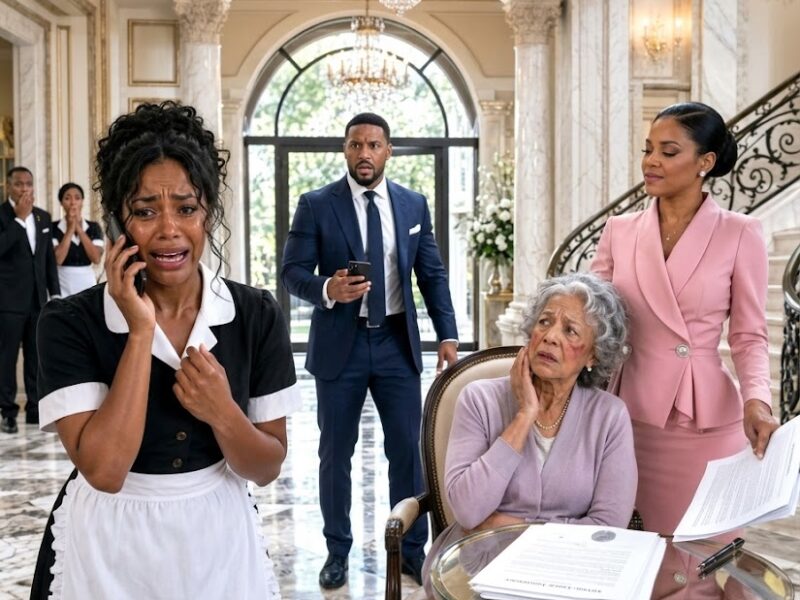
“Come Home Now!” Our Maid Cried—What I Found My Wife Doing to Mom Ended Our Marriage
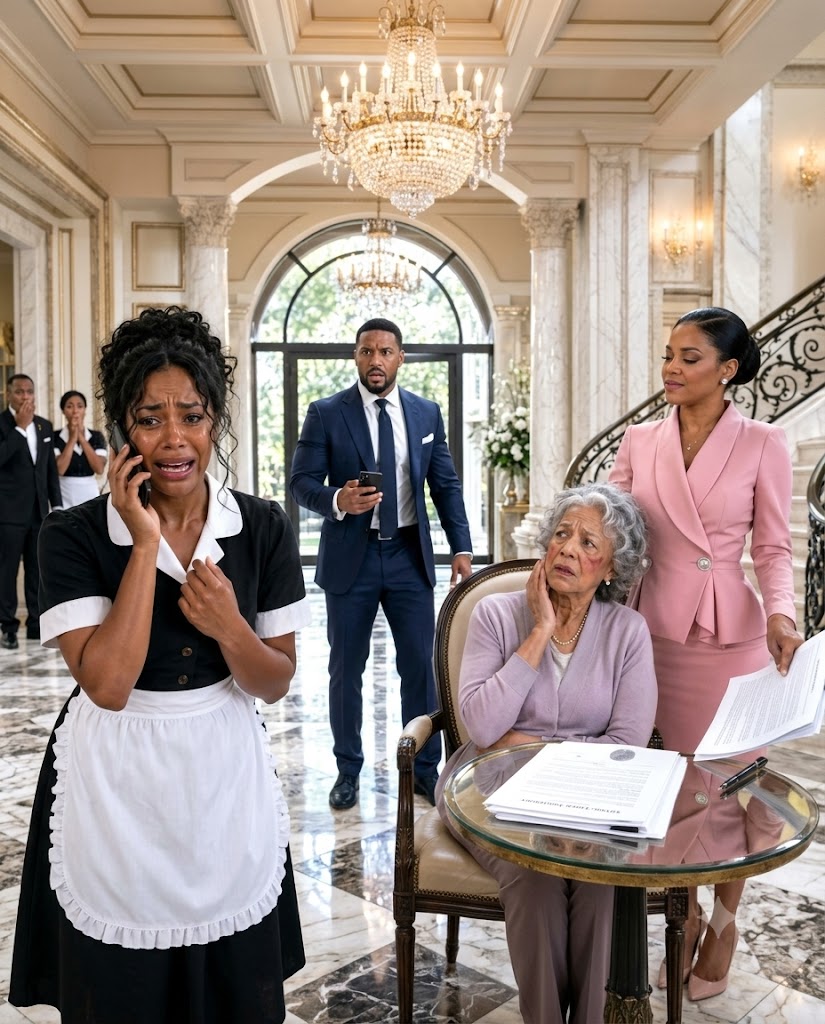
The call came at 4:47 on a Tuesday afternoon, and I was three states away in a hotel conference room that smelled like burnt coffee and someone else’s cologne.
“Come home now,” Grace said, and her voice was doing something I had never heard it do in six years of working in my house—it was cracking, splintering right down the middle like ice on a pond in March.
“Your wife is hurting your mother.”
I heard a sigh and a gasp on the line, and then nothing, and then everything.
My wife.
The conservatory door is locked.
Mrs. King is inside with her.
She has papers.
She made your mother put her hand on them.
Tell me exactly where you are, Grace.
Darius, what happened?
By the time I reached my house, the lights in the conservatory were still on, blazing yellow against the dark water of the lake like something burning on the shore.
My wife Celeste stood in her pastel pink blouse beside my mother’s chair.
My mother’s cheek was red.
Grace stood between them, shaking but unbroken, and on the glass table was a legal document with my mother’s thumb print smeared across the final page like a wound that would not close.
The conservatory is a glass room on the lakeside of the house.
My mother sits there every afternoon because the light is good for reading.
I built it for her.
I chose the chair, the lamp, the little wooden box where she keeps her treasures.
That night, I stood outside it like a stranger, looking through my own wall, and I could not get in.
The handle did not turn.
I put my shoulder into the frame twice, and on the second hit, the latch tore out of the wood, and the door swung wide and hit the glass.
Nobody moved for a second.
Not my wife, not Grace, not my mother.
Then Celeste turned toward me, and I watched her face change the way a stage light changes—the tightness went out of her mouth, her eyes filled, and her voice came out soft and tired and reasonable.
“Darius, thank God. She broke in here. Grace frightened your mother.”
I looked at Grace.
Her uniform sleeve was torn at the shoulder, and her hands were shaking so hard she had pressed them flat against her thighs to stop it.
She did not defend herself.
She just kept her body between my wife and my mother’s chair.
I looked at my mother, Ruth King, 76 years old, a woman who used to work three jobs and still read to me at night with her shoes still on.
Her cheek was red in the shape of something that was not a fall.
Her hands were trembling in her lap, and her mouth was working, and no words came out.
Since her stroke, words are the thing that fails her.
Her mind is fine.
Her mouth is not.
She hears everything, understands everything, but when she reaches for a sentence, the sentence walks away from her.
That is what my wife had been counting on.
I did not know it yet, but I would.
“Mama,” I said, and I crossed the room and knelt beside the chair. “Mama, look at me.”
She did not look at me.
She turned her head slowly and reached toward the glass table, past the papers, toward a small wooden box that had been knocked open.
Cards had spilled out of it.
Old index cards, yellowed, each one with a dried flower pressed flat under a piece of clear tape.
Her fingers moved over them.
She was not touching randomly.
I could see that even then, and I still did not understand what I was seeing.
She pushed one card away from the rest—a red one.
Celeste stepped forward and swept the cards back into the box with one smooth motion, the way you would clear a table after dinner.
“She does that when she is agitated,” she said. “It is a comfort thing. Grace encourages it. I have told her it confuses her.”
I picked up the document instead.
It was a temporary healthcare proxy, six pages of careful language that all meant one thing.
If my mother signed it, Celeste would make every medical decision for her.
Where she lived, who saw her, what she took, whether she stayed in this house at all.
On the last page, where a signature line should have been, there was a thumb print.
It was smeared sideways, dragged across the paper as if the hand had pulled back.
“What is this?” I said.
“Her doctors wanted a decision maker on file.” Celeste’s voice stayed soft. “Darius, you are gone four days a week. You know what she has been like. She wanders at night. She would not take her evening pills on Tuesday. Somebody has to be responsible on paper.”
“Her hand pulled away,” Grace said.
It was the first thing she had said since I came through the door.
Celeste did not even turn to look at her.
“Her hand has a tremor.”
“Her hand pulled away,” Grace said again. “Because Mrs. King held her wrist and pressed it down.”
The room went very quiet.
Out on the lake, a boat engine started somewhere and faded.
I have spent my entire adult life in rooms where the wrong sentence gets somebody hurt.
I know what it feels like when the temperature drops.
It dropped then, and the cold was coming off me.
I stood up.
I was aware of my own hands.
And Grace stepped sideways, not away from me, but into my line of sight, and she said something so quietly that I do not think my wife heard it.
“Do not give her the version of you she is waiting for.”
I stopped.
I did not understand that sentence for another two weeks, but my body understood it before my mind did, because I stayed where I was.
Celeste watched me not move, and something flickered across her face.
Disappointment.
It was gone in less than a second, replaced by concern, and she sat down on the ottoman beside my mother and took her hand as gently as a nurse.
“You should hear the rest before you decide who to be angry at,” she said. “Grace has been in your mother’s papers. She has been changing her medication schedule without telling anyone. Tonight, I found her in here with the door shut. Your mother was crying when I tried to separate them. Your mother clawed at me.”
She turned her shoulder toward me and touched the torn sleeve on Grace’s arm with two fingers, delicately, like evidence.
“That is how this happened.”
Grace said nothing.
She looked at the floor.
I did not want to believe my wife.
I want to be honest about this.
I did not want to.
But I had known Celeste for 11 years.
She had never raised her voice in my house.
She called my mother Mama Ruth in front of guests.
She hosted a charity lunch on the lawn every June.
Nobody has ever told me my wife was a hard woman because to everyone outside this room, she was the softest thing in my life.
And Grace, I am ashamed to say, was somebody I paid.
I knew her name and almost nothing else.
Six years in my house, and I could not have told you where she lived.
So I did the thing I thought was fair.
I knelt back down in front of my mother and I asked her directly.
“Mama, did Grace hurt you?”
My mother’s eyes came up to mine.
Whatever was behind them was fully awake.
Her lips parted.
Her jaw moved.
A sound came out that was not a word.
And then another.
And her hand closed on the arm of the chair.
And I watched her try and fail and try again.
And I watched her get frightened by her own failing.
Celeste leaned close to my ear and whispered the way you would say something kind.
“See? She does not understand.”
I felt something in my chest give way.
It was not anger.
It was grief.
And grief makes you stupid.
And for about 90 seconds, I stopped thinking.
Then Grace said, “Ask her again, but let her answer her own way.”
“Her own way,” I said.
Grace crouched and opened the wooden box on the table.
She took out the cards and laid them in a row on the glass, and her hands were steady now.
“These are hers,” she said. “She made them a long time ago. She still uses them. She has been using them with me since the spring.”
Celeste laughed.
It was a short laugh, and it came out too sharp, like something dropped on a hard floor.
That was the first crack.
I heard it and I did not know what I was hearing.
“Darius, this is what I am talking about,” Celeste said. “This is exactly what I am talking about. She has your mother touching flowers and calling it conversation.”
“Blue hydrangea,” Grace said.
Not to Celeste.
To me.
“Yes. White lily. No. Red geranium. Danger. Yellow marigold. Remember. Lavender. Listen.”
“Says who?” I said.
“Her. She taught it to children for 22 years.”
My mother was a school librarian.
I knew that the way you know the color of your own front door.
I had never once wondered what she actually did in that library.
Grace turned to my mother and spoke slowly, and she left a long space after every sentence, longer than felt comfortable.
“Mrs. King, I am going to ask you two easy things. You do not have to hurry.”
She waited.
“Is your son wearing navy blue?”
I stood there in a navy suit I had put on that morning without thinking about it.
My mother’s hand moved out over the row of cards.
It drifted.
It shook.
It passed over three of them.
Then her forefinger came down and stayed on the blue hydrangea.
“Yes.”
“Is Celeste wearing green?”
The hand went out again, slower this time because she was tired.
It stopped on the white lily.
“No.”
My wife was wearing pastel pink.
She has worn some version of pastel pink every day I have known her.
I did not say anything.
I remember the sound of my own breathing.
Grace looked up at me, and her face asked permission, and I nodded.
“Mrs. King,” she said. “Did someone hurt you today?”
The hand did not hesitate.
Blue hydrangea.
“Yes.”
Celeste stood up.
“She is exhausted. This is cruel, Darius. She is being led.”
“One more,” I said.
Grace said, “Do you feel safe with Celeste?”
My mother’s hand came off her lap and hung in the air above the cards, and it shook so badly that the cards fluttered.
Her breathing went thin.
She looked at my wife first.
She looked at her the way a person checks a road before crossing it.
Then she put her finger on the red geranium.
Danger.
I do not remember standing.
I remember being closer to Celeste than I had been, and I remember her not backing up, and I remember her eyes going just for a moment to the corner of the ceiling.
There was a security camera in that corner.
I had it installed myself four years ago so that my mother would never be alone in a room where nobody could see her.
My wife looked at that camera and she waited for me.
Grace said, “Not here. Not like this.”
I stepped back.
Fifteen minutes later, the front bell rang, and a man I had never met came into my house wearing a gray overcoat and carrying a leather folder.
“Mr. King, Malcolm Vale. I represent your wife on estate and elder care matters.”
He offered his hand as if we were meeting at a bank.
“I understand there has been an incident.”
“You understand fast.”
“Mrs. King contacted my office on Monday.” He said her concern was that your mother had become unsafe under this roof. “Given the household’s particular profile, she wanted the process documented properly.”
Monday.
Four days before Grace called me.
“The household’s particular profile,” I repeated.
Malcolm Vale did not blink.
He was polite the way a closing door is polite.
“Mr. King, you have a reputation. I do not offer an opinion about it. I only tell you how a reviewing officer will read it. A powerful man frequently absent with a history that invites questions. A vulnerable elderly parent. A staff member who has inserted herself into medical routines and now a door broken off its hinges.”
He glanced at the conservatory, which I am obligated to note.
That was the moment the fight changed shape.
It was not a family argument anymore.
My wife had not lost control of herself in that glass room.
She had been building a file.
And every single thing that made me dangerous to other men made me useless here.
After they went upstairs, Grace took me to my mother’s care suite.
I had not been inside it in three months.
She showed me four things.
She turned my mother’s left wrist over under the lamp.
There were marks on the inside of it, faded yellow, green in the pattern of fingers.
She showed me the medication log on the counter.
Two different hands had written in it.
Hers was small and square.
The other was looping and elegant, and it appeared only on days when Grace had been sent home early.
She showed me the care journal on the shelf and the place where a page had been torn out close to the binding, and she showed me a paper pill in the waste basket with a smudge of pastel pink lipstick on the rim.
“No single one of these means anything,” Grace said. “I know that. I am not a fool. Together they mean something.”
“Together,” she said, “they mean it did not start tonight.”
She sat down on the edge of the bed then, and for the first time all evening, she looked afraid instead of brave.
“I almost did not call you,” she said. “I have rent. I have a daughter starting community college. Everyone in this house told me the same thing when I got hired. Do your work. Keep your head down. Do not look at the family.”
She rubbed her hands together.
“Three weeks ago, your mother held on to my sleeve. She could not say a word. She wrote one on my hand with her finger. S-T-A-Y.”
I went down to the conservatory alone after that and sat in my mother’s chair in the dark.
My father died when I was nine.
My mother worked three jobs and never once let me see her cry about it.
When I was 31 and finally had money—real money, the kind that scares people—I drove her out to this lot before the house existed.
And I made her a promise standing in the mud.
Nobody will ever make you afraid in your own house again.
I bought the house.
I hired the staff.
I wired the cameras.
I put a fence along the road and a gate on the drive and men at the gate.
I married a woman everyone described as lovely.
And I never once sat down across from my mother and asked her whether she actually felt safe.
Grace stood in the doorway.
I did not turn around.
“I built walls high enough to keep enemies out,” I said. “I never asked who I had locked in with her.”
The next morning, I did the first smart thing I had done in 24 hours.
I did not call a lawyer, and I did not call any of my men.
I called a doctor who had no reason to like me.
Dr. Helen Ward is a geriatric specialist.
She came out to the house on a Saturday, refused coffee, and made it clear within four minutes that she was not on my side.
“I want to be direct with you,” she said. “I have been contacted by both parties. Your wife’s attorney reached me first, and you came anyway. I came for your mother.”
She spent an hour with Ruth.
She would not let me stay in the room, and she would not let Grace prompt anything.
She shuffled the cards herself.
She asked questions with the yes answer and the no answer in different orders so that a pattern of habit would not fake it.
When she came out, her expression had changed.
“Her responses are consistent,” she said. “She is slow and she fatigues and there are questions she cannot manage at all. But when she can answer, she answers correctly and she answers the same way when I change the order. That is not random touching. Whatever that is, it is meaningful and it deserves to be respected.”
I remember the feeling in my chest.
It was relief, and relief made me careless, because for about six hours I believed I had won.
I told Celeste that evening in the front hall.
I told her a doctor had verified my mother could communicate, that the proxy was dead, that I wanted her out of the house by the end of the week.
She listened with her coat over her arm.
She did not argue.
She did not cry.
She looked almost sorry for me.
“Darius,” she said, “you can make flowers mean anything in a room full of people who want to believe you.”
Then she picked up her purse and went upstairs, and that calm was the loudest warning I have ever ignored.
They came at 7 the next morning.
Two patrol officers and a medical transport van and a woman with a clipboard from a county office and a folder with an emergency order in it, signed the night before.
The order said Ruth King was to be removed from the residence for independent evaluation at a private wellness residence pending a full hearing.
“On what basis,” I said.
The woman with the clipboard would not meet my eyes.
Malcolm Vale answered from the driveway where he had been waiting in his car since before dawn.
“On the basis of submitted household footage,” he said, “and a sworn statement.”
They played it for me on a tablet in my own front hall.
The clip was two minutes long.
It started with the sound of a door frame splintering.
It showed me coming through that broken door with my jaw set, filling the whole width of the frame.
It showed me crossing the room fast.
It showed me standing over my mother in her chair while she trembled and could not speak.
It showed me rising up in front of my wife, close, my hands open at my sides, and my wife not moving.
There was no audio of Grace’s phone call.
There was no audio of my mother’s sound on the line.
There was no angle on the moment before, when Celeste’s hand had been on my mother’s wrist.
The camera in that corner points at the chair.
It always has.
I aimed it there myself.
Every protective thing I had ever built had been turned around and pointed at me.
“You understand my position,” Malcolm said mildly. “A reviewing officer sees a man break a locked door and stand over a frail woman. Whatever happened before that, the officer did not see it.”
I have been in rooms with men who wanted me dead.
I have never felt as powerless as I felt in my own front hall in a navy sweater at 7 in the morning.
They brought my mother down in a wheelchair with a blanket over her knees.
I moved toward the transport, and Grace got in front of me.
“Do not,” she said. “Please do not touch that vehicle.”
Dr. Ward had come at my call and was standing on the steps with her arms folded.
“Mr. King,” she said, “if you put one hand on that transport, you will hand them everything they need. I will not be able to say a word for you afterward. Nothing I observed will matter.”
So I stood in my own driveway with my hands at my sides, and I watched two strangers load my mother into a van.
She looked at me the whole way.
She was not confused.
That is the part I could not stand.
She knew exactly what was happening, and she could not say one word about it.
At the last moment, she reached out of the blanket and pressed something into Grace’s hand and closed Grace’s fingers over it.
A lavender card.
Listen.
Then the door shut, and my mother left the house I built for her.
And my wife stood at the top of the steps in a pale pink cardigan with her hands folded, looking sad in a way that anybody watching would have believed.
I sat in the empty conservatory for most of that night.
Around 2:00 in the morning, Grace came in with two cups of tea and sat down across from me on the ottoman, which she had never done before.
And she did not ask permission.
“Say it,” she said.
“My way does not work. No, I can buy a building in a morning.” I said, “I can find any man in this state inside a day. I cannot make one county officer believe a woman who cannot finish a sentence.”
“No,” Grace said. “You cannot.”
“I could go get her.”
“And then what?” She said it flatly, not unkindly. “You take her out of that place tonight, and by Monday, you are exactly what your wife has been describing since Monday of last week. A dangerous man who removed a vulnerable adult from supervised care, and your mother spends the rest of her life in a room in another state where you need an appointment.”
She was right.
I hated it and she was right.
“Then what is left?” I said.
Grace put the lavender card down on the glass between us.
“Stop trying to prove your wife is a liar,” she said. “Start proving your mother can talk. Not to you, not to me—to people who have no reason to care about either of us.”
That was the night my objective changed.
I stopped building a case against Celeste and started building a way for Ruth King to answer a question in front of strangers, on the record, where nobody could clear the cards off the table.
Everything after that had to happen in front of neutral witnesses.
No threats, no private confrontations, no family testimony, nothing that could be dismissed as loyalty.
Grace gave me the notebook two days later.
She put it on the kitchen counter and slid it across, and I could see what it cost her.
“I kept this for six months,” she said. “Not to spy on anyone. Your mother has good days and bad days, and nobody was tracking which was which. Dates, what she ate, what time she woke, what she reached for, which flower she answered with, and what I had asked.”
I turned the pages, every date written out in words, every entry in that small square handwriting.
“This can hurt you,” I said. “Their lawyer will say you wrote it last week. He will say you made it up for money.”
“I know what he will say.”
“Then why give it to me?”
Grace looked at the window.
“Because when I was 24, I took care of my own mother for two years after her aphasia. Everybody in the family talked about her like she was furniture in the room with her. She heard every word.”
She pushed the notebook the last inch toward me.
“I am not doing that to another woman.”
Two days after that, she stopped in the middle of folding towels and said, “The greenhouse. What about it?”
She points at it.
Every day since spring, she points out the conservatory window at the greenhouse.
And I thought she was remembering her plants.
The old greenhouse sits behind the house, past the hedge, and nobody has used it since my mother got sick.
The glass is cloudy.
There is a potting bench along one wall with her trays still on it and a mineral crust on the taps, and bolted to the frame above the bench, aimed down at the workspace, there was a small camera I had forgotten I ever installed.
I put it there nine years ago because somebody had been coming over the back fence and taking tools.
It was still recording to the same old drive in the utility closet.
Thirty days of storage riding over itself.
The angle points at the bench and past the bench, through two panes of cloudy glass, at the strip of lawn outside the conservatory windows.
We pulled the drive that night and sat on the utility room floor with a laptop.
Celeste was on it.
Not once—six different afternoons, walking that strip of lawn, pausing at the conservatory window, her mouth moving.
The angle only caught her from the shoulders down half the time.
There was no audio at that distance.
It was not proof of anything.
It was a woman walking on her own lawn.
But she was walking there on exactly the days Grace had been sent home at 3:00.
And Grace’s notebook said so in her own square handwriting, written weeks before either of us knew this camera existed.
“It is not enough,” Grace said.
“No,” I said, “but now we know where to point.”
The last piece I found myself, in the family records room, in a cardboard box on a shelf I had walked past for years.
My mother’s library teaching box.
Inside were four decks of index cards worn soft at the corners, each one with a dried flower taped under clear plastic, and each one labeled in a young woman’s handwriting for a class of children who are middle-aged now.
Blue hydrangea. Yes.
White lily. No.
Red geranium. Danger.
Ask for help.
Yellow marigold. Remember.
Lavender. Listen.
Dated 29 years ago.
That mattered more than anything else in the box because it meant Grace could not have invented the system.
It existed before Grace was born into my house.
It existed before my wife did.
At the bottom, under the decks, there was a single card in my mother’s handwriting.
The sturdy handwriting she had before the stroke.
“Children listen better when adults stop rushing them.”
I sat on the floor of that room with the card in my hand for a long time.
Celeste’s counterattack came on a Thursday.
Malcolm Vale filed a statement alleging that Grace Holloway had cultivated an inappropriate influence over a vulnerable adult, had accessed private medical records, and had a financial motive to be seen as indispensable to a wealthy family.
Grace was suspended from the property pending review.
I found her in the service drive putting a bag into her car, and I offered her money.
I offered her a year of pay and told her to take it and stay out of it.
She shut the trunk.
“No, Grace. If I take cash from you today,” she said, “then everything I say next month is bought. Pay me properly, on the record, through payroll, with a job title and a description—or do not pay me at all.”
She looked up at me.
“I will not let your wife turn help into hush money.”
I want to say I understood immediately.
I did not.
I stood there insulted for about 10 seconds.
Then I understood, and I did it her way.
Celeste made her own move the following week.
There is a family council that oversees some of my legitimate holdings.
Eleven people, mostly lawyers and one cousin.
Celeste requested time, and they gave it to her, and I sat at the end of the table and watched my wife work.
She wore a pastel pink coat.
Her hair was in a neat bun.
She spoke for nine minutes and never once raised her voice.
She said I was grieving, and that grief in a man like me looks like rage.
She said Grace was ambitious, and that she did not blame her for it, because ambition in a woman with nothing is not a sin.
She said Ruth was frightened, and that a frightened woman will point at whoever is asked about last.
She said, “I am not trying to take anything from anyone. I am trying to give an old woman peace.”
Two people at that table cried.
I sat there and finally understood why everyone believed her.
She was not loud.
She had never been loud.
Loud people get resisted.
Calm people get agreed with.
And I had spent 30 years being the loudest thing in every room I entered.
Dr. Ward agreed to testify only under conditions, and she wrote them out herself, one question at a time.
No leading questions.
No question containing a name and an accusation together.
Cards shuffled and laid out fresh each time by a neutral hand.
Everything recorded, no coaching, no gestures, no eye contact from family.
Enough time given, however long it took, without anyone speaking into the silence.
And one more.
“You will not sit where she can see you,” Dr. Ward told me. “Not in her sightline. Not once. She will think I am not there. She will know you are there, but if she looks at you before she answers, their attorney will say she was reading your face, and he will be entitled to say it.”
I did not sleep much that week.
Every instinct I have ever had told me to be in front, to speak, to take the weight.
The protocol required the opposite.
My whole job was to sit down, shut up, and let a 76-year-old woman with a damaged mouth do the hardest work in the room by herself.
Three days before the hearing, Malcolm Vale offered me a deal in the parking structure under his building.
“Withdraw your objection,” he said. “Mrs. King is prepared to grant you supervised visits, one afternoon a month, at the residence, with staff present. That is more than the court is likely to give you if this goes badly. And if I fight, then my client will request a no-contact provision on the grounds of documented intimidation. She has footage. She has a broken door. She has a sworn statement.”
He shrugged almost apologetically.
“I would rather not. I am telling you plainly.”
I sat in my car for 20 minutes afterward.
One afternoon a month is 12 afternoons a year.
My mother is 76.
I did the arithmetic like a coward, and the arithmetic said, Take it.
I called Grace from the car and told her.
She was quiet for a while.
Then she said, “A visit is not the same as freedom.”
I hung up and drove home and told Malcolm Vale, “No.”
The hearing room was small and cold, and there was a water stain on the ceiling tile above the door.
That is what I remember.
Not the seal on the wall—the water stain.
Celeste sat in pastel pink beside Malcolm Vale with her hands folded on the table.
I wore a navy suit, and I folded my hands too, and I did not look at her.
The hearing officer, a woman with reading glasses pushed up in her hair, began with the simplest possible question.
“Mr. King, did you break a locked door in your residence on the evening in question?”
“Yes, ma’am.”
“Would you like to explain?”
“I would like to answer your question first. I broke it. I am not going to argue about whether I broke it.”
Malcolm played the footage.
It looked worse on a screen in a cold room than it had looked in my own hallway.
Two minutes of a large man coming through a splintered door and standing over a shaking old woman, with no sound and no context and no before.
When it ended, nobody in that room looked at me the way people usually look at me.
They looked at me the way you look at a dog that has gotten loose.
Then Malcolm stood up and started on me, and he did it well.
He asked about my business.
He asked about a matter from 19 years ago that never became a charge.
He asked whether it was fair to say people were generally careful around me.
He asked whether the staff in my home were free to disagree with me.
He asked whether my mother had ever seen me frighten someone.
He was not trying to prove anything.
He was trying to make me stand up.
Everything in my body wanted to.
I have never in my life let a man speak to me like that and stay in my chair.
My heart was going hard enough that I could feel it in my jaw.
And I thought about Grace saying, Do not give her the version of you she is waiting for.
And I finally understood what she had meant that first night.
Celeste did not need me to lose.
She needed me to roar.
So I unfolded my hands and I put them flat on the table, and I spoke to the hearing officer instead of to him.
“Ma’am, I am not going to answer those questions, and I am not asking you to like me. I have been what he says I am. Some of it. I am not asking you to believe me at all.”
I heard my own voice come out level, which surprised me.
“I am asking you to let my mother answer.”
The room changed, not dramatically.
Nobody gasped, but Malcolm Vale paused for half a second before his next sentence, and I saw Celeste’s thumb move against her knuckle, and I knew I had taken something small away from her.
They called Grace next, and Malcolm went after her harder than he had gone after me.
Was she a member of the family?
No.
Was she a licensed nurse?
No.
A doctor?
No.
A speech therapist?
No.
Did she have any credential of any kind relevant to communication disorders?
No, sir.
Was she paid by the King household?
Yes.
Had she been suspended?
Yes.
Had she kept a private notebook on a woman she was not licensed to assess?
Yes.
“You wrote in that notebook every day for six months,” Malcolm said, “about a wealthy family’s mother. And you expect this office to believe there was no purpose behind that?”
“There was a purpose.”
“Financial?”
“No, sir.”
“Then what?”
Grace sat very straight in a chair too big for her.
“Being paid to care for someone,” she said, “does not mean I am paid to ignore pain.”
Malcolm Vale let that sit for a second longer than he should have, and then moved on, which is how you know a lawyer has been hit.
Dr. Ward went next, and she was careful in a way that helped us more than enthusiasm would have.
She refused to say my mother was competent to manage her own affairs.
She said the opposite plainly.
She said Ruth King could not handle complex or abstract questions and fatigued quickly and had no reliable capacity for financial decisions.
“Then why are we here?” Malcolm said.
“Because inability to speak is not inability to answer,” Dr. Ward said. “I tested her four times over three weeks. I shuffled the cards myself. I varied the order and the phrasing. Her responses to clear, simple, single questions were consistent every time. That is not a comfort behavior. That is communication. And the fact that it is inconvenient does not make it less real.”
“Cards, doctor. Flowers.”
“The medium is irrelevant. Some patients use a letterboard. Some use eye movement. This patient built her own system 29 years ago and taught it to school children.”
Dr. Ward looked at the hearing officer.
“I would recommend she be permitted to answer under my protocol, with everyone in this room silent.”
The hearing officer took off her reading glasses.
“Bring Mrs. King in,” she said.
They wheeled my mother through the side door, and my chest closed up.
She had lost weight.
Somebody at that wellness residence had put her in a soft gray cardigan that was not hers and brushed her hair the wrong way.
Her hands were on the blanket, and they were shaking.
I sat behind and to the left, out of her sightline, exactly as I had been told, with my hands flat on the table.
Celeste rose from her chair as the wheelchair passed and reached out and touched my mother’s shoulder.
It was a lovely gesture—warm, familiar, wifely.
Any camera in the world would have loved it.
My mother flinched.
It was small.
It was fast.
But every person in that room saw an old woman pull away from a hand, and Celeste sat back down a half second too quickly, and I watched the hearing officer write something on her pad.
Dr. Ward shuffled the cards and laid five of them on the table.
“Mrs. King, I am Dr. Ward. We have talked before. Take all the time you want. Do you understand where you are?”
The room was completely silent.
It took 11 seconds.
Blue hydrangea.
“Yes.”
“Do you want Celeste to make all of your medical decisions for you?”
Her hand went out.
It hovered.
It came down on the white lily.
“No.”
“Did Grace hurt you?”
White lily again, faster.
“No.”
Dr. Ward reshuffled the cards, laid them in a different order, and waited a full minute before the last one.
“Did Celeste hurt you?”
My mother’s hand came off the blanket and began to shake so hard the whole arm moved with it.
She was not looking at the cards.
She was looking across the table at my wife.
And I could see her being afraid.
And I could not do one thing about it.
The silence went on so long.
The hearing officer opened her mouth, and Dr. Ward held up one finger and stopped her.
My mother put her hand down on the red geranium.
Danger.
Somebody in the back of the room let out a breath.
And then Celeste began to cry, and I understood that we had not won anything yet.
She cried well, quietly, into her hand, with her shoulders down.
When she spoke, her voice was wrecked and small.
“She has been in a house with them for two weeks before they took her. Two weeks with a maid holding her hand and my husband telling her what to be afraid of. Of course she points at me.”
Malcolm was already on his feet.
“With respect, this office is being asked to accept a colored card as sworn testimony from a woman who cannot state her own address. There is no basis in any procedure for this, and there is context this office has not seen.”
He played the second clip.
I had never seen it.
It was from the corner camera in the conservatory, from the night before they took her, and it was not edited at all, which made it worse.
It showed Grace crouched beside my mother’s chair, holding her hand.
It showed me standing right over both of them, close, my head down.
It showed my mother’s face, and my mother’s face in that clip was frightened, because in that clip, I had just told her they were coming to take her in the morning.
Without sound, it looked like two people cornering an old woman and telling her what to say.
It was the best thing my wife ever did, and it nearly finished us, because it was true footage of a false thing.
The hearing officer looked at the screen, then at me, and I could see it going.
Grace stood up.
“Ma’am, may I show you one more?”
Malcolm objected.
The officer allowed it.
Grace explained the greenhouse camera in four sentences.
An old tool camera above a potting bench, installed nine years ago, aimed at the bench, catching a corner of lawn through two panes of dirty glass.
She ran the clip from the 11th of the month, 3:00, a day the household log showed she had been sent home early.
A woman in a pale pink cardigan standing close to the conservatory window, looking in.
The camera was bolted to the metal frame of the bench, and the bench runs to the wall, and old glass carries sound into metal better than air ever does.
It came through thin and flat, a second behind her mouth.
The officer had it played three times.
“If you point at Grace, Darius will blame her. If you point at me, I will send you away.”
Eleven seconds.
No confession.
Just a woman on an ordinary afternoon, calmly teaching an old woman which lie to tell.
Malcolm Vale sat down and did not stand again.
I watched him move his chair three inches from his client.
Celeste stopped crying.
Her face went smooth and empty.
And for the first time in 11 years, I saw what was behind it.
Not hatred.
Calculation.
Still running, still looking for the next door.
The hearing officer put her glasses back on.
“Dr. Ward, one more question, if she can manage it.”
Dr. Ward knelt beside the wheelchair.
“Mrs. King, there is no right answer. What do you want us to do right now?”
My mother’s hand crossed the cards—past the hydrangea, past the lily, past the geranium.
She put her finger on lavender and left it there.
Dr. Ward lifted an old library deck from the box, 29 years old, and held up the labeled card so the officer could read a young librarian’s handwriting.
Lavender.
Listen.
She had not been asked to accuse anyone.
She had been asked what she wanted.
And what she wanted was not punishment.
It was to be heard.
I put my hands over my face and cried without a sound, which I have never done in my life.
The temporary authority was vacated that afternoon.
An investigation opened into the proxy, the medication entries, the torn journal page, and the footage.
Celeste was permanently removed from my mother’s care with a contact restriction.
Malcolm withdrew, and his filing went under review.
I could have done more to her.
I did not, because my mother chose lavender instead of geranium in front of everyone, and hunting after that would have told the whole room I still had not heard her.
Grace was cleared.
I wrote her a real position, and she read it twice before signing.
Resident care advocate.
She reports to independent oversight, not to me, and she has overruled me twice.
My mother came home on a Friday.
That morning, I took a screwdriver out and removed the lock from the conservatory door.
Not changed—removed.
There is a pale rectangle in the wood where it used to be, and I have left it.
That afternoon, I sat with her in the cleaned greenhouse in a navy sweater.
No guards inside.
“I thought power meant making everyone hear me,” I said.
Her hand moved.
“Lavender,” then blue hydrangea.
“Listen.”
“Yes,” I said. “But my mother was speaking the whole time. I was just the last one to learn her language.”
She put her shaking hand on top of mine and held it the way she did when I was nine and my father was gone and she was the only wall between me and the world.
There is a lavender card on my desk now, propped against the lamp, the one she pressed into Grace’s hand at the transport van.
A flower can be pressed flat and still keep its shape.
So tell me in the comments—have you ever seen someone dismissed simply because they were quiet, old, sick, or working in the background?
And if this story reminded you of someone who was not heard until it was almost too late, write one word for them.
Listen.









