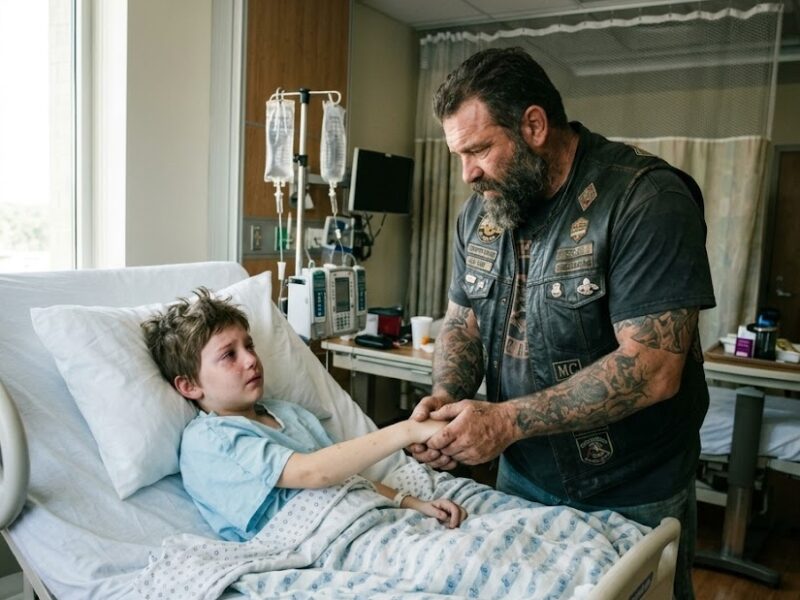
“Can you stay until the light goes off?” the sick boy asked the Hells Angel. He never left the hospital.
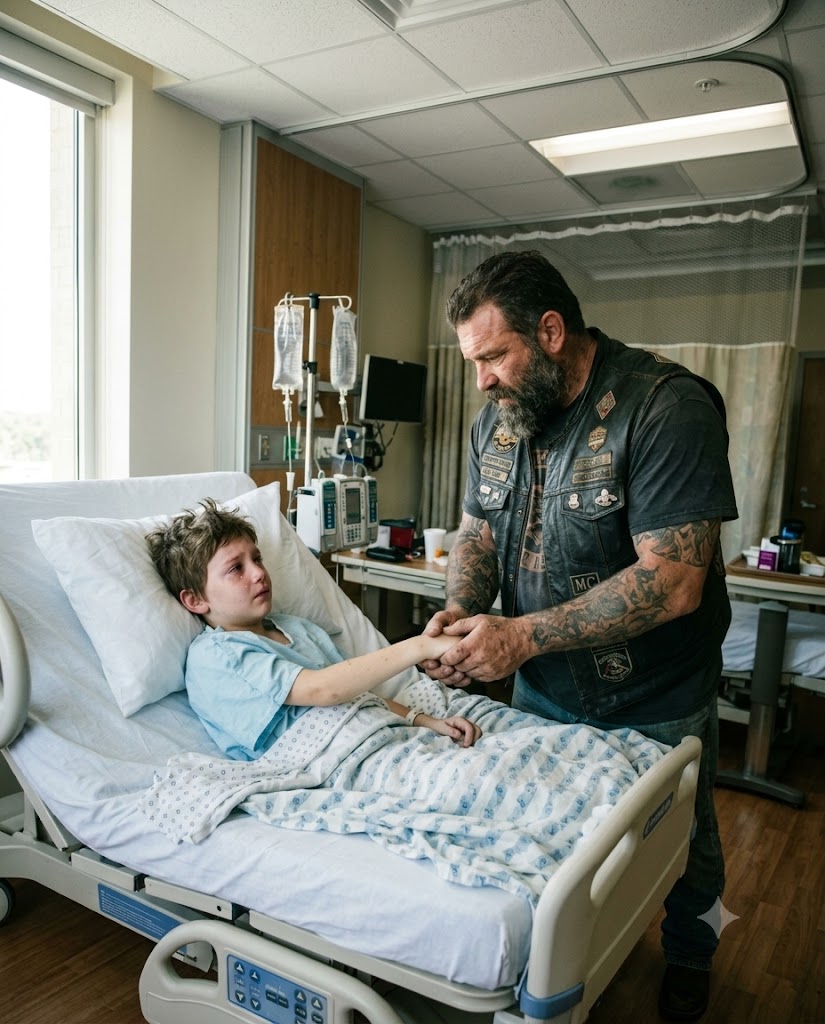
The lamp clicked off at 8:30 and the boy’s whole body went rigid.
“Please,” he whispered, “don’t go yet.”
I am 54 years old.
I have buried a wife.
I have ridden through blizzards, bar fights, and funerals that nobody else would attend.
And I had never been so afraid as I was in that dark hospital room, holding the hand of a 9-year-old who was trying so hard not to cry.
I had promised him I wouldn’t leave.
What I hadn’t told him was that I had walked out on someone I loved once before, four minutes before she died.
And somewhere down that hallway, a vending machine was humming my name.
The first Saturday of December in Dayton, Ohio, smelled like diesel exhaust and snow that hadn’t decided to fall yet.
Dennis Walker stood in the parking lot of Riverbend Children’s Hospital with his helmet hooked over one arm while 40 motorcycles ticked behind him, cooling in the gray afternoon.
He was 54 years old and six-foot-two with a thick gray beard and a scar that split his left eyebrow in two.
The leather vest on his back had been broken in over 26 years, and it carried the patch of the Hells Angels.
People noticed it.
A woman pulling a toddler in a red coat actually changed direction to avoid him.
Dennis noticed her noticing the way he always did and said nothing.
“You’re doing that thing again,” said Gus Toliver, rolling up beside him on a Harley with more chrome than a diner.
Gus was the chapter president, 61 years old, wide as a doorway, with a voice like gravel in a clothes dryer.
“That thing where you look like you’re at a funeral.”
“I don’t like hospitals,” Dennis said.
“Nobody does. That’s why we do the toy run. Sick kids get a pile of presents and a bunch of bearded guys who can’t wrap anything. Worst case, it’s weird.”
Dennis looked at the glass doors at the paper snowflakes taped to the inside.
Ellen died in a hospital two years in January.
Gus didn’t say he was sorry.
He had said it two years ago, and both men knew it hadn’t helped.
He just put a heavy hand on Dennis’s shoulder.
“Carry a bag and smile with your eyes. That’s all anybody needs from you today.”
They went in as a line, boots loud on the tile, arms full of wrapped boxes.
Volunteers in green aprons stared openly.
A security guard named Howard Bell, 60, with reading glasses hanging from a cord around his neck, held up both palms like he was directing traffic at a parade.
“Gentlemen, I have your paperwork. Keep your voices down and your hands off the fish tank.”
“Yes, sir,” Gus said, and 40 bikers dropped to a murmur.
The fourth floor was oncology.
Dennis hadn’t known that until the elevator doors opened onto walls painted with cartoon whales and a hallway that smelled like hand sanitizer and microwave popcorn.
Children in pajamas pushed IV poles along the corridor, slow and careful like tiny astronauts in orbit.
A little girl with a purple scarf tied over her head studied Gus’s beard and asked, “Are you Santa’s brother?”
Gus laughed so hard he had to set his bag down.
Dennis handed out gifts as children appeared.
A Lego set, a stuffed bear, a coloring book with a pack of markers.
He said “Merry Christmas” 15 times and meant about half of them.
Every door he passed stood open a few inches, and behind every door was a bed with rails and a parent asleep in a chair.
He kept his eyes straight ahead.
It was easier that way.
The last room at the end of the hall had its door wide open and its lights turned low.
A nurse in navy scrubs stood at the window checking a monitor.
In the bed, propped against three pillows, sat a boy in astronaut pajamas, so thin that his wrists looked like they belonged to a bird.
He had large brown eyes and almost no hair, and he was watching the doorway like he had been waiting for someone for a long time.
Dennis stepped in with the last box wrapped in blue paper.
“Hey, bud, I’ve got something for you.”
“Are you a Hells Angel?”
The boy’s voice was dry and quiet and not the least bit afraid.
“That’s what the vest says.”
“My teacher said they were scary.”
“Some people think so.” Dennis set the box on the tray table. “What do you think?”
The boy considered him with the seriousness that only 9-year-olds and judges possess.
“I think your beard looks soft.”
The nurse, whose badge read Carol Whitaker, RN, pressed her lips together to hide a smile.
“That’s Jack Brooks. Jack, introduce yourself properly.”
“I’m Jack.”
He tore the paper off the box with surprising speed.
Inside was a model of the space shuttle, 261 pieces according to the label.
His whole face lit up as if someone had turned a dial.
“Whoa. Can I really keep it?”
“It’s yours.”
“My mom can help me build it. She’s at work right now. She works nights at the warehouse so we can keep the insurance. She comes in the mornings.”
Jack said all of it plainly, the way a kid recites his address, then glanced up at the little round lamp on the wall above his bed.
Its frosted shade glowed a soft yellow.
Carol checked her watch and her voice gentled.
“It’s almost 8:30, sweetheart. Say good night to our guest.”
Something shifted in the boy’s face.
Dennis had seen that look before on his wife’s face in a different building in the last weeks.
It was the look of someone watching the one safe thing in the room get ready to leave.
“The lamp turns off by itself at 8:30,” Jack said quietly to the blanket. “It’s on a timer. Everybody leaves right before it does.”
He lifted his eyes.
“Can you stay until the light goes off?”
Dennis felt 40 bikers waiting downstairs, engines and cold air and an easy exit.
He felt every reason he had ever collected for not sitting in rooms like this one.
His mouth opened to say that he had to go.
“Sure,” he said instead.
His own voice surprised him.
He lowered himself into the vinyl chair by the bed.
It creaked under his weight.
Jack watched the clock above the door, and Dennis watched Jack, and for a few minutes, neither of them said a word.
Out in the hall, Gus’s voice rumbled something to Howard Bell, and then the sound of boots faded toward the elevator.
At 8:30 exactly, the lamp clicked off.
The room dropped into the blue glow of the monitors and the thin strip of hallway light under the door.
Jack’s breathing hitched once, then evened out as Dennis’s heavy hand came to rest on the edge of the mattress, not touching him.
Just there.
“Thanks,” the boy whispered into the dark. “Nobody’s ever stayed.”
Dennis sat there with his heart pounding like he had run a mile and realized he had not stayed for anyone in two years.
He told himself it was a one-time thing.
He told himself so all the way home on I-75, with the cold biting through his gloves, and again in the kitchen of the small brick house in Kettering, where Ellen’s reading glasses still sat on the windowsill, folded, waiting for a woman who wasn’t coming back.
He told himself so while he heated a can of soup he didn’t eat.
At midnight, he was still awake.
He kept seeing the lamp click off.
On Sunday, he rode past the hospital twice without turning in.
On Monday, he stopped at a hobby shop on Wayne Avenue and bought a tube of plastic cement and a set of fine-tipped tweezers because a 9-year-old with shaky hands would need them.
He told himself that was practical, not personal.
At 6:40 that evening, he stood at the front desk with his helmet under his arm.
Howard Bell looked at him over the top of his reading glasses.
“Visiting hours for non-family are daytime only, Mr. Walker. Unit policy.”
“I’m not family.”
“Then you see my problem.”
Howard studied him a moment longer.
Whatever he saw changed something in his face.
“Fourth floor. Ask for Nurse Whitaker. If anyone gives you trouble, I never saw you.”
Carol Whitaker met him at the nurse’s station with her arms crossed, but her eyes were kind.
“He asked about you four times today. I told him you probably had better things to do.”
“I don’t.” Dennis lifted the little bag. “I brought tweezers.”
Carol laughed short and surprised, and led him down the hall.
Jack was sitting up with the shuttle box open on his lap, pieces sorted into neat piles on the tray table.
Next to him in a hardback chair pulled close to the bed sat a woman of about 33 in a warehouse fleece with a company logo on the chest.
Her hair was tied back in a hurry and the shadows under her eyes looked like thumbprints.
She stood so fast the chair scraped.
“Mom, this is Dennis,” Jack said, delighted. “The Hells Angel with the soft beard.”
“Melissa Brooks.” She did not offer her hand. “Carol told me a man in a motorcycle vest sat with my son Saturday night. I wanted to meet you before I decided how I felt about it.”
“That’s fair,” Dennis said.
“Why did you stay?”
He considered lying.
He had a clean, easy answer ready about the toy run and the holiday spirit.
Instead, he said, “Because he asked, and nobody ever asks me for anything.”
The words sounded stranger out loud than they had in his head.
Melissa searched his face for a long moment.
She looked at the tweezers in his hand, at Jack’s hopeful grin, at the vest, and back at the tweezers.
“Ten minutes,” she said. “In the hallway. Then we’ll see.”
The hallway was lit in a cold white that made everybody look sick.
Melissa leaned against the wall beside a poster of a smiling cartoon whale and kept her voice low.
“Jack has acute myeloid leukemia. It came back in October after the second round of treatment. Dr. Foster says the trial drug didn’t work.”
She swallowed.
“There isn’t another option. They’re calling it palliative now, which is a word that means they’re going to keep him comfortable.”
Dennis said nothing.
There was nothing in the world to say.
“The part that breaks me,” she went on, “isn’t that he knows. It’s how he knows. He’s not afraid of dying. He asked me once what it feels like and I said I didn’t know and he said okay and went back to his cartoons. He’s afraid of the dark and of being alone in it. He’s afraid it will happen when everybody’s gone.”
Her voice cracked on the last word.
“I work nights, Mr. Walker. Eleven to seven. If I lose this job, we lose his coverage and I can’t be in two places.”
“His father?” Dennis asked gently.
“Left the week of the diagnosis. Sends a card on his birthday sometimes.” Her jaw tightened. “I don’t have anyone else. My mother lives in Arizona and can’t travel.”
Dennis looked through the doorway where Jack was fitting a tiny wing together with his tongue stuck out in concentration.
“Then let me do the part you can’t,” he said. “Evenings. Seven until he’s asleep. I won’t promise anything I can’t keep, but I’ll keep that.”
“I don’t know you. Do you?”
“No, ma’am. You don’t. Ask Howard downstairs. Ask anyone at the garage. I’ve had a clean record for 20 years and a very boring life.”
Melissa let out a breath that was almost a laugh and almost a sob.
“Okay,” she said. “Okay, but if he gets hurt, if you disappear, I won’t—”
“I won’t.”
The promise came out before he could weigh it, and it landed in his chest like a stone he would be carrying a long time.
The next obstacle arrived the following afternoon in the shape of Patricia Hail, the unit director, a tall woman in a gray blazer who held her clipboard like a shield.
“Ms. Brooks, I understand you’ve asked for an unapproved visitor to remain past hours. It’s a safety and liability matter. The man is a stranger.”
“He’s not a stranger to Jack,” Melissa said.
She had come in on her day off, still in her fleece, holding a form she had printed at the library.
“I’m naming him an approved visitor in writing. I’m his mother. I’m allowed.”
Patricia Hail looked at the form, then at Dennis, who stood by the window with his hands clasped like a man in church.
“He’ll need to sign in every night and wear a badge. And if Jack’s condition changes, he leaves the room when staff asks.”
“Yes, ma’am,” Dennis said.
So it began.
Every evening at seven, he walked through the lobby and Howard Bell slid a visitor badge across the desk with a deadpan face.
Dennis stuck on the little label that said VISITOR, which made him feel like a sailor in a library.
Upstairs, he and Jack built the shuttle one tiny piece at a time.
The boy narrated everything.
He explained thrust and orbit and why astronauts ate their food from pouches.
At 8:30, the lamp always clicked off, and Dennis always stayed, at first for a few minutes, then until Jack’s eyes got heavy.
Then, one night, until the nurse’s rounds told him the boy was fully asleep, and it was almost 11, and his back ached from the chair, and he felt better than he had in two years.
On the ninth night, Jack held up a tiny white piece in his thin fingers.
“Two hundred sixty-one pieces. We’re on 190. Do you think I’ll finish before—”
He stopped.
His eyes went to the dark window.
Dennis understood the sentence even though the boy hadn’t finished it.
“We’ll finish it,” Dennis said.
He hoped he wasn’t lying.
Out in the hall, he saw Dr. Paul Foster pull Melissa aside near the nurses’ station, his white coat bright under the fluorescent lights.
Melissa’s hand went to her mouth.
Through the glass, Dennis watched a mother hear the number of weeks.
December turned into the longest month of Dennis’s life, and the best one, and he could not have said which fact bothered him more.
By Christmas Eve, the shuttle’s cargo bay was glued.
Jack had insisted on coloring the tiles on its underside with a black marker one at a time, even though his hands shook and the pen left streaks.
“Real ones get scorched,” he explained. “Scorched is part of the job.”
Melissa had begun to arrive early to hand off the evening shift, and the two of them had worked out a rhythm of nods and shared thermoses of coffee.
She no longer called him Mr. Walker.
She called him Dennis.
And one night while Jack slept, she said, “I don’t know how to thank you.”
And he said, “Don’t. I’m the one who got something.”
Gus visited twice with the club.
They brought a boom box, a space-themed cake from a bakery in the Oregon District, and a bag of cheap plastic stars that they stuck to the ceiling above Jack’s bed.
The boy laughed so hard he coughed.
A burly tattooed man named Frank Doyle sat on the edge of the mattress and told him a long story about a motorcycle that ran out of gas in the middle of a cornfield.
On Christmas Eve, Jack ran a fever.
It started small, a flush on his cheeks at dinner, a glassy tiredness in his eyes, and then Carol’s thermometer read 103.2 and her voice shifted into the careful, steady one nurses use when the room is about to get busy.
Dr. Foster arrived within minutes.
Words flew past Dennis.
Neutropenic, cultures, antibiotics, blood pressure.
“Mr. Walker,” Patricia Hail said from the doorway. “We need you to step out.”
Dennis stepped into the corridor.
Through the window, he watched staff swarm around the small bed.
Someone hung a bag of fluid.
Someone adjusted the oxygen.
Jack, small and flushed against the white pillow, turned his head toward the glass and found Dennis’s face.
His lips shaped a word.
Don’t.
Don’t—what?
Don’t leave.
Don’t go.
He wasn’t sure, but Dennis’s knees had gone weak and the hallway tilted because he knew this exact scene.
The glass, the rush of footsteps, the gap between the person you love and your own useless hands.
Two years earlier in a different hospital, Ellen had lain in a bed like that.
Pancreatic cancer found late, the kind that moves fast.
Dennis had sat with her for 11 nights.
On the 12th, at 3:00 in the morning, her breathing had changed, and a nurse said it might be soon, and he had stood up and said he needed air.
He had walked down the hall to a vending machine and fed it a dollar and watched a bag of pretzels drop.
Four minutes.
He could not stop counting them.
When he came back, the room was quiet, and the nurse was lowering Ellen’s hand to the blanket.
“She went peacefully,” the nurse had said. “You just missed her.”
He had never forgiven himself.
He had never told anyone the whole truth about it either, not even Gus, who thought Dennis had simply been out of the room.
He had not been out of the room.
He had left it the way he had left every hard thing, and Ellen had died while he stared at a bag of pretzels.
Now the same cold weight rose in his chest.
Inside Jack’s room, the monitors beeped faster.
Dennis took one step back, then another.
Then he turned and walked toward the elevators with his heart slamming, telling himself he was only going for air.
He did not come back that night.
He did not come back the next day, which was Christmas.
He sat on his motorcycle in the parking garage in the cold with his phone buzzing in his pocket.
Melissa.
Carol.
Melissa again.
He let them all ring.
He rode home, put Ellen’s glasses in a drawer, and sat at the kitchen table until the windows went from black to gray.
The day after Christmas, Carol Whitaker called from the unit’s landline.
He answered only because he could not stand the sound of it ringing.
“His fever broke this morning,” she said. No greeting. “He’s stable. He’s tired and he’s sad. He asked me to leave the lamp on last night. I’m not supposed to. I did it anyway.”
A pause.
“Dennis, he thinks you left because of something he did.”
The words went into him like a nail.
“I can’t, Carol.” His voice was rough. “I can’t watch another one go. I can’t be that guy.”
“Then be the guy who tells him that to his face,” she said, and hung up.
That evening, Gus found him in the back of the garage under a half-finished engine with grease on his arms and nothing in his eyes.
The club president stood there for a long time.
“Brooks kid.”
“Yeah.”
“Melissa called me. Said you disappeared.”
Dennis slid out from under the engine.
He wiped his hands on a rag long past the point where they were clean.
“I walked out on Ellen, Gus.”
The sentence came out of him whole, like something he’d been holding underwater.
“I told you I was out of the room. I wasn’t just out of the room. I left. I couldn’t stand it. So I left and she died alone.”
Gus was quiet.
A compressor clicked on in the corner.
Then he sat down on an overturned bucket, slowly, because his knees were old.
“And now you’re doing it again,” Gus said. “Only this time, the kid’s still alive to notice.”
It hit harder than any punch Dennis had ever taken.
He sat on the cement floor with his back against a tool chest and looked at his hands, big and scarred and empty.
“I don’t know how to do this,” he said.
“Nobody does,” Gus said. “You just show up and find out.”
Dennis didn’t answer.
He stayed on the floor a long time.
He thought about a boy asking for one small thing in a room with a lamp on a timer, in a voice too steady for his age.
Then he thought about the vending machine and the four minutes.
Somewhere in that quiet, a different thought arrived.
Plain and awful and clear.
The only thing worse than watching Jack die was making him do it without anyone there.
He stood up.
The clock on the garage wall said 7:52.
He took his helmet from the hook and his hands were still shaking and he started the engine anyway.
At 8:21 p.m., Dennis stepped off the elevator on the fourth floor with his helmet in one hand and no plan in the other.
Carol Whitaker saw him first.
She said nothing, only tilted her head toward the last room at the end of the hall.
The lamp was still on.
Jack lay on his side, facing the door, small and gray under the blanket, an IV taped to the back of his hand.
He was awake.
He had been watching the doorway the way he had on the first night.
Across the room, Melissa slept, sitting up in the vinyl chair with her fleece pulled over her like a blanket.
“You came back,” Jack said.
It wasn’t an accusation.
It was just a fact he was setting on the table carefully, the way he set pieces of the shuttle.
“I did.”
Dennis lowered himself into the chair on the other side of the bed.
It creaked.
“I need to tell you something, bud. And I need you to know it isn’t about you.”
He told him, not all of it because Jack was nine, but enough.
He said his wife’s name was Ellen and that she had been sick the way Jack was sick and that one night he had gone to get a snack from a machine in the hall because he couldn’t stand to sit still.
He said that when he came back, she was gone.
“I’ve been scared of that room ever since. I ran out of yours because I was scared. That’s the only reason.”
Jack was quiet.
The monitor beeped its small steady beep.
Then he asked, “Did she know you were in the building?”
Dennis blinked.
“I think so. I’d been there 11 nights.”
“Then she wasn’t alone,” Jack said, simply, like solving a math problem. “She just knew you were close.”
Dennis couldn’t speak.
He bent forward and put his forehead on the mattress rail, and his big shoulders shook once, and the boy’s thin fingers came down on his knuckles, light as paper.
“It’s okay,” Jack murmured. “I get scared, too.”
The next afternoon, Carol caught him in the break room by the coffee machine.
She had a paper cup in each hand and pushed one toward him.
“Melissa told me about your wife,” she said. “Can I say something? Nurse to a person who needs to hear it.”
“Go ahead.”
“I’ve worked this floor for 19 years. I’ve sat with more families than I can count. And I can tell you something I’ve seen over and over, which is that very often patients go at the exact moment the room is empty. A bathroom break. A coffee run. The person who loved the most steps out for four minutes and that’s when it happens.”
She held his gaze.
“I don’t know why. Maybe it’s easier for them. Maybe it’s one more way of protecting you. But it isn’t because you weren’t there for them, Dennis. It’s the opposite.”
He turned the cup in his hands.
“Eleven nights,” he said.
“Eleven nights,” she agreed. “That’s what she knew.”
Something he had been carrying for two years shifted a little.
It wasn’t gone, but it had resettled like a load strapped onto a different part of his back.
January came in white.
Snow piled against the windows of the fourth floor, and the shuttle on Jack’s tray table grew a fuselage, a tail fin, and a pair of delicate wings that Jack glued himself while Dennis steadied his wrist.
Melissa, with a letter from Dr. Foster, got approved for family medical leave.
Gus’s chapter organized a poker run and a pancake breakfast that raised enough to cover her rent through spring.
She cried when Gus handed her the envelope, and he looked like a man who wanted to melt into the floor.
Now Melissa could sit through the nights, and Dennis could leave at 11 without guilt.
But Jack’s body wasn’t following the plan.
In the last week of February, the doctors told them the tone had changed.
Jack slept most of the day.
He ate almost nothing.
A pale yellow tinge had crept into his skin, and his breathing took on a slow, shallow rhythm that made Melissa watch his chest like a person watching a glass at the edge of a table.
On a Wednesday night, with a winter storm sliding across the Great Miami River and the wind rattling the windows, Dr. Foster pulled the two of them into the hallway.
His voice was low and unhurried.
“I think it’s days now, maybe a little longer. I’m sorry. I would give anything to tell you something else.”
Melissa nodded the way people nod when they’ve already heard it in their heads a hundred times and it still lands like a hammer.
Dennis put his hand on her shoulder.
He did not say anything.
There was nothing in his repertoire for this and he had stopped pretending.
Back in the room, Jack’s eyes were open.
He had been awake for the whole conversation, Dennis realized, or at least enough of it.
The boy stared at the plastic stars on the ceiling.
“Is it tonight?”
Melissa knelt by the bed and pressed her lips to his hand.
“I don’t think so, baby.”
“Okay.”
Jack rolled his head toward Dennis.
His voice was a thread.
“When it’s the last night, the last time the light goes off—” he swallowed. “Will you leave?”
Dennis had spent two years being afraid of that question.
He had rehearsed his escape routes.
He knew every exit in the building.
He looked at the small face on the pillow, at the monitor, at Melissa with her hand over her mouth, and he said the only true thing he had.
“No, I’m not going to leave. Not for coffee, not for air, not for anything. I’ll be right here in this chair until the light goes off and after it goes off. Promise.”
“Promise.”
That night, the storm hit hard.
Snow piled up in the parking lot until the hospital’s lights turned it blue.
At 8:30, the lamp clicked off and the room settled into its usual glow.
Jack slept and his breathing was slow and loud.
At midnight, a long pause.
At 12:03, a gasp.
At 12:10, another pause that stretched until Melissa gripped the rail so hard her knuckles went white.
Then the breath came, ragged and slow, and the monitor chirped, and the room exhaled with it.
Carol appeared at 3:00 a.m. with two cups of fresh coffee and an apologetic face.
“You two looked like you need these.”
Dennis looked at the cup, at the door, at the hall beyond it with its vending machines and its exits.
His whole body leaned toward it, the old animal instinct to flee, to get one more minute of air.
“Thank you,” he said. “I’m good here.”
He set the coffee on the windowsill and didn’t touch it.
He stayed in the chair.
He stayed when Melissa slept at 4:00 and woke again at 5:00.
He stayed when the stars on the ceiling went from glowing green to dull plastic in the dawn.
At 6:40, when the snow outside turned pink in the first sun and the monitors steadied, Jack’s eyelids fluttered.
“Dennis.”
“Right here, bud.”
Jack’s eyes found him.
He smiled slow and weak.
“You stayed past the light.”
“I said I would.”
“I’m not scared anymore,” the boy whispered, and closed his eyes again.
Dennis sat very still with his big hand wrapped around that thin one, and for the first time in two years, he understood what staying cost and what it gave back.
The doctors had no explanation for the extra days, and nobody asked for one.
Dr. Foster said bodies sometimes rally on their own schedule, a last burst of strength before the end, and that whatever the cause, the days were a gift.
Melissa wrote that down on the back of a pharmacy receipt and kept it in her pocket for weeks.
For 10 days after the storm, Jack lived in small, bright pieces.
He was awake for an hour in the morning, an hour in the afternoon, a few minutes at night.
He asked for his mother’s hands.
He asked Dennis to read the shuttle instructions out loud, the numbered steps rolling over him like a lullaby.
On a Tuesday afternoon, with his mother on one side of the bed and Dennis on the other, he pressed the last piece into place, a tiny white panel at the tip of the left wing.
“Done,” he said.
His voice was barely more than breath.
“Done,” Melissa echoed, laughing and crying at the same time.
The shuttle sat on the tray table with its belly scorched black by marker, small and imperfect and complete.
Dennis thought it was the most beautiful thing he had ever seen.
Jack slept through most of the next two days.
On the evening of March 12th, snow was falling again, soft and slow, the kind that doesn’t stick.
Melissa sat on one side of the bed with her forehead resting against her son’s hand.
Dennis sat on the other in the vinyl chair that had long since molded itself to his shape.
Carol turned the monitors down to their lowest settings and left without a word, pulling the door almost closed.
At 8:20, Jack opened his eyes.
He looked at the lamp, then at each of them.
“Is it almost time?”
“Almost,” Dennis said.
“Okay.” A long shallow breath. “Mom, I’m here.”
Melissa’s voice broke apart.
“I’m right here, baby. I’m not going anywhere.”
“I know.”
His eyes drifted across the bed.
“Dennis, right here.”
“Right here.”
“After, you stay with Mom. She doesn’t like the dark either.”
Melissa made a sound that was not a word.
Dennis nodded because he could not trust his voice.
At 8:30, the lamp clicked off.
The room turned blue and quiet.
Jack’s gaze rested on the window, on the snow drifting down through the parking lot lights, and his mouth curved into a small smile.
“It’s okay,” he said. “It’s not that dark.”
Those were the last words he spoke.
He slipped into sleep, and his breath stretched farther and farther apart, and neither of them let go of his hands.
Dennis did not count anything.
He did not look at the clock.
He did not think about exits.
He thought about Ellen and 11 nights and about a boy telling him she had not been alone.
For the first time he understood that sitting in the chair was not a punishment.
It was the whole point.
A little after 10, a breath went out and did not come back in.
The monitor drew a long flat line, and Carol slipped in quietly to silence it.
Melissa folded forward over her son and wept.
And Dennis stayed exactly where he was, holding the small hand, and did not run.
He had not missed a single second.
Much later, Melissa lifted her wet face and said, “Thank you for staying.”
He could not answer.
She reached across the bed and took his hand.
And they sat that way, two people, at the edge of the worst night of their lives, until the first gray light came through the window.
The funeral was on a cold, bright Saturday.
Two hundred motorcycles lined Far Hills Avenue.
Riders from three states in their vests, engines silent, helmets in their hands.
When the hearse pulled out, they fell in behind it in a long, slow river of chrome and leather, and people on the sidewalk stopped and put their hands over their hearts.
Howard Bell stood at the end of the funeral home’s driveway in his best suit, his reading glasses swinging on their cord.
Carol Whitaker, Dr. Foster, and even Patricia Hail stood beside him.
Melissa found Dennis afterward by the bikes.
She was holding the model shuttle in both hands, wrapped in a dish towel.
“He’d want you to have it,” she said. “He told me he made it for the person who stayed.”
“Melissa, I can’t.”
“You can.”
She pushed it gently into his arms.
“Please.”
That night, Dennis set the shuttle on the kitchen windowsill in Kettering beside Ellen’s folded reading glasses.
He sat looking at the two of them for a long time.
For the first time in two years, the house did not feel like a waiting room.
It felt like a place where someone had been loved.
On a Tuesday in April, he walked into Riverbend Children’s Hospital at 6:30 in the evening.
Howard Bell looked up from the front desk and slid a badge across the counter without a word.
This one did not say VISITOR.
It said VOLUNTEER.
Patricia Hail had spent three weeks reading the notes Carol had written and talking to Melissa on the phone.
She had called a meeting.
She had called the club.
Somewhere in the middle, she had admitted to Gus Toliver that she had been wrong about the vest.
The program they built together was called Night Watch.
Trained volunteers, background-checked and approved by the hospital, who sat with children whose parents could not be there after dark.
Gus signed up first.
Frank Doyle came second.
Within a year, there were 14 volunteers and a waiting list.
Dennis took four nights a week.
He learned the rhythms of the floor, the squeak of the third rolling cart, the smell of cafeteria soup drifting up at six.
He learned to fold an origami crane badly and to sit through a hard night without filling it with words.
Sometimes the nights ended in laughter.
Sometimes they ended in grief.
He never left in the middle of either.
Melissa came by on the first of every month.
She brought coffee for Dennis and Carol and a framed photo of Jack holding up the finished shuttle, crooked grin and all.
She had gone back to school for a nursing certificate.
“Somebody has to,” she told him, and he understood.
On a night in late October, with leaves skittering across the parking lot and the first frost on the windshields, Dennis walked down the same hallway toward the same last room.
A girl of six named Emma Puit sat inside, small in the big bed, her mother’s name written on the whiteboard beside the words, “Back in the morning.”
She had a stuffed rabbit under one arm, and a look on her face that Dennis recognized from across a lifetime.
She watched him come through the door.
She glanced up at the lamp on the wall, round and frosted, glowing yellow, and then back at him.
“Can you stay until the light goes off?”
Dennis lowered himself into the vinyl chair.
It creaked.
“I’ll stay until it goes off,” he said. “And then I’ll stay a while after.”
He settled his big hands on his knees.
Down the hall, the clock moved toward 8:30.
Outside the parking lot, lights hummed, and the night for once had someone in it.
The Hells Angel never left that hospital.
He never wanted to.









