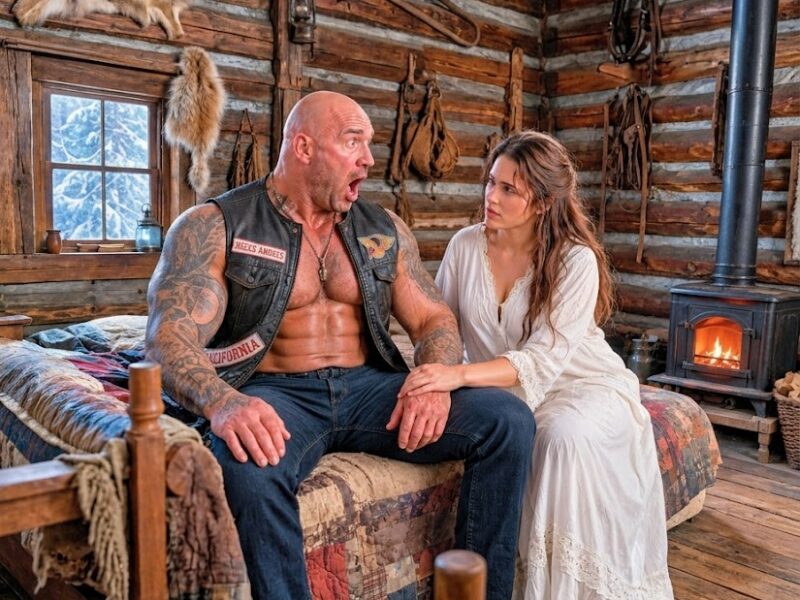
“Can You Make Me Feel Safe Tonight?” the Mail-Order Bride Asked—The Shy Hells Angel Whispered One Word
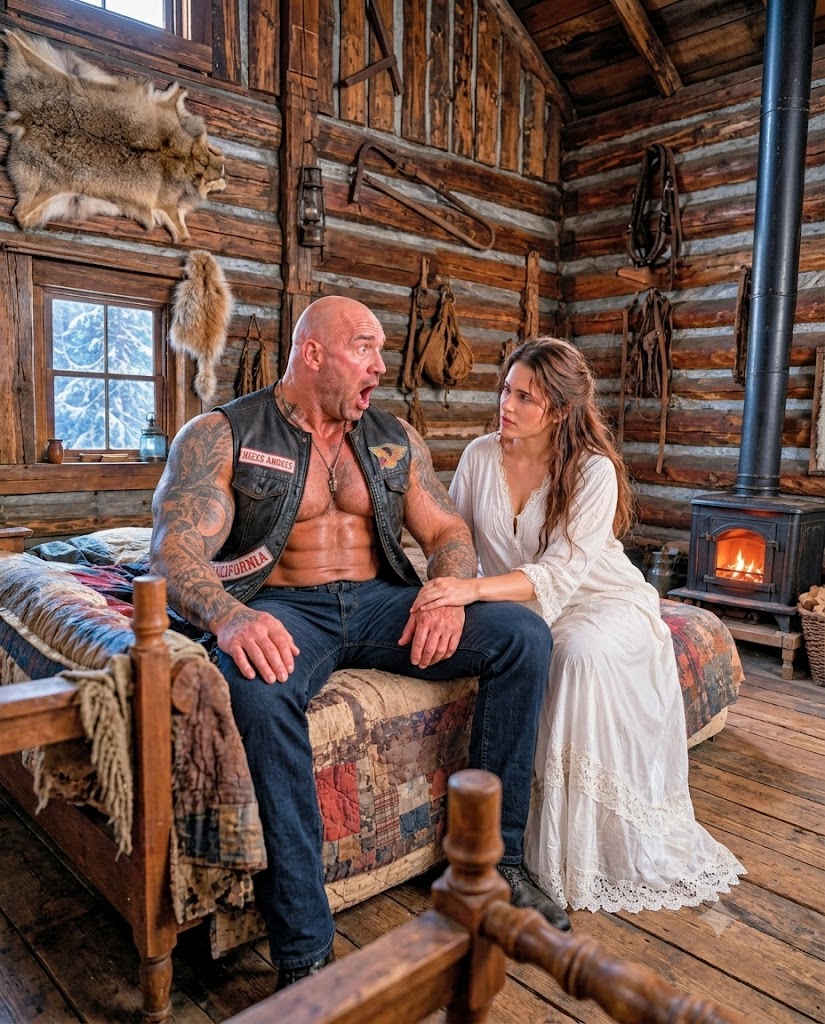
The coffee mug shattered against the tile floor like a pistol shot in church. Hot coffee splashed across Ruth’s bare legs and she flinched back, biting down on the cry that tried to climb her throat. A man’s hand shot out and grabbed her wrist, twisted it hard until she bent sideways over the counter, her hip banging the Formica.
Fork stopped moving, suspended halfway to a trucker’s mouth. Nobody at the lunch counter said a single word. The man leaned in close enough that she could smell the beer on his breath, the sourness of it, the way it mixed with the onions from his plate.
He said something low and ugly that made her face go white. She did not pull away, did not cry, just stood there and took it the way she had learned to take everything.
Her name was Ruth, and the quiet old man two stools down slowly set his coffee cup in its saucer with a click that sounded like a judge’s gavel. What did that old man do next that made a two-hundred-pound bully go pale and completely still?
Stay with me on this one.
The diner sat alone off Old Route 66, a low cinder block building with a gravel lot and a sign that hadn’t worked right in years. Twenty miles east of Barstow, where the Mojave stretched out like a dead ocean and the heat shimmered off the asphalt in waves that looked like water but weren’t. Nothing around it but scrub and heat and the long gray line of the highway, a place where the wind tasted like dust and regret.
Truckers knew it. Bikers knew it. If you were driving that stretch and you were hungry, Klay Dunmore’s place was the only thing for forty minutes in either direction, and the coffee was always hot, and the eggs were always done right.
Klay ran it himself, sixty-one years old, lean, with a white beard cut close and hands that had seen a lot of hard work. People called him Preacher, though he’d never preached a day in his life. The name came from the way he talked, slow, quiet, like every word cost him something, like he was paying for each one out of a pocket that wasn’t deep.
He didn’t raise his voice. He didn’t need to. When Preacher said the kitchen was closed, the kitchen was closed, and that was the end of it.
He’d buried his wife four years back, cancer, the kind that eats a person from the inside out while you watch and can’t do a thing but hold their hand and lie about how it’s going to be okay. He’d nursed her through the last of it right there in the little rooms behind the kitchen, closing early some nights, sitting with her when the pain got bad, reading to her from a Louis L’Amour paperback she’d read a hundred times already.
After she was gone, the place got quiet in a different way. He kept the coffee hot and the griddle clean, and he didn’t talk about her. The regulars learned not to ask, the way you learn not to poke a sleeping dog, the way you learn not to ask a man about the scar that runs up his arm.
A man can run a whole business on habit alone. For a few years, that’s exactly what Klay did. Open at five, close at nine, turn the sign, do it again, the days bleeding into weeks into months until the calendar on the wall behind the register was just a thing he forgot to look at.
Then one morning in the spring, a woman stepped off the eastbound bus.
She had one suitcase, cardboard, held together with a belt, the kind of suitcase that told you everything about a person’s life without them saying a word. She walked the quarter mile from the stop in the heat, her shoes kicking up dust, her shadow walking beside her like a reluctant companion.
She came through the door, and the little bell above it jingled, and she asked if he needed help. Said her name was Ruth. Didn’t give a last name, didn’t give a story, just stood there holding that suitcase like it might run off without her if she let go.
Klay looked at her a long moment. He looked at the suitcase and at the way she stood half turned toward the door, like a woman who always kept one eye on the exit, like a woman who had learned the hard way that doors could close as fast as they opened.
Then he said there was an apron on the hook and the coffee needed making. That was the whole interview.
Ruth was maybe forty, hard to tell. She had the kind of face that had decided a long time ago not to ask anybody for anything, the kind of face that had learned to make itself small and useful and quiet. She worked like someone who was afraid the job would be snatched back if she slowed down, first one in, last one out, her hands always moving, always busy, always doing something.
She learned the regulars’ orders in three days. She never sat down. She flinched when a plate dropped, a quick little jerk of the shoulders, there and gone, like a ghost passing through.
Klay noticed that. He noticed the way she wore long sleeves in the desert heat, even in July, even when the thermometer outside the door hit a hundred and twelve. He noticed she never let anybody stand behind her, always positioning herself so her back was to a wall or a window or the pie case, always keeping the room where she could see it.
He noticed a lot of things and said none of them.
Now here’s the thing the counter crowd didn’t know, the thing that would have made every trucker and biker and working man in that diner sit up and pay attention if they’d known it.
Ruth didn’t even know that Klay knew.
Months before she ever stepped off that bus, Klay had done something he’d told no living soul. He’d placed an ad, a lonely man’s ad, in the back of a paper that ran such things, the kind of paper you bought at a truck stop and read in the cab of your truck with the windows rolled up so nobody could see what you were looking at.
The kind of ad a proud man is ashamed of the second he drops it in the mail. He’d written it four times before he mailed it, burned the first three in the sink, watched the paper curl and blacken and turn to ash, and then sat down and written it again because the silence in the rooms behind the kitchen had gotten too loud to bear.
A woman had answered. They traded letters all winter long, through the cold months when the highway went empty and the nights got long and the wind rattled the windows like it was trying to get in. She’d signed hers with a single letter, just R. He’d closed every one of his with a single word.
In those letters, a different Klay came out than the one who flipped eggs and said three words a day. He wrote about his wife, about the cancer, about the way he’d held her hand at the end and felt her go still. He wrote about the quiet, the way it filled the diner at night, the way it sat with him at the counter and ate breakfast and didn’t say a word.
He wrote that he’d about given up on the idea that a man his age had any business hoping for company, that he’d figured his time for that had passed, that he was just marking days until the clock ran out.
And R wrote back, careful, a little more each time, like someone testing ice before they put their weight on it. She never said much about herself, but she said enough for a patient man to read between the lines, the way you read the weather in the sky before a storm.
A man had hurt her, maybe more than one. She’d learned the hard way that promises were just words, that a man used to get what he wanted, that the ones who said the prettiest things were usually the ones who took the most.
Then the letter stopped, right when they’d gotten to the part where he’d asked her to come. Just stopped, like a radio going dead mid-song. And Klay figured that was that, figured he’d scared her off or she’d thought better of it, and he put the whole thing away in a drawer in his chest and went back to the coffee and the griddle.
And then a woman named Ruth, carrying everything she owned in a cardboard suitcase, got off a bus and asked him for a job instead of asking him for the life he’d offered her in those letters.
Klay was not a stupid man. He saw it the first morning in the way she watched him when she thought he wasn’t looking, the way her eyes followed him around the kitchen, measuring him, weighing him, looking for the man in the letters underneath the man in the apron.
But he was a patient one. He figured she had her reasons. So he said nothing. He waited and let her pour the coffee.
Then there was Dale Cray.
Dale came in most days around noon. Big man, loud, a contractor who did well enough to think it made him somebody, the kind of man who wore his truck like a personality and his wallet like a badge. He’d been coming to the diner for years, through the good times and the bad, and somewhere along the line he’d decided the place was his, and everyone in it was there for his amusement.
He had a way of filling a room before he was halfway through the door, his voice arriving ahead of him like a warning siren, his laugh bouncing off the walls and making the windows rattle.
He rode Ruth hard from the first week. Said her coffee was dishwater, snapped his fingers at her like she was a dog, called her sweetheart in a way that wasn’t sweet at all but was meant to put her in her place. Made her carry his plate back twice for nothing at all, then a third time just to watch her do it, his eyes tracking her across the floor like a cat watching a bird.
Ruth took it. She took all of it. She’d say, “Yes, sir. Sorry, sir,” and keep her eyes down, and that only made Dale meaner because a bully needs you to push back a little so he can tell himself it’s a fair fight. When you don’t give him that, he just keeps leaning until he finds the floor, until he finds the thing that breaks you, and then he leans on that.
The more she shrank, the bigger he got. It fed him, the way a fire feeds on dry grass, the way a man like that feeds on the smallness of others.
Klay watched from the end of the counter where he always sat, his coffee cup at his elbow, his hands still, his eyes missing nothing. He didn’t step in. Not yet. Ruth had made it clear in a hundred small ways that she needed to stand on her own, that a man fighting her battles was a thing she’d had before, and it had cost her more than she’d ever say.
There had been a protector once, Klay figured, and the protecting had turned into owning the way it sometimes does, the way a hand that reaches out to help can close into a fist before you even see it coming. So Klay held his tongue and kept his coffee hot and waited for the day Dale went too far. He’d know it when he saw it.
A man who’d spent two tours in a war learns the difference between a loud man and a dangerous one. Dale wasn’t dangerous. Not yet. But loud men go looking for the edge, and sooner or later they find it.
That day came on a Thursday.
The lunch rush was on, every stool full, both booths taken, two tables of truckers, and three bikers who’d rolled in off the highway and were working through plates of eggs in the corner, their leathers creaking when they moved, their patches bright against the dark of their vests.
Ruth was moving fast, balancing four plates up one arm, calling orders back to Klay at the griddle, her voice steady, her hands sure. For a minute there, if you didn’t know better, it looked like an ordinary noon in an ordinary place, the kind of place where nothing ever happens and that’s the whole point.
And Dale was three beers into a liquid lunch he had no business having before he climbed back in his truck. He’d heard something, that was the trouble. Somebody in town had been talking, the way people in small towns do when they’ve got nothing better to do than chew on other people’s business.
What they’d been saying was that the new waitress out at Preacher’s Place hadn’t just wandered in off the road, that she’d come answering an ad, a mail-order woman, bought and paid for, the way people put it when they want to make a decent thing sound dirty.
Dale loved that. He loved having a card nobody else at the counter had, a piece of information he could play when the room was full and the attention was on him. He’d been sitting on it a couple of days, waiting for a crowd big enough to make it worth playing.
It started small, the way it always does. “Hey, hey, mail-order.” He said it loud enough for the whole room, loud enough for the truckers to look up from their eggs, loud enough for the bikers to go still in their corner booth.
Ruth kept moving, set down a plate, didn’t look up. “I’m talking to you.” Dale’s voice had that edge now, the edge that said he wasn’t going to let it go. “They tell me you come out of a catalog. That true? You got a price on you like the pie?”
A couple of men laughed because they were nervous, the kind of laugh that comes out of a man’s mouth before he can stop it, the kind of laugh that dies in the air. Most didn’t laugh. Most just looked at their plates and wished they were somewhere else.
Ruth’s hands were shaking a little now, and she pressed them flat against her apron to stop it. She kept working. Pour the coffee. Clear the plate. If she just kept moving, maybe it would pass. It had always been her plan, keeping moving, make yourself small and useful, and maybe the storm goes around you.
“Come on,” Dale said, turning on his stool, grinning that wet grin, the one that showed his teeth and nothing behind them. “Don’t be shy. A man wants to know what he’s buying. They mail you out in a box? Some holes punched in the top so you can breathe?”
“Dale.” One of the truckers said it low, a warning, the way you’d warn a man about a rattlesnake he hadn’t seen yet.
But Dale was rolling now. He had the floor and the beer and the crowd, and that was all a man like him ever really wanted, that feeling of being the center of the room, the thing everyone was looking at, the thing everyone was afraid of.
He reached out as Ruth passed and caught her by the apron string, pulling her up short, her tray wobbling, a coffee mug sliding off and shattering on the floor. Hot coffee went everywhere, splashing across her legs, and she jumped back, and that was when his hand shot out and closed around her wrist and twisted, and he pulled her down over the counter and leaned in close.
“Tell you what,” he said, quiet now, just for her, but everyone heard it because the room had gone dead silent, the kind of silence that has weight, that presses down on you. “You come out to the lot after your shift. I’ll pay better than he does. Let’s see what the catalog’s selling.”
That was the ugly part. That was the thing that made her face go white, the color draining out of it like water running out of a sink.
And then Dale let her go, just like that, laughed loud, waved a hand like he was swatting a fly, and said, “Oh, I’m just funning with her. Clean that up, honey. You’re making a mess.”
He sat back down, picked up his beer, and the terrible thing is the room let out its breath. A couple of men chuckled, relieved, the way people are relieved when the storm passes and they can go back to pretending it was never there. The truckers went back to their plates. It was over, they figured. Just Dale being Dale. Ugly, sure, but over.
Ruth knelt down with a rag and started picking up the broken glass with shaking fingers, her head down so nobody could see her face. The blood welled up on her fingertips where the glass had cut her, bright red against the white of the rag, and she didn’t even seem to notice.
And Klay Dunmore, down at the end of the counter, slowly set his coffee cup in its saucer. The room thought that meant it was finished.
What nobody saw was the folded piece of paper that had slipped out of Ruth’s apron pocket when Dale yanked her over the counter. It had fallen to the floor by his boot, and while she was down on her knees picking up glass, Dale reached down, quiet, and palmed it.
He unfolded it under the lip of the counter, his eyes moving across it slow, his lips working a little the way they do with a man who doesn’t read much. And that wet grin came back wider than before, wider and meaner and hungrier.
“Well, now,” Dale said, standing up off his stool. “What’s this?”
Ruth looked up, and when she saw what was in his hand, something in her face just collapsed, the way a building collapses when you take out the supports, all at once and then nothing but dust.
It was one of the letters. One of Klay’s letters. The one she kept folded against her chest like it was the only warm thing she owned, the one she’d read so many times the creases had worn soft as cloth.
She lunged for it and Dale held it up high, out of reach, laughing, his arm stretched up like a boy tormenting a smaller kid on a playground.
“No, no, no. This is good. This is real good.” He cleared his throat and started to read, loud, to the whole room, his voice booming off the walls. “Dear R, I know you’re scared. I know what a man did to you, and I know why you don’t trust the word of one.”
He looked around, delighted, his eyes bright with the joy of it. “Oh, this is rich. We got ourselves a love story.”
The room had gone a different kind of quiet now. This wasn’t the bully picking on the help anymore. This was something crueler, something that reached into a person’s chest and pulled out the thing they kept hidden, the thing they’d built walls around, and held it up for everyone to see.
He had her open on the floor, her secret, her shame, the one soft thing she had, and he was going to read it out loud to a room full of strangers for a laugh.
You could feel the men shifting. A couple looked at the floor. One of the truckers set down his coffee real careful, like he didn’t want to make a sound, like any sound would make it worse.
“Please,” Ruth said. It was the first time anyone in that diner had ever heard her ask for anything, the first time that word had come out of her mouth in six months. “Please don’t.”
“What did he do to you, honey?” Dale said, grinning down at her, turning the page over, his fingers thick and clumsy on the paper. “Your old man. Let’s find out. Let’s all find out together.”
And that right there was the moment the whole thing changed, because this wasn’t about a loudmouth and a waitress anymore. This was about a woman’s survival, the one wall she’d built to stay alive, and a man about to kick it down in front of the world for fun.
Take a woman who’s lost everything. Let her build one small safe thing, and then tear it open in a crowd. There’s not much lower a man can go. And Dale was going there smiling.
Down at the end of the counter, Klay Dunmore stood up.
He didn’t rush. He didn’t shout. He just rose off his stool slow, the way a man rises when his knees have a lot of miles on them, when his body has done things and been places and carries the memory of all of it in the way it moves.
He walked down the length of that counter with his boots loud on the tile, each step a small declaration, and the room had gone so quiet you could hear the griddle tick, could hear the hum of the refrigerator, could hear the blood in your own ears.
“Dale,” he said. “Give the lady her letter back.”
“Or what, Preacher?” Dale was still grinning, but it had gone tight at the corners, the way a grin does when the man wearing it starts to realize he might have miscalculated. “You going to pour hot coffee on me? Sit down, old man. We’re having fun.”
Klay stopped about four feet from him. He looked down at Ruth on the floor, at the glass and the blood on her fingers, and something in his face shifted, something that wasn’t anger exactly. It was older than anger. It was the thing that comes before anger, the thing that lives in a man who’s seen too much and decided a long time ago what he would and wouldn’t stand for.
Then he reached up and took hold of the zipper on his old leather jacket, the one he wore every day, summer and winter, the one nobody ever thought twice about, the one that was just part of the scenery like the busted sign and the gravel lot.
And he pulled it down.
Underneath was the vest. On the vest was the patch.
The three bikers in the corner booth were already on their feet. They hadn’t said a word. They didn’t need to. One look at the colors on Klay’s chest and all three of them stood up at the same time like a single man and turned to face Dale Cray.
And then the truckers started to rise. One, then two, then the whole table. Men who’d been eating their eggs a minute ago, big men, bolted-down working men, pushing back their chairs and standing up. Every one of them facing Dale.
They didn’t all know what the patch meant. Not exactly. But they knew what it meant that three hard men from a motorcycle charter had just stood for the quiet old cook. And that was enough.
Dale Cray stood there in the middle of a room where every single man was on his feet and not one of them was on his side, and for the first time in a long time, maybe for the first time in his life, he understood what it felt like to be small.
Now, if you’re still with me, do me a favor and hold on, because what Preacher did next is the part nobody in that diner ever forgot, and I don’t want you to miss it.
Klay didn’t throw a punch. I want you to understand that, because it matters. In twenty years riding with that charter, and before that a combat medic, two tours, he’d put more men back together than most men ever meet. He’d held boys together with his bare hands while the world came apart around them, had knelt in the mud with his fingers in a wound and told a kid to hold on, just hold on, help was coming.
He knew exactly what his hands could do, and he knew exactly how little it solved.
And he knew the strongest thing in that room was the one thing he hadn’t used yet. His voice.
“Son,” Klay said, and he said it soft, almost kind, which somehow made it worse. “You’ve been coming into my place for six years. I fed you when you were broke. I let you run a tab that winter your truck got repossessed. Your wife left that same winter, and you sat right there on that stool, and I poured you coffee till two in the morning, and I never said a word about any of it. You want to know why?”
Dale didn’t answer. His jaw was working, but nothing came out.
“Because my wife told me once that everybody who walks through that door is somebody’s whole world to somebody.” Klay said it slow, the way he said everything, each word a stone set carefully in a wall. “Even the loud ones. Even you. So I kept quiet for six years. I kept quiet.”
He took a step closer. Dale took a step back and bumped the counter.
“But you put your hands on her,” Klay said. “And then you went into her pocket. And now you’re standing in my place in front of these men reading out loud the worst day of a woman’s life so you can feel big.”
He shook his head slow, a man disappointed in a way that went deeper than anger.
“No. Not here. Not her. Not today.”
“I didn’t—” Dale started. “I was just—”
“You’re going to set that letter down on the counter,” Klay said, real gentle, like it was made of glass. “Because to her it is.”
For a second, Dale tried to find the old grin, the one that got him through everything, the one that had always worked before. He looked around the room for one face that might laugh with him. There wasn’t one. Not the truckers, not the man he’d bought drinks for sometimes, not the kid in the corner who always laughed at his jokes. Nobody.
The three bikers hadn’t moved. The nearest of them, a huge man with gray in his beard, just looked at Dale with the patient, bottomless calm of a man who had all the time in the world and no reason to hurry.
Dale’s hand was shaking now, a fine tremor that ran up his arm and into his shoulder. He set the letter down on the counter. Real gentle.
“Good,” Klay said. “Now you’re going to look at her, and you’re going to say you’re sorry, and you’re going to mean it, or you’re going to say it again until you do.”
Dale turned toward Ruth. She’d gotten to her feet by then, pressed back against the pie case, her bleeding hand held against her chest, her eyes wide and wet and watching.
Dale opened his mouth, and whatever was in there, whatever meanness he’d been running on his whole life, it just drained out of him all at once. His chin went soft. His eyes got wet. Because here’s the thing about men like Dale. Press hard enough, and there’s nothing underneath. Nothing at all. Just a scared boy who learned that being loud kept the herd away and never learned a single thing after that.
“I’m sorry,” he said, and his voice cracked when he said it, the way a boy’s voice cracks, the way a man’s voice cracks when he’s been holding something too long and finally lets it go. “I’m sorry, ma’am. I don’t—I don’t know why I—I’m sorry.”
Then his legs just went. He didn’t fall exactly. He sort of folded down onto the stool and then lower, one hand on the counter, and he sat there on the edge of it with his head down and his shoulders shaking. This big loud man come apart in the middle of a lunch rush.
Nobody laughed. Not one man in that room laughed, because there’s no fun in watching a thing that empty.
The gray-bearded biker walked over. He didn’t grab Dale. He put one hand on his shoulder, almost gentle, and said, “Come on, friend. Let’s get you some air. You’re done here for a while.”
And he walked Dale out the door into the hot white light of the parking lot, and the other two followed, their boots crunching on the gravel, their shadows long on the ground.
And that was the last time Dale Cray ever set foot in that diner.
Inside, nobody moved for a moment. Then one by one, the truckers sat back down, and somebody picked his fork back up, and the ordinary sounds of a diner started to come back the way they do, the clink of silverware, the murmur of conversation, the sizzle of something on the griddle.
Klay zipped his jacket up over the patch, slow, like it had never been a thing at all. He picked up a clean rag and came around the counter and knelt down and started picking up the rest of the broken glass himself, careful, piece by piece, so Ruth wouldn’t cut herself again.
“Sit down,” he told her, nodding at a stool. “Please. I’ve got this.”
And she did. She sat. And she watched this old man she’d worked beside for six months, this quiet man she thought she’d known, down on his bad knees cleaning up her broken mug. And she didn’t understand yet what she was feeling. She only knew that nobody had ever gotten down on the floor for her before. Not once in her whole life.
When the glass was gone, Klay stood up. He reached over and picked the letter up off the counter, his own letter, and he folded it back along its worn creases, careful, the way you’d handle something that had been read a thousand times.
Then he held it out to her. She took it, her fingers brushing his, and she looked up at him with the question all over her face. The question she’d been too scared to ask for six months. The question of how a diner cook twenty miles east of Barstow had come to be wearing colors under his jacket. And more than that, how he’d known, how he’d known exactly what Dale was about to read before he read it.
Klay leaned down close to her then, the way Dale had leaned down close, except there was nothing ugly in it. And he whispered so only she could hear.
“I wrote it,” he said.
Ruth went still.
“Dear R,” he said, quiet, from memory, not reading. “I know you’re scared. I know what a man did to you, and I know why you don’t trust the word of one.” He paused. “I wrote that in December at that table over there with a pot of coffee, trying to get the words right for a woman I’d never met who signed her letters with one letter because she was too afraid to sign her name.”
Ruth’s mouth opened. No sound came out.
“You got off that bus in April,” Klay said. “And you didn’t ask me for the life I offered. You asked me for a job. And I understood that, Ruth. I did. A woman who’d been promised things by a man before and had those promises turn into the thing she ran from. Of course you didn’t trust a letter. Of course you wanted to watch me first. See if I was what I said. See if the man matched the handwriting.”
He smiled just a little, the corners of his eyes crinkling.
“I figured that out the first morning. The way you looked at me when you thought I wasn’t looking. Measuring me.”
“You knew,” she said. It was barely a breath.
“All this time, you knew it was me.”
“I knew,” Klay said.
“Then why?” Her voice broke apart, the way a voice does when it’s been held together by will alone and the will finally gives out. “Why didn’t you say anything? Why’d you let me scrub your floors for six months? Why’d you let Dale—”
“Because it wasn’t my choice to make,” Klay said. “You’d had enough men decide things for you. I wasn’t going to be another one. I figured when you were ready, you’d tell me. And until then, I’d just keep the coffee hot and make sure you were safe. That was the whole plan. That was all of it.”
Ruth sat there with the letter pressed to her chest and six months of held breath finally leaving her body. And still, even now, there was a wall up. One last wall. The one that said, “Don’t believe it. Don’t you dare believe it.” Because the second you believe it is the second it gets taken away.
He could see it in her face. The not quite. The almost. So Klay said the one thing left to say. He closed every letter he ever wrote her the same way. One word at the bottom under his name, a word she had read a hundred times, folded against her heart on a bus and in a rented room and on the long walk down that highway.
He leaned in and he said it out loud for the first time.
“Stay.”
And that was the word that did it. Not the patch. Not the room full of men standing. Not even the apology. Just that one quiet word, the word from the bottom of every letter, said out loud in a voice that matched the handwriting.
After all, Ruth Avery put her face in her hands, this woman who did not pull away and did not cry, who had taken everything her whole life without a sound, and she finally, finally came apart. Not from fear, for once in her life. Not from fear.
Klay didn’t grab her. He didn’t pull her in. He just rested one hand, light as anything, on her shoulder, and he let her cry it all out right there at the counter with the lunch rush going quiet and kind around her. The truckers looked at their plates. Somebody turned the radio up a notch so she’d have a little privacy. That’s a kindness men know how to give when they can’t give any other.
It was a long time before she lifted her head. When she did, her eyes were red and her face was wet, but something underneath it had changed. The decision she’d made a long time ago, the one that said, “Don’t ask for anything.” It had cracked straight down the middle, and behind it was a woman who looked about twenty years lighter.
“Okay,” she said.
“Okay,” Klay said.
That was it. That was the whole agreement. Two people who’d said everything that mattered in letters all winter, saying the rest of it in two words over a counter full of broken glass and spilled coffee.
They got married that fall out back of the diner under the busted sign, with the three bikers standing up as witnesses and a parking lot full of trucks and motorcycles and working men in their clean shirts. The gray-bearded one gave the toast. He kept it short. He said that in all his years he’d known Preacher to be a man of very few words, and that it figured the woman who finally got all of them out of him would be the one worth every single one.
Ruth kept the letters in a tin box on the shelf over the register, the same tin box she’d carried in that cardboard suitcase, the one thing she’d kept from the life she’d run from. Sometimes on a slow afternoon, a new customer would ask about the old framed photograph beside it, the one of a lean man in a leather vest from years back, and Klay would just smile and say, “That was a long road and a long time ago,” and pour them a fresh cup, and that would be the end of it.
Dale Cray, they say, moved on a few months later. Nobody rode him out of town. Nobody had to. He just couldn’t stand to drive past that diner anymore. Couldn’t stand to be in a place where everyone had seen what was underneath all that noise. Which, if you think about it, was its own kind of justice. The quiet kind. The kind that doesn’t need a fist.
And Ruth. Ruth stopped flinching when the plates dropped. It took a while, but one day Klay noticed she didn’t jump anymore. And he never said a word about it, the way he never said a word about any of the things he noticed. He just kept the coffee hot.
She was the first one in and the last one out. Same as before. But now, at the end of every long day, there was an old man waiting to walk her home.
And every single night before the lights went off, he’d lean over and say the same word he’d written at the bottom of every letter. The word that had carried her across half a country and cracked her open at a lunch counter and given her back her own life.
Just the one word. Slow, like it cost him something.
“Stay.”
And she did.









