“Can You Help Carry My Brother’s Casket?” a Little Girl Asked One Biker—Then 700 Riders Arrived
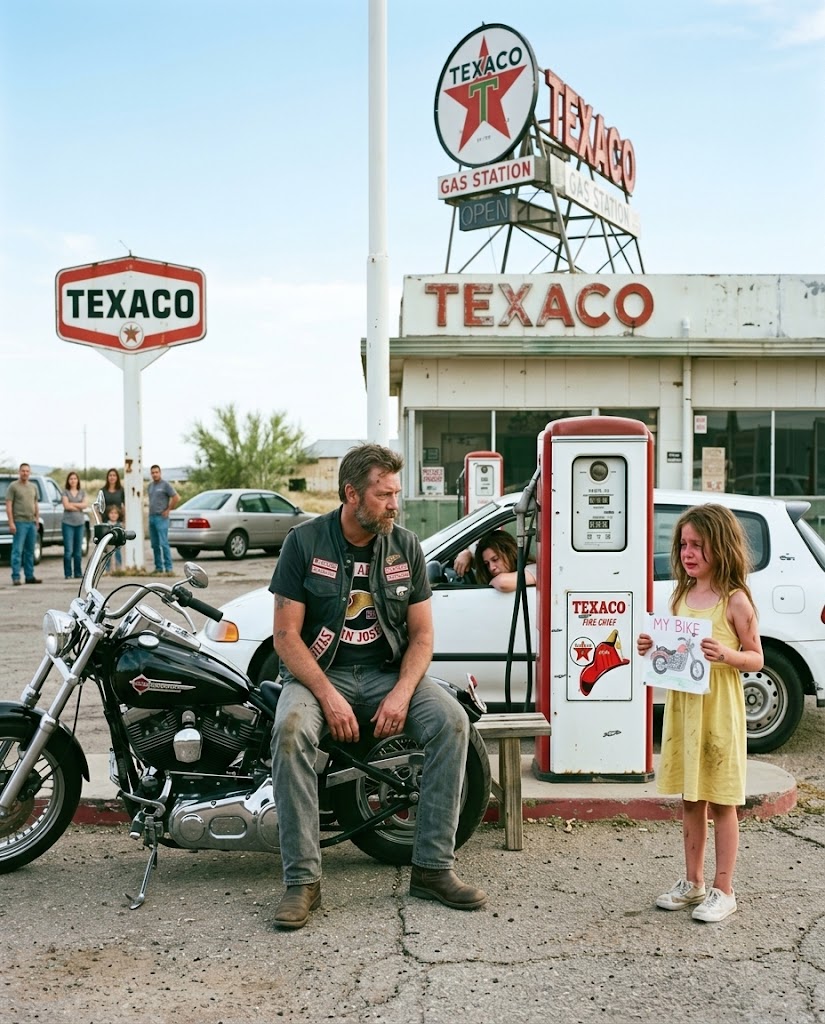
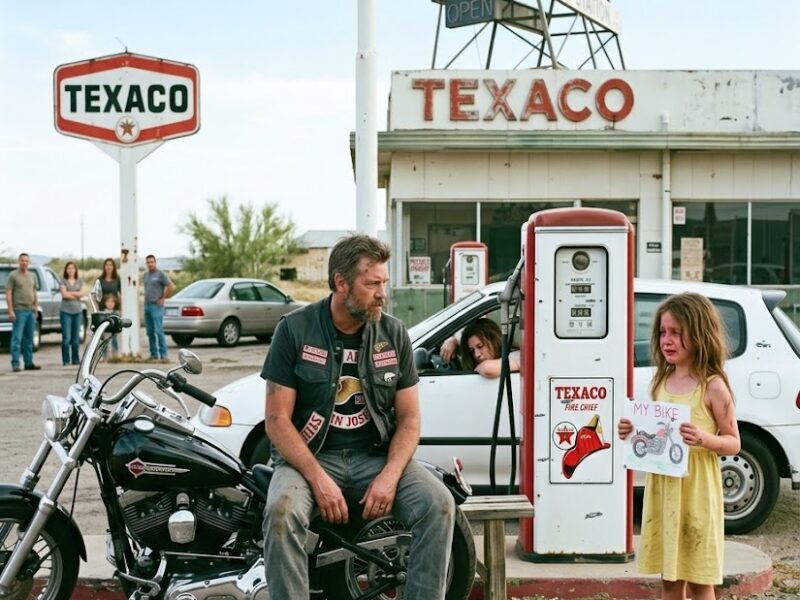
The oppressive summer heat bore down as the old panhead’s exhaust clicked and ticked, slowly cooling. Cade smelled like stale nicotine, road grit, and yesterday’s bad decisions. He wasn’t a hero. He was a 50-year-old man with a bad back and a wrap sheet, wearing a patched leather vest that explicitly warned polite society to look the other way.
Then came the hesitant tug on his heavy denim jeans. A little girl, barely eight, looking past the grim reaper on his back, straight into his bloodshot eyes. “Can you carry my brother’s casket?” she asked.
The asphalt of the Texaco parking lot was practically melting, releasing a chemical tar stench that mixed poorly with the smell of old coffee radiating from Cade’s paper cup. It was Tuesday, 2:00 in the afternoon. Cade sat on the curb next to his bike, massaging a dull ache in his left knee, a souvenir from a crowbar in a bar fight back in 2009. He dragged heavily on a Winston, letting the harsh smoke fill his lungs before exhaling it in a thick, lazy stream into the humid air.
He didn’t notice her at first. Kids usually gave him a wide berth. Mothers actively pulled their offspring to the other side of the gas pumps when they saw the winged death head patched on his back. That was the point. The patch wasn’t an invitation. It was a barricade.
But this kid didn’t get the memo. She was small, maybe seven or eight, wearing a faded yellow sundress that had a localized stain of what looked like melted cherry popsicle down the front. Her sneakers were scuffed white canvas, the laces on the left one dangerously untied. She stood about three feet away, staring at him. Not at the bike, not at the patch, at his face.
Cade scowled. It was a reflex. The kind of scowl meant to send tourists scurrying back to their minivans. “Beat it, half pint,” he grunted, his voice sounding like boots grinding on gravel. He flicked his cigarette ash toward the storm drain.
She didn’t flinch. She took a step closer. Up close, Cade noticed her eyes were red-rimmed, puffy, the skin underneath a pale, bruised purple that spoke of nights spent staring at the ceiling. She was clutching a piece of crumpled blue-lined notebook paper in her right hand, her knuckles white from the pressure.
“My name is Lucy,” she said. Her voice was thin, reedy, but it didn’t shake.
Cade sighed, rubbing a hand over his deeply lined face, feeling the familiar coarse scratch of his beard. “Look, kid, I ain’t lost. You ain’t lost. Go find your mom.”
“My mom is crying,” Lucy said flatly. She pointed a tiny, dirty finger toward a rusted silver Honda Civic idling by the air pump. Through the smeared windshield, Cade could see a woman slumped over the steering wheel, her shoulders heaving in erratic, violent spasms.
A cold, unwelcome knot tightened just beneath Cade’s ribs. He hated this. He dealt in debts, violence, and the rigid politics of the 1% world. He didn’t do tears. He didn’t do collateral damage.
“Listen,” Cade started, trying to moderate the natural growl of his voice and failing. “Whatever’s going on—”
“My brother liked motorcycles,” she interrupted. She thrust the crumpled piece of notebook paper toward him.
It was an instinctual reaction to take it. The paper felt damp, probably from the sweat of her palms. Cade smoothed it out against the denim of his thigh. It was a drawing done in heavy, pressed-down ballpoint pen. A chopper, extended forks, ape hangers, a bar. It was remarkably detailed for a kid’s sketch. At the bottom, written in jagged, blocky letters, were the words, “Ride free.”
“He drew that,” Lucy said, watching Cade’s face. “His name was Toby. He was 15.”
“Was?” Cade muttered the word, slipping out before his brain could stop it.
“He died on Saturday,” she said, delivering the news with the blunt, terrifying honesty that only young children possess. “He took all of mom’s sleeping pills because of the boys at school. They shoved his head in the toilet and filmed it. They posted it.”
Cade stared at the drawing. The cheap blue ink seemed to blur. He swallowed, his mouth suddenly tasting of copper and ash. He didn’t want to hear this. He wanted to swing his leg over his bike, kick the starter, and let the deafening roar of the exhaust drown out the miserable, pathetic reality of the civilian world.
“I’m sorry for your loss, kid,” Cade said stiffly. He tried to hand the paper back. She didn’t take it.
“Toby hated the church,” she continued, her voice finally catching a small tremor vibrating through her tiny frame. “He hated the kids there. They all laughed at him. The funeral is tomorrow. My mom doesn’t have anyone to carry the box. My dad left a long time ago and my uncles live in Ohio.”
She looked up, and for the first time, Cade saw the sheer unadulterated desperation in her face. It mirrored the look of guys he’d seen bleeding out on the roadside. The realization that the world was entirely indifferent to their pain.
“I saw your jacket,” Lucy said. “Toby said you guys are outlaws. He said outlaws don’t care what normal people think. The normal people at school killed him.” She paused, wiping a string of snot from her nose with the back of her hand. “Can you carry my brother’s casket?”
Cade froze. The ambient noise of the gas station—the hum of the fluorescent lights, the distant wail of a siren on the interstate, the mechanical clicking of his cooling engine—all of it faded into a thick, suffocating silence. He looked at the little girl, then down at the drawing, then over at the weeping mother in the rusted Honda.
“I ain’t a good man, Lucy,” Cade said quietly, the cynicism bleeding out of his voice, leaving only a dry, hollow truth. “I’m the last guy you want at a church.”
“I don’t want a good man,” Lucy said, staring directly at the Hell’s Angel’s patch on his chest. “I want a monster, so the kids who hurt Toby will be scared.”
Cade’s breath hitched. He looked at the crude drawing in his massive, calloused hand. He carefully folded the blue-lined paper and slid it into the breast pocket of his cut, right over his heart. “Where and when?” he asked.
The clubhouse smelled like it always did. A pungent cocktail of stale Pabst Blue Ribbon, Pine-Sol masking older unidentifiable odors, and the heavy metallic tang of unwashed leather. The blinds were drawn tight against the late afternoon sun, casting the main room in a perpetual gritty twilight. Cade walked through the reinforced steel door, the heavy deadbolts clanking shut behind him. He didn’t stop at the bar. He bypassed the pool table where three prospects were quietly cleaning cues, their eyes darting nervously toward him.
He headed straight for church, the back room with the massive scarred oak table where the fully patched members handled the club’s business. There were 12 men at the table. To a civilian, it would look like a gathering of nightmares, heavily tattooed, scarred, wearing the miles of the road on their faces like topographical maps of bad decisions.
At the head of the table sat Boon, the president. Boon was a massive man with a thick silver beard and eyes like chipped flint. He was in the middle of discussing a supply route issue when Cade pulled out a heavy wooden chair and sat down. The room fell silent. It wasn’t a scheduled meeting for Cade to interrupt.
“You’re late, Cade,” Boon rumbled, his voice echoing off the corrugated tin walls. “And you look like you swallowed a wasp.”
Cade didn’t apologize. He reached into his breast pocket, pulled out the folded blue-lined notebook paper, and tossed it onto the center of the scarred wood. It sat there glaringly out of place among the empty beer bottles, scattered shell casings used as ashtrays, and switchblades.
“What’s this?” asked Dutch, the sergeant-at-arms, leaning forward. He was a wiry, twitchy guy who looked perpetually ready to throw a punch.
“A kid’s drawing,” Cade said. He leaned back, crossing his arms over his chest. He felt ridiculous. He felt exposed. It made him angry. “Kid named Toby. 15 years old. Ate a bottle of sleeping pills this weekend because the local high school golden boys thought it would be funny to use him as a mop.”
Dutch sneered, a short, ugly sound. “Tragic. Since when did we become the suicide hotline? We got real problems, Cade. The Mongols are pushing up on the northern border, and you’re bringing us high school drama.”
“I was asked to carry the casket,” Cade said, his voice dropping an octave, carrying a subtle, dangerous edge.
Boon raised a thick eyebrow. “By who?”
“His little sister. Eight years old. Confronted me at the Texaco on Fourth.” Cade looked around the table, meeting the eyes of men he had bled with, men he had gone to jail for. “She said she didn’t want good men at his funeral. She wanted monsters to scare the kids who put her brother in the ground.”
A heavy silence descended on the room. The only sound was the hum of the ancient window AC unit struggling against the heat.
“We ain’t a charity, Cade,” spoke up a guy named Wyatt, tracing the rim of his beer bottle. “We show up at a suburban church, the cops are going to swarm. The town will panic. It’s a heat score.”
“I know what it is,” Cade snapped, slamming his hand flat on the table. The sharp crack made a prospect flinch in the other room. “You think I want to put on a suit and listen to a priest talk about God’s plan? There is no plan. That kid got chewed up by the same polite, sanitized society that looks at us like we’re a disease.”
He stood up, pacing the short length of the room. The leather of his vest creaked.
“We ride around with 1%er on our chests,” Cade pointed a thick, calloused finger at Dutch. “We say we reject their rules. We say we live outside their system because their system is broken. Well, their system just pushed a 15-year-old kid into a coffin because he didn’t wear the right clothes or play football, because he liked choppers.” Cade pointed at the drawing on the table. “Because he looked up to us.”
Dutch looked down at the drawing. He didn’t say anything.
“The funeral is tomorrow at 10:00 a.m. St. Jude’s on Elm,” Cade said, his chest heaving slightly. He felt a weird, alien knot in his throat and swallowed it down with pure spite. “I’m going. I’m carrying the box. I don’t care if I go alone, but I figured I’d bring it to church.”
Boon sat perfectly still. He reached out with a massive, scarred hand and pulled the piece of paper toward him. He stared at the jagged, heavily inked chopper. He stared at the words, “Ride free.”
Boon had a son who died 20 years ago. Overdose. Nobody ever talked about it. Nobody dared.
Boon slowly slid the paper back to the center of the table. He looked up at Cade.
“You ain’t carrying it alone,” Boon said softly. The flint in his eyes had sparked into something else, something dark and protective.
Boon looked around the table. “How many chapters we got within a five-hour ride?”
Dutch blinked, caught off guard by the shift in the room’s gravity. He mentally calculated. “Statewide? Four. If we call across the state line, maybe six.”
“Why?” Wyatt asked.
“Start making calls,” Boon ordered, his voice suddenly sharp, carrying the absolute authority of the president.
“Boon, we’re talking about a Tuesday morning,” Wyatt protested weakly. “Guys have work, they have shifts.”
“Tell them to call in sick,” Boon growled, standing up. His massive frame dominated the room. “Tell the Nomad chapter. Tell the Riverside boys. Put the word out to every fully patched member, every prospect, every hangaround. I want every V-twin engine within a 300-mile radius in this town by 8:00 a.m. tomorrow.”
Cade stared at Boon, the reality of what had just been set in motion washing over him. He had expected maybe four or five guys to begrudgingly agree.
“We’re going to a funeral,” Boon said, looking down at his scarred knuckles. “And we are going to be exactly what that little girl asked for. We are going to be the monsters.”
The vote wasn’t even called. It didn’t need to be. The scrape of chairs pushing back against the concrete floor sounded like the racking of shotguns. Phones were pulled out. The air in the room shifted from stagnant apathy to electric, violent purpose.
Cade picked up the drawing, folded it, and put it back over his heart. He walked out to his bike, the ache in his knee completely forgotten.
Wednesday morning broke gray and heavy. The sky was the color of a bruised plum, threatening rain but stubbornly holding it back. The air was thick, damp, and smelled of ozone and damp pine needles. Cade was up at 5:00 a.m. He didn’t sleep. He spent the night polishing the chrome on his panhead until it mirrored his own exhausted, lined face. He ironed his black button-down shirt. He polished his boots until the scuffs from the road were hidden beneath layers of black wax. It felt like preparing for war.
By 7:00 a.m., Cade was sitting on his bike in the sprawling parking lot of an abandoned strip mall on the edge of town, the designated staging area. The mist hung low over the cracked asphalt. He wasn’t alone.
They started arriving just as the sun tried to burn through the cloud cover. At first, it was a distant, low-frequency rumble, a vibration you felt in your teeth before you heard it with your ears. Then they crested the hill on Route 9. A pack of 20, then 50, then 100. They poured into the parking lot like a river of black leather and chrome. The smell of unburned hydrocarbons, hot oil, and exhaust fumes quickly overpowered the damp morning air.
The noise was apocalyptic. It wasn’t just loud. It was a physical force, a concussive wave that rattled the dirty glass of the abandoned storefronts. Cade watched as the Riverside chapter rolled in, their bikes dripping with morning dew. Then came the Nomads, looking feral and road-weary, having ridden straight through the night. Guys he hadn’t seen in a decade nodded at him as they killed their engines. There were no smiles. There was no joking. The usual boisterous, chaotic energy of a motorcycle rally was entirely absent. There was only a grim collective silence beneath the mechanical ticking of hundreds of hot engines cooling down.
By 8:30 a.m., the strip mall lot was full. They were spilling out onto the grassy shoulders of the highway. Cade stood on the pegs of his bike to look back. It was an ocean of metal and men.
Dutch walked up holding a clipboard, looking bewildered. “Cade,” he said, having to shout slightly over the din of idling engines. “I stopped counting at 600. We got guys from three states away here. Some guys from a completely different MC asked for permission to ride at the back. We gave it.”
700 bikers. 700 hardened, scarred men standing in the damp morning chill for a kid they had never met.
Boon pulled his massive Road Glide to the front of the pack, right next to Cade. He killed the engine. The silence that rippled backward as 700 men shut off their bikes was deafening.
Boon didn’t give a speech. He just looked at Cade, gave a single sharp nod, and kicked his bike into gear.
“Let’s go to church,” Boon said.
The synchronized ignition of 700 heavy V-twin engines sounded like the earth cracking open. They rode in a 2×2 formation, tight and disciplined. Cade rode at the very front, directly to Boon’s right.
As they entered the city limits, the town stopped. People came out of diners holding coffee mugs, standing frozen on the sidewalks. Cars pulled over to the shoulders, their drivers staring wide-eyed at the endless procession of leather and roaring chrome.
The manicured, wealthy suburb where St. Jude sat was a place of pristine lawns, HOA rules, and quiet, polite cruelty. It was a place where bullying was swept under the rug as “kids being kids” as long as the aggressors were on the honor roll.
The Angels didn’t just drive through it. They invaded it. The rumble shook the leaves off the oak trees lining the streets. It rattled the windows of the colonial-style homes. Cade felt the vibration deep in his chest, a righteous, furious rhythm.
They turned onto Elm Street. St. Jude’s was a modern glass and stone structure. The parking lot was filled with luxury SUVs and sedans. The attendees—the parents of the bullies, the indifferent teachers, the kids who had filmed Toby’s torment—were lingering outside the main doors, wearing expensive black suits and tasteful dresses, murmuring in polite, hushed tones.
Then they heard it. Heads snapped toward the street. The polite murmurs died instantly.
Cade turned his bike into the church driveway. He didn’t rev his engine. He didn’t need to. The sheer overwhelming mass of the procession did the work. They flooded the parking lot completely, boxing in the BMWs and Audis. When the lot was full, they parked on the pristine grass, leaving deep tire ruts in the manicured turf. They parked on the sidewalks. They surrounded the church entirely.
Cade killed his engine and put the kickstand down. He swung his leg over, the leather of his boots crunching loudly on the gravel. Behind him, 700 engines died in a staggered, echoing wave. The silence that followed was heavy, suffocating, and terrifying to the civilians.
Cade adjusted his cut, feeling the crinkle of the blue-lined paper in his pocket. He looked toward the front steps of the church. The crowd of mourners had shrunk back, pressing against the glass doors in sheer unadulterated panic. They looked at the bikers as if a pack of wolves had just circled the flock.
And standing right in the middle of the terrified crowd, holding the hand of her trembling mother, was Lucy. She was wearing a black dress now, but the scuffed white sneakers were the same. She saw Cade. She saw the sea of patches behind him. And for the first time since he met her, a tiny, fierce smile broke across the little girl’s face.
The gravel of the church driveway crunched with a sound like grinding teeth beneath the heavy, oil-stained soles of Cade’s engineer boots. Behind him, the synchronized footfalls of 700 men created a low, rhythmic shock wave that you didn’t just hear—you felt it in your sternum. The air was thick, still smelling sharply of hot exhaust and unburned fuel, aggressively overpowering the subtle, damp scent of the suburban morning.
Cade kept his eyes locked on the front doors of St. Jude’s. The crowd of mourners had physically compressed themselves against the stone facade. It was a visceral animal reaction. They were a mass of charcoal gray suits, conservative black dresses, and pearls shrinking away from the advancing tide of denim, leather, and heavily inked skin.
As Cade walked up the wide concrete steps, the scent of the crowd hit him. A clashing, nauseating mixture of expensive sandalwood cologne, floral perfume, and sharp, acidic, nervous sweat. The civilians didn’t make a sound. There were no hushed whispers of indignation, no demands to know what was going on. Complete, paralyzing silence.
The crowd parted. They didn’t just step aside. They recoiled, pressing their backs flat against the brickwork, their eyes darting to the floor, terrified that making eye contact might invite violence. Cade walked straight down the newly formed human corridor. Boon was a half step behind his right shoulder. Dutch and a dozen other fully patched members flanked them, creating a solid, impenetrable wedge.
At the top of the steps, near the heavy oak doors of the sanctuary, stood Lucy. Her mother knelt beside her, a woman worn thin by grief, her face a blotchy canvas of burst capillaries and smeared makeup. She was clutching her daughter’s hand so tightly her knuckles were translucent.
A man in a meticulously pressed, cheap black suit stepped forward, holding a clipboard against his chest like a shield. His silver hair was sprayed stiff, and a drop of sweat was currently navigating the deep wrinkles of his forehead. He was the funeral director, a man used to managing grief, not heavily armed motorcycle clubs.
“Excuse me,” the director said. His voice cracked, sounding an octave higher than he likely intended. “This is a private service for the Miller family. You—You can’t be here.”
Cade stopped. The entire procession behind him halted instantly. The sudden lack of movement was somehow more intimidating than the march. Cade looked down at the man. He noticed the slight tremor in the clipboard, the way the man’s Adam’s apple bobbed convulsively. Cade didn’t say anything immediately. He let the silence hang heavy and suffocating, letting the man feel the full crushing weight of 700 unblinking stares.
“We’re here for Toby,” Cade finally rasped, his voice sounding like a rusty hinge.
“I don’t think you understand,” the director stammered, his eyes darting frantically to the polished brass handles of the church doors. “The family didn’t arrange for—for this. The church has a capacity limit. The fire marshal—”
A massive, scarred hand clamped down on the director’s shoulder. Boon stepped up, towering over the smaller man. Boon smelled of old leather and chewing tobacco.
“We are the arrangement,” Boon rumbled, his voice a deep, gravelly baritone that offered zero room for negotiation. He didn’t squeeze the shoulder, just rested his heavy hand there, a physical anchor. “We’re the pallbearers. And the rest of the club is here to pay their respects. We ain’t going to cause trouble. But we ain’t leaving.”
The director opened his mouth to protest, but a small voice cut through the tension.
“I invited them.”
Lucy stepped forward, gently pulling her hand free from her mother’s white-knuckled grip. She looked up at Cade, her small face pale and completely devoid of the terror that gripped the adults around her.
Her mother, Sarah, stood up. She looked at Cade, her eyes scanning the skull patch on his chest, the heavily tattooed arms, the deep ragged scar that cut through his left eyebrow. She looked at Boon, at Dutch, at the sea of hardened faces stretching all the way back to the highway. She looked terrified, utterly bewildered.
But underneath the panic, Cade saw something else. He saw the sheer hollow exhaustion of a woman who had spent the last four days fighting the world alone.
“Ma’am,” Cade said, pulling off his sunglasses and holding them in his left hand. The harsh morning light stung his bloodshot eyes. “Your daughter asked me to carry your boy. If you want us gone, say the word and you won’t see a single piece of leather in this town again. We walk.”
Sarah looked down at Lucy. The little girl gave a single, firm nod. Sarah took a ragged, shuddering breath. Her shoulders dropped slightly, a fraction of the tension leaving her spine. She looked back at Cade, tears brimming in her exhausted eyes.
“They told me he was just a weak kid,” Sarah whispered, her voice trembling so quiet Cade had to lean in slightly to hear her. “The school, the principal, they said kids can be cruel, but Toby just couldn’t handle normal teenage pressure. They blamed him.”
She looked out over the crowd of bikers, taking in the sheer massive presence of them.
“Carry him,” she said, her voice hardening, cracking with a sudden fierce grief. “Please carry my son.”
Cade gave a short, stiff nod. He turned to the funeral director, who was now sweating profusely through the collar of his shirt.
“Open the doors,” Cade said.
The director fumbled with the brass handles, pulling the heavy oak doors open. The blast of over-conditioned air from inside hit them, carrying the cloying, decaying sweet stench of funeral lilies. Cade hated lilies. They smelled like forced apologies and formaldehyde. They smelled like the desperate, sanitized lies people told themselves when someone died ugly.
Cade stepped over the threshold. The floor transitioned from concrete to a thick crimson carpet. He walked down the center aisle, his boots leaving heavy indentations in the plush fabric. The rest of the club followed. They filled the church. They filled the back pews, their massive frames taking up the space of two normal men each. When the pews were full, they lined the walls, standing shoulder-to-shoulder, a perimeter of black leather, denim, and steel. They stood in the aisles. They crowded the vestibule.
The civilian mourners trickled in behind them, huddling together in the front center pews, casting terrified sidelong glances at the men lining the walls. They looked like hostages.
Cade didn’t sit. He stood at the very front, off to the left side, right near the steps leading up to the altar. The casket was there. It was cheap wood stained a dark cherry, resting on a collapsible metal gurney with squeaky rubber wheels. It looked too small.
Cade stared at it, feeling the sharp corner of the folded notebook paper pressing against his chest from inside his breast pocket. He ground his teeth together, the muscles in his jaw ticking rhythmically.
The sanctuary of St. Jude’s was designed to inspire awe, with vaulted ceilings and massive, intricate stained glass windows that cast long, sickly beams of fractured blue and red light across the pews. Usually, it felt airy. Today, it felt like a pressure cooker. The air conditioning hummed aggressively, but it couldn’t compete with the body heat of nearly a thousand people packed into a space designed for 400. The smell in the room was a bizarre, jarring collision of worlds. The aggressive, sterile sweetness of the floral arrangements placed around the altar was constantly undercut by the heavy, masculine odor of damp wool, stale cigarette smoke, motor oil, and unwashed denim.
Father Thomas, a man in his late 50s with a soft, doughy face and wire-rimmed glasses, stepped up to the pulpit. He adjusted the microphone. The high-pitched whine of feedback echoed off the vaulted ceiling, making several people in the front pews flinch. The priest cleared his throat. He looked out over his congregation, his eyes sweeping past the familiar faces of the suburbanites and slamming into the solid wall of outlaw bikers lining the perimeter. He swallowed hard.
“We are gathered here today,” Father Thomas began, his voice lacking its usual theatrical resonance, sounding thin and reedy over the speakers. “To remember the life of Tobias Miller.”
Cade stood perfectly still, his hands clasped behind his back in a loose parade rest posture. He focused his eyes not on the priest, but on the third pew on the right. There they were. They were easy to spot, a group of five teenage boys wearing ill-fitting suits, their hair meticulously gelled, sitting with their parents. They were the local royalty—the linebackers, the point guards, the kids with college funds and athletic scholarships waiting for them.
The kid on the aisle seat, a thick-necked boy with a square jaw and a light blue dress shirt, was physically vibrating. He kept swallowing, his Adam’s apple jumping wildly. His knee bounced up and down in a rapid, uncontrollable staccato.
This was the kid Lucy had described to Boon in a brief, hushed conversation outside. This was Trent, the one holding the camera in the bathroom.
Cade stared at him. He didn’t glare. He didn’t scowl. He just locked his dead, flat, unblinking eyes onto the side of the boy’s head, projecting a cold, heavy intent.
“Tobias was taken from us too soon,” the priest droned on, falling back on the sanitized, prepackaged platitudes the church kept in reserve for suicides. “In times of tragic accidents, we struggle to understand God’s divine plan. We ask why, but we must remember that the Lord works in mysterious ways, and Tobias is now at peace, free from the earthly burdens that troubled his gentle soul.”
Tragic accident. The words hit Cade like a physical blow to the ribs. A hot, ugly spike of rage flared in his chest, burning away the cold detachment he usually carried. It wasn’t an accident. An accident was a blown tire on the interstate. An accident was a patch of black ice. Swallowing a fistful of Ambien because you couldn’t take another day of being hunted in the school hallways wasn’t an accident. It was a casualty.
Cade shifted his weight, his bad knee throbbing a dull, rhythmic warning. The leather of his vest creaked loudly in the quiet church. At the sound, Trent, the kid in the third pew, jumped. He couldn’t help it. Slowly, agonizingly, as if pulled by an invisible string, the teenager turned his head to look back.
His eyes met Cade’s. Trent’s face went entirely slack, the blood draining from his cheeks, leaving him the color of old parchment. Cade didn’t break the stare. He let the boy see the total, sociopathic lack of forgiveness in his eyes. Trent quickly whipped his head back to the front, staring rigidly at the altar, but the damage was done. The panic had infected the rest of the group. The boys sat completely frozen, terrified to whisper, terrified to move, suffocating under the collective gaze of 700 men who had spent their lives perfecting the art of violence.
The Angels didn’t make a sound. There was no coughing, no shifting of feet, no whispered conversations. It was a disciplined, weaponized silence. To the civilians, the stillness of the bikers was more terrifying than a riot. It felt like a held breath, an unnatural pause before a devastating explosion.
“We pray for his mother Sarah and his sister Lucy,” the priest continued, picking up his pace, visibly eager to get this over with. He wasn’t looking at the family. He was looking down at his notes. “May they find comfort in community and forgiveness in their hearts.”
Cade looked at Sarah. She was staring blankly at the dark cherry wood of the casket. She wasn’t crying anymore. She looked entirely hollowed out, a shell of a person running on the fumes of sheer shock. Lucy sat next to her, swinging her legs slightly, her scuffed white sneakers occasionally brushing the back of the pew in front of her. She looked incredibly small.
The hypocrisy of the room was a physical weight pressing down on Cade’s shoulders. These people, these neatly dressed, polite suburbanites murmuring prayers, were the same people who had looked the other way. The teachers who saw the bruises and said nothing. The parents who bought their kids the iPhones used to record the humiliation. They were all here playing their parts, washing their hands clean in the holy water of a sanitized funeral service.
I want a monster so the kids who hurt Toby will be scared. Cade felt the notebook paper in his pocket again. He realized with a startling clarity that Lucy had understood the assignment better than anyone in the room. She knew that polite society only responds to consequences. And right now, consequences were standing shoulder-to-shoulder, wrapping around the entire perimeter of the church, wearing leather and smelling of road dirt.
The priest finished his homily with a hasty sign of the cross. “We will now prepare for the procession to the cemetery. I ask the pallbearers to please step forward.”
The organist, a tiny ancient woman tucked away in the balcony, began to play a slow, mournful dirge. The heavy, vibrating chords filled the vaulted ceiling.
This was it. Cade stepped forward out of the shadows of the side aisle. The funeral director scurried toward the front, gesturing nervously toward the casket. Cade ignored him. He walked straight to the front left corner of the cheap cherrywood box. Boon stepped out from the opposite side, his massive frame moving with surprising silence on the thick carpet. He took the front right corner. Dutch and three other fully patched men—a giant of a man called Tiny, a scarred Nomad named Silas, and a quiet, broad-shouldered guy from Riverside known only as Preacher—stepped out of the crowd to take the middle and rear handles.
There were six of them. Six men who had carried illegal firearms, smuggled contraband, and brawled in parking lots, now standing around the pristine, polished box holding a 15-year-old boy.
The handles were cold brass, etched with a cheap, repetitive floral pattern. Cade slipped his large, calloused hands under the metal bar. He looked across the casket at Boon. Boon’s face was unreadable, carved from granite, his flinty eyes locked forward.
“On three,” Boon murmured, his voice barely carrying over the low hum of the organ. “One, two, three.”
They lifted. The casket cleared the collapsible metal gurney with a soft scrape. The weight hit Cade’s shoulders and lower back instantly. It was shockingly heavy. Not the physical mass of the boy—Toby had been scrawny, underweight—but the sheer density of the wood, the cheap metal lining, the finality of it all. It was dead weight in the most absolute, literal sense. The pull of gravity felt aggressive, as if the Earth was eager to claim the box and pull it down into the dark.
Cade’s bad knee flared instantly, a sharp, white-hot spike of pain shooting up his thigh and into his hip. He didn’t wince. He locked his jaw, the muscles in his cheek bulging, and shifted his weight to compensate, relying on the sheer stubborn strength of his back and shoulders.
The funeral director pulled the metal gurney away, collapsing it with a loud clatter that made several people in the front pews jump.
“Ready,” Boon commanded quietly.
They stepped forward. The walk down the center aisle began. It was agonizingly slow. The six men had to synchronize their gaits, matching the slow, shuffling steps required to keep the heavy box level. The leather of their cuts creaked rhythmically with every step. The heavy thud of their engineer boots on the crimson carpet sounded like a muffled drumbeat.
They approached the third pew. Trent and the other four boys were standing now, as was the custom as the casket passed. They were physically trembling. Trent was staring at the floor, his face pale, sweat beading on his forehead and rolling down the side of his neck into the tight collar of his dress shirt.
As they drew level with the pew, Cade deliberately slowed his pace by a fraction of a second. The other five pallbearers felt the shift in momentum and adjusted instantly, holding the casket practically still for a long, agonizing moment right beside the boys.
Cade turned his head. He looked directly at Trent. He didn’t say a word. He didn’t make a threat. He just let the sheer, suffocating reality of his presence, the presence of the casket he was carrying, and the presence of the 700 men watching them settle over the boy.
Trent looked up, unable to stop himself. He met Cade’s eyes. In that moment, Cade saw the illusion break. The arrogance of youth, the protective bubble of suburban wealth, the belief that actions didn’t have consequences—it all shattered. The boy looked at the rough, scarred face of the biker, looked at the heavy cherrywood box mere inches from his chest, and he began to cry. Not a loud, performative sob, but a silent, terrified weeping, his breath hitching in his chest, tears spilling over his eyelashes.
Cade held the stare for one second longer, letting the fear permanently brand itself onto the kid’s psyche. Then he looked forward again. They resumed their slow march.
Behind them, the congregation fell in, following the family. The bikers lining the walls didn’t move. They remained locked in place, a silent honor guard, forcing the civilian mourners to walk the gauntlet between them.
The air in the church felt heavier the closer they got to the doors. The smell of the lilies was thick in the back of Cade’s throat, making him want to spit. The brass handle dug into his palm, the friction rubbing against a thick callous.
They reached the vestibule. The heavy oak doors were propped open. Stepping out of the air-conditioned sanctuary and into the gray, humid morning air was like walking into a damp sponge. The sky hadn’t broken. It was still a bruised, oppressive plum color. The air smelled of impending rain and wet asphalt, completely washing away the cloying stench of the church flowers.
A black Cadillac hearse was parked at the bottom of the concrete steps, its rear doors wide open, revealing a track of chrome rollers.
The six men carried the casket down the steps. The weight felt different out here—less oppressive, more real. They reached the back of the hearse.
“Up and in,” Boon instructed.
They hoisted the box, lifting it over the bumper and settling the front edge onto the chrome rollers. The sound of the wood scraping against the metal track was loud and final. With a synchronized shove, they rolled the casket deep into the cavernous back of the vehicle.
Cade let go of the handle. He stepped back, rolling his shoulders, feeling the tension uncoil in his lower back. He rubbed a hand over his face, feeling the grit of the road still embedded in his skin.
He turned around. The entire parking lot, the grassy shoulders of the street, the sidewalks—everything was completely silent. 700 men stood by their bikes, watching. The only sound was the distant cawing of a crow in the oak trees.
Sarah and Lucy walked down the steps, accompanied by the nervous funeral director. Sarah stopped at the back of the hearse, placing a trembling hand on the dark wood of the casket. She closed her eyes, letting out a long, shuddering breath.
Lucy walked over to Cade. She looked up at him. She didn’t say thank you. She didn’t need to. She reached into the pocket of her black dress and pulled out a small, slightly crushed pack of Cherry Pez. She held it out to him.
Cade looked at the small plastic dispenser, then at the little girl. He reached out with his massive, scarred hand and took it, slipping it into the pocket of his jeans.
“We ride to the cemetery,” Boon said, his voice carrying across the silent lot.
Cade walked toward his panhead. He didn’t feel heroic. He didn’t feel like a good man. He just felt tired, his knee aching, his chest heavy with the crumpled piece of blue-lined paper sitting over his heart. But as he swung his leg over the saddle and reached for the ignition switch, he knew one thing for absolute certain. The monsters had shown up, and they weren’t done yet.
The collective ignition of 700 heavy motorcycles didn’t just break the silence. It obliterated it. It was a mechanical thunderclap that reverberated off the brick facade of the church, rattled the stained glass, and vibrated up through the soles of Cade’s boots into his aching knee. The air instantly thickened with a blue-gray haze of exhaust, the sharp, acidic bite of unburned hydrocarbons stinging his nostrils.
Cade kicked his panhead into gear with a heavy thrust of his heel. The transmission clunked, a solid, satisfying engagement of steel on steel. He let the clutch out slowly, feeling the immediate torque pull of the engine as the massive rear tire bit into the gravel.
The hearse led the way, its red taillights glowing dimly against the bruised overcast sky. The funeral director drove with white-knuckled rigidity, terrified of the army of leather and chrome tailgating his pristine Cadillac. Behind the hearse came Sarah’s rusted Honda Civic, driven by a neighbor, and then the long, pathetic line of expensive suburban SUVs and sedans.
And surrounding them all, an iron river of outlaws. Boon took the left flank of the hearse. Cade took the right. The rest of the pack fell in behind, a massive, unbroken column that stretched for blocks.
They rolled down Elm Street at a crawling 20 mph. The heat radiating off the engine block baked Cade’s thighs, mixing with the humid, heavy air to create a suffocating microclimate around his bike. He didn’t mind it. The heat, the vibration, the deafening roar—it was a sensory overload that usually brought him peace. But today, the heavy cherrywood box sitting in the back of the Cadillac anchored his thoughts, dragging them down into the miserable reality of the errand.
As they approached the main intersection of town, a four-way stop usually governed by a sleepy traffic light, Cade saw two local police cruisers parked diagonally across the intersection. The light bars were flashing, casting erratic, strobe-like reflections off the chrome of the approaching bikes. Two officers stood outside their vehicles wearing high-visibility vests. They looked young, jumpy, their hands resting uncomfortably close to their duty belts.
They had clearly been dispatched to manage the procession, but as the vanguard of the club crested the hill, Cade saw the exact moment the cops realized the sheer scale of the problem. You can pull over one biker. You can harass 10. You do not dictate terms to 700.
Dutch and three other Nomads accelerated, their engines howling as they broke formation and shot forward. They didn’t slow down for the cruisers. They swerved around the front bumpers, sliding their heavy bikes sideways into the intersection, effectively barricading the cross traffic themselves. They were corking the intersection, an illegal, highly aggressive maneuver to ensure the procession wouldn’t be broken up.
The young cops didn’t say a word. They just stepped back, pressing themselves against the doors of their cruisers, allowing the massive, roaring column to blow through the red light. Cade rode past them, his face an impassive mask. He felt the hard plastic rectangle of the Pez dispenser in the right pocket of his jeans pressing into his thigh with every shift of his weight. Over his heart, the blue-lined notebook paper crinkled slightly beneath his leather cut.
He watched the town roll by. The manicured lawns, the pristine storefronts, the coffee shops with their chalkboard menus. People stood on the sidewalks holding their phones up, recording the spectacle. They were gaping, pointing, treating it like a parade.
Cade felt a surge of hot, bitter disgust rise in the back of his throat. These people were recording a funeral for a kid their community had casually destroyed. They wanted the spectacle. They wanted the gritty, raw edge of the bikers riding through their sanitized streets, but they didn’t want the messy, ugly reality of the dead boy in the hearse.
He gripped the throttle tighter, his knuckles turning white beneath his leather gloves. He gave the grip a sharp, violent twist. The old panhead snarled in response, the exhaust pipes spitting a sharp retort that echoed off the storefronts, making a group of onlookers flinch and step back. Good, Cade thought. Flinch.
The cemetery was three miles outside the city limits, situated on a rolling hill that overlooked the valley. As they turned onto the winding two-lane road leading up to the gates, the gray sky finally gave way. It didn’t rain—it misted. A fine, pervasive drizzle that hung in the air like a cold sweat. It immediately coated the chrome in a dull film and made the black leather cuts glisten. The drops hit Cade’s hot engine block and instantly vaporized with a sharp hiss, filling the air with the smell of wet metal and hot oil.
They passed through the wrought-iron gates of Oakwood Memorial. The contrast was jarring. The cemetery was a vast, sprawling expanse of perfectly manicured emerald green grass and polished granite markers. It was quiet, peaceful, and entirely artificial. The roar of 700 unbaffled exhaust pipes shattered the tranquility.
The hearse navigated the narrow, winding asphalt paths, finally pulling to a stop near a freshly dug plot on the crest of the hill. A green canvas canopy had been set up, and a strip of bright, unnatural Astroturf was laid over the mound of excavated dirt—a pathetic attempt to hide the raw, brown reality of the earth.
Cade killed his engine. The synchronized shutdown of the pack echoed across the rolling hills like rolling thunder fading into the distance. Kickstands went down in a massive, metallic wave. They didn’t park neatly. There wasn’t room. Bikes were angled onto the pristine grass, heavy tires sinking into the soft, rain-soaked earth, leaving deep, muddy ruts. The club was a blunt instrument, and they were leaving their mark on the sanitized landscape.
Cade swung his leg over, the ache in his knee spiking sharply with the cold dampness creeping into the air. He unclipped his helmet, hooking it over the bar, and ran a thick, scarred hand through his thinning, sweat-dampened hair. He looked toward the canopy. It was time to put the boy in the dirt.
The smell of the cemetery was different from the church. There were no lilies here. Instead, there was the sharp, metallic scent of ozone from the mist, the sweet smell of crushed grass underneath heavy boots, and the deep, loamy stench of freshly turned earth bleeding through the fake Astroturf.
Cade, Boon, and the other four pallbearers walked to the back of the hearse. The funeral director didn’t try to direct them this time. He just stood back, shivering slightly in his thin suit coat as the drizzle darkened the shoulders of his jacket.
They pulled the casket out. The cherrywood was slick with the mist, the polished surface cold beneath Cade’s palms. He gripped the brass handle, his muscles protesting as they took the dead weight once again. They carried the box across the damp grass. The rest of the club formed a massive, silent horseshoe around the grave site. 700 men standing shoulder-to-shoulder, their leather cuts turning a deep, wet black in the rain. They completely boxed in the civilian mourners, creating an inescapable perimeter.
They reached the hole. The mechanical lowering device was set up, heavy canvas straps stretched tight across the rectangular void.
“Set it down,” Boon muttered, his breath pluming in the cool air.
They lowered the casket onto the straps. The nylon creaked under the weight, a sharp, ugly sound that cut through the silence. Cade stepped back, shaking out his arms, feeling the cold dampness seeping through his shirt.
The priest, Father Thomas, stepped under the green canvas canopy. He looked smaller here, devoid of the vaulted ceilings and the microphone. He opened a small, leather-bound book, the pages instantly curling from the moisture in the air. He began the final rites.
“Ashes to ashes, dust to dust.”
The words were rote, empty, offering absolutely zero comfort to the reality of the wooden box sitting over the six-foot hole. Cade didn’t look at the priest. He looked at the crowd.
Sarah was standing right at the edge of the Astroturf. She wasn’t just crying anymore. She was shaking. Violent, full-body tremors racked her thin frame. She was clutching a balled-up tissue, pressing it to her mouth as if trying to physically hold in the grief. Lucy stood beside her, holding the hem of her mother’s coat. The little girl was staring at the casket, her face pale, the mist beading on her forehead and running down her cheeks like cold, clear tears.
Then Cade looked for the boys. He found them near the back of the civilian group, clustered together like frightened sheep. Trent was staring at the ground, his hands shoved deep into the pockets of his slacks, his shoulders hunched against the damp cold.
Cade locked eyes with Dutch across the grave. He gave a subtle, almost imperceptible jerk of his chin toward the boys. Dutch understood. The wiry sergeant-at-arms stepped backward, melting into the wall of bikers. A moment later, Cade saw the perimeter shift. The line of patched members at the back of the crowd took one collective, synchronized step forward. The physical space around the civilian mourners shrank. The smell of wet leather and stale tobacco closed in.
Trent looked up, his eyes widening as a massive, heavily tattooed biker with a jagged scar across his throat stepped up right behind him. The man didn’t touch Trent. He didn’t say a word. He just stood there, completely blocking the boy’s retreat, projecting an aura of quiet, imminent violence. Trent swallowed hard, his throat working convulsively. He looked trapped. He was trapped.
“In sure and certain hope of the resurrection to eternal life,” Father Thomas intoned, raising his hand.
The funeral director stepped forward, his shoes squelching in the wet grass. He grabbed the heavy metal crank attached to the lowering device. He turned it. Clack, clack, clack. The ratchet system released. The canvas straps began to slide, slipping through the metal gears with a horrific, screeching friction. The casket began to sink.
That was the moment the dam broke. When the wood finally dropped below the level of the grass, disappearing into the dark, raw earth, Sarah collapsed. Her knees buckled completely. She didn’t faint. She just fell, hitting the muddy ground with a dull thud. A guttural, animalistic wail ripped from her throat, a sound so raw, so utterly devastated that it made the hair on the back of Cade’s neck stand up. It was an ugly, snot-nosed, hysterical reality. The polite suburbanites looked away, deeply uncomfortable with the messy display of genuine human agony. They stared at their shoes, shifted their weight, waiting for someone to help her up so they could go back to pretending everything was fine.
Cade didn’t look away. Boon didn’t look away. The 700 monsters standing in the rain kept their eyes locked on the grieving mother, bearing witness to her pain without judgment, without looking for an exit.
Lucy dropped to her knees in the mud next to her mother. She wrapped her small arms around Sarah’s heaving shoulders, burying her face in the wet fabric of her mother’s coat.
The director finished cranking. The casket hit the bottom with a muffled, heavy thud. The straps were pulled up, the metal clanking against the sides of the vault. It was done. The boy was in the ground.
Father Thomas quickly sprinkled a handful of damp sand into the grave, mumbled a final blessing, and stepped back, eager to escape the suffocating tension. The civilian crowd immediately began to fracture, turning away from the hole, their faces flushed with relief. They practically sprinted toward their cars, terrified of the bikers, terrified of the rain, terrified of the grief. Within five minutes, the luxury SUVs were driving away, their tires throwing muddy water onto the paved paths. The school principal, the teachers, the parents of the bullies—they all fled.
Trent and his friends tried to leave, but the wall of leather didn’t part for them immediately. They were forced to stand there, shivering in the rain, trapped by the silent, judging stares of the men surrounding them. Finally, Dutch gave a slow nod, and the line parted just enough to let the teenagers squeeze through. They practically ran down the hill, looking over their shoulders, the fear permanently lodged in their chests.
Soon the only people left on the hill were the cemetery groundskeepers, leaning on their shovels under a nearby oak tree, Sarah, Lucy, and 700 Hell’s Angels.
The rain picked up, shifting from a mist to a steady, cold drizzle that soaked through Cade’s black button-down, plastering it to his skin. The cold seeped into his bones, aggravating every old fracture and torn ligament his body harbored.
The groundskeepers, two older men in heavy canvas jackets, hesitated, looking nervously at the massive crowd of bikers. They needed to fill the hole, but they didn’t want to interrupt.
Boon stepped forward. He walked to the pile of excavated dirt hidden beneath the fake grass. He bypassed the Astroturf and kicked it aside, revealing the raw earth. He reached down with his massive hands, scooped up a heavy clump of wet, loamy soil, and walked to the edge of the grave. He didn’t toss it. He dropped it. The wet dirt hit the top of the cherrywood casket with a loud, definitive smack.
Boon stepped back. Dutch walked up, did the same. Then Silas. Then Preacher. Cade stood near the back. He watched as the men filed past one by one, dropping dirt onto the wood. It was an old sign of respect, a physical acknowledgement of the burden of burial.
Cade reached into the inner pocket of his leather cut. He pulled out the folded blue-lined notebook paper. It was damp now, the heavy ballpoint ink bleeding slightly at the edges where his sweat and the rain had soaked through. He unfolded it. He stared at the jagged drawing of the chopper, the extended forks, the bold words: Ride free. It was the drawing of a kid who desperately wanted a way out, who had looked at the loud, violent, ostracized men on the fringes of society and thought they were heroes.
Cade knew they weren’t heroes. They were deeply flawed men, violent men, men who left trails of wreckage in their own lives. But looking at the drawing, he felt a strange, bitter kinship. They were both rejects. Toby just didn’t have the armor to survive it.
Cade walked to the edge of the grave. The hole looked deep, the dark wood of the casket already partially covered by the scattered clumps of wet soil thrown by his brothers. He didn’t drop the paper. He didn’t want it buried in the dark. He carefully folded it back up into a tight, precise square and shoved it deep into the front pocket of his jeans, right next to the plastic Pez dispenser. He would keep it. A heavy, uncomfortable reminder.
He knelt down, the wet mud soaking through the knees of his jeans, the sharp pain in his joint flaring brilliantly. He scooped up a handful of dirt. It smelled like worms and decaying roots. He held it over the open grave, opened his fingers, and let it fall. He stood up, wiping his muddy hands on his thighs.
Sarah was still kneeling by the edge, though the violent sobbing had subsided into a hollow, exhausted staring. She looked utterly spent.
Cade walked over to Lucy. The little girl was standing just outside the canopy, letting the rain wash over her face. Her black dress was soaked, clinging to her small frame. Her scuffed white sneakers were completely coated in brown mud. She looked up at him. Her eyes were red, but they were dry.
“Did they look scared?” she asked, her voice raspy.
Cade looked down at her. He didn’t offer a gentle, patronizing smile. He didn’t crouch down to be at her eye level. He stood tall, a looming figure of wet leather and scars.
“Yeah, kid,” Cade rasped, his voice sounding like cracked gravel in the damp air. “They looked scared. They’ll remember.”
Lucy gave a small, solemn nod. “Good.”
“Take care of your mom,” Cade said. It was the only piece of advice he had, the only thing that felt real.
“I will,” she replied.
Cade turned away. He didn’t say goodbye to Sarah. There was nothing left to say. The debt was paid. The casket was carried. The monsters had done their job.
He walked back through the muddy grass, his boots sinking deep with every step. The pack was already mounting up. Engines were firing, the air filling with the harsh bark of cold motors struggling to turn over in the damp air.
Cade reached his panhead. He threw his leg over the wet leather of the saddle, cold against his jeans. He pulled his helmet off the bar and strapped it on, the heavy fiberglass shell muting the sounds of the cemetery. He kicked the starter. The engine roared to life, shaking the frame beneath him.
Boon pulled up beside him, his silver beard dripping with rain. The president looked at Cade, his flinty eyes betraying nothing, just the exhaustion of a long, heavy day. He gave a single nod.
Cade nodded back. He kicked the kickstand up. He pulled the heavy panhead around, slipping and fishtailing slightly in the wet grass before catching traction on the asphalt path. He led the pack toward the wrought-iron gates. He didn’t look back at the hill. He didn’t look back at the canopy, or the pile of dirt, or the little girl in the faded white sneakers. He kept his eyes locked on the gray ribbon of road unwinding ahead of him.
The rain fell harder, washing the cemetery mud from his boots, cooling the hot exhaust pipes, and plastering his clothes to his skin. It was going to be a long, miserable, freezing ride back to the clubhouse. His back ached. His knee throbbed. He smelled like exhaust, damp wool, and stale tobacco.
He reached down with his left hand, patting the soaked denim of his pocket. He felt the hard plastic outline of the Cherry Pez dispenser and the damp lump of folded notebook paper.
Cade opened the throttle, letting the deafening roar of the V-twin swallow his thoughts entirely, leaning hard into the curve as the iron river flowed out of the valley, leaving the polite, cruel world behind them in the rain.









