“Can You Fix My Brother’s Bag?” the Little Girl Asked—The Marine Saw the Name and Suddenly Froze
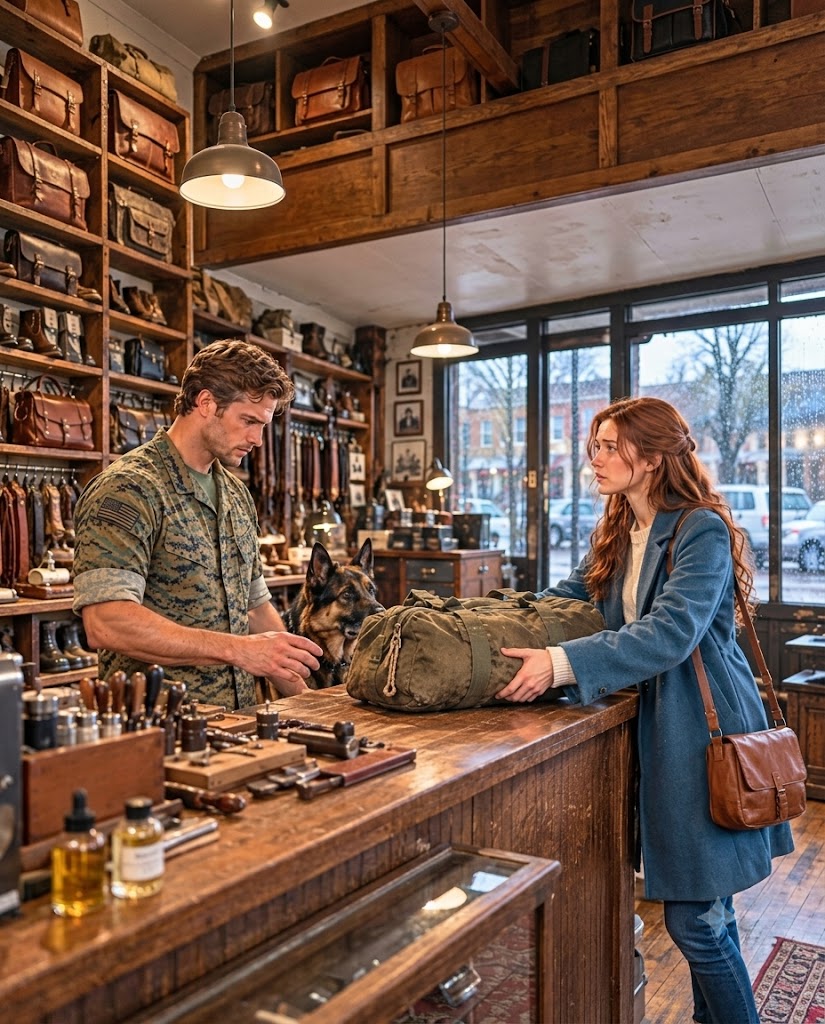
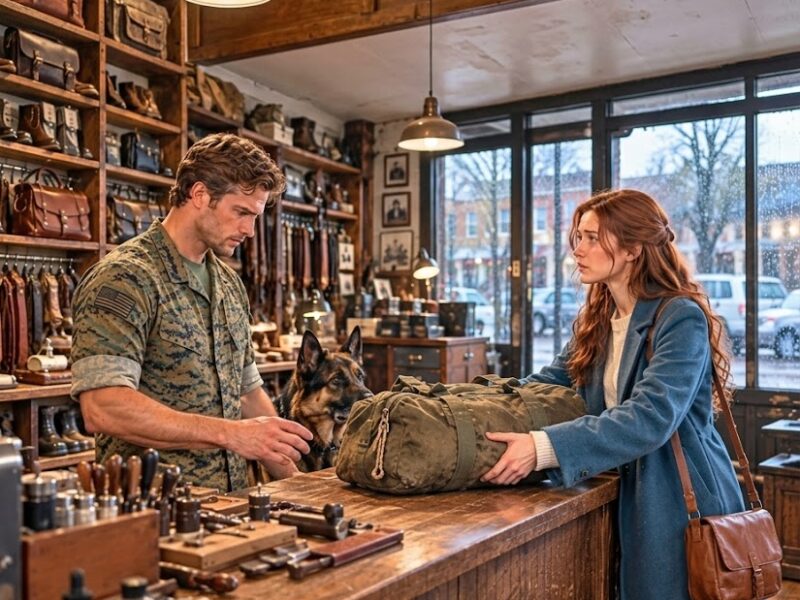
Can you fix my brother’s bag?” the young woman asked, placing an old military duffel on the counter.
Before the Marine could answer, his retired German Shepherd suddenly stood.
The K9 walked straight to the bag, ignored the woman completely, and gently tugged at a faded piece of paracord tied to the zipper.
The Marine went completely still.
He slowly reached for the strap.
The young woman noticed. “Is something wrong?”
For several seconds, he said nothing.
Because his K9 had recognized something on that bag, and judging by the Marine’s face, so had he.
Cold December rain slicked the old brick streets of Stanton, Virginia, at 4:45 p.m., gathering beneath iron lamps and running in thin streams past shop windows already glowing against the early winter dusk.
Staff Sergeant Reese Halden stood behind the scarred workbench of Halden Leather and Field Repair, finishing the stitching on a weathered leather case before closing.
At 32, Reese was still serving in the U.S. Marine Corps Reserve after years on active duty, and that afternoon he was still dressed from his reserve obligations in a woodland MARPAT blouse and matching trousers, an olive drab undershirt visible at the collar and tan combat boots planted squarely on the plank floor.
He stood a little over 6’2″, lean and athletic rather than heavily built, with naturally broad shoulders and the controlled posture of a man whose body remembered discipline even when his mind was elsewhere.
Dark ash-blonde hair, neatly cut at the sides but thicker and naturally textured above, softened an otherwise sharply masculine face.
His jaw was clean-shaven and defined, his nose straight, his hazel-green eyes unusually calm.
Customers generally knew him as patient, reserved, and meticulous.
Reese rarely raised his voice, never hurried damaged work, and had an instinctive gentleness with things people brought in because they could not bear to throw them away.
The shop had become his civilian life after he transitioned from active duty to the reserve.
Shelves held old boots, cracked leather cases, canvas packs, belts, and outdoor gear waiting for careful hands.
Reese liked repairs because damage was usually honest.
A split seam showed where it had failed.
Worn leather told you where pressure had been.
Find the weakness, reinforce it, preserve what remained.
Human memory had never been that cooperative.
For six years, one name had remained beyond repair.
Corporal Nolan Aldridge.
Reese pushed the thought away before it could fully form.
Near the rear counter lay a nine-year-old black and tan German Shepherd whose powerful frame had aged without becoming frail.
Gray had only begun dusting the fur around his muzzle.
His dark brown eyes remained alert, his erect ears tracking small noises even while he appeared asleep.
Once a military canine, Mako had served beside Reese and Nolan when he was younger.
Now retired, he belonged wholly to Reese, following him between home, shop, and the quieter pieces of a life they had somehow assembled afterward.
Mako was disciplined with strangers and sparing with affection.
But with Reese, he possessed the effortless loyalty of a creature that had already seen the worst thing a man could survive.
Reese tied off the final stitch.
The bell above the front door rang.
Mako’s eyes opened first.
A young woman stepped in from the rain carrying an old olive drab canvas duffel against her chest.
She paused to close the door carefully behind her, as though even entering a strange shop required consideration.
She was 27, slender and naturally graceful, perhaps 5’7″, with fair skin flushed lightly pink from the cold and striking amber-brown eyes.
Long copper auburn hair fell in loose waves over the shoulders of a muted teal-blue wool coat, dampened at the ends by rain.
Beneath it showed a cream knit sweater.
She was beautiful without looking arranged for anyone’s attention.
But there was fatigue behind her composed expression, the particular tiredness of someone who had spent too many recent days deciding what pieces of a former life could be kept.
“Sorry. Are you still open for a few minutes?”
Her gaze briefly settled on his uniform before returning to his face.
“Are you Mr. Halden?”
“Reese is fine.”
“My name’s Serene Aldridge.”
The surname struck somewhere deep, but Reese gave no outward reaction.
Aldridge was not rare enough to mean anything by itself.
At least that was what he told himself.
Serene approached the workbench and lowered the duffel carefully onto it.
A leather-reinforced strap was badly cracked near one attachment point.
The canvas faded and softened by years of storage.
She explained that her mother had died several months earlier.
Serene lived in Richmond and had been clearing the family house before putting it up for sale when she found the bag inside an old trunk.
It had belonged to her older brother, a Marine who had died six years ago.
One section inside appeared to have been stitched closed by hand, and Serene refused to cut it open herself.
“I don’t need it to look new,” she said. “I just don’t want it falling apart.”
Reese understood that sentence better than he wanted to.
Serene rested one hand on the faded canvas.
“Can you fix my brother’s bag?”
Behind him came the faint scrape of claws against wood.
Reese turned.
Mako was standing.
The German Shepherd did not bark.
He crossed the shop slowly, nose working the air, but instead of investigating Serene, he went directly to the duffel.
Reese’s attention sharpened.
“Mako.”
The dog ignored the quiet warning.
A short length of faded paracord had been tied through one zipper pull.
Mako touched it with his nose, inhaled, then caught it gently between his front teeth and gave one small, familiar tug.
Reese stopped breathing.
Not because of a scent.
Because of the knot.
He knew that knot.
Years earlier, during long waits between movements, Nolan had tied scraps of paracord exactly that way and let a much younger Mako tug at them.
Three turns, a tight fold, then the short tail tucked beneath.
Nolan had once joked that Mako could recognize his knots faster than half the Marines in their unit.
Mako tugged once more, then looked directly at Reese.
The shop seemed suddenly too quiet.
Serene noticed.
“Is something wrong?”
Reese reached for the duffel.
His fingers moved beneath the damaged leather strap, turning it carefully.
Two scratched initials appeared on the underside.
N.A.
Below them were three short hand-cut marks.
Reese knew those too.
The rain tapped steadily against the windows, but for a moment he was no longer hearing Stanton.
Serene watched the color drain subtly from his face.
“My brother marked everything he owned,” she said softly. “His name was Nolan.”
Reese’s hand remained on the strap.
Nolan Aldridge.
Six years of deliberate silence collapsed into a name spoken by a woman with Nolan’s surname and something of his steadiness in her eyes.
Serene studied him.
“You knew him?”
Reese looked at her, then down at Mako.
The German Shepherd had settled beside the workbench now, but his gaze remained fixed on the old bag, as if some part of the past had entered the room with it.
Reese had imagined meeting Nolan’s family more times than he could count.
In every version, he had found some reason not to.
Now Nolan’s sister was standing three feet away.
There was nowhere left to go.
“He saved my life.”
Serene did not move.
Outside, headlights slid through the December rain.
Inside the shop, her fingers slowly tightened around the edge of the workbench.
She had come to Stanton looking for someone who could repair her dead brother’s bag.
Instead, she had found a Marine who looked at it as though he had been waiting six years for it to return.
By nine the next morning, the rain had passed, leaving Stanton beneath a pale December sky.
Water still shone between the bricks outside Halden Leather and Field Repair while weak winter sunlight stretched across the shop floor.
Serene Aldridge had slept perhaps two hours.
Every time she closed her eyes, she heard the same four words in the same restrained voice.
He saved my life.
For six years, Nolan’s death had existed in her family as a collection of careful phrases.
Support operation.
Civilian evacuation.
Structural failure.
Fatal injuries.
The official report had given them enough information to understand that her brother was dead and almost nothing that helped them understand his final hours.
Her mother had kept a folded copy in a bedroom drawer until the paper softened along the creases.
Serene had read it often enough to remember sentences she wished she could forget.
Yet nowhere in those pages had there been a Staff Sergeant Reese Halden, a German Shepherd named Mako, or any suggestion that Nolan’s death had become the dividing line in another man’s life.
When Serene entered, Reese was already working.
He had returned from another early reserve obligation and still wore the same woodland MARPAT uniform, clean and sharply kept, his ash-blonde hair slightly damp from the cold outside.
Mako lay near the workbench, watching her with dark, intelligent eyes.
The duffel remained exactly where Serene had left it.
Reese glanced up.
Something in his expression told her he had expected her return.
“Yesterday you said my brother saved your life. You never told me how.”
Something tightened along Reese’s clean-shaven jaw.
“Because I’m not sure you’ll want to hear the answer.”
Serene wanted to remind him that Nolan had been her brother long before he had been Reese’s fellow Marine.
Instead, she watched him lower his attention to the damaged strap and understood that forcing the door open would only make him brace harder against her.
So she stayed.
As the morning moved around them, Serene began noticing something that contradicted the picture she had constructed during her sleepless night.
Reese Halden was not a man who had collapsed after Nolan’s death.
Customers came through the door and he greeted them by name.
An elderly man collected repaired hunting boots and Reese remembered to ask about his wife’s recovery from surgery.
A delivery driver received an easy nod and a quiet joke.
His phone chimed once with a reserve message.
Reese read it, answered promptly, then returned to work.
He had not abandoned the Marine Corps or other people.
He had built a business, maintained obligations, cared for Mako, and learned how to move through ordinary days with quiet competence.
Nolan, Serene realized, was simply the one room in Reese’s life whose door remained locked.
Without asking, Reese poured her coffee and placed the mug near her.
Serene accepted it with a tired smile and sat beside the workbench while he examined the duffel’s interior seams.
Mako eventually rose, disappeared behind the counter, and returned carrying a battered red rubber ball.
He placed it against Serene’s boot.
She picked it up and threw it toward the back of the shop.
Mako bounded after it with surprising speed for a nine-year-old dog, caught it, turned, and trotted directly past her.
The German Shepherd deposited it at Reese’s boot.
Serene stared after him.
“Seriously?”
Reese laughed.
It was brief and low, but it changed his entire face.
For one fleeting second, Serene saw the younger man who might once have laughed beside her brother instead of carrying his memory in silence.
“Apparently you failed the evaluation.”
Serene looked accusingly at Mako.
“I threw the ball.”
“He has rigorous standards.”
The ordinary moment lasted only seconds, but when it passed, the room no longer felt quite as guarded.
Then Reese’s hands stopped.
He had reached the hand-stitched section inside the duffel.
The stitching was strong but uneven, unlike the original construction.
Reese studied the spacing and the way the canvas had been folded beneath it.
Someone had added the compartment after the bag was manufactured.
Most likely Nolan.
Serene moved closer.
Yesterday, she had been afraid that opening it would damage something Nolan had left behind.
Now she was more afraid of leaving it closed forever.
“Can you open it without ruining it?”
“I can preserve the canvas.”
Serene looked at the old stitches one final time.
“Do it.”
Reese selected a small seam tool and worked beneath each stitch individually rather than cutting through the fabric.
His hands moved with patient precision, treating the duffel not as evidence or a mystery, but as something another person had trusted him not to harm.
The final stitch released.
Reese folded the hidden flap back.
Inside lay three objects: a compact digital field recorder, a small brass key stamped with the number 214, and a folded piece of paper.
Serene opened the paper first.
An address in Stanton had been written across it beside a date from shortly before Nolan’s final deployment.
Reese recognized the location as a private veterans workshop Nolan had once used.
Serene looked at the key, then at the recorder.
Reese saw the decision forming before her thumb reached the power button.
He quietly told her she did not have to listen today.
But Serene had spent six years living with everything she had never been told.
She pressed the button.
The recorder flickered weakly to life.
Static came first, followed by male voices.
Someone complained about terrible coffee.
Another voice laughed.
A chair scraped across a floor.
Then Nolan spoke.
Serene stopped breathing.
Six years had softened her memory of her brother’s voice.
She had not realized how much until the real sound returned, warmer than she remembered, younger, careless in a way dead people were never allowed to remain inside photographs.
For an instant, she was back in her mother’s kitchen, hearing Nolan tease her from another room.
Her eyes filled before she could prevent it.
On the recording, Nolan said something teasing to someone nearby, followed by laughter and a sharp two-note whistle.
Mako’s head snapped up.
The German Shepherd rose and approached the workbench, ears forward.
When the whistle sounded again, he released a soft breath through his nose and stared at the recorder.
Serene looked at Mako, then at Reese.
The reaction was too immediate to misunderstand.
Reese finally confirmed what he had withheld the day before.
Mako had served alongside Nolan.
More than that, the dog had been with Reese and Nolan during the operation in which her brother died.
Suddenly, Mako’s reaction to the paracord made complete sense.
So did Reese’s recognition of the duffel.
Reese, Nolan, and Mako had once belonged to the same chapter of a life Serene had never been permitted to see.
Reese’s hand closed against the edge of the workbench.
Serene noticed, but she did not ask another question.
She looked back at the recorder.
Another file waited.
She pressed play.
Static whispered from the small speaker.
Then Nolan’s voice returned, quieter this time, without laughter behind it.
“Halden, if you ever hear this.”
Reese reached across the workbench and stopped the recording.
Silence.
Serene stared at his hand resting over the device, then slowly raised her eyes.
“Halden.”
Reese did not move.
“Me?”
Serene looked down at the recorder between them.
Until that moment, she had believed they were listening to fragments Nolan had happened to leave behind.
Now she understood something far more unsettling.
At least one of them had been meant for the Marine standing across from her.
By early afternoon, the winter sky over Stanton had turned the color of dull steel.
A dry wind moved through the narrow streets as Reese, Serene, and Mako crossed toward an old brick building three blocks beyond the historic district.
The address from Nolan’s folded note belonged to the Stanton Veterans Workshop, a privately operated space established decades earlier for veterans and local service members who needed tools, benches, storage, or simply somewhere to work among people who understood military life without requiring explanations.
Its brick facade had faded with age, and a small brass plaque beside the door was polished brighter than anything around it.
Reese recognized the building immediately.
Nolan had brought him there once during leave before their final deployment.
Reese remembered very little about that afternoon, except Nolan complaining about the ancient coffee machine and insisting the place had the best woodworking bench in Virginia.
At the time, locker numbers in storage rooms had meant nothing.
Now, the brass key marked 214 felt unexpectedly heavy in Serene’s hand.
Inside, they were met by Arthur Bell, the workshop’s administrator, a 68-year-old Army veteran with a compact build, close-cropped silver hair, weathered pale skin, and a neatly trimmed gray mustache.
Years of managing veterans had given him a patient manner and an instinct for knowing when questions should remain unasked.
He listened to Serene, examined the key, then disappeared into the records office.
The wait lasted nearly twenty minutes.
Reese spent most of it standing beside Mako near a wall covered with photographs of service members from different decades.
Serene watched him without appearing to.
Since the recorder had spoken his name that morning, Reese had become quieter, but not evasive in the same way as before.
It seemed less like he was hiding something from her now, and more like he was trying to hold something inside himself in place.
Arthur returned carrying an old ledger and a sealed storage record.
Locker 214 had indeed been registered to Corporal Nolan Aldridge.
After Nolan’s death, payments had stopped.
Workshop policy required unclaimed property belonging to a deceased service member to be inventoried, sealed, and retained rather than discarded.
Because Nolan had listed no family contact on the locker agreement, the contents had eventually been transferred from the active locker room into archival storage.
No one in the Aldridge family had ever known they existed.
Serene produced identification and documents establishing her relationship to Nolan.
Arthur checked each carefully before leading them downstairs.
The storage room smelled of old wood, metal shelving, and dust.
Arthur located a rectangular military-green storage case labeled 214, set it on a table, and left them alone.
Serene inserted the brass key.
The lock opened on the first turn.
For six years, she had imagined there must be something she did not know about Nolan’s death.
Standing over the case, she realized she had half expected some dramatic answer to be waiting inside.
There wasn’t.
There was only Nolan.
Several photographs bound with a rubber band, a worn multi-tool, two notebooks, an old unit patch, a cracked coffee mug wrapped in cloth, a rugged external storage drive, and beneath them, a faded working collar with a scratched metal identification plate.
Mako moved before Reese did.
The German Shepherd approached the open case, lowered his head, and inhaled along the collar.
His ears shifted backward.
He sniffed it again, slower this time, then settled onto the concrete beside the table with his muzzle close to the faded strap.
Serene watched him and felt something tighten behind her ribs.
Mako could not explain what he remembered.
He did not need to.
Reese picked up one of the photographs.
Nolan stood in it beside a much younger Mako, smiling broadly at something outside the frame.
Reese himself was visible near the edge.
Serene had never seen that version of her brother.
She also had never seen that version of Reese.
“You were happy.”
Reese kept looking at the photograph.
“We were young.”
It was not quite an answer.
They connected Nolan’s rugged storage drive to an old workshop computer Arthur allowed them to use.
Most folders contained photographs, equipment lists, and backups from the field recorder.
Nothing classified, nothing that resembled the secret Serene’s imagination had prepared her for.
Then Reese saw a date.
His posture changed.
Serene noticed immediately.
“That one.”
Reese did not open it.
Instead, after a long silence, he finally gave her what she had asked for since returning to the shop that morning: his version of Nolan’s final operation.
Their team had been helping evacuate civilians from a badly damaged structure.
Mako had alerted to instability inside.
Reese remembered the dog becoming increasingly insistent, remembered knowing the building was dangerous, and remembered moving deeper anyway because people were still being brought out.
Then came the second collapse.
Everything after that lived in Reese as broken images rather than a continuous memory.
Dust so thick he could barely see his own hands.
Mako barking somewhere through the debris.
Nolan appearing where Reese believed he should never have been.
A violent impact.
Nolan shoving him toward safety.
Reese survived.
Nolan did not.
For six years, Reese had reduced those fragments into a simple equation because guilt preferred simple equations.
Mako warned him.
Reese continued.
Nolan came back.
Nolan died getting him out.
“I made the call to keep moving,” Reese said quietly. “He came back because I was still in there.”
Serene finally understood why he had never contacted them.
Reese had imagined standing before Nolan’s mother and explaining that her son had died saving a man who believed he should have known better, so he had done nothing.
Each year that passed made the silence harder to break until shame itself became another reason not to try.
Serene looked toward Mako.
The old German Shepherd still lay beside Nolan’s collar.
Then she opened the dated folder.
One audio file had been copied from the field recorder.
Reese stiffened when Nolan’s voice filled the room.
The recording had been made before the operation.
Nolan spoke casually at first, reviewing equipment and joking about Mako’s impatience.
Then his tone changed.
He mentioned that Mako had alerted twice during an earlier assessment of the damaged structure.
Reese looked up.
The recording continued.
Nolan said that if Mako confirmed someone was still trapped inside, he was going back in.
Serene turned toward Reese.
He had gone completely still.
Nolan’s voice continued from the computer, calm and unmistakable.
It was not Reese giving an order.
It was not Nolan describing a plan to retrieve Reese.
It was Nolan making a decision of his own.
Reese reached forward and stopped the recording.
The sudden silence felt physical.
He stared at the darkened audio bar for several seconds, then stepped away from the computer.
Serene did not stop him.
Reese crossed the storage room, climbed the stairs, and walked outside into the cold.
Mako remained beside Nolan’s collar.
For several seconds, the German Shepherd looked toward the doorway through which Reese had disappeared.
Then he looked back at Serene.
Finally, Mako rose.
He followed his handler.
Outside, Reese stood alone beneath the gray Virginia sky, breathing cold air that seemed incapable of reaching deep enough.
For six years, he had believed guilt was the price of surviving Nolan Aldridge.
Now, for the first time, he was facing something almost more frightening than guilt.
The possibility that he had spent six years punishing himself for a version of the past that had never been entirely true.
Morning came to Stanton beneath a clear, bitter sky, frost whitening parked cars and the edges of old brick sidewalks.
Before eight, the lights were already burning inside Halden Leather and Field Repair.
Reese had been at the workbench for nearly an hour, repairing a torn canvas strap that did not require half the concentration he was giving it.
He had slept badly after leaving the veterans workshop.
Nolan’s archived voice had followed him through the night, repeating the same impossible possibility.
Nolan had already decided to go back if Mako confirmed someone remained inside.
Mako rested nearby.
But every few minutes, the nine-year-old German Shepherd raised his graying muzzle toward the front door.
When the bell finally sounded, Mako was standing before Reese looked up.
Serene entered, carrying Nolan’s recorder and the archive files.
Her copper auburn hair fell loosely over her muted teal-blue coat, and the cold had brought color into her fair cheeks.
Yesterday, she had not followed Reese outside.
She had allowed him to leave.
Today, she placed the recorder on the scarred workbench.
“I’m going to finish listening to my brother. You can stay or you can leave.”
Reese stared at the small device.
Then he pulled out a chair.
The remaining files offered no perfect explanation.
There were timestamps, short field notes, equipment checks, and fragments of conversation.
Serene arranged them chronologically while Reese listened, and gradually the sequence he had carried in broken pieces for six years began putting itself back together.
Mako had warned them that the damaged structure was unstable.
Reese remembered that.
Then came the part guilt had buried beneath everything that followed.
Mako detected someone alive behind a partially collapsed interior wall.
A little girl.
The repair shop seemed to disappear around Reese.
He could smell concrete dust again.
He saw Mako rigid near a narrow opening, nose working through powder and debris before turning toward the two Marines with unmistakable certainty.
Someone was alive.
Then Reese remembered Nolan looking at the dog.
There had been no order.
Nolan made the decision himself.
He was going back, and Reese chose to go with him.
The memory continued now without the gaps Reese had spent years filling with blame.
They reached the trapped girl.
Nolan freed her while Reese widened a narrow passage through the debris.
Then the structure groaned.
The second collapse was beginning.
Nolan got the girl through the safe opening first.
Mako followed her out.
Nolan had not cleared the debris when Reese turned back.
For six years, Reese had remembered Nolan coming back for him.
Now he remembered himself going back for Nolan.
Reese caught his arm and pulled.
Nolan suddenly looked upward.
The ceiling was failing.
Before Reese understood, Nolan drove both hands into his chest and shoved him beyond the collapse line.
Impact.
Dust.
Mako barking somewhere beyond the debris.
Then darkness.
Reese woke injured.
Nolan never did.
The shop slowly returned around him.
Winter light lay across the floor.
Serene sat opposite him.
Mako remained close enough that Reese could hear his breathing.
Reese looked down at his trembling hands.
The memories had never been entirely false.
That was what made them so dangerous.
Mako really had warned them.
Reese really had gone inside.
Nolan really had pushed him clear.
Nolan really had died.
But the missing pieces changed everything.
Reese had not caused Nolan to return.
Nolan had chosen to rescue the girl.
Reese had tried to bring Nolan out.
For six years, “I couldn’t save him” had slowly become “I caused his death.”
Now that sentence no longer fit the truth.
Serene did not tell him what he should feel.
Instead, she simply started the next recording.
Nolan’s voice came through the small speaker, younger and almost painfully ordinary.
He joked about Reese checking equipment twice and laughed at his own remark.
Then his voice softened.
“If anything happens to me, somebody keep an eye on Halden. He can bring everybody home except himself.”
Reese stopped the recording.
Silence settled between them.
Yesterday, he had walked away.
Today, he stayed.
After a while, Reese began speaking.
He told Serene there had been no dramatic collapse in the years after Nolan died.
He continued serving in the Marine Corps Reserve.
He opened his shop every morning.
He paid invoices, repaired boots and bags, remembered customers’ names, and took Mako home every night.
From the outside, he had been fine.
He had simply built his life around one locked room.
He declined old unit reunions.
When Nolan’s name entered a conversation, Reese found a way out of it.
He never contacted the Aldridge family because he could not imagine looking Nolan’s mother in the eyes while believing her son had died because of him.
His gaze moved across the shelves surrounding them.
Boots with new soles, stitched canvas, old leather repaired instead of discarded.
There was a bitter irony in it.
Reese had spent six years repairing things other people believed were worth saving while quietly deciding he was not one of them.
Serene understood that more than she wanted to, because she had done the opposite.
“I was angry with him.”
Reese looked at her.
Serene had never said those words aloud.
She loved Nolan.
She had always loved him.
But after his death, part of her resented the way he had always moved toward whoever needed help.
Sometimes it seemed strangers had received the bravest parts of her brother, while his family was left with photographs and an official report.
Their mother never blamed him.
Serene sometimes had.
After their mother died, she responded by moving faster.
Boxes appeared throughout the Richmond house.
Clothes were donated, papers sorted.
A realtor contacted.
She told herself she was moving forward.
In truth, she had been trying to make the past smaller.
Now, the same truth that released Reese from guilt changed the way Serene saw her brother.
Nolan had not returned for that little girl because his family mattered less.
He had returned because he knew she was there.
That was Nolan.
For several moments, neither of them spoke.
Then Reese stood.
He crossed behind the counter to a narrow locked drawer and removed a small key from his pocket.
Inside lay a single military dog tag.
Nolan Aldridge.
The metal rested in Reese’s palm as though six years had changed its weight.
It was a spare tag Nolan had left with Reese shortly before their final deployment.
One of those small, practical exchanges between Marines that neither man had considered important enough to remember at the time.
After Nolan died, Reese could have returned it to the Aldridge family.
He never did.
Facing Nolan’s mother while believing her son had died because of him had felt impossible.
And as the years passed, the small piece of metal became something else.
A punishment, a promise, and perhaps the last piece of Nolan Reese believed he was allowed to keep.
He placed it in Serene’s hand.
She stared at her brother’s name.
Her thumb moved slowly across the worn letters.
For a moment, she thought about the Richmond house and everything still inside it.
Photographs her mother had framed.
Nolan’s books.
Uniforms carefully stored away.
Birthday cards nobody had thrown out.
Her family had Nolan.
Not all of him.
No family ever could.
Some pieces of a life belonged to the people who had shared them.
Serene looked at Reese.
Then she placed the dog tag back in his palm and gently closed his fingers around it.
“He left enough of himself with us. Maybe this part was meant to stay with you.”
Reese said nothing.
For once, silence did not feel like somewhere to hide.
Mako rose from the floor.
The old German Shepherd crossed to Reese and sat against his leg.
Gray had spread around the muzzle that had once been almost entirely black.
Mako had been there when Nolan died.
He had heard the collapse.
He had waited for a man who never came out.
And Mako had survived, too.
He had grown older, carrying the same day inside him without ever treating survival as betrayal.
Mako slowly rested his head on Reese’s knee.
Reese looked down.
His fingers tightened once around Nolan’s dog tag.
Something inside him gave way.
Not the memory of Nolan, not the grief, only the belief that suffering was the price he owed for being alive.
His shoulders shook once.
Then again.
Nolan was still dead.
Reese still missed him.
Nothing Serene had brought into the shop could change that.
But grief did not need guilt to prove that Nolan had mattered.
For the first time in six years, Reese allowed that to be enough.
He lowered his head, Nolan’s dog tag enclosed in one hand, and Mako pressed quietly against his knee.
And when the tears came, Reese Halden did not turn his face away.
Early spring returned to Stanton beneath a mild March sky, with new green showing along the old brick streets and afternoon sunlight warming shop windows that had spent most of winter reflecting rain, frost, and gray clouds.
Three months had not transformed Staff Sergeant Reese Halden into another man.
He still served in the Marine Corps Reserve.
He still opened Halden Leather and Field Repair in the morning, still kept his tools arranged with almost unreasonable precision, and still became quietly irritated when customers left wet umbrellas against finished leather.
Some mornings were easy.
Others were not.
Nolan’s name could still catch unexpectedly inside him.
The difference was that Reese no longer treated those moments as proof he had failed to move forward.
He had attended one gathering with men from his old unit and stayed longer than the twenty minutes he had promised himself.
Afterward, another Marine asked whether Reese could restore a cracked leather belt belonging to a friend who had died years earlier.
Reese repaired it without charging him.
Then came a pair of boots, then a faded field bag.
There was no foundation, no sign above the door, and no grand project bearing Nolan’s name.
Reese simply began setting aside a few hours when he could to restore selected military keepsakes for bereaved families who wanted them preserved rather than replaced.
He repaired torn seams and weakened straps without hiding every scar.
It was work he already knew how to do.
Only now he understood why it mattered.
Serene had changed her plans too, though not by abandoning them.
The family house remained in Richmond.
She postponed the sale for several months and began sorting through her mother’s and Nolan’s belongings slowly instead of trying to empty rooms as quickly as possible.
Photographs were scanned.
Recordings were copied.
Boxes were labeled with more care than urgency.
Because Nolan’s archive still required work in Stanton, Serene rented a small studio nearby rather than repeatedly making the drive from Richmond.
It was temporary, and neither she nor Reese pretended otherwise.
That honesty made what developed between them easier.
There were coffees beside the workbench and lunches eaten too late because Reese forgot the time.
Sometimes Serene helped identify photographs from Nolan’s archive.
More often they talked about things that had nothing to do with him.
Bad restaurants, books, Serene’s dislike of customers Reese secretly found amusing, whether Mako understood every word spoken around him and simply chose when to acknowledge people.
They walked him through Stanton’s older streets in the evenings.
No one named what was growing between them.
They did not need to.
One afternoon, Serene arrived to find Mako waiting near the workbench with his battered red rubber ball.
She bent down.
“You still judging me?”
Mako stared at her.
Reese continued stitching a leather strap without looking up.
“Standards haven’t changed.”
Serene took the ball and threw it toward the back of the shop.
Mako launched after it.
He was slower than he had once been, gray spreading around his black and tan muzzle, but the old working drive remained unmistakable.
He caught the ball, turned, and started back.
Serene expected him to pass her.
Three months earlier, he always had.
Mako stopped in front of her.
The ball dropped against her boot.
Serene looked down, then at Reese.
Reese had stopped stitching.
For a moment, he watched Mako standing beside her, tail moving once behind him.
Then Reese smiled.
Nothing needed explaining.
Serene threw the ball again.
Later that afternoon, Reese cleared the center of the workbench.
Nolan’s duffel lay there.
Serene had seen it many times over the previous months, but never finished.
The damaged strap was strong again.
Weak sections of canvas had been reinforced from inside, and the hand-sewn compartment had been reconstructed so carefully that Nolan’s original work remained visible.
Reese had preserved the faded paracord tied to the zipper with its distinctive knot.
He had also preserved the scratches, the faded canvas, the three small marks beneath the strap.
Serene ran her fingers over them.
The bag was repaired.
It was unmistakably still Nolan’s.
“Why didn’t you make it look new?”
Reese rested one hand lightly against the old canvas.
“Repairing something doesn’t mean erasing what happened to it.”
Serene looked at him.
Three months earlier, the sentence might have sounded like something a craftsman said about an old bag.
Now, neither of them heard it that way.
Reese had not needed to erase Nolan to begin living beyond the day he died.
The dog tag remained in the locked drawer, but the drawer was no longer a place Reese feared opening.
Serene had learned something similar in Richmond.
Moving forward did not require empty walls or a sold house before she was ready.
Some things could be kept, others could be released.
Neither choice measured how deeply she had loved the people attached to them.
She lifted the duffel by its repaired strap.
It held.
“How much do I owe you?”
Reese looked at the bag for a second.
His eyes moved toward Mako, now resting in a patch of spring sunlight near the window.
Then back to Serene.
“Your brother already paid me.”
She understood immediately.
Six years ago, Nolan Aldridge had pushed Reese beyond a collapsing ceiling.
Reese was not calling that sacrifice a debt anymore.
He was simply acknowledging the life Nolan had made possible.
Serene did not argue about the bill.
She slipped the duffel over her shoulder and walked toward the door.
Her hand reached the handle before she stopped.
Outside, sunlight had begun turning golden along the brick storefronts.
“Have you eaten yet?”
Reese glanced at the clock.
Serene smiled.
“Dinner?”
There was nothing dramatic in the question.
No declaration, no promise about Richmond or Stanton.
No attempt to decide what they might become months from now.
Just dinner.
Reese looked around his shop.
Once work had given him a reason to remain behind that counter when the rest of life felt more complicated than damaged leather and broken stitching.
There would always be another repair waiting for the first time.
That did not mean he had to stay.
Reese removed his apron.
He switched off the workbench lamp, collected his keys, and locked the front door behind them.
Mako immediately took his familiar position beside Reese’s left leg.
Serene walked on the other side.
Together they started down the old Stanton street beneath the soft light of an early spring evening.
Behind the shop window, boots, belts, and weathered canvas waited on shelves for tomorrow.
Some would still carry scratches when Reese finished with them.
Some seams would always show where they had once torn.
That no longer seemed like failure.
Not everything that had been broken needed to become what it had been before.
Sometimes being repaired simply meant it was ready to keep going.
Maybe the miracle in this story was never that the past could be changed.
Nolan could not come home.
The scars could not disappear.
And six lost years could not be returned.
Perhaps the miracle was that God placed the right people in each other’s path at the moment they were finally ready to stop carrying their pain alone.
Sometimes in our own lives, healing does not arrive with thunder or a sign from heaven.
It comes quietly in a conversation we almost avoided.
A hand that stays beside us, an old memory we finally have the courage to face, or even a faithful dog reminding us that surviving is not something to be ashamed of.
Whatever you are carrying today, remember this.
Being healed does not mean becoming the person you were before you were hurt.
Sometimes it simply means finding the strength to keep walking with the scars.









