“Can I Buy Him, Daddy” She Asked — The Marine Looked at the $20 Dog and Froze
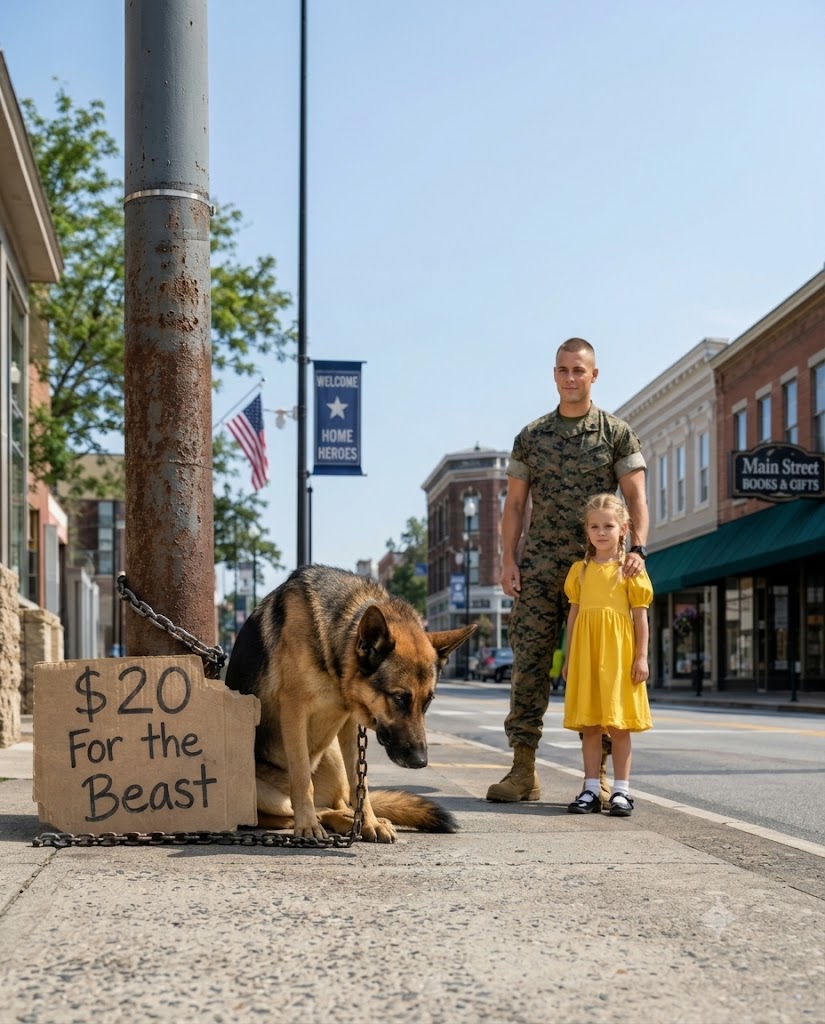
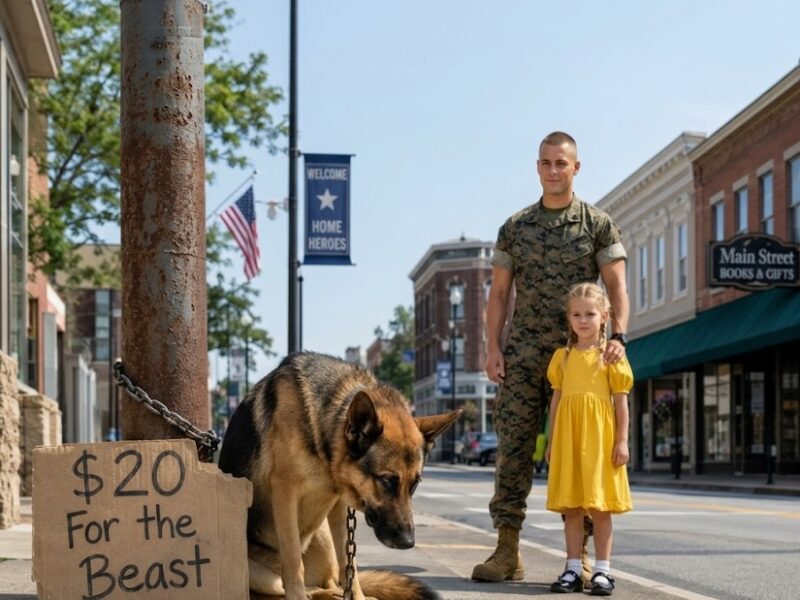
“Daddy, can we buy him, please?” Ellie whispered, tugging at Staff Sergeant Caleb Hartman’s sleeve.
Chained to a rusted pole on a downtown Fredericksburg sidewalk sat an old German Shepherd.
Beside a cardboard sign that read, “$20 for the beast.”
Caleb almost kept walking.
The dog looked worn down and forgotten, but when Caleb stepped closer, the shepherd suddenly moved to his left side and sat perfectly at attention.
That was no stray behavior.
Caleb paid the $20 and brought him home, never imagining the dog they named Maverick carried a secret, buried for three years.
His microchip would reveal that he had once been a trained rescue canine and had officially been declared dead.
Following Maverick’s past would lead Caleb and Ellie into a mystery involving missing dogs, hidden records, and a truth someone had worked hard to erase.
The late May sun hung bright over downtown Fredericksburg, Virginia, warming the brick storefronts and the flags still fluttering above Main Street after the Memorial Day ceremony.
Families drifted toward their cars beneath a clear blue sky, while banners honoring service members moved gently in the afternoon breeze.
Staff Sergeant Caleb Hartman walked among them with his nine-year-old daughter beside him.
At thirty-seven, Caleb had the unmistakable bearing of a career Marine.
He stood a little over six feet, broad through the shoulders, with close-cropped brown hair and a clean-shaven face hardened slightly by years of early mornings, long deployments, and responsibilities he rarely talked about.
His camouflage uniform was still neatly pressed despite the heat, his boots polished, his posture instinctively straight.
People often mistook Caleb’s silence for severity.
In truth, he was patient, careful, and far more sentimental than he allowed most people to see.
Years in the Marine Corps had taught him how to make decisions under pressure.
But becoming Ellie’s primary parent had taught him something much harder—how to make decisions when there was no mission plan, no chain of command, and no guarantee that the choice he made would be the right one.
Lately, one choice had followed him everywhere.
He had thirty days to decide whether to accept an instructor position at Quantico.
It would keep him in uniform and allow him to pass years of experience to younger Marines.
More importantly, it could mean fewer long stretches away from home.
Yet Caleb had spent so much of his adult life identifying himself with operational units that accepting something more stable felt strangely like admitting a chapter of his life was ending.
He hadn’t told Ellie everything.
He didn’t have to.
Children noticed more than adults like to believe.
Ellie Hartman walked beside him in a bright yellow summer dress and black shoes, carefully balancing the remains of a melting vanilla ice cream cone.
She was small for nine, with blonde hair divided into two neat braids and clear blue-gray eyes that seemed permanently curious about the world.
Where Caleb tended to study a situation before acting, Ellie usually felt first and reasoned later.
She was gentle with animals, quick to notice lonely children at school, and completely incapable of pretending not to care when something seemed wrong.
Caleb sometimes worried that the world would eventually teach her to become harder.
Secretly, he hoped it never did.
A small backpack bounced against her shoulders as they walked.
Inside it, folded between a library book and several colored pencils, was a letter from her elementary school announcing the upcoming Family Heroes Day.
Ellie had carried it for four days.
She still hadn’t shown her father.
“So,” Caleb said, glancing at the ice cream dripping toward her fingers, “you planning to eat that or wear it?”
Ellie looked down.
“Oh.”
Caleb smiled.
She hurriedly took another bite.
They had almost reached the parking lot when Ellie suddenly stopped.
Caleb took another two steps before noticing she was no longer beside him.
“Ellie?”
She didn’t answer.
Her attention had fixed on something across the sidewalk.
Beside an old metal utility pole sat a German Shepherd.
The dog was large, even while seated, though age had softened the powerful build he must once have carried.
His coat was black and tan, thick around the shoulders, but dusty from the street.
Gray had begun spreading across his muzzle.
One ear stood upright, while the other leaned slightly outward, giving his face an oddly thoughtful expression.
He looked to be eight or nine years old, perhaps older.
A long chain ran from his collar to the base of the pole, giving him enough room to shift position but little reason to move.
He wasn’t barking at pedestrians or pulling toward passing dogs.
He simply watched.
Those dark brown eyes followed everything—cars, shoes, children, uniforms.
Caleb noticed that last part.
Propped against the pole was a rough piece of cardboard.
Thick black letters covered its surface.
$20 for the beast.
Ellie’s face changed immediately.
“Daddy.”
Caleb already knew that tone.
“No.”
“You don’t even know what I’m going to say.”
“I have nine years of evidence.”
Ellie stepped closer to him.
“Daddy, can we buy him, please?”
Caleb looked toward the man sitting nearby.
Leonard “Lenny” Voss appeared to be in his late fifties, though years spent outdoors made him seem older.
He was thin without looking frail, with a weathered face, an uneven gray beard, and long brown-gray hair escaping beneath an old baseball cap.
His faded work shirt had been repaired at one elbow, and his boots looked as though they had covered more miles than some cars.
There was a restless quality about him.
His eyes moved frequently toward the street, then toward the dog, then back toward Caleb.
He didn’t seem openly hostile.
He seemed like a man accustomed to expecting conversations to go badly.
Caleb approached slowly.
“That your dog?”
Lenny shrugged.
“Been with me a while.”
“What’s his name?”
Another shrug.
“Doesn’t much matter.”
Ellie frowned.
“It matters to him.”
Lenny looked at her for the first time.
Something unreadable passed across his face before he looked away.
“He’s old,” he said.
“Hard to keep. Eats plenty. Doesn’t do much anymore.”
Caleb glanced at the cardboard.
“And you call him a beast.”
“Figure people noticed the sign.”
Ellie crossed her arms.
“He isn’t a beast.”
Lenny gave a tired half-smile.
“You know that already, do you?”
“Yes.”
Caleb almost told Ellie they were leaving.
The dog was not a twenty-dollar decision.
There would be food, veterinary care, time, responsibility, and whatever history came attached to an animal this old.
Caleb was already balancing fatherhood against a career decision he hadn’t solved.
Adding another responsibility made no practical sense.
Then the German Shepherd looked directly at him.
Caleb stopped.
There was something unusually steady in the dog’s gaze.
Not fear.
Not excitement.
Assessment.
Caleb had seen working dogs around military installations over the years.
He wasn’t a canine handler, but he had watched enough handlers communicate with their dogs to recognize certain patterns.
Without really thinking, Caleb lowered his left hand beside his thigh, palm angled inward.
It was a small movement.
The German Shepherd reacted instantly.
His head lifted.
Then he stood.
Despite the stiffness of age, the movement was controlled and deliberate.
He stepped forward until the chain allowed him enough room, shifted directly to Caleb’s left side, aligned his shoulder with Caleb’s leg, and sat perfectly.
Caleb stared down at him.
Ellie’s mouth fell open.
Even Lenny became very still.
Caleb slowly raised his eyes.
“You said he doesn’t do much.”
Lenny rubbed his palms against his jeans.
“Guess he likes you.”
“That’s not what I asked.”
Lenny looked toward the street.
Caleb crouched, keeping enough distance to allow the dog to choose whether to approach.
The shepherd remained seated.
His eyes never left Caleb.
“Somebody trained you,” Caleb murmured.
At the sound of his voice, the dog’s upright ear shifted forward.
Ellie moved beside her father but stopped when Caleb gently extended an arm.
Slowly, she nodded.
Instead of reaching immediately for the dog, Ellie knelt several feet away.
For a few seconds, nothing happened.
Traffic passed behind them.
A flag snapped softly overhead.
The shepherd looked from Caleb to Ellie.
Then he lowered his head.
One large front paw slid forward across the pavement until it rested just short of Ellie’s hand.
She smiled.
Not the excited grin Caleb expected.
Something softer.
“Daddy,” she whispered.
“He isn’t a beast.”
Caleb felt his resistance beginning to collapse.
He examined the dog’s collar more closely.
It was old leather darkened by years of wear.
Hanging beneath it was a small metal tag scratched so heavily that most of the markings had disappeared.
Caleb tilted it toward the sunlight.
Two letters.
Two numbers.
BR27.
“What does that mean?” Ellie asked.
“I don’t know.”
Caleb looked toward Lenny.
“Where did you get him?”
Lenny’s expression closed immediately.
“Like I said, he’s been around.”
“That’s not an answer.”
“It’s the one I’ve got.”
Caleb studied the man for several seconds.
Lenny wouldn’t meet his eyes.
Finally, Caleb reached into his wallet and removed a twenty-dollar bill.
Ellie’s eyes widened.
“Really?”
Caleb pointed gently toward her.
“This doesn’t mean every animal with a cardboard sign comes home with us.”
She threw both arms around his waist.
“Thank you, Daddy.”
“You don’t even know what I was going to say.”
“I have nine years of evidence.”
Caleb couldn’t help laughing.
He handed Lenny the money.
The older man accepted it quickly.
Then something changed.
He folded the twenty into his pocket, picked up a worn canvas bag from behind the crate, and stood.
Caleb expected instructions about feeding or temperament.
Instead, Lenny glanced once at the German Shepherd, then at Caleb.
“Take care of him.”
Before Caleb could ask another question, Lenny walked away—not toward the parking area, but toward a narrow side street between two brick buildings.
Within moments, he disappeared from view.
Caleb’s smile faded.
That was strange.
Very strange.
Ellie, however, was focused entirely on the dog.
“We need a name.”
Caleb unclipped the chain from the pole.
The shepherd remained calmly beside his left leg.
Ellie considered several possibilities with the seriousness of someone naming a battleship.
“Bear.”
No reaction.
“Ranger.”
The dog blinked.
“Captain.”
Caleb raised an eyebrow.
Then Ellie smiled.
“Maverick.”
The shepherd turned his head toward her.
Ellie gasped.
“He likes it.”
“That’s not exactly scientific.”
“His name is Maverick.”
Apparently, the decision had been made.
The three of them started toward the parking lot.
Halfway down Main Street, the rumble of a vehicle approached from behind.
A Marine Corps utility vehicle rolled slowly through town, returning from the Memorial Day event.
Maverick stopped.
Caleb turned.
The old German Shepherd had straightened completely.
His head rose, his shoulders squared, his eyes locked onto the passing Marines.
For several seconds he stood motionless beside Caleb with the alert, disciplined posture of a working dog awaiting the next command.
Caleb looked down at the scratched tag hanging from Maverick’s collar.
BR27.
Then he looked toward the alley where Lenny Voss had vanished.
Whatever story Caleb had just been told about this dog, he was beginning to suspect it wasn’t the real one.
Morning came softly over Fredericksburg, turning the windows of Caleb Hartman’s small rented house pale gold.
The neighborhood was quiet, except for sprinklers clicking across trimmed lawns and the distant hum of traffic beginning on Route 1.
Caleb had slept badly.
Every time he closed his eyes, he saw Maverick standing rigid on Main Street as the Marine Corps vehicle passed, the scratched metal tag beneath his collar catching the light.
BR27.
Maverick had spent the night on an old folded blanket Caleb placed in the hallway.
At least that was where Caleb expected him to sleep.
When he woke shortly after midnight to check on Ellie, the German Shepherd was lying directly outside her bedroom door instead.
The dog’s head rested between his paws, one ear upright, the other leaning slightly outward, but his eyes opened the instant Caleb approached.
He did not growl or move.
He simply watched until Caleb returned to his own room.
By 7:30, Ellie was already dressed and kneeling beside Maverick with a bowl of water.
“He likes my door,” she announced as Caleb came downstairs.
“I noticed.”
“He’s guarding me.”
“Or your room is closer to the air conditioning vent.”
Ellie narrowed her eyes.
“You always ruin beautiful things with logic.”
Caleb poured himself coffee.
“It’s one of my Marine Corps specialties.”
An hour later, they pulled into the parking lot of Monroe Veterinary Clinic, a modest brick building on the quieter edge of Fredericksburg.
Maverick rode in the back seat with Ellie, sitting upright instead of lying down.
He watched the world through the window with calm attention, turning his head toward delivery trucks, pedestrians, and every uniformed person they passed.
Dr. Clare Monroe met them in the examination room.
Clare was forty-two, tall and slender, with chestnut brown hair gathered into a practical ponytail and faint laugh lines at the corners of hazel eyes that seemed to notice everything.
She wore navy scrubs beneath a white veterinary coat and moved with the controlled patience of someone who had learned that frightened animals rarely responded well to hurried people.
Fifteen years earlier, she had started her career in a large emergency hospital outside Richmond.
After seeing too many families struggle when unexpected veterinary bills arrived, she had returned to Fredericksburg and opened a smaller community clinic where she was known for explaining every option before making anyone feel judged.
“Well,” Clare said, lowering herself slightly rather than approaching Maverick head-on, “you’re certainly a handsome gentleman.”
Maverick watched her.
“He hasn’t barked much,” Ellie said, “but he understands things.”
Clare smiled.
“Most old dogs understand far more than we give them credit for.”
Caleb explained how they had found Maverick, including Lenny Voss, the cardboard sign, the strange hand signal response, and the tag marked BR27.
Clare’s expression became more serious when she heard that last detail.
She examined Maverick carefully, keeping the process calm and unhurried.
His age showed in the stiffness of his movements and the gray spreading around his muzzle, but Clare found no reason to believe he could not enjoy several good years with proper care.
He needed better nutrition, rest, routine veterinary attention, and time to regain strength after an uncertain period of living.
“He’s been through a lot of change,” Clare said.
“But what matters now is that he’s stable, alert, interested in people, and still very engaged with his surroundings. Those are encouraging signs.”
Ellie rubbed Maverick’s shoulder.
“So he’s going to be okay.”
“I think he has an excellent chance of becoming a very spoiled old man.”
“That’s the plan.”
Clare laughed and reached for a handheld microchip scanner.
“Let’s see whether somebody registered you once.”
She passed the scanner slowly over Maverick’s shoulders.
A beep sounded.
Caleb straightened.
Ellie’s eyes widened.
“He has one.”
“He does.”
Clare entered the number into the computer.
At first, her expression was routine.
Then her fingers stopped above the keyboard.
“What?” Caleb asked.
Clare leaned closer to the monitor.
“That’s strange.”
Caleb stepped beside her.
The screen displayed a registration record.
Name: Maverick.
Ellie immediately smiled.
“See? I picked his real name.”
Caleb barely heard her.
Below the name appeared another line.
Organization: Blue Ridge Recovery Dogs.
Clare searched a second database, then frowned.
Blue Ridge Recovery Dogs was a nonprofit search and rescue organization.
They worked throughout Virginia and parts of West Virginia after storms, floods, missing person cases—things like that.
Caleb looked down at Maverick.
The German Shepherd sat quietly beside Ellie.
“So he really was trained.”
“It appears that way.”
Clare scrolled farther, then stopped completely.
“What is it?”
She turned the monitor slightly toward him.
At the bottom of the record was a status notation dated three years earlier.
Maverick: deceased.
For several seconds, nobody spoke.
Ellie finally looked from the computer to the dog.
“But he’s right there.”
“I can see that,” Caleb said quietly.
Clare checked the chip number again, then a second time.
Same result.
The dog registered as Maverick from Blue Ridge Recovery Dogs had officially been recorded as dead three years ago.
Clare searched archived contact information and eventually found the name of the handler associated with the record.
Jonah Pierce.
There was also an old telephone number.
Caleb stared at it.
“Call him,” Ellie said.
Clare looked at Caleb.
He nodded.
Caleb used his own phone.
It rang five times before someone answered.
“Hello?”
The voice belonged to a man who sounded cautious and tired.
“Is this Jonah Pierce?”
A pause.
“Who’s asking?”
“My name is Caleb Hartman, Staff Sergeant, United States Marine Corps.”
“I’m calling from Fredericksburg about a German Shepherd.”
Another pause, longer this time.
Caleb looked at Maverick.
“I think I have your dog.”
Silence.
Then Jonah gave a short, disbelieving laugh.
“Who is this really?”
“I told you.”
“You’ve got the wrong person.”
“The dog’s name is Maverick. His chip lists Blue Ridge Recovery Dogs. Tag code BR27.”
Nothing came from the other end.
Caleb could hear only faint breathing.
When Jonah finally spoke, his voice had changed.
“Maverick died three years ago.”
Caleb looked directly at the old shepherd sitting beside Ellie.
“I’m looking at him right now.”
Jonah Pierce was fifty-one.
Caleb would later learn he was a former volunteer search handler with a weathered face, graying dark hair, and the broad hands of a man who had spent most of his life working outdoors.
After Blue Ridge Recovery Dogs dissolved, he had taken a maintenance job near Rowan Oak and largely withdrawn from rescue work.
Losing Maverick had affected him deeply enough that he had never partnered with another search dog.
On the phone, however, Caleb knew none of that yet.
All he heard was disbelief.
Jonah explained that Maverick had been injured during a search operation years earlier and later transferred to a K-9 rehabilitation facility.
Several weeks afterward, Jonah received notification that the dog had died during recovery.
He had never seen Maverick again.
“Send me something,” Jonah finally said.
“A picture, the tag, anything.”
Caleb promised he would.
That afternoon, Maverick began settling more naturally into the Hartman home.
Caleb installed a temporary barrier where the backyard fence had a low opening, while Ellie threw a tennis ball across the grass.
Maverick showed little interest in chasing it.
He preferred lying beneath the shade of an oak tree and watching Ellie run.
The ball eventually bounced over the side fence into an unused strip of property behind the neighboring lots.
“I’ll get it,” Ellie called.
Caleb was tightening a screw on the gate.
“Stay where I can see you.”
“I will.”
She slipped through the small side opening before he could finish the sentence.
Caleb looked down for perhaps thirty seconds.
When he looked back, Ellie was gone.
“Ellie?”
No answer.
Before Caleb could move, Maverick was already standing.
The dog crossed the yard, pushed through the same opening, and disappeared behind the fence.
Caleb followed.
He found Ellie twenty yards away, retrieving the tennis ball from tall grass.
Maverick stood between her and the path leading farther into the wooded property.
He did not bark.
He simply blocked her from going deeper.
When Ellie turned toward home, Maverick immediately moved with her, keeping himself on the outside edge as though escorting her.
Caleb stopped.
No command had been given.
No one had trained Maverick to protect Ellie.
At least no one in this house had.
Ellie held up the ball.
“Found it.”
Caleb glanced at Maverick.
“So did he.”
Later that week, Clare invited them to visit Homefront Animal Rescue, a small nonprofit operating from converted farm buildings outside Fredericksburg.
She thought Ellie might enjoy seeing how rescued dogs were cared for, and Caleb hoped the visit might help his daughter understand that bringing Maverick home was only the beginning of responsibility.
The rescue was managed by Hannah Foster, a forty-five-year-old woman with curly auburn hair, sturdy work boots, and the energetic walk of someone permanently five minutes behind schedule.
Hannah had spent nearly twenty years working in community nonprofits before opening Homefront after her older brother, an Army veteran, struggled to find a suitable home for a retired service dog.
She was practical, warm, and famously incapable of saying no when another shelter called asking for space, which was precisely why Homefront was nearly always full.
A section of the kennel roof was covered by a blue repair tarp.
“Winter storm,” Hannah explained.
“We fixed the worst of it, but every time we save enough for the rest, another dog needs something.”
Ellie watched volunteers preparing bowls of food.
“How much does it cost to help one?”
Hannah considered the question.
“Depends on what they need, but twenty dollars can feed some dogs for several days.”
Ellie looked at Caleb.
“Twenty dollars?”
He knew immediately where her mind had gone.
That evening, she washed out a large glass jar that had once held pasta sauce.
She found construction paper, tape, and a black marker.
Caleb sat across from her at the kitchen table while Maverick rested nearby.
“What are you making?”
“A project.”
“That sounds expensive.”
“It costs zero dollars.”
Ellie carefully taped the paper around the jar.
In large letters, she wrote: “$20 can save a life.”
Caleb studied the words.
Yesterday, twenty dollars had been the amount someone placed on Maverick.
As though it measured what he was worth.
Now Ellie was turning the same number into something completely different.
His phone vibrated.
A message from Jonah Pierce.
There was an attachment.
Caleb opened it.
The photograph was several years old.
Jonah stood younger beneath a cloudy mountain sky, wearing a bright search and rescue jacket.
Beside him stood a powerful German Shepherd in a working harness, head high, ears alert.
Caleb enlarged the image, then enlarged it again.
Around the shepherd’s neck was the same old metal tag.
The engraving in the photograph was clear.
BR27.
Caleb slowly lowered the phone and looked across the room.
Maverick had raised his head.
There was no longer any reasonable doubt.
The twenty-dollar dog from Main Street had once belonged to Blue Ridge Recovery Dogs.
And according to every official record anyone had found so far, he had been dead for three years.
The photograph Jonah Pierce had sent remained open on Caleb Hartman’s phone long after Ellie had gone upstairs.
In the picture, Maverick looked younger and stronger, his black and tan coat darker, his shoulders broad beneath a bright search harness.
Beside him stood Jonah, one hand resting lightly on the dog’s back while mist-covered mountains stretched behind them.
The scratched tag hanging from Maverick’s collar was unmistakable, even in the old photograph.
BR27.
Across Caleb’s living room, the same German Shepherd slept beside the couch, his breathing slow, his gray muzzle resting on his paws.
The official record said that dog had been dead for three years.
The photograph said otherwise.
Maverick himself was the final proof.
The following morning, Jonah called again.
This time, his voice was steadier, though Caleb could hear the strain beneath it.
Jonah Pierce was fifty-one, broad-chested but slightly stooped from years of physical work, with graying dark hair cut short around a weathered face.
He had spent much of his younger life volunteering with wilderness search teams in western Virginia.
People who knew him described him as patient, dependable, and unusually comfortable in silence.
Losing Maverick had changed that.
After the dog was reported dead, Jonah had stepped away from search and rescue work entirely, taking a maintenance job near Rowan Oak and keeping mostly to himself.
“He wasn’t just trained,” Jonah told Caleb.
“Maverick was one of the best dogs Blue Ridge ever had.”
Blue Ridge Recovery Dogs had been a nonprofit network rather than a military or police unit.
Its handlers trained dogs to support searches after severe weather, flooding, wilderness disappearances, and other emergencies across Virginia and neighboring states.
Maverick had started training as a young German Shepherd and quickly developed a reputation for being unusually focused.
Jonah said he rarely wasted energy.
He could work through distractions, remember routes, and remain calm around frightened people.
“He had a habit,” Jonah said.
“Whenever we entered a room, he’d check the doorway first, then the corners. After that, he’d settle down. Drove people crazy until they understood what he was doing.”
Caleb looked toward the kitchen.
Maverick had done exactly that every night since arriving.
Jonah continued.
Three years earlier, during a difficult search operation following severe weather in the mountains, Maverick had been injured badly enough that he could no longer continue working.
Jonah avoided unnecessary detail.
What mattered was that the dog needed rehabilitation, and Blue Ridge did not have the facilities for long-term recovery.
They transferred Maverick to a private facility called Black Ridge K-9 Recovery.
“At first, they sent updates,” Jonah said.
“Short ones. Said he was resting. Said they were working with him. Then the calls stopped.”
Jonah had tried contacting the facility several times.
Eventually he received formal notice that Maverick had died following complications during recovery.
Caleb lowered his voice.
“Did you see him afterward?”
“No.”
“Did they return his collar?”
“No.”
“Anything?”
There was silence.
“A letter,” Jonah finally said.
“That was all.”
For three years, Jonah had believed Maverick was gone.
Caleb ended the call with a promise that he would keep Jonah informed, then stared again at the dog sleeping near Ellie’s chair.
Something had happened between Black Ridge receiving Maverick and Lenny Voss appearing on Main Street with a twenty-dollar sign.
Caleb wanted answers, but he also understood the difference between wanting answers and having authority to pursue them.
That afternoon, he called someone who did.
Deputy Owen Brooks arrived at Caleb’s house shortly after five.
Owen was thirty-nine, tall and solidly built, with closely shaved black hair, brown eyes, and the calm posture of someone who rarely needed to raise his voice to command attention.
He had served in the Marine Corps earlier in life before joining the Stafford County Sheriff’s Office, which was how he and Caleb had met more than a decade earlier.
Owen had always been methodical where Caleb could become instinctive.
He trusted paperwork, timelines, and evidence, believing that patience solved more cases than anger ever could.
He listened while Caleb explained everything.
The twenty-dollar sign.
BR27.
The microchip.
Blue Ridge Recovery Dogs.
The deceased status.
Jonah Pierce.
When Caleb finished, Owen leaned back in his chair.
“You understand I can’t treat a weird database record like a crime by itself.”
“I know.”
“And you’re not going looking around private property on your own.”
Caleb gave him a look.
“I’m serious.”
“I said I know.”
“You said it like a Marine who plans to reinterpret the sentence later.”
Ellie, doing homework at the kitchen counter, covered a smile.
Caleb ignored her.
Owen took copies of the veterinary record and Jonah’s photograph.
Over the next several days, he checked publicly available licensing information and contacted animal control officials familiar with older facilities in the region.
What he found made the situation stranger.
Black Ridge K-9 Recovery had once operated legally, but its license had later been revoked after repeated administrative and welfare concerns.
The business eventually closed.
Maverick’s record was not the only one that ended.
Strangely, Owen found eleven other dogs whose files listed them as deceased, transferred, or otherwise removed from Black Ridge custody.
Yet the final documentation was incomplete.
Some had no receiving facility recorded.
Others had mismatched dates.
None of it proved a larger scheme, but there was enough inconsistency for Owen to request a formal review.
“This is official now,” he told Caleb.
“Which means you let us handle it.”
Caleb nodded.
For once, he meant it.
At home, Maverick was changing in smaller ways.
Better meals and regular rest had put more energy into his movements.
He still carried the stiffness of an older dog, but he no longer seemed like the tired animal sitting beside the utility pole on Main Street.
Ellie began discovering pieces of his training by accident.
One morning, she misplaced one of her sneakers and jokingly held the other beneath Maverick’s nose.
“Find it.”
Maverick sniffed once, walked upstairs, and returned less than a minute later to sit outside Ellie’s bedroom closet.
The missing shoe was inside.
Another afternoon, Ellie started across the driveway toward the mailbox just as a delivery truck turned onto the street.
Maverick immediately stopped at the curb and positioned himself beside her until the vehicle passed.
He responded to several simple hand signals Caleb remembered seeing handlers use.
Before sleeping, he checked rooms methodically, pausing briefly at doorways.
When visitors arrived, he never behaved aggressively, but he quietly placed himself between Ellie and anyone he did not know.
Caleb began to understand that Maverick’s training had not disappeared.
It had simply been waiting beneath everything else.
On Saturday, Ellie returned to Homefront Animal Rescue to help Hannah Foster fold blankets and refill water bowls.
That was where she met Daisy, a six-year-old shepherd mix with a cream and brown coat, oversized ears, and cautious amber eyes.
Daisy had arrived from another shelter after losing her previous home and had become shy around unfamiliar people.
She preferred the back corner of her run and usually waited until visitors moved away before approaching.
Ellie sat outside Daisy’s enclosure without reaching through.
For almost fifteen minutes, she did nothing.
Eventually, Daisy came forward and pressed her nose gently against the gate.
By lunchtime, Ellie had reached a conclusion.
“We should adopt her.”
Caleb nearly choked on his coffee.
“No.”
“But Maverick likes dogs.”
“That is not the adoption standard.”
“She needs a home.”
“She does.”
“So we help Hannah find the right home.”
Ellie frowned.
Caleb crouched beside her.
“Saving an animal doesn’t always mean bringing it into our house. Sometimes helping means making sure it gets where it belongs.”
Ellie looked toward Daisy.
It was not the answer she wanted, but she understood enough to nod.
That afternoon, she added another twenty-dollar bill to her donation jar.
A week later, Owen called.
He had arranged to inspect Black Ridge’s former address with County Animal Control.
Because Maverick’s identity was central to the old records, Owen asked Caleb to accompany them only as a witness and dog owner.
The abandoned property sat near an old railway spur outside town.
Marisol Vega, the county animal control investigator accompanying Owen, was thirty-four, compact, and athletic, with dark hair braided down her back and a direct, practical manner.
She had spent eight years handling neglect complaints and licensing cases and had learned to separate disturbing circumstances from the people and animals who still needed help.
The building itself was empty.
No dogs.
No active operation.
Only dust, abandoned equipment, and traces of a business that had disappeared without cleaning up properly.
Maverick changed the moment he stepped near the entrance.
His head rose.
His pace slowed.
Caleb felt the leash tighten, not from pulling, but from sudden concentration.
“You remember this place,” Caleb whispered.
Inside, Owen and Marisol documented what remained.
They found old numbered tags, transportation sheets, kennel photographs, several discarded collars, and boxes of administrative papers.
Nothing by itself explained Maverick.
Then Marisol opened a warped filing drawer.
“Owen.”
She pulled out a stack of invoices.
One company name appeared repeatedly during Black Ridge’s final months of operation.
Kesler Animal Transport.
Owen photographed every document before removing anything permitted under the inspection.
Back at the office, he began tracing the company.
Kesler Animal Transport was still registered, still operating, and still moving animals throughout central Virginia.
The final clue came from an ordinary gas station several miles from the old Black Ridge property.
Security footage from its exterior cameras had been retained longer than expected because the owner used cloud storage.
Owen found recent video showing a white cargo van stopping there repeatedly late at night.
On the side was a faded but readable logo.
Kesler Animal Transport.
The van appeared on several dates, always after midnight, always leaving the station in the same direction—southwest, toward the rural roads beyond Culpeper.
Owen paused the footage on the van disappearing beyond the edge of the parking lot.
Whatever connection Black Ridge once had to Maverick was no longer simply buried in the past.
At least one piece of it was still moving.
By the middle of the following week, Fredericksburg had settled into the slow heat of early summer.
Morning sunlight spilled across the old brick buildings downtown, and the last Memorial Day banners had finally been taken down from Main Street.
Yet every time Caleb Hartman passed the corner where he had first seen Maverick beneath that cardboard sign, he found himself looking toward the narrow alley where Leonard Voss had disappeared.
For days, Lenny had seemed like the simplest part of the mystery.
He had been the weathered stranger who accepted twenty dollars, offered almost no explanation, and vanished before Caleb could ask the questions that now mattered most.
But after Owen Brooks discovered the connection between Black Ridge K-9 Recovery and Kesler Animal Transport, Lenny no longer looked like a random man trying to get rid of an old dog.
Somehow, he had possessed a German Shepherd officially recorded as dead three years earlier.
Caleb needed to know why.
Owen eventually found him through a local outreach program that occasionally provided meals and temporary motel vouchers to people without stable housing.
Lenny had been staying several nights a week in a small boarding house near the Rappahannock River.
Caleb did not go alone.
Owen insisted on accompanying him, partly because an official review was now underway, and partly because he knew Caleb well enough to recognize the stubborn look that appeared whenever the Marine believed something needed an answer.
They found Lenny sitting behind the boarding house beneath a cottonwood tree, repairing the strap on his canvas bag with a piece of heavy thread.
He looked much as he had on Memorial Day—thin, sun-weathered, gray beard uneven, old baseball cap pulled low.
But there was less nervousness in him now.
When he saw Caleb approaching with Owen, he stopped sewing.
“You found me,” he said.
Caleb remained standing several feet away.
“You knew someone would.”
Lenny looked at him for a moment, then toward the parking lot.
“Dog okay?”
The question caught Caleb off guard.
“He’s doing better.”
A quiet relief moved through the older man’s face.
“Maverick,” Caleb added.
“That’s his real name.”
Lenny lowered his eyes.
“I know.”
Owen said nothing.
He simply waited.
Caleb felt his jaw tighten.
“Then start talking.”
For several seconds, Lenny stared at the needle in his hand.
When he finally spoke, the story that emerged was nothing like Caleb had expected.
Years earlier, Lenny Voss had worked ordinary maintenance jobs wherever he could find them.
Warehouses, boarding facilities, storage yards.
He had never stayed anywhere long.
After his wife died unexpectedly more than a decade before, his life had gradually lost structure.
He drifted between temporary rooms and seasonal employment, becoming the kind of man people often noticed only when they wanted him to move somewhere else.
He was not educated, wealthy, or particularly confident around authority, but he remembered details.
License plates.
Faces.
Times.
Routes.
Years of being ignored had made him observant.
Black Ridge K-9 Recovery hired him as a nighttime cleaner.
“At first, it was just work,” Lenny said.
“Sweep floors, carry food bags, wash things down. Nothing special.”
The facility changed ownership during his time there.
After that, Lenny began noticing inconsistencies.
Dogs would arrive with paperwork, stay for a period, and then disappear from their assigned areas.
When he later saw discarded copies of records, some of those same dogs were listed as deceased or transferred.
Yet the details did not always match what he remembered seeing.
Lenny had no proof of what those discrepancies meant, and at the time he had no idea who he could safely trust with suspicions based mostly on things a janitor happened to notice.
“I figured there had to be some explanation,” he said.
“People with offices always got explanations.”
“Until Maverick,” Caleb said.
Lenny nodded.
One night he had been cleaning near an area used for outgoing transports when he noticed the German Shepherd sitting calmly behind a gate.
Maverick was older even then, recovering and no longer moving like the powerful working dog he had once been.
But there was something unmistakably disciplined about him.
Lenny had seen that face before.
A newspaper clipping had been pinned for years inside a small diner near Black Ridge.
A photograph showing rescue volunteers after a mountain search.
Jonah Pierce stood in the picture beside a German Shepherd wearing a working harness.
The dog was Maverick.
“I remembered the ear,” Lenny said.
“And those eyes.”
Then Lenny saw paperwork that did not make sense.
Maverick had already been recorded as dead, yet he was standing there alive.
Lenny did not know the full purpose behind the inaccurate records, and he never claimed that he did.
What he knew was simpler.
The dog in front of him was alive while the paperwork said otherwise.
He decided Maverick should not leave in another transport.
Lenny described what followed only in broad terms.
During a period when staffing at the facility was changing and operations were already becoming disorganized, he managed to take Maverick away before the dog was transferred again.
He left Black Ridge shortly afterward and never returned.
For months, Maverick stayed with him.
They slept wherever Lenny could arrange temporary shelter.
Some weeks were easier than others.
Lenny shared what food he had, found inexpensive places where Maverick could rest, and tried to keep the shepherd comfortable.
But the older dog needed more care than Lenny could consistently provide.
Eventually, Lenny realized that keeping Maverick because he loved him might become less kind than letting someone else take responsibility for him.
“So you took him to Main Street,” Caleb said.
“Memorial Day. Why there?”
Lenny finally looked Caleb directly in the eyes.
“Because military families were everywhere.”
Caleb went still.
“I figured if that dog was trained around service people, maybe he’d know who he trusted.”
The cardboard sign had been deliberately provocative.
$20 for the beast.
Lenny admitted he hated writing it, but he needed people to stop.
“Put ‘free dog’ on a sign, someone calls animal control before I can say two words. Put twenty dollars on him, people ask questions.”
Caleb remembered how Lenny had sat quietly watching them that afternoon.
“You were waiting for Maverick to choose.”
Lenny nodded.
“Then you walked up in uniform with your girl.”
Lenny’s expression softened.
“And he moved to your side before you even bought him.”
For the first time, Caleb understood the strange look Lenny had given Maverick that afternoon.
The man had not been eager to escape responsibility.
He had been watching a goodbye.
“Why didn’t you just tell me all this?” Caleb asked.
Lenny gave a humorless smile.
“Look at me, Sergeant. Then imagine me walking up to a Marine and saying, ‘I took a dog from a place that says he died three years ago.'”
Caleb had no immediate answer.
Lenny reached inside his canvas bag and removed a small black notebook held together by an elastic band.
“I wrote things down.”
Owen stepped forward.
Inside were dates, vehicle descriptions, partial plate numbers, and handwritten notes from Lenny’s time at Black Ridge.
Several entries mentioned the same transport company.
Kesler Animal Transport.
And beside that name appeared another repeatedly.
Wade Kesler.
Owen already knew the basics.
Wade Kesler was forty-eight, owner of the transportation company, a heavy-set man with thinning sandy hair, a neatly trimmed beard, and the polished public manner of someone who preferred presenting himself as a practical businessman.
Company photographs showed him smiling beside white transport vans and pressed work shirts.
Records suggested he had spent years moving animals between kennels, veterinary facilities, breeders, and shelters across central Virginia.
Now Lenny’s notebook placed his vehicles at Black Ridge during the period when several records had become unclear.
Owen accepted the notebook carefully.
“This could help.”
Lenny nodded toward Caleb.
“That’s why I kept it.”
Later that afternoon, Owen confirmed another important detail.
Kesler was currently leasing an old farm property south of Culpeper.
The information was passed to investigators handling the growing review.
Caleb was told clearly that anything from this point forward belonged to law enforcement and state authorities.
He agreed.
But the mystery followed him home.
That evening, his phone rang while Ellie sat at the kitchen table decorating another donation jar.
The call came from Quantico.
The instructor position was still available.
Caleb had only a short time left to decide.
The assignment would not take him out of the Marine Corps.
He would still wear the uniform, train Marines, and continue serving, but the rhythm of his life would change.
Deployments would be less frequent.
His schedule would become more predictable.
For most fathers, that might have sounded like an easy decision.
For Caleb, it felt strangely complicated.
Operational service had defined much of his adulthood.
Men he respected were still taking difficult assignments and spending months away from their families.
Part of him feared that choosing stability meant stepping away while others continued carrying the burden.
He told the caller he needed more time.
After dinner, Ellie disappeared upstairs.
She returned holding a folded paper.
“I was supposed to give you this.”
Caleb opened it.
Family Heroes Day.
Her school was inviting students to write about someone they considered a hero.
He turned the page over.
In Ellie’s careful handwriting were five words.
My hero always comes home.
Caleb read them twice.
Ellie suddenly looked embarrassed.
“I don’t want you to stop being a Marine.”
He raised his eyes.
“I just like when you’re here.”
Something inside him shifted.
Maverick walked quietly between them and lowered himself onto the floor, his back against Caleb’s boot and his head beside Ellie’s chair.
Caleb placed the letter carefully on the table.
For once, he did not try to solve everything immediately.
Across Fredericksburg, Ellie’s small idea was already beginning to travel.
Hannah Foster had placed a “$20 can save a life” jar at Homefront Animal Rescue.
Clare Monroe put one at her clinic.
Soon another appeared at the old diner downtown, then at a bookstore, a pet supply shop, and a local fire station.
Nobody organized a campaign.
People simply heard about the girl who had helped bring home a twenty-dollar German Shepherd and began adding bills of their own.
Near midnight, Caleb’s phone rang again.
This time, it was Owen.
His voice was controlled but urgent.
“State investigators have enough to seek a warrant for the Culpeper property.”
Caleb sat upright.
Owen continued.
“There’s another problem. Information from the transport record suggests one of Kesler’s vans may leave that property tomorrow morning.”
Caleb looked across the dark hallway.
Maverick was awake, watching him.
“If that van leaves before they get there,” Caleb asked.
Owen paused.
“Then whatever dogs are connected to it may disappear into another set of records.”
Caleb looked toward Ellie’s bedroom door, then down at Maverick.
Three years earlier, a piece of paper had declared the German Shepherd dead.
Now the same trail that had nearly erased Maverick was moving again, and this time someone was finally watching.
The sky over Culpeper County was still black when the first sheriff’s vehicles turned off the state road and gathered beneath a line of wet sycamore trees half a mile from the property leased by Kesler Animal Transport.
Rain had moved through during the night, leaving the fields dark and shining under the portable lights.
Mud clung to tires.
Fence posts dripped steadily.
Somewhere beyond the low hills, a rooster called into an hour that did not yet feel like morning.
Caleb Hartman stood near a mobile command vehicle with Maverick beside him, one hand resting lightly on the old German Shepherd’s shoulder.
He was not wearing tactical equipment.
He was not part of the entry team.
Owen Brooks had made the boundaries clear, and Caleb had accepted them.
He was there because Maverick’s identity, the old Black Ridge records, and Lenny Voss’s notebook might help investigators understand what they found.
Nothing more.
Maverick seemed to understand the mood, even if he could not understand the warrant folded inside Owen’s jacket.
The old shepherd was quiet, his gray muzzle pointed toward the farm, his body more alert than Caleb had seen him in days.
There was no excitement in him.
Only concentration.
Caleb looked down and wondered what memories the scent of wet earth, transport vans, and distant kennel buildings might be pulling forward.
He rubbed the dog gently behind one ear.
“You don’t have to prove anything today, old man.”
Maverick glanced up once, then returned his attention to the property.
Miles away in Fredericksburg, Ellie sat at the back table of Monroe Veterinary Clinic between stacks of folded towels and boxes of donated supplies.
Caleb had brought her there before dawn, and for once she had not argued about staying behind.
Dr. Clare Monroe had converted two examination rooms and part of the recovery area into temporary intake space in case animals from the property needed evaluation.
Hannah Foster had arrived from Homefront Animal Rescue with foster forms, spare leashes, collapsible bowls, blankets, and a phone that seemed to ring every three minutes.
Ellie had changed since the first days with Maverick.
A few weeks earlier, she would have wanted to know exactly where her father was, what was happening, and whether she could somehow be part of it.
Now she understood that being useful did not always mean being close to danger.
She sat beside Hannah and carefully printed numbers on temporary identification cards.
“Next one,” Hannah said.
Ellie wrote 17 in large black marker.
“You know,” Hannah added, “most volunteers twice your age get bored after ten minutes of paperwork.”
“I’m not volunteering for paperwork.”
“No?”
“I’m volunteering for the dogs.”
Hannah smiled.
“Fair distinction.”
Back near Culpeper, the operation began just as a faint silver line appeared along the eastern horizon.
Sheriff’s deputies and state investigators moved onto the property with animal control officers following.
Once the site was secured, Caleb remained at the staging area with Maverick as instructed.
From where he stood, he could see an old farmhouse, two long agricultural buildings, several fenced runs, and three transport vans parked near a gravel yard.
One van was already running.
Its headlights came on.
Owen, positioned with the deputies near the entrance, stepped into view and signaled for the driver to stop.
The vehicle rolled only a short distance before coming to a halt.
The man behind the wheel was Wade Kesler.
At forty-eight, Kesler had built his public identity around appearing dependable.
Company photographs showed a broad, heavy-set man with thinning sandy hair, a trimmed beard, clean work shirts, and the easy, practiced smile of someone accustomed to telling customers that everything was under control.
In person that morning, the polish was gone.
He stepped from the van under official direction, visibly frustrated and demanding explanations, but the officers remained calm and professional.
No confrontation was needed.
The warrant was presented.
The vehicle was secured.
Investigators began documenting the property.
Caleb watched from a distance.
He felt no satisfaction.
Only a strange heaviness.
For weeks, the mystery had revolved around paperwork.
Dead dogs that might not have died.
Transport records that went nowhere.
Dates that did not match.
Now the paperwork had become real animals.
More than two dozen dogs were located across the property and transport areas.
Some were older.
Some were young.
Several appeared nervous after so much change, while others immediately leaned toward the animal control workers who approached them.
The teams moved slowly, using calm voices and giving each dog space.
One by one, they were identified, photographed, provided water, and prepared for transport to veterinary clinics or temporary shelters.
Caleb helped only when asked.
At one point, Marisol Vega brought him three old collar tags recovered from a storage cabinet.
“Recognize any of these?”
He studied them carefully.
None showed BR27.
“No.”
She nodded and carried them back to the evidence table.
Another officer brought out a box of photographs from the office.
Caleb did not touch them.
Everything now belonged to the investigation.
By mid-morning, the first transport vehicles began leaving for Fredericksburg.
At Monroe Veterinary Clinic, the quiet preparation became organized motion.
Ellie stood beside Hannah as each arriving dog was assigned a temporary number.
She carried clean towels from the laundry room, placed water bowls beside kennels, and checked names off Hannah’s list.
Clare and her staff handled the medical evaluations while Hannah contacted foster families who had already volunteered through Homefront.
A small brown dog trembled near the back of one carrier when Ellie approached.
Ellie stopped.
Months earlier, she might have reached in immediately.
Instead, she lowered herself a few feet away and waited.
“Hi,” she whispered.
“You don’t have to come out yet.”
After a minute, the dog lifted its head.
Ellie smiled and moved on.
Clare noticed from the doorway.
She said nothing, but her expression softened.
Near noon, Hannah’s phone rang again.
This time, her face changed.
She walked quickly toward Clare, and the two compared a transport sheet with a list recovered from Kesler’s property.
Clare called Caleb.
He answered on the second ring.
“What happened?”
“We have a count problem.”
Caleb straightened.
Clare explained.
According to the intake and transport documents found on site, there should have been one additional young shepherd mix at the property.
Staff had checked the buildings twice.
The dog was not among those transported.
Owen heard enough of the conversation to walk over.
Marisol soon found the likely explanation.
Along the rear boundary of the farm, rain had weakened a section beneath an old fence.
There was a gap large enough for a smaller dog to slip through.
Fresh impressions in the wet soil led toward the woods.
Owen looked at the tree line, then at Caleb, then at Maverick.
For a long moment, nobody spoke.
Caleb understood before Owen said anything.
“You sure he can do it?” Owen asked.
Caleb looked down at Maverick.
“I don’t know.”
That was the truthful answer.
Maverick had once been a search dog, but once was years ago.
He was older now.
His endurance was not what it had been, and Caleb would not push him beyond what he could safely manage.
Marisol returned from one of the transport crates carrying a small folded blanket used by the missing dog.
Owen held it out.
“Only if he wants to.”
Caleb knelt beside Maverick.
For the first time in years, an old search harness was placed across the German Shepherd’s shoulders.
It had been recovered among equipment inside Kesler’s storage area.
Not Maverick’s original harness, but the shape of it seemed to awaken something.
Maverick stood differently.
Not younger.
Not magically restored.
Simply focused.
Caleb held the blanket close enough for him to investigate.
“Find.”
Maverick lowered his head.
Then he began walking.
There was no dramatic sprint into the forest.
The old dog moved at a measured pace across the wet grass, stopping several times to examine places Caleb could not distinguish from anything else.
At the broken fence, he paused, circled once, then continued beneath the trees.
Caleb followed with Owen several yards behind, carrying water and maintaining contact with the team.
The forest smelled of rain, pine, and damp leaves.
Sunlight gradually filtered through the branches as morning brightened.
Maverick followed a narrow drainage path, crossed an old service road, then stopped near a fallen log.
For a moment, Caleb thought the trail had ended.
Maverick lifted his head, tested the air, and changed direction.
Forty minutes became fifty.
Caleb watched the dog carefully for signs of fatigue.
Twice he stopped him for water.
Maverick accepted only a few laps before returning to the scent.
Then, almost an hour after they had entered the woods, the trees opened around an abandoned water tower standing above an overgrown clearing.
Maverick stopped.
Caleb followed his gaze.
Beneath a cluster of low bushes near the tower’s concrete foundation, something moved.
A young shepherd mix was tucked into the shadows, mostly tan with a dark saddle across its back and ears still too large for its narrow head.
The dog appeared frightened and exhausted from wandering but remained alert.
Caleb started forward.
Maverick did not.
The old shepherd slowly lowered himself to the ground several yards away.
He placed his head between his paws and waited.
The younger dog watched him.
Minutes passed.
Then one paw emerged from beneath the bush.
Then another.
The young shepherd moved cautiously into the clearing.
Maverick remained completely still.
The little dog approached him first.
It sniffed Maverick’s muzzle.
Only then did Caleb move closer.
He crouched, let the dog become comfortable with his presence, and eventually lifted it gently into his arms.
Owen let out the breath he had been holding.
Caleb looked down at Maverick.
The German Shepherd, who had once sat beneath a sign calling him a beast, had just completed another search.
Not because anyone demanded it.
Because something inside him still remembered what he had been taught to do.
When they returned to the farm, the young dog was transferred safely into animal control care.
Caleb removed the search harness from Maverick and ran both hands gently along his shoulders.
“That’s enough,” he whispered.
“You’re retired again.”
Maverick sat beside him, looking entirely satisfied with the arrangement.
By late afternoon, investigators had begun organizing the records recovered from Kesler’s office.
Among them were files confirming what everyone had suspected.
Several dogs had been recorded under final statuses that did not reflect where they had actually gone.
One file contained the designation Caleb already knew by heart.
Maverick.
BR27.
Beside it was the old status entry.
Deceased.
But attached transport paperwork told a different story.
Maverick had remained alive after leaving Black Ridge.
The official record had simply stopped telling the truth.
Then Owen found a small storage box among Kesler’s archived material.
Inside was a photograph.
Jonah Pierce stood beneath a mountain sky beside a younger Maverick after a successful search operation.
Caleb recognized it immediately as a variation of the photograph Jonah had sent.
Beneath it lay a small service medallion from Blue Ridge Recovery Dogs.
Owen handed it to Caleb only after investigators had documented it and cleared the item.
The metal felt surprisingly heavy in his palm.
Maverick sniffed it once, then looked away toward the trees.
Caleb smiled.
“You don’t care about medals, do you?”
Owen stood beside him.
“There’s someone coming tomorrow who wants to see him.”
Caleb closed his fingers gently around the medallion.
He did not need to ask who.
Across the field, Maverick stood in the afternoon sunlight, gray around the muzzle, older than the dog in the photograph, but unmistakably the same animal.
Three years ago, Jonah Pierce had been told Maverick was dead.
Tomorrow, he was going to learn what it felt like to see an old friend walk toward him again.
The morning after Maverick’s final search arrived clear and warm over Fredericksburg, the storm clouds that had lingered over Virginia were gone, leaving a polished blue sky above Caleb Hartman’s neighborhood.
Sunlight stretched across the wooden porch where Maverick rested beneath the railing, his old search harness packed away for good.
The German Shepherd looked tired from the previous day but peaceful.
His gray muzzle rested over his paws, and every few minutes one ear shifted toward the street as cars passed.
Caleb sat nearby with coffee while Ellie worked at the porch table, adding another handwritten label to one of her donation jars.
Neither of them said much.
They were waiting.
Shortly after nine, an older blue pickup turned onto the street and slowed in front of the house.
Caleb stood.
Maverick lifted his head.
The truck stopped for several seconds.
No one got out.
Then the driver’s door opened.
Jonah Pierce stepped onto the pavement.
Caleb had spoken with him by phone and seen photographs from years earlier, but this was the first time they had met face to face.
Jonah was fifty-one, broad through the chest but slightly stooped from years of physical labor.
His dark hair had turned mostly gray around the temples, and deep lines framed a weathered face that seemed more comfortable outdoors than in any room.
He wore faded jeans, work boots, and a blue canvas jacket despite the warming morning.
His hands were large and rough—the hands of someone who had repaired fences, carried equipment, and once spent long hours moving through Virginia wilderness beside a search dog.
But it was Jonah’s eyes that changed when he saw the porch.
Maverick was standing now.
Nobody spoke.
Jonah walked halfway up the path, then stopped.
Caleb expected him to call Maverick’s name.
He didn’t.
He didn’t whistle.
He didn’t give a hand signal.
Jonah simply lowered himself onto one knee in the grass.
Maverick stared at him.
Three years separated the dog on Caleb’s porch from the powerful search and rescue shepherd in Jonah’s photographs.
Three years of missing records, unanswered questions, and a life that had moved forward because everyone believed there was nothing left to wait for.
Maverick took one step.
Then another.
His pace was slow.
Jonah’s mouth trembled.
Maverick crossed the yard and stopped directly in front of him.
For one long moment, dog and man simply looked at each other.
Then Maverick leaned forward and pressed his head against Jonah’s chest.
Jonah wrapped both arms around him.
The sound that escaped him was somewhere between a laugh and a sob.
Caleb looked away for a moment.
Ellie didn’t.
She stood at the edge of the porch with both hands pressed over her mouth, tears already running down her cheeks.
Jonah buried his face against Maverick’s neck.
“I thought you were gone, buddy.”
Maverick remained perfectly still.
His tail moved once.
Then again.
Nothing dramatic happened.
There was no heroic music, no crowd, no applause.
Three years of separation ended in the quiet front yard of an ordinary house.
And somehow that made it more powerful.
Jonah stayed for most of the morning.
He showed Ellie photographs from Maverick’s years with Blue Ridge Recovery Dogs.
Maverick standing beside rescue teams after mountain searches.
Maverick riding in the back of an emergency vehicle.
Maverick sleeping with his head across Jonah’s boots after long training days.
Ellie listened to every story.
Eventually, she asked the question Caleb knew was coming.
“Are you taking him home?”
Jonah looked toward Maverick.
The dog was sitting beside Ellie’s chair.
Jonah’s expression softened.
“My life’s different now,” he said.
“I work long hours. Small apartment. I don’t do search work anymore.”
“But he was yours.”
“He was my partner.”
Ellie looked worried.
Jonah leaned forward.
“And partners are supposed to know when the other one has found where he belongs.”
Maverick shifted closer to Ellie.
Jonah smiled at Caleb.
“He already chose his next handler.”
Ellie looked down at Maverick.
“I don’t know how to be a handler.”
“You already figured out the important part.”
“What’s that?”
“Listen to him.”
Before leaving, Jonah reached into his jacket pocket and removed the small Blue Ridge Recovery Dogs medallion recovered from Kesler’s records.
After investigators documented it, it had been returned to Jonah as part of Maverick’s old belongings.
He placed it in Ellie’s palm.
“This belonged with him,” Jonah said.
“Now I think it belongs with you.”
Ellie closed her fingers around it carefully.
Maverick rested his chin against her knee.
By late summer, the story that had begun with a cardboard sign on Main Street had changed more lives than Caleb could have imagined.
Wade Kesler and others connected to the records faced formal charges while the legal process continued.
The investigation remained in the hands of authorities, and Caleb was content to leave it there.
What mattered most to him was what happened to the dogs.
The animals recovered from the Culpeper property were distributed among approved shelters, veterinary partners, and foster families.
Some needed time before they were ready for permanent homes.
Others adjusted quickly.
Daisy, the shy shepherd mix Ellie had once begged Caleb to adopt, found an especially unexpected home.
Deputy Owen Brooks arrived at Homefront Animal Rescue one Saturday, claiming he was just dropping off paperwork.
He left with Daisy sitting in the passenger seat of his truck.
The dog who once avoided nearly everyone discovered that Owen’s quiet personality suited her perfectly.
Within weeks, she followed him from room to room and slept beside his boots whenever he filled out reports at home.
Ellie never let him forget that she had introduced them.
Lenny Voss also returned to Homefront.
At first, he came only to repair a broken kennel latch.
Then Hannah Foster asked whether he could fix a storage shelf, then a gate, then part of the damaged roof.
By September, Lenny was working there three days a week.
For the first time in years, he had regular work, a small rented room, and somewhere people expected him to show up the following morning.
He never took credit for saving Maverick.
Whenever anyone tried, he shrugged.
“I just helped him get to the right corner.”
Dr. Clare Monroe began volunteering several afternoons each month, providing routine veterinary support and teaching foster families basic care.
Hannah’s overcrowded rescue, once held together by patched roofing and determination, began receiving donations from families throughout the region.
And everywhere, the same glass jars appeared.
Twenty dollars can save a life.
A diner kept one beside the register.
The bookstore placed one beside its community board.
The fire station put one near the entrance.
The veterinary clinic had two.
What began as Ellie’s small idea became an annual fundraising program.
Enough money eventually came in to repair Homefront’s roof, expand several outdoor runs, improve the recovery area, and create a quieter section specifically for older and working breed dogs.
Hannah gave that section a new name.
Homefront Canine Haven.
Maverick became its honorary ambassador.
He never returned to full-time search work.
Nobody asked him to.
His working years were behind him, and Caleb believed he had earned the right to spend the rest of his life without anyone expecting another mission.
Still, Maverick found one.
Whenever a frightened new dog arrived at Homefront, volunteers began noticing the same thing.
Maverick would walk over.
He never crowded them, never demanded attention.
He simply lay several feet away, sometimes for ten minutes, sometimes for an hour.
Eventually, more often than not, the frightened dog would move closer.
Ellie said Maverick was telling them they were safe.
Clare said there was probably a behavioral explanation.
Hannah said she preferred Ellie’s version.
Caleb’s life changed, too.
He accepted the Marine instructor position at Quantico.
On his first morning there, he stood in uniform before a group of young Marines and realized something he had spent months refusing to admit.
Changing assignments was not abandoning service.
Passing experience forward was service.
Coming home more consistently did not make him less committed.
It simply meant he had finally learned that responsibility could point in more than one direction.
Ellie noticed the difference before he did.
There were more breakfasts together, more evenings when Caleb actually knew what homework she had, more Saturdays at Homefront.
And when Family Heroes Day finally arrived, Caleb sat in the school auditorium while Ellie read her paper.
She did not write about battles.
She wrote about coming home.
Months later, on a warm afternoon at Homefront Canine Haven, Caleb and Ellie were cleaning an old storage room when Ellie pulled a flattened piece of cardboard from behind a stack of boxes.
She stared at it.
Caleb recognized the black letters instantly.
$20 for the beast.
Somehow, Lenny had kept it.
Caleb reached for the trash bag.
“We can finally get rid of that.”
Ellie pulled the sign away.
“No.”
“Ellie.”
“It’s part of his story.”
A week later, the cardboard was inside a simple wooden frame near the entrance to Homefront Canine Haven.
Beneath it hung a smaller plaque.
Ellie had chosen the words herself.
He cost $20.
What he gave us was priceless.
Outside, Maverick rested beneath a maple tree while several dogs played quietly across the grass.
Caleb stepped onto the porch.
Ellie followed.
Maverick opened his eyes, stood slowly, and walked toward them.
He settled between father and daughter, as naturally as if that had always been his place.
Not long ago, Caleb had believed his job was simply to keep moving forward, no matter how much of life he missed along the way.
Ellie had believed loving her father meant learning to accept that he might always be leaving again.
And Maverick had once been reduced to twenty dollars and a word written on cardboard by the side of a street.
None of them had been looking for the same thing.
Yet somehow, on one Memorial Day afternoon in Fredericksburg, they had found it together.
A second chance.
A purpose.
And finally, home.
You know what stays with me most about Maverick’s story?
It wasn’t the “$20 for the beast” sign.
It was realizing that beneath his gray muzzle and tired steps, Maverick was still a search dog, a protector, and a loyal partner waiting for someone to believe in him.
For three years, the world believed Maverick was dead.
Jonah mourned him.
Lenny protected him.
And Ellie finally saw what others had missed.
A life still worth choosing.
Then when another frightened dog disappeared into the woods, Maverick searched one more time and brought it home.
Maybe that was what God wanted Caleb to see.
Sometimes what the world calls finished is simply waiting for a new purpose.
Because Caleb stopped that day, Jonah found his miracle.
Lenny found belonging.
Homefront became a haven.
Ellie learned the true meaning of courage.
And Caleb discovered that coming home can be part of serving, too.
Tonight, I pray God blesses you, protects your family, heals the parts of your heart you rarely talk about, and reminds you that your value was never decided by your age, your scars, or what someone else was willing to pay for you.
If Maverick’s story touched your heart, write amen in the comments.
And if you believe in loyalty, faith, family, and second chances, subscribe and stay with us.
But Maverick was not the last forgotten canine whose past refused to stay buried.
Wait until I tell you about the retired Marine who found an old German Shepherd sitting alone beside an abandoned mountain cabin during the first snow of winter.
Around the dog’s neck was a faded military tag belonging to a handler who had disappeared years earlier.
And beneath the cabin floor was one clue nobody expected to find.
The dog would lead that Marine through the mountains to a truth an entire town had stopped searching for.
Subscribe now, because the next story begins with one set of paw prints in the snow and ends with a homecoming no one thought was still possible.









