Bride Left the Altar to Appear on the Show — What Steve Harvey Said Made Her Rethink Everything
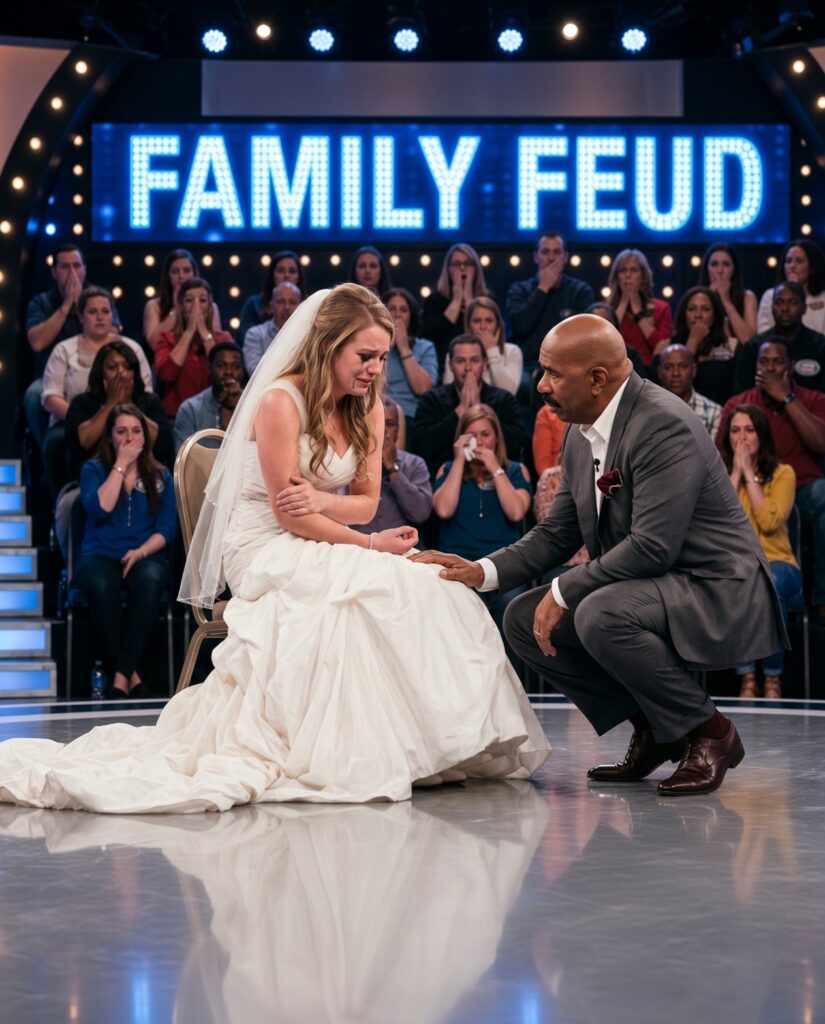
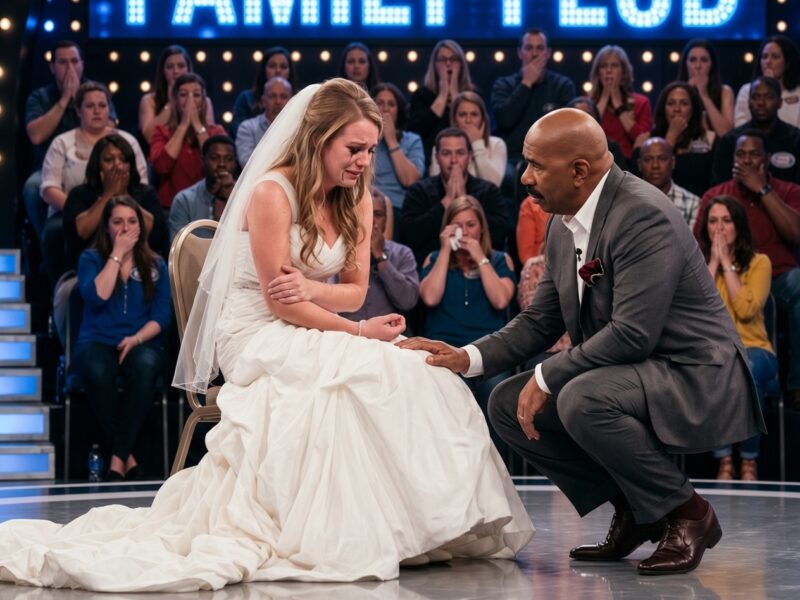
Rebecca Vance was wearing a white wedding dress when she walked onto the Family Feud stage at 11:14 a.m. on a Saturday morning in November of 2024.
The dress was Vera Wang. It had cost her father $7,000. The veil was still pinned to her hair.
The makeup had been done at 6:00 a.m. by a woman named Sheree at the Four Seasons Atlanta. The bouquet, white peonies and eucalyptus, was sitting in a vase of water in the back of her sister’s Honda Civic in the studio parking lot.
Her wedding had been scheduled to begin at 11:00 a.m. at St. Andrews Presbyterian Church in Buckhead, four miles away. Three hundred and forty guests were sitting in the pews at that exact moment, waiting.
Her fiancé, a 32-year-old investment banker named Connor Whitlock, was standing at the altar in a black tuxedo with the ring in his pocket. He had been standing there for fourteen minutes.
He did not know that his bride was at a TV studio. He did not know that her sister Hannah, the maid of honor, had been driving Rebecca through Atlanta traffic for the last twenty-three minutes.
He did not know that two hours earlier Rebecca had locked the bridal suite door and slid down the wall and could not breathe and could not stand and could not remember her own name. He did not know any of it.
Steve Harvey, who had been told ninety seconds before that a woman in a wedding dress had just walked through the studio loading dock asking for him by name, set down his card, walked off his mark, and met Rebecca Vance at center stage.
He looked at her. She was holding her own elbows. She could not stop shaking.
Steve said one sentence that would change the next forty years of her life. He said, “Baby girl, where do you actually want to be right now?”
And Rebecca Vance, twenty-nine years old, in a $7,000 dress with 340 people waiting for her four miles away, opened her mouth to answer and could not because for the first time in her life, somebody had asked her the right question, and she did not have a rehearsed answer for it.
But the real story hadn’t even started yet.
It was November 9th, 2024, and the Family Feud studio in Atlanta had been mid-taping when Rebecca walked in. The Halverson family from Minneapolis had been on the platforms, five Halversons and five Diaz cousins from Tampa in matching colorblocked T-shirts.
Steve had been in the middle of the second round when a producer’s voice came through his earpiece, low and urgent. “Steve, there is a bride at the loading dock. She is asking for you. I think you need to come now.”
Steve had paused. He had asked the producer to repeat herself. The producer had repeated.
Steve had told the audience the family would have a five-minute break. He had walked off stage. He had met the head of security, Reggie, in the corridor.
Reggie had walked him to the loading dock, and there, standing on a concrete floor in a white Vera Wang dress, with the train pulled around her feet like spilled milk, was a woman Steve had never met.
Hannah, her sister, was beside her, breathing hard, mascara running, holding her sister’s purse and a pair of white kitten heels.
Steve had taken one look at Rebecca and known. He had walked her himself slowly through the corridor, past the makeup rooms, past the green rooms, and out onto the studio stage.
The audience had gasped. The Halversons and Diazes had frozen on the platforms. The cameras had kept rolling because nobody in production had time to make a different decision. The studio fell completely silent.
Rebecca Vance had been engaged to Connor Whitlock for fourteen months. She had been dating him for four years before that. They had met at a dinner party in 2019 hosted by Connor’s law school roommate.
Connor had been twenty-eight. Rebecca had been twenty-five, working as a public defender in Fulton County, six months out of Emory Law and exhausted and idealistic and underpaid.
Connor had been charming. Connor had been steady. Connor had also been, Rebecca’s mother Margaret had said within four weeks of meeting him, exactly the kind of man we have been waiting for you to bring home.
Margaret Vance was the only daughter of Robert and Caroline Westbrook of Buckhead, Atlanta. A name that meant something in Atlanta to the people who knew what Atlanta names meant.
Margaret had married Rebecca’s father, Charles Vance, in 1992 at the same St. Andrews Presbyterian Church where her own daughter was scheduled to be married thirty-two years later.
Margaret had given birth to two daughters, Hannah the older and Rebecca the younger. Margaret had raised them on a script. The script had a beginning, a middle, and an end.
The beginning was good schools. The middle was the right people. The end was the right marriage.
Margaret had not deviated from the script in fifty-eight years of life, and she had not until the morning of November 9th, 2024 considered the possibility that her younger daughter might.
The system failure chain in Rebecca’s life had not been bureaucratic. It had been quieter than that. It had been the slow accumulation of every time a woman had been told she was being silly or dramatic or selfish or ungrateful or difficult until she had stopped trusting the only voice in her head that had ever told her the truth.
The first time Rebecca had told her mother she did not want to be a lawyer, she was sixteen. Her mother had laughed.
The second time she was nineteen and a sophomore at Vanderbilt. Her mother had said, “Rebecca, we don’t change horses midstream in this family.”
The third time she was twenty-three and at Emory Law and crying on a Sunday afternoon phone call. Her mother had said, “Honey, every law student feels this way. You’re almost done. You’ll feel different when you graduate.”
The fourth time was 2020, two years out of law school, working public defense, exhausted and underpaid, and watching her clients cycle through a system that did not seem to want to be fixed. Her mother had said, “Rebecca, you’re being self-indulgent. Connor is going to take care of you. You can do whatever you want once you’re settled.”
The fifth time, she did not say it out loud. She had stopped saying it out loud by 2021. She had started saying it only into her own pillow at 2:00 a.m. on the nights Connor was traveling for work.
The lie Rebecca had told her sister Hannah was small, but it had grown. She had told Hannah in the spring of 2023 that she was happy. She had said it on a hike. She had said it with conviction.
Hannah had not believed her. Hannah had not pushed. Hannah had been waiting, the way older sisters wait, for the night her younger sister would call her and finally say the true thing.
The night had not come until 5:47 a.m. on November 9th, 2024, when Rebecca had called Hannah from the bridal suite at the Four Seasons. She had been on the bathroom floor. She had not been able to breathe.
She had said, “Hannah, I don’t think I can do it. I don’t think I can do any of it. I can’t breathe.”
Hannah had said, “Don’t move. I’m coming.”
Hannah had been driving from Decatur. She had been there in twenty-six minutes.
What none of them said out loud was that Rebecca had not chosen Connor. Connor had chosen Rebecca and Margaret had chosen Connor and Rebecca had let herself be carried because she had been carried her whole life and did not know what it would feel like to swim.
Connor was kind. Connor was solid. Connor would have been a good husband to a different woman. He would have been a kind father to children Rebecca had agreed to want.
He would have provided a life Rebecca had agreed to live. He had not, as far as Rebecca could tell, ever asked her what she wanted. He had assumed, like everyone else, that she had been raised in a family where the women already knew.
What Rebecca had not told anyone, not Connor, not her mother, not Hannah, was that she had been writing applications in the locked notes app on her phone since the summer of 2023.
Applications to a master’s program in social work. Applications to a documentary film fellowship in Birmingham. An application to teach high school civics at a charter school in West Atlanta that paid $41,000 a year.
She had not submitted any of them. She had written them and saved them and reread them at 2:00 a.m. and closed the app and gone back to sleep beside the man she was going to marry.
The morning of the wedding, Hannah had arrived at the Four Seasons at 6:13 a.m. She had unlocked the bridal suite with the key card Rebecca had pushed under the door.
She had found her sister on the bathroom floor in her bridal robe, crying so quietly that the sound was just her shoulders moving. Hannah had sat down beside her. Hannah had said nothing. Hannah had let her sister breathe.
After fifteen minutes, Rebecca had said in a voice that was not her own, “Hannah, I’m not okay. I have not been okay for a long time. I don’t know what to do.”
Hannah, who had been the older sister for twenty-nine years, who had watched her younger sister be carried, who had known since 2021 that this morning was going to come, said the sentence she had been rehearsing in her head for three years.
“Becca, you don’t have to get married today. You don’t have to do anything today. We can leave right now. We can just leave.”
Rebecca had looked at her sister. She had looked at the wedding dress hanging on the bathroom door. She had looked at her phone. She had thought of her mother.
She had thought of her father, Charles, who had been quietly polishing his cufflinks at 7:00 p.m. the night before in the hallway of the family house. She had thought of 340 guests.
She had thought of Connor and she had thought for the first time of the locked notes app on her phone with the four unsent applications.
She had said, “I don’t want to go home. I can’t go home. I don’t know where to go.”
Hannah had thought for a long moment. And then Hannah, who had watched her sister try to tell the truth for fourteen years and watched the room shut her down every single time, said something only an older sister could say.
“Becca, there’s a thing I’ve been thinking about for a year. I don’t know if it’s right, but you watch Family Feud every Sunday night with Dad. He’s been your favorite since you were a kid. Steve Harvey, the way he talks to people, the way he listens. He’s taping today. I read it online last week. The studio is four miles from here. Becca, if you don’t want to go to that church and you don’t want to go home, then maybe, maybe we go where the only voice you’ve ever trusted is.”
Rebecca had laughed. Then she had stopped laughing. Then she had cried. Then she had said, “Hannah, that’s insane.”
Hannah had said, “Becca, the whole world is insane. You’ve been doing the same thing for twenty-nine years, and look where it got you. Let’s do the insane thing for one day.”
They had left the Four Seasons at 10:47 a.m. through the parking garage. Rebecca had not changed out of the dress. They had not gotten gas. Hannah had driven.
Rebecca had texted her mother only two words at 10:51 a.m. from the passenger seat. I’m sorry. She had turned her phone off and put it in her purse and not looked at it again.
They had pulled up to the loading dock at 11:11 a.m. The security guard had not believed them. Hannah had stood in front of the security camera and explained fast in the voice of a crisis lawyer who had practiced.
The producer on duty, a woman named Karen, the same Karen from a story another family had told a year earlier on this same stage, had walked down to the loading dock and looked at Rebecca’s face for ten seconds and said, “Get her inside. I’ll go find Steve.”
Now Rebecca was standing on the Family Feud stage in a Vera Wang dress in front of two hundred audience members and ten contestants on platforms and one boom operator who had stopped rolling and one sound engineer who was crying quietly behind a console and Steve Harvey was looking at her and the studio was completely silent and Steve had just asked her the question.
“Baby girl, where do you actually want to be right now?”
Rebecca opened her mouth. She closed it. She tried again.
“I don’t know,” she whispered.
Steve nodded. He did not press. He took her elbow gently. He guided her to a chair the stage manager had pulled out from the wings. He sat her down. He sat down across from her on the floor.
Sixty-seven years old with a bad knee in a charcoal suit on a Family Feud stage at 11:18 a.m. on a Saturday. And he looked her in the eye.
“How old are you, sweetheart?”
“Twenty-nine.”
“Where are you supposed to be right now?”
“St. Andrews Presbyterian, Buckhead. Four miles from here.”
“Who’s waiting for you?”
“Three hundred and forty people. My mother, my father, my fiancé. His name is Connor.”
“He a good man, Connor?”
Rebecca’s face crumpled. “Yes.”
“He love you?”
“I think he loves the version of me my mother showed him.”
The studio fell completely silent. Steve closed his eyes for a long second. He nodded slowly. When he opened them, his voice was softer.
“Baby,” he said. “Listen to me. I’ve been married four times. The first three times I wasn’t marrying a woman. I was marrying a story I’d been telling myself about who I was supposed to be with. The fourth time, Marjorie, I married a person. Took me forty-eight years. I almost died before I figured it out. You’re twenty-nine. You’re four miles and one decision away from doing something that would take you twenty years to undo. So, I’m going to ask you again. And this time, I want you to take your time. Where do you actually want to be right now?”
Rebecca was crying. She was looking at the floor. The veil was crooked. Her hands were in her lap. Hannah was standing at the edge of the stage with her hand over her mouth.
“Not there,” Rebecca said.
Steve nodded. “Where, baby?”
Rebecca looked up, her face changed. It was not relief. It was something else. The look a person gets when they finally name a thing they have been afraid to name.
“I want to teach high school civics,” she said. “At a charter school in West End. I applied last year. I never sent it. It pays $41,000. My mother would never recover. I wanted more than I have ever wanted anything in my life. And I have not said it out loud to one person.”
Hannah on the edge of the stage put both hands over her face.
Steve sat there on the stage floor and looked at her for a long moment.
“Then that’s where you want to be,” he said.
But Steve wasn’t done. He stood up slowly with help from a lighting tech who had stepped forward without being asked. He looked at Rebecca. He looked at Hannah. He looked at the cameras. The producers in his earpiece were silent. They had given up trying to direct him an hour ago.
“Sweetheart,” he said, “I want you to do three things, and I want you to do them in order. First, you call Connor right now from this stage. Not your mother, not your father, Connor, because he’s the man standing at the altar. And he deserves to hear it from you. And he deserves to hear it before 340 people start telling him versions of it that ain’t true.”
Rebecca’s hands started shaking. Steve handed her his own phone.
“Use mine, baby. Yours is off. We don’t turn it on yet. Hannah, you got Connor’s number?”
Hannah nodded. She gave Steve the number. Steve dialed it. He handed the phone to Rebecca. The phone rang once. Connor answered on the first ring.
His voice came through the speaker. Steve had put it on speaker gently with Rebecca’s small nod. The whole studio could hear him.
“Becca, Becca, where are you? Are you okay? Hannah’s not answering. Your mom is—Becca, where are you?”
Rebecca closed her eyes. The studio fell completely silent.
“Connor,” she said. “Connor, I’m okay. I’m safe. I’m not at the church. I’m not coming to the church. I’m so sorry.”
There was a long pause on the line.
“Where are you?” Connor said. His voice had changed.
“I’m with Hannah. I’m somewhere safe. Connor, listen. Please listen. I should have said this six months ago. I should have said it a year ago. I love you. I have loved you. But I have been disappearing for two years and you have not seen it because I have been very, very good at hiding it. I cannot marry you today. I cannot marry you ever. Not because of you, because of me. Because I am about to throw away the only life I will ever have. And I cannot do that to you. And I cannot do that to me. I am so sorry. I am so, so sorry.”
There was a longer pause. Then Connor said very quietly, “Becca, I knew. I have known for six months. I didn’t say anything because I was hoping I was wrong.”
Rebecca dropped her head.
“Are you safe?” Connor said.
“Yes.”
“Is Hannah with you?”
“Yes.”
“Then go,” Connor said. “Go. I’ll handle the church. I’ll handle your mom. Go figure out who you are. Don’t call me for a while, but Becca, don’t apologize. Just go.”
He hung up.
Rebecca handed the phone back to Steve. She was sobbing. Hannah came up onto the stage and held her sister.
But Steve wasn’t done.
“Second thing,” Steve said. “I want you to send those four applications you’ve been hiding in your phone today. Before you sleep tonight, not tomorrow, today. You’ve been writing them for a year. You’ve been rereading them at 2:00 a.m. for a year. The hardest part was already done. The hard part wasn’t the application. The hard part was telling yourself you was allowed to want it. You said it on this stage. So now you send them.”
Rebecca nodded into her sister’s shoulder.
“Third thing,” Steve said. “And this one is just for me. I want you to come back here in one year. November 9th, 2025. I want you to walk on this stage and tell me what happened. Not what you think I want to hear. What happened? Promise me, Rebecca.”
“I promise.”
Steve looked at the camera. He looked into camera one for a long moment. The studio was silent.
“Forty-three years ago,” he said, “I was twenty-six years old and I had just left a job at the Ford plant in Cleveland. I had a wife and a mortgage and two kids. I quit to do standup comedy. Everybody told me I was crazy. My wife told me I was crazy. My mama told me I was crazy. I left anyway. Three years later, I was sleeping in a 1976 Ford Tempo. Three years in that car, eating out of trash cans, showering in gas stations. And I will tell y’all something. I will tell y’all something every man and every woman watching needs to hear. Those three years in that car was the best decision of my life. Because every day in that car, I was on my own road. And I would rather sleep in a car on the road I picked than sleep in a king-size bed on a road somebody else picked for me. You hear me? Rebecca Vance just got out of the king-size bed. She just walked out the door. Y’all going to watch what she does next, and you’re all going to be inspired by it because she don’t even know yet what she’s about to do.”
The audience stood up. Two hundred people in a Family Feud studio stood up at 11:34 a.m. on a Saturday morning and clapped for a runaway bride in a wedding dress.
But Steve wasn’t done. He pulled out his phone. He called his business manager, Marvin, on speaker.
He told Marvin to set up a private fund for Rebecca Vance, $50,000 to cover one year of living expenses while she figured out her next step. He told Marvin to find her a lawyer for the Connor situation. Gentle, no animosity, just the legal logistics of a canceled wedding.
He told Marvin to find her a therapist by Monday morning. Top of her field, specializing in women raised by mothers like Margaret Vance. Steve did not say like Margaret Vance. Steve said high-pressure family environments, but everybody on stage knew what he meant.
Rebecca tried to refuse. Steve held up one hand.
“This ain’t a gift, baby,” he said. “This is a runway. You’re going to pay it back. Not to me. To the next girl who walks into a studio in a wedding dress because she ain’t got nowhere else to go. You’re going to spend the rest of your life building runways for the next Rebecca. That’s the deal.”
Rebecca nodded.
The Halversons won the day’s prize money. Steve covered the Diaz family’s pot out of his own pocket. The Diaz matriarch, a woman in her sixties named Enz, walked across the stage to Rebecca and pressed her own rosary into Rebecca’s hand.
She said in Spanish that the boom mic translated through Hannah Mika. Hannah translated softly, “The woman who walks away from the altar is the woman who finds herself.”
The clip went viral within forty-eight hours. The producers had blurred Connor’s name on the broadcast and bleeped Margaret’s. By the end of the first week, the segment had been viewed 428 million times across YouTube, TikTok, Instagram, and Facebook.
The hashtag “Where do you actually want to be?” trended in thirty-three countries. Wedding planners in nineteen countries reported a measurable uptick in cancelled or postponed weddings in the eight weeks after the broadcast.
What one industry analyst called the Rebecca Effect. A bridal magazine in London ran a cover story titled The Question That Changed Everything. A bridal magazine in Sao Paulo ran the same.
Connor Whitlock spoke to the press once, four days after the canceled wedding. He gave one interview to the Atlanta Journal-Constitution. He said, “Rebecca did the bravest thing I have ever seen anyone do. I am grateful she did not marry me. I hope she finds what she’s looking for. I hope I do too.”
He did not give another interview after that.
Margaret Vance did not speak to her daughter for seven months. Rebecca’s father, Charles, called Rebecca on the Tuesday after the wedding from his car in the parking lot of his law firm.
He told her he was proud of her. He told her he had been waiting twenty-nine years to be proud of her in this particular way. He told her he had been quietly, secretly watching Family Feud at 7:00 p.m. for the last ten years because he liked the way Steve Harvey talked to people.
He cried on the phone. Rebecca cried back. They had dinner the next Saturday. It was the first dinner the two of them had ever had alone.
Six months after the taping, Steve Harvey announced the launch of the Vance Question Foundation. The mission was specific. Provide emergency grants, legal assistance, therapy, and one year of housing support for women who left high-stakes weddings, engagements, or marriages because they had recognized, sometimes hours before, sometimes years late, that they had been carried into a life they had not chosen.
The foundation did not require evidence of abuse. It required only the woman’s own statement that she was leaving on her own terms.
The seed funding came from Steve himself, $6 million. Within ninety days, public donations had pushed the foundation past $78 million. Within a year, the Vance Question Foundation had served 3,146 women across forty-four states.
Each woman received in the mail a small card. The card had one sentence printed on it. Where do you actually want to be right now?
Rebecca Vance taught her first day of high school on August 14th, 2025. She was assigned a tenth-grade class of twenty-eight students at Westside Charter Academy in West End Atlanta.
Her starting salary was $41,400. She lived in a one-bedroom apartment in Cabbagetown with a bookshelf she had built herself. She had not bought another wedding dress. She had not started dating.
She had been in therapy for nine months. She and her father had dinner every Saturday. Her mother had begun in the early summer of 2025 to call once a week. Rebecca answered every other call.
They were rebuilding it slowly. Margaret had not yet by the fall of 2025 said the word sorry, but she had on a Tuesday in July said the words “I’m beginning to understand.” For Margaret, that was the same thing.
A year after the taping, on November 9th, 2025, Rebecca Vance walked back onto the Family Feud stage in a navy blue dress, flat shoes, and a blazer she had bought at a thrift store on Edgewood Avenue.
She was twenty-nine pounds heavier than she had been the year before. She told Steve she had stopped dieting. She told him she had stopped doing a lot of things.
She told him about her students. She told him the name of the kid in her third-period class who had asked her on the second day of school, “Miss Vance, why are you a teacher when you went to law school?”
She told him she had answered the kid honestly. “Because I wanted to be where I actually wanted to be.”
Steve, in an interview with People magazine that month, was asked what the moment with Rebecca had taught him.
“I’ve been on this stage for years asking people about their families,” he said. “About their mamas, their kids, their husbands, their wives. I never thought about the question I should have been asking. The question is, where do you actually want to be right now? You ask any person that question and you ask it real and you wait for the real answer. You find out everything you need to know about how lost they’ve been.”
He paused.
“I was lost too once. Took me three years in a 1976 Ford Tempo to find my answer. Rebecca Vance found hers in an hour. Some people are just braver than the rest of us.”
On a Sunday evening in October of 2025, Rebecca Vance sat at her kitchen table in her one-bedroom apartment in Cabbagetown grading civics quizzes.
The Vera Wang wedding dress had been donated to a charity called the Brides Project, which gave free dresses to brides who could not afford them. Rebecca had not kept anything from that morning except one item.
On a small bookshelf in her hallway, leaning against a stack of paperbacks, was a single white peony, the last one from the bouquet that had been sitting in the back of Hannah’s Honda Civic. Hannah had pressed it for her. It was framed now behind glass.
Below it, in Rebecca’s own handwriting on a small white card she had written one Sunday in March, was a sentence. Where do you actually want to be right now?
Some women spend their whole lives in dresses other people picked out for them. And some women on a Saturday morning in November walk out of a hotel suite in a Vera Wang gown and into the loading dock of a TV studio because the only voice they trust belongs to a stranger who once slept in his car and the stranger looks them in the eye and asks the question and waits.
If there’s a question you’ve been asking yourself at 2:00 a.m. that you’ve never said out loud to one living person, write it down tonight. Just write it. Don’t answer it yet. Just let it exist on paper.
We’ll be here when you’re ready to answer.
—
The weeks that followed the broadcast were not clean or easy for Rebecca Vance. They were messy in the way that real life is messy, the way that healing is messy, the way that stepping off a script and into an unwritten life is messy.
She did not sleep well for the first eleven nights. She woke at 2:00 a.m. out of habit, reaching for her phone, reaching for the locked notes app, reaching for the applications she had already sent.
She had sent all four the night of the taping, sitting on the floor of Hannah’s living room in Decatur with Hannah’s laptop on her knees because her own phone was still off. She had sent them at 11:47 p.m., 11:52 p.m., 11:58 p.m., and 12:03 a.m.
She had cried after each one. She had felt something she had not felt in years, something she could only describe as the opposite of drowning.
The first response came nine days later. It was from the charter school in West End. They wanted an interview.
The second response came twelve days later. It was from the social work program. They wanted to know if she could start in the spring.
The third and fourth responses never came, and Rebecca found that she was okay with that. She had learned something in the sending. She had learned that the wanting was the thing. The wanting was the whole thing.
Her mother did not call for seven months. Rebecca felt every one of those days.
She felt them in the shower. She felt them at the grocery store when she saw a woman who looked like her mother from behind. She felt them on Sunday evenings when she watched Family Feud alone in her apartment and thought about her father watching it alone in his den.
Charles Vance called her every Tuesday. He called her from his car in the parking lot of his law firm, the same parking lot he had called from on the Tuesday after the wedding.
He never missed a Tuesday. He never missed a Saturday dinner. He was learning how to be her father, Rebecca realized, in a way he had never been allowed to be before.
He told her things on those Saturday dinners. He told her about his own father, a man who had wanted Charles to take over the family hardware business in Macon, a man who had never understood why Charles wanted to be a lawyer.
He told her he had spent his whole life trying to be what other people wanted him to be, and he had only learned in the last few years how much that had cost him. He told her he was proud of her. He told her he was proud of her again. He told her he would keep telling her until she believed it.
Margaret Vance broke her silence on a Tuesday in July of 2025, seven months and three days after the wedding. She called at 6:47 p.m. Rebecca almost did not answer.
She answered.
Her mother’s voice was different. It was not the voice Rebecca had heard for twenty-nine years, the voice that had a plan and a script and a way things were supposed to be. It was a smaller voice. It was a voice that sounded like it had been doing some thinking.
“Rebecca,” her mother said. “I’m beginning to understand.”
That was all she said. That was all she needed to say. For Margaret Vance, a woman who had never in her life said the word sorry, a woman who had been raised by a mother who had never said the word sorry, a woman who had raised two daughters on a script she had inherited from her own mother, those four words were a revolution.
Rebecca cried after she hung up. She cried for a long time. She cried for the twenty-nine-year-old version of herself who had been so scared. She cried for the sixteen-year-old version of herself who had first tried to tell the truth. She cried for her mother, who had spent fifty-eight years doing what she was told and had never once been asked the question.
She called her mother back the next day. They talked for eleven minutes. They talked about nothing important. They talked about the weather and about a new restaurant in Buckhead and about whether Rebecca needed anything for her apartment.
It was the most honest conversation they had ever had.
The Vance Question Foundation grew faster than anyone had predicted. By the end of 2025, it had served 3,146 women across forty-four states. By the spring of 2026, it had served over 8,000.
The foundation did not just provide money. It provided a phone number, answered twenty-four hours a day, by women who had been where these women were. It provided lawyers who specialized in the legal logistics of leaving. It provided therapists who specialized in high-pressure family environments. It provided one year of housing, no strings attached, no evidence required, no proof that the man was bad or the marriage was wrong or the family was cruel.
The only requirement was the woman’s own statement that she was leaving on her own terms.
Steve Harvey funded the first year out of his own pocket, $6 million. The public funded the rest. Donations came in from brides who had gone through with their weddings and wished they hadn’t. Donations came in from mothers who had pushed their daughters toward matches their daughters did not want. Donations came in from men like Connor Whitlock, who sent a check for $10,000 with a note that said, “For the next one.”
The note was framed in the foundation’s office in Atlanta. It hung on the wall next to a photograph of Steve Harvey and Rebecca Vance on the Family Feud stage, November 9th, 2024, the moment before everything changed.
Rebecca did not work for the foundation. She had her own classroom now, her own students, her own life. But she spoke at the foundation’s annual gala every year. She stood on the stage in a dress she had picked out herself and told her story, the whole story, the messy parts and the hard parts and the parts that still made her cry.
She told the women in the audience, the ones who had written their own questions on their own pieces of paper and hidden them in their own locked notes apps, that the question was not the answer. The question was just the beginning.
The answer was the life you built after you asked it.
In the spring of 2026, Rebecca Vance received a letter from a woman in Ohio. The woman was sixty-three years old. She had been married for forty-one years. She had raised three children and buried one husband and never once in her life asked herself where she actually wanted to be.
She had watched the Family Feud clip on YouTube. She had watched it seventeen times. She had written the question on a sticky note and put it on her bathroom mirror. She had looked at it every morning for three months.
She had left her second husband in February of 2026. She had moved into a small apartment near her daughter. She had enrolled in a community college course on American history, a subject she had loved as a girl and had never been allowed to study.
She wrote to Rebecca to say thank you. She wrote to say that the question had found her forty-one years too late but that forty-one years too late was better than never.
Rebecca read the letter three times. She put it in a drawer in her kitchen, next to the card that said Where do you actually want to be right now? and the pressed peony from her bouquet and the rosary that Enz Diaz had pressed into her hand.
She kept these things as evidence. Evidence that the question worked. Evidence that it was never too late. Evidence that a woman in a wedding dress on a Saturday morning could change the course of her own life and the lives of thousands of women she would never meet.
On a Sunday evening in October of 2026, two years after the taping, Rebecca Vance sat at her kitchen table in Cabbagetown and graded civics quizzes.
Her apartment was bigger now. She had moved to a two-bedroom on the second floor of a renovated building on Carroll Street. She had a couch she had bought herself and a rug she had picked out herself and a cat named Harvey who slept on her grading papers.
She was thirty-one years old. She had been teaching for a year and a half. She had been in therapy for two years. She had dinner with her father every Saturday and talked to her mother every Sunday.
She was not married. She was not engaged. She was not dating anyone seriously. She was, for the first time in her life, exactly where she wanted to be.
Her phone buzzed on the table. It was a text from Hannah. Hannah was pregnant with her second child. Hannah wanted to know if Rebecca would be the godmother.
Rebecca typed yes and put the phone down. She looked at the bookshelf in her hallway, at the framed peony, at the card below it in her own handwriting. Where do you actually want to be right now?
She knew the answer now. She had known it for a while. The answer was here. The answer was this. The answer was a kitchen table in Cabbagetown and a stack of civics quizzes and a cat named Harvey and a sister who had driven her through Atlanta traffic on the worst morning of her life and a stranger on a TV stage who had asked her the question that changed everything.
The answer was a life she had chosen. The answer was a life she was still choosing, every day, every morning, every time she woke up and remembered that she was allowed to want what she wanted.
She picked up her pen and went back to grading. The quizzes were about the Bill of Rights. The students had been asked to write about a right they believed was most important. Most of them had written about the First Amendment. One of them, a girl named Destiny, had written about the Ninth Amendment, the one that said the enumeration of certain rights in the Constitution shall not be construed to deny or disparage others retained by the people.
Destiny had written, “This one means we have rights nobody wrote down. This one means we get to decide for ourselves what we’re allowed to want.”
Rebecca gave her an A.
She wrote at the bottom of the quiz, in her own handwriting, “You are exactly right. Keep asking yourself the question.”
She did not know if Destiny would understand what she meant. She did not know if Destiny had a mother who had raised her on a script or a father who polished his cufflinks in the hallway or a fiancé waiting at an altar four miles away.
She did not need to know. She just needed to plant the question. She just needed to let it exist on paper, in a quiz book, in a classroom in West End, in the mind of a fifteen-year-old girl who might one day need it.
That was the deal she had made with Steve Harvey. That was the runway she had promised to build. Not for herself. For the next Rebecca. For the next woman who walked into a studio in a wedding dress because she didn’t have anywhere else to go.
Rebecca Vance finished grading the quizzes at 9:47 p.m. She put them in her bag. She turned off the kitchen light. She walked down the hallway past the framed peony and the card and the rosary.
She stopped for a moment and looked at the question. Where do you actually want to be right now?
She smiled. She knew the answer. She had always known the answer. She had just needed someone to ask.
She went to bed. She slept well. She did not wake up at 2:00 a.m. She had not woken up at 2:00 a.m. in a long time.
The next morning, she would wake up in her own bed, in her own apartment, in her own life. She would feed the cat. She would drink her coffee. She would drive to Westside Charter Academy and stand in front of twenty-eight tenth graders and teach them about the Constitution and the Bill of Rights and the Ninth Amendment and the rights nobody wrote down.
She would teach them that they were allowed to want what they wanted. She would teach them that the question was the beginning. She would teach them that the answer was the life they built after they asked it.
And if one of them, someday, walked into a TV studio in a wedding dress because she didn’t have anywhere else to go, Rebecca hoped that someone would be there to ask her the question.
She hoped someone would be there to wait for the real answer.
She hoped someone would be there to build her a runway.
That was the deal. That was always the deal. That was the only deal that had ever mattered.
Where do you actually want to be right now?
Write it down. Just write it. Don’t answer it yet. Just let it exist on paper.
We’ll be here when you’re ready to answer.
We’ll be here.









