
Boutique Manager Cut an Elderly Black Man’s Credit Card in Half, Calling It Fake—Then Discovered He Owned the Entire Building
**Part 1**
The rain came down in sheets across Fifth Street, turning the gutters into rushing rivers and soaking through the thin coat of the old man who stood outside Maison de la Mode.
He was seventy-eight years old, with silver hair that clung to his forehead and hands that shook just slightly as he reached for the door handle.
The bell above the entrance chimed, announcing his arrival to the three women inside who looked up from their phones with expressions that ranged from mild annoyance to outright disdain.
“Can I help you?” A woman with sharply arched eyebrows and a name tag reading “Sloane” stepped forward, her heels clicking against the marble floor like warning shots.
“The thrift store is across the street.”
The old man smiled, water dripping from his coat onto the pristine white tile. “Good afternoon. I would like to see the blue gown in the window.”
Sloane’s lips curled into something that might have been a smile if it hadn’t been so cold. “That gown is four thousand eight hundred dollars.”
A young woman behind the counter—her name tag said Nia—let out a small laugh before catching herself.
The old man didn’t flinch. “I know the price.”
“Sir, the sale rack is outside in the rain.” Sloane gestured vaguely toward the door. “Perhaps something in your budget?”
Another employee, a girl barely out of her teens named Kendall, wrinkled her nose as she approached. “Is that coat older than me? It smells like the bus.”
“It was my father’s coat.” The old man’s voice was quiet, steady.
Nia was already moving, pulling out a chair from behind the display. “Sir, please sit down. Can I bring you some water?”
“Thank you, my dear.”
“Nia, do not offer him a seat. He will settle in.” Sloane’s voice cut through the air like a blade.
The old man lowered himself into the chair anyway, his joints creaking in protest. “It is for my wife. Our fiftieth anniversary is Saturday. Size eight.”
Sloane laughed, a sharp, humorless sound. “Fifty years and she still lets you dress like that? Fifty years of clearance.”
Kendall snickered behind her hand.
“Fifty years ago I could not afford a dress for her.” The old man’s eyes grew distant, lost in a memory that seemed to warm him despite the rain soaking through his clothes. “She sewed her own. This time I can.”
Sloane crossed her arms. “Can you? Show me.”
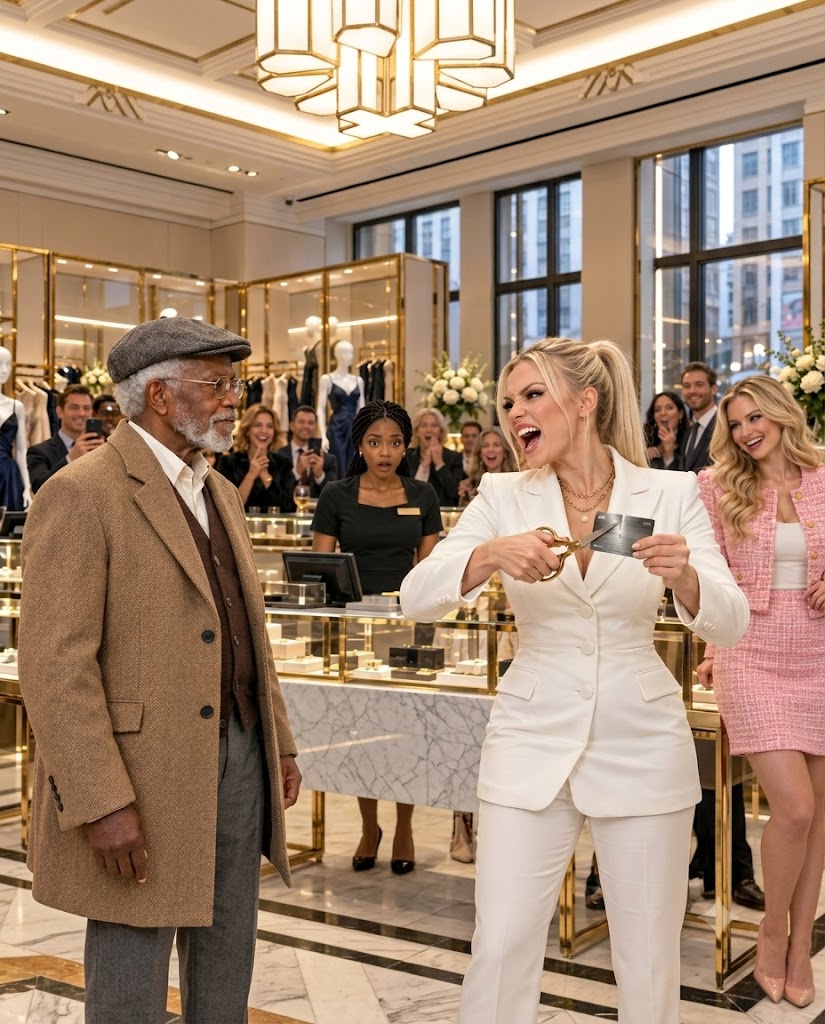
The old man reached into his pocket and pulled out a wallet so worn that the leather had cracked and peeled at the corners. From inside, he withdrew a black card—matte finish, no visible numbers, just a subtle metallic sheen that caught the light.
“Where did you find this?” Sloane snatched it from his fingers.
“In my wallet.”
“Kendall, look. He’s got a black card.” Sloane held it up like a specimen under a microscope. “Did it come in a cereal box? This card is fake.”
“It’s real,” the old man said quietly.
Nia stepped forward. “Ms. Whitler, just run it. Please.”
Sloane’s eyes narrowed. “Run it? I can do better than that.”
She walked to the counter, pulled out a pair of heavy scissors, and with a single, deliberate snip, cut the card in half.
“There.” She dropped the pieces on the counter like trash. “Now it’s a coaster.”
Kendall burst out laughing. Nia’s hand flew to her mouth.
“Oh my God,” Nia whispered.
“That card worked this morning, Ms. Whitler.” The old man’s voice remained calm, but something flickered in his eyes—something that looked almost like pity.
“Sir, leave before I call security.”
“I would still like to see the gown.”
Sloane’s smile was predatory now. “You want the gown? Here’s something in your price range.”
She grabbed a cheap, sequined dress from the sale rack—something garish and bright that had clearly been marked down multiple times—and threw it at him.
“Ms. Whitler, don’t,” Nia pleaded.
The old man caught the dress against his chest, his father’s coat now adorned with something that looked like it belonged in a discount bin.
“Now you look like you belong outside.”
The old man stood slowly, the dress clutched in his hands. “Finally.”
He turned toward the door, and that’s when his foot caught on the edge of the wet tile.
He went down hard, the dress flying from his hands, his body hitting the floor with a sound that made even Kendall wince.
“Oh no.” Nia rushed forward, dropping to her knees beside him. “Sir, let me help you.”
“Look, the new hire is cleaning him up,” Kendall sneered.
Nia ignored her, gently helping the old man sit up. His lip was split, and there was a gash on his forehead that was already starting to bleed.
“Nia, get up.” Sloane’s voice was ice. “You are embarrassing this store.”
“He is a customer, Ms. Whitler.”
“He is a fraud in a wet coat.” Sloane reached down and ripped the name tag from Nia’s blouse. “Take off your name tag. You are fired.”
Nia stared at her, disbelief and hurt warring on her face. “For helping him? For forgetting where I work?”
“For forgetting where you work.”
Nia stood slowly, her chin lifted. “I know exactly where I work. Or where I worked.”
The old man was on his feet now, Nia’s hand steadying his elbow. He looked at Sloane with those calm, ancient eyes.
“How long has this store occupied this building, Ms. Whitler?”
“Ten years. Why?”
“No reason.” He straightened his father’s coat, brushing off the dust from his fall. “I know this address very well. Thank you for your time. I will remember the gown.”
He turned toward the door, then paused.
“And I will remember you.”
The bell chimed as he stepped back into the rain.
Nia moved to follow him, but Kendall’s voice stopped her.
“Bye, Grandpa. The bus stop is that way.”
“Don’t come back, Nia,” Sloane called after her. “No store on this street will hire you.”
Nia paused at the threshold, rain already misting her face. “Then I’ll find another street.”
She stepped out into the storm, pulling her thin cardigan tighter around her shoulders.
The old man was standing at the corner, one hand against the brick wall, the other holding a small umbrella that looked like it had seen better decades.
“So, wait.” Nia hurried toward him, her heels splashing through puddles. “The rain is coming down hard. Take my umbrella.”
She held out a bright yellow umbrella—cheap, cheerful, completely inadequate for the deluge.
“You just lost your job because of me.”
“She cost me my job. My mother would have helped you too.”
The old man studied her face for a long moment, rain streaming down his weathered cheeks. “Your mother raised you well. What’s your name?”
“Mia.” She smiled, water dripping from her eyelashes. “Mia Brooks.”
“I’m Ezra.” He took her hand, his grip surprisingly strong. “Mia, may I get you a cup of tea?”
“I’d love to if I can pay.” She gestured across the street. “There’s a diner across the street.”
“It has been a long time since anyone held an umbrella for me.”
“Then it’s about time.” Mia adjusted her umbrella to cover him better. “Two teas and apple pie, my treat.”
“That might be your last twenty dollars.”
“Then it’s well spent.”
They crossed the street together, the old man’s pace slow but steady, Mia matching his rhythm without seeming to think about it.
The diner was warm and smelled like coffee and cinnamon, the kind of place that had been on this corner for fifty years and would probably be there for fifty more.
They slid into a booth by the window, watching the rain paint patterns on the glass.
“Tell me about your mother,” Ezra said.
Mia wrapped her hands around her mug, letting the warmth seep into her fingers. “She was a seamstress. She taught me on an old machine. I design at night.”
She pulled out her phone, scrolling through photos of sketches—elegant dresses, flowing lines, intricate details that spoke of hours of careful work.
Ezra took the phone, studying each image with the eye of someone who understood. “These are beautiful, Mia.”
“Nobody hires a designer without a degree. So I sold dresses instead.” She shrugged. “Used to.”
Ezra set the phone down gently. “Fifty years ago I married Ruth. I was a tailor’s apprentice with eleven dollars. Eleven dollars.” He shook his head, a fond smile playing at his lips. “She sewed her own blue dress. I promised her that one day I would buy her one.”
Mia leaned forward, her eyes bright. “Then let me make it. A dress made by hand like hers.”
“You would do that for a stranger?”
“You are not a stranger.” Mia’s voice was soft but certain. “You are a man keeping a promise.”
Ezra reached across the table and took her hand. “I will pay you the full amount for your design work.”
“Just pay for the silk. I won’t charge for my work.”
The old man’s eyes glistened, and for a moment, Mia couldn’t tell if it was rain or tears on his cheeks.
“Deal,” he whispered.
—
Across town, in a sleek glass tower that overlooked the river, a woman named Marisol Vega was reviewing documents on her tablet.
“Saturday at six o’clock, we sign the lease renewal. Ten more years in the best corner of Hollis Place.”
The man across from her—Trent Caldwell, regional manager for Maison de la Mode—nodded eagerly. “And I become regional director.”
“Has anyone even met the owner?”
Trent shrugged. “Nobody has. Some old man who sends a property manager.”
Marisol’s phone buzzed with a text message, and she glanced at it briefly. “Old men. I’ve met enough of them today.”
She turned the tablet toward Trent, showing him a video that had already accumulated thousands of views.
It was Ezra, standing in the rain outside Maison de la Mode, his father’s coat soaked through, a cheap sequined dress in his hands.
And then the fall—the sickening thud as he hit the ground.
“Grandpa and his cereal box car,” Trent laughed.
“Don’t delete it.” Marisol’s voice was cold. “Free marketing.”
—
Back at the store, Sloane was on her phone, her voice dripping with false sweetness.
“And Nia, I’m calling every boutique on Fifth. Nobody hires her.”
Nia was gone, but Kendall was still there, watching with wide eyes.
“Hi Vanessa. It’s Sloane.” A pause. “If Aniyah Brooke applies, she was let go for lying to customers.”
“That’s not true.” Kendall’s voice was barely a whisper. “Sloan, she never lied about anything.”
Sloane turned, her eyes blazing. “Kendall, do you want to keep your job, too?”
Kendall fell silent.
“Third store today,” Sloane muttered, scrolling to the next number.
—
**Part 2**
Three days later, Mia sat at a small table in her cramped studio apartment, a single lamp illuminating the space in front of her.
Spread across the table was a pattern—delicate lines drawn on paper that had yellowed with age, the handwriting elegant and precise.
“I brought you something.” Ezra had arrived an hour ago, a box of tissues in one hand and a worn leather satchel in the other. “Ruth’s pattern from 1976. She kept it in a drawer for fifty years.”
Mia traced her finger along the lines. “Her handwriting. She drew every line herself.”
“She sewed it on a table in a little tailor shop.” Ezra’s voice was thick with memory. “I watched her all night.”
Mia looked up. “Then I’ll follow her lines and add one thing she couldn’t afford.”
“What’s that?”
“Silk.” Mia smiled. “Real silk.”
She got to work, her fingers moving with the practiced ease of someone who had spent years perfecting her craft. The old sewing machine hummed, a sound that filled the small apartment with something that felt almost like hope.
“Every store says the same,” Mia said, not looking up from her work. “Someone told them I lied to customers.”
“One person, actually,” Ezra replied. “Ms. Sloane Whitler, if my guess is correct.”
“It doesn’t matter. Doors close, some of us build new ones.”
Ezra settled into a worn armchair, pulling a blanket over his knees. “Ruth used to hum when she sewed.”
“So did my mother.”
He smiled, his eyes drifting closed. “Rest, Mr. Ezra.”
“I’m not tired.”
But within minutes, his breathing had evened out, and Mia sat in the quiet, listening to the soft rhythm of his sleep.
“Mama,” she whispered to the empty air. “I’m making something good.”
—
In a penthouse apartment overlooking the city, Ezra Hollis sat before a young man named Thomas, who was scrolling through files on a tablet.
“Mr. Hollis, Maison de la Mode renews on Saturday at six o’clock. Their regional manager, Mr. Caldwell, wants ten more years.”
“Ten more years?”
Thomas paused, his brow furrowing. “Sir, is this you?”
He turned the tablet around, showing Ezra the video that had been circulating online—the one Sloane had posted herself.
Ezra studied it for a long moment, watching himself fall again and again. “It is.”
“They cut your card?” Thomas’s voice rose with outrage. “I’ll cancel their appointment right now.”
“No.” Ezra held up a hand. “Keep the appointment. I’ll be there myself.”
He leaned back in his chair, looking out the window at the city he had built from nothing.
“Marisol, the corner suite on the ground floor. Do you know what it was before Maison de la Mode?”
Thomas consulted his tablet. “Your first tailor shop, sir. Hollis Tailoring.”
“Where Ruth sewed her dress.” Ezra’s voice was soft. “And find out who told every store on Fifth not to hire a seamstress named Nia Brooks.”
“Yes, sir. Consider it done.”
—
Saturday arrived with clear skies and a strange sense of anticipation in the air.
Nia—Mia, as she now called herself—stood outside Maison de la Mode, her portfolio tucked under her arm.
She had no job, no income, and a half-finished dress hanging in her closet that might never be worn.
She was about to turn away when Sloane appeared in the doorway.
“Look who came back. Looking for a job?”
Mia lifted her chin. “Just passing by, Ms. Whitler.”
“Those sketches?” Sloane reached out and snatched the portfolio from Mia’s hands, flipping through it with exaggerated interest. “Sewing rags for Grandpa now?”
She tore out a page—a design Mia had spent three weeks perfecting—and dropped it in a puddle.
“Oops.”
Mia stared at her ruined work, then at the woman who had destroyed it. “Why do you hate me so much?”
“I don’t hate you.” Sloane smiled. “I just don’t see you.”
She turned and walked back into the store, the bell chiming cheerfully behind her.
Mia stood there for a long moment, the rain from the earlier storm soaking through her shoes.
Then she bent down, picked up the ruined sketch, and smoothed it out.
She would just have to draw it again.
—
At six o’clock that evening, the doors of Maison de la Mode opened for what the staff believed would be a simple lease signing.
Sloane stood at the front, flanked by Trent and Kendall, all three of them in their finest clothes.
Marisol Vega arrived first, her tablet in hand, followed by a man none of them recognized—an elderly gentleman with silver hair and a coat that looked like it had seen better days.
“You?” Sloane’s voice was sharp. “Again? And you brought her?”
She pointed at Mia, who had followed Ezra through the door.
“Sir, this is a private event. Leave before I have you removed.”
“We’re expecting the owner of this building,” Trent added, puffing out his chest.
“So are we.” Marisol stepped forward. “Mr. Caldwell, I’m Marisol Vega, property manager of Hollis Place.”
She gestured toward Ezra. “You are expecting the owner? Here he is. Mr. Ezra Hollis.”
The color drained from Trent’s face. “Mr. Hollis, what an honor.”
“No.” Sloane shook her head, her voice rising. “He paid with a fake card. That card was fake.”
“It was real.” Ezra’s voice carried across the store, calm and steady. “It still is.”
“Mr. Hollis, there has been a terrible misunderstanding.” Trent was already backing toward the counter. “Let us sign and move forward.”
“Not yet, Mr. Caldwell.” Ezra walked slowly through the store, his fingers trailing over the displays. “Fifty years ago, this room was a tailor shop. Mine. Hollis Tailoring.”
He stopped at the center of the floor, right where the main counter now stood.
“I sewed my blue dress at a table right where this counter stands.” His voice was thick with emotion. “Tonight, the woman you fired made it again by hand.”
All eyes turned to Mia, who stepped forward with a garment bag in her arms.
She unzipped it carefully, revealing a gown so exquisite that even Sloane’s breath caught in her throat.
It was deep blue silk, the color of midnight, with delicate stitching that spoke of hours of patient labor. The lines followed Ruth’s original pattern, but there was something more—something that made it look almost alive.
“You made this?” Trent asked, his voice barely a whisper.
“Yes, sir.”
Ezra gestured toward Sloane. “Ms. Whitler, you told me I belonged outside. Then you tossed your coffee on my coat.”
“Is that true?” Trent turned to Sloane.
“He—he looked like—”
“It is true,” Kendall interrupted, her voice shaky but determined. “I filmed all of it. The card, the coffee, and her calling every store to say Nia lied.”
Every head swiveled toward Kendall, who was holding up her phone.
“You’re finished at Maison de la Mode,” Trent said to Sloane. “Tonight.”
“Trent, say something. We’re engaged.”
“I barely know her.” Trent stepped back. “And we’re not engaged anymore.”
Sloane stood frozen, her face a mask of disbelief and fury.
“Mr. Hollis, about the lease, the ten years—”
“There will be no renewal.” Ezra’s voice was firm. “Maison de la Mode has sixty days.”
“Sixty days?”
“Nia, come back.” Sloane’s voice cracked. “Store manager, double the salary.”
“Thank you, Ms. Whitler, but no.”
“Nia has other plans.” Ezra smiled at Mia. “When this suite is empty, when this city is, it will be hers. Rent-free. Her own name over the door.”
Mia’s eyes widened. “Mr. Hollis, I—I can’t—”
“Yes, you can.”
The room erupted in applause, though there were only a few people present to clap.
“You are giving the best corner of Hollis Place to a sales clerk?” Sloane’s voice was shrill.
“No, Ms. Whitler.” Ezra’s voice was gentle. “To a designer. You simply never looked at her.”
“I’ll sue. I’ll—” Sloane grabbed her bag. “Your key’s in the office.”
“You cut a card, Ms. Whitler.” Ezra met her eyes. “It cost me nothing. It cost you everything. Now, if you’ll excuse us, we have a fiftieth anniversary to attend.”
—
**Part 3**
The anniversary party was held at the Hollis estate, a sprawling Victorian house that had been in Ezra’s family for four generations.
Ruth stood at the top of the staircase, resplendent in the blue silk gown Mia had made.
Fifty years had passed since she had sewn her own wedding dress on a borrowed machine, but tonight she looked like a queen.
“You still take my breath away,” Ezra whispered as he took her hand.
“And you still wear that coat.” Ruth laughed, smoothing the worn fabric of his father’s coat. “Fifty years, Ezra Hollis.”
“And fifty more, Ruth Hollis.”
Guests filled the ballroom—friends, business associates, people Ezra had known for decades and people he had only just met.
Mia stood at the edge of the room, a glass of champagne in her hand, watching the couple dance.
“Fifty years ago, I could not afford a dress.” Ezra’s voice carried across the room as the music faded. “Tonight, a woman made one for a stranger with her last twenty dollars and her own two hands.”
He raised his glass. “To Nia Brooks.”
Mia’s cheeks flushed as every eye turned to her.
“Thank you,” she whispered. “For walking into that store.”
“Come here, sweetheart.” Ruth held out her hand. “This dance is yours, too.”
Mia stepped forward, taking Ruth’s hand, and let herself be pulled into the warmth of the celebration.
Across the room, Trent was staring at his phone, his face pale.
“Trent?” a woman beside him asked.
“I just got the lease termination notice. Maison de la Mode is finished.”
—
Three months later, a new boutique opened on the corner of Fifth and Hollis.
The sign above the door read “Nia Brooks Atelier” in elegant gold script.
Inside, the walls were white, the floors polished marble, and the displays were filled with dresses that seemed to glow.
Mia stood behind the counter, arranging a new shipment of fabric, when the bell above the door chimed.
She looked up, and her heart stopped.
Sloane Whitler stood in the doorway, her hair disheveled, her clothes rumpled.
She looked nothing like the polished manager who had cut up Ezra’s card and thrown a cheap dress at him.
“Miss Whitler?”
“I’m not here to buy.” Sloane’s voice was hoarse. “Nobody on Fifth will hire me. I came to apologize.”
Mia set down the fabric and gestured to a chair. “Please, sit down.”
Sloane hesitated, then collapsed into the seat.
“Can I bring you some water?”
Sloane looked up, tears streaming down her face. “He offered me water that day. I never offered him that. That’s why I’m offering it to you.”
“No.” Mia shook her head. “I never offered him that. That’s why I’m offering it to you.”
They stared at each other for a long moment.
“Do you need someone to sweep, fold, anything at all?” Sloane’s voice cracked. “I’ll do anything.”
Mia considered this, remembering the day Sloane had cut up the card, the day she had thrown the dress, the day she had ripped the name tag from Mia’s blouse.
“We start at eight,” Mia said finally. “Bring comfortable shoes.”
Sloane nodded, and for the first time in months, something like hope flickered in her eyes.
—
**Part 4**
The years passed, as years do.
Nia Brooks Atelier became one of the most sought-after boutiques in the city, known for its handcrafted garments and its commitment to hiring people others had overlooked.
Sloane Whitler started as a floor sweeper, then a sales associate, then a manager in her own right.
She never cut up another card.
—
Ruth Hollis passed away five years after the anniversary party, in her sleep, with Ezra by her side.
She was wearing the blue silk gown.
Ezra followed her three months later, a broken heart that no doctor could fix.
But before he died, he sat with Mia in her atelier, surrounded by the dresses she had made, the lives she had touched.
“You gave me a reason to keep sewing,” he said.
“You gave me a reason to keep going.”
He pressed something into her hand—the two halves of the black card, taped together.
“I never fixed it,” he admitted. “I kept it as a reminder.”
“Of what?”
“That sometimes the best things come from the worst moments.”
—
**Part 5**
Ten years after the opening of Nia Brooks Atelier, a young woman walked into the boutique, clutching a portfolio under her arm.
She was nervous, clearly—her hands shaking, her eyes darting around the space.
“I’m here to see Ms. Brooks,” she said to the woman behind the counter.
The woman looked up. It was Sloane.
“Do you have an appointment?”
“No, but I—I have some sketches.” The young woman held out her portfolio. “I was told Ms. Brooks might be interested.”
Sloane took the portfolio and flipped through it carefully.
“These are beautiful,” she said. “Ms. Brooks will see you now.”
She led the young woman through the boutique, past racks of dresses, past the old sewing machine that had been restored and put on display, past the photograph of Ezra and Ruth on their wedding day.
At the back of the store was a small office, and inside was Mia—older now, gray at her temples, but still with that same light in her eyes.
“You must be Mariana,” she said, standing to shake the young woman’s hand. “I’ve heard wonderful things about your work.”
“I brought some sketches—”
“Let’s see them.”
Mariana laid her portfolio on the table, and Mia studied each page with the same care Ezra had shown when he’d looked at her designs all those years ago.
“These are beautiful,” she said finally. “Tell me about your mother.”
Mariana looked surprised. “My mother?”
“A seamstress?”
“No, she—” Mariana paused. “How did you know?”
“Your hands.” Mia smiled. “You have a seamstress’s hands. Just like mine.”
—
That night, after Mariana had left, Mia sat alone in her office, looking at the photographs on the wall.
Ezra and Ruth, dancing at their anniversary party.
The original sign from Hollis Tailoring, salvaged and framed.
The two halves of the black card, taped together.
The first dress she had ever made—Ruth’s blue silk gown, now on display in a glass case.
She remembered the day Ezra had walked into Maison de la Mode, soaked to the bone, carrying a promise and a worn-out wallet.
She remembered the day he had made her the offer of a lifetime.
She remembered the words he had said the day he died:
“You gave me a reason to keep sewing.”
She closed her eyes and whispered the words back to the empty room.
—
The next morning, Mariana arrived at the atelier for her first day of work.
She found a small package on her workstation—a roll of blue silk and a note written in elegant, faded handwriting.
“Everyone deserves a place to sit, a glass of water, and someone who truly cares about them.”
Mariana looked around the store, at the women working, at the dresses on display, at the old sewing machine humming softly in the corner.
She smiled.
She had found her place.
—
Six months later, Nia Brooks Atelier held its first fashion show.
The last look was a gown made of blue silk—a design that had been handed down through three generations of seamstresses, from Ruth to Mia to Mariana.
When the model appeared on the runway, the audience gasped.
The dress was alive, woven with threads of memory and promise and love.
At the end of the runway stood Mariana, nervous and proud, her hands clasped together.
And in the front row, where she always was, sat Mia—not as a designer, not as an owner, but as a guest, a witness, a keeper of promises.
“Fifty-one years, Ezra,” she whispered to the empty seat beside her. “You still take my breath away.”
The applause was thunderous.
The lights were bright.
And somewhere, in a tailor shop that no longer existed, two people danced to a song only they could hear.
—
**Part 6**
The years continued to pass.
Nia Brooks Atelier grew into a chain of boutiques across the country, each one committed to the same values that had made the original so special.
Sloane Whitler became the director of operations, a woman who had learned from her mistakes and spent the rest of her life making amends.
Kendall, who had filmed the video that started it all, became a photographer for the brand, capturing the stories of every seamstress who worked there.
And Mariana—Mariana became the head designer, creating clothes that spoke of history and heart.
—
When Mia finally retired, she moved to a small house by the sea, surrounded by photographs and memories and the old sewing machine that her mother had taught her on.
She spent her days tending her garden, her evenings watching the sunset, her nights dreaming of the day an old man in a worn-out coat had walked into a store and changed her life.
—
On a clear morning in early spring, a young woman knocked on Mia’s door.
She was nervous, clutching a portfolio under her arm.
“I’m here about a job,” she said.
Mia, who was now well past seventy, studied the young woman’s face.
“What’s your name?”
“Ruth. Ruth Hollis.”
Mia’s breath caught. “Hollis?”
“My grandfather was Ezra Hollis. I heard about you from my grandmother’s stories.” The young woman held out her portfolio. “I design dresses. I was hoping you might teach me.”
Mia stood there for a long moment, the past and the present colliding in her mind.
“Come in,” she said finally. “I’ll put on some tea.”
They sat in Mia’s small kitchen, the kettle whistling on the stove, and Mia looked through the young woman’s sketches.
They were beautiful—bold and new and filled with the same kind of passion she had once poured into her own designs.
“What did your grandmother tell you about me?” Mia asked.
“She said you were a woman who kept a promise to a stranger.”
Mia laughed, tears pricking at her eyes. “No. It was your grandfather who kept the promise. I just helped.”
—
That afternoon, Mia took Ruth Hollis to the old sewing machine.
She sat her down, placed her hands on the wheel, and showed her how to thread the needle.
“Your grandmother used to hum when she sewed,” she said.
“So did you.”
“Everyone who sews hums.” Mia smiled. “It’s the song of creation.”
She sat back and watched the young woman work, the machine humming under her fingers, the fabric flowing like water.
And for a moment, she could almost see Ruth and Ezra standing there, watching over them, smiling.
—
**Part 7**
The story of Nia Brooks Atelier traveled across the country, from city to city, from store to store.
It was told in the speeches of business leaders, in the lectures of fashion schools, in the quiet conversations of grandmothers and granddaughters.
It was a story about a black card that was real and a black coat that was old and a blue gown that was priceless.
It was a story about kindness, and the power of seeing someone when everyone else had looked right through them.
—
And in the end, that was what mattered most.
Not the money, not the fame, not the success.
It was the glass of water offered to a stranger.
It was the umbrella held over an old man’s head.
It was the chair pulled out for someone who had nowhere to sit.
It was the simple act of looking at another human being and saying: I see you.
—
**Part 8**
On a rainy afternoon many years later, a young man walked into the original Nia Brooks Atelier on Fifth Street.
He was soaked to the bone, his coat too thin for the weather, his hands shaking with cold.
“I’m looking for the manager,” he said to the woman behind the counter.
The woman—Mariana, now in her fifties—looked up and smiled.
“Can I help you?”
“I want to see the blue gown in the window.”
Mariana stepped out from behind the counter. “That gown is five thousand dollars.”
The young man’s face fell. “I know the price.”
“Sir, the sale rack is outside in the rain.”
“No, I—I have to have that gown. It’s for my mother. She’s sick and she’s always wanted to see it. I’ve been saving for two years.”
Mariana studied him for a long moment.
Then she walked to the window, took the blue gown from the display, and brought it to him.
“Sir, please sit down. Can I bring you some water?”
The young man stared at her, tears streaming down his face.
“Thank you,” he whispered. “Thank you.”
Mariana smiled.
“Your mother raised you well. What’s your name?”
“Leon. Leon Hollis.”
Mariana’s heart stopped.
Hollis.
She looked at him more closely—at the shape of his face, the color of his eyes.
And she knew.
“Leon,” she said, her voice thick with emotion. “You are not a stranger. You are a man keeping a promise.”
He looked up at her, confused.
“Fifty years ago,” she said, “an old man walked into this store with a black card and a dream. He taught us all what it means to be seen.”
She held out her hand.
“Come with me. Let me show you something.”
She led him to the back of the store, to the glass case that held the original blue silk gown.
“My grandmother made that,” she said. “And a woman named Nia Brooks helped her.”
Leon stared at the gown, his eyes wide.
“I heard the stories,” he whispered. “I thought they were just legends.”
“They’re not legends.” Mariana smiled. “They’re history. And you’re a part of it.”
—
That evening, as the rain continued to fall, Leon Hollis walked out of Nia Brooks Atelier with the blue gown in his arms and something that felt almost like hope in his heart.
He was walking to the bus stop, the gown carefully wrapped in plastic, when a young woman ran up beside him.
“You forgot your umbrella,” she said.
He looked at her—at her bright smile, her kind eyes, the way she looked at him like he was important.
“Thank you,” he said. “My name’s Leon.”
“Mia,” she said. “Mia Brooks. The second.”
He laughed. “Any relation?”
“She was my grandmother. She used to say everyone deserves a place to sit, a glass of water, and someone who truly cares about them.”
Leon looked at her—really looked—and felt something shift inside him.
“I’m glad I walked into that store,” he said.
“So am I,” Mia said.
And together, they walked into the rain.
—
**Part 9**
The story of Nia Brooks Atelier never really ended.
It continued, generation after generation, passed down from seamstress to seamstress, from stranger to stranger.
It was told in the hum of sewing machines, in the rustle of silk, in the laughter of people who had found their place in the world.
And it all started with a black card that was real.
And a black coat that was old.
And a promise that a man made to his wife fifty years ago and kept on a rainy afternoon on Fifth Street.
—
**Part 10**
In a small cemetery on the edge of the city, there was a headstone that read:
EZRA HOLLIS
1920-2018
Beloved Husband, Father, Tailor
And beside it:
RUTH HOLLIS
1922-2013
Beloved Wife, Mother, Seamstress
Visitors often found small gifts left at their graves—a spool of thread, a piece of blue silk, a note that said “Thank you.”
They had started something that would never end.
A legacy of kindness.
A legacy of seeing.
A legacy of love.
—
And somewhere, in a tailor shop that no longer existed, two people danced.
—
*The End*









