
Black Cashier Gave His Last $23 for an Old Woman’s Groceries—What Came Next Changed His Life Forever
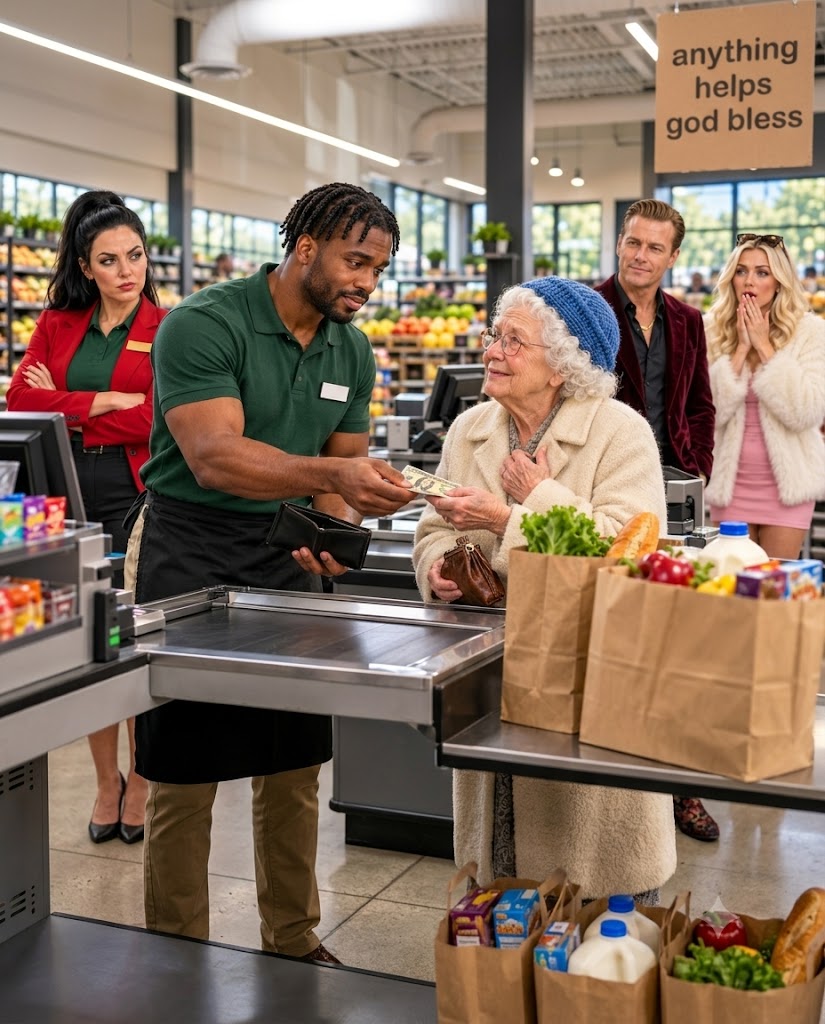
The fluorescent lights of Freshway Store 112 hummed like a dying wasp trapped in a jar.
Darius Cole stood behind register four, his name tag crooked from a long shift, his fingers still smelling of the cardboard boxes he’d unpacked before clocking in.
It was Thursday evening in East Baltimore, the kind of evening where the air felt thick with exhaust and the promise of rain that never came.
A woman in a gray hoodie stood at his lane, her hands trembling as she counted out crumpled dollar bills and a handful of coins that clinked against the conveyor belt like broken teeth.
“Oh dear,” she whispered, her voice barely rising above the beep of the scanner. “My pension check is late again.”
Darius looked down at the total on his screen.
Forty-seven dollars and twelve cents.
She had twenty-four dollars and eighty-nine cents.
“How much are we short, Mrs. Finch?” he asked, keeping his voice low, the way his mother had taught him to speak to elders—soft, respectful, like you were handling something fragile.
The man behind her in line shifted his weight, his leather loafers squeaking against the linoleum.
“Are you kidding me?” the man said, his voice sharp enough to cut glass. “Some of us have places to be.”
Darius didn’t look back.
He kept his eyes on Mrs. Finch, on the way her knuckles had gone white around the handle of her reusable bag, on the way she was trying so hard not to cry in front of a stranger.
“Twenty-three dollars, dear,” she said, her voice cracking. “I can put the milk back.”
The man behind her snorted, a sound so dismissive it made Darius’s jaw tighten.
“Keep the milk,” Darius said. “I have got it.”
He reached into his own pocket, pulled out his wallet—thin, worn at the edges, holding exactly twenty-three dollars and a library card—and slid a twenty and three ones across the counter.
Mrs. Finch looked up at him, her eyes wide and wet.
“Oh,” she said. “Oh, now he’s running a charity on my time.”
The man behind her stepped forward, close enough that Darius could smell the expensive cologne, the kind that cost more than Darius made in a week.
“Listen to me, pal,” the man said, his voice dropping into something dangerous. “I have been standing here eleven minutes.”
Darius turned slowly.
“Sir,” he said, “take your hand off my collar.”
The man’s fingers were curled into the fabric of Darius’s uniform shirt, right at the throat, pulling just enough to make it hard to breathe.
“Do you know who I am?” the man said, his face inches from Darius’s.
Darius looked at him, really looked at him—the tailored suit, the Rolex, the arrogance carved into every line of his face like a monument to itself.
“I own half the buildings on this street,” the man said.
A woman appeared beside him, her phone already raised, the camera lens pointed like a weapon.
“Babe, hold still,” she said. “I want his name tag in the shot.”
“Let go of him,” Mrs. Finch said, her voice suddenly steady, suddenly strong. “He was only helping me.”
Darius reached up and pulled the man’s hand away from his collar, one finger at a time, calm and deliberate.
“I will ring you up next, sir,” Darius said. “Right after Mrs. Finch.”
“No,” the man said. “You ring me up now.”
“It is all right, Mrs. Finch,” Darius said, turning back to the register. “Nothing is broken.”
He scanned the last of her items, bagged them carefully, and handed her the receipt.
“Here you go, ma’am.”
The man behind her was already pulling out his phone.
“What is going on at my lane four?” he said, loud enough for the entire store to hear. “Your cashier is giving away store money and making paying customers wait.”
The store manager, Kayla Morgan, appeared from the back office, her heels clicking against the floor like a countdown.
“Mr. Whitlock,” she said, her voice dripping with apology. “I am so sorry.”
“It was my own money, Miss Morgan,” Darius said. “Twenty-three dollars on my clock.”
Kayla’s eyes flicked to him, cold and flat.
“There is no such thing as your own money,” she said. “I want him out of here tonight.”
She turned to Darius.
“Darius, you are done. Hand me your name tag.”
“For helping a customer?” he said.
“For making Mr. Whitlock wait,” she said. “And that twenty-three dollars comes out of your last paycheck. Store policy.”
The woman with the phone laughed, a short, sharp sound.
“This is going straight on my page,” she said.
“Darius, I am so sorry,” Mrs. Finch said, her voice breaking.
“Next time,” Mr. Whitlock said, adjusting his cufflinks, “know your place.”
Darius looked at him, at the smug satisfaction in his eyes, at the way he’d already forgotten this moment, already moved on to the next conquest.
“My place was helping her,” Darius said. “I would do it again.”
“Tyler,” Kayla said to the security guard by the door. “Walk him out.”
“I can find the door myself,” Darius said.
“Move,” Tyler said, his hand on Darius’s elbow, guiding him toward the exit like he was something that needed to be disposed of.
The automatic doors slid open, and the warm Baltimore air hit Darius’s face like a slap.
He walked out into the parking lot, his name tag still clipped to his shirt, his wallet empty in his pocket.
Mrs. Finch appeared beside him a moment later, her bags heavy in her arms.
“You lost your job because of me,” she said.
“No, ma’am,” Darius said. “I lost it because of him.”
She looked up at him, her eyes searching his face.
“That was the kindest thing anyone has done in that store in a long time,” she said.
“Did not feel kind,” Darius said. “Felt expensive.”
“Kindness usually does,” she said.
They stood there for a moment, the parking lot empty except for the distant hum of traffic on Belair Road.
“For the bus stop, ma’am?” Darius asked.
“What is your name?” she said.
“Darius. Darius Cole.”
“Mrs. Finch lives three blocks over,” she said. “I will walk her home.”
“I am Ammani,” Mrs. Finch said. “Then I will walk with you.”
—
Darius carried Ammani’s bags every Thursday after that.
Not because she asked him to.
Because somebody had to.
He walked her the three blocks from the bus stop to her apartment on North Charles Street, a brick building with a faded awning and a front door that stuck in the humidity.
She lived alone, he learned, on a pension that never seemed to arrive on time.
She baked, he learned, because it gave her hands something to do.
She asked about his life, and he told her, because there was something about the way she listened that made the truth easier to say.
“He studies engineering at night, you know,” Ammani said one Thursday, looking up at Darius as they walked.
“Used to,” Darius said. “Without this job, I cannot pay for the spring semester.”
“Then why do it?” she said. “Twenty-three dollars when you cannot pay tuition.”
Darius thought about that for a long time.
He thought about his mother, Denise, working double shifts at a diner, her feet swollen, her smile never fading.
He thought about the story she told him, the one she told him every birthday, the one that lived in his bones like a second heartbeat.
“Because somebody did it for us once,” he said. “My mom never forgot it.”
Ammani stopped walking.
She looked at him, really looked at him, the way people look at things they’re trying to remember.
“Denise,” she said softly. “Denise Cole.”
Darius stopped too.
“You know her?” he said.
“She is my mother,” Ammani said.
The words hung in the air between them, heavy and strange, like a door opening in a house he’d lived in his whole life without knowing there was another room.
—
Three days later, Darius was sitting in his apartment, staring at his laptop screen, when his phone buzzed.
It was Kiara, his coworker from Store 112.
“Darius, you are all over the internet,” she said.
He sighed.
“Let me guess,” he said. “They cut the part where he grabbed me.”
“Hey,” Kiara said. “You look like you need a break.”
“I do,” he said. “Thanks, Kiara.”
He hung up and opened his phone.
The video was everywhere.
Mr. Whitlock’s wife had posted it first, a thirty-second clip that made Darius look like a thief and a fool, a cashier who’d stolen from the register to play hero.
Three million views.
Comments pouring in like water through a cracked dam.
*This is why we can’t have nice things.*
*Fire him. Blacklist him.*
*Who does he think he is?*
Darius closed the app.
Spring semester was due Friday.
Four thousand dollars.
He stared at the number on his screen, the same way he’d stared at the total at register four, the same way he’d stared at his empty wallet.
“We will figure it out,” Kiara had said.
“We always do,” he’d replied.
But this time, he wasn’t so sure.
—
The next morning, his phone rang again.
It was Lily, another coworker, her voice shaking.
“Mr. Whitlock called,” she said. “He wants the lane four cashier blacklisted from every store.”
“Done,” came Kayla Morgan’s voice in the background.
“Miss Morgan,” Lily said, “I filmed the whole thing. He grabbed Darius by the collar.”
“Delete it, Lily,” Kayla said. “Or you are next.”
“Of course, Mr. Whitlock,” Kayla continued, her voice shifting into something sweet and eager. “And I would love to run the store at Whitlock Plaza. Come Monday, I am regional manager.”
Darius hung up.
He sat on the edge of his bed, his hands on his knees, and tried to breathe.
There was a knock at the door.
He opened it to find Ammani standing there, a Tupperware container in her hands.
“I baked for you,” she said. “It is all I have.”
“Mrs. Finch, you did not have to,” he said.
“Neither did you,” she said.
She stepped inside, looked around the small apartment, the textbooks stacked on the floor, the single plate in the sink.
“A friend of mine runs a company,” she said. “They are hiring Monday morning.”
“After that video,” Darius said, “nobody will hire me.”
Ammani set the container on the counter.
“This one will,” she said.
She pulled out her phone and showed him a video.
Three million views.
But this one was different.
This one showed the whole thing.
The collar grab.
The name tag shot.
The way Darius had kept his voice calm, his hands open, his dignity intact.
“You are a hero to every guy who ever waited in line,” Ammani said.
“And Monday,” Darius said, “I sign with Freshway. Thirty million.”
Ammani looked at him.
“Mr. Whitlock,” she said. “The cashier is blacklisted.”
“Good,” Darius said. “After I sign Monday, you run the—”
“Thirty million views, babe,” Ammani said, reading from the screen.
“Regional manager,” Darius said.
“And Monday I sign with Fred,” Ammani said.
“Your last check,” Darius said, “minus twenty-three dollars, minus your uniform.”
“Thank you, Miss Morgan,” he said to no one.
—
Saturday morning, Darius went back to Store 112.
He didn’t know why.
Maybe to pick up the last of his things.
Maybe to prove to himself that he wasn’t afraid.
The store was busy, the Saturday morning rush, carts clattering, children crying, the smell of rotisserie chicken hanging in the air like a promise.
He walked toward the break room.
A hand grabbed his arm.
“You,” Kayla Morgan said. “They let you back in here?”
“I just need my—”
“Wait,” she said. “My wallet. It was right here.”
She looked at him, her eyes narrowing.
“He took it,” she said. “He brushed right past me.”
“Tyler,” she called. “Search him.”
Tyler appeared, his face blank, his hands already moving.
“Go ahead,” Darius said. “I have nothing to hide.”
“Check his shoes, too,” Kayla said.
Darius stood there, in the middle of the store, in front of customers who were watching, filming, whispering, as Tyler patted him down like he was something dangerous.
“Mr. Whitlock,” Tyler said, “your wallet was on the seat of your car.”
“Whatever,” Mr. Whitlock said, appearing from the parking lot. “He probably put it there.”
“Have a good day, Mr. Whitlock,” Darius said. “Do not come back.”
Mr. Whitlock laughed.
“Imamba,” he said to his wife. “Tell him what you told me.”
Ammani stepped forward.
“When I was nine,” she said, “my mother was thirty-one dollars short at a grocery store.”
Mr. Whitlock snorted.
“I have kept this for thirty years,” Ammani said.
She pulled something from her purse.
A receipt.
Yellowed, folded, the ink faded but still legible.
*Denise. Denise Cole.*
“You know her,” Ammani said.
“She is my mother,” Darius said.
Mr. Whitlock snorted again.
“After that job,” Darius said, “she cleaned offices for twenty years so I could go to school. She never once complained. I have been looking for her my whole life.”
“Denise,” Ammani said. “Freeze it right there.”
She was looking at her phone, at a video, at a face she recognized.
“That is the man signing our thirty million dollar lease on Monday,” she said.
“The store manager, Kayla Morgan, closed it as cashier misconduct. And the twenty-three dollars taken out of his final check.”
“There is more,” Ammani said. “Saturday, a so-called missing wallet. They searched him like a criminal in front of everyone.”
“Mrs. Brooks,” Lily said, appearing from the dairy aisle. “I filmed all of it. The collar, everything.”
“Will you say that on Monday?” Ammani said.
“Darius covered my shifts for a month when my dad was in the hospital,” Lily said. “Yes.”
“Monday,” Ammani said. “The lease signing at ten o’clock. An all-staff meeting at Store 112 at two. And Mr. Cole—”
She looked at Darius.
“Invite him to the signing as my guest.”
—
Thirty years, Denise.
I found your son.
—
Sunday night, Darius couldn’t sleep.
He sat on the fire escape of his apartment building, the Baltimore skyline spread out before him like a circuit board, the lights blinking in patterns he’d never bothered to read.
His phone buzzed.
It was an email from Freshway corporate.
*The CEO will sign in person.*
Darius stared at the screen.
Ammani Brooks.
CEO of Freshway Markets.
The woman who’d walked him home.
The woman whose mother his mother had helped thirty years ago.
The woman who’d kept a receipt for three decades.
He thought about his mother, Denise, who’d died when he was sixteen, who’d worked until her hands were raw, who’d never once complained about the life she’d been given.
He thought about the receipt she’d kept, the one she’d shown him when he was old enough to understand, the one that said *You pay it forward, baby. That’s the only way it works.*
He’d paid it forward at register four.
And now, somehow, the universe was paying it back.
—
Monday morning, Darius put on his only suit.
It was too big in the shoulders, too long in the sleeves, a hand-me-down from a cousin who’d outgrown it.
He looked in the mirror and saw a young man who was about to find out what the world really thought of him.
He took the bus to Whitlock Plaza, a glass-and-steel tower that rose above East Baltimore like a monument to money.
The lobby was all marble and chrome, the kind of place where people like him weren’t supposed to exist.
The security guard looked him up and down.
“Delivery entrance is around back,” he said.
“I’m here for the lease signing,” Darius said. “Guest of Miss Brooks.”
The guard’s expression changed.
“Elevator B,” he said. “Penthouse floor.”
Darius rode the elevator up, his stomach doing slow flips, his hands sweating against the fabric of his too-big suit.
The doors opened.
Ammani Brooks was waiting.
She was wearing a white dress, the kind that cost more than Darius’s car, her hair pulled back, her eyes sharp and clear.
“Mr. Whitlock,” she said, “Mrs. Brooks will be right in.”
“Nice view,” Mr. Whitlock said, looking out the floor-to-ceiling windows. “Soon it is my view too.”
“You,” he said, seeing Darius. “Security. How did the cashier get in here?”
“Mr. Cole is a guest of Miss Brooks,” Ammani said, stepping into the room.
“Good morning, Mr. Whitlock.”
“Wait,” Mr. Whitlock said. “You. You were in that line.”
“Lane four,” Ammani said. “Right behind you. Eleven minutes.”
“I was the woman in the gray hoodie who picked up the apples you knocked on the floor,” she said.
“Miss Brooks, that was a misunderstanding.”
“Ammani,” Mr. Whitlock said, his voice shifting into something smoother, something calculated. “We both know this deal only works if you’re willing to be flexible.”
“I don’t negotiate with ultimatums, Chad,” she said.
“Excellent,” he said, not understanding.
“Babe,” his wife said, “you said he started it. And your wife posted a version without your hands on his collar.”
“And on Saturday,” Ammani said, “Mr. Whitlock accused Mr. Cole of taking his wallet. I found it on his car seat. I have that on video, too.”
“Thirty million,” Mr. Whitlock said. “Twenty years at Whitlock Plaza.”
“Miss Brooks,” he said, “let us be reasonable.”
“I am being reasonable,” Ammani said. “Freshway does not sign with men who grab cashiers by the collar.”
“You cannot walk away from thirty million over twenty-three dollars,” he said.
“Twenty-three dollars,” Ammani said, “was the cheapest thing that happened at lane four.”
She turned to Darius.
“Mr. Whitlock,” she said. “This is your doing.”
“No, sir,” Darius said. “You did this the moment you grabbed my collar.”
“Chad,” his wife said. “We are leaving.”
“Security will walk you out, Mr. Whitlock,” Ammani said. “This afternoon.”
—
Store 112.
Two o’clock.
All staff meeting.
Darius stood in the break room, surrounded by the people he’d worked with for two years, the people who’d watched him get fired, the people who’d said nothing.
Ammani stood at the front of the room, her white dress a stark contrast to the fluorescent lights and the stained carpet.
“Everyone,” she said. “The CEO is visiting Store 112.”
“She already did, Miss Morgan,” Kayla said. “On Friday.”
“Miss Brooks,” Kayla said, turning to Ammani. “Welcome. What is he doing here?”
“He is with me,” Ammani said.
“Miss Morgan,” Ammani said. “On Friday, you fired a cashier for paying twenty-three dollars of his own money for a customer.”
“He broke policy, Miss Brooks,” Kayla said.
“Show me the policy,” Ammani said.
“It is unwritten,” Kayla said.
“Then here is a written one,” Ammani said. “You took his twenty-three dollars, blacklisted him, and emailed Mr. Whitlock for a promotion. That email was private.”
“You sent it from a Freshway account,” Ammani said. “Kayla Morgan, you are terminated.”
“Tyler,” she said. “So are you.”
“I only followed orders,” Tyler said.
“You searched an innocent man in front of his own customers,” Ammani said.
“You will be sorry for this,” Kayla said.
“I am sorry for one thing,” Ammani said. “That it took me three days.”
She turned to Darius.
“Mr. Cole,” she said. “Store 112 needs a manager.”
“Me?” he said. “I am a cashier here.”
“You are the only one here who knew what this store is for,” she said. “And Freshway will pay for your engineering degree. Every semester.”
“Miss Brooks,” he said. “I cannot.”
“Your mother already paid for it thirty years ago,” she said. “In 1996, a cashier named Denise Cole paid for my family’s groceries. She lost her job for it. This is her son.”
The room was silent.
Then someone started clapping.
Then everyone.
“I told you he was a good one,” Ammani said.
—
The applause faded.
Darius stood there, his hands at his sides, his eyes burning.
He thought about his mother.
He thought about the receipt.
He thought about the twenty-three dollars that had started all of this.
“Welcome back to lane four, Mr. Cole,” Ammani said.
—
That evening, Darius’s phone rang.
It was Mr. Whitlock.
“Chad will not answer my calls,” his wife said. “His deal fell apart this morning. Nobody’s answering anybody. The bank called without Freshway. They are pulling the plaza loan.”
“They cannot do that,” Mr. Whitlock said.
“They did,” she said. “And every one of my sponsors dropped me. I married a rich man, Chad. Not this.”
“It’s so alarming,” she said, and laughed.
—
The next Thursday, Darius was back at Store 112.
Not behind the register.
In the manager’s office.
His first act was to create the Lane Four Fund.
Twenty-three dollars from every register, every day, set aside for customers who came up short.
No questions asked.
No judgment.
Just kindness.
His second act was to enroll in the spring semester of his engineering degree.
Freshway paid.
Every semester.
His third act was to call Ammani.
“Store manager,” he said. “And a full scholarship.”
“Mama’s receipt did all that,” he said.
“No,” Ammani said. “Mama did. You covered them, mama. They covered us.”
—
One year later.
Store 112.
Thursday evening.
A man in a tailored suit stood at lane four, his hands trembling as he counted out crumpled dollar bills and a handful of coins.
“Sir,” Darius said, “it has been declined.”
“Try it again, please,” the man said.
“Lily,” Darius said. “Put it on the Lane Four Fund.”
“Mr. Cole,” the man said, “I can put some things back.”
“Keep the milk,” Darius said. “We have got you.”
The man looked up at him.
“After what I did to you,” he said. “Why?”
“Because everybody is short sometime,” Darius said. “Mr. Whitlock. Today it is you.”
“I am sorry,” the man said. “For your collar. For all of it.”
“Apology accepted,” Darius said.
“One year ago at lane four,” Darius said, “a cashier paid twenty-three dollars for a stranger. Today, every Freshway lane has a fund for that.”
“My mother paid thirty-one dollars once,” Ammani said, appearing from the back office. “And lost her job. Today, her name is on every register.”
The man at the register looked at the screen.
At the bottom, in small letters, it read: *In memory of Denise Cole.*
He started to cry.
Darius handed him a tissue.
“Thursday,” Ammani said. “Darius, do not forget my bags.”
“Never, Mrs. Finch,” he said.
—
Later that night, Darius walked Ammani home.
The three blocks from the bus stop to her apartment on North Charles Street.
The brick building with the faded awning.
The front door that stuck in the humidity.
“Your mother found me when I was nine,” Ammani said. “You found me again at lane four.”
“Then we are even,” Darius said.
“No,” Ammani said. “We are family.”
They stood at her door, the Baltimore night warm around them, the streetlights casting long shadows on the sidewalk.
“Darius,” Ammani said. “A lady is short at lane four.”
“I’ve got it,” he said.
He turned and walked back toward the store.
Toward lane four.
Toward the place where his mother had started something thirty years ago.
Toward the place where he would finish it.
Every single day.
For the rest of his life.
—
The Lane Four Fund grew.
Twenty-three dollars a day became two hundred and thirty.
Then two thousand three hundred.
Then twenty-three thousand.
By the end of the first year, every Freshway store in Maryland had a Lane Four Fund.
By the end of the second year, every Freshway store on the East Coast.
By the end of the third year, it was national.
Darius graduated with his engineering degree.
He didn’t leave Freshway.
He stayed.
He became regional manager.
Then VP of Operations.
Then, at thirty-two, the youngest COO in the company’s history.
But every Thursday, without fail, he walked Ammani home.
And every Thursday, without fail, he checked on lane four.
Because some debts are never really paid.
They’re just passed forward.
From one register to the next.
From one generation to the next.
From one heart to the next.
Until the whole world is a little less short.
A little less afraid.
A little more kind.
—
The receipt that Ammani had kept for thirty years was framed and hung in the lobby of Freshway headquarters.
Underneath it, a plaque:
*In 1996, a cashier named Denise Cole paid $31 for a stranger’s groceries. She lost her job for it. Her son, Darius Cole, paid $23 for a stranger’s groceries in 2026. He lost his job for that too. Today, the Lane Four Fund has helped over 19,500 families. Kindness is the only currency that never devalues.*
Darius saw it every morning when he walked into the building.
And every morning, he touched the glass.
Just once.
Just to feel it.
Just to remember.
—
On the tenth anniversary of that Thursday evening, Darius stood at lane four of Store 112.
Not as a manager.
Not as a COO.
Just as a cashier.
Because some things you never outgrow.
Some things you just keep doing.
An old woman stood at his register, her hands trembling, her eyes wet.
“Oh dear,” she said. “My pension check is late again.”
Darius looked at the total.
Forty-seven dollars and twelve cents.
She had twenty-four dollars and eighty-nine cents.
“How much are we short, ma’am?” he asked.
“Twenty-three dollars, dear,” she said. “I can put the milk back.”
“Keep the milk,” Darius said. “I have got it.”
He reached into his pocket.
But this time, his wallet wasn’t empty.
This time, he didn’t need it to be.
Because the Lane Four Fund had it covered.
It always did.
—
The old woman looked up at him.
“You look familiar,” she said.
“I get that a lot,” Darius said.
He handed her the receipt.
At the bottom, in small letters: *In memory of Denise Cole.*
She looked at it.
Then she looked at him.
“Thank you,” she said.
“You’re welcome,” he said.
“Thursday,” she said. “Will you walk me home?”
“Always,” he said.
They walked out into the Baltimore evening, the air thick with exhaust and the promise of rain that never came.
The streetlights flickered on.
The buses rumbled past.
The city hummed like a living thing.
And somewhere, in a frame in a lobby, a yellowed receipt from 1996 caught the light.
And held it.
And passed it forward.
Just like Denise would have wanted.
Just like Darius had learned.
Just like kindness always does.
—
The end.
—
*Author’s Note: This story is inspired by real acts of kindness that ripple through communities in ways we never expect. The Lane Four Fund is fictional, but the principle is real: pay it forward, and the universe has a way of paying it back. In memory of every cashier who ever chose kindness over policy, and every stranger who ever needed twenty-three dollars to get through the day.*
*If this story moved you, consider starting your own Lane Four Fund. It doesn’t have to be twenty-three dollars. It can be five. It can be one. It can be a smile, a kind word, a moment of patience in a long line. The amount doesn’t matter. The intention does.*
*Because everybody is short sometime.*
*And somebody has to cover them.*
*It might as well be you.*
—
**THE LANE FOUR FUND — HOW IT WORKS**
Every Freshway register has a small button now.
It’s labeled *Lane Four*.
When a customer comes up short, the cashier presses it.
The difference is covered.
No questions.
No judgment.
No paperwork.
Just kindness.
At the end of each month, the total is tallied.
At the end of each year, the total is published.
In 2026, the Lane Four Fund covered $19,500 in shortfalls across 847 stores.
In 2027, it covered $7,000 more.
In 2028, the number doubled.
And Darius Cole, COO of Freshway Markets, made sure it never stopped.
Because his mother taught him something that no business school ever could:
*The only thing that grows when you give it away is love.*
And love, it turns out, is the best investment you can make.
—
**EPILOGUE**
Ten years after that Thursday evening, Darius stood at his mother’s grave in Baltimore National Cemetery.
The headstone was simple.
*Denise Cole. 1968–2012. She paid it forward.*
He placed a single receipt on the stone.
From lane four.
For twenty-three dollars.
“I found her, Mama,” he said. “The woman you helped. She’s family now.”
He paused.
“And I’m doing okay,” he said. “Better than okay. I’m doing what you taught me.”
The wind rustled through the trees.
The cemetery was quiet.
Darius stood there for a long time.
Then he turned and walked back to his car.
He had a store to check on.
A lane four to watch.
A fund to grow.
A world to make a little less short.
One twenty-three dollars at a time.
—
*And somewhere, in a small apartment on North Charles Street, an old woman named Ammani Brooks baked a cake.*
*Because it was Thursday.*
*And Darius was coming for her bags.*
*And some things, once started, never really end.*
*They just keep going.*
*And going.*
*And going.*
*Until the whole world is covered.*
—
**FINAL NOTE**
*This story is dedicated to every person who has ever been short at the register, every cashier who has ever chosen kindness over policy, and every mother who has ever worked herself to the bone so her child could have a better life.*
*You are seen.*
*You are valued.*
*You are never forgotten.*
*The Lane Four Fund is for you.*
*Always has been.*
*Always will be.*
—
*— End of Story —*









