Billionaire Pretended to Sleep to Test a Black Waitress’s Son —What the Boy Did Brought Him to Tears
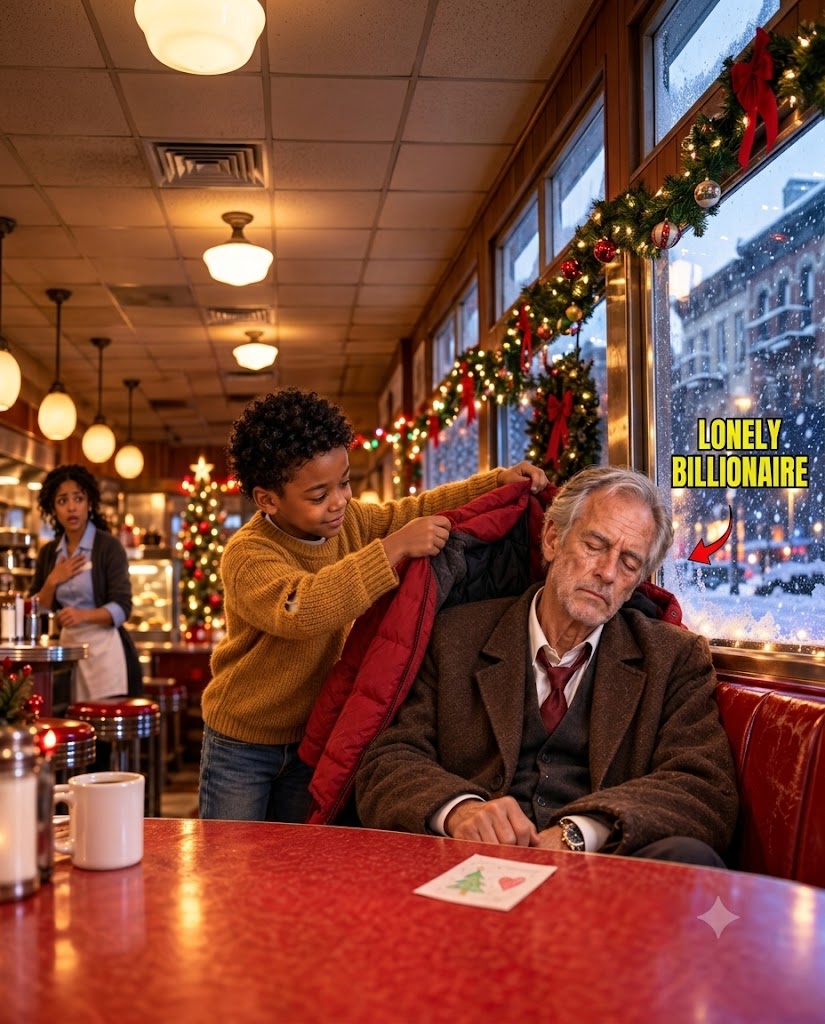
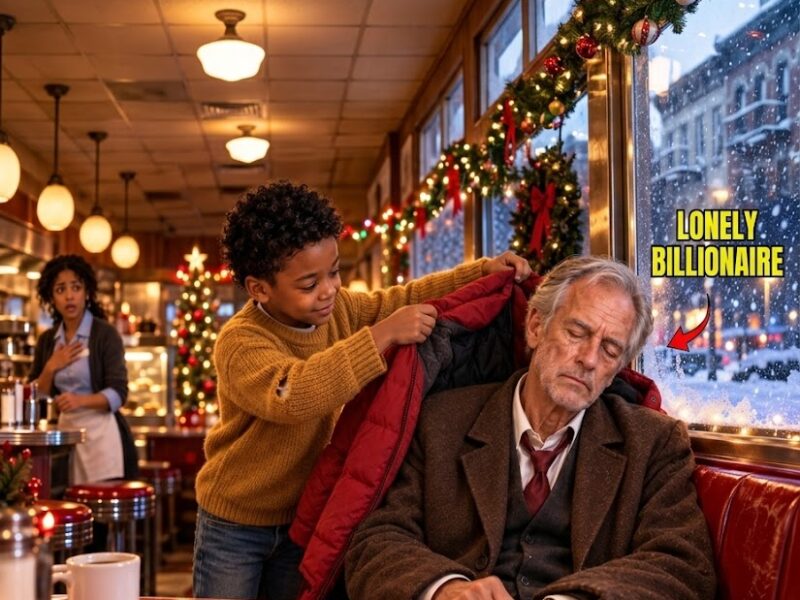
The snow hit the diner windows like tiny white fists, and inside, the Christmas Eve crowd had thinned to almost nothing. Edward Callaway sat in the corner booth with his coat still on, watching the door like he expected someone to walk in and finally see him. Nobody did. He was seventy-four years old, the richest man in the state, and the only person in the room who knew his own name was the waitress refilling his coffee.
Grace moved between the counter and the booths with the tired grace of a woman who had been on her feet for eleven years straight. Her son Theo sat in the booth across from Edward, drawing on a napkin with a broken crayon. He was nine years old, missing two front teeth, and wearing a coat that had been patched at the elbows so many times it looked like a map of small survival stories.
Edward closed his eyes and let his head tilt against the cold window. He wasn’t asleep. He hadn’t slept well in twenty years. But he wanted to see what the boy would do when he thought no one was watching. It was an old habit, a cruel one, the kind of test he had run on everyone since Daniel died. He always expected the worst. He was almost never disappointed.
Theo looked up from his drawing. He studied the old man’s face, the way his breath fogged the window, the way his hands had curled into loose fists inside his coat pockets. The boy didn’t know about the money. He didn’t know about the houses or the accounts or the foundation that would change everything by morning. He just saw a cold old man who had nobody sitting with him on Christmas Eve.
“He looks like Dad did,” Theo whispered to himself. “Before the hospital.”
He slid out of his booth and walked over to the old man. He stood there for a moment, then reached up and tucked the edge of Edward’s scarf tighter around his neck. The old man didn’t move. Theo pulled a crumpled dollar bill and a handful of coins from his pocket, counted them twice, and placed them on the table next to the coffee cup. Then he took the candy cane Ruth had given him and laid it across the napkin like a tiny bridge.
“You’re not alone,” Theo said softly. “From a friend.”
Edward’s hand moved before he could stop it. His fingers closed around the tin of coins, and he felt the weight of every quarter the boy had saved since September. He had been pretending to sleep, but his body had betrayed him. Theo saw it. He didn’t flinch. He just smiled and went back to his booth.
The old man opened his eyes and stared at the tin. It was a small metal box, dented at the corners, with a faded sticker of a dinosaur on the lid. Inside was forty-seven dollars and twenty-three cents. A fortune to a boy who had been saving for months to buy his mother a coat. A rounding error to a man who had spent more on dinner last Tuesday.
Grace came back with the coffeepot and stopped when she saw the tin. “Theo, baby, what did you do?”
“I gave him the unalone,” Theo said. “He needed it more than me.”
Edward looked up at her, and for the first time in twenty years, he didn’t see a waitress. He saw a woman who had been feeding strangers on faith for eleven years, who had brought soup to a grieving family for a month, who had raised a son who gave away his whole Christmas to a man he didn’t know.
“Ma’am,” Edward said, and his voice cracked. “I owe you an apology.”
Grace set the coffeepot down. “For what?”
“For thinking you wanted something from me.”
She laughed, but it wasn’t a cruel laugh. It was the laugh of a woman who had heard every version of that accusation and had stopped being surprised by it. “Mr. Callaway, I’ve been serving you coffee for three weeks. You always tip too much and talk too little. I don’t want anything from you. I just want you to drink it while it’s hot.”
Preston appeared in the doorway, shaking snow off his coat. He was thirty-eight years old, Edward’s only nephew, and he had spent his whole life learning to read the numbers instead of the people. He saw the tin on the table and his jaw tightened.
“Uncle Edward, we should go. The roads are getting worse.”
“Sit down, Preston.”
“I don’t think—”
“Sit down.”
Preston sat. He looked at the tin, then at Theo, then at Grace. His expression was the same one he wore in board meetings, the one that said he was calculating odds and finding them unacceptable.
“You’ve been handing out cash all month,” Preston said. “The accountants called me. A waitress, a cook, some kid. They’re working you, Uncle. You’re too lonely to see it.”
Edward picked up the tin and held it so Preston could see the dinosaur sticker. “This boy gave me every coin he had. He doesn’t know my name. He doesn’t know what I’m worth. He looked at my coat and decided I was poor and alone, and he was right about the alone part.”
Preston’s face didn’t change. “It’s a performance.”
“It’s forty-seven dollars and twenty-three cents,” Edward said. “That’s what a performance costs these days?”
Grace stepped between them. “You can say what you want about me. Leave my son out of it.”
Preston looked at her. “A month of free pie. You’ve been working him for weeks.”
“The only thing I’ve worked is a double shift,” Grace said. “You’ve spent your whole life hunting the worst in people and missing every good thing right in front of you.”
Edward stood up. He was old, and his knees ached, and he had spent two decades building walls so high that no one could climb them. But a nine-year-old had just walked through the front door and sat down in the rubble.
“Preston,” he said. “When your father died, I tried to make you strong enough to survive us. Strong isn’t the same as loved. You handed me armor and called it a childhood.”
Preston’s mouth opened, then closed. For the first time in his life, he had nothing to say.
“I spent thirty years waiting for you to ask if I was okay,” Edward continued. “You only ever asked if the quarterly numbers were ready. On the day of Daniel’s funeral, you asked me that. I remember it every December, word for word.”
“I don’t remember doing that.”
“I know. That’s the whole problem.”
Theo slid out of his booth and walked over to Preston. He held up a piece of pie on a paper plate. “Here, mister. There’s enough. You can have it.”
Preston stared at him. “An hour ago, I was cruel to your mother. And you’re giving me pie.”
“You look sadder than the cold guy, even,” Theo said. “You just didn’t see what really happened. That’s okay. Everybody messes up.”
Edward watched his nephew take the pie. He watched Preston’s hands shake as he lifted the fork. He watched twenty years of armored silence crack down the middle.
“Harold,” Edward called toward the door. His driver stepped in from the cold, snow melting on his shoulders. “In the morning, call the estate office. The bulk of it goes to a foundation. For families like these. The ones who feed a stranger when they can barely feed themselves.”
Preston set the fork down. “You’re cutting me off on Christmas Eve.”
“Not off. Loose. You’ll live on what you earn. It’ll take you the rest of your life to learn which one this was.”
“You’re really doing it. Giving it all away.”
“Not away. Forward. To people who’ll pass it on.”
Preston stood up. His coat was expensive, his shoes were polished, and his face was the face of a man who had just watched his whole future get rewritten by a boy in a patched coat.
“And me?” he asked. “What am I supposed to pass on?”
“Whatever you build once money stops building it for you.”
Edward turned back to Grace. He reached into his pocket and pulled out an envelope that had been folded so many times the creases had gone soft. “This was in your apron. Final notice. Three months behind.”
Grace’s face went pale. “It’s handled.”
“It’s handled as of tonight. The rent and whatever bills are under your eyes.”
“Sir, I can’t take charity. I never have.”
“It’s not charity. Your boy paid for all of it tonight. He just didn’t know the account ran this deep.”
Grace looked at the envelope, then at her son, then at the old man who had been sitting in her diner for three weeks pretending to be nobody. “I don’t know how to be on this side of it.”
“You take it the way your son gave it. Simply.”
Theo tugged on Edward’s sleeve. “Are you going to be okay tonight? Going home all alone?”
Edward looked down at him. “First time in a year anyone’s asked me that. And I think I just might be.”
“You should get a dog. Dogs are good for alone.”
“A dog.”
“A big one. So the quiet’s got something to bump into.”
Edward laughed. It was a rusty sound, like a door opening after years of being stuck. “That’s the second best advice I got tonight.”
“What was the first?”
Edward pulled the crayon note from his pocket. “This. Nothing tops that one.”
Theo beamed. “I’ll make you more. One for every Sunday.”
“Then I’ll need a bigger pocket, won’t I?”
Grace wiped her eyes with the back of her hand. “Theo, leave the man a little wall for his real art.”
Edward looked at the crayon drawing on the napkin, then at the tin of coins, then at the boy who had given him both. “I spent seventy-four years learning that money doesn’t make the same sound as love. This boy taught me in one night.”
Ruth came out from the kitchen, wiping her hands on her apron. She had been cooking at that diner for fifty years, and she had seen every kind of man walk through the door. She took one look at Edward and nodded.
“You’re keeping all of us on,” she said. “The diner. The staff. Everything.”
“I’m keeping the one warm room that would still have me.”
“Fifty years I fed folks on faith. Never saw it come back like this.”
“It always comes back, Ruth. You said so yourself.”
“I say a lot of things. Nice when one turns out true.”
Edward reached into his coat and pulled out a checkbook. He wrote a number that made Preston’s eyes go wide, then tore it off and handed it to Grace. “This covers the diner. The rent. The staff. And a coat for every kid in this neighborhood who needs one.”
Grace stared at the check. “Why would you do all this for people you met over coffee?”
“A year ago, I decided nobody was good. An hour ago, a boy with a tin can proved me wrong. That’s worth more than every building I own.”
Theo climbed onto the booth next to Edward. “You could come have cocoa with us. There’s plenty.”
“I’d like that more than any dinner I’ve ever been invited to.”
“It’s just powder cocoa, not the fancy kind.”
“Powder cocoa with you beats fancy anything alone.”
Theo nodded solemnly. “That’s what Mom says. Fancy’s lonely, plain’s warm.”
Edward looked at Grace. “Your mother should run the world.”
“She runs ours. That’s plenty for her.”
The snow kept falling outside, but inside the diner, the windows had fogged up with warmth. Edward took off his coat for the first time all night. Underneath, his sweater had a hole in the elbow. Grace saw it and smiled.
“Somebody used to mend that,” she said.
“My wife. She passed twelve years ago.”
“Then I’ll mend it. Bring it back next Sunday.”
Edward looked at her. “You’d do that?”
“Everybody needs one place that’s theirs. You gave us ours back. Least I can do is fix a hole.”
Theo tugged on Edward’s sleeve again. “Does this mean you’re our family now?”
Edward felt something break open in his chest. It was the same thing that had broken when Daniel died, the same thing he had spent twenty years trying to rebuild with money and walls and silence. But this time, it didn’t hurt.
“Family just means you keep showing up,” he said. “Even when it’s snowy.”
Theo nodded. “That’s a good rule. I’m going to write it down.”
“Page eleven?”
“Page twelve. I’m almost bigger now.”
Edward pulled the boy into a hug. It was awkward and sudden, and Theo hugged him back like he had been waiting his whole life for someone to hold on.
“You’re not alone, mister,” Theo said. “Not anymore.”
Edward closed his eyes. This time, he wasn’t pretending. He was just letting himself feel what it was like to be seen.
“Thank you,” he whispered.
The diner lights flickered once, then steadied. Ruth poured fresh coffee for everyone, even the boy, and Grace cut the pie into five slices. Preston sat in the corner, eating his piece in silence, and for the first time in his life, he didn’t know what the numbers meant.
Edward looked around the table. He had four houses, three cars, and a portfolio that could fund a small country. But he had never been richer than he was in that moment.
“To second chances,” he said. “Nobody earns them. Everybody needs them.”
Theo raised his cocoa mug. “To the friend who told me I wasn’t alone.”
Grace raised hers. “To the boy who taught a rich man how to be poor.”
Ruth raised hers. “To fifty years of feeding strangers who turned out to be family.”
Preston raised his fork. “To whatever I build next.”
Edward raised his coffee. “To Daniel. Who would have liked this very much.”
They drank. The snow fell. The diner stayed open. And somewhere in the cold city, a boy who heard everything finally heard something worth remembering.
One year later, the diner had a new sign above the door. It was painted in crayon colors, and it said “The Warmest Royalty in the Whole Cold City.” Edward Callaway sat in his booth by the window, studying a spelling list while Theo finished his homework across from him.
“Grandpa,” Theo said, not looking up. “How do you spell ‘generous’?”
Edward smiled. “G-E-N-E-R-O-U-S.”
“That’s a hard one.”
“You’ll get it. You get everything.”
Preston walked in, shaking snow off his coat. He was working at the diner now, managing the books, learning what it meant to earn a dollar instead of inherit one. He slid into the booth next to Theo.
“Uncle Edward, the foundation just approved another twenty grants. Families in six states.”
“Good. Keep going.”
“I will.”
Theo looked up. “Uncle Preston’s teaching me chess. He lets me win sometimes.”
“I do not let him win. He’s just better. It’s humiliating.”
“Good for the soul, though.”
Grace came over with a pot of coffee and a plate of crispy potato corners. She set them down and kissed the top of Theo’s head. “Don’t let him stay up too late. He’s got school.”
“I know,” Edward said. “I’ll have him home by nine.”
“You always say that. Then you keep him until ten talking about dinosaurs.”
“That’s because dinosaurs are important.”
Theo laughed. “Grandpa, you’re worse than me.”
“I’ve had seventy-four years of practice. All saved up for you.”
Ruth called from the kitchen. “Edward, don’t make me come out there. Eat your soup before it goes cold.”
“Ordered around in my own diner by my own cook.”
“Your best cook. The only one who’ll put up with you.”
Edward picked up his spoon. The soup was chicken, the kind Ruth had brought to Grace and Theo the month after Daniel died. He had never tasted it before, but he knew the story. He knew that kindness had a memory. He knew that the smallest light showed up in the dark.
“Grandpa,” Theo said. “What’s the best thing you ever bought?”
Edward thought about it. He thought about the towers, the accounts, the paintings that cost millions. Then he pulled the crayon note from his pocket. It was worn at the edges now, soft from being held.
“This,” he said. “This cost a boy everything. And it gave me everything back.”
Theo smiled. “I knew you’d say that.”
“How did you know?”
“Because you always say it. Every single Sunday.”
Edward looked at the note. Then at the boy. Then at the diner full of people who had become his family.
“Then I’ll keep saying it,” he said. “For the rest of my life.”









