Billionaire Grandma Disguised Herself as a Poor Widow to Test Her Grandson’s Fiancée—What She Witnessed Changed Everything
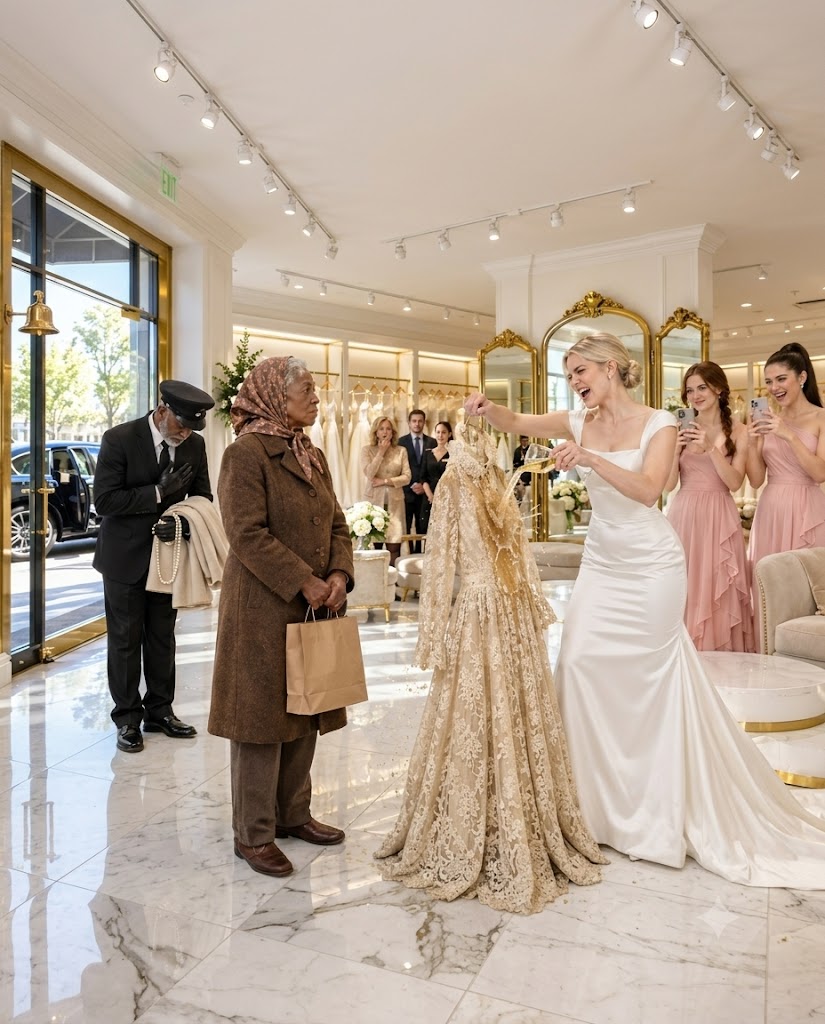
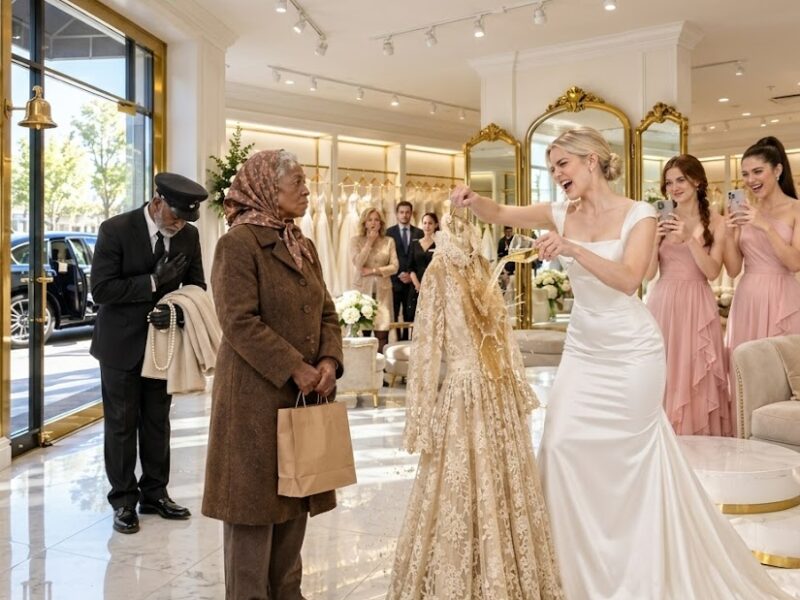
The bell above the bridal salon door chimed, and Mrs. Eleanor Whitlow shuffled in wearing a coat that had seen better decades.
The fabric was the color of old teeth, and she clutched a grocery bag to her chest like it held the crown jewels.
Her grandson Julian was marrying Paige Prescott on Saturday, and Eleanor had five days to find out if the girl was worth the family name.
“Somebody got married in this?” Paige Prescott wrinkled her nose, pointing at the yellowed lace spilling from Eleanor’s bag.
The salon erupted in laughter, and Paige’s friend Bren leaned in to whisper something that made them both snort.
“Ew, don’t let it touch you,” Bren said, flicking the fabric with her manicured nail.
Eleanor kept her voice small, the way she’d practiced. “It was my wedding dress. The lace come loose.”
Paige’s eyes narrowed, calculating the cost of the coat versus the profit of a customer.
“Honey, this is a bridal salon. It’s not a donation bin.”
Then Paige snapped her fingers at a young seamstress kneeling nearby, adjusting pins in a wedding gown’s hem.
“Excuse me? You’re working for me, pin girl. Get back on your knees.”
The seamstress, Delia Banks, didn’t look up from her work, but her jaw tightened.
Eleanor felt something crack inside her chest—a memory of her own mother, hunched over a sewing machine in a mill town.
“Mrs. Whitlow, you own half this street,” her driver Earl had reminded her just that morning. “You don’t need that coat.”
That was precisely the point. She needed the coat to see how Paige treated a nobody.
“I’ll fix it for you, ma’am. No charge,” Delia said softly, reaching for the dress.
“Baby, I don’t want you in trouble,” Eleanor murmured, her eyes flicking toward Paige.
“It’s good lace, ma’am. It just needs stitching.”
But before Delia could examine the hem, Paige’s voice cut through the salon.
“Excuse me. You’re working for me, pin girl. Get back on your knees.”
Delia lowered herself back to the floor, and Eleanor noticed how the girl’s hands trembled as she resumed pinning.
Then Paige screamed. “My ring. Where’s my ring?”
The salon froze. Paige’s grandmother, Mrs. Prescott, had given her that diamond—$85,000 worth of family legacy.
“It was right here. That ring is worth more than this whole store. And nobody’s been near me but the pin girl.”
Delia looked up, her face pale. “I didn’t take it, miss.”
“Then empty that apron,” Paige demanded.
The salon owner, Miss Fenwick, shifted uncomfortably. “Paige, you took it off when you tried the gloves. Please look in the left pocket.”
Paige’s eyes blazed. “So now I’m the one who lost it?”
“No, miss. I’m asking you to look.”
“Don’t you tell ME WHERE TO LOOK!”
The door chimed again, and Julian Whitlow walked in, tall and handsome in his tailored suit.
“Julian, thank god. She took my ring. See? She knew right where it was.”
Paige produced the ring from her pocket with theatrical relief. “Well, there it is. No harm done.”
Eleanor watched her grandson’s face—the easy smile, the quick forgiveness. He saw nothing wrong. He never did.
“Come back tomorrow morning, ma’am. It’ll be ready,” Delia whispered to Eleanor.
“Thank you, baby.”
After Eleanor left, she stood on the sidewalk and watched Paige through the window, laughing with her friends.
Five minutes. That’s all it took to know everything she needed to know about the girl marrying her grandson.
“Find me the rest,” Eleanor told Earl when he pulled up in the black sedan. “Everything about that seamstress. Her name was Delia.”
The next morning, Delia arrived at the bridal salon to find her final check waiting.
“Miss Prescott just called. Either you go, or her whole order goes. The gown, the veil, every bridesmaid. I can’t lose that.”
Delia nodded slowly, her brown eyes steady. “Can I ask one thing? Let me take this dress home. I told that lady tomorrow morning.”
Miss Fenwick sighed. “Take it. I’ll mail your last check.”
Delia sat on a bus bench outside, the yellowed wedding dress folded in her lap.
A police car rolled past, and for a moment her heart seized—but it kept going.
“Why you sitting out here, child?” A voice came from beside her. It was the old woman from the salon, still wearing that awful coat.
“I don’t work in there anymore,” Delia said quietly.
“On account of me?”
“On account of me. I chose. I choose the same again. But I can’t talk back to people like her. Mama taught me to sew. She never taught me to fight.”
The old woman was quiet for a long moment, watching the traffic.
“Baby, folks see a thread and think it’s weak. That little thread holds the whole coat together.”
She reached into her pocket and pulled out a crumpled business card.
“I used to sew for a family. They need a seamstress quick for a wedding. Call that number. Say the old lady with the dress sent you.”
“Ma’am, I never got your name.”
“Ms. Banks,” the old woman said, and Delia didn’t realize until much later that she’d given Delia’s own last name back to her.
—
The Whitlow estate sat behind iron gates on twelve acres of Savannah marshland, and Delia’s hands shook as she walked up the gravel drive.
A butler named Gordon led her through hallways lined with oil paintings and old money.
“Mrs. Whitlock is expecting you. Every bridesmaid dress needs fitting and her own suit before Saturday.”
“Where do I meet Mrs. Whitlock?”
“You don’t. She’s resting upstairs till the wedding. She’ll be fitted last.”
That was strange—a bride’s grandmother who didn’t come downstairs to inspect the help.
The sewing room was a converted sunroom with enormous windows and a professional-grade machine.
Delia ran her fingers over the equipment. Better than anything her mother ever had.
Her mother Odessa had sewn collars in a mill for eleven years before she finally saved enough to buy one machine.
“How’s your face?”
Delia spun around. Julian Whitlow stood in the doorway, his expression unreadable.
From the hallway, she heard Paige’s voice—high-pitched and outraged. “No. The pin girl? They hired the girl I just got fired?”
“Mrs. Whitlock hired me, miss,” Delia said when Paige stormed in.
“My hem’s crooked. Get down there.”
Paige watched Delia kneel, then deliberately kicked over her pin box. Pins scattered everywhere.
“Careful with those pins. This dress costs more than your car. Do you even have a car, hon?”
“No, miss.”
“That’s crooked, too. Take it out. Again. Are you sewing with your feet?”
Paige’s friends laughed on cue, and Delia felt the familiar heat of humiliation rise up her neck.
From the doorway, Julian’s voice cut through. “Paige. Move your foot.”
“Baby, relax. It was a joke. She’s the help.”
“She’s doing her job. Let her do it. She works in this house.”
Paige’s jaw dropped. “Laugh at her again, and stay home Saturday.”
That night, Delia heard a soft knock at the service entrance.
Paige stood there in silk pajamas, holding an envelope.
“$10,000, hon. It’s yours tonight. Pack up your pins, leave this house, and leave Savannah before Saturday.”
Delia’s heart hammered, but she kept her voice steady. “I was hired to sew till Saturday, miss. I’ll sew till Saturday.”
Paige laughed—a brittle, cold sound. “Fine. Then I’ll get you out for less.”
The next day, the Whitlow garden was filled with white tents and white roses, and Paige’s mother Loretta presided over a tray of family heirlooms.
“This is the Whitlow brooch. Your something old, Paige. In this house, every bride has worn it.”
Paige clasped the antique diamond brooch to her chest. “It’s beautiful.”
Then the brooch vanished.
Paige pointed a trembling finger at Delia. “Her tool bag. The little side pocket.”
The butler Gordon produced the brooch from Delia’s bag, his face impassive.
“I opened this house to you,” Loretta hissed. “I let you sit beside my mother-in-law’s things. Two days before my son’s wedding.”
Paige’s father, Richard Prescott, was already dialing. “I’m calling the police.”
Mrs. Prescott, Julian’s grandmother, stepped forward. “Julian. It was in her bag.”
“Your ring was in your glove, Paige,” Julian said quietly.
“And who knew right where to look?”
Julian didn’t answer.
The housekeeper arrived with a message from Mrs. Whitlock: the brooch belonged to her. No charges were to be filed. No police would come to her house.
“Then she leaves this house. Now,” Richard said.
Delia packed her tools slowly, her hands steady despite the chaos in her chest.
“Please thank Mrs. Whitlock for me, sir. I never even met her. She’ll have it by Saturday.”
“I’ll tell her, Miss Banks.”
After Delia left, Eleanor sat in her upstairs bedroom, staring at the garden below.
“I didn’t see who put it there, Earl. I only know who didn’t.”
“One word from you ends it, ma’am.”
“My word against that girl’s tears. And Julian still hasn’t seen a thing. Tomorrow morning I go see that child myself.”
—
The morning light slanted through the windows of Odessa’s Alterations, a tiny shop on Montgomery Street that had been closed for six months.
Eleanor stood outside, still in her ragged coat, and watched Delia through the glass.
The girl was sitting at her mother’s old sewing machine, not moving, just staring at the needle.
“Ma’am, how did you find me?” Delia asked when she looked up.
“Name stitched on your bag, baby. I come to pay what I owe on that dress.”
Delia shook her head. “You don’t owe me. Sit down. I’ll pour you some tea.”
Eleanor perched on a worn stool and looked around. One table, one machine, a sign that said “Odessa’s Alterations” in faded letters.
“So, this is it? The family business?”
Delia’s hands wrapped around her teacup. “Julian hasn’t said one word to me since yesterday. I came to see what he’s thinking about. A sign nobody can read, one table, and that old thing. This is what he feels sorry for?”
Eleanor reached toward the sewing machine, and Delia’s voice sharpened. “Please don’t touch that.”
But Eleanor picked up a scrap of fabric and a needle. “Odessa,” she said, threading the needle with practiced ease.
“What?”
“Odessa. There. Now it matches the sign.”
Paige’s voice came from the doorway, sharp and amused. “The old lady from the bridal shop. Look at that. You two found each other.”
She sauntered in, her heels clicking on the linoleum. “What, does she sleep in your doorway now? Sit down, granny, before you break a hip.”
Delia stood up slowly. “That’s enough, young lady.”
Paige laughed. “Enjoy the shop, pin girl. Maybe she’s right. Every time I stand up straight, I lose something. My job, my name, now mama’s machine.”
She shoved the machine, and it crashed to the floor. The needle snapped. The casing cracked.
Delia stared at the broken pieces of her mother’s legacy. “I’m closing the shop, Mom.”
Eleanor reached down and picked up a piece of the machine. “I sewed collars in the mill 11 years. 11 years before I owned one machine.”
She set the piece carefully on the counter. “I know what this is. A welder can fix iron. The machine’s broke, baby. Your hands ain’t.”
Later that day, Julian found Paige in the garden.
“You skipped lunch. My father noticed. Not one word to me since yesterday.”
“I was there, Paige. You raised your hand. Delia was holding her cheek. I watched you step on her hand. In this room.”
Paige rolled her eyes. “Oh, please.”
“And yesterday you didn’t say search her things. You said the little side pocket before anybody looked.”
“Lucky guess. Where else would a thief put it?”
“She never said one word back to you. Not once.”
Paige’s eyes flashed. “You’re taking a seamstress over me? The day before our wedding?”
Julian’s voice was quiet. “There’s no wedding.”
Paige went rigid. Then she lifted her arm, showing a fresh scratch.
“Look at my arm, Julian. I went to her little shop this morning to make peace. She came at me with her scissors.”
“She wouldn’t.”
“I told the police an hour ago. And who speaks up for her? Some old who sleeps in her doorway?”
Paige stepped closer, her voice dropping to a whisper. “Here’s how it goes. Tomorrow you stand at that altar. After the honeymoon, I remember it wrong. Or she goes to jail. You pick, baby.”
At the police station, an officer read Delia her rights.
“Delia Banks? There’s an assault complaint against you. I need you to come with me.”
Julian arrived at the station twenty minutes later. “Officer. Miss Banks never laid a hand on her.”
“Tell it at the station, sir. I’ve got a signed complaint.”
But before Delia could be processed, the sergeant received a phone call.
“Ms. Banks, you’re free to go. A witness came in. Her statement doesn’t match Ms. Prescott’s complaint.”
“What witness, sir?”
“She’s waiting for you outside. Mrs. Whitlow.”
—
Eleanor Whitlow stood in the station lobby, still in her coat, but something had changed.
She held herself differently—shoulders back, chin lifted.
“Mrs. Whitlow, I’ll need a word with Miss Prescott about that complaint.”
“Noon tomorrow, Sergeant. At my house. She’s easy to find. She’ll be the one in white.”
Outside, Eleanor turned to Delia. “You’re Mrs. Whitlow?”
“I am. I wanted to know who was marrying into my house.”
“You were in that house the whole time?”
“Yes. I watched them call you a thief. And I stayed upstairs.”
Eleanor’s voice cracked. “I can’t put that machine back, baby. But I can stand up.”
“Why me? I only fixed a dress.”
“Folks walked past me all my life. You’re the one who knelt down and picked it up. Sit by me tomorrow. Front row.”
The next morning, the garden was filled with white chairs and white flowers, and every seat was taken.
Paige stood at the altar in her $40,000 gown, waiting for a groom who wasn’t coming.
Instead, Eleanor Whitlow walked down the aisle in a pale gray suit that Delia had finished the night before.
“What is she doing here?” Paige’s mother Loretta demanded.
“She’s supposed to be in jail,” Paige hissed.
“Jail? What’s she talking about?” Julian asked.
“Because she’s a thief. SOMEBODY GET HER OUT. She stole the family brooch, then she came at me with scissors.”
“Did anyone actually see it?” Eleanor asked quietly.
“Nobody. Just some old from her doorway. The police can’t even find her.”
“They found her.”
Paige’s face twisted. “Who are you?”
“You poured champagne on this Monday. Friday, you told me, ‘Sit down, Granny, before you break a hip.'”
Paige’s mouth opened and closed. “No. That coat? You were in rags.”
“Rags come off, young lady.”
“That’s Mrs. Whitlow,” someone whispered.
“Mother?” Julian’s father, Gordon, stepped forward.
“Sit down, Loretta. You’ll want to hear this.”
Eleanor turned to face the garden. “I was in that shop yesterday morning. This girl raised her hand to nobody. I watched that bride throw her mama’s sewing machine on the floor.”
Paige’s voice was shrill. “She’s confused. She’s an old woman. What about the brooch? Everybody watched it come out of her bag.”
Eleanor’s gaze found Bren, Paige’s bridesmaid, cowering in the second row. “Bren, you were standing right there. Tell them.”
Bren looked at Paige, then at Julian, then at the ground.
“I watched you put it there, Paige. I held the train. I didn’t say anything.”
“BREN, SHUT YOUR MOUTH.”
Paige spun on Eleanor. “Do you know what I’m worth, old woman? My lawyers will—”
“Mr. Prescott, I wore that ragged coat this week. I’m wearing these pearls today. Your money didn’t scare me in either one.”
Two police officers appeared at the back of the garden.
“Mrs. Whitlow, noon, like you said. Miss Prescott, about the complaint you signed yesterday, come with me, please.”
“Daddy, do something.”
Richard Prescott’s face was gray. “Don’t say a word, Paige. I’m calling my lawyers.”
Julian walked toward Delia, who sat in the front row in a simple blue dress.
“I called you a thief in my house. I was wrong.”
“Thank you, ma’am.”
Eleanor touched Delia’s shoulder. “Drop an old dress on the floor and you see who everybody is.”
Delia looked up, her eyes wet. “I didn’t see it when I should have. I’d like to start over. As a customer with a shirt to mend.”
“The shop opens at 9:00.”
From the front row, Eleanor’s voice rang out. “Earl, this tea is weak as dishwater.”
“Yes, ma’am. Same as last Saturday.”
“Delia, baby, come teach this man to boil water.”
“Yes, ma’am. After this seam.”
—
One year later, Delia’s shop had doubled in size, and her mother’s machine—repaired by a welder Eleanor knew from the old days—hummed in the window.
The bell above the door chimed, and Julian Whitlow walked in, looking nervous in a way he never did on the trading floor.
“Morning. I lost another button.”
“That’s a lot of buttons, Mr. Whitlow.”
“Try the button box. There’s one in there that fits.”
Delia reached into the old tin box her mother had kept for forty years, and her fingers closed around something that wasn’t a button.
A ring. A simple gold band.
“Delia Banks, will you marry me?”
From the corner of the shop, Eleanor snorted over her tea. “A whole year. That boy slow as his grandmother.”
The door chimed again. A woman in a worn coat stood there, holding a dress with torn lace.
“I’m sorry. The sleeve’s torn. I don’t have much money.”
Delia smiled and pulled out a chair. “Sit down, ma’am. Let me see it.”









