Billionaire Disguised Himself as a Poor Construction Worker to Test a Coffee Shop Girl—Her Unexpected Kindness Changed His Life
The drawer in Marcus Hale’s penthouse office smelled like old velvet and bad decisions. Three rings sat inside it now, each one a small, expensive failure. The first had been a diamond that could have paid off a small country’s debt. The second was a vintage sapphire that had belonged to his grandmother. The third was a simple platinum band he’d picked out himself, thinking the lack of flash might finally mean something.
It didn’t.
She’d handed it back in a manila envelope with a Post-it note that said “Thanks, but no thanks.” No explanation. No apology. Just the ring, cold and alone, like it had never meant anything at all.
Marcus slid the drawer shut and poured himself three fingers of bourbon. He didn’t drink it. He just stared at it, watching the amber liquid catch the light from the Manhattan skyline outside his window. The city was glittering and indifferent, a million people who didn’t know his name and wouldn’t care if they did.
“You’re doing it again,” his grandmother said from the doorway.
He didn’t turn around. “Doing what?”
“Standing in front of that window like you’re the last man on earth.” She shuffled in, her heels clicking against the marble floor. Eleanor Hale was eighty-seven years old and still wore pearls to breakfast. “That’s the third one, isn’t it? The one that came back?”
“The third one,” he confirmed.
“Then stop giving them away.” She settled into the leather chair across from his desk, her posture ramrod straight despite her age. “You keep meeting girls in places where somebody parks your car. They don’t marry you, Marcus. They marry the building.”
He turned then, raising an eyebrow. “And what would you have me do, Grandma? Hang out at the laundromat?”
“Maybe.” She shrugged, the gesture surprisingly casual for a woman who hadn’t done anything casual in sixty years. “I want to see how one girl treats somebody who can’t do a thing for her.”
“They’ll know you,” Marcus said. “You’re Eleanor Hale. They’ll recognize you from the Founder’s Day programs.”
She snorted. “They know me in pearls on a Founder’s Day program. Nobody looks twice at an old woman with grocery bags.” She stood up, brushing invisible lint from her sleeve. “I’m going to go sit in your lobby. And you’re going to figure out who’s worth your time.”
The lobby of Hail Tower was a monument to excess. Thirty-foot ceilings. Marble floors polished to a mirror shine. A fountain that cost more to maintain than most people’s mortgages. Security guards in suits that cost more than most people’s cars.
And in the middle of it all, parked near the entrance like an afterthought, was a coffee cart.
The cart was small and dented, its once-bright silver surface now scuffed and worn. A hand-lettered sign taped to the front read “NIA’S COFFEE — GOOD BREWS, FAIR PRICES.” The woman behind the counter was young, mid-twenties maybe, with dark curls pulled back in a practical ponytail and an apron that had seen better days.
Her name was Nia Brooks, and she’d been there for three years.
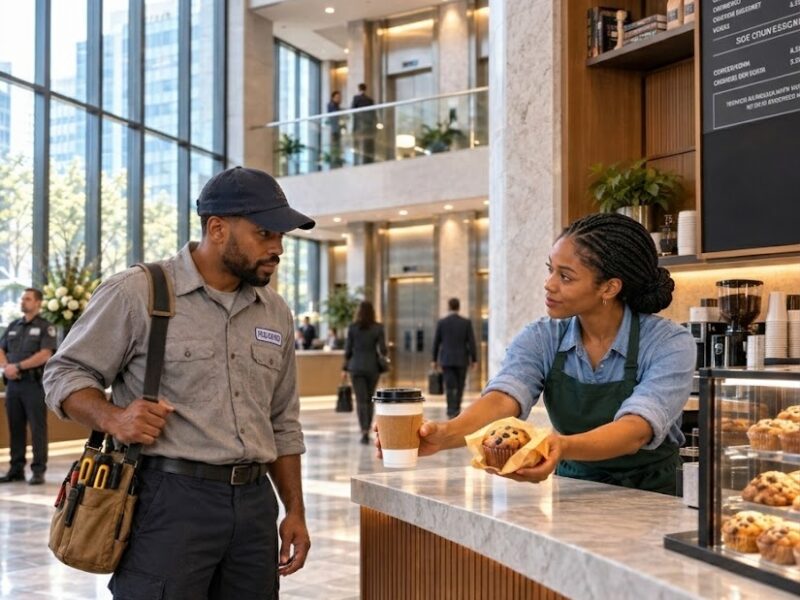
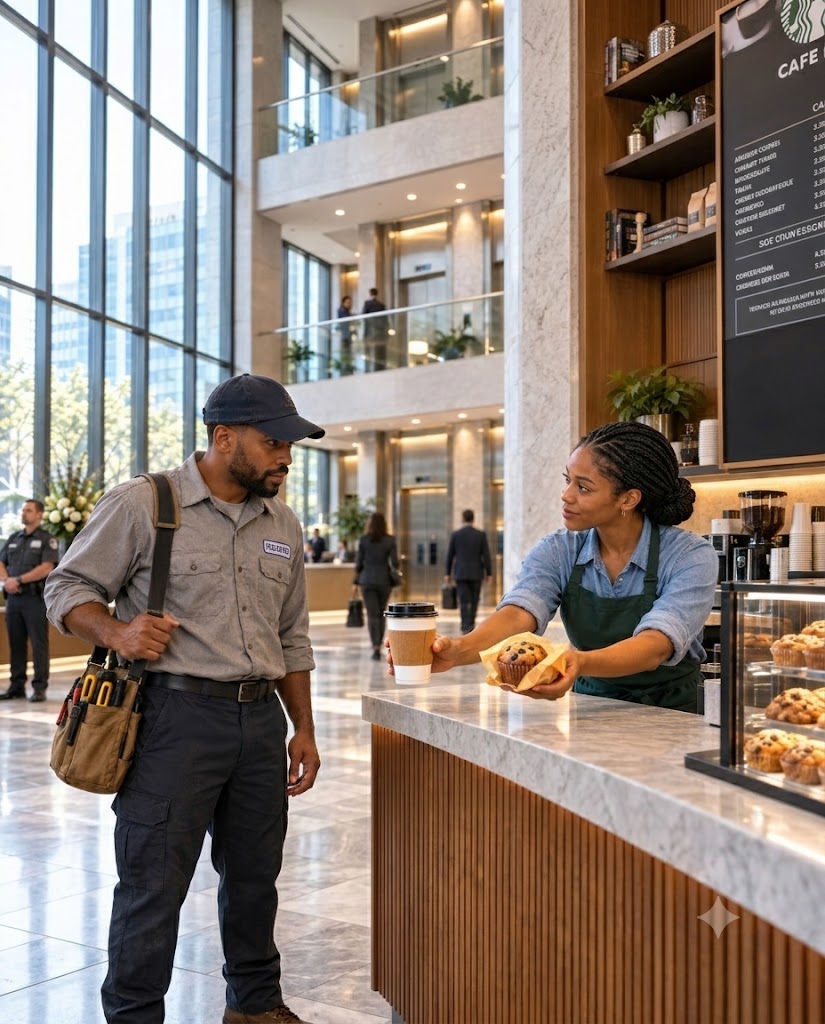
The first time Marcus saw her, he was dressed in a maintenance uniform that itched around the collar. He’d borrowed it from the facilities department, along with a badge that said “TEMP” in faded red letters. Nobody looked at him twice. Nobody ever looked at maintenance.
He stood in line behind a man in a pinstripe suit who ordered a triple-shot espresso and didn’t say thank you. Nia handed it over without comment, her expression carefully neutral.
“Next,” she called.
Marcus stepped forward. “Coffee. Black. A small one.” He reached for his wallet, then stopped. “My wallet. I left it at home. I’m sorry. Cancel that.”
Nia looked at him then, really looked. Her eyes were brown and sharp, taking in the temp badge, the scuffed boots, the slightly-too-large uniform that hung off his frame.
“You new?” she asked.
“First week. I don’t get paid till Friday.”
She was already reaching for a cup. “First week’s on the cart.”
He blinked. “I’ll pay you back Friday.”
“Did I say Friday?” She poured the coffee with practiced efficiency, sliding it across the counter. “I said on the cart. And eat something.” She pushed a wrapped muffin next to the cup. “What’s your name?”
“Marcus.”
“Mia.” She gestured at his badge. “What do they have you doing?”
“Facilities. I fix what’s broken.”
Her eyebrows rose. “Then go fix the dock door. It jacks every other morning.”
He picked up the coffee and muffin, something warm and unexpected settling in his chest. “I’ll take a look. Thank you.”
“Thank me by moving.” She was already looking past him. “I’ve got a line. Who’s next?”
The muffin was blueberry. He ate it in the freight elevator, sitting on a stack of pallets, and it was the best thing he’d tasted in years.
—
The dock door was indeed broken. Marcus spent two hours wrestling with the hydraulic mechanism, his hands covered in grease, his borrowed uniform ruined. But by the time he was done, it opened and closed smoothly, no jacking, no stalling, no drama.
He didn’t tell Nia. He just went back the next morning and ordered another coffee.
“You fixed it,” she said, not a question.
“I had someone look at it.”
“You had someone.” She smirked. “Sure you did. Large or small?”
“Small. Black. And a muffin, if you have one.”
She reached under the counter. “One day I’m opening my own place. Small, four tables.”
“Why four?”
She shrugged, sliding a cranberry-orange muffin into a paper bag. “Four I can look after. And one door. Everybody comes in the front.”
He studied her face, the way she moved, the way she treated the customers who didn’t say thank you and the ones who barely looked at her. “What about you? What do you want?”
“A place where nobody knows my name.”
“You work in facilities. Nobody knows your name now.”
She laughed, a bright, unguarded sound. “And if you’re really facilities, fix that door already.”
He was there the next morning. And the next. And the next.
—
The orders started coming from the 40th floor on a Tuesday.
Marcus was in the lobby, nursing his small black coffee, when he heard Nia’s phone buzz. She glanced at it, frowned, and then looked up at him.
“Could you order coffee for the boardroom on 40 every morning this week?” she read. “From the cart downstairs. And have the girl bring it up herself.”
Marcus felt something cold settle in his stomach. “Who sent that?”
“Assistant to someone named Cutler.” She shrugged. “Don’t ask me. I just pour the coffee.”
“Be careful,” he said, before he could stop himself.
She tilted her head, studying him. “What’s that supposed to mean?”
“Nothing. I just—be careful.”
The first morning, Nia brought six coffees and a box of pastries up the service elevator. She was gone for twenty minutes. When she came back, her jaw was tight and her smile was forced.
“How’d it go?” Marcus asked.
“Fine.” She started organizing the cups, her movements jerky. “Real fine.”
“Not everyone on 40 is…” He trailed off, unsure how to finish the sentence.
“Not everyone on 40 is what?”
“Not everyone on 40 is worth your time.”
She looked at him then, her eyes softening. “You know something I don’t?”
He didn’t answer. He couldn’t.
—
The photo went up on Thursday.
It was taken from behind: Nia on her knees in front of a row of executive chairs, her apron slipping off one shoulder, the angle of the shot making her look like she was doing something she absolutely wasn’t.
The caption was simple. “This is why the coffee girl makes more than you.”
It was on every phone in the building within twenty minutes.
Marcus found her in the lobby, her face white, her hands shaking. The coffee cart was empty, the cups neatly stacked, the pastries untouched.
“Everybody’s looking at me,” she whispered. “They took this from behind me. I was just cleaning up a spill.”
“I know.”
“It went up twenty minutes ago. It’s all over the building.” She held up her phone, the screen cracked, the photo glaring up at him. “I go up there because they order. I’ve got the slips. Every single order.”
“I know you do.”
A crowd had gathered, security guards and secretaries and men in suits, all of them staring. Some of them had their phones out. Some of them were laughing.
“Who put this up?” Nia demanded, her voice rising. “Who took this picture?”
Nobody answered.
Marcus stepped forward, positioning himself between her and the crowd. “I’m going down there,” he said quietly. “As me. And I’ll tell them—”
“Tell them what?” A voice interrupted. Marcus turned to see his grandmother in the doorway, her grocery bags gone, her posture impossibly straight. “Son, you walk in with a Hale name and say that about the coffee girl, what do they hear? Exactly what the post says.”
Marcus opened his mouth, but no words came out.
“Find out who took that picture,” Eleanor continued, her voice steely. “No camera in that hallway on 40. The board never wanted one. It’ll take time.”
“How much time?” Marcus asked.
“Enough time for everyone to remember what they saw and forget what actually happened.” She turned to Nia, her expression softening. “I’m sorry, dear. I’m so sorry.”
Nia didn’t answer. She just stood there, her hands clenched at her sides, her eyes fixed on something far away.
—
The next morning, the coffee cart was gone.
Marcus stood in the empty space where it had been, the marble floor scuffed and worn. Someone had already called facilities to polish it, to erase all evidence that the cart had ever existed.
He found Nia outside, sitting on a bench two blocks down, the same bench where his grandmother had waited for the bus.
She didn’t look up when he approached. “I got a call. My boss said the building terminated our contract. Something about ‘unprofessional conduct.'”
“That’s not—”
“What?” She finally looked at him, her eyes red. “That’s not fair? I know it’s not fair. I know this isn’t about what I did. It’s about what people think I did.”
“I’m sorry.”
“Everybody’s sorry.” She laughed, but there was no humor in it. “I’ve had people come up to me all morning, telling me they’re sorry. But nobody’s actually doing anything. Except Ms. Cutler. She went to HR. Said I was the one who was unprofessional. Said I was ‘distracting the executives.'” She shook her head. “I’ve been on that cart for three years. Nobody’s ever complained about me. Now all of a sudden I’m a distraction.”
Marcus sat down next to her, the bench cold beneath his thin coat. “What are you going to do?”
“I don’t know.” She looked up at the sky, gray and flat, threatening rain. “Maybe go home. I’ve got some savings. Enough for a few months, if I’m careful.” She paused. “My mom would say this is a sign. That I should have gone to nursing school like she wanted.”
“Is that what you want?”
“I want my cart back.” Her voice cracked. “I want to stand there every morning and pour coffee and not have to worry about whether someone’s taking my picture. I want to not be afraid.”
They sat in silence for a long moment. The wind picked up, carrying the smell of exhaust and rain.
“I can help you,” Marcus said finally.
She turned to look at him, really look, the way she had that first day. “Can you?”
“I think so.”
“Then help me.” She stood up, her jaw set. “But not because you feel sorry for me. Not because you think you owe me. Because it’s the right thing to do.”
“It’s the right thing to do,” he repeated.
She nodded, once, then walked away.
—
Marcus went back to the tower and called a meeting with the building’s chief of security, a man named Hill who’d been with the company for twenty years.
“I need you to find out who took that picture,” Marcus said.
Hill shifted in his chair. “Sir, I’ve looked into it. There’s no camera in that hallway—”
“I know there’s no camera. I want you to look at the phone records. The access logs. Somebody on 40 took that photo, and I want to know who.”
“With respect, sir, that’s a lot of resources to spend on a—”
“On a what?” Marcus leaned forward. “On a woman who’s been nothing but kind to everyone in this building? On a woman who lost her livelihood because someone decided to play a joke that wasn’t funny?”
Hill’s face reddened. “Sir, I didn’t mean—”
“I know what you meant. I want the person who did this found. And I want it done quietly. No leaks. No more photos.” Marcus stood up. “Can you do that?”
“Yes, sir.”
—
The evidence came together slowly.
Nia, it turned out, had kept every coffee receipt from the 40th floor. She brought them to Marcus, spread them across his desk like a hand of cards.
“Look at the signatures,” she said. “Every single one is signed by the same person. Ms. Whittaker’s assistant. She signed for every order, every morning.”
“And she was on 40 the day of the photo?”
“She was the one who called the front desk. Ms. Cutler called down herself. Caroline.” Nia’s voice was steady now, calm. “But a search is in the picture. For the search, all I can do is write up one guard. So clear that girl’s name, I need something that ties Ms. Cutler to the picture.”
Marcus studied the receipts. Something was nagging at him, a detail just out of reach.
“The boardroom door,” he said. “The photo was taken from behind you, at the boardroom door. Who stands behind you when you deliver the coffee?”
“The assistant.” Nia’s eyes widened. “The one who hands me the pen.”
“Who just signed these receipts.”
They looked at each other. The same thought passed between them, unspoken but understood.
—
The confrontation happened on Friday.
Marcus walked into the 40th-floor conference room, his grandmother at his side, the receipts and a printout of the photo in his hand. The board members were already seated, Caroline Cutler among them.
“Can I help you, sir?” Caroline asked, her smile polished and empty.
“This is Mr. Hale,” Eleanor said.
Caroline’s smile faltered. “Mr. Hale? Sir, I didn’t—”
“That’s the maintenance guy,” someone whispered.
Marcus ignored them. He walked to the head of the table and set the evidence down. “I know who took the photo. And I know who ordered it taken.”
Caroline’s face went white. “I don’t know what you’re talking about.”
“The signature,” Marcus said. “Ms. Whittaker’s assistant signed every order. But she wasn’t the one who handed you your pen. She wasn’t the one standing behind Nia at the boardroom door.” He turned to Caroline. “You were.”
“I was just—”
“You were on the 40th floor. You ordered the coffee. You stood behind her. And then you took the photo and sent it to everyone in the building.”
“That’s a serious accusation,” one of the board members said.
“It’s a serious offense.” Marcus pulled out his phone, showing them a screenshot. “The photo metadata shows it was taken at 8:47 AM. Ms. Cutler’s access log shows she badged into the 40th-floor hallway at 8:45. She was the only person in that hallway besides Nia.”
Caroline stood up, her chair scraping against the floor. “I was protecting the company. I was protecting you. Look at who she is.”
“I know who she is.” Marcus’s voice was quiet but sharp. “She’s the woman who paid for my coffee for a week. She’s the woman who gave me a muffin when I couldn’t afford one. She’s the woman who treated me like a human being when everyone else in this building looked right through me.”
He turned to the board members. “You all watched her get searched. You all saw the photo and didn’t say a word. So you’ll watch this, too.”
He held up his badge. “Your badge, Ms. Whitlock.” He turned to the security guard who had conducted the search. “Who told you to search that cart?”
Ms. Whitlock’s voice was barely a whisper. “Ms. Whitlock called down, sir.”
“And who do you take orders from?”
“You, sir.”
“Then you’re fired. Security will escort you out.” He looked at Caroline. “And you—you can expect a call from my lawyers. Defamation. Harassment. Creating a hostile work environment. I’ve got twenty witnesses who saw that photo and what it did.”
Caroline’s mouth opened and closed. No words came out.
—
The news spread through the building like wildfire.
By the end of the day, everyone knew: the maintenance guy was Marcus Hale, heir to the Hale fortune, the man whose name was on the building. And the coffee girl—the one they’d all laughed at—had been the only person in the entire tower who’d treated him like a person.
“I’m sorry,” said the man who’d ordered the triple espresso and never said thank you. He stood in front of Nia’s cart the next morning, his face red. “I passed it around. I shouldn’t have.”
Nia looked at him for a long moment. “Mr. Hill.”
“Yes?”
“You’ve been coming here for three years. You’ve never said good morning. You’ve never asked my name. And now you’re sorry because you found out I matter to someone you care about.”
Hill’s face fell. “I—”
“I have customers.” She turned away. “Next.”
—
The cart stayed. Marcus made sure of that.
But it wasn’t the same. Everyone who came to the cart now knew who Nia was, or at least who she was to him. Some of them apologized. Some of them tried to tip her extra, as if money could erase months of indifference. Some of them just stared, their eyes full of questions they didn’t know how to ask.
“You don’t have to keep working,” Marcus said one morning, standing in line like everyone else.
“I know.”
“Then why—”
“Because this is mine.” She poured his coffee, black, small. “I built this. Not you. Not your family. Me.” She slid the cup across the counter. “Three dollars.”
He paid. “And the muffin?”
“On the cart.”
He took the muffin, a blueberry one this time, and stood there, holding it like it was something precious.
“The bus stop,” he said finally. “The day you walked me to the bus. That was you, wasn’t it?”
She didn’t look up. “I don’t know what you’re talking about.”
“The woman in the lobby. The one who told me to sit until the bus stopped. That was you.”
“Maybe.”
“I sat there for an hour. The bus came and went six times. I just sat there, thinking about what you’d said.”
“What did I say?”
“You said a line comes back. A bus doesn’t.” He paused. “That’s you. You’re the line.”
She looked up then, her eyes meeting his. For a moment, neither of them spoke.
“I don’t feel like I won something,” she said. “The bus, the coffee. I’d have done that for anybody.”
“I know.”
“Then don’t—”
“I’m not.” He set the muffin on the counter. “I’m asking you to a dance. A company thing. Founder’s Day. There’ll be cameras, and people, and probably at least one person who’ll say something stupid. But I’ll be there. And if you come, I’ll be the one standing next to you.”
She was quiet for a long moment. “As who?”
“As me. As the facilities guy who still hasn’t fixed your loading dock door.”
A smile tugged at the corner of her mouth. “You had it fixed.”
“I had it fixed,” he agreed. “But I still haven’t touched it myself. I’ve seen you carry a crate. I’m not risking it.”
She laughed, the same bright sound from that first day. “Fine. I’ll go. But I’m not wearing pearls.”
“Neither am I.”
—
Founder’s Day was a spectacle.
The lobby was transformed, filled with flowers and champagne and people in expensive suits. A stage had been erected at one end, a microphone stand waiting for the speeches that would inevitably be too long.
Eleanor Hale stood at the podium, her pearls gleaming under the lights. “We started with one truck. My husband drove it. I did everything that was hard.” She paused, her eyes scanning the crowd. “And every year I stand up here for my grandson. He does not care for a microphone.”
The crowd laughed. Marcus, standing at the edge of the stage, did not.
“This year, I have something else to say.” Eleanor’s voice was clear, carrying through the room without effort. “Marcus gave a ring to three women. All three came back. But the fourth—” She held up her hand, and on her finger was a simple gold band. “—the fourth one stayed.”
The crowd murmured. Marcus felt his face flush.
“Her name is Nia Brooks. Two O’s. Write it down right.” Eleanor smiled. “She bought my grandson coffee when he had nothing to give her. She treated him like a person when everyone else treated him like a uniform. And now she’s standing in the back of this room, wondering why everyone’s looking at her.”
Nia was indeed in the back, dressed in a simple blue dress, her hair down, her expression caught somewhere between terror and wonder.
“Close your mouth, sir,” Eleanor said, her eyes on a man in the front row. “You’ll catch a fly.”
The crowd laughed again, louder this time. But it wasn’t a mocking laugh. It was a laugh of recognition, of understanding.
—
“I’ve made a list,” Eleanor said later, when the dancing had started and the champagne had been poured. “The big church downtown. Six hundred people. I went to all their weddings. They can come to mine.”
Nia was standing next to her, Marcus’s jacket draped over her shoulders. “Six hundred people?”
“Four tables,” Marcus said.
Eleanor’s eyebrows rose. “Four tables? Lord have mercy. Fine, but they’re going to be big tables.”
Nia laughed. “I want four. Small ones. So I can look after them.”
“You hear that?” Eleanor elbowed Marcus. “She wants to look after them. That’s the kind of woman you keep.”
Marcus looked at Nia, his eyes soft. “I know.”
—
The wedding was small.
Four tables, just like she wanted. The big church downtown stayed empty. But the courtyard of the Hale estate was filled with flowers and twinkling lights and people who had come to celebrate.
Eleanor sat at the head table, her gold band gleaming. “I had one grandson,” she said, her voice carrying over the clinking of glasses. “Now I’ve got me a daughter. And she got her four tables, big ones like I said.”
The crowd cheered.
Nia leaned over to Marcus. “She called them big.”
“They look big to her.”
“They’re the same size as the others.”
“I know.” He kissed her forehead. “Don’t tell her.”
—
The cart stayed.
It was a new cart, bigger and shinier, with a proper espresso machine and a display case full of pastries. But it was still in the same spot, near the entrance, where everyone could see it.
Nia stood behind the counter every morning, pouring coffee, taking orders, treating everyone the same way she’d treated Marcus that first day.
“You’re still doing this,” said a man in a suit, one of the new hires who’d heard the story but hadn’t lived it.
“I’m still doing this.”
“Your husband’s Marcus Hale. You could—”
“I could do a lot of things.” She handed him his coffee. “But this is mine. And I’m not giving it up.”
The man nodded, taking his coffee. “Thank you.”
“Thank me by moving. I’ve got a line.”
—
Marcus still came every morning.
He stood in line with everyone else, even though he could have walked around. He ordered a small black coffee and a muffin, even though he could have had anything he wanted. He paid with cash, even though he could have put it on a card.
“Name for the cup?” Nia asked, her pen hovering.
“Marcus.”
“That’s three dollars.”
He handed her a five. “Keep the change.”
She handed the change back. “First week’s on the cart.”
He took the coins, his fingers brushing hers. “I love you, Nia. That part was never a test.”
She smiled, the same smile from that first day, bright and unguarded. “I know.”
—
The drawer in Marcus’s office was empty now.
He’d given all the rings away, and they’d all come back. Except the fourth one, the simple gold band that was now on Nia’s finger.
“The drawer’s getting crowded,” his grandmother said, standing in the doorway of his office.
“Not anymore.”
She nodded, satisfied. “You know, your grandfather bought that truck with money he saved for a year. He ate beans, three meals a day. It’s a plain little thing. It never came off my hand, not once.”
Marcus looked at the ring on his own finger. “I know.”
“Don’t you hand it to anybody who will hand it back.”
“I won’t.”
She smiled, the same sharp, knowing smile she’d worn the day she sat in his lobby with grocery bags. “Good. Now go fix that dock door. Your wife says it’s jamming again.”
—
The door was fine.
But Marcus went down to the loading dock anyway, a tool kit in his hand, his suit jacket hanging from a hook. He spent two hours there, working on a mechanism that didn’t need fixing, just because he wanted to.
Because he wanted to remember what it felt like to be the maintenance guy. To be the man nobody looked at twice.
When he finished, he walked back through the lobby, past the coffee cart, past the line of people waiting for their morning brew.
Nia caught his eye and smiled. “You fixed it?”
“I fixed it.”
“Then get in line. I’ve got customers.”
He got in line. He waited his turn. When he got to the front, he ordered a small black coffee and a muffin.
“Name for the cup?” she asked.
“Marcus.”
“That’s three dollars.”
He paid. He took his coffee. He stood there for a moment, watching her serve the next customer, the same way she’d served all the others.
“You’re not going to ask me about it?” she said, not looking up.
“About what?”
She gestured at his suit, his tie, his carefully polished shoes. “About any of it. The money. The name. All of it.”
“No,” he said. “You never asked me.”
She smiled. “I knew there was a reason I liked you.”
—
The cart opened at 6:30 every morning.
There was always a line.
And every morning, Marcus Hale stood in it, waiting his turn.









