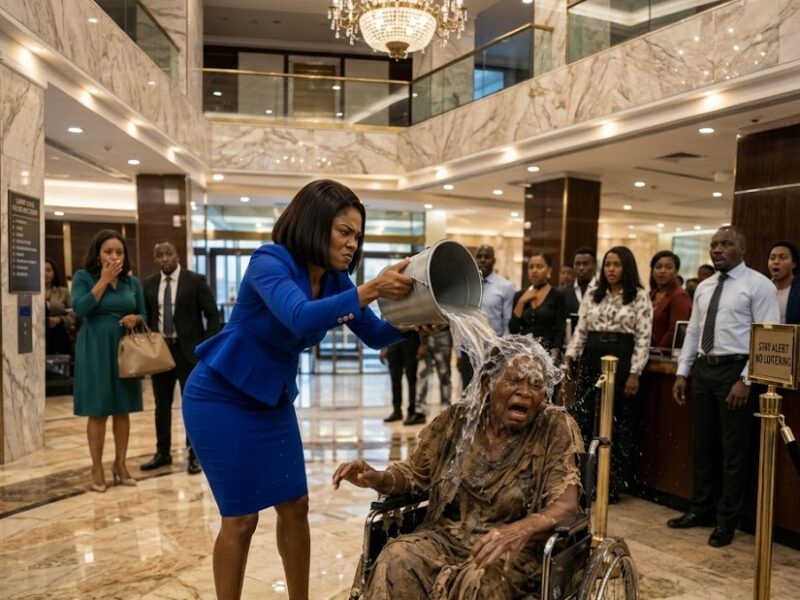
Bank Employees Humiliated an Elderly Beggar—Then She Sat in the Billionaire Owner’s Chair
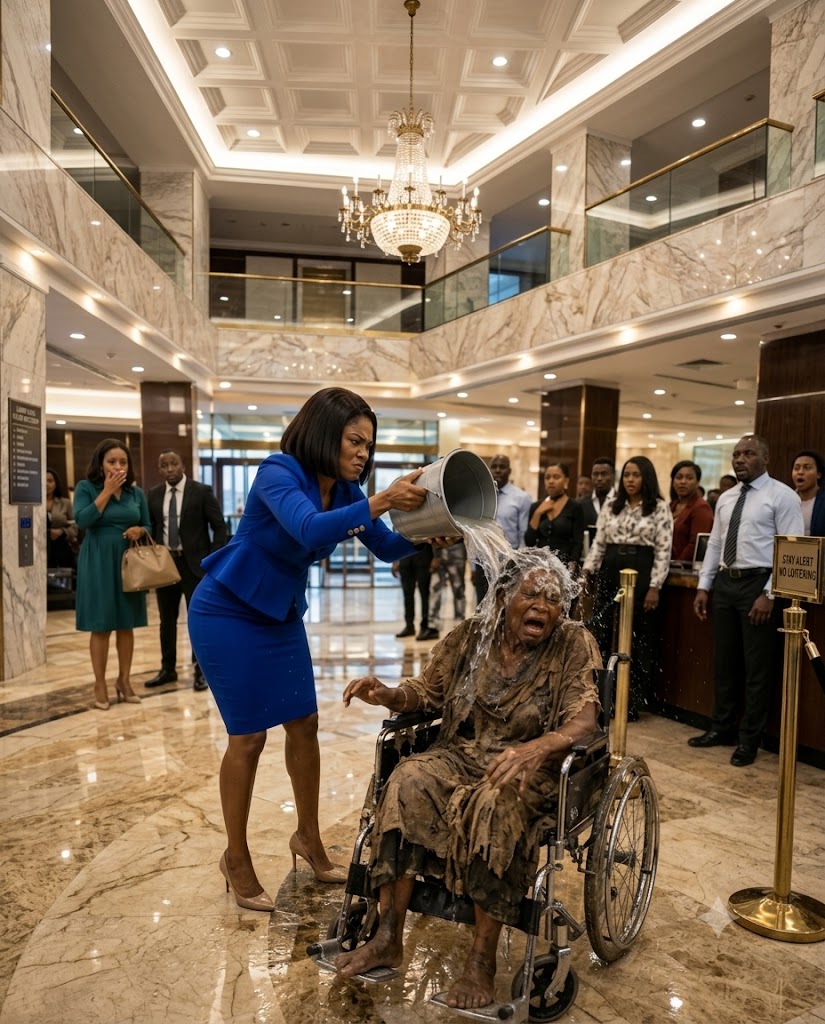
## Part 1
The morning sun cast long shadows across the marble floors of First Meridian Bank as Mrs. Grace Okonkwo pushed through the heavy glass doors, her worn sandals making soft whispers against the polished surface.
She clutched a faded check to her chest like a prayer, her only good dress—a simple floral print she’d saved for special occasions—hanging loose on her thin frame.
The security guard, a broad-shouldered man named Marcus, barely glanced up from his phone as she approached the customer service desk.
“Good morning, my daughter,” Mrs. Okonkwo said softly to the young woman behind the counter, her voice carrying the gentle weight of years. “I would like to withdraw some money from my account.”
The woman, whose name tag read Sandra, looked up with eyes that had already decided something before Mrs. Okonkwo finished speaking.
“If you want to withdraw money, go join the teller line,” Sandra said, gesturing dismissively toward the winding queue. “Can’t you see people waiting there?”
Mrs. Okonkwo’s fingers tightened around her check. “My daughter, I need to withdraw with a check. That is why I came here first.”
“How much?” Sandra asked, her tone already bored.
“One hundred million dollars.”
The words hung in the air like a wrong note in a symphony.
Sandra’s pen stopped moving. Her eyes traveled slowly from Mrs. Okonkwo’s scuffed sandals to her faded handbag to the thin gold band on her finger that had known better days. Then she laughed—a sharp, cutting sound that drew glances from nearby customers.
“Ma’am, please don’t start this morning,” Sandra said, shaking her head. “Do you even know how many zeros are in one hundred million?”
“I have an account here,” Mrs. Okonkwo replied, her voice steady despite the heat rising in her chest. “You can check it.”
“I said I will not check anything.” Sandra’s voice rose, cracking through the morning calm. “This is a serious bank. People are here for real business. Carry your check and leave.”
Mrs. Okonkwo stood frozen, her heart hammering against her ribs. “My daughter, I am old enough to be your mother. Even if I made a mistake, is this how you speak to me?”
“Please don’t bring age into this.” Sandra’s eyes narrowed. “If you’re old enough to be my mother, then behave like someone with sense.”
The words struck like stones.
Mrs. Okonkwo opened her mouth to respond, but a new voice cut through the tension—authoritative, sharp, accustomed to being obeyed.
“What is going on here? Why is there noise in my banking hall?”
Mr. Collins, the branch manager, strode toward them in a perfectly tailored navy suit, his Italian leather shoes clicking against the floor with each step. He was a man who measured worth in numbers and appearance, and Mrs. Okonkwo’s appearance had already told him everything he needed to know.
“Sir, I’m sorry,” Sandra said, her tone shifting instantly to deference. “It’s this woman. She came here saying she wants to withdraw one hundred million dollars. I tried to explain, but she refused to leave.”
Mrs. Okonkwo’s hands trembled. “Sir, please. That is not true. I only asked her to check my check.”
Mr. Collins looked at her the way one might examine a stain on a new carpet. “Madam, please don’t raise your voice in my bank. You’re already causing a scene. This is not a market. This is a bank.”
“Sir, I know this is a bank.” Mrs. Okonkwo’s voice cracked. “That is why I came here. Please check it.”
“These people,” Mr. Collins muttered, turning to Sandra with an exasperated sigh. “Every day, one drama or another.”
“Sir, I have money in this bank,” Mrs. Okonkwo said, her desperation bleeding through.
Mr. Collins’s patience snapped. “Madam, I don’t have time for this nonsense. Leave this place now before I call security.”
“Sir, please.” Tears welled in her eyes. “I am not here to fight. I only want my money. Even if you don’t believe me, just check the account.”
“Are you teaching me my work?”
“No, sir.”
“Then why are you still talking?” Mr. Collins turned to the security guard. “Marcus, take this woman out.”
“Sir, please don’t do that—”
“Now.”
Marcus stepped forward, his hand closing around Mrs. Okonkwo’s arm with a grip that would leave bruises. She stumbled as he pulled her toward the door, her check fluttering from her fingers to the floor.
“Please give it back to me,” she cried, reaching for the paper. “Please give it back!”
“Leave it there,” Mr. Collins ordered.
“I said leave it.”
“Marcus, what are you waiting for? Remove her from here.”
The guard’s grip tightened. “Please, ma’am, stand up.”
“My body’s paining,” Mrs. Okonkwo gasped as he hauled her upright.
“Move.”
She lost her footing. The floor rushed up to meet her, and she landed hard on her hip, her handbag spilling open. Coins rolled across the marble, a lipstick skittered under a chair, and her dignity scattered like the contents of her bag.
“Please,” she whispered.
“Sorry,” Marcus muttered, not sounding sorry at all.
“I came as a customer, not as a thief.”
“Madam, just move.”
“Madam, please don’t come and cause trouble here again,” Sandra called from behind the counter.
“I did not cause trouble.”
“Go. Please just go.”
Mrs. Okonkwo gathered herself slowly, her body screaming with every movement. She collected her scattered belongings while the entire banking hall watched—customers who looked away, staff who pretended to be busy, a security guard who stood over her like a sentinel.
“My body is paining me,” she said to no one in particular, “but my heart is worse.”
She made it to the door somehow, the same door that had welcomed her minutes ago now feeling like a barrier she could barely cross.
“So this is what poverty-looking clothes can do to a person,” she murmured to herself as the glass swung shut behind her. “They pushed me down like I was not somebody’s mother. I did not beg them. I did not ask them for free money.”
The parking lot stretched before her, blinding in the morning sun. She walked past cars worth more than her house, past trees trimmed into perfect shapes, past everything that told her she didn’t belong.
“God sees me,” she said, her voice barely above a whisper. “Even if they refuse to see me, God sees me.”
She found a bench near the bus stop and sat down heavily, her hip throbbing. For a long moment, she simply breathed—in through her nose, out through her mouth, the way her late husband had taught her when the children were young and money was tight and life felt impossible.
Then she pulled out her phone.
Her fingers trembled as she pressed the screen, navigating to a contact she rarely called. It rang twice before a voice answered—warm, familiar, the voice of the boy she had raised, the man he had become.
“Mommy?”
“Daniel.” Her voice broke on his name.
“Mommy, what happened? Why does your voice sound like that?”
“Nothing. I am fine.”
“No, you are not fine. Tell me what happened.”
She closed her eyes. The tears she had been holding back spilled down her cheeks, hot and shameful. “My son, today I was disgraced.”
“Who disgraced you, Mommy?”
“The customer service woman laughed at me. She said I was wasting their time.”
“Which customer service woman?”
“Sandra. They called her Sandra. The manager came out. He did not listen to me. He looked at me like I was dirt.”
A pause. When Daniel spoke again, his voice had changed—lower, harder, the voice of a man who had learned to control his anger but never to forget it.
“The manager touched you?”
“He pushed me, my son.” The words tumbled out now, unstoppable. “I fell on the floor. My things scattered. Then the security man dragged me outside.”
“Where are you now?”
“I am at home. I took the bus.”
“Lock your door and rest.”
“My son, don’t worry yourself. I only called because my heart was heavy.”
“No meeting, no business, no money in this world is more important than your dignity.” His voice cracked with barely contained fury. “I am coming.”
“No, my son. Please, I don’t want trouble. Daniel, please don’t leave your work because of me.”
“They already brought trouble to you. Now they will answer for it.”
“Please don’t fight anybody.”
“I will not fight.” His voice was ice. “But they will learn.”
She heard him speaking to someone else—his assistant, perhaps, or a colleague. “I am sorry. I have a family emergency. I have to leave now.”
“Sir, should we wait for you?”
“No. Continue what you can. Send the final documents to my office.”
“Sir, should I come with you?”
“Not now, but I will need you tomorrow morning.”
“Yes, sir.”
“Get the legal team ready. Get compliance ready. Also contact the regional head.”
“Yes, sir.”
“I want all of them available tomorrow.”
“I will arrange it immediately.”
“Sir?”
“Yes?”
“Mommy? I am coming.”
The line went dead.
Mrs. Okonkwo sat on her worn sofa in her small apartment, staring at the wall. The clock ticked. The refrigerator hummed. Outside, children played, car horns blared, life continued as if nothing had happened.
But something had happened.
She had been invisible. She had been dismissed. She had been thrown out of a place she had every right to be, treated like garbage because her clothes were old and her sandals were scuffed and her handbag had seen better decades.
She thought about the money. One hundred million dollars—money her husband had left her, money she had never touched because it felt like blood, money that had sat in that bank for years while she lived on her modest pension and the occasional help from her son.
She had wanted to withdraw a portion. Just a portion. To help her church build a new roof. To send her granddaughter to college without loans. To finally, after all these years, do something good with the fortune that had fallen into her lap through tragedy.
And they had laughed at her.
The doorbell rang.
She didn’t move.
“Mommy, it’s me. Open the door.”
Daniel’s voice, urgent and worried.
She rose slowly, her hip protesting, and made her way to the door. When she opened it, her son stood there—tall, broad-shouldered, dressed in a suit that probably cost more than her monthly pension. His face was a mask of controlled fury, but his eyes—those eyes that had looked up at her when he was a boy, that had trusted her to make everything okay—were wet.
“Mommy.”
He stepped inside and gathered her into his arms, holding her like she might break.
“I’m sorry,” she whispered into his chest. “I didn’t want to bother you.”
“You are not a bother to me.” His voice was thick. “You are my mother.”
She pulled back, looking at him—really looking. He had grown into such a man. Successful. Powerful. Respected. But none of that mattered to her. What mattered was the boy who had held her hand when his father died, who had promised to take care of her, who had kept that promise a thousand times over.
“I have never been so ashamed in my life,” she said.
Daniel’s jaw tightened. “Tomorrow we are going back.”
“No.” She shook her head firmly. “I will not enter that place again. No, Daniel, please let the money go. Let everything go.”
“This is not about the money.” His voice was quiet but fierce. “It is about what they did to you. It is about what they may do to another person tomorrow.”
“I don’t want trouble.”
“There will be no trouble. There will only be truth.”
“My son, please don’t let anger control you.”
“It will not.” He took her hands in his. “But I will not allow pride to win either.”
She winced as she shifted her weight.
“Careful, Mom.” His eyes searched her face. “Your side still hurts?”
“It is better. Leave it, my son. I can carry my bag.”
“Let me carry it.”
She looked at him—her son, her defender, her boy.
“Tomorrow,” he said, “you will not walk into that bank with shame. Tomorrow you will walk out with your head held high.”
She closed her eyes. “Let God help us.”
—
## Part 2
The morning came gray and cold, the kind of morning that made old bones ache and old hearts remember.
Mrs. Okonkwo stood before her mirror, studying her reflection. She had worn her best dress—the same floral print from yesterday, freshly washed and pressed—and her good shoes, the ones with the slight heel that made her feel taller than she was. She had pinned her gray hair back neatly and applied a touch of lipstick, the last gift her husband had given her before he passed.
“You look beautiful, Mommy.”
Daniel stood in the doorway, already dressed in a charcoal suit that fit him like armor. He had been up since before dawn—she had heard him on the phone, making calls, arranging things she didn’t fully understand.
“I look like myself,” she said.
“That’s what I said.”
She smiled despite herself. “You have your father’s charm.”
“I learned from the best.”
They left the apartment together, Daniel carrying her handbag despite her protests. A black car waited at the curb—not the flashy kind, but substantial, the kind of car that whispered rather than shouted.
“Where is your driver?” she asked.
“I told him not to come. We are going the way you went.”
“The bus?”
“The bus.”
She looked at him, surprised. “Daniel, you don’t have to—”
“I want to.”
So they took the bus. Daniel in his expensive suit, sitting beside his mother in her faded dress, as the city rolled past the windows. People stared—they couldn’t help it—but Daniel didn’t seem to notice. He held his mother’s hand and talked about nothing and everything, the way they used to when he was young.
“Mommy, don’t be afraid,” he said as they approached the bank.
“I am not afraid.” She paused. “What if they embarrass us again?”
“They took your peace yesterday.” His grip tightened on her hand. “Today we are going back to collect your dignity.”
The bank loomed ahead—all glass and marble and the cold elegance of money. Mrs. Okonkwo’s heart began to race as they approached the doors.
“This place again,” she murmured.
“I am here with you.”
They walked inside together.
Sandra was at her station, her perfectly made-up face freezing when she saw them.
“You people again.” Her voice was sharp. “Good morning. Don’t come and cause problem here today.”
“We came for banking,” Daniel said calmly.
Mrs. Okonkwo’s heart hammered. “My heart is beating fast.”
“Stay close to me, Mommy.”
“Good morning, madam.” Daniel’s voice was pleasant, professional, the voice of a man who had spent years in boardrooms. “We’re here to conduct a transaction.”
“So you came back?” Sandra’s eyes narrowed.
“Yes, we came to withdraw money.”
“Oh, so this is the son she went to report to.”
“We are here for banking.” Daniel placed the check on the counter. “This is my mother’s check. Please process it.”
Sandra picked it up, her expression shifting from disdain to disbelief as she read the amount.
“One hundred million dollars.”
“Yes. Please check the account.”
“Yesterday was the mother. Today the son has joined.” She laughed, but there was unease in it now. “Do you think this is a roadside shop? I will not check anything.”
“You are refusing to check a customer’s check.”
“I am refusing to waste my time.” She looked them up and down. “Look at both of you.”
Daniel’s jaw tightened. “My mother’s clothes are not her account balance. Please spare me that speech.”
“If you people are so sure of yourselves, go and meet the branch manager.”
“All right.” Daniel picked up the check. “Come, Mommy.”
“My son, let us go home.” Mrs. Okonkwo’s voice was tired. “They will insult us again.”
“They already have.” He guided her toward the manager’s office. “Not yet, Mommy.”
People in the banking hall watched them pass—the same people who had watched yesterday’s humiliation, who had said nothing, who had looked away.
“People just wake up and come here to act drama,” someone muttered.
“God knows I came for my own money,” Mrs. Okonkwo said quietly.
“Daniel, please let us not beg them again.”
“We are not begging them. We are asking them to do their work.”
“My heart is tired, my son.”
“Just stay with me.” He stopped before the manager’s door. “Let them show us who they are.”
A receptionist looked up. “Yes? What do you want?”
“We need to see the manager.”
“Do you have an appointment?”
“No.”
“Then you cannot see him.”
“It is urgent.”
“Everybody says their matter is urgent. Go and sit over there.”
“Daniel, please,” Mrs. Okonkwo whispered. “Let us go.”
“When he is free, I will tell him,” the receptionist added.
“We will wait.”
They sat in the waiting area—the same chairs where Mrs. Okonkwo had waited yesterday, where she had hoped someone would help her, where she had been ignored until she became a problem to be removed.
“He is inside,” Daniel observed.
“I know.” Mrs. Okonkwo shifted uncomfortably. “This place has no mercy.”
“They did not ask that one for appointment,” Daniel said, nodding toward a well-dressed man who had just walked past the receptionist with a wave.
“I saw it.”
“My son, let us go.”
“Not yet.”
“They will insult us again.”
“They already have.”
“Daniel, where are you going?”
“To see the manager.”
He stood and walked toward the inner door.
“Sir, where are you going?” The receptionist’s voice rose.
“To see the manager.”
“Sir, you can’t go in there!”
“Daniel, please wait.” Mrs. Okonkwo struggled to her feet. “Let me call him for you.”
But Daniel was already through the door.
“What is this nonsense?”
The voice came from behind a massive desk—Mr. Collins, the branch manager, rising from his chair with fury in his eyes.
“Are you Mr. Collins, the branch manager?”
“You broke into my office to ask me who I am?”
“My mother came here yesterday to withdraw money. Your staff refused to check the account.” Daniel’s voice was ice. “I am asking you to process this check.”
Mr. Collins’s face contorted as recognition dawned. “Oh, so it is you again. Madam, you really don’t have shame.”
“Choose your words carefully,” Daniel said quietly.
“One hundred million dollars.” Mr. Collins laughed. “This is becoming madness.”
“Check the account.”
“Check the account,” Mr. Collins mocked. “I will not check anything. Your mother came here yesterday with this same foolishness. Instead of thanking God I did not hand her over to police, she went and brought you.” He looked them up and down with undisguised contempt. “Look at both of you. If your mother has one hundred million dollars, then I own the whole country.”
“Interesting.”
“What is interesting?”
“Your confidence.” Daniel pulled out his phone. “Carry your mother and leave before I call police.”
“My son, please,” Mrs. Okonkwo whispered.
“Who are you calling?” Mr. Collins demanded. “Your village people?”
Daniel spoke into the phone. “Mr. Bellow, come in now with the team. Put Mr. Tunde Balogun on the call. Let him hear everything live.”
Mr. Collins’s face went pale. “Wait, what did you just say?”
“Mommy, sit down.”
“Daniel, what is happening?”
The door opened. A team of people in sharp suits entered—legal counsel, compliance officers, a woman with a tablet who immediately began recording.
“Sir, the documents.” Mr. Bellow placed a folder on the desk.
“Thank you, Bellow.” Daniel turned to Mr. Collins. “Sit down, Mr. Collins.”
“I don’t understand what is going on here.”
“I said sit down.”
Mr. Collins sat.
“My name is Daniel Okonkwo.” Daniel’s voice filled the room, calm and absolute. “This woman you pushed to the floor yesterday is my mother, Mrs. Grace Okonkwo.”
“My son—” Mrs. Okonkwo started.
“I am the majority owner and chairman of this bank.”
The silence was absolute.
“Sir, I didn’t know.” Mr. Collins’s voice was barely a whisper. “Sir, I can explain—”
“Don’t start begging yet.” Daniel’s eyes were cold. “We have not even begun. The chair you sit on belongs to the institution my family built.”
“Sir—”
“And the woman you dragged through shame yesterday is the mother who raised me.”
“Daniel, enough,” Mrs. Okonkwo said softly.
“Now, before you explain anything, let us watch what happened yesterday.”
“Yes, sir.” Mr. Bellow connected a laptop to the large screen on the wall.
“Daniel, I am on the line,” a voice said through the speakerphone. “This is Tunde Balogun, regional head.”
“He’s listening,” Daniel said. “Play it.”
The footage was grainy but clear. Mrs. Okonkwo entering the bank. Approaching Sandra’s desk. The conversation that turned to dismissal, then contempt, then cruelty. Mr. Collins emerging from his office. The push. The fall. The scattered belongings. The security guard dragging her out while customers watched and did nothing.
“I remember that door,” Mrs. Okonkwo said quietly.
“That was the first thing they gave her,” Daniel said. “Judgment.”
“Sir, I was not there at the door,” Mr. Collins protested. “The customer care officer refused to check the account—”
“And laughed at her instead.” Daniel pointed at the screen. “Here is where you entered the banking hall.”
“I only came out because there was noise.”
“I don’t want to see that part again,” Mrs. Okonkwo said.
“They must see it, Mommy.”
On the screen, Mrs. Okonkwo lay on the floor, her handbag spilled, her dignity in pieces. No one helped her. No one offered a hand. The security guard stood over her like a jailer.
“She was on the floor and still no one assisted her properly,” Daniel said. “They dragged her out like a criminal. Mr. Collins, is that you in the video?”
“Sir, I can explain—”
“Explain.”
“Madam, please forgive me.” Mr. Collins turned to Mrs. Okonkwo, his eyes desperate. “I did not know who you were.”
“That is your first problem.” Daniel’s voice cut through the room. “You are not sorry because you pushed an old woman. You are sorry because you now know she is my mother.”
“No, sir. Please, sir—”
“Sir, please. I made a mistake. I was under pressure.”
“Stand up, Mr. Collins.”
“I have family. I have children. Please don’t end my career.”
“My son,” Mrs. Okonkwo said softly.
“Mommy, mercy without correction will make him do it again.”
“I understand.”
Daniel turned back to Mr. Collins. “You saw my mother clearly. You saw her clothes, her sandals, her old handbag. That was why you judged her.”
“I was wrong, sir.”
“Sandra, come in.”
The customer service representative entered, her face ashen.
“Sir—”
“Yesterday my mother stood before you and asked for help. What did you do?”
“Sir, please forgive me.”
“Answer the question.”
“She asked me to check her check.”
“Did you check it?”
“No, sir.”
“Why didn’t you check it?”
“I thought she was lying because of how she looked.”
“You laughed at her.”
“Yes, sir.”
“You refused to check the account.”
“Yes, sir.”
“You called her poor because of her clothes.”
“Sir, I made a terrible mistake.”
“If I had entered this bank alone dressed like this, would you have respected me?”
“Sir—”
“That is why you cannot sit at that desk anymore.”
“Sir, please. I need this job.”
“Sir, please. I am sorry. I will change.”
“You should have changed before you met power.” Daniel’s voice was relentless. “You should have changed when an old woman stood in front of you with tears in her eyes.”
“I was wrong, sir.”
“Please, sir, I need this job.”
“Sandra, this is not only about your job.” Daniel turned to the security guard standing by the door. “Musa.”
“Sir.”
“Musa, you dragged my mother out yesterday.”
“Sir, I was following instruction.”
“Instruction?” Daniel’s eyes blazed. “If they instructed you to beat her, would you beat her?”
“Sir—”
“But you dragged her.”
“I was afraid to lose my job. Sir—”
“Your uniform is not for oppressing people. It is for protecting them.”
“I’m sorry, sir.”
“Each of you showed that you cannot be trusted with people’s dignity.” Daniel turned to his assistant. “Bellow, bring the letters.”
“Yes, sir.”
“Mr. Collins. Sandra Adami. Musa.” He took the envelopes and placed them on the desk. “Your employment has been terminated with immediate effect.”
“Sir, please. No—”
“Not legal action. Sir, please not legal action, please.”
“When you pushed my mother, you were not thinking of law.” Daniel’s voice was quiet, terrible. “Now law remembers you. I am not taking this action because she is my mother. I am taking it because you cannot be trusted with people’s dignity.”
“I understand, sir.”
“Mrs. Nwosu, begin a full review of this branch.”
A woman in a gray suit stepped forward. “Yes, sir.”
“I want customer complaints from the last two years. Every ignored report, every rude staff record, every case buried.”
“I will begin immediately, sir.”
“Any case ignored because the customer looked poor, dressed poor, or sounded poor, I want it on my table.”
“Understood, sir.”
“Prepare the legal report. My mother was assaulted in this branch.”
“Yes, sir. We will decide the next step after reviewing everything.”
“This lesson will not end inside this office.”
Daniel turned to address the staff who had gathered, drawn by the commotion. His voice carried through the banking hall, reaching every corner.
“Everybody, please listen. Yesterday an elderly woman walked into this bank to withdraw her own money. She was not begging. She was not stealing. She came as a customer. Because she wore simple clothes, some of you decided she had no value.”
The staff stood frozen, their eyes down.
“Because her sandals were old, you thought her account must be empty.” His voice rose. “I am sorry, sir,” someone whispered. “This woman is my mother. But before she’s my mother, she’s a human being.”
“Sir, please.”
“Even if she had only one thousand dollars in her account, she deserved respect. A bank does not exist for rich people alone. Traders come here. Teachers come here. Drivers come here. Widows come here.”
“Yes, sir.”
“Your job is not to worship expensive clothes. Your job is to serve people.”
“I am sorry.”
“And to the customers who watched yesterday and said nothing.” Daniel’s eyes swept the banking hall. “Silence is not always peace. Sometimes silence is how injustice grows.”
“Forgive us, Mama.”
“From today, this branch will change. Any staff member who insults or embarrasses a customer will answer for it.”
“Yes, sir.”
“If you cannot respect people, resign. I will not allow pride to destroy a bank built on trust.”
“Yes, sir.”
Mrs. Okonkwo touched her son’s arm. “My son, let me say something.”
“Yes, Mommy.”
“My children.” Her voice was soft but carried through the silent hall. “I did not come here yesterday to disgrace anybody.”
“Speak, Mommy. They are listening.”
“I came because I trusted this bank with my money. Some of you looked at me and saw only my clothes.”
“Mama, I am sorry.”
“You did not see my years of suffering. You did not see the nights I stayed awake when life was hard.”
“Mommy—”
“But God saw.”
“I am sorry, Mama.”
“A person can dress simply and still have value. A person can be old and still deserve respect.”
“Yes, Mama.”
“A person can look poor and still be carrying a story bigger than your own.”
“We hear you, Mama.”
“My son, money is good, position is good, but character is greater.”
“Yes, Mommy.”
“If people fear you only because of your power, that is not respect. Real respect is how you treat people when you think they cannot help you.”
“I understand, Mama.”
“Let this not happen to another person.”
“It will not, Mama.”
“My son, let us go.”
“Yes, Mommy. Please make way for Mama.”
The staff parted like water as Mrs. Okonkwo walked toward the door. The same door she had been dragged through yesterday. The same floor that had received her fallen body.
“Mama, I am sorry,” someone said.
“Mama, I am sorry.”
“Learn from it,” she replied.
“Careful, Mommy. Take your time,” Daniel said, his hand under her elbow.
“I am walking, my son. Let them see me walk.”
“Please give Mama space.”
Mrs. Okonkwo paused at the threshold. “Yesterday they told me to leave. Today nobody is blocking me.”
“Are you all right?”
“The same floor saw my shame yesterday. Today it will see my honor.”
“Mama, please forgive me.”
“This is not the place for that. Learn first.” She straightened her shoulders. “My legs are weak, but my heart is standing.”
“Lean on me, Mommy.”
“Mama, I am sorry.”
“Learn from it.”
“After you, Mommy.”
Mrs. Okonkwo stepped through the door into the morning light. “Today I am not being thrown out. I am walking out.”
“Mommy, are you all right?”
“The air feels different today.”
“Mommy, why are you crying?”
“Yesterday I cried because they disgraced me.” She wiped her eyes. “Today I am crying because God has lifted my head.”
“You deserve more than this.”
“No, my son. I only wanted respect.”
“And they will never forget that.”
“That same door closed behind me yesterday like I was a thief. Today it opened for you with honor.”
“Let us go home, my son.”
“Yes, Mommy. Slowly. Are you sure you can walk?”
“I can walk. Today shame is not following me.”
“May they never treat another person like that again.”
“They won’t. Not while I am alive to stop it.”
—
## Part 3
The news spread through the city like wildfire.
“That old woman they insulted yesterday—she’s the chairman’s mother.”
“God have mercy. The people inside that bank finished themselves today.”
“We all watched her yesterday. Nobody helped her. Today I understood something. Silence can disgrace you too.”
“Sandra laughed at me too. Because I brought money in a nylon bag.”
“So you were not the only one. I waited in that bank until my legs started paining me. They attended to people who came after me because they looked important.”
“I only asked questions because I did not understand my husband’s account. And they shouted at me.”
“Yes. Right there in the bank.”
“When they thought I was just a driver, I was nobody. And when your boss called, suddenly I became visible.”
The stories poured in—dozens of them, hundreds, each one a small wound that had been ignored, dismissed, buried.
Mrs. Nwosu sat in her temporary office at the branch, her tablet glowing with complaint after complaint.
“Start with every complaint marked resolved without customer follow-up,” she instructed her team.
“Yes, ma’am.”
“There are many of them.”
“Flag them. We need to verify every single one.”
“Understood, ma’am.”
“Ma, Sandra was rude to many elderly customers, especially those who could not speak English.”
“Was it reported?”
“Mr. Collins only cared about customers who looked rich.”
“Say it clearly. What happened to ordinary customers?”
“He ignored them or delayed their transactions. He would say we should handle them outside.”
“Meaning they were not important enough for his office.”
“Sir, it is worse than we thought.”
Daniel stood at the window of his office, looking out over the city. “No, it is exactly what my mother’s tears were trying to show us.”
“Invite Mrs. Chinwe, Mr. Peters, Mrs. Tajayi, Chuka, and every customer with a confirmed complaint.”
“Yes, sir.”
“This must not become a press show. These people were embarrassed in public. We will not use their pain to advertise ourselves.”
“Understood, sir.”
“Mommy, we found other people they treated badly.”
Mrs. Okonkwo sat in her living room, a cup of tea cooling in her hands. “I knew it. Then help them, too. Don’t let it be only because I’m your mother.”
The disciplinary hearing was held in a conference room on the top floor, with a view of the city that stretched to the horizon.
Mr. Collins sat at one end of the table, his expensive suit rumpled, his confident demeanor shattered. Sandra sat beside him, her makeup smeared from crying. Musa, the security guard, sat apart from them, his uniform replaced by civilian clothes.
“This disciplinary hearing is now in session,” Mrs. Nwosu announced.
“Yes, ma’am.”
“Mr. Collins, you were the branch manager. You were responsible for staff conduct and customer safety.”
“I understand, ma’am.”
“Do you accept that an elderly customer was assaulted and dragged out under your authority?”
“I accept that the incident happened.”
“That is not what I asked.”
“Yes, ma’am. I accept responsibility.”
“Why did you refuse to check her account? The evidence shows the decision was based on appearance.”
“Yes, ma’am. I judged wrongly.”
“Sandra Adami, did you mock the customer and refuse to attend to her?”
“Yes, ma’am.”
“You said you thought she was lying. Did you check?”
“No, ma’am.”
“So you decided she was lying because of her clothes.”
“Yes, ma’am.”
“Admission recorded. Musa, did Mama Grace attack anyone?”
“No.”
“Did she threaten anyone?”
“No. I was following my manager’s instruction.”
“Your manager did not remove your conscience from your body. Fear of losing a job does not excuse harming a customer.”
The footage played again on the screen—the push, the fall, the dragging.
“The footage confirms the customer was pushed, fell, and was removed without proper care.”
“I am ashamed.”
“The bank’s decision stands. Your appointments remain terminated. Further action will depend on the legal review.”
“I understand.”
—
## Part 4
Three days later, Mr. Collins stood on Mrs. Okonkwo’s doorstep.
“Madame Grace, thank you for allowing me to come.”
“You came to my house. Speak.”
“I was wrong. I judged you by your clothes, by your sandals, by your handbag. And I used that judgment to hurt you.”
“Are you sorry because I am Daniel’s mother, or because what you did was wrong?”
“Because what I did was wrong.”
“Sir, please. I have lost my job already.”
“An apology does not erase consequences. It only proves whether you understand them.”
“If another old woman stands before you tomorrow, remember me.”
“I will, Mama. I swear I will.”
“Thank you for hearing me.”
“Go and become better than what happened.”
The next day, Sandra came.
“Mama, thank you for allowing me to enter your house.”
“Say what you came to say.”
“I laughed at you. I insulted you. I treated you like you were nothing.”
“Say why.”
“Because you looked poor.”
“My daughter, poverty is not a disease.”
“I know that now, Mama.”
“Sir, is there any way I can get my job back?”
“Not there, but you can become better somewhere else. Wherever you go next, leave people better than you met them.”
“I will try, Mama. I will try.”
“Thank you, Mama. Go in peace, but do not forget.”
When they were gone, Daniel sat with his mother in her small living room.
“My son, anger has done its work. Do not let it follow you home.”
“I am trying, Mommy. When I saw that video, I wanted all of them to feel what you felt.”
“That is why God gives us mothers to pull anger back before it becomes another cruelty. Let justice correct. Let mercy heal.”
“I hear you, Mommy.”
—
## Part 5
The changes came swiftly.
“Every confirmed customer must receive a personal apology and proper compensation.”
“I will handle it today, sir.”
“Send this to every branch. No customers beneath respect.”
“Every branch, sir. Every branch.”
“Madame Chinwe, the bank apologizes for how you were treated.”
“I hope this apology teaches the people who laughed.”
“Sir, the bank is sorry for keeping you waiting and ignoring your complaint. Respect should not wait until a chairman is angry.”
“Madame Ajayi, your late husband’s account has been reviewed properly. We are sorry for the way you were spoken to.”
“Thank God someone finally listened.”
“Mr. Chuka, the bank apologizes. You should not have been ignored because of your job. A driver is also a customer when he enters a bank.”
“Customer service begins before you know a person’s balance.”
“Yes, ma’am. Always treat every customer with dignity and respect. This is our policy. No exceptions.”
—
Mrs. Okonkwo sat with Daniel on her porch, watching the sun set over the city.
“My son, what a person has in the bank is not greater than what he has in his heart.”
“I will remember that, Mommy.”
“Mommy, after everything, do you regret going back to that bank?”
“No, my son. Sometimes God lets people disgrace you so he can teach them through you.”
“They saw your clothes and missed your value. That is why character must see what eyes cannot see. Money is good, Daniel, but money must never become the only language a person understands.”
“Then what should the bank understand first?”
“Human beings.”
“I will build it better, Mommy. Not just for rich people—for everybody. Build it so the small person can enter without fear.”
“Now stop looking serious and eat before these ground nuts finish.”
“Yes, Mommy.”
“Chairman or not, you are still my son.”
—
## Part 6
Six months later, Mrs. Okonkwo walked into a different branch of the bank—not the one where she had been humiliated, but a new one, in a different part of the city.
She wore the same floral dress. The same worn sandals. The same faded handbag.
“Good afternoon, Mama. You are welcome.”
“Good afternoon, my son.”
“Please, Mama. How may we help you today?”
“I came to do my banking.”
“Of course. Right this way, please.”
“Mama, please come in. You will be attended to properly.”
“Properly?”
“Yes, Mama. Properly.”
“Should I call someone to assist you, Mama?”
“Call them if that is how you treat every customer.”
“Yes, Mama. Every customer.”
“This way, Mama. We will take care of you.”
“Take care of everybody like this.”
“We will, Mama.”
“Good afternoon, Mama. Please take your time. How may I help you today?”
“Good afternoon, my daughter. I want to do my transaction.”
“Of course, Mama. I’ll assist you with that.”
“Let me bring it out slowly. My hands are not as fast as before.”
“No rush, Mama. I am here with you.”
“Mama, your account is active. Everything is in order.”
“Thank you. That is all I wanted them to check that day.”
“My daughter, do not treat me well because you know my story.”
“Mama, we are learning to treat everybody well.”
“Good. That is the real banking.”
“Mama, your transaction is completed.”
“Thank you, my daughter. May your own mother meet kindness where she goes.”
“Amen. Mama, thank you.”
“Mama, thank you for coming. Please go well.”
“Thank you, my son. Let this place remain like this.”
“Do not treat me well because my son is powerful.”
“No, Mama. We understand.”
“Treat people well because they are people.”
“We will remember, Mama.”
“Remember the ones who cannot speak loudly for themselves.”
“She left happy.”
“No, she left respected.”
—
Mrs. Okonkwo walked out of the bank into the afternoon sun. The same sun that had watched her humiliation now warmed her face like a blessing.
“Yesterday I left this place with shame. Today I live with peace. Today they saw me. Not my clothes, not my slippers—me.”
She paused on the steps, looking back at the bank.
“Lord, let this respect remain when nobody important is watching. Let the next person enter without fear.”
—
Daniel received the report that evening.
“She went back alone?”
“Yes, sir. She was welcomed properly and her transaction was completed without delay.”
“Did they know she was my mother?”
“No, sir. She entered like every other customer and they treated her with respect.”
“Then it is working.”
“Yes, sir. The branch manager confirmed every staff member followed the new protocol.”
“Do not relax because one branch improved. Keep watching every branch.”
“Understood, sir.”
“Respect must become the culture, not the campaign.”
—
“Mommy, I got a report from the branch.”
“And what did they say?”
“They treated you well before they knew who you were.”
“Then it has begun.”
“Begun?”
“Yes. Change has not finished. It has only started working.”
“Do not build it around my name alone.”
“I will not, Mommy.”
“Build it for the woman whose son is not chairman.”
“I thought removing the wrong people was the hard part.”
“No, my son. Keeping the right lesson alive is harder. Respect should not look like a miracle in a bank.”
“It should be normal.”
“Yes, let it become normal.”
—
## Part 7
The community center was crowded with people—old women in faded dresses, young mothers with babies on their hips, day laborers still dusty from work.
Mrs. Okonkwo stood at the front of the room, her floral dress freshly pressed, her gray hair pinned back.
“Mama Grace, you did not have to do all this.”
“My daughter, kindness is not for show. It is for sharing.”
“Thank you, Mama Grace.”
“Mama, God will bless you for remembering people.”
“I know what it means to wait and hope somebody will remember you. Sometimes asking for help makes somebody feel small. Help should not remove your dignity. Keep it. It belongs to you.”
“Mama, may your children never lack.”
“Amen.”
“What God gives one hand, he expects that hand to open for another person.”
“Mama Grace, this your kindness will not end here.”
“It must not end here. Each person should carry a little of it forward.”
—
That night, Daniel sat with his mother in her small living room. The television was off. The neighborhood was quiet.
“Mommy, everyone has gone. Are you tired?”
“My body is tired, my son, but my heart is resting. After everything, you still gave to people today.”
“Money is not alive until it helps somebody breathe easier.”
“Mommy, I am sorry you had to call me in tears before I knew what was happening.”
“But you came, Daniel. Some children hear their mother’s pain and still stay busy.”
“I will always come. The bank will be different now.”
“Do not say it only tonight. Change must wake up every morning and go to work.”
“It will, Mommy. Now leave bank matter and eat ground nut before I finish it alone.”
“Yes, Mommy.”
“Chairman or no chairman, in this house you are still my son.”
“After all the noise, this place is still the quietest place in my life.”
“Because home does not ask you to prove yourself.”
“Thank you, Mommy.”
“Thank God, my son.”
—
## Epilogue
One year later, First Meridian Bank had become a different institution.
The policies were simple: every customer deserved respect. Every complaint was investigated. Every employee was trained to see people, not just accounts.
Mrs. Okonkwo rarely visited the bank anymore. She had other things to do—her church, her grandchildren, the community center that now bore her name.
But sometimes she would walk past the branch where it all began, and she would pause.
Not to gloat. Not to remember her pain.
Just to see.
The doors were the same. The marble floors were the same. But the faces were different. The voices were different. The feeling was different.
“Good morning, Mama. How may we help you today?”
“I am just passing, my daughter. Just passing.”
“Please, Mama. Would you like some water? A seat?”
“No, no. I am fine.”
“Please come again, Mama.”
“I will. God willing, I will.”
She would walk on, her worn sandals making soft whispers against the pavement, her faded handbag swinging gently at her side.
And she would smile.
Because she had learned something—something she wanted every person to know.
A person’s worth is not measured by their clothes. Not by their sandals. Not by the age of their handbag or the balance in their account.
A person’s worth is measured by their heart.
And no bank, no institution, no amount of money could ever change that.
That was the lesson.
That was the truth.
And Mrs. Grace Okonkwo—the woman they had laughed at, the woman they had pushed, the woman they had dragged out like garbage—had taught it to them all.
Not with anger.
Not with revenge.
But with dignity.
And that, she knew, was the most powerful thing of all.









