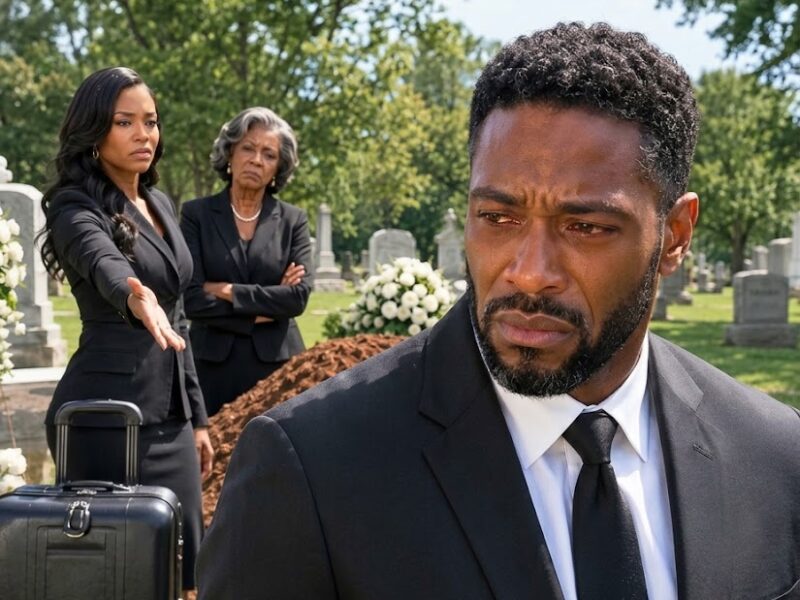
At Mom’s Funeral, My Wife Said, “Stop Crying and Get Out”—Then Her Attorney Opened Mom’s Final Envelope
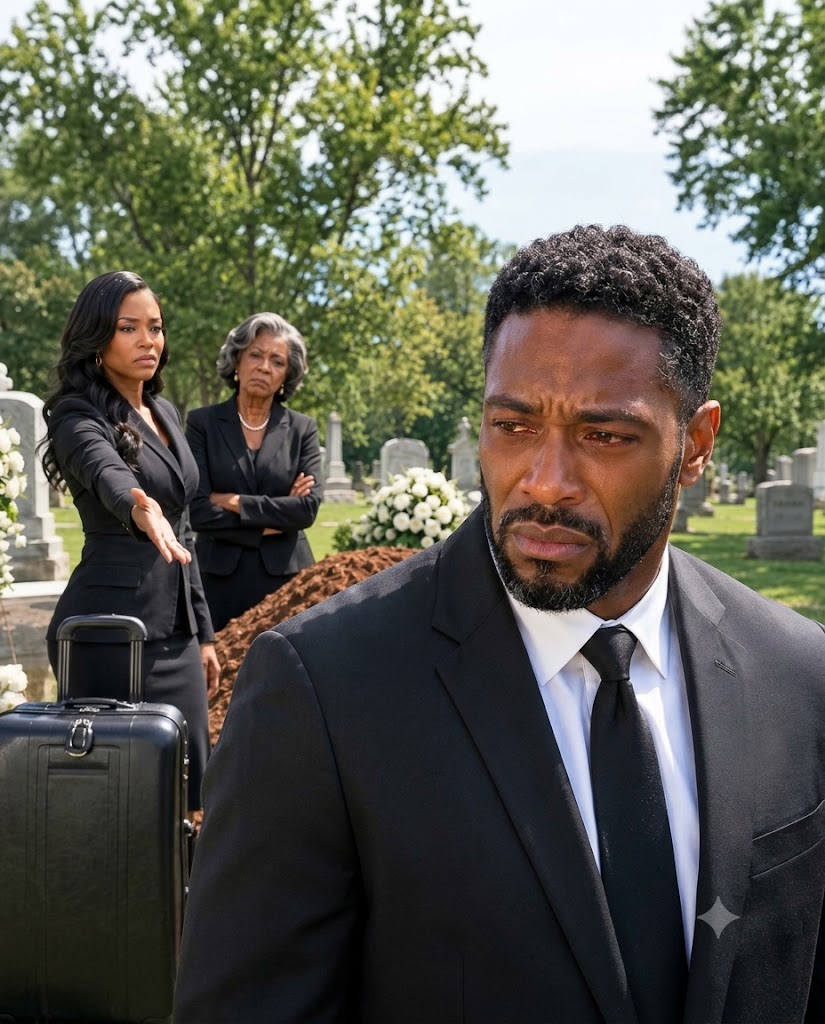
Stop. You’re making a scene at your own mother’s funeral.
That was the first thing my wife said to me after they lowered my mother into the ground. Not “I’m sorry.” Not “How are you holding up?” Just stop, and pack your bags, and get out.
We both already know how this ends, she said. You need to pack your things and leave.
My mother had been in the ground less than an hour when Leah told me I had no right to be there anymore. She stood at the edge of that grave with her mother beside her, and the look on her face was not grief. It was relief. She had been waiting for this. She had planned for it.
What she had not planned for was the question I asked before she walked away, or what came later that same night.
So what exactly had my mother left behind? And why did it terrify them both?
If you’ve ever watched someone underestimate the wrong person, stay with this story. And if you’re new here, subscribing takes one second and means you won’t miss what comes next.
My mother had been sick for two years before she died, and in those two years I learned something about grief that nobody tells you. It doesn’t wait for the funeral. It starts the moment you realize the person you love is already leaving, a little more each week, and there is nothing you can do but stay close and pretend you don’t see it happening.
I had been grieving Ruth Hale long before they lowered her into the ground that Tuesday morning. What I was not prepared for was what came after the last shovel of dirt.
The funeral had been small. My mother was not a woman who needed an audience. A few of her friends from church, two neighbors who had known her since before my father died, and the people who worked for Gavin Price, her attorney, who stood at the back of the crowd with his hands folded and his face giving nothing away.
Leah stood beside me through the service. She held my arm. She looked appropriately sad. Looking back now, I understand she was performing. But in that moment, I was too hollowed out to notice the difference between a woman mourning and a woman waiting.
It was Corinne who gave it away. Leah’s mother had positioned herself just far enough from the graveside that she didn’t have to hold an expression for too long. She kept glancing toward the parking lot like someone checking a clock. I noticed it and filed it somewhere in the back of my mind. The way you file things when your brain is already overloaded and the body is just trying to survive the next hour.
My mother was gone. That was the only fact that felt real.
The service ended. People began drifting toward their cars, offering condolences in that quiet, careful way people do when they don’t know what else to give. I was still standing near the grave when Leah came up beside me, and I heard Corinne’s heels on the path just behind her. Something in the way they moved together, coordinated, deliberate, made the back of my neck go cold before either of them said a word.
Leah didn’t touch me. She stood close enough that nobody nearby would notice anything unusual, and she spoke in a voice that was so controlled it barely sounded like a voice at all. She told me our marriage was over. She told me I needed to move out of the house by the end of the week. She said that Ruth had always intended for the property to go to her, that she had given up years of her life caring for my mother, and that the least I could do was accept what was already decided and make it clean.
Corinne stood just behind her daughter’s shoulder, not speaking, watching my face the way someone watches a screen when they already know how the movie ends.
I had been with Leah for nearly eight years. I knew the way she spoke when she was nervous, when she was lying, when she was performing confidence she didn’t feel. This was none of those things. This was rehearsed. This was something she had said out loud to herself enough times that the words had lost their weight and become simply a task to complete.
That was the thing that cut deepest. Not the words themselves, but how easy they were for her to say.
Standing twenty feet from where my mother’s casket had just been sealed into the earth, Corinne finally spoke. She told me Ruth was gone, that there was no one left to protect me from reality, and that I should accept it. She said it the way someone says something they have decided is a kindness, which is always worse than cruelty, because at least cruelty doesn’t pretend to care about you.
I looked at Leah for a long moment. Then I asked her quietly whether she was certain my mother hadn’t changed anything before she died.
Leah smiled. Not a cruel smile, something almost dismissive. The kind of smile that means the other person has said something so desperate it doesn’t even deserve a real response. She turned away. Corinne followed. I watched them walk toward the parking lot together, and I stood there alone beside the grave for a while, because there was nowhere I needed to be and no one left who was waiting for me to arrive.
I drove back to the house. Ruth had lived in that house for thirty-one years. It was the kind of house that had absorbed a family into its walls. The kitchen smelled like her. The hallway light switch still had the small piece of masking tape she had put there years ago to remind herself to replace a bulb she had then never replaced. And the back bedroom where she had spent her last months still had the shape of her in the mattress if you pressed your hand against it.
I had moved in with Leah two years earlier when Ruth’s heart had gotten bad enough that someone needed to be close. I had turned down two promotions at work during those two years. I hadn’t counted the cost at the time. I wasn’t counting it now.
I started moving some things. Not packing, just handling objects the way you do when your hands need something to do and your mind refuses to cooperate. I pulled a few of my books off the shelf in the study. I stood in the middle of the kitchen for a while holding a mug I had bought Ruth as a birthday gift three years ago, and I did not know what to do with it, so I set it back down exactly where it had been.
My phone rang a little after nine. The name on the screen was Gavin Price.
I had met Gavin twice, both times in formal settings where he was representing my mother’s interests and I was simply present. He was a careful man, the kind who measured his words before he spent them, and he had never called me directly. Whatever he was about to say, I understood before I answered that it was going to matter.
He told me not to leave the house. He said it without preamble, directly, the way a man speaks when he has been waiting to say something and wants to make sure it lands clearly.
Then he said something that stopped me completely. My mother had seen this coming, and she had made sure I would not be caught without ground to stand on.
Three months before she died, Ruth had met with Gavin without telling anyone. Not me, not Leah, not Corinne. She had made that appointment herself, driven herself there herself, which given her condition at the time, I later understood to be an act of considerable determination. And she had spent two hours remaking every document that governed where her estate would go.
The old plan was canceled. The house was placed into a trust. I was named the sole beneficiary. Her physician had been brought in on a separate occasion to provide documentation confirming that Ruth was in full command of her mind and her intentions, and that documentation had been witnessed and dated and filed alongside everything else.
Gavin also told me that Ruth had left two sealed envelopes with him. He had been instructed to give me the first one that night, the night of the funeral, if I called him. The second one had different instructions. He would tell me when it was time, and I would know when that was.
He came to the house within the hour.
The first envelope was smaller than I expected. My mother’s handwriting was on the front, just my name in the careful cursive she had used her whole life. Inside was a single folded page, and on it she had written only a few sentences.
She said that if Leah had told me to leave, I should not argue with her, and I should not beg, and I should not try to explain anything to anyone before I called Gavin. Then she told me that Gavin would take care of the rest.
At the very bottom of the page, almost as an afterthought, she had written that if I was holding this letter and reading it, she wanted me to know she had not made her choices from fear or anger or any change of heart about how much she had loved the life our family had built in that house. She had made them because she had seen something she could not unsee, and because she loved me too much to leave without doing something about it.
She did not tell me what she had seen, not in that letter. Gavin sat across from me at the kitchen table and told me the second envelope would answer that question, but that I would know when I was ready to open it, and it was not yet time. He said simply that I would have to wait until everything that was hidden had been brought into the open, and that when that happened, I would understand.
I sat in my mother’s kitchen for a long time after Gavin left. The house was quiet in the particular way old houses are quiet, not empty, but settled, as though the walls had heard enough over the years that they no longer needed to respond to every sound. I thought about Leah standing at that grave with her rehearsed expression, and her mother two steps behind her. I thought about how certain she had looked. I thought about the smile she had given me when I asked whether she was sure my mother hadn’t changed anything, the smile that meant she thought she already knew the answer.
She had been waiting for this day for a long time. I could see that now in the way you see something clearly only after the thing that was blocking your view has been removed. I did not know yet exactly what she had done or how long she had been planning it. What I knew was that Ruth had spent the last chapter of her life preparing something for me quietly, without asking for credit or explanation, and that she had trusted me to hold on long enough to find out what it was.
I was not going to leave that house. Not because of the trust, not because of the legal documents, not because Gavin had told me to stay, but because my mother had looked at whatever was coming and had decided to face it rather than let it bury what she had built, and the least I could do was honor that.
I put the letter back in the envelope and set it on the kitchen counter next to Ruth’s mug. Then I turned off the light, went to the back of the house, and sat in the chair beside the window in her old room until morning came.
Leah filed the first legal motion four days after the funeral.
I found out from Gavin, who called me on a Thursday morning while I was standing in the kitchen making coffee I didn’t want. He told me in that measured way of his that Leah’s attorneys had moved to freeze the trust and were petitioning the court to declare the updated estate plan invalid. The grounds were undue influence, the legal term for what they were claiming, which was that I had manipulated my mother in her final months to cut Leah out of what she was owed.
Gavin laid it out without editorializing. He told me what we were facing and what he intended to do about it, and then he told me to go to work and let him handle the next steps.
I went to work. I sat at my desk and looked at spreadsheets and approved purchase orders and answered emails, and the whole time there was a part of my brain running a separate process underneath everything else, turning the same question over and over.
My mother had known. She had watched Leah move through those months of caregiving, carrying trays, adjusting pillows, speaking softly to the doctors who came and went. And underneath all of that quiet performance, Ruth had seen something real, something specific enough that she had driven herself to Gavin’s office and spent two hours remaking every document that governed what would happen after she was gone.
I needed to understand what she had found, and I understood that waiting passively for the legal process to reveal it was not something I was capable of.
I started the way I knew how to start things, by going back to the beginning and looking at what was actually there. I pulled out my mother’s old phone, the one she had used until about six months before she died, when her hands had gotten bad enough that the small screen gave her trouble. I sat with it for an evening and went through her call history, her text messages, the things she had searched on the browser that most people assume nobody else will ever see.
Ruth had looked up divorce proceedings in our state. She had looked up what happens to jointly held property when one spouse dies during a legal dispute. She had searched the name of a law firm, not Gavin’s, three separate times over the course of two weeks.
I wrote the name down and brought it to Gavin. He cross-referenced it against the documents that had come through the discovery process Leah’s own attorneys had initiated, and what he found confirmed what I had suspected. That firm was the same one Leah had visited for a divorce consultation four months before my mother died.
Ruth had found the name somewhere in the house, had looked it up quietly on her own, and had understood exactly what it meant. She hadn’t said a word to anyone. She had simply started making phone calls of her own.
I also reached out to Sandra, the home health nurse who had come three times a week during Ruth’s last months. Sandra had genuinely liked my mother. You could tell the difference between someone doing a job and someone who actually cared, and Sandra was the latter. She told me that in Ruth’s final weeks, my mother had asked her a series of questions that hadn’t seemed connected at the time. How long certain medication stayed in a person’s system. What constituted legal mental competence. What a person could do to make sure their wishes were honored if someone tried to claim otherwise afterward.
Sandra had answered as best she could and had thought Ruth was simply being thorough about her own end-of-life planning. Looking at it now, it looked like something different. It looked like a woman doing research because she understood that whatever she was about to put into motion was going to be challenged, and she intended to leave no opening for that challenge to succeed.
I brought everything to Gavin. I laid it on the table in his office. The phone records, the browser history, what Sandra had told me, the connection between the law firm name and Leah’s consultation. Gavin listened without interrupting. When I finished, he looked at me for a moment and then said that my mother had told him I would do this. She had said it was time for me to see the video.
He set up a laptop on the conference table and left the room.
The recording was forty-three minutes long. Ruth was sitting in a chair in Gavin’s office, dressed carefully, the way she dressed when she wanted to be taken seriously. Her physician sat to her left, partially visible at the edge of the frame, and two independent witnesses were present whose names were stated at the beginning for the record.
My mother looked directly at the camera for the entire recording, the way she had always looked at things she intended to see clearly. She said she was making the statement voluntarily, that no one had asked her to do it, and that her son Damon had not been told she was there.
Then she began to explain what she had found and why it had changed everything she had originally planned.
Ruth said that for most of the time she had known Leah, she had believed Leah was a good match for me. Not perfect, but genuine. She had been glad when we married. She had trusted her with the house, with her routines, with the quiet daily management of a life that was winding down. But sometime in the months before she died, Ruth had noticed a change in the way Leah spoke about the future. Not the content of what she said, the texture of it. A certain impatience when conversations touched on estate matters. A careful way of steering topics back to what Leah had contributed, and what she deserved in return.
Then Ruth had found a letter in the house. Correspondence between Leah and Corinne discussing the timeline of the separation Leah was planning. Corinne had written, in terms that left no room for interpretation, that Leah should wait until after Ruth’s death before filing for divorce, because doing it beforehand would compromise her position relative to the property. Leah had agreed. There were follow-up messages in which Corinne and Leah discussed what they expected the estate to look like, and what Leah’s strategy would be once it transferred.
Ruth also said she had noticed that money had been leaving her household account in small increments, amounts that didn’t correspond to any bill or expense she could identify. She had documented the withdrawals and left the records with Gavin.
At the end of the video, Ruth looked at the camera for a moment before she spoke again. She said she knew I would find it hard to accept that someone could plan this kind of thing while sitting beside a sick woman and asking how she felt and carrying her tea in the morning. She said she had found it hard to accept, too, but she had not let that difficulty stop her from doing what needed to be done, because she understood that I would not protect myself from something I couldn’t see coming, and that protecting me was the last real thing she could do.
The recording ended. I sat in Gavin’s empty conference room for a while. Then I drove back to the house.
Within a week of that meeting, Leah’s legal strategy shifted. When the petition to freeze the trust failed to gain the traction they had expected, Corinne hired a second firm, larger, more aggressive. And the focus moved away from the estate documents and toward me personally. Leah began making claims that I had controlled Ruth’s finances during her illness. That I had isolated her from people who might have challenged my influence. That I had created a psychological environment in which Ruth had been effectively coerced. The story she told publicly was the inverse of everything that had actually happened, and because it was delivered through legal filings and quiet conversations with mutual friends, it spread in the way that accusations always spread. Faster than the truth and without any requirement to be accurate.
People I had known for years began to step back from me. Not dramatically. Nobody made a scene or issued a statement. They simply became less available. Texts took longer to be answered. Invitations stopped coming. A colleague at work told me, somewhat awkwardly, that someone had sent a letter to my company’s management raising concerns about my professional conduct, and that HR had been asked to note it on file.
I didn’t need to ask who had sent the letter.
The legal process moved forward on its own logic, with Gavin managing my side and Leah’s firm filing motions and requesting documents and scheduling depositions. And I did what I was told to do, which was to produce records and stay quiet and trust the process. But trust is hard to maintain when everything around you is designed to make you feel like the ground is disappearing beneath your feet.
I was exhausted in a way that went beyond sleep. I would finish a day at work and come home to the house and sit in rooms that still felt like my mother’s, in a life that had been systematically hollowed out from the inside while I had been standing right there and not understanding what I was seeing.
Gavin kept telling me the record was strong. I kept telling myself he was right. Some nights I believed it.
The settlement offer came on a Wednesday, six days before the scheduled hearing. Leah’s attorney delivered it formally through Gavin, but Corinne called me directly the same afternoon. She told me that Leah was prepared to walk away from all of it if I agreed to sell the house and give Leah forty percent of whatever it brought. She said I could win in court and spend the next several years of my life in a legal battle that would cost me more than forty percent ever would, or I could end it now, cleanly, and get on with whatever came next.
She said it as though she were doing me a favor. Then she added that if I refused, Leah would make sure everything that had been kept out of the public record became part of it. Every private detail, every family matter, every document that could be filed and made available to anyone who wanted to look.
I told her I would think about it.
I went to the kitchen table that night and took out the first letter my mother had written, the one Gavin had delivered the night of the funeral, and I read it again from the beginning. Near the bottom of the page, after the instructions and the explanations, Ruth had written something I had read before without fully absorbing.
She wrote that if I gave them what they wanted just to make the noise stop, she would not blame me. She understood that exhaustion was real and that there were only so many things a person could hold at once. But she asked me to be clear with myself about what I was actually deciding. Silence, she wrote, was not the same thing as peace. And there were moments in a life when a person had to hold their ground not because the thing they were holding was worth more than their comfort, but because the alternative was to let someone else write the story of who you were. And once you let that happen, it was very hard to take the pen back.
I folded the letter and set it down.
The thing was, Leah hadn’t just tried to take a house. She had stood at my mother’s grave and tried to rewrite what my mother’s life had meant. And she had tried to turn every year I had spent inside that family into evidence of something shameful. She had tried to make Ruth into a confused old woman who had been manipulated, and she had tried to make me into the person who had done it. And if I settled, if I handed over forty percent and walked away quietly, that story would never be corrected. It would just remain unchallenged in the space where the truth was supposed to be.
I called Gavin in the morning and told him to decline the offer. He said he had been expecting that. He told me the hearing was in six days and to get some sleep if I could.
I didn’t sleep particularly well, but I didn’t change my mind, either.
The hearing was held on a Tuesday morning, eleven weeks after my mother’s funeral.
I had been inside that courtroom building once before, years ago, for something administrative and forgettable. Walking in that morning felt entirely different. Not because the building had changed, but because I understood for the first time what it meant to need a room like that to tell you what was true.
Gavin met me in the hallway outside the assigned courtroom and went over the sequence one final time. Not because I didn’t know it, but because he was the kind of man who believed in saying the important things out loud at least once before they mattered. He told me to sit still, to keep my expression neutral, and to let him do the talking.
Leah was already seated at the opposing table with her attorneys. Corinne sat in the gallery directly behind her daughter, arms folded, chin level. The posture of someone who had decided the outcome before the room came to order.
Leah did not look at me when I walked in. She kept her eyes forward, which I recognized as a performance of composure, because Leah had always looked at the things she wasn’t worried about and looked away from the things she was.
The opening arguments from her side were thorough and delivered with confidence. Her lead attorney was good at his job. I could acknowledge that without pleasure. He described a picture of our marriage and my mother’s final months that was almost unrecognizable to me, but constructed carefully enough from selected facts that it had a surface coherence. In his version, I was a man who had gradually tightened my control over a vulnerable woman’s life, who had manufactured distance between Ruth and Leah, and who had finally leveraged the last weeks of my mother’s diminished capacity to redirect an estate that had always been intended to honor both of us.
He spoke for nearly forty minutes. I used the phrase undue influence eleven times. I counted.
When Gavin stood up, he did not raise his voice. He did not use dramatic language or make appeals to sympathy. He simply began to present the record that my mother had spent the last months of her life assembling, piece by piece, with the same quiet deliberateness she had applied to everything she had ever decided mattered.
The first thing he entered was the documentation from Ruth’s physician, a formal assessment of her cognitive and emotional state conducted at two separate appointments in the months before she died, both of which concluded that she was entirely competent, entirely clear on the implications of what she was doing, and acting without any external pressure that the physician could identify. The physician himself was present and testified to that directly. Leah’s attorneys cross-examined him for twenty minutes and did not move him.
The second element was the record of how the trust had been established. Gavin walked the court through the timeline. Ruth’s initial phone call to his office, made from her personal cell without anyone else present, the appointments she had kept without telling me or Leah, the witnesses who had been present for the signing, all of whom were unconnected to our family. The record showed clearly and without ambiguity that I had not been in the room for any of it. I had not known it was happening. My mother had done the whole thing herself, from the first call to the final signature, because she had not wanted it to be possible afterward for anyone to claim she had been led.
Then Gavin set up the screen.
The courtroom was not large, and the room went genuinely quiet when Ruth appeared on it. Not the managed quiet of a formal proceeding, the other kind, the kind that happens when something unexpected takes the air out of a space. She looked the way I remembered her from those months. Careful, a little tired, but fully present in the way that mattered. She stated her name, the date, the names of the people in the room with her. Then she began to speak, and she spoke for a long time, and no one interrupted her.
She said that she had originally intended her estate to benefit both her son and his wife, because for most of the years she had known Leah, she had believed Leah was part of her family in the way that mattered, not by paperwork, but by genuine attachment. She said that had changed when she understood what Leah and Corinne were actually planning. She said she had changed her own plans in response, not because she was angry, but because she was a mother, and a mother’s first obligation is to make sure her children are not left defenseless.
Then she looked directly into the camera and said that no one had asked her to do this. No one had suggested it, and her son had not known it was happening. She was making the change because she had found out that the people she had trusted were using her illness as a waiting room.
Leah’s expression did not collapse dramatically. It tightened, a small controlled adjustment around the eyes and jaw, the kind a person makes when they are processing something they cannot afford to visibly react to. Corinne, in the row behind her, looked down at her hands in her lap and did not look up again for a long time.
The final piece of evidence was the messages.
Gavin had obtained them through the discovery process. Correspondence between Leah and Corinne that had been produced as part of the document request Leah’s own attorneys had initiated without anticipating what the other side of that exchange might contain. The court clerk read two of the messages into the record.
The first was from Corinne to Leah, advising her not to file for divorce until after Ruth had died, explicitly because doing so beforehand would cost Leah her strategic advantage regarding the property. The second was Leah’s reply, in which she agreed and added that once the house was in her name, I could find somewhere else to live.
The date on those messages was eight months before my mother died. Eight months before the funeral where Leah had stood beside me and held my arm and looked appropriately sad. She had already decided how that day was going to end.
The words she said to me at that grave, pack your bags and get out, were not a decision made in grief or anger. They were a line she had rehearsed. They were the final step of a plan that had been running quietly in the background of our life together for the better part of a year.
There was nothing left to interpret. The messages said exactly what they meant.
The judge took a recess and returned with a ruling the same afternoon. The trust was valid. Ruth’s competence was established beyond any reasonable challenge. There was no evidence of undue influence. In fact, the documented record showed the opposite, that Ruth had gone to considerable lengths to ensure her decision was made entirely independently. The petition to invalidate the estate plan was denied in full. The house remained in the trust with me as its sole beneficiary.
Leah left the courtroom without speaking to me. Corinne followed her out without looking in my direction. The legal fees they had accumulated over eleven weeks, combined with the failure of every motion they had filed, meant there was nothing left for them to press forward with. Gavin filed the remaining paperwork and told me it was finished.
That evening he told me about the second part of Ruth’s estate. The shares her husband had built up in a small manufacturing company over the course of his working life, which Ruth had held quietly for years. Those had been placed in a separate instrument that named only me. I had not thought much about them before the hearing, and I did not think much about them now. What I had been thinking about since Gavin first mentioned it on the night of the funeral was the second envelope.
He gave it to me after the paperwork was signed and the conference room had emptied. I sat in my car in the parking structure beneath his building and opened it.
Ruth did not explain what she had found or how she had found it. She had already done that in the video for the record. This letter was not for the record. This letter was for me.
She told me she was sorry. Not in a general way, but specifically. She was sorry she had known for months and had not told me, and she wanted me to understand why. She wrote that she had watched me during those final months, the way I arranged my days around her needs without being asked, the way I stayed even when staying cost me things I didn’t mention, and she had known that if she told me what she had discovered about Leah, I would have tried to handle it immediately, and the last months of her life would have become a battlefield that I would have had to carry alone. She had decided she would rather carry the knowledge herself and handle it in the only way she had left, quietly, through Gavin, through documents, through the kind of preparation that would outlast her and protect me from the wreckage after she was gone.
She wrote that she could not choose who I loved. She had never been able to do that for me, and she would not have wanted to, even if she could. But she could make sure that loving the wrong person did not cost me my future, and that was the one thing she could still do.
The last line of the letter was short. She wrote that she hoped I would find, eventually, that the house had never been the point. What she was leaving me was not a property or a legal structure, but the simple fact that someone had seen clearly on my behalf when I hadn’t been able to see for myself. And that this, she wrote, was the only inheritance that had ever really mattered.
I sat in the car for a long time.
The divorce proceedings moved forward without incident. Gavin handled my side of it, and Leah’s attorneys, now working with a significantly reduced budget, filed the standard paperwork and made no further attempts to claim anything from the estate. The assets Ruth had placed in trust were legally protected from the settlement, exactly as she had structured them to be. What remained of the marriage, which was not much once everything had been documented and divided, was concluded in a way that was quiet and final and left nothing unresolved.
Leah took what she had always had, and none of what she had waited for. Corinne had no remaining legal standing and nothing left to spend.
Several months after the ruling, I stood alone in the house on a Saturday morning in early spring. The light in the kitchen was the particular soft yellow I had always associated with that house at that time of year. I had won. The house was mine, legally and completely. And there was no one left who could tell me otherwise.
I stood there and understood, for the first time with any real clarity, that winning and wanting were two different things.
Every room held an image of my mother in her final months. The chair she had used to sit in and look out toward the garden. The kitchen table where we had eaten breakfast on the mornings I didn’t need to leave early. The hallway where her handwriting was still on the piece of masking tape beside the light switch. The house had been the place where Ruth had lived and where I had come to be near her when she was leaving. It had served that purpose completely. It had been protected because she had made sure it would be. But I was not the same person who had moved in two years ago, and the life that waited for me was not inside those walls.
I called a real estate attorney the following Monday.
Before the house was listed, I went through each room one final time. I took a few things. The mug from the kitchen counter, a photograph she had kept on her dresser, the small ceramic bird she had received as a wedding gift and kept on every window sill she had ever lived beside. I left everything else.
In the hallway outside her old bedroom, I stood with my hand resting on the door frame. The wood worn smooth in the spot where I had leaned so many times checking to see if she was sleeping. I told her I was okay. Then I locked the front door, walked to my car, and drove away without looking back.
Leah and Corinne had believed that power was a matter of who could make whom leave. They had calculated the value of a house, drawn up a timeline, rehearsed their lines, and waited for the right day to deliver them. What they had not calculated was that Ruth had been watching them do it. And that she had spent her final months making sure that when the moment came, the ground would hold only under one of us.
My mother had not left me a weapon. She had not left me a way to punish anyone. She had left me something quieter and more durable than that. The truth, carefully documented, witnessed, and delivered at exactly the right time. She had left me the ability to stand in a courtroom and let the record speak for itself without raising my voice or making a single threat. She had left me the ability to walk away when it was over, on my own terms, on my own day, carrying only what I chose to carry.
At the grave, Leah had told me to pack my bags and get out. I had refused. Not with anger, but with the particular stubbornness of a man who has just been handed a letter from his mother telling him to hold on. I had stayed. I had let the truth do what the truth does when you give it enough room and enough time.
And then, when everything was finished and the house was mine and no one was coming to take it, I packed my bags anyway. And I left. Not because she had won, because I was finally free to choose.
Some people spend their whole lives waiting for someone else to hand them permission to move forward. My mother understood that the greatest thing she could leave me wasn’t a house or a legal document. It was the certainty that I had stood my ground when it mattered, and that the truth had been on my side all along.
If this story stayed with you, share it with someone who needs to hear it. And if you haven’t subscribed yet, it’s the simplest way to make sure you’re here for the next one.









