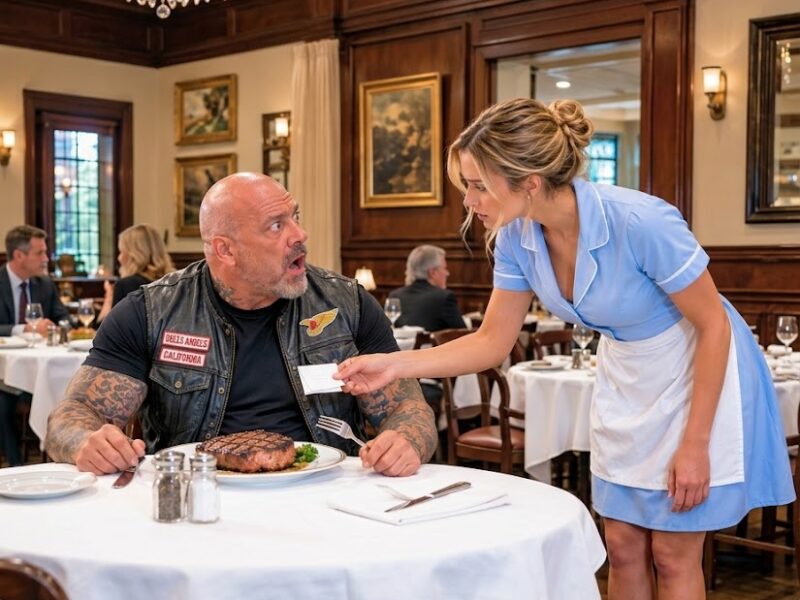
An Undercover Hells Angels Leader Ordered Steak at His Own Bar—Then the Waitress Slipped Him a Note That Made Him Freeze
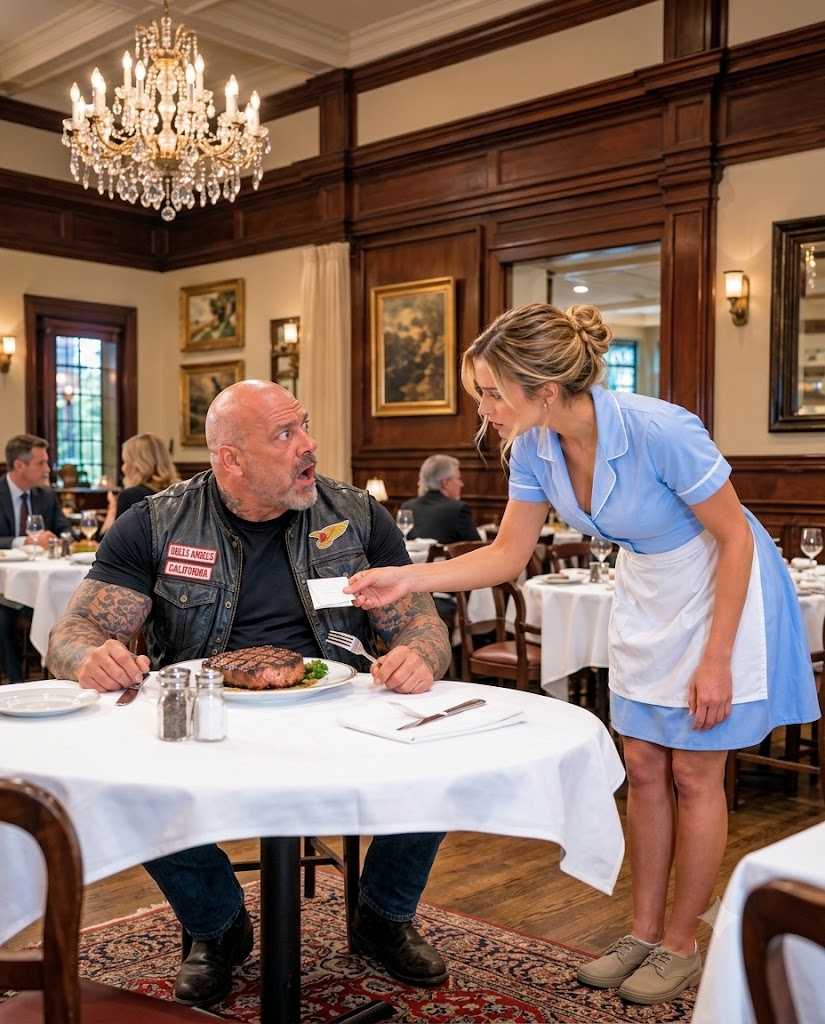
A boot kicked the back door of a bar open, and the sound cracked through the night like a gunshot nobody reported.
A red gas can hit the floor and rolled in a slow half-circle, its cap rattling loose.
Two men dragged a third toward the dark by his collar, their boots scraping gravel behind the Iron Spur outside Flagstaff, Arizona.
Somebody laughed low and mean, the way men laugh when they think nobody’s watching.
Out front, the lights were still on, and the neon sign buzzed against the pines like a tired insect.
A waitress carried a plate across the room with both hands shaking, and she set a ribeye down in front of a man in a plain flannel and a ball cap.
Then she slipped a folded napkin under the edge of the plate.
The man did not look up.
He read four words.
His coffee went cold in his hand.
What that waitress did not know was that the quiet stranger in the corner booth owned the building she just risked her life to save.
His name was Dutch.
What did those four words say?
Stay with me on this one, because the answer is not the part that matters most.
The truck that pulled into the gravel lot was nothing to look at.
Faded blue, a dent in the fender, one headlight taped over, and a rear bumper held on with more hope than hardware.
A big shepherd mix stood up in the bed, ears forward, watching the door like he already knew something was wrong.
The man who climbed out was heavy through the shoulders, gray at the temples, maybe sixty, with the kind of face that had spent decades not explaining itself.
Plain flannel, ball cap pulled low, jeans worn white at the seams.
He looked like every tired man who ever stopped for a cheap dinner on a long drive.
He was not that.
Here’s the thing you need to understand right away.
The man in the flannel was Dallas Verlander.
Everybody who mattered called him Dutch.
In three states, grown men went quiet when he walked into a room, and not because they were polite.
He was the president of a motorcycle charter older than most of the people drinking in that bar, a charter with a history long enough to have buried friends and made peace where peace seemed impossible.
And believe me, he’d earned every inch of his reputation the hard way.
But none of that walked into the lot that night.
Tonight he was nobody on purpose.
The bar was called the Iron Spur, a low roadside place with a tin roof, a gravel lot, and a neon sign that buzzed loud enough to hear from the ditch.
Truckers stopped there.
Ranch hands stopped there.
Folks heading up the mountain for the weekend stopped there, and most of them drove past a hundred times without ever really seeing it.
Dutch owned it quietly.
Nobody knew.
Not his crew, not the staff, not even the man he’d hired to run it.
He’d bought it years back through a lawyer and a shell company, cash, clean, no paper trail that led anywhere near a man with his name.
Because a man in his position needed one thing in the world that was just his.
Something honest that had nothing to do with the life he’d led.
For a long while, that’s exactly what the Iron Spur had been.
Then the numbers started lying.
It began small, the way most betrayals do.
A few hundred short one month.
A supplier invoice that didn’t match the delivery.
Cash drawers that came up light on the busiest nights, when the register ran hot and nobody had time to count twice.
His accountant flagged it first with a quiet phone call, the kind that starts with “probably nothing” and ends with a man sitting up straighter in his chair.
Dutch had spent forty years reading men, and nothing in his gut said this was nothing.
So he started asking around.
Careful, never using his name, never letting his shadow fall across a doorway twice.
And what came back bothered him more than the money.
The staff were scared.
Two waitresses had quit without notice, both of them good, both of them suddenly too busy to talk.
The old cook, a man who’d worked there since before Dutch bought the place, retired to his sister’s in Tucson and wouldn’t return a call.
People who’d been happy to talk about the Iron Spur six months ago now changed the subject fast, like the words themselves had become a hot stove.
Something had moved into his quiet little bar while he wasn’t looking.
Something that made good people walk away and keep their mouths shut.
The man running the place was named Cole Mercer.
Smooth.
Good with a handshake.
The kind of guy who always had an answer ready before you finished the question, and who smiled a little too long when he thought he was winning.
Dutch had hired him two years back on a solid resume and a firm grip.
And for a while, Cole had done fine.
Lately, every explanation came a little too easy.
Dutch could have made a call and had three men sit Cole Mercer down for a long, unpleasant conversation.
That’s how the life would have handled it, but this bar wasn’t the life.
This was the one clean thing he had.
So he decided to do it himself and do it quiet.
Drive up in the old truck, wear the flannel, sit in a corner, and watch how his manager ran the floor when he thought the owner was a thousand miles away.
He left Bandit in the truck bed with the window cracked and a bowl of water.
The old dog settled with a groan, one eye still open.
Dutch scratched him behind the ear.
“Won’t be long,” he said.
“Keep an eye on things.”
Then he walked across the gravel, pushed open the door, and became a stranger in his own bar.
Inside, it was half full.
A few truckers at the counter, a couple sharing fries, and three men at the far end of the bar who were drinking slow and not talking much.
Dutch clocked them right away without seeming to look at anything.
He took a corner booth where he could see the whole room, the door, and the hallway to the kitchen.
Old habit.
A man didn’t live as long as Dutch had by sitting with his back to a room.
A young waitress came over with a menu and a tired smile.
She couldn’t have been more than twenty-two.
Dark hair pulled back, a name tag that said Nora, and hands that moved quick and sure.
But there was something underneath the smile.
Something wound tight.
Dutch noticed it the way you notice a wire pulled taut across a trail.
You don’t know what it’s connected to yet.
But you know it’s connected to something.
“Get you started with a drink?” she asked.
“Coffee,” Dutch said.
“And a ribeye medium, whatever comes with it.”
“Good choice,” she said, writing it down.
“That’s about the only thing in this kitchen I trust tonight.”
She said it light, like a joke.
But her eyes flicked once toward the three men at the end of the bar, then toward the office door behind the counter, then back to him.
Fast, like she was checking who was watching.
Then she was gone, and Dutch sat there turning that small strange moment over in his mind.
That’s where it started, right there.
He just didn’t know it yet.
The coffee came, then the salad.
Dutch ate slow and watched the room the way other men watch a fire.
And the more he watched, the less he liked.
Cole Mercer came out of the office twice.
Both times he went straight to the three men at the end of the bar.
He didn’t take their order.
He didn’t bring them drinks.
He leaned in close and talked low, and one of the three, a big one with a shaved head and a jaw like a cinder block, did most of the listening and none of the smiling.
Once Cole looked at his watch, then up at the clock over the bar, then at the front door, the lock, the open sign.
A man who ran a bar looked at the clock to see how long till close.
This wasn’t that.
This was a man counting down to something.
The three at the end weren’t drinking to drink.
Their glasses stayed full.
Their eyes kept moving.
And every so often the big one would glance out the window at the parking lot, at the road, at the dark coming down over the mountains, like he was waiting for the lot to empty.
Nora worked the floor the whole time.
Fast, friendly, never still.
But Dutch caught her watching Cole watch the clock.
And he caught the moment her face went pale when the big bald man got up, walked to the window, and pulled the blinds halfway down.
She came back to his booth with the ribeye balanced on her arm.
That was when her hand started shaking.
He saw it before the plate even hit the table.
A fine tremble, enough to rattle the silverware.
She set the steak down careful, both hands, like it weighed fifty pounds.
And as she did, she slid a folded napkin under the rim, pressed it flat with two fingers, and said, loud enough for the room, “Careful, that plate’s hot.”
Then she walked away without waiting for a thank you.
Dutch didn’t reach for the napkin right off.
Forty years had taught him patience.
He cut into the steak, took a bite, let a long moment pass.
Then, like a man reaching for the salt, he pulled the napkin out and opened it in his lap below the table line where nobody could see.
Four words in a shaky hand, written fast.
“They will burn it.”
And below that, smaller, pressed hard into the paper like it cost her everything, “Three at the bar. After close. Manager knows. Don’t let them see. Just leave.”
Dutch kept his face still, completely still, not a flicker.
He folded the napkin back along its creases, set it under the edge of his plate exactly where she’d left it, and took a slow sip of coffee that had gone stone cold in the cup.
Inside, everything had changed.
He’d come here thinking the worst was a crooked manager skimming the till.
Something a man could fix with a talk and a new lock.
But this was arson.
His bar, the one clean thing he had.
They were going to torch it tonight with gasoline and a match, and the man he trusted to run it was standing twenty feet away counting down the minutes.
And a girl he’d never met had just put herself between a stranger and a fire.
Think about that.
She didn’t know him.
For all she knew, he’d crumple the napkin and point right at her.
She’d gambled her whole life on a stranger’s face.
One wrong read and those three men would know exactly who warned him.
She risked everything to save a man she’d never see again and had no idea she was warning the one man in the world who could do something about it.
Dutch finished his steak, all of it.
He acted like a man with no cares and a long drive ahead.
When Nora came back with the check, he counted out cash, laid it on the table, and added a tip that was more than the meal.
“Appreciate it,” he said, easy and warm.
“Best ribeye I’ve had in a while.”
“Come back sometime,” she said, her voice almost held.
“I just might.”
He stood, stretched his back like an old man does, and walked out into the lot without looking back once.
The bell over the door jingled.
Behind him through the window, he saw the big bald man relax his shoulders half an inch.
He saw Cole Mercer let out a breath.
The quiet stranger was gone.
The last civilian was leaving.
The lot was emptying out just like they wanted.
Bandit stood up in the truck bed and wagged his tail.
Dutch climbed in and the old engine turned over on the second try.
He pulled out onto the dark road, headlights sweeping the pines, and for one full minute the Iron Spur shrank in his mirror and everything was quiet.
The radio hummed.
The dog settled.
Just a tired man driving home.
For one minute it was over.
It was not over.
Half a mile down the road, Dutch killed his headlights and pulled the truck off onto a logging track he knew behind a stand of trees and let the engine die.
Because here’s what he’d figured out while he was mopping that plate with a smile on his face.
If he just drove home, the bar burned.
Simple as that.
A building he could rebuild.
Insurance he didn’t even need.
He could let it go, but the girl couldn’t go anywhere.
That was the thing clawing at him.
Nora still had to close that bar with those three men.
With Cole Mercer, who knew everything and would wonder after the fire how a stranger in a corner booth walked out whistling on the one night they’d picked to do it.
Men who plan to burn a building for money don’t leave loose ends standing.
And a waitress who’d been passing notes to customers was the loosest end there was.
Dutch sat in the dark and did the math he’d spent a lifetime learning to do fast, and it came back ugly.
They weren’t just going to burn his bar.
They were going to burn it with her still inside or close enough that nobody would ask hard questions.
A fire covers a lot of sins.
A dead waitress and a torched building looked like a tragedy.
It did not look like a murder.
This wasn’t about his money anymore.
It wasn’t about pride or a crooked manager or a dent in a bar he could buy back twice over.
The second he understood that, the whole shape of the night changed under him.
This was about getting that girl out alive.
He reached under the seat and pulled out a phone.
Not his everyday one.
The other one.
He thumbed a number he knew by heart, and it was answered on the first ring by a man named Reyes, his road captain.
A man who would drive through a wall if Dutch asked him to.
“Where are you?” Reyes said.
“No hello,” Dutch said.
“That was the life.”
“The bar outside Flagstaff,” Dutch said.
“The quiet one.”
He kept his voice flat.
“I need three or four of ours up here fast and silent. No colors, no bikes close, park dark, and wait for my word. There’s going to be a fire tonight if we let it happen, and there’s a girl in the middle of it.”
A pause.
“How long you got?”
Dutch looked at the clock on the dash, then back at the faint glow of neon through the trees.
“Closing’s at one. They’ll move after the last customer clears, so maybe an hour. Maybe less.”
“We can’t get four there in an hour, boss, not clean.”
“Then send who you can, and raise,” Dutch said.
His jaw tightened.
“This one’s mine. Whatever happens, this one’s mine. You understand me?”
“I understand,” Reyes said, and he did.
Dutch didn’t wait for Reyes.
He couldn’t.
An hour was too long, and the fire was too close, and there was no version of this where he sat in a truck and let a stranger burn for warning him.
He pulled the truck back onto the road, lights still off, and rolled it slow and quiet into the far corner of the lot behind the dumpsters, where the blinds were down and nobody was looking.
He cut the engine.
He looked at Bandit.
“Stay,” he said.
The dog sat.
Then he got out, and he was not the tired trucker anymore.
The slouch was gone.
The easy warmth was gone.
What crossed that dark lot toward the back of his own bar was the man three states had learned to go quiet around, the president, flannel and all.
He went to the back door first, the one by the kitchen, and eased it open an inch.
Through the gap he heard it, the thing that turned the whole night from a plan into a race.
Cole Mercer’s voice, low and fast.
“After she locks the front, do it quick. She doesn’t walk out of here tonight, you get me? Boss said no witnesses. The girl’s been asking questions for weeks. She goes in the fire or this whole thing comes down on us.”
A second voice, rough.
“She’s just a waitress.”
“She’s a loose end,” Cole said.
“And the man we work for doesn’t do loose ends. You want to explain to him why she’s out there talking to cops next week? No. So she stays. Light it, lock it, gone.”
Dutch stood in the dark with his hand on the door and felt something go very cold and very calm inside his chest.
The thing people who knew him feared most was not rage.
It was calm, the calm of a man who has already decided.
So there it was, a bigger fish.
The man we work for.
This was never Cole’s idea.
Cole was a middleman, a weak link selling out the bar and the girl to somebody above him who wanted the Iron Spur gone and had decided a young woman’s life was a line item.
Dutch didn’t know the name yet.
He would, but the name could wait.
Nora could not.
He slipped inside through the kitchen.
Empty, the cook long gone home.
He moved through it quiet for a big man, past the walk-in, to the swinging door that opened onto the floor.
Through the little round window he saw the room.
Nora was at the front locking the deadbolt.
Her hand shook on the key.
The last customers were gone.
The three men had stood up from the bar.
The big bald one had the gas can in his fist and was unscrewing the cap.
The second man had a lighter out, flipping it open and shut.
Cole stood by the office door with his arms crossed.
A man who’d convinced himself he was just managing a problem.
Nora turned from the door and saw the gas can.
Dutch watched the exact moment she understood she was not supposed to leave.
Her whole body went still.
Her eyes went to the back, to the kitchen, calculating a run she wasn’t going to make.
The big man started pouring.
Gasoline slapped onto the floorboards and ran dark along the base of the bar.
That’s when Dutch came through the kitchen door.
He didn’t yell.
He didn’t announce himself.
He just walked out onto the floor of his own bar into the smell of gasoline and stood there until the lighter stopped flipping and four men turned to look at the tired old trucker who was supposed to be twenty miles down the road by now.
For one second nobody moved.
“Floor’s getting wet,” Dutch said quietly.
Cole’s face went through four expressions in half a second.
Confusion, recognition, fear, and then something worse.
Calculation.
“You,” Cole said.
“You left. I watched you leave.”
“I came back for the pie,” Dutch said.
“Heard it was good.”
The big bald man set down the gas can slow and reached behind his back.
When his hand came around, there was a pistol in it.
He pointed it at Dutch’s chest from fifteen feet.
“Bad night to be a hero, old man,” he said.
Here’s what those three men didn’t know.
They thought they were pointing a gun at a nosy customer.
They had no idea who was standing in front of them in that flannel shirt.
“Put it down,” Dutch said, still quiet.
“I’m going to tell you this once because after tonight you’re going to want to say you got the chance. That gas you just poured, that’s my floor, this building, the sign out front, the neon that don’t work right. All mine. Have been for six years.”
He let that land.
“And that girl behind you, you’re not touching her. Not tonight. Not ever.”
Cole made a strangled sound.
“That’s not possible. The owner’s a company, a lawyer in Phoenix. I’ve never even—”
“You’ve never met me,” Dutch finished.
“That was the idea.”
He took one step forward, right into the barrel of the gun.
“My name’s Dallas Verlander. Some people call me Dutch.”
The name moved through the room like a cold draft.
The second man, the one with the lighter, went white because he knew the name.
Of course he did.
Everybody in that part of the world knew it.
“Verlander,” he whispered.
“Dutch Verlander. That’s the Angels. Cole, Cole, that’s the Angels’ president. You said this was a nothing bar. You said the owner was a paper company.”
“Shut up,” Cole said.
But the bald man’s hand had started to shake now because he’d figured out the same thing.
He was pointing a gun at a man whose friends would find him no matter where he ran, and the math he’d done all night had just come back wrong.
And that’s the moment it all broke.
The bald man made the only choice his fear left him.
He pulled the trigger.
But Dutch had already moved.
He’d been reading that hand for a full minute, waiting for the tendons to tense.
And the second they did, he stepped inside the barrel and drove his shoulder up under the man’s arm.
The shot went high into the ceiling plaster, raining down.
The bang was huge in the small room.
Dutch’s hand closed over the gun and the man’s wrist and twisted hard the way he’d learned a lifetime ago.
The big man howled, and the pistol came loose into Dutch’s grip.
Then Dutch hit him.
Once.
A short, heavy punch that started in his boots and ended under the man’s jaw.
The bald man folded like a dropped coat and did not get up.
The man with the lighter ran for the back.
Dutch let him go.
Because the back door opened as he reached it and Reyes was standing in it with two more behind him.
No colors, dark clothes, early, blessedly early.
The man with the lighter ran straight into a wall of them and went down and stayed down.
That left Cole Mercer backed against the office door.
And the third man who’d gone to his knees with his hands up before anyone touched him.
Dutch turned the pistol around in his hand, set it on the bar out of the gasoline, and looked at Cole.
“The name,” he said.
“Who do you work for?”
Cole was shaking so hard he could barely speak.
“Dutch, I didn’t—I didn’t know it was you. I swear to God, if I’d known—”
“If you’d known it was mine, you wouldn’t have burned it, but you’d still have burned her,” Dutch said.
His voice dropped.
And that was the most frightening thing he did all night.
“That’s the part I can’t get past, Cole. She’s a kid. The name.”
Cole gave it.
A man named Harlan Pruitt who ran strip clubs and worse out of Phoenix and wanted the Iron Spur’s liquor license and its highway lot for reasons that didn’t matter anymore and who’d leaned on a weak manager until burning a bar with a girl inside seemed like the smart play.
Dutch filed the name away.
Harlan Pruitt would get a visit.
That’s all I’ll say about that.
He got his visit, and the Iron Spur was never bothered again.
But that’s tomorrow’s story.
Tonight there was still a girl standing by the front door, pressed into the corner, staring at the whole thing with her hand over her mouth.
Dutch told Reyes to hold the three and call the right people, the honest kind, the Flagstaff kind, because this one was going to be done clean and on paper.
Then he crossed the floor, careful of the gasoline, and stopped a few feet from Nora so he wouldn’t crowd her.
He pulled his ball cap off and held it in his hands, and the hard man was gone and just a tired old man stood there.
“You’re all right,” he said.
“It’s over. Nobody’s touching you.”
Nora was crying now, the shaking kind, the kind that comes after you’ve been brave for hours and finally get to stop.
“You came back,” she said.
“You read it.”
“I thought you were just going to leave. I wanted you to leave. I didn’t want you in it. I just didn’t want you to walk into a fire and not know.”
“I know,” Dutch said.
“You tried to save a stranger. You had no reason to. Why’d you do it?”
And here’s where the whole night turned one more time.
Because Nora wiped her eyes and she looked at him, really looked, and something crossed her face.
“My dad used to say that,” she said, almost exactly that.
“You help the stranger, Nora, because nobody helped him.”
She swallowed.
“My dad’s dead. He died when I was little. He rode with a club. I never knew much about it. My mom wouldn’t talk about it. All I had was a photo and a name on a patch.”
She reached into her apron and pulled out a worn photograph, soft at the corners from being carried.
“His name was Danny Keen.”
Dutch went very still.
He knew that name.
He knew that face.
He took the photo in his big hands like it was made of glass.
And he looked down at a young man he had carried out of a wreck on a rain-slicked highway twenty years ago.
A young man who died three days later in a hospital with Dutch holding his hand.
A brother.
A good one.
The best of them.
Who’d made Dutch promise to look after a wife and a little girl Dutch had never managed to find.
Because the wife had moved and changed their names and vanished into a new life to keep the kid away from the world that took her father.
“Danny Keen,” Dutch said, and his voice broke on it.
“And I’ll tell you this was a man who did not break. Danny Keen was my brother. Not by blood, by the road. I carried him off that highway. I held his hand when he went. He asked me to look after his little girl.”
He looked up from the photo at the shaking young woman in the apron.
“And I looked for you for twenty years. Your mother did right to hide you, but I looked and I couldn’t find you.”
Nora stared at him.
“You’re—”
“I’m the man your daddy trusted most in the world,” Dutch said.
“And you just saved my life. And I just saved yours. And neither one of us knew the other from a stranger in a corner booth.”
The two of them stood there in the smell of gasoline.
A girl who’d warned a stranger and the stranger who turned out to be the last promise her father ever asked for.
And nobody in that bar said a word.
The police came, the honest kind.
The three men went away in handcuffs, and Cole Mercer went with them talking fast, giving up Harlan Pruitt and everyone else to save his own skin, which is what men like Cole always do in the end.
The gasoline got mopped up.
The floor got torn out and replaced the next week, and the Iron Spur reopened before the month was out.
Same buzzing neon, same tin roof, cleaner now, lighter, like a house after a long sickness finally lifts.
Dutch didn’t go back to being a stranger.
There was no point anymore.
The whole town knew by morning that the quiet old trucker in the flannel owned the place and knew what he’d walked into and what he’d walked out of.
People came just to shake his hand.
He let them.
He’d spent a lifetime being feared.
It turned out being thanked sat a little easier on an old man’s shoulders.
He made Nora the manager.
Not as a reward, though it was that too.
He did it because she’d watched that bar for weeks, scared and alone, and tried to do right when doing right could have gotten her killed.
And a man who runs anything worth running knows that’s the only quality you can’t teach.
She fought him on it.
She said she was just a waitress.
He said her father said the same thing once.
Right before he turned into the finest man Dutch ever rode beside.
She took the job.
They never made a big thing of the blood between them because there wasn’t any, and because the thing they had was bigger than blood and didn’t need a word stuck on it.
But Dutch drove up that mountain most weeks after that in the old blue truck with the taped headlight, and Bandit rode in the bed with his ears forward, and the two of them would take the corner booth.
Nora would bring him a ribeye medium, whatever came with it.
And every single time she’d set the plate down careful with both hands and slide a folded napkin under the rim.
He’d open it in his lap same as that first night.
And every time it said the same four words.
“Glad you came back.”
He kept every one of them.
A stack of folded napkins in an old cigar box on his dresser next to a worn photograph of a young man who rode off a rain-slick highway twenty years ago and asked a friend for one last favor.
Dutch was an old man now, and he didn’t have much use for words, but he figured a promise kept was the only thing a man really got to take with him in the end.
The accountant’s final report put the missing money at $19,500 over four months, a number small enough to hide in a busy register and large enough to buy a lot of silence.
The police report put three men in custody, one manager cooperating, and one name at the top that made a lot of people in Phoenix suddenly decide to hire better lawyers.
The town put a new sign in the window of the Iron Spur, hand-lettered and crooked, that said “Under new management,” because Nora thought it was funny and Dutch thought it was honest.
And the old dog Bandit got a steak of his own every Friday, cut small and warm, because a man who keeps a promise ought to keep all of them.
So that’s the story of the night the Angels’ president ordered a steak at his own bar, and a frightened girl slipped him a note that froze him cold.
It started with a gas can on the floor and a hand that shook.
It ended with a napkin in a cigar box and a promise twenty years old finally quietly kept.
Funny how that works.
You spend your whole life learning to be the most dangerous man in the room.
And in the end, the thing that saves you is a stranger who didn’t know who you were, trying to do the right thing anyway.
Take care of each other out there.
You never know who the stranger in the corner booth turns out to be.









