An Undercover Biker Ordered Lunch at His Own Diner—Then He Noticed the Bruises the Waitress Was Hiding
Part 1
The coffee pot hit the counter like a gavel, and the glass fractured with a sound that cut through the diner’s low hum. Dark liquid erupted across the laminate, a hot wave that cascaded over the edge and spattered onto the linoleum floor in a dozen tiny rivers.
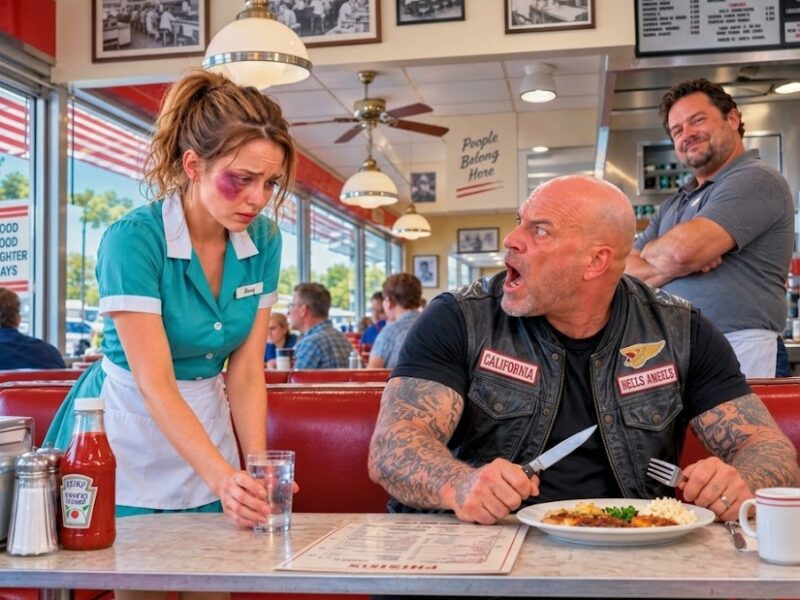
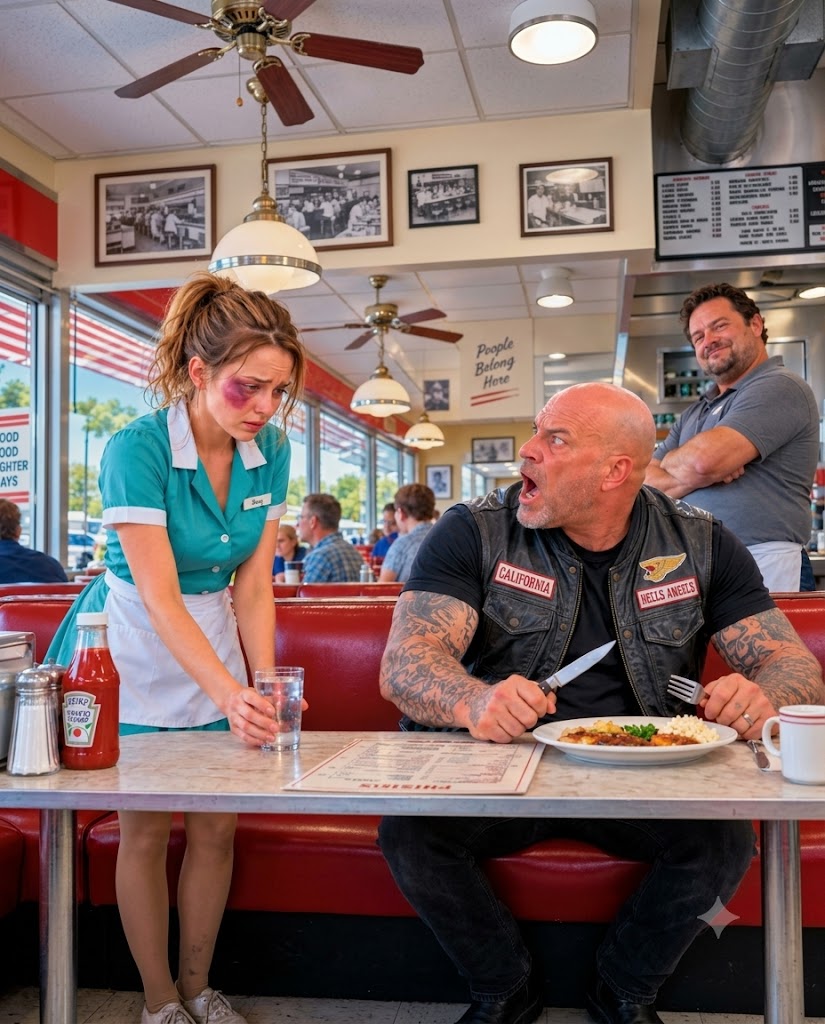
The girl flinched back, her arm flying up to shield her face. She was fast, but not fast enough to avoid the big man’s hand closing around her wrist. He yanked her forward, his thick fingers digging into her skin, pulling her so close that her apron pressed against his stained shirt. “You spill one more thing,” he growled, his voice a low rumble that carried no farther than the space between them, “and you’ll wish you hadn’t.”
She didn’t cry out. She didn’t pull away. She just dropped her eyes to the floor and gave a single, slow nod. It was the kind of nod that needed no explanation, a practiced gesture from someone who had learned long ago that the cost of defiance was always higher than the cost of submission.
Three tables away, a man in a worn leather vest set his fork down with a quiet click. He didn’t say a word. He just watched, his eyes flat and gray as winter slate. His name was Cole Mercer, and the people in that diner had no idea who he really was. They saw a tired drifter, a man with road dust on his boots and too many miles in his eyes. They were wrong. What Cole did next would empty that diner in under a minute.
But to understand why, you have to understand the man. Cole had been riding since before sunup. Eleven hours of highway, two gas stops, and a headwind the whole way down from Utah. By the time he rolled off the interstate outside Flagstaff, his hands were stiff on the bars and his back was one long, grinding ache.
He saw the diner from the off-ramp. A low, flat-roofed building with a crooked neon sign and a gravel lot that needed grading. The kind of place a man eats at because it’s there, not because it’s good. He parked his bike at the far end of the lot, away from the windows, and killed the engine. Old habits. He always liked to see the door before anybody saw him.
He walked in slow, pulled off his gloves one finger at a time, and took a booth in the back corner where he could watch the whole room. Back to the wall. Eyes on the door. You don’t last as long as Cole had lasted by sitting with your spine toward a room full of strangers.
The place was half empty. A trucker nursing a coffee at the counter. An old couple splitting a slice of pie in a booth by the window. A kid staring at his phone, earbuds in, oblivious. Behind the counter, a big man with a thick neck and a stained apron worked the grill. The cook. The boss. You could tell which just by the way he moved, like the whole room belonged to him and everybody in it was borrowing space. His name was Vernon Pruitt, and he ran this place like a small-time king who had never been told no.
Then Cole saw the waitress. She was young, early twenties maybe. Thin, with hair pulled back so tight it looked painful. Her shoulders were rolled forward, like she was trying to take up less room than she actually did. She moved fast and quiet. She never stopped moving, and she never looked anybody in the eye. She came to his table with a pad already out, her pen poised. “What can I get you?” she asked, her voice a soft monotone.
“Eggs,” Cole said. “Over easy. Bacon. Coffee. Whatever toast you’ve got.” She wrote it down, her handwriting small and precise. And that’s when he saw it. She’d put makeup over it, but makeup can only do so much, and under the diner’s harsh fluorescent lights, Cole could see the shape of it clear as day. A bruise. Fresh. Along her cheekbone, spreading down toward her jaw. The yellow-green edge of an older one underneath, like a shadow beneath a shadow. This wasn’t the first time.
Cole didn’t say anything. He’d learned a long time ago that the fastest way to shut a frightened person down is to ask about the thing they’re hiding before they trust you. So he just said, “Thank you,” and watched her walk away.
Here’s the thing you have to understand about Cole Mercer. He noticed things. The life he’d lived had taught him to read a room the way other men read a newspaper. Who was scared? Who was dangerous? Who was lying? He’d been doing it for thirty years, and he was very, very good at it. And right now, every instinct he had was lighting up like a pinball machine.
He watched the cook. The man barked orders at the girl, even when there was nothing to bark about. Called her name, Dana, in a short, ugly way, like it tasted bad in his mouth. When she came back from the trucker’s table, he said something low that made her go stiff. She nodded, kept moving, and Cole noticed the other thing, too. Nobody else looked up. The trucker kept his eyes in his cup. The old couple studied their pie like it was a map to somewhere else. They’d all learned to look at nothing, the way people do when they’ve seen how a place works and decided it isn’t their business.
Cole’s coffee came. He drank it black and said nothing. A few minutes later, it happened. Dana rang up the old couple at the register, and the cook came up behind her. He put his hand on her arm. Not gentle. His fingers dug in, and he leaned down and said something into her ear. From where Cole sat, he couldn’t hear the words. But he didn’t need to. He saw her face. He saw the way she held still, the way a rabbit holds still when the hawk’s shadow passes over. He saw the man’s knuckles go white on her thin arm.
And Cole saw something else. On the wall behind the register, in a cheap plastic frame, was a business license. He couldn’t read it from his booth. But he knew that building. He knew it the way you know your own hands. Because he owned it.
Three years back, Cole had bought up a strip of roadside property along that highway through a company that didn’t carry his name. A gas station, a storage lot, and this diner. He’d leased the diner to a man named Vernon Pruitt and never thought about it again. The checks came in on time, every month, regular as clockwork. He’d never once walked through the door until today, stopping here by pure accident because he was tired and hungry and the off-ramp came up.
You spend your whole life learning to read rooms, and then one day the room you can’t read is one that belongs to you. That’s the thing about ownership. You can hold a deed in your hand and still not know a single thing about what happens inside the walls. But that wasn’t the only thing tying Cole to this room. Because he knew that girl’s face. Not her. Her father.
Her father had been a man named Tommy Whitfield. And Tommy had been Cole’s brother. Not by blood. By the club. They’d ridden together for fifteen years, back-to-back through things Cole didn’t talk about to anybody who wasn’t there. Tommy had a little girl he carried a picture of in his vest, a gap-toothed kid on a tricycle. He used to show it around at every stop. “That’s my Dana,” he’d say. “That’s my whole world right there.” He said it so many times the other men used to groan and wave him off. But Cole never groaned. Cole never had a kid of his own. He used to look at that little photo and feel something he didn’t have a word for.
Tommy died six years ago. A truck crossed the center line on a wet road, and that was that. And at the funeral, Cole had stood over the grave and made a promise, the kind a man makes and then lets life carry him away from. He said he’d look out for the girl. He’d lost track of her. People scatter. Addresses go stale. The mother remarried and moved and stopped answering. And after a while, Cole stopped calling. He told himself she was fine. That’s the lie, isn’t it? She’s probably fine. You tell yourself that because the truth means getting on a bike and going to check. And life is long and the road is wide, and there’s always next month.
And now here she was, in a building he owned, with a bruise under her makeup and a man’s fingers digging into her arm. Cole set his coffee down very carefully. His jaw was tight, but his face stayed calm. Dead calm. And if you knew Cole, you’d know that was the dangerous version of him. Not the loud one. The quiet one.
The eggs came. Dana set the plate down without a word and turned to go. “Hey,” Cole said. Soft. Just for her. “Sit down a second.” She froze. “I’m not allowed to sit with customers.” “Then pretend you’re clearing my table.” Cole nudged his coffee cup toward her, slow, so from across the room it looked like he was asking for a refill. “I’m going to ask you one question. You don’t have to answer. But I think you want to.”
She didn’t sit. But she didn’t leave either. She stood there with the pot in her hand, her knuckles white around the handle, and she looked at him for the first time. Really looked. And whatever she saw in his face made her stay. Cole kept his voice low and even. “Who left the marks on your face?”
The question landed like a stone in still water. Dana’s eyes filled up fast, and she blinked hard to stop it, because crying at work was one more thing that got her in trouble. Her mouth opened. Nothing came out. “You don’t have to say his name,” Cole said. “Just tell me if it’s the man behind the counter.” And she gave the smallest nod in the world. Barely a movement. Just her chin dropping and lifting once. That was all Cole needed.
“Okay,” he said. “Here’s what’s going to happen. You’re going to go back to work like we just talked about eggs. You’re not going to look scared. And in a few minutes, everything is going to be different. Do you understand me?” “You don’t know him,” she whispered. “You don’t know what he’s like. He’s got people. The cop who comes in here for free dinner, that’s his cousin. Nobody does anything. I went in once and told them everything. And three days later, Vernon knew every word I’d said. Every word. Who do you tell after that? There’s nobody left to tell.”
“Dana.” Cole said her name gentle, and it stopped her cold, because she hadn’t told him her name. “Your dad was Tommy Whitfield.” Her whole body went still. “How do you know that?” “Because I rode with him for fifteen years. I carried him to his grave. And I made him a promise I’m about six years late keeping.” Cole looked up at her. “My name is Cole Mercer. I’m going to fix this. Go back to work.”
She went back behind the counter on legs that barely held her, picked up a rag, and started wiping down a surface that was already clean because her hands needed something to do. And here’s where a lot of men would have stood up right then. Thrown a punch. Made a scene. But Cole didn’t move. He picked up his fork and he ate his eggs, every bite, calm as Sunday morning.
Because Cole had learned something over thirty hard years. When you’re about to end something, you don’t rush. You let the other man think he’s won. You let him get comfortable. A man who thinks he’s safe makes mistakes. So Cole ate, and he let Vernon Pruitt feel like the biggest man in the room for a few more minutes. Because those were the last minutes he’d ever get to feel that way.
Part 2
Vernon was watching from the grill. He’d seen the waitress linger at the back booth, and he didn’t like it. He wiped his hands on his apron and came out from behind the counter, moving down the aisle toward Cole with his chest out and his chin up. A big man used to being the biggest man in any room he walked into. “She bothering you?” Vernon said. It wasn’t a question. It was a warning aimed at her, dressed up as manners aimed at him.
Cole looked up from his plate. “Food’s good,” he said. “Tell the cook.” “I’m the cook. I’m the owner. I’m everything around here.” Vernon planted his hands on the edge of the table and leaned in. “And the girl’s got a mouth on her and a habit of running it at customers. So whatever she told you, forget it. We clear?”
Cole set his fork down. He folded his napkin slow and laid it beside the plate. “We’re clear,” he said. “I understand you perfectly.” Vernon smirked. He took that for surrender. Most men surrendered to Vernon Pruitt, and he’d come to expect it. He straightened up, satisfied, and jerked his head at Dana. “Get this man his check. Then get in the back and do the dishes you were supposed to do an hour ago.” He walked back to his grill.
The room settled. The trucker went back to his coffee. The old couple collected their coats. Dana brought the check, her hands shaking, and Cole laid down cash, enough to cover the meal and a lot more besides. “Looks like he backed off,” she said quietly, not quite believing it, half hoping it was true. “Maybe you should just go. Please. Before he gets worse. After people leave, that’s when it’s bad. So please, just go.”
Cole stood, pulled on his gloves, and for a second it really did look like it was over. He walked to the door. The bell over it gave a little tired jingle. The afternoon light spilled in. Dana let out a breath she’d been holding, and for one small moment she let herself think the stranger had come and gone, and nothing bad had happened. And that was as good as her days usually got.
Then the door didn’t close. Cole stood in the open doorway with his back to the room, and he pulled a phone out of his vest, and he made one short call. Four words. “Flagstaff. The diner. Now.” Then he put the phone away, and he turned around, and he walked back in. And the look on his face was not the look of a man leaving.
Vernon saw it from the grill. “We’re done here,” he barked. “Lots that way, friend.” “We’re not done.” Cole’s voice had changed. It wasn’t soft anymore. It carried across the whole room, flat and cold, and every head turned. “You put your hands on that girl at the register. I watched you do it. And you’ve been doing it for a while now. See, up until about two minutes ago, this was between you and me. A man and a bully. But you just made me a liar to a dead friend. So now it’s something else.”
Vernon came out from behind the counter, and this time there was no apron wiping, no fake manners. He reached under the counter and came up with a short wooden bat, the kind bar owners keep for trouble. “You’ve got a big mouth for a man who walked in here alone,” he said. “You know who my cousin is. He’s got a badge. You lay one finger on me, you leave here in cuffs, and nobody, nobody, is going to believe some road trash over me. I’ve had guys come in here acting tough before. You know where they are now? Gone. Every one of them. This is my road, friend. Out here, I’m the law that matters.”
And there it was. The thing Dana had warned him about. It wasn’t just a man with heavy hands anymore. It was a man with a cop in his pocket. A man who’d built a little kingdom out here where no rule reached him and nobody who worked for him had anywhere else to go. That’s how men like Vernon survive. Not on muscle. On the quiet certainty that the people they hurt have no one to call. They pick the ones with no family close by, no money, no next move, and build a wall of fear so high that fighting back stops looking like an option.
What Vernon didn’t know, what he couldn’t have known, was that Cole Mercer had already made the call. Cole didn’t flinch at the bat. He didn’t back up. He pulled a folded paper out of his inside vest pocket, worn soft at the creases, and set it on the nearest table and smoothed it flat with two fingers. “You know what that is, Vernon?” he said. “That’s your lease. Three years old. Signed by you and signed by a company called Red Highway Holdings. You ever wonder who you mail your rent to every month?”
Vernon’s eyes dropped to the paper. The bat lowered an inch. “That’s me,” Cole said. “I own this building. I own the gravel you park on. I own the sign out front with your name on it. You’ve been living inside my walls for three years beating on a girl whose father I buried. And you want to tell me about your cousin’s badge.”
The room had gone completely silent. The trucker had stopped drinking. The old couple stood frozen by the door with their coats half on. Dana had both hands pressed over her mouth. “That paper doesn’t mean a thing,” Vernon said, but his voice had lost its bottom. “You can’t just throw me out. There’s laws. There’s a process. I got rights.”
“There’s a process,” Cole agreed. “There’s a lot of them. There’s the one where I terminate your lease for cause. The one where the labor board hears how you treat your staff. The one where I hand a certain cousin’s supervisor a stack of free dinner receipts and some questions about why nobody ever wrote up the assaults happening in a public restaurant. You like processes, Vernon? I’ve got a drawer full of lawyers who love them. They bill by the hour and they never get tired.” Cole took one step closer. “But none of those are what you should be worried about right now.”
That’s when the sound reached the diner. Low at first, like far-off thunder. Then closer. Then unmistakable. The hard rolling rumble of engines. A lot of them. The windows buzzed in their frames. Gravel crunched and popped as bike after bike swung off the highway and into the lot. And the light coming through the front windows flickered as they rolled past. One after another. Until the whole front of the building was lined with chrome and leather.
Vernon’s face went gray. The bell over the door jingled and they came in. Big men in the same worn leather Cole wore. Each one with the same patch on the back. Iron Saints. They didn’t rush. They didn’t shout. They just filled the room, quiet and enormous, and arranged themselves along the walls. And looked at Vernon Pruitt the way you’d look at something you’d scraped off your boot.
The last one in was older. Gray in his beard. And he walked straight to Cole and stood at his shoulder. “You all right, Prez?” he said. Prez. President. “I’m fine, Dallas,” Cole said. “Took me a minute to get here. Six years, give or take.”
Vernon still had the bat. But he was holding it now like he’d forgotten it was there. Like a man holding something he wished he could put down without anyone seeing. “Look,” he said. “Look. I don’t know what she told you, but it wasn’t like that. She’s clumsy. She bruises easy. I never—” “Set the bat down,” Cole said. Vernon set the bat down.
Cole walked to the register, to the spot where he’d watched Vernon dig his fingers into Dana’s arm an hour before. He put his hand flat on the counter. “Dana. Come here a second.” She came slow, around the end of the counter, keeping the whole room between herself and Vernon out of pure habit. Cole put himself between them, easy, like it was the most natural thing in the world for a wall to stand up between a frightened girl and the man who scared her.
“I want you to tell me,” Cole said, loud enough for the room, “and you don’t have to be scared, because every single person standing in here right now would walk through fire for you, and they don’t even know your name yet. Tell me what he did. All of it. Starting with the first time.”
And she did. Haltingly at first, then faster, the words coming out like water through a crack that keeps getting wider. How she’d taken the job because it was the only one that would hire her with no car and no address. How Vernon held her paychecks and docked them for mistakes that weren’t mistakes. A dropped plate was forty dollars. Being a minute late was an hour’s pay. He kept a little notebook of it, and every week the number he owed her got smaller instead of bigger, and she could never climb out, and that was the point. How he’d started with words and moved to grabbing and moved to worse. How she’d gone to the police station once, and the cop behind the glass turned out to be Vernon’s cousin. And how after that night it got so much worse that she never tried again. How she’d started sleeping in the storeroom some nights because she had nowhere else and Vernon knew it. And used it.
By the time she finished, the room was so quiet you could hear the grill ticking as it cooled. Dallas, the gray-bearded one, spoke first, and his voice was very soft. Which from a man that size was somehow worse than shouting. “Tommy’s girl,” he said. “This is Tommy’s girl.” “This is Tommy’s girl,” Cole said.
Something moved through the men in the room then. You could feel it. These were men who had known her father, some of them. Who had stood at the same grave Cole had. Who had heard Tommy say, “That’s my whole world right there,” a hundred times over a hundred beers. One of the younger ones by the window took his hat off, slow, the way you do at a funeral. And the knowledge of what had been done to Tommy’s whole world, inside walls their own president owned, under their own noses, settled onto them hard.
You don’t come back from a thing like that by hurting the man who did it. You come back by making sure it never happens to her again. Vernon broke. He bolted for the back, for the kitchen door, for the alley beyond it. He got four steps. Two of the Saints didn’t even seem to hurry. And somehow they were there first. And Vernon ran into them like a man running into a wall. And they turned him around by the shoulders, almost gently, and walked him back out front and sat him down in a booth. He stayed sad.
“You’re not going to touch me,” Vernon said, and he was pleading now. The kingdom gone, the big man gone, just a scared bully left behind. “You can’t. The cop. My cousin.” “Call him,” Cole said. “What?” “Call your cousin. Go on.” Cole took out his own phone and set it on the table in front of Vernon. “Call him and tell him to come down here and arrest me. I’ll wait. In fact, I’d love it. Because I’m going to be standing right here when he walks in, and I’m going to hand him a folder. My lawyers put it together this afternoon while I was eating your eggs. Photographs of this young woman’s injuries. Dates. The complaint she filed that your cousin buried. Bank records showing the wages you stole. And a very polite letter asking the state attorney general’s office why a Flagstaff deputy has been running interference for his cousin’s private business.” Cole leaned down. “So, please. Call him. Let’s find out whose badge survives the next thirty days.”
Part 3
Vernon didn’t call him. Here’s what actually happened, and I want to tell it straight because it matters. The Iron Saints didn’t beat Vernon Pruitt half to death in that diner. I know that’s maybe what you were waiting for. But Cole had learned something a long time ago. A beating heals. A beating lets a man like Vernon play the victim, call his cousin, flip the whole thing around. A fist feels good for about ten seconds, and then it hands your enemy the one thing he needs. No. Cole had something better than a beating. He had leverage and patience, and the law lined up in his corner for once instead of the other guy’s.
The sheriff came. Not the cousin. The actual sheriff, an older man Cole’s lawyer had called directly, going straight over the deputy’s head. He took one look at the folder, and he took Dana’s statement himself in the booth, with Cole sitting beside her so her hands would stop shaking. And when it was done, he put Vernon Pruitt in the back of a car. The deputy cousin was put on leave within the week, and by the end of the month, he didn’t have a badge anymore, either. The processes Cole had talked about, the slow, boring processes, they ground forward one after another, and they ground Vernon Pruitt down to nothing. No fists. Just paper and patience, and the simple fact that a man who hides behind one crooked cop has nothing left when that cop goes down.
But that was later. That night, before any of it, there was one more thing. The Saints filed out slow as the sun went down, and the lot full of chrome rumbled to life and rolled off into the dusk a few at a time, until it was just Cole and Dallas and Dana left in the quiet diner. Dana stood behind the counter one more time out of pure habit, not knowing what else to do with her hands or her life now that the thing that had defined both was suddenly gone.
“What happens to me now?” she said. “He held my pay. I don’t have anything. I don’t have anywhere.” Cole looked around the diner. The cracked coffee pot still sat on the counter from that morning, from the moment that started all of it. He walked over and picked it up and looked at the fracture running through the glass. “This your coffee pot?” he said. She almost laughed despite everything. “It’s the diner’s.” “No,” Cole said. “It’s mine. I just told you. I own the building. I own the lease. And as of about an hour ago, when a sheriff drove your boss away, I own a diner with no one to run it.”
He set the broken pot down and turned to face her. “Your dad used to say something every time something went wrong. Something broke. A bike, a deal, a bone. He’d say, ‘Well, guess we’re building something new now.’ Drove me crazy.” Cole’s voice went rough for just a second, and he cleared it. “You know how to run this place. You’ve been running it for years. He stole the credit and the pay, but you’ve been doing the work. So here’s what I’m offering. You run it. Not for him. For you. Rent free the first year. The club will make sure nobody ever bothers you again. And believe me, out here, nobody will. And the sign out front gets your name on it instead of his.”
Dana stared at him. “Why?” she said. “Why would you do that for me? You don’t even know me.” “Because I knew your father,” Cole said. “And because six years ago, I stood over his grave and told him I’d look out for you. And then I let the road carry me away, and I didn’t. I’m not going to stand in front of him again someday and tell him I walked past you one more time.”
He picked up his gloves off the counter. “He carried your picture everywhere he went. A little girl on a tricycle, gap in her teeth, showed it to anybody who’d stand still. ‘That’s my Dana,’ he’d say. ‘That’s my whole world.'” And that’s when Dana Whitfield finally cried. Not the scared kind she’d been swallowing all day. The other kind. The kind that comes when a door you thought was locked forever swings open and there’s light on the other side. And somebody’s standing there who was supposed to come a long time ago and finally did.
Cole let Dallas drive the truck back. He took the long way out on his bike. Slow through the dark lot. Past the sign that would carry a new name by the end of the month. He stopped at the edge of the highway and looked back once at the lit windows of the little diner. At the girl inside wiping down a counter that was finally, truly hers. Then he thought about Tommy, and about promises, and about how a man can spend years telling himself a person is probably fine, so he doesn’t have to go check.
And he made himself one more promise, a smaller one, an easier one to keep. He’d come back through here every few months. Order the eggs. Check the sign. Make sure nobody’s hands ever landed on her again. He pulled out onto the empty highway and opened it up. And the sound of his engine rolled out across the dark desert and faded. And behind him, the diner glowed warm against the night. And for the first time in a long time, the quietest person in that whole story wasn’t afraid of the morning.
Because the thing about looking past somebody, about deciding somebody small and quiet doesn’t matter, is that you never know who’s sitting three tables away. You never know who used to carry their picture in his vest. And you never, ever know which tired drifter ordering eggs at your counter is the one man in the world you should have been afraid of all along.









