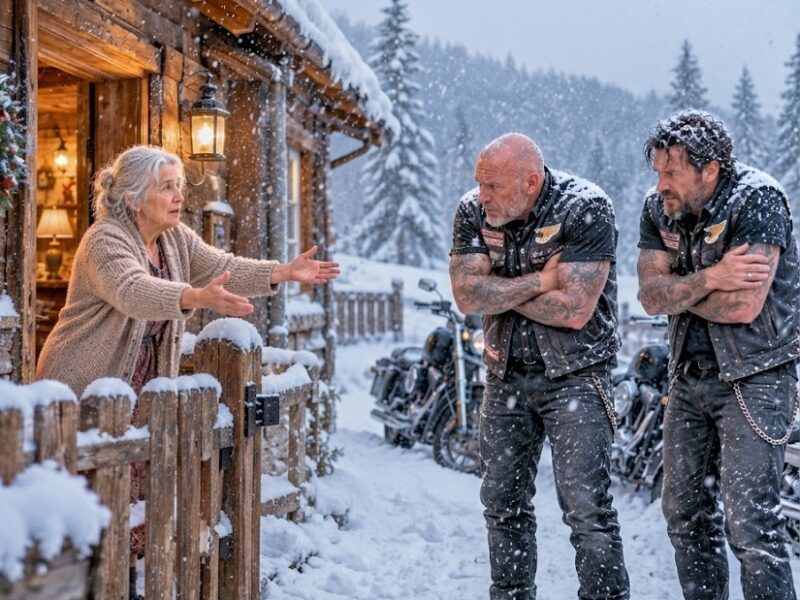
An old woman took in two freezing bikers on a deadly winter night. The next morning, 2,000 Hells Angels stood outside her door.
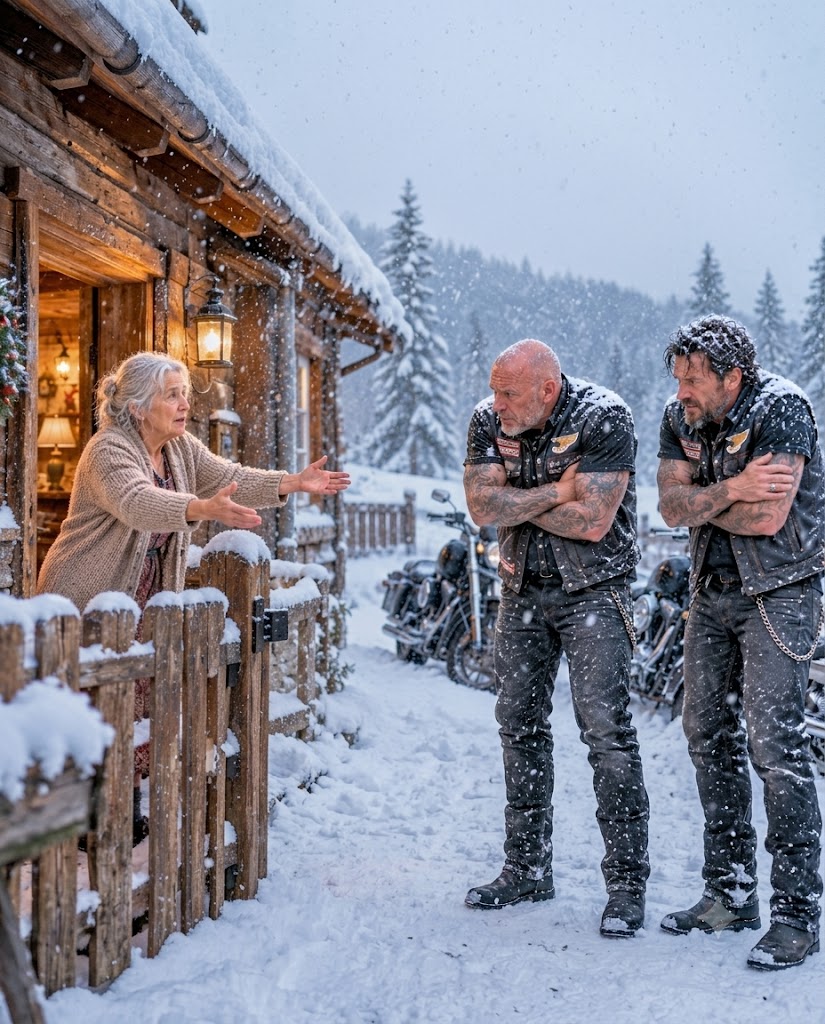
The boot skidded first—just a quick, ugly scrape against the black ice—and then the whole man went down hard, shoulder-first, into the gravel and frozen mud along the county road.
A second man dropped to his knees beside him, grabbing him by the collar of his leather vest and dragging him up halfway, shouting into the sleet that cut sideways across the headlights.
The wind tore the words apart before they could travel ten feet.
Two motorcycles sat dead at the edge of the road, kickstands down, headlights dark, engines already cold enough to hurt a bare hand.
Both men had hands gone blue from the cold.
The younger one couldn’t feel his fingers anymore, and he kept slapping them against his thigh, over and over, like he was trying to wake up a limb that had already quit on him.
A porch light snapped on across the field—one small yellow eye opening in all that freezing dark.
A screen door creaked open, and a small woman in a house coat stepped out onto the porch, 71 years old, holding an old lantern in one steady hand.
Her name was Margie Howerin, and she weighed all of a hundred pounds soaking wet.
Now, why would two hardened bikers trust a stranger’s door on the worst night of the year?
Stay with me on this one.
You have to understand something about Margie first.
She wasn’t brave—she’d have told you that herself, flat out, no argument.
Her hands shook on that lantern, and not just from the cold.
Two big men on a dark road, her nearest neighbor a mile off, no phone signal worth a damn out that way, and a winter storm settling in like it meant to stay.
Any sensible person would have locked the door, turned off the light, and pretended they never saw a thing.
But Margie looked at those blue hands and that man down on the ground, and she did the only thing she knew how to do.
She waved them in.
“Come on,” she called out over the wind. “Before you lose those fingers for good.”
The two of them half-carried each other up the porch steps, boots heavy and clumsy on the wood.
The bigger one, gray in his beard, went by Tuck.
The younger one, all sharp elbows and nervous energy, was Reno.
Inside her little kitchen, they looked even bigger, like two bears somebody had let in out of the rain.
Margie didn’t ask questions—that was her way.
She pointed at the two chairs by the wood stove and told them to sit, and they sat.
She had a pot on the back burner, the kind of stew her husband Walt used to make, heavy with beef and potatoes and a whole head of garlic.
Walt had been gone four years now.
She still made it his way.
Some habits keep you company when nobody else will.
She ladled out two bowls big enough to bathe in.
Reno’s hands shook so bad he could barely hold the spoon.
Tuck just stared at the food a long moment before he ate—the way a man does when he hasn’t been handed anything for free in a long, long time.
“Bike trouble,” Tuck said, almost like an apology. “Both of them same night. Never seen it happen.”
“The cold does that,” Margie said.
She didn’t know a thing about these men.
Didn’t know about the patches stitched on their worn leather vests, the winged skull, the words underneath.
To Margie, they were just two cold, hungry people the good Lord had set down on her road.
She’d have told you any decent person would have done exactly what she did.
But you and I both know that isn’t true.
Most people would have kept that door shut their whole lives and never thought twice about it.
While they ate, an old hound came clicking across the floorboards on three legs.
Biscuit.
Walt had found him in a ditch as a pup, chewed up and left for dead, and the two of them had been a matched set of broken-down old men right up until Walt passed.
Biscuit didn’t trust strangers.
He’d growled at the mailman four years running.
But that dog took one look at Tuck, hobbled over, and laid his gray muzzle right down on the big man’s boot.
Tuck scratched behind his ears, and something in his face came loose—some hard thing he’d been carrying that finally set itself down.
Tuck told her they’d been on the road eleven days, coming up from a funeral down south, a brother of theirs.
He didn’t say much more, and Margie didn’t press him.
She knew grief when she saw it in a man’s shoulders.
She told them the farm was hers, free and clear—seventy acres she and Walt had worked their whole lives.
“It isn’t much,” she said, “but it’s paid for, every last inch, and it’s the only thing in this whole world that’s still mine.”
Reno looked up from his bowl when she said it, and for just a second that nervous young man looked at her like she’d said something he understood all the way down.
They slept on her floor that night, stretched out by the wood stove under quilts she’d sewn by hand, and Biscuit curled up in the warm hollow between them like he’d known them all his life.
Margie lay awake a while, listening to two strangers breathe in her house.
She thought about what Walt would have said.
It was the same thing he always said: You feed a man who’s hungry. You don’t run his pockets first.
Then she slept better than she had in months.
At first light, they were up and quiet.
Tuck folded the quilts into a neat square.
Reno filled her wood box without being asked, stacked it higher than she’d have managed all winter.
At the door, Tuck took her small hand in both of his big scarred ones, and for a second the man couldn’t get his words out.
“You didn’t have to open that door,” he finally said.
“Of course I did,” Margie told him.
He nodded slow, like she’d said something that mattered more than she knew.
Then the two engines caught in the cold dawn, coughed, roared, and rolled off down the gravel.
Margie watched until she couldn’t see them anymore.
Then she went in and washed two bowls, and she figured that was the end of it.
It wasn’t.
Not by a long shot.
—
Three weeks went by.
November turned mean the way it does in that part of Ohio, and Margie settled back into her quiet.
She fed the chickens.
She sat with Biscuit in the evenings.
She let herself forget the two men—the way you forget most kindnesses the minute they’re behind you.
Then on a gray Tuesday, a car came up her gravel road that she didn’t recognize.
A county car, white, with a gold star painted on the door.
A young deputy climbed out.
He had a clipboard, and he wouldn’t look at her straight.
He came up her porch steps, and instead of knocking, he took a hammer and a nail out of his coat and started tacking a yellow paper right to her front door.
“What in the world are you doing to my door?” Margie said.
“Notice of seizure, ma’am,” he mumbled. “County’s got a lien on the property. Back taxes and an unpaid debt. There’s going to be an auction.”
Margie just stared at him.
“I don’t owe anybody a dime,” she said. “This land’s been paid off since 1961. Walt and I paid it off ourselves. I’ve got the deed in a drawer not twenty feet from where you’re standing.”
“I just deliver the paper, ma’am,” the deputy said.
And he hurried back to his car like the porch was on fire.
And that, though Margie didn’t know it yet, was the first thing that should have told her something was wrong.
A man delivering an honest paper doesn’t run from it.
Now, here’s the thing.
Margie read that paper three times standing in the cold, and none of it made a lick of sense.
It said she owed eleven thousand dollars in back taxes and a private debt to something called Vain Development Group.
It said if she didn’t pay inside of thirty days, the county would sell her seventy acres at public auction.
There was a date, a case number, a signature from the county assessor’s office—all official, typed up neat as you please.
She had never borrowed a cent from anybody named Vain.
She’d never heard the name in her life.
The next morning, she drove her old truck into Ashfall with that yellow paper folded in her purse.
She waited two hours on a hard bench while people in warm coats walked past without a glance.
When they finally called her back, a man behind a desk barely looked up from his coffee.
The debt was recorded.
It was legal.
And there was nothing to be done but pay it or lose the land.
“But I don’t owe it,” Margie kept saying. “Show me one thing with my name on it in my own hand.”
The man just shrugged—he’d shrugged at a hundred people before her.
“Take it up with a lawyer,” he said, and he called the next number before she’d even stood up.
So she did.
She spent forty dollars she didn’t have to sit across from the only attorney in Ashfall, a tired old fellow named Prout, and he put on his glasses and read every page twice.
Slow.
When he took the glasses off, his face had gone careful the way a doctor’s does before bad news.
“Margie,” he said, “you know who Cyrus Vain is?”
She didn’t.
“Came to town about two years ago. Money from out of state. Buys up land. Wants to put a big lake resort out along the county road—marina, condos, a golf course, the whole circus. He’s been buying every farm from here to the river, and buying them cheap.”
Prout tapped the yellow paper.
“And the ones that won’t sell? Well, funny thing—they all run into trouble. Tax trouble. Debt nobody remembers signing. A well goes bad. A barn burns. Then the price he’s offering starts to look real good all of a sudden.”
“Can he do that?” Margie asked. “Just make up a debt out of thin air?”
“He can if the assessor signs off. And if the sheriff serves the papers and runs the auction. And Boyd Kettering, our good sheriff, drives a brand-new truck he sure didn’t buy on his salary.”
Prout leaned back, and the old chair creaked.
“This is no clerk’s mistake, Margie. Nobody typed the wrong number in the wrong box. Somebody built this on purpose, and they built it careful, brick by brick, so every part of it looks legal from the outside.”
Margie felt something cold settle in her chest, colder than any November.
She thought about Walt—about the two of them on their knees in that dirt, putting in corn the first spring they owned it, laughing, broke, happy, sunburned to the neck.
Seventy acres. All that was left of him in this world.
“So what do we do?” she asked.
And Prout smiled—and that smile was the kindest lie anybody ever told her.
He said he’d file a challenge with the court first thing Monday.
Said he’d known the judge thirty years, gone to church with him.
He told her to go home, feed her dog, and let him handle the rest.
“You’ve got rights, Margie,” he said, patting her hand. “This is still America. Nobody takes a widow’s paid-off land on a made-up debt. Not while I’ve got breath in me.”
And you know what?
She believed him.
Every word.
Driving home that evening, the fields were silver with frost, and for the first time in days, Margie felt her shoulders come down from around her ears.
She got a fire going in the wood stove.
She made herself a cup of tea—the good kind she saved for company.
She sat down in Walt’s old chair with Biscuit’s warm weight across her feet and the wind quiet for once outside the window.
Somebody was going to fix it.
She sipped her tea and let her eyes fall shut.
The worst of it was behind her now.
She really thought that.
God help her, she did.
—
The pounding on her door came before sunrise.
Not a knock—a fist hard enough to rattle the windows in their frames.
Biscuit came up barking, hackles high, and Margie pulled on her house coat and opened the door to find Sheriff Boyd Kettering standing on her porch in the dark.
Two deputies behind him, and behind them the yellow glare of headlights idling in her yard.
“Morning, Miss Howerin,” Kettering said.
He was chewing gum slow, working it side to side.
He held out a fresh paper.
“Auction’s been moved up. Judge cleared the docket special. Sale’s Saturday morning, right here on your front lawn. Nine o’clock sharp.”
“Saturday,” Margie said.
Her voice came out thin.
“That’s four days. My lawyer filed a—”
“Your lawyer’s challenge got denied yesterday afternoon,” Kettering said, and he smiled around his gum. “Judge looked it over real quick. Didn’t take him but a few minutes. These things move fast sometimes, when everybody’s of a mind to move them.”
That’s when it hit her.
This wasn’t a mistake in a file that a good man could fix with a phone call.
The deputy who nailed the paper.
The man behind the desk.
The assessor who signed.
The judge who denied it in an afternoon.
The sheriff on her porch before dawn.
They were all the same hand.
Every door she could knock on, Cyrus Vain was already standing behind it, smiling.
There was no sheriff to call on the sheriff.
No law above the law that was taking her home.
It wasn’t about eleven thousand dollars.
It never had been.
It was a machine somebody had built to swallow her land whole, and every gear in it was already turning, and she was the only thing left small enough to get caught in it.
Kettering leaned in close, his voice dropping low so the deputies couldn’t hear.
“Now, Mister Vain’s a reasonable man,” he said. “He’ll still give you twelve thousand for the place. Walk-away money, if you sign today and save yourself the embarrassment of an auction. All alone out here. No husband, no kids I ever heard of. Long winter coming. You ought to think real hard about being reasonable, too. Wouldn’t want anything else to go wrong out here.”
Margie’s hands were shaking.
She was seventy-one years old and a hundred pounds, and there were three armed men on her porch in the dark.
But she looked up at that big man and she said, “Get off my land.”
Kettering just chuckled.
“It won’t be your land come Saturday,” he said.
And he walked back to his car whistling—a man who’d already won and knew it.
She stood in the doorway a long time after the taillights were gone, until the cold had gone all the way into her bones.
Then she went inside and did something she hadn’t done since the day they lowered Walt into the ground.
She sat down at the kitchen table and she cried hard—the way you cry when there’s nobody left to be strong for and no reason left to pretend.
And that’s when her eye fell on the sugar tin.
She didn’t even know why.
Something just turned her head.
But she got up and lifted the lid and dug down the side where she’d shoved it three weeks back and clean forgotten it was there—a folded scrap of paper.
She’d found it on the chair after the two men left, under the neat square of quilts, and tucked it away without thinking.
She unfolded it now with shaking fingers.
A phone number in a rough hand, and two words.
Anytime. Anywhere.
Tuck.
Margie stood there a long while looking at it.
She was a proud woman.
She didn’t like to bother anybody.
And these were strangers.
What could two men on motorcycles do against a sheriff, a judge, and a rich man with money from out of state?
Probably get themselves hurt.
But she was out of doors to knock on.
Every honest door in that county was already nailed shut.
So she picked up the phone and dialed.
It rang a long time—so long she almost hung up—and then a gruff voice finally answered.
She stumbled over her words.
Said she was probably being foolish, sorry to bother anybody.
Said her name was Margie Howerin, out past Ashfall, Ohio, and two of their fellows had stayed a night at her house back in November, and she didn’t know who else to call.
There was a silence on the line.
She could hear the man breathing slow.
Then he said, “Ma’am, say that name again.”
She did.
“You’re the one,” the man said, and his whole voice had changed—gone soft and low. “You’re the one made those boys stew and put them on your floor and let old Biscuit sleep between them. Tuck’s been telling that story for a month. Told it at three campfires I sat at myself.”
A longer pause.
“Ma’am, you listen to me now. You are family. You hear me? Doesn’t matter that we never met. You opened your door to two of ours on the coldest night of the year, and that makes you ours. So you don’t do one more thing. You don’t sign one more paper. You don’t answer that door to anybody in a badge. You sit tight in that house with your dog. We are coming.”
And I want to stop right here for just one second.
Because if you’re still with me—and I hope to God you are—this is where it all turns.
Do me a favor and hit that subscribe button.
It costs you nothing, and believe me, you want to be here for what rolled up that gravel road on Saturday morning.
—
Because word travels fast among people like that.
Faster than any lawyer.
Faster than any court.
By Thursday night, folks in Ashfall started noticing motorcycles they didn’t recognize.
Two here, four there—quiet men in leather buying coffee and pie, saying little, tipping heavy, moving on.
By Friday, there were dozens, and the whole town could feel something gathering—the way animals go quiet before weather.
Cyrus Vain heard about it.
Of course he did.
And he made the mistake every man like Vain makes.
He thought it was nothing.
He thought money always wins, because money had always won for him.
He even drove out to Margie’s himself that Friday evening, all smiles and cologne, and offered her fifteen thousand dollars cash in a briefcase on her own porch.
Final offer. A favor, really.
She shut the door in his face without a word.
And Boyd Kettering doubled his deputies for Saturday and cleaned his gun and told himself a handful of bikers wouldn’t dare start trouble in front of the law.
He had no idea what was already on the road.
—
Saturday morning came gray and cold, the ground white with frost.
The auctioneer’s van pulled up at half past eight.
Kettering came with six deputies and a folding table they set up right on Margie’s lawn—right where she and Walt used to string the wash.
Cyrus Vain arrived in his black car with a lawyer and a smug little smile, ready to buy seventy acres for pennies on the dollar.
A few neighbors drifted in to watch, heads down, ashamed they couldn’t help and more ashamed they were glad it wasn’t them.
Margie stood on her own porch in her good dress—the navy one she’d married Walt in.
Biscuit pressed hard against her legs, and she felt smaller than she ever had in her whole life.
Then she heard it.
Way off, low, like weather coming.
A rumble in the ground—more than a sound.
You felt it in your feet before your ears caught it.
Kettering lifted his head.
The auctioneer stopped shuffling his papers.
It grew and grew until it wasn’t a rumble anymore but a roar—a wall of thunder rolling up the county road.
And then the first motorcycles came around the bend.
Headlights on in the gray morning, and behind them more, and behind those more still, and it did not stop.
They came for twenty minutes without stopping.
Two thousand of them.
Riders from six states, chapter after chapter, colors from places that old woman had never been, until the road was a river of chrome and leather as far as anyone could see in either direction.
And they lined Margie’s fence three deep and four deep, and cut their engines all at once on some signal nobody outside could see.
And the silence that dropped down after was the loudest thing that county had ever heard.
Kettering’s hand went to his gun.
One of his deputies actually turned and got back in the car and shut the door.
At the front of it all, Tuck swung off his bike, and Reno beside him, and they walked up that gravel drive slow and easy, like they had all the time in the world.
And behind them came a lean, older man with white in his beard and the calm of a man who has never once in his life needed to hurry.
You could tell he ran things by the way the men parted for him.
He walked right past the sheriff like he wasn’t standing there.
Right up to the porch, and took off his glove, and held out his bare hand to Margie.
“Miss Howerin,” he said. “My name’s Doyle. I’m sorry it took us four days. We’d have come the first hour, if we’d known.”
And then he turned around, and he wasn’t calm anymore.
“Now, which one of you is running this theft?” he called out across the yard.
Kettering found his voice, though it cost him something.
“This is a legal auction,” he barked. “Court-ordered. You’re all trespassing on county business. You disperse right now, or I start making arrests.”
Doyle nodded slow, like he’d expected exactly those words.
And here’s the part nobody in that yard saw coming.
He didn’t reach for a weapon—not a knife, not a gun, not a chain.
He reached into his vest and pulled out a thick envelope and handed it to a woman who’d walked up quiet beside him in a gray suit.
She was a member’s daughter, it turned out—an attorney out of Columbus—and she’d spent two straight days doing what old Prout couldn’t, because she had two thousand reasons standing behind her and not one thing left to be scared of.
“Sheriff,” she said, loud and clear, so the neighbors could hear, so the two newspaper reporters could hear. “This lien is fraudulent. The debt was never signed by Mrs. Howerin, and a handwriting examiner will say so under oath. We’ve got the assessor’s original filing. We’ve got bank records showing forty thousand dollars moving from Vain Development into a personal account belonging to your county assessor—and eleven thousand more into an account belonging to you, Sheriff Kettering, three days after you signed the seizure order.”
She held up the pages one at a time, high, so the light caught them.
“And we’ve got the same paper trail on nine other farms in this county. Nine families. The same lawyer, the same forged signatures, the same two accounts.”
She let that sit.
“And a state investigator from the attorney general’s office is right now about eight minutes out. We called him Thursday morning. He’s been reading these pages all night.”
You could have heard a pin drop in that frozen yard.
Cyrus Vain went white.
He started slow at first toward his car.
And two thousand men took one step forward all at once—boots coming down on frozen ground in a single sound, like the whole world drawing one breath.
And Vain stopped dead.
He didn’t run.
There was nowhere on this earth for a man like him to run to.
Every direction was leather and quiet eyes.
“You touch nothing,” Doyle told him.
Not loud, not angry. Just certain.
“You don’t get in that car. You wait right here for the man from the state. Same as anybody would. And all these good people are going to stand witness that you waited.”
The state car came up the road with its lights going and had to slow to a crawl to thread between the bikes.
The investigator climbed out and took one long look at that ocean of men, at the papers the lawyer put in his hands, at Kettering’s gray face—and he knew.
He knew everything in about thirty seconds flat.
He put the cuffs on Cyrus Vain right there on Margie Howerin’s frostbitten lawn, in front of God and the neighbors and two newspaper cameras.
And then he turned and took the sheriff’s gun and his badge off his belt.
And Boyd Kettering—who chewed his gum and smiled and told an old woman to be reasonable in the dark—was walked to a car with his hands behind his back while two thousand men watched him go without saying a single word.
They didn’t have to say anything.
Their silence said all of it, and it followed him every step.
The auctioneer packed up his folding table so fast he dropped half his papers in the frost and left them there.
Margie Howerin stood on her porch and could not make her legs work.
She had come out that morning ready to lose everything Walt had left her, and instead the whole world had turned around in the space of an hour.
Tuck came up the steps two at a time and put one big arm around her small shoulders, and that was the only reason she stayed standing at all.
—
The state investigation ran for months.
Cyrus Vain went to prison for fraud, forgery, and bribery, and he took the assessor and Sheriff Kettering right down with him—and two of Kettering’s deputies besides.
Nine families in that county got their land back.
Deeds that got torn up and made whole again in a courthouse that had to answer for itself at last.
Old Prout the lawyer cried when he heard, and he never charged Margie the forty dollars he’d taken.
He mailed it back to her with a note that just said, “I’m sorry I gave up.”
And the lake resort—the marina, the condos, the golf course, the whole circus—it never got built.
Not one shovel of it.
To this day, it’s just seventy acres of Ohio farmland with an old woman’s house sitting square in the middle of it, exactly like it was always meant to be.
But that’s not the part Margie told people about in the years after.
Because the angels didn’t just leave when the state car pulled away.
Doyle looked around that farm—at the barn roof that had a sag in it, at the porch step that had gone soft, at the fence line that needed mending, at the wood box that a hundred-pound widow could only fill so high.
And he turned to two thousand men and said, “Well. We’re already here.”
And they stayed.
Not all of them—but a hundred or more, right through the weekend.
They put a new roof on her barn in a single afternoon, men swarming over it like it was nothing at all.
They fixed the porch and the soft step and hung a new screen door that didn’t creak.
Reno filled the wood box again, and then he filled the shed, too—split and stacked enough to last her three winters.
They didn’t ask what needed doing.
They just did it—the same way she just opened her door.
Because that’s how it works between people who understand something the rest of the world keeps trying to forget.
And that Saturday night, Margie Howerin did the only thing she knew how to do.
She cooked.
She made Walt’s stew—garlic and beef and potatoes, pot after pot after pot, until she ran out of pots and men went and found more.
And men who’d ridden five hundred miles to stand at an old woman’s fence sat all over her yard and her porch and her kitchen floor, eating out of every bowl and cup and mug she owned.
And some of them—big, rough men with skulls stitched on their backs—ate that stew and had to look away and wipe their eyes and pretend it was the cold, the smoke, anything.
Tuck sat by the wood stove where he’d slept that first freezing night, and Biscuit—that suspicious old three-legged hound who’d never trusted a soul—climbed right up and laid his gray head on the man’s boot again.
And this time, Tuck didn’t try to hide anything at all.
Late that night, when the fires in the yard were burning low and the men had gone quiet and the stars had come out hard and cold over all of it, Margie stepped out onto her porch and turned on the light.
The same porch light she’d flipped on for two frozen strangers on the worst night of the year.
Only now the dark wasn’t empty and cold.
Now it was full—full of firelight and low voices and people who had come from everywhere because one woman, one time, decided a stranger’s blue hands mattered more than her own fear.
She stood there in her house coat, seventy-one years old, all of a hundred pounds, and Tuck came and stood beside her, and neither of them said much for a while.
“You didn’t have to open that door,” he finally said again—same words as the first morning.
And Margie looked out at all those men her one small kindness had somehow called home across a thousand miles of cold road.
And she smiled, and she gave him the same answer she’d given before.
The only answer she ever had.
“Of course I did,” she said.
Then she went inside, and she washed the bowls.
All of them.
And this time, she knew for certain it wasn’t the end.
—









