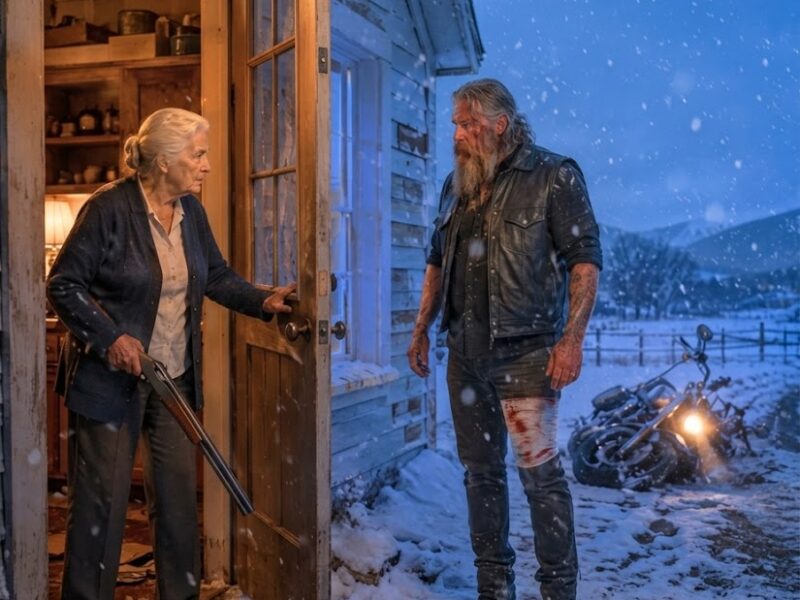
An old woman took in one injured biker for the night — and by sunrise, 300 Harleys were roaring down her quiet street.
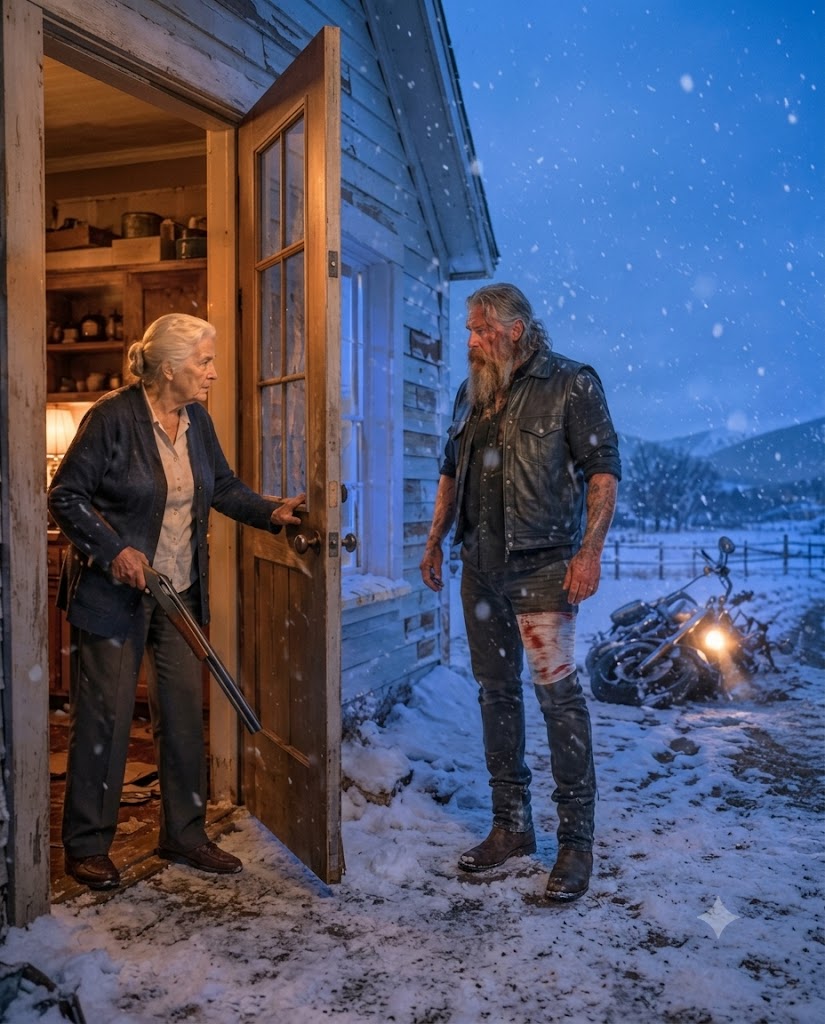
Gravel crunched under heavy boots before a desperate fist pounded the oak door.
Martha didn’t flinch. At 72, fear was a luxury she had discarded decades ago, buried somewhere between her third divorce and her first hip replacement.
She grabbed her late husband’s shotgun from behind the coat rack, unbolted the lock, and found a giant of a man bleeding out on her welcome mat.
Pine branches scraped the siding of the isolated farmhouse, a frantic rhythm driven by the harsh winds of the high desert.
Martha sat in her worn armchair, the glow of a single reading lamp casting long skeletal shadows across the floorboards. She was awake.
Sleep rarely came easily anymore. Forty years as a night-shift trauma nurse at County General had permanently rewired her circadian rhythm, leaving her a ghost haunting her own living room.
She was halfway through a tepid mug of black coffee when the noise started. Not a polite knock. A heavy, wet thud against the front door, followed by a low, vibrating groan.
Martha set her mug down. It clicked sharply against the wooden coaster. She didn’t panic. Panic was for rookies facing their first gunshot wound.
She walked to the hall closet, retrieved the 12-gauge Remington, and racked a shell into the chamber. The sound was loud, mechanical, and uncompromising.
She opened the door.
He collapsed inward, a mountain of scuffed leather and ruined denim. He was massive, easily 250 pounds, and he hit the hardwood floor like a felled oak.
Martha took a step back, keeping the muzzle pointed dead center at his chest. He wasn’t moving to attack. He was trying to breathe.
A jagged piece of chrome, likely a torn highway peg from a motorcycle, was embedded deep into the meaty part of his right thigh. Dark arterial spray had soaked his jeans, turning the blue fabric a slick, heavy black.
He smelled of hot engine oil, scorched asphalt, and raw copper.
Martha’s eyes flicked to the back of his leather cut. A winged death’s head stared back at her through the grime. Top rocker read “Hell’s Angels.” Bottom rocker read “Nomads.”
Most women her age, living alone, miles from the nearest highway, would have slammed the door and prayed. Martha just sighed.
She recognized the specific shallow breathing of a man twenty minutes away from hypovolemic shock.
He lifted his head. His beard was matted with gravel and grit. One eye was swollen shut, the skin around it already blooming into a violent purple.
“Don’t,” he choked out, a heavy, calloused hand weakly gripping the doorframe. “No cops.”
“At this hour, I wouldn’t wake the dispatcher if my own roof was on fire,” Martha muttered. She leaned the shotgun against the wall. “But you’re bleeding all over my floor. Try to stand.”
“Can’t.”
“Then crawl.”
She grabbed him by the collar of his cut and hauled backward. She was old, but her grip was iron, forged from decades of lifting dead weight onto hospital gurneys.
Together, they managed to drag his massive frame into the kitchen. He left a smeared trail of crimson across the faded linoleum.
Martha kicked a chair out of the way. “Stay awake,” she ordered. She disappeared into the bathroom and returned with a heavy green canvas bag.
It was her old trauma kit, restocked with supplies she’d pilfered over her last decade at the county hospital. She knelt beside him.
The harsh overhead fluorescent light washed all the warmth out of the room, making the gore on his leg pop with terrifying clarity.
“This is going to hurt,” she said, producing a pair of heavy trauma shears.
“Done worse,” he grunted, his voice like grinding rocks.
Martha didn’t smile. She just cut away the ruined denim, exposing the wound. The chrome peg had missed the femoral artery by half an inch, but it had torn through muscle and vein. It was an ugly, jagged tear, actively pooling with dark blood.
“Dear,” he whispered, his head lulling back against the cabinets, his eyes rolling back slightly. “Came out of nowhere. Laid the bike down.”
“Shut up and bite down on this,” Martha said. She shoved a rolled-up clean washcloth into his mouth. She didn’t hesitate.
She gripped the chrome peg, braced her knee against his hip, and pulled straight out.
The biker convulsed. A muffled, guttural scream tore through the washcloth. His massive hands slammed flat against the linoleum, knuckles turning white as all the blood rushed from them. Fresh crimson pulsed rapidly from the new cavity.
Martha was already moving. She packed the wound with QuikClot gauze, her thumbs pressing deep into his torn flesh, applying brutal, necessary pressure.
She didn’t look at his face. She watched the blood flow, calculating, adjusting her grip until the pulsing slowed to a steady, manageable seep.
“Breathe,” she commanded, her voice entirely devoid of sympathy, anchored only in professional command. “Deep breaths. Don’t you dare pass out on me. You’re too heavy to move again.”
He kept breathing. Ragged, harsh, but he stayed awake.
—
Three hours later, the kitchen smelled sharply of iodine and burnt coffee. Martha sat at the small dinette table, meticulously wiping blood from her trauma shears with an alcohol prep pad.
The biker was propped against the base cabinets, his leg heavily bandaged and elevated on a stack of old Yellow Pages. He looked awful—pale, sweaty, and exhausted—but he was stable.
He spat the washcloth onto the floor. “You a doctor? Nurse?”
Martha answered without looking up. “Forty years at County General. I’ve patched up more gangbangers, drunks, and fools than I can count. You’re just another Tuesday night.”
He let out a dry, rattling chuckle that immediately turned into a cough. “Cotlin,” he said, tapping his chest.
“Martha.”
“You didn’t call the police, Martha.”
“I told you I wouldn’t.”
“Most people see the patch.” Cotlin gestured weakly to the leather vest discarded on the floor, heavy with patches and pins. “And they call the National Guard.”
Martha finally looked at him. Her eyes were hard, pale blue chips of ice. “I’ve held the hands of dying men who wore suits and ties, and I’ve stitched up kids who wore gang colors. Pain doesn’t care what you wear, and neither do I. You were dying on my porch. Now you’re not. Don’t make it more complicated than it is.”
Cotlin stared at her. For a man accustomed to instilling immediate, visceral fear, her absolute indifference was jarring. It wasn’t bravery, he realized. It was exhaustion. She was simply too tired to be afraid of him.
“My bike,” he muttered, shifting his weight and wincing sharply.
“It’s in the ditch about a mile up the road. It’s staying there tonight,” Martha said. She stood, walked to the percolator, and poured a mug of black coffee. She handed it down to him, not bothering to offer sugar or milk. “Drink. You need the fluids.”
He took the mug with a shaking, grease-stained hand. “I need a phone.”
Martha crossed the kitchen and pulled an old cordless phone from the wall cradle. She tossed it onto his lap. “Long distance costs extra.”
Cotlin dialed a number from memory. He didn’t look at a screen. He just punched the heavy plastic buttons with a thick thumb. He waited.
It rang three times.
“It’s Cotlin,” he said into the receiver.
The voice on the other end was muffled, but loud enough that Martha could hear the sharp, angry tone of it. Cotlin held the phone away from his ear for a second, letting the voice finish.
“I laid it down. Route 9 spur. Yeah, the dead end. Mando’s dead.”
Martha paused at the sink, her hands submerged in warm, soapy water. She hadn’t asked about a second rider.
“Dear,” Cotlin continued, his voice going completely flat, stripping away any emotion. “I’m holed up some old lady’s farmhouse. Yeah, I’m bleeding, but I’m not dying. Come at first light. Bring the rig for the bike and bring a bag for Mando.”
He hit the off button and tossed the phone onto the floor. He leaned his head back against the cabinet doors, closing his eyes.
“Someone else was out there,” Martha asked, her voice dangerously quiet.
Cotlin didn’t open his eyes. “My prospect. Kid named Mando. He was riding staggered behind me. When I went down, he panicked, hit his brakes too hard, flipped over the handlebars into the tree line. Neck snapped. He was dead before I even crawled out of the ditch.”
Martha dried her hands on a kitchen towel. She didn’t offer condolences. She knew death intimately. She knew the sudden, violent finality of it.
“And you crawled a mile with a piece of metal in your leg.”
“Couldn’t leave him out there forever. Couldn’t call it into the cops. We got reasons to keep a low profile right now.”
“I don’t want to know,” Martha said sharply.
“Good. You shouldn’t.” Cotlin opened one eye. The swelling had worsened, giving his face a distorted, monstrous quality under the fluorescent lights. “My brothers are coming at sunrise. They’re going to clean this up. You won’t have to worry about a thing.”
Martha scoffed, pulling her chair back and sitting down. “I’m not worried about your friends, Cotlin. I’m worried about getting blood out of the grout.”
Silence settled over the kitchen. It wasn’t a peaceful silence, but it wasn’t hostile either. It was the heavy, quiet truce of two people who understood the ugly mechanics of survival.
The digital clock on the stove blinked 4:12 a.m.
“Why did you let me in?” Cotlin asked softly. The bravado was entirely gone. The tough biker exterior had bled out onto her linoleum, leaving only a battered, tired man. “You could have locked the door, called the cops in the morning, let me die on the porch.”
Martha looked past him through the kitchen doorway toward the empty armchair in the living room. Her husband’s chair.
He had died in that chair, quietly, from a massive coronary while she was working a double shift at the hospital. Her entire life had been spent saving strangers, and she hadn’t been there to save the only man she loved.
“Because,” Martha said, her voice finally losing its hard edge, replaced by a profound weariness, “there’s already enough ghosts out on that highway. I didn’t need another one sitting on my porch.”
Cotlin nodded slowly. He understood ghosts. The patch on his back demanded he understand them.
Outside, the fierce wind finally died down. The deep, oppressive black of the night began to thin out, bruised purple at the edges of the horizon.
Sunrise was coming.
—
Martha stood up. She walked over to the hallway and pulled out her late husband’s shotgun again. She didn’t point it at Cotlin, but she cracked the action, checking the shell, then snapped it shut with a definitive metallic click.
Cotlin watched her. A faint smirk touched his cracked lips. “Don’t trust me?”
“I trust you,” Martha said, setting the shotgun across the kitchen table and taking a seat behind it. “But you said your brothers are coming, and I don’t know them.”
She poured herself another cup of coffee. They sat in silence, waiting for the dawn.
It didn’t start with a sound. It started with a tremor.
The pale, bruised purple of the horizon was just giving way to a dirty yellow sunrise when the water in Martha’s percolator began to vibrate. It was a subtle, rhythmic ripple against the glass.
A few seconds later, the wooden floorboards beneath her boots picked up the frequency.
Then came the noise.
It wasn’t the high-pitched whine of passing semi-trucks. It was a deep, guttural thrum that vibrated in the chest cavity, a collective mechanical roar that swallowed the quiet isolation of the high desert.
Cotlin opened his good eye. He shifted his weight against the kitchen cabinets, suppressing a sharp hiss of pain as his bandaged leg throbbed.
“They’re here.”
Martha didn’t say a word. She stood up, grasped the Remington 12-gauge by the pistol grip, and walked into the living room.
She pushed aside the heavy floral curtains with the barrel of the gun.
The dirt road leading to her property was a mile long, usually empty, save for the occasional lost delivery driver. Now it was a river of chrome and black leather.
They rode two abreast in a staggered, tightly controlled formation that stretched all the way back to the main highway. The dust kicked up by their tires formed a thick amber cloud that swallowed the rising sun.
“Good Lord,” Martha whispered, her grip tightening on the wooden stock of the shotgun.
They didn’t just fill her driveway. They filled her front lawn, her side yard, and the shoulder of the road for half a mile.
Hundreds of them.
The sheer volume of engines created a localized earthquake, rattling the framed photos on Martha’s mantle.
Men dismounted with military precision. There was no shouting, no chaotic scrambling. They moved with a grim, practiced efficiency.
A heavy custom flatbed truck rolled up through the sea of motorcycles, hauling a winch. A sleek black hearse—an older Cadillac model—followed closely behind it.
“I told them to bring the rig,” Cotlin called out from the kitchen, his voice tight. “And the bag.”
Martha watched as a man separated himself from the pack. He was older than Cotlin, maybe in his early sixties, with silver hair pulled tightly into a short ponytail.
His leather cut was pristine, heavily decorated, and the rocker on his back marked him as the president.
He didn’t strut. He walked with the slow, deliberate pace of a man who owned the ground he stepped on.
He stopped at the edge of the porch, raised a gloved hand, and the deafening roar of three hundred engines died in a single, synchronized heartbeat.
The sudden silence was heavier than the noise.
He stepped onto the porch. He didn’t knock. He simply waited.
Martha unlocked the deadbolt and pulled the door open. She stood squarely in the frame, the shotgun held at a low ready, angled just enough to make her intentions clear.
The man looked at the barrel, then up to Martha’s face. He had deep-set, intelligent eyes that had seen decades of bad miles and worse decisions.
He removed his leather gloves, tucking them neatly into his belt.
“Abelardo Reynolds,” he said. His voice was gravel—quiet, but carrying immense weight. “You have one of mine inside.”
“He’s bleeding on my kitchen floor,” Martha replied, not moving an inch.
“Is he breathing?”
“I made sure of it.”
Abelardo nodded slowly. He didn’t offer a fake smile or empty gratitude. He looked past her into the dim hallway. “Can my men come in and get him? Two of them.”
Martha dictated. “No weapons in their hands. They dragged dirt on my rug. They’re cleaning it.”
Abelardo turned his head slightly. Two massive men flanking the porch immediately stepped forward, unbuttoning their flannels to show empty waistbands.
They squeezed past Martha, moving with surprising care for men their size, disappearing into the kitchen.
“He said there was another one,” Martha said, keeping her eyes locked on Abelardo. “A boy. Mando.”
A flicker of genuine grief cracked the hard mask of Abelardo’s face. There and gone in a fraction of a second.
“His bike went down in the ravine. My men are loading him into the Cadillac now. He was twenty-two.”
“He shouldn’t have died out there alone,” Martha said flatly.
“No,” Abelardo agreed, his voice dropping a fraction of an octave. “He shouldn’t have.”
From the kitchen, a low groan echoed as the two bikers hoisted Cotlin to his feet. They practically carried him down the hallway.
Cotlin looked pale, his head lulling slightly, but when he reached the front door, he dug the heel of his good boot into the floor to stop his momentum.
He looked at Martha. He didn’t say thank you. In their world, words were cheap air. He just gave her a single, sharp nod.
Martha lowered the barrel of the shotgun so the muzzle pointed at the floorboards. “Keep the leg elevated, Cotlin. And change that dressing by tomorrow night, or you’ll lose it to sepsis.”
“Yes, ma’am,” Cotlin grunted.
The men carried him out to a waiting black SUV.
Martha stood in the doorway, watching the chaotic yet perfectly orchestrated machinery of the club operate on her front lawn. They were loading Cotlin’s wrecked bike onto the flatbed.
Further down the road, a solemn group of men stood in a circle around the back of the Cadillac hearse, their heads bowed in the morning light.
Abelardo Reynolds hadn’t moved from the porch. He watched his men work, his hands tucked into the pockets of his jeans.
“You patched him up,” Abelardo said, turning back to her.
“Dug the chrome out, packed the wound.”
“I was a trauma nurse for forty years. It wasn’t the first time I pulled shrapnel out of a fool.”
“You could have called the local sheriff. You would have been well within your rights. A stranger bleeding on your porch in the middle of the night.”
Abelardo took a step closer, stopping just short of the doorway. “Why didn’t you?”
Martha looked out at the sea of leather and motorcycles. She saw the heavy patches, the scars, the hard faces.
She also saw the way three hundred men stood in absolute, reverent silence as the doors of the Cadillac hearse were closed.
“Because a hospital would have called the police,” Martha said. “The police would have called the state troopers. It would have been a circus. I didn’t want a circus. I just wanted to stop the bleeding.”
Abelardo studied her face. He saw the deep lines around her mouth, the exhaustion settled permanently under her eyes, and the total lack of fear.
She was entirely unimpressed by the spectacle on her lawn.
“You’re a practical woman, Martha.”
“I’m a tired woman, Abelardo.”
The sun was fully above the horizon now, casting long golden shadows across the dirt road. The temperature was rising rapidly, baking the scent of sagebrush and spilled motor oil into the dry air.
Two bikers approached the porch carrying a heavy industrial mop bucket and a box of heavy-duty garbage bags. Abelardo gestured to them.
“My men are going to scrub your kitchen,” Abelardo stated. It wasn’t a request. “They’re going to bleach the linoleum and take the medical waste with them. You won’t find a single drop of blood when they’re done.”
Martha finally leaned the shotgun against the door frame. “Use hot water. The grout is stubborn.”
Abelardo nodded, and the men slipped inside.
He reached into the inside pocket of his leather cut. He pulled out a thick, banded stack of hundred-dollar bills. It had to be at least ten thousand dollars.
He held it out toward her.
Martha looked at the money. Then she looked at Abelardo, her pale blue eyes hardening into frost.
“Put that away,” she snapped, the commanding tone of a head nurse returning in full force. “I don’t sell my medical supplies, and I don’t take blood money. I fixed his leg because he was a human being dying on my floor. If you think you can buy my silence, you severely misunderstand who you’re standing in front of.”
Abelardo didn’t flinch, but a faint, genuine smile touched the corners of his mouth. He slowly lowered his hand, sliding the cash back into his vest.
“I apologize,” Abelardo said, and meant it. “In my world, everything has a price. It’s rare to find something that doesn’t.”
“Your world is sitting on my lawn,” Martha said. “My world is inside this house. Keep them separate.”
“I intend to.”
Abelardo reached into his pocket again. This time he didn’t pull out cash. He pulled out a small, heavy piece of metal.
It was a challenge coin cast in solid brass, bearing the winged death’s head of the club on one side and the words “Nomads Respect” on the other.
He held it out. It sat heavy in his calloused palm.
“This isn’t money,” Abelardo said quietly. “This is a marker.”
Martha looked at the coin.
“We live outside the lines, Martha,” Abelardo continued, his voice dropping so low she had to strain to hear him over the idling rumble of a few bikes. “Because of that, we don’t forget our debts. We don’t forgive our enemies, and we do not forget our debts. You saved one of my top men tonight. You kept the law out of our business on a night when we couldn’t afford them. You gave us the time to retrieve our dead brother with dignity.”
He took a step forward and gently placed the heavy brass coin on the wooden railing of the porch, right next to Martha’s hand.
“You keep this,” Abelardo told her. “You put it in a drawer. You throw it in a shoe box. But if anyone ever comes up this road to cause you harm—if the bank tries to push you out, if a storm takes your roof and you need hands to rebuild it—you show this to any man wearing my patch. They will drop whatever they are doing, and they will answer to you.”
Martha looked down at the brass coin gleaming in the morning sun. It was heavy, primitive, and completely binding.
She didn’t touch it, but she didn’t push it away either.
“I take care of my own house, Abelardo.”
“I know you do,” Abelardo said. “But even wolves get old, Martha. It’s good to have the pack on speed dial.”
He turned away, walking down the porch steps.
The two men who had been scrubbing the kitchen emerged a moment later, carrying a tied-off black garbage bag and their cleaning supplies. They nodded respectfully to Martha as they passed.
Abelardo reached his own motorcycle, a massive custom-built Road Glide painted a deep midnight black. He swung his leg over the saddle.
He didn’t shout an order. He simply raised his right hand into the air and brought it down.
The sound was apocalyptic.
Three hundred V-twin engines roared to life simultaneously—a mechanical thunderclap that shook the dust from the pine trees. The vibration rattled Martha’s teeth in her skull.
The flatbed truck carrying Cotlin’s ruined bike pulled out first, followed by the black SUV, and finally the Cadillac hearse.
Abelardo Reynolds waited until the procession had started moving, acting as the rear guard.
They didn’t speed off in a cloud of reckless dust. They rolled out with funeral precision—a slow, rumbling parade of leather, steel, and grief.
The procession took nearly ten minutes to clear the dirt road, fading into a long, dark ribbon on the distant state highway.
Martha stood on the porch until the very last motorcycle vanished over the horizon. The sound faded slowly, replaced by the familiar high desert wind whistling through the dry brush.
The silence that returned to the farmhouse was profound, heavy, and absolute.
She looked down at the railing. The brass coin sat exactly where Abelardo had left it. Martha picked it up. It was still warm from his hand.
She rubbed her thumb over the raised metal of the skull, feeling the hard edges of it. She turned and walked back inside, locking the deadbolt behind her with a heavy, satisfying click.
She walked into the kitchen. It smelled strongly of industrial bleach and lemon pine. The floor was spotless. The bloody rags, the ruined denim, the used syringes—all of it was gone.
The only evidence that a giant had bled out on her floor was the lingering smell of exhaust in the air.
Martha walked to her late husband’s empty armchair in the living room. She set the heavy brass coin on the side table, right next to his framed photograph.
She sat down, sinking into the worn upholstery. For the first time in ten years, she closed her eyes, listened to the wind rattling the siding, and fell into a deep, dreamless sleep.
—
## Part 2
The phone rang at 2:47 a.m., three weeks later.
Martha had been dozing in the armchair again, the television muted, a half-eaten bowl of tomato soup growing cold on the side table. She reached for the cordless handset on reflex, her trauma-nurse brain already cataloging the possible emergencies.
“Hello?”
“Martha.” The voice was gravel and exhaustion, stripped of all pretense. “It’s Abelardo.”
She sat up straighter, her joints protesting. “What’s wrong?”
“I need your help. Not for me. For one of my men.”
Martha glanced at the clock. “It’s almost three in the morning. Where are you?”
“About forty minutes out. I know it’s a lot to ask. I know I said I’d keep my world separate from yours. But you’re the only person I trust with this.”
The word trust hung in the air between them, heavy and unexpected. Martha had spent forty years earning the trust of strangers in hospital corridors, but she had stopped expecting it from anyone outside those walls.
“What happened?” she asked.
“Gunshot wound. Through and through, left shoulder. He’s lost a lot of blood. The hospitals are crawling with state troopers right now—there was a bust two counties over, and every ER within a hundred miles is flagged for mandatory reporting.”
Martha closed her eyes. She knew the protocol. Gunshot wounds meant police reports, and police reports meant questions, and questions meant the kind of scrutiny that got people killed in Abelardo’s world.
“Bring him,” she said. “But I’m not running a field hospital. One man. No weapons. And you’re paying for my groceries for the next month.”
A dry chuckle crackled through the receiver. “You drive a hard bargain, Martha.”
“I drive a hard bargain because I’m old and I don’t have time for bullshit. Get here.”
She hung up before he could respond.
—
She was already dressed when the headlights swept across her living room windows forty-three minutes later. Martha had pulled on her old work clothes—the ones she kept for gardening and the occasional emergency—and laid out her trauma kit on the kitchen table.
She had also made coffee. Old habits.
The black SUV pulled into her driveway, followed by two motorcycles. Martha watched from the window as Abelardo stepped out of the passenger seat, his silver ponytail catching the moonlight.
Two men helped a third figure out of the back seat. He was young—barely out of his twenties—with a pale face and a shoulder wrapped in a blood-soaked blanket.
Martha opened the door before they could knock.
“Bring him in. Lay him on the kitchen floor.”
Abelardo nodded, and his men moved with practiced efficiency. They laid the young man down on the same linoleum where Cotlin had bled three weeks earlier.
Martha knelt beside him, her hands already moving, pulling back the blanket to assess the damage.
The bullet had entered just below the collarbone and exited through the back of his shoulder. The wound was clean, as far as gunshot wounds went, but the blood loss was significant. The young man’s skin was the color of old paper.
“What’s his name?” Martha asked, pressing a sterile gauze pad against the entry wound.
“Diego,” Abelardo said. “He’s twenty-four. One of our newest prospects.”
Martha looked up at him, her eyes narrowing. “A prospect. Like Mando.”
The name landed like a stone in still water. Abelardo’s jaw tightened.
“This wasn’t the same thing,” he said quietly. “This was a dispute at a bar. A rival club. Diego didn’t start it, but he finished it. He took a bullet protecting one of our officers.”
Martha turned back to the wounded man. “I don’t care about your politics. I care about keeping this kid alive.”
She worked in silence for the next hour, her hands moving with the same practiced precision she had honed over four decades. She cleaned the wound, packed it with gauze, and stitched the entry and exit points with the kind of neat, efficient sutures that had earned her a reputation as one of the best trauma nurses in the county.
Diego drifted in and out of consciousness, mumbling in Spanish, his eyes rolling back.
“Is he going to make it?” Abelardo asked from the doorway. He had been standing there the entire time, watching, his hands clasped behind his back.
“He’s going to make it,” Martha said, tying off the last stitch. “But he’s going to need antibiotics. And rest. And probably a tetanus shot, but I don’t have any of those.”
“I can get them.”
“Then get them. But first, help me move him off this floor. He’s not a sack of potatoes.”
Abelardo and one of his men lifted Diego carefully, carrying him into the living room. They laid him on the couch, and Martha propped his feet up with a stack of pillows.
She checked his pulse one more time, then straightened, her back aching from the hours of kneeling.
“He’ll need to stay here for at least twenty-four hours,” she said. “I need to monitor him for infection.”
Abelardo nodded. “I’ll leave two men outside.”
“No,” Martha said sharply. “You’ll leave one man, and he’ll stay in the barn. I don’t want a parade of leather and noise on my property.”
“One man,” Abelardo agreed. “And the antibiotics. I’ll have them here by noon.”
He reached into his pocket and pulled out a familiar brass coin, the same one he had given her three weeks earlier. He held it up.
“You still have the marker,” he said. “You could have called it in.”
“Calling in a favor for a gunshot wound isn’t the same as calling in a favor for a broken fence,” Martha said. “This is different.”
“Is it?”
Martha looked at Diego’s pale face, at the slow rise and fall of his chest. She thought about the countless young men she had patched up in the ER, the ones who had been shot over drugs, over turf, over nothing at all. She thought about the ones she hadn’t been able to save.
“It’s the same,” she said finally. “A bullet doesn’t care what patch you wear, either.”
—
The antibiotics arrived at 11:37 a.m., delivered by a silent man on a motorcycle who handed Martha a brown paper bag and left without a word.
She administered the first dose to Diego, who was awake now, his dark eyes following her movements with a mixture of gratitude and confusion.
“Where am I?” he asked, his voice hoarse.
“At my house,” Martha said. “You were shot. You’re going to be fine.”
Diego blinked, looking around at the floral wallpaper, the lace curtains, the framed photograph of a man in a military uniform on the mantle.
“You’re the lady,” he said. “The one who helped Cotlin.”
“That’s me.”
“Abelardo told us about you. He said you were… he said you weren’t afraid.”
Martha checked his pulse, her fingers cool against his wrist. “Fear is a luxury I can’t afford.”
Diego was silent for a moment, his eyes drifting to the window. Outside, the high desert stretched endlessly, a sea of sagebrush and dust.
“I’ve never been in a house like this,” he said. “It’s… quiet.”
“That’s the point.”
“My mother’s house was never quiet. Too many kids, too much noise. She would have liked this.”
Martha looked at him, at the youth in his face, the softness that hadn’t yet been hardened by years of violence.
“Where is your mother now?”
Diego’s expression flickered. “She died. Two years ago. Cancer.”
Martha didn’t offer condolences. She knew they were hollow words, empty vessels that carried no weight. Instead, she pulled a chair over and sat down beside the couch.
“What was her name?”
“Rosa.”
“Tell me about her.”
Diego looked surprised, but he did. He talked about Rosa, about her garden, about the way she made tamales every Christmas, about the songs she used to sing while she cooked. He talked until his voice grew tired, and then he slept.
Martha watched him for a long time, her hands folded in her lap.
—
Abelardo returned at sunset, his motorcycle pulling into the driveway with a low rumble. He knocked this time, a polite tap against the oak door.
Martha opened it.
“How is he?”
“Stable. He’ll need another dose of antibiotics in six hours, and he shouldn’t move his shoulder for at least a week.”
Abelardo nodded. He looked tired, the lines around his eyes deeper than they had been three weeks ago.
“I brought you something,” he said. He reached into his saddlebag and pulled out a small wooden box.
Martha took it, opening the lid. Inside was a set of vintage medical instruments—forceps, scissors, a scalpel with a mother-of-pearl handle. They were old, but beautifully maintained, the metal gleaming in the fading light.
“They belonged to my grandmother,” Abelardo said. “She was a midwife in Mexico. Delivered half the babies in her village. When she died, my mother kept them. When my mother died, I kept them.”
Martha ran her fingers over the instruments, feeling the weight of history in her hands.
“They’re beautiful.”
“I want you to have them. Not as payment—I know you don’t take payment. As a gift. Because you reminded me of her.”
Martha looked up at him, her pale blue eyes meeting his dark ones.
“She was stubborn, too,” Abelardo said with a faint smile. “And she never took anyone’s bullshit.”
Martha closed the box carefully, cradling it against her chest.
“Thank you,” she said. And she meant it.
—
The days that followed settled into a strange rhythm.
Diego stayed for three days, recovering on Martha’s couch, eating her soup, watching her old television set. He told her stories about his life, about the club, about the brotherhood that had given him a family after his mother died.
Martha listened without judgment, offering nothing but her silence and her care.
On the fourth day, Abelardo came to take Diego home. The young man stood on the porch, his arm in a sling, his eyes bright with gratitude.
“Thank you,” he said. “For everything.”
Martha nodded. “Take care of that shoulder. And stay out of bar fights.”
Diego laughed, a genuine, warm sound that seemed to echo across the empty desert.
“I’ll try.”
Abelardo shook her hand, his grip firm and warm.
“You’re always welcome here,” Martha said. “But call first. I’m too old for surprise visitors.”
“I’ll remember that.”
They rode off, a small procession of two motorcycles and one black SUV, disappearing into the golden haze of the afternoon.
Martha stood on the porch until they were gone. Then she went inside, placed the wooden box of instruments on her husband’s side table, next to the brass coin, and sat down in her armchair.
She closed her eyes.
The house was quiet. The wind rattled the siding. And for the first time in years, Martha felt something she hadn’t felt in a long, long time.
She felt useful.
—
## Part 3
The trouble started six weeks later, on a Tuesday.
Martha was in the garden, tending to her tomatoes, when a dusty sedan pulled into her driveway. It wasn’t the kind of car that belonged in her world—too clean, too new, too official.
A man stepped out, wearing a suit that looked like it had been bought at a department store. He was in his forties, with thinning hair and a nervous smile.
“Mrs. Martha Hendricks?”
“That’s me.”
He flashed a badge. “I’m Detective Alan Pierce, county sheriff’s department. I’d like to ask you a few questions.”
Martha’s heart didn’t race. Her hands didn’t shake. She had spent forty years navigating the minefield of hospital politics, of police inquiries, of families demanding answers they didn’t want to hear.
She straightened, wiping her hands on her apron.
“Ask away.”
Pierce gestured toward the house. “Mind if we go inside? This might take a while.”
Martha led him into the kitchen, offering him a cup of coffee that he accepted with a polite nod. They sat at the dinette table, the same table where she had sat with Cotlin six weeks earlier.
“I’m investigating a series of incidents in the area,” Pierce said, stirring his coffee. “A shooting at a bar three weeks ago. A motorcycle accident on Route 9 about a month before that. And a report of a large gathering of motorcycles at a private residence—your residence, specifically.”
Martha sipped her coffee. “I don’t know what you’re talking about.”
Pierce smiled, but it didn’t reach his eyes. “Mrs. Hendricks, we have reason to believe you’ve been providing medical assistance to members of a known outlaw motorcycle gang. The Hell’s Angels Nomads chapter, to be specific.”
“That’s a serious accusation.”
“It is. And I’d like to give you the opportunity to explain yourself before this goes any further.”
Martha set down her mug. She looked at Detective Pierce with the same cold, assessing gaze she had used on countless police officers who had come into her ER, demanding information about patients they had no right to see.
“I’ve been a nurse for forty years,” she said. “I’ve treated everyone from CEOs to crack addicts. I don’t ask questions about who my patients are or what they’ve done. I just stop the bleeding.”
“So you’re not denying it.”
“I’m not confirming anything. I’m telling you who I am.”
Pierce leaned forward, his nervous smile fading. “Mrs. Hendricks, I’m trying to help you. These people are dangerous. If you’re involved with them, you could be putting yourself at serious risk.”
Martha laughed. It was a dry, humorless sound.
“Young man, I’ve had guns pointed at my face. I’ve been threatened by drunk husbands and strung-out junkies and gang members who didn’t like the way I looked at them. I’ve survived forty years of night shifts in a county hospital. I think I can handle myself.”
Pierce studied her for a long moment. Then he sighed, reaching into his jacket pocket and pulling out a photograph.
It was a picture of Martha standing on her porch, the brass coin clearly visible on the railing beside her.
One of the bikers must have taken it, she realized. Or someone had been watching her from a distance.
“We know about the coin,” Pierce said quietly. “We know it’s a marker. A symbol of protection. We’ve seen it before.”
Martha didn’t respond.
“I’m not here to arrest you,” Pierce continued. “I’m here to warn you. There’s a task force being put together. State and federal. They’re going after the Nomads, and they’re not going to be gentle. If you’re caught in the crossfire, no one’s going to protect you. Not your badge, not your age, not your medical license.”
He stood, sliding the photograph back into his pocket.
“Think about what I said, Mrs. Hendricks. You seem like a good woman. Don’t let these people drag you down with them.”
He left, the screen door slamming behind him.
Martha sat at the table for a long time, her coffee growing cold.
—
That night, she called Abelardo.
“You had a visitor today,” she said, without preamble.
There was a pause on the other end of the line. Then: “I know. We have eyes on the sheriff’s department. They’ve been building a case against us for months.”
“They know about me. They have a photograph of the coin.”
Another pause. “I’m sorry, Martha. I never meant to put you in this position.”
“I know you didn’t.” She closed her eyes, rubbing her temple. “What are you going to do?”
“We’re going to disappear for a while. Move the operation south, lay low until the heat dies down. It’s not the first time we’ve had to do this.”
“And Diego? Cotlin?”
“They’ll be fine. They’re family.”
Martha was silent for a moment. Then she said, “What about me?”
“You’re not family, Martha. You’re something else. Something better.”
She didn’t know what to say to that.
“If they come for you,” Abelardo continued, “if they try to pressure you, you don’t know anything. You treated a stranger with a medical emergency. That’s all. They can’t prove otherwise.”
“And the coin?”
“Keep it. It’s yours. It was always yours.”
He hung up before she could respond.
—
The next few weeks were quiet. Too quiet.
Martha went about her routine—gardening, reading, watching the news—but she couldn’t shake the feeling that she was being watched. That somewhere, in the shadows of the high desert, eyes were tracking her every move.
She received a letter from the county sheriff’s department, informing her that her property was subject to a routine inspection as part of an ongoing investigation. She ignored it.
She received a phone call from a reporter, asking if she had any comment on her alleged involvement with the Nomads. She hung up.
She received a visit from two men in dark suits, who flashed federal badges and asked to search her property. She told them to come back with a warrant.
They did.
—
The search took four hours.
Martha sat in her armchair, watching as they combed through her house, opening drawers, pulling back rugs, examining every inch of her property.
They found the brass coin on the side table. They found the wooden box of medical instruments. They found her trauma kit, still stocked with the supplies she had used on Cotlin and Diego.
But they didn’t find anything that could tie her to the Nomads. No phone records, no letters, no photographs. Abelardo had been careful, and so had she.
The lead investigator, a woman with gray-streaked hair and sharp eyes, approached her at the end of the search.
“We’re done here,” she said. “For now.”
“You didn’t find anything,” Martha said.
“We didn’t find anything today. But we’ll be watching, Mrs. Hendricks. We’ll be watching.”
They left, their cars disappearing down the dirt road.
Martha stood on the porch, the wind whipping through her hair, and watched them go.
—
The trial began eight months later.
Martha followed it on the news, watching as Abelardo Reynolds and twelve other members of the Nomads chapter were led into the courtroom in chains. They were charged with racketeering, drug trafficking, and conspiracy to commit murder.
The prosecution’s case was built on wiretaps, surveillance footage, and the testimony of a former member who had flipped in exchange for immunity.
Martha recognized the name.
It was the man who had taken the photograph of her porch. The man who had sold out the club.
She watched Abelardo on the screen, his silver hair now cropped short, his face impassive. He didn’t look at the cameras. He didn’t show any emotion.
But when the verdict was read—guilty on all counts—he looked up, and for a moment, Martha could have sworn he was looking directly at her.
—
He was sentenced to twenty-five years.
Martha read about it in the newspaper, a small article buried on page six. The Nomads were disbanded, their members scattered to the wind. Cotlin and Diego were among the lucky ones—they had been charged with lesser offenses and would be out in a few years.
She wondered where they were now. She wondered if they thought about her.
She wondered if she would ever see them again.
—
Two years passed.
Martha’s life returned to its quiet rhythm. She tended her garden. She read her books. She watched the sun rise and set over the high desert.
She still had the brass coin. She kept it on her husband’s side table, next to his photograph, a small token of a world she had briefly touched.
Sometimes, late at night, she would pick it up and rub her thumb over the raised metal of the skull. She would think about Abelardo, about Diego, about Cotlin.
She would think about the night a giant bled out on her floor, and the morning three hundred motorcycles filled her street.
And she would smile.
—
It was a Wednesday when the letter arrived.
No return address. No stamp. Just her name scrawled on the envelope in thick, blocky handwriting.
Martha opened it carefully, her hands trembling slightly with age.
Inside was a single photograph.
It was a picture of a group of men, standing in front of a line of motorcycles. The sun was setting behind them, casting long shadows across the desert. They were smiling.
Cotlin was there, his leg fully healed, a fresh tattoo covering the scar. Diego stood next to him, his arm around a young woman with dark hair and a bright smile. And in the center, dressed in a plain leather jacket, his silver hair grown back to his shoulders, was Abelardo.
He was older. Tired. But he was free.
On the back of the photograph, in that same blocky handwriting, was a single sentence:
“The pack remembers.”
Martha held the photograph to her chest, tears streaming down her face.
She didn’t know how they had found her. She didn’t know how Abelardo had gotten out of prison. She didn’t know what the future held.
But she knew one thing.
She was not alone.
—
The sun was setting over the high desert, painting the sky in shades of orange and purple.
Martha stood on her porch, the photograph in one hand, the brass coin in the other. She looked out at the dirt road, at the sagebrush, at the endless horizon.
Somewhere out there, three hundred motorcycles were riding into the night.
And they remembered.
She tucked the coin into her pocket, went back inside, and locked the door behind her.
The wind rattled the siding, a familiar, comforting sound.
And for the first time in a long time, Martha felt at peace.
—
If Martha’s unyielding courage and Cotlin’s unexpected vulnerability kept you glued to the screen, hit that like button and share this video with someone who appreciates real, gritty stories of humanity. Don’t forget to subscribe and ring the bell so you never miss out on our gripping narratives. What would you have done in Martha’s shoes? Drop your thoughts in the comments below. Your support helps us bring more powerful character-driven tales straight to your feed.









