An old woman sat alone in the ER for nine hours. Everyone walked past her. Then a biker noticed the one thing no one else did.
The rain had been falling on Kansas City since noon, the kind that blew sideways off the Missouri River and found every gap in a jacket.
Caleb Mercer felt it in the gash on his left forearm as he pushed through the sliding doors of Westbridge Regional Medical Center a little after 6:00 on a Friday evening, pressing a shop towel against the wound.
The towel had started the afternoon white. It was mostly red now.
He had done it to himself, which was the embarrassing part. Twenty-two years of rebuilding engines in his shop on Southwest Boulevard, and a slipped screwdriver had opened him up like an envelope.
He had wrapped it in duct tape and stubbornness, and only when the blood reached the floor did he admit that neither was a medical plan.
The emergency room waiting area hit him with warm, stale air and the smell of wet coats. Every plastic chair seemed to be taken.
A television bolted high in the corner played a muted weather report, a green smear of storm creeping across the map of Northwest Missouri. Somewhere a child was crying.
Caleb stood inside the doors and did what he always did in a new room. He made himself smaller.
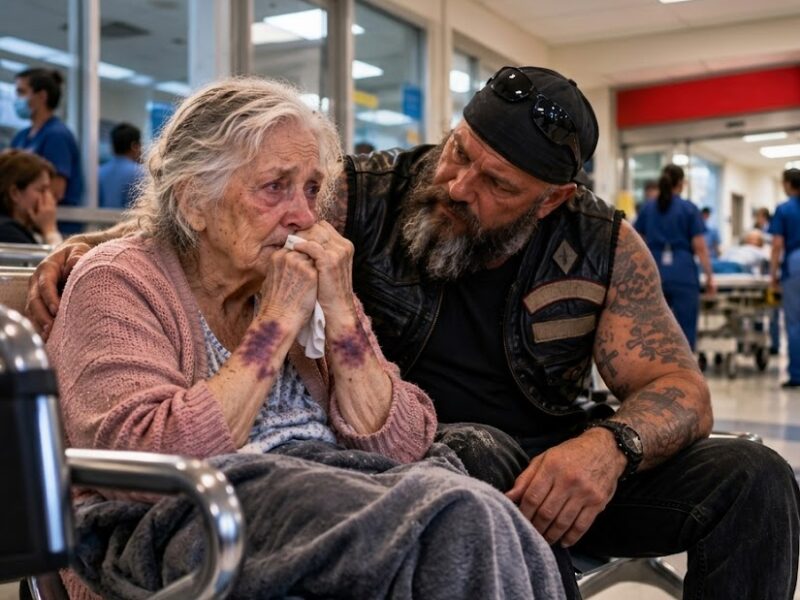
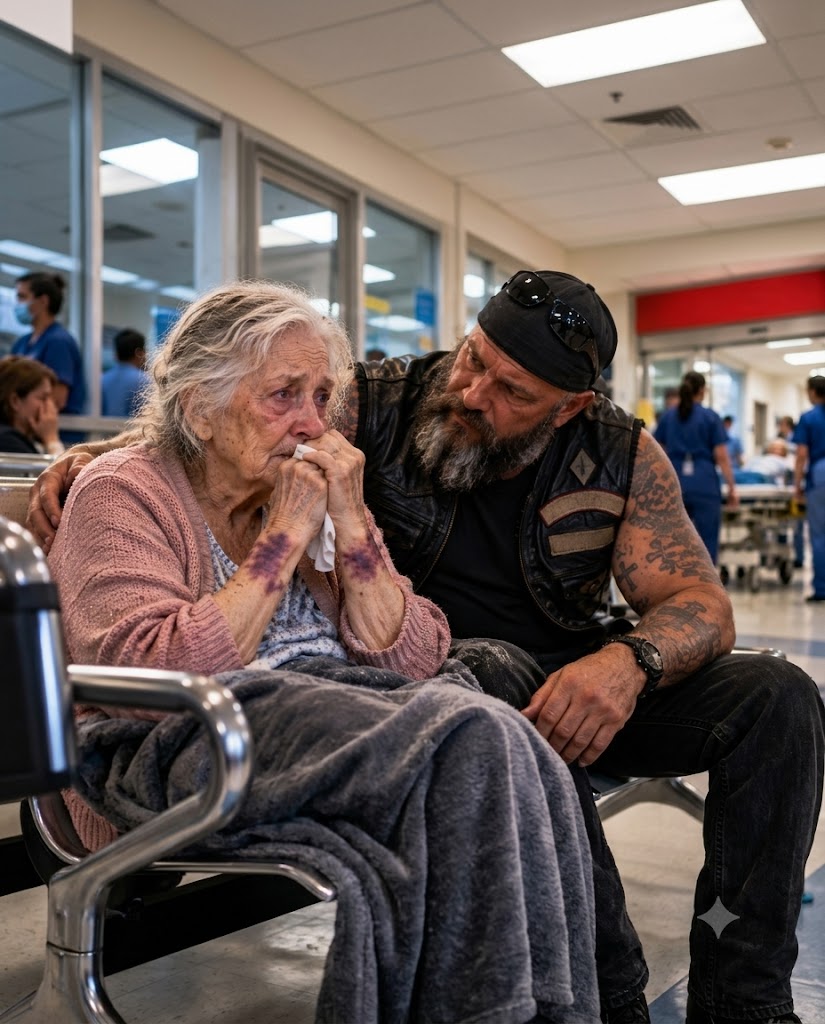
He was forty-six years old and six foot two, with a gray-shot beard, forearms covered in faded ink, and a black leather vest with a club patch stitched across the back.
For as long as he could remember, he had been the kind of man people crossed the street to avoid. He had learned to keep his shoulders rounded, his hands visible, his voice low. He had learned to apologize for taking up space.
Heads turned. He watched it happen the way you watch weather.
A woman in flannel pajama pants pulled a little boy closer. A man in a Chiefs jacket looked at the vest, then at the blood, then quickly away.
At the check-in window, a clerk with a lanyard full of pins looked up, and Caleb saw her hand drift just slightly toward a button beneath the counter.
“Evening,” he said, and held up the towel like a passport. “Screwdriver. Got a little deep.”
“Name?” she said, in the voice of someone reading from a script.
He gave it. She typed. She slid a clipboard across the counter, and he filled it out left-handed, dripping on the pen.
Then she fastened a plastic wristband around his good wrist and pointed to the waiting area. “It’s a busy night,” she said. “Friday, rain, you know.”
“Yes, ma’am,” said Caleb. “I know.”
He looked for a seat. There was one at the end of a row against the back wall, next to an old woman in a beige cardigan. The chairs on her other side were empty, too.
A small island of space no one had wanted to cross.
He walked over slowly, so as not to startle her, and lowered himself into the chair with a nod. She did not nod back. She did not look at him at all.
She was small, maybe five feet even, with white hair pinned into a careful coil at the back of her head. Her cardigan was buttoned to the throat and damp across the shoulders.
She sat with her knees together and her hands folded in her lap and her back perfectly straight, the way people sit in front of a principal’s desk. She had no purse, no coat, no phone.
Caleb noticed the hands only because he noticed hands for a living. These were thin and spotted, with a wedding band worn loose on the finger and knuckles swollen with arthritis.
And when she shifted just slightly, the cuffs of her cardigan slid back from her wrists, and Caleb stopped breathing.
Both wrists were bruised. Not the yellow smudge of a bump against a countertop. These were dark, purple going to black at the center, banded around the bone like bracelets, with smaller oval marks along the edges.
He had seen marks like that once years ago and had never forgotten them. They were made by fingers.
She saw him looking. She did not flinch. She pulled her sleeves down, one wrist and then the other, with slow, practiced care, as if she had done it many times that day.
Caleb turned his eyes to the television and gave it a minute. Then he tried the only opening he had, the way he would have approached a nervous dog.
“Not much of a night to be out,” he said quietly.
Nothing. The muffled weather report. The crying child.
He glanced at her wristband. The plastic strip on her thin arm was printed with a name and a time, and he read it without meaning to.
Whitaker, Caroline. Arrival, 2:07 p.m.
He looked up at the clock above the check-in window. It was 6:14.
Four hours. Four hours and seven minutes in a plastic chair without a coat, without a phone, without a single person beside her.
People who had come in after him were already being called back. Nobody had said her name. Nobody had even glanced at her since Caleb walked in, and he understood then why the chairs around her were empty.
It was not that people were avoiding her. It was that they had forgotten her.
She had been sitting there so long and so quietly that she had become part of the furniture.
“Ma’am,” he said gently, “has anyone been out to see you?”
For the first time, she turned her head. Her eyes were pale blue and very clear, and there was something in them that did not belong to a confused old woman.
It was alarm.
She glanced past him at the automatic doors, then back at his face, and gave the smallest shake of her head. Not an answer. A warning.
Then she looked away again, folded her hands, and said nothing at all.
Caleb sat back slowly. His arm throbbed. The rain hammered the glass, and a cold, precise certainty settled into his chest, the kind he had felt only twice before in his life.
Whatever had happened to Caroline Whitaker was no accident. Somebody had held her down, and she was afraid in this warm, bright room full of strangers that somebody was about to walk back through those doors.
By 7:00, Caleb understood that the room had already decided who the dangerous one was, and it was not the person with the bruises.
He had tried to do a small, ordinary kindness. There was a vending machine down the hall by the restrooms, and he fed it four wrinkled dollar bills and came back with a paper cup of coffee, a packet of peanut butter crackers, and a bottle of water.
He set them on the empty chair between himself and Caroline Whitaker without a word, the way you leave food out for something that might bolt.
She stared at the cup. Her lips were dry and cracked.
“Nothing in it,” Caleb said quietly. “Just coffee. I figured you’d be cold.”
Her hand rose an inch off her lap, and then a shadow fell across them both.
“Ma’am?”
It was the clerk from the front desk, Gwen Toliver according to her badge, a heavyset woman in her fifties who had crossed the room without Caleb noticing. She planted herself squarely between him and Caroline, arms folded.
“Is this gentleman bothering you? Is he with you?”
Caroline said nothing. Her eyes dropped to the floor.
Her thin shoulders began to tremble, a fine steady shaking, and her hands twisted together so tightly the knuckles went white.
“I brought her a coffee,” Caleb began.
“I’m asking her, sir.”
But Caroline could not answer. She was not afraid of him. She was afraid of the doors, and of the man who had put her here, and of what would happen if she said one wrong word in a room full of people who had already been told she was confused.
But to Gwen Toliver and to everyone watching, the picture was as plain as a road sign: a frail old woman shaking with fear and a tattooed man in a leather vest sitting close enough to touch her.
The mother with the little boy stood, gathered her son, and moved to the far side of the room.
The man in the Chiefs jacket, who had been muttering for a while, finally said what he had been working up to. “Guys like that, you just know.”
Security arrived in the form of Ray Colton, a wide gray-mustached man of about sixty with a heavy belt and the slow careful walk of someone whose knees had opinions.
He had spent twenty years as a patrol officer before taking this job, and he looked at Caleb the way his training had taught him to look at a man in a vest. Not with hatred. With calculation, which was worse because it was reasonable.
“Sir,” Ray said, “I’m going to ask you to step away from the lady.”
“I’m a patient.” Caleb held up his wrist in the bloody towel. “Same as everybody. Screwdriver. I’m just sitting.”
“Then you can sit over there.” Ray pointed to the far corner near the vending machines, a good forty feet away. “Just till you’re called. It’ll make folks more comfortable.”
Caleb looked at the crowd, a dozen faces all turned toward him wearing the same expression. Not one of them was looking at Caroline.
He could have argued. He could have said, “Look at her wrists. Ask yourselves why nobody has spoken to her in five hours.”
But he knew how that went. He had learned it eight years ago on a cold night outside a gas station on Truman Road, when he saw a man in a clean polo shirt slamming a woman against the side of a car.
Caleb had stepped in and pulled the man off her. When the police arrived, the man in the polo was the calm one.
He was an insurance manager with a house in Lee’s Summit and a soft, reasonable voice, and he told the officers that a biker had attacked him for no reason. The woman had slipped away into the dark before anyone could ask her anything.
Caleb spent that night in a holding cell with a swollen hand and a lesson he had carried ever since. When the man in the polo shirt and the man in the leather vest tell two different stories, only one of them gets believed.
He had not stepped into anyone else’s trouble since.
Now he stood and without another word walked to the far corner. He felt the room exhale behind him.
He did not sit. He leaned against the wall with his arms crossed and kept his eyes on the woman in the beige cardigan forty feet away.
Once, when Gwen Toliver went back to her window and the murmurs sank into the drone of the television, Caroline lifted her head and looked straight at him across the length of the room.
It was a brief look, the kind you would give a lighthouse. Then she looked down.
At ten minutes to eight, a nurse in navy scrubs called out, “Mercer, Caleb Mercer.”
He followed her through the double doors into a corridor as bright and loud as a machine shop. Her name tag read Patricia Holloway, RN.
She was in her fifties with reading glasses pushed up into short gray hair, and she moved like someone who had not sat down since sunrise.
She put him on a bed in a curtained bay and unwound his sodden towel.
“Screwdriver,” she said, whistling softly. “You’ll need a dozen stitches.”
“Ma’am, the lady by the far wall. Cardigan, white hair. Whitaker. Look at her wrists.”
Patricia Holloway’s hands did not pause on his arm. “I have twenty-three people waiting and two nurses out sick,” she said without looking up.
“I know. Just look. Please. She’s been out there since two.”
Her eyes lifted then, and something moved behind her glasses. She said nothing for a moment.
“I’ll pull her chart,” she said.
It took eleven stitches and forty minutes. The ER doctor wrapped Caleb’s arm in gauze and handed him a sheet of instructions.
By 9:20 he was free. He walked out through the double doors, past the front desk, past the woman in the beige cardigan without looking at her, and out through the sliding doors into the cold.
The rain had thinned to a needle mist. His Harley waited under the awning, chrome beaded with water.
All he had to do was walk twenty yards, throw a leg over the seat, and ride home to the apartment above his shop, a fridge with leftover barbecue from Joe’s. Nobody would blame him. Nobody would even notice.
He stood under the awning with his keys in his good hand for a long time.
He thought about the woman on Truman Road. He had never learned her name. He had never known whether she got away.
For eight years, he had told himself it wasn’t his place, that a man who looked like him had no business stepping into other people’s storms. He had said it so often, it had begun to sound like wisdom.
But wisdom did not sit for five hours in a plastic chair with her sleeves pulled over her bruises.
Caleb put his keys back in his pocket, turned around, and walked back through the sliding doors.
Ray Colton watched him come in, jaw set. Caleb did not go to the far corner.
He crossed the room in full view of everyone and sat down in the chair beside Caroline Whitaker, next to the untouched cup of coffee.
“I’m not going anywhere, ma’am,” he said quietly. “You don’t have to say a word.”
The next hour was the longest of Caleb’s life. Almost nothing happened in it. That was what made it hard.
He sat with his bandaged arm across his knees, and the untouched coffee cooling on the chair between them, and the whole room watched him do it.
The mother in the corner whispered to her sister. The man in the Chiefs jacket went to speak to Gwen Toliver, and Gwen Toliver went to speak to Ray, and by 10:00 the big guard was standing over Caleb again, hands on his belt, looking more tired than angry.
“Mr. Mercer, you’ve been treated and discharged. I checked. You don’t have a reason to be in this waiting room anymore.”
“I’m waiting on a friend.”
“You told the desk you came alone.”
“I did.” Caleb met his eyes. “Then I made one.”
“Sir, I have complaints. People are uncomfortable. I have a job to do, and I’d rather not do it the hard way.”
Caleb could hear how it would go. Someone would call the police, and the police would draw only one conclusion.
He searched for a sentence that would stop it, and found nothing a man like him could say that a man like Ray would believe.
“He’s with me.”
The voice was small, dry, and completely steady.
Ray Colton’s head turned. So did half the room.
Caroline Whitaker had not lifted her eyes from the floor. But she had spoken clearly, in the voice of a woman who had spent thirty-one years telling children to hush in a library and being obeyed.
“This young man is sitting with me. I asked him to.”
Ray looked from her to Caleb and back. Something in this room did not add up, and Ray knew it. But instincts do not hold up well against complaints.
“Ma’am, are you sure? You don’t have to be afraid.”
“I’m not afraid of him,” said Caroline. And there was a strange weight on the word him.
Ray hesitated, then nodded once, curtly, and stepped back. “I’ll be over by the door,” he said, and walked away with the stiff back of a man who knew he had just been handed a puzzle.
Caleb’s heart was hammering. Those were the first words she had offered anyone in eight hours, and he could not be sure what they meant.
He had spent the evening building a story in his head, but a man who builds stories about strangers is also a man who can be wrong.
What if the bruises had a simple explanation? What if she was more confused than she seemed, and the clerk and the guard were right to worry?
What if his old grief, the woman on Truman Road, was making him see a crime where there was only an accident and a tired family?
His arm throbbed under the gauze. The clock read 10:11. He shifted his weight to stand.
“Please don’t go yet,” Caroline said.
She spoke without turning her head, in a whisper he had to lean toward to catch. “I’ve been trying to decide whether I could trust you.”
“I’m sorry. I’ve been a poor judge of people lately. You don’t have to trust me.”
“I know what you did,” she said. “The coffee. You left it where I could reach it and you didn’t stand over me while I decided.”
She looked at the paper cup, and a faint, dry ghost of a smile touched her mouth. “My husband used to do that. Harold. Thirty-nine years.”
Then she told him.
It came out in pieces, level and precise, like a librarian reciting a catalog entry, and Caleb understood that she had been rehearsing it for eight hours.
Her name was Caroline Ruth Whitaker. She was seventy-four. She had run the Brookside Branch Library for thirty-one years and had lived in the same brick bungalow on Wornall Road for forty-four.
Her husband had died two years ago in March. Her daughter, Melanie, taught high school English and was in Denver until Saturday for a conference.
And Melanie’s husband, Douglas Pruitt, had been helping with Caroline’s finances ever since the funeral.
“Douglas is a financial advisor,” she said. “You may have seen his face. He’s on the bus benches. Rotary Club. The Hospital Foundation. He coaches basketball at the community center. He gave the speech at my grandson’s graduation. Everybody loves Douglas.”
She paused. Her folded hands tightened.
“But Thursday night, he came to my house with a folder. A new power of attorney. A deed moving the house into a trust that he would control. He said it was for my protection.”
Her voice did not waver.
“I said I would like my own lawyer to read it first. He said I was being difficult. I said I would like him to leave, and he took hold of my wrists.”
She lifted them slightly, sleeves down.
“He held me at my kitchen table for an hour, talking pleasantly the entire time, until my hands went numb, and I told him I would think about it.”
“Caroline,” Caleb said. It was the first time he had used her name.
“This morning, he told me I’d had a fall. He said it to the doctors, too, before I understood what he was doing. He said I’d been confused. He took my phone and my purse, and he said he would be back in an hour.”
She looked at the clock. “That was eight hours ago.”
“I think he wants me to sit here until I am too tired to argue. I think he wants a record that I was left in an emergency room, agitated and confused, with no good account of my injuries. And on Monday, he will file for guardianship.”
“Why didn’t you tell the nurse?”
“Because he told me what would happen.” Her voice thinned, but did not break. “He said any doctor would believe a respected man over a confused old widow. And by Monday, I would be in Maple Ridge, a locked memory unit in Lee’s Summit, where he has already reserved a room.”
She turned her pale eyes on him.
“And then I watched you walk in, Caleb, and I watched this whole room look at you. Who did they see? And who would they see if he walked in behind you?”
Caleb had no answer. She had described from the other side precisely what he had learned on Truman Road.
“I told the nurse about your wrists,” Caleb said. “Nurse Holloway. I hope that was all right.”
Her eyes closed for a moment. “Then I have not been sitting here for nothing.”
“No, ma’am, you haven’t.”
“One more thing,” Caleb said, more quietly. “If he comes, I’d like to record it. In Missouri, if I’m part of the conversation, I don’t need his permission. I looked it up once over a dispute with a supplier. I’d like to have it if it goes badly.”
Caroline considered this with the gravity of a woman who had spent her life protecting the written record.
“I think,” she said, “that I would like that very much.”
He slid his phone into the inner pocket of his vest, tapped the screen, and pressed it flat against his ribs.
At 10:35, Patricia Holloway pushed through the double doors, scanning the room. Her eyes found Caroline.
Then the double doors banged open again behind her, and a paramedic shouted something about a pileup on I-70, four cars, rain-slick, and the corridor filled with gurneys and noise.
Patricia caught Caleb’s eye across the room and mouthed a few words. Half an hour. Social services stuck in traffic.
Then she was gone, swallowed by the chaos.
Half an hour. He looked at Caroline. Caroline looked at the doors.
At 10:52, they slid open.
When the doors slid open, the temperature of the room changed. It happened in small ways.
Gwen Toliver straightened at her window and smiled. A man who had been slumped over his phone sat up.
And Caroline Whitaker, who had held herself upright for nine hours through cold and hunger and fear, began to shake so hard that the plastic chair rattled against the wall.
The man who came in shaking rain from a black umbrella was fifty-one, tall and trim, with silver hair combed back from a tanned forehead and a camel overcoat that had cost more than Caleb’s last motorcycle.
A small Rotary Club pin gleamed on his lapel. He had a face people trusted on sight, open and warm and faintly sorrowful, the face of a man arriving to bear bad news gently.
It was the face on the bus benches.
“Gwen,” said Douglas Pruitt, his voice rich with relief. “Thank goodness. I’m so sorry. The storm has the whole city backed up. Is she all right?”
“Mr. Pruitt, she’s fine, hon. She’s right over there.” Gwen rose halfway from her chair. “We’ve been looking after her. I can’t thank you enough.”
He gripped her hand across the counter. Then he spotted Ray Colton by the doors, and the two men shook hands like old friends.
“Ray, good to see you. How’s your daughter’s shoulder?”
“Better, Mr. Pruitt. Thank you for asking.”
“Good. Good.” Douglas lowered his voice, leaning in with a small, pained wince. “Ray, may I ask you something quietly? That man sitting beside my mother-in-law. Vest, tattoos. Has he been there long? Caroline has been confused lately, as I’m sure the staff has noticed. She’s so vulnerable. I would hate to think anyone was taking advantage.”
Ray’s eyes flicked toward Caleb. Caleb watched the answer form on the big man’s face, and it was the same answer that had formed on every face in the room since 6:00.
It was not malice. It was simply the easiest story to believe.
“He’s been here a while, sir,” Ray admitted. “I asked him to leave. The lady said he could stay.”
“She would,” Douglas said gently. “She doesn’t always know what’s good for her.”
He crossed the room with his hand extended, smiling, and Caleb rose from the chair because he had been raised to stand when someone approached. He kept his hands loose at his sides.
In his vest pocket against his ribs, the phone was warm.
“You must be the concerned citizen,” Douglas said, not withdrawing his hand when Caleb didn’t take it. “Thank you for looking after her. Truly. I’ll take it from here, friend. You can go home.”
“I’m staying,” said Caleb.
The smile did not move. But Douglas stepped closer, near enough that Caleb smelled expensive cologne and rain, and dropped his voice to a murmur meant for no one else.
“Let me explain how this works. In about two minutes, I’m going to walk out of here with my mother-in-law, and you’re going to be escorted out by the man with the badge. Nobody in this building is going to believe a man like you.”
He said it pleasantly, the way you mention the weather. “Look around.”
Caleb looked around. Every face in the room was turned toward the two of them, and every face was on Douglas’s side. He could feel it, that old weight.
Then a chair scraped.
Caroline Whitaker was standing up.
She was five feet tall and her legs were shaking and her cardigan was still damp at the shoulders, but she stood, and she squared her thin shoulders the way she must have squared them at a hundred library board meetings, and the room, without quite knowing why, went silent.
“Douglas,” she said.
“Caroline, sweetheart, sit down. You’re upsetting yourself.”
“My name is Caroline Ruth Whitaker.”
Her voice carried the whole length of the waiting room, dry and clear, trained by thirty-one years of speaking to children who did not want to listen.
“I am seventy-four years old. I live on Wornall Road. I ran the Brookside Library. I know what day it is and where I am and who you are. I am not confused.”
“Caroline—”
“And I want everyone here to see this.”
She pushed back both cardigan sleeves.
Under the hard light of the emergency room, the bruises looked worse than they had in the shadows. Two dark bracelets, purple and black, wrapped around each thin wrist, the outlines of fingers plain along the edges.
The mother in the corner put a hand over her mouth.
“You held my wrists at my kitchen table for an hour,” Caroline said, “because I would not sign your papers.”
For half a heartbeat, Douglas’s face slipped, and Caleb saw what lived behind the warm, sorrowful mask.
It wasn’t rage. It was worse. It was calculation, cold and fast, the look of a man rearranging an equation.
Then the mask slid back into place.
“You see?” He turned to the room, spreading his hands with a sad, patient smile. “You see what I’ve been dealing with? She fell last week. She bruises like a peach. And lately, she has been telling these stories. It breaks my heart. Please, everyone, I’m so sorry.”
It might have worked. Caleb saw it nearly work. A few faces softened. The man in the Chiefs jacket looked at the bruises, then at the pressed suit, and visibly chose the suit.
Then Douglas did the one thing that could not be explained.
He reached out and closed his hand around Caroline’s arm, just above the wrist, and pulled. “That’s enough. We are going home.”
She cried out. It was a small, sharp sound, the sound of a hand landing on a bruise, and it cut through the room like a dropped glass.
Everyone saw the manicured fingers clamped over the purple marks.
Caleb moved before he thought. He took one step, and a heavy hand landed flat against his chest and stopped him.
Ray Colton.
But Ray was not looking at Caleb. Ray was looking at Douglas Pruitt’s hand.
For a long second, the old patrol officer said nothing. The calculation drained from his face, and something older took its place, something Caleb suspected he had carried for twenty years and set down on a shelf.
Then Ray took his hand off Caleb’s chest, turned, and stepped between the man in the camel coat and the woman in the beige cardigan with all of his considerable bulk.
“Mr. Pruitt,” he said, “let go of her arm.”
“Ray, for heaven’s sake—”
“Let go of her arm, sir.”
“Do you have any idea who I am?”
“Yes, sir,” Ray said quietly. “I do. Let go.”
The hand opened.
Caroline stumbled back into Caleb, who caught her by the elbows gently, avoiding the wrists, and held her up.
Douglas straightened his cuffs. The smile was back, but it had gone stiff and thin, like paint over damp wood.
“This is absurd. I hold her power of attorney. I have every right.”
“You have the right to be quiet,” said a new voice, dry as paper.
Patricia Holloway had come through the double doors with a woman in a gray raincoat, a lanyard around her neck, and a leather folio under her arm. Behind them came the hospital’s night security supervisor, and beyond him, through the glass, the flashing blue lights of a Kansas City police cruiser pulling in under the awning.
“I’m Lorraine Hartley with the state’s adult protective services,” the woman in the raincoat said. “I’d like to speak with Mrs. Whitaker. Alone, please, Mr. Pruitt.”
Douglas turned. His eyes traveled across the room, past the guard, past the nurse, and stopped on Caleb Mercer.
He looked, for the first time all night, directly at the man in the vest.
And then he saw the faint red glow through the leather, and understood.
“You recorded me,” he said.
The rest of the night unspooled in fluorescent light and quiet voices.
Ray Colton walked Douglas Pruitt into a small consultation room off the corridor, where two Kansas City police officers waited. And where a man who had spent thirty years being believed discovered that being believed is not the same as being right.
Detective Frank Odell arrived at half past midnight, a rumpled, patient man in a wet trench coat, and listened to Caroline for an hour and a half without once glancing at his watch.
Patricia Holloway photographed the bruises with a ruler beside them, measured each one, and noted in the chart the time Caleb had first raised the alarm. 7:52 p.m.
Every hour of the record mattered now.
Then Odell asked Caleb for his phone.
“It’s all there,” Caleb said. “Starting around 10:30.”
They listened in the consultation room with the door shut. The recording was tinny, but clear.
The soft, pleasant voice. The scrape of a chair. “Nobody in this building is going to believe a man like you. Look around.”
Then Caroline’s voice, dry and level, and the sharp cry of pain, and Ray Colton saying, “Let go of her arm, sir.”
Odell played it twice. When it ended, he sat for a moment with a hand over his mouth.
“Mr. Mercer,” he said at last, “in twenty-six years, I’ve watched a lot of people say things they wish they hadn’t. I have almost never had one handed to me with a timestamp.”
Douglas Pruitt was arrested that night.
Over the following days, detectives with a search warrant found a guardianship petition in his home office, already drafted and dated for Monday, along with a list of concerning incidents that had never happened.
They found bank records, too. Over two years, more than $300,000 had quietly moved out of Harold Whitaker’s old accounts and into a business that belonged to the good man from the bus benches.
The prosecutor filed charges of assault and financial exploitation of an elderly person. A judge ordered Douglas to stay five hundred feet away from Wornall Road.
Melanie Pruitt landed on the first flight out of Denver and came through the hospital doors at 8:00 the next morning with her coat buttoned wrong.
Lorraine Hartley had found her number in an old emergency contact on file.
She had believed her husband for two years. “Mom’s been forgetful,” he’d said. “She’s not herself.” It had been so easy to believe because he’d said it so kindly.
She stopped at the foot of her mother’s bed and could not move.
“I should have told you sooner,” Caroline said.
“No, Mom. No.” Melanie’s voice cracked. “I should have asked.”
Caroline held out both arms, sleeves pushed up, and did not hide anything, and her daughter crossed the room and put her face against her shoulder.
Later, Melanie found Caleb in the corridor sitting in a plastic chair with his arm in a sling because he had not quite been able to make himself go home.
She took his good hand in both of hers. Her mouth worked and nothing came out.
“I just sat there,” Caleb said. “That’s all I did.”
“That’s the whole thing, isn’t it?” Caroline’s voice came from the doorway behind them.
She stood there in a borrowed hospital robe, straight-backed, with her hair still pinned in its careful coil.
“For nine hours, a room full of people saw a woman with bruises and not one of them sat down. You sat down.”
He had no answer. He had never been good at being thanked.
On his way out that morning, Ray Colton was waiting by the sliding doors. The big guard had been on shift for sixteen hours and it showed, but he stood up straighter when Caleb came through.
“Mr. Mercer, I owe you an apology.”
“You don’t.”
“I looked at the vest,” Ray said. “I should have looked at her. Twenty years I wore a uniform, and I spent them thinking I could tell who was dangerous by looking at them. I had it backwards tonight, and I could have sent an old woman home with the wrong man.”
“Most folks would have,” Caleb said.
“That’s no excuse.”
“No,” Caleb agreed. “It’s an explanation. You did the right thing when it counted.”
Ray held out his hand, and Caleb shook it.
Gwen Toliver at her window pressed a fresh cup of coffee into his hand without meeting his eyes, her own eyes wet.
And by the door, holding it open with one arm, stood the man in the Chiefs jacket, staring at his shoes. He did not say anything. Neither did Caleb.
He simply nodded once and walked out into a gray-washed morning that smelled like wet leaves and clean air.
The second Saturday in December was cold and bright. The Plaza lights had been burning since Thanksgiving night, and along Ward Parkway the last brown leaves skittered over the curbs.
Douglas Pruitt was awaiting trial. Melanie had changed every lock on the house on Wornall Road and had moved back in for a while, and there was a new lawyer, a new bank, and a stack of new papers that Caroline had read line by line at her own kitchen table in her own time.
Caleb came for lunch.
Caroline served soup and a sandwich that she had cut without asking into neat triangles. When the plates were cleared, she folded her hands on the table.
“Do you know what I noticed about you first?” she said. “That night, before you ever spoke. Your hands. You were holding that shop towel against your arm as if you were afraid of getting blood on the chair. Bleeding through the cloth and worried about somebody else’s furniture.”
She shook her head. “I thought, that is not a dangerous man.”
Caleb looked at the table. He had spent twenty-two years making himself smaller so that other people would not be afraid of him. It had never occurred to him that someone might simply look and see.
“I’d like to ask you a favor,” Caroline said.
“Anything.”
“I would like a ride.”
He stared at her. “Ma’am, I’m not sure that’s—”
“I am seventy-four years old, Caleb. I’ve spent two years being told what I should not do by a man who wanted me to be small and quiet and afraid. I would like to go for a ride on a motorcycle. Slowly, if you insist.”
Melanie, standing at the sink, pressed her lips together and did not say a word.
Twenty minutes later, Caroline Whitaker stood in the driveway in a borrowed helmet and her good wool coat, holding Caleb’s arm with a hand that no longer shook.
He helped her onto the seat, showed her where to put her feet, and checked the strap twice.
“Slowly,” he said.
“I’ve been going slowly for two years,” said Caroline. “Let’s not.”
They rolled out onto Ward Parkway in the low winter sun. She held onto his leather vest with both hands, her white hair blowing loose from its coil, and somewhere behind him, over the engine, Caleb heard her laughing.
Nine hours she had sat in that room, and nobody had seen her. Nine hours the room had watched him instead, and seen only the vest, the tattoos, the beard.
The man they had feared had been the only one who stayed. The man they had trusted had been the one who did the harm.
It was not a complicated lesson, and it had cost a night of cold and fear to learn.
Caleb rode on through the bright cold afternoon with a seventy-four-year-old librarian at his back, and for the first time in longer than he could remember, he did not make himself small.
He sat up straight, and he let the wind take them both.









