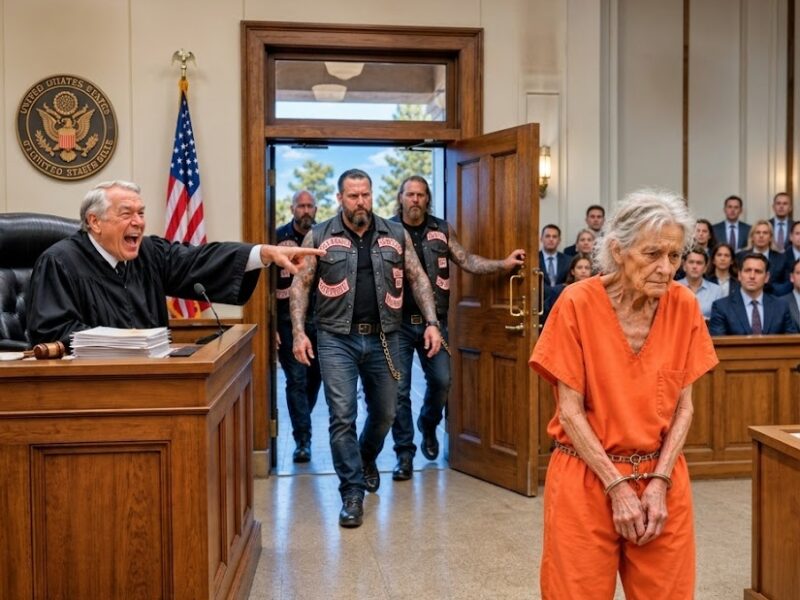
An old lady raised 3 orphan boys all by herself. 20 years later, 3 Hells Angels walked into court to save her.
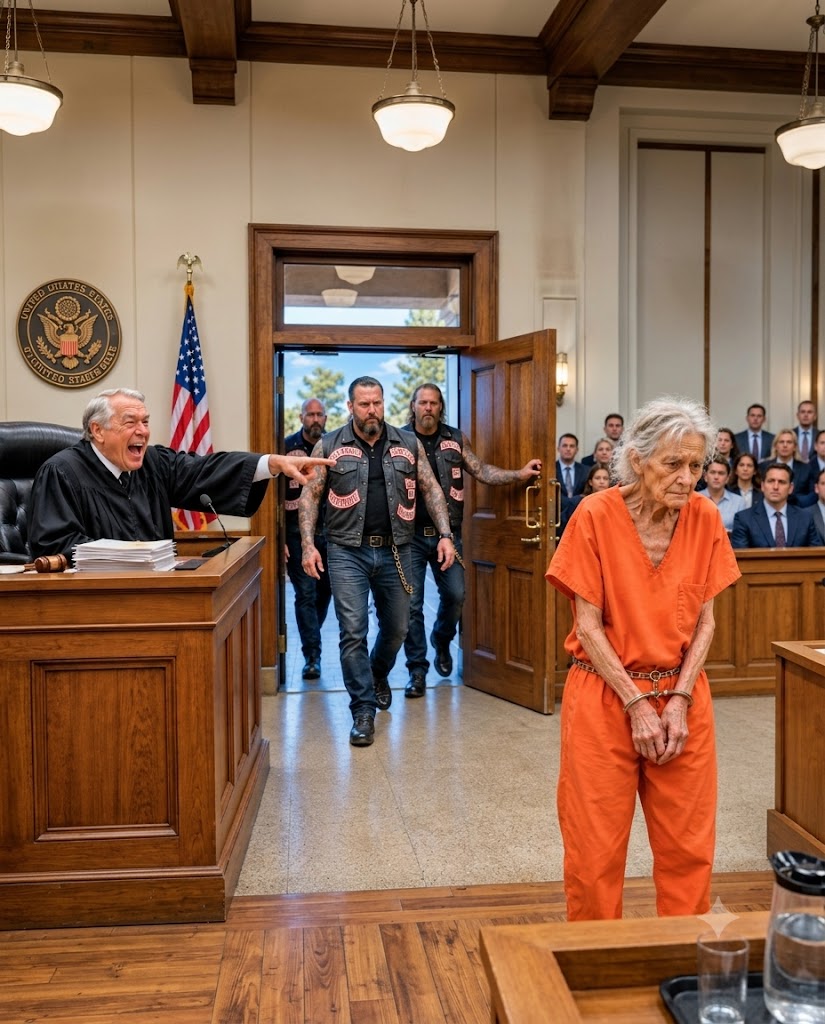
The fist came down on the wooden table so hard the water pitcher jumped and spilled across the papers.
A man in a gray suit leaned over the railing and jabbed his finger at a small white-haired woman close enough that she flinched back in her seat.
Her hands shook in her lap.
She gripped the strap of an old purse with both hands and stared at the floor.
Behind her, rows of benches sat empty.
Nobody had come.
Nobody was coming for her.
The man straightened his tie and smiled because he already knew he had won.
Her name was Elena Apprentice.
She had raised three boys with nothing for twenty years.
And now a stranger was about to take the last thing she owned.
But what three men on motorcycles did when those heavy doors swung open left that whole courtroom frozen in place.
Stay with me on this one.
Mil Haven, Ohio was the kind of town the map forgot.
One stoplight that blinked yellow after dark.
A mill down by the river shut for thirty years.
And on Chestnut Street, past the church in the empty lot, there was a small white house with a crooked porch.
That was Elena Apprentice’s house.
She had lived in it for fifty-one years.
Her husband built the back room with his own hands before the mill took his lungs and then took him.
After that, it was just a lean-to and a sewing machine and a stack of other people’s clothes to mend.
She was a seamstress, not a rich one.
People brought her torn work pants and wedding dresses and Sunday suits, and she fixed them for whatever they could pay, sometimes for nothing at all.
She never could say no to somebody who needed something.
And people knew it.
Everybody knew whose prom dress she had let out the night before the dance, whose funeral suit she had pressed when the family could not afford the cleaners.
She kept a coffee can on the window sill, and when somebody was short, she would tell them to just put what they had in the can, and she never once counted it.
She had patched the same man’s overalls for thirty years, and when he died, she mended the shirt they buried him in.
That was the kind of woman she was.
Quiet, steady, the sort of person a town leans on without ever once saying thank you.
Which is how it started, really.
The boys.
One winter, a car went off the county road in the ice and two people died.
They left behind three sons.
Jesse was twelve, Caleb was nine, and little Toby had just turned six.
No relatives came forward.
None that wanted them anyway.
The county said three brothers was too many for one home, so they were going to split them up, send them to three different towns.
Jesse heard that and he stopped talking altogether.
Three weeks, not one word.
The case workers wrote it down like it was a problem with the boy.
It was not a problem with the boy.
It was a boy watching the last of his family get divided up like furniture.
Elena heard about it at the church.
She was fifty-four years old.
She had no children of her own, a widow’s savings, and a house with two bedrooms.
By every reasonable measure, she had no business taking in three grieving boys.
She took them anyway.
All three.
The case worker, a tired woman with a clipboard, told her plainly she was making a mistake, that three boys from a crash like that would come with troubles she could not imagine.
Elena just said brothers stay together and signed the papers.
She did not raise her voice.
She did not argue.
She just signed, and that was the end of the discussion.
Now here’s the thing.
It was not easy.
I want you to understand that those first months were hard in a way that would have broken most people.
Jesse was angry at the whole world and he had every right to be.
He broke a window with a baseball on purpose.
He ran off twice, once in the rain, and Elena walked the county road at midnight calling his name until she found him sitting on the guardrail near where it happened.
Caleb wet the bed and cried for his mother in the dark, and he was ashamed of it, which made it worse.
And Toby, that baby, he would wake up screaming and not know where he was.
Elena did not yell.
She did not give up.
She sat on the floor of that little room night after night, one hand on Toby’s back, telling the same stories until he fell asleep.
She took in twice the mending to feed three growing boys, and some nights the sewing machine ran until two in the morning.
She wore the same two dresses for years so they could have shoes that fit.
She sold her husband’s good watch, the only thing of real value she had left, and never told the boys where the winter coats came from.
When Jesse got into a fight at school, she did not scold him.
She cleaned the cut over his eye at the kitchen sink and she held his chin so he had to look at her and she said, “You are not trash. Somebody told you that you were and they lied to you. You are mine now.”
And Jesse, twelve years old and hard as a fist, finally cried.
Then there was the dog, a one-eyed mutt the boys found half-starved behind the shut-down mill.
Toby named him Buckshot because somebody had clearly shot at the poor thing once.
Elena said they could not possibly feed another mouth and then she fed it anyway, and Buckshot never left her side again.
Twenty years later, that dog, old and gray in the muzzle, still curled up at her feet while she worked the sewing machine.
The boys grew up rough and loyal and loud.
They learned to fix engines in that garage, mostly because Jesse took an old motorcycle apart and could not get it back together, and the three of them figured it out over one long summer.
They learned to fight, but only for people who could not fight for themselves.
Because that is what Elena taught them at that kitchen table over and over until it was bone deep.
You do not start it, but you do not stand by either.
And when they were grown, they did what a lot of men from dying mill towns do.
They got on motorcycles and left to find work and a life out on the open road.
But they never forgot her.
Every birthday, a card.
Every Christmas, money folded inside, more than they could really spare.
Phone calls on Sundays.
Every Sunday, no matter where they were.
They had become something the world would learn to fear by its patch and its name.
Men crossed the street when they saw the three of them coming.
But to Elena, they were still her boys, the ones who did homework at her table and left their muddy boots on her porch.
And she was still the only mother they had ever really had.
And that is who Raymond Vance decided to rob.
Vance was a property developer out of Columbus.
Nice suits, white teeth, a handshake like warm oil.
He had done this before in other small towns, and he had a system.
He found places that were dying, where the people were old and the money was gone, and he bought up the land cheap, betting on a highway or a plant that would make him rich.
He had been buying the cheap blocks around Mil Haven for a year, betting a new highway interchange would turn worthless dirt into gold.
He already owned most of the street.
Elena’s house sat right in the middle of a block he wanted, the one piece he did not have.
He offered to buy it.
She said no.
It was not for sale, not for any price, because it was the only home three orphaned boys had ever known, and because her husband was in every board of it.
Vance was not a man who took no for an answer.
He had never taken no for an answer in his life, and he was not going to start with a seamstress in a town nobody had heard of.
So he found another way.
The letter came on a Tuesday.
Elena almost did not understand it.
The words were so tangled and legal.
She read it three times at the kitchen table.
It said her house was not hers.
It said the deed had been transferred, that there was a lien, that she owed money she had never borrowed, and that she had thirty days to leave or be removed by force.
There was a court date at the bottom.
The paper trembled in her hands the same way her hands trembled now.
The house was paid off.
She knew that.
Her husband had burned the mortgage papers in the kitchen sink the day they made the last payment, and the three of them had danced around the smoke like it was a holiday.
She had the deed in a shoe box on the closet shelf, right where it had always been.
But when she took it to a lawyer in town, a man she had known for years, he would not quite meet her eye.
He said the papers Vance filed looked official.
Notarized, stamped, dated.
He frowned and she could see he did not like them.
But he said fighting it would cost more money than she had, and even then she might lose because a judge goes by what is on the paper.
He said, as gently as he could, that sometimes it was easier to just take the settlement and start fresh somewhere smaller.
Elena walked home that day and did not sleep that night.
She did not know it, but a town two hundred miles away was about to get a phone call.
She just felt alone.
That is what a man like Vance manufactures, the feeling of being alone.
It was what he counted on.
He had looked at her file the way he looked at all of them.
And he saw a widow, no income, no lawyer on retainer, no powerful friends.
On paper, she was the easiest mark he had ever worked.
Nobody would even notice she was gone.
What he did not count on was who she had raised.
The day of the hearing, Elena put on her good dress, the blue one she wore to church.
She pinned her hair and she walked the eleven blocks to the courthouse because she did not have a car and would not ask anyone for a ride.
She did not call the boys.
She did not want to worry them.
She told herself they had their own lives now, their own troubles, and that a mother does not hand her problems to her children.
She thought she could handle it herself, the way she had handled everything herself for fifty years.
She was wrong about that, and she would be glad she was wrong.
The courtroom was small and smelled of floor wax and old wood.
Judge Harmon sat up front, a tired man near the end of a long career who had stopped expecting surprises a long time ago.
Raymond Vance sat at one table in a gray suit, and beside him was his lawyer, a sharp young man named Sloan, who smiled like the whole thing was already decided, because for him it was.
He had done a dozen of these for Vance.
They never lost.
At the other table, Elena sat alone.
No lawyer, just her purse and her shoe box of papers she did not fully know how to use.
Sloan stood up first and he was good.
Smooth.
He laid out documents one after another, walking them up to the clerk like a man dealing a winning hand.
A transfer of deed, a promissory note with Elena’s shaky signature on the bottom, or a signature made to look like hers, records of a loan from a company Vance owned, though nobody in that room but Vance knew yet that he owned it.
He spoke fast in words Elena could barely follow, and every word built the same picture.
A confused old woman who had taken money she could not repay and was now refusing to honor her debt.
He made it sound so reasonable.
He even made it sound kind, like Vance was the patient one here, pushed at last to the courthouse by a stubborn old woman who would not do the sensible thing.
Elena tried to speak.
She stood up, her knees shaking, and she said, “I never signed that. My husband paid this house off twenty years ago. I have the deed right here.”
She held up the shoe box like it was evidence in a murder trial.
Sloan did not even look at her.
He turned to the judge and said, “Your honor, with respect, the defendant is elderly and confused. The documentation speaks for itself. We have notarized records. She has a shoe box.”
A few people chuckled.
A clerk and a bailiff and a man waiting on another case.
Vance smiled down at the table.
And Elena sat back down slowly, her face burning, feeling every one of her seventy-four years, feeling the thing Vance had wanted her to feel all along, which was small.
Judge Harmon rubbed his eyes.
He looked at the papers in front of him, all those official stamps and signatures, and he looked at the old woman with her cardboard box, and you could see him deciding.
You could see the whole thing tipping.
He had seen a hundred of these.
Old person, big developer, paperwork that all lined up.
He picked up his pen.
He said, “Mrs. Apprentice, I understand this is difficult, but the court can only go by the record, and the record is fairly clear.”
That is when Sloan’s fist came down on the table hard for effect and the water pitcher jumped and Elena flinched like she had been struck.
The judge called a short recess.
Fifteen minutes.
He needed to review the file before he signed the order.
He stood and disappeared through the door behind the bench and the room went quiet.
And here is where it all seemed to be over.
Sloan walked across the floor and sat down right next to Elena, uninvited, and lowered his voice to something soft and friendly, the voice you use on a frightened animal.
He slid a single sheet of paper in front of her.
“Mrs. Apprentice,” he said, “nobody wants to see you out on the street. Mr. Vance is a generous man. Sign this and you walk away with ten thousand dollars and no fuss. You can find somewhere small, somewhere easy to manage. No stairs, no yard to keep up. Doesn’t that sound better than a fight you can’t win?”
Elena looked at the paper.
Her eyes were wet.
She was tired, bone tired, the kind of tired that fifty years of being strong leaves in a person.
She thought about the sewing machine and the coffee can on the window sill and the dog waiting at the screen door, and she thought maybe the lawyer in town was right.
Maybe it was easier to just take the money and go.
She picked up the pen.
Her hand hovered over the line.
The clock on the wall ticked.
Vance watched from his table, and the smile on his face was the smile of a man who had already spent the money.
The room settled into that heavy final calm, the calm of a thing that is finished.
Elena took a slow breath.
She touched the pen to the paper.
And then from the back of the courtroom came the sound of boots.
Not one pair.
Three.
Heavy and unhurried, coming down the hall toward the double doors.
Then those doors swung open so hard they banged against the walls and the whole room turned around at once.
Three men stood in the doorway.
They were big, road-worn.
Leather cuts over their shoulders, sleeves rolled to show arms covered in old ink, boots still dusty from four hundred miles of highway ridden through the night.
They had not stopped except for gas.
On the back of every jacket was the same patch, the one that makes a certain kind of man go pale when he sees it walk through a door.
Hell’s Angels.
And they were not looking at the judge.
And they were not looking at Sloan.
They were looking at the old woman with the pen in her hand.
The biggest one, the one in front, with gray coming into his beard and a scar through one eyebrow, spoke first.
His voice was quiet, but it filled the whole room.
“Put the pen down, Ma.”
Elena turned around, and when she saw them, something broke open in her face.
The pen fell out of her fingers and rolled across the table.
“Jesse,” she whispered.
Then Caleb.
Toby.
She said their names like a prayer she had given up on.
Sloan shot to his feet.
The easy smile was gone.
“This is a closed proceeding. You three cannot just walk in here.”
Jesse did not even look at him.
He walked down the center aisle, slow, boots loud on the wood floor, and his two brothers came right behind him.
They walked past the railing, and they lined up behind Elena’s table, three big men standing like a wall at the old woman’s back.
For the first time all day, she was not alone, and Raymond Vance’s smile finally cracked.
If you have ever been rooting for somebody to get what is coming to them, this is the moment.
So if you are still with me, take one second and hit that subscribe button, because the best part of this story is just getting started.
Now let me tell you exactly what those three men did next.
The judge came back in.
He saw the three bikers standing behind Elena and he stopped halfway to his chair.
“What is going on in my courtroom?” he said. “Who are these men?”
And that was the question.
That was the whole thing right there.
Who are these men to this woman?
Jesse stepped forward.
He took off nothing, apologized for nothing.
He said, “Your honor, my name is Jesse Holt. These are my brothers, Caleb and Toby. Twenty years ago, our parents died on an icy road, and the county was about to split the three of us up and ship us to strangers in three different towns. This woman right here took all three of us into her home. She had no money and no reason to. She fed us when she went hungry. She sold my father’s watch to buy us coats and never said a word about it. She stayed up every night for a year so my baby brother could sleep. She is the only mother we have ever had.”
He turned and looked at Vance.
“And you tried to steal her house while she was alone because you thought nobody would come.”
The room was dead silent.
You could hear the clock ticking.
Sloan recovered first.
Lawyers always do.
“A touching story,” he said, “but it changes nothing. The documents are legal and notarized. Sentiment is not evidence. Your honor, I move that we proceed.”
“We’d like to talk about those documents,” Caleb said.
Now Caleb was the quiet one, the middle boy, the one who used to cry in the dark.
He had grown into a careful, watchful man, and after he left Mil Haven, he had spent six years working in a title and records office before the road called him back.
He knew paper.
He knew exactly how it got made and exactly how it fell apart.
When his mother called him three weeks ago, he had gone very still, and then he had started making calls.
He stepped up to the railing and set down a folder of his own.
“When Ma called me three weeks ago and read me that letter,” he said, “I drove to the county recorder’s office the next morning. I pulled the original deed. It’s filed right there in the public record in my mother’s name, free and clear, paid off twenty years ago.”
He slid a copy across to the clerk.
“Now here’s the thing, your honor. The transfer document Mr. Sloan just showed you is dated the fourteenth of March. It’s stamped by a notary named Deborah Hale.”
He let that sit for a second.
“Deborah Hale retired and moved to Arizona in January. Two months before she supposedly stamped that paper. I’ve got her notary commission records right here and a signed statement from her, overnighted, saying she has never met my mother and never notarized anything with her name on it.”
He laid the pages down one at a time like cards.
“That stamp is a forgery, which makes every document built on it worthless.”
Sloan’s mouth opened and nothing came out.
He looked at Vance, and for the first time there was something uncertain in his face.
The look of a man who has just realized he might not have been told everything.
But Caleb was not finished.
And this is where it turned all the way around.
“And it gets worse,” he said. “The loan company that supposedly lent my mother all this money. I pulled its filings. It was incorporated four months ago. One officer listed.”
He looked straight at the man in the gray suit.
“Raymond Vance.”
He loaned her money from his own shell company, forged a dead notary stamp, and then sued her to collect on a debt he invented.
“That is not a real estate dispute, your honor. That is fraud start to finish.”
He set down the last page.
“And I’d bet the deed on it that Mil Haven is not the first town he’s done it in. Pull the records in the other counties where he’s been buying. You’ll find more Deborah Hales.”
Vance was on his feet now, his face gone red and blotchy.
“This is a setup. These are criminals. Look at them. You’re going to take the word of a pack of outlaw bikers over a licensed attorney?”
He was pointing, his voice climbing, losing control in front of everyone.
And every word out of his mouth made him look worse.
And that is when Toby spoke for the first time.
The baby.
Six years old when Elena took him in, screaming in the dark.
He was a mountain of a man now, soft-spoken, slow to anger.
He reached into his cut and pulled out a worn envelope and he walked it up to the bench himself.
“Your honor,” Toby said. “I didn’t bring any legal papers. My brothers handle that. I just brought this.”
He opened the envelope.
Inside were photographs, old and creased.
“That’s me the night she took us in. You can see I’m still holding the bag they packed me in. That’s Ma teaching Jesse to patch a tire. That’s all three of us at the kitchen table doing homework.”
He laid them gently on the wood.
“She kept these in a frame by her bed for twenty years. I called her last week and she didn’t even tell me about the lawsuit. She didn’t want to worry us. I had to hear it from a neighbor who saw the notice.”
His voice cracked just a little and he steadied it.
“A woman like that does not borrow against her house behind her children’s backs. Everybody in this room knows that, including him.”
The judge picked up the photographs.
He looked at them for a long time.
Then he looked at the deed Caleb had filed and the notary statement and the incorporation papers with Raymond Vance’s name sitting right there at the top.
Something in the old judge’s face changed.
The tiredness burned off and left something harder underneath.
“Mr. Sloan,” Judge Harmon said slowly, “were you aware your client incorporated the lending company himself?”
Sloan was already gathering his files.
“Your honor, I was retained in good faith. I had no knowledge of—”
“Sit down,” the judge said.
He did not raise his voice.
He did not have to.
Sloan sat down.
Judge Harmon turned to Vance, and when he spoke, it was with twenty years of quiet disgust finally finding somewhere to go.
“I have been on this bench a long time,” he said. “I have seen people do desperate, ugly things for money. But I do not think I have ever seen a man walk into my courtroom and ask me to help him rob a seventy-four-year-old woman who spent her life raising other people’s children. You forged a stamp. You invented a debt. You picked her because you thought she was alone.”
He leaned forward.
“She was never alone. Mr. Vance, you just couldn’t see it from where you were standing.”
He brought the gavel down.
“This claim is dismissed with prejudice. The deed stands in the name of Elena Apprentice, free and clear, as it has for twenty years.”
Then he looked at the clerk.
“I want the county prosecutor in my chambers within the hour. We are going to talk about forgery, perjury, and attempted fraud against the elderly. I want those other counties called too. Mr. Vance, do not leave this county.”
The gavel came down a second time and it was over.
The real kind of over.
For a moment, nobody moved.
Then Elena put her face in her hands and her shoulders started to shake, and Jesse knelt down beside her and put one big tattooed arm around her, and Caleb on the other side, and Toby behind.
And the three of them just held her while she cried.
Not the frightened crying from before.
The other kind.
The kind you do when the weight finally comes off.
Raymond Vance was escorted out a side door.
The last anyone in that courtroom saw of his famous smile, it was long gone.
They walked her home eleven blocks, slow, the three of them on either side of her because she would not ride on the back of a bike in her church dress, and they would not let her walk alone.
People came out onto their porches to watch.
A seventy-four-year-old seamstress walking down Chestnut Street, flanked by three leather-clad giants, and all four of them laughing now, the sun coming out.
When they reached the little white house, Buckshot was waiting at the screen door.
The old one-eyed dog saw the boys and went absolutely wild, spinning in circles, too stiff to jump but trying anyway.
Toby scooped him up like a puppy.
Elena stood on her crooked porch and looked at the house her husband built, the house she had almost lost, and she pressed a hand flat against the doorframe like she was making sure it was still real.
The boys stayed a week.
They were not the kind of men who did things halfway.
They fixed the porch step that had been loose for years.
They patched the roof.
Caleb made sure the fraud charges were filed and would stick, and they did stick.
Raymond Vance lost his license, lost his company, and traded his nice suits for a very different kind of uniform for a good long while.
Sloan, the lawyer, was investigated too, and never smiled in a courtroom in that county again.
But the roof and the charges, that was not the part that mattered most.
The part that mattered happened in the evenings.
When the work was done, the three grown men sat around Elena’s kitchen table, the same table where they had done their homework as boys, and they ate her cooking, and they told stories, and they laughed until the windows rattled.
Buckshot lay in the middle of the floor with his belly up, and Elena sat at the head of the table with her hands finally still in her lap, looking at the three men she had pulled out of the cold twenty years before, and she did not say much.
She did not need to.
Before they left, Jesse sat with her on the porch one last evening.
He said, “Ma, why didn’t you call us? You almost lost everything. We would have been here in a day.”
Elena was quiet for a while.
Then she said, “When you three came to me, you had nothing. Nobody wanted you. I spent twenty years trying to teach you that you were worth fighting for.”
She patted his hand.
“I suppose I just forgot to believe it about myself.”
Jesse looked down at the old woman’s hand under his.
“Well,” he said, “you’ve got three sons who will never forget it again.”
They set up something before they rode out.
Money quietly into an account so she would never worry about mending clothes to eat again.
One of them calls every single day now, not just Sundays.
And twice a year, spring and fall, the whole street hears them coming.
Three engines rumbling down from the highway.
Three sons coming home to the woman who took them in when the world was done with them.
Now here is the thing I keep thinking about.
That man in the gray suit.
He looked at Elena Apprentice and he saw an easy target.
A poor old woman alone with a shoe box of papers and nobody to call.
He was so sure of what he saw.
And he was so completely wrong.
Because kindness is not weakness.
The quiet woman who spends her whole life giving to everyone else is not alone.
And she is not unprotected.
She is the richest person in the room.
She just carries it where men like Vance never think to look.
He counted the empty benches behind her and thought he had already won.
He forgot to ask who was still out there on the road four hundred miles away waiting for the call.
And when it came, they rode all night.
That is the thing about love you plant in people when they have nothing.
It grows up, and one day it walks back through the door wearing boots, and it stands at your back, and it does not let anyone touch you ever again.









