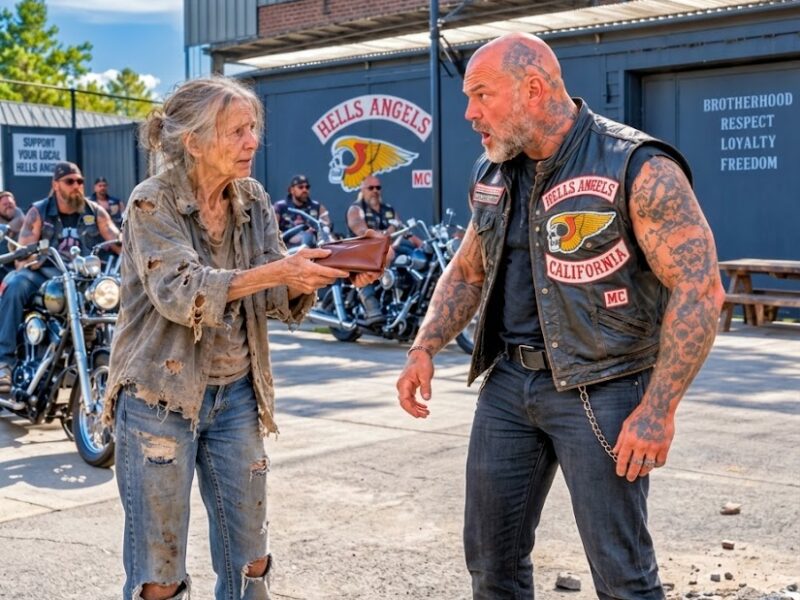
An old homeless lady found a Hells Angel’s wallet on the street. Inside was thousands of dollars. She could have kept it. Nobody would have known. But she returned every single dollar — and what he did next changed both their lives forever.
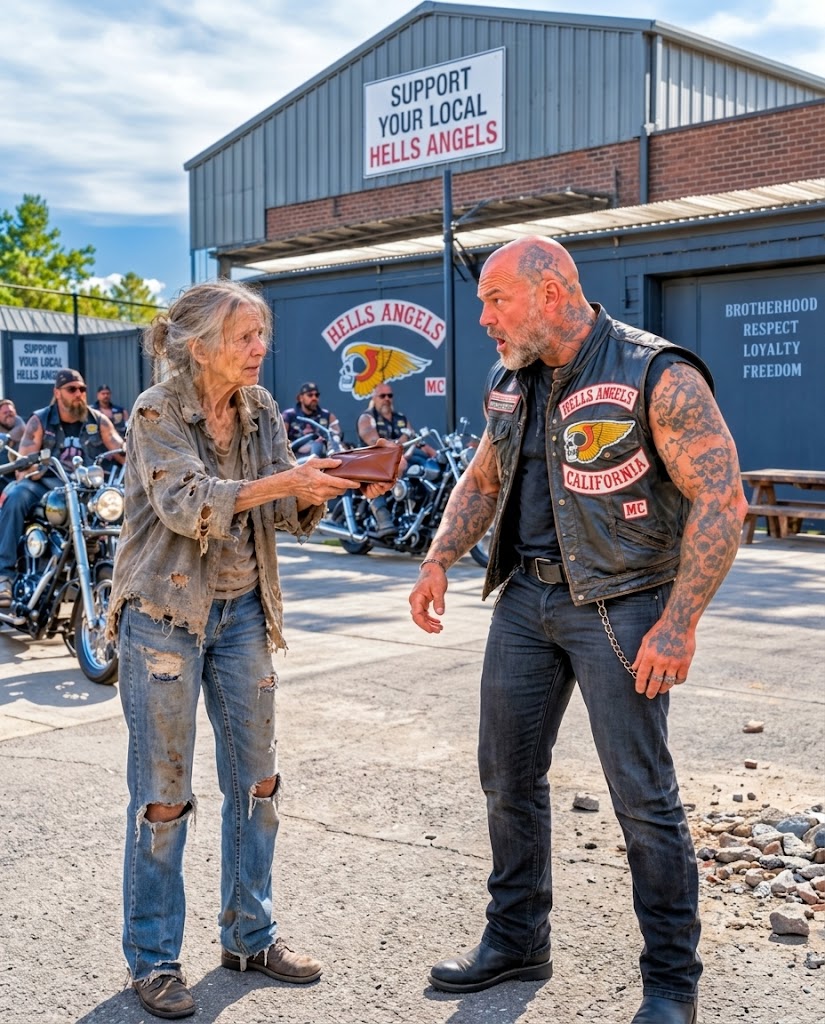
A boot heel came down on a paper cup and crushed it flat against the pavement.
Coffee splashed across a woman’s shoes.
She didn’t flinch.
A man shoved past her laughing and knocked her shoulder hard enough to spin her half around.
Her one-eyed dog growled low beside her.
Somebody told her to move along, to get her filthy blanket off the sidewalk.
She bent down instead and picked something up off the wet concrete.
A wallet.
Thick black leather, heavy with cash and folded bills.
It had fallen from the pocket of a big man walking away.
Thick neck, gray beard, leather cut across his back.
Her name was Estelle Vance, though the street called her Birdie, and she hadn’t eaten since yesterday.
She had every reason to keep it.
What she did next would bring 3,500 engines to her door.
Stay with me on this.
Now here’s the thing you have to understand about Birdie Vance.
She was 71 years old and she weighed about as much as a wet coat.
She’d been sleeping under the Route 58 overpass on the edge of Bakersfield for going on two years, ever since the bank took the little house she and her husband Raymond had paid on for 30 years.
Raymond died in the spring.
The house went in the fall.
And by that first cold November, Birdie had learned every hard lesson the street teaches.
She kept exactly three things that mattered.
A photograph of Raymond in his navy whites.
A tin box with $41 in it, which was everything she had in the world.
And Domino, the dog who had shown up under the overpass one night, half starved, one eye gone milk white and blind.
Birdie had split her last can of beans with him, and he never left after that.
People crossed the street to avoid the both of them, and Birdie had stopped minding.
Mostly.
So there she was outside the Flying J truck stop on that freezing morning, holding a stranger’s wallet.
And believe me, $41 against what was in that leather, it wasn’t even close.
She opened it just to see.
She saw the cash, sure.
But she also saw a photo behind a cracked plastic window.
An old woman in a Sunday dress, squinting into the sun, holding a baby.
Somebody’s mother.
Somebody had carried her in his pocket for years, from the look of the worn edges.
Birdie looked up.
The big man was already half a block gone, walking heavy toward the far lot where the motorcycles were parked.
And Birdie did a thing that made no sense at all for a woman in her position.
She grabbed Domino’s rope, and she went after him.
Three blocks.
That’s how far she chased him.
She was slow.
She crossed against the light on Union Avenue, and a delivery truck laid on its horn and swerved, and a man screamed something ugly out the window, and she kept going.
She called out.
Her voice didn’t carry.
She called out again, louder, and this time the big man stopped and turned around.
And here’s where a lot of folks would have run the other way.
Because up close, Colt Rennick was a frightening thing to look at.
Six-foot-four easy.
Gray beard down to his chest.
A scar that pulled one corner of his mouth into a permanent sneer.
Hands like a pair of bricks.
He had a look that made grown men suddenly remember somewhere else they needed to be.
Birdie held the wallet out in both hands.
“You dropped this,” she said.
“Back at the truck stop.”
“It’s all there.”
“I didn’t take nothing.”
Colt didn’t move for a second.
He just looked at her.
This little bent woman with a rope in one hand and a busted-up dog at her feet, holding out a wallet fat enough to feed her for a month.
He took it slow.
He opened it and counted, right there in front of her, and Birdie let him because she understood why a man would.
Every bill was there.
And behind the cracked plastic, his mother squinted into a sun that had gone down 40 years ago.
He looked at her shoes, soaked through, and her coat cinched with clothesline.
He’d seen a thousand people cross the street to get away from him.
He’d never once seen the poorest person on a block chase him three blocks in traffic to hand him back a fortune.
“Why?” he said.
It wasn’t really a question.
It came out rough, like he didn’t use his voice much.
Birdie shrugged.
“Wasn’t mine,” she said.
Like that settled it.
Then she nodded at the wallet.
“The lady in the picture, that your mama?”
Something moved across Colt’s face that hadn’t moved there in a long time.
“Yeah,” he said.
“She’s got a kind face,” Birdie said.
And she gave him a little nod, and she pulled gently on Domino’s rope, and she turned to go back the way she’d come.
She didn’t ask for anything.
That’s the part that got him.
She never asked for one thin dime.
Colt pulled the cash out, all of it, a thick fold of twenties and hundreds, and took two long steps.
“Hey, wait.”
Birdie looked back, and she saw the money in his hand, and she did something else that made no sense.
She shook her head.
“I didn’t do it for that,” she said.
And she kept walking.
Colt stood in the middle of that lot with a fistful of money and his dead mother’s photo and no idea what to do with either one.
He watched until the old woman and the one-eyed dog disappeared under the far end of the overpass.
He watched exactly where she went.
Then he sat there a long while thinking.
Because Colt Rennick had spent a long, hard life learning that people were mostly out for themselves, and a 71-year-old woman with nothing had just proved him wrong in the space of ten minutes.
And that was going to sit with him.
What Birdie didn’t know was that the patch on the back of that leather cut wasn’t just for show.
Colt Rennick wasn’t some weekend rider.
He was a chapter officer with the Iron Saints Motorcycle Club, 22 years in.
And when a man like that decides he owes you something, the whole world is about to tilt on its axis.
Birdie went back to her cardboard and her $41, and she figured she’d never see the big man again.
She had no idea the ground was already shifting under her feet.
That afternoon, it started to shift for real.
And not the good way.
Not yet.
Around four o’clock, a white pickup and a black SUV pulled up on the frontage road above the overpass, and three men got out.
Birdie knew trouble when she saw it walking.
The one in front was a soft, pink man in a golf shirt and pressed jeans.
A man who’d never done a hard day’s labor, but liked to stand near men who had.
His name was Del Pruitt.
He owned half the empty lots along that frontage road, and he had plans for the land under the overpass.
Parking.
A storage yard.
Money.
And the ragged little camp of tents and cardboard was in the way of it.
“This is private property now,” Pruitt announced, though it wasn’t, not exactly.
“You people need to clear out.”
“Today.”
He had two men with him for muscle, big fellows in work boots, the kind you rent by the afternoon.
One of them was already kicking at the milk crates Birdie used for a table.
There were maybe six people living under that overpass.
An old vet named Sanchez.
A young couple.
A man everybody called Preacher who wasn’t one.
They’d all gone quiet the way you do.
But Birdie was closest to the road and that made her the first target.
The bigger goon walked straight up to her cardboard lean-to and put his boot through it.
Flattened it.
Birdie’s tin box spilled across the concrete and she went scrambling after the bills on her hands and knees while Pruitt laughed and told her to hurry it up.
Domino did not care for that.
The dog put himself between Birdie and the men, hackles up.
That one good eye locked on them.
A growl coming up out of his chest like a truck downshifting.
And the second goon drew back his boot and caught Domino square in the ribs.
The dog yelped and went down and rolled and Birdie screamed.
An awful thin sound and threw herself over him.
“Please,” she said.
“Please, he’s all I got.”
“Please, don’t.”
Pruitt crouched down in front of her, careful not to get his nice jeans dirty.
“Then take the mutt and get gone,” he said.
“You’ve got till morning.”
“Six a.m. sharp.”
“I’ve got a crew coming and a machine coming.”
“And I do not want to see one scrap of this garbage still here.”
He smiled.
“Nobody’s coming to help you, sweetheart.”
“Nobody ever does.”
And here is the terrible quiet truth of that moment.
He was right.
Birdie was on her knees in the cold with her dog trembling under her, and her last dollars blowing down the frontage road.
And there was not one soul in the world who was going to stand between her and that man.
That’s how it always looked out there.
The men got back in their trucks and peeled out slow, letting the tires spit gravel, because that’s the kind of men they were.
And the camp went dead silent.
Sanchez helped Birdie chase down two of her bills.
Preacher righted her milk crates without a word.
And Birdie sat on the cold ground with Domino’s head in her lap, checking his ribs with shaking fingers, telling him he was all right, telling him they’d figure it out.
And that right there is where it should have ended.
A cold woman, a hurt dog, a morning coming that was going to take even the concrete out from under her.
That’s the story the street tells a thousand times a night, and nobody ever hears about it.
But then, a little after nine o’clock, headlights swung under the overpass.
Not a truck.
A single motorcycle, its engine low and heavy.
And Birdie’s stomach dropped, because she thought they’d come back.
She held Domino tight.
The bike rolled to a stop, and the engine cut.
And a big man swung his leg off and stood up.
And the street light caught a gray beard and a scar.
It was cold.
He walked over slow and crouched down in front of her, except it was nothing like the way Pruitt had.
He had a paper sack in one hand.
He set it down.
Inside was a foil container still warm, a real dinner, meat and potatoes, and a second one smaller that turned out to be plain chicken and rice.
For the dog.
Colt said gruff, like he was embarrassed.
He’d noticed the dog.
Of course he had.
Birdie didn’t know what to say.
She’d been braced for the world to hurt her again.
And instead a frightening stranger was handing her a hot meal in the dark.
Colt looked at the flattened cardboard, at the boot print in the middle of it, and something in his jaw went tight.
“Who did this?” he said.
She told him.
Pruitt.
The machine.
Six in the morning.
Domino’s ribs.
The $41.
She hadn’t meant to tell him all of it, but it came out, the whole day.
Because it turned out she hadn’t had a single person to tell it to in two years.
And here was somebody kneeling in the dirt actually listening.
When she got to the part about the boot and the dog, his hands closed slow into fists and opened again.
He reached out and gentle as anything felt along Domino’s ribs the way a man does who’s known hurt animals.
“Not broke,” he said.
“Bruised.”
“He’ll be sore a few days.”
Domino, who trusted approximately no one, let him do it.
Even licked his wrist once.
Dogs know.
They sat there a long while.
Colt fixed her lean-to, wedged the cardboard against the concrete pillar so the wind couldn’t get under it, and put his own heavy canvas jacket around her shoulders before she could argue.
Birdie ate.
Domino ate.
And for a little bit in the dark, it felt like the danger had gone away.
It felt, honestly, like maybe the worst was over.
Birdie let herself believe it.
She was warm for the first time in a week, her dog was fed, and a decent man was sitting three feet away, and she thought, “We’ll manage.”
“We always manage.”
She had no idea what was coming with the dawn.
Neither did the world.
It was the word morning that did it.
Because as Colt stood up to go, Birdie thanked him, and she said it soft and tired, “We’ll be all right till morning.”
And she saw his face change.
She saw him remember.
Six a.m. sharp.
A crew and a machine.
He’d let the real thing slip, and now it landed on him all at once.
“Say that again,” Colt said.
“About the machine.”
“What time?”
“Six,” Birdie said.
“He’s got papers.”
“A deputy’s coming to make sure we go.”
“He said it’s all legal.”
And that word legal, it changed everything.
Because you can stand up to a bully, but Pruitt wasn’t just a bully anymore.
He had the county behind him.
He had paper and a badge and a bulldozer, and that’s a whole different animal than a fat man with two rented goons.
This wasn’t about one cruel person now.
This was the machinery of the whole world grinding toward one old woman, and it had the law riding shotgun.
Colt asked her for the papers.
She had them crumpled in her coat.
He read the demolition notice by the light of his phone, slow, his lips moving a little.
Pruitt Holdings.
A permit number.
A time.
And down at the bottom, a line about the removal and impound of any animals on site to be turned over to county animal control.
Colt read that part twice.
Then he looked at Domino, asleep now against Birdie’s leg, ribs sore, trusting the world for the first time in a long while.
Come morning, the law was going to take him and put him in a cage.
And a 14-year-old one-eyed shepherd with bruised ribs does not come back out of a county cage.
They both knew what that meant, even if neither of them said it.
Something settled over Colt Rennick’s face then.
Not anger, exactly.
Anger’s loud.
This was quiet, and it was worse.
It was a decision.
“Miss Birdie,” he said, “I need you to listen to me now.”
He crouched back down so they were eye to eye.
“You gave me back my mother’s picture today.”
“You had nothing, and you gave it back, and you wouldn’t take a dime for it.”
“Do you know how long it’s been since somebody did something like that for me?”
His voice cracked just slightly and he let it.
“You are not going to stand out here alone tomorrow.”
“Not you.”
“Not that dog.”
“You’ve got my word.”
And Birdie, God love her, she didn’t understand.
“You’re one man,” she said kind, not wanting to hurt his feelings.
“Against the county?”
“Against all that?”
“What can one man do?”
Colt actually smiled then.
That scar pulled his mouth crooked, but it was a real smile, maybe the first one Birdie had seen out of him.
“I’m not one man,” he said.
And he tapped the patch on the front of his cut.
The little rocker that said his club, his chapter, his office.
“I’m an Iron Saint.”
“And where I go, a whole lot of people follow.”
He stood up.
“Get some sleep.”
“Keep my jacket.”
“I’ve got some calls to make.”
Now, if you’re still with me, and I hope to God you are, because this is where it turns, do me one favor.
Hit that subscribe button.
Not for me.
For every Birdie out there who ever handed back a wallet nobody would have blamed her for keeping.
Let’s get this story in front of the people who need to hear it.
All right.
Back to the overpass.
Colt walked out from under Route 58 and made the first call from the frontage road.
It was to a man named Tank, the chapter president, and it lasted about 90 seconds.
Then Tank made calls.
And those men made calls.
Because here’s the thing about a motorcycle club that’s been around 40 years and spread across three states.
It’s not a phone tree.
It’s a nervous system.
You touch it in one place and the whole thing lights up at once.
By ten o’clock that night, the Bakersfield chapter knew.
By eleven, Fresno and Barstow.
By midnight, it had jumped the mountains into the desert.
Run north up the valley to Modesto and Stockton and crossed the line into Nevada and Arizona.
And the message was the same everywhere it went, short and plain.
A brother’s mother’s photo.
An old woman with nothing who chased him three blocks to give it back.
A fat man with a bulldozer coming at six a.m. to take her dog and flatten what little she had.
Riders needed.
Bakersfield.
Route 58 overpass.
Dawn.
That’s all it took.
Because there is a code among these people.
You do not touch the ones under our protection.
And Birdie Vance, without knowing it, without asking for one single thing, had put herself under it the moment she handed back that wallet.
The whole desert was rolling before she ever woke up.
Birdie slept under Colt’s jacket with Domino curled against her.
And she did not hear the first engine start 40 miles out, then 80, then 200, men pulling their boots on in the dark all over the Southwest.
And she slept.
And the sound came for her the way weather comes.
Del Pruitt showed up at ten minutes to six and he was in a fine mood.
He had his white pickup and a flatbed hauling a compact excavator, yellow and mean-looking, and a sheriff’s deputy in a county cruiser rolling along behind.
He had his two goons from the day before and a photographer, too.
Some kid paid to document the site clearance.
He climbed out into the gray morning, looked under the overpass, and saw the old woman standing there in the canvas jacket holding her dog, and he smiled because in Del Pruitt’s whole life things like this had always gone exactly the way he wanted.
“Time’s up, sweetheart,” he called out.
“You should have left last night.”
“Deputy, if you do the honors, and somebody grab that animal.”
“It’s got to go to the county.”
That’s when he noticed the sound.
It had been there for a minute already, under everything low, like a train that never quite arrives.
Now it was getting louder.
Pruitt turned toward the frontage road and the deputy stood up out of his crouch, and the two goons stopped where they were.
Because up on the overpass and down the frontage road and along Union Avenue in both directions, headlights were appearing.
Not two or three.
Not a dozen.
They came over the rise and kept coming, a river of white light and chrome, and the sound rolled ahead of them and filled the whole underpass and shook grit down off the concrete, and it did not stop.
For two full minutes the bikes kept pouring in.
Rank after rank until they filled the frontage road bumper to bumper in both directions as far as anyone could see.
And they filled the lot.
And they lined the overpass above.
And still more were arriving.
3,500.
That was the count the newspaper landed on later.
And even that was a guess because nobody could hold still long enough to count them all.
3,500 engines.
And then all at once, at some signal Birdie never saw, every one of them shut off.
The silence after was the loudest thing she’d ever heard.
Out of that silence, one big man walked forward.
Gray beard.
Scar.
Leather cut.
Colt Rennick crossed the empty ground between the bikes and the bulldozer.
And he stopped square in front of Del Pruitt.
And behind Colt, without anybody saying a word, a wall of men and women got off their bikes and formed up.
They didn’t shout.
They didn’t rush.
They just came and stood shoulder to shoulder.
A solid line of leather across the whole mouth of that underpass between the excavator and one old woman.
And they folded their arms and they waited.
Pruitt’s face had gone the color of paper.
“This is, this is private property,” he said, and his voice came out high.
“I have a permit.”
“I have a deputy right here.”
“You people are trespassing.”
Colt looked down at him.
“This lady found my mother’s photograph in a wallet I dropped,” he said, and he said it loud so the deputy could hear, so the photographer could hear, so all 3,500 could hear.
“She had $41 to her name, and she chased me three blocks in traffic to give it all back.”
“Every dollar.”
“And yesterday you put your boot through her home, and your man kicked her dog.”
He turned to the deputy.
“That true, deputy?”
“You here to help this man take a 71-year-old widow’s dog to be put down, so he can build a parking lot?”
The deputy had already taken his hand off his belt.
A young man looking at 3,500 people and one crying grandmother and one shaking dog doing the math on which side of this he wanted to be remembered on.
“I’m just here to keep the peace,” he said carefully.
“Mr. Pruitt, you got a permit for the structure.”
“You do not have any order that lets your men lay hands on a person or an animal.”
“And from where I’m standing, that looks like an assault complaint waiting to happen.”
He nodded at the photographer, whose camera was going the whole time.
“Plenty of witnesses.”
Pruitt’s mouth opened and closed.
He looked at his two goons.
They were looking at the wall of leather, and they had gone very small, and one of them was already edging back toward the truck.
There would be no help there.
And then Colt Rennick did the thing that Birdie tells people about to this day, when she can get through it without her voice breaking.
He turned his back on Pruitt, like the man wasn’t worth another second.
He faced the club.
And he took off his hat and he called out, “Brothers and sisters, you know why we came.”
And he reached inside his cut and pulled out that same fat black wallet.
And he pulled out every bill in it.
And he dropped them one by one into the hat.
Then he walked the line.
And down that whole wall of 3,500 people, hands went into pockets.
Twenties, fifties, hundreds.
A man pulled off a gold ring and dropped it in.
A woman put in a roll of bills that would choke a horse.
The hat filled and they passed a saddle bag and it filled and they passed another.
It took 20 minutes.
Nobody rushed it.
They just walked up one after another and gave.
Birdie stood there under Colt’s jacket with both hands over her mouth and Domino pressed against her legs.
And she watched thousands of strangers empty their pockets for a woman they had never met and would never see again.
And she could not make a sound.
When it was done, Tank, the chapter president, a mountain of a man with a white braid down his back, carried the saddle bags over and set them down in front of Birdie.
And he took a knee so he wasn’t towering over her.
“Ma’am, there’s near a hundred and forty thousand dollars there.”
“It’s yours.”
“Free and clear.”
He nodded back at the club.
“And that’s not the good part.”
He grinned.
“The good part is Pruitt over there owns three empty houses on Kern Street he can’t sell, and one of our brothers made him an offer this morning.”
“He was real motivated to take.”
“You’ve got keys coming, Miss Birdie.”
“The house?”
“A real one with a door that locks and a yard for that dog.”
“Paid for?”
“Done.”
Del Pruitt did not build his parking lot.
He was leveraged up to his eyeballs and by nine that morning in front of a photographer and 3,500 witnesses and a deputy taking notes, he sold one of his dead weight properties for a dollar over what he owed on it just to make the whole thing go away.
The excavator went home on its flatbed without turning a wheel.
The two goons were gone before the collection even finished and Pruitt himself climbed into his white pickup and pulled out slow, except this time nobody let him spit gravel.
The bikes were packed too tight around him for that.
He had to crawl out through a canyon of leather and chrome past 3,500 faces that watched him go without a word, and that silent crawling exit is the one the town remembered.
The man who came to bulldoze a grandmother creeping out through the people who wouldn’t let him.
The house on Kern Street was small and yellow and needed paint, and Birdie Vance cried when she stood in the front room of it because the last time she’d stood in a room that was hers, Raymond had been alive.
The club fixed the paint.
Somebody’s brother was a roofer and patched the roof for the cost of the shingles, which is to say for nothing.
Somebody’s sister ran a furniture store, and a truck showed up with a bed and a couch and a kitchen table with four chairs because, she said, “A table needs to be ready for company.”
They put a fence around the little backyard so Domino could lie in the sun, and the vet checked his ribs for free, and that old one-eyed dog got fat and slow and happy, which is all any of us can hope for in the end.
The $140,000 went in the bank, and Birdie, who had made $41 last for two years, was not about to be foolish with it.
But she did two things right off.
She bought a good granite headstone for Raymond’s grave because he’d been in a plain marker, and it had bothered her every single day.
And she started cooking on Sundays.
Big pots of it.
Because there were still folks under the Route 58 overpass, and Birdie had not forgotten one minute of what it was to be cold and hungry and stepped over.
Every Sunday, rain or shine, that yellow house filled up with people who had nowhere else, and they ate at a table that was ready for company.
And Colt Rennick came around.
He’d pull up on that heavy bike a couple times a week and sit at Birdie’s kitchen table and drink coffee and let Domino sleep on his boots, and the two of them would talk about nothing much.
He brought his mother’s photograph over one afternoon and set it on Birdie’s mantel next to Raymond’s navy portrait, and he said he figured his mama would rather live somewhere warm than ride around in his pocket, and Birdie said she’d be honored to have her.
And neither one of them could quite look at the other for a minute after that.
He never talked much, Colt.
But he’d found the one person on Earth who didn’t need him to.
People ask Birdie, now that the story’s gotten around, if she’d do it again.
$41 to her name, hungry, cold, and a fortune sitting in her hands with nobody watching.
Would she give it back, knowing what it cost her to chase that man three blocks?
And Birdie always looks at whoever’s asking like they’ve lost their mind a little.
“It wasn’t mine,” she says.
Same as she said to Colt in that parking lot.
Like it’s the simplest thing in the world.
And maybe it is.
Maybe that’s the whole thing right there, and the rest of us just make it complicated.
She thinks about that first morning sometimes.
The boot coming down on the paper cup.
The man shoving past, laughing.
Somebody telling her to move her filthy blanket.
To move along.
Because nobody was coming and nobody ever does.
She’d believed that, too, for two hard years.
And then 3,500 engines had come over the rise in the gray dawn.
And stood a wall of strangers between her and the machine.
All because she’d done the one small right thing when it would have been so easy to do the wrong one.
Domino died two winters later, old and warm and full, asleep in the sun in his own yard.
Colt dug the grave himself, out back by the fence, and he didn’t say much because he never did.
Birdie planted a rosebush over it.
She’s still in the yellow house.
The table’s still ready on Sundays.
And somewhere in a drawer she keeps a canvas jacket three sizes too big that a frightening-looking man put over her shoulders one cold night when she thought the whole world had forgotten she was alive.
It hadn’t.
That’s the thing she’d want you to know.
It hadn’t forgotten.
It was just waiting for somebody to remind it who we’re supposed to be.
And it turned out to be the poorest woman on the block holding out a wallet in both hands saying the only thing that ever really mattered.
It wasn’t mine.









