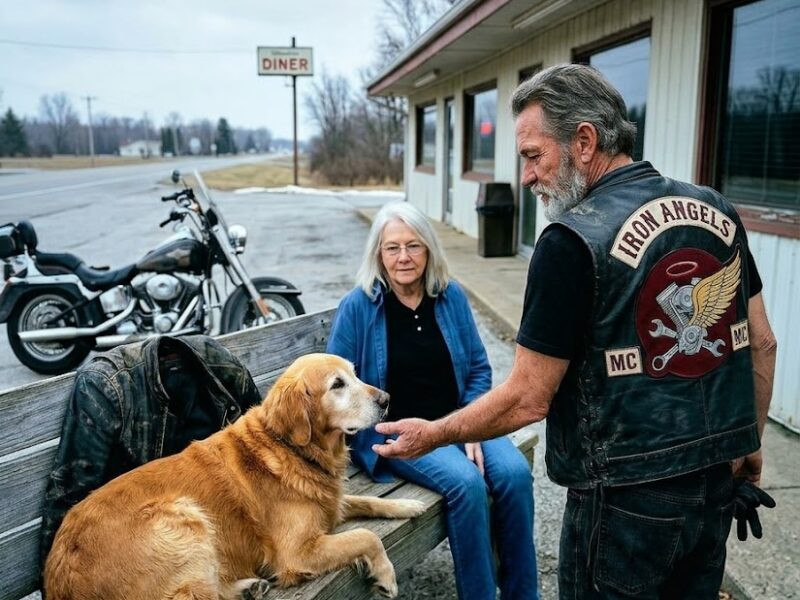
An Iron Angel found an old woman alone outside a diner in the freezing cold. Then he recognized her jacket—and froze.
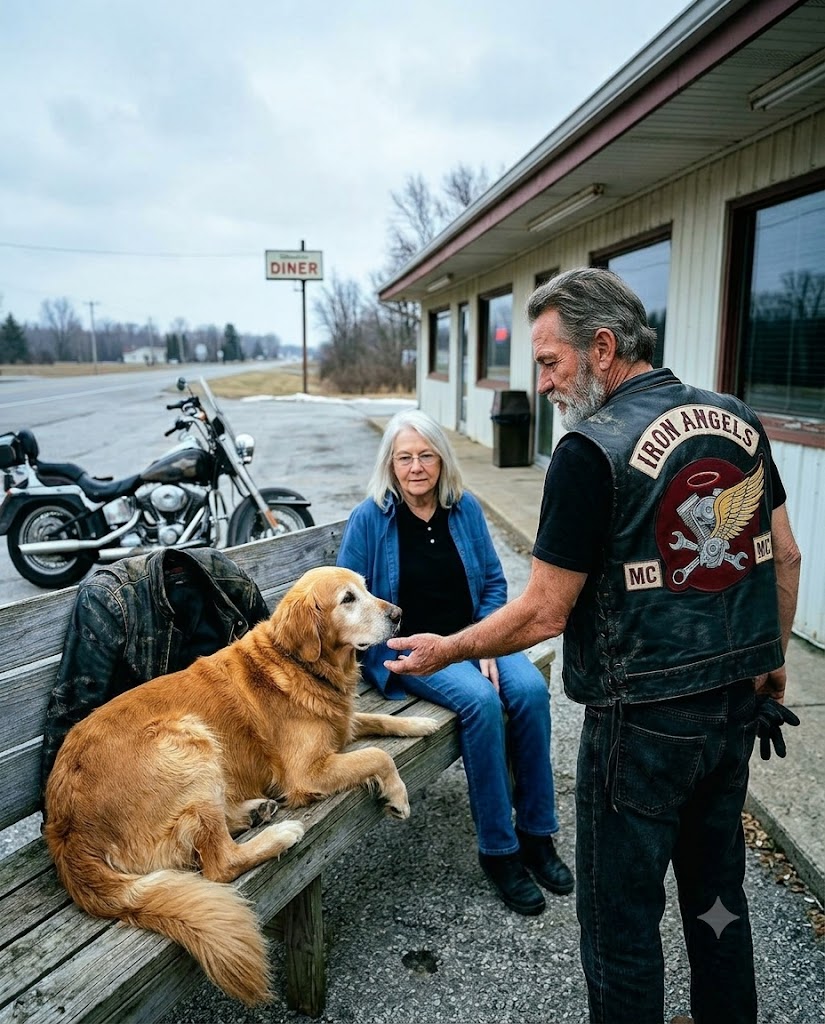
The engine of Forge’s motorcycle had gone quiet for almost a minute before he noticed the dog.
It was a cold afternoon on a two-lane highway, the kind of gray daylight that made everything look a little older than it was.
He’d only meant to stop for coffee.
The diner sign was half lit, buzzing every few seconds like it couldn’t decide whether to keep working.
Outside, on a wooden bench, an elderly woman sat with a golden retriever resting against her leg.
Draped over the back of the bench was an old black leather motorcycle jacket.
Forge noticed the dog first.
Then he noticed the patch on the jacket.
Faded but unmistakable.
He slowed his bike without deciding to.
He turned around without deciding to.
Some part of him had already recognized what his mind hadn’t caught up to yet.
He walked closer.
It was the Iron Angel’s patch, the same as the one on his own back.
But that wasn’t what made him stop breathing for a second.
It was the repaired tear near the shoulder seam.
It was the small brass snap missing from the left pocket.
The one that had never been replaced because the man who wore it never bothered to fix small things.
It was Daniel’s jacket.
Daniel Vance had disappeared from Forge’s life in 1988.
For 38 years, Forge had believed his brother walked away because he wanted to.
Officially, after enough years passed without a word, people had simply started saying he was gone.
Forge had never used the word dead out loud.
He’d just stopped saying Daniel’s name.
He approached the bench slowly.
The dog lifted his head, studied him with the calm patience of an old animal who had seen plenty of strangers, and wasn’t impressed by many of them.
Forge held out a hand, more out of habit than confidence.
The retriever rose, walked forward, and pressed his head against Forge’s chest like he’d done it a hundred times before.
Forge went still.
The woman on the bench didn’t look surprised.
She watched him the way someone watches a scene they’ve been expecting for a long time.
“Where did you get that jacket?” Forge asked.
“Daniel gave it to me,” she said.
He didn’t say anything for several seconds.
It wasn’t the kind of silence that comes from shock.
It was the kind that comes from a door opening that a man has spent decades keeping shut.
“I’ve been waiting for you,” the woman said.
She didn’t explain what she meant.
Forge looked at the jacket again, at the dog now sitting calmly at his feet, and understood that whatever this woman knew, it was going to change something he’d built his whole adult life around not asking about.
The last time Forge had seen his brother, he’d been 28 years old.
He hadn’t said Daniel’s name out loud in longer than he could remember.
Forge sat down across from her instead of leaving, which surprised him more than it seemed to surprise her.
The dog settled at his feet like it belonged there.
“Buddy,” she said, nodding toward the retriever. “He’s a good judge of people.”
She introduced herself as Marin Lawson.
She said Daniel had come to this diner for years, long before Forge had any reason to imagine his brother still existed anywhere at all.
She remembered small things, that Daniel ordered coffee and let it go cold while he talked, that he always sat facing the door, that he asked about a younger brother named Rey more times than she could count.
Forge’s given name was Denton, but almost nobody used it.
Almost nobody but Daniel ever had.
You might be thinking of someone else, Forge said, though he didn’t fully believe it himself.
Marin shook her head.
She knew details a stranger couldn’t have known.
The way Daniel talked about the club before Forge was old enough to understand it.
The fact that Daniel never once spoke badly about his brother, not in all the years she’d known him.
That last part sat wrong in Forge’s chest.
It contradicted the story he’d told himself for half his life, that Daniel had grown tired of dragging a kid brother around and left because freedom was easier than family.
For 38 years, Forge said quietly, I thought he left because he wanted to.
Marin didn’t correct him.
She let the silence sit there heavy and unfinished.
And somehow that was worse than an argument would have been.
You don’t know the story your brother left behind, she finally said.
Before Forge could ask what she meant, she reached into her handbag.
He expected another photograph.
Instead, she pulled out an old envelope with his name written across the front in handwriting he hadn’t seen in decades.
Forge didn’t open the envelope.
Not yet.
He set it on the table like it might do something unpredictable if he touched it wrong.
He thought instead about who Daniel used to be.
Daniel was seven years older, and for most of Forge’s childhood, that gap felt like a canyon.
Daniel taught him to ride on an old dirt bike behind their uncle’s property.
Daniel was the one who first brought him around the brotherhood back when Forge was young enough that the older bikers still called him kid instead of using his name.
It wasn’t a simple relationship.
Daniel was protective in a way that sometimes felt like control.
He had opinions about who Forge should spend time with, what decisions he should make, how fast he should grow up.
Forge, in turn, spent his early twenties trying to prove he didn’t need supervision anymore.
Their worst argument happened in early 1988.
Forge didn’t remember every word of it, but he remembered the shape of it.
Forge wanting to make his own choices.
Daniel convinced his brother was walking toward something dangerous.
Neither of them backed down.
Daniel disappeared not long after.
No explanation followed it.
No note, no phone call, nothing that gave the moment an ending.
Rumors moved through the club for a while.
Some brothers thought he’d simply had enough and started over somewhere else.
Others thought something worse had happened to him.
Eventually, the rumors quieted, the way rumors do when nobody has new information to add to them.
Forge stopped asking.
It was easier to believe his brother had chosen to leave than to keep wondering if something had happened to him and no one would ever know.
Anger was simpler than grief.
He built a life around that simplicity, disciplined, private, a man who didn’t talk about family because family for him had become a subject with no comfortable answer.
Marin watched him work through all of it without saying a word.
When he finally looked up, she continued.
“He didn’t visit because he needed anything,” she said. “He checked on me and my husband, that was all. Just showed up some Thursdays, sat right about where you’re sitting.”
She told him something Daniel had said once years earlier in that same seat.
“My brother thinks I left him.”
Forge’s face changed when she said it.
Not dramatically, just enough that Marin noticed.
He knew, Forge said. He knew I thought that and he stayed away anyway.
Then why didn’t he come home? he asked.
Marin didn’t answer that one.
Not yet.
He gave me the jacket years after he disappeared, Marin said. Told me to keep it somewhere safe. Told me not to hand it to you just because someone showed up claiming to know him. He needed to know you were ready before you ever heard any of this.
Forge felt his jaw tighten.
Even from wherever he’d been all these years, Daniel had still been making decisions for him.
That was his call to make, not mine.
Marin didn’t defend it.
She just kept going.
She nodded toward the dog resting near Forge’s boots.
“Buddy had belonged to Daniel first,” she explained.
Daniel found him as a stray puppy behind a gas station and couldn’t bring himself to leave him there.
Eventually, when Daniel’s life got complicated, Buddy became part of Marin’s household instead.
But the Thursday visits never stopped.
Not for years.
Buddy learned the routine the way dogs learn routines.
Not through explanation, just repetition.
Even after the visits became less frequent, the dog kept waiting by the door on Thursdays, long after there was any reason to.
I’m not saying he remembers everything, Marin said when she saw the skepticism on Forge’s face. I’m saying he remembers waiting.
That framing settled something in Forge that he hadn’t expected to need settling.
It wasn’t magic.
It was just a dog who’d learned that someone used to come and never fully unlearned it.
Forge decided he didn’t want to sort through the rest of this alone.
He asked Marin if she’d come with him to the clubhouse.
The moment Denton Price, the brothers all still called him Deacon, saw the jacket, something shifted behind his eyes.
He was the oldest active member left, 72 now.
And he’d known Daniel personally back before Forge was even patched in.
Daniel didn’t abandon the brotherhood, Deacon said.
Then what did he do? Forge asked.
Deacon exhaled slowly like a man setting down something he’d been carrying a long time.
He explained that Daniel had discovered back in ’88 that a former associate of the club had been using the Iron Angel’s name to intimidate people in local business disputes.
Nothing tied to any grand conspiracy, just a man leveraging fear that didn’t belong to him.
Daniel worried that confronting it publicly, especially with Forge as hot-headed and impulsive as he was at that age, would drag brothers who had nothing to do with it into the mess.
So Daniel stepped back from the club and quietly worked to undo the damage from a distance without ever explaining why to the one person who most deserved an explanation.
Forge didn’t feel relief hearing it.
He felt something closer to fresh anger.
He spent 38 years deciding what I could handle.
He said Deacon had no answer for that.
Some decisions made with good intentions still cost people things that couldn’t be given back.
Marin spoke again, quieter this time.
She said Daniel had kept coming back to that diner, not once, not as a passing thing, for years, and every single visit he’d asked about Forge.
Marin handed Forge an old photograph.
Daniel stood outside the diner, Buddy a clumsy puppy at his feet.
In the background, barely in frame, was Forge’s old motorcycle.
Forge remembered that day.
He’d been inside arguing with Daniel, furious enough to walk out and ride off without looking back.
He never knew Daniel had stayed outside afterward.
Never knew his brother had watched him leave.
Marin told him there was more.
A letter written years ago that she’d never delivered.
“He told me not to,” she said before Forge could get angry. “First he told me to give it to you. Then he told me not to. Then later he said only give it to you if you ever asked what really happened.”
Forge sat with that.
It wasn’t the calculated cruelty he’d almost expected.
It was a man who kept changing his mind because he didn’t know how to face what he’d done.
Then Marin told him the part that reshaped everything.
Daniel hadn’t died in 1988.
He’d lived for decades after that, working quietly, staying away from the club, but never fully letting go of the people in it.
Health problems caught up to him later in life.
He died nine years ago.
Forge sat in silence long enough that Marin reached over and rested a hand on his arm.
He had spent nine years mourning a man who’d actually been alive for most of his adult life.
Did he ever try to find me? Forge finally asked.
More times than you know, Marin said.
She explained that Daniel had opportunities, real ones.
He backed away from every one of them.
Pride got in the way.
So did fear.
He didn’t know how to explain thirty years of silence.
And the longer he waited, the harder it became to imagine any explanation being enough.
It didn’t make Daniel a villain.
It didn’t make him a saint, either.
It made him a man who’d let one bad year turn into a lifetime he never meant to build.
What would you have done? Waiting that long for someone to come back. Is there a point where too much time makes an apology impossible? Or is it never too late no matter how many years pass?
Buddy stood up without warning, ears forward, and moved toward the edge of the parking lot.
Marin said he’d never done that before.
He pulled toward an old side road like he had somewhere specific to be.
Forge followed.
Deacon and two other brothers came along.
The road led to a property Daniel had once used as a workshop.
The garage had clearly been abandoned for years, but the door had recently been unlocked.
Nothing about the workshop looked staged.
Dust covered the workbench in a way that couldn’t be faked.
Old tools sat exactly where someone had left them, untouched for years.
On the far wall hung a faded photograph of the Iron Angels, taken long before Forge had joined.
Buddy moved through the space with more confidence than Forge expected, stopping in front of an old metal cabinet like he’d been there before.
Forge opened it.
Inside were boxes, each one labeled with a year.
They weren’t evidence of some hidden operation or secret Daniel had been protecting.
They were evidence of a brother who never stopped paying attention.
Forge went through them slowly.
An old birthday card, never sent, addressed to him.
A photograph of his first motorcycle, the one he’d saved up for over two summers.
A watch still in its box that Daniel had clearly bought but never given him.
A newspaper clipping about work Forge had done years later, cut out and kept.
Handwritten notes about dates that mattered.
Birthdays, anniversaries, the day Forge got patched in.
A photograph of their mother, gone since before either of them were grown.
Something Forge remembered losing as a teenager, quietly repaired and kept safe for decades.
Every item proved Daniel had kept track of his brother’s entire life from a distance.
None of it proved he’d been right to stay away.
Forge understood that distinction clearly, and he wasn’t ready to let it go just because the boxes were full.
Deacon, working through a lower shelf, found a stack of letters, all in Daniel’s handwriting.
None of them ever sent.
He read one, and his voice changed when he spoke.
He was afraid you’d hate him more if he came back.
Forge took the letters and read them alone off to the side while the others gave him room.
Daniel had written that he first believed distance would protect his brother.
Then over time he’d convinced himself Forge was simply better off without him.
Eventually shame took over completely.
Every year of silence made the next year of silence easier to justify and harder to break.
He hadn’t stopped caring.
He’d just gotten trapped inside his own decision, the way people sometimes do when the way back starts to feel farther than the way forward.
Forge didn’t read those letters looking for an excuse.
He wasn’t interested in excusing what the silence had cost him, but for the first time, he understood the shape of it.
Not forgiveness, understanding.
One envelope sat apart from the rest, marked simply, “For Rey, when you’re ready.”
Forge held it for a long moment before opening it.
Daniel didn’t ask to be forgiven inside.
He didn’t try to explain away the years or offer some tidy justification for all the missed birthdays and unanswered questions.
He wrote plainly, the way a man writes when he’s run out of reasons to keep something to himself.
He told Forge that leaving him had never been the same thing as abandoning him.
If you ever find this, Rey, the letter read, don’t spend another day wondering whether I loved you.
Forge sat down right there on the workshop floor.
Buddy came and rested against his leg without being called.
There was no dramatic collapse, no tears that needed describing, just quiet, the kind that follows a question finally being answered after 38 years of carrying it unanswered.
Back at the clubhouse, Deacon admitted something he’d held on to for years.
He had known Daniel was alive.
He’d made a promise to Daniel not to interfere, not to tell Forge, and he’d kept that promise even as the years piled up.
Now he understood that keeping it might have cost Forge decades he could have had with his brother instead.
The older members sat with that, too.
Daniel’s disappearance had become accepted history in the club.
A story everyone repeated without anyone actually knowing the whole of it.
It became clear that Daniel hadn’t just disappeared from Forge.
He’d gradually disappeared from everyone, one relationship at a time, convinced that staying invisible was the same thing as keeping people safe.
It wasn’t.
It never had been.
Forge stood in front of the brothers who remained, the ones who’d known Daniel and the ones who’d only heard his name.
“We didn’t lose him in ’88,” he said.
He let that sit for a moment.
We lost thirty years after that.
Nobody argued with him.
The tragedy hadn’t been Daniel’s death.
It had been every ordinary day in between that neither brother ever got back.
Forge brought Daniel’s jacket back to the clubhouse and refused to have it restored.
The worn leather stayed worn.
The faded patch stayed faded.
The tear near the shoulder, repaired badly by Daniel himself decades earlier, stayed exactly as it was.
He wanted it to remain a reminder of a person, not get turned into some polished symbol of a tragedy.
Marin brought Buddy by not long after.
The old dog walked straight to where the jacket hung, sniffed it once, and settled down beneath it like it was the most natural place in the world to rest.
Nobody in the room laughed.
Nobody made a joke out of it.
Forge sat down on the floor next to him and scratched behind his ears the way Daniel probably had years before either of them ever crossed paths.
Forge didn’t turn into a different man overnight.
That wasn’t how any of this worked.
But something did shift.
He started calling Marin more just to talk.
He stopped flinching away from Daniel’s name in conversation.
He began asking the older brothers what they remembered about his brother, the good and the complicated both.
He let himself tell stories about Daniel again.
Instead of keeping the subject closed the way he had for almost four decades, the brotherhood in turn stopped remembering Daniel as the man who vanished.
They started remembering him as what he actually was.
A flawed, frightened, deeply loyal man who made a mistake he never figured out how to undo.
The lesson wasn’t that Daniel had been perfect.
He hadn’t been.
The lesson was simpler and harder than that.
Love can survive terrible mistakes, but it doesn’t erase what those mistakes cost.
Months later, Marin returned to the same roadside diner.
Buddy was slower now, gray around the muzzle, but he still knew how to find a patch of sun on the pavement and settle into it.
Forge arrived on his motorcycle.
This time, he wasn’t riding alone.
Deacon and several other Iron Angels pulled in behind him, engines quieting one after another in the empty lot.
Marin smiled when she saw them.
Forge walked over and sat beside her.
Buddy lifted his head, recognized him immediately, and rested his head against Forge’s knee like no time had passed at all.
Marin looked out at the line of motorcycles parked behind them.
“Daniel would have liked this,” she said.
Forge looked down at the dog, then reached into his jacket and pulled out the old photograph.
Daniel standing outside this same diner, a puppy at his feet, Forge’s motorcycle just visible in the background.
He turned it over.
On the back in Daniel’s handwriting was a line Forge hadn’t noticed the first time he’d looked.
Someday, Buddy will find his way back to Rey.
Forge didn’t take it as proof his brother had somehow predicted any of this.
He understood it differently.
Daniel had simply spent years hoping the two separated halves of his life might someday meet again.
And somehow, without either of them planning it, they had.
The dog had never really been waiting for Daniel to come back.
He’d been waiting for the person Daniel had spent decades hoping would eventually find his way into the story.
People often judge bikers by what they see first.
The leather, the tattoos, the hard faces, the noise of the engines pulling into a quiet lot.
But a person’s character rarely lives in what’s visible.
It lives in the promise someone keeps without being asked to.
The letter someone almost never sends.
The jacket someone refuses to throw away no matter how many years pass.
The dog that waits by the door for someone who stopped coming because some part of him still remembers.
And it lives in the brother who spent 38 years believing he’d been forgotten only to learn he never was.
Forge never got those years back.
He never got another conversation with Daniel.
Another Thursday, another chance to say what should have been said decades earlier.
But he finally got the one thing he’d spent his entire adult life quietly needing.
Daniel hadn’t stopped loving him.
He’d just been too afraid, too proud, and eventually too late to come home.
—









