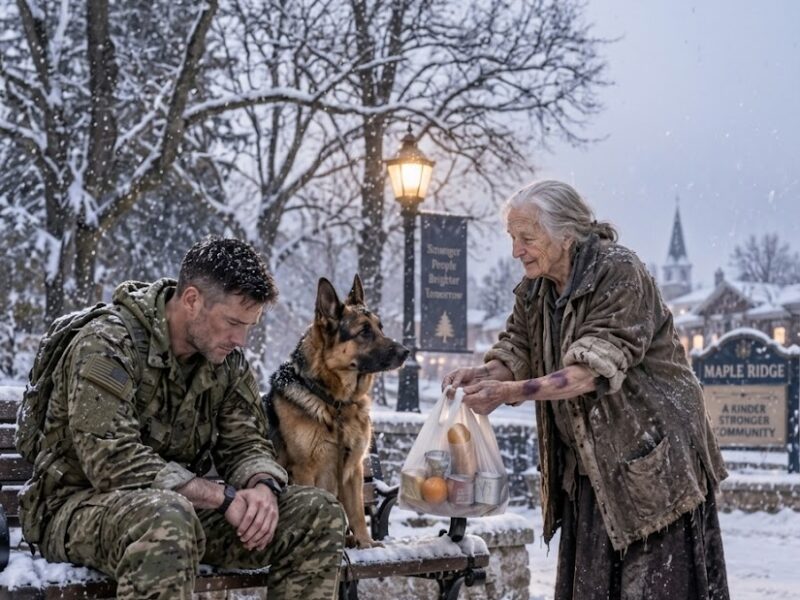
An Injured Elderly Woman Shared Her Only Meal With a Grieving Navy SEAL—Then He Recognized the Recipe
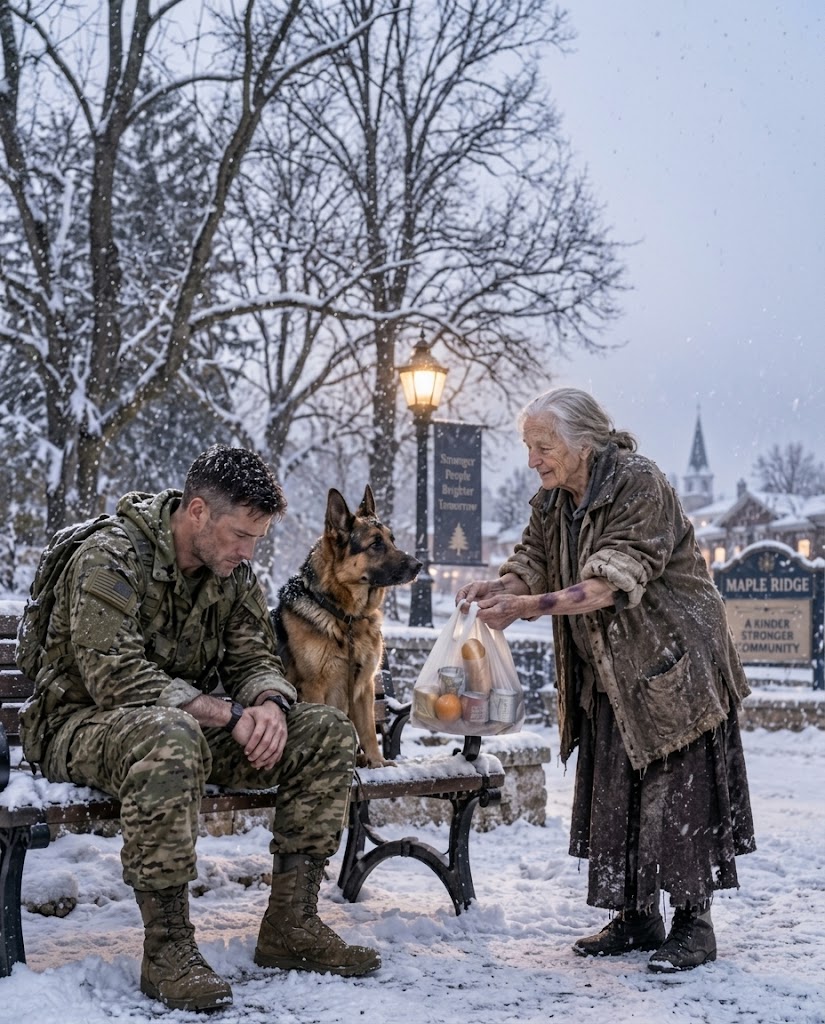
For two years, former Navy SEAL Eli Veiler sat alone by a frozen lake in northern Michigan, grieving his wife and daughter with only his German Shepherd, Orion, beside him.
Then an elderly woman offered him half of her only sandwich, and Orion noticed bruises hidden beneath her sleeve.
When she walked away, Orion ignored Eli’s command and followed her through the snow.
They found her living in a freezing room behind an old boat workshop, abandoned by the family she once trusted.
Eli began helping her survive the brutal winter, but a forgotten photograph soon pointed to a secret buried for years.
What they uncovered could change the old woman’s future and force Eli to decide whether his own life was truly over.
Two years after the accident, the people of Silverpine Reach had stopped wondering why Elias Veiler came to Maple Lantern Park every morning.
They simply knew that he did.
Snow or wind, clear sky or sleet, the old dark blue pickup appeared shortly after 8, rolled slowly through the narrow road beside Lake Alderwin, and stopped beneath the same row of white pines.
Eli would get out first.
At 40, the former Navy SEAL still carried the shape of a man who had spent years treating discipline as something closer to instinct than habit.
He stood 6’1″ with broad shoulders and a firm athletic build maintained through quiet daily exercise rather than vanity.
His face was sharply masculine with angular cheekbones, a straight nose, and a strong square chin that was always clean shaven.
Dark brown hair was kept in a neat undercut, silver beginning to show clearly at both temples.
His gray-blue eyes were deep set and steady, but sadness had settled into them so completely that people who had known him before sometimes found it difficult to remember how easily he used to smile.
Even in winter, Eli dressed with almost military consistency.
A fitted long-sleeved green camouflage shirt, matching camouflage trousers, a black belt, and dark brown combat boots polished well enough to seem strangely formal against the snow.
Grief had taken many things from him.
Order was not one of them.
Orion jumped down from the passenger side.
The 7-year-old German Shepherd was large but lean, built for endurance rather than bulk.
Warm golden-brown fur covered his legs, chest, and flanks, while a deep black saddle ran from his shoulders along his back.
A black mask framed his long muzzle, and amber eyes watched the world with an intelligence that sometimes made strangers uncomfortable.
Both ears stood high and straight.
A thin scar crossed the front of his left foreleg, nearly hidden beneath the fur.
Around his neck was a dark brown leather collar carrying a small metal tag stamped with one word: Orion.
Sophie had chosen the name.
She had been eight when she died.
She had once explained, with the solemn certainty available only to children, that Orion was a hunter in the sky, and therefore obviously knew how to find his way home.
Eli had not corrected her astronomy.
Clare had laughed and told him that correcting an 8-year-old while she was naming the family dog was a good way to spend the night on the couch.
That memory came every morning.
Eli and Orion walked through the park until they reached a wooden bench overlooking Lake Alderwin.
Years earlier, Clare had sat there drinking coffee while Sophie ran along the shoreline, throwing crumbs toward ducks that were usually too far away to notice.
Once Sophie had climbed onto the bench, stretched onto her toes, and announced that she could see Canada.
“You can see a fishing boat,” Eli had told her.
“That boat could be from Canada.”
Clare had laughed so hard that hot chocolate spilled onto her glove.
Now Eli sat in the same place without coffee, without Clare, without Sophie.
Orion lowered himself beside his boots.
The people of Silverpine Reach had tried at first.
Some brought coffee, others offered casseroles.
Men Eli barely knew invited him fishing.
Women from the church left cards at his cabin.
A former teammate called every Sunday for months, even after Eli stopped answering.
Eventually, the offers became less frequent.
Not because the town was cruel.
People simply ran out of sentences.
There were only so many ways to ask a grieving man whether he was doing all right when everyone knew he wasn’t.
By the second winter, some locals had begun calling the place Eli’s Bench.
The name reached Eli once.
He pretended it had not.
That January morning was painfully bright.
Fresh snow covered Maple Lantern Park, and sunlight broke across Lake Alderwin in sheets of silver so sharp that Eli had to narrow his eyes.
Children dragged sleds toward the small hill behind the pavilion.
A couple walked past holding steaming paper cups.
Someone laughed near the parking lot.
Life had the discourteous habit of continuing.
Eli sat with both hands clasped between his knees.
Orion rested his chin over one paw.
Near noon, the dog lifted his head.
A small woman was approaching along the path.
She walked slowly, carrying a cloth shopping bag in one hand and a brown paper sack in the other.
Beatrice Holloway was 78 years old and barely 5’1″.
Age had made her narrow frame smaller without making it fragile in spirit.
Her shoulders curved slightly beneath a worn ash-gray wool coat, and a faded blue scarf was wrapped twice around her thin neck.
A long brown skirt disappeared beneath the coat, meeting thick stockings and old brown winter boots rubbed pale around the toes.
Gray wool gloves covered most of her hands.
Her white hair was thin and gathered into a simple low bun.
Fine wrinkles spread across her pale face, especially around light gray-blue eyes that seemed much more alert than the rest of her tired body suggested.
People around downtown knew Bee.
She collected returnable bottles and cans, repaired things that other people discarded, and somehow managed to make accepting charity feel like a negotiation in which she intended to win.
She stopped beside Eli’s bench.
There was plenty of empty space elsewhere.
She sat anyway.
Eli did not look at her.
Bee did not look at him.
For nearly a minute, they shared the silence like two strangers waiting for a bus that neither intended to board.
Then Bee opened the paper sack.
A sandwich appeared.
Nothing impressive.
Two pieces of wheat bread, cheese, and a thin slice of turkey.
She examined it.
Then she tore it roughly in half.
One half was clearly larger.
She offered that piece toward Eli.
He finally looked at her.
“No.”
Bee studied him as though he had answered a question incorrectly.
“I didn’t ask whether you wanted it.”
“I’m not hungry.”
“That makes two of us.”
She continued, holding it out.
Eli glanced at the bag.
There was nothing else inside.
“This is your lunch.”
“Very observant.”
“Keep it.”
Bee sighed.
“I’m offering a tall man free food. Don’t turn this into another tragedy.”
For the first time that morning, something almost moved at the corner of Eli’s mouth.
Almost.
He still did not take the sandwich.
Bee shrugged.
“Excellent. More for me.”
Then Orion stood.
Eli assumed the smell of turkey had finally defeated the dog’s manners.
“Orion.”
The German Shepherd ignored the sandwich.
Instead, he moved slowly toward Bee.
She smiled down at him.
“Well, at least somebody here understands hospitality.”
She reached to scratch beneath his ear.
Her coat sleeve slid back.
Orion froze.
So did Eli.
Across Bee’s narrow wrist was a dark bruise, fading yellow along one edge, but purple near the center.
The dog lowered his nose toward it.
Bee pulled her hand away too quickly.
Orion’s ears shifted forward.
His amber eyes rose to her face.
Something in his entire posture changed.
Not aggression, not alarm, but attention.
Eli knew that look.
Orion had worn it after Clare came home with a sprained ankle years earlier.
He had worn it whenever Sophie cried behind a closed bedroom door.
The dog noticed what people tried to hide.
Bee tucked her wrist under the opposite sleeve.
Orion did something stranger.
He stepped away from the sandwich and sat directly in front of her, blocking the path as if he had quietly decided that she should not leave.
For several seconds, nobody spoke.
Snow drifted from a pine branch behind them.
Bee looked at Orion, then at Eli.
Her humor disappeared.
Just for an instant, Eli saw something underneath it.
Not fear, exactly.
The practiced exhaustion of someone who had spent too long convincing the world that everything was fine.
Then Bee smiled again.
The door closed.
Eli felt it happen.
He had spent years learning to read people before dangerous situations became worse.
That instinct had dulled beneath grief, but it had not died.
“What happened to your wrist?”
Bee looked down.
“This?”
“Yes.”
“I’m 78. At this age, even furniture wins arguments.”
“You fell?”
“I didn’t say that.”
Eli watched her.
Bee took a bite of sandwich.
Conversation over.
Except Orion apparently disagreed.
He remained sitting near her knee.
Bee glanced at him.
“Your dog is nosy.”
“He usually has reasons.”
“That sounds like something people say before blaming dogs for bad manners.”
Despite himself, Eli almost smiled again.
A gust came across the lake.
Bee shivered.
It was small enough that someone less observant might have missed it.
Eli did not.
“Where do you live?”
Her eyes narrowed.
“You always interrogate women who feed you?”
“You didn’t feed me.”
“Exactly. This relationship is already disappointing.”
She pushed herself upright.
The movement took more effort than she wanted Eli to see.
Her right knee trembled once before steadying.
She gathered the paper sack and cloth bag.
“Thank you for the conversation.”
“We barely had one.”
“My favorite kind.”
Bee started along the northern path.
Orion watched.
Eli remained seated.
The dog rose.
“Orion.”
Orion took three steps after Bee.
“Here.”
The command should have ended the matter.
It always did.
Orion stopped.
He turned toward Eli, then looked back at Bee.
She was already 20 yards away, moving slowly against the wind.
Orion followed her again.
Eli straightened.
“Orion.”
The German Shepherd stopped a second time.
For two years, Orion had stayed with Eli as though proximity itself were a duty.
At night, he slept outside Eli’s bedroom.
At the park, he never moved farther than a few yards.
When Eli disappeared into silence, Orion simply waited.
He had never deliberately chosen another direction until now.
Eli looked at the bench, then at the dog, then at the small gray figure disappearing beyond the snow-covered trees.
He stood.
The movement felt oddly significant.
For months, he had remained on that bench until afternoon shadows stretched across the lake.
Today, he left before noon.
Orion waited until Eli reached him.
Then they followed Bee.
She walked almost a mile beyond the park, leaving the cheerful storefronts and Christmas garlands of downtown Silverpine Reach behind.
Houses became farther apart.
The road narrowed.
At last Bee turned through an old wooden gate.
A large lakeside house stood beyond it, handsome but dark, its windows reflecting the winter sun.
It looked unused rather than abandoned.
Eli expected Bee to approach the front porch.
She didn’t.
She continued around the side.
Behind the house stood a much older wooden structure.
Faded letters above a broad set of doors were barely readable beneath peeling paint: Holloway Boat Works.
One side of the old workshop had been partitioned into a smaller room with its own door.
Bee walked toward it.
Eli stopped.
“You live here?”
Bee turned.
She looked mildly annoyed that he had followed her this far.
“I told you I didn’t live far.”
“You didn’t tell me you lived in a workshop.”
“It has walls.”
Eli studied the building.
Weathered boards, a patched section of roof, one narrow window, no smoke rising from the old metal chimney.
Orion walked to the door and sniffed along the bottom edge.
Eli’s eyes moved upward again.
The chimney remained cold.
“Where’s the heat?”
Bee’s expression did not change.
For the first time, however, her answer carried no humor.
“I have blankets.”
The words settled strangely in the bright winter air.
Eli looked at the woman, then at the building, then at Orion.
The German Shepherd was already looking back at him.
For two years, Eli had believed the world had taken everything from him.
Standing beside an old boat workshop beneath a brilliant northern sky, he began, only barely, to understand that grief had not made him the only person left outside the warmth, and for the first time in a very long while, someone else’s cold mattered enough to make him forget his own.
The room behind Holloway Boat Works was not a shed in the way Eli had first imagined.
That almost made it worse.
Someone had once intended the space to be useful.
A narrow bed stood against one wall beneath a faded patchwork quilt.
A small porcelain sink occupied the opposite corner, fed by exposed pipes wrapped in old insulation.
There was a single-burner electric stove, a scarred wooden table, two mismatched chairs, and shelves lined with canned soup, tea tins, sewing supplies, and jars whose labels had long since faded.
A faded photograph of a younger Bee and a broad-shouldered man stood beside an old radio.
The floor was swept.
The dishes were washed.
A small glass vase on the windowsill held three dried sprigs of lavender.
Bee had done what proud people sometimes did when life gave them too little.
She had arranged the little she had with dignity.
Eli stepped farther inside.
The temperature was barely better than outdoors.
His breath did not fog, but it came close.
The heater beneath the window was an old wall-mounted unit with yellowed plastic and a cracked control knob.
Eli crouched beside it and removed the cover.
Dust clung to the wiring.
One connection had darkened from heat.
Another had been repaired with electrical tape so old that the adhesive had turned brittle.
“You’ve been using this?”
“Not successfully.”
Bee hung her gray wool coat over the back of a chair, but kept the faded blue scarf around her neck.
Without the coat, she looked even smaller.
Her frame was narrow, almost birdlike, though nothing about her expression suggested fragility.
Pale skin stretched over high cheekbones, and age had drawn fine lines around her gray-blue eyes.
Her white hair remained pinned neatly into a low bun, as if keeping it tidy were one small argument she still intended to win against the world.
Eli touched the thermostat housing.
“When did it stop working properly?”
“October.”
He looked over his shoulder.
“It’s January.”
“I own a calendar.”
“Why didn’t anyone fix it?”
Bee opened a cupboard.
“That sounded suspiciously like a personal question.”
Orion wandered quietly around the room, nails tapping against the old wooden floor.
The 7-year-old German Shepherd sniffed the table legs, the baseboards, and finally the heater before sneezing once and stepping away as though delivering a professional assessment.
Bee looked at him.
“See? Even your dog thinks it’s terrible.”
“He has standards.”
“Unlike you. You refused half a sandwich.”
Eli removed the heater cover completely.
The inside was worse than he expected.
It could be repaired temporarily, but not safely enough for a serious cold snap.
“When does someone come to maintain this building?”
Bee busied herself filling a kettle.
“No one.”
“The property owner?”
“That depends on whom you ask.”
That answer made Eli pause.
Through the narrow window, he could see part of the larger lakeside house beyond the old boat shop.
It was not abandoned.
The gutters were clean.
Snow had been cleared from one side of the roof.
A security light hung above a side entrance.
Someone maintained that building, just not this one.
“What exactly is this place?”
Bee set the kettle on the single burner.
“It used to be Arthur’s back workroom.”
The name changed her voice.
Not much.
Enough.
“Arthur Holloway. My husband.”
She nodded toward the faded lettering outside.
“He built boats in that shop for nearly 35 years. Rowboats first. Fishing boats later. Repairs. When people realized buying something new cost more than admitting the old thing could still be useful.”
A faint smile touched her face.
“He liked things that could be repaired.”
Eli looked again at the cracked window, failing heater, and patched ceiling.
The irony seemed too obvious to mention.
“After he died, things changed.”
Bee said it simply.
Those two words seemed to contain several winters.
Eli did not press yet.
He examined the electrical outlet behind the heater, then followed the conduit along the wall.
A stain spread beneath one corner of the ceiling.
The window frame had begun to separate.
The water pipe beneath the sink wore two layers of old insulation and one fresh fracture in the outer wrapping.
It was not impossible to live here.
That was precisely the problem.
The room had enough of the shape of a home to let people pretend it was one.
A knock sounded at the door.
Before Bee answered, it opened.
A woman stepped inside carrying a wicker basket covered with a red cloth.
Pastor Ellen Marsh was 64, medium height, and pleasantly full through the shoulders and waist, with a round face warmed by years of easy smiles.
Her pale blue eyes were gentle without being timid.
Silver-gray hair fell neatly to her chin beneath a knitted burgundy hat, matching the dark burgundy winter coat she wore over a light gray sweater, black trousers, brown winter boots, and a cream scarf.
Ellen had spent more than 20 years serving the small community church near downtown Silverpine Reach.
People trusted her partly because she listened well and partly because she had learned through funerals, divorces, addiction, illness, and family quarrels that people rarely needed someone to tell them how simple their problems were.
She stopped when she saw Eli.
Then she looked at the open heater, then at Bee.
Her expression said she understood everything and approved of almost none of it.
“You let someone look at the heater.”
Bee poured hot water into a chipped mug.
“Apparently, I had a moment of weakness.”
Ellen set the basket on the table.
“Praise be.”
Bee glared.
Ellen smiled.
Only then did she look toward Eli.
“Elias Veiler.”
Eli straightened.
“Eli.”
“I know.”
Most people in Silverpine Reach knew.
That did not mean they knew him.
Ellen glanced at Orion.
“And this must be Orion.”
The German Shepherd sniffed her glove.
Ellen wisely waited rather than reaching immediately.
When Orion relaxed, she scratched him gently beneath the jaw.
“Good judgment,” Bee said. “He likes you.”
“I’ve always valued expert opinion.”
Eli began reinstalling the heater cover.
Ellen unpacked the basket.
Canned stew, bread, apples, oatmeal, coffee.
Bee’s mouth tightened.
“I told you I don’t need groceries.”
“I know.”
“Then why bring them?”
“They were blocking my office.”
“They were in your pantry.”
“A very crowded office pantry.”
Bee stared at her.
Ellen stared back.
Neither woman yielded.
It was clearly an old argument.
Eventually, Bee took the bread.
Ellen had won without making victory visible.
Eli understood something.
Bee had not been entirely invisible.
People had tried.
“Have you offered her somewhere warmer?” he asked.
Bee turned.
“I am still standing here.”
Ellen looked between them.
“Yes. Repeatedly.”
She pulled off her gloves.
“The church has a spare room. We found a senior housing program in Marquette County. Last winter, I even offered to cover two months in a small apartment until something permanent could be arranged.”
Eli looked at Bee.
“She refused.”
“Repeatedly.”
Bee set her jaw.
Ellen’s voice softened.
“She said Dean and Marissa had everything handled.”
Silence entered the room.
Eli glanced at Bee.
She avoided his eyes.
Ellen apparently sensed she had stepped into something neither of them had finished discussing.
She gathered the empty cloth from the basket.
“I’ll leave you two to the plumbing.”
“Electrical,” Eli said.
Ellen considered the heater.
“At my age, if it produces warmth without exploding, I call it a miracle.”
She gave Bee one long look before leaving.
Not accusation.
Concern.
That seemed harder for Bee to endure.
The door closed.
For several seconds, only the kettle hummed.
Eli stood.
“Why?”
Bee knew exactly what he meant.
She stared into her tea.
“Because people ask questions.”
“Sometimes questions help.”
“Sometimes questions make a person explain why her own family doesn’t want her.”
The words were quiet.
Eli said nothing.
Bee rubbed one thumb slowly over the chipped edge of the mug.
“When Arthur died, everyone knew I was lost. They brought food. They called. Ellen came nearly every day.”
Her eyes remained on the tea.
“Then Dean said this room would be temporary. He said the estate was complicated. He said they were fixing things. At first there was heat, water. Everything worked.”
She looked around.
“It wasn’t wonderful, but it wasn’t this.”
“And you told everyone you wanted to stay.”
“Yes.”
“Why?”
Bee gave a humorless little smile.
“Because sometimes having people know your family threw you away feels colder than the room they left you in.”
Eli had no answer.
He had spent two years believing isolation was something that happened when the world took people from you.
Bee was showing him another kind.
Sometimes the people were still alive.
They simply decided you no longer belonged.
An engine sounded outside.
Orion’s head rose instantly.
Not alarmed, focused.
The vehicle stopped near the workshop.
Bee went perfectly still.
That frightened Eli more than if she had panicked.
Her hand tightened around the mug.
One small movement.
Nothing dramatic.
But Eli had spent too many years learning the difference between surprise and anticipation.
Bee knew whoever had arrived, and she was already bracing for him.
The door opened moments later.
Dean Holloway stepped inside without knocking.
He was 51 and a little under 6 feet, broad through the shoulders, but softened slightly through the waist by comfortable middle age.
His face was long and controlled with a defined jaw, thin lips, and pale blue eyes that appeared pleasant until they rested too long on someone.
Brown hair, heavily threaded with gray, was cut short and combed neatly to one side.
His face was clean shaven.
He wore a charcoal wool coat over a black sweater, dark trousers, and polished black leather boots.
Everything about Dean suggested a man who preferred problems arranged into categories and people arranged into positions.
His eyes moved first to Bee, then Eli, then the dismantled heater.
“What’s going on?”
Bee answered before Eli could.
“The heater is broken.”
“I know.”
Eli looked at him.
Dean seemed to realize the mistake.
“I mean, I knew it had been having problems.”
“For three months,” Eli said.
Dean’s eyes settled on him.
“And you are Eli Veiler.”
Recognition came immediately.
Silverpine Reach was small enough that reputation often arrived before introduction.
Dean’s tone changed.
Not friendlier, more careful.
“I’ve heard of you.”
Eli did not respond.
Dean gestured toward the heater.
“This property is part of the Holloway estate. Repairs should be approved before anyone starts altering things.”
“I’m not altering anything.”
“You’ve removed part of the unit.”
“To keep it from catching fire.”
Dean’s jaw moved once.
Bee stepped toward the table.
Dean reached past her for a stack of utility bills.
His hand moved quickly.
Bee flinched backward, barely, but Orion saw it.
The German Shepherd rose and walked quietly to her side.
He did not bark.
He did not growl.
He simply stood close enough that his shoulder touched the hem of her skirt.
Dean noticed.
“Protective dog.”
Eli watched him.
“He usually has a reason.”
For the first time, something colder appeared behind Dean’s polite expression.
Then it vanished.
He placed the bills down.
“Bee. We’ve talked about inviting people onto the property.”
“You talk. I listen selectively.”
Dean exhaled through his nose.
“This arrangement works only if everyone respects boundaries.”
Eli looked at the room.
“What arrangement?”
Dean ignored him.
He turned back to Bee.
“I’ll call someone about the heater.”
“When?”
“When I can.”
Eli said, “That won’t be soon enough.”
Dean met his eyes.
The silence between them was not loud.
That made it more dangerous.
Finally, Dean buttoned his coat.
“I assume you’re leaving soon.”
Eli answered.
“I haven’t decided.”
Dean looked at Bee again, then walked out.
Orion remained beside her until the sound of the SUV disappeared.
Only then did he lie down.
Eli waited.
He did not ask immediately.
Bee began stacking the utility bills.
One paper, then another.
Her fingers were not steady.
“Did he hurt you?”
She stopped.
For a long time, she said nothing.
Then she sat.
“A few weeks ago, I went into the main house.”
“Why?”
“There was a box of Arthur’s things I wanted.”
Her voice weakened slightly.
“Dean caught me in the study. We argued. He grabbed my wrist and pulled me toward the hallway.”
Eli’s jaw tightened.
“I lost my balance. Hit the edge of a table.”
“And he called that an accident.”
“Yes.”
Eli reached for his phone.
Bee’s head snapped up.
“No.”
“Bee.”
“No. He put his hands on you.”
“And if you call the sheriff right now, what happens tonight?”
Eli stopped.
She stood.
Anger gave strength to her voice.
“You were a SEAL. You have money, a truck, a cabin. If somebody shuts a door in your face, you find another door.”
She pointed around the room.
“I don’t.”
The words landed harder than accusation.
Eli lowered the phone.
Bee looked away.
“I am not asking you to pretend it didn’t happen.”
“What are you asking?”
“To let me decide what happens to me next.”
That was harder for Eli than calling someone.
Doing something had always been easier than waiting.
But after a moment, he nodded.
“Then let me document it.”
Bee looked back.
“The room, the heater, the broken window, your wrist. Dates. Nothing gets sent anywhere unless you say so.”
She considered him, then nodded once.
“All right.”
That evening, Eli returned to his cabin beneath a deep blue winter sky.
Orion followed him inside.
The house was warm, orderly, and painfully quiet.
On a shelf beside the stone fireplace stood a photograph of Clare and Sophie.
Clare was laughing at something outside the frame.
Sophie had one front tooth missing and both arms wrapped around Orion as a puppy.
Most nights, Eli sat before that photograph until coffee went cold in his hand.
Tonight, he sat for only a few minutes.
Then he stood.
He found a small black notebook in the workshop drawer.
At the kitchen table, he opened it.
He wrote five words down the left side of the page.
Heater. Insulation. Window seal. Pipe wrap. Generator.
Eli stared at the list.
Orion rested beneath the table.
For two years, Eli had organized his days around surviving what had already happened.
Tonight, without realizing it until the final word was written, he had made plans for something that had not happened yet.
Tomorrow.
By the end of the week, the room behind Holloway Boat Works had begun to sound different.
Not warmer yet, but alive.
There was the rasp of a utility knife cutting insulation, the metallic click of Eli’s tools, the low buzz of a new space heater being tested, and occasionally Bee’s voice informing him that he was doing something in the most complicated way possible.
Eli ignored most of her commentary, or pretended to.
He had replaced the failed heater with a safer unit, sealed the worst of the cracked window frame, wrapped the exposed pipes, installed a smoke detector, and reinforced the section of roof where melt water had begun slipping beneath the shingles.
He did not rebuild the place.
He made it survivable.
That distinction mattered to him.
Bee had insisted from the first morning that she would not accept charity.
So they reached an agreement.
She would provide coffee and meals.
Eli would provide labor.
The arrangement immediately proved unfair to Eli.
Bee’s coffee was strong enough to remove paint.
Her cooking was worse.
One afternoon, she placed a bowl of stew in front of him.
Eli stared at it.
The spoon remained upright without assistance.
Bee folded her arms.
“Well?”
Eli pushed the spoon gently.
It barely moved.
“I could seal the window with this.”
Bee’s gray-blue eyes narrowed.
Across the room, Orion lifted his head.
“If you don’t like it,” Bee said, “Orion looks extremely grateful.”
The 7-year-old German Shepherd rose at the sound of his name, his black and gold coat caught the light from the repaired window, amber eyes moving immediately toward the bowl.
Eli pulled it closer.
“No.”
Orion sat.
Bee smiled.
“He has more faith in me than you do.”
“He eats things off the ground.”
“Exactly. A sophisticated palate.”
Something escaped Eli before he could stop it.
Not quite laughter, a breath with amusement inside it.
Bee noticed.
Mercifully, she said nothing.
That was becoming one of the things Eli respected most about her.
She noticed almost everything.
She simply did not demand explanations for all of it.
Over the next several days, their strange routine settled into place.
Eli arrived in the morning with Orion and a truck bed full of supplies.
Bee made coffee.
Orion inspected every object brought into the room as though Holloway Boat Works had appointed him safety supervisor.
When Eli climbed a ladder, Orion sat beneath it.
When Bee crossed the room carrying something too heavy, Orion followed close enough to catch nothing but convinced he could.
The dog had somehow decided that both humans required supervision.
Neither challenged him.
But progress did not mean Eli was healed.
On Thursday, he did not come.
Bee waited until 10:00, then 11.
At noon, she placed two mugs on the table anyway, one for herself, one across from her.
By 1:00, the second cup had gone cold.
She called Eli.
No answer.
She considered calling again.
She did not.
The next morning, his pickup appeared outside shortly after 9.
Eli entered carrying pipe insulation beneath one arm.
He looked clean, shaved, composed.
Only his eyes betrayed him.
There were faint shadows beneath them.
Bee did not ask where he had been.
She poured coffee.
He took it.
That was all.
What Bee did not know was that the day before had been Clare’s birthday.
Eli had awakened before dawn with the date already waiting inside his chest.
He had spent most of the morning sitting on the floor beside his bed while Orion lay against him.
By afternoon, he had managed to walk outside, no farther.
Healing, Eli was beginning to discover, was less like climbing a mountain than walking across ice.
Some days the ground held, some days it did not.
A few days later, Pastor Ellen Marsh appeared at the workshop again.
This time, she did not bring food.
She brought a problem.
“Henry Bell’s furnace keeps shutting down.”
Eli did not look away from the weather stripping he was measuring.
“Call a heating company.”
“I did. Three-day wait.”
“Then call another one.”
“Five days.”
Bee looked over from the table.
Ellen continued.
“Henry is 81.”
Eli sighed.
“That’s emotional blackmail.”
“I learned from church committees.”
Bee pointed toward Eli’s truck outside.
“You have enough tools in there to rebuild civilization.”
“I’m not a public utility.”
Bee nodded thoughtfully.
“No, your attitude is much more public.”
Ellen turned away to hide a smile.
Eli closed his eyes briefly.
Twenty minutes later, he was driving toward Henry Bell’s house.
Orion rode beside him.
Henry lived in a narrow yellow house near the western edge of town.
The old man opened the door wearing a green flannel shirt beneath faded brown overalls.
At 81, Henry was tall but stooped with long arms, a narrow face, and skin weathered by decades of Michigan winters.
Wispy white hair clung stubbornly above his ears, while the top of his head had surrendered years ago.
A white mustache covered his upper lip.
His eyes were dark brown and lively.
Henry had taught high school history for 38 years and still carried himself like a man who expected people to explain their reasoning before receiving partial credit.
“You the furnace man?”
“No.”
Henry frowned.
“Then this is disappointing.”
“Ellen sent me.”
“That explains it.”
Henry stepped aside.
“Come in before she sends someone to supervise you.”
Eli found the problem within an hour.
A clogged sensor and a worn connection were causing repeated shutdowns.
Nothing dramatic, nothing heroic, just something broken that could be fixed.
Henry did not know Eli had been a SEAL.
Or if he did, he never mentioned it.
He asked instead whether Eli preferred socket wrenches or nut drivers.
He complained about modern thermostats.
He told Orion that German Shepherds were too serious for their own good.
Orion sneezed.
Henry nodded.
“Exactly.”
Three hours later, the furnace ran steadily.
Warm air moved through the vents.
Henry stood over one register with both hands extended.
“That’s better.”
He disappeared into the kitchen and returned carrying a metal tin.
“My daughter sends too many cookies.”
Eli shook his head.
“No need.”
“There is absolutely a need. I’m 81 and trying not to die from butter.”
Eli accepted the tin.
On the drive back, snow began falling lightly.
The road wound between dark pines.
Orion sat upright in the passenger seat.
Eli suddenly realized something.
For nearly three hours, he had not thought about the accident.
Not once.
The realization should have felt like relief.
Instead, guilt hit him so quickly that his hands tightened around the steering wheel.
Three hours.
Three hours without Clare, without Sophie, without the icy road, without the phone call.
Was that what moving on meant?
Forgetting in larger and larger pieces?
Eli’s jaw tightened.
Orion turned toward him.
“Don’t.”
The dog continued looking.
Eli swallowed.
“They deserve better than being forgotten.”
Orion said nothing, of course.
But the silence beside Eli felt different from the silence he had chosen for himself.
It asked nothing.
It judged nothing.
It simply remained.
That evening, back at Bee’s room, Orion began behaving strangely.
Not urgently, curiously.
He stood near an old cedar chest positioned beneath a shelf at the far end of the room.
The chest had always been there, partly hidden by folded blankets and an unused lamp.
Orion lowered his nose to the lid.
He sniffed along one corner, then the brass latch, then the floor beneath it.
Bee looked over.
“What are you doing?”
Orion sat.
His eyes remained fixed on the chest.
Eli barely glanced up.
“He smells something. Probably dust.”
Orion sniffed again.
Bee’s expression shifted.
Not fear, memory.
For a moment, she seemed to be looking at something years away.
“That was Arthur’s.”
Eli stopped working.
Bee crossed the room slowly.
She placed one hand on the lid.
“I haven’t opened this in a long time.”
There was no supernatural sign, no mysterious sound, only an old dog drawn to the smells of leather, machine oil, aged cedar, and objects that had once belonged to a man who had spent most of his life working with his hands.
Yet something about the moment held all three of them still.
Bee lifted the latch.
Inside were pieces of another life.
A wooden mallet polished smooth by years of use.
Several small notebooks filled with measurements.
Receipts held together by rusted clips.
Old letters.
Photographs.
A leather watch case.
Bee picked up each item carefully.
Arthur had been gone three years, but his fingerprints seemed almost imaginable on the worn handles.
“He kept everything,” Bee murmured.
“Useful habit,” Eli said.
“Terrible habit. I once found 12 screws he kept because he said they were perfectly good.”
Eli looked at his own toolbox.
Bee noticed.
“Oh no.”
“What?”
“You’re one of them.”
“One of who?”
“Men who believe throwing away hardware is a moral failure.”
Eli returned to the window.
“That sounds reasonable.”
Bee laughed softly.
Then she stopped.
She had found a photograph.
It was older.
The colors slightly faded.
Arthur Holloway stood in front of a small cottage painted pale blue.
He looked to be in his early 70s, broad through the chest with thick silver hair swept back from his forehead and a heavy white-gray mustache.
Even in the photograph, his face carried the easy confidence of a craftsman accustomed to solving problems with his hands.
He wore a brown work jacket and held a hammer loosely by his side.
Behind him, Lake Alderwin shone through birch trees.
Bee frowned.
“I’ve never seen this place.”
She turned the photograph over.
Her face changed.
Eli stepped closer.
Written in Arthur’s handwriting were eight words.
For Bee, where the mornings belong to us.
Bee read them twice, then once more.
Her fingers trembled.
“What is it?” Eli asked.
“I don’t know.”
“You recognize the house?”
“No.”
“Could it have belonged to a customer?”
“Maybe.”
But her answer lacked conviction.
She sat slowly.
Around six years earlier, she explained, Arthur had begun disappearing some Saturdays.
He always said he was restoring an old fishing boat for a client north of the lake.
Sometimes he came home with paint on his sleeves.
Sometimes sawdust.
Once he had brought home a kitchen cabinet catalog and claimed somebody at the workshop had left it behind.
Bee had believed him.
Then Arthur died suddenly from a heart attack before any explanation arrived.
In the weeks afterward, Bee remembered almost nothing clearly.
Funeral arrangements, insurance forms, bank letters, signatures.
Dean and Marissa had handled most of it.
She had let them.
Grief had made decisions feel like objects placed too far away to reach.
Eli picked up the photograph.
“A picture is still just a picture.”
Bee nodded, then looked at the handwriting again.
“But sometimes a picture is also a question.”
The following afternoon, they visited Clara Fenwick.
Clara lived above a small stationery store near downtown Silverpine Reach.
At 69, she was short and pleasantly round with bright brown eyes behind thin reading glasses and a neat silver-brown bob cut just below her ears.
She wore an olive cardigan over a cream blouse, brown trousers, and practical dark shoes.
Clara had worked as Holloway Boat Works’ bookkeeper for almost 25 years.
She possessed the temperament of someone who trusted numbers more than explanations because numbers, in her experience, lied less creatively.
She examined the photograph.
At first nothing, then her eyes narrowed.
“I’ve seen this.”
Bee leaned forward.
“Where?”
“I don’t remember exactly.”
Clara removed her glasses and cleaned them.
An old habit whenever memory resisted.
“Arthur asked me about property taxes once. Six years ago, maybe.”
“What property?”
“A small parcel on the north shore.”
Bee looked at Eli.
Clara raised a finger.
“Don’t get excited. I never saw a deed. He might only have been considering a purchase.”
“Did he say why?”
“No.”
She studied the photograph again.
“But I remember the lawyer.”
Eli leaned slightly closer.
Clara snapped her fingers.
“Dawson and Pike Legal Services.”
The room became quiet.
It was not proof of a hidden house, not a fortune, not even certainty that Arthur had bought anything.
Just the name of a law office.
Bee looked down at the photograph in her hands.
Yesterday, it had been an old picture in a forgotten chest.
Now it had become the first real question Arthur had left behind.
Eli did not call Dawson and Pike first.
That would have been the old version of him, the man who believed that once a direction appeared, momentum mattered more than permission.
Instead, the next morning, he called Deputy Rowan Hail.
Rowan arrived at Holloway Boat Works just before 10:00.
She was 44, about 5’7″, compact and athletic, with the balanced posture of someone who had spent years standing in doorways where other people were angry.
Her face was square without being severe, pale skin reddened slightly by the winter air, and her gray-blue eyes were calm in the particular way of people who had learned not to confuse urgency with panic.
Dark brown hair was pulled into a low ponytail beneath a navy winter cap.
She wore a dark navy sheriff’s winter jacket, matching trousers, a black duty belt, and heavy snow boots.
Rowan had known Eli for years in the loose way people in small towns knew one another.
She knew he had been a Navy SEAL.
She knew about Clare and Sophie.
She also knew enough about former military men to recognize when training became an excuse to carry too much responsibility alone.
Eli laid the photograph, Clara’s information, and the name Dawson and Pike on the table.
Rowan listened without interrupting.
When he finished, she folded her arms.
“You’re not going to start breaking into buildings, are you?”
Eli stared at her.
“No.”
“That pause was longer than I liked.”
“I said no.”
Rowan looked toward Bee.
“Did he say it convincingly?”
Bee took a sip of coffee.
“He rarely says anything convincingly. He mostly looks disappointed in furniture.”
Eli ignored that.
Rowan turned serious.
“You can help Bee. You can drive her somewhere. You can make calls. You can stand beside her.”
Then she pointed at him.
“You cannot turn this into a mission.”
Eli’s jaw tightened.
“I know the difference.”
“I’m sure you do.”
Her tone suggested she was less sure than he was.
He did not like being managed.
That, Rowan suspected, was precisely why he needed to be.
“Fine,” he said.
Rowan nodded.
“Good growth.”
Bee smiled into her mug.
The next person to arrive was Naomi Greer.
At 46, Naomi was slender and composed with straight dark brown hair brushing her shoulders and warm amber-brown eyes behind thin rectangular black glasses.
Her face was oval, intelligent rather than soft, and rarely revealed more emotion than she intended.
She wore a charcoal blazer beneath a long winter coat, a cream turtleneck, tailored black trousers, and dark brown ankle boots.
An old leather document case rested beneath one arm.
Naomi practiced probate and property law in two counties.
She had a reputation for speaking quietly enough that people sometimes leaned closer before realizing she had already dismantled their argument.
After listening to Bee, Clara’s recollection, and the story of Arthur’s photograph, Naomi placed both hands on the table.
“First rule.”
Bee raised an eyebrow.
“There are rules already?”
“There are always rules. That’s how lawyers stay employed.”
Naomi opened her document case.
“We assume nothing.”
Eli nodded.
Naomi continued.
“A photograph is not ownership. A handwritten note is not a recorded deed. A memory about property taxes is not proof of purchase.”
Bee looked down.
Naomi softened slightly.
“But those things are enough to justify looking.”
That distinction mattered.
Over the next two days, Naomi began requesting records, probate filings, recorded deeds, property tax histories, anything associated with Arthur Holloway, anything associated with the old law firm Dawson and Pike, any parcel listed under the Holloway name along the north shore of Lake Alderwin.
The answers did not arrive quickly.
That frustrated Eli.
Naomi appeared entirely unbothered.
“You cannot intimidate county archives into moving faster,” she told him.
“I wasn’t planning to.”
“You have the face of someone planning to.”
Bee whispered, “He has that face most days.”
Meanwhile, winter tightened around Silverpine Reach.
The sky cleared after two days of snow, leaving the temperature lower than before.
Snow lay deep behind Holloway Boat Works, smooth except where wind had carved shallow ridges across the surface.
One afternoon, Eli took Orion outside while Bee rested.
The German Shepherd moved ahead along the old rear service lane, nose low.
Eli followed slowly.
Orion had been unusually interested in some old canvas bags Bee had removed from Arthur’s cedar chest.
The bags still carried the layered smells of machine oil, leather, dust, cedar, and decades of workshop use.
Now Orion paused beside a cluster of young birches.
His head turned sharply left.
There was no visible trail there, only snow.
“Orion.”
The dog sniffed again, then stepped away from the service lane.
Eli watched.
Orion was not behaving urgently.
No raised hackles, no bark, no tension, just curiosity.
He pushed through low brush and stopped beside what looked like a shallow depression beneath the snow.
Eli called him back.
Orion turned.
For a second, he seemed prepared to obey.
Then he looked ahead again.
Eli sighed.
“You’re becoming difficult.”
Orion continued.
Eli followed because the temperature had dropped below 15 degrees, and he had no intention of chasing a dog through half a mile of frozen woods.
After 20 yards, the terrain changed.
Beneath the snow was packed gravel, an old road nearly erased by years of weeds and winter.
Eli stopped.
He looked back toward the workshop.
The line of the road made sense now.
It curved behind the former boatyard, hidden by brush, and continued toward the northern edge of the property.
Orion sniffed one of the half-buried wooden posts beside it.
A faint oily scent clung to the weathered timber.
Probably old machinery.
Probably nothing more.
Still, Eli took out his phone.
He called Bee.
Bee reached the old road 10 minutes later, moving carefully with a cane over the uneven snow.
The moment she saw the buried gravel, her face changed, not because she recognized the road.
Because she recognized a sound in memory.
She looked toward the trees.
“Arthur used to come back from somewhere behind here.”
Eli said nothing.
Bee stared at the bend in the road.
“There was a metal latch.”
“What?”
“At night, sometimes I heard it when he returned late. A hard metal sound. Then he’d come in through the workshop with dirt on his boots.”
She frowned.
“I thought it was the rear equipment shed.”
Orion stood beside her.
Bee looked down at him, then back at the road.
For the first time, the mystery around Arthur’s weekends no longer belonged only to a faded photograph.
There was a place attached to it, something physical, something still standing beneath the snow.
The old road ended at a small utility building nearly hidden behind spruce.
Its roof sagged slightly on one side, but the structure remained sound.
A steel latch secured the door.
Eli did not touch it.
Bee did not either.
Instead, Eli called Rowan.
She arrived 40 minutes later with Naomi.
Rowan examined the building, checked the parcel information from her vehicle, and made several calls.
The structure appeared to be part of the former Holloway Boat Works storage property.
Ownership, however, was tangled with the estate.
That meant nobody was going inside because curiosity felt important.
Not yet.
Naomi approved of that.
“Boring procedure,” she said, “is one of civilization’s finest achievements.”
Eli looked at her.
“You say that because you’re a lawyer.”
“I say that because doors tend to become evidence the moment someone breaks them.”
By the following afternoon, Naomi had confirmed enough through the estate administrator and property records to arrange lawful access with documentation.
Rowan accompanied them.
Only then was the old latch opened.
Inside, the air smelled of old timber and metal.
Shelves held boat fittings, rope, sealed containers of hardware, blueprint tubes, and stacks of warped plywood.
Nothing looked dramatic.
Nothing glittered.
Near the back wall stood a squat gray fire-resistant filing cabinet.
Bee recognized it.
“Arthur kept tax papers in one like that.”
Naomi crouched.
The lock was intact.
Again, no one forced it immediately.
The key was eventually located in an old labeled ring among documented workshop property.
When the cabinet opened, Bee stood behind Naomi.
Eli remained near the door with Orion.
Inside were folders, not treasure.
Paper.
Old tax receipts, a photocopy of part of a deed, several letters bearing the letterhead of Dawson and Pike Legal Services, a handwritten note containing a file number, one bank transfer receipt, and a faded manila folder marked only with B.H.’s initials.
Bee reached toward it.
Naomi raised one hand.
“Photographs first.”
Bee stopped.
Rowan documented the cabinet as found.
Only then did Naomi begin examining the contents.
The folder did not contain a secret will.
It did not contain a miracle.
Instead, it contained references, parcel numbers, an account notation, a correspondence date, the incomplete shape of something that had to be verified elsewhere.
Eli watched Naomi read.
“Well?”
Naomi looked up.
“These are clues. That’s all.”
“That is already a lot.”
She tapped the partial deed.
“But no conclusions.”
Bee sat on an overturned crate.
The hope in her face had become cautious.
Naomi noticed.
“That’s not bad news.”
“What is it?”
“It’s honest news.”
She held up the document.
“Arthur was doing something involving property on the north shore. This file strongly suggests that. Now I need records that don’t depend on what happened to survive inside this cabinet.”
That evening, Naomi began tracing the file number through county records and archived correspondence.
Two days later, she returned to Bee’s room with a stack of copies.
Her expression was controlled, but Eli could tell she had found something.
Naomi placed the first document on the table.
Arthur Holloway had purchased a small cottage on the northern shore of Lake Alderwin roughly six years earlier.
The address matched the general location Clara remembered.
The property had not been sold after Arthur’s death.
Bee stared at the page.
“But Dean told me it was gone.”
Naomi looked at her carefully.
“He may have been wrong.”
Bee’s mouth tightened.
“Or—”
“Or we keep checking.”
Naomi placed down another record.
A deed linked Bee’s name to the property in a way that could matter significantly, though Naomi wanted the complete chain of title before saying exactly how.
Then came the banking records.
Arthur had also set aside approximately $82,000 connected to Bee’s future support.
The exact legal mechanism still required confirmation, but the intention was increasingly difficult to misunderstand.
The cottage.
The money.
The handwritten note.
Arthur had been trying to build a future in which Bee would have somewhere safe to live after he was gone.
Not a fortune, not wealth.
Security.
That distinction broke something open in Bee.
She turned away from the table.
For years she had believed she had simply been unlucky.
Arthur died.
The estate disappeared into paperwork.
The children inherited what remained.
She lived in a back room because that was what life had left her.
Now another possibility existed.
Maybe life had not left her empty-handed.
Maybe someone had convinced her that it had.
Bee pressed one hand against her mouth.
Eli did not touch her.
He had learned enough by now to know that comfort also required permission.
After a while, she whispered, “All this time, I thought I had nothing.”
Naomi answered carefully.
“We still have work to do.”
Bee nodded.
“I know.”
Her eyes moved toward the repaired heater, the sealed window, the little room she had fought to survive inside, then back to the papers.
The worst part was no longer the cold.
It was the realization that for three years she might have been living inside a story someone else had written for her.
And that story might never have been true.
By the time Naomi Greer returned to Holloway Boat Works, the mystery had stopped looking like a mystery.
It had become paperwork.
Stacks of it.
That was how Naomi preferred things.
She arrived just after 9 carrying her scratched brown leather document case and two thick folders held beneath one arm.
Snow clung to the shoulders of her charcoal coat.
Her dark brown hair had been blown slightly out of place by the wind, but everything else about her remained precise.
Bee cleared the table.
Eli stayed near the window with Orion lying beside his boots.
Naomi sat and opened the first folder.
“I checked the cottage through the county recorder.”
Bee said nothing.
Naomi placed one document on the table.
Arthur purchased the property six years ago using funds from an account held in his name alone.
Another page followed.
He never sold it.
Bee looked at the record as though the paper itself had offended her.
Naomi continued carefully.
“There’s more.”
Over the previous week, she had compared multiple sources: the county recorder, tax records, Arthur’s probate file, archived correspondence from Dawson and Pike, bank statements obtained through Bee’s lawful beneficiary inquiry, even old email records Clara had helped identify from the boat works office backups.
No single document told the whole story.
Together, they did.
Arthur had bought the small pale blue cottage on the north shore quietly.
He had paid for repairs in stages.
Roof work, plumbing, cabinetry, new windows.
The receipts matched the years Bee remembered him disappearing on Saturdays.
He had not been restoring a customer’s fishing boat.
He had been restoring a home for her.
Naomi placed another document down.
“This is the account we discussed.”
Bee leaned closer.
Approximately $82,000 had been set aside in a payable-on-death account naming Beatrice Holloway as beneficiary.
The designation had not disappeared because of probate.
It was not something Dean could simply inherit by handling Arthur’s estate.
Bee stared at Naomi.
“Then why didn’t I get it?”
“That’s the part I’m still reconstructing.”
Naomi adjusted her glasses.
“But I know what did not happen.”
She tapped several forms.
“These papers you signed after Arthur died did not legally erase every right you had.”
Bee looked at the signatures.
Her own handwriting appeared shaky on the lines.
She remembered almost none of it.
Dean placing folders in front of her.
Marissa bringing coffee.
People telling her there were deadlines.
People saying Arthur had left things complicated.
People saying, “Sign here, Bee.”
She had signed because grief had turned the world into instructions she did not have the strength to question.
Naomi pointed to one form.
“This acknowledged receipt of probate notice.”
Another.
“This allowed Dean to handle specific administrative matters.”
Another.
“This waived an objection deadline.”
Bee’s brow furrowed.
“So I didn’t give away everything.”
“No.”
Naomi’s answer was immediate.
“Not even close.”
The words seemed to strike Bee physically.
She sat back.
For three years, she had believed the opposite.
Dean had never needed to forge her name.
He had never needed to manufacture a dramatic crime.
He had only needed to understand the difference between what the forms actually said and what Bee believed they meant.
And then let that misunderstanding harden into reality.
Eli’s expression darkened.
“That’s deliberate.”
Naomi looked at him.
“Maybe.”
He frowned.
“You think it wasn’t?”
“I think my job is to prove what happened, not choose the ugliest explanation first.”
That answer frustrated him, which was exactly why Naomi gave it.
A knock came shortly after noon.
Bee looked toward the door.
Naomi closed the folder.
Eli opened it.
The woman standing outside was not Dean.
She was 47, about 5’6″, slender, with an oval face that had once likely been softer before years of held tension sharpened it.
Chestnut brown hair fell to her shoulders in loose waves.
Her hazel-green eyes resembled Arthur’s around the shape, though not the warmth Bee remembered.
Fine lines gathered near them whenever she frowned.
Marissa Holloway Keen wore a camel-colored winter coat over a cream sweater, black trousers, and dark brown boots.
Her clothing was expensive without being flashy.
She carried herself like someone who had rehearsed calm before arriving.
Bee’s posture changed.
Not fear, defense.
“Marissa.”
Marissa looked at Eli first, then Naomi, then Bee.
“So. This is what we’re doing now.”
Naomi’s tone remained neutral.
“You’re welcome to sit.”
“I didn’t come to talk to a lawyer.”
“You came to a room with one in it.”
Marissa looked irritated.
Then her eyes landed on the papers.
Her jaw tightened.
“You’re digging through Dad’s estate.”
Bee answered quietly.
“I’m trying to understand it.”
“You understood it three years ago.”
“No. I signed things three years ago. That’s not the same thing.”
For a moment, Marissa had no answer.
She moved into the room.
Orion lifted his head but stayed down.
Marissa glanced at him uneasily.
“I heard about the cottage.”
Bee’s expression remained still.
“Did you know about it?”
Marissa hesitated.
Too long.
Eli noticed.
Naomi did too.
“I knew Dad was buying something.”
“That wasn’t my question.”
Marissa looked at Bee.
“Yes.”
The word changed the room.
Bee’s face did not move.
“When?”
“Before he died.”
“How long before?”
“Months.”
Bee swallowed.
“And you never told me.”
Marissa’s composure cracked slightly.
“He was already doing too much for you.”
Silence.
Marissa seemed to hear herself only after the words were out.
She continued, defensive now.
“After Mom died, he changed everything.”
Bee did not interrupt.
“He stopped going to the places they used to go. He stopped talking about her every day. Then you came along.”
Marissa’s voice hardened.
“He was happier.”
The accusation was strange because happiness should not have sounded like betrayal, but to Marissa it had.
She had been in her 20s when her mother died.
Old enough to understand death.
Young enough to resent anyone who made her father survive it.
“He bought you things. He changed holidays. He made plans with you.”
Bee looked at her for a long moment, then said softly, “I never wanted to take your father away from you.”
Marissa looked down.
Bee continued.
“I loved him after your mother died. That does not mean I replaced her.”
The words landed differently than anger would have.
Marissa’s eyes filled, though she blinked quickly.
For the first time since entering the room, she looked less like Dean’s sister and more like a daughter who had spent 20 years arguing with a grief she had never named correctly.
She left without another word.
Bee did not stop her.
Neither did Naomi.
Later that afternoon, Eli drove to Maple Lantern Park.
He had not planned to.
He simply found himself turning toward it.
The bench waited beside Lake Alderwin beneath a clear white sky.
Orion walked with him.
Eli sat.
The park was quieter than usual.
A mother passed along the path holding the hand of a little girl.
The child wore a red knitted hat.
Eli stopped breathing.
Sophie had owned one almost exactly like it.
The girl laughed at something her mother said.
That sound did more damage than the hat.
Eli turned toward the lake.
His hands closed tightly between his knees.
Orion pressed his body against Eli’s leg.
For several seconds, Eli could hear nothing except his own breathing.
Then he whispered, “I laughed yesterday.”
Orion looked up at Bee’s stupid joke.
His throat tightened.
“I laughed.”
The confession sounded almost shameful.
“I didn’t think about them for a while.”
Orion rested his muzzle across Eli’s knee.
Eli closed his eyes.
“What kind of man does that?”
The lake gave no answer.
Neither did the dog.
There was no sign, no voice from Clare, no sudden gust carrying Sophie’s name, just Orion’s warmth against his leg.
And perhaps that was enough.
Orion eventually stood.
He looked toward the path leading out of the park.
Two years earlier, Eli might have imagined meaning in it.
A sign, a message, something telling him where to go.
Now he understood better.
Orion was simply ready to move.
The choice belonged to Eli.
He remained seated.
One minute, then another.
He let the grief come without fighting it.
He remembered Clare’s laugh.
Sophie standing on tiptoe.
The terrible phone call.
Then, equally painfully, he remembered Bee waiting for her window seal to be finished.
Henry’s furnace.
A pot of terrible stew.
The fact that tomorrow contained people who expected him to exist inside it.
Eli stood.
Not because Orion pulled him, not because anyone asked, because he chose to.
They walked away from the bench together.
Two days later, Naomi’s phone rang.
Marissa’s name appeared on the screen.
When Naomi arrived at Bee’s room that evening, Marissa was already there.
This time, she had no camel coat buttoned like armor.
She held a laptop.
“I found something.”
Dean and Arthur had exchanged emails years earlier.
Most were ordinary.
Invoices, repair costs, tax questions.
Then Naomi reached one message from Arthur.
The cottage address appeared in the subject line.
Arthur had written clearly that the place was being prepared for Bee.
Not someday, not hypothetically, for Bee.
Then another email appeared, sent by Dean to Marissa shortly after Arthur’s death.
Marissa looked at Bee before Naomi read it.
Her face had gone pale.
Naomi read silently first, then aloud.
“Don’t tell Bee about the house until we understand how it affects the estate.”
Nobody spoke.
The message did not say Dean stole the property.
It did not say he planned fraud.
It did not prove what happened to the account.
But it proved one fact beyond argument.
Dean had known the cottage existed and he had chosen not to tell Bee.
Marissa closed the laptop.
“I should have said something.”
Bee looked at her.
Marissa’s voice broke.
“I knew enough to ask questions.”
She pushed the computer toward Naomi.
“Take everything.”
Naomi did not dramatize the moment.
She simply nodded.
“I’ll preserve copies.”
Marissa wiped beneath one eye.
For years, she had believed loyalty to Dean meant loyalty to her father.
Now, for the first time, she was beginning to understand that silence could protect the wrong person.
And across the room, Bee looked at the woman she had once thought of only as Arthur’s angry daughter, not forgiving her, not yet, but seeing perhaps the first honest thing Marissa had done in a very long time.
The cold arrived before the storm.
By noon, Silverpine Reach had fallen beneath a sky the color of old steel.
Wind came hard across Lake Alderwin, driving loose snow against houses in long white sheets.
The roads glazed first, then the sidewalks, then the bare branches of the maples around town.
By late afternoon, the weather station warned residents to stay home unless travel was necessary.
Temperatures were expected to fall well below zero overnight.
Several power lines had already gone down east of town.
Eli had anticipated most of it.
Three days earlier, he had checked the portable generator beside Bee’s room twice.
He had changed the oil, tested the fuel line, inspected the transfer connection, and run the unit long enough to make sure the heater, a lamp, and the small refrigerator could operate together.
Bee had watched him from the doorway.
“You’ve checked that machine more often than most people check their children.”
“Machines complain less.”
“That is because they can’t speak.”
Eli had looked at Orion.
“Neither can he.”
Orion had sneezed.
Bee pointed.
“He disagrees.”
Now, as the first heavy gusts slammed against Holloway Boat Works, that careful preparation no longer seemed excessive.
Eli arrived shortly after 3.
Orion jumped down from the passenger side, golden-brown legs disappearing briefly into deep snow before he climbed onto the packed path.
The German Shepherd immediately shook himself, sending snow across Eli’s camouflage trousers.
Eli looked down at him.
“Helpful.”
Orion trotted toward the door without apology.
Inside, Bee had already lit two battery lanterns.
She stood near the table wearing her ash-gray wool coat over her usual brown skirt, the faded blue scarf wrapped around her neck, even though the heater was still running.
Something about her posture felt different.
Too straight.
Too prepared.
Eli noticed a phone lying beside her tea.
“What happened?”
Bee looked at him.
“Dean messaged me.”
Eli’s expression hardened.
“What did he say?”
“That he wanted to talk.”
“When?”
“Today.”
Eli glanced toward the window where snow swept past horizontally.
“He picked a good day.”
“He said it was his last attempt to settle things privately.”
Eli disliked every word in that sentence.
“Did you answer?”
“Yes.”
That surprised him.
Bee lifted her chin.
“I told him he could come.”
Eli stared at her, then noticed something else.
“You called Rowan.”
It was not a question.
Bee’s mouth tightened in what might almost have been pride.
“Before I answered him.”
That changed something in Eli.
Not because the danger was gone, because Bee had acted before anyone could act for her.
Two chapters of her life ago, she would have hidden the message.
Now she had documented it.
Prepared.
Chosen.
Eli nodded.
“Good.”
Bee looked almost disappointed.
“That’s all?”
“What do you want? A medal?”
“I was hoping for surprise.”
“I’m surprised. You hide it badly.”
“People usually say the opposite.”
“Those people are afraid of you.”
Eli almost answered.
A vehicle turned into the driveway.
Orion’s head rose.
The humor vanished.
Dean’s dark SUV stopped outside.
He stepped out into the wind.
The cold had forced him into a heavier charcoal wool coat than usual, but everything else remained controlled.
Brown-gray hair combed neatly to the side.
Clean-shaven face.
Polished black boots.
Pale blue eyes carrying the strained calm of someone who had begun losing control of a situation and intended to disguise that loss as reason.
He entered after Bee opened the door.
No one invited him farther than the threshold.
Dean looked at Eli, then Orion, then the folder on the table.
His eyes stopped there for half a second too long.
“You called him.”
Bee answered.
“He was already coming.”
Dean removed his gloves.
“This doesn’t concern him.”
Eli remained near the wall.
Then talk to Bee.
Dean looked back at her.
For several seconds, the only sound was the heater and wind rattling the window.
Dean’s tone softened.
It was almost convincing.
“Bee. This has gone far enough.”
She said nothing.
“You’re dragging Dad’s name through lawyers and county offices. You’re pulling Marissa into it. You’re turning paperwork into accusations.”
“I haven’t accused you of anything.”
“You don’t need to. Naomi Greer does it for you.”
Bee’s eyes narrowed.
“She asks questions.”
“Questions destroy families.”
“No.”
Bee’s voice remained calm.
“Answers sometimes do.”
Dean’s jaw tightened.
Outside, the wind struck the building hard enough to make the old roof groan.
Dean stepped farther inside.
“You lived here because we allowed it.”
There it was.
The sentence that once would have frightened Bee into silence.
This time she looked directly at him.
“You keep saying that as though it makes you generous.”
“You had nowhere else.”
“That may not have been true.”
Dean’s face changed barely, but enough.
Bee continued.
“You knew about the cottage.”
Dean looked at Eli.
Eli did nothing.
This was not his conversation to take.
Dean returned his attention to Bee.
“I knew Dad bought property.”
“You knew he intended it for me.”
“That was never legally settled.”
“You could have told me.”
“You were grieving.”
“So were you.”
Dean stepped toward the table.
“What exactly has Naomi shown you?”
Bee’s hand rested lightly over the folder.
“Enough.”
Dean exhaled.
“You’re making a mistake.”
“I’ve made several.”
Her voice shook slightly now, but she did not look away.
“Believing you without asking questions was one.”
Dean’s expression hardened completely.
“The estate is complicated. You don’t understand what you’re doing.”
Something in Bee seemed to settle.
For years, those words had worked.
You don’t understand.
Let us handle it.
Sign here.
Wait.
Stay quiet.
This time they did not.
“You don’t get to decide where I belong anymore.”
The words were not loud.
They did not need to be.
Dean stared at her, then reached for the folder.
Bee pulled it back.
Orion moved instantly.
The German Shepherd crossed the space between them in two silent steps.
He placed himself between Bee and Dean.
His black and gold body went rigid, ears forward, head level.
A low growl formed deep in his chest when Dean took another step.
Dean stopped.
“Control your dog.”
Eli’s voice came immediately.
“Orion.”
The growl ceased.
The dog did not move away.
Eli repeated, quieter.
“Stay.”
Orion remained perfectly still, watching Dean.
Controlled, alert.
No lunge, no exposed teeth, only a clear boundary.
Dean looked at Eli.
“You like this?”
Eli’s brow tightened.
“What?”
“This.”
Dean gestured around the room.
“A woman in trouble. A problem to solve. Someone to protect.”
He gave a humorless laugh.
“You think saving her fixes something in you?”
The question struck where Dean intended.
For one instant, Clare’s face appeared in Eli’s mind.
Then Sophie.
A red hat.
An empty house.
A bench by the lake.
Eli felt the old guilt rise, but it did not control his mouth.
“No.”
Dean seemed surprised.
Eli looked at Bee.
“I’m not saving her.”
Then he met Dean’s eyes.
“I’m helping her get enough room to stand on her own.”
Bee’s face changed just slightly.
Dean noticed that, too.
Before he could answer, headlights appeared beyond the frosted window.
A sheriff’s SUV pulled into the driveway.
Dean turned.
Rowan Hail entered moments later, snow collecting on the shoulders of her navy winter jacket.
Her gray-blue eyes moved from Dean to Bee, then to Orion, then to the folder.
No one needed to explain the tension.
Rowan had received Bee’s call earlier.
That fact mattered.
She had not been summoned by Eli.
She had not come because someone had decided Bee was helpless.
Bee had chosen to call.
Rowan looked at Dean.
“Mrs. Holloway asked for me to be present if this conversation became uncomfortable.”
Dean’s face tightened.
“We’re family.”
Rowan replied evenly.
“That doesn’t cancel her right to ask you to leave.”
Bee looked at him.
“I’m asking.”
Dean stared at her for several long seconds.
For once, he seemed unable to find the correct tone.
Then he put on his gloves.
“This isn’t over.”
Bee answered.
“I know.”
Dean left.
No one followed him.
The strange part came after the door closed.
Bee did not collapse.
She did not cry.
She walked to the window and watched Dean’s SUV disappear into the storm.
Then she reached down and placed one hand on Orion’s head.
The dog leaned gently into her palm.
Bee whispered, “I was afraid of him for so long that I forgot fear could get tired, too.”
Eli heard it.
So did Rowan.
For several seconds, nobody spoke.
Outside, the storm grew louder.
Inside, something had become quieter.
Not the wind.
The fear.
The power failed.
At 7:18, every light in the room went dark at once.
Bee inhaled sharply.
Then from outside came a mechanical cough.
A second later, the generator caught.
One lamp flickered back to life, then the heater, then the refrigerator.
Eli checked the panel.
“Stable.”
Bee looked at him.
“You sound disappointed.”
“I like things that work.”
“Terrible personality trait.”
A knock came at the door.
Rowan opened it.
Naomi Greer stood outside with Pastor Ellen Marsh behind her, both carrying bags.
Naomi’s dark hair had escaped its neat arrangement, and snow covered the shoulders of her winter coat.
Ellen looked even less elegant.
Her burgundy hat sat crooked, and her cream scarf had collected snow along one side.
“We lost power at the church,” Ellen announced.
“And Naomi refuses to admit her office is colder than a meat locker.”
Naomi stepped inside.
“I admit it. I object to the metaphor.”
Another delivery arrived 20 minutes later.
Not a person, a covered pot.
Henry Bell had convinced his neighbor with a four-wheel-drive truck to bring over soup before the roads worsened.
A handwritten note was taped to the lid.
Bee. This is soup, not building material. Tell Eli there is a difference. Henry.
Eli read it twice.
Bee laughed first.
Rowan followed.
Even Naomi smiled.
By eight, six chairs had been gathered around Bee’s small table.
Orion lay underneath it, strategically positioned near the soup.
Wind pushed snow against the window.
The old workshop creaked.
Outside, Silverpine Reach disappeared beneath darkness and weather.
Inside there was light, soup, bread, coffee, arguments about whether Henry had used too much salt.
Ellen telling Rowan that no one should be allowed to call canned beans a secret ingredient.
Naomi trying to keep paperwork away from Bee’s coffee.
For three years, this room had represented everything Bee had lost.
The main house, Arthur, security, dignity, choice.
Now the same walls held laughter.
Not because the room had changed completely, because the people inside it had.
Bee looked around the table.
Her gaze stopped on Eli.
“The house is finally warm.”
Eli glanced toward the heater.
“I told you I could fix it.”
Bee shook her head.
Her eyes were bright.
“I wasn’t talking about the heater.”
Eli looked at her, then around the table, at Rowan, Naomi, Ellen, at Orion’s ears visible beneath the table, at the steam rising from Henry’s soup.
For once he understood without needing anything explained.
Warmth was not always something a machine produced.
Sometimes it was simply what happened when people stopped leaving each other alone in the cold.
By the time the worst of winter loosened its grip on Silverpine Reach, the story had changed shape again.
Not suddenly, not dramatically.
There was no courtroom packed with spectators, no judge striking a gavel while someone confessed everything in tears.
The truth moved more slowly than that.
Paper by paper, signature by signature.
Naomi Greer confirmed that Arthur Holloway had purchased the small cottage on the north shore of Lake Alderwin with his own money and had structured the paperwork strongly enough that Bee’s claim could be protected.
The payable-on-death account naming Bee as beneficiary was also restored through the proper banking process.
The amount was just over $82,000.
Not a fortune, not enough to erase every difficulty, enough to give an elderly woman choices that mattered more.
Dean’s handling of parts of the estate remained under review.
Some financial decisions, disclosures, and administrative actions required further explanation.
Naomi made it clear that consequences would come through records, attorneys, and formal processes rather than vengeance.
Marissa continued cooperating.
She turned over old emails, account references, and several boxes of family papers she had once assumed did not matter.
Bee never asked what punishment Dean might receive.
She asked only one question.
“When can I see the cottage?”
The answer came on a bright morning near the end of February.
The sun reflected sharply off Lake Alderwin, and long icicles hung from the eaves of houses around town.
Snow still covered the shoreline, but water had begun appearing in thin, dark seams along the ice near the reeds.
Eli drove.
Orion rode beside him.
Bee sat in the passenger seat because she had informed Eli that at 78 she had earned the right not to be transported like cargo.
The cottage stood beyond a narrow lane lined with birch and white pine.
It was smaller than Bee expected.
Much smaller.
The pale blue paint had peeled from several boards.
One corner of the roof needed repair.
The porch railing leaned outward slightly, and the old kitchen chimney had collected rust around its cap, but the structure was solid, and behind it, Lake Alderwin filled the horizon.
Bee stepped from the truck.
For a long time, she simply stood there.
Eli did not speak.
Neither did Orion.
The German Shepherd walked several steps ahead, then stopped and looked back at her as if waiting for permission to continue.
Bee moved toward the porch.
The front door opened stiffly.
Inside, the cottage smelled of cold wood, dust, and old paint.
Arthur had clearly begun the renovation.
Some walls were freshly paneled.
Others remained unfinished.
One bedroom contained stacked flooring boards.
A box of unused cabinet handles sat beneath the kitchen window.
The kitchen itself was small.
A wooden shelf ran along one wall.
Bee touched it.
“Arthur made this.”
Eli looked over.
“You sure?”
“He always rounded the corners too much.”
Her fingers moved across the edge.
“He said sharp corners were for people who enjoyed bruised hips.”
For the first time that morning, Bee smiled.
She opened the top drawer beneath the shelf.
Something inside slid forward.
A folded piece of paper, old, yellowed slightly at the edges.
Bee unfolded it.
The handwriting was unmistakable.
Arthur’s.
Bee likes morning light. No curtains here.
She stared at the sentence, then toward the broad kitchen window.
Morning sunlight poured across the room.
Arthur had planned even that.
Not the value of the property, not the money, the light.
Bee sat down slowly in the nearest chair.
Her face folded.
The tears came without warning.
Eli looked away, giving her the dignity of privacy without leaving.
Orion walked over and lowered himself beside her.
Bee pressed one hand to her mouth.
For three years, she had been taught to believe she had been left with whatever others were willing to spare.
But Arthur had not forgotten her.
He had imagined mornings she would live through after he was gone.
That was what finally broke her.
Not wealth.
Love made visible in wood, glass, and sunlight.
The cottage became a project almost immediately.
Eli began with the roof.
This time he was not alone.
Henry Bell arrived carrying two paintbrushes and claiming he had retired from retirement.
At 81, his tall frame remained slightly stooped, but his dark eyes were lively as ever.
His white mustache had gathered paint within the first hour.
“You missed a spot,” Eli told him.
Henry looked at the entire fence.
“Be specific. I’m old.”
Pastor Ellen arrived next.
She carried two curtain rods and a folded set of cream curtains.
Bee met her at the kitchen door holding Arthur’s note.
“No curtains.”
Ellen stared at the paper, then at the wide window.
“I spent $40.”
“Return them.”
“They were on sale.”
“Then you have made an economical mistake.”
Ellen groaned.
“Arthur is becoming inconvenient in death.”
Clara Fenwick brought an old photograph album from the Boat Works office, including pictures of Arthur building hull frames, repairing docks, and once accidentally falling waist-deep into the lake while trying to prove he did not need help.
Naomi arrived one Saturday claiming she only needed Bee to sign a document.
Ten minutes later, she was standing at the bottom of a ladder holding it while Eli replaced a section of gutter.
“This is not legal work,” she said.
Bee looked up.
“You charge too much for legal work.”
Naomi sighed.
Rowan changed the batteries in the smoke detectors, checked the locks, and declared that she was absolutely not volunteering for painting.
Nobody believed her.
By noon, she had a brush in her hand.
The cottage filled with people, not helpers arriving out of pity.
People arriving because Bee belonged among them.
One afternoon, Bee carried a small wooden sign onto the porch.
Eli was kneeling near the railing.
“What’s that?”
“Management.”
She hung it beside the door.
Orion’s Inspection Office.
Beneath it in smaller letters: Payment accepted in biscuits.
Orion sat directly below the sign.
Perfect posture.
Amber eyes forward as if he had been waiting for the promotion.
Henry saluted him.
“Sir.”
Ellen laughed.
Naomi looked at Eli.
“Your dog has a better office than I do.”
Eli tried to hold it in.
Failed.
The laugh came out fully this time.
Warm, uncontrolled, real.
For several seconds, everyone went quiet because they heard it.
Eli noticed.
His smile faltered.
Then something important happened.
The guilt did not arrive.
No punishment.
No sudden thought that Clare would be disappointed.
No fear that Sophie had been pushed farther away because he had laughed.
Only the sound itself.
Then Bee said, “Don’t stop now. We’ve already paid for the performance.”
The laughter started again.
This time, Eli led it.
Marissa came two days later alone.
She stood at the edge of the porch in her camel winter coat, hands clasped together.
No laptop, no documents, nothing to hide behind.
Bee saw her through the kitchen window.
Everyone else noticed, too.
Henry suddenly became very interested in sanding the same piece of railing.
Naomi disappeared toward the back room.
Eli took Orion outside.
The choice belonged to Bee.
She opened the door.
Marissa stood there.
Neither woman spoke at first.
“I can leave,” Marissa said finally.
Bee considered her.
Forgiveness did not arrive because the plot needed it.
Three years could not disappear in one conversation.
Neither could decades of resentment.
Bee stepped aside.
“You can have coffee.”
Marissa looked at her.
“That’s all?”
“That’s enough for today.”
Marissa entered.
The door closed behind them.
It was not reconciliation.
It was possibility.
Near the end of winter, Eli returned to Maple Lantern Park.
He came early.
Orion walked beside him.
In Eli’s hands were two cups, one black coffee, one hot cocoa.
He sat on the bench facing Lake Alderwin.
From his jacket pocket he removed a small silver hair clip shaped like a star.
Sophie’s.
He had kept it in a drawer for two years because holding it hurt too much.
Now he held it between his fingers.
No voices came.
No signs appeared in the clouds.
The lake remained a lake.
The sky remained pale blue.
Eli looked at the water.
“I still remember you.”
He paused.
“Every day.”
Orion placed his head against Eli’s thigh.
Eli looked down at the star clip.
For so long he had believed grief was proof of love, that if the pain weakened, the love must be weakening, too.
But Bee had taught him otherwise without ever trying.
Arthur was gone.
Yet his love had become a window facing morning light.
Maybe love was not measured by how long a person could remain broken.
Eli swallowed.
“I think remembering you and living are allowed to happen at the same time.”
The words trembled slightly, but they held.
He sat a little longer, then stood.
He picked up both cups.
He did not leave them on the bench.
He carried them with him.
Memory was not something he needed to abandon in order to move forward.
He could bring it along.
When Eli and Orion reached Bee’s cottage that afternoon, she was waiting on the porch with a brown paper bag.
Eli stopped.
“No.”
Bee frowned.
“You haven’t even seen what’s inside.”
“Don’t tell me it’s sandwiches.”
“I have money now. I upgraded.”
She opened the bag.
Three sandwiches.
Eli looked at the third.
“Orion does not need a sandwich.”
Orion sat immediately.
Bee looked at the dog, then at Eli.
“I trust the expert.”
“He eats snow.”
“He also found me.”
Eli had no answer to that.
Bee handed him a sandwich.
They sat together on the porch.
Lake Alderwin shone silver beneath the late winter sun.
Snow still covered the pines, but water dripped steadily from the roof.
Spring was not here yet, but it was coming.
None of them had recovered the life they once had.
Arthur was still gone.
Clare was still gone.
Sophie was still gone.
Orion could not bring anyone back.
Neither could money.
Neither could justice.
What they had found was smaller than a miracle and perhaps more useful.
A home.
A table with room for someone else.
A reason to expect tomorrow.
Eli looked toward Orion.
The dog sat between them, watching the lake.
There had been no prophecy, no supernatural force, only a winter morning when a dog had noticed a lonely woman and refused to ignore her.
Eli had followed, and somewhere along that ordinary road, a man who believed his life had ended discovered that surviving was not the same as being finished.
Sometimes destiny did not arrive like thunder.
Sometimes it stood up quietly beside you and waited to see whether you would follow.
Sometimes the miracle we pray for does not arrive as thunder from the sky.
Sometimes it comes quietly in the form of a dog who refuses to walk away.
In the form of an old woman willing to share half of the only meal she has.
In the form of a broken man who believes his life is over, only to discover that God may still have another purpose waiting for him just beyond the place where he stopped looking.
Eli thought grief had taken everything from him.
Bee thought age, loss, and the choices of others had left her with nothing.
Neither of them expected to become part of the answer to someone else’s prayer.
But that is one of the strange gifts of life.
We may not always recognize a miracle when it first appears.
It may look like a small kindness, a phone call, a warm meal, a stranger sitting beside us, a faithful animal noticing pain that everyone else has learned to ignore.
And sometimes God does not remove the storm immediately.
Sometimes he places the right people beside us while we walk through it.
The lesson from Eli, Bee, and Orion is not that pain disappears when we help someone else.
Loss does not work that way.
The people we love do not become less important because we begin to smile again.
Moving forward is not betrayal.
Healing does not mean forgetting.
It means learning that love can remain in our hearts without asking us to stay broken forever.
Eli could never bring Clare and Sophie back.
Bee could never have Arthur beside her again.
But the love those people left behind still mattered.
It became courage.
It became kindness.
It became a warm room on a freezing night.
It became a place at the table for someone who once believed there was nowhere left to belong.
And perhaps that is something worth remembering in our own lives.
There may be someone near us carrying a burden we cannot see.
An elderly neighbor who has stopped asking for help.
A friend who laughs while quietly falling apart.
A family member who says everything is fine because explaining the truth feels harder than enduring it.
We do not have to solve every problem.
Sometimes we simply have to notice, to listen, to stay, to offer what we can, because one small act of kindness may become the doorway through which someone finds hope again.
And sometimes while helping another person find their way home, we discover that God has been gently leading us home too.
If this story touched your heart, please share it with someone who may need a little hope today.
Tell us in the comments where you are watching from.
And if you have ever experienced a moment when a person, an animal, or an unexpected act of kindness appeared in your life at exactly the right time, we would be honored to hear your story.
And if you believe stories of faith, loyalty, second chances, and the quiet bond between people and animals still matter, please subscribe to the channel and join us for the next story.
May God bless you and the people you love.
May he bring comfort to those carrying grief, strength to those facing difficult seasons, protection to those who feel alone, and the right companion to anyone who has forgotten that there is still a road forward.
And wherever you are tonight, may you never lose faith that even after the coldest winter, morning can still find its way through.









