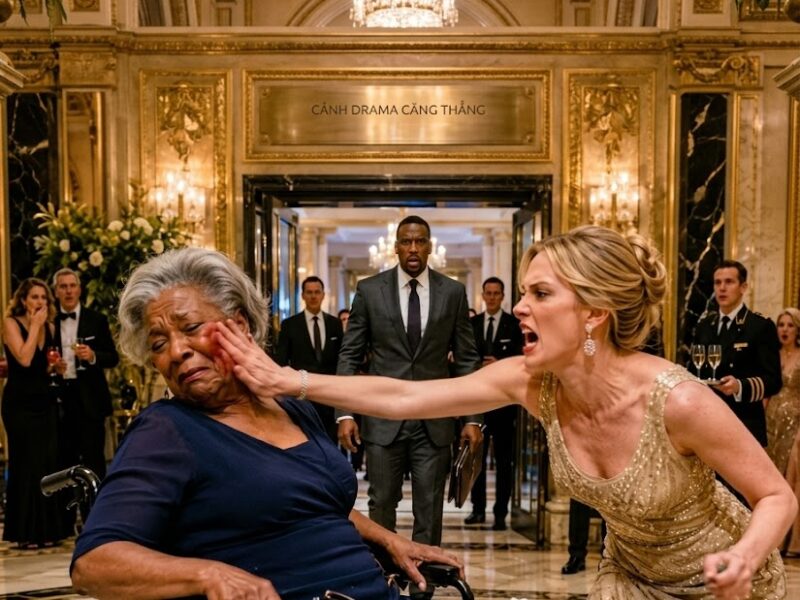
An heiress slapped a Black grandmother in a wheelchair — minutes later, her son cancelled a $1.4 billion deal, and her world fell apart.
## Part 1
The Grand Western Hotel had never seen anything like it.
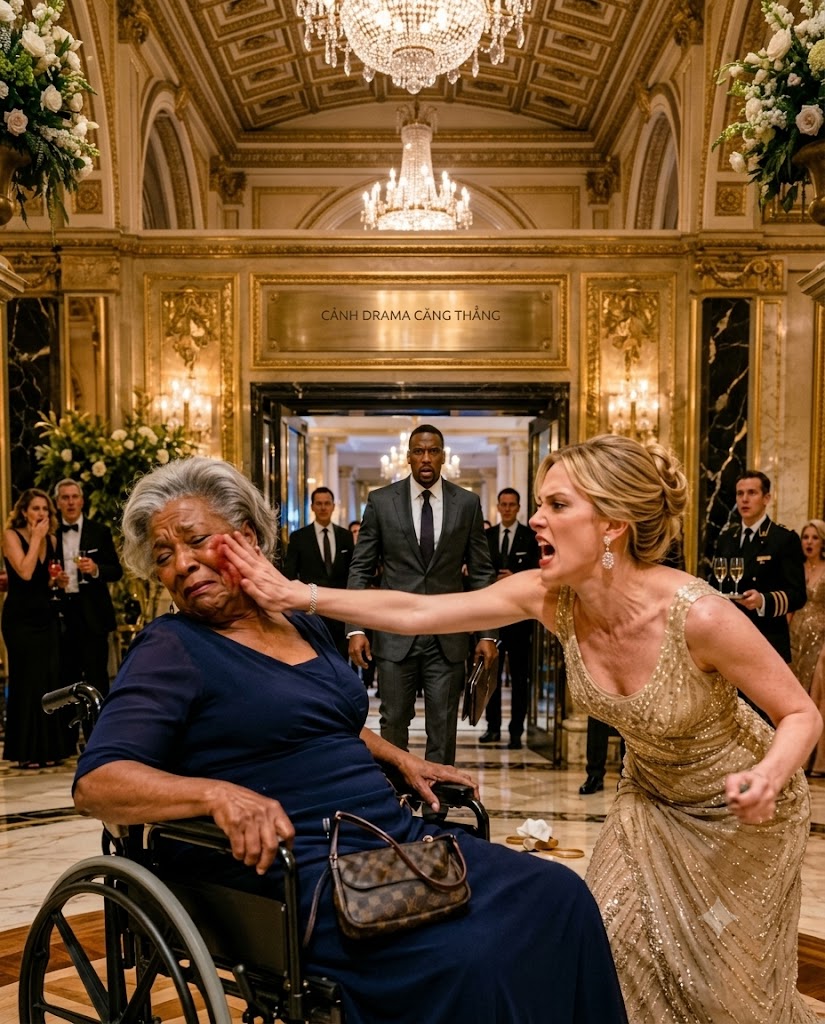
Crystal chandeliers hung above floors polished to mirrors. Three hundred of Manhattan’s most powerful families were expected within the hour for the Pemberton Properties 50th Anniversary Gala. And at the center of it all, a 72-year-old Black woman sat in a wheelchair with a fresh red handprint burning across her left cheek.
Irene Washington did not cry. She had survived too much in her life to give this young woman that satisfaction. But her hands shook. Her jaw throbbed. And for the first time in decades, she felt truly small.
“Are you still sitting here?” Sloan Pemberton walked back from the reception desk, heels clicking like gunshots on marble. “I told security to remove you five minutes ago.”
“I’m waiting for my son,” Irene said quietly. “He’ll be here soon.”
“Your son is not coming. Nobody is coming for you.” Sloan turned to the two security guards standing awkwardly near the elevator bank. “What are you waiting for? I gave you an order. Get her out.”
The taller guard shifted his weight. “Ma’am, she says she’s on the guest list. Maybe we should check.”
“Check what? Look at her.” Sloan gestured at Irene’s wheelchair, her simple dress, her worn leather handbag now spilled across the floor. “Does she look like she belongs at a Pemberton event?”
The guard went silent. He looked at the floor.
“That’s what I thought.” Sloan crouched down until her face was level with Irene’s. Her perfume was expensive. Her voice was poison. “Let me make this very clear. You are trespassing. If you are not gone in sixty seconds, I will have you arrested. And trust me, the police in this neighborhood do not ask questions when I call.”
Irene looked into Sloan’s eyes. She saw something she recognized. Not anger, not even cruelty—something worse. Certainty. The absolute certainty that she was better than the woman sitting in front of her.
“Sixty seconds,” Sloan repeated. She stood up, smoothed her dress, and walked toward the ballroom without looking back.
Irene sat alone. The spilled contents of her handbag still scattered across the marble floor. A wallet. Reading glasses. A photograph of her son on his college graduation day. No one helped her pick them up.
—
Sloan Pemberton did not think about Irene Washington for the next twenty minutes. She had a gala to run. Flower arrangements to approve. A seating chart to finalize. Her father, Preston Pemberton, was expecting perfection tonight.
This was the 50th anniversary of Pemberton Properties. Every real estate mogul, hedge fund manager, and society columnist in Manhattan would be walking through those doors. Sloan had spent six months planning this evening. Every napkin fold. Every wine pairing. Every name card placed at precisely the right table. She had fought her father for creative control. She had won.
Tonight was supposed to prove to the board that Sloan Pemberton was more than a last name. That she was ready to lead.
And then she walked back through the lobby to check on the valet station.
The woman was still there. Same wheelchair. Same spot. Same quiet, steady expression on her bruised face.
“You have got to be kidding me.” Sloan’s voice carried across the entire lobby. Two bellhops froze. A concierge looked up from her screen. “I gave you sixty seconds. That was twenty minutes ago.”
“I told you, ma’am, my son is coming.”
“Stop saying that.” Sloan’s patience had evaporated. She turned to the lobby full of arriving staff. “Does anyone know who let this woman in? Because someone is going to answer for this tonight.”
Silence. Every employee in that lobby suddenly found something urgent to do with their hands.
Sloan walked closer. She stood directly in front of the wheelchair, blocking Irene’s view of the ballroom entrance. Her shadow fell across Irene’s lap.
“You know what I think? I think you wandered in off the street because you saw the lights and the fancy people. I think you made up a story about a son because you thought we’d feel sorry for you.” She leaned down, close enough for Irene to smell the champagne on her breath. “And I think you’re sitting in that chair not because you can’t walk, but because it gets you more sympathy.”
The words landed like stones dropped into still water. Ripples of silence spread across the lobby. Two women near the entrance exchanged glances but said nothing. A bellboy turned his back entirely.
Irene’s chin trembled, but she did not look away. “That is not true,” she said. Her voice was barely above a whisper. “I’ve been in this chair for eleven years.”
“I don’t need your life story.” Sloan straightened up. “I need you gone.”
“My son has the invitation. He’s on his way. If you could just—”
“Convenient. Your magical son has the magical invitation. How perfect.” Sloan turned to the growing cluster of early arriving guests who had paused near the entrance watching the scene unfold. She raised her voice so every one of them could hear. “Ladies and gentlemen, I apologize for this disruption. We had an uninvited guest wander in off the street. It’s being handled.”
A few guests nodded. One woman in a fur stole pulled her coat tighter as if poverty were contagious. A man in a tuxedo shook his head and muttered something about security.
No one spoke up for Irene. Not one person in that entire marble lobby opened their mouth to say maybe check the list.
Irene Washington sat in her wheelchair and watched a room full of people agree without saying a single word that she did not belong.
That was the first wound. Not the slap from earlier. This. The silence. The collective turning away. The unspoken agreement that a woman in a wheelchair wearing a simple dress could not possibly have a right to be here.
Sloan saw it, too. The surrender in the room. The way the guests had sided with her without being asked. And it fed something inside her. Something hungry.
She should have stopped there. She had won. The lobby was hers. The guests were hers. The evening was hers. But Irene was still sitting there. Still calm. Still waiting. And something about that calmness made Sloan Pemberton furious in a way she could not explain.
“Give me your bag.”
Irene looked up. “Excuse me?”
“Your bag. If your so-called son really invited you, there should be something in there. An email. A printed ticket. A text message. Something.”
Sloan reached down and grabbed the worn leather handbag from Irene’s lap before she could respond.
“Please, don’t.” Irene reached for it, but the wheelchair made her slow. Her fingers closed on air.
Sloan unzipped the bag and turned it upside down. Everything inside tumbled onto the marble floor. A wallet. A pill bottle. A folded church program. The photograph of her son in his graduation cap. A pack of tissues. A small Bible with a cracked leather spine. A tube of hand cream. Three dollars and loose change that rolled across the floor and clinked against the base of a marble column.
Items that told the entire story of a simple, dignified, careful life. Scattered across the lobby of a five-star hotel like garbage from an overturned trash can.
“No invitation,” Sloan announced to the watching crowd. She nudged the Bible with the toe of her designer heel. “Just junk.”
Irene stared at her belongings on the floor. The photograph had landed face down. She could see the back of it, the handwriting she knew by heart. *Love you forever, Mama.*
She wanted to pick it up. She wanted to hold it against her chest. But the wheelchair kept her two feet too far from the floor.
“That Bible belonged to my mother,” Irene said, her voice cracked on the word *mother*.
“I don’t care whose Bible it was. It doesn’t change the fact that you don’t belong here.”
Irene looked at the scattered items on the marble. Every single one of those objects had a story. The pill bottle held her blood pressure medication, the kind she could barely afford on her pension. The church program was from last Sunday’s service at Mount Carmel Baptist. She had sung in the choir there for thirty-one years before the wheelchair took that from her, too. The three dollars was all the cash she had until the first of the month.
And none of that mattered to the woman standing over her. None of it ever would.
A waiter carrying a tray of champagne flutes walked past. Sloan lifted a glass from the tray without asking. She took a slow sip, watching Irene over the rim. Then she looked at Irene’s simple navy dress.
The dress Irene had picked out three days ago. The dress she had ironed that morning with shaking hands because she wanted to look nice for her son’s important evening.
Something cruel and deliberate moved across Sloan’s face. She tilted the glass.
Champagne poured down the front of Irene’s dress. Cold. Steady. Intentional. The golden liquid soaked through the fabric, darkening it from navy to black. It pooled in Irene’s lap and dripped onto the floor between the wheels of her chair.
“Now you match your situation,” Sloan said. She placed the empty glass on the reception desk with a soft click. “Wet. Messy. Out of place.”
Three guests gasped. One woman covered her mouth. A man in a gray suit pulled out his phone and started recording.
But no one stepped forward. No one said stop. No one walked over and handed Irene a napkin.
Irene looked down at her ruined dress. Her hands lay flat in her wet lap. The champagne soaked into every fold, every crease. She could feel it cold against her skin. She could smell it sharp and sweet and humiliating.
Her eyes burned, but she blinked the tears back. She had promised herself decades ago that she would never cry in front of someone who wanted her to.
“I will wait for my son,” Irene said. Her voice did not waver. Not even slightly. “Right here.”
Sloan stood there, arms crossed, waiting for Irene to break. To beg. To wheel herself out of the lobby in tears. That was how it was supposed to work. That was how it always worked. You push hard enough, people fold. They apologize for existing. They shrink. They leave.
But this woman would not leave.
Irene sat in her champagne-soaked dress with her hands folded in her wet lap. And she looked at Sloan Pemberton with something worse than anger. She looked at her with patience.
The kind of patience that comes from a lifetime of being underestimated, overlooked, dismissed, and outlasting every single person who did it.
It was the patience that broke Sloan. Not because she felt guilty, but because she could not stand being defied by someone she had already decided was beneath her. The rage that rose in her chest was old and ugly and had nothing to do with lobbies or guest lists or galas.
It had to do with control. And she was losing it.
Sloan stared at her. For one brief moment, something almost human crossed her face. A flicker of recognition. The faintest shadow of doubt. It lasted less than a second. Then it vanished, replaced by something colder.
“Fine,” Sloan whispered. “You want to play stubborn? Let’s see how far that gets you.”
—
What happened next would be captured by four security cameras and one guest’s cell phone. Every frame of it would eventually be seen by fourteen million people.
Sloan grabbed the handles of Irene’s wheelchair. Her knuckles went white.
“What are you doing?” Irene gripped the armrests.
“What I should have done twenty minutes ago.”
Sloan pushed the wheelchair hard. Not toward the front entrance. That would mean pushing her past the arriving guests, past the valets, past the photographers. That would be too visible.
Instead, she pushed the wheelchair across the lobby, past the reception desk, past the kitchen entrance, toward the service corridor at the back of the hotel, where deliveries came in, where garbage went out.
“Stop. Please stop.” Irene’s voice echoed off the narrow walls. Her hands gripped the armrests so hard her knuckles turned gray.
Sloan did not stop. She pushed the wheelchair through a set of heavy swinging doors and into a dim hallway that smelled of industrial cleaner and old grease. Fluorescent lights buzzed overhead. The floor changed from polished marble to bare stained concrete. The temperature dropped ten degrees.
“This is where you belong,” Sloan said. She parked the wheelchair facing a wall stacked with crates of empty bottles and flattened cardboard boxes. “Not in my lobby. Not at my gala. Here. With the rest of the garbage.”
Irene’s hands were shaking badly now. Her soaked dress clung to her legs in the cold air. The handprint on her cheek had deepened from red to purple. Goosebumps covered her arms.
“You can’t leave me here,” Irene said.
“Watch me.” Sloan turned to the two kitchen staff who had watched the entire scene from behind a stainless steel prep station. A young man in a white apron. A middle-aged woman holding a ladle. Both had horror in their eyes.
Sloan pointed at them. “If either of you helps this woman—water, food, a blanket, a phone call, anything—you’re fired. Tonight. No severance. No reference. I will make sure you never work in a kitchen in this city again. Are we clear?”
Both workers nodded slowly. They looked at the floor. The woman with the ladle blinked hard twice.
“Good.” Sloan straightened her dress. She checked her reflection in a stainless steel panel, tucked a strand of hair behind her ear. Then she walked back through the swinging doors without a single glance back.
The sound of her heels faded. The kitchen doors swung shut, and then there was only the hum of a refrigerator and the buzz of a dying fluorescent bulb.
Irene Washington was alone.
Seventy-two years old, sitting in a champagne-soaked dress in a garbage corridor behind one of Manhattan’s most expensive hotels. A bruise spreading across her cheek. Her belongings scattered across a lobby she would never be allowed back into. Her son’s graduation photograph lying face down on a marble floor somewhere, being stepped over by people who would never know what it meant.
She closed her eyes. She did not pray. She did not cry. She did not call for help.
She just sat there. Breathing. Waiting. Still believing with everything she had left that her son would come.
—
The kitchen was quiet except for the sounds of preparation. Pots simmered. Knives struck cutting boards in steady rhythms. The staff moved around Irene’s wheelchair like water flowing around a stone, pretending she was not there.
The young man in the white apron kept his head down. The woman with the ladle stirred her pot and did not look up. They had families. They had rent. They had heard Sloan Pemberton’s threat and they believed every word of it.
Irene understood. She did not blame them. She had spent her whole life understanding why people looked away.
Her phone had fallen out of her handbag when Sloan dumped it in the lobby. It was still out there somewhere on the marble floor next to the Bible and the photograph and the three dollars in loose change. She had no way to call Terrence. No way to tell him where she was. No way to tell him what had happened.
The fluorescent light above her head buzzed and flickered. The concrete floor was stained with years of kitchen grease. A draft came through a gap under the loading dock door carrying the smell of exhaust and wet pavement.
Irene’s arms were bare and the champagne on her dress had turned cold against her skin. She shivered. Then she shivered again. And she could not stop.
She thought about leaving. Just wheeling herself out the loading dock and onto the street and going home. She could hail a cab. She could be in her small apartment in Harlem in forty minutes. Dry clothes. A cup of tea. Her television and her cat. She could pretend tonight never happened. She could pretend she never came.
But then she thought of Terrence walking into that gala in his good suit, looking around the room for her, asking the staff where his mother was and no one knowing. Or worse—no one caring enough to say what they had seen.
She could not do that to him. She could not let him walk into a room and wonder why his mother had disappeared.
So she stayed. In the dark. In the cold. Alone.
Twenty minutes passed. Then thirty. The only sounds were the hum of the refrigerator and the distant muffled pulse of music beginning somewhere on the other side of the wall.
—
Meanwhile, the Grand Western Hotel was transforming.
The ballroom doors had opened. Three hundred guests filed in under crystal chandeliers and ceiling-high flower arrangements. A string quartet played Vivaldi in the corner. Waiters glided between tables carrying silver trays of hors d’oeuvres. Laughter rose and fell in polished waves.
Every seat was filled, except one. The VIP table near the stage. Finest china. Three wine glasses per setting. A small placard read: *Reserved — Washington Capital.*
Preston Pemberton stood near the ballroom entrance, shaking hands, accepting compliments, performing the role of patriarch with practiced ease. But beneath the polished smile, his jaw was tight. His eyes kept drifting to that empty VIP table.
He pulled his assistant aside. “Has Washington arrived yet?”
“Not yet, sir. His team confirmed thirty minutes ago. He’s en route.”
“The second he walks through that door, I want to know. Walk him to his table personally. Pour the reserved Bordeaux before he sits down. Whatever he wants, the answer is yes.” Preston loosened his collar slightly. “Do you understand what this deal means? If Washington Capital pulls out, Pemberton Properties files for restructuring within ninety days. We are leveraged to the ceiling. This is not a dinner. This is a lifeline.”
The assistant nodded gravely and disappeared into the crowd.
Sloan appeared at her father’s elbow, radiant and confident. She had just finished her third glass of champagne and was feeling victorious. The lobby was clean. The gala was flawless. The uninvited woman was exactly where she belonged—in the garbage corridor, out of sight, forgotten.
“Everything looks perfect,” Sloan said, surveying the ballroom with pride. “You can thank me later.”
“It needs to be perfect.” Preston was not smiling. “Washington Capital is our last option, Sloan. Every other fund passed. If this deal falls through, we lose everything. The company. The properties. The building we’re standing in. Everything your grandfather built.”
“It won’t fall through. Relax, Dad.”
“I will relax when Terrence Washington’s signature is on that contract.” Preston looked at his daughter. “Make sure his table has fresh flowers. Check the wine. And for God’s sake, be charming tonight. We need this man more than he needs us.”
Sloan rolled her eyes. “I’m always charming.” She turned and walked toward the ballroom, heels clicking on the polished floor, champagne glass in hand.
She had no idea that the man her father was desperate to impress held the power to save or destroy her family’s empire.
And she had no idea he was the son of the woman she had just slapped, soaked, and locked in a corridor next to the garbage.
The irony was so precise, it was almost surgical.
—
Back in the corridor, Irene heard the muffled sound of music. The Vivaldi. She recognized the piece. She had played it on her church piano once, years ago, when her fingers still worked. Before the arthritis. Before the wheelchair. Before the world decided she was invisible.
The music was beautiful. And it was coming from a room full of people who had watched her be humiliated and had not said a single word.
She sat in the cold. The bruise on her cheek throbbed in rhythm with her heartbeat. Her dress was still wet. She was hungry. She had not eaten since noon.
She was seventy-two years old and sitting alone in a garbage corridor behind one of Manhattan’s most expensive hotels. A string quartet played music she once loved through a wall she was not allowed to pass.
Then she heard footsteps. Soft ones. Careful. Deliberate.
A young woman appeared from behind the prep station, dark hair pulled back in a neat bun, hotel uniform pressed and clean. She carried a glass of water in one hand and a folded napkin in the other. She moved quickly, checking over her shoulder twice before crouching beside the wheelchair.
“Ma’am?” The young woman’s voice was barely audible. “I’m so sorry. I’m so sorry about what happened to you.”
Irene opened her eyes. The girl was young. Twenty-two at most. Her name tag read *Emily Torres — Front Desk.*
“Thank you, sweetheart,” Irene said. She took the water with both hands. They shook so badly the water trembled in the glass. “You didn’t have to do that.”
“Yes, I did.” Emily unfolded the napkin and gently pressed it against the champagne stain on Irene’s dress. Her hands were careful. Tender. The way you would touch your own grandmother. “She said she’d fire anyone who helped you. I don’t care. Some things matter more than a job.”
“You could lose everything, honey.”
“Ma’am, with all due respect, you just lost more than I ever could tonight. And you’re still sitting here. Waiting. Still calm. Still patient. So I can risk a paycheck.”
Irene looked at this young stranger. A girl kneeling on a cold concrete floor in her pressed uniform, pressing a clean napkin against a ruined dress. Risking everything for a woman she had never met.
And for the first time that evening, a tear rolled down Irene Washington’s cheek. Not from pain. Not from humiliation. Not from the slap or the champagne or the garbage corridor or the loneliness.
From kindness. The ordinary, reckless, stubborn kindness of a twenty-two-year-old girl who decided that doing the right thing mattered more than doing the safe thing.
“What’s your name again, sweetheart?”
“Emily. Emily Torres.”
“Emily Torres.” Irene reached out and held the girl’s hand. Her grip was weak but warm. “I’m going to remember that name for a very long time.”
She had no idea how much that name would matter before the night was over.
—
At exactly 8:45, a black sedan pulled up to the front entrance of the Grand Western Hotel. The valet opened the rear door.
A tall Black man in a custom charcoal suit stepped out. His cufflinks caught the light. His shoes were Italian leather. His posture carried the kind of quiet authority that made strangers step aside without being asked.
Behind him, two men in dark suits followed. One carrying a leather briefcase. The other holding a phone to his ear. A third man, older and silver-haired, walked at his left. Raymond Cross, senior counsel for Washington Capital, one of the most respected corporate attorneys on the East Coast.
Terrence Washington had arrived.
The hotel staff recognized the name immediately. The general manager appeared from nowhere, smiling wide, extending both hands. “Mr. Washington. Welcome to the Grand Western. We’ve been expecting you. Your table is prepared.”
“Thank you.” Terrence’s voice was deep and measured. He scanned the lobby with calm, careful eyes. “My mother should already be here. Irene Washington. She’s in a wheelchair. Could you point me to her?”
The general manager blinked. “I’m not sure, sir. Let me check with the front desk.”
“She arrived over an hour ago. I spoke with her at seven. She was very excited.” Terrence smiled slightly. “She ironed her dress three times this morning.”
The general manager hurried to the front desk. Two staff members shook their heads. No one could locate an Irene Washington.
—
Inside the ballroom, the news spread like electricity through a wire. *He’s here. Washington is here.*
Preston Pemberton set down his wine glass and moved toward the lobby. His urgency was unmistakable. His company. His legacy. His family’s future. All of it depended on the next two hours.
Preston met Terrence at the ballroom entrance. The handshake was firm, warm, rehearsed. Preston placed his left hand on top of Terrence’s, the way powerful men do when they want you to feel important.
“Mr. Washington, I can’t tell you what it means to have you here tonight. This is a milestone evening for my family, and having you share it with us—” Preston’s smile was wide, practiced, almost convincing. “Please. Your table is ready. We’ve opened a 1996 Chateau Margaux just for you.”
“That’s very generous.” Terrence did not return the warmth. His eyes were still moving. Still searching. “Mr. Pemberton, I need to find my mother first. She arrived early. Irene Washington. Seventy-two years old. In a wheelchair.”
Preston’s smile faltered by a fraction. “Your mother?”
“Yes. I put her name on the guest list myself. I wanted her here tonight.” Terrence’s voice was steady, but there was something beneath it now. The faintest edge of concern. “She should have been seated an hour ago.”
Preston turned to his assistant. The assistant checked his tablet, scrolled, shook his head. He had no idea who Irene Washington was. No one had connected the name on the VIP list to the elderly Black woman who had been slapped, soaked, and dragged out of the lobby.
“I’m sure she’s here somewhere,” Preston said smoothly. “Let me have someone do a full check. In the meantime—”
Terrence pulled out his phone. He dialed his mother’s number. It rang five times and went to voicemail. He tried again. Same result. A third time. Voicemail.
A shadow crossed his face. His jaw tightened. “She’s not answering.” Terrence’s voice had changed. The professional warmth was gone. Something harder had taken its place. Something that made Raymond Cross set down his briefcase and step closer. “She always answers my calls. She keeps her phone in her hand when she knows I’m coming. Always.”
Sloan appeared at her father’s side, champagne glass in hand, smiling her practiced smile. She extended her hand to Terrence. “Mr. Washington, I’m Sloan Pemberton. I organized tonight’s gala. Everything has been—”
“Have you seen my mother?” Terrence did not take her hand. He did not look at her hand. “Elderly woman. Wheelchair. She would have arrived alone around seven.”
Sloan’s smile froze. For one brief moment, something flickered behind her eyes. *A wheelchair. An elderly woman. An exchange in the lobby.* But the connection did not fully land. The woman she had dealt with earlier was nobody. A trespasser. A nuisance. A street person who had wandered into the wrong building. There was no possible universe in which that woman could be the mother of Terrence Washington.
“I’m sure the front desk can help,” Sloan said. Her hand was still extended. Terrence still had not taken it. She let it fall.
Terrence turned away from her without another word and walked to the front desk. His voice was controlled but carried across the lobby. “I need to speak with whoever was working the lobby between seven and eight tonight. Right now. Not in five minutes. Now.”
The front desk manager’s face went pale. He picked up an internal phone with a shaking hand.
And then, from the far end of the desk, a young woman stepped forward. Dark hair pulled back in a neat bun. Hotel uniform pressed clean. Her hands were clasped together so tightly her knuckles were bone white.
Emily Torres.
“Sir.” Her voice was small but clear. It did not waver. “I know where your mother is.”
The lobby went silent. Preston Pemberton’s smile vanished completely. Sloan tilted her head, confused.
“Where?” Terrence said. One word. It filled the room.
Emily swallowed hard. She looked at Sloan. Then she looked at the marble floor. Then she looked back up at Terrence Washington.
And she made a choice that would change her life forever.
“Follow me. Please.”
—
She led Terrence through the lobby, past the kitchen entrance, through the heavy swinging doors, and into the service corridor. Preston followed. Sloan followed, her champagne glass still in her hand, her heels now clicking on concrete instead of marble. Raymond Cross followed. The hotel general manager followed.
A trail of people walking into the back of their own building like they had never been there before.
The fluorescent lights buzzed overhead. The floor was bare concrete, stained and cracked. The air smelled of industrial cleaner and old grease and something slightly rotten from the loading dock. The temperature was at least fifteen degrees colder than the ballroom.
And there, at the end of the corridor, sat Irene Washington.
Her wheelchair faced a wall of empty bottle crates and flattened cardboard boxes. A mop bucket and garbage bags flanked her on both sides. Her dress was soaked dark with dried champagne. Her face was bruised. A purple handprint covered her left cheek, swollen now, the outline of four fingers clearly visible. Her arms were crossed over her chest for warmth, and she was shivering in small, continuous tremors.
The napkin Emily had given her was still in her lap, pressed against the stain. The glass of water sat untouched on a crate beside her.
She looked up when she heard footsteps. She saw her son.
And her face did something that broke every person standing in that corridor.
She smiled. A real smile. Warm and full and relieved.
“Baby,” she said. “You came.”
—
Terrence Washington stopped walking. He stood perfectly still for three full seconds. His eyes moved across the scene. The concrete floor. The garbage bags. The bottle crates. The mop bucket. The flickering fluorescent light. His mother’s soaked dress. Her shivering arms. The bruise on her face.
His hands began to shake. Not with fear. Not with sadness. With something far more dangerous. Something quiet and absolute.
He walked forward and dropped to his knees on the cold concrete floor next to his mother’s wheelchair. He took her hands. They were like ice. He held them between his palms, trying to warm them with his own heat.
“Mama.” His voice cracked on the single syllable. “What happened? Who did this to you?”
“It’s all right, baby. I’m fine now. You’re here.” She squeezed his hands. “Don’t let this ruin your evening.”
“Mama. Look at me.” He lifted her chin gently. He saw the full extent of the bruise. Four fingerprints and a palm, purple and swollen, on the face of the woman who had raised him alone. Who had worked three jobs so he could finish school. Who had never once in his life asked him for anything. “Who hit you?”
Irene said nothing. Her eyes moved past Terrence’s shoulder to the group of people standing frozen in the corridor behind him.
Her gaze found Sloan Pemberton. Still holding her champagne glass. Still wearing her confident dress. Standing on a concrete floor for the first time in her life.
Irene did not point. She did not accuse. She just looked.
And that was enough.
—
Sloan understood.
The blood left her face in stages. First her cheeks. Then her lips. Then her hands. The champagne glass trembled between her fingers. She looked like someone watching a building collapse in slow motion, knowing with absolute certainty that she was the one who had lit the match.
*The homeless woman. The wheelchair. The slap. The champagne. The garbage corridor. The threat.*
*That woman was his mother.*
Sloan’s mouth opened. Nothing came out. Not a word. Not a breath.
Preston Pemberton looked at his daughter. Then at Irene. Then at Terrence. His face went gray. He understood, too. And the understanding hit him like a physical blow to the chest.
Terrence stood up slowly. He took off his suit jacket and draped it over his mother’s shoulders, tucking it carefully around her thin arms. He wiped a smudge of grease from the rim of her wheelchair. He picked up the untouched glass of water and held it to her lips so she could drink.
Then he straightened up. He turned around. His eyes found Sloan Pemberton.
And every single person in that corridor took one step back.
Terrence Washington did not raise his voice. He did not have to.
“You.” One word. Aimed at Sloan Pemberton like a blade thrown across the corridor.
Sloan’s champagne glass slipped from her fingers. It hit the concrete floor and shattered. Sparkling wine and broken glass spread across the stained surface. She did not move to pick it up. She could not move at all.
“My mother called me at 7:15 tonight.” Terrence’s voice was low, controlled. Every syllable placed with the precision of a man who had built a billion-dollar empire by choosing his words the way surgeons choose their cuts. “She said she had arrived early. She said a nice young man at the front desk had pointed her toward the lobby. She said she was nervous because she had never been to a gala before. She told me she ironed her dress three times.”
He paused. “Three times. Because she wanted to look right. For me.”
He took one step toward Sloan. She took one step back. Her heel crunched on broken glass.
“And then I get here. And no one knows where she is. No one. Three hundred people in this building, and not a single one of you can tell me where my seventy-two-year-old mother went.” His jaw tightened. “Until a twenty-two-year-old front desk clerk had enough courage to speak up. The only one.”
He turned to Emily Torres. His expression softened for one brief second. “Thank you. I will not forget what you did.”
Emily nodded. Her eyes were wet. She clasped her hands together and pressed them against her chest.
Terrence turned back to Sloan. “So let me understand this clearly. You slapped my mother. You poured champagne on her dress. You emptied her bag onto the lobby floor. Her wallet. Her medication. Her Bible. A photograph of me at my college graduation. You pushed her wheelchair through a service corridor and left her next to the garbage. And you threatened to fire anyone who gave her so much as a glass of water.”
He paused. Let each word settle into the silence like stones dropped into still water.
“Is that what happened?”
Sloan’s mouth moved. No sound came out. Her face was the color of old ash.
Preston Pemberton stepped forward. His voice was shaking. “Mr. Washington, I—I had no idea. Please. Let me explain. This was a misunderstanding. My daughter did not know. She could not have known.”
“She did not need to know.” Terrence cut him off without raising his voice. “She did not need to know who my mother was. She needed to know how to treat a human being. An elderly woman in a wheelchair asked for help, and your daughter slapped her across the face.”
Preston opened his mouth. Closed it. Opened it again. Nothing came. His rehearsed pitch. His carefully planned evening. His rescue strategy. All of it dissolving in a service corridor next to a mop bucket.
“Mr. Pemberton, I came here tonight to sign a deal worth 1.4 billion dollars.” Terrence paused. His jacket was draped over his mother’s shivering shoulders. He had no papers. He did not need them. “That deal is dead.”
Raymond Cross stepped forward. The silver-haired attorney opened his briefcase with a clean, practiced motion. He placed a single document on top of a stack of empty crates.
“This is a formal notice of withdrawal from all pending agreements between Washington Capital and Pemberton Properties. Effective immediately. No renegotiation. No extension. No second meeting.”
Preston stared at the document like it was a death certificate.
In many ways, it was.
Without Washington Capital, Pemberton Properties would default on 312 million dollars in outstanding bonds within ninety days. The company his father had built from a single apartment building in Brooklyn would collapse.
“You can’t—” Preston’s voice broke. “We have been negotiating for eight months.”
“Eight months. And your daughter undid all of it in eight minutes.” Terrence did not blink. “That is not my problem. That is yours.”
Sloan finally spoke. Her voice came out in pieces. Cracked. Barely above a whisper. “I didn’t know. I swear. I didn’t know she was your mother. I thought she was—”
“You thought she was nobody.” Terrence finished the sentence for her. “You thought she was a poor old Black woman who wandered into your hotel. And because you thought she was nobody, you decided you could treat her like garbage. Literally. You put her next to the garbage.”
Sloan’s knees buckled. She caught herself on the corridor wall with one hand. Mascara had begun to run down her cheeks, mixing with the foundation she had applied so carefully three hours ago.
“The security cameras in this hotel,” Terrence said, turning to the general manager. “Every corridor. Every lobby angle. I want copies of all footage from seven o’clock forward tonight. My legal team will be filing charges in the morning.”
The general manager nodded rapidly, his face drained of all color.
Terrence looked at Preston one final time. “You asked me to share a milestone evening with your family, Mr. Pemberton. I did. I just did not expect the milestone to be this.”
He turned back to his mother. He crouched beside her wheelchair again and took her hands. “Mama, we’re leaving.”
“Baby, you don’t have to—”
“Yes, I do.” He kissed her forehead. “We are leaving. And you are never setting foot in this building again. Neither am I.”
He stood. He placed both hands on the wheelchair handles. He looked at Emily Torres. “Would you walk with us? I would like to talk to you before we leave.”
Emily’s eyes widened. She looked at the general manager. The general manager looked at the floor.
“Yes, sir,” Emily said.
Terrence Washington pushed his mother’s wheelchair out of the service corridor, through the kitchen, through the lobby, out the front entrance of the Grand Western Hotel. Emily Torres walked beside them. Raymond Cross followed, briefcase in hand.
Three hundred guests in the ballroom never saw them leave. They were still laughing. Still clinking glasses. Still celebrating the 50th anniversary of a company that would not exist in ninety days.
Preston Pemberton stood alone in the service corridor. His daughter was on her knees on the concrete floor, crying into her hands, kneeling in a puddle of champagne and broken glass.
He looked at her. He looked at the mop bucket. He looked at the empty space where Irene Washington’s wheelchair had been.
And he understood, with perfect and terrible clarity, exactly what his daughter had cost him.
Everything.
—
## Part 2
The news broke before breakfast.
A guest at the gala had recorded the lobby incident on her phone. Not the service corridor. But the slap. The moment Sloan Pemberton’s hand struck Irene Washington’s face. Fourteen seconds of footage. No audio was needed. The visual told the entire story. A young white woman in designer clothes slapping an elderly Black woman sitting in a wheelchair.
The video went online at 11:42 that night. By six o’clock in the morning, it had been viewed nine million times. By noon, it had a name.
The internet called it *the Pemberton Slap.*
Every major news outlet ran the story. The headline wrote itself: *Heiress Slaps Elderly Black Grandmother in Wheelchair — Hours Later, Her Son Cancels $1.4 Billion Deal.*
The details that emerged made it worse. The champagne poured on a dress that had been ironed three times. The handbag dumped on the floor. A Bible kicked with a designer heel. A wheelchair pushed into a service corridor next to garbage bags. Kitchen staff threatened with termination for offering a glass of water.
Every detail confirmed what the video already showed: cruelty so specific and so deliberate that it could not be explained away as a misunderstanding.
Sloan Pemberton released a statement through her lawyer at two o’clock in the afternoon. She expressed deep regret. She said she had not known who Irene Washington was. She asked for the public’s understanding and compassion.
The statement made things worse.
The public heard the same thing Terrence had heard the night before. She was sorry because of *who* Irene turned out to be. Not because of what she had done.
—
The legal consequences followed with surgical precision.
Raymond Cross filed assault charges on behalf of Irene Washington the next morning. The security footage from the Grand Western Hotel was entered into evidence within forty-eight hours. Every camera. Every angle. Every minute from seven o’clock forward.
Sloan was arrested on a Tuesday morning, photographed in handcuffs outside her TriBeCa apartment, and released on bail by the afternoon. The mug shot replaced the gala photos on every news site in the country.
Pemberton Properties collapsed exactly the way Preston had predicted.
Without Washington Capital, the company defaulted on its bond obligations within sixty-three days. The board voted to file for Chapter 11 restructuring. Preston Pemberton resigned as chairman. The family sold their East Hampton estate, their apartment on Park Avenue, and the vintage Porsche collection that Preston’s father had spent forty years assembling.
It was not enough.
The debt exceeded the assets by over eighty million dollars. The Pemberton name, once synonymous with Manhattan real estate, became a cautionary tale. What arrogance costs when it meets the wrong person on the wrong night.
Sloan pleaded guilty to misdemeanor assault in exchange for 180 hours of community service at a senior care facility. The judge, during sentencing, told her something that made the evening news.
“Miss Pemberton, you are not here because you made a mistake. You are here because you decided that some people do not deserve to be treated as people. That is not a mistake. That is a choice.”
—
Terrence Washington did not speak publicly about the incident for three weeks.
When he finally did, it was not at a press conference. It was at a small ceremony at the Harlem Community Center, six blocks from the apartment where Irene Washington had lived for thirty-one years.
He stood at a podium in front of forty people. Neighbors. Church members. Local business owners.
He announced the creation of the Irene Washington Foundation. The foundation would provide legal aid, medical transport, and emergency housing for elderly residents facing abuse or discrimination. Its first-year budget was twelve million dollars.
Irene sat in the front row. She wore a new navy dress. It was simple and clean and pressed. She did not speak. She did not need to.
Sitting beside her in the second chair from the left was Emily Torres. She was no longer wearing a hotel uniform. She was wearing a blazer and carrying a leather portfolio. Terrence had hired her three days after the gala as the foundation’s community outreach coordinator. Her first assignment was to build a volunteer network for home-bound seniors across Upper Manhattan.
She was twenty-two years old. She was terrified. And she was ready.
After the ceremony, a reporter asked Terrence why he had named the foundation after his mother instead of himself. He looked at Irene. She was talking to a neighbor, holding the woman’s hand with both of hers, the same way she always did. The same way she had held Emily’s hand in the service corridor.
“Because she taught me everything I know about strength,” Terrence said. “Not the kind of strength that builds companies. The kind that sits in a cold corridor, soaked and bruised and alone, and still believes that her son will come.”
He paused.
“That is the strongest thing I have ever seen anyone do.”
—
The Grand Western Hotel still stands on the corner of Lexington and 52nd Street. The lobby still smells of fresh flowers. But the Pemberton name is gone from the directory. The gala has not been held since.
Irene Washington still lives in her apartment in Harlem. She still plays piano at her church on Sunday mornings. Her fingers are slower now, but the music is the same. She keeps the photograph of Terrence’s graduation on her piano. It has a new frame. The old one cracked when it hit the marble floor.
She never replaced the navy dress.
—
Hold on. I need y’all to hear this.
This woman got slapped, soaked, and left next to the garbage. And she stayed. She didn’t leave. She sat in that cold hallway because she didn’t want her son to walk into a room and wonder where his mama went.
That’s not patience. That’s the kind of love most of us spend our whole lives trying to deserve.
—
## Part 3
The Irene Washington Foundation opened its first office in a converted brownstone on 125th Street, three blocks from the Apollo Theater. The building had good bones and bad plumbing, but Terrence paid for the renovations out of pocket. He wanted the foundation to feel like a home, not a corporate headquarters.
Emily Torres spent her first month building a database of every senior center, church, and community board in Upper Manhattan. She hired two case managers. She answered the phone herself for the first six weeks because they could not afford a receptionist. She learned the names of every client. She learned their stories. She learned which ones had family and which ones did not.
The first case that came through the door was a seventy-eight-year-old man named Walter Simmons. He had been evicted from his apartment after his landlord raised the rent by forty percent. He had been sleeping in his car for eleven days. He had not eaten a hot meal in a week.
Emily found him a temporary room at a YMCA in the Bronx. She got him signed up for SNAP benefits. She connected him with a legal aid attorney who specialized in tenant rights. Within three months, Walter Simmons was back in his own apartment, with a new lease and a rent freeze.
He sent the foundation a thank-you card with a five-dollar bill inside.
Emily framed the card and hung it on the wall next to her desk.
—
The foundation grew faster than anyone expected. By the end of its first year, it had helped over four hundred seniors. It had prevented thirty-one evictions. It had provided emergency housing for sixty-two people. It had filed eleven lawsuits against landlords, businesses, and individuals who had discriminated against elderly residents.
The foundation’s annual gala—held at a community center in Harlem, not a five-star hotel—raised three million dollars.
Irene Washington attended every event. She never spoke. She did not need to. Her presence was enough. When she rolled into a room, people stood. Not because they had to. Because they wanted to.
—
Sloan Pemberton completed her 180 hours of community service at the Riverside Senior Care Facility on the Upper West Side. She spent her days serving meals, changing bedpans, and listening to the stories of men and women she had spent her whole life ignoring.
She quit after the first week.
The judge ordered her to complete the hours or face jail time. She went back. She lasted another week. She quit again.
The third time, the facility’s director, a woman named Beatrice Coleman, sat her down in a small office and closed the door.
“You don’t want to be here,” Beatrice said. “That’s fine. I don’t want you here either. But you’re going to finish these hours. And you’re going to do it with some dignity.”
“Why do you care?” Sloan asked.
“I don’t care about you,” Beatrice said. “I care about them.” She gestured through the glass window at the residents in the day room. “They’ve been abandoned by everyone. Their families. Their friends. The system. I’m not going to let you abandon them too. Even if it’s just for 180 hours.”
Sloan finished her hours. She did not enjoy them. She did not learn anything she wanted to learn. But she finished.
On her last day, Beatrice handed her a small card with the foundation’s address on it.
“What’s this?”
“A place that could use your money,” Beatrice said. “If you have any left.”
Sloan did not donate. But she kept the card.
—
The lawsuit against Sloan Pemberton was settled out of court. The terms were sealed. But sources close to the case confirmed that the settlement included a six-figure payment to Irene Washington and a written apology.
Irene donated the money to the foundation.
—
Preston Pemberton moved to Florida after the bankruptcy. He bought a small condo in Boca Raton and spent his days playing golf and avoiding reporters. He never spoke to his daughter again. When asked about Sloan in a rare interview, he said only: “I raised her. I failed.”
Sloan moved to a one-bedroom apartment in Queens. She took a job as a sales associate at a department store. She was unrecognizable without her designer clothes and her entourage. Customers complained about her attitude. She was written up three times in her first month.
She kept the job. She needed the money.
—
Two years after the gala, Emily Torres was promoted to executive director of the foundation. She was twenty-four years old. She had a corner office, a staff of twelve, and a budget of fifteen million dollars.
She still answered the phone sometimes. Just to remember what it sounded like.
—
Irene Washington died peacefully in her sleep on a Sunday morning in March. She was eighty-four years old. Her funeral was held at Mount Carmel Baptist Church. Over eight hundred people attended. The mayor of New York City spoke. So did Terrence. So did Emily.
At the end of the service, a member of the choir stood up and sang “Amazing Grace.” The same song Irene had sung in that choir for thirty-one years.
Terrence did not cry. He stood at the front of the church with his mother’s Bible in his hands. The same Bible that had fallen out of her handbag on the marble floor. The same Bible that Sloan Pemberton had nudged with her designer heel.
He read a passage from the Book of Psalms. Chapter 34. Verse 18. *The Lord is close to the brokenhearted and saves those who are crushed in spirit.*
Then he closed the Bible and sat down.
—
The Irene Washington Foundation still operates out of the same brownstone on 125th Street. Its budget has grown to forty million dollars. It has offices in eight cities. It has helped over fifty thousand seniors.
Emily Torres still runs the foundation. She is thirty-one years old now. She has a daughter named Irene. She tells her the story every year on her birthday.
The story of a woman who sat in a cold corridor and waited. The story of a son who kept a promise. The story of a girl who risked everything for a stranger.
And the story of a dress that was ironed three times. A dress that was ruined by champagne. A dress that was never replaced.
—
On the fifth anniversary of the gala, a small plaque was installed in the lobby of the Grand Western Hotel. It read:
*In memory of Irene Washington. She was not a trespasser. She was not a nuisance. She was a mother. A grandmother. A friend. A woman who deserved dignity. May this plaque remind us that every person who walks through these doors deserves the same.*
The plaque was paid for by the Irene Washington Foundation.
The hotel’s current owner—a real estate investment firm from Chicago—approved the installation without hesitation.
The Pemberton name was not mentioned.
—
Sloan Pemberton still lives in Queens. She still works at the department store. She still keeps the card from Beatrice Coleman in her wallet.
She has never visited the Irene Washington Foundation. She has never donated. She has never apologized in person.
But every year on the anniversary of the gala, she buys a single navy dress from the clearance rack at the store where she works. She brings it home. She hangs it in her closet. She does not wear it.
She does not know why she does this. She cannot explain it.
But she does it every year.
And every year, she thinks about the woman in the wheelchair. The woman she slapped. The woman she soaked with champagne. The woman she left next to the garbage.
The woman whose son had the power to cancel a 1.4 billion dollar deal.
The woman who smiled at her son and said, *”Baby, you came.”*
—
The Grand Western Hotel still hosts galas. But the ballroom is booked by different families now. Different companies. Different names.
The crystal chandeliers still hang above floors polished to mirrors. The string quartet still plays Vivaldi in the corner. The waiters still glide between tables carrying silver trays of hors d’oeuvres.
But the VIP table near the stage is no longer reserved for anyone. It is simply a table. A table like any other.
And on the wall near the reception desk, where Sloan Pemberton once stood and poured champagne on an old woman’s dress, there is a small plaque.
Some people read it. Some people don’t.
But it is there.
And it will be there for a long time.
—
## Part 4
The video of the Pemberton Slap did not disappear from the internet. Nothing ever does.
It was remixed. It was shared. It was commented on. It was used in lectures on corporate ethics, in law school seminars on assault and battery, in sociology classes on race and class in America. It became a case study. A cautionary tale. A meme.
But mostly, it became a reminder.
A reminder that the world is full of people like Sloan Pemberton. People who mistake privilege for virtue. People who confuse wealth with worth. People who believe that the measure of a person is the label on their handbag or the car in their driveway or the neighborhood they live in.
And a reminder that the world is also full of people like Irene Washington. People who have every reason to be bitter and angry and broken. People who have been pushed and shoved and ignored and dismissed. People who have been told, in a thousand different ways, that they do not matter.
And yet they keep getting up. They keep moving forward. They keep showing up. They keep being kind. They keep being patient. They keep believing that their son will come.
Terrence Washington never gave another interview about the gala. He never spoke Sloan Pemberton’s name in public. He never discussed the 1.4 billion dollar deal that he walked away from.
But he did give one interview—years later—about his mother.
He was asked what he remembered most about the night of the gala. He thought about it for a long time. And then he answered.
“I remember her hands,” he said. “They were cold. They were shaking. But they held mine. She was the one who had been hurt. She was the one who had been humiliated. She was the one sitting in a wheelchair with a bruise on her face and champagne on her dress. But she held my hands. She tried to warm me. She told me not to let it ruin my evening.”
He paused. “That’s my mother. That’s who she was. She never stopped taking care of me. Not even when she was the one who needed taking care of.”
The interviewer asked if he had forgiven Sloan Pemberton.
Terrence shook his head. “That’s not my job. I’m not the one she hurt. My mother is gone. She never got to see Sloan Pemberton apologize. She never got to hear the words. But my mother didn’t need an apology. She had something better. She had a life well lived. She had a son who loved her. She had a church full of friends. She had a foundation that will help people for generations. Sloan Pemberton has none of that. She has a mug shot. She has a criminal record. She has a one-bedroom apartment in Queens and a job at a department store.”
He smiled. “My mother won. She didn’t win the way the world measures winning. She didn’t win money. She didn’t win power. She didn’t win revenge. She won the way the world measures character. She won by being the kind of person that people remember.”
—
Emily Torres was named one of Time Magazine’s 100 Most Influential People the year she turned thirty-five. She was recognized for her work with the Irene Washington Foundation. She was photographed for the cover wearing a simple blazer and a small gold pin shaped like a wheelchair.
In the profile that accompanied the cover story, Emily was asked about the night of the gala. She was asked what she was thinking when she stepped forward and said, *I know where your mother is.*
Emily thought about it for a moment. Then she answered.
“I was thinking about my grandmother,” she said. “She was a housekeeper for forty years. She worked for a wealthy family in Westchester. They treated her well. But I remember how she used to come home with her hands raw from cleaning. I remember how tired she was. I remember how she never complained. She just did her job. She just kept going.”
She paused. “When I saw Irene in that corridor, I saw my grandmother. I saw my mother. I saw myself. I saw what it would be like to be old and alone and forgotten. And I knew I couldn’t just walk away. I knew I had to do something.”
The interviewer asked if she ever regretted stepping forward. If she ever worried about losing her job. If she ever feared what Sloan Pemberton might do to her.
Emily shook her head. “I didn’t think about any of that. I just thought about Irene. She was sitting there in the cold. She was shaking. She was alone. And she was still waiting for her son. She had been through everything. The slap. The champagne. The garbage corridor. And she was still waiting. Still hoping. Still believing.”
Emily smiled. “What was I supposed to do? Walk away? Pretend I didn’t see? No. I couldn’t do that. Some things matter more than a job. Some things matter more than money. Some things matter more than your own comfort.”
—
The Irene Washington Foundation now has a legal aid division. It has a medical transport division. It has an emergency housing division. It has a community outreach division. It has a policy advocacy division. It has a research division.
It has helped over one hundred thousand seniors across the country.
It has filed lawsuits. It has changed laws. It has built housing. It has trained caregivers. It has educated businesses. It has advocated for policy reforms.
It has done all of this in the name of a woman who spent most of her life working in the shadows. A woman who sang in a church choir for thirty-one years. A woman who ironed her dress three times. A woman who sat in a wheelchair and waited for her son.
And every year, on the anniversary of the gala, the foundation holds a small ceremony. They read Irene’s name. They read the names of other seniors who have been helped. They read the names of the volunteers who make it all possible.
And then they eat cake. Because Irene loved cake. Red velvet. With cream cheese frosting.
—
Sloan Pemberton heard about the foundation’s anniversary ceremonies. She read about them in the newspaper. She saw them on the news.
She never went. She never sent a card. She never made a donation. She never apologized.
But every year, on the anniversary of the gala, she put on the navy dress she bought from the clearance rack. She stood in front of the mirror in her one-bedroom apartment in Queens. She looked at herself.
She did not cry. She did not speak. She did not pray.
She just stood there. Remembering. Thinking. Wondering.
Wondering what her life would have been like if she had just let the old woman sit in the lobby. If she had just asked one question. If she had just treated another human being with respect.
She did not know the answer.
She would never know the answer.
—
The Grand Western Hotel was sold again two years later. The new owners—a family from Dubai—renovated the lobby. They replaced the marble floors. They replaced the crystal chandeliers. They replaced the reception desk.
They kept the plaque.
It is still there. On the wall near the entrance to the ballroom. Small. Simple. Easy to miss if you are in a hurry.
But it is there.
And it will be there for a long time.
—
## Part 5
Irene Washington’s piano still sits in the corner of her apartment in Harlem. The apartment is empty now. It was sold after she died. The new owners—a young couple from Brooklyn—did not know what to do with the piano. They did not play. They did not have room.
So they called the Irene Washington Foundation. They asked if the foundation wanted it.
Emily Torres drove up to Harlem herself. She sat at the piano. She played one song. “Amazing Grace.” The same song Irene had sung in the choir.
She did not play well. She had never learned. But she played.
Then she called a piano mover. She had the piano brought to the foundation’s office on 125th Street. It sits in the lobby now. Next to the front desk. Next to the card Walter Simmons sent with the five-dollar bill inside.
Visitors sometimes ask about the piano. Emily tells them the story. The story of a woman who played at her church. The story of a woman who ironed her dress three times. The story of a woman who sat in a wheelchair and waited.
And sometimes, when the office is quiet and the phones have stopped ringing, Emily sits at the piano and tries to play “Amazing Grace.”
She is getting better.
—
The Irene Washington Foundation has a motto. It is printed on the letterhead. It is painted on the wall in the lobby. It is embroidered on the tote bags they give to volunteers.
*Some things matter more than a job. Some things matter more than money. Some things matter more than your own comfort.*
Emily wrote those words. She wrote them the night of the gala. She wrote them in her journal. She wrote them when her hands were still shaking and her heart was still pounding and she did not know if she would have a job in the morning.
She read those words every day. She read them when she was tired. She read them when she was frustrated. She read them when she wanted to quit.
She read them when she remembered the woman in the wheelchair. The woman who was cold. The woman who was shaking. The woman who was alone.
The woman who smiled at her son and said, *”Baby, you came.”*
—
Terrence Washington never remarried. He never had children. He devoted the rest of his life to his mother’s foundation. He served as chairman of the board until he was seventy-five years old. He attended every anniversary ceremony. He read every annual report. He signed every check.
He died peacefully in his sleep on a Sunday morning in June. He was seventy-eight years old. He was buried next to his mother at Mount Carmel Cemetery in Queens.
His tombstone reads: *Terrence Washington. Son. Philanthropist. Keeper of a promise.*
—
Emily Torres spoke at his funeral. She was forty-two years old. She had run the foundation for eighteen years. She had a daughter named Irene. She had a husband named Marcus. She had a life she never could have imagined on the night of the gala.
She stood at the podium and looked out at the crowd. Over a thousand people. Neighbors. Friends. Colleagues. Volunteers. Seniors who had been helped by the foundation. Dignitaries. Politicians. Journalists.
She took a deep breath.
“Terrence Washington taught me something,” she said. “He taught me that you don’t have to be loud to be powerful. You don’t have to be angry to be strong. You don’t have to be cruel to be feared.”
She paused.
“He taught me that the most powerful thing you can do is keep a promise. He promised his mother he would come. And he came. He promised his mother he would never let anyone hurt her again. And he kept that promise. He promised his mother he would build something in her name. And he built it.”
She looked at the casket.
“He kept every promise he ever made. That’s who he was. That’s who his mother raised him to be.”
—
The Irene Washington Foundation will celebrate its fiftieth anniversary next year. It has helped over two million seniors. It has offices in twenty-three cities. It has a budget of two hundred million dollars.
Emily Torres is sixty-eight years old. She still comes to the office three days a week. She still answers the phone sometimes. She still plays “Amazing Grace” on Irene’s piano.
She is teaching her granddaughter to play. The girl is seven years old. Her name is Irene. She has her great-grandmother’s smile.
—
The Grand Western Hotel is now called the Lexington Grand. It is owned by a hospitality group from Singapore. The lobby has been renovated again. The ballroom has been updated. The crystal chandeliers have been replaced with modern lighting.
But the plaque is still there.
Small. Simple. Easy to miss if you are in a hurry.
*In memory of Irene Washington. She was not a trespasser. She was not a nuisance. She was a mother. A grandmother. A friend. A woman who deserved dignity. May this plaque remind us that every person who walks through these doors deserves the same.*
Some people read it. Some people don’t.
But it is there.
And it will be there for a long time.
—
Sloan Pemberton died alone in her apartment in Queens. She was eighty-one years old. She had no children. No husband. No friends. Her neighbors knew her only as the old woman who never smiled.
Her body was found by the building superintendent. She was sitting in a chair by the window. She was wearing a navy dress. It was simple and clean and pressed.
On her lap was a small card. It had the address of the Irene Washington Foundation on it. It was worn and faded. It had been in her wallet for fifty years.
She had never visited. She had never donated. She had never apologized.
But she had kept the card.
The superintendent did not know what to do with it. He threw it away.
—
The Irene Washington Foundation received an anonymous donation the week after Sloan Pemberton died. It was for one hundred thousand dollars. The return address was a post office box in Queens.
The card that accompanied the donation read: *For Irene. I am sorry. I know it is too late. But I am sorry.*
Emily Torres read the card. She read it three times. Then she put it in a file. She labeled the file: *Anonymous Donors.*
She did not know who sent it. She never found out.
But she had a feeling.
She had a feeling it was the woman in the navy dress.
—
The story of Irene Washington and Sloan Pemberton is taught in business schools now. It is used as a case study in corporate ethics. It is discussed in sociology classes. It is analyzed in law schools. It is written about in books.
But the story that matters most is the one that is not written down. The one that is passed from person to person. The one that is told by volunteers at the foundation. The one that is whispered in senior centers and church basements and community halls.
The story of a woman who sat in a cold corridor and waited.
The story of a son who kept a promise.
The story of a girl who risked everything for a stranger.
The story of a dress that was ironed three times.
The story of a smile that said, *”Baby, you came.”*
—
That is the story.
That is the story that matters.
That is the story that will be told for generations.
—
*Some things matter more than a job. Some things matter more than money. Some things matter more than your own comfort.*
*Some things matter more than everything.*
*Some things matter.*
*Some people matter.*
*Everyone matters.*
—
**THE END**









