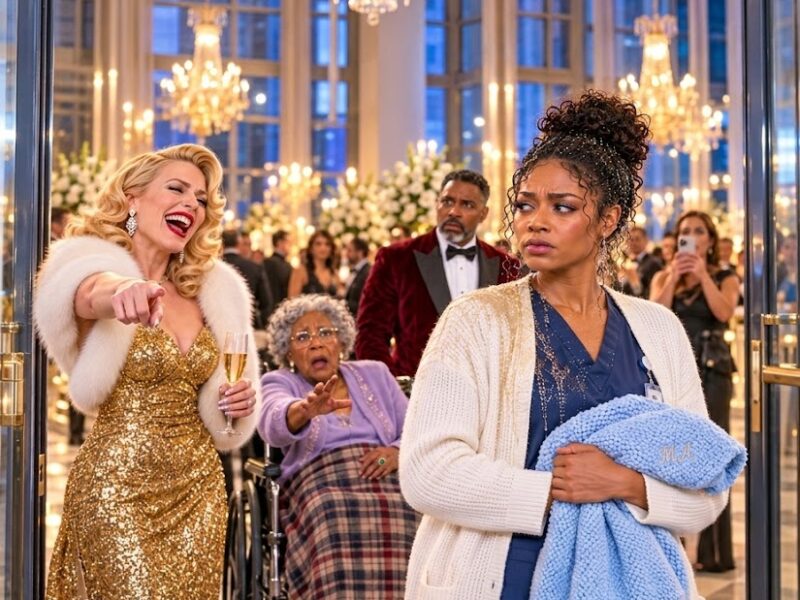
An heiress accused a Black night nurse of being a thief at a charity gala—then froze when she saw who had knitted her favorite blanket.
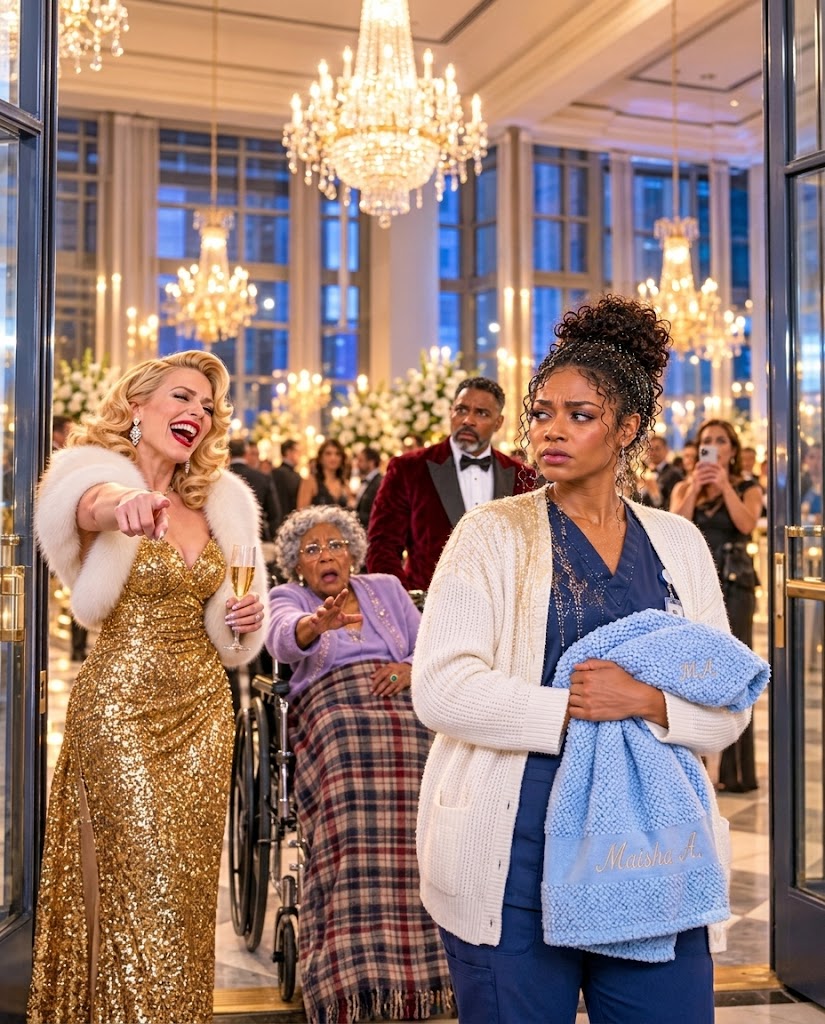
The chandelier in the Ashworth ballroom threw light like scattered diamonds, catching on champagne flutes and the desperate smiles of three million strangers watching the livestream. Imani Wells stood frozen near the service entrance, her navy scrubs a stain against the sea of silk and tuxedos. She had only come to drop off Mrs. May’s evening medication, a small kindness she had not been asked to perform.
“Before the toast, one small matter.” Dr. Voss’s voice cut through the string quartet’s performance, amplified by the microphone she had commandeered. The music died with a screech of strings. “Mama’s emerald ring is missing.”
A collective gasp rippled through the crowd. Imani felt every pair of eyes swivel toward her, the only person in the room who did not belong. Her fingers tightened around the paper pharmacy bag in her hand.
“Our night nurse was the last one in her room tonight,” Dr. Voss continued, her gaze landing on Imani with surgical precision.
“Mrs. Ashworth, I have never taken anything from her.” Imani’s voice came out steadier than she felt. She had learned long ago that shaking in front of rich people only made them hungrier.
“Then turn out your cardigan pockets.” Dr. Voss descended the marble steps like a judge approaching the bench. “Of course. I have nothing to hide.”
The silence stretched like a held breath as Imani’s fingers found the familiar lint and pen caps in her pockets. Nothing but a crumpled tissue and the key to the medication cabinet. She turned the pockets inside out, the white fabric hanging like surrender flags.
“See?” She held Dr. Voss’s gaze. “Nothing.”
“She gave it to me tonight.” A new voice—Margot Ashworth, the youngest daughter, emerged from the crowd clutching something in her fist. “She asked me to keep it safe for her family.”
The emerald caught the chandelier’s light as Margot raised it, a perfect three-carat stone set in platinum. Imani’s stomach dropped. She had seen that ring every night for a year, watched Mrs. May twist it absently while reading her mystery novels.
“Mama, did you give this woman your ring?”
Mrs. May sat in her wheelchair near the fireplace, her silver hair perfectly coiffed, her eyes clouded with the particular fog of late-stage confusion. “I… I do not remember.”
“It is all right, Mrs. May.” Imani stepped forward instinctively, her hand reaching for the old woman’s shoulder. “You don’t have to—”
“She takes advantage of a confused old woman.” Dr. Voss’s accusation landed like a slap. “Ask her in the morning. Mornings are hers.”
Someone in the crowd laughed—a sharp, ugly sound that echoed off the vaulted ceiling. Imani recognized the laugh. She had heard it before, in the hallways of the Ashworth wing, where the family’s dysfunction played out in nightly performances for anyone unlucky enough to witness.
“Now you finally look dressed for the gala.” A man in his sixties approached Mrs. May, his smile too bright. Preston Ashworth, the eldest son, always performing for cameras. The livestream was still running. Imani could see the red recording light on the camera mounted above the fireplace.
“Stop it.” Mrs. May’s voice cracked. “Stop it.”
“Margie, that is enough.” Dr. Voss snapped her fingers at a young woman in gold lamé.
“Hush, Mama.” Margot stepped closer to the wheelchair, her designer heels clicking against marble. “And you stay out of this, Preston.” She turned to Imani, her expression shifting from tearful victim to cold CEO in the space of a heartbeat. “Miss Wells, you are dismissed effective tonight.”
“Yes, Dr. Voss.” The words tasted like copper.
“Dr. Voss, she has not missed one night in a whole year.” Nurse Reyes, the evening supervisor, stepped out of the shadows, her badge glinting. “She stays late every shift. She reads to Mrs. May when the rest of you are at dinner parties.”
“Then she can miss this one, Nurse Reyes.” Dr. Voss waved her hand dismissively. “Kurt, see her out.”
A man built like a refrigerator materialized at Imani’s elbow. She recognized him—Kurt, the head of security, the one who always looked through her as though she were furniture. She gathered what was left of her dignity and walked toward the service exit, her sneakers squeaking on the polished floor.
“Good night, Mrs. May.” She paused at the door. “Your tea is on the second shelf.”
The old woman looked up, and for a moment—just a moment—the fog cleared. “Imani?”
“She knows my name.” Imani whispered it to no one in particular.
“Now, where were we?” Dr. Voss’s voice rose again, bright and brittle. “Ah, yes. To family. To the Ashworth family.”
The applause started as Kurt guided Imani through the door. She heard the toast begin, the clink of glasses, the renewed strains of the string quartet. The corridor outside was empty except for the hum of the HVAC system and the distant echo of dishes being washed in the kitchen.
“You’re not really going to let them do that, are you?” Kurt’s voice was gruff, and Imani realized with a start that he was speaking to her, not at her.
“Did you see me take anything, Kurt?”
He shook his head slowly. “I saw her press it into your hand in the hallway. Before the gala started.”
Imani’s knees nearly buckled. “Then why didn’t you—”
“Orders.” He looked away. “Dr. Voss has been planning this for weeks. The competency hearing. The will reading. They need the ring to be gone, and they need someone to blame.”
“So I’m just collateral damage?”
“You’re the help, Miss Wells. That’s all you ever were.”
He held the service door open, and Imani stepped into the cool October night. The Ashworth estate spread before her like a postcard—rolling lawns, a fountain lit from below, a driveway lined with limousines. Behind her, the gala continued. Three million people were watching the livestream, and three million people now believed she was a thief.
Her phone buzzed. A text from an unknown number: “I’m sorry. I’m so sorry. — T”
Talia. The middle daughter, the one who had watched the whole scene from the shadows, her face a mask of barely contained horror. Imani had seen her try to speak, seen Preston’s hand on her arm, silencing her.
She walked to her car—a fifteen-year-old Honda Civic with a dented fender and a bumper sticker that read “Kindness is free”—and sat in the driver’s seat without starting the engine. The leather steering wheel was worn smooth from years of use. She had bought this car with the last of her mother’s insurance money, the same year she had started nursing school, the same year she had found the blue blanket folded in a cardboard box on her doorstep.
The blanket. She reached into the back seat and pulled it out, a hand-knitted lap blanket in deep cerulean blue. Her mother had told her it came from a stranger, left on their porch the night Imani was born. She had carried it through nursing school, through breakups and bad shifts, through the long nights when Mrs. May couldn’t sleep and needed someone to sit with her.
“Who made you?” Imani ran her fingers over the intricate cable-knit pattern. “Who knitted you and left me on someone’s doorstep?”
The blanket didn’t answer. It never did.
—
Her apartment was a one-bedroom on the wrong side of town, the kind of building where the elevator smelled like bleach and the walls were thin enough to hear your neighbors’ arguments. Imani carried the blanket inside and dropped onto her couch, still wearing her scrubs. The TV was already on—she had forgotten to turn it off that morning—and the local news was running a segment about the Ashworth Gala.
“An emotional evening at the Ashworth estate,” the anchor was saying, her tone carefully neutral. “A family celebration turned sour when a longtime employee was accused of theft.”
Imani changed the channel. She changed it again. Every station seemed to be covering the story. The Ashworths were local royalty—old money, influence, the kind of family whose scandals made headlines. She was the help, the Black night nurse, the perfect scapegoat.
Her phone buzzed again. Another text from Talia: “She’s asking for you. Won’t drink her tea without you. What do I do?”
Imani stared at the screen. She had spent a year reading to Mrs. May, listening to her talk about the past, watching her struggle against the fog that was slowly claiming her mind. The old woman had asked for her every night. Had called her family, though she couldn’t remember why.
“I can’t help you,” Imani typed back. “I’m fired.”
The reply came instantly: “I know. I’m sorry. — T”
She was about to put the phone down when a new message appeared, this one from a number she didn’t recognize: “Wednesday night. The garage elevator doesn’t have a camera. I’ll be waiting at 5:45. Bring the blanket. — R”
Reyes. The evening supervisor, the one who had spoken up at the gala. Imani frowned at the phone. Nurse Reyes had always been kind but distant, a thirty-year veteran who never got involved in family politics.
“10 minutes,” Imani typed back. “That’s all I can do.”
“10 minutes is enough.”
—
The Ashworth Medical Wing was a strange hybrid—part luxury hotel, part hospital, part museum. The walls were lined with oil paintings of Ashworth ancestors, their expressions ranging from stern to constipated. The floors were marble, the ceilings vaulted, the lighting soft and warm. It was designed to feel like home, Imani had always thought, if home were a five-star resort where elderly people went to be forgotten.
She took the stairs to the third floor rather than the elevator, avoiding the camera in the main corridor. The stairwell smelled like lavender and disinfectant. Her sneakers made no sound on the carpeted steps.
At the door to Mrs. May’s suite, she paused. The room was dark except for the nightlight near the bathroom, casting a soft glow over the antique furniture. Mrs. May lay in her bed, her eyes open, staring at the ceiling.
“Imani?” The voice was barely a whisper. “Is that you?”
“It’s me, Mrs. May.” Imani crossed the room and sat in the familiar chair beside the bed. “I brought your blanket.”
She unfolded the blue lap blanket and tucked it around the old woman’s legs. Mrs. May’s hand found hers, the grip surprisingly strong for someone who had been declared incompetent three days earlier.
“You found your way back.”
“I promised I would read you the ending.”
Mrs. May smiled, a ghost of her former self. “I knitted one like this once. For a grandchild I never got to hold.”
Imani’s breath caught. “You knitted?”
“When I was young. Before… before I made all the wrong choices.” The old woman’s fingers traced the cable-knit pattern. “I gave you my ring, didn’t I?”
“Yes, Mrs. May.”
“I gave it to you because you are family. I just could not find the word.”
Imani felt tears pricking at her eyes. She had learned long ago not to cry in front of patients, but this was different. This was an old woman with nothing left to lose, speaking a truth she couldn’t remember in the morning.
“Thirty years ago, I sent my son away.” Mrs. May’s voice was barely audible. “For loving a woman I thought was not good enough. I was the one not good enough.”
“What was his name?”
“I have not said it out loud in 30 years.” Mrs. May pointed to the antique dresser across the room. “Second drawer. The note on top, not the letters underneath. Take that to Lenora Vance, only to Lenora.”
“Lenora Vance, the lawyer?”
“What is in it?”
“The morning I have been waiting for.” The old woman’s eyes closed. “I am not as confused as they want me to be.”
—
The second drawer of the antique dresser contained a manila envelope sealed with wax. The note inside was written in a shaky hand, the letters uneven and sometimes backward.
*To my son, Desmond Ashworth. I am sorry. I was wrong. Come home. — Mom*
Imani turned the envelope over. There was an address in the town of Ridgefield, about forty minutes away. The name above the address made her heart stop.
*Lenora Vance, Attorney at Law.*
She remembered now—the day she had first met Mrs. May, the old woman had called her by the wrong name. *Lenora*, she had said. *You came back*. At the time, Imani had assumed it was the confusion talking. Now she wondered.
Her phone buzzed. Reyes, warning her that the morning shift was coming on duty in fifteen minutes. Imani tucked the envelope into her backpack and slipped out through the service entrance, her mind racing.
—
The exterior of Lenora Vance’s office was unremarkable—a converted Victorian house on the main street of Ridgefield, a small town that time had forgotten. But the inside was a different story. The walls were lined with bookshelves, the desk was an antique mahogany, and the woman behind it was examining Imani with the kind of sharp intelligence that made her feel sixteen again, caught sneaking out past curfew.
“Let me see the envelope.” Lenora held out her hand. She was in her seventies, with silver hair pulled back in a bun and eyes the color of gunmetal. “I have been waiting for this for thirty years.”
“You know Mrs. May?”
“May and I were roommates in college. Before she married Ashworth. Before she…” Lenora’s voice trailed off. She broke the wax seal and read the note in silence, her expression unreadable.
“Is she…?” Imani didn’t know how to finish the question.
“She is exactly what I have always known her to be.” Lenora set the note aside. “Stubborn, proud, and far more cunning than anyone gives her credit for. She has been playing a long game, Ms. Wells. And you are part of it.”
“Me?”
“Tell me about the blanket.”
Imani reached into her backpack and pulled out the blue lap blanket. Lenora’s breath caught.
“Where did you get that?”
“My mother found it on our doorstep the night I was born. A stranger left it there.”
“A stranger.” Lenora laughed, a hollow sound. “May Ashworth left that blanket on your doorstep. She knitted it herself. She told me once that she had given it to the woman who raised her granddaughter. The woman who took in her son’s child when no one else would.”
Imani’s world tilted. “I don’t understand.”
“Desmond Ashworth was your father, Ms. Wells.” Lenora’s voice was gentle. “He fell in love with your mother—a Black woman, a nurse, a widow. May disowned him. He left. Your mother died in childbirth. And May spent the next thirty years trying to find you.”
—
The next morning, a letter arrived at Imani’s apartment. It was hand-delivered, no return address, the envelope expensive and thick.
*Ms. Wells,*
*You are cordially invited to the reading of Mrs. May Ashworth’s will.*
*Friday, 10:00 AM, Ashworth Estate.*
*Please bring the blanket.*
*— L.V.*
Imani stared at the invitation for a long time. The news was still playing in the background, another segment about the gala, another clip of her turning out her pockets. Someone had posted a picture of her on social media—her face, her name, her address. The comments were exactly what she had expected: racist, violent, terrifying.
Her phone rang. Talia.
“I know about the will,” Talia said before Imani could speak. “I know you’re coming.”
“How do you—”
“Lenora called my mother. My mother called me. It’s all happening.” Talia’s voice was strained. “I just wanted to say… I’m sorry. For not saying anything. For letting them do that to you.”
“Why are you calling me, Talia?”
“Because I need you to know something.” There was a pause. “I didn’t know about the will. I didn’t know my grandmother had been planning this. But I did know that my aunt was lying about the ring. And I did nothing.”
“Your aunt?”
“Dr. Voss. Margot. Whatever you want to call her.” Talia’s voice dropped. “She’s not actually a doctor. She bought that title from a diploma mill in the Caymans. She’s been running this con for years. The competency reports, the will, all of it.”
Imani’s mind raced. “Why are you telling me this?”
“Because I’m tired of being a coward.” The line went dead.
—
The Ashworth estate was even more imposing in daylight. The gala tent had been dismantled, the lawn returned to its manicured perfection. But the driveway was lined with cars—lawyers, I assumed, and family members, and the board of directors Dr. Voss had mentioned.
Imani wore her gray dress, the one her mother had loved. She had spent the last of her savings on it three years ago, for a wedding that never happened. The fabric was soft and simple, with long sleeves that covered the scars on her forearms from years of tending to difficult patients.
Lenora met her at the door. “Ready?”
“No.”
“That’s the right answer.” Lenora smiled. “Let’s go.”
—
The library was packed. Imani recognized Preston Ashworth, sitting in the front row next to a woman in a black dress who must have been his wife. Margot—Dr. Voss—stood near the fireplace, her arms crossed, her expression smug. Talia sat apart from the others, her face pale.
At the center of the room, in her wheelchair, sat Mrs. May. She was dressed in a blue silk dress that matched the blanket, her hair styled, her eyes clear. She looked at Imani and smiled.
“You came.”
“I promised I would read you the ending.”
“This is the beginning.” Mrs. May gestured to the empty chair beside her. “Sit.”
Imani sat. The room was silent, all eyes on her. The camera above the fireplace was recording again, the red light blinking.
“Before we begin.” Dr. Voss stepped forward. “The board should read Dr. Brandt’s report. Mama was declared not competent on Thursday. Anything she signed this spring means nothing.”
“Noted, Mrs. Ashworth.” Lenora’s voice was calm. “However, Mrs. Ashworth signed her new will on Wednesday. At 9:00 in the morning. Ten minutes after you left the ward. Two of Dr. Voss’s own nurses signed as witnesses.”
Dr. Voss’s face went white. “That’s impossible.”
“Is it?” Lenora held up a document. “The witnesses are Nurse Reyes and Nurse Chen. Both have testified to Mrs. Ashworth’s full mental capacity at the time of signing. They have also testified to the presence of one Dr. Voss in the hallway outside Mrs. Ashworth’s room, listening through the door.”
“That’s a lie.”
“Let me read the will.” Lenora cleared her throat. “To the woman who sat with me every night when my own family did not. Imani Wells, I leave the Ashworth wing and my seat on this board.”
The room erupted. Dr. Voss was on her feet, screaming. Preston was arguing with his wife. Talia was crying. And through it all, Mrs. May sat in her wheelchair, her hand in Imani’s, her eyes bright with tears.
“There’s more.” Lenora raised her voice above the chaos. “And this is Mama’s real will. Dated last Thursday. Signed in front of Dr. Brandt.”
“A forgery!” Dr. Voss lunged toward the table where Lenora had set her papers. “You’re all in on it. The nurse, the lawyer, the—”
“That’s enough, Margot.” The voice came from the doorway, and everyone turned.
A man stood there, tall and weathered, his face lined with years of hard work and heartbreak. He wore a mechanic’s uniform, his hands stained with grease. Behind him, a young woman with Imani’s exact eyes held a folder of documents.
Desmond Ashworth had come home.
“I’m here for the reading,” he said. “I believe my mother left me something.”
—
The silence that followed was deafening. Dr. Voss—Margot—stared at the man in the doorway as though seeing a ghost.
“Desmond?” Her voice cracked. “But you’re—”
“Dead?” He stepped into the room, the crowd parting before him. “You tried. The brake lines on my truck. The fire at my apartment. The men you sent to threaten my daughter.” He looked at Imani. “But I’m harder to kill than you thought.”
“Daddy?” The young woman behind him stepped forward. “What are you doing here?”
“Who let the mechanic in?” Dr. Voss was backing away now, her composure crumbling.
“The mechanic with father’s hands.” Lenora’s voice was cold. “The one who has been living in Ridgefield for thirty years. The one who has been parking his truck under the Ashworth wing every night, waiting for a chance to see his mother.”
“Oh Lord.” Preston Ashworth sank into his chair. “Thirty years.”
“Preston, who is he?” His wife tugged at his sleeve.
“I’m here.” The young woman—Desmond’s daughter, Imani realized—stepped forward. “I’m here because my father asked me to be. And because I have something to tell you.” She looked at Imani. “My name is Emma. Emma Wells. Your sister.”
—
The next hour was chaos and revelation. Dr. Voss was led away in handcuffs—it turned out she had been siphoning millions from the Ashworth estate for years, forging signatures and manipulating medical records. The will was read in full. Imani was named heir to the Ashworth wing and the board seat, while Desmond received the estate and Emma received a trust fund.
But the most important moment came at the end, when Mrs. May rose from her wheelchair—rose, with no help—and walked across the room to where Imani sat.
“You’re not confused,” Imani whispered.
“I have been confused for exactly as long as it served me.” Mrs. May took Imani’s hands in hers. “I was a coward, and I was cruel, and I lost my son for thirty years. I did not deserve to know you. But I hoped, every night, that you would come.”
“How did you know I would?”
“Because I know who knitted your blanket.” Mrs. May smiled. “I know who you are. And I know that kindness—true kindness—is something you give without expectation of return.”
Imani looked down at the blanket, the blue yarn faded but intact. She had carried it through every shift, every heartbreak, every dark night when she had wondered if she was making a difference. And now, at last, she understood.
“You gave it to my mother.”
“I gave it to your mother the night you were born. She was alone, and scared, and grieving. I had just lost my son, and I could not bear to lose you too.” Mrs. May’s eyes were wet. “I have watched you from the beginning, Imani. Through every job, every move, every night you sat with a confused old woman and read her stories she could not remember. You are the child I should have raised. The child I was too proud to raise.”
Imani felt the tears falling now, hot and free. “I don’t want the money. I never wanted the money.”
“I know.” Mrs. May squeezed her hands. “That’s why you deserve it.”
—
The livestream had caught everything. The viral clip of Imani turning out her pockets had been replaced by a new clip: Dr. Voss in handcuffs, the forged will, the revelation of the missing son who had been hiding in plain sight. Social media exploded with apologies and think-pieces and the kind of performative outrage that always followed these stories.
But Imani didn’t care about any of that. She cared about the woman in the blue silk dress, who had stopped calling her by the wrong name. She cared about the sister she had never known and the father who had been watching her from the shadows. She cared about the board seat she would now occupy, the doors that would open, the changes she could make.
And she cared about the blue blanket, still tucked under her arm, the proof that even in the darkest moments, someone had been watching out for her.
“Will you stay?” Mrs. May asked. “Will you sit with me tonight?”
“I’ll stay.” Imani helped her back to the wheelchair, the two women moving together like they had done it a thousand times. “I’m not going anywhere.”
The camera above the fireplace recorded the moment: the heiress in her gray dress, the old woman in blue silk, the blue blanket spread across their laps. Three million strangers had called Imani a thief. Now they knew the truth.
She was family.
—
Three months later, on a quiet Wednesday night, Imani sat in the familiar chair beside Mrs. May’s bed. The room was dark except for the nightlight, the same one that had glowed for a year of midnight readings. The blue blanket was tucked around Mrs. May’s legs.
“Read to me,” Mrs. May said. “The ending.”
Imani opened the book—a mystery novel they had started months ago, before the gala, before everything—and began to read. Her voice filled the room, soft and steady, the words wrapping around them both like a blanket.
Outside, the snow fell on the Ashworth estate, covering the lawns in white. The security camera watched from its corner, recording the scene: a woman in scrubs, an old woman in a hospital bed, the blue blanket spread across them both.
Three million strangers had watched the gala. Three million strangers had watched the accusation. But only a few would see this: the quiet aftermath, the healing, the love that survived.
And somewhere in Ridgefield, a mechanic lay awake in his bed, thinking about the family he had lost and the family he had found. He had spent thirty years waiting for a sign, a chance, a way back home.
The sign had come in the form of a blue blanket.
It had taken him to the end of the story.









