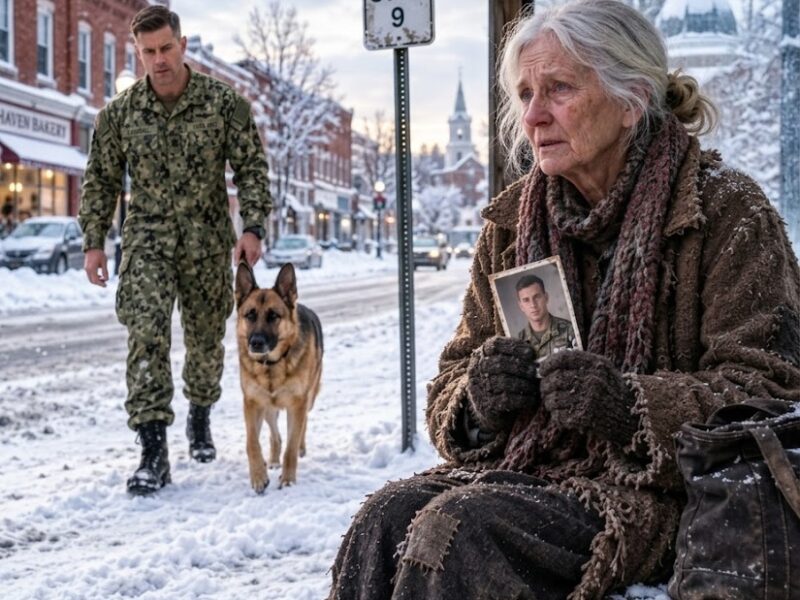
An Elderly Woman Waited Through Three Winters for Her Missing Son—Then a Navy SEAL’s K9 Ran Straight to Her
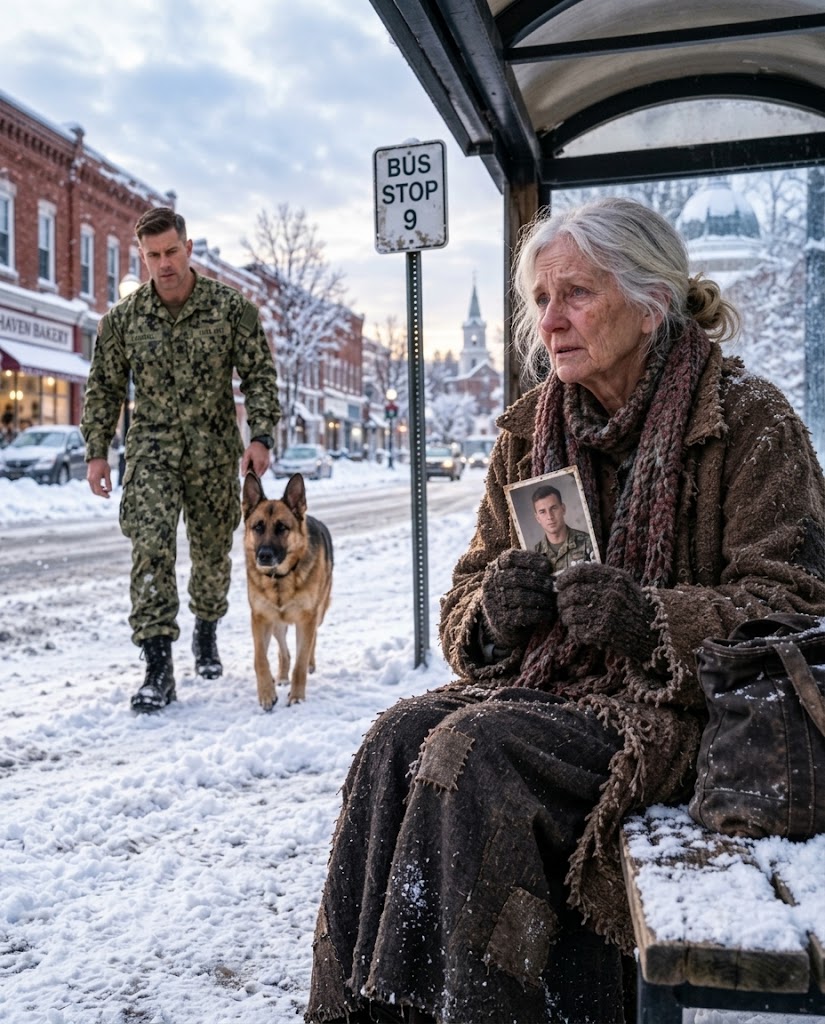
For three brutal winters, 76-year-old Nora Bellamy sat at the same bus stop, waiting for the Navy son everyone else said would never come home.
The town whispered that Mason had deserted, joined smugglers, and abandoned his own mother.
But Nora refused to believe the boy she raised could become that man.
Then one snowy afternoon, a 40-year-old former Navy SEAL named Gavin Calder passed through town with his German Shepherd, Alder, and the dog suddenly refused to keep walking.
When Nora showed Gavin the worn photograph she carried every day, his face changed because the missing sailor was not a stranger to him at all.
Mason had been Gavin’s teammate.
And what really happened on their final mission would destroy the rumor that had haunted Nora for three years.
But the truth about Mason was only the beginning.
Because Gavin soon discovered that while Nora had been waiting for her son, someone else had been quietly taking pieces of her home away.
—
Winter made Clearwater Haven look gentler than it really was.
Snow rested in clean white layers on the pitched roofs of the northern Michigan town, and late afternoon sunlight spilled across Lake Superior until the frozen edges shone like sheets of hammered silver.
Red brick storefronts lined the small town square.
Smoke curled lazily from chimneys.
Children in bright coats dragged sleds past the library while their parents hurried behind them, calling warnings that nobody under twelve had any intention of obeying.
At exactly 4:20, bus number 9 turned onto Harbor Street, and Lenora Bellamy was already waiting.
Everyone called her Nora.
At 76, Nora was a small, slender woman who seemed at first glance as though a strong winter wind might carry her away.
She stood barely five-foot-two with narrow shoulders and a slight bend in her back earned from years of gardening, housework, and refusing help when help would have been sensible.
Her white hair was gathered into a loose knot at the nape of her neck, with several silver strands escaping around a deeply lined but still graceful face.
Her pale blue-gray eyes were what people remembered.
They were tired eyes, but they were not defeated ones.
Nora wore the same old brown wool coat she had worn for several winters, carefully brushed despite the frayed cuffs.
Beneath it was a cream turtleneck, dark trousers, and worn brown snow boots.
A faded blue-gray scarf covered her throat.
A small canvas bag rested against her hip, and both gloved hands wrapped around a dented silver thermos.
Three years of waiting had taught her how to prepare for the cold.
It had not taught her how to stop waiting.
The bus sighed to a stop.
Nora straightened.
The folding doors opened.
A teenage girl came down first, headphones covering both ears.
Then a man carrying two grocery bags.
A nurse in blue scrubs.
An elderly couple arguing gently about whose turn it had been to buy milk.
Nora watched every face.
Then the doors closed.
The bus pulled away.
She remained seated.
Across the street, people noticed.
They always noticed.
Three years earlier, the Navy had informed Nora that her only son, Petty Officer Mason Bellamy, had disappeared during an operation, and that the conditions surrounding his disappearance made survival extremely unlikely.
Nobody had ever come home.
There had been a memorial service, folded flags, carefully chosen words, and men in uniform who had spoken to Nora in the quiet voices people used around fresh grief.
None of it had felt like an ending.
Then the rumors began.
Someone heard that Mason had been seen with men connected to an illegal transport network.
Someone else claimed he had been under investigation.
By the time those fragments passed through enough mouths, the story became simpler and uglier.
Mason Bellamy had deserted.
Mason had joined smugglers.
Mason had run away.
Whenever someone was foolish enough to repeat the story near Nora, she answered the same way.
“You heard stories about him. I raised him.”
Then she ended the conversation.
She did not believe herself immortal, and she was not confused about reality.
Nora knew perfectly well that three years was a long time.
She understood what the Navy’s careful language meant.
She understood that Mason might never walk down Harbor Street again.
But understanding death without a body was like standing before a door that had almost closed.
Almost was enough to keep a mother looking through the crack.
So she came to bus number nine.
Almost every afternoon.
On dangerous days when snow buried the curbs and the wind came hard off the lake, Hank Doyle refused to let her sit outside.
Hank was 65, broad through the waist and slightly stooped from decades behind a steering wheel.
His thinning silver hair showed beneath a navy knit cap, and his round face had the permanently red nose of a man who had spent half his working life stepping between heated buses and Michigan winters.
He had driven number nine for seventeen years and possessed the stubborn kindness of someone who complained while helping.
Once during a blizzard he had stopped the bus, opened the doors, and pointed across the street toward the diner.
“You either sit in there, Nora, or I park this bus and carry you myself.”
“You couldn’t carry me.”
“I can drag you.”
She had laughed and obeyed.
Even then, Nora had chosen the window facing the stop.
Mason had used number nine when he was young.
During high school, after sports practice, during his first summer job, even on leave years later when he could have rented a car.
Once when he was barely twenty, he had kissed Nora on the forehead before boarding and said, laughing, “If you ever don’t know where to find me, Mom, just watch that bus.”
He had meant nothing by it.
Mothers were dangerous custodians of casual promises.
They remembered them forever.
—
That same afternoon, thirty miles south of Clearwater Haven, Gavin Calder saw the highway closure sign.
He muttered something under his breath.
Beside him, Alder lifted his head.
Gavin Calder was forty years old and stood six-foot-one with broad shoulders and a hard, disciplined build that looked less like a bodybuilder’s physique than the result of a man who had never learned how to neglect physical training.
His face was distinctly masculine.
Angular cheekbones, a strong jaw, straight nose, and clean-shaven skin.
Dark brown hair silvering lightly at the temples was kept in a precise undercut.
His deep gray-blue eyes gave away more than the rest of him did.
There was a permanent quietness there, not weakness, weariness.
He wore a fitted long-sleeved blue camouflage uniform-style outfit, neat and practical, with black tactical boots and a plain dark watch.
Years as a Navy SEAL had taught Gavin to tolerate discomfort.
They had not taught him how to tolerate Clearwater Haven.
His navigation screen offered the detour.
The road went straight through town.
Gavin stared at it.
For three years, he had known Mason Bellamy had grown up there.
For three years, whenever travel brought him anywhere near northern Michigan, Gavin had found another route.
This time, the snow had taken that choice away.
“Just passing through,” he said.
Alder’s ears moved.
The seven-year-old German Shepherd occupied the passenger side of the truck with the calm authority of an animal who believed most human decisions required supervision.
Alder was large and powerfully built, with a rich golden-tan coat beneath a black saddle across his back.
His muzzle had begun to silver faintly, and a small notch in his left ear gave his otherwise handsome face a slightly battle-worn character.
His amber-brown eyes were alert without being restless.
Alder rarely barked unnecessarily.
He watched.
He remembered.
And sometimes, Gavin suspected he noticed the truth several minutes before people did.
“Don’t start,” Gavin told him.
Alder yawned.
That somehow felt judgmental.
By 4:35, Gavin had parked near Clearwater Haven’s town square.
He needed coffee, fuel, and approximately ten minutes before getting back on the road.
Nothing more.
Alder walked beside him on a worn brown leather collar, the small metal identification tag at his throat clicking softly with each step.
They passed the library, a bakery, a diner glowing gold behind fogged windows.
Then Alder slowed.
Gavin kept walking.
The leash tightened.
“Alder.”
The dog stopped completely.
Across Harbor Street, Nora sat beneath the small shelter at bus stop 9.
Gavin barely glanced at her.
“Come.”
Alder took two steps, then looked back.
Gavin felt irritation rise, not at the dog, but at the strange pressure beginning somewhere beneath his ribs.
“You’ve seen old ladies before.”
Alder looked at him, then back at Nora.
A gust of wind swept loose snow over the sidewalk.
Nora opened her canvas bag and took out a scarf.
It was old, gray-blue with one frayed corner.
Alder changed instantly.
His ears rose.
His body became still.
Not aggressive, not frightened.
Attentive.
So completely attentive that Gavin stopped breathing for half a second.
“Alder.”
The German Shepherd gave a low sound in his throat.
Not a growl, not quite a whine.
Then he stepped toward the street.
Gavin caught the leash.
“Alder.”
The German Shepherd looked at the scarf again, and memory struck Gavin with the physical force of cold water.
A younger man laughing beside a dock, wind tearing at his coat.
That same muted blue-gray wrapped carelessly around his neck.
Mason.
Gavin stared across the road.
It could not be the same scarf.
Even if it was, three years was too long.
Snow, wind, distance, hundreds of scents.
There was no sensible reason for Alder to recognize anything.
Maybe he didn’t.
Maybe Gavin was the one recognizing ghosts.
But Alder had already chosen a direction, and for once Gavin followed.
They crossed Harbor Street.
Nora noticed the dog first, her expression softened.
“Well, aren’t you handsome?”
Alder approached without his usual reserve and stopped beside her knees.
Nora slowly offered one gloved hand.
Alder sniffed it, then sat.
Gavin’s stomach tightened.
“He doesn’t usually do that.”
Nora looked up.
For a moment, she simply studied him.
Gavin was accustomed to being assessed by military officers, doctors, hostile strangers, and men who believed silence was intimidation.
An old mother’s scrutiny was somehow worse.
Her gaze dropped to the small Navy patch worked into Gavin’s winter gear.
“You served?”
“Yes, ma’am.”
Her eyes returned to his face.
“Navy?”
“Yes.”
Something changed in her.
Not hope exactly.
Hope had hurt her too many times to arrive quickly anymore, but attention sharpened behind her tired eyes.
Nora moved the thermos aside.
“My son was Navy.”
Gavin said nothing.
There were thousands of sailors, thousands of families.
There was no reason the next word should matter.
Yet his hands had already gone cold.
Nora opened the canvas bag again.
“I know this sounds foolish.”
“It doesn’t.”
“You don’t know what I’m going to ask.”
“No, ma’am.”
That almost made her smile.
She reached inside and carefully removed a photograph protected by a clear plastic sleeve.
“My son served a long time. Maybe you crossed paths.”
Gavin saw the picture before he could prepare himself.
Mason Bellamy stood beside Nora beneath a summer sky.
He was younger in the photograph, perhaps thirty.
Tall and athletic with short, dark blonde hair, clear blue eyes, and the broad, open smile Gavin remembered from long nights, bad coffee, and moments when nobody else had found anything worth laughing about.
One arm rested around his mother’s shoulders.
Mason looked alive in the careless way only photographs could preserve.
Gavin’s thumb froze against the edge of the plastic.
Alder shifted closer to Nora.
Then the German Shepherd quietly rested his chin against her knee.
Nora noticed.
Her hand trembled as she touched the dog’s head.
When she looked back at Gavin, the softness had disappeared from her expression.
A mother had seen something.
Perhaps in his face, perhaps in Alder, perhaps only in the silence that had lasted one heartbeat too long.
“You know him,” she said.
It was no longer a question.
Gavin looked down at Mason’s smiling face.
Three years of avoided roads, unanswered guilt, and carefully locked memories had followed him into Clearwater Haven.
He could have lied.
He had lied to himself often enough, but not to her.
Nora’s fingers tightened around the photograph.
“You knew my son, didn’t you?”
Gavin raised his eyes to hers.
“Yes, ma’am,” he said quietly.
“I did.”
—
Gavin did not tell Nora the truth at the bus stop.
Not because he wanted to hide it from her, because the snow had begun to fall harder, gathering in the folds of her coat and along the silver strands of hair near her temples, and because some truths deserved more than a plastic shelter, a frozen bench, and strangers passing within earshot.
“You live far?” he asked.
Nora pointed toward a narrow road climbing away from the square.
“Pine Lantern Road. Ten minutes if my knees are behaving. Fifteen if they’ve declared independence.”
Despite himself, Gavin almost smiled.
“Let me drive you.”
“I can walk.”
“I know.”
That answer seemed to satisfy her more than an argument would have.
Alder climbed into the back of Gavin’s truck while Nora settled carefully into the passenger seat.
She held her canvas bag against her chest the entire drive.
Gavin noticed that.
He noticed everything except where he wanted his thoughts to go.
The Bellamy house stood near the edge of town, a weathered one-story home surrounded by snow-laden pines.
The pale siding had faded unevenly, and one corner of the porch sagged just enough to suggest years of repairs postponed by necessity rather than neglect.
Warm yellow light glowed behind the kitchen curtains.
“It looks smaller than he made it sound,” Gavin said before he could stop himself.
Nora glanced at him.
“Mason talked about the house more than once.”
Something in her face softened.
“Then come inside.”
The front door opened with a stubborn scrape.
The house smelled of wood smoke, coffee, old books, and something faintly sweet.
Cinnamon, perhaps, lingering from a morning that had already become memory.
Photographs filled the walls.
Mason in an oversized backpack on his first day of school.
Mason at fourteen, all elbows and bad hair, holding a fishing rod twice his height.
Mason in a high school football jersey, mud across one cheek and a grin wide enough to embarrass any teenager forced to pose for his mother.
Mason at graduation.
Mason in uniform.
Gavin stopped in front of one photograph near the hallway.
Mason looked about eleven, kneeling beside a sapling in the backyard.
His hands were muddy, his blonde-brown hair falling over his forehead.
One knee ripped through his jeans.
Beside him stood a younger Nora with darker hair and both hands on her hips, apparently trying not to laugh.
“He planted that tree,” Nora said from behind Gavin.
Gavin turned.
“Apple?”
“Supposed to be. Supposed to be. It gave us four apples in its first six years. Mason called it an underachiever.”
Gavin smiled before he could prevent it.
Nora noticed.
She said nothing.
That silence was kinder than sympathy.
Alder wandered into the kitchen, circled once near the small wood stove, and lay down where he could see both Gavin and Nora.
Nora filled an old kettle.
Her hands were steady now.
That surprised Gavin.
He had seen people receive bad news before.
Some cried before hearing it.
Some talked too much.
Some went unnaturally quiet, as if stillness could slow whatever was coming.
Nora behaved like someone who had spent three years preparing for a knock at the door.
She placed two coffee mugs on the table.
Then she sat across from Gavin.
For a while, she did not ask how Mason died.
Instead, she asked, “Did he ever learn to eat tomatoes?”
Gavin blinked.
“What?”
“He hated them as a boy. Claimed they were fruit pretending to be vegetables.”
Gavin looked down into his coffee.
“No, he still picked them out of everything.”
Nora laughed softly.
The sound broke something inside him.
“He snored like a chainsaw with a personal grievance.”
Her eyes brightened.
“I knew it. And he denied it every time.”
“He always did.”
The questions continued.
Did Mason still whistle when nervous?
Yes.
Did he still tap his fingers twice on a table before making a difficult decision?
Yes.
Did he still laugh at his own jokes before reaching the punchline?
Unfortunately, yes.
Each answer gave Nora something.
Each answer took something from Gavin because every small habit proved how well he had known Mason in the years Nora had not.
There was a cruelty in that even though neither of them had caused it.
Nora finally wrapped both hands around her mug.
“Did he talk about me?”
Gavin looked up.
“All the time.”
“That sounds like something people say to mothers.”
“I know.”
“So don’t say it unless it’s true.”
“It’s true.”
He told her about Mason complaining that Nora mailed wool socks even when he had enough.
About Mason insisting nobody made chicken pot pie correctly except his mother.
About a Christmas when he spent twenty minutes arguing that Nora’s recipe could settle international disputes if governments were serious about peace.
Nora lowered her head, her shoulders shook once, then stopped.
When she looked up again, tears had gathered but not fallen.
“That sounds like him.”
Gavin nodded.
“It does.”
The room became very quiet.
Outside, snow whispered against the windows.
Finally, Nora asked the question Gavin had been waiting for.
“Were you with him when it happened?”
Gavin’s hand tightened around the coffee mug.
He could have answered with one word.
Instead, he stared at the small chip along the rim.
Nora understood his silence.
“Oh.”
That was all she said, but the word carried three years inside it.
Gavin took a slow breath.
“There are things about the operation I can’t discuss.”
“I’m not asking for secrets.”
“I know.”
“I’m asking about my son.”
That distinction landed harder than any accusation.
Gavin leaned back.
“The rumors were wrong.”
Nora did not move.
“Mason was working as part of a coordinated operation connected to illegal transport activity through the Great Lakes region. Some of the people he was seen around were people being investigated. He was supposed to be near them.”
Her lips parted.
“He didn’t join them.”
“No, he didn’t desert.”
“No.”
The first tear fell.
Nora wiped it away almost angrily.
Gavin continued carefully.
“The operation was ending. Weather conditions deteriorated quickly. We were moving out.”
He stopped.
There were pieces he could still see too clearly.
Black water, wind stripping words from men’s mouths.
Cold so sharp it had felt like metal beneath the skin.
He did not give Nora those images.
He gave her only what belonged to her.
“I was injured.”
Nora’s eyes fixed on him.
“I ended up in the water.”
Alder raised his head from the floor.
Gavin noticed but kept speaking.
“Mason was already in a safer position.”
“Safer?”
“He had a way out.”
Nora’s fingers tightened around her mug, but he came back.
Alder suddenly stood.
The German Shepherd crossed the kitchen without a sound and stopped beside Gavin.
Then he pressed his head firmly against Gavin’s thigh.
It was an old behavior, not training, memory.
Gavin looked down.
For one impossible second, the kitchen disappeared.
He remembered Mason laughing in freezing rain, one hand buried in Alder’s fur after an exhausting training day.
“He worries about you,” Mason had joked.
“He’s a dog. He has excellent judgment.”
Then Mason had looked at Alder and added, “Keep this idiot from wandering off.”
Gavin had forgotten the moment.
Alder had not.
Or perhaps Gavin only needed to believe he had not.
Nora watched the dog lean against him.
“What is it?”
Gavin swallowed.
“Mason liked him.”
Nora looked at Alder differently.
“Did Alder know my son?”
“Yes.”
Alder turned toward her voice.
Nora reached down slowly and touched the dog’s head.
This time, her tears came freely.
Not loudly, not dramatically.
Just the quiet surrender of a woman finally receiving proof that her son had existed somewhere beyond photographs and official letters.
“Then you both came back,” she whispered.
Gavin had no answer for that.
He continued only when Nora was ready.
“Mason reached me in the water. He kept me above the surface until the others could get close enough.”
“And him?”
Gavin’s voice lowered.
“The conditions shifted. We were separated.”
“How long did they search?”
“Long enough.”
It was an honest answer without pretending any search had ever been enough.
“We kept looking after the initial response. Air, water, shoreline. Nothing.”
Nora closed her eyes.
Gavin watched her absorb the absence all over again.
No body, no final goodbye.
But now the blank space had shape.
“What was he like?” she asked.
“When? At the end?”
Gavin hesitated, focused.
“Afraid.”
He could have offered comfort.
Instead, he gave her respect.
“Yes.”
Nora nodded.
That answer seemed to matter.
“Good.”
Gavin frowned slightly.
She opened her eyes.
“I didn’t raise a boy who couldn’t be afraid. I raised one who knew what to do while he was afraid.”
Gavin looked away.
That sentence belonged to Mason so perfectly that for several seconds it hurt to breathe.
“I need you to understand something,” he said.
Nora waited.
“Mason had a chance to get clear.”
Her mouth tightened.
“He came back anyway.”
“Yes.”
“Why?”
Gavin looked directly at her.
“Because I was still there.”
The words sat between them.
Gavin had spent three years refusing to form the crueler sentence.
Mason died because of me.
He still would not say it, not because it was entirely false, because it was not entirely true.
Mason had made a choice.
Reducing that choice to Gavin’s guilt would make Mason’s courage only another man’s punishment.
So Gavin said the thing he could live with.
“Mason saved my life.”
Nora covered her mouth.
For several moments, she cried without making a sound.
Alder moved beside her chair and lay down close enough that one of his paws touched her boot.
Then Nora lowered her hand.
“Tell me three things.”
Gavin waited.
“Did he abandon his duty?”
“No.”
“Did he betray the men beside him?”
“No.”
She stared at Gavin as though the next answer would determine what remained standing inside her.
“Are you certain?”
Gavin did not look away.
“I’m alive to answer you because Mason turned back for me.”
Nora’s face crumpled, but she did not collapse.
She leaned back, closed her eyes, and breathed once.
Twice.
A long time passed before she spoke.
“So I wasn’t crazy.”
Gavin understood immediately.
She was not talking about bus number nine.
She was talking about every person who had lowered their voice when she entered a store.
Every sideways look, every rumor she had refused to repeat, every night she had wondered whether a mother’s faith was simply grief wearing a better coat.
“No,” Gavin said.
“You weren’t.”
Nora looked toward Mason’s photographs.
“For three years, I thought maybe loving him had made me stupid.”
“It didn’t.”
“No,” she wiped her cheeks.
“Apparently, it just made me stubborn.”
That earned the smallest laugh from Gavin.
Nora smiled through her tears.
“There. He would have liked that.”
It was dark when Gavin finally left.
Snow had stopped.
The air over Clearwater Haven was clean and still, the moon bright enough to turn the road pale blue.
Gavin rented a room at a small roadside motel instead of continuing north.
He told himself it was because the roads were worse after dark.
Alder knew better.
The room was plain.
One bed, one chair, a lamp giving off weak yellow light.
Gavin sat on the edge of the mattress.
Alder lay near the door for several minutes.
Neither moved.
Then Gavin noticed the small metal tag on Alder’s collar.
He reached down and turned it over.
Scratched into the back were words Mason had engraved years earlier.
Don’t let Calder get lost.
Gavin laughed.
One short, helpless sound.
Then the laughter disappeared.
Mason had left a joke on a dog’s collar.
Gavin had spent three years turning it into an accusation without even realizing it.
He looked toward Alder.
“You did a terrible job.”
Alder thumped his tail once.
Gavin leaned forward, elbows on his knees.
For the first time, he allowed himself to think about Nora without immediately thinking about escape.
He had planned to leave Clearwater Haven in the morning.
Instead, Gavin picked up his phone and canceled the next day’s travel reservation.
He would stay a little longer.
Not because Nora needed another son, not because Gavin could repay Mason.
Some debts were too large to be repaid and too sacred to be treated like debts at all.
He would stay because three years ago he had survived.
And three years later, he had finally begun the conversation survival required.
—
By eight the next morning, Gavin was standing on a ladder outside Nora Bellamy’s kitchen window with a screwdriver between his teeth.
The wind had found a narrow gap in the frame and spent most of the night pushing cold air through it.
Nora stood below him in her old brown wool coat, arms folded.
“You know, I survived three winters with that window.”
Gavin removed the screwdriver.
“That doesn’t make the window good.”
“It means the window and I had an understanding.”
“The window was winning.”
Nora gave him a look that suggested Navy SEALs were more annoying than advertised.
Alder lay in the snow near the porch, his golden and black coat bright against the white yard.
The seven-year-old German Shepherd appeared relaxed, but his amber eyes followed every movement around him.
His ears turned at distant truck engines, crows in the pines, the scrape of Gavin’s boot against the ladder.
Gavin had planned to stay only long enough to seal the frame.
That was what he told himself.
Then he noticed Alder was no longer beside the porch.
The dog had crossed the backyard and stopped near a metal fence.
It looked newer than everything around it.
Most of Nora’s property carried the soft wear of decades, an old shed leaning slightly east, weathered wooden posts, shrubs half buried beneath snow.
The fence did not.
Dark galvanized panels ran in a straight line across what appeared to be the rear edge of the yard.
Beyond it sat stacks of lumber, two utility trailers, and the corner of a small prefabricated storage building.
“Alder,” Nora called.
“Don’t go onto Mr. Deak’s property.”
Gavin stopped halfway down the ladder.
“Where does his property start?”
Nora pointed past the fence.
“Over there.”
“That’s not very specific.”
“It used to be.”
She gestured toward an old apple tree nearly thirty feet beyond the current fence line.
Even in winter, Gavin recognized it.
The tree from the photograph.
Its trunk had thickened and twisted with age, branches reaching upward like stiff hands beneath the snow.
Gavin looked from the tree to the fence.
“That much?”
Nora’s expression changed.
Not anger, something closer to embarrassment.
“It’s complicated.”
Gavin climbed down.
“Those are usually the expensive ones.”
That earned the faintest smile.
Then Nora looked toward the neighboring property.
“After my husband died, I stopped using most of the back garden. Too much for one person.”
“How long ago?”
“Seven years.”
She rubbed one gloved hand across the other.
“Warren Deak helped with snow removal. Sometimes he moved equipment through the side drive when his own access was blocked.”
“Did you give him permission?”
“At first.”
Those two words mattered.
Nora continued.
“Two years ago, he brought over a paper. Said his insurance company wanted written permission so his trucks could continue using the side path.”
“You read it?”
“I tried.”
Gavin did not ask why she had signed something she did not fully understand.
He knew the question was useless after the fact.
Nora answered anyway.
“Warren had lived next door for fifteen years. He had helped repair my porch once, brought firewood after Harold died.”
Harold.
Gavin realized that was the first time she had mentioned her late husband by name.
Trust, he thought, rarely disappeared all at once.
Sometimes it was spent one small favor at a time.
“What happened after you signed?”
Nora pointed.
“The trucks came farther in.”
“How far?”
“First the side path, then a little beyond it. Warren said it was temporary because he needed room to turn around.”
“And the fence moved once.”
Gavin looked at her.
Nora paused.
“Twice.”
“The first movement was several feet. The second nearly ten. A storage building appeared the following spring.”
When Nora objected, Warren told her the old property markers were unreliable and that everyone in the neighborhood had misunderstood the boundary for years.
“He kept saying I wasn’t using that ground anyway,” Nora said.
Gavin’s jaw tightened.
“That’s not how ownership works.”
“I know that now.”
“You knew it then.”
Her eyes flicked toward him.
“I knew what I felt. That’s different from knowing what I could prove.”
There it was, the sentence of someone who had already been made to doubt herself once before.
Mason, now the land.
Gavin felt anger rise, but anger was only useful if pointed in the correct direction.
He did not walk next door.
He did not confront anyone.
Instead, he asked, “Do you still have the paper you signed?”
“Somewhere.”
“Find it.”
Nora raised one eyebrow.
“That sounded like an order.”
“Old habit.”
“I don’t take orders.”
“Well, I noticed.”
—
The Clearwater Haven Public Library sat two blocks from the town square inside a pale brick building with tall windows and an old brass clock over the entrance.
By late morning, Gavin stood at the reference desk with a folder of photocopies Nora had found in a kitchen drawer.
The woman behind the desk introduced herself as June Mercer.
June was 63, slim and energetic, with chin-length chestnut hair.
Sturdy wire-frame glasses sat low on her nose, and warm brown eyes had the alert quality of someone who had spent decades remembering which local family owned which farm, who married whom, and which road had once been called something entirely different.
She wore a forest green cardigan over a pale denim shirt, dark jeans, and a burgundy scarf.
“You’re the man who brought Nora home yesterday.”
Gavin looked at her.
“News moves fast.”
“This is a town of four thousand people in winter.”
June adjusted her glasses.
“News walks faster than the snowplow.”
She examined the paperwork.
Then she frowned.
“This document doesn’t show a transfer.”
“I didn’t think it did.”
“It looks like permission for access.”
“How much access?”
“That part is badly written.”
June tapped one paragraph.
“Which is how arguments become lawsuits.”
She led Gavin into a back room where plat maps, historical property records, and old aerial photographs were stored.
June did not pretend any one document proved Nora’s boundary.
Instead, she worked carefully.
She found a county plat earlier, an aerial photograph from twenty-one years ago, another from twelve years ago.
The old Bellamy property appeared wider than the land currently enclosed by Nora’s fence.
“This doesn’t settle anything,” June warned.
“But?”
“But I’d ask why a fence moved inward when the historical lines don’t seem to.”
Gavin studied the maps.
June watched him.
“Mason rebuilt half that garden one summer.”
Gavin looked up.
“You knew him?”
“Most people here did.”
Her smile was small.
“He was seventeen. Thought manual labor built character until the first week of pulling stones.”
Gavin almost smiled.
“That sounds right.”
“He planted the apple tree earlier than that with his father.”
June pointed at an old photograph included in a local property file.
The tree appeared as a thin sapling.
For Gavin, it was strange how Mason kept appearing not through military memories, but through soil, bad jokes, family photographs, and ordinary work.
Perhaps that was the part of him Gavin had never really known.
They returned to Nora’s house after lunch.
Alder immediately walked toward the rear yard.
He had been restless there all morning.
This time Gavin followed.
The dog moved along the snow near the old apple tree, nose low, pausing every few feet.
“Alder.”
The German Shepherd ignored him.
Not disobedience, concentration.
Then Alder stopped at a shallow depression near the base of a buried patch of weeds.
He sniffed, scratched once, then again.
Snow flew behind his front paws.
Gavin approached.
“What did you find?”
Alder dug harder.
Something dark appeared beneath the snow.
Metal.
Gavin crouched and cleared the area with one gloved hand.
A short iron rod protruded from frozen ground.
Only an inch showed above the soil.
Alder sat beside it, very still.
Gavin stared at the rod, then at the fence several yards away.
For a moment, the yard felt strangely silent.
Nora had spent years looking toward a road, waiting for something to return.
Yet here, beneath snow, she had walked over countless times.
Another part of her life had been waiting, too.
Not for rescue, for someone to notice it.
June arrived behind them and leaned closer.
“That could be an old survey pin.”
“Could,” she straightened.
“And before you start moving fences around like a conquering army, it could also be an old piece of pipe.”
Gavin looked at her.
“I wasn’t going to move the fence.”
June smiled.
“You looked like you wanted to.”
Alder sneezed into the snow.
Nora laughed from the porch.
It was the first easy laugh Gavin had heard from her.
June gave Gavin the name of a licensed land surveyor.
Thomas Reed arrived later that afternoon in an aging white pickup truck carrying tripods, marking stakes, and more caution than enthusiasm.
Thomas was 52, tall and lean, with a long, narrow face weathered by years outdoors.
His sandy-gray hair was cut short beneath a knit cap, and a trimmed salt-and-pepper beard sharpened his jaw without making him look severe.
He had pale green eyes and the patient manner of a man accustomed to telling property owners things they did not want to hear.
He studied the iron rod, then the maps, then the fence.
“One pin proves nothing by itself,” he said.
Gavin nodded.
“I know.”
Thomas looked mildly surprised.
“Good. Saves me twenty minutes.”
He explained that he would need the deed, recorded plat, neighboring descriptions, historical monuments, and any other reliable markers.
“The ground tells part of the story,” Thomas said.
“Paper tells another. My job is to make them agree.”
He marked the location but made no conclusion.
That suited Gavin.
Facts first, everything else later.
Warren Deak arrived shortly before sunset.
Gavin saw him crossing the side yard carrying a pie box.
Warren was 58, broad and heavy through the chest and waist with thick shoulders made larger by a brown work coat.
His square face had rough, wind-reddened skin, short salt-and-pepper hair, and small gray eyes that seemed to measure people before deciding how friendly to be.
There was no beard, only a faint shadow along a strong jaw.
He looked like what he was, a man accustomed to work, bills, machinery, and getting his own way through persistence rather than shouting.
“Nora.”
He raised the box.
“Apple.”
She looked at it.
“That’s ambitious.”
Warren did not laugh.
His gaze moved to Gavin, then Thomas’s stakes in the snow.
“I hear you’re asking questions.”
“I am,” Gavin said.
Warren looked back to Nora.
“You signed permission for the side drive for access.”
“Not half my garden.”
Warren exhaled.
“We’ve used that strip for two years.”
Gavin said using something doesn’t automatically make it yours.
Warren turned toward him.
“You don’t live here.”
“No.”
“You don’t know what agreements were made between neighbors.”
“That’s true.”
Warren seemed prepared for resistance, not agreement.
Gavin continued.
“That’s why I’m finding people who do know.”
Silence.
Warren’s jaw tightened.
Then he looked at Nora.
“I helped you when Harold died.”
“I remember.”
“I cleared snow. Fixed that porch.”
“I remember that, too.”
“And now this stranger comes into town and suddenly everything is a fight.”
Nora’s expression hardened.
“Looking at a property line isn’t a fight, Warren.”
He glanced at Gavin again.
Then he said the cruelest thing in the mildest voice.
“You’ve already lost enough, Nora. Don’t let another military man come here, stir everything up, then disappear.”
The words hit their target.
Gavin felt it.
He said nothing.
Alder rose.
The German Shepherd walked forward slowly and stopped between Warren and Nora.
No growl, no bared teeth, only a calm, unmoving body.
Warren looked down at him, then at Gavin.
Finally, he placed the untouched pie on the porch rail.
“Do what you want.”
He walked home.
The yard grew quiet again.
Nora stared after him.
Gavin looked toward the metal fence cutting across the snow, then toward the old apple tree standing beyond it.
He had come back that morning intending to fix a drafty window.
Now he understood how small that problem had been.
While Nora had spent three years staring down a road, waiting for a son who could not come home, other pieces of her life had quietly moved away from her.
A few feet, then a few more, until losing them had begun to feel normal.
Gavin looked at Alder beside her.
This time, he did not think about rescuing Nora.
He thought about making sure she had enough truth to decide what she wanted back.
—
Evelyn Hart arrived at Nora Bellamy’s house the next morning, carrying a black leather folder and the expression of someone who had already decided not to be impressed by anybody’s confidence.
June Mercer had made the introduction.
Evelyn was 44, tall and straight-backed with a lean, professional build and a sharply composed face.
Her dark brown hair fell neatly to her shoulders, framing deep brown eyes that seemed to sort facts from emotion before she ever spoke.
She wore a charcoal wool coat over a burgundy turtleneck, black trousers, and low black leather boots that collected a thin edge of snow at the soles.
She was not cold.
Not exactly.
She was careful.
Years in legal aid had taught her that people often arrived with stories already arranged into heroes and villains.
Evelyn preferred documents.
Nora set the old agreement on the kitchen table.
Evelyn read it once, then again.
Gavin remained standing near the counter.
Alder lay beneath the window, his golden and black body stretched across the floor, ears shifting whenever a page turned.
Finally, Evelyn removed her glasses.
“This does not transfer ownership.”
Nora let out a breath she had been holding too long.
Gavin asked, “Then Warren has no right to use the land.”
Evelyn looked at him.
“That is not what I said.”
Her tone was not rude.
That somehow made the correction more effective.
She tapped a paragraph with one finger.
“This appears to give Mr. Deak limited permission to use a defined access route for equipment. The problem is that the language describing the route is imprecise.”
Nora leaned closer.
“I thought it meant the side path.”
“That may very well have been your understanding.”
“It was.”
“But the document is badly drafted. It mentions access sufficient for vehicle passage without clearly fixing the width.”
Gavin’s jaw tightened.
“So he exploited it.”
Evelyn looked at him again.
“Maybe.”
The single word stopped him.
“Maybe. Intent matters if you’re going to accuse someone of fraud. Right now, what I can say is that his current use may exceed what this agreement reasonably permits.”
Nora stared at the page.
“I should have known better.”
Evelyn’s expression changed slightly.
Not softer, more human.
“Most people sign papers because they trust the person sitting across from them.”
Nora gave a bitter little laugh.
“That sounds expensive.”
“Sometimes.”
Gavin stepped closer.
“What do we do next?”
Evelyn closed the folder.
“You don’t do anything.”
Gavin frowned.
She looked directly at him.
“You are not the property owner.”
“I know.”
“Do you?”
The room went quiet.
Nora glanced between them.
Evelyn continued.
“You can help. You can gather records. You can drive her to appointments. You can sit beside her if she asks.”
Then she pointed gently toward Nora.
“But you cannot take this over because you’re uncomfortable watching her deal with it.”
Gavin said nothing.
Evelyn’s voice remained calm.
“You don’t get the land back for her.”
Gavin finally asked, “Then who does?”
“Nora.”
The answer landed harder than Gavin expected.
He had spent half his adult life in environments where problems had objectives, procedures, and chains of command.
You identified the threat.
You acted.
You secured the result.
But Nora was not an operation.
Her life was not a damaged position for Gavin to retake.
Nora folded her arms.
“I like her.”
Gavin looked at her.
“Of course you do.”
Thomas Reed returned before noon to continue the survey.
Fresh snow had fallen overnight, but the sky was clear enough to expose a hard blue winter light.
Thomas worked methodically.
He confirmed the first known marker, checked recorded measurements, and followed the line toward the rear section of the property.
The second monument was less cooperative.
Part of the likely boundary ran close to the newer structure Warren had placed beyond the fence.
Thomas spent nearly an hour checking distances.
“No conclusions yet,” he warned.
Gavin nodded.
He had learned not to ask.
While Thomas worked, Alder wandered toward a much older wooden shed that stood entirely on Nora’s side of the uncontested yard.
The shed looked tired enough to qualify for retirement.
Its boards were gray with age.
One hinge hung lower than the other.
Snow had gathered in a deep drift against the north wall.
Alder stopped near the corner, sniffed, moved two feet, came back.
Nora noticed.
“What is he doing?”
“Being difficult.”
Alder scratched once beneath a loose bottom board.
Then again.
Gavin approached.
The dog’s nose pressed into the narrow gap.
“There’s something under there.”
Nora shrugged.
“Probably mice.”
Alder sneezed, then resumed scratching.
Gavin pulled off one glove and worked his fingers beneath the loose plank.
The wood resisted, then gave with a dry crack.
Behind it was packed dirt and a cavity beneath the floor.
Something rusted sat inside.
Gavin reached in.
A small metal box emerged.
It was rectangular, once green perhaps, though most of the paint had surrendered to rust.
Nora stopped breathing.
“Oh.”
Gavin looked at her.
“You know it.”
She stepped closer.
“Mason’s.”
Her voice changed completely.
Not old, not tired.
For a moment, it belonged to the mother of a teenage boy who had hidden things in sheds.
“He kept baseball cards in that when he was little.”
Gavin placed it on an overturned crate.
The latch resisted before finally opening.
Inside lay a tightly packed collection of paper wrapped in an old dish towel.
Letters, photographs, hand-drawn maps, a school certificate, a pressed leaf nearly turned to dust.
Nora laughed through sudden tears.
“He saved everything.”
Gavin picked up a folded page.
“Looks like a garden plan.”
It was.
Mason had drawn the yard in uneven pencil lines, labeling vegetable beds, a compost pile, the shed, and the apple tree.
At the bottom, he had written, “Mom says straight rows. Dad says plants don’t care.”
Nora smiled.
“Harold never planted a straight row in his life.”
Gavin looked at her.
“Your husband?”
“Yes.”
She took another photograph.
This one showed Mason as a teenager beside Harold.
Harold Bellamy had been a broad, handsome man in his early fifties with thick dark hair beginning to gray, a square face, and a heavy mustache.
He wore work jeans and a faded flannel shirt, one arm draped over Mason’s shoulder.
There was an ease in his smile that explained something about Nora’s house before grief had narrowed it.
Behind them stood the apple tree, and farther back, barely visible, was a short metal marker.
Thomas noticed it over Gavin’s shoulder.
“Wait.”
He took the photograph.
Nora stiffened.
“That important?”
Thomas did not answer immediately.
He walked outside with the picture in his hand.
Gavin followed.
Thomas stood near the tree, turned the photograph toward the present landscape, and adjusted his angle.
The old background had changed.
The shed was different.
One neighboring structure was gone, but a line of mature pines remained.
Thomas studied them.
“This doesn’t prove a boundary.”
“I know,” Gavin said.
Thomas pointed to the image.
“But it may tell me where to look.”
Alder suddenly trotted past them.
Not toward the photograph, not toward the fence, toward a patch of frozen ground several yards beyond where Thomas had been searching.
The dog stopped beside a low mound of snow and looked back once, then again.
Thomas gave Gavin a skeptical glance.
“If that dog finds my second monument before I do, I’m changing careers.”
Alder pawed once at the snow.
Gavin laughed.
Thomas did not until he walked closer.
Then his expression changed.
He crouched, brushed aside snow, and pushed a probing rod into the frozen ground.
Metal answered metal beneath the surface.
Thomas went still.
“Well.”
Nora came down from the porch.
“What?”
Thomas looked up.
“Your dog has extremely inconvenient timing.”
Alder wagged his tail once.
Gavin felt the hair rise along his arms.
Not because he believed in miracles, because sometimes coincidence arrived with such precision that disbelief felt just as arrogant as faith.
Thomas marked the spot.
Then he stood.
“Still not proof by itself.”
Gavin smiled.
“You really enjoy saying that.”
“I enjoy not being sued.”
The full answer took several more hours.
Thomas checked the deed, the recorded plat, the first marker, the newly located monument, historical measurements.
By late afternoon, he was finally willing to say it.
“The present fence does not follow the recorded Bellamy boundary.”
Nora said nothing.
Thomas continued, “It crosses onto your property by a significant amount.”
“How significant?” Gavin asked.
Thomas gave the approximate distance.
Nora looked toward the fence.
For two years, she had accepted that line as reality.
Now it looked different.
Not because the metal had moved, because doubt had.
Evelyn, who had returned for the final measurements, reminded Nora that a survey established the physical boundary, but did not automatically resolve every legal issue surrounding access or structures.
Nora nodded.
For once, Gavin stayed quiet.
He was learning.
Later, back inside, Nora returned to the tin box.
She unfolded one of the letters.
Mason had been nineteen when he wrote it.
His handwriting was less disciplined then, slanted and impatient.
The letter was not about war, not about duty, not about heroism.
It was about leaving.
He wanted to travel, see oceans, live in places where nobody knew him.
He joked that Clearwater Haven was so small that if he sneezed near the hardware store, Nora would hear about it before he got home.
Then the tone changed.
Nora read silently for several seconds.
Gavin watched her face.
“What?”
She handed him the letter.
One passage had been underlined years ago.
“If I ever go so far that you can’t see me anymore, don’t turn this house into a place where you wait for me. Live here because you love it, not because you think I’m coming through the door.”
Gavin read it twice.
Nora took the letter back.
“He was nineteen.”
Her voice trembled.
“Kids that age think they understand leaving.”
Gavin looked around the room.
The photographs, the preserved bedroom doorway, the untouched chair near the window, the scarf folded carefully on the coat rack.
Suddenly, the house looked different, not abandoned.
Paused.
Nora had not merely waited at a bus stop for three years.
She had been waiting everywhere.
—
Across the neighboring property, Warren Deak stood inside his workshop with his son, Caleb.
Caleb was 31, tall and lean, with a strong workman’s build and lighter features than his father.
His brown hair was cut short but never quite neat, and hazel eyes made him look younger until worry settled across them.
He wore a navy hoodie beneath an olive quilted vest, faded jeans, and brown work boots stained with salt.
Caleb had spent most of his adult life trying to keep the family business alive.
That responsibility had made him loyal.
It had not made him blind.
He watched Warren stare through the workshop window toward the survey stakes.
“How bad?” Caleb asked.
Warren did not answer.
Caleb tried again.
“If they move the access line, we can’t get the larger trucks around the storage building.”
“I know.”
“We’d have to open the east side.”
“I know.”
“That’ll cost money.”
Warren turned.
“You think I don’t know that?”
Caleb held his ground.
The business carried equipment loans, a line of credit, and two winters of weak contracts.
The access through Nora’s side made everything easier, cheaper, possible.
Caleb looked toward the fence, then asked the question Warren had been avoiding.
“But is that land actually ours?”
Warren’s jaw tightened.
He looked away at the trucks, at the workshop, at the life he had built and nearly borrowed into collapse.
He did not answer, and for Caleb, the silence was answer enough.
—
By the end of the week, Gavin had developed a habit of arriving at Nora Bellamy’s house before she asked him to.
At first, Nora appreciated it.
The porch roof had been leaking along one edge, so Gavin climbed up with shingles, sealant, and the quiet concentration of a man more comfortable fixing wood than discussing grief.
The next morning, a half cord of split firewood appeared beside the shed.
The day after that, Gavin arranged an inspection of the old heating system.
Then he spent nearly an hour on the phone asking about assistance programs available to surviving families of service members.
Nora watched all of it happen.
For several days, she said nothing.
Gavin mistook silence for permission.
That was his first mistake.
His second was assuming every problem became smaller once he put his hands on it.
A loose porch board could be replaced.
A broken hinge could be tightened.
Cold air could be kept out with insulation.
Gavin understood those things.
People were harder, especially people who had already survived without him.
Alder seemed to notice the tension before Gavin did.
The seven-year-old German Shepherd had begun dividing his time between the kitchen and the back porch, often lying where he could see both Gavin and Nora.
His black and gold coat caught the pale winter light through the windows, and his amber eyes moved between them whenever their conversations sharpened.
One Thursday morning, Gavin stood beside Nora’s wood stove with a notebook in one hand.
“This needs to go.”
Nora looked up from peeling potatoes.
“What does? The stove?”
She stared at him.
“It works.”
“It’s inefficient.”
“It burns wood and makes heat. I’m unclear what other career you expected from it.”
Gavin ignored the sarcasm.
“The technician said the flue needs work and the stove itself is outdated. I found a replacement.”
Nora stopped peeling.
“You found one?”
“Yes.”
“You bought it?”
“Not yet.”
“That was almost a good answer.”
Gavin lowered the notebook.
“I can have it installed next week.”
Nora placed the potato on the cutting board.
“I didn’t ask for a new stove.”
“You need one.”
“That is not the same sentence.”
Gavin’s patience tightened.
“It’s safer.”
“So fix what’s unsafe.”
“The whole thing is old.”
“So am I.”
“Nora.”
“No.”
The word was quiet.
That made it more final.
Gavin stared at her.
She wiped her hands on a dish towel.
“I was grateful when you fixed the window.”
He said nothing.
“I was grateful for the wood.”
Still nothing.
“And I appreciated you calling about those programs.”
Then she looked directly at him.
“But somewhere between the porch and my stove, you stopped helping me and started managing me.”
Gavin’s jaw tightened.
“That’s not what I’m doing.”
“Isn’t it? I’m trying to make sure you’re safe.”
“I was alive before you arrived.”
The sentence hit harder than she intended, or perhaps exactly as hard as she intended.
Alder lifted his head.
Gavin looked toward the floor.
Nora continued, “You decide what needs fixing. You decide who to call. You decide what I should replace.”
“I’m trying to help.”
“I know.”
“Then what exactly is the problem?”
Nora’s eyes flashed.
“The problem is that you’re acting like if you repair enough things, Mason will owe you less.”
Gavin went completely still.
The room seemed to contract around them.
Nora realized she had found the wound.
She did not apologize.
Not yet.
Gavin set the notebook on the table.
“You don’t know what I owe him.”
“No.”
Nora’s voice softened only slightly.
“But I know my son.”
Gavin looked away.
Outside, snow slid from the porch roof in a heavy sheet.
Alder stood.
He did not approach either of them.
He simply remained between the kitchen and the door, watching.
Nora stepped closer.
“Mason saved you.”
Gavin said nothing.
“That does not mean you have to spend the rest of your life paying me back for it.”
His expression changed.
The disciplined calm slipped.
Not dramatically.
Just enough.
Nora saw the exhaustion underneath.
Three years of it.
“I’m not paying you back.”
“Then why are you here every morning before I ask?”
Gavin opened his mouth.
No answer came.
“Why did you know exactly where Clearwater Haven was and never come?”
That did it.
He looked at her.
Nora understood immediately.
“You knew.”
Gavin’s face hardened.
“Yes.”
The word came out low.
“I knew where you lived.”
Nora’s anger did not explode.
It became colder.
“For three years.”
“Yes.”
“You knew this was Mason’s home.”
“Yes.”
“And you never came.”
Gavin swallowed.
“No.”
Silence.
Alder slowly lowered himself to the floor.
Nora gripped the back of a kitchen chair.
“Why?”
Gavin looked toward the window.
Not because the answer was outside.
Because it was easier than looking at her.
“I couldn’t.”
Nora’s voice sharpened.
“You crossed oceans. You went into things most people would run away from. But you couldn’t drive into a small town.”
“No.”
“Why?”
Gavin finally looked at her.
“Because I knew who would open the door.”
Nora stopped breathing for a moment.
Gavin’s voice lost its military steadiness.
“I could handle what happened out there.”
That was not entirely true, and they both knew it.
“I could handle reports, debriefings, recovery, people telling me what Mason did.”
He paused.
“But I couldn’t look at his mother and know I was the man who came back.”
Alder rose and crossed the room.
This time he did not go to Gavin.
He went to Nora.
The German Shepherd stood beside her, pressed lightly against her leg, and looked toward Gavin.
The gesture was so simple that it hurt.
Nora rested one hand on Alder’s head.
For several seconds, neither human spoke.
Then she said, “You thought I would blame you?”
“Yes.”
“Did you blame yourself?”
Gavin did not answer.
He did not need to.
Nora’s expression changed.
Not forgiveness, understanding, which was harder.
“You should have come sooner,” she said.
Gavin lowered his head.
“Yes.”
No excuse, no defense, no mention of trauma, orders, recovery, or fear.
Just yes.
Nora let the silence sit between them.
Then she pulled out a chair.
“Sit down.”
Gavin obeyed.
She returned to the potatoes.
Several minutes passed.
Finally, Nora said, “Mason made his choice.”
Gavin stared at the table.
“I know.”
“No, you know the words.”
She sliced one potato in half.
“That is not the same as believing them.”
Gavin looked at her.
Nora continued, “My son did not save you so you could become miserable enough to make his death fair.”
The knife stopped.
“There is no fair version.”
Gavin’s throat tightened.
“He should be here.”
“Yes, and I shouldn’t.”
Nora turned.
“That is the first foolish thing I’ve heard you say.”
Gavin almost laughed.
Almost.
Nora placed the knife down.
“You were not given his life.”
She tapped the table once.
“You were given yours back.”
That distinction stayed with Gavin.
A moment later, Nora added, “And for the record, you are still not replacing my stove without permission.”
This time he did laugh.
So did she.
Not because anything was healed, because they had finally stopped pretending repair and healing were the same thing.
—
That afternoon, Evelyn Hart arrived with copies of Thomas Reed’s completed survey.
Warren and Caleb came over shortly afterward.
The meeting took place at Nora’s kitchen table.
Warren sat stiffly, still wearing his brown work coat.
Caleb stood behind him at first, his navy hoodie sleeves pushed slightly up his forearms.
His hazel eyes looked tired, and for once he seemed less like Warren’s son than a man trying to decide which version of his father he could continue defending.
Evelyn placed the documents on the table.
“The survey confirms the recorded boundary.”
Warren shook his head.
“Those old descriptions are a mess.”
“Some are,” Evelyn said.
“This one is not.”
She pointed to the relevant section.
“The fence crosses onto Mrs. Bellamy’s property. So does part of the storage structure.”
Warren leaned back.
“We’ve used that land for two years.”
“That does not make it yours.”
His eyes narrowed.
“Nora signed access for a limited route.”
“We needed room for the trucks.”
Evelyn’s voice remained calm.
“Need does not expand a property agreement.”
Caleb looked toward his father.
“Dad.”
Warren ignored him.
“We put money into that side.”
Nora spoke for the first time.
“So did my family.”
Warren looked at her.
For several seconds, neither moved.
Then Caleb said quietly, “Did you know the fence was past what she agreed to?”
Warren’s face tightened.
“That’s not the question.”
“It is to me.”
Warren turned toward his son.
“We were trying to keep the business alive.”
“That still isn’t an answer.”
The room sharpened.
Gavin remained silent.
A week earlier, he might have stepped in.
Now he looked at Nora.
Her choice.
Warren finally rubbed one hand across his face.
“When Harold died, nobody was using that section.”
Nora’s eyes hardened.
“That was not what Caleb asked.”
Warren exhaled.
“I knew we were using more than the old side path.”
There it was.
Not a grand confession.
Just enough truth.
“I kept telling myself you didn’t need it,” he said.
Nora stared at him.
Warren looked away.
“My trucks did.”
For a moment, Gavin expected Nora to demand everything removed immediately.
She had every reason.
Instead, she asked Evelyn, “What are my options?”
Evelyn explained them carefully.
Nora listened.
Then she made her decision.
“The shed comes off my property.”
Warren opened his mouth.
She raised one hand.
“The fence goes back to the surveyed line. The ruts and compacted ground get repaired.”
Caleb nodded slowly.
Nora continued.
“You can use a narrow section of the side route for six months while you arrange another access.”
Warren stared at her.
“Six months with a written agreement this time.”
Evelyn almost smiled and clearly measured.
Nora added, “Caleb let out a breath.”
“Mrs. Bellamy.”
“Nora. Thank you.”
Warren said nothing.
Gavin looked at her.
Later, after the Deaks had left, he asked why give him six months.
Nora folded the survey papers neatly.
“Because his company employs people who did not move my fence.”
“He took advantage of you.”
“Yes.”
“And you’re helping him anyway.”
“No.”
She looked up.
“I’m giving him time to correct what he did without making other people pay for it immediately.”
Gavin considered that.
Nora added, “Fairness does not require me to answer selfishness with selfishness.”
Outside, Warren stood near the boundary with Caleb.
For the first time, he looked back at Nora’s house without the easy confidence of a man who believed an old woman would eventually give way.
Something had changed.
Not the survey, not the fence, not Nora.
Or perhaps Warren had simply been forced to see what had always been there.
She had never been weak.
She had only been tired.
And those were not the same thing.
—
Gavin thought the truth would change Nora’s routine.
It did not.
Not immediately.
The day after Warren agreed to restore the property line, Nora still put on her brown wool coat shortly before four.
She wrapped the faded blue-gray scarf around her neck, filled her dented thermos, and walked toward town.
Gavin watched from the porch.
“You’re going to the bus stop?”
Nora buttoned the top of her coat.
“Yes.”
He hesitated.
“I thought maybe you wouldn’t anymore.”
She looked at him with mild amusement.
“You thought three years could be switched off before supper?”
Gavin said nothing.
Nora softened.
“I know what happened to Mason now.”
She glanced toward the road.
“That doesn’t mean my feet know it yet.”
Alder stood beside Gavin, ears forward.
Nora started walking.
This time Gavin did not follow.
He was learning.
Over the next week, Nora continued going to bus stop 9, but something had changed.
Before she had waited through several arrivals, sometimes until the sky darkened and the lamps over Harbor Street came on.
Now she stayed for one bus.
Only one.
The doors opened.
People stepped down.
Nora looked.
Then she left.
No second bus.
No lingering until dusk.
One afternoon Gavin joined her.
He sat at the far end of the bench while Alder lay between them, his black and gold coat dusted lightly with snow.
The street was quiet.
Gavin finally asked, “Do you still think Mason might get off that bus?”
Nora looked straight ahead.
“No.”
The answer was immediate.
“Then what are you waiting for?”
She took a breath.
“I don’t think I’m waiting anymore.”
Gavin frowned.
Nora looked at him.
“I think I’m learning how not to.”
He understood that better than he wanted to.
The bus arrived.
Nora watched the doors open.
She watched the passengers step down.
Then she stood before the engine had fully pulled away.
That was new.
—
Mason’s birthday came six days later.
Snow began before dawn.
By noon, Clearwater Haven had disappeared beneath a soft, steady curtain of white.
Gavin spent the morning helping move firewood closer to Nora’s back porch.
When he went inside around three, the kitchen was empty.
“Nora?”
No answer.
Her coat was gone.
So was the old blue-gray scarf.
Gavin turned toward the mudroom.
“Alder?”
Silence.
He stepped outside.
The gate stood slightly open.
A set of small bootprints led toward the road.
Beside them were paw prints.
Gavin stared for one second, then grabbed his coat.
By the time he reached Harbor Street, snow had thickened enough to blur the far end of the square.
Nora sat beneath the bus shelter.
Alder sat beside her, not at her feet, beside her, almost upright, shoulders square, watching the road.
Nora held the scarf in both hands.
Gavin slowed before reaching them.
He did not ask why she had come.
He already knew.
Mason would have been thirty-seven.
Nora shifted slightly on the bench.
“There’s room.”
Gavin sat.
Alder stayed between them.
For several minutes, nobody spoke.
The snow muffled everything.
Cars moved more slowly, footsteps disappeared almost as soon as they were made.
Nora ran her thumb along the edge of the scarf.
“He hated birthdays after thirty.”
Gavin looked at her.
“That sounds accurate.”
“He said thirty-one felt suspicious.”
Gavin smiled.
“He told us thirty-five was a government conspiracy.”
Nora laughed softly.
The sound faded.
Then she said, “This is the last time.”
Gavin turned.
She looked at the road.
“The last time I sit here waiting for him to come back.”
He did not answer.
Some promises did not need witnesses.
Only silence.
At 4:20, bus number nine appeared through the snow.
Its headlights emerged first.
Then the blue and white body of the bus rolled toward the curb.
Nora straightened, not with hope, with habit.
The doors folded open.
A college student stepped down carrying a backpack covered in patches.
Then an elderly couple descended carefully, the husband holding his wife’s elbow.
A construction worker followed, broad-shouldered and tired, orange reflective stripes bright against his dark coat.
Last came a young mother holding a bundled baby against her chest.
Nora watched every face.
No Mason.
The doors remained open.
Nora did not cry.
She folded the scarf once, then again, and placed it in her lap.
Hank Doyle climbed down from the driver’s seat.
He had changed little since Gavin first noticed him, stocky through the middle, silver hair thinning beneath his navy knit cap, round face reddened by cold.
He carried himself with the weary steadiness of a man who had spent decades driving the same roads through weather other people considered a reason to stay home.
Hank looked at Nora.
“Birthday?”
She nodded.
He removed one glove and scratched his cheek.
“Mason used to ride this route after school.”
Nora looked up.
“You remember that?”
“Hard not to.”
Hank smiled.
“He gave up his seat every time somebody older got on.”
Nora’s mouth softened.
“He complained about it afterward.”
“Every time.”
Hank laughed.
“Said old people somehow knew when he was tired.”
A woman standing near the diner entrance overheard them.
Her name was Ruthie Cole, 68, owner of the small diner across from the stop.
Ruthie was short and broad-hipped with fair skin, thick white-blonde hair cut just below her ears, and the kind of round expressive face that made secrets difficult.
She wore a red quilted vest over a black sweater, and flour still dusted one sleeve from the kitchen.
She crossed the street carrying a paper cup.
“Mason shoveled my front walk once.”
Nora turned toward her.
Ruthie handed her the coffee.
“Wouldn’t take money.”
“He always took food.”
“That he did.”
Ruthie smiled.
“Two cinnamon rolls and half a pie.”
Gavin heard Nora laugh again.
It was becoming easier.
June Mercer arrived from the direction of the library, bundled in her forest green cardigan beneath a heavier coat.
She raised one mitten hand.
“He also returned every military history book late.”
Nora looked scandalized.
“He told me the library fines were unreasonable.”
“They were twenty cents.”
“He was cheap.”
“He was terrible.”
June smiled.
“And he always paid.”
One memory invited another.
Not speeches, not tributes, small things, human things.
Then a man stopped at the edge of the shelter.
Gavin recognized him only vaguely from the hardware store.
His name was Eli Turner, 59.
A tall, narrow man with a weathered face, close-cropped gray hair, and a short beard turning white at the chin.
He owned a small repair shop on the west side of town and had the uncomfortable posture of someone who had come specifically to say something he did not want to say.
Eli removed his cap.
“Nora.”
She looked at him.
He glanced at Gavin, then away.
“I said some things about Mason.”
The warmth around the bus stop changed.
Nobody spoke.
Eli swallowed.
“I repeated things I heard.”
Nora’s face became still.
“I know.”
He nodded.
“I shouldn’t have.”
Snow collected on his shoulders.
“I don’t expect you to forgive me.”
Nora looked at him for several long seconds.
Then she said, “Good.”
Eli blinked.
Nora’s voice remained calm.
“Because that would make this too easy.”
He lowered his eyes.
She continued, “But you know better now.”
“Yes.”
“Then don’t say it anymore.”
Eli nodded.
“I won’t.”
“That’s enough for today.”
No embrace, no grand reconciliation.
Eli put his cap back on.
Before leaving, he looked toward the empty bus seat behind Hank.
“For what it’s worth, Mason fixed my truck once when he was sixteen.”
Nora raised one eyebrow.
“He knew nothing about trucks at sixteen.”
Eli almost smiled.
“Exactly. Took him five hours.”
The tension broke.
Even Gavin laughed.
Eli walked away.
Nora watched him go, then looked down at the scarf in her lap.
For years, people had spoken about Mason as rumor.
Now, one by one, they were remembering him as a person.
The bus engine idled.
Hank checked the clock.
“I’ve got to go.”
Nora nodded.
He climbed back inside, then leaned out through the open doors.
“See you tomorrow.”
Nora looked at the bench.
The snow along its edge had begun to melt beneath the warmth left by her coat.
She looked toward the road, then toward Gavin.
Finally, she looked at Alder.
The German Shepherd stood.
Nora placed the scarf inside her canvas bag.
“No,” she said.
Hank paused.
“No, I’ve got work in the garden tomorrow.”
For a moment, Hank simply stared.
Then he smiled.
“All right.”
The doors folded shut.
Nora stood.
Gavin instinctively moved one hand toward her elbow, then stopped.
She noticed.
A very small smile touched her face.
Nora stepped away from the shelter on her own.
Alder walked beside her.
Gavin followed.
Bus number nine pulled away behind them.
Nora did not turn around.
Neither did Gavin.
Halfway across the square, Ruthie called from the diner.
“Nora, you want that second coffee?”
Nora looked over her shoulder.
“Only if it’s free.”
Ruthie shouted back.
“For you? Never.”
Nora laughed.
The sound carried through the snow.
Gavin watched her walk ahead with Alder.
For the first time, he understood that helping someone move forward did not always mean pulling them.
Sometimes it meant resisting the urge to touch their arm.
Sometimes it meant walking at their pace, and sometimes healing looked almost disappointingly ordinary.
An old woman, a dog, a snowy street, and a bus leaving without taking anything else from her.
—
Spring arrived in Clearwater Haven without ceremony.
One week the town was still edged in dirty snow banks, the roads narrowed by gray ice and sand.
The next, water ran in shining threads along the gutters.
The roofs began dripping at noon, and the dark ground slowly emerged beneath winter.
By April, the Bellamy garden had returned, at least on paper.
The fence stood along the surveyed line again.
Warren’s storage structure had been moved.
The temporary access route was reduced to the narrow strip written into the new agreement.
But ownership restored did not mean beauty restored.
Truck tires had compressed long sections of soil until the ground was hard as packed clay.
Grass had died in irregular patches.
A corner near the fence had become a shallow basin where melt water collected.
The apple tree looked worst of all.
Mason’s tree had survived nearly three decades, but winter seemed to have finished what neglect had started.
Its bark was split in several places.
Most branches were bare.
Gavin stood beneath it one cool morning and looked upward.
“I think it’s done.”
Nora was kneeling nearby, loosening soil around an old flower bed.
At 76, she still moved carefully, but there was something different in her posture now.
She no longer seemed folded inward by waiting.
Her white hair was tied loosely at the nape of her neck, and dirt already marked one knee of her trousers.
She looked at the tree.
“No. Give it another season.”
“It’s mostly dead.”
“Mostly is not completely.”
Gavin glanced down at Alder.
The German Shepherd had chosen the tree as his preferred resting place since the snow melted.
His black and golden coat gleamed under the pale sunlight, and the faint silver around his muzzle made him look older when he closed his eyes.
He lay with one shoulder against the trunk.
Gavin pointed at him.
“You’re encouraging her.”
Alder opened one amber eye.
Nora smiled.
“He has good judgment.”
“I’ve heard that before.”
The words came out before Gavin could stop them.
For a brief second, Mason was there.
Not as a body in cold water, not as a name in an official report, as a voice making fun of Gavin.
The ache still came, but it no longer swallowed everything around it.
Nora noticed that, too.
She said nothing.
They left the tree standing.
Restoring the garden became a town project almost by accident.
June Mercer arrived first.
She carried three paper sacks of seeds against her green cardigan and announced that she had obtained them legally enough.
Gavin looked suspicious.
June adjusted her round glasses.
“The library has connections with seed smugglers. Don’t ruin the mystery.”
She brought beans, squash, carrots, lettuce, and two varieties of tomatoes.
Nora looked at the tomatoes.
“Mason would consider this a personal betrayal.”
June smiled.
“That’s why I brought extra.”
Evelyn Hart appeared the following Saturday in her charcoal coat with a new pair of gardening gloves that looked far too clean.
She lasted four minutes with a hoe before Nora took it away from her.
“You’re holding it like opposing counsel.”
Evelyn looked offended.
“I went to law school so I wouldn’t have to know this.”
“Clearly.”
Thomas Reed came with cedar posts to reinforce the reconstructed boundary.
He worked without much conversation, measuring twice before driving anything into the ground.
“Still afraid of being sued,” Gavin asked.
Thomas did not look up.
“Always.”
Caleb Deak brought lumber.
He had spent the previous weeks helping relocate equipment from the disputed strip and looked more rested now that the argument was no longer hanging over the business.
He and Gavin rebuilt a low raised bed near the kitchen.
Neither discussed Warren.
Not at first.
Then an engine sounded from the neighboring drive.
Everyone looked up.
Warren approached on a compact tiller.
He stopped near the property line.
Nobody welcomed him.
Nobody told him to leave.
That seemed appropriate.
Warren climbed off the machine.
He looked older than he had during the dispute.
The same broad shoulders filled his brown work jacket, but something in his square face had lost its stubborn certainty.
He looked at Nora.
“Where do you want me?”
Nora pointed toward the bright survey marker.
“Start by staying on the correct side of that line.”
Caleb laughed.
June covered a smile.
Even Thomas looked interested.
Warren stared at Nora.
Then, after several seconds, he laughed once.
“Fair enough.”
It was not forgiveness.
It did not erase what happened.
But for the first time, Warren entered the Bellamy garden because Nora allowed him to.
That mattered.
By early May, the ground softened.
The garden changed.
Not quickly.
Nothing important in Clearwater Haven seemed to happen quickly anymore.
Beds were turned.
Old roots were cleared.
Compost was worked into damaged soil.
Nora began planning what to grow where.
One afternoon, June unfolded a handwritten list.
“What about community plots?”
Nora looked up.
“For who?”
“Mrs. Holloway and the apartments can’t keep a garden anymore.”
June tapped the page.
“The Ramirez family lost their backyard when they moved. Two seniors from the church asked about raised beds.”
Nora looked across the land.
For years, Warren had justified taking part of it by saying she did not use it.
The accusation had once hurt.
Now she saw another answer.
Maybe land did not have to be used only by its owner to remain theirs.
Maybe ownership could include choosing to share.
A week later, Nora put a small wooden sign beside the path.
Mason Bellamy Community Garden.
No rank, no medals, no long explanation, just his name.
Gavin stood beside her as she looked at it.
“You sure?”
“Yes.”
“About using his name?”
Nora nodded.
“I spent three years defending what people said about him.”
She touched the top of the sign.
“I’d rather give them something good to do with it.”
That summer, the garden filled.
Older residents planted herbs and beans.
Families took turns watering.
Children June recruited through the library learned that seeds required patience, and that patience did not mean poking the soil every six minutes to check whether anything had happened.
One boy did it anyway.
Nora caught him.
“Plants don’t like being interrogated.”
The boy stared at her.
“Are you sure?”
“No, but stop digging.”
Gavin watched her laugh.
The garden no longer looked like disputed property.
It looked inhabited.
—
One afternoon, Gavin found Nora alone beside the apple tree.
Alder was already there.
The dog stood beneath one low branch, staring upward.
Nora had one hand pressed against the trunk.
“What is it?” Gavin asked.
She pointed.
At first, he saw nothing.
Then he stepped closer.
Near the end of a branch that had looked dry all spring, a tiny green bud had opened.
Then another.
Three in all.
Nothing dramatic, no sudden bloom, no miracle large enough for anyone else to notice.
Gavin stared at them.
Nora smiled.
“Mason was like that, like a tree. Stubborn enough to make everyone wait before proving them wrong.”
Gavin laughed, and this time the memory of Mason did not immediately become guilt.
That realization startled him more than the buds.
For three years, every memory had ended in the same place.
Cold water, loss, debt.
Now one ended in laughter.
Alder sat beneath the branch and looked from Nora to Gavin.
Gavin rubbed the dog’s neck.
“Fine. You were right.”
Nora folded her arms about the tree.
She smiled.
“I know.”
—
By June, Gavin knew it was time to leave.
Not because Nora needed him less, because she had never needed him in the way he first imagined.
She had needed truth, choice, respect, sometimes company.
Those were different things.
Gavin packed his truck on a bright Friday morning.
Alder waited near the passenger door.
Nora stood on the porch.
“I put you down as my emergency contact,” she said.
Gavin looked up.
“You did?”
“Don’t sound so frightened.”
“I’m not frightened.”
“You look frightened.”
“I’ve done worse things.”
“That is not reassuring.”
He smiled, then said, “I’ll come back.”
Nora studied him.
“Don’t make one of those military promises.”
Gavin paused.
He understood.
Big promises were easy.
Dates were harder.
He took out his phone.
“Next Friday, six o’clock.”
“What happens at six?”
“I call you.”
Nora considered it.
“That I believe.”
Gavin nodded.
Alder jumped into the truck, then jumped back out.
“Alder.”
The dog trotted toward the apple tree.
Gavin followed.
Nora followed more slowly.
Alder stopped beneath the same branch.
The green buds had opened farther.
Small leaves now caught the morning light.
Nora touched one carefully.
“Mason would have loved this.”
Gavin looked at the tree.
For years, he had believed surviving meant owing the dead something impossible.
Punishment, sacrifice, a life lived carefully enough to justify another life ending.
Now he understood.
Mason had not saved him so Gavin could spend the rest of his years apologizing for breathing.
He had saved him so he could breathe.
That was all.
And perhaps that was everything.
—
Three months later, Gavin returned to Clearwater Haven.
Late summer had transformed the town.
Flowers spilled from window boxes.
Lake Superior flashed blue beyond the trees.
Bus number nine moved along Harbor Street as Gavin entered the square.
He slowed near the old stop.
The bench remained empty.
Gavin looked at it.
He felt no sadness, only recognition.
Some places stopped being prisons once people stopped asking them to return what they had lost.
He drove on.
At the Bellamy garden, Nora stood between rows of tomatoes, arguing with Warren.
“You’re drowning them.”
“I’m watering them.”
“You’re trying to create Lake Superior.”
Warren pointed at the plants.
“They look fine.”
“They look terrified.”
June laughed from a nearby table.
Caleb was repairing one section of fence.
Children moved between raised beds carrying baskets.
Alder saw them first.
He barked once, jumped from Gavin’s truck, and ran ahead.
Nora turned.
She did not cry.
She did not rush toward Gavin.
She simply raised one hand.
Gavin raised his.
Then he walked into the garden.
Behind him, bus number nine passed somewhere beyond the houses.
Nora never looked toward the sound.
There was nothing left for her to wait for there.
Mason would never come home on a bus, but he had returned in other ways.
In the truth about what he had done, in a mother who could finally say his name without defending it, in the man whose life he had saved, in a German shepherd who once refused to keep walking, and in an old garden that winter had nearly emptied, only for spring to remind everyone that surviving and living were not always the same thing.
Sometimes surviving was only the beginning.
Living was what came after.
Sometimes the miracles God sends do not arrive with thunder, flashing lights, or the answer we begged for.
Sometimes they arrive as a dog that refuses to keep walking.
As a stranger who finally stops.
As a truth that comes years too late to change the past but just in time to change what remains.
Nora waited for Mason because a mother’s love does not measure time the way a calendar does.
Gavin carried guilt because surviving can feel like a burden when someone else did not come home.
And Alder, without understanding grief the way people do, simply kept noticing what everyone else had learned to pass by.
In the end, Mason did not return on bus number nine.
But his courage returned, his name returned, the truth returned, and through the people he had loved, something in Nora and Gavin began to live again.
Maybe that is one of the quiet ways God works in our lives.
He does not always restore what was taken from us.
Sometimes He gives us the strength to carry the loss without letting it become our whole identity.
Sometimes He places the right person in our path, opens a door we had stopped looking for, or uses something as simple as a loyal animal, an old letter, a garden, or a conversation to remind us that hope has not completely left.
There may be someone in your own life you have been meaning to call.
Someone you have misunderstood.
Someone you need to forgive.
Someone who needs to hear the truth.
Or perhaps there is a part of your own heart that has been waiting at the same old bus stop for far too long.
You do not have to forget the people you have lost in order to keep living.
You do not dishonor them by laughing again.
You do not betray the past by planting something new.
Sometimes the greatest way to honor those we love is to carry forward the goodness they left behind.
If this story touched your heart, share it with someone who may need to hear its message today.
Tell us in the comments: is there someone you still carry in your heart, or a place in your life where you are learning to stop waiting and begin living again?
And if you believe stories of faith, loyalty, second chances, and the bond between people and animals still matter, please subscribe to the channel and join us for the next story.
May God bless you and your family.
May He comfort those who are grieving, strengthen those who are carrying burdens in silence, guide home those who feel lost, and give courage to anyone standing at the edge of a new beginning.
And may He remind us that even after the longest winter, there can still be a garden waiting for us to plant again.









