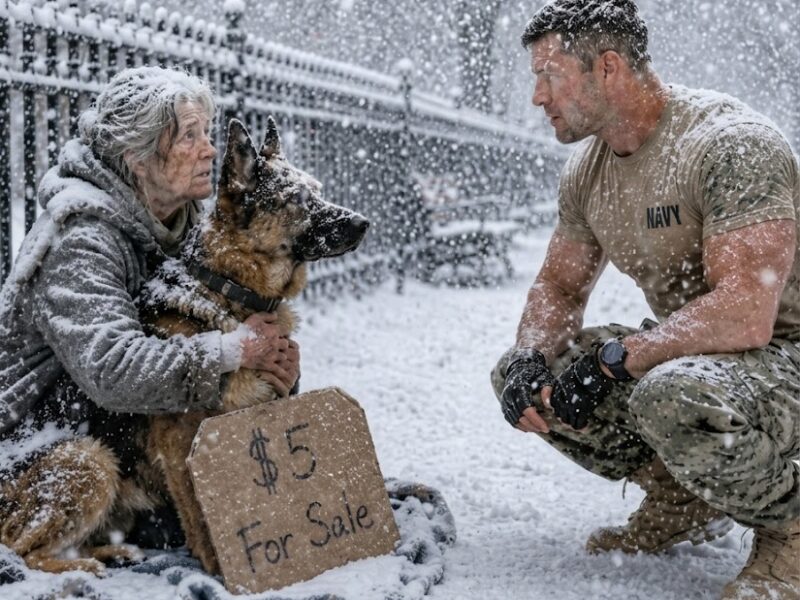
An elderly woman stood on a freezing bridge, holding a cardboard sign that read: “Dog for sale. $5.” Then a Navy SEAL stopped — and what he did next changed three lives forever.
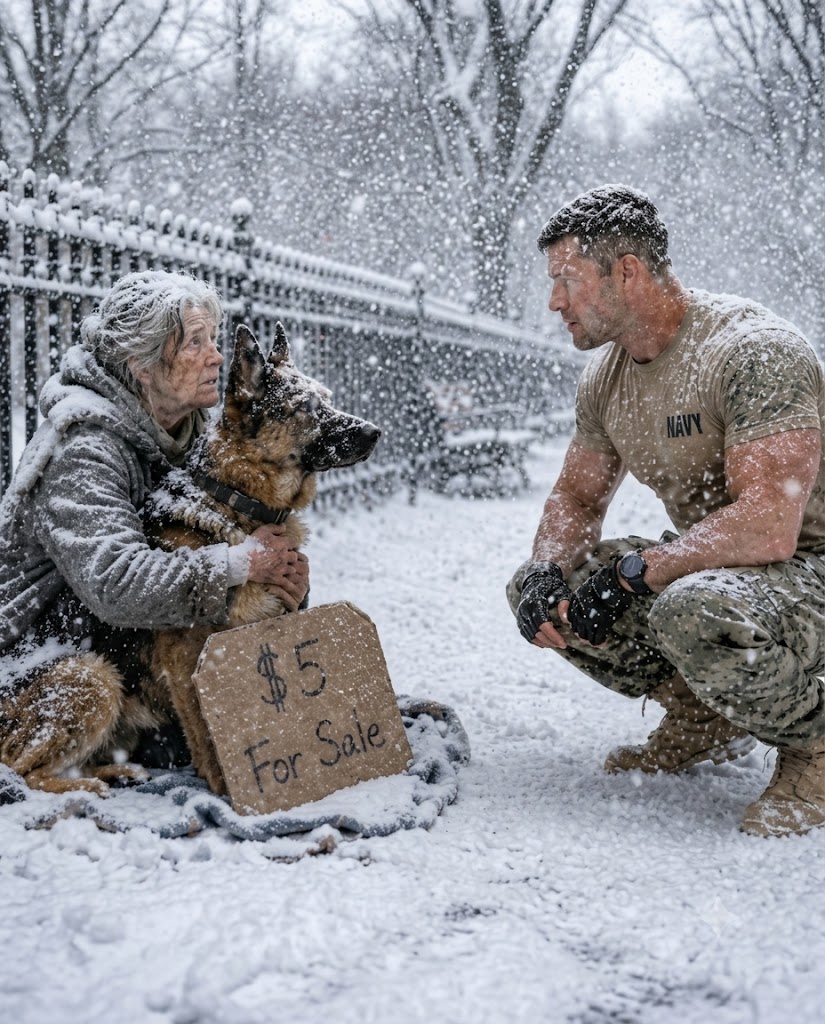
Snow came down over Duluth in heavy white sheets, thick enough to soften the hard edges of the bus depot, the pawn shop sign, and the line of parked cars slowly turning into rounded hills.
Lake Superior was only six blocks away, but that afternoon it felt close enough to breathe through the streets, sending a bitter wind up the avenues and under every coat that had dared to call itself warm.
Nathan Cole stepped out of Miller’s Discount Market with one paper sack against his chest and the other hooked in the crook of his elbow, careful not to let the milk crush the marked-down bread.
At 41, he still moved like a man measuring distance without meaning to—doorway to curb, curb to light pole, light pole to the narrow alley where snow collected in a waist-high drift.
Some habits stayed after the uniform came off, even when there was no team behind him, no radio at his shoulder, no dog breathing beside his knee.
He had been a Navy SEAL once and a canine handler after that, which meant people sometimes expected the old stories to come out sounding sharp and glorious.
Nathan never told them that the sharp parts were mostly screams cut short by weather, and the glorious parts were usually a dog doing what men could not bear to ask of each other.
His VA check had landed three days earlier, and rent had swallowed most of it with the manners of a starving thing.
The rest had become rice, beans, coffee, eggs, a small bottle of aspirin, and chicken thighs with a yellow sticker that said “Manager’s Special.”
As if poverty sounded better when dressed like a sail, he tucked his chin into his field jacket and started toward the apartment building two blocks uphill from the tracks.
The snow squeaked under his boots, and a city bus groaned at the stop near the old depot, its windows fogged, its wipers fighting a losing war.
Somewhere beyond the white air, a ship horn rolled low over the harbor.
Nathan nearly missed the cardboard sign because the wind kept folding it against itself.
It sat under the bus depot awning, weighted at one corner by a cracked thermos and held at the other by a gloved hand so thin the knuckles looked like pale stones.
“Dog for sale, $5.”
The letters were written in blue marker that had begun to bleed where melted snow touched the cardboard.
Behind the sign, an elderly woman sat on a metal bench with her shoulders drawn tight, a burgundy wool coat buttoned wrong near the collar, a gray scarf wrapped twice around her neck, and snow gathered in her white hair like ash.
Beside her, pressed close enough to share what little warmth remained, lay an old German Shepherd with a dark sable coat, a black saddle, and a silvered muzzle.
The dog did not look for buyers.
He did not wag at the passing boots or whine at the cold.
He watched.
That was what made Nathan slow down.
A tired dog watched with fear.
A hungry dog watched with hope.
This one watched with responsibility.
Two young men stood too near the bench—the sort of too near that could be explained away if anyone asked and understood instantly by anyone who had ever been cornered.
One wore a puffy blue coat and clean work gloves.
The other had a knit cap pulled low and a grin that kept trying to become laughter.
“Five dollars,” the one in the cap said, leaning toward the sign. “Ma’am, that leash is worth more than the dog.”
The other laughed and nudged the cardboard with the toe of his boot. “Maybe he comes with instructions like an old snowblower. Pull twice and pray.”
The woman held the leash closer. “Please don’t touch him,” she said.
Her voice was polite—too polite.
It had the old training of church basements and thank-you notes in it, the kind of politeness some people kept wearing even while the world used it against them.
The German Shepherd lifted his head, and snow slid from the ridge of his back.
His ears rose, though the left one dipped at the tip, and Nathan saw the stiffness in the front leg when the dog gathered himself.
Pain, then discipline.
The dog stood anyway, slowly, carefully.
He moved between the woman and the men and lowered his head without baring his teeth.
No wasted threat, no theater—just a line drawn in cold air.
“Atlas,” the woman whispered, one hand landing on his shoulder.
Her glove trembled.
The man in the cap made a show of stepping back, then stepped forward again, enjoying the little circle of fear he had made.
“Atlas,” he said. “Big name for a discount dog.”
Nathan stopped walking.
The paper sack creaked in his hands.
For a moment, he told himself the same thing he had told himself for years when trouble appeared in public places.
Keep moving.
Trouble belonged to the world, and the world had more of it than one tired man could carry.
He had a cold apartment, a past-due power bill, and knees that ached before storms.
He had no room for an old woman, a dog, or two fools who thought cruelty counted as entertainment if they kept their voices light.
Then Atlas shifted his weight, favoring the injured leg, but stayed in front of her.
Nathan saw Ranger for half a second—not with his eyes.
Worse, he saw the black line of a canine’s back against snow, the lift of ears, the final choice a dog made because the man beside him had asked without speaking.
His hands tightened around the grocery bag until the bread flattened.
The man in the blue coat reached toward the leash. “Five dollars means I can at least inspect the merchandise.”
Nathan set both bags in the snow beside a lamppost.
Nothing dramatic—just down.
The eggs gave a soft clack inside the paper.
He walked toward the awning at a pace that did not invite argument and did not warn enough to be fair.
The woman looked up first.
Her face had the pale, pinched look of someone who had been cold for hours and ashamed for longer.
Atlas turned his head a fraction, enough to register Nathan and dismiss him as not the immediate problem.
Good dog, Nathan thought.
The young men did not notice him until he was already under the awning, snow melting on his shoulders.
“That’s close enough,” Nathan said.
His voice was quiet enough that the wind did not steal it.
The man in the cap straightened, annoyed at being interrupted before his joke had finished becoming ugly. “You buying him?”
Nathan looked at the hand still hovering near the leash. “No.”
The blue coat snorted. “Then maybe mind your business.”
Nathan’s eyes moved from the man’s boots to his gloves to the phone clipped badly in his pocket.
He smelled cheap beer under wintergreen gum.
He heard the woman’s breath catch when the bus behind them hissed and pulled away.
The depot suddenly seemed emptier, the city muffled behind snow.
“I said close enough,” Nathan repeated.
Atlas gave one low sound from deep in his chest—not loud, controlled.
The old woman whispered his name again, more prayer than command.
The man in the cap looked from Atlas to Nathan, trying to decide which one made the better target.
His grin thinned. “Old soldier type, huh? What are you going to do, salute us to death?”
Nathan did not move. “I was hoping you were smarter than that.”
The blue coat took a step closer, and in the white blast coming through the open end of the awning, Nathan saw the moment before a bad choice became real.
The wind shoved snow sideways through the bus depot awning, turning the space between Nathan and the two men into a pale, restless curtain.
Under the yellow depot light, every breath showed, rising and breaking apart before it could reach the roof.
Nathan did not raise his hands.
He had learned a long time ago that men looking for a fight often needed the other man to help them pretend they had found one by accident.
He gave them nothing useful.
The man in the blue coat stopped a few feet from him, shoulders high, chin out, performing courage for his friend.
The one in the cap watched Nathan’s face and began to look less amused.
That one had better instincts—not better character, but instincts would do in a pinch.
“You got a badge?” Blue Coat asked. “No? Then you got a problem.”
Nathan looked past him toward the corner of the depot where a black half-dome security camera sat beneath a crust of ice.
“Camera above the ticket window. Another one outside the liquor store across the street. Bus driver saw you standing here when he pulled out. If she asks you to back away and you keep crowding her, that’s harassment of an elderly person in public. If you touch the leash, it gets uglier.”
Blue Coat blinked.
Nobody liked hearing their stupid moment translated into paperwork.
The woman on the bench made a small sound—not quite relief, not quite fear.
Atlas stood without shifting, his silver muzzle pointed at the two men, his old body stiff from the cold, but his mind awake as fire.
“Man,” the one in the cap said, trying to laugh again and not quite reaching it. “We were only talking.”
“Then talk from over there.” Nathan nodded toward the snowbank near the curb. “Plenty of room. Whole city, actually.”
Blue Coat’s eyes narrowed. “You always rescue strays?”
Nathan’s jaw moved once. “Only when they stand in pairs, wearing gloves too clean for work.”
The line landed strangely enough that the old woman looked down, and for one quick second, a smile tried to touch her mouth before shame chased it away.
Blue Coat stepped forward again because pride, once embarrassed, often tried to repair itself by becoming louder.
Atlas moved faster than Nathan expected—not young-dog fast, not clean, but decisive.
He put his injured leg down hard, lifted his head, and barked once.
The sound cracked under the awning and bounced off the glass doors.
A woman inside the depot turned from the vending machine.
The clerk behind the ticket window looked up.
The man in the cap grabbed Blue Coat’s sleeve. “Leave it.”
“I’m not scared of a grandpa dog.”
“Good,” Nathan said. “Then you won’t mind leaving before he embarrasses you.”
That did it.
Not the warning, not the camera—the idea of being embarrassed by an old dog.
Blue Coat’s face reddened above his scarf, and for one heated second, Nathan thought the man would swing.
Nathan measured the distance to the man’s wrist, the slick patch beneath his right boot, the metal edge of the bench.
He also saw the old woman’s hand tighten on Atlas’s collar, and he hated that she had to be ready for more.
The man in the cap understood the change in the room. “Come on, Trevor,” he muttered. “She’s not worth it.”
The old woman flinched as if the words had touched skin.
Nathan’s eyes went to the man in the cap. “Say that again, and I’ll ask the clerk to save the audio, too.”
Silence.
The clerk had come out from behind the ticket window and stood with a phone in her hand, pretending to wipe the counter while missing every inch of it.
Blue Coat—Trevor—spat into the snow near the bench and backed away. “Fine. Keep the mutt. We know where she sleeps anyway.”
The other man gave him a hard look, but the sentence had already landed.
Nathan heard it.
Atlas heard it.
The old woman heard it in a way that made her shoulders fold inward.
The two men walked off into the snowfall, boots sliding on the salted sidewalk, their laughter returning in pieces only after they had put half a block between themselves and the awning.
They did not look back until they reached the corner.
Atlas was still watching.
Nathan waited until they turned out of sight before he crouched slowly and with his hands visible a few feet from the dog.
“Good boy,” he said.
Atlas stared at him with the solemn distrust of a retired judge.
Fair.
“His name is Atlas,” the woman said.
“Yes, ma’am, I heard.”
“He is not a mutt.”
“No, ma’am.”
“And he is not from men like that.”
Her voice shook on the last word.
Nathan looked at the cardboard sign lying against her boot.
“Dog for sale, $5.”
The ink had begun to smear at the five, making it look like the number itself wanted to disappear.
“Is he for sale?”
The question was gentle, but it still hurt her.
She touched Atlas’s head with two gloved fingers. “I thought if somebody decent bought him, then he would have a warm floor tonight.”
She swallowed. “I was not selling him like a chair.”
Nathan stayed crouched.
His knees complained, and he ignored them.
“What’s your name?”
“Margaret Ellis.”
She said it with the careful dignity of someone answering at a bank window, as if a proper name could keep life from becoming too messy.
“Margaret, when did you last eat?”
Her eyes moved away. “I had tea this morning.”
“Tea with what?”
The wind rattled the depot sign.
Atlas shifted closer to her leg.
“With hope, mostly,” she said, and then looked embarrassed by her own little joke.
Nathan almost smiled.
Almost.
“And Atlas?”
“He had half a roll. The soft part, not the crust. His teeth bother him if it’s too hard.”
Nathan glanced back at his grocery bags by the lamppost, already taking on snow.
There was not enough in them for generosity, but there was enough for obedience to the part of him that still knew an order when it came from conscience.
“Where are you staying tonight?”
Margaret pulled the scarf tighter. “My son said he made arrangements.”
“Where?”
“I don’t know anymore.”
That was the first answer that told the truth.
Nathan stood and retrieved his groceries, brushing snow off the paper.
He kept his body angled so she could see the street, the clerk, the door—every way out.
“I have an apartment. Small, not pretty. Hot water works when it feels patriotic, but it works. You and Atlas can warm up, eat, use the phone.”
Margaret shook her head before he finished. “I cannot go home with a strange man.”
“Good.”
That made her look at him.
“That’s still the right instinct. You can ask the depot clerk to take a picture of my ID. She can text it to whoever you trust. You keep the key while you’re there. You take the bed. I sleep by the door. If you tell me to leave my own room, I sit in the hallway and make the neighbors uncomfortable.”
Atlas blinked once, unimpressed, but listening.
Margaret’s mouth trembled. “Why would you do that?”
Nathan looked at the old dog standing in the snow with one bad leg and all the courage in the county.
“Because he stood up when it hurt.”
He paused.
“And because you touched him before you touched your own coat.”
Margaret shut her eyes for a second.
Snow blew under the awning and dusted the toes of her boots.
She was about to answer when tires hissed at the curb.
A black SUV rolled slowly through the whiteout and stopped across the street.
The driver’s window lowered just enough for Nathan to see a square jaw, a clean wool coat, and eyes that found Margaret without surprise.
“Mother,” the man called over the wind. “Get in the car.”
The snow thickened around the black SUV until the vehicle looked less parked than half-erased, its headlights glowing like two dull coins through the storm.
Across the street from the Duluth bus depot, the man behind the wheel kept the window down only a few inches, as if he wanted authority to travel farther than warmth.
Margaret did not stand.
Atlas did.
That told Nathan enough to make his spine go quiet.
The man in the SUV smiled without softness. “Mother, this is ridiculous. Get in before you freeze.”
He had a broker’s haircut, clean hands, and the tired anger of someone inconvenienced by another person’s suffering.
A woman sat in the passenger seat, partly turned away, a beige coat collar pulled up to her cheek.
She looked at Margaret once, then down at her lap.
“Peter,” Margaret said.
One word, and the cold under it was not from the lake.
Nathan stayed near the bench, but not between them yet.
If Margaret had been stripped of choices, he would not help by stealing another one.
“You know him?” he asked quietly.
“My son.” Her fingers moved on Atlas’s collar. “And Linda is with him.”
The woman in the passenger seat flinched at her name.
Peter’s eyes moved to Nathan.
They took in the worn jacket, the grocery bags, the boots, the old military posture.
He did not like the sum. “Who is this?”
“Someone who told two young men to leave your mother alone.”
Nathan said that happened before or after she tried to sell the dog in a public place.
Peter’s voice sharpened with the practiced sorrow of a man who had rehearsed being misunderstood. “She has been confused lately. We’re trying to get her help.”
Margaret sat very still.
People who were accused of confusion in public often learned that defending themselves only made them look more confused to strangers.
Nathan knew the tactic.
He had seen versions of it in interrogation rooms, hospital offices, family courts, on daytime television playing above VA waiting room chairs.
“Are you confused, ma’am?” he asked.
Peter laughed once. “That’s not how it works.”
Nathan did not look away from Margaret. “Ma’am.”
She lifted her chin.
Snow had melted on her lashes.
“I know my name. I know my birthday. I know that my husband Frank planted lilacs on the east side of our house because the wind killed the first two apple trees. I know my son changed the locks last week and said the house had to be cleared for repairs. I know my daughter cried while looking at the floor.”
Linda covered her mouth with one hand.
Peter’s face hardened. “She left out the part where she signed power of attorney because she couldn’t manage the bills.”
“I signed so you could pay the hospital and property tax,” Margaret said. “Not so you could sell my home.”
The words were not loud, but the ticket clerk inside the depot turned fully toward the glass.
Nathan heard the hinge in the moment, the place where private cruelty began attracting witnesses.
Peter heard it, too.
He opened the SUV door and stepped out into the street.
The snow caught in his dark hair and on the shoulders of his expensive coat. “Mother, enough. Give me the bag.”
Margaret pulled the canvas bag closer against her side.
Atlas moved one paw forward.
His bad leg trembled, but he held.
“What’s in the bag?” Nathan asked.
“Nothing that belongs to him.”
Peter pointed at Nathan. “This is a family matter.”
“Most bad sentences are.”
Peter’s expression went flat. “You don’t know what you’re walking into.”
“I know she’s cold, hungry, and sitting under a bus depot awning with a five-dollar sign because her son is yelling from a heated SUV. That one found a home.”
A man shoveling near the liquor store slowed down.
The depot clerk held her phone higher.
Linda opened her door at last.
She stepped out with her boots sinking into the curb slush, her face blotched with cold or shame.
She was in her late forties, pretty in a worn, tired way, with eyes that kept asking permission from the air.
“Mom,” she said. “Please. You were going to come back.”
Margaret looked at her daughter, and for the first time, Nathan saw the old woman’s anger crack into grief.
“You left me by the bus stop, Linda. Peter said Denise from the church was coming. Denise Walker hasn’t worked evenings in three years.”
Linda looked at Peter.
Peter did not look back. “Get in the car. The dog goes to animal control tonight. We’ll sort the rest tomorrow.”
Atlas growled.
It came low and old and full of winter.
Peter stepped toward the bench anyway, one hand extended toward the canvas bag.
Nathan moved then—not fast enough to frighten Margaret, but fast enough that Peter stopped before he meant to.
“You touch her or the bag, and this becomes simple.”
“Are you threatening me?”
“Explaining gravity.”
Peter’s mouth twitched. “You some kind of veteran hero?”
Nathan felt the word hit the place where Ranger used to live.
Hero.
People loved that word because they could say it and walk away.
“No.”
“Then what are you?”
Nathan looked once at Atlas. “Available.”
Linda made a sound that might have been a sob, but Peter cut across it. “Mother, if you leave with him, you prove everything I said about your judgment.”
That was clever.
Cruel, but clever.
Margaret’s hand tightened so hard on the leash that her glove creaked.
Nathan gave her space. “You don’t have to come with me. You can stay inside the depot while the clerk calls police or adult protective services. You can ask the church for Pastor Eli. You can tell your daughter to sit with you without him. But you don’t have to get in that vehicle.”
Margaret looked at the SUV, then at Linda, then at Atlas.
The dog leaned against her knee, not pushing, simply reminding her he was there.
“Only tonight,” she said, almost to herself.
Nathan nodded. “Only tonight.”
Peter laughed, but it had lost its easy shape.
He pulled out his phone and pointed it toward Nathan’s truck, parked half a block away under a coat of snow. “Fine. I’ll know where to send the police when she comes to her senses.”
Nathan picked up his grocery bags and offered Margaret his free arm without taking hers.
She stood slowly, and the pain in her knees crossed her face before she could hide it.
Atlas stepped down from the curb with stiff dignity, nearly slipped, then recovered as if the sidewalk had behaved poorly.
Nathan heard himself huff once.
Margaret glanced at him. “He does not like being laughed at.”
“Then we have that in common.”
Behind them, Linda whispered, “Mom, wait.”
Margaret stopped.
Peter snapped, “Linda.”
The daughter froze between her brother and her mother—a whole life of obedience packed into that one flinch.
Margaret’s voice softened. “You know where the lilacs are.”
Linda’s face crumpled.
Nathan did not understand the sentence yet, but Peter did.
His eyes sharpened, and as Nathan guided Margaret and Atlas toward the truck, Peter took another picture, this time of Nathan’s license plate, with snow falling hard enough to make the flash look like lightning.
—
Night settled over Duluth under a storm so thick the streetlights looked wrapped in wool, and Nathan’s apartment building shivered each time the plow truck scraped past on the hill below.
The old brick place stood three stories high near the railroad tracks, with a front door that stuck in wet weather, radiators that complained like unpaid actors, and a hallway smelling faintly of salt, onions, and somebody’s laundry soap.
Nathan reached his second-floor door ahead of Margaret and Atlas, unlocked it, then froze for half a breath, as if remembering too late that the room was not prepared to be seen.
“It’s small,” he said, “and I wasn’t expecting company.”
Margaret, who had been standing in a bus depot trying to sell her best friend for five dollars, gave him a look that was almost stern. “Mr. Cole, I am past being impressed by furniture.”
He opened the door wider.
The apartment was not dirty so much as unattended by hope.
A cold coffee mug sat beside a stack of VA letters on the table.
One boot leaned near the radiator; the other hid under a chair as if ashamed of its partner.
A folded sleeping mat rested behind a dented metal storage bin.
The sink held two bowls, one spoon, and a pan that had once intended to be washed before life changed its mind.
Nathan moved quickly, gathering papers, kicking the hidden boot into view, and clearing the chair with the embarrassment of a man whose loneliness had been caught wearing socks with holes.
“Sorry,” he muttered. “I clean on Thursdays.”
Margaret stepped inside and looked around. “Is today Thursday?”
“Not emotionally.”
The corner of her mouth lifted.
It was small, but in that room it counted as a lamp.
Atlas entered last.
He sniffed the threshold, the table leg, the radiator, Nathan’s boot, then Nathan himself, lingering at the knee with the old ache.
He seemed unimpressed by every decision in the apartment, but he did not object to the radiator.
Nathan took that as a generous review.
He placed the spare key on the table in front of Margaret. “This is yours while you’re here. Bathroom is through there. Window opens but sticks. Fire escape outside it. Building manager’s number is taped by the phone. Door locks from the inside without a key. If you want me out, I sit in the hall.”
Margaret looked at the key as if it were too heavy to touch. “You say these things like you’ve said them before.”
“People listen better when they know where the exits are.”
She did not ask how he knew.
That kindness, too, was a kind of intelligence.
Nathan turned the radiator valve until it hissed awake, then dragged the sleeping mat near the door. “You take the bed.”
“Absolutely not.”
“Ma’am, don’t ma’am me in that tone. I’ve buried a husband, raised two children, and once drove through a blizzard with a casserole between my knees because Frank said the rescue crew needed hot food. I can sleep in a chair.”
Nathan looked at Atlas. “You hear that? She’s difficult.”
Atlas lowered himself near the radiator with a slow, careful fold of old bones and released a sigh that sounded like agreement.
Margaret laughed once before tears could reach it.
Nathan let the laugh be.
He washed the bowls badly but with speed, then unpacked the groceries.
Rice, beans, eggs, bread, coffee, aspirin, and the chicken thighs lay on the counter like the full inventory of a kingdom with plumbing problems.
He cooked without ceremony—rice in the dented pot, beans in the pan, one chicken thigh chopped fine and warmed with water for Atlas because old teeth deserved diplomacy.
Margaret noticed.
Nathan pretended she did not.
“He can eat dry food if he must,” she said.
“He doesn’t have to must tonight.”
Atlas ate near the radiator, slow and grave, pausing once to look up at Margaret as if asking whether she had eaten, too.
“Bossy,” Nathan said.
“He was trained by my husband,” Margaret replied. “Frank believed every creature should know its job, including the neighbor’s cat.”
They sat at the table with mismatched plates.
Nathan gave her more without making a display of it and kept the smaller portion for himself.
She saw the open notebook by his elbow, the narrow rows of numbers written with military pressure—rent, power, phone, VA copay, groceries, gas, laundry.
She looked away quickly, but not before understanding that this meal had cost him something.
“You shouldn’t have done this,” she said.
“Probably.”
“That is not an argument.”
“I’m out of better ones.”
Snow tapped the window in hard little grains.
The radiator clicked and filled the room with reluctant warmth.
Margaret ate with the manners of someone who had once set proper tables and now wanted not to look hungry in front of a stranger.
Nathan hated that.
He looked down at his plate so she could stop defending herself from food.
After a while, she told him Frank had died three winters ago.
That Atlas had belonged to both of them but slept on her side after the funeral.
That Peter used to be a sweet boy who brought injured birds home in shoeboxes until ambition taught him to call tenderness inefficient.
She spoke of Linda more softly, with anger tied up in worry.
“She always was afraid of storms,” Margaret said. “Even the ones indoors.”
Nathan rinsed the plates while she spoke.
When he turned off the faucet, the pipes knocked somewhere in the wall.
The sound was small.
It should have been small.
Instead, it opened a white room inside him.
Not a room—a ridge.
Snow blown sideways under a black sky.
A radio call breaking into static.
Ranger’s harness slick under Nathan’s glove.
The shape of his dog moving ahead because the trail was wrong and the men behind Nathan still had time.
He heard the crack again, felt the snow lift, saw nothing but white and red and Ranger’s body between him and the blast.
The apartment vanished.
Nathan’s fingers closed around the edge of the sink until the metal bit his skin.
He did not fall.
He had learned not to fall.
That was different from being present.
Atlas rose from the radiator.
His bad leg shook, but he crossed the room without a bark.
He came to Nathan’s side and leaned shoulder against thigh, warm and solid.
Then the old dog began to breathe—in, out, in, out—not command rhythm, just presence.
Nathan’s eyes found the silver muzzle, the sink returned, the radiator, the snow at the window.
Margaret sitting very still at the table, both hands folded around the spare key.
“Ranger,” Nathan whispered before he could stop himself.
Atlas did not mind the wrong name.
He only leaned harder.
Margaret’s face changed with understanding she did not yet have words for.
Outside, tires hissed through slush, and somewhere below the building, a vehicle slowed too long near the curb.
—
Morning came gray and wind-bent over Duluth, with snow packed against the apartment windows and the fire escape wearing a white coat thick enough to hide the metal grating.
Down on the street, plows grumbled like tired machinery from another century, pushing ridges of dirty snow toward the curbs, while the sky kept lowering more.
Nathan woke on the sleeping mat by the door with one hand under his jacket and the taste of old fear still sour in his mouth.
For three seconds, he did not know where he was.
Then Atlas snored near the radiator, a deep, uneven rumble that sounded far too judgmental for a dog who had drooled on Nathan’s boot sometime before dawn.
The room returned gently.
Margaret sat at the table in the borrowed wool socks Nathan had found in the back of a drawer, both hands around a mug of coffee gone pale with powdered creamer.
Her white hair had dried in soft waves around her face, and the spare key lay beside her like a small promise she had not yet decided to trust.
She did not mention the night.
Neither did Nathan.
Some mercies were made of silence.
He stood slowly, knees objecting, and put water on for oatmeal he did not remember buying until he found the packet under the rice.
“Breakfast is either maple flavor or the idea of maple flavor,” he said. “That depends how honest the box was.”
Margaret touched the mug with one finger. “Frank used to say oatmeal was what people ate when they wanted pancakes but had made poor choices.”
“Frank sounds like a man of education.”
Atlas opened one eye at the name, then closed it again when no food appeared.
Margaret smiled, and this time the smile stayed long enough to become sad.
After they ate, she opened the canvas bag she had guarded all night.
Nathan did not reach toward it.
He sat across from her and waited while she removed each item with the careful order of someone unpacking the last pieces of a life.
A small pill bottle.
A photo of a younger Margaret standing beside a broad-shouldered man in a rescue jacket, Atlas at their feet with no gray on his muzzle.
A folded church bulletin from Frank’s funeral.
Two envelopes stiff with damp.
A copy of a power of attorney form.
Property tax notices.
A letter from North Harbor Property Group printed on thick paper and using words like “transition,” “upkeep,” and “opportunity” in the way wolves might use table manners.
Margaret moved the power of attorney with her palm. “Peter said I was foolish to keep handling everything alone. He wasn’t wrong about the bills. After Frank died, there was the mortgage balance, medical things, furnace repairs. I forgot a payment once—only once. But Peter spoke of it as if I had set the house on fire.”
Nathan read without moving the pages from under her hand. “You signed this four months ago.”
“At the kitchen table. Linda brought pound cake. Peter brought a notary.”
She gave a small, bitter laugh. “That should have warned me. Nobody brings a notary with pound cake unless the cake is camouflage.”
“Did anyone explain what it allowed?”
“They said bills, repairs, talking to the county if I was tired. I was tired.”
Her eyes went to the window where snow chased itself against the glass.
“Being tired is dangerous when someone else is holding a pen.”
Nathan felt that sentence settle in the room.
He thought of forms at the VA, of signatures made by men whose pain medication had outrun their patients, of how often the world asked wounded people to read fine print while bleeding.
“What happened last week?”
Margaret folded the funeral bulletin, unfolded it, then folded it again. “Peter said the porch was unsafe and the insurance company might cancel coverage. He said I should stay with Linda for a few days. Linda looked sick, but she nodded. I packed clothes, Frank’s picture, Atlas’s medicine. When we reached Linda’s building, Peter said there had been a change—a church room was better, more supervision. Then he got a call, pulled over near the bus depot, and told me Denise Walker would come in ten minutes.”
She touched the edge of the cardboard sign Nathan had brought in and dried by the radiator. “I waited six hours.”
Nathan’s hands stayed flat on the table.
They wanted to become fists.
He gave them a job instead, lining up the damp envelopes.
“Why not call police?”
“And say what? My son is late. My daughter is frightened. I signed papers I did not understand. I am an old woman with a dog and no proof that my own children did not mean well.”
Her voice did not break.
That made it worse.
“By evening, Atlas was shivering. A man at the depot said animal control might take him. I thought if someone kind paid even five dollars, it would feel less like begging and more like I had chosen.”
Atlas lifted his head from the radiator and looked at her.
Margaret looked back. “I know,” she whispered. “It was a terrible plan.”
Nathan slid the letter from North Harbor closer. “This says interior cleanout scheduled. Peter said it meant repairs. It says tomorrow morning.”
The room changed.
Margaret leaned forward. “No, that can’t be right. My things are still there. Frank’s tools, the cedar chest, our wedding dishes, the quilt my mother made.”
Nathan read the line again, hoping it would become less plain.
It did not.
North Harbor Property Group had scheduled a crew to remove occupant belongings before buyer walkthrough, pending final transfer.
Pending final transfer.
Not after—before.
“Do you have the original will?” he asked.
“Frank kept important things in a lockbox. Peter said the key was missing.”
“Where is the lockbox?”
“In our bedroom closet, unless he moved it.”
Nathan stood and went to the window.
A black SUV idled across the street for half a minute, half-hidden by blowing snow.
Then it pulled away before he could read the plate.
Margaret had seen it, too. “That was Peter’s car,” she said.
Her voice had gone flat.
Atlas rose, stiff and slow, and placed himself beside her chair.
Nathan turned from the window, already reaching for his phone. “Do you know Pastor Eli’s number?”
Margaret nodded.
“And Denise Walker?”
“Yes.”
“Good. We start where people remember you before Peter started explaining you.”
—
By late morning, the snow over Duluth had become a public argument, shutting down side streets and turning the church steps on West 4th into a white ramp that Pastor Eli Monroe attacked with a shovel and a patience clearly borrowed from heaven.
The church was small, red brick and stubborn, wedged between a closed hardware store and a laundromat whose neon sign blinked “WASH” even when the power flickered.
Nathan parked near the curb and came around to help Margaret down before she could protest.
Atlas went first, nose to the wind, then braced himself on the sidewalk with the solemnity of a dog who had inspected worse conditions and found humans consistently underprepared.
Pastor Eli looked up from his shovel.
He was a lean man in his sixties with a gray beard, wire glasses fogged from effort, and a knit hat that said “Lake Trout Festival 2014.”
“Margaret Ellis,” he said, and the way he said her name did more for her than any blanket could have—not surprise, recognition, belonging.
Margaret pressed one hand to her scarf. “Eli.”
He came down the steps too fast for the ice, slipped, recovered by grabbing the rail, and pretended the whole thing had been a form of greeting.
“I’ve been calling Peter since yesterday. He didn’t answer. He answered once and told me you were resting.”
Pastor Eli looked at Nathan, then at Atlas, then at the cardboard sign folded under Margaret’s arm.
His face went quiet. “Come inside.”
Warmth hit them in the entryway, carrying the smell of soup, old hymnals, coffee, and wet wool.
In the fellowship hall, Denise Walker stood over a stockpot with a wooden spoon in one hand and a phone wedged between her shoulder and cheek.
She was a broad-shouldered woman with silver curls tied back, a flower smudge on one sleeve, and eyes that could count every lie in a room before anyone finished speaking.
When she saw Margaret, she hung up without saying goodbye.
“Oh, honey.”
Margaret’s mouth tightened. “Please don’t ‘oh honey’ me unless there is bread.”
Denise looked at the cardboard sign. “There is bread, soup, and if I get five minutes alone with your son, there may be repentance.”
“Denise,” Pastor Eli warned mildly.
“I said may.”
Nathan liked her at once.
He did not say so.
He was out of practice with liking people in public.
Denise wrapped Margaret in a hug that somehow did not crush her and did not treat her like glass.
Atlas watched closely until Margaret’s hand came down on his head.
Then he sneezed once, showering melted snow on the fellowship hall floor.
“Bless you,” Denise said.
Atlas looked unimpressed by formalities.
They settled at a long folding table while Denise brought soup thick with potatoes and chicken, soft bread for Margaret, and a bowl of warm water with shredded meat for Atlas.
Nathan stood near the wall until Denise pointed the spoon at him.
“Sit down, soldier. Former. The chair does not care.”
He sat.
Margaret ate, and the room let her eat without staring.
That was another mercy.
Pastor Eli called the county recorder.
Denise called a retired attorney who volunteered with senior services and then a man named Harold Briggs whom Nathan knew from the VA building.
Harold had been a JAG years before and had later become the person veterans found when paperwork had teeth.
He answered on the second ring.
Nathan took the phone.
“Harold, it’s Cole.”
A pause. “If this is about your benefits appeal, I told you to stop ignoring mail.”
“Different problem.”
“You collect those?”
“Apparently.”
Harold listened without interruption while Nathan described the power of attorney, the cleanout letter, North Harbor Property Group, and Margaret’s night at the depot.
When he finished, Harold said, “Scan everything. I’ll meet you at county if roads open. If they don’t, we start by phone. Tell Mrs. Ellis not to sign, hand over, agree, confirm, or apologize for breathing.”
Nathan glanced at Margaret. “He says not to apologize for breathing.”
Margaret lifted her spoon. “That may be difficult. I was raised Methodist.”
Denise snorted. “We’ll work on it.”
For the first time since the depot, the room breathed easier.
Margaret told them Frank had fixed the church roof one spring after a storm tore shingles loose.
Pastor Eli found the old maintenance ledger and read Frank’s name written beside the words, “No charge, just coffee.”
Denise remembered him carrying canned goods in both arms and telling jokes so dry it took people three minutes to realize they were jokes.
The memories steadied Margaret.
They also changed the shape of the fight.
She was not a confused old woman alone in snow.
She was someone with witnesses, history, and a dog who had begun to snore under the folding table like a small engine with moral authority.
Nathan stepped outside to photograph the paperwork in better light near the vestibule window.
The storm stung his face the moment he opened the side door.
He lifted the pages one at a time, phone steady, and sent them to Harold.
That was when Atlas appeared beside him.
Nathan looked down. “I didn’t invite you.”
Atlas looked toward the parking lot.
Nathan followed his gaze.
Between blowing curtains of snow, a man stood beside a gray pickup, phone raised toward the church windows.
He was thick through the neck, wearing a brown work jacket dusted white, and when he saw Nathan looking, he turned away too quickly.
Not a passerby.
Nathan took one photo before the man climbed into the truck.
The plate was half-caked with snow, but not all.
Atlas growled quietly.
“You know him?” Nathan asked.
Atlas did not answer because he had standards.
Inside, Denise took one look at the photo and said, “Ray Turner.”
Margaret’s spoon stopped halfway to her mouth. “He works with Peter. Repairs, hauling, whatever Peter needs done cheaply.”
Denise’s face hardened. “He was at the house last week.”
Pastor Eli moved to the window, but the pickup was already gone.
A minute later, Denise’s phone buzzed.
She opened a message from a friend who worked at the gas station across the street.
It was a blurry photo taken through glass—Ray in his truck, phone screen visible as he typed.
The words were not perfect, but enough could be read: “Old lady found. Dog still with her.”
Denise placed the phone on the table.
Margaret looked at it, then at Nathan.
Outside, the church bell shifted in the wind and gave one dull note by itself, as if the building had decided to warn them.
—
The courthouse in downtown Duluth stood under a sky the color of wet tin, its stone steps cut into narrow paths by shovels and its flags snapping hard in the lake wind.
By noon, the snow had eased just enough for traffic to crawl, though every car moved as if apologizing to the road.
Nathan drove Margaret, Atlas, and Denise in his old truck, while Pastor Eli followed in a borrowed van with a box of files from the church office because he had decided this was the sort of errand that required both prayer and documentation.
Harold Briggs waited inside near the recorder’s office—a tall Black man in a navy overcoat, thick glasses, and a scarf tucked with military precision.
He looked at Nathan over the frames. “You look terrible.”
“Good to see you, too.”
“I assume the dog is the competent one.”
Atlas sat beside Margaret’s leg and gave Harold one slow blink.
“Clearly,” Harold said.
Margaret offered her hand.
Harold took it gently—not the way people sometimes handled age, as if it were made of old paper.
“Mrs. Ellis, I am not your lawyer unless we make that official. But I know enough to say this: nobody gets to use your confusion as a shortcut. Unless a court has agreed you are confused. Family does not count as court, even when they speak loudly.”
Margaret nodded, her eyes filled, but she did not cry. “Thank you.”
They spent the next hour at counters and conference tables gathering copies.
The county clerk, a woman with silver glasses and a cardigan covered in tiny embroidered cardinals, pulled records and frowned so deeply the cardinals seemed concerned.
The deed had not transferred.
A purchase agreement existed, but final closing had not occurred.
A temporary authorization had been filed to permit inspection and emergency repairs.
The power of attorney was broad enough to wave like a flag in the hands of someone honest and broad enough to become a weapon in the hands of someone who was not.
Harold read each line twice.
Nathan watched Margaret watch him, her hands still in her lap, one thumb rubbing the place where her wedding ring had worn the skin smooth over decades.
Denise sat close enough to be useful and far enough not to crowd.
Atlas lay beneath the table with his head on his paws, occasionally sighing whenever a printer jammed.
“This supplemental authorization,” Harold said at last, tapping one page. “Did you sign it?”
Margaret leaned forward, her eyes narrowed. “That is my name.”
“Is it your signature?”
She took the paper, held it close, then farther away.
The room seemed to wait.
“No,” she said. “The M is wrong. Frank used to tease me because my M looked like two hills and a fence. This looks like a bird fell in ink.”
The clerk made a sound that was almost a cough and almost agreement.
Harold slid the page into a folder. “Good. Not good, but useful.”
Nathan looked at the date.
The supplemental authorization had been signed two days after Peter claimed Margaret had left the house voluntarily.
It approved removal of personal property for “safety and sale preparation.”
“Can they clean out the house tomorrow?” Nathan asked.
“They can try,” Harold said. “We’re going to make trying expensive.”
He called adult protective services from the hallway, then legal aid, then a senior housing attorney whose voicemail sounded cheerful enough to be suspicious but who called back within seven minutes.
By then, Linda had arrived.
She came in wearing the same beige coat from the SUV, snow melting in her hair, breath uneven from hurrying or panic.
She stopped when she saw Margaret surrounded by Nathan, Denise, Harold, Pastor Eli, the clerk, and Atlas.
The scene clearly did not match the one Peter had given her.
“Mom,” she said.
Margaret stood.
The movement cost her, and Atlas rose with her.
Linda looked at the dog, then at the floor. “Peter said you were with a man from the bus station. He said you wouldn’t answer your phone.”
“My phone is in the house,” Margaret said. “Because Peter took my purse when he changed the locks.”
Linda’s lips parted. “He said you misplaced it.”
“He says many things.”
The daughter flinched.
Nathan recognized the pattern now.
Peter did not need to lock every door if he could train people to close them for him.
Margaret looked at Harold. “May I speak to my daughter privately?”
“Of course.” Harold nodded toward a small waiting area near the windows. “But do not sign anything, agree to anything, or apologize for weather.”
Margaret gave him a tired look. “You and Denise have formed a committee.”
“We prefer task force,” Denise said.
Nathan stayed back while mother and daughter sat near the window.
Atlas went with Margaret and settled in the patch of weak gray light.
Linda cried before Margaret touched her hand—not loudly, not cleanly.
The kind of crying people do when guilt has been packed too tightly.
Nathan could not hear everything, but pieces reached him.
“Peter said it was temporary. Peter said you needed supervision. Peter said the house would bury us. I thought if I argued, he would cut me out, and then I could not help later.”
Margaret listened, face still, heartbreak moving only in her fingers as they stroked Atlas’s ear.
“You left me in the snow,” she said.
Linda bent forward as if struck. “I know.”
No excuse followed.
“That mattered.”
Nathan looked away.
Forgiveness, if it came, did not need an audience.
Harold returned with news.
Legal aid would file an emergency notice that afternoon.
Adult protective services would open a case, and the recorder’s office would flag the property for disputed authorization pending review.
It was not victory.
It was a door wedge.
Sometimes that was enough to keep a house standing through the night.
Linda came back to the table, pale but steadier. “Peter keeps the lockbox key in his office. Top drawer, under a false bottom in the desk organizer. He thinks nobody notices things if he calls them systems.”
Margaret closed her eyes.
Denise whispered something that sounded like a prayer and a threat sharing a coat.
Linda’s phone rang.
Everyone saw the name on the screen.
Peter.
She did not answer.
A text arrived instead: “If you talk, you lose your share.”
Linda stared at it, then turned the phone around so Harold could photograph it.
Outside, a gust threw snow against the courthouse windows with both hands, and Atlas lifted his head sharply, looking not at the storm but toward the hallway behind them, where Ray Turner stood half-hidden near the vending machines.
—
By evening, the storm had swallowed Duluth whole, closing the schools, canceling buses, and making the hill streets glitter with ice under fresh snow.
The emergency alert on Nathan’s phone kept buzzing until he silenced it, though the city outside the windshield was already alert enough—stalled cars hunched at curbs, porch lights blurred into halos, and wind off Lake Superior pushing hard enough to rock the truck at stop signs.
They left the courthouse with more paper than certainty.
Harold had filed what he could.
Legal aid had promised an emergency petition before morning.
Adult protective services had opened a case and advised Margaret not to return to the house alone.
The police had taken a preliminary report about Ray’s presence at the courthouse and church, which meant his name had moved from rumor to record.
Still, Margaret’s home stood in the storm with Peter somewhere near it, and legal systems Nathan knew often moved with the grace of a frozen garage door.
Margaret sat beside him in the truck.
Linda and Denise squeezed into the back with Atlas across their boots because the old dog had decided the floor was his jurisdiction.
Pastor Eli had gone back to the church to open the basement for stranded people.
Harold had insisted on meeting them in the morning, then handed Nathan a folder and said, “Do not improvise unless you must.”
Nathan had looked at him.
Harold sighed. “Fine. If you must, improvise intelligently.”
They nearly made it back to the apartment before Margaret pressed one hand to her chest.
It was a small movement.
She tried to hide it beneath her scarf, which made Nathan turn immediately into the urgent care lot.
“I’m all right,” she said.
“That sentence is rarely evidence,” Nathan replied.
The clinic smelled of disinfectant, wet coats, and coffee that had given up several hours earlier.
A nurse checked Margaret’s vitals while Atlas waited outside the exam area with Denise, offended by the rule but too dignified to challenge a woman holding a clipboard.
The doctor said it was likely stress, cold exposure, and missed medication—not a heart attack.
But he spoke seriously enough that Linda began crying again.
Margaret patted her hand. “If you keep that up, people will think I raised a fountain.”
Linda laughed through tears, then cried harder, which defeated the point but warmed the room.
Nathan stood near the door, feeling useless in the specific way hospitals made him feel.
He could secure a hallway, read a threat, carry weight, stay awake.
He could not negotiate with an old heart that had been asked to hold too much.
When they left, the nurse gave Margaret a paper bag with sample medication, a list of warning signs, and a look at Peter’s name in the emergency contact field that turned flinty when Margaret asked to change it.
By the time they reached Nathan’s building, the storm had turned the sidewalk into a narrow trench between plow walls.
The black SUV was not visible.
That did not comfort him.
Absence was a kind of cover.
He parked where his truck could see the entrance and the alley.
“We can go to the church,” Denise said.
“Basement is full by now,” Nathan answered. “And Peter knows the church.”
Linda looked at the apartment building. “He knows this place, too.”
“He knows the address, not the building.”
Nathan regretted the words as soon as they left his mouth.
They sounded like confidence, and confidence had killed better men than fear.
Inside, Mrs. Alvarez from the first floor was taping plastic over a drafty window in the lobby.
She was eighty if she was a day, with pink curlers under a scarf and the moral authority of someone who had outlived three landlords.
Nathan introduced Margaret as a guest and asked quietly whether the hallway camera still worked.
Mrs. Alvarez narrowed her eyes. “Why?”
“Might need it.”
“Then it works beautifully. Even if yesterday it did not.”
She picked up a broom. “I will be in my chair by the lobby. My hearing is terrible, except when it is useful.”
Denise gave Nathan a look that said the building had more defenses than he had admitted.
He shrugged. “Mrs. Alvarez terrifies the mailman.”
Upstairs, he placed Margaret in the chair farthest from the door, Linda beside her, Denise near the phone, and Atlas where Atlas chose to be, which was between everyone and the entrance.
Nathan checked the window latch, the fire escape, the hallway sight line, and the deadbolt.
Then he did something Margaret noticed.
He moved a small bookcase two inches, tied a loop of paracord low between its leg and the inside door bracket, and covered most of the cord’s shadow with a boot.
“That looks like something Frank would have called unnecessary until it worked,” she said.
“I’m hoping it stays unnecessary.”
Denise set water to boil and found tea in a cabinet Nathan had forgotten existed.
Linda sat at the table and wrote a statement in careful, shaking handwriting about the bus stop, the power of attorney, and Peter’s threats.
Each sentence seemed to cost her—not because the truth was complicated, but because it was simple.
She had known enough to feel wrong and done too little.
Margaret did not comfort her too quickly.
That, Nathan thought, was love with bones in it.
Atlas watched the door.
The storm pressed against the windows until the glass hummed.
For a while, the apartment held together around small sounds—pen on paper, kettle simmering, Denise opening cupboards and muttering about bachelors, Mrs. Alvarez’s broom knocking faintly below.
Nathan stood at the side of the window and looked down through a slit in the curtain.
A gray pickup rolled past once, then again five minutes later, slower.
“Ray,” Linda whispered from behind him.
He had not heard her stand.
“He drives like that when he’s looking for numbers on houses.”
Nathan stepped back. “Denise, lights low. Linda, keep writing. Margaret, stay seated.”
“I am elderly, not decorative,” Margaret said, but her hand went to Atlas’s collar.
Nathan allowed himself one short breath.
That might have been a laugh. “Yes, ma’am. Be elderly away from the door.”
The lights flickered.
The building groaned in the wind.
Downstairs, a door opened and closed.
Then nothing.
Nathan turned off the kitchen light and let the apartment fall into the blue-gray glow from the street.
Atlas rose.
Every human in the room felt the change before they heard anything.
His body became still, tail low, ears forward.
Nathan crouched beside him and placed two fingers lightly in the old dog’s shoulder fur.
A shoe scuffed in the hallway.
Another.
Then metal touched the lock very softly, as if someone outside believed the storm was loud enough to hide a bad decision.
—
The hallway outside Nathan’s apartment was dark except for the weak yellow bulb above the stairs, and the storm pressed against the old building hard enough to make the walls tick.
Snow hissed against the windows at the far end of the corridor, and somewhere below, Mrs. Alvarez’s television murmured through a game show as if ordinary life had chosen a strange time to continue.
Inside the apartment, nobody moved.
Nathan stayed crouched beside Atlas with two fingers in the dog’s shoulder fur, feeling the old muscle quiver without breaking.
Margaret sat in the chair, one hand locked around the spare key.
Linda stood near the table with her phone in both hands, recording because Nathan had pointed once and she had understood.
Denise held the kettle like a weapon, which would have been funny in another year.
The lock clicked softly.
Not opening—testing.
Then came the scrape again.
Metal worrying at metal.
Nathan raised one hand, palm low. “Wait.”
Atlas waited.
His breath came through his nose in a slow white rhythm.
The deadbolt held, but the cheaper latch below gave a small jump.
Nathan had known it would.
The landlord had promised to fix it three times, which meant the latch existed mostly as decoration and optimism.
A shoulder pressed the door.
The loop of paracord tightened near the floor.
Nathan moved back one step, keeping himself out of the swing line.
The door opened six inches.
Then a boot came through.
“Quiet,” a man’s voice whispered. “She’s old. Just grab the bag.”
Atlas hit the door like judgment with teeth.
He did not bite.
He did not need to.
He lunged to the threshold, barked once into the opening, and stopped exactly where Nathan’s hand signal told him to stop.
The man outside screamed anyway and jerked backward.
His boot caught the paracord.
The rest of him entered the apartment without dignity—shoulder first, arms windmilling—and landed hard on Nathan’s floor with a sound that made the radiator clank in sympathy.
Ray Turner lay there in a brown work jacket dusted with snow, one hand still clutching a flat pry tool, his eyes wide and fixed on Atlas.
Behind him, a younger man in a knit mask froze in the hallway.
Denise flicked on the lamp.
Linda stepped forward with the phone. “I’m recording,” she said.
Her voice shook, but it held. “I know who you are, Ray. I know Peter sent you.”
Ray tried to rise.
Nathan placed one boot gently on the sleeve of Ray’s jacket, pinning the arm with the pry tool without crushing it. “Stay.”
“You can’t hold me.”
“I’m not holding you. Gravity is. I’m supervising.”
The younger man turned to run and nearly collided with Mrs. Alvarez, who had appeared at the top of the stairs in a robe, snow boots, and pink curlers, holding a broom across both hands like a rifle from a very domestic war.
“Hallway camera is working tonight,” she announced. “Beautiful picture. Very ugly men.”
The masked man fled down the stairs.
Atlas barked after him once, then looked at Nathan as if asking whether pursuit would improve morale.
Nathan shook his head.
Atlas accepted this with disappointment.
Ray rolled onto his side, face red. “I was checking on her. Peter said she was being held here.”
Margaret rose from the chair slowly.
She looked smaller than the room deserved, but her voice came out with years in it, not weakness. “I am not being held. I am being helped. You know the difference, Ray Turner.”
Ray looked away.
A folded packet had slipped from inside his jacket when he fell.
Denise saw it first and set the kettle down.
Nathan picked it up with two fingers and placed it on the table without opening it until Linda had the camera close.
The top sheet carried the North Harbor Property Group logo.
“Interior clearing order. Ellis residence. Remove occupant belongings prior to final signature. Coordinate with P. Ellis. Avoid county contact until transfer clears.”
The room went so still the storm outside sounded suddenly enormous.
Margaret read the words once, then again, her lips moving without sound.
Linda lowered the phone a fraction. “Peter told me the cleanout was only junk from the garage.”
Harold’s warning came back to Nathan: Do not improvise unless you must.
Nathan looked at Ray, the pry tool, the door, the packet, Linda’s recording, Mrs. Alvarez in the hallway, and Atlas standing with his silver muzzle lifted.
This, he decided, had become official enough for sirens.
Denise called 911.
Pastor Eli called five minutes later because Mrs. Alvarez, efficient as weather, had phoned the church and given a report that began with, “Your people are under siege,” and became more dramatic from there.
Police arrived slower than anyone wanted but faster than the storm should have allowed.
Ray changed his story twice before the officers finished taking his name.
He was checking welfare.
He was retrieving documents for the family.
He had been told Margaret was unstable.
He had not meant to force the door, only encourage it.
The officer taking notes looked at the pry tool, the damaged latch, Linda’s video, the hallway camera, and Atlas, who had settled near Margaret’s feet with the calm of a professional whose invoice would be paid in chicken.
“Encourage the door,” the officer repeated.
“Yes, sir.”
“With that?”
Ray did not answer.
When they searched his jacket with his reluctant consent, they found a key ring holding a brass key Margaret recognized before anyone asked.
“That’s Frank’s lockbox key,” she whispered.
Ray closed his eyes.
Peter had given away too much.
The police bagged the key and the clearing order.
Harold arrived in a parka over pajamas and boots unlaced, which said more about urgency than any speech could have.
He read the order, took photographs, and made one phone call in the hallway using a tone Nathan had never heard from him—low and dangerous and very polite.
Margaret sat down because her knees began to shake.
Linda knelt in front of her and said, “Mom, I’m sorry.”
Not as a request for pardon, but as an admission that had finally found its full weight.
Margaret put one hand on her daughter’s hair.
She did not say it was all right.
It was not.
She only said, “Stay now.”
Linda nodded against her coat.
Nathan stepped away from the table and bent to pick up the packet envelope.
A photograph had slid half out from between the pages—old, creased, maybe copied from a file.
It showed a winter rescue team standing outside a training facility, men in parkas, dogs at their feet.
Frank Ellis stood near the middle, younger and strong, one hand resting on Atlas’s head when Atlas was young and dark-faced.
At the far edge of the photograph was another dog, black and tan, harnessed, ears high, eyes fixed on a handler, cropped halfway out of frame.
Nathan’s breath stopped.
He knew that dog.
Not by the harness, not by the date on the corner—by the way the dog leaned forward as if the world ahead was his to read.
Ranger.
The room tilted quietly.
Atlas came to Nathan’s side and leaned against his leg before anyone else noticed the paper shaking in his hand.
—
The morning after the break-in, Duluth lay under a hard blue cold—the kind that follows a storm and makes every drift glitter as if the whole city had been cut from glass.
Lake Superior steamed faintly beyond the roofs, dark water breathing under a sky so clear it felt almost cruel.
Nathan had not slept much.
He sat at his kitchen table with the old photograph in front of him, a mug of coffee untouched near his hand, and Atlas asleep across his boots like a sandbag with opinions.
In the picture, Frank Ellis stood with a winter rescue team, smiling at something outside the frame.
Young Atlas sat at his feet.
At the edge, Ranger stood in harness beside a half-visible handler.
Nathan had spent years avoiding the name when he could.
Ranger belonged to the locked places—the ridge, the white blast, the radio call that never finished, the silence after.
Yet here he was, printed on old photo paper in Margaret’s life, not as a ghost but as proof that the world had been quietly braided long before Nathan saw a five-dollar sign under the depot awning.
Margaret came from the bathroom wrapped in Nathan’s spare robe because Denise had declared her own clothes “not fit for a scarecrow with low standards” and taken them downstairs to wash.
Linda slept on the bed, exhausted from crying and giving statements.
Denise had gone to the church kitchen before dawn and returned with biscuits wrapped in foil because grief apparently did not excuse anyone from breakfast.
“That picture kept you up,” Margaret said.
Nathan slid it toward her. “Your husband knew my dog.”
She lowered herself into the chair and picked up the photograph with both hands.
“Frank worked winter rescue training with police, fire, sometimes military people. He never bragged. He said bragging made a man taller in his own mirror and shorter everywhere else.”
“Ranger was with me overseas.” Nathan’s voice came out rough. “Before that, he rotated through cold-weather training after an injury. I was in rehab for three weeks. They told me a civilian rescue handler helped keep him steady. I never knew the name.”
Margaret touched Frank’s face in the photograph. “Frank used to sit on the porch with Atlas and say some dogs carry doors inside them. They know how to open people.”
Nathan looked down at Atlas.
The old dog opened one eye, found the conversation sentimental, and closed it again.
Denise came in without knocking because by then the apartment had lost the ability to be private. “Harold is downstairs with a woman in a red coat who looks like she can frighten a bank.”
“Attorney?” Nathan asked.
“Either that or an angel with billing codes.”
The woman in the red coat was Claire Donnelly from Legal Aid, and she did not waste a syllable.
She reviewed the clearing order, the disputed signature, Linda’s statement, the video, Ray’s arrest report, and the lockbox key.
She said the emergency petition had been filed, the property flagged, and any transfer frozen pending investigation.
“Frozen,” Margaret repeated.
Claire softened just enough. “For now, that means nobody sells, clears, enters, or removes property without court permission or your verified consent.”
Margaret closed her eyes.
Her breath trembled. “My dishes are safe.”
Claire looked briefly surprised, then understood. “Your dishes are safe.”
That was when Margaret cried.
Not loudly, not in a way that asked anyone to rush over.
The tears simply came, old and exhausted, and Linda woke at the sound.
She came to her mother and knelt beside the chair. “Mom.”
Margaret touched her cheek. “The blue plates from my mother. I thought they would end up in a dumpster.”
Linda covered her mouth.
Claire let the moment stand for a few seconds, then returned to business because good mercy sometimes wore a watch.
“We also need the original documents. The lockbox key is evidence, but if the box is still in the house, we should retrieve it with police present.”
Harold nodded. “Peter has been asked to come in for questioning. He is not answering.”
Linda’s face drained. “He will go to the house.”
Nathan was already standing.
Claire held up one hand. “Police first. Yes, I mean it, Mr. Cole.”
“So do I.”
Harold looked over his glasses. “That tone means trouble.”
“That tone means I heard you the first time.”
“I’ve known you six years. It rarely means that.”
Nathan almost smiled.
The plan formed carefully, with less drama than fear wanted.
Two officers would meet them at the Ellis house once roads were passable.
Claire would bring the court filing and temporary protective notice.
Harold would come because he understood veteran stubbornness and legal stubbornness—a useful bilingual skill.
Pastor Eli would meet them with the church van in case Margaret needed to leave quickly.
Denise insisted on coming until Claire asked who would keep the church kitchen running for stranded families.
Denise cursed softly at responsibility and stayed behind, but not before packing enough food to support a minor expedition.
Before they left, Linda asked to speak to Nathan in the hallway.
She stood by the window where snow had drifted against the sill outside, twisting her gloves.
“I knew Peter was pushing too hard,” she said. “I told myself I was protecting my share so I could help Mom later. That sounds filthy when I say it.”
Nathan watched a plow crawl down the street below. “Fear makes people call delay a plan.”
“Is that what I did?”
He looked at her then.
She had not meant to cut.
That did not mean she had missed.
“Sometimes.”
Linda nodded, accepting no comfort she had not earned. “I’m going to tell them everything. Even the parts that make me look small.”
“That’s usually where the useful truth is.”
They drove toward the lake road in a cold so bright every roof seemed outlined in fire.
The Ellis house sat outside the denser part of the city near a stand of bare birches and a slope that led down toward a frozen inlet.
Before they reached the turnoff, Nathan’s phone rang.
Mrs. Alvarez.
He answered on speaker.
“Your fancy black car came by again,” she said. “The angry son was driving. He did not stop here. Went north.”
“I wrote the plate on my grocery list.”
“North toward what?”
“Toward the lake houses, I suppose. Also, you owe me tape from my window.”
Nathan met Harold’s eyes in the rearview mirror.
Then Linda whispered from the back seat, “He’s going to the house.”
Ahead, the road curved between high white banks and fresh tire tracks cut through the snow where no car should have gone that morning.
—
The Ellis house stood beside the frozen inlet under a sky washed clean and pitiless, its white clapboard walls nearly disappearing into the snow piled along the porch rail.
Wind came off Lake Superior in long, flat breaths carrying fine ice crystals that whispered across the road and filled the fresh tire tracks leading to the driveway.
Nathan stopped behind the police cruiser and let the engine idle for one more second than necessary.
Margaret sat beside him with both hands folded around the photograph of Frank, young Atlas, and Ranger.
She had insisted on coming.
Claire had argued.
Harold had argued.
Pastor Eli had offered a prayer that sounded suspiciously like an argument in gentler clothing.
Margaret had listened to all of them, then said, “My husband built the porch. My children learned to walk in the kitchen. My dog knows every corner. If Peter is in that house, I will not wait in a parking lot like misplaced luggage.”
That had settled it.
Atlas stepped down from the truck first, stiff in the cold, his paws sinking into powder, then waited for Margaret with his shoulder angled toward her knee.
The house looked tired, but not abandoned.
Snow had blown against the front steps.
The porch light was on, burning pale in daylight.
One upstairs curtain shifted.
Linda made a small sound from the back seat. “He’s inside.”
Nathan looked at the officers. “Any sign of forced entry?”
One officer pointed to the side door. “Fresh marks near the lock. Could be a key. Could be a tool.”
Claire held up the court filing in its plastic sleeve. “No one enters without authorization except law enforcement. Mrs. Ellis is the lawful occupant until a court says otherwise.”
Margaret looked at the front door. “I have a key.”
Her voice carried something old in it now—not anger alone.
Ownership.
The officer knocked hard and announced himself.
For a long moment, nothing moved except snow slipping from the porch roof in soft little falls.
Then Peter’s voice came from inside. “This is private property.”
Margaret lifted her chin. “Yes,” she said. “Mine.”
Silence.
The officer tried the door. Locked.
Margaret handed him her key.
It turned.
The house opened with the smell of cold wood, dust, and a closed-up life.
Nathan entered behind the officers, then Margaret, Linda, Claire, Harold, Pastor Eli, and Atlas.
The living room was half-packed.
Boxes sat near the wall, some marked “donate,” some “trash,” some with no label at all.
The blue plates Margaret had cried over were wrapped in newspaper on the dining table.
Frank’s rescue jacket hung on the back of a chair.
That detail hurt Nathan for reasons he had not prepared for.
Peter stood near the hallway holding a metal lockbox against his chest.
He looked less polished than before—hair loose, coat unbuttoned, snow melting on his shoulders.
“Mother,” he said, and tried to make the word tender.
It failed. “You shouldn’t be here.”
Margaret stepped forward.
Atlas moved with her.
“Put Frank’s box down.”
“I’m protecting it.”
Linda’s voice broke through. “No, you’re not.”
Peter looked at his sister with contempt sharpened by panic. “You have no idea what this costs. Repairs, taxes, insurance, Mom’s care. You think soup ladies and churchmen are going to pay for everything?”
Pastor Eli blinked. “Soup ladies are historically formidable.”
“Not now, Eli,” Harold murmured.
But Margaret had heard enough. “I know what the house costs. I paid for it with Frank. I cleaned rooms at the Wilson when your father’s knee went bad. I hemmed uniforms. I stretched soup with barley. I went without a new coat for six winters so you and Linda could have braces and school shoes. Do not stand in my living room and explain cost to me.”
Peter’s face twisted. “You’re not thinking clearly.”
“I’m thinking clearly enough to know my son left me in a snowstorm.”
The room seemed to pull back from him.
Even the officers stopped shifting their weight.
Peter looked at Linda. “Tell her.”
Linda’s hands were shaking, but she stepped to her mother’s side. “I already did.”
“You’ll lose everything.”
“Then I’ll start with less.”
The sentence was plain and terrified and brave enough.
Peter clutched the lockbox tighter.
Atlas growled—not loud, not theatrical.
The sound carried through the room and into the hallway where old family photographs hung crookedly because someone had brushed them while packing.
Nathan saw one of Frank in a rescue sled team.
One of Margaret holding a birthday cake.
One of Peter and Linda as children grinning with missing teeth.
This was not a villain’s lair.
That made it worse.
Evil rarely built its own house.
More often, it walked into a warm one and began labeling boxes.
“Mr. Ellis,” the officer said, “put the box on the table.”
Peter backed up one step.
His heel struck a box marked “linens.”
“That box contains documents relevant to a disputed property transfer,” Claire said. “If you remove it, destroy it, or refuse lawful review, you compound the problem.”
Peter laughed, breathless. “You people have no idea how much debt there is.”
Margaret’s eyes changed. “Yours?”
He did not answer.
There it was.
Not the whole truth, but the door to it.
Linda covered her mouth. “Peter.”
He looked at her then, and for a second, Nathan saw the boy Margaret had described—the one who brought home injured birds.
Then the grown man returned, frightened and cornered by choices he still wanted to blame on others.
He bolted toward the kitchen door.
Atlas moved before Nathan did.
Not fast enough to catch a young man in summer, maybe, but enough in a narrow room with icy boots and guilt doing half the work.
The old shepherd cut across the path and planted himself by the kitchen threshold, head low.
Peter stopped short, slipped on a scatter of dropped newspapers, and hit the side of the table with his hip.
The lockbox fell.
Nathan caught it before it struck the floor.
For a moment, he stood with Frank’s box in his hands, Atlas between Peter and the exit, Margaret behind him, and the photograph of Ranger still folded in his jacket pocket.
“Good boy,” Nathan said quietly.
Atlas did not look back.
He had work.
Peter sank into a chair as if all his strings had been cut.
The officer took the lockbox from Nathan and set it on the table.
Margaret produced the key Ray had stolen, now released for supervised use after being photographed as evidence.
It turned with a small metallic click.
Inside were the original will, insurance papers, Frank’s rescue commendations, a savings bond envelope, and a sealed letter addressed in careful handwriting: “For Margaret, when the house feels too large.”
Beneath the letter lay a notarized addendum no one in the room expected.
Claire read it once, then again, her face softening in spite of herself.
Margaret gripped the table. “What does it say?”
Claire looked up. “It says Frank knew exactly who this house was meant to protect.”
—
Sunlight returned to Duluth two days later—brittle and golden on the snowbanks, making the city look scrubbed clean even where plows had left gray ridges along the curbs.
At the Ellis house, the frozen inlet shone beyond the birches, and the porch steps creaked under Nathan’s boots as he replaced the cracked board Frank had meant to fix before his heart gave out one November morning.
The legal ending did not arrive all at once.
Real mercy often came stamped, filed, witnessed, and delayed by lunch breaks.
But the important door had closed before Peter could force his way through it.
Frank’s addendum gave Margaret the right to live in the house for the rest of her life, protected the property from sale without independent medical and legal review, and set aside a modest fund for repairs and emergency lodging for older neighbors in winter.
It was not a fortune.
It was better than a fortune.
It was a map of Frank’s heart drawn in plain language by a man who had known storms did not only happen outdoors.
Claire filed the documents.
Harold made copies and then copies of copies because trust, in his view, was good, but paper was warmer.
The court froze the transfer, opened review of the forged supplemental authorization, and referred Peter’s handling of the power of attorney for investigation.
Ray Turner faced charges for attempted unlawful entry and possession of the lockbox key.
North Harbor Property Group suddenly discovered a deep respect for procedure and withdrew so quickly Denise said she could smell their shoes smoking from the church kitchen.
Peter did not go to prison that week, and Margaret did not pretend the wound was healed because a judge signed a page.
He was still her son.
That made the betrayal heavier, not lighter.
When he came once under police supervision to collect his personal things from a storage closet, she met him on the porch with Linda beside her and Atlas sitting between them.
Peter looked smaller without a plan in motion. “I thought I was saving us,” he said.
Margaret’s face trembled, but her voice did not. “No, Peter. You were saving yourself and calling it family.”
He cried then—maybe from shame, maybe from fear, maybe from the sudden collapse of a story in which he had been the practical one and everyone else had been a burden.
Margaret did not hug him.
She did not curse him either.
She said, “Get help before you ask me for forgiveness.”
Then she went inside.
Linda stayed.
That choice cost her, and the cost began teaching her who she might still become.
She moved into the small back bedroom for a while—not as a nurse with a halo, but as a daughter learning how to keep promises after breaking them.
Some mornings Margaret spoke to her gently; some mornings not.
Both were honest.
Denise came twice a week with soup, gossip, and instructions nobody requested but everyone obeyed.
Pastor Eli fixed the gutter while claiming he had come only to pray over it.
Harold arranged a senior services review, a veterans’ volunteer day, and a lock for the side door that made Nathan nod with rare approval.
Nathan stayed through the first repairs because the porch was unsafe.
Then through the furnace inspection because the technician overcharged by inventing words.
Then through the afternoon Linda found Frank’s old rescue radio, and Atlas refused to let anyone throw away the chewed antenna.
Each reason became another board in a bridge he had not admitted he was building.
Margaret saw it before he did.
One evening, with the sky turning pink over the frozen inlet, she placed a key on the kitchen table beside his coffee.
“There are two empty rooms upstairs,” she said. “Three if you count the one with Frank’s fishing gear. Though I warn you, the lures have organized politically.”
Nathan looked at the key. “I have an apartment.”
“Yes, Denise says it looks like a drawer where socks go to lose faith.”
“Denise talks too much.”
“She does. Take the key.”
Atlas, lying under the table with his gray muzzle on Nathan’s boot, thumped his tail once without opening his eyes.
Betrayal from below.
Nathan picked up the key, then set it down, then picked it up again. “I’m not replacing anyone.”
Margaret understood.
She had been living with a dead man’s coffee mug on the same shelf for three years. “Neither am I.”
Outside, the wind moved through the bare lilac bushes Frank had planted—the ones Linda had remembered from the courthouse.
In spring they would bloom beside the east wall.
For now their branches held small caps of snow like candles waiting to be lit.
The house changed slowly.
It became “Ellis Winter House” because Denise painted the sign before anyone approved the name, and once Denise painted a thing, democracy became decorative.
Margaret opened one room at a time for older women stranded by family trouble, veterans passing through VA appointments, and neighbors whose furnaces failed at the worst possible hour.
The fund Frank had left paid for handrails, insulation, a ramp, and a pantry shelf that never stayed empty for long.
People brought what they could—canned peaches, blankets, a repaired lamp, a box of books with large print, a bag of dog treats Atlas inspected with grave authority.
Nathan built a small bench by the entry so guests could remove snowy boots without feeling they were in the way.
He told himself it was practical.
Margaret told him practical things could still be love wearing work gloves.
On the first Sunday of March, the church ladies arrived after service with a casserole procession so solemn Nathan whispered that it looked like a military operation.
Margaret whispered back that he should salute the lasagna.
He did.
Only Atlas saw, and Atlas kept the secret in exchange for chicken.
That night, after the guests had gone and Linda had fallen asleep in the back room with a legal pad full of budgeting notes, Nathan stepped onto the porch.
The snow had stopped.
The inlet lay quiet, the moon resting on it in broken silver.
Atlas came out slowly and stood beside him.
Not Ranger—never Ranger.
The old shepherd was himself: stubborn, sore-footed, dignified, fond of chicken, suspicious of bad carpentry, and loyal to a woman who had nearly given him away to save him.
Nathan lowered his hand to Atlas’s head. “You opened the wrong door, old man,” he said.
Atlas leaned against his leg, warm and solid.
Inside, Margaret turned on the porch light, and the yellow glow spread across the repaired steps, the new sign, the snow, and the two figures standing there as if they had been expected all along.
Sometimes grace arrives in a way that looks too small to save anyone.
A five-dollar sign.
A spare key on a kitchen table.
An old dog standing up when his legs hurt.
Margaret thought she had lost her house, her children, and the right to be treated with dignity.
Nathan thought the best part of his heart had been buried with the dog he could not save.
Yet God can use tired people, winter roads, honest neighbors, and even one stubborn German shepherd to open a door no one expected.
If this story reminded you of someone who feels forgotten, say a prayer for them tonight.
If it touched your heart, comment “Amen” and share it with someone who needs hope.
May your home be warm, your courage return when you need it, and may you never underestimate the love that waits faithfully beside the door.









