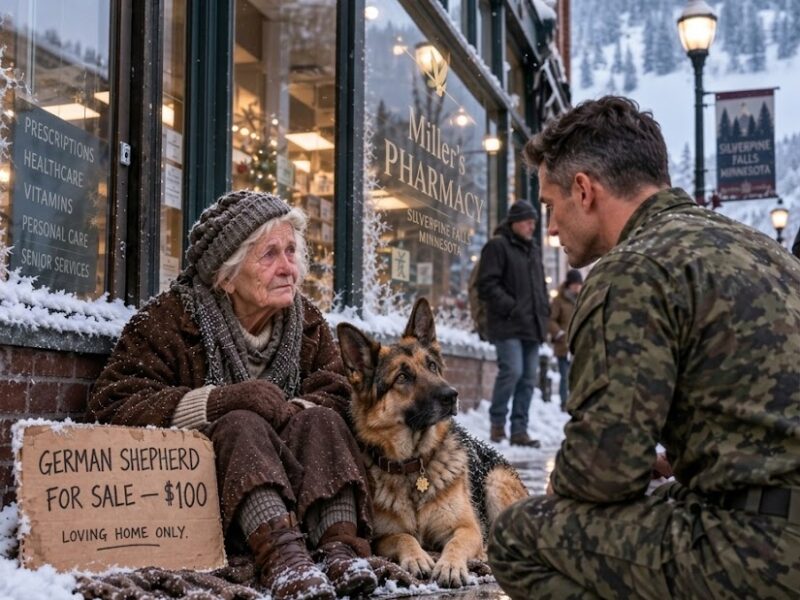
An elderly woman sold her beloved dog for $100—then a Navy SEAL stepped in and changed three lives forever.
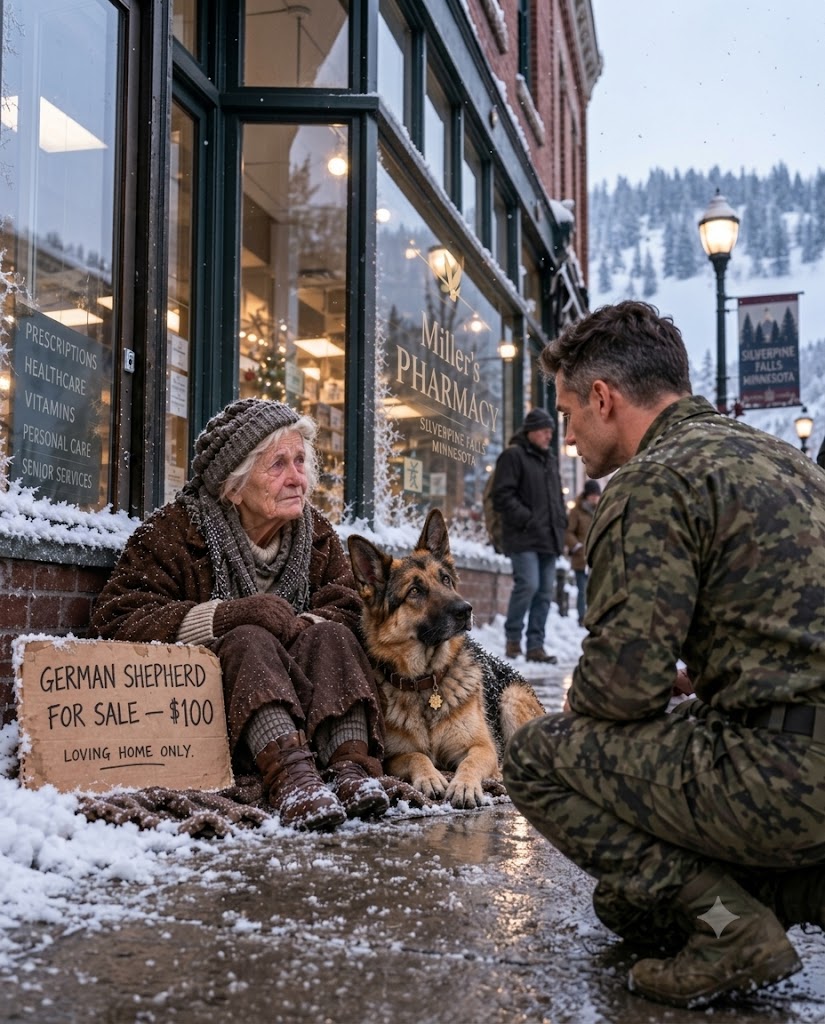
The winter that settled over Silver Pine Falls, Minnesota, seemed determined to remind everyone how small human beings really were.
For forty years, the northern town had endured blizzards, frozen lakes, and temperatures cold enough to turn eyelashes white.
But this winter was different.
Delivery trucks sat stranded beyond the county line, grocery shelves emptied faster than they could be restocked, and rolling power outages left families gathering beneath blankets, praying their furnaces would last another night.
On Main Street, Clara Winslow, a sixty-eight-year-old bakery owner with rosy cheeks and silver-gray curls gathered into a loose bun, handed out warm bread to families who could no longer afford it.
Her burgundy sweater and cream apron were dusted with flour, and her cheerful voice carried the stubborn determination of someone who believed kindness should never depend on a person’s bank account.
Even Clara’s supplies were running low.
And three blocks away, beneath the faded awning of Miller’s Pharmacy, an elderly woman was preparing to say goodbye to the one companion she could not bear to lose.
Her name was Eleanor Whitcomb.
At seventy-six, Eleanor stood barely five-foot-two, her small frame slightly stooped, deep wrinkles surrounding pale blue eyes that had spent a lifetime looking for goodness in people.
White hair rested beneath a gray knitted hat, a faded scarf covered her neck, and a patched brown winter coat with worn leather boots offered little protection against the bitter wind.
Beside her metal folding chair sat a cardboard sign: German Shepherd for sale, $100. Loving home only.
And beside the sign sat Cedar.
He was a six-year-old male German Shepherd with a rich golden-tan coat, a deep black saddle across his back, a dark facial mask, and two perfectly upright ears.
His body was large but noticeably lean, his thick tail resting against the snow.
Around his neck hung an old dark brown leather collar with a little brass tag shaped like a leaf.
But his most remarkable feature was his eyes—warm amber eyes that seemed to notice everything.
Whenever Eleanor shivered, Cedar moved closer, pressing his shoulder against her knees.
“Don’t worry about me, sweetheart,” she whispered, rubbing his ears through her mittens. “You just have to find someone good.”
Cedar looked up at her.
He did not wag his tail.
Perhaps he had already learned that some words sounded gentle, even when they carried heartbreak.
This was Eleanor’s fourth afternoon trying to find him a home.
She took breaks inside the nearby warming area, yet each return to the sidewalk felt harder than the last.
A heavy-set passerby stopped long enough to inspect Cedar.
“$100 for that skinny old dog?”
“He’s only six,” Eleanor replied.
“Well, he looks twelve.” The man laughed and walked away.
Two younger men suggested she surrender him to an animal shelter instead.
Another passerby shook his head as though poverty were a personal failure.
Eleanor said nothing.
Once she had worked in the town library, helping children discover books and elderly neighbors fill out difficult forms.
People had trusted her with their questions.
Now strangers looked at her as though she were something inconvenient on the sidewalk.
A young woman with dark curls and a blue winter jacket quietly placed a bottle of warm water beside Eleanor.
“Please stay warm, ma’am.”
“Thank you, dear.”
The woman hurried away before Eleanor could say more.
Eleanor held the bottle between her palms.
Then she looked down at Cedar.
“I wish love could pay bills,” she murmured.
Cedar rested his chin against her knee.
Across town, Wyatt Callahan was having an entirely different argument with winter.
At forty, the former Navy SEAL stood six-foot-one with broad shoulders and the firm, athletic build of a man who maintained military discipline.
Despite spending much of his civilian working life coordinating maintenance and inspecting facilities, his handsome angular face held a strong square jaw, clean-shaven cheeks, and deep gray-blue eyes that rarely revealed everything he felt.
His dark hair, lightly silvered at the temples, was cut into a precise undercut.
He wore his familiar fitted long-sleeved green camouflage uniform, matching camouflage trousers, and polished black combat boots.
Everything about Wyatt was orderly.
Everything except his loneliness.
He had grown up moving between foster homes, learning early that belongings should fit inside one suitcase and affection should never be mistaken for permanence.
The Navy had given him structure, comradeship, and a place where he mattered.
Retirement had given him silence.
His cabin near Frozen Pine Lake contained one bed, two chairs, neatly arranged tools, and very little evidence that anyone actually enjoyed living there.
He had never married, had no surviving family he knew of, and had never owned a pet.
Animals, he figured, were complicated.
People were complicated enough.
That afternoon, Wyatt left the hardware store carrying furnace filters, batteries, and a small bag of groceries.
He noticed Eleanor’s cardboard sign almost immediately.
He intended to keep walking.
Then Cedar stood.
The German Shepherd did not bark or strain wildly against his leash.
Instead, he stepped forward and watched Wyatt with an unwavering gaze.
Wyatt stopped.
Something about those amber eyes unsettled him.
He had been stared at by commanding officers, suspicious strangers, and men who wanted to intimidate him.
But he had never been looked at quite like this.
There was no challenge in Cedar’s expression—only attention, and something that felt strangely like trust.
“Well,” Wyatt murmured, “that’s a serious look for somebody without a job.”
Cedar tilted his head.
Eleanor gave a faint smile. “He always knows when someone is speaking to him.”
Wyatt approached slowly. “What’s his name?”
“Cedar.”
“How old?”
“Six.”
“Any health problems?”
“Nothing serious that I know of. He’s lost weight lately. Things have been difficult.”
Wyatt studied the dog’s lean frame and old collar.
Then he noticed Eleanor’s trembling hands.
“Why are you selling him?”
Her smile disappeared.
For a moment she watched snowflakes settle on Cedar’s black fur.
“Because sometimes loving someone means admitting you can’t give them what they need.”
Wyatt recognized the careful answer.
He had used a few himself.
“Does he have somewhere warm to sleep?”
“He used to.”
Three words, nothing more.
Yet Wyatt felt their weight.
Eleanor swallowed. “I need $100 for something important, but I won’t give him to someone who’ll leave him chained outside. He’s family.”
Wyatt looked at Cedar.
The dog remained motionless, gazing up at him.
For reasons Wyatt could not explain, the thought of walking away suddenly felt much harder than the thought of staying.
He crouched. “Listen, buddy. I don’t know anything about dogs.”
Cedar’s ears shifted forward.
“I don’t even know what kind of food you eat.”
Eleanor almost laughed.
“But I’ve got heat, a roof, and enough room for two.” Wyatt looked up. “I’ll take him.”
Eleanor stared. “You mean that?”
“Yes, ma’am.”
She searched his face. “Where do you live?”
“Near Frozen Pine Lake. Small cabin. Mostly quiet.”
“Will he stay indoors?”
“Absolutely.”
“And when you go to work?”
“I can arrange my schedule. I’m not away all day.”
She hesitated. “Have you ever had a dog?”
“No, ma’am.”
Eleanor’s face fell slightly.
Wyatt added, “But I’ve learned harder things than how to fill a food bowl.”
For the first time that afternoon, Eleanor laughed.
It was a small sound, fragile as sunlight on ice.
Then Wyatt took five twenty-dollar bills from his wallet.
He counted them into her gloved hand.
Eleanor looked at the money, and her eyes filled.
For one heartbreaking moment, she seemed almost ready to return it.
Instead, she carefully folded the bills and placed them inside her coat.
She handed Wyatt Cedar’s veterinary information, a handwritten feeding schedule, and the old leash.
“He’s yours now,” she whispered. “Please be patient with him.”
“I will.”
“And perhaps someday you could let me know how he’s doing.”
Wyatt nodded. “You have my word.”
Eleanor lowered herself painfully onto one knee.
Cedar immediately pressed close.
She buried her face in the thick fur around his neck.
“Oh, my sweet boy.” Her voice trembled. “You’ve been so good to us.”
Cedar stood perfectly still.
“You go somewhere warm now. Eat your supper. Be happy.”
A tear disappeared into his golden fur.
Wyatt turned his face toward the street.
He had witnessed difficult farewells before, yet something about this one hurt differently.
There were no ceremonies, no speeches, no flags—only an old woman surrendering the creature she loved because life had left her too few choices.
When Eleanor finally released Cedar, the dog remained beside her.
Wyatt waited.
Eleanor forced a smile. “Go on, Cedar. He’s a good man.”
The dog took one step, then another.
He followed Wyatt toward the truck, looking back until Eleanor disappeared behind the blowing snow.
Wyatt opened the passenger door.
Cedar hesitated before climbing inside.
“Neither of us knows what we’re doing,” Wyatt said. “That makes two of us.”
At the cabin, Cedar inspected every corner with solemn concentration.
Wyatt filled a soup bowl with water, unfolded a clean blanket beside the radiator, and searched his phone for proper dog food and feeding instructions.
He also arranged a veterinary appointment with Dr. Rebecca Foster, a forty-three-year-old veterinarian known locally for her gentle manner and practical advice.
Cedar drank some water and accepted a small, suitable meal.
Then he walked to the front door and lay down.
Wyatt pointed toward the blanket. “That’s the luxury accommodation.”
Cedar ignored him.
“Excellent. My first house guest, and already I’m getting complaints.”
The dog sighed.
Later, while organizing Eleanor’s belongings, Wyatt noticed an old knitted glove caught in the strap of the bag she had given him.
It was too large to belong to her.
A dark grease stain marked the fabric near the thumb.
Wyatt placed it on the table.
Cedar rose immediately.
He sniffed the glove, gently took it between his teeth, and carried it to the front door.
There he laid it down and looked back.
Wyatt frowned. “That belonged to somebody you miss.”
Cedar remained beside the glove.
Wyatt did not know what to make of it.
He left it near the door, turned down the lights, and settled into his chair.
Outside, snow whispered against the windows.
Inside, Cedar refused the new blanket and slept facing the entrance.
For the first time in years, Wyatt listened to another living creature breathing inside his home.
The silence no longer seemed quite so empty.
And when morning sunlight finally crossed the wooden floor, Cedar rose, carried the old glove across the room, and placed it gently at Wyatt’s feet.
Wyatt picked it up.
Cedar hurried to the door, turned around, and waited.
The former Navy SEAL stared at the dog.
Somewhere behind those amber eyes was a longing Wyatt did not yet understand, and for reasons he could not explain, he no longer wanted to ignore it.
By the third morning, Wyatt Callahan had discovered that caring for a dog required considerably more patience than maintaining a military inspection schedule.
Cedar had opinions about everything.
The six-year-old German Shepherd disliked squeaky toys, ignored an expensive dog bed, and considered Wyatt’s clean kitchen floor an appropriate place to rearrange his belongings.
Yet the big yellow-and-black dog never chewed furniture, never begged at the table, and never left Wyatt’s side for long—except when he stood by the front door.
Then nothing seemed capable of distracting him.
The previous afternoon, Wyatt had taken Cedar to Dr. Rebecca Foster, a forty-three-year-old veterinarian with warm brown eyes, a gentle round face, and chestnut hair tied into a low ponytail.
Wearing teal medical scrubs beneath a white coat, Rebecca had examined Cedar with the practiced tenderness of someone who trusted animals more readily than people.
“He’s underweight, but thankfully there’s no sign of serious illness,” she explained. “Give him smaller, balanced meals while he recovers, and don’t push him into long walks yet.”
Wyatt nodded as though receiving operational instructions.
Rebecca smiled. “You know, Mr. Callahan, dogs aren’t military recruits.”
“Good, because mine already ignores the commanding officer.”
Cedar answered with a dignified yawn.
Now, as pale sunlight spilled across the frozen surface of Frozen Pine Lake, Wyatt prepared for a short morning walk.
Cedar followed him eagerly until they reached the fork in the wooded road.
One path curved toward the lake; the other led back toward Silver Pine Falls.
Cedar stopped.
His ears rose sharply, and his amber eyes fixed on the distant road.
Wyatt gently encouraged him toward the lake.
Cedar remained still.
“That’s a pretty firm vote against my scenic route.”
The dog turned toward town, then looked back.
Wyatt studied him.
For three days, Cedar had watched the same direction whenever daylight began fading.
Perhaps the dog wasn’t simply restless.
Perhaps he missed someone.
Wyatt returned to the cabin, helped Cedar into the passenger seat, and started the truck.
The dog sat quietly as they passed snow-covered fields and silent farmhouses.
But near the old railway crossing, Cedar suddenly straightened.
His nose moved toward the window.
At the next intersection, he became alert again, watching a narrow road disappearing between pine trees.
Wyatt slowed. “Recognize something?”
Cedar gave a short, eager whine.
Wyatt continued toward an aging gas station at the edge of town.
Inside, a gray-haired attendant with thick eyebrows, weathered cheeks, and a friendly but cautious manner was stacking firewood beside the counter.
Wyatt asked whether he knew an elderly woman named Eleanor Whitcomb.
The attendant nodded. “Sure do. Lives out on Birch Hollow Road, past the old water tower. Her husband used to bring coffee through here.” He glanced at Cedar. “Well, I’ll be. That’s her boy, Shepherd, isn’t it?”
Wyatt looked toward the road outside.
It led in precisely the direction Cedar had been watching.
A strange feeling settled in his chest.
Not fear—something closer to being guided by a question he hadn’t known to ask.
Twenty minutes later, Wyatt parked where the plowed road ended.
He and Cedar walked the remaining short distance through packed snow.
At the end of a narrow driveway stood a weathered wooden house.
Its porch sagged slightly, clear plastic covered two windows, and a thin ribbon of smoke escaped from a small chimney.
Cedar pulled gently toward the steps.
Then he stopped at the door and barked twice.
Wyatt knocked.
After a long moment, Eleanor appeared, her pale blue eyes widening.
“Cedar!”
The German Shepherd stepped forward, his tail sweeping through the snow.
Eleanor lowered herself carefully, opening her arms. “Oh, my darling boy!”
Cedar pressed his head against her shoulder.
The old woman buried trembling fingers in his fur, laughing and crying at once.
Wyatt quietly looked away.
There were reunions a man had no right to interrupt.
When Eleanor finally stood, she studied him anxiously. “Mr. Callahan, has something happened? Is he too much trouble?”
“No, ma’am. He’s doing fine.”
“Then why?”
“I think he wanted to see you.”
Eleanor covered her mouth.
For several seconds, she could not speak.
Then she whispered, “He always did know the way home.”
Wyatt noticed the cold air escaping through the doorway. “Are you managing all right?”
“Well enough.”
He glanced at the patched window covering. “That heating system giving you trouble?”
Eleanor’s expression tightened. “We’re managing.”
Before Wyatt could respond, something crashed inside.
A man’s strained voice followed. “Mom, I’m all right.”
Eleanor turned sharply. “Daniel.”
Wyatt stepped back. “Would you like some help?”
She hesitated, then nodded.
Inside, the house smelled of old wood, weak coffee, and the faint smoke of a carefully tended stove.
Only the back bedroom held much warmth.
There, beside a narrow bed, sat Daniel Whitcomb.
At thirty-six, Daniel had the broad shoulders and powerful arms of a man who had spent years working with machinery.
His rectangular face was handsome but drawn, his cheekbones more pronounced than they should have been.
Short, light brown hair lay untidily above tired blue eyes, and his clean-shaven jaw tightened as he reached toward a small medicine bottle on the floor.
He wore a navy-and-black flannel shirt over a gray T-shirt and dark trousers adapted to his body.
A black manual wheelchair supported him.
Both legs had been amputated above the knees.
Wyatt noticed immediately, but he made himself meet Daniel’s eyes rather than stare.
“Sorry,” Daniel muttered. “Dropped the supplies.”
Wyatt retrieved the fallen items.
Then Cedar entered.
Daniel froze for a heartbeat.
He looked unable to believe what he was seeing.
“Cedar.”
The dog crossed the room and gently placed his large head on Daniel’s lap.
Daniel’s hands rose slowly.
“Oh, buddy.” His voice broke.
He stroked Cedar’s ears, his black muzzle, and the worn brown collar with its little brass leaf.
“I thought I was never going to see you again.”
Cedar pressed closer.
Daniel bent forward, hiding his face against the dog’s neck.
Wyatt stood silently beside the doorway.
He had seen grown men endure unimaginable physical hardship without shedding a tear.
But this was different.
Daniel wasn’t crying because he was weak.
He was crying because something he loved had come back.
Then Wyatt noticed something else.
Cedar positioned himself beside the wheelchair with extraordinary care, leaving room for Daniel’s hands and never pushing against the sensitive areas of his body.
The dog remembered how to comfort him.
And suddenly, Wyatt understood that the animal he’d purchased for $100 had once been somebody’s entire world.
Eleanor explained the visit, then brought Wyatt a cup of weak coffee.
Daniel looked embarrassed. “You didn’t have to come all this way.”
“Your dog disagreed.”
Daniel managed a faint smile. “He’s always been stubborn.”
“That’s reassuring. I thought it was personal.”
For a moment, the room felt warmer.
Then Wyatt asked about the wheelchair.
Daniel looked down at his hands. “Industrial accident eight months ago.”
He had worked as a maintenance technician at Northstar Timber Works, the largest timber processing company in the region.
During a maintenance operation on conveyor line four, machinery had unexpectedly started moving.
The injuries had been devastating.
Several surgeries followed.
The doctors saved his life, but not his legs.
Daniel spoke without theatrics, though every sentence seemed to carry something heavy beneath it.
“The company report said I failed to follow safety procedures.”
He looked toward the window. “I remember following the instructions I was given.”
The insurance administrator had disputed important parts of his workers’ compensation claim, relying partly on the employer’s account of the incident.
Some early medical care had been covered, but other benefits and ongoing expenses remained unresolved.
Eleanor had spent her savings keeping the household functioning.
She sold their old car and pawned several possessions.
The heating system failed as winter approached, leaving them dependent on limited fuel for a small stove.
Even basic necessities had become difficult.
Wyatt glanced at a shelf holding neatly organized medicine containers.
Eleanor followed his gaze. “The $100 paid for things Daniel needed.” Her eyes lowered. “And Cedar deserved more than we could give him.”
Daniel gripped the wheels of his chair. “She shouldn’t have had to sell him.”
“Daniel,” Eleanor whispered.
“No, Mom. You shouldn’t.” His voice cracked with frustration.
Wyatt felt an instinctive urge to promise he would fix everything.
He nearly did.
Instead, he asked, “What would help most right now?”
Daniel looked surprised.
After a pause, he answered, “Reliable heat, groceries, and a way to get my chair over that miserable front step without risking my neck.”
Wyatt nodded. “Those are things we can look into.”
He called Walter Boone, a seventy-two-year-old retired electrician with a lean, wiry build, short silver-white hair, a neat gray mustache, and sharp brown eyes.
Walter was known for his dry humor and refusal to compromise safety.
Walter agreed to arrange a proper heating inspection with qualified assistance.
Wyatt then contacted Clara Winslow.
Within the hour, Clara had organized a delivery of soup, bread, and groceries.
When the food arrived, Eleanor insisted everyone sit down.
Daniel told stories about Cedar as a puppy, including the day he’d stolen an entire oven mitt and buried it beneath the porch.
“Apparently, he considers household items his personal collection,” Wyatt said.
Eleanor laughed. “He has expensive tastes for someone who contributes nothing to the mortgage.”
Cedar lay contentedly between the two men.
For the first time in months, Daniel ate a meal without watching his mother pretend she wasn’t hungry.
As Eleanor cleared the dishes, Wyatt set the belongings from Cedar’s old bag on the table.
Daniel noticed the grease-stained glove among them.
His expression changed.
He picked it up carefully. “Where did you get this?”
“It came with Cedar’s things.”
Daniel ran his thumb across the dark mark near the wrist. “Mom kept this.”
Eleanor turned from the sink. “I couldn’t throw it away.”
Daniel stared at the glove. “I wore this on my last day at Northstar.”
The room grew quiet.
He slipped his fingers into the familiar fabric, then removed them slowly.
“I used to think that was just another ordinary morning.”
Wyatt sat across from him. “You don’t have to talk about it.”
Daniel looked at Cedar, who rested his head against the wheelchair.
For several moments, he said nothing.
Then he opened the drawer beside his workbench.
Inside lay a dented yellow hard hat and a bundle of carefully folded notes.
Daniel placed them on the table. “I kept these because there was something about that day nobody ever explained.”
Wyatt waited.
Daniel touched the edge of the hard hat. “Before the conveyor started, I heard a warning from the safety system. It wasn’t supposed to sound like that.”
His blue eyes rose to Wyatt’s. “That machine wasn’t supposed to move.”
He swallowed. “Someone knew it was unsafe.”
Snow fell softly beyond the Whitcomb kitchen window, covering the narrow driveway with a fresh layer of white.
Inside, the air carried the comforting smell of coffee and burning wood, but no one at the kitchen table seemed interested in either.
Wyatt Callahan sat across from Daniel Whitcomb, his broad shoulders slightly forward, his deep gray-blue eyes studying the younger man’s expression rather than the papers between them.
At forty, the former Navy SEAL had spent years learning how to recognize fear, uncertainty, and the things people struggled to say aloud.
But he had also learned that silence was sometimes more useful than questions.
Daniel sat in his black wheelchair, wearing his familiar navy-and-black flannel shirt.
His strong hands rested on the wheels while Cedar, the six-year-old German Shepherd, lay nearby, his golden-and-black body stretched across the wooden floor.
“Tell me what you remember,” Wyatt said quietly. “Not what the company said—just what you remember.”
Daniel took a slow breath.
For weeks before the accident, conveyor four had been acting strangely.
He explained that the enormous timber processing system had repeatedly displayed warning messages.
Sometimes the machinery stopped unexpectedly.
Other times, maintenance crews reported irregular responses from its safety controls.
Daniel had submitted requests for a closer inspection.
“I wasn’t the only one concerned,” he continued. “But production was behind schedule. Every time we asked for more time, somebody reminded us how much money the company was losing.”
Wyatt listened without interrupting. “Did you personally see those warnings?”
“Some of them. Others were reported by the men working different shifts.”
Wyatt nodded.
That distinction mattered.
Daniel rubbed his forehead. “That morning there was a jam. We were told the equipment had been secured for maintenance.”
His voice grew quieter. “I remember the warning sound. Then the machinery started moving.”
He stared toward the window. “The next thing I remember clearly is waking up in a hospital room.”
His mother, Eleanor Whitcomb, stood beside the kitchen counter.
At seventy-six, the petite woman looked almost swallowed by her patched brown winter coat.
Her white hair rested beneath a gray knitted hat, and her pale blue eyes filled with quiet sorrow.
She reached for Daniel’s hand.
For several moments, nobody spoke.
Cedar lifted his dark muzzle and rested it against the edge of Daniel’s wheelchair.
Daniel looked down. “Yeah, buddy,” he whispered. “I know.”
Wyatt did not ask Daniel to describe his injuries.
The wheelchair and the sorrow in his eyes already told enough.
Instead, he asked about the records.
Daniel opened a worn folder containing medical documents, insurance correspondence, maintenance notes, and copies of reports he had kept before the accident.
Wyatt arranged the papers by date.
One detail caught his attention.
A maintenance warning recorded in Daniel’s personal notes three weeks before the accident did not appear in the company’s summary provided to the insurance administrator.
“Could there be another report?” Wyatt asked.
“Possibly,” Daniel admitted. “But I never received one.”
Wyatt placed the documents beside each other. “Then we need somebody who knows how to request the originals.”
Eleanor looked worried. “Lawyers cost money we don’t have.”
“Some legal assistance programs help people in situations like this,” Wyatt said. “We can at least ask.”
He contacted Clara Winslow, whose little bakery had become an unofficial gathering place for half the town.
Wyatt knew her from occasional maintenance work and from the food deliveries she organized whenever winter storms trapped elderly residents indoors.
Clara recommended Maya Bennett.
By early afternoon, Maya arrived at the Whitcomb house.
She was thirty-four, with a slender build, clear hazel eyes, and straight chestnut-brown hair falling neatly to her shoulders.
Her oval face had a composed, intelligent expression, and her charcoal blazer, white blouse, and dark trousers reflected the careful professionalism of someone who understood that frightened people needed clarity more than dramatic promises.
Maya had built her career helping injured workers understand complicated claims.
Years of seeing families overwhelmed by paperwork had made her patient with uncertainty and exceptionally careful with facts.
She greeted Eleanor warmly before sitting beside Daniel.
“I’d like to hear your account in your own words,” she said.
Daniel glanced toward Wyatt.
Wyatt nodded but remained silent.
For the next hour, Maya asked about medical treatment, the original accident report, insurance decisions, and the dates Daniel had received written notices.
She explained that workers’ compensation benefits and possible workplace safety violations involved different procedures.
“A company’s internal report matters,” Maya said, “but it isn’t necessarily the final word. We need to examine the records, the insurer’s decisions, and the available review process.”
Daniel looked down at his hands. “So you’re saying there’s still a chance?”
“I’m saying there are questions worth examining. I won’t promise an outcome before we know the facts.”
It was not the comforting answer he expected.
Yet, strangely, Daniel trusted her more because of it.
He agreed to have Maya review his case and signed the appropriate authorization for representation.
After Maya left, Wyatt began organizing the remaining papers.
“This sensor system,” Wyatt said, pointing toward a diagram. “Wouldn’t it have interrupted the operating circuit?”
Daniel’s expression tightened. “That’s not exactly how that equipment worked.”
Wyatt started explaining what he remembered from civilian maintenance training.
Daniel interrupted. “I know what an interlock is, Wyatt. I maintained that line for seven years.”
The room went still.
Wyatt slowly lowered the paper.
He had been so determined to help that he had forgotten whose expertise mattered most.
“You’re right,” he said. “I shouldn’t have explained your own job to you.”
Daniel looked surprised. “Most people just keep talking.”
“I’ve been accused of that by people with considerably higher ranks.”
A reluctant smile appeared on Daniel’s face.
Wyatt pushed the diagram toward him. “How about you teach me?”
Something changed in Daniel’s posture.
He straightened and began identifying the different components, explaining their functions and the specific questions an investigator would need to answer.
Wyatt took notes.
For the first time since the accident, Daniel was not merely explaining what had happened to him.
He was using the knowledge he had spent years earning, and Wyatt could see how much that mattered.
Later that afternoon, Wyatt took Cedar into town for dog food.
At the hardware store, Cedar suddenly lifted his ears and began wagging his thick tail.
A young man near the shelves turned around.
He was twenty-nine, of average height with an athletic build, sandy-blonde hair, pale green eyes, and a narrow face scattered with freckles.
His brown canvas work jacket hung over a red-and-black flannel shirt, and his rough hands bore the marks of years spent handling industrial equipment.
Owen Reed.
The man introduced himself, crouching beside Cedar. “Well, look at you, old friend.”
Cedar enthusiastically pressed his nose into Owen’s palm.
Owen smiled. “Daniel used to bring him around when he picked up supplies. Best-behaved dog in the county—unless somebody had a sandwich.”
Wyatt introduced himself.
When he mentioned helping the Whitcomb family review Daniel’s accident records, Owen’s smile faded.
“Things are difficult at Northstar right now,” he said. “People are worried about their jobs.”
“I’m not asking you to accuse anybody.”
Owen glanced toward the store windows. “Good, because I’ve got a wife and little girl depending on me.”
Wyatt handed him Maya’s contact information. “If there’s something you want to share, talk to her. You don’t owe me an explanation.”
Owen accepted the card.
Cedar nudged his hand once more.
The young worker looked down at the dog, and for a brief moment regret crossed his face.
Then he walked away.
Wyatt watched him go.
Fear, he knew, rarely announced itself loudly.
More often it appeared as an ordinary person carefully avoiding a difficult conversation.
That evening, Owen sat in his truck outside a small grocery store, turning Maya’s card between his fingers.
He remembered standing near conveyor four weeks before Daniel’s accident, hearing another technician complain about repeated warnings.
He remembered Russell Pike, the maintenance supervisor, promising to look into the problem.
And he remembered a printed inspection summary that had looked different from the information recorded during his shift.
Owen took out his phone.
He stared at the number for nearly a minute before making the call.
“I might remember something,” he told Maya. “But I need to know this won’t become public before I understand what happens next.”
Maya listened carefully.
They arranged to speak privately.
The following day, Wyatt attended a town meeting concerning fuel deliveries and emergency heating supplies.
There he met Graham Voss.
At fifty-three, Graham was a tall, lean man with neatly combed dark-gray hair, a sharply defined face, a clean-shaven jaw, and cold steel-blue eyes.
His camel-colored wool coat covered a navy business suit, white shirt, and burgundy tie.
He spoke politely to everyone, displaying the controlled confidence of an executive accustomed to being heard.
Graham expressed sympathy for Daniel’s injuries.
“Northstar has hundreds of employees,” he added. “A prolonged dispute could create uncertainty for families already suffering through this winter.”
Wyatt studied him. “Then finding out whether the equipment was safe should matter to everyone.”
Graham’s smile thinned. “The company followed the procedures documented in its investigation.”
“Then an independent review should help establish that.”
For several seconds, Graham said nothing.
Finally, he excused himself.
Wyatt did not follow.
He had learned long ago that an argument could feel satisfying without accomplishing anything useful.
Back at the Whitcomb house, Eleanor was troubled.
“People are going to blame Daniel if the mill loses work,” she said.
Daniel stared at the floor. “Some already do.”
Maya, speaking with them over the phone, reminded the family that seeking a fair review did not mean demanding the factory close.
Their responsibility was to provide accurate information and allow the appropriate process to proceed.
Daniel listened quietly.
Then he looked at Cedar, who rested beside his wheelchair.
“I just want to know what really happened.”
Two days later, Owen finally met Maya at her modest office.
Wyatt drove him there at Owen’s request but allowed Maya to conduct the conversation.
Owen sat across from her, turning his work cap nervously in his hands.
He explained that several workers had reported problems with conveyor four.
Russell Pike had received maintenance concerns, but inspection dates were repeatedly moved.
Owen could not say who made the final decisions, nor could he prove exactly which warnings had been formally recorded.
“But Daniel wasn’t imagining things,” he said.
Maya asked careful questions, separating what Owen personally witnessed from what colleagues had told him.
Owen’s voice began to tremble. “I should have spoken up sooner.”
He looked toward the window. “My daughter needed winter boots. My wife was between jobs. Every paycheck mattered.”
He swallowed. “I kept telling myself somebody else would deal with it.”
Maya did not interrupt.
Owen lowered his eyes. “Daniel wasn’t the first man to warn them. He was just the one who paid the highest price.”
Silence filled the office.
Then Maya asked, “Do you still have any notes from that period? Anything you personally recorded?”
Owen rubbed his rough palms together.
For the first time since entering the room, he looked directly at her.
“Maybe,” he said quietly. “Maybe there’s still a notebook.”
The old storage shed stood behind a weathered farmhouse surrounded by pine trees whose branches sagged beneath the weight of fresh snow.
Owen Reed stepped out of Wyatt Callahan’s truck, rubbing his hands together against the bitter Minnesota wind.
At twenty-nine, Owen possessed the sturdy build and rough hands of a working man, but worry had carved shadows beneath his pale green eyes.
He had barely slept.
“If my uncle throws anything away, he never remembers doing it,” Owen muttered.
Wyatt, the forty-year-old former Navy SEAL, adjusted the sleeves of his fitted green camouflage shirt.
His broad shoulders, clean-shaven angular face, neatly silvered undercut, and calm gray-blue eyes gave him an air of quiet authority.
“Then we’d better hope he was feeling sentimental.”
Cedar jumped down carefully beside him.
The six-year-old German Shepherd, with golden-tan fur, a deep black saddle, amber eyes, and a worn brown leather collar bearing a brass leaf, immediately began investigating the unfamiliar surroundings.
Inside the shed, Owen searched through boxes of old work clothes.
Cedar suddenly approached a faded brown jacket hanging from a wooden peg.
His ears rose, and his tail began moving.
Owen laughed softly. “Remember that one, buddy?”
He had worn the jacket during visits to Daniel Whitcomb’s house back when life had been simpler.
Owen reached into its pockets.
His expression changed.
Between a folded receipt and a broken pencil lay a small notebook with a cracked blue cover.
For a moment, Owen simply held it.
“I thought I’d lost this.”
Wyatt looked at the notebook. “Then don’t change a word.”
Owen nodded.
He carried it directly to Maya Bennett.
At her office, the thirty-four-year-old attorney studied the pages beneath the light of her desk lamp.
Her straight chestnut hair framed an intelligent oval face, and her hazel eyes moved carefully between handwritten dates and maintenance codes.
Several entries matched Daniel’s personal records.
One stood out.
Inspection request 417.
Daniel had submitted concerns about the safety interlock system on conveyor line four approximately three weeks before his accident.
Owen’s notes mentioned a scheduled inspection, but the company’s summary contained no clear explanation for why it had been postponed.
Maya placed the documents side by side.
“This supports the need for further review,” she said. “But we still need the original records and confirmation of who made those decisions.”
Owen leaned back. “So it isn’t enough.”
“It’s important. That’s different from being enough.”
Wyatt watched Owen absorb the distinction.
Truth, he was learning, often traveled more slowly than anger.
Maya next contacted Russell Pike, Northstar’s forty-eight-year-old maintenance supervisor.
Russell was a stocky man with a weathered square face, thinning dark brown hair, tired gray eyes, and short stubble along his jaw.
He wore a dark gray industrial work shirt and matching trousers.
Years of responsibility had made him cautious, while mounting family debts and his wife’s ongoing health problems had taught him to fear uncertainty.
Russell acknowledged remembering changes to maintenance schedules.
However, he declined a detailed interview without consulting his own attorney.
Maya respected the decision.
She did not mistake hesitation for proof of wrongdoing.
But Russell’s strained voice suggested that some memories were becoming difficult to carry.
Two days later, Owen received an unexpected schedule change at Northstar.
His regular daytime shifts were replaced with inconvenient hours, and management requested a written explanation concerning his handling of workplace information.
Owen could not prove retaliation.
Yet the timing frightened him.
He visited Wyatt’s cabin that evening, his work cap twisted between his hands.
“My wife thinks I should stop,” he admitted. “We’ve got a mortgage. My little girl needs us.”
Wyatt poured coffee. “Then think about what your family needs. Nobody gets to make that choice for you.”
Owen looked surprised. “You’re not going to tell me to be brave.”
“Courage doesn’t pay the heating bill. But fear shouldn’t be the only thing making your decisions either.”
Owen stared into his cup.
For the first time, he felt Wyatt was speaking to him as a man rather than a witness.
Meanwhile, Eleanor Whitcomb faced a different kind of winter.
At the community food distribution center, the seventy-six-year-old widow stood in her patched brown coat, gray scarf, and worn boots, waiting quietly for groceries.
Her white hair framed a small, deeply lined face, and her pale blue eyes were fixed on the floor when an acquaintance approached.
“I heard Daniel’s making trouble for Northstar.”
Eleanor stiffened. “He only wants his claim reviewed fairly.”
“Well, if that mill loses contracts, we’ll all suffer.”
The words were not shouted.
That somehow made them hurt more.
Eleanor accepted her groceries and walked outside before her tears could betray her.
Clara Winslow spotted her through the bakery window.
The sixty-eight-year-old baker hurried out, her silver curls escaping their bun, her rosy cheeks bright against the cold.
Her burgundy sweater and flour-dusted cream apron looked wonderfully out of place beneath the gray sky.
“Eleanor Whitcomb, you’re coming inside before you turn into a snow-covered statue.”
Over tea, Eleanor confessed what had happened.
Clara listened, then reached across the table.
“Do you remember when my husband lost his job twenty-two years ago?”
Eleanor nodded faintly.
“You helped me find training programs. You filled out forms when I couldn’t stop crying long enough to read them.”
“That was nothing.”
“It was everything to me.”
Eleanor lowered her eyes.
Clara squeezed her hand. “Kindness doesn’t expire just because twenty years have passed.”
For the first time that afternoon, Eleanor smiled.
But when she returned home, Daniel noticed her exhaustion.
He also learned about Owen’s changed work schedule.
The weight of both discoveries settled heavily on him.
That evening, he called Maya and asked for time to consider whether he wanted the case to proceed.
Then Wyatt arrived.
“I’ll take care of it,” Wyatt assured him. “We’ll get this sorted.”
Daniel’s expression hardened. “You keep saying that.”
Wyatt frowned. “Saying what?”
“That you’ll fix everything.” Daniel gripped the wheels of his black wheelchair. “You can drive wherever you want. Work wherever you want. Walk out of this house whenever life gets uncomfortable.”
His blue eyes glistened. “I can’t even reach half the things I used to reach without asking somebody.”
Wyatt remained silent.
“I appreciate what you’ve done,” Daniel continued. “But I’m not another mission, Wyatt.”
The words struck harder than an accusation.
Wyatt had survived years by solving problems quickly, anticipating danger, and taking responsibility before anyone asked.
He had never considered how exhausting that might feel to someone whose independence had already been taken from him in so many ways.
“You’re right,” Wyatt finally said.
Daniel looked away.
Wyatt did not defend himself.
He simply left Daniel the space he had asked for.
The following morning, Wyatt returned with two coffees and no plans.
Daniel opened the door from his wheelchair. “What is it this time?”
Wyatt held up the cups. “Thought I’d ask whether you wanted help fixing your mother’s radio.”
Daniel stared at him.
“No heroic rescue—just bad coffee and questionable technical ability.”
Despite himself, Daniel smiled.
They settled near the living room window with the old radio between them.
After several minutes, Wyatt spoke. “I owe you an apology.”
Daniel looked up.
“I’ve been deciding what you need instead of asking.”
Daniel rested his hands on the tabletop. “I shouldn’t have yelled. You had a point. I was angry because you could do things I couldn’t.”
Wyatt nodded. “And I was uncomfortable because I couldn’t fix what happened to you.”
A quiet understanding passed between them.
Daniel extended his hand.
Wyatt shook it.
Neither man needed to say more.
Over the next few days, they worked together on a modest repair bench beside the window.
Daniel measured the available space and determined the height and arrangement best suited to his wheelchair.
Walter Boone, the seventy-two-year-old retired electrician with short silver-gray hair, a neat mustache, and alert brown eyes, checked the electrical supply and helped them ensure the setup was safe.
Wyatt handled the lifting.
Daniel directed the design.
By the time the bench was ready, a small collection of tools stood within Daniel’s comfortable reach.
Their first project was Eleanor’s old desk lamp.
Daniel examined the damaged connection, selected a suitable replacement component, and repaired it.
When the lamp finally glowed, Eleanor stood in the doorway, watching her son with tear-filled eyes.
“Look at that,” Wyatt said. “I may have found myself a technician.”
Daniel leaned back. “My rates are expensive.”
“How expensive?”
“Coffee. Real coffee, not whatever you brought yesterday.”
Cedar, resting beneath the bench, gave a low, contented sigh.
Eleanor laughed.
The sound filled a room that had been silent with grief for too long.
Yet, beyond the warmth of that small victory, the investigation continued.
Clara helped connect Maya with two former Northstar employees willing to discuss their experiences.
One was Samuel Price, a fifty-nine-year-old former equipment inspector with silver hair, a lean frame, and a reserved manner shaped by decades of checking machinery rather than trusting promises.
The other was Helen Ward, a forty-four-year-old former scheduling assistant with shoulder-length auburn hair, fair skin, and observant gray eyes.
She had left Northstar months earlier for another job and remembered changes to maintenance schedules.
Maya interviewed them separately.
Samuel recalled concerns about conveyor four.
Helen remembered a planned inspection being moved shortly before a major production deadline.
Neither could identify every person responsible, but their accounts offered new avenues for verifying the records.
Then late one afternoon, Maya received a copy of an old scheduling communication that Helen had retained among her personal employment correspondence.
It referenced inspection request 417.
Beside the revised date was a brief explanation: Postponed due to production requirements.
Maya read the sentence twice.
For months, Daniel had wondered whether anyone had taken his concern seriously.
Now there was evidence that a scheduled inspection had been postponed.
It did not prove everything, but it gave an important question a place to begin.
That evening, Wyatt stopped at the hardware store for supplies.
Graham Voss approached him near the counter.
The fifty-three-year-old executive looked immaculate in his camel-colored wool coat, navy suit, and burgundy tie.
His sharply defined, clean-shaven face remained composed, though his steel-blue eyes showed little warmth.
“Silver Pine Falls is going through enough,” Graham said. “People need stability, Mr. Callahan.”
“They also need safe workplaces.”
“Northstar provides hundreds of jobs.”
“Then protecting the people doing those jobs should be worth the effort.”
Graham’s jaw tightened.
He offered no reply before walking away.
Wyatt watched him leave.
He felt no satisfaction.
There was still too much uncertainty and too much suffering for satisfaction.
That night, Daniel sat beside the window while Cedar rested his head on his lap.
Eleanor knitted quietly across the room.
Daniel thought about Owen, the frightened workers, and the life he had lost.
He also thought about the repaired lamp glowing on his new workbench.
He called Maya.
“I want to continue,” he said.
“Are you certain?”
“Yes. Not because Wyatt wants me to, not because my mother needs something to hope for.” He looked down at Cedar. “Because I need to know the truth.”
The German Shepherd lifted his amber eyes.
Daniel stroked the dog’s ears. “I lost my legs, Cedar, but I don’t intend to lose my voice.”
Outside, wind swept fresh snow across Birch Hollow Road.
A weather alert appeared on Wyatt’s phone.
Another powerful winter storm was approaching Silver Pine Falls, bringing the possibility of widespread power failures and dangerous cold.
And for a town already struggling to stay warm, the hardest night of the season might still lie ahead.
By noon, Silver Pine Falls had begun to disappear beneath the snow.
The storm rolled across northern Minnesota with a fury the town had not witnessed in decades.
Pine branches bowed under thick white blankets.
Delivery trucks remained stranded beyond the county line, and power failures spread through neighborhoods already struggling to stay warm.
At Silver Pine Elementary School, the gymnasium had become an emergency warming center.
Folding beds lined the walls, volunteers carried blankets between classrooms, and the smell of chicken soup drifted through the hallways.
Wyatt Callahan had been working since dawn.
The forty-year-old former Navy SEAL moved with his usual quiet discipline, his broad shoulders filling a fitted long-sleeved green camouflage shirt.
His clean-shaven, angular face remained composed beneath neatly trimmed dark hair silvered at the temples, though his deep gray-blue eyes betrayed exhaustion.
He had spent the morning delivering bottled water, carrying emergency supplies, and helping elderly residents reach the shelter.
Clara Winslow, the sixty-eight-year-old bakery owner with rosy cheeks and silver-gray curls, coordinated the kitchen in her burgundy sweater and cream apron.
Walter Boone, seventy-two, lean and sharp-eyed beneath his short silver hair and gray mustache, helped arrange qualified technicians to inspect emergency heating equipment.
“Sit down for five minutes,” Clara ordered. “You can’t still have deliveries. You know, being stubborn isn’t a military decoration.”
“That’s disappointing. I was hoping for a medal.”
Clara shook her head and handed him a sandwich anyway.
Nearby, Cedar rested inside a designated animal-friendly room.
The six-year-old German Shepherd had regained some strength since Wyatt adopted him.
His golden-tan coat and deep black saddle looked healthier, while his amber eyes remained constantly attentive.
His worn brown leather collar still carried the small brass leaf that Eleanor Whitcomb had given him years before.
But today, Cedar could not settle.
He paced between his blanket and the doorway, ears raised, tail low.
When Wyatt entered, the dog hurried toward him, then turned back toward the exit.
“What’s wrong, buddy?”
Cedar whined softly.
Wyatt assumed he needed a walk.
Then he checked his phone.
Two missed calls from Eleanor.
He tried returning them.
The call failed.
Wyatt stared at the screen.
Birch Hollow Road had been experiencing electrical problems all morning.
Eleanor’s aging heating system had never been fully repaired, and Daniel’s medical needs made prolonged cold particularly dangerous.
Cedar nudged his hand.
Wyatt looked down.
He did not believe the dog could somehow know what was happening miles away, but he had learned that Cedar rarely became restless without a reason.
And Eleanor had tried to reach him.
That was reason enough.
Across town inside the Whitcomb house, Eleanor was kneeling beside her son’s wheelchair.
At seventy-six, her petite frame seemed especially fragile beneath her patched brown coat, gray scarf, and knitted hat.
Yet her pale blue eyes still held the stubborn courage that had carried her through widowhood, poverty, and eight months of caring for Daniel.
The main heating system had failed again.
Their backup heat had become unreliable after the electricity went out, and the temperature inside the house was falling.
Daniel Whitcomb sat wrapped in blankets, his broad shoulders hunched with exhaustion.
His short light brown hair was damp at the temples, and his blue eyes looked unusually tired.
He had lost both legs above the knees in the industrial accident at Northstar Timber Works, but his determination had never completely disappeared.
“Mom, please stop worrying,” he said.
“Then stop looking like someone who needs worrying about.”
“I’m just cold.”
“And I’m just seventy-six. Neither statement is particularly useful.”
Daniel almost smiled.
Eleanor had called the emergency assistance number and left their address.
She had also attempted to contact Wyatt, but the signal disappeared before the calls connected.
Now she sat beside Daniel, adjusting the blankets and watching the small thermometer near the window.
She knew they could not remain there much longer.
A short time later, a rescue vehicle approached along Birch Hollow Road, followed by Wyatt’s truck.
Wyatt had contacted the emergency team before leaving the school.
Cedar rode safely secured in the vehicle.
When the rescuers entered the house, Wyatt found Eleanor still beside Daniel.
“We’re getting you somewhere warm,” he said.
Daniel looked toward his mother. “She’s been pretending she isn’t freezing.”
“And he’s been pretending he’s fine,” Eleanor replied.
A medical responder assessed Daniel’s condition and confirmed that he needed warmth and further monitoring.
Wyatt helped carry essential belongings while the trained responders assisted Daniel into accessible transportation.
Cedar stayed close to Eleanor, calmly allowing the rescuers room to work.
Before leaving, she rested a trembling hand on the dog’s head. “You brought him back to us again, didn’t you?”
Wyatt offered a small smile. “I think you called for help, Eleanor. Cedar just made sure I paid attention.”
She looked into the dog’s amber eyes. “Then perhaps that’s enough of a miracle for one day.”
At the school, Daniel received medical attention and was given a warm place to rest.
Eleanor joined Wyatt and Cedar near the animal-friendly room, where volunteers provided water and a safe resting area for pets.
Throughout the building, people shared stories of broken furnaces, missing deliveries, and frightening nights spent listening to the wind.
An elderly widower admitted he had been too embarrassed to ask for assistance.
A young mother explained that her children’s bedroom had become unbearably cold.
A Northstar worker worried that reduced hours would leave his family unable to pay next month’s bills.
Wyatt listened.
The difficulties of the Whitcomb family were not isolated tragedies.
They were part of a town quietly running out of ways to help itself.
Near the animal room, a little girl approached Cedar.
She was about nine, with a small round face, light brown skin, dark eyes, and two long black braids escaping a purple knitted hat.
Her pink winter jacket was slightly oversized, and she possessed the fearless curiosity of a child who had not yet learned to hide every question.
“Is he your dog?”
Wyatt nodded. “He’s Cedar.”
“Did you have him when he was a puppy?”
“No, we only met a few weeks ago.”
She stroked Cedar’s back after asking permission. “Why didn’t you have a dog before?”
Wyatt considered giving a simple answer.
Instead, something about the girl’s innocent expression made him pause.
“I moved around a lot when I was young. Like when families move houses.” He told her gently about growing up in different foster homes, how each new place had unfamiliar rules, how he learned not to unpack everything because he never knew how long he would stay.
Later, the military had given him purpose and people who depended on him.
But after leaving the Navy, he returned to living alone.
“I guess I never thought I could give a dog a permanent home,” he admitted.
The little girl frowned. “But you gave Cedar one.”
Wyatt looked down.
Cedar leaned against his leg.
“Yeah,” he said quietly. “I suppose I did.”
Eleanor had heard everything.
She approached with two paper cups of tea.
“Sometimes,” she said, “family isn’t where you’re born. It’s where someone decides to stay.”
Wyatt accepted the cup.
For several seconds, he could not answer.
Later, Daniel joined them after being cleared to rest outside the medical area.
He watched Cedar settle between Wyatt and Eleanor.
“Ever get lonely living out by the lake?” Daniel asked.
Wyatt looked toward the frost-covered windows. “Loneliness becomes a habit after a while.”
“Does that make it easier?”
“No. Just more familiar.”
Daniel lowered his eyes. “Since the accident, I felt like a burden. Mom had to sell practically everything—even Cedar.”
Wyatt leaned forward. “You helped me build that repair bench. You taught me things about machinery I didn’t know.”
“That doesn’t pay the bills.”
“Not yet. But it proves your knowledge didn’t disappear with your legs.”
Daniel was silent.
Wyatt continued, “You still have something to give, Daniel. More than you realize.”
The younger man studied his hands.
For months he had measured his worth by everything he could no longer do.
Perhaps he had forgotten to count what remained.
Two days later, when the worst winds had eased, the shelter hosted a community discussion about fuel shortages, employment, and rebuilding efforts.
Graham Voss attended as a representative of Northstar Timber Works.
At fifty-three, Graham was tall and lean with carefully combed gray-black hair, steel-blue eyes, and a clean-shaven face that rarely betrayed his thoughts.
His camel wool coat and navy suit made him look strangely formal among the blankets and folding chairs.
Several workers questioned whether the ongoing dispute involving Daniel could threaten the mill’s future.
One man suggested that additional scrutiny might cost everyone their jobs.
Daniel listened until he could bear the misunderstanding no longer.
He raised his hand. “May I say something?”
The room quieted.
Wyatt stepped aside, allowing Daniel to maneuver his wheelchair toward the front.
Daniel looked at the faces before him.
Some were familiar.
Some belonged to men who had once worked beside him.
“I loved working at Northstar,” he began.
His voice trembled, but he continued. “I liked fixing equipment. I liked knowing that what we built mattered. I thought I’d retire from that place someday.”
He glanced down at his wheelchair. “That future changed.”
Nobody interrupted.
“I don’t want the mill closed. I don’t want anybody losing a paycheck. I know what it means when a family suddenly has no money coming in.”
His mother watched with tears in her eyes.
“But I also know what happens when something dangerous gets ignored.”
Daniel steadied himself. “I’m not asking you to believe every word I say without evidence. I’m asking that the people reviewing what happened be allowed to see the truth.”
Silence filled the gymnasium.
Then an older factory worker approached.
He was a broad-shouldered man in his early sixties with a deeply lined face, short gray hair, a neatly trimmed white beard, and heavy hands roughened by decades of work.
“My son’s still on that line,” he said.
He held out his hand. “I want him coming home safe.”
Daniel shook it.
For the first time in months, he felt seen as a fellow worker rather than a tragedy.
During the gathering, Owen Reed approached Maya Bennett.
The twenty-nine-year-old worker looked exhausted, his sandy-blonde hair untidy above anxious green eyes.
Maya, composed in her charcoal blazer, listened as Owen described a recent request to confirm summaries carrying dates from before Daniel’s accident.
Some entries, he explained, did not match what he personally remembered.
“I didn’t sign,” Owen said.
“That was wise if you couldn’t verify them,” Maya replied. “Preserve what you’ve received lawfully. We’ll determine the proper next steps.”
The discussion gave Maya another issue to examine, but she promised no instant victory.
That evening, as families prepared to leave the shelter, Wyatt sat with Walter and Clara near the kitchen.
He spoke about creating a volunteer program to help elderly residents and families with disabilities access heating inspections, emergency supplies, and reliable repair services.
Walter suggested involving licensed professionals.
Clara offered to organize volunteers and donations.
Daniel volunteered to coordinate technical information and requests from home.
For the first time, he spoke about future work without shame.
As the shelter grew quieter, Wyatt finally sat beside Cedar.
Exhaustion settled into his shoulders.
Eleanor approached carrying an old wool blanket.
Without asking permission, she placed it gently around him.
“You’ve been taking care of everybody else,” she said. “Someone ought to take care of you.”
Wyatt looked up.
The words were simple.
Yet they reached a place inside him that years of military discipline had never managed to protect.
He could not remember the last time someone had covered his shoulders with a blanket simply because they cared.
“Thank you, Eleanor,” he whispered.
She smiled. “That’s what families do, sweetheart.”
Across the room, Maya’s phone vibrated.
A message confirmed that the newly gathered information could support the next formal steps in reviewing Daniel’s disputed claim and referring relevant safety concerns to the proper authorities.
The road ahead remained uncertain, but the silence surrounding Daniel’s accident was finally beginning to break.
And beneath the warm lights of the school gymnasium, Wyatt understood something he had spent most of his life avoiding.
A man did not have to face every winter alone.
The snowbanks along Birch Hollow Road were beginning to shrink, revealing patches of frozen earth beneath the pale March sunshine.
Silver Pine Falls had survived its fiercest storm in decades.
Electricity had returned to most neighborhoods.
Emergency shelters were closing gradually, and delivery trucks once again rumbled along Main Street.
Yet inside Maya Bennett’s office, another struggle was far from over.
Thomas Keane, a fifty-eight-year-old industrial safety engineer, stood beside a table covered with maintenance records.
He was a sturdy man with short salt-and-pepper hair, a neatly trimmed gray mustache, rectangular glasses, and observant brown eyes.
His navy work jacket and measured manner reflected thirty years spent investigating machinery rather than trusting assumptions.
Across from him sat Daniel Whitcomb, the thirty-six-year-old former maintenance technician whose life had changed eight months earlier.
Daniel’s broad shoulders filled his familiar navy-and-black flannel shirt.
His short light brown hair framed a tired, clean-shaven face, while his blue eyes followed Thomas’s finger across a technical drawing.
His black wheelchair stood close to the table.
“These entries confirm earlier concerns about the interlock system,” Thomas explained. “But determining exactly what caused the accident requires more than matching dates.”
Maya, thirty-four, with straight chestnut hair, hazel eyes, and a charcoal blazer, nodded. “We have to distinguish what the records establish from what we still need to prove.”
Daniel studied the diagram. “That inspection should have happened before the production schedule changed.”
Thomas looked toward him. “Can you explain why you requested it?”
Daniel straightened.
For the next several minutes, he described the equipment’s operating behavior, the warnings that concerned him, and the questions that remained unanswered.
Nobody interrupted.
For the first time since losing his legs, Daniel felt his technical knowledge mattered more than his wheelchair.
Outside the office, Wyatt Callahan waited beside a window.
At forty, the former Navy SEAL stood six-foot-one, broad-shouldered and athletic, with an angular, clean-shaven face, a strong jaw, and neatly cut dark hair silvered at the temples.
His fitted long-sleeved green camouflage clothing remained immaculate despite the muddy winter streets.
Wyatt had offered to attend the entire meeting.
Daniel had gently declined.
“I need to answer for myself,” he had said.
Wyatt respected that.
In military service, he had learned to take responsibility quickly.
But Daniel was teaching him a different kind of discipline: knowing when to step aside.
When Daniel emerged, Wyatt asked only, “Coffee?”
Daniel smiled. “Real coffee. I’ve been informed my previous attempts were unacceptable.”
“Then we’re making progress.”
Over the following weeks, Maya continued reviewing records through the appropriate legal channels.
Russell Pike, Northstar’s forty-eight-year-old maintenance supervisor, eventually agreed to provide information after consulting his own attorney.
Russell was a stocky man with thinning dark brown hair, tired gray eyes, a weathered square face, and short stubble along his jaw.
His dark gray work uniform looked freshly washed, but the exhaustion in his expression could not be hidden.
He acknowledged that maintenance concerns had been raised before Daniel’s accident.
Some requests had been forwarded to management; others had been delayed as production demands increased.
“I kept telling myself the equipment would be checked soon,” Russell admitted.
He stared at his hands. “My wife was sick. We had debts. I couldn’t imagine losing my job.”
The explanation did not erase his responsibility.
Russell understood that.
He also understood that remaining silent would not change what had happened to Daniel.
Further records showed discussions about reducing equipment downtime to meet a major production deadline.
Graham Voss, Northstar’s fifty-three-year-old operations director, had argued that lengthy shutdowns could threaten contracts and hundreds of jobs.
Graham was tall and lean with a sharp, clean-shaven face, carefully combed gray-black hair, and steel-blue eyes.
His camel wool coat, navy suit, and burgundy tie conveyed professional confidence, though his expression grew guarded whenever safety decisions were discussed.
At a formal meeting attended by legal representatives, Graham explained the financial pressure the mill had faced.
“Keeping the factory operational was never a simple matter,” he said. “Families depended on those paychecks.”
Daniel listened without interrupting.
Then he spoke. “My family depended on mine, too.”
Graham looked at him.
Daniel continued quietly. “I understand why jobs matter. I spent seven years proud of that work. But when a machine shows signs of trouble, somebody has to take those warnings seriously.”
No accusation followed—only a question that stayed in the room long after the meeting ended.
The investigation continued through documents, professional evaluations, and official procedures.
Meanwhile, Daniel began working toward something equally important: a future.
Maya introduced him to Susan Parker, a fifty-one-year-old vocational rehabilitation counselor with shoulder-length dark blonde hair, soft gray-green eyes, and a gentle oval face.
Wearing a beige knitted cardigan over an ivory blouse and charcoal trousers, Susan had the calm patience of someone accustomed to hearing people describe everything they feared they had lost.
She visited Daniel at the Whitcomb house.
After greeting Eleanor, Susan sat beside his workbench.
“What would you like your life to look like a year from now?” she asked.
Daniel glanced toward his wheelchair. “I suppose that depends on what I can do.”
“Then let’s begin with what you want to do.”
He thought for a moment. “I miss fixing things.”
Susan smiled. “Tell me more.”
Daniel described the satisfaction of finding a problem, understanding it, and returning a broken machine to useful service.
Susan listened, then discussed adaptive workspaces, vocational training, equipment needs, and ways Daniel might gradually rebuild professional independence.
She did not promise that he would walk again.
She did not suggest that his worth depended on prosthetic legs.
Instead, she helped him write three goals: develop a safe repair workspace, improve access to the house, and explore work he could perform independently.
Daniel stared at the list.
It looked ordinary.
That was what made it extraordinary.
For months, every plan had revolved around surviving another week.
Now he was planning a life.
A few days later, Wyatt and Walter Boone arrived to improve Daniel’s workbench.
Walter, seventy-two, was lean and wiry with short silver-white hair, a neat gray mustache, and alert brown eyes.
His dark green flannel shirt and worn work trousers suited a man who had spent decades making careful repairs and distrusting shortcuts.
Daniel directed the changes.
The tabletop was adjusted for comfortable wheelchair clearance.
Tools were repositioned within reach, and Walter checked the electrical arrangements.
Wyatt worked with the wood while Daniel supervised.
“Three inches to the left,” Daniel instructed.
Wyatt shifted a shelf another inch.
Wyatt sighed dramatically. “Are you always this demanding?”
“Only when the workmanship is questionable.”
Walter chuckled.
Cedar lay beneath the nearby window, his golden-tan fur and black saddle warmed by sunlight.
The six-year-old German Shepherd raised his amber eyes whenever a tool clattered, then returned to resting with his brass leaf tag against the wooden floor.
From the doorway, Eleanor watched her son working with the same focused expression he had worn as a boy dismantling broken clocks.
Something inside her softened.
The accident had changed Daniel’s body.
It had not taken away the curious, determined person she had raised.
Weeks passed.
Then Maya called with news.
The newly reviewed information had prompted reconsideration of several disputed benefits, and arrangements were beginning to address some urgent treatment and support needs.
The broader questions of long-term entitlement and responsibility remained unresolved.
Daniel listened carefully. “So I can keep moving forward with rehabilitation.”
“There are resources we can begin arranging,” Maya replied. “But we’ll review every agreement properly before you decide.”
Eleanor closed her eyes.
For once, relief arrived without demanding that she pretend everything was finished.
At a subsequent evaluation, Daniel met Dr. Hannah Mercer, his forty-six-year-old physician, alongside Susan.
Hannah was a slender woman with a neatly cut dark blonde bob, pale blue eyes, and a composed expression.
She wore a white medical coat over a light blue blouse and navy trousers.
After reviewing Daniel’s recovery and discussing his daily needs, they explained that he could be considered for a specialized rehabilitation program and assessment of appropriate assistive equipment.
Nothing guaranteed he would walk with prosthetics.
But the discussion opened possibilities Daniel had stopped imagining.
When Susan handed him a written plan, Daniel read it twice.
Then he whispered, “I thought the rest of my life had already been decided.”
Hannah shook her head gently. “Your injury changed what you’ll need. It didn’t take away your right to choose where your life goes.”
Daniel folded the paper carefully.
For the first time in eight months, he wanted to see what came next.
That evening, Eleanor brought an old photograph album to the living room.
Wyatt sat nearby while Cedar rested beside the chair.
There were pictures of Daniel as a little boy standing beside his father, Frank, on the porch.
Another showed Daniel holding a fishing rod too large for his small hands.
Later photographs captured his first day at Northstar and the afternoon Cedar arrived as a young dog with oversized ears.
Eleanor touched a photograph of Daniel standing beside a ladder. “He promised he’d repair this roof someday.”
Her voice weakened. “After the accident, I stopped mentioning it. I thought it would hurt him.”
Daniel heard her from the doorway.
He rolled closer. “Mom, I still intend to keep that promise.”
She looked at his wheelchair.
Daniel smiled. “I can’t climb onto the roof, but I can plan the repairs, choose the materials, and hire people who know what they’re doing. Honestly, that might be safer than letting me up there in the first place.”
Eleanor laughed through her tears.
Cedar approached Daniel, placed his head on his lap, and sneezed loudly as Eleanor bent to embrace them.
Wyatt laughed.
Even grief, it seemed, occasionally had to make room for a dog’s terrible timing.
Driving home that night, Wyatt noticed how empty his cabin felt before he even reached it.
He remembered Daniel arguing cheerfully over measurements, Eleanor insisting everyone eat, and Cedar wandering between them as though checking that his favorite people remained together.
Wyatt had spent years believing independence meant needing nobody.
Now he understood how much he had missed.
But he also wondered about Cedar.
The dog belonged to him now, yet Eleanor and Daniel remained part of Cedar’s world.
Wyatt could not bear the thought of causing another painful separation.
Several weeks later, Maya invited Daniel to review a significant development in his claim.
After further examination and negotiations through the appropriate representatives, a meaningful portion of the disputed benefits had been resolved, including financial support that would help the family manage essential treatment and living needs.
Other legal and safety questions remained under review.
Maya explained each term and gave Daniel time to consider his choices.
He asked questions, reviewed the information, and made his own decision.
When he returned home, Eleanor waited beside the window.
“Well?” she asked.
Daniel smiled. “We can finally start repairing this place, Mom.”
For a moment, Eleanor did not move.
Then she covered her face and began to cry.
Daniel wheeled closer and held her hands.
Wyatt remained by the doorway, giving them space, but Eleanor looked up. “Wyatt, come here.”
He approached.
“If you and Cedar hadn’t found us—” Her voice failed.
Wyatt shook his head gently. “Daniel did the hardest part. He chose not to give up.”
Cedar settled between them, looking thoroughly satisfied with the attention.
Daniel chuckled. “I think this dog deserves a vacation. He’s been looking after all three of us.”
Later, as Wyatt prepared to leave, Daniel called him back.
“Can I ask you something?”
“Sure.”
“Before this winter, did you ever imagine owning a dog?”
Wyatt smiled. “Not once.”
Daniel looked down at Cedar. “And when you paid $100 for him, did you ever imagine he’d bring you back here?”
Wyatt studied the German Shepherd’s amber eyes. “No,” he answered softly. “But I’m beginning to think Cedar knew something the rest of us didn’t.”
Daniel nodded. “When things settle down, I’d like us to talk about how he can keep both homes in his life.”
Wyatt looked toward Eleanor, then at Cedar.
For the first time, the idea of belonging to more than one place did not seem impossible.
It sounded like family.
By the time spring finally reached Silver Pine Falls, the town had almost forgotten what silence sounded like without the wind.
Snowmelt trickled beneath the wooden bridges.
Sunlight shimmered across Frozen Pine Lake, where the last sheets of ice drifted toward the northern shore.
Grocery trucks returned on schedule.
Shopkeepers reopened their doors, and tiny green shoots appeared beside sidewalks that had been buried for months.
Five months had passed since the winter that nearly broke the Whitcomb family.
Northstar Timber Works remained open, operating under renewed safety reviews and corrective requirements.
Daniel Whitcomb’s compensation dispute had made significant progress, although some questions of responsibility were still being handled through proper legal procedures.
There had been no dramatic public punishment, no angry crowd demanding revenge.
There was something quieter and more important.
People were beginning to listen.
At the end of Birch Hollow Road, the old Whitcomb house looked almost unrecognizable.
Professional workers had repaired the roof, replaced the unreliable heating system, and improved the insulation.
A sturdy wheelchair ramp led to the front porch, while wider interior passages gave Daniel room to move freely.
Eleanor Whitcomb stood beside a row of newly planted flowers.
At seventy-six, she remained petite and slightly stooped, with white hair tucked beneath her familiar gray knitted hat and pale blue eyes surrounded by gentle wrinkles.
Her patched brown winter coat, gray scarf, and worn boots remained unchanged, although the weather no longer demanded so many layers.
“These flowers look better than any I’ve grown before,” she announced.
From the porch, Daniel smiled. “Maybe because you’ve waited longer for them.”
Daniel was thirty-six, broad-shouldered, clean-shaven with short, light brown hair and thoughtful blue eyes.
His navy-and-black flannel shirt was neatly buttoned, and his black wheelchair moved smoothly along the new ramp.
He still had days when pain, fatigue, and memories of the accident made life difficult.
But those days no longer defined everything.
Inside, his adapted workbench stood beside the living room window.
Under Susan Parker’s continuing vocational guidance, he had begun accepting suitable small repair jobs from neighbors.
Wyatt Callahan helped transport equipment when necessary, but Daniel made the technical decisions.
One afternoon, a neighbor brought Daniel an old radio that had belonged to her late father.
After carefully examining it and arranging a safe repair, Daniel managed to restore its sound.
An old country song filled the room.
Eleanor froze in the kitchen.
It was the same song her late husband Frank used to play on Sunday mornings.
She slowly approached the workbench.
“Your father loved that song,” she whispered.
Daniel looked up. “I remember.”
“He would have been so proud of you.”
Daniel lowered his face for a moment.
The tears that gathered in his eyes were not simply grief.
They carried the strange, beautiful realization that his father would still recognize the man he had become.
Nearby, Cedar lifted his head.
The six-year-old German Shepherd had regained a healthy weight.
His golden-tan fur shone beneath a deep black saddle.
His upright ears remained constantly alert, and his warm amber eyes followed every familiar movement.
The old brown leather collar and brass leaf tag still rested around his neck.
Dr. Rebecca Foster had recently confirmed that Cedar was thriving, and Cedar seemed to agree.
When Eleanor sat reading on the porch, he stretched out beside her boots.
When Daniel worked, he rested near the window.
But the sound that always sent Cedar racing toward the driveway was the rumble of Wyatt’s truck.
Wyatt still lived at his cabin near Frozen Pine Lake.
At forty, he retained his disciplined appearance: six-foot-one, broad-shouldered, athletic, with a masculine angular face, strong clean-shaven jaw, neatly trimmed undercut hair lightly silvered at the temples, and deep gray-blue eyes.
His fitted long-sleeved green camouflage clothing and black boots were as familiar to Eleanor as the sound of his footsteps.
He had not moved into the Whitcomb house.
Neither he nor Daniel wanted their friendship to become another form of dependence.
Instead, Wyatt visited because he enjoyed being there.
Some afternoons he helped Daniel deliver repaired equipment.
Other days he drank coffee while Eleanor complained affectionately about Cedar stealing the warmest place on the rug.
Eleanor had even begun keeping Wyatt’s favorite blue coffee mug on the kitchen shelf.
It was a tiny change, but Wyatt noticed it every time.
For much of his life, he had believed belonging meant being useful.
Now he was learning that sometimes people wanted him around, even when nothing needed fixing.
The volunteer effort conceived during the winter had also grown.
They called it the Silver Pine Warm Hearts Project.
Wyatt coordinated requests from elderly residents and families struggling with basic home maintenance.
Walter Boone, the seventy-two-year-old retired electrician with a neat gray mustache and lively brown eyes, helped arrange qualified professionals for heating and electrical inspections.
Clara Winslow, sixty-eight, rosy-cheeked and energetic beneath her silver curls, organized food donations from her bakery.
Daniel managed appointments, equipment records, and suitable technical guidance from his adapted workspace.
Eleanor contacted older residents who were too proud or frightened to ask for assistance.
At the program’s first community gathering, an elderly widower approached Wyatt.
The man was seventy-nine, short and thin, with a narrow wrinkled face, sparse white hair, clean-shaven cheeks, and pale gray eyes behind thick glasses.
Wearing a faded navy cardigan and brown trousers, he held his cap nervously between both hands.
“My name is Harold Finch,” he said. “Your volunteers helped me get my furnace inspected.”
Wyatt smiled. “Glad we could help.”
Harold swallowed. “I hadn’t realized how long it had been since somebody checked on me.”
His voice trembled. “I started thinking perhaps nobody remembered I was still here.”
Wyatt felt the words settle somewhere deep inside him.
He remembered countless evenings in his cabin when he had wondered whether anyone would notice if he disappeared from town.
“I understand that feeling,” Wyatt said quietly.
Harold looked surprised.
Wyatt glanced at Cedar resting nearby. “I needed someone to find me, too. Mine just happened to have four paws.”
Several people laughed gently.
Cedar raised his ears at the attention.
For once, Wyatt did not feel embarrassed about being understood.
One sunny afternoon, Daniel invited Wyatt to remain after lunch.
Eleanor brought out Cedar’s old leash and the handwritten record of his sale.
Wyatt recognized the careful handwriting immediately.
Daniel rested his hands on the wheels of his chair. “There’s something I’ve been wanting to say.”
Wyatt listened.
“Cedar was part of our family before the accident. When Mom sold him, I thought losing him meant everything good was disappearing.” He looked toward the dog. “But you gave him a home. You cared for him when we couldn’t.”
Wyatt shook his head slightly. “He did quite a bit for me, too.”
Daniel smiled. “I know. And I don’t want to ask you to give him back.”
The words surprised Wyatt with their tenderness.
Instead of ownership, Daniel wanted to discuss what would be best for Cedar.
Wyatt explained that Cedar could continue living primarily at his cabin, where he had an established routine and veterinary care, while visiting Eleanor and Daniel regularly.
When Wyatt needed to travel, the Whitcombs could care for him if circumstances allowed.
Eleanor agreed. “No more goodbyes forced by desperation,” she said.
Wyatt looked at Cedar. “Sounds like you’ve got a pretty good arrangement, buddy.”
Later, as Wyatt opened the passenger door of his truck, Cedar climbed halfway in.
Then he turned.
Eleanor and Daniel stood on the porch.
Cedar jumped back down, trotted toward Daniel, and pressed his muzzle into the younger man’s hand.
He moved to Eleanor for an affectionate scratch behind his ears before returning to Wyatt.
Then he paused on the path between the house and the truck.
Wyatt watched the dog look from one familiar face to another.
“Well,” he said softly, “I guess Cedar thinks we’re all his family now.”
Eleanor laughed.
Daniel grinned. “If he gets a vote, he’ll probably demand dinner together every night.”
Cedar wagged his thick tail.
Nothing supernatural had happened.
A loyal dog simply knew the people he loved.
And somehow that was more wonderful than magic.
As they turned toward the house, Eleanor suddenly stopped.
“Oh, Wyatt, there’s something I’ve been meaning to give you.”
She disappeared into the kitchen and returned holding a small envelope.
Inside was a crisp $100 bill.
Wyatt stared. “Eleanor, what’s this?”
Her fingers trembled slightly. “The money you gave me for Cedar bought medicine and things Daniel needed during the worst days. I’ve saved this from what we can now afford.”
“You don’t owe me anything.”
“I know.” Her pale blue eyes glistened. “But gratitude deserves a voice, too.”
Wyatt held the envelope without speaking.
Then he looked at Cedar. “What if we used this to help somebody else keep their dog?”
Eleanor blinked.
Wyatt explained that other families might be struggling to afford food or veterinary care for beloved pets.
Perhaps they could provide small emergency assistance before those families faced an impossible choice.
Eleanor covered her mouth. “Oh, Wyatt.”
Within weeks, Dr. Rebecca Foster helped them establish a modest, transparently managed assistance fund through her veterinary clinic.
They named it Cedar’s $100 Promise.
Its purpose was simple: help families in temporary financial hardship care for their animals when possible.
Their first request came from a widowed woman named Ruth Bell.
Ruth was seventy-three with a slender frame, short silver hair, soft brown eyes, and a kind but weary face.
She wore a faded blue cardigan, a cream blouse, and practical brown shoes.
Her companion was Jasper, an eleven-year-old mixed-breed dog with a sandy coat, white muzzle, floppy ears, and a slow, affectionate manner.
Ruth had been skipping meals to afford Jasper’s special food.
Rebecca reviewed the dog’s needs, and the small fund helped provide appropriate supplies and a veterinary visit.
Eleanor visited Ruth with Cedar.
She placed a bag of food on the table.
Ruth began to cry. “I never thought I’d have to choose between my own groceries and his.”
Eleanor took her hand. “Neither did I, once.”
She did not offer pity.
She offered understanding.
Cedar settled peacefully beside Jasper.
Watching the two elderly women talk, Eleanor realized that the most painful decision of her winter had become the beginning of someone else’s relief.
One evening, near the end of spring, Wyatt returned to the Whitcomb house for dinner.
Clara had sent apple pie.
Eleanor prepared chicken soup and roasted potatoes.
Daniel entertained everyone by describing Wyatt’s earliest attempts at buying dog toys.
“He bought Cedar something made for a puppy half his size.”
Wyatt raised an eyebrow. “The packaging didn’t warn me he’d respond with disappointment.”
Eleanor laughed until tears gathered in her eyes.
Cedar rested beneath the table, apparently unconcerned with his reputation.
Later, Eleanor called from the kitchen. “Wyatt, sweetheart, could you bring those plates over here?”
Wyatt stopped.
Sweetheart.
She had spoken naturally, without ceremony, as though he had always belonged there.
He carried the plates into the kitchen, suddenly unable to trust his voice.
After dinner, Daniel handed him a small brass key.
“Front door,” Daniel explained.
Wyatt stared at it. “Why?”
“So you don’t have to knock like a stranger every time you visit.”
Eleanor nodded. “And because there’s always room for you at our table.”
Wyatt had carried keys to barracks, apartments, storage rooms, and military facilities.
But this was the first key someone had given him simply because they wanted him to come home.
He closed his fingers around it.
“Thank you,” he whispered.
The following Sunday, Wyatt walked Cedar through downtown Silver Pine Falls.
Spring flowers brightened the sidewalks.
The pharmacy windows reflected warm sunshine instead of falling snow.
When they reached the familiar corner, Cedar stopped.
Wyatt looked down.
It was the exact place where he had first seen Eleanor sitting beside a handwritten sign.
$100, a desperate goodbye, and a dog whose amber eyes had somehow persuaded a lonely stranger to stop.
Wyatt crouched beside Cedar. “I thought I was saving you that day.”
He ran a hand through the dog’s golden fur. “But you were the one who led me home.”
Cedar gently placed one paw against Wyatt’s hand.
Wyatt smiled.
He did not need to believe the dog understood every word.
Love did not always require words.
That afternoon, Wyatt drove back to Birch Hollow.
Eleanor was reading on the porch.
Daniel worked beside the window, afternoon sunshine falling across his neatly arranged tools.
Cedar hurried toward Daniel, then returned to Eleanor for another affectionate greeting.
Wyatt stood at the doorway.
From inside, Eleanor called, “Come inside, sweetheart. Dinner’s almost ready.”
Wyatt looked at the two people waiting for him.
Then he stepped inside.
Cedar settled between the kitchen and living room, where he could watch everyone he loved.
Outside, the long winter was finally over.
And inside that little wooden house, nobody had to face life alone.
In the coldest winter Silver Pine Falls had ever known, an elderly mother had sold her beloved dog for $100 because she was desperate to save her son.
A lonely Navy SEAL believed he was simply giving that dog a warmer home.
But Cedar had carried something greater than loyalty through the snow.
He had carried the memory of a family that still needed help and somehow found a man who needed a family just as much.
Perhaps some of life’s most beautiful answers arrive quietly—not through thunder or impossible miracles, but through ordinary acts of compassion that change the direction of human lives.
Sometimes the road home begins with four faithful paws.
And sometimes the greatest gift we receive is discovering that we still have love to give.
As we come to the end of this story, let us remember one beautiful truth: sometimes the greatest miracles begin with the smallest acts of kindness.
Wyatt thought he was simply giving a hungry German Shepherd a warm home.
But through Cedar’s loyalty, fate led a lonely man to a family that desperately needed help and guided that family toward hope, healing, and justice.
Eleanor taught us that a mother’s love knows no limits.
Daniel showed us that losing part of our physical strength does not mean losing our dignity, purpose, or future.
And Cedar reminded us that true love never forgets the people who once gave us a home.
In our everyday lives, we may walk past someone silently fighting a battle we cannot see.
An elderly neighbor may need a helping hand.
A struggling family may need a little compassion.
Someone living alone may simply need to hear, “You matter, and you are not forgotten.”
Perhaps life’s miracles do not always arrive with thunder from heaven.
Sometimes they come through a stranger who chooses to stop, a hand reaching out in kindness, or a faithful pause leading someone exactly where they are needed.
So never underestimate the difference one small act of love can make.
You may never know whose life is being changed through your kindness.
If this story touched your heart, please share it with someone who needs a little hope today.
Tell us in the comments where you are watching from and whether you believe animals sometimes enter our lives for a special reason.
And if you believe in kindness, loyalty, faith, and second chances, please like this video and subscribe to our channel for more heartwarming stories.
Before we say goodbye, I want to offer a prayer for everyone watching.
May God bless you and your family.
May He bring healing to those who are suffering, comfort to those who are grieving, strength to those facing hardship, and companionship to those who feel forgotten.
May your home always be filled with peace, your heart with faith, and your life with the kind of love that never gives up.
And if you are going through a difficult season right now, remember this: winter does not last forever.
Spring will come again.
And with God’s grace, hope can find its way back into even the loneliest heart.
God bless you, and may you never forget that sometimes the smallest footsteps leave the deepest footprints on our hearts.
Amen.









