**An Elderly Woman Paid $5 for What Her K9 Puppy Broke—Then a U.S. Marine Made Her a Promise**
Rain hammered the windows of Sentinel Veterans House like a drumroll before judgment.
Gunnery Sergeant Silas Corbett was stacking the last folding chair when thunder rolled beyond the glass, shaking the old brick building on Main Street in Stanton, Virginia.
At forty-two, he stood six-one with the solid shoulders of a man who had spent most of his adult life in the United States Marine Corps.
His dark brown hair was clipped short, silver beginning at both temples, and a narrow scar followed the right side of his angular jaw beneath a day’s worth of dark stubble.
His gray-green eyes rarely gave away much.
Years of deployments had taught him that the first version of any story was rarely the whole one, and that habit had followed him home.
He listened before speaking, checked before judging, and disliked pity almost as much as he disliked excuses.
Outside his Marine duties, he gave much of his free time to Sentinel, a small community center helping veterans navigate housing, employment, and other services.
He had just reached for the front door lock when it flew inward.
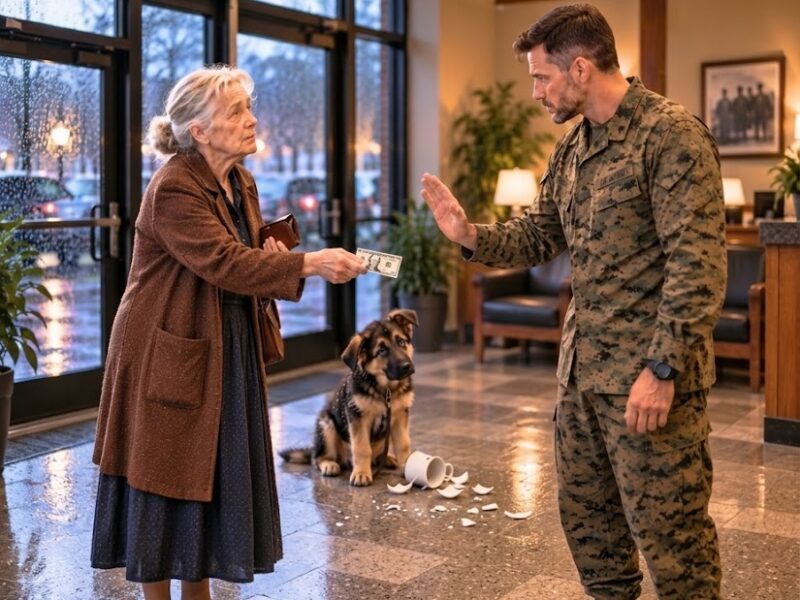
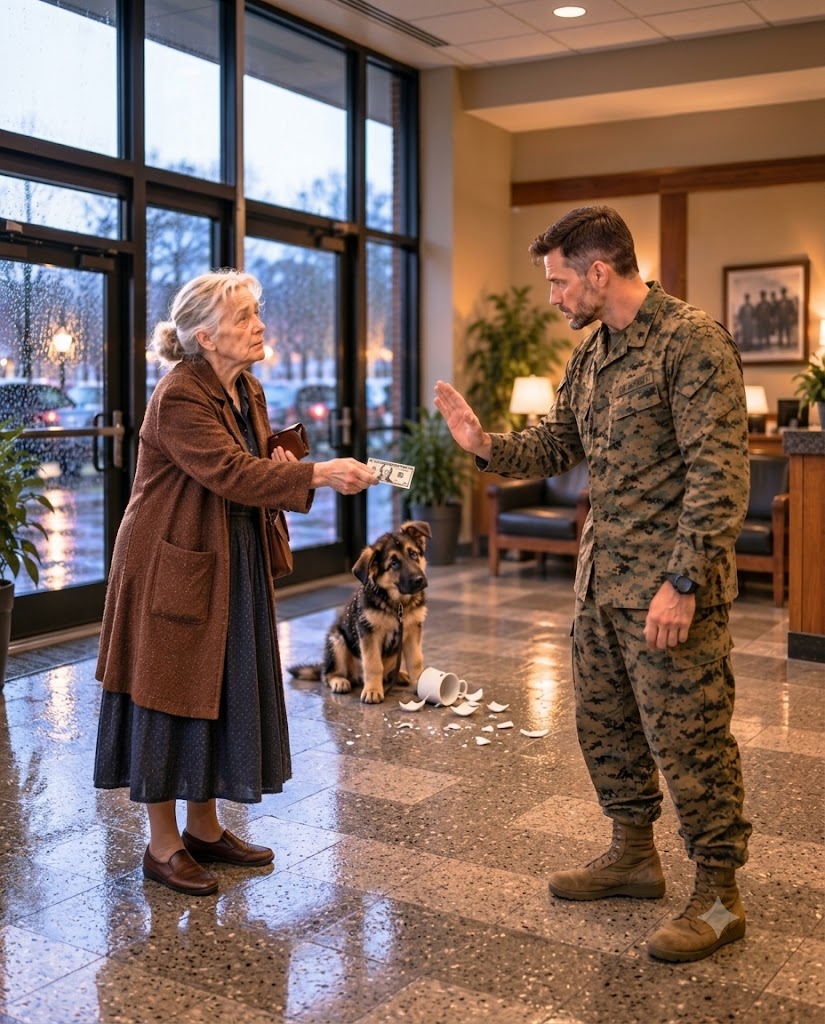
A German Shepherd puppy shot through the opening.
The little dog was perhaps twelve or thirteen weeks old, black and tan with oversized paws, a narrow puppy chest, one ear standing proudly while the other still tipped sideways.
Rain darkened his coat.
A thunderclap cracked outside and the puppy startled, skidded across the polished floor, clipped the leg of a side table, and sent a ceramic mug crashing to the ground.
“Pippen!”
An elderly woman hurried through the doorway behind him.
Dorothia Belrose—Thea, as she would soon introduce herself—was seventy-five and barely five-foot-four.
Her silver-white hair was gathered into a low bun, damp strands clinging to a narrow, pale face marked by age rather than neglect.
Light blue eyes sat beneath fine brows, alert despite her obvious exhaustion.
She wore a worn brown coat over a dark navy dress and scuffed leather shoes wet from the rain.
She looked fragile at first glance, but there was something disciplined in the way she immediately straightened after catching her breath.
She stared at the broken mug.
“How much do I owe you?”
Silas glanced at Pippen, who had retreated behind her shoes.
“For that?”
“Yes.”
“Five dollars, maybe. Forget it.”
Thea opened an old leather wallet.
Silas saw six dollars inside.
She removed a five and placed it on the counter.
“Ma’am, I said forget it. He broke it. He’s a puppy. And he’s my puppy.”
She pushed the bill toward him.
“Being short on money doesn’t make it yours to pay for.”
Silas said nothing.
He could have slipped the five back into her pocket.
He could have replaced the mug twenty times over, but something in her expression stopped him.
Returning the money now would not feel generous.
It would tell her that her circumstances had somehow reduced her responsibility.
So he left the five where she had placed it.
“Fair enough.”
The tension in her shoulders eased.
Silas pointed toward the rain hammering the glass.
“You can wait that out.”
Thea hesitated before accepting a chair.
She sat carefully, breathing a little harder than the short run from the sidewalk seemed to justify.
When she thought Silas had turned away, she removed a small pill container from her coat, swallowed something with water, then tucked it quickly away.
Pippen had been investigating a chair leg, but immediately abandoned it and returned to her.
He rested his muzzle against her knee.
“I’m all right,” she whispered, resting a hand gently against his damp neck.
Silas noticed.
He asked nothing.
—
Across the room sat Harold Pritchard, a sixty-eight-year-old Army veteran with a heavy gray mustache, broad weathered hands, and the permanently worried expression of a man recently told he might lose his apartment.
Harold had spent nearly an hour struggling through a housing assistance packet.
He sighed and dropped his pen.
“They sent me the wrong damn thing again.”
Thea glanced toward the paperwork, then at Silas.
“May I?”
That question interested him more than if she had simply walked over.
Silas nodded.
Thea approached Harold, but did not touch his documents until he handed them to her.
Her eyes moved quickly over the pages.
“This version is outdated,” she said. “That’s why the section numbers don’t match the instructions they gave you.”
Harold frowned.
“So I start over.”
“Not all of it.”
Within minutes, Thea had separated what could still be used from what needed replacing.
She never promised Harold approval.
She never pretended Sentinel could make the decision.
Instead, she wrote down the correct documents he needed and the office that could verify them.
Silas leaned against the counter, watching.
“You’ve done this before.”
Thea gave him a small look.
“Twenty-three years.”
“Doing what?”
“Veteran intake, documentation, housing referrals, a little employment coordination when they were short-handed.”
Before Silas could ask more, a volunteer in the rear kitchenette accidentally knocked a metal serving tray from a counter.
The crash made Pippen jump backward.
His body stiffened.
Then almost immediately, curiosity overcame fear.
He crept forward, nose working, and investigated the sound.
Silas watched closely.
During his Marine career, he had worked around military working dog teams often enough to recognize certain raw qualities, though he had never been a handler himself.
Confidence after a startle mattered.
Curiosity mattered.
Recovery mattered.
“He’s got a good head on him.”
Thea looked down at Pippen.
“He was taken into rescue at eight or nine weeks,” she said. “Too much energy for some people, too curious for others.”
“You adopted him?”
“I helped with paperwork there. Then somehow I ended up signing some of my own.”
A faint smile appeared.
Silas almost smiled back.
“The rescue will take him back if I ever can’t care for him.”
The sentence carried something Silas could not place.
Pippen sat against her shoe.
Thea rested one hand on his head.
“Then make sure he gets to use it.”
Silas looked from the puppy to the woman who had arrived with six dollars and surrendered five of them because responsibility mattered more to her than comfort.
Sentinel had been short a part-time intake assistant for nearly two weeks.
“I need somebody tomorrow morning,” he said.
Thea looked up.
“For what?”
“Paid evaluation shift. Intake desk. Four hours.”
Suspicion replaced surprise.
“You don’t know me.”
“No. That’s why I said evaluation.”
Her eyes narrowed slightly.
“And after that?”
“If you’re good, we talk.”
“I don’t need charity.”
“Good. I’m not offering any.”
For several seconds, she studied him.
Then she nodded.
Silas pulled a temporary staff badge from a drawer and wrote her name on it.
“I’ll need employment history. References, too.”
Thea’s hand stopped before taking the badge.
Something changed in her face.
Not fear exactly.
Something older and more tired.
“You’ll call my last employer.”
“Yes.”
The rain had softened outside.
Thea slowly took the badge, slipped it into her coat, and clipped Pippen’s leash back onto his collar.
At the door, she stopped.
“Gunnery Sergeant.”
Silas looked up.
“When you call them tomorrow—” She held his gaze. “Don’t believe the first thing they tell you about me.”
Then Thea Belrose stepped into the rain with Pippen beside her, leaving Silas alone with five dollars on the counter, a broken mug on the floor, and the first question about her that no application form was going to answer.
—
By eight the next morning, the rain had passed, leaving Stanton beneath a pale winter sky and a thin skin of ice along the shaded edges of the sidewalks.
Thea Belrose arrived ten minutes early.
Silas noticed because he had expected hesitation after her warning the night before.
Instead, she stepped through Sentinel’s front door, carrying a canvas tote in one hand and Pippen’s leash in the other.
The puppy recognized the room immediately and headed toward the table he had collided with, apparently interested in investigating the scene of his crime.
Silas intercepted him with a baby gate and arranged a small space behind the intake counter with a folded blanket, water bowl, and enough room for him to move without reaching confidential files.
“Probation?” Thea asked.
“For him?”
Pippen put both front paws against the gate.
“Seems harsh. He has a record.”
Thea’s mouth twitched.
It was the first time Silas had seen her nearly laugh.
Her paid evaluation began at eight-thirty.
Silas deliberately gave her no special treatment.
The first veteran she assisted had brought three folders of documents but was missing the one income verification page needed for his housing referral.
Thea found the problem without making him feel foolish for overlooking it.
The second was convinced Sentinel could approve his disability claim.
Rather than encouraging false hope, Thea carefully explained what Sentinel could help organize and which accredited service office he needed for the claim itself.
“I can help you get to the right door,” she told him. “I can’t pretend I’m the person behind it.”
Silas heard that from across the room.
By mid-morning, he had stopped evaluating whether Thea knew the work.
He was evaluating whether she could still do it under pressure.
She could.
Her hands sometimes slowed when fatigue caught up with her, but her judgment remained precise.
When she encountered a revised referral requirement she had never seen before, she did not bluff.
She turned to Silas and said, “This changed after my time. Show me the current procedure.”
That impressed him more than twenty confident answers would have.
During their break, Thea sat near the rear hallway with Pippen.
She produced a small pouch of puppy food, measured his portion carefully, and waited while he bounced in impatient circles.
“Pippen.”
The puppy kept bouncing.
“Pippen.”
One uneven ear turned toward her.
“Yes. Good.”
She rewarded the glance with a single piece of kibble.
Next came sit, which Pippen performed mostly by accident the first time, and with slightly more intention the second.
Recall was messier.
Silas held the puppy briefly while Thea moved several feet away, then released him at her call.
Pippen launched himself at her as though they had been separated for six months rather than six seconds.
“Subtle,” Silas said.
“He’s developing nuance.”
Impulse control proved harder.
Thea closed one piece of food inside her fist and waited while Pippen licked, pawed, and tried every form of negotiation available to a German Shepherd puppy.
Only when he backed away did her hand open.
Silas watched the repetition.
No shouting, no impatient corrections.
Thea simply made the right choice easy to understand.
When Pippen finally settled with his meal, Thea opened her own lunch.
Half a plain sandwich, an apple, and water.
Silas looked at the puppy’s measured food, then at her sparse meal.
A vaccination reminder card protruded from her canvas tote beside a receipt from a veterinary clinic.
“You always take care of him first.”
Thea looked up.
“No.”
Silas waited.
“I take care of what depends on me first.”
There was no self-pity in the answer.
That made it land harder.
At one o’clock, Silas placed the evaluation sheet on the counter.
“Twenty-four hours a week. Three days to start.”
Thea stared at him.
“That’s an offer.”
“That’s an offer.”
She did not immediately smile.
Instead, she asked about hourly pay, schedule, duties, and whether the position was guaranteed beyond the introductory period.
Silas answered each question.
Only then did she let herself breathe.
“I’m applying for a studio through a senior transitional housing program,” she said quietly. “Documented employment helps.”
Silas nodded.
“Then we document it.”
Thea’s eyes dropped toward Pippen.
“You still need to make the call.”
He knew exactly which one.
—
Silas waited until she had left before dialing Allegheny Veterans Outreach Collaborative.
The man who answered after Silas was transferred twice introduced himself as Gideon Rusk, fifty-six, former program director over the division where Thea had worked.
Silas knew his appearance only later from the organization’s staff profile.
While they spoke, he imagined the photograph: tall and lean, iron-gray hair combed neatly away from a narrow forehead, clean-shaven with pale brown eyes and the carefully composed expression of a man accustomed to boardrooms.
His voice matched the photograph.
Measured, courteous, never hurried.
Gideon had spent years managing grants and compliance-heavy programs, and he spoke with the practiced caution of someone who understood that implication could travel farther than accusation.
“Dorothia Belrose,” Gideon repeated. “Yes. I remember Mrs. Belrose.”
“I’m verifying employment.”
Gideon confirmed her dates and position.
“Would you rehire her?” Silas asked.
A pause.
“I would advise any organization handling sensitive veteran information to perform its due diligence.”
“That wasn’t my question.”
Another pause, shorter this time.
“Mrs. Belrose left following serious irregularities involving veteran assistance records.”
Silas picked up a pen but did not write yet.
“Was she charged with anything?”
“No.”
“Was there a police report naming her as responsible?”
“Not to my knowledge.”
“Internal finding?”
“The circumstances were complicated.”
“Do you have a written determination stating she altered those records?”
Gideon’s tone remained pleasant.
“Gunnery Sergeant. Organizations sometimes have to make decisions before every ambiguity can be resolved.”
Silas finally wrote something down.
“No finding provided.”
Gideon continued.
“I understand Sentinel participates in the regional community partnership network.”
“We do.”
“Then you know renewals consider risk as well as performance. An unresolved employment history involving sensitive records may invite questions.”
It was not a threat.
That was precisely why Silas disliked it.
“Are you telling me Allegheny will oppose Sentinel’s renewal if I hire her?”
“I’m telling you what a review committee may consider.”
Silas thanked him and ended the call.
For several minutes, he sat alone.
Thea had warned him.
Gideon had confirmed there had been a problem.
Neither fact proved what the problem actually was.
Silas opened the employment form.
Under status, he checked hired.
—
Thea returned late that afternoon after Silas called to confirm the position.
She carried no celebration with her.
Instead, she entered his office with an old manila folder pressed against her chest.
“You spoke to him?”
“Yes.”
“Gideon Rusk?”
“Yes.”
“What did he say?”
“That there were irregularities.”
A bitter recognition crossed her face.
Silas continued.
“He didn’t give me a police report. He didn’t give me a disciplinary finding. He didn’t give me evidence that you altered anything.”
Thea looked at him carefully.
“And you hired me anyway?”
“I hired what I evaluated this morning.”
For a moment, she seemed unable to answer.
Then she placed the folder on his desk.
Inside were photocopies and printed emails, some dated nearly three years earlier.
Silas examined the first veteran file.
The status on Thea’s copy showed housing placement still pending.
A later record attached behind it showed the same case marked successfully housed.
Another file showed services incomplete.
The later version read services completed.
Silas went through three more.
Same pattern.
“These prove the records changed,” he said. “They don’t tell me who changed them.”
Thea’s fingers tightened around the edge of the folder.
“No.”
Silas looked up.
“Then who did?”
Thea held his gaze, and whatever relief she had felt over being hired disappeared beneath something far older.
“That,” she said quietly, “is the question that cost me my career.”
—
December settled over Stanton with hard mornings and early darkness, frosting Sentinel’s windows before sunrise and sending veterans through its doors with cold hands, wet boots, and problems that rarely fit neatly onto forms.
Thea had been working there for three weeks when she finally told Silas what had happened at Allegheny.
They sat after closing with the old manila folder between them.
Pippen slept beneath Thea’s chair, considerably less interested in institutional wrongdoing than in the shoelace he had exhausted himself attacking ten minutes earlier.
“It started before a funding report,” Thea said. “Cases I remembered as unresolved appeared in the system as completed.”
“How many at first?”
“Four that I recognized. Then more.”
She explained that Allegheny measured outcomes partly through housing placements, completed referrals, and other services.
Before several reporting periods, cases that had still been pending when Thea handled them later appeared more successful than she remembered.
She had asked for a compliance review rather than accusing anyone directly.
A week later, her system access was restricted.
Soon after that, questions began focusing on her.
“They never charged me,” she said. “They never proved I changed anything. They didn’t have to.”
Silas understood the rest.
A cautious sentence from a former employer could do damage without becoming an accusation anyone was required to defend.
After that, applications, interviews, references—she gave a tired shrug—then silence.
Years without steady employment had consumed her savings.
Housing costs took more.
Medical bills took what remained.
She offered the facts without asking him to feel sorry for her, which somehow made the losses sound heavier.
Silas tapped one photocopy.
“These show records changed. I know they don’t show who changed them.”
Thea studied him.
For one second, disappointment crossed her face.
Then she nodded.
“That’s fair.”
Silas leaned back.
“If we pursue it, we do it properly. Legal aid, compliance channels, no accusations we can’t support. No digging through records you aren’t authorized to access.”
“I wouldn’t ask you to.”
They contacted a veteran’s legal aid service and submitted what Thea possessed through the appropriate review process.
When asked whether anyone else might remember the reporting irregularities, Thea gave one name.
Mara Kitridge, a former compliance assistant at Allegheny.
Thea remembered her as a careful woman who had seen enough to ask questions but had been too afraid at the time to become part of the answer.
They provided the name and stopped there.
No private confrontation, no hunting for evidence.
Life at Sentinel continued.
So did Pippen.
His sit became more deliberate.
His recall remained dependent on whether the universe contained anything more interesting than Thea, which it frequently did.
But Silas began noticing something that had nothing to do with commands.
When Thea was strong, Pippen played.
When she was tired, he watched.
Some afternoons, he would abandon a toy halfway across the staff area and return to press against her ankle.
Once, before Thea admitted she needed to sit down, Pippen was already standing beside her chair.
Silas never called it training.
It was simply something the puppy knew about his person.
—
The collapse happened on a Thursday.
Thea had been helping a veteran sort documents when her voice stopped mid-sentence.
One hand caught the desk, the other reached for the chair and missed.
Pippen sprang up as Thea crumpled.
He barked once, sharp and frightened.
Then again.
Silas was in the supply room when he heard claws racing down the hallway.
Pippen appeared in the doorway, barking, spun around, ran several steps back, then looked over his shoulder.
Silas followed.
Thea was conscious when he reached her, but barely.
At the hospital, Silas sat beneath fluorescent lights until a physician finally came to speak with them.
Dr. Elaine Mercer, a compact woman in her early fifties with short chestnut hair threaded with gray and tired, compassionate eyes, had the calm precision of someone who had learned never to soften facts into dishonesty.
Thea had advanced cancer.
Silas looked at her.
She looked at the blanket covering her legs.
Dr. Mercer explained that Thea had already been receiving care.
At this stage, treatment was focused primarily on controlling the disease where possible, easing symptoms, and preserving quality of life.
She gave no neat countdown.
Bodies did not honor calendars that way.
When they were alone, Silas asked, “How long have you known?”
“Before Sentinel.”
His jaw tightened.
“Why didn’t you tell me?”
Thea looked toward the window.
“Would you have hired me?”
“Yes.”
“You answered too fast.”
Silas fell silent.
That silence was the answer she had expected.
“I needed you to see whether I could do the work,” she said, “not how sick I was while doing it.”
Silas thought of the five-dollar bill, the half sandwich, the pills swallowed when she believed nobody was watching.
Then another question came.
“Why Pippen?”
She turned toward him.
“You knew this before you adopted a puppy.”
“I did.”
“He could live twelve years.”
“I hope he lives longer, Thea.”
Her expression hardened, not defensively, but with the exhaustion of someone who had answered the wrong version of the question too many times.
“The rescue knew about my health. We agreed from the beginning that if I became unable to care for him, they would take him back. He was never going to be abandoned.”
Silas said nothing.
“Everyone asked the same thing,” she continued. “Who gets the dog when you die? Where will he go? Who will feed him?”
Her eyes filled, but her voice remained steady.
“Nobody asked what he might become.”
Silas remembered Pippen recovering after the fallen tray.
The way he learned.
The way he had come running down Sentinel’s hallway that afternoon.
“Who will take him?”
Thea looked at him for a long moment.
“I haven’t decided.”
It surprised him more than he wanted to admit.
Perhaps some part of him had assumed the answer.
Thea noticed.
“He needs more than somebody willing to love him.”
Silas understood enough not to ask again.
—
Two days after she returned to Sentinel, an official letter arrived.
Sentinel Veterans House’s regional community partnership renewal had been placed under review pending questions concerning staffing, information handling risk, and participation requirements.
Thea read the letter twice.
“I’ll resign.”
“No.”
“Silas, don’t be stubborn.”
“This isn’t stubbornness.”
“They warned you. They gave me allegations, and now your center is paying for them.”
Silas turned toward her.
“A chance stops being charity the moment someone earns it. You earned yours.”
Thea’s composure cracked for half a second.
She looked away.
The review continued.
Then the following week, the consequence became real.
Sentinel received notice that while the review remained pending, it was temporarily suspended from participating in one of the region’s major coordinated outreach programs—an event that connected vulnerable veterans with multiple housing, employment, benefits, and referral services in one place.
Silas read the notice alone behind the intake counter.
This time there was no easy argument to make.
Veterans Sentinel might have reached would now have to be redirected elsewhere.
Staff schedules would change.
Relationships Silas had spent years building could weaken.
Pippen wandered over and sat beside his boot.
Across the room, Thea was helping a veteran organize a stack of forms, unaware that the letter had arrived.
Silas looked at the suspension notice, then at her.
For the first time since he had placed a check beside hired, keeping Thea Belrose had cost him something he could not replace with five dollars.
—
January brought freezing rain to Stanton, glazing the streets before dawn and dragging tree limbs onto power lines across the Shenandoah Valley.
By seven that morning, the regional Veterans Assistance Day was already in trouble.
The event’s primary site had lost electricity and network access.
Nearly eighty veterans were expected for housing consultations, employment assistance, benefits referrals, and document review—some having traveled more than an hour.
Cancelling meant sending many of them home to wait weeks for another coordinated event.
At 7:18, Sentinel Veterans House received the call.
Silas did not say yes immediately.
Sentinel had backup power, independent internet service, private interview rooms, and enough open floor space.
But having room for eighty people did not automatically give anyone authority to move confidential records through it.
“I need the scope in writing,” Silas told the event coordinator. “Who handles originals, who has system access, where completed packets go, and who assumes custody when they leave this building?”
“We’re losing time.”
“Then send it quickly.”
Twenty-three minutes later, written authorization arrived, identifying participating agencies, privacy requirements, data access limitations, and chain-of-custody responsibilities.
Only then did Silas unlock every usable room.
The next hour became controlled chaos.
Silas handled tables, staffing, signage, emergency exits, generator load, secure network access, and the flow of people through the building.
Thea took the work itself and gave it shape.
She established five stages: check-in, intake, document review, private assistance, referrals, then secure handoff.
No veteran carried confidential paperwork backward through the line.
No volunteer touched a file outside assigned responsibility.
Questions involving authority Sentinel did not possess were routed to the correct agency.
She never tried to become the most important person in the room.
She made it possible for everyone else to do their jobs.
Pippen remained behind the staff area gate with water, bedding, and several safe toys.
He was older now, his puppy legs beginning to look less awkward beneath him, though patience remained an unfinished project.
During a brief lull, Thea stood several feet from him.
“Stay.”
Pippen stared at her.
She took one step backward.
He followed.
“No.”
She returned him gently to position.
“Stay.”
This time she managed two steps before his entire body seemed to argue with the command.
His ears tipped forward, one paw lifted.
He wanted to follow her.
Thea waited.
Pippen lowered the paw.
“Good.”
She returned to him rather than calling him toward her.
Silas noticed that too.
—
By late morning, another participating organization arrived with additional staff.
Among them was Mara Kitridge, forty-seven, the former Allegheny compliance assistant whose name Thea had given the reviewers.
Mara was a slender woman of medium height with straight auburn hair cut just above her shoulders, rectangular glasses, and a narrow, serious face that seemed accustomed to withholding reactions until she had enough information.
She had left Allegheny the previous year for a smaller veterans nonprofit.
Caution had shaped much of her professional life.
Years earlier, supporting an elderly mother on one income had made losing a job feel less like a moral abstraction than a threat with a mortgage attached.
She recognized Thea immediately.
Thea recognized her, too.
Neither woman moved for several seconds.
“Hello, Mara.”
“Thea.”
That was all.
Then the front door opened again.
Gideon Rusk entered with two representatives from Allegheny.
His expression barely changed when he saw Thea processing intake packets.
“Gunnery Sergeant Corbett,” he said quietly. “May we speak?”
Silas stepped aside with him.
“I wasn’t informed Mrs. Belrose would be handling sensitive documentation today.”
“She’s handling it under Sentinel’s approved scope.”
“Given the unresolved review, that seems unwise.”
“Do you have a written restriction barring her from this work?”
Gideon’s jaw tightened almost imperceptibly.
“No.”
“Then the event lead decides.”
The lead reviewed the authorization and allowed Thea to continue.
Gideon did not argue further.
That mattered.
So did what Mara saw during the next five hours.
She watched Thea refuse to accept a veteran’s unsigned release, even when correcting it slowed the line.
She watched her stop a volunteer from leaving an intake sheet on an unattended table.
She watched her recount every packet before a secure handoff and require the receiving staff member to confirm the count.
At one point, a tired coordinator said, “We know where they’re going, Thea.”
Thea answered without irritation.
“Knowing isn’t custody.”
Mara looked away.
Years earlier, she had watched questions rise around Allegheny’s numbers.
She had watched Thea request review.
Then she had watched the atmosphere change and had convinced herself that staying silent was not the same as choosing a side.
Now, watching Thea work beneath the scrutiny of the very organization that had damaged her reputation, that excuse no longer felt sufficient.
By late afternoon, the last veteran completed intake.
No files were missing.
No privacy incident had been reported.
No one person had rescued eighty veterans.
The event had worked because dozens of people had done their assigned jobs correctly.
But Thea had built the structure that kept those jobs from collapsing into one another.
Mara found Silas near the secure storage room.
“Is the review still active?”
“Yes.”
“I need the investigator’s contact information.”
Silas studied her.
“Why?”
“Because there are records they should request.”
“What records?”
“Audit logs.” She lowered her voice. “System timestamps. Login histories. Administrative overrides.”
Silas did not ask her to retrieve anything herself.
He gave her the official review contact.
Within days, Mara cooperated through the authorized process.
Investigators obtained audit records from the appropriate systems rather than relying on documents carried out privately.
The logs did not yet answer every question, but they changed the direction of the case.
Several disputed records had been modified after Thea had logged out.
Others were altered on days she had not worked.
More troubling were administrative overrides associated with privileges controlled within Gideon’s management structure.
That did not prove Gideon personally made every change.
Silas refused to say it did.
But for the first time, independent evidence existed that fit Thea’s account.
When Silas told her, she closed her eyes.
He expected relief.
Instead, she whispered, “Three years.”
There was no triumph in her voice, only grief for time evidence could not return.
—
Weeks passed.
The review continued, but Thea’s strength diminished faster than either of them acknowledged aloud.
She worked fewer hours.
Some mornings Silas found her sitting before opening, gathering enough breath to begin.
Pippen noticed every change.
He stayed closer now, his youthful energy still there but increasingly tempered by attention.
One evening, after the last veteran left, Thea took Pippen into the quiet center.
Silas remained near the counter.
“Stay,” Thea said.
Pippen sat.
She stepped backward.
One step, two, three.
His body leaned toward her.
Thea kept moving.
Pippen rose halfway.
“Stay.”
He froze.
Every instinct in the young dog seemed to pull him toward the woman who had become the center of his small world.
His paws trembled against the floor, but he did not follow.
Thea reached the other side of the room.
For several seconds, she simply looked at him.
Then she smiled.
Not the smile of someone pleased that a puppy had learned a command—something quieter, something Silas could not yet name.
“Good boy,” she whispered.
Pippen stayed where she had asked him to stay.
And Silas, watching Thea steady herself against the edge of a table before walking back to him, suddenly understood that she was no longer teaching Pippen only how to wait.
—
Spring returned slowly to Stanton, softening the frozen ground beneath Sentinel’s windows, while an investigation that had consumed months finally reached conclusions no rumor could rewrite.
The findings were careful rather than dramatic.
Audit records confirmed that veteran assistance files at Allegheny had been altered before funding reviews, making performance outcomes appear better than they actually were.
Archived emails established something equally important.
Thea had raised concerns and requested a compliance review before her access was restricted.
Investigators found no evidence that she had made the unauthorized changes.
Administrative consequences followed.
Gideon Rusk was removed from his position.
Allegheny was required to correct affected reporting and address resulting funding issues.
And on a quiet Tuesday afternoon, a certified envelope arrived at Sentinel formally correcting Dorothia Belrose’s employment record.
Silas carried it to her desk.
He did not open it.
Thea did.
Her hands trembled badly enough that she had to slide one finger beneath the envelope flap instead of tearing it.
Pippen lay across her shoes, larger now but still young, his head lifting whenever her breathing changed.
Silas watched her reach the final paragraph.
For three years, Thea had imagined what vindication might feel like.
She had expected anger, perhaps even satisfaction.
Instead, she pressed the letter against her chest and closed her eyes.
“They gave it back,” she whispered.
“What?”
“My name.”
Silas looked away for a moment, giving her the privacy of not being watched while she cried.
When Thea finally lowered the letter, Pippen raised his muzzle toward her.
She smiled through the tears.
“See? We weren’t such a bad hire.”
The letter restored something cancer could not preserve.
—
By early summer, treatment was taking more from Thea than it returned.
Her care shifted toward comfort.
First, she reduced her hours at Sentinel.
Then she stopped working entirely.
On stronger mornings, she still asked Silas which veterans had found housing, whether anyone had forgotten to update the referral board.
One afternoon, Silas brought Pippen to see her.
Thea had paperwork waiting beside her chair.
“The rescue can still take him,” she said. “That agreement never changed.”
Silas glanced at the documents.
“But you’re not sending him back.”
“The rescue would feed him, protect him, find him a good home.”
Pippen rested his chin beside her hand.
Thea stroked the dark fur between his ears.
“I wasn’t looking for someone who’d feed him.”
Silas remained quiet.
“I was looking for someone who wouldn’t waste him.”
Only then did Silas understand why she had refused to answer when he first asked who would take Pippen.
She had not been deciding who loved the dog most.
She had been watching.
She had watched Silas refuse to call Pippen a future canine because of one promising reaction to a noise.
She had watched him respect the puppy’s limits, praise progress without demanding perfection, and accept that potential was not the same thing as destiny.
“You’ve been evaluating me,” Silas said.
A trace of the old Thea returned to her eyes.
“You evaluated me first.”
He almost laughed.
Then her expression softened.
“You gave me a chance without deciding what the answer had to be. Do the same for him.”
Silas looked at Pippen.
“He might not qualify for working life.”
“I know.”
“He might have the wrong drives. Something could show up medically. He might simply be happier doing something else.”
“I know that, too.”
Thea pushed the caretaker documents toward him.
“Find out what he’s capable of.”
Silas looked directly at her.
“I promise.”
—
Their final visit came twelve days later.
Thea could barely sit upright.
Pippen approached her differently now.
There was no pulling, no bouncing greeting.
He crossed the room slowly and placed his head beneath her thin hand.
Thea breathed his name.
Then she looked toward Silas.
“Stay.”
Silas moved toward the doorway.
Pippen’s eyes followed him, but his paws remained planted.
Thea looked down at the young German Shepherd.
For months, she had taught him that staying did not mean abandonment.
Someone could step away and still return.
Her fingers moved weakly against his head.
“Not forever,” she whispered.
She died peacefully later.
—
The first morning at Silas’s house, Pippen stood at the front door.
At first, Silas thought he needed outside.
He opened it, walked him into the cold morning, then brought him back.
Pippen returned immediately to the door.
Breakfast remained untouched.
A favorite toy rolled across the floor and stopped without being chased.
Pippen simply waited.
Silas knew whom he was waiting for.
He sat on the floor beside him.
Minutes passed, then an hour.
Silas did not pull him away.
He did not say she was gone, as though human language could make absence understandable.
Eventually, he rested his forearms across his knees.
“She told you not forever.”
Pippen’s ears shifted.
Silas waited.
“You don’t have to leave her behind,” he said quietly. “You just have to come with me.”
For a long time, the dog remained facing the door.
Then Pippen turned his head.
He looked at Silas.
One paw moved, then another.
By his own choice, Pippen stepped away from the door and came to sit beside him.
Silas lowered one hand against his shoulder.
“All right,” he whispered. “We’ll find out.”
—
He kept his promise slowly.
As Pippen matured, Silas continued foundation work but refused to manufacture an outcome.
Experienced professionals evaluated the German Shepherd’s health, temperament, environmental confidence, recovery, drives, and ability to work under distraction.
Some days, Pippen excelled.
Other days exposed weaknesses that needed patience.
Silas welcomed both.
The promise had never been make him a canine.
The promise was find out.
Through an appropriate professional and official military working dog pathway, Pippen eventually received the opportunity to be evaluated for demanding working service.
He earned each next step on ability rather than sentiment.
Nearly two years after the rainy night when he had shattered a five-dollar mug, Pippen stood mature and powerful beside a handler in a structured training environment connected to military working dog service.
The oversized paws finally fit the dog.
The frantic puppy energy had become controlled readiness, but the same alert curiosity remained in his eyes.
The handler stepped away.
“Stay.”
Pippen remained motionless.
Footsteps passed.
Equipment moved.
Noise rose around him.
He waited.
Silas watched from a distance.
For one instant, he no longer saw the adult working dog.
He saw a puppy trembling across the floor of Sentinel, desperate to follow an elderly woman who was teaching him the hardest lesson she would ever ask him to learn.
Not forever.
—
Months later at Sentinel, a photograph of the grown Pippen stood behind the intake counter.
Beside it was a five-dollar bill.
Silas had never spent it.
A veteran waiting for housing assistance noticed the photograph.
“That’s your dog.”
Silas looked at Pippen’s picture.
“No.”
The man waited.
Silas glanced at the five, remembering a rain-soaked woman who had possessed six dollars and surrendered five because responsibility mattered more than poverty.
Then he looked back at the photograph.
“He belonged to a woman who saw what he could become.”
—
Sometimes God’s miracles do not arrive with thunder, signs, or answers we can immediately understand.
Sometimes they arrive quietly in a stranger who chooses to believe us, in a second chance we thought would never come, or even in a faithful dog who reminds us that love can remain after someone is gone.
Thea could not choose how much time she had left, but she could choose what she did with it.
She gave Pippen a chance to become more than anyone expected, just as Silas gave her the chance to prove that her past did not define her truth.
Maybe that is something we can carry into our own lives.
Before judging someone by what we have heard, look closer.
Before deciding that someone has nothing left to offer, give them room to show you.
And when life asks us to let go, remember that letting go does not mean love has ended.
Sometimes it simply means trusting God with what comes next.
May God bless you and your family, strengthen you through every difficult season, place the right people along your path, and remind you that even when you cannot yet see the way forward, He may already be preparing the next step.
Amen.
—









