An Elderly Woman Held Her Sleeping Granddaughter in Snow — A Marine and His K9 Couldn’t Walk Away
By 10:40 that late December night, light snow had covered the paths of the nearly empty Fort Collins Park.
The temperature had fallen below freezing, but there was no storm, only quiet flakes drifting through the yellow pools of lamplight.
Gunnery Sergeant Silas Red Fern knew this loop well enough by then to walk much of it without thinking.
He was in Fort Collins temporarily for training, and the two-mile circuit had become a useful ritual before returning to his lodging for the night.
At 42, Silas stood a little over six feet, solid through the shoulders and leaner through the waist, with short ash brown hair, watchful gray eyes, and a thin scar beneath his chin.
Cold had roughened his clean-shaven face, and snow gathered along the shoulders of his USMC winter digital camouflage blouse before melting into darker specks.
Years as a Marine had left him with a habit that followed him, even off duty.
He noticed changes.
A gate left open, a light where there had been darkness, a sound arriving half a second too late.
Beside his left leg walked Bront, a 7-year-old black and tan German Shepherd with amber eyes, a dark saddle across his back, and a small notch in his left ear.
Bront moved with the economical confidence of a working dog that had long ago stopped wasting energy on meaningless distractions.
His paws made soft marks in the fresh snow as they approached the final turn.
Then Bront stopped.
Silas continued two steps before feeling the leash tighten.
“Bront, come.”
The shepherd obeyed immediately.
Three steps later, however, his ears turned toward a dark bench beneath a row of bare trees.
He glanced back.
Silas followed his gaze.
Nothing moved.
“Come on.”
Bront came, but his attention remained behind them.
That mattered.
Silas turned his head and listened.
A faint cough slipped through the stillness.
Not an adult’s cough.
Smaller.
He changed direction.
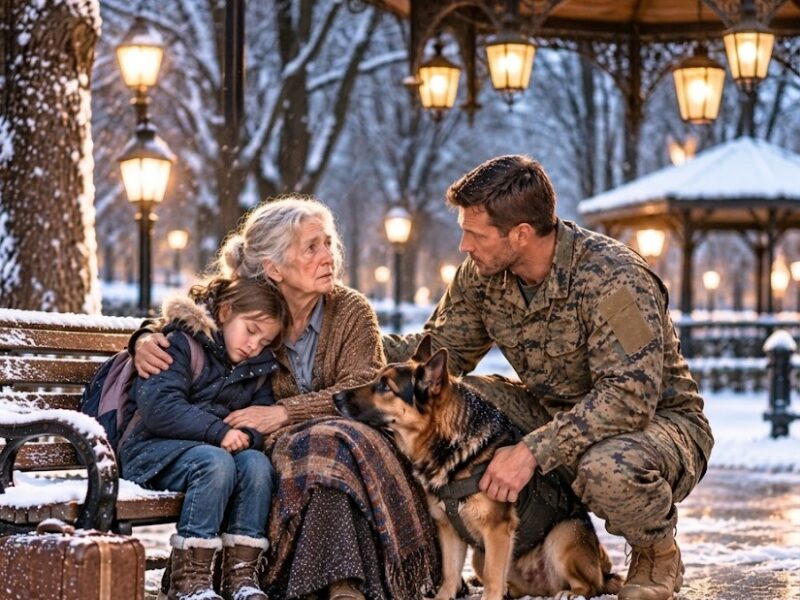
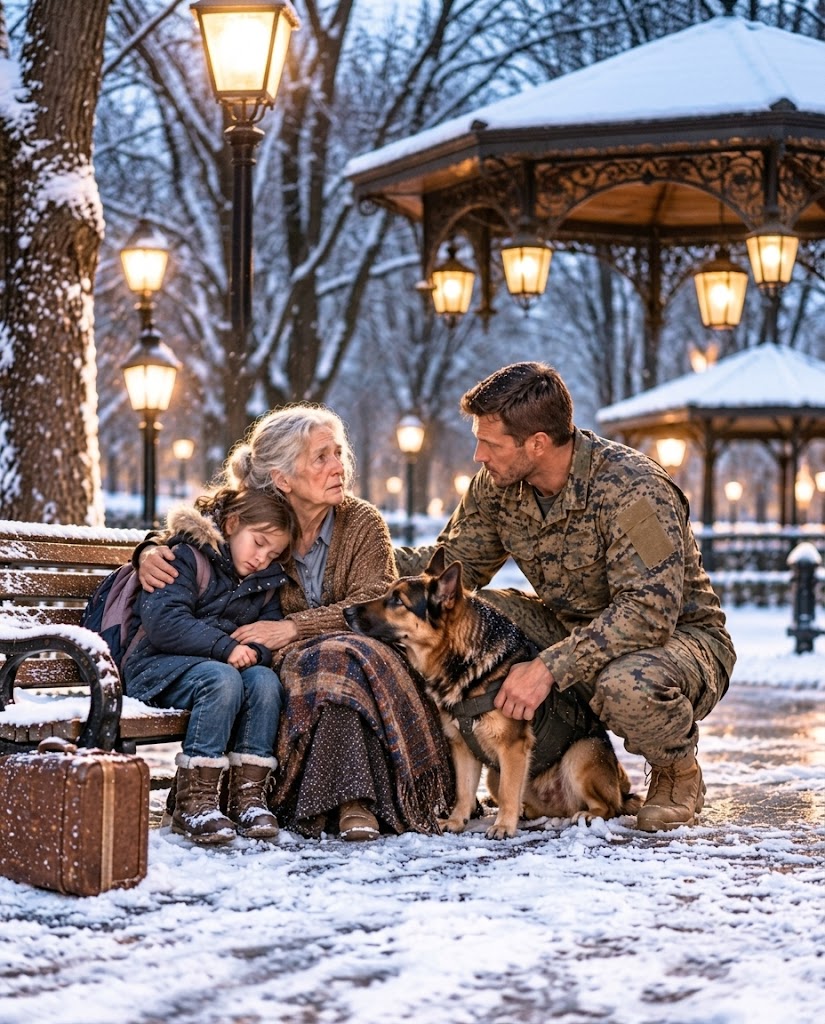
The bench looked empty until he came closer.
Then two shapes emerged from the darkness.
An elderly woman sitting rigidly beneath the trees and a child folded against her side.
A small suitcase stood near one end of the bench.
Beside it rested a school backpack dusted with snow.
“Ma’am.”
The woman jerked her head up.
Silas stopped several yards away, keeping Bront close.
“Sorry, I didn’t mean to startle you.”
Lenora Wickliffe was 74, small and fine-boned, with a narrow face whose deep lines suggested years of stubborn endurance rather than frailty.
Her silver-white hair was gathered into a low bun, though damp strands had escaped around her temples.
She wore a faded blouse beneath a thin brown cardigan, far too little for the temperature.
Snow had settled on her shoulders and hair.
The reason became obvious when Silas looked at the child.
Nine-year-old Maisie Wickliffe slept curled tightly against her grandmother, wrapped almost completely inside a thick winter coat.
She was slight, with soft brown hair across one cheek and a pale face tucked against Lenora’s chest.
Lenora had given the girl nearly everything she had against the cold, then curved her own body around her like a second coat.
Something in Silas’s chest tightened.
“Are you two all right?”
“Yes.”
Too fast.
“We’re fine,” Lenora added.
“We’re waiting for someone.”
Silas looked briefly at the empty path behind her.
He did not ask who.
Maisie stirred at the voices, her eyes opened, unfocused at first, then settled on Bront.
“Does he bite?”
Silas glanced down at him.
“Only his dinner.”
Maisie studied Silas as though deciding whether adults were still allowed to make jokes tonight.
Then the corner of her mouth lifted.
“Can I pet him?”
“If your grandmother says it’s okay.”
Lenora hesitated.
Silas noticed that she examined him before she examined the dog.
Finally, she nodded.
Maisie slipped one hand from beneath the coat and offered its back.
Bront stepped forward at Silas’s quiet permission, sniffed her fingers, then lowered himself onto the snowy pavement beside the bench.
His chin rested between his front paws.
Maisie’s small smile became real.
Silas let the moment breathe before asking, “How long have you been out here?”
“Not long,” Lenora said.
“Grandma said five minutes.”
Lenora turned toward her.
Maisie looked confused by the reaction.
“You did, Maisie.”
“But that was a long time ago.”
Silas glanced at Lenora’s hands.
She had tucked them beneath her arms, but they were shaking.
When she adjusted her sleeve, he caught sight of a pale band of adhesive residue around her wrist.
Hospital.
He said nothing.
Maisie stroked the coat over her knees.
“Grandma?”
“Yes, sweetheart.”
“When does the bus place open?”
Lenora became perfectly still.
Silas’s eyes moved from the suitcase to the backpack.
“We’re waiting for someone,” Lenora repeated.
This time, her voice barely carried.
Silas had met enough frightened people to understand that exposing a lie was not always the same thing as discovering the truth.
Whatever Lenora was protecting, cornering her would only make her run.
And running was exactly what she tried to do.
She reached down for the suitcase.
“Come on, Maisie. We have to go.”
“Ma’am, you may want to get warm first.”
“I appreciate your concern.”
Her tone was polite, but final.
She stood.
The moment her weight shifted forward, her expression changed.
One boot slid slightly on the snow, but the real problem was not the pavement.
Her knees gave way.
Silas caught her before she fell.
“I’ve got you.”
Lenora gasped and pulled against him.
“Let go.”
He released her as soon as she found her balance, stepping back immediately.
Maisie was standing now, the oversized coat gathered around her shoulders.
Fear had replaced the sleepy curiosity in her face.
Bront remained beside her, alert, but motionless.
Silas kept both hands where Lenora could see them.
“Ma’am, I’m not going to tell you where to go.”
His voice remained quiet.
“But I’m not going to pretend I didn’t see you nearly fall.”
Lenora stared at him.
For a moment, anger seemed easier for her than fear.
Her jaw tightened, her shoulders straightened.
Silas could almost see her rebuilding whatever wall had kept her moving this far.
Then Maisie whispered, “Grandma.”
That one word destroyed it.
Lenora looked at the little girl standing inside the coat she herself should have been wearing.
Her face changed.
Not dramatically.
It simply seemed to grow older.
She reached for Silas.
Both of her freezing hands closed around one of his.
“Please.”
Silas did not move.
“What is it?”
Lenora looked past him toward the dark path, then back at Maisie.
Terror finally surfaced beneath all that pride.
Her fingers tightened around his hand.
“Please don’t let them take my granddaughter.”
Silas felt the meaning of the night shift beneath his feet.
They were not waiting for someone.
They were running from someone, or from something Lenora feared even more.
Silas did not ask who they were.
The terror behind Lenora’s words made one thing clear.
If he pushed too hard, she would gather Maisie, grab that suitcase, and try to disappear into the snow again.
Instead, he waited until she realized she was still gripping his hand and released it herself.
“Nobody is taking anybody anywhere right now,” he said.
He chose every word carefully, unwilling to promise something he had no authority to guarantee.
“But we can’t stay out here.”
Lenora stiffened.
“I’m not going back.”
Silas noticed the word back.
He let it pass.
“There’s a covered waiting area near the park exit. It blocks the wind. We can sit there while you warm up.”
From the small pack he carried on walks with Bront, he removed a bottle of water and an insulated layer he had brought against the cold.
Lenora stared at both as if accepting them might create an obligation.
“You don’t owe me anything,” Silas said.
“And I’m not asking you to tell me anything yet.”
Her eyes moved to Maisie.
That was where every decision seemed to begin and end.
Finally, she accepted the garment.
They crossed the short distance slowly.
Silas carried the suitcase only after Lenora reluctantly surrendered its handle, while Maisie kept her backpack and walked beside Bront.
The covered area near the exit was simple.
Three walls, a roof, two benches, and a light humming overhead, but it kept the falling snow off them and cut most of the wind.
Silas brushed the seat dry before Lenora lowered herself onto it.
She drank in small, deliberate swallows.
Bront settled beside Maisie’s boots, and the girl rested her fingertips against the German Shepherd’s shoulder.
Silas noticed how quickly her breathing steadied whenever she touched him.
He remained close enough to catch Lenora if she became dizzy again, but far enough that she did not feel surrounded.
After several quiet minutes, he asked, “Who did you think was going to take Maisie?”
Lenora stared at the water bottle.
“People who decide things.”
“What people?”
“Hospital people, social workers, whoever decides an old woman isn’t enough.”
Maisie lowered her eyes.
Silas sat at the opposite end of the bench.
“Did anyone tell you they were taking her?”
Lenora’s mouth opened, but no answer came immediately.
“No,” she finally whispered.
That single word changed the shape of the problem.
Lenora rubbed her thumb against the bottle label.
“My son was Graham. Graham Wickliffe.”
The name softened her voice in a way nothing else had.
He repaired heating systems in houses.
Furnaces, boilers, thermostats.
He used to joke that furnaces knew exactly when Christmas was coming because that was when they chose to quit.
A tiny smile crossed Maisie’s face.
Graham had been broad-shouldered from years of carrying equipment into basements and crawl spaces, with unruly brown hair that Maisie had inherited and an easy patience that made older customers ask for him by name.
He was the kind of man who would finish a repair and then spend another ten minutes explaining which switch not to touch.
Maisie’s mother had left their lives years earlier, and Graham had raised his daughter largely alone.
Lenora had helped, but Graham had been the center of the child’s world.
Nearly two years ago, a traffic accident ended that world in a single afternoon.
Maisie’s hand stopped on Bront’s fur.
Silas did not offer one of the empty phrases people often reached for around grief.
He simply waited.
“After Graham died, Maisie came to me,” Lenora continued.
“There were forms and meetings. I signed what needed signing. I became the one the school called. I took her to the dentist. I sat beside her when she had a fever. I packed lunches.”
Her voice tightened.
“We kept living.”
“But there were things left unfinished,” Silas said.
Lenora nodded reluctantly.
Some practical arrangements had been handled after Graham’s death, but the longer question—what would happen if Lenora became unable to care for Maisie—had never been fully resolved.
There was always something more immediate to do.
Rent, homework, groceries, a school project due Friday.
Lenora had convinced herself that preparing for her own weakness was almost the same as inviting it.
That afternoon, weakness arrived.
“I was at the pharmacy for my prescription,” she said.
“I remember standing at the counter. Then I remember the ceiling.”
“You fainted.”
“Yes.”
Maisie looked toward her grandmother.
“It wasn’t the first dizzy spell,” Lenora admitted.
“Just the first time I went all the way down.”
Someone at the pharmacy had called for help, and Lenora had been taken to the ER with Maisie beside her.
Doctors wanted further evaluation and told her they might need to keep her overnight.
Lenora had tolerated the questions about dizziness, medications, meals, and previous episodes.
Then a staff member asked one ordinary question.
Who could care for Maisie overnight?
“I told her I could,” Lenora said.
Silas watched her carefully.
“While you were admitted.”
Lenora looked down.
“She asked if there was another adult family nearby, someone they could call.”
Her fingers tightened around the bottle.
“I didn’t have a name.”
“Did she threaten you?”
“No.”
“Did anyone say they were going to remove Maisie from your care?”
“No.”
“Did anyone tell you that you couldn’t leave?”
Lenora shook her head.
There it was.
No pursuit, no threat, no villain.
Just a reasonable question landing on the worst possible fear.
“I heard what she was asking,” Lenora said.
“But all I could think was what came after it. Seventy-four, fainting, no other adult standing there. Papers I should have finished. Questions I should have answered years ago.”
Her voice cracked.
“I thought if I stayed long enough, somebody would decide Maisie needed someone better.”
Maisie whispered, “I never said that.”
Lenora closed her eyes.
Silas saw pain move across her face.
“So you left the hospital,” he said.
“I panicked.”
It was the first admission Lenora made without wrapping it in an excuse.
She had taken Maisie home, collected medication, identification, important papers, several changes of clothes, and the school backpack.
Lenora had no car.
She considered calling a taxi or rideshare, but panic had made ordinary details feel dangerous.
A driver would want a destination.
An app would record where they went.
Someone might ask questions.
None of that reasoning was sound.
And somewhere inside herself, Lenora knew it.
Fear had simply become louder than reason.
Her plan was to walk through the park to a nearby transit point, find somewhere indoors to wait until morning, then reach a station and figure out transportation west.
“To where?” Silas asked.
“Bend, Oregon.”
Lenora nodded.
Maisie leaned against Bront, looking suddenly very small.
“I thought I could make it across the park,” Lenora said.
“Then my legs started feeling wrong. I sat down for five minutes.”
Silas remembered the snow accumulated on her shoulders.
Five minutes had become far longer because she could neither continue nor admit she needed to turn back.
Silas rested his forearms on his knees.
“Who’s in Oregon?”
For several seconds, Lenora said nothing.
Then she reached for the suitcase.
Silas placed it beside her.
Lenora opened it and moved past folded clothing, a plastic bag of prescription bottles, and a thick envelope of documents.
From beneath them, she pulled an old piece of paper folded and unfolded so many times that the creases had become soft.
She stared at it before turning it toward him.
A Bend, Oregon address was written beneath one name.
Tamson Wickliffe.
“Who is Tamson?” Silas asked.
Lenora’s thumb trembled against the edge of the paper.
“My daughter. Maisie’s aunt.”
Silas looked from the address to Lenora.
Her fear had changed again.
This was no longer the fear of hospitals or strangers making decisions.
This was older.
“When did you last speak to her?”
Lenora stared at the name as if fourteen years could somehow fit between those two words.
Maisie went completely still beside Bront.
When Lenora finally answered, her voice was barely louder than the snow brushing against the shelter roof.
“Fourteen years ago.”
For several seconds after Lenora said fourteen years ago, nobody spoke.
Snow whispered against the shelter roof, and the old Oregon address remained open across her knees.
Silas did not ask what kind of argument could survive that long.
He had learned that some truths came faster when no one dragged them out.
Lenora stared at Tamson’s name until her thumb began rubbing the paper’s worn edge.
“I thought I was protecting her,” she finally said.
“That’s what I told myself.”
Fourteen years earlier, Tamson had been weeks away from marrying Dean Harwick.
Dean was in his mid-thirties then, a broad-faced man with neatly trimmed dark hair, a clean jaw, expensive shirts, and the easy confidence of someone accustomed to being welcomed into a room.
He remembered birthdays, shook hands firmly, and could make attention feel like kindness.
Yet Lenora had noticed that he often answered questions meant for Tamson and made small decisions before she could make them herself.
She disliked it, but kept quiet because Tamson loved him.
Then Lenora discovered something she could not ignore.
Dean had secretly used Tamson’s financial information to secure a loan without her knowledge.
There were documents, dates, and numbers.
It was not suspicion anymore.
It was proof.
“I should have taken everything to Tamson,” Lenora said.
“I should have shown her and let her decide what came next.”
Instead, terrified that her daughter would forgive Dean or allow him to explain it away, Lenora called Graham.
Graham confronted Dean before Tamson had time to process what her mother had found.
What should have been Tamson’s decision became a family confrontation.
Dean denied what he could.
Graham pushed back, and the argument grew until Tamson found herself listening to three people debate a future that belonged to her.
The wedding collapsed soon afterward.
Dean disappeared from their lives, but Tamson did not thank her mother or brother.
She said we had taken away her choice.
Lenora whispered, “I kept telling her Dean had betrayed her. She kept telling me that wasn’t the point.”
Later, Tamson uncovered enough on her own to know Lenora had been right about Dean.
The loan was real.
The deception was real.
But being right did not undo the humiliation of having her life taken out of her hands.
She left Colorado.
Graham continued speaking with his sister occasionally—holiday calls, brief messages, photographs of Maisie—but he never managed to repair what had broken between the two women.
Lenora waited for Tamson to call.
Tamson apparently waited for the same thing from her mother.
Neither moved.
“After Graham died, I found her number,” Lenora said.
Silas looked at her.
“Did you call once?”
She had sat at Graham’s kitchen table after the funeral, surrounded by things that still seemed to expect him home.
Unopened mail, his coffee mug near the sink, Maisie’s drawings on the refrigerator.
Lenora dialed Tamson’s number.
It rang three times.
Then her daughter answered.
“Hello.”
Lenora had spent years imagining what she would say if she ever heard that voice again.
In the actual moment, grief and shame closed her throat.
She remained silent for several seconds and then ended the call.
Maisie looked up sharply.
“That was Aunt Tamson?”
Lenora nodded.
The girl pulled her backpack onto her lap and searched inside.
Beneath worksheets and pencils, she found a small address book with worn corners.
“This was Dad’s.”
She opened it to a page filled with Graham’s handwriting.
One name had been circled lightly in pencil.
Tamson.
Lenora stared.
“Who circled that?”
“I did.”
“Why?”
Maisie shrugged faintly.
“Because Dad wrote her name.”
She held the book against her knees, then looked toward Silas.
“Grandma thinks Aunt Tamson hates her.”
“Maisie,” Lenora said.
Silas did not silence the girl.
“What do you think?”
Maisie rested one hand against Bront’s shoulder and considered the question.
“I think you can be mad at somebody and still wish they’d come home.”
Lenora turned toward the snowy darkness beyond the shelter.
Silas removed his phone and placed it on the bench between them.
He did not pick up Graham’s address book.
He did not dial the number.
Lenora stared at the phone.
“What if she hangs up?”
“Then at least she’ll know you called.”
“What if she doesn’t want to hear from me?”
Silas kept his voice quiet.
“You won’t know until you let her answer for herself.”
The word struck somewhere deeper than he intended.
Fourteen years earlier, Lenora had failed to let Tamson make her own decision.
Calling now meant doing exactly that—speaking honestly and surrendering control over what happened afterward.
Lenora picked up the phone.
Maisie read the number from Graham’s book.
Lenora entered it slowly.
Her thumb hovered over the call button.
Once the screen dimmed before she touched it, awake again.
Then she pressed it.
One ring.
Two.
Three.
“Hello.”
Lenora froze.
“Tamson.”
Her voice failed.
She swallowed.
“Tamson. It’s Mom.”
Silence.
Then came a stunned, quieter response.
“Mom.”
“Please don’t hang up.”
Another pause.
“I’m still here.”
Lenora closed her eyes when she spoke again.
She did not begin with the hospital, the snow, or her need for help.
“I was right about Dean,” she said.
“But I was wrong about what being right gave me the right to do to you.”
Tamson said nothing.
“I should have shown you what I found. I should have warned you and trusted you to decide. Instead, I brought Graham into it because I was afraid you wouldn’t make the choice I wanted.”
Lenora’s voice trembled.
“I thought protecting you meant stopping you from making a mistake. I understand now that I took your choice away first.”
A long breath came through the phone.
“I waited a long time to hear you say that.”
“I’m sorry it took fourteen years.”
Tamson did not say she forgave her, but she stayed.
So Lenora told her about Graham’s death, about Maisie coming into her care, and about the responsibilities she had managed while refusing to think about what would happen if her health failed.
She admitted the dizzy spells, fainting at the pharmacy, the hospital wanting further tests, and the question she had been unable to answer.
Who could care for Maisie if Lenora had to stay overnight?
Finally, she admitted that nobody had threatened her.
She had become frightened, taken Maisie home, packed the suitcase, and left because fear convinced her that running was safer than waiting.
Tamson’s voice sharpened.
“Where are you now?”
“Fort Collins.”
“Fort Collins?”
“Yes.”
“With Maisie?”
Lenora looked at her granddaughter.
“Yes.”
“Where?”
“At a park.”
There was a short silence.
“Mom, I don’t live in Oregon anymore.”
Lenora looked down at the old Bend address.
“What?”
“I moved ten months ago.”
“Where?”
“Loveland.”
Lenora stared ahead.
Loveland.
“I took a job here. I’ve been back in Colorado for ten months.”
The daughter Lenora had been preparing to cross hundreds of winter miles to find had been living only a short drive away.
For ten months, distance had no longer separated them.
Only silence had.
“Tamson, are you somewhere covered?”
“Yes.”
“Stay there.”
Lenora heard movement through the phone, followed by the unmistakable sound of keys being picked up.
“Tamson, you don’t have to.”
“Don’t go anywhere.”
Lenora stopped.
Her daughter’s voice was still guarded.
Fourteen years had not disappeared.
Nothing had been magically repaired, but Tamson was still on the line.
“I’m coming.”
For several seconds after the call ended, Lenora continued holding Silas’s phone.
The screen had gone dark, but her fingers remained wrapped around it as if setting it down might somehow undo what had happened.
Tamson was coming.
After fourteen years of silence, her daughter was driving toward her.
Lenora finally returned the phone to Silas and tried to stand.
Halfway up, one hand shot toward the bench, and the color drained from her face.
“I’m fine.”
Silas moved closer without touching her.
“Sit down.”
“I just stood too quickly.”
“Grandma.”
Maisie was already on her feet.
Lenora lowered herself reluctantly.
“I’m all right, sweetheart.”
All night, Maisie had heard some version of those words.
She had heard them after the hospital, during the walk through the cold, and on the bench while Lenora’s hands shook beneath her arms.
Until now, the girl had accepted them because she seemed to understand that accepting them was part of helping her grandmother remain strong.
This time, she did not.
“Grandma, I’m more scared when you pretend you’re okay.”
Lenora stared at her.
Maisie’s eyes filled.
“Because then I don’t know when you really are okay.”
The words left Lenora with no defense.
She looked at the child she had spent nearly two years trying to protect and seemed to understand something Silas could never have explained for her.
By hiding every weakness, Lenora had not spared Maisie from fear.
She had taught the girl to watch every movement, every trembling hand, every pause in her breathing, because the words “I’m fine” could no longer be trusted.
Lenora reached for her granddaughter’s hand.
“I’m sorry.”
Maisie stepped closer.
Lenora closed both hands around hers.
For once, she did not promise that everything would be all right.
Instead, she looked toward Silas.
“I need help.”
The sentence came quietly but without shame.
Silas nodded.
“Then we get you help.”
When he suggested returning to the hospital, Lenora did not resist.
By the time they arrived, she was visibly exhausted.
Silas explained only what he had personally witnessed.
He had found Lenora and Maisie outside in below-freezing weather.
She had been exposed to the cold for an extended period, and she had experienced dizziness and nearly fallen more than once.
He did not invoke his rank, tell the medical staff what decisions to make, or offer opinions about who should care for Maisie.
Those questions belonged to Lenora, her family, and the appropriate professionals.
A nurse led Lenora back for evaluation.
Bront could not enter the treatment area, so Silas remained with him in an authorized waiting section while Maisie stayed nearby.
The girl chose the chair closest to the German Shepherd.
At the park, she had cautiously offered the back of her hand and waited for Bront to sniff it.
Now she placed her palm across his shoulder without hesitation.
Bront leaned slightly into the contact.
“Does he know Grandma’s scared?” Maisie asked.
“He probably knows something’s different.”
Maisie stroked his fur once.
“Kids know, too.”
Silas looked at her.
She was watching the hallway.
Time stretched beneath the hospital lights.
Occasionally, someone passed through the corridor, and each time Maisie lifted her head.
Silas did not tell her to relax.
He suspected she had heard enough adults tell her how she should feel.
Outside the windows, the snowfall was weakening.
The darkness gradually softened toward the gray-blue edge of morning.
Then footsteps sounded at the far end of the corridor.
A woman appeared and stopped.
Tamson Wickliffe was 45, tall and slender, with straight dark brown hair brushing her shoulders and a pale angular face made sharper by exhaustion.
Fine lines framed her brown eyes.
She wore jeans, winter boots, and a charcoal coat hurriedly pulled over a dark sweater, and she still held her car keys in one hand.
There was nothing composed about her arrival.
Her hair had been tucked unevenly behind one ear, and her breathing suggested she had walked quickly from the entrance.
Her eyes moved across the waiting area.
Then she saw Maisie.
Tamson stopped.
Silas noticed the resemblance immediately.
Something in her brow and the shape of her mouth echoed Graham strongly enough that even someone who had known him only through Lenora’s description could understand what Maisie must be seeing.
“Maisie.”
The girl stood for one second.
Neither moved.
Then Tamson crossed the corridor and dropped to one knee in front of her.
“Do you know who I am?”
Maisie studied her face.
“Dad’s sister.”
Tamson’s mouth trembled.
“Yes.”
Maisie stepped forward.
Tamson wrapped both arms around her.
The embrace was awkward only for an instant.
Then Tamson closed her eyes and held her brother’s daughter tightly, one hand resting protectively against the back of Maisie’s head.
When she finally released her, she kept both hands gently on the girl’s shoulders.
“You look like him,” she whispered.
Maisie studied her in return.
“So do you.”
A small, broken laugh escaped Tamson.
Then a door opened farther down the corridor.
Lenora appeared beside a nurse.
Mother and daughter saw each other.
Fourteen years did not disappear simply because they were standing in the same hallway.
Tamson rose slowly.
She did not run toward her mother.
Lenora did not open her arms.
They remained several yards apart, each studying a face remembered younger.
Lenora spoke first.
“I should have warned you. Then I should have trusted you to decide.”
Tamson’s eyes filled, but she held Lenora’s gaze.
“And I shouldn’t have made fourteen years the price you paid for one mistake.”
Lenora shook her head.
“It wasn’t only one mistake.”
“No,” Tamson said, “but fourteen years was mine.”
She stepped closer.
There was no dramatic embrace, no instant forgiveness capable of erasing everything between them.
Tamson simply extended one hand.
Lenora looked at it.
Then she took it.
For now, that was enough.
After further evaluation, the medical team explained that Lenora needed treatment, follow-up, and closer attention to the episodes of dizziness.
Her condition could be managed, but she should not continue behaving as though she had to carry every responsibility surrounding Maisie alone.
This time, Lenora listened.
When the practical question of Maisie’s care came up again, her shoulders tightened automatically.
Tamson noticed.
“I’m not here to take Maisie from you.”
Lenora looked at her daughter.
“I’m here so you don’t have to be the only person she has.”
Maisie moved between them and took one hand from each woman.
Silas looked down at Bront.
The shepherd looked back at him.
That was when Silas knew his part was finished.
He stood, and Bront rose immediately beside his left leg.
Maisie noticed.
“You’re leaving?”
“Your aunt’s here now.”
Maisie crouched and wrapped both arms around Bront’s neck.
Bront remained still, his tail brushing the floor once.
When she released him, she looked up at Silas.
“Will he remember me?”
Silas glanced at the German Shepherd.
“He remembers people who are kind to him.”
Maisie nodded seriously.
Tamson approached Silas.
“I don’t know what would have happened if you hadn’t stopped.”
Silas looked toward Lenora.
“She made the call.”
Lenora understood what he meant.
He had offered a phone, a warm place to sit, and enough time for her to choose.
The decision that changed everything had still been hers.
Silas gave them a small nod and turned toward the exit.
Bront fell into step beside him.
Beyond the glass doors, the snow had almost stopped.
The first weak light of morning spread across Fort Collins, turning the low clouds pale above the rooftops.
Silas and Bront walked outside without looking back.
Behind them, a grandmother, a daughter, and a granddaughter remained together beneath the hospital lights.
Fourteen years had not been repaired in one night, but for the first time, nobody was walking away.
By early spring, the snow had disappeared from Fort Collins, leaving damp earth beneath the trees and thin green shoots along the edges of the sidewalks.
Winter had not ended with a miracle for Lenora Wickliffe.
There had been appointments, medication adjustments, follow-up examinations, and mornings when dizziness forced her to sit before finishing breakfast.
There were forms to complete and conversations she once would have avoided, because admitting uncertainty still felt dangerously close to admitting failure.
But one thing had changed.
Lenora stopped pretending that needing help meant losing control of her life.
Tamson did not move into Lenora’s home and take over.
That had never been what either woman wanted.
Instead, she began showing up in smaller, less dramatic ways.
Some mornings, she drove Maisie to school when Lenora had an appointment.
She kept copies of important contact information.
She learned which medications Lenora took and which clinic to call if something changed.
With appropriate professional guidance, the family completed the long-term care arrangements Lenora had postponed after Graham’s death, giving Maisie something she had not possessed during that night in the park.
More than one dependable adult.
The process was not always peaceful.
Lenora still had opinions about how Maisie should be raised.
Tamson had opinions, too.
One afternoon, they argued over whether Maisie was old enough to attend a school trip without either of them volunteering to accompany her.
Lenora accused Tamson of being too relaxed.
Tamson accused Lenora of treating every possibility like a disaster waiting to happen.
Both women became quiet.
Fourteen years earlier, silence would have been the beginning of distance.
This time, Tamson went into the kitchen, made coffee, and came back.
“I’m still mad at you,” she said.
Lenora folded her arms.
“I’m still mad at you.”
“Good,” Tamson said.
Lenora frowned.
“At least we’re both still here.”
The corner of Lenora’s mouth moved.
They finished the argument.
That became their new rule without anyone formally naming it.
They were allowed to disagree.
They were allowed to be angry.
They were not allowed to disappear.
For Lenora, the harder change happened in quieter moments.
One evening, after climbing the stairs with a basket of laundry, she felt the familiar heaviness settle into her legs.
Her first instinct was to keep going.
Maisie was at the table doing homework, and Lenora almost said the old words before the girl could ask.
“I’m fine.”
Instead, Lenora set the basket down.
“I’m tired.”
Maisie looked up.
There was no fear on her face this time.
“Want me to call Aunt Tamson?”
Lenora considered it.
“Yes.”
That simple answer mattered more than Lenora expected.
She began to understand that loving Maisie with her whole life did not require becoming the child’s entire world.
A grandmother could be essential without being alone.
A family could grow wider without anyone being replaced.
Silas knew almost none of those details.
After that morning at the hospital, he returned to his training schedule and then to his regular duties with Bront.
He did not become a frequent visitor.
He did not send money, involve himself in the family’s paperwork, or appear at their door to make sure everything worked out.
The boundary felt right to him.
He and Bront had entered their lives at a particular moment because stopping had been necessary.
Once Lenora had family beside her and professionals handling what came next, there was nothing noble about refusing to leave.
Weeks later, an envelope reached Silas through the appropriate unit mail.
He recognized none of the handwriting on the front.
Inside was a photograph.
Three people stood outside a modest home beneath a pale spring sky.
Lenora was in the center, wearing a dark cardigan and looking healthier but not transformed into someone untouched by age.
Tamson stood on one side with an arm lightly around her mother’s back.
Maisie stood on the other, smiling broadly enough to make the resemblance to Graham easier to see.
They did not look wealthy.
They did not look perfect.
They looked together.
Behind the photograph was a folded card written in a child’s careful handwriting.
Silas read it twice.
“Grandma thought asking for help would make her lose me. It helped us find Aunt Tamson instead.”
At the bottom, Maisie had added a smaller sentence.
“Please tell Bront I remember him.”
Silas looked toward the German Shepherd resting nearby.
Bront lifted his head at the sound of his name.
Silas turned the photograph around for him.
“Apparently, you made an impression.”
Bront stared at him for a moment, then lowered his head again.
Silas kept the photograph.
Several months after the night they had first crossed the park, training brought him through Fort Collins again.
One afternoon, with enough time before his next obligation, he took Bront along the familiar route.
The difference was almost difficult to reconcile with his memory.
Children chased one another across grass that had been buried beneath snow the last time he saw it.
A runner passed with music playing softly through headphones.
Someone pushed a stroller along the path.
The bare winter branches had begun filling with early leaves, and patches of sunlight moved across the ground whenever the wind stirred them.
Bront walked at Silas’s left side with the same steady working rhythm.
They followed the path beneath the trees.
Then Silas saw it.
The bench.
It looked smaller in daylight.
There was nothing remarkable about it now.
Weathered wooden slats, dark metal arms, a little dirt gathered beneath one leg.
Someone had left an empty paper coffee cup in a nearby trash container.
No suitcase rested on the ground.
No school backpack leaned against the bench.
No elderly woman sat trembling in a thin cardigan because she had wrapped her only warm coat around a sleeping child.
Silas slowed.
Bront moved another step before stopping.
The German Shepherd lowered his nose briefly toward the ground near the bench, taking in whatever traces the spring air carried.
Then he raised his head and looked at Silas.
Silas reached into an inside pocket and removed the photograph.
He had not planned to bring it to the park.
It had simply remained with him.
For a few seconds, he studied the three faces.
Lenora stood between her daughter and granddaughter.
Not rescued, not repaired, not suddenly free of everything that had hurt them together.
Bront continued watching him.
Silas folded the photograph carefully along none of its edges and returned it to his pocket.
“Yeah,” he said.
“I remember too.”
Bront’s ears shifted forward.
Silas started walking.
The shepherd fell into step beside him.
Neither of them looked back.
Silas had not saved a family with money.
He had not used rank, authority, or connections to solve Lenora’s problems.
Bront had not uncovered a hidden document or performed some impossible act that changed three lives.
A German Shepherd had heard a cough in a dark park.
A Marine had stopped.
And when an elderly woman insisted she was fine, they had remained long enough for the truth to become harder to hide than the fear behind it.
Everything important afterward had required Lenora to choose.
She chose to tell the truth.
She chose to make the call.
She chose to return for help.
And eventually, she chose to believe that accepting another hand did not mean releasing Maisie’s.
Behind Silas and Bront, children laughed somewhere beyond the trees.
Shoes struck the path.
A bicycle bell sounded once and faded.
Life moved around the place without knowing what had happened there during one cold December night.
That was how it should be.
The place that had once marked the lowest point in Lenora Wickliffe’s life no longer needed to carry the weight of that memory.
Now it was simply a bench in the park.
Sometimes a miracle doesn’t arrive with thunder, flashing lights, or an answer to every prayer.
Sometimes God sends it quietly.
A stranger who notices.
A faithful dog who refuses to walk past.
Or a phone call we have been afraid to make for fourteen years.
Lenora believed asking for help might cost her the person she loved most.
Instead, it opened the door to a family she thought she had lost forever.
Maybe that is something we can carry into our own lives.
We do not have to face every burden alone.
Strength is not pretending we are never tired, afraid, or hurting.
Sometimes the bravest words we can say are simply, “I need help.”
If this story touched your heart, share it with someone who may need that reminder today.
Tell us in the comments where you’re listening from and what this story meant to you.
And if you believe stories of faith, kindness, loyalty, and second chances still matter, please subscribe and join us for the next journey.
May God watch over you and your family.
Give strength to those carrying silent burdens, bring comfort to those who feel alone, and place kind hearts along your path when you need them most.
And may He remind us that sometimes the miracle we are praying for begins the moment someone chooses to stop, notice, and stay.
God bless you wherever you are.









