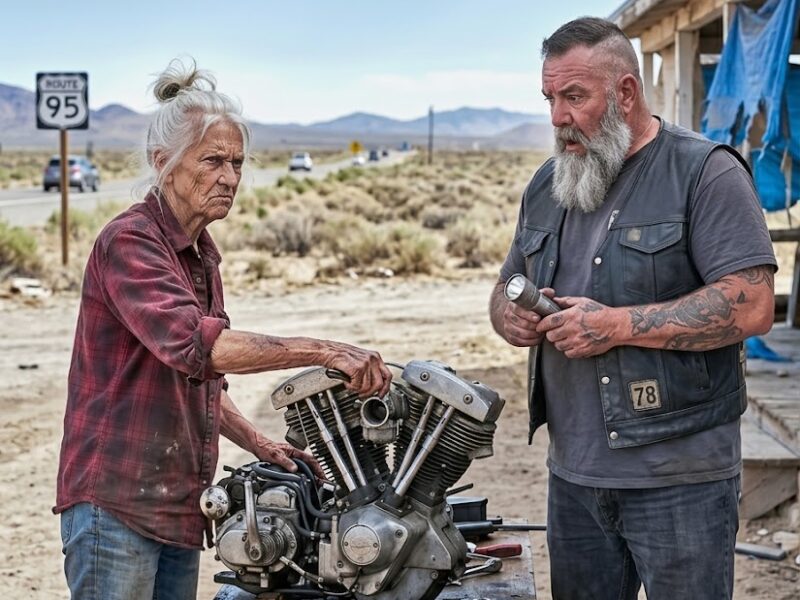
An elderly woman fixed bikers’ bikes for free for years — and the next morning, 400 Hell’s Angels showed up to build her a brand-new home.
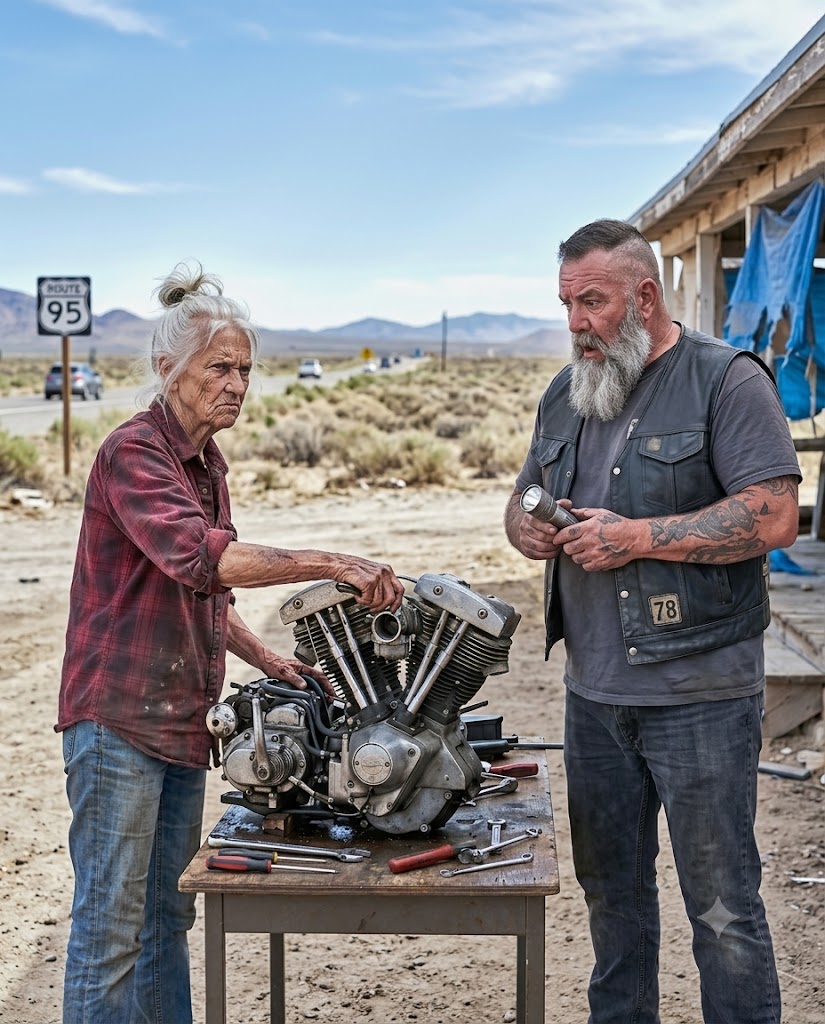
Grease doesn’t wash off.
It settles into the deep cracks of an 80-year-old palm, becoming a permanent tattoo of a hard life.
Lorraine wiped her hands on a rag that was white sometime during the late ’90s, squinting at the burning desert highway.
She despised company, and she absolutely hated the noise of motorcycles.
But when a chopped Harley ground to a screeching, smoking halt right outside her rotting front porch, ignoring them wasn’t an option.
Stick around, because tomorrow morning 400 notorious outlaws are coming to balance the ledger.
Heat radiated off the Nevada asphalt in heavy, visible distortions, making the horizon look like it was melting.
Lorraine sat on a lawn chair that had lost its plastic webbing decades ago, replaced by a woven lattice of frayed bungee cords.
The chair groaned under her slight weight.
She held a mug of lukewarm, bitter coffee, staring at the sagging roof of her own porch.
Above her, a blue plastic tarp slapped rhythmically against the exposed wooden joists, a temporary fix for a leak that had been rotting the ceiling since last November.
She took a sip.
The coffee tasted like burnt copper and hard water.
Out on Route 95, the silence of the desert was absolute, broken only by the occasional hiss of a passing 18-wheeler.
Lorraine liked the silence.
It didn’t ask her for favors.
It didn’t remind her of Arthur, whose grave was out back behind the rusted skeletal remains of a 1978 Ford pickup.
It just existed, dry and indifferent.
Then came the mechanical scream.
It started as a low, guttural sputter in the distance, rapidly decaying into a violent metallic grinding that made Lorraine’s jaw clench.
She didn’t have to see the vehicle to diagnose it.
That was the sound of a spun bearing and a seized transmission.
A catastrophic failure of lubrication and common sense.
Three motorcycles breached the crest of the hill.
Two were riding steady, loud, and arrogant.
The third was vomiting thick, acrid black smoke, weaving erratically across the yellow line.
The rider was fighting the handlebars, leather boots kicking out to stabilize the dying machine.
With a final explosive backfire that sounded like a gunshot echoing off the scrub brush plains, the bike locked up entirely.
Momentum carried it in a skid right into the dirt shoulder of Lorraine’s property.
A heavy cloud of alkaline dust washed over her porch, coating her coffee mug in a fine layer of grit.
Lorraine didn’t move.
She just closed her eyes and let out a long, raspy breath.
“Son of a bitch.”
A deep voice barked from the dust cloud.
When the air cleared, three massive men were dismounting.
They wore heavy leather vests over sun-baked skin, the fabric adorned with the unmistakable winged death’s head patch of the Hells Angels.
The man who had been riding the smoking bike kicked his front tire violently.
He was a mountain of a man, easily pushing 300 pounds, with a graying beard that reached his collarbone and arms covered in faded prison ink.
“Spit the gasket,” the second biker said, pulling off a pair of aviators.
He spat a stream of dark tobacco juice into the dirt.
“Whole bottom end is fried, Griggs.”
Griggs, the large man, dragged a thick hand over his face, smearing motor oil across his cheek.
“I just rebuilt the damn primary in Reno. It shouldn’t be locking up.”
Lorraine watched them from the shadows of her porch.
She didn’t feel a swell of grandmotherly pity.
She felt a sharp, territorial irritation.
Her property was a sanctuary of isolation, and these loud, smelling giants were trespassing on her peace.
The overwhelming scent of raw gasoline, burnt clutch plates, and stale male sweat drifted up to her nose.
“We need to tear it down,” Griggs grunted, pulling a heavy canvas tool roll from his saddlebag.
He dropped it onto the dirt with a heavy thud.
“Give me the 3/8 socket.”
They spent the next 45 minutes making it worse.
Lorraine sat perfectly still, observing the disaster unfold through the warped screen door.
Every time Griggs applied torque to a bolt, she winced.
He was forcing it.
He was stripping the threads.
The sound of metal grinding against metal in the hands of an impatient man was a physical agony to her.
She had spent 40 years running a heavy diesel shop with Arthur before the bank took the commercial property, leaving them with this decaying residential shack.
She knew engines better than she knew most human beings.
“You’re going to snap the mounting bracket,” Lorraine muttered to herself, her arthritic fingers tightening around the coffee mug.
Outside, Griggs let out a roar of frustration and threw a wrench.
It bounced off the dirt and clattered against the wooden pilings of Lorraine’s porch.
That was the limit.
Lorraine set her mug down on a milk crate.
Her knees popped like dry twigs as she stood up.
She pushed open the screen door.
It whined loudly on rusted hinges, announcing her presence.
The three bikers froze, turning to look at her.
To them, she must have looked like a ghost, a frail, 80-year-old woman in a faded flannel shirt and grease-stained denim jeans, her white hair tied back in a messy knot.
“If you snap that bolt,” Lorraine said, her voice like grinding sandpaper, “you’re going to be pushing that 600-pound piece of junk all the way to Vegas. Pick up the wrench.”
Griggs stared at her, his heavy brows pulling together.
“Excuse me, lady?”
“You heard me.”
Lorraine stepped off the porch.
Her back ached with a dull, throbbing intensity, but she kept her posture rigid.
She walked into the blistering heat, stopping two feet from the towering biker.
She looked down at the smoking engine block, then up at his flushed, angry face.
“You’ve got a sheared Woodruff key in the primary drive. Your clutch hub is spinning free, and you’re trying to pry the cover off without releasing the tensioner. You’re acting like a butcher, not a mechanic.”
The second biker snorted, trying to suppress a laugh.
Griggs shot him a murderous glare before looking back at Lorraine.
“And I suppose you know how to fix a Twin Cam 88.”
“I know how to fix anything that burns gas and makes noise,” Lorraine snapped.
She held out her trembling, calloused hand.
“Give me the socket. Not the 3/8, the 1/2-inch. And back away from my dirt.”
It wasn’t a quick job, and it wasn’t cinematic.
There was no magical touch that made the engine purr instantly.
There was only heat, pain, and the stubborn refusal to let a machine defeat her.
Lorraine dropped to her knees onto a piece of cardboard she made the third biker fetch from the trash.
The ground was hard, sending jolts of pain up her fragile shins.
The engine block was still radiating a fierce, localized heat, baking the skin on her forearms.
“Hold this,” she ordered, shoving a flashlight into Griggs’s massive hand.
The sun began to dip below the jagged peaks of the Spring Mountains, casting long, bruised, purple shadows across the highway.
For three hours, the only sounds were the clicking of the ratchet, the scrape of metal, and Lorraine’s occasional fits of dry coughing.
The dust was thick, clinging to the sweat on her neck.
Her hands betrayed her constantly.
The joints in her knuckles were swollen with arthritis, screaming in protest every time she had to apply leverage.
Once her wrench slipped, and her knuckles smashed hard into the cooling fins of the cylinder head.
“Damn it,” she hissed, pulling her hand back.
A thick ribbon of crimson welled up across her paper-thin skin.
“You all right, ma’am?” Griggs asked, his voice softer than it had been all afternoon.
He shifted his weight, looking genuinely uncomfortable.
“Don’t hover,” she barked, wiping the blood carelessly on her already ruined jeans.
The mixture of blood and black motor oil formed a dark, sticky paste.
“Just keep the light steady.”
She wasn’t doing this out of the kindness of her heart.
At least, that’s what she told herself.
She was doing it because the sight of a broken machine was an insult to the order of the universe.
And because the sooner she fixed it, the sooner these loud, dangerous men would leave her alone.
She hated the vulnerability of being old.
She hated that her roof leaked, that her plumbing groaned, and that she couldn’t fix her own house anymore.
But an engine, an engine was finite.
It had rules.
By the time she finally talked the last primary cover bolt into place, the desert was pitch black, illuminated only by the harsh white beam of the flashlight and the pale glow of a silver moon.
“Start it,” she ordered, pushing herself up from the cardboard.
Her legs shook violently, and she had to lean against the handlebars to steady herself for a fraction of a second.
She masked the weakness by immediately turning her back and walking toward the porch.
Griggs swung his heavy leg over the saddle.
He turned the key and hit the ignition.
The Harley roared to life.
It wasn’t sputtering.
It wasn’t smoking.
It settled into a deep, rhythmic idle that vibrated the ground beneath their boots.
The other two bikers let out low whistles of genuine, impressed relief.
Griggs killed the engine and kicked the stand down.
He walked toward the porch, reaching into his heavy leather vest.
He pulled out a thick wad of bills, twenties, fifties, hundreds, all crumpled and smelling of stale smoke.
“Lady,” Griggs said, peeling off several large bills, “I don’t know who you are, but you just saved me a $2,000 tow and a week in a motel. Take this.”
Lorraine stood on the bottom step of her porch, the darkness hiding the violent trembling in her exhausted arms.
She looked at the money.
She desperately needed it.
The property taxes were four months past due.
The water heater had been dead since January.
The roof was a single bad storm away from collapsing onto her bed, but her pride was a rigid, ugly thing.
It was all she had left.
She looked at the dirt under Griggs’s fingernails, the violent patches on his chest, the arrogant way he held out the cash, assuming money could buy his way out of incompetence.
“Put your dirty money away,” Lorraine said, her voice flat and cold.
“It smells like cheap weed and bad choices.”
Griggs froze, the bills hanging in the air.
“I didn’t fix it for you,” she said, wrapping her arms around her thin frame to ward off the sudden desert chill.
“I fixed it because you were butchering a perfectly good machine, and your cursing was giving me a headache. Now, pack up your tools, get off my dirt, and don’t ever break down in front of my house again.”
She turned around, walked up the steps, went inside, and slammed the heavy wooden door behind her.
She threw the deadbolt with a loud, definitive clack.
Outside, there was silence for a long moment.
Then, the low murmur of voices, the clinking of tools being packed away, and finally, the roaring ignition of three heavy motorcycles.
Lorraine stood by the window, peeking through the frayed curtains until the red tail lights disappeared down the dark highway.
She walked into her kitchen, her body aching so deeply it felt like her bones were made of cracked glass.
She ran her bleeding knuckles under the cold tap, watching the brown and red water swirl down the rusty drain.
That night, a rare, unseasonal rain rolled across the desert.
Lorraine lay in her bed, staring at the ceiling.
The rhythmic drip, drip, drip of water hitting the metal bucket at the foot of her bed kept her awake.
She felt foolish.
She had let her stubbornness override her survival.
She could have taken the money.
She could have bought a new tarp.
Maybe paid a handyman from town to patch the shingles.
Instead, she was just an old, bitter woman hurting and alone in a rotting house.
She closed her eyes.
The exhaustion finally dragged her down into a dark, dreamless sleep.
The vibrations woke her before the sound did.
It was 5:30 in the morning.
The sky outside the bedroom window was a bruised, pale gray.
The sun not yet cresting the horizon.
Lorraine lay still, feeling a strange, rhythmic tremor in the springs of her mattress.
The water in her glass on the nightstand was rippling in tiny, concentric circles.
Then came the sound.
It was a low, subsonic hum that seemed to rattle the fillings in her teeth.
It grew louder, expanding into a heavy, oppressive roar that swallowed the silence of the desert whole.
It sounded like a fleet of low-flying bomber planes descending directly onto her roof.
Panic, cold and sharp, spiked in Lorraine’s chest.
She threw off the thin quilt, her bare feet hitting the freezing linoleum floor.
She grabbed her flannel robe, wrapping it tightly around herself as she hurried down the narrow hallway.
The framed photographs on the walls were vibrating against the peeling floral wallpaper.
They had come back.
Her mind raced to the darkest conclusion.
She had insulted them.
She had slept away their money and treated them like stray dogs.
Men like that, men who wore death’s heads on their backs and lived outside the law, didn’t take disrespect from anyone, not even an 80-year-old woman.
They had come back to trash her shop, to burn out her property, to teach her a lesson.
Lorraine didn’t go to the phone.
The line hadn’t worked in years, anyway.
Instead, she marched to the hall closet, reached past the moth-eaten winter coats, and pulled out Arthur’s old 12-gauge shotgun.
It was heavy.
The blued steel grew cold against her palms.
She hadn’t bought shells for it since 2014, but they didn’t know that.
Holding the heavy weapon by her side, she walked to the front door and kicked open the screen.
“Get off my—” she started to shout, but the words died in her throat.
The breath was knocked completely out of her lungs.
Route 95 was gone.
The dirt shoulder was gone.
The empty expanse of scrub brush was gone.
In their place was a vast, undulating sea of chrome, matte black steel, and heavy leather.
Motorcycles were parked two deep along the highway, stretching out for a quarter mile in both directions.
Hundreds of them.
The air was thick with the blue haze of exhaust, smelling sharply of hydrocarbons and hot engines.
The roar of 400 V-twin engines idling simultaneously was deafening.
A physical pressure pushing against Lorraine’s chest.
She stood on the porch, frozen, the useless shotgun dangling from her grip.
She was completely, utterly surrounded.
Near the front of the pack, parked precisely where it had broken down yesterday, was Griggs’s chopped Harley.
Griggs was standing beside it.
He wasn’t wearing his leather vest this time.
He was wearing a faded gray T-shirt stained with sweat, thick denim work pants, and heavy steel-toed boots.
He caught sight of her on the porch.
He didn’t look angry.
He didn’t look threatening.
He raised a massive hand and made a sharp downward chopping motion.
Instantly, the roar died.
Four hundred engines were killed in a staggered wave of clicks and dying sputters.
The sudden silence that rushed in to fill the void was almost as overwhelming as the noise had been.
The only sound left was the ticking of hot metal cooling in the dawn air.
Lorraine gripped the doorframe, her knuckles white.
She tried to project a tough exterior, but her lower lip was trembling.
“What is this?” she demanded, her voice cracking, completely lacking the venom from the night before.
“What do you want?”
Griggs walked forward.
He stopped at the edge of the porch, looking up at her.
Then his eyes flicked to the shotgun.
He didn’t flinch.
He just gave a small, weary smile.
“Put the cannon away, ma’am,” Griggs said, his deep voice carrying easily in the quiet air.
“We ain’t here to hurt you.”
“Then why are you trespassing on my property with a small army?” she snapped, refusing to lower the barrel, even though her arms were shaking from the weight.
Griggs looked past her, his eyes scanning the sagging roof, the rotting porch pillars, the torn blue tarp fluttering weakly in the morning breeze.
“You told me yesterday that you fixed my bike because you hate seeing a perfectly good machine go to waste,” Griggs said slowly, looking back into her eyes.
“Well, my brothers and I, we hate seeing a perfectly good house rot into the ground.”
Lorraine blinked, entirely failing to comprehend.
What?
Griggs turned around and faced the hundreds of silent bikers watching from the highway.
He didn’t yell.
He didn’t give a grand cinematic speech.
He just nodded his head once.
The sea of men moved.
They began unstrapping heavy canvas bags from their bars.
They weren’t pulling out chains or baseball bats.
They were pulling out framing hammers, crowbars, cordless drills, and heavy leather tool belts.
Three men climbed out of a battered pickup truck that had been parked at the rear of the convoy, dropping the tailgate to reveal stacks of fresh plywood, two-by-fours, and bundles of asphalt shingles.
Lorraine watched in total, paralyzed shock, as a dozen massive, heavily tattooed men marched past her onto the porch.
Two of them gently, but firmly, took the empty shotgun from her trembling hands and set it leaning against the wall.
“Excuse us, ma’am,” a biker with a spiderweb tattooed across his neck muttered politely as he walked past her into the living room carrying a heavy roll of moisture barrier.
“Hey!” Lorraine finally found her voice, a weak, bewildered chirp.
“Hey, what are you doing? You can’t just—”
“Ma’am,” Griggs interrupted, stepping onto the porch.
He reached out and gently placed a hand on her shoulder.
His grip was surprisingly light.
“Your roof is caving in. Your foundation is sinking on the east side. Your porch is a safety hazard. We got carpenters, plumbers, and electricians in the charter. We’re going to fix it.”
“I can’t pay for this,” Lorraine stammered.
The cynical armor she had worn for 20 years cracking wide open.
She felt exposed.
She felt completely out of control.
“I don’t accept charity.”
“I told you. It ain’t charity,” Griggs said firmly, cutting her off.
“You balanced my ledger yesterday. You gave me your time, your blood—” he gestured to her bandaged knuckles “—and your expertise. You didn’t ask for nothing. Out here, respect is currency, and you earned ours.”
He guided her gently toward her rusted lawn chair and practically forced her to sit down.
“Now,” Griggs said, pulling a pair of heavy work gloves from his back pocket, “you just sit there and drink your coffee. If any of my boys start doing the carpentry wrong, you just yell at them like you yelled at me.”
Before Lorraine could formulate a protest, the chaotic symphony began.
The screech of crowbars tearing away rotten wood filled the air.
The rapid-fire thud of hammers echoed like drumbeats.
Men were scrambling onto her roof like heavy, leather-clad ants, ripping away the useless blue tarp and tossing decaying shingles down into a pile in the dirt.
Inside the house, she could hear the clanking of pipes and the muffled shouting of men coordinating a plumbing repair.
Lorraine sat in the lawn chair, her hands gripping the frayed bungee cords.
She looked at the army of outlaws dismantling the decay of her life.
She wanted to be angry.
She wanted to tell them to leave.
She hated being a passenger in her own life, but as the smell of fresh-cut pine sawdust drifted over her, masking the scent of stale desert dust, Lorraine felt a hot, unfamiliar pressure behind her eyes.
A single treacherous tear escaped, cutting a clean track through the dirt and grease on her cheek.
She quickly wiped it away with the back of her wrist, glaring at a biker who was struggling to pry a rusted nail out of a porch post.
“Use the back of the hammer, you idiot,” she croaked, her voice thick with emotion she refused to name.
“You’re just bending the head.”
The biker paused, looked at her, and grinned, flipping the hammer around.
“Yes, ma’am.”
Sawdust tasted like dry copper on the back of the tongue.
It hung in the air, a thick yellow mist catching the harsh morning light, coating the peeling floral wallpaper of Lorraine’s living room.
The noise was an assault.
Circular saws screamed through two-by-fours with a high-pitched, tooth-rattling whine, followed immediately by the rhythmic percussive thud of pneumatic nail guns.
Lorraine hated it.
She hated the loss of control.
For 20 years, the only sounds in this house had been the ticking of the mantel clock and the wind fighting the cheap aluminum siding.
Now, her sanctuary felt like a shipyard.
She paced.
Sitting in the lawn chair had lasted exactly 14 minutes before her nerves forced her up.
She walked the perimeter of her own home, leaning heavily on a broom handle she’d repurposed as a walking stick.
Men were everywhere.
They stepped around her with a deference that irritated her further, treating her like a fragile glass ornament placed in the middle of a war zone.
She stopped by the side of the house where the kitchen plumbing routed out to the septic tank.
A biker named Cole, a wiry man with a long braided beard and a spiderweb tattooed over his right eye, was waist-deep in a freshly dug trench.
He was wrestling with a length of white PVC pipe, trying to mate it to a rusted, calcified iron flange sticking out of the concrete foundation.
He cursed, wiping a mixture of mud and sweat from his forehead with a dirty forearm.
Lorraine watched him struggle for a full minute, leaning on her broom.
Cole pushed the pipe, the rubber gasket fighting him, refusing to seat.
“You’re fighting the angle,” Lorraine rasped.
Cole flinched, looking up from the trench.
He hadn’t heard her approach.
“Ma’am?”
“I said you’re fighting the angle,” she repeated, pointing the rubber tip of the broom at the joint.
“That iron flange has 40 years of hard water build-up. It’s warped. If you force that PVC straight in, you’re going to pinch the O-ring. It’ll hold pressure for a week, and then it’ll flood my crawl space.”
Cole frowned, looking down at the fitting.
He ran a calloused thumb over the edge of the iron.
“It’s pretty chewed up. I was just going to force it and hit it with a heavy bead of silicone.”
“Silicone is for lazy men and amateurs,” Lorraine snapped.
She reached into her flannel shirt pocket and pulled out a small, flat file she’d been carrying around all morning.
She tossed it down.
It landed in the dirt next to the trench.
“Chamfer the inside edge of the PVC. File down the burr on the bottom left of the iron flange. Give it some dish soap for lubrication, and it’ll slide in like a piston. Do it right, or don’t do it at all.”
Cole stared at the file, then up at Lorraine.
A slow, genuine grin cracked his dirt-smeared face.
“Yes, ma’am.”
She didn’t smile back.
She just nodded once and continued her patrol.
Inside, the living room ceiling was completely exposed.
The water-damaged drywall had been ripped down, revealing the black rotting joists that had kept Lorraine awake during every rainstorm.
Three men were wrestling a massive treated wooden beam through the front door.
Griggs was at the center of the room shouting orders over the roar of a gas generator outside.
“Watch the drywall on the left. Easy. Easy. Drop it on the sawhorses.”
Griggs bellowed, his massive chest heaving.
The beam hit the sawhorses with a heavy thud that shook the floorboards.
Griggs turned, wiping his brow, and caught sight of Lorraine standing in the hallway doorway.
He reached over and killed the music blaring from a portable radio.
“How we doing, boss?” Griggs asked, his tone a mix of respect and exhaustion.
“You track mud on my rug, you’re buying me a new one,” Lorraine said, her voice flat.
Griggs looked down at the faded, threadbare rug under his boots.
It was practically entirely dirt at this point.
He let out a booming laugh that echoed in the empty rafters.
“Fair enough. We’re reinforcing the load-bearing wall before we lay the new roof decking. The rot went deeper than we thought.”
“Termites,” Lorraine said, stepping into the room.
She pointed up at a crumbling piece of wood hanging from a nail.
“Got into the sill plate back in ’09. I sprayed diesel fuel on the foundation to keep them out. But they’d already climbed the framing.”
Griggs looked at her, his eyebrows raised.
“You sprayed diesel fuel on your house?”
“It works,” she muttered defensively.
She looked around the gutted room.
The bare bones of her house were exposed.
Wires dangled like dead vines.
Plumbing stacks stood naked in the walls.
It looked terrifyingly vulnerable.
She felt a sudden sharp ache in her chest.
Not a heart attack, but a deep hollow panic.
She was letting strangers dismantle her life.
What if they left right now?
What if they just packed up their tools and rode away, leaving her with a gutted shell of a home?
Her fierce independence had been a survival mechanism.
Letting them do this meant trusting them.
Lorraine didn’t trust anyone.
Griggs seemed to notice her posture stiffen.
He stepped closer, towering over her, smelling of fresh pine and old sweat.
“We don’t leave jobs half done, Lorraine,” he said quietly.
His voice dropped below the noise of the saws outside.
It was the first time he had used her name.
“By sundown, you’ll have a roof that could stop a meteor. I promise you that.”
She looked up at him, her jaw tight.
She hated that he could read her fear.
She hated it more that his words actually settled the panic slightly.
“Just make sure it’s level,” she said gruffly, turning away to hide her face.
“I hate a crooked ceiling.”
Noon arrived with the brutal, flattening heat of a forge.
The Nevada sun hung directly overhead, baking the desert floor and turning the air inside the un-air-conditioned house into a stagnant, suffocating oven.
The pace of the work slowed.
Even men who spent their lives riding heavy iron across asphalt in the dead of summer needed to breathe.
Outside, dozens of bikers were slumped in the meager shade of the mesquite trees, drinking lukewarm water from plastic gallon jugs.
The silence of the break was almost as loud as the construction.
Lorraine stood by the kitchen window.
She had a damp dish towel wrapped around the back of her neck.
She watched a young biker, a kid who couldn’t have been older than 22, with a fresh, raw-looking prospect rocker on his vest, backing a heavy Ford F-250 pickup toward the side of her house.
The back of the truck was loaded with thick steel hydraulic jacks and heavy wooden cribbing.
They were getting ready to lift the sagging east corner of the foundation.
The problem wasn’t the jacks.
The problem was where the prospect was trying to park.
Sitting dead center in the side yard, half swallowed by brittle weeds and rust, was the 1978 Ford F-150.
Its tires had rotted off the rims a decade ago.
The windshield was a spider web of cracked glass.
The paint, once a vibrant factory blue, was sun-bleached to a chalky gray.
It was garbage to anyone looking at it.
The prospect jumped out of his truck, pulling a heavy logging chain from the bed.
He walked over to the old Ford, dragging the heavy steel links through the dirt, aiming for the rusted front bumper.
Lorraine’s heart stopped.
A cold electric jolt of absolute fury overrode the heat.
She didn’t grab her broomstick.
She didn’t feel her arthritis.
She bolted out the back door, the screen slamming against the frame with a gunshot crack.
“Drop that chain!”
Her voice tore through the quiet afternoon, raw and ragged.
The prospect froze, the heavy steel links slipping from his hands to hit the dirt with a heavy clatter.
He spun around, his eyes wide, looking at the frail woman charging toward him like a cornered wolverine.
Several bikers resting in the shade sat up abruptly, hands instinctively reaching for the heavy tools on their belts.
“Ma’am, I was just—” the prospect started, holding his hands up defensively.
“Don’t you touch it.”
Lorraine shoved past him, putting her body between the young man and the rusted grill of the truck.
Her chest heaved, her breathing shallow and frantic.
She gripped the hot metal of the hood, not caring that it burned her palms.
“You don’t hook a chain to this truck. You don’t move it. You don’t even look at it.”
Griggs appeared from the front of the house, his heavy boots pounding the dirt.
He jogged over, instantly sensing the volatile shift in the air.
“Whoa. Whoa,” Griggs said, holding a hand out to the prospect to step back.
He looked at Lorraine.
She was shaking violently, her knuckles white against the rusted blue hood.
Her eyes were wide, feral, and wet.
“He was going to drag it,” Lorraine choked out, pointing a trembling finger at the kid.
“He was going to snap the axle.”
“We need to clear the grade to get the jacks under the foundation sill,” Griggs explained slowly, keeping his voice incredibly calm, like he was talking down a jumper from a ledge.
“The truck is sitting right over the spot where the house is sinking. We just need to pull it 10 feet forward.”
“No.”
Lorraine’s voice broke.
It wasn’t a command anymore.
It was a plea.
She pressed her forehead against the burning metal of the hood.
The smell of baked rust and old dry-rotted rubber filled her nose.
“He died under here,” she whispered.
The words barely carried over the hot wind, but Griggs heard them.
The prospect heard them.
Silence fell over the side yard.
The ambient noise of 50 men resting simply ceased to exist.
Lorraine kept her eyes squeezed shut, ashamed of the tears that were finally spilling over her eyelashes, cutting tracks through the sawdust on her face.
“1998,” she said.
Her voice hollow, detached, speaking to the rusted metal rather than the men.
“He was swapping the oil pan gasket. Slipped a jack stand. The ground was soft from the rain. It came down on his chest.”
She swallowed hard, her throat painfully dry.
“I was in the kitchen. I didn’t hear it happen. I came out to bring him a beer and he was just—he was gone. He’s been gone 28 years and this is exactly where he left.”
Griggs stared at her.
He looked at the rusted hulk of machinery, then down at the dirt beneath it.
The dirt that had swallowed the weight of a man.
The tough, cynical armor that Lorraine wore wasn’t just pride.
It was scar tissue formed over a catastrophic, localized wound.
She hadn’t let anyone move the truck because moving the truck meant Arthur was truly, finally erased from the physical space of the world.
Griggs turned to the young prospect.
“Pick up the chain,” Griggs ordered quietly.
The kid scrambled to gather the heavy steel, his face pale.
Griggs looked around at the dozen bikers who had gathered nearby to watch the commotion.
He didn’t have to shout.
“Miller, Boone, get the shovels,” Griggs commanded.
He pointed to a spot four feet to the left of the old Ford.
“We dig by hand. We trench under the truck and we set the cribbing beneath the chassis. We’re jacking the house without touching the iron.”
Boone, a massive man with a thick red beard, frowned.
“Griggs, the angle is going to be hell. We won’t have leverage for the hydraulic pumps. We’ll have to hand-crank the bottle jacks in a two-foot clearance.”
Griggs walked over until he was chest to chest with Boone.
“Then you better stretch your shoulders, brother, because we aren’t moving the truck.”
Lorraine slowly lifted her head from the hood.
She looked at Griggs.
The giant biker didn’t offer her a pitying smile or a soft word of comfort.
He just gave her a curt nod, an acknowledgement of the ghosts that haunted her dirt.
She let go of the truck, wiped her face violently with the back of her dirty sleeve, and stood up straight.
The momentary lapse in her armor was over, but the atmosphere had permanently shifted.
“You better dig deep,” Lorraine rasped, her voice regaining its sandpaper edge.
“That topsoil is pure caliche clay. It’ll break your shovels if you don’t hit it right.”
“Yes, ma’am,” Griggs said.
Houses do not like to be moved.
They settle into the earth over decades, their wooden bones warping and conforming to the slow, inevitable pull of gravity.
When you try to force them back to level, they fight.
The sun began its long descent behind the mountains, painting the desert sky in violent streaks of bruised purple, burnt orange, and pale yellow.
The shadows lengthened, stretching across the dirt yard like dark fingers.
Beneath the east side of Lorraine’s house, in a cramped, claustrophobic trench dug entirely by hand, Boone and three other men lay on their backs.
They were coated in pale, chalky dust, sweat tracking through the grime on their faces.
Wedged between the dirt and the rotting sill plate of the house were four heavy steel bottle jacks.
Griggs stood by the corner of the house holding a four-foot carpenter’s level against the exterior siding.
“Pump one,” Griggs shouted.
“Beneath the house,” Boone grunted.
The metallic click-clack of the jack handle echoed hollowly.
The house groaned.
It wasn’t a small sound.
It was a deep, structural screech of nails pulling against grain, of ancient wood being forced out of its comfortable decay.
Plaster dust drifted down from the ceiling inside the house, coating the floors.
Lorraine stood on the front lawn watching.
Her hands were buried deep in the pockets of her jeans.
Her chest was tight.
Every time the wood screamed, she expected the whole structure to collapse inward, burying these men in the rubble of her life.
“Pump two,” Griggs called out.
Another chorus of metallic clicks.
A sharper crack echoed from the rafters.
The visible dip in the roofline, a sag that had been there for 15 years, imperceptibly shifted upward.
“Hold,” Griggs yelled, checking the bubble on the level.
He wiped sweat from his eyes.
“We’re an inch out. Give me two more cranks on the left side. Slow.”
The men beneath the house obeyed.
The house shifted again, settling onto the temporary wooden cribbing with a heavy final sigh.
The structural groan ceased.
Griggs tapped the glass of the level.
The green bubble rested perfectly between the two black lines.
Plumb and level.
“Lock it off,” Griggs shouted.
“Start packing the concrete forms.”
A cheer went up from the men resting in the yard.
It was a guttural, exhausted sound of victory.
They had wrestled gravity and won.
Above them, the roofers were finishing the last row of asphalt shingles.
The rhythmic thud of their hammers was slowing down as the light faded.
Lorraine walked up the steps of her porch.
The stairs didn’t sag under her boots.
The railing, which had wiggled like a loose tooth yesterday, was rock solid, reinforced with new carriage bolts.
She walked into the kitchen.
The air inside smelled different.
The damp, moldy odor of rotting wood was gone, replaced by the sharp, clean scent of fresh pine, PVC cement, and roofing tar.
She stood in the center of the kitchen floor.
It was completely flat.
She didn’t have to lean slightly to the left to compensate for the slant.
She walked over to the counter.
Sitting there was her heavy, commercial-grade aluminum coffee percolator.
It held 40 cups.
She had pulled it out of the back of the pantry an hour ago, dusted off the cobwebs, and scrubbed the inside with steel wool.
She opened the massive tin of cheap, harsh coffee she kept for emergencies, dumping an ungodly amount of grounds into the metal basket.
She filled it with water from the tap, which now ran with immense pressure thanks to the new plumbing, and slammed it onto the stove, cranking the gas burner to high.
Forty-five minutes later, the sun had fully set.
The desert air cooled rapidly, dropping 30 degrees as the darkness took over.
The generator was killed, bringing a shocking, ringing silence back to the highway.
Outside, the men were packing up their tools.
The work was done.
A single day, 400 men, and the house was reborn.
Lorraine walked out onto the porch carrying two massive, dented metal thermoses filled with boiling, black, sludgy coffee.
She set them down on the solid new railing.
Alongside them, she placed a stack of Styrofoam cups she’d found in the basement.
“Come get it before it eats through the metal,” Lorraine called out into the dark.
The men didn’t hesitate.
They swarmed the porch, a silent, exhausted procession.
They poured the steaming, bitter liquid into the cups, wrapping their thick, calloused hands around the warm Styrofoam.
They stood around the yard, leaning against their motorcycles, drinking in silence.
Griggs walked up the steps.
His shirt was ruined, torn at the shoulder and black with grease.
He looked older in the moonlight, the deep lines around his eyes pronounced by exhaustion.
He poured a cup of coffee and took a sip.
He grimaced slightly at the battery-acid strength of it, but drank it anyway.
He leaned against the porch post, looking out at the sea of parked bikes.
Lorraine stood next to him.
She didn’t look at him.
She looked at the rusted roof of Arthur’s truck, barely visible in the dark.
“The roof won’t leak,” Griggs said quietly.
“Foundation is poured solid. The plumbing will outlast us both. You shouldn’t have to worry about this place for another 30 years.”
Lorraine took a slow breath.
The cold desert air filled her lungs.
She felt a strange, terrifying sensation in her chest.
It wasn’t the panic of vulnerability anymore.
It was the crushing weight of gratitude, an emotion she hadn’t practiced in decades.
She couldn’t say thank you.
The words wouldn’t physically form in her throat.
They felt too small, too insufficient for the sweat and blood these men had poured into her dirt.
Instead, she looked at the cup of awful coffee in Griggs’s hand.
“If that transmission on your Harley locks up again,” Lorraine said, staring straight ahead into the dark, “don’t bring it to a dealership. They’ll rip you off. Bring it here. I’ll mic the tolerances for you.”
Griggs looked down at the top of her head.
A slow, exhausted smile spread across his face.
He understood the translation perfectly.
“I’ll hold you to that, Lorraine,” he said.
A heavy, comfortable silence settled over the porch, broken only by the ticking of cooling motorcycle engines and the sound of men drinking coffee in the dark.
The house stood behind them, quiet, solid, and utterly unmoving.
Stiff joints screamed louder than the circular saws had.
Lorraine woke up instinctively bracing for the sharp, dry draft that usually sliced across her mattress at 6:00 in the morning.
It wasn’t there.
The air in her bedroom was still, holding an unfamiliar, trapped warmth.
She swung her legs over the edge of the bed, her bare heels hitting the icy linoleum.
For 20 years, she had stepped precisely 14 inches to the left to avoid a warped, spongy floorboard that threatened to plunge her foot into the dirt crawl space.
Muscle memory dictated the awkward swinging stride.
Her foot came down anticipating the terrifying give of rotten wood.
It met unyielding, rock-solid resistance.
The abrupt halt of momentum traveled hard up her shin, making her stumble forward.
She caught herself on the edge of the heavy oak dresser, breathing quickly.
She looked down.
The linoleum was still faded, still curling up slightly at the corners, but beneath it, the subfloor was terrifyingly rigid.
She walked down the narrow hallway, running her calloused fingers along the drywall.
The subtle, dusty smell of fresh spackle hung in the air.
Someone had stayed up late into the night, patching the holes left by the electrical rewiring.
The silence of the house was absolute.
There was no rattling window pane.
There was no rhythmic dripping from the kitchen ceiling.
The absence of decay felt overwhelmingly loud.
Pushing open the heavy wooden back door, she expected the familiar, agonizing shriek of metal hinges grinding on rust.
Instead, the door swung open with a heavy, oiled smoothness, catching on a brand-new pneumatic closer that hissed quietly before snapping the door firmly shut behind her.
Outside, the desert air was violently cold, carrying the scent of sagebrush and cold exhaust.
The sun was just beginning to crack the horizon, casting a blinding pale yellow light over the scrub plains.
Most of the men were asleep.
They were sprawled out on bedrolls in the dirt, curled up against the front tires of their massive motorcycles, wrapped in heavy leather vests and thick Mexican blankets.
The yard looked like a battlefield casualty ward.
Bodies scattered indiscriminately among piles of sawdust and leftover PVC piping.
Near the side of the house, by the rusted hulk of Arthur’s Ford, a single figure was moving.
It was Wyatt, the young prospect from yesterday.
He was kneeling in the dirt, working quietly with a caulking gun along the newly poured concrete of the foundation pier.
His movements were slow, stiff with exhaustion, but methodical.
He ran a wet finger along the bead of gray polyurethane, smoothing it perfectly against the rough wood of the new sill plate.
Lorraine walked over, her boots crunching loudly in the frost-hardened dirt.
Wyatt didn’t jump this time.
He just wiped his hands on his heavy denim thighs and looked up.
His eyes were entirely bloodshot, ringed with dark, bruised bags.
He looked incredibly young, despite the dirt and the fresh, bleeding scrape across his jawline.
“Shouldn’t you be asleep, kid?” Lorraine rasped, pulling her flannel robe tighter across her narrow chest.
“Got to finish sealing the grade,” Wyatt mumbled, his voice thick with fatigue.
“Grig said if water pools against this corner during the monsoon season, it’ll undermine the jack points. Got to ensure the slope carries the runoff past the truck.”
He didn’t say Arthur’s truck.
He just said the truck, affording the rusted machine the same careful reverence he’d been forced to learn the day before.
Lorraine looked down at his handiwork.
The concrete was smooth, troweled to a perfect three-degree angle away from the house.
The caulk line was flawless, completely sealing the vulnerable gap between the earth and the wood.
It was professional work, executed by a young man running entirely on fumes and the fear of his superiors.
“You missed a spot behind the drainage pipe,” she pointed out, her tone devoid of any grandmotherly warmth.
She wasn’t going to patronize him.
“Water tension will pull moisture right up that hairline crack.”
Wyatt squinted, leaning closer to the pipe.
He cursed softly under his breath, grabbed the caulking gun, and squeezed a tiny, precise dab into the hidden gap.
“Thanks,” he muttered.
Lorraine stood there for a long moment, watching the boy pack up his meager tools.
She felt a strange, sharp pang in her chest.
She remembered when Arthur was that age, working in the diesel bay until 2:00 in the morning, his hands perpetually stained, his eyes heavy with the desperate need to build something that would last.
This boy was doing the same thing, just under a different flag.
“There’s half a pot of coffee left on the stove,” Lorraine said abruptly, turning her back to him.
“It’s been sitting on the burner for six hours. It’s basically hot tar at this point. If you drink it, you might dissolve your stomach lining.”
Wyatt cracked a weary, genuine smile.
“Sounds perfect, ma’am. Thank you.”
She walked back toward the front porch.
The camp was beginning to stir.
The harsh metallic snap of a Zippo lighter echoed across the yard, followed by the thick, sweet smell of cheap cigarette smoke.
Deep, gravelly voices murmured in the dawn chill.
The symphony of engines was preparing to wake.
On the porch, sitting heavily in the newly reinforced wooden rocking chair, was Griggs.
He was staring out at the highway, a lit cigarette hanging loosely from his cracked lips.
He looked worse than Wyatt.
His graying beard was matted with sawdust, and his heavy leather boots were caked in dried caliche mud.
He didn’t turn his head when Lorraine walked up the steps.
The stairs didn’t flex.
They didn’t groan.
They just held her weight, silent and completely indifferent.
“You guys made a mess of my dirt,” Lorraine said, leaning against the solid wooden railing.
Griggs took a slow drag from his cigarette, exhaling a thick plume of gray smoke into the cold air.
“We’ll rake it out before we kick the tires. You won’t even know we were here.”
Lorraine looked at the sea of motorcycles, the piles of empty water jugs, the stacked toolboxes.
The idea that this invasion could just vanish, leaving no trace, felt absurd.
But she knew they would.
Men who lived their lives on the edge of the law knew exactly how to erase their footprints.
“The roof doesn’t leak,” she stated.
It wasn’t a thank you.
It was an acknowledgement of fact.
“It better not,” Griggs rumbled, finally turning to look at her.
“Boone laid three courses of ice and water shield under the architectural shingles. A category five hurricane couldn’t rip that felt up. You’re sealed tight, Lorraine.”
She nodded once, slowly.
The cynical armor she had worn for 20 years was still there, but it felt looser, heavy and unnecessary on her shoulders.
She didn’t know how to navigate this debt.
In her world, every transaction had a clear price.
You fix a spun bearing, you charge an hourly rate.
You pour a foundation, you sign a check.
This massive, violent act of collective generosity defied her entire understanding of survival.
“Why?” she finally asked, the word slipping out before she could catch it.
It sounded small, fragile.
“Really, Griggs? Four hundred men, thousands of dollars in lumber and steel, over a stripped primary bolt?”
Griggs dropped his cigarette onto the new porch planks and carefully crushed it out beneath the heel of his boot.
He picked up the butt and slid it into his pocket, refusing to leave trash on her property.
“You think this world is hard, Lorraine?” Griggs said, his voice dropping to a low, quiet rumble.
“And you’re right, it is. It chews people up. It takes their land. It takes their men. It leaves them rotting in the desert.”
He stood up.
He was a mountain, blocking out the rising sun.
“Most people out here, they just surrender to the rot,” Griggs continued, looking down at her.
“They let the house cave in. They let the engine seize. They take the handout, or they just lay down and die. But you, you stood on this porch, an 80-year-old woman with hands full of arthritis, and you bullied three men twice your size into doing the job right. You refused to let the machine die.”
Griggs reached out, his massive, grease-stained hand hovering for a second before he gently tapped the solid wooden post of her porch.
“We respect the refusal to surrender,” Griggs said simply.
“That’s it. That’s the whole ledger.”
By 8:00 in the morning, the desert was fully awake, and the heat was already beginning its oppressive climb.
The transformation of the staging area was a master class in aggressive efficiency.
Heavy canvas tool bags were violently strapped to chrome bars with thick bungee cords.
Empty lumber racks on the back of the F-250 were bolted down tight.
Four men walked the perimeter of Lorraine’s property side by side, dragging heavy push brooms across the dirt, erasing the deep tire ruts and the footprints, restoring the desert to its flat, desolate perfection.
Lorraine stood by the kitchen window, drinking a fresh cup of coffee.
She watched the organized chaos with a tight feeling in her throat.
She hated company.
She had spent two decades aggressively cultivating isolation, viewing every approaching vehicle as a threat to her fragile peace.
Yet watching these massive, dangerous men pack up to leave, she felt an uncomfortable, hollow ache forming in her chest.
She walked out the back door as the pneumatic closer hissed quietly behind her.
The roar started gradually.
It wasn’t a sudden explosion of sound like the day they arrived.
It was a staggered, rolling thunder.
One heavy V-twin engine coughed to life, settling into a deep, guttural idle.
Then another.
Then five more.
Within three minutes, the air was entirely saturated with the violent physical pressure of 400 motorcycles running simultaneously.
The ground beneath Lorraine’s boots vibrated so hard it made her teeth ache.
The smell of raw, unburnt hydrocarbons and hot synthetic oil washed over the property, a thick blue haze rising into the cloudless Nevada sky.
Griggs was at the front of the pack, sitting astride his chopped Harley.
He had his heavy leather vest back on, the winged death’s head patch stretched tight across his broad back.
He kicked the bike into gear with a loud metallic clack that somehow cut through the deafening roar of the idling engines.
He didn’t ride over to say a final, tearful goodbye.
That wasn’t how this worked.
Instead, he looked across the 70 yards of dirt separating them.
He raised his right arm high into the air, his fist clenched inside a thick leather riding glove.
Every single rider behind him instantly mirrored the gesture.
Four hundred fists raised in the blue exhaust smoke.
It was a silent, overwhelmingly powerful salute.
Lorraine stood perfectly still.
She didn’t wave.
She didn’t smile.
She just raised her chin, pulling her shoulders back, standing as straight and proud as her aching spine would allow.
She held his gaze across the distance, acknowledging the absolute, unspoken respect passing between them.
Griggs dropped his hand.
He twisted the throttle.
The noise escalated from a roar to an apocalyptic scream.
The pack moved out.
It was a river of rolling iron and heavy leather flowing out onto the asphalt of Route 95.
They rode two abreast, a perfectly synchronized mechanical beast leaving the dirt shoulder and merging onto the highway.
The heat waves radiating off the asphalt distorted their shapes as they accelerated, turning them into shimmering black mirages against the desert landscape.
Lorraine watched them go.
The procession took an agonizingly long time to pass her property.
For 20 minutes, she was entirely bathed in the sound and fury of their departure.
She felt the concussive force of the exhaust pipes beating against her chest, a physical reminder of the sheer power that had just descended upon her life and rebuilt it.
Slowly, the pack stretched out, becoming a long dark snake winding its way south toward the jagged peaks of the mountains.
The overwhelming roar began to fade, decaying back down into a low, distant rumble until finally it was swallowed completely by the vast emptiness of the desert.
The silence rushed back in.
It was absolute.
The blue haze of exhaust dissipated on the morning breeze.
The dust settled back onto the earth.
The highway was entirely empty.
Lorraine stood in her yard for a long time, listening to nothing.
For the first time in years, the silence didn’t feel oppressive.
It didn’t feel like a heavy blanket hiding the slow, inevitable creep of decay.
It just felt clean.
She turned and looked at her house.
The sagging roofline was perfectly straight, capped with dark, heavy architectural shingles.
The rotting porch pillars were gone, replaced by thick pressure-treated pine wrapped in a crisp white moisture barrier.
The blue tarp was a memory.
The house looked solid.
It looked anchored to the earth, capable of fighting back against the wind and the sun.
She walked slowly toward the side yard.
The ground here had been meticulously raked flat.
The deep trench where Boone and the others had jacked the foundation was completely filled, the caliche clay tamped down hard.
Sitting in the center of the newly leveled dirt was Arthur’s 1978 Ford F-150.
Lorraine walked up to the rusted hood.
She reached out, running her swollen, arthritic knuckles over the chalky blue paint.
The metal was cold in the morning shadow.
She looked down at the heavy chrome front bumper.
Sitting perfectly balanced on the flat expanse of the rusted metal was a single, heavy forged steel wrench.
A half-inch box end.
The exact size she had demanded from Griggs two days ago.
It was impeccably clean, polished to a mirror shine, heavy with the weight of professional, unyielding iron.
Lorraine picked it up.
The metal was cool against her palm.
She squeezed it, feeling the rigid strength of the tool.
Her vision blurred, the sharp edges of the rusted truck softening as hot, silent tears finally spilled over her eyelashes.
She didn’t wipe them away.
She just stood there in the shadow of her solid home, clutching the wrench, letting the grief and the profound, terrifying relief wash over her in equal measure.
Echoes behave differently in a structurally sound environment.
Before the invasion, the sound of Lorraine’s heavy boots on the kitchen floor would bleed out through the massive, unseen gaps in the walls.
The noise was swallowed by the vast, indifferent desert outside, making every movement inside the house feel small, hollow, and insignificant.
Now, as she walked across the linoleum later that afternoon, the sound snapped back at her.
The sharp clack-clack of her heels was contained, bouncing off the rigid drywall and the perfectly level ceiling.
The house was holding its breath, sealed tight against the outside world.
She spent the afternoon conducting a slow, cynical inspection.
She wanted to find a flaw.
She needed to find a corner cut, a nail driven crooked, a piece of weather stripping peeling away.
It was a defense mechanism.
Finding a mistake would bring the overwhelming reality of the gift back down to a manageable, transactional level of annoyance.
She found nothing.
She crawled under the bathroom sink, a flashlight clenched between her teeth.
The old, calcified copper pipes that had wept green oxidation onto the floorboards for a decade were entirely gone.
In their place was a beautiful, mathematically perfect network of white PEX tubing and heavy brass SharkBite fittings.
The joints were flawless.
There wasn’t a single drop of moisture on the subfloor.
She went to the electrical panel in the hallway.
The terrifying nest of frayed, cloth-wrapped wires that had sparked ominously every time she ran the microwave had been completely gutted.
A brand-new 200-amp breaker box sat flush against the drywall.
Every single circuit was meticulously labeled in sharp, aggressive black marker handwriting.
Kitchen mains, well pump, water heater.
It was an obsessive level of care.
It was the kind of work a man does for his own family, not for a hostile, bitter stranger.
Lorraine closed the metal panel door with a soft, definitive click.
She leaned her back against the hallway wall, sliding down slowly until she was sitting on the solid floor, her knees pulled to her chest.
The emotional exhaustion finally caught up with her physical pain.
Her arms ached from the wrenching.
Her back throbbed from the tension.
But the deep, hollow panic that had lived behind her ribs since Arthur died, the constant, grinding fear that the roof would collapse, that the cold would finally win, that she would be crushed by her own failing environment, was entirely gone.
The grease on her hands would never fully wash off.
The dark stains deep in the lines of her palms were permanent records of a life spent fighting broken machinery.
She couldn’t fix the past.
She couldn’t bring Arthur out from under the heavy iron of that truck.
But as she sat in the quiet, warm hallway of her perfectly level house, Lorraine realized she didn’t have to fight the wolves anymore.
Outside, the wind began to howl, sweeping across the desert plains with a violent, freezing ferocity.
It hit the side of the house with a heavy, concussive thud.
Lorraine didn’t flinch.
She didn’t look up at the ceiling waiting for the blue tarp to rip.
She didn’t reach for a bucket.
The house didn’t groan.
The timbers didn’t shift.
It absorbed the blow of the desert wind, standing resolute and entirely unmoved.
Lorraine closed her eyes, resting her head against her knees, and for the first time in 28 years, she let herself fall asleep in the middle of the day, completely, unconditionally safe.
Stories like Lorraine’s never make the front page.
We are conditioned to believe heroes wear badges and villains wear patches.
But reality is raw, greasy, and infinitely more beautiful.
If this story of brutal, unexpected humanity hit you right in the chest, do us a favor.
Hit that like button.
Share this video with someone who needs a reminder that fierce compassion still exists in the rough edges of the world.
And subscribe for more true, unbelievable stories.
Drop a comment below.
Would you have trusted the pack or kept the door locked?
See you in the next one.









