An Elderly Woman Begged a Navy SEAL to Bring Her German Shepherd Home—But When He Found the Dog, It Refused to Leave, Revealing a Heartbreaking Secret
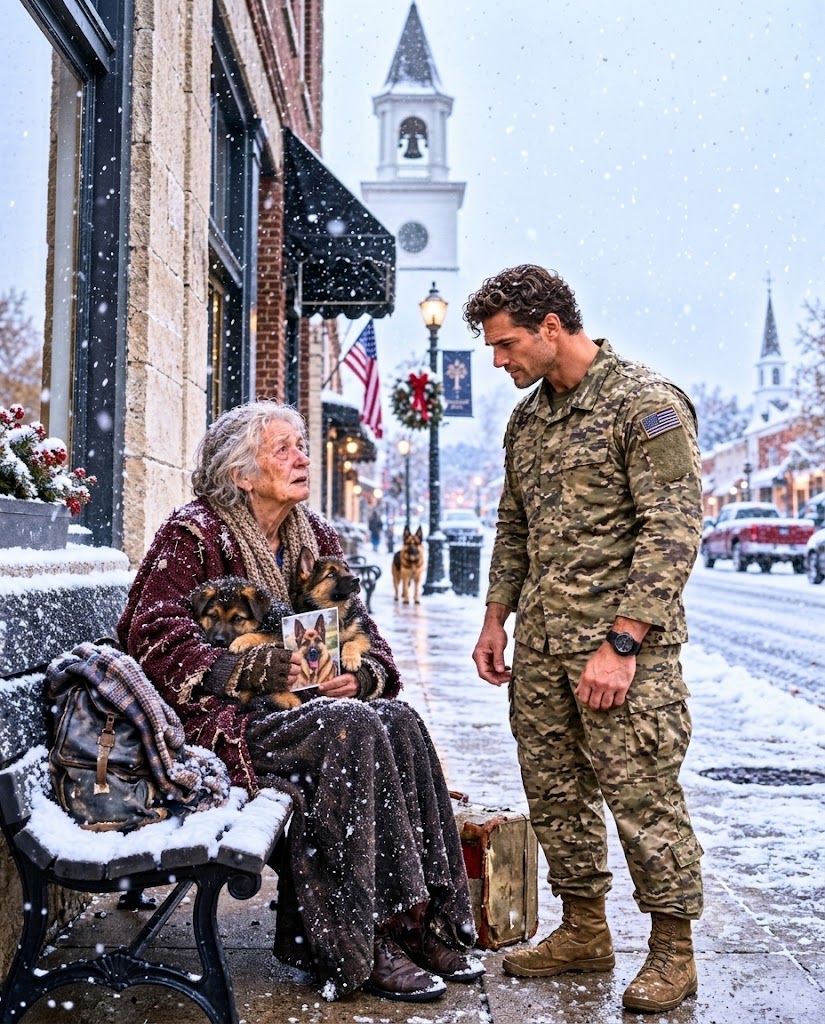
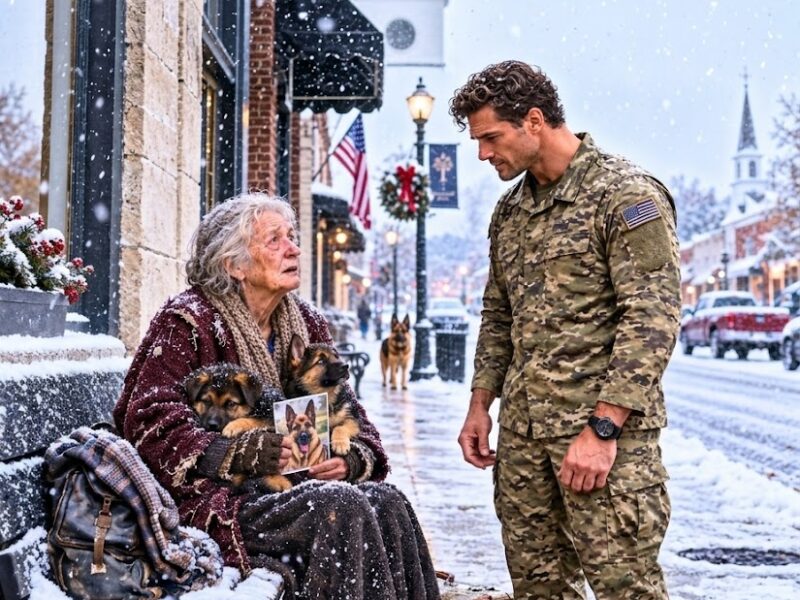
Every afternoon at 3:15 sharp, 77-year-old Helen Brookke lowered herself onto the same frost-cracked bench outside a shuttered gift shop on Market Street in Ligonier, Pennsylvania.
Two eight-week-old German Shepherd puppies pressed against her burgundy wool coat while a photograph of their mother trembled in her gloved hand.
The strange part was that the mother wasn’t missing.
Molly appeared at the far end of the street almost every day, a dark silhouette against the thin December snow, watching Helen and watching her puppies with amber eyes that never blinked.
Whenever Helen stood and called her name, the German Shepherd turned away.
Then 40-year-old Navy SEAL Daniel Reed stopped beside the old woman and noticed something Helen had been too frightened to consider.
Why would a mother keep returning to watch her puppies yet refuse to come any closer?
And what had happened between Helen and Molly that made the dog choose distance over home?
Some people believed losing something meant no longer knowing where it was, but Helen Brooks had begun to suspect there was another kind of loss, the kind that stood in plain sight and still refused to come home.
Early December had settled over Ligonier with thin snow, pale afternoon light, and evergreen wreaths hanging along the old brick storefronts.
Helen sat on a wooden bench outside a closed gift shop, wrapped in a worn burgundy wool coat that had once been expensive and now simply knew the shape of her body.
At 77, Helen was a small, narrow-framed woman with slightly rounded shoulders, pale skin marked by age, silver-white hair cut to her jaw, and blue-gray eyes still sharp enough to make strangers reconsider offering help before she asked for it.
Pride had carried Helen through widowhood, retirement, a replaced knee, and many years of living alone, and it had also taught her the dangerous habit of hearing concern as criticism.
Two eight-week-old German Shepherd puppies slept against Helen beneath a thick plaid blanket, the female slightly larger with black and tan fur and oversized ears that had not yet decided whether to stand.
The male had a warmer golden tan coat, a dark saddle beginning across his back, soft brown eyes, and a more cautious nature that made him press deeper against Helen’s coat whenever unfamiliar footsteps passed too close.
Helen had refused to name either puppy, telling people that names made temporary things feel permanent, though she already knew which puppy stole the corner of the blanket and which one made a tiny sound in sleep before curling tighter against the other.
In Helen’s gloved hand rested a photograph protected inside a clear plastic sleeve, and across the top written in thick black marker were the words, “Have you seen her?”
The picture showed Molly, a five-year-old female German Shepherd with a rich black and tan coat, a strong athletic body, upright ears, amber-brown eyes, and a small patch of pale fur beneath her chin.
Molly looked relaxed in the photograph, mouth slightly open, attention fixed on whoever had stood behind the camera, and Helen had taken the picture before the puppies were born, before Helen had begun watching every meal, every movement, every sound as though enough attention could prevent the world from taking something away.
For six days, Helen had told everyone that Molly was missing, because missing was a useful word that people understood.
Missing meant photographs taped inside shop windows, phone calls, open gates, neighbors checking alleys, and slowing their cars alongside roads, and missing gave people something to do.
What Helen rarely admitted was that she had seen Molly three times in the last four days, always in the afternoon, always at a distance, always watching.
The first time, Helen had almost convinced herself that exhaustion had invented the familiar shape at the end of Market Street, where Molly had been standing beneath a bare maple nearly forty yards away, her dark back unmistakable against the snow.
Helen had called, Molly remained still, Helen had taken several steps toward her, and Molly turned and disappeared behind a row of parked cars.
The same thing happened the following afternoon, which was why Helen sat outside again now, carrying a photograph of a dog whose location was not really the mystery anymore.
The puppies had come into Helen’s care six weeks earlier after Molly gave birth in a storage room behind the town’s community center, where Helen had volunteered for nearly eleven years.
First serving meals, then organizing pantry deliveries, and eventually becoming the person everyone called whenever something went wrong.
A delivery failed to arrive and Helen handled it, someone forgot a volunteer shift and Helen filled it, a cabinet hinge broke and Helen found the screwdriver before anyone else found the maintenance number.
Being useful had begun as generosity, but somewhere along the way it had become proof that Helen still belonged.
When Molly first appeared behind the community center, heavily pregnant and cautious around unfamiliar people, Helen had taken responsibility almost before anyone else finished discussing what should happen.
Helen arranged food, blankets, veterinary care, and a quiet place for the litter, spending weeks making sure mother and puppies had everything she believed they needed.
Recently, members of the center’s board had suggested that caring for the dogs while also managing winter meals and deliveries might be too much for one 77-year-old woman.
They had meant concern, but Helen had heard retirement, and worse, she had heard replacement.
So Helen kept doing everything, and then Molly left.
August moved down Market Street and slipped beneath Helen’s faded scarf as the larger puppy stirred, pushed one small paw against Helen’s wrist, and went back to sleep.
Helen looked toward the far end of the street and found nothing.
“Stubborn girl,” Helen murmured, no longer certain which of them she meant.
A man crossing from the pharmacy slowed when he noticed the puppies, a 40-year-old a little over six feet tall with broad shoulders and an athletic build that looked controlled rather than exaggerated, the posture of a man accustomed to carrying strength quietly.
Short dark brown military-cut hair showed the first traces of gray at the temples, and a neatly trimmed beard framed a strong square jaw and angular cheekbones, while hazel eyes seemed to register details before his expression revealed anything about them.
He wore an authentic Navy working uniform Type 3 in green-gray-brown camouflage, the fabric soft and unarmored with no tactical vest, plate carrier, body armor, helmet, or gloves.
Daniel Reed was a Navy SEAL home briefly to visit his father, and years of military discipline had made Daniel economical with movement and careful with words.
Strangers occasionally mistook that restraint for coldness, but Daniel simply disliked pretending certainty before he had earned it.
Daniel stopped several feet from Helen’s bench, and Helen raised the photograph before Daniel could ask anything.
“Five-year-old German Shepherd, female, answers to Molly.”
Daniel studied the picture, then the puppies, then something behind Helen, and his expression changed so slightly that another person might have missed it.
Helen did not.
“What?”
Daniel remained silent for another second as across Market Street, beyond a parked pickup and beneath the bare branches of a maple, a German Shepherd stood in the falling snow.
Molly.
Helen recognized the deep black saddle, the pale patch beneath the chin, and the upright ears, and immediately noticed that Molly was lean but did not appear weak.
Her body remained alert, weight balanced as though she had already decided how much distance she needed, and her amber eyes were fixed on the bench, more precisely on the two puppies in Helen’s arms.
Helen’s breath caught.
“Molly.”
The German Shepherd’s ears moved forward, and Helen rose too quickly, pain flashing through her left knee that she ignored as she pulled the puppies closer beneath the blanket.
Molly stepped backward.
Daniel lifted one hand, not touching Helen, the gesture merely creating a small pause between impulse and action.
“She’s right there,” Helen said. “I see her. Then help me bring her home.”
Daniel watched Molly rather than Helen.
“Has she done this before?”
Helen’s jaw tightened.
“Three times. And when you go toward her—”
Helen looked across the street.
“She leaves.”
Molly took another step backward, and for six days Helen had imagined explanations that frightened her but also gave her comfort.
Perhaps Molly had become confused, perhaps something had frightened the dog, perhaps Molly wanted to return but could not find the way, and every explanation had one mercy in common.
None required Helen to consider that Molly knew exactly where she was.
Daniel glanced at the photograph in Helen’s hand.
“If that’s the dog you’re looking for,” Daniel asked quietly, “why are you calling her missing?”
Helen turned toward him with a sharp answer already forming, but nothing came.
Daniel did not cross the street, did not whistle, chase Molly, or attempt to demonstrate how useful he could be.
Instead, Daniel sat at the far end of the bench, leaving enough space that Helen could reject his company without having to ask him to move.
Molly remained beneath the maple, and Helen looked from the photograph to the real German Shepherd.
In the photograph, Molly stood close to the camera, relaxed and trusting, but across the street the same dog held forty yards of winter between them like a boundary.
“You’re just going to sit there?” Helen asked.
“For now.”
“That seems remarkably unhelpful.”
One corner of Daniel’s mouth moved.
“I’ve been accused of worse.”
Helen almost told him to leave, and then Molly sat down, not closer but not farther away either, while the two puppies stirred beneath the blanket and their mother watched them from across the snow.
Daniel kept his eyes on Molly.
“That dog knows exactly where you are.”
Helen said nothing, because for the first time since Molly had disappeared, the truth arrived without the comfort of a task attached to it.
Helen was not searching for a dog who could not find her way home.
She was waiting for a dog who knew the way perfectly well and had chosen not to cross the street.
By the time Helen Brooks understood that love could become frightening when mixed with fear, she had already spent most of her life believing the opposite.
Love, in Helen’s experience, was supposed to mean doing more.
More meals carried to sick neighbors, more blankets tucked around cold shoulders, more phone calls, more checking, more preparation for disasters that had not happened yet.
Sitting still while something precious remained uncertain felt less like patience to Helen and more like negligence.
The afternoon in Ligonier had grown colder since Molly disappeared from the far end of Market Street, and snow gathered in the seams of the brick sidewalks while the holiday wreaths above the shops moved slightly in the wind.
Helen remained on the bench for several minutes after Daniel Reed had told her that Molly knew exactly where she was, the two eight-week-old German Shepherd puppies settled again beneath the plaid blanket, unaware that their mother had just appeared and vanished from their small world.
Helen finally stood.
“We should get them inside.”
Daniel did not ask whether we included him, and he simply took the folded sign while Helen carried the puppies toward the community center two blocks away.
The building was an old red brick former schoolhouse with broad windows, a wheelchair ramp added long after the original stone steps, and a multi-purpose room that smelled faintly of coffee, floor wax, and whatever had been served for lunch.
Helen knew every crooked cabinet door and every radiator that needed encouragement in January, and for eleven years she had moved through the building with the confidence of someone who did not technically own anything there but could tell everyone where everything belonged.
The puppies’ temporary space occupied a quiet storage room near the rear entrance that Helen had transformed with washable bedding, low barriers, bowls, towels, and two soft dog beds donated by neighbors.
The room was warm and clean, and nothing about it suggested carelessness, which Daniel would later realize was part of the problem.
Helen set the puppies down and immediately began adjusting things that did not need adjusting, straightening a blanket, checking the water, pressing two fingers against the radiator pipe, lifting the smaller male puppy, and inspecting his paws.
The puppy squirmed.
“He was sleeping,” Daniel said.
“He can sleep again.”
Helen placed him down, then checked the female puppy’s belly with the practiced concentration of someone examining a complicated machine.
Daniel leaned against the door frame.
“Does she need that?”
Helen looked up, the question irritating her because she understood exactly what he meant.
Both puppies were healthy, they had eaten, they were warm, they were not crying, and still Helen’s hands searched for the next thing to correct.
“They lost their mother.”
Daniel’s gaze remained calm.
“Their mother was across the street twenty minutes ago.”
Helen turned away, and that was when Daniel understood there was more to the story than she had given him.
Molly had not originally belonged to Helen.
Her owner was Patricia Hail, a 64-year-old woman who had worked at the community center for nearly fifteen years.
Patricia was tall for her age, around five foot eight, with a lean build, fair freckled skin, and straight auburn hair streaked heavily with silver that she usually wore tied loosely behind her neck.
Her green eyes were lively even when her body was tired, and she possessed the peculiar social gift of making strangers believe they had known her longer than five minutes.
Patricia remembered birthdays, disliked gossip disguised as concern, and had once driven twenty miles through freezing rain because an elderly meal recipient mentioned that her furnace sounded odd.
Patricia and Helen were friends, although both women would have objected to the sentimental simplicity of the word, because they argued too often for sweetness and trusted each other too deeply for mere acquaintance.
Molly belonged to Patricia.
Seven weeks before the day on Market Street, Patricia had needed surgery followed by a longer recovery than expected, and she could not safely manage a pregnant German Shepherd while she healed.
So Helen had volunteered, not offered, volunteered, announced, organized, because there was a difference.
Helen had brought Molly with her to the community center during the day because she still refused to reduce her volunteer schedule, and one quiet evening Molly had chosen the storage room at the back of the building and delivered three puppies there.
Helen had been delighted.
For two days, the third puppy had been noticeably weaker from the beginning, and the veterinarian had warned Helen that sometimes, despite warmth, monitoring, and appropriate care, a newborn simply did not develop strongly enough.
The little puppy died on the second day.
There had been nothing dramatic about it, no terrible scene, no failure that could be assigned to a single person, and that almost made it harder for Helen.
She understood mistakes, mistakes could be corrected, but helplessness was different.
The veterinarian had told Helen she had done what could reasonably be done, Patricia calling from rehabilitation had told Helen the same thing, and the staff at the center repeated it.
Helen thanked all of them, and then she stopped believing them.
After that day, her care became vigilance.
She began weighing the surviving puppies several times a day even after their progress had stabilized, and if one slept longer than expected, Helen woke it to make sure it responded.
She moved Molly’s bedding whenever she thought the floor felt too cold, then moved it again when she worried the radiator made the room too warm.
She kept exterior doors closed whenever Molly was nearby and shortened outdoor breaks because she feared the German Shepherd might wander farther than Helen could control.
Molly, once comfortable following Patricia through town without much concern, became restless, and Helen interpreted restlessness as danger, so she tightened the routine.
Human beings did this more often than they admitted, fear disguising itself as responsibility so convincingly that even the frightened person failed to recognize it.
Daniel watched Helen fold another towel.
“How long ago did she leave?”
“Six days.”
“What happened?”
Helen’s hands stopped, and for once there was no useful task available to hide behind.
Six days earlier, the morning had been cold but clear, and Helen had arranged a veterinary check for Molly and the puppies.
The two puppies had already been placed in a small carrier, and Molly was supposed to go into a larger crate, except Molly had begun avoiding it.
Helen had noticed that too, and she had simply decided avoidance was a problem to overcome.
Molly backed away when Helen brought the crate near the rear door, and Helen used a calm voice, offered food, waited, and tried again.
None of that worked, and eventually Helen became impatient, not cruel, not angry enough to frighten herself, simply determined in the way she had always considered one of her best qualities.
She clipped Molly’s leash on and attempted to guide her toward the crate, Molly resisted, Helen pulled slightly, and Molly backed away harder.
Helen tightened her grip because she was afraid the dog would bolt, and then everything happened faster than Helen expected.
Molly twisted free during the confusion and slipped through the partly open rear door before Helen could close it, and by the time Helen reached the alley, Molly was already halfway to the next block.
Helen had called until her voice became hoarse.
Molly did not return that night, but she came back the next afternoon.
Daniel said, “Near the center, and then again?”
“Yes.”
“How close?”
Helen disliked the questions because each answer rearranged the event.
“She stayed across the street the first time, closer the next, until you approached.”
Helen’s mouth tightened.
“I wasn’t going to leave her standing there.”
Daniel glanced toward the puppies, where the female had awakened and begun chewing gently on the edge of the blanket.
Helen immediately bent down.
“Don’t eat that.”
She pulled the fabric away, the puppy reached for it again, and Helen moved the blanket farther.
The male puppy woke when the bedding shifted, looked around in confusion, then climbed partly over his sister.
Helen separated them.
Daniel watched for several seconds.
“They were fine. They were wrestling. They’re puppies.”
Helen straightened slowly.
“You don’t know them.”
“No.”
“You don’t know what happened.”
“No, you’ve been here less than an hour.”
“That’s also true.”
Helen stared at him, almost more annoyed by his refusal to argue than she would have been by arrogance.
Daniel looked at the perfectly arranged room, then at the puppies, then back at Helen.
“But I know what it looks like when somebody is trying so hard to prevent the next bad thing that they stop noticing what is happening right now.”
Something in his tone suggested the sentence had not been created entirely for Helen, and she noticed but did not ask.
Instead, Helen crossed her arms.
“So now you’re diagnosing me?”
“No.”
“Good.”
“I’m observing you.”
“That sounds worse.”
Daniel almost smiled, and Helen did not, but she nearly did.
Later that afternoon, they returned to the same bench, and Helen insisted on bringing the puppies because Molly had appeared there before.
Daniel said nothing about whether that was wise, having already learned that direct resistance made Helen strengthen her grip on whatever position she had chosen.
The snow had stopped, and the sky had turned the washed-out silver of an early Pennsylvania winter evening as they waited.
Ten minutes passed, then twenty, and Helen began to think Molly would not come.
At twenty-seven minutes, Daniel looked toward the corner.
Molly stood beside a bare tree, the German Shepherd’s amber eyes fixing immediately on the bundle in Helen’s lap.
Helen inhaled.
“Molly.”
Molly’s ears came forward, Helen stood, and Daniel said nothing as Molly took one step, then another, then a third.
Helen’s heart rose so quickly it almost felt painful.
“There you are, sweetheart.”
She stepped toward Molly, only one step, and Molly turned immediately, disappearing behind the corner within seconds.
Helen stopped in the middle of the sidewalk, and for a long moment humiliation hurt more than worry.
“She came closer,” Helen whispered.
Daniel remained behind her.
“Until I moved.”
“Yes.”
Helen turned.
“Then what am I supposed to do?”
Daniel looked toward the empty corner where Molly had disappeared.
“Tomorrow when she comes back, don’t move toward her.”
Helen stared at him.
“That may be the stupidest advice I have heard in seventy-seven years.”
“Could be.”
“And if she leaves, then she leaves.”
Helen’s face hardened, and Daniel added nothing.
That evening, Helen lay awake much longer than usual while the puppies slept in a pen beside her bed, every few minutes one shifting, sighing, or pressing closer to the other.
Helen had spent six days asking why Molly would not come home, and now another question had begun troubling her.
What if Molly had been trying to come closer all along, and Helen simply had not known how to stop chasing?
There were few things Helen Brooks disliked more than waiting, because waiting required a person to admit that effort and control were not always the same thing.
By the following afternoon, Ligonier had settled beneath a thin layer of fresh snow, the kind that softened the edges of parked cars and gathered neatly along the brick sidewalks without yet becoming a storm.
The temperature had dropped enough for breath to show in the air, Christmas garlands hung between lamp posts along Market Street, and the small shops glowed warmly behind their windows as people hurried home before evening.
Helen returned to the same wooden bench, carrying the two eight-week-old German Shepherd puppies beneath a plaid blanket.
The female puppy was awake and alert, black and tan ears trying unsuccessfully to remain upright as she watched every passing boot, while the smaller male pressed against Helen’s side, golden tan fur warm beneath her glove and his dark saddle becoming more defined each week.
Beside Helen sat the photograph of Molly in its clear plastic sleeve, and Helen had considered leaving it at the community center but had not, because some habits stayed useful long after their original purpose had disappeared.
Daniel Reed arrived several minutes later carrying two paper cups, wearing the same authentic Navy working uniform Type 3 in green-gray-brown camouflage, soft and unarmored with no tactical vest, plate carrier, body armor, helmet, or gloves.
His broad shoulders and disciplined posture made him noticeable without making him theatrical, and the faint silver at his dark brown temples seemed more visible against the pale winter light.
His neatly trimmed beard sharpened an already angular face, but the hazel eyes beneath his brow remained quieter than the rest of him.
Daniel handed Helen one cup without announcing what it was.
Helen took a cautious sip.
“Tea?”
“Coffee seemed dangerous.”
Helen glanced at him.
“You’re learning.”
Daniel sat at the opposite end of the bench, leaving the same respectful distance as the day before.
For several minutes, nothing happened, and Helen hated every second.
Her eyes moved constantly toward the street corner where Molly usually appeared, she checked the puppies twice, adjusted the blanket once, looked at the photograph three times, and Daniel did not comment.
At the community center that morning, however, someone else had commented enough for both of them.
Emily Foster managed the center’s daily operations, and at 36, Emily was five foot six with a slim, energetic build, warm brown skin, dark curly hair gathered into a practical bun, and large brown eyes that made her look gentler than she sometimes sounded.
She dressed simply in dark trousers, comfortable shoes, and a cardigan, with a clipboard almost permanently beneath one arm, and she had grown up in Ligonier and returned after working several years in nonprofit administration in Pittsburgh.
She was patient with elderly residents, patient with nervous volunteers, patient with unreliable delivery companies, but with Helen, patience occasionally developed cracks.
Emily had found Helen in the storage room before lunch, weighing the female puppy again even though the veterinarian had said once daily was sufficient.
“Helen, we need to talk about the schedule.”
Helen had not looked up.
“That sentence has never improved anyone’s morning.”
Emily had placed the clipboard on the shelf.
“Two additional volunteers have offered to cover feeding, cleaning, and supervision during part of the day.”
Helen had refused both offers.
“They don’t know the puppies.”
“They can learn.”
“They’ll feed them too much.”
“We have written instructions.”
“They’ll misunderstand the instructions.”
Emily had stared at Helen long enough that Helen finally looked back, because silence between women could be more precise than argument.
“You cannot do every shift yourself.”
“I’ve managed this long.”
“That doesn’t mean you should.”
There it was again, should, a word that had acquired for Helen the particular sting of aging.
You should rest, you should let someone drive, you should stop carrying those boxes, you should consider moving somewhere easier.
Every sentence might have been practical, but together they sounded like the world quietly shrinking her permitted territory.
Helen had folded the towel beside the puppies with unnecessary force.
“I know these dogs better than anyone here.”
Emily had not raised her voice.
“That may be true.”
Helen expected victory, but instead Emily continued.
“But sometimes knowing someone well makes us think we have the right to decide everything for them.”
Helen had turned sharply, and Emily looked toward the puppies before asking the question that followed Helen all the way to Market Street.
“Are you taking care of them because they need you, or because you need them to need you?”
Helen had left before answering, and now the question sat beside her on the bench almost as clearly as Daniel did.
The female puppy climbed partly onto Helen’s forearm and sniffed the rim of her teacup.
“No,” Helen murmured gently, moving the cup away.
The puppy sneezed.
Daniel looked over.
“She agrees with my coffee decision.”
“Don’t encourage her. She seems difficult to discourage.”
Helen looked down at the puppy, and something about the ridiculousness of being judged by an eight-week-old German Shepherd almost made her smile.
Then Daniel’s posture changed, not dramatically, his chin lifting slightly, and Helen followed his gaze.
Molly stood across the street.
The five-year-old German Shepherd had appeared beside the same bare maple, black saddle dark against the white ground, tan chest visible between the parked vehicles, and snow had collected lightly along her back.
Her upright ears were aimed toward Helen, and her amber-brown eyes were fixed on the bundle in Helen’s lap.
Helen’s body reacted before her mind did, her shoulders tightening and one boot shifting beneath the bench.
Daniel spoke quietly.
“Remember?”
Helen frowned.
“I remember.”
“No calling.”
“I heard you yesterday.”
“No walking toward her.”
Helen turned her eyes toward him.
“Anything else? Shall I stop breathing?”
“For now, breathing is allowed.”
She almost laughed, which irritated her further.
Molly remained where she was, and Helen forced herself not to say the dog’s name, the urge feeling physical.
She wanted Molly to know she was seen, wanted to reassure her, wanted to fix whatever misunderstanding stood between them, but Molly already knew Helen was there.
That was the part Helen had finally begun to understand.
Five minutes passed, then seven, as people crossed between them, a woman carrying grocery bags glanced at Molly and kept walking, two teenagers came out of a bakery laughing too loudly, and a delivery truck turned onto Market Street.
Molly landed, and Helen’s hands stayed beneath the blanket because she did not trust them anywhere else.
At almost ten minutes, Molly moved one step, then another, crossing part of the sidewalk on the opposite side of the street and stopping closer than the day before.
Helen’s heart began pounding hard enough to feel foolish, and she wanted to whisper encouragement, but Daniel said nothing, which helped more than instructions would have.
Molly lowered her head and sniffed the air, the female puppy shifted in Helen’s lap, and the smaller male gave a soft, sleepy sound.
Molly’s head snapped up, the change immediate, her ears coming forward and her body leaning slightly toward the sound.
Helen saw it, not imagination, not wishful thinking, recognition.
Molly took another step, and then a car rolled slowly between them.
Nothing dangerous happened, the driver passed normally with tires whispering over wet pavement, but the movement and engine noise startled Molly, and she hurried several feet away.
Helen’s body rose halfway from the bench, and Daniel did not touch her.
“Helen.”
She froze.
Molly had not run, the German Shepherd stood farther back now, breathing faster, but she remained in sight.
Helen lowered herself onto the bench again, every instinct telling her to repair the moment, call Molly, offer food, move closer, do something.
Instead, Helen sat, and it was surprisingly exhausting.
The male puppy whimpered again beneath the blanket, and Molly stared toward him, her body angled forward.
For a brief moment, Helen thought the mother might cross the street, and she did not, but she did not leave either.
That distinction mattered.
Helen looked down at the puppies, because for six days she had quietly feared that Molly had abandoned them, and the idea had been easier to tolerate when Helen could imagine something had happened to Molly.
If the dog was lost, frightened, confused, then absence was not a choice, but Molly was standing there watching, responding to the puppy’s voices, keeping distance from the humans.
The realization was uncomfortable because it required Helen to divide two things she had kept joined together.
Molly was not rejecting her puppies, Molly might be rejecting the conditions surrounding them.
Helen thought about the shortened outdoor breaks, the closed doors, the repeated weighing, the crate, her own hands constantly adjusting, guiding, preventing.
She had called all of it protection, but perhaps Molly had experienced some of it differently.
Human beings rarely saw themselves from the receiving end of their good intentions, and it was one of the quieter cruelties of love.
A person could mean safety and still create pressure, intent mattered, so did impact, and mature love had to survive learning that the two were not always identical.
Molly stayed for another four minutes, then turned and walked around the corner, not running, simply leaving.
Helen exhaled.
Daniel looked at her.
“She stayed longer.”
Helen nodded.
“And she came closer.”
Another nod.
Neither sounded like victory, and that was what made the afternoon important.
They returned to the community center just before dusk, and Helen allowed one of the volunteers to refill the puppies’ water bowls while she stood nearby and resisted correcting the angle of the bowls.
It was a pathetic accomplishment, and it was also an accomplishment.
Later, after the building had quieted, Helen sat alone in the storage room while the puppies slept together inside their pen with paws overlapping and the radiator clicked softly.
Helen took Molly’s photograph from the plastic sleeve and studied it carefully.
The Molly in the photograph stood beside Patricia Hail on a sunny afternoon months earlier, Patricia’s long silver-streaked auburn hair come loose around her shoulders, and Molly stood close against Patricia’s leg with ears upright but relaxed, mouth slightly open, body loose with the ease of an animal that expected nothing unpleasant from the next moment.
Helen had been looking at that picture every day, yet until now she had looked only at the face and had not noticed the posture.
Helen turned toward the window, and far down the street beyond the glass, she could just make out a dark shape near the corner.
Molly, not close, not gone.
Helen looked back at the photograph, because perhaps that had been her mistake from the beginning.
She kept waiting for the dog in the picture to return exactly as she had been before fear, loss, confinement, and confusion entered the story, but living things did not return unchanged merely because someone missed the older version.
Helen rested the photograph against her knee and for once did not call Molly’s name, speaking so softly that only the sleeping puppies could hear.
“Maybe I keep waiting for the dog in this picture to come back.”
Outside, Molly remained where she had chosen to stand, and Helen, for the first time, let the distance exist without immediately trying to defeat it.
People often believed regret began with a terrible decision, but Helen Brooks was beginning to learn that sometimes it began with a reasonable decision made too quickly, followed by days of refusing to ask whether reasonable had also been right.
The next morning in Ligonier was colder but clearer, with a pale December sun reflecting from the snow along the sidewalks and the mountains beyond town standing blue-gray beneath a clean winter sky.
Helen left the two eight-week-old German Shepherd puppies at the community center with Emily Foster for less than two hours, a concession that would have seemed impossible only three days earlier.
She gave Emily written feeding instructions, checked the water twice, rearranged the female puppy’s blanket, then caught herself reaching for it a third time.
Emily noticed but mercifully said nothing.
Helen drove instead to Laurel Ridge Veterinary Clinic, where Molly and the litter had been examined since the puppies were born, and she had not come because anyone had asked her to, which bothered her because she preferred appointments with clear purposes.
Vaccination, weight check, medication, something that could be written on a form and crossed off when completed.
Today she had come to ask whether something she had done might have mattered more than she wanted it to.
Dr. Rachel Morgan met her in a small consultation room overlooking a snow-covered parking lot, a 51-year-old woman of medium height with a sturdy build, warm olive skin, short dark brown hair threaded with silver near the temples, and thoughtful hazel eyes behind thin rectangular glasses.
She had spent more than twenty years treating companion animals and had developed the calm of someone who knew that frightened owners often needed as much management as frightened pets.
Rachel was not sentimental about animals in the way some people expected veterinarians to be, loving them enough not to invent emotions she could not prove and respecting them enough not to reduce every behavior to obedience.
Helen appreciated that quality when Rachel was agreeing with her, and found it considerably less pleasant when Rachel was not.
Rachel pulled Molly’s records onto the computer and reviewed the notes from the weeks surrounding the birth, the first pages ordinary, pregnancy monitoring, appetite, temperature, three puppies delivered, two progressing normally.
Then came the note about the third puppy.
Helen kept her hands folded tightly in her lap.
The puppy had been weaker from the beginning, and Rachel had explained at the time that despite appropriate warmth, feeding support, and monitoring, some newborn puppies failed to thrive for reasons that could not always be corrected.
There had been no dramatic emergency and no neglected warning Helen should have recognized, the little one simply had not become stronger.
Helen had heard all of that before, but hearing it had never stopped her from replaying those two days.
“What happened afterward?” Helen asked.
Rachel glanced at the record.
“With Molly?”
Helen nodded, and Rachel scrolled farther.
There were notes Helen had almost forgotten because at the time she had treated them as inconveniences rather than information.
Molly had paced more frequently, had carried towels from one side of the storage room to another, and twice had stood for long periods near the door after Helen removed the bedding associated with the puppy that had died.
Her appetite dipped briefly, then returned, and she remained attentive to the surviving two but appeared more restless when separated from the nesting area.
Helen stared at the screen without really seeing it.
“I cleaned everything that morning. I remember. I thought leaving it there would confuse her.”
Rachel turned slightly toward her.
“That was understandable.”
Helen disliked the word immediately.
“Understandable isn’t the same as right.”
“No.”
The answer came without cruelty, and Rachel explained carefully that no one could know exactly how Molly experienced the loss.
Dogs did not understand death through human language or human concepts, but behavior could change after the disappearance of a companion or offspring, and some dogs searched, some became quieter, some became restless, some showed very little outward change at all.
There was no single reaction and no reliable way to translate Molly’s behavior into a human sentence.
That uncertainty frustrated Helen.
“So the puppy could be why she won’t come near me?”
“It could be part of it. And the crate possibly.”
“And everything I did afterward?”
Rachel paused before answering.
“Possibly.”
Helen leaned back, because she had secretly hoped for something cleaner, a medical explanation, a hormonal change, a sound Molly feared, anything that placed the problem outside Helen’s reach and therefore outside Helen’s responsibility.
Instead, Rachel gave her an accumulation, loss, changed routines, reduced freedom, repeated handling, a stressful encounter with the crate, Helen’s own increasingly anxious attention.
None alone proved anything, but together they formed a picture Helen could no longer dismiss.
Rachel folded her hands.
“I don’t think you hurt Molly because you wanted control.”
Helen looked up sharply.
“I never wanted control.”
Rachel’s expression remained gentle.
“I think you wanted certainty.”
That was worse.
Helen looked toward the window, because human beings were remarkably skilled at renaming their fears.
Control became responsibility, anxiety became preparation, refusal to let go became devotion, and sometimes the new names were not lies exactly, they were simply incomplete truths made comfortable enough to live with.
Helen thought about the days after the third puppy died, how she had scrubbed the nesting area, washed the towels, replaced the bedding, reorganized the room before Molly had finished investigating what had changed.
Helen had believed cleanliness would restore order, but grief did not ask permission before entering a clean room.
“Would leaving everything alone have changed anything?” Helen asked.
Rachel shook her head.
“I don’t know.”
Helen studied her, and Rachel continued.
“That matters, Helen. You’re looking for the moment you caused this so you can find the opposite moment and undo it. Behavior usually isn’t that tidy.”
Helen looked down at her gloves.
“So what am I supposed to do?”
“Stop trying to solve Molly faster than Molly can adjust.”
Helen gave her a dry look.
“You and Daniel would get along.”
“Is he the Navy SEAL?”
Helen frowned.
“How do you know about him?”
“Ligonier has twelve thousand people and approximately forty thousand opinions.”
Despite herself, Helen laughed, brief but real.
That afternoon, Daniel met Helen behind the community center, and Helen discovered he had started carrying a small pocket notebook when she saw him glance at Molly across the parking area, then write something down.
“What is that?”
“Notes.”
“About my dog?”
“Distance, time, what happens before she moves closer or farther.”
Helen stared at him.
“You’ve gone from Navy SEAL to sidewalk surveyor.”
Daniel closed the notebook.
“Promotion prospects are limited.”
He had recorded that Molly approached more closely when Helen remained seated, stayed longer when fewer people crossed nearby, and retreated when movement became sudden.
Daniel made no claim that the pattern would continue, and he was learning slowly and somewhat against his nature to record what Molly chose instead of designing what Molly should do next.
Helen recognized something familiar in that struggle, because Daniel liked plans, Helen liked plans, and plans protected people from the unbearable possibility that outcomes did not always respond to effort.
Neither of them mentioned the similarity.
Before returning to Market Street, Helen stopped at her house, because there was one object she had not thrown away or washed after the third puppy died.
A faded cream-colored towel had slipped behind a laundry basket and remained there unnoticed for several days, and when Helen found it, she had folded it and placed it on the top shelf of a closet rather than adding it to the wash.
She had never been able to explain why, but now she brought it with her.
At the bench, Helen unfolded the towel on her lap, and it carried no dramatic secret and no magical guarantee that Molly would recognize anything, it was simply one surviving object from the nesting area before Helen had cleaned everything.
Her first thought was to place it across the street, a lure, something familiar to draw Molly nearer.
Helen stood halfway up, then stopped, and Daniel watched but said nothing as Helen understood what she was about to do again.
Take something meaningful to Molly and use it to create the result Helen wanted.
Slowly, she sat back down and placed the towel beside her on the bench.
Nothing more.
The puppies slept under the plaid blanket, Daniel sat several feet away with his notebook closed, and for nearly twenty minutes Molly did not appear.
Then the female German Shepherd emerged near the corner, her amber-brown eyes finding the bench immediately.
Helen did not call.
Molly moved closer, thirty feet, then twenty-five, her nose lifting to sniff the cold air.
Helen’s fingers tightened once around the edge of her coat, but she stayed still.
Molly advanced again, twenty feet, close enough now that Helen could see the dusting of snow along the black fur over Molly’s shoulders and the familiar pale patch beneath her chin.
The German Shepherd stopped, then slowly lowered herself onto the snow.
She did not come to Helen, and Helen did not go to Molly.
Between them lay roughly twenty feet, two sleeping puppies, one old towel, and a week of mistakes nobody could simply reverse.
Daniel glanced at his notebook but did not open it, and Helen noticed.
For once, the distance did not feel entirely like failure.
It felt like something Molly had chosen, and for the first time in a week, Helen let that choice be enough.
People often imagined reunion as proof that love had survived separation, but Helen Brooks had begun to understand that this was another comforting idea humans invented for themselves.
Sometimes love survived perfectly well and still returned cautiously, carrying memories no one else could see.
Three mornings after Molly had chosen to lie twenty feet from Helen’s bench, Ligonier woke beneath a bright winter sky.
The snow along Market Street had hardened overnight into thin white ridges around the curbs, and sunlight flashed against decorated shop windows.
Helen was at the community center shortly after breakfast, kneeling beside the puppy enclosure despite the complaint in her left knee, when Emily Foster appeared in the doorway with a look Helen recognized immediately.
Someone had news.
“Patricia’s coming home.”
Helen straightened too quickly.
“Today?”
“Her sister is bringing her.”
Helen’s first sensation was relief so immediate it nearly became certainty.
Patricia was Molly’s person, Patricia had raised her, walked her, slept in the same house with her, and known her long before pregnancy, puppies, crates, or Helen’s anxious routines entered the picture.
Of course Molly would return to Patricia, and the problem Helen thought would finally have an ending.
Human beings loved endings almost as much as they loved explanations, because both saved them from having to remain inside uncertainty.
Patricia Hail arrived in Ligonier shortly before noon, and recovery had altered her without making her fragile.
At 64, Patricia was still tall, nearly five foot eight, with a lean frame that looked slightly thinner after weeks away.
Her fair skin carried freckles across her nose and cheeks, and her straight auburn hair, heavily streaked with silver, had been cut shorter during rehabilitation and now rested just below her ears.
Her green eyes remained lively, but fatigue had settled around them in faint shadows.
Patricia moved carefully with a black cane in her right hand, favoring one side when she turned, though she became visibly irritated whenever someone watched too closely.
Helen recognized that irritation, and it was almost comforting to discover someone else could be unreasonable about assistance.
Patricia stood inside the community center entrance and looked toward the puppy room, saying nothing for several seconds.
The female German Shepherd puppy noticed her first and pushed against the low barrier, oversized ears lifting crookedly, and the male followed more cautiously with his black muzzle raised as he studied the unfamiliar woman.
Patricia’s expression changed.
“They got big.”
Helen folded her arms.
“That tends to happen when you feed them.”
Patricia looked at her.
“I missed you, too.”
It was their version of affection.
Patricia sat in a chair beside the enclosure, and she did not immediately pick up either puppy.
Her hands remained folded over the top of her cane while she watched them stumble, bite each other’s ears, and eventually become interested in one of her shoelaces.
Helen noticed the restraint, and before the last week she might have interpreted it as hesitation, but now she understood it could also be respect.
Molly was not at the center, which did not worry Helen because Molly usually appeared later in the afternoon.
By 2:30, Helen and Patricia were sitting on the familiar Market Street bench, and Daniel stood farther down the sidewalk near a bookstore window, present but deliberately not part of the arrangement.
He had offered to leave entirely, but Patricia had told him that any man patient enough to spend several afternoons watching a German Shepherd from across the street had already earned the right to be ignored in person.
The two puppies lay beneath the plaid blanket between the women, and Patricia held Molly’s photograph with her thumb moving slowly across the plastic sleeve.
“She always hated having her picture taken.”
Helen glanced over.
“She looks fine.”
“She was watching a squirrel.”
“That explains the concentration.”
Patricia smiled, then the smile disappeared.
For Helen, Patricia’s return had represented resolution, but for Patricia, the afternoon carried a different weight.
She had spent weeks away from home thinking about Molly in hospital rooms and rehabilitation hallways where time moved according to medication schedules, therapy appointments, and the arrival of meal trays.
She had imagined the German Shepherd sleeping beside Helen’s chair, and she had imagined bringing Molly home eventually.
She had not imagined sitting across a street, wondering whether Molly would choose to approach.
At 3:11, Daniel shifted his weight, and Helen followed his gaze.
Molly stood near the corner.
The five-year-old German Shepherd looked healthier than she had a few days earlier, though winter had roughened the fur along her legs.
Her black saddle contrasted sharply with the snow, while the tan fur across her chest caught the pale afternoon light.
Her upright ears turned toward the bench, and then Molly saw Patricia.
The change was immediate but subtle, Molly’s tail lowering from its guarded position into something softer, her head lifting, one ear tipping slightly sideways, and her whole body seeming to lose a small amount of tension.
Patricia inhaled sharply, and Helen expected her to call, but Patricia did not.
A tear slid down Patricia’s cheek, and she wiped it away almost impatiently.
“Well,” she murmured. “That’s embarrassing.”
Helen pretended not to notice.
Molly remained across the street, five minutes passing, then ten, and Helen felt impatience gathering again, though this time it was not directed toward Molly.
She wanted Patricia to do something, call her, stand up, whistle, surely years together had earned more than silence.
But Patricia remained seated.
At twelve minutes, Molly stepped closer.
At fifteen, she crossed toward the near side of the street after traffic had cleared.
At nearly twenty minutes, she stopped perhaps thirty feet away.
Patricia looked at Helen.
“She knows me.”
“Yes.”
“And she still doesn’t want to come closer.”
Helen heard the pain beneath the statement, and before Helen could answer, Patricia looked back toward Molly.
“She doesn’t owe us a reunion scene.”
The sentence settled between them, and Helen thought about how often human beings demanded performances from love.
A child should run into a parent’s arms, a friend should forgive when an apology was sincere, an animal should rush home because people had missed it.
If affection was real, people expected it to behave properly, but Molly had experienced weeks that neither woman could fully translate.
Perhaps recognition was not the same as readiness.
Helen looked down at the photograph, and for once she did not measure success by distance.
Molly was still there, and that was enough.
Later, after Molly moved away without running, Helen and Patricia returned to the community center.
The puppies slept while the two women sat at one end of the multi-purpose room with coffee between them, and it was Patricia who disturbed the fragile peace.
“I was going to ask you to keep her.”
Helen looked up.
“Molly? After I recovered, you were going to what?”
Patricia rested both hands around her mug.
“My mobility may not come back as quickly as I hoped. Molly needs exercise, routine, space. You already love her.”
Helen stared at her.
“And when exactly were you planning to involve me in this plan?”
Patricia frowned.
“I thought you’d be happy.”
“That isn’t the point.”
“Then what is?”
Helen almost laughed at the irony, because only days earlier she might have made the same argument Patricia was making now.
I know what is best because my reasons are good.
“You decided where Molly should live. You decided I would want it. You didn’t ask either of us.”
Patricia’s expression hardened.
“She’s a dog, Helen. She can’t sit at the table and discuss housing.”
“No, but we can watch what she’s telling us before arranging the rest of her life.”
Silence followed, not pleasant silence, the kind that exposed hypocrisy without offering either person an easy escape.
Patricia finally leaned back.
“And you never decided things for her.”
Helen looked toward the puppy room.
There it was, the blow landing because it was accurate.
“I did.”
Patricia waited.
Helen exhaled.
“That doesn’t make your version better.”
“No.”
Another silence, and then Patricia gave a tired little laugh.
“We’re exhausting.”
“Mostly you.”
“Naturally.”
For the first time, they agreed not to discuss where Molly would eventually live, not today, not until Molly was comfortable enough for them to understand more than their own preferences.
Later that afternoon, they returned briefly to the bench, Daniel staying across the sidewalk and saying almost nothing.
The winter light had begun fading, and a fine dusting of snow drifted through the air.
Molly appeared again, and this time she stopped closer.
Helen kept the puppies tucked beside her, and then the female puppy wriggled unexpectedly from beneath the blanket.
She landed awkwardly in the soft snow, surprised more than frightened, and took several uncertain steps away from the bench.
Helen’s hands moved instinctively, and she stopped herself.
Patricia did the same.
Across the sidewalk, Molly reacted before either woman could decide anything, the German Shepherd moving quickly toward the puppy.
Helen’s heart jumped as Molly reached her daughter, lowered her head, sniffed along the puppy’s face and shoulders, then stood close for several seconds while the puppy pressed beneath her chest.
No grand reunion, no miracle, just recognition and contact.
Then Molly stepped backward.
Helen was close enough to touch her now, and Patricia was too, but neither woman reached out.
Molly looked at Helen, then Patricia, and the German Shepherd did not run.
In that small decision, both women understood something they had been slow to learn.
Sometimes trust did not begin when someone came closer.
Sometimes it began when everyone else finally stopped grabbing for the moment.
Progress, Helen Brooks was discovering, had an irritating habit of refusing to behave like progress.
It did not climb neatly from worse to better, it wandered, doubled back, disappeared for a day, then returned when nobody was watching closely enough to claim credit.
During the next several days in Ligonier, winter tightened around the town without becoming severe.
Mornings arrived beneath low gray skies, and afternoons brought brief patches of pale sunlight over snow-darkened brick.
Market Street continued preparing for Christmas, shop windows filling with paper stars and artificial pine, children pressing mitten hands against bakery glass, and somewhere near the courthouse square someone played the same collection of holiday songs loudly enough that Helen began to suspect it was an act of municipal aggression.
Molly’s progress was equally repetitive and unpredictable.
One afternoon, the five-year-old German Shepherd came within fifteen feet of Helen and accepted a few pieces of food that had been placed on the ground well before Molly arrived.
The next day, she did not appear at all.
On another afternoon, Molly approached the two puppies while Helen and Patricia sat several yards away, sniffed both pups carefully, remained beside them for perhaps three minutes, then walked away without looking back.
Helen went home encouraged.
The following day, Molly stopped at the far end of the block and refused to come closer.
Helen went home angry.
“Not at Molly,” she told herself, and that was only partly true.
What frustrated Helen most was the absence of a dependable equation.
If she remained still today, Molly might approach, but if Helen repeated the same behavior tomorrow, Molly might not.
It offended the part of Helen that had spent decades believing diligence ought to produce predictable results.
Daniel Reed noticed the pattern in Helen before Helen noticed it herself, and he was still keeping his small notebook, although the entries had changed.
At first, he had recorded approximate distance, time, passing vehicles, and sudden noises.
Now he occasionally wrote a single sentence and closed it again.
Molly stayed longer today.
Molly did not appear.
Helen moved less.
No conclusions.
That last line appeared more than once.
Daniel’s military training had taught him to identify patterns because patterns could matter, but Molly was quietly teaching him the danger of forcing meaning onto incomplete evidence.
He could observe what happened, but he could not turn a living animal into a predictable system simply because uncertainty made people uncomfortable.
Helen considered this lesson mildly amusing when it applied to Daniel, and found it less amusing when it applied to herself.
At the community center, Emily Foster had made good on her promise to redistribute some of the puppy care.
One of the new volunteers was Janice Miller, a 62-year-old retired elementary school secretary with a compact build, rosy fair skin, short sandy-blonde hair fading toward gray, and cheerful blue eyes behind round glasses.
Janice wore practical sweaters with animals embroidered near the collar and possessed the unhurried temperament of someone who had survived thirty-seven years of children losing lunch money, parents missing forms, and teachers discovering printer problems five minutes before class.
Helen distrusted her almost immediately, not personally, professionally.
Janice followed the feeding chart carefully but measured the puppies’ afternoon food slightly differently than Helen did.
The total was still within the veterinarian’s recommended amount, and both puppies ate comfortably.
Helen discovered the difference while reviewing the clipboard, stared at the number, then checked it again.
Janice was wiping down the counter nearby.
Helen picked up a pen, the old instinct arriving with astonishing speed.
Correct the number, correct the measurement, correct the system before incorrect became normal.
Then Helen looked through the open doorway.
The two German Shepherd puppies were wrestling over a soft rope toy, the larger female planting both front paws on it while the smaller male pulled backward with great determination and almost no success.
Both coats had become thicker and brighter over the previous week, their ribs were well covered, their eyes clear, their movements energetic.
Nothing was wrong.
Helen looked back at the chart.
Janice noticed.
“Did I make a mistake?”
Helen could have said yes, but instead she forced herself to ask, “What did Emily tell you?”
Janice explained the portion range the veterinarian had approved and showed Helen where it had been written.
Helen knew immediately that it was acceptable.
Her irritation did not disappear merely because reality had refused to justify it.
“No mistake,” she said, the words coming out reluctantly.
Janice smiled.
“Good. I was afraid there might be a puppy feeding examination.”
“There may still be.”
Janice laughed because she assumed Helen was joking, and Helen allowed her to believe that.
After Janice left, Helen remained beside the clipboard for a long moment.
The world had not collapsed because another woman fed the puppies differently, and more unsettling, the puppies seemed not to have noticed that Helen was not indispensable for every meal.
That realization hurt, and then beneath the hurt, something unexpectedly lighter appeared.
Relief.
Helen had spent years assuming that being needed protected her from becoming unnecessary, and she had never considered the cost of arranging life so nobody could function without her.
Perhaps usefulness and importance were not identical.
Perhaps letting another person carry something did not automatically mean they were taking it away.
That afternoon, Helen met Daniel on Market Street while Patricia rested at home, and the two puppies remained at the community center with Janice for another hour.
This alone represented progress.
Helen carried Molly’s photograph as usual, the clear plastic sleeve had begun to crease near one corner, and the handwritten notice was still taped across the top.
Daniel sat down beside Helen and looked at it.
“Why do you still carry that?”
Helen frowned.
“To help people recognize her.”
Daniel looked down the street.
“The bakery employee knows Molly. The bookstore owner knows Molly. The pharmacist has seen Molly twice. Half the volunteers at the community center could identify her from a block away.”
By now, Molly had become one of the least anonymous German Shepherds in western Pennsylvania.
Helen followed Daniel’s gaze.
“That isn’t why anymore,” he said, and she disliked how gently he said it because gentleness made some truths harder to fight.
Helen examined the photograph.
The sign had once represented action, search, find, return, but it had transformed into something else without her noticing, a declaration that Molly was still missing.
But Molly was not missing.
She had been seen repeatedly, she knew where Helen was, she knew where her puppies were, she knew Patricia had returned.
The problem was no longer location.
Helen peeled the tape from the plastic sleeve, the paper resisting slightly at one corner before coming free.
Have you seen her?
She folded the sign once, then again, and placed it inside her coat pocket.
The photograph remained, Molly beside Patricia months earlier, body relaxed, amber-brown eyes bright, mouth slightly open.
Daniel glanced at it.
“So now, what is it?”
Helen looked at him.
“A photograph.”
Daniel nodded, and nothing more needed saying.
Molly appeared late that afternoon and remained near the opposite sidewalk for only a few minutes before leaving, and Helen did not consider it a failure, which surprised her.
Patricia arrived briefly near sunset, but fatigue sent her home before darkness, and Daniel left soon afterward to have dinner with his father.
Helen should have gone too, but instead she remained on the bench.
For once she had no puppies in her lap, no blanket, no food placed nearby, no Patricia, no Daniel with his irritating notebook, only Helen, her burgundy coat, the photograph tucked inside one pocket, and the early winter evening settling around Market Street.
The shops began turning on their lights, Helen watched people pass, and she thought about going home.
Then Molly appeared.
Not beneath the distant maple, closer.
The German Shepherd stepped from between two parked cars and stopped perhaps twelve feet away.
Helen’s heartbeat changed.
Molly took another step, eight feet, then another six.
Helen could see the fine silver of cold moisture around Molly’s whiskers, the familiar pale fur beneath the chin, and the small rise and fall of the dog’s chest.
There were no puppies drawing Molly closer, no food, no Patricia, nothing Helen could credit for the approach.
Molly was there because Molly had chosen to be there.
Helen kept both hands in her lap and did not say the dog’s name.
The silence lasted nearly a minute, and to Helen it felt enormous.
Then Molly lowered herself onto the cold pavement, not beside Helen but a few feet away, close enough that Helen could have reached her with only a little movement.
Helen did not.
The old photograph remained inside her pocket, and for the first time Helen had no need to compare the dog before her with the dog in the picture.
Molly had not come home, not yet, but she had stopped leaving.
That evening Helen understood that those were not the same thing, and that perhaps for now the second mattered more.
There was a difference between opening a door and waiting beside it, and Helen Brooks had spent most of her life confusing the two.
To her, an open door meant opportunity, and opportunity ought to be used before weather, age, or bad luck changed its mind.
Waiting beside one without deciding who should walk through felt almost wasteful.
By the second week of December, Ligonier had grown colder, and that old instinct was becoming harder to justify.
The sidewalk stayed white through the afternoon, and night temperatures dropped low enough that the staff at the community center had begun checking exterior pipes and leaving faucets at a careful trickle.
Molly was still moving through town on her own terms, appearing near the center, near Market Street, and sometimes behind Patricia Hail’s house.
But everyone understood that simply allowing the five-year-old German Shepherd to remain outdoors indefinitely was no longer responsible.
What mattered was how they changed that.
Helen rejected the first suggestions before anyone finished explaining them.
She did not want people chasing Molly through alleys or surrounding her with too many bodies, and Dr. Rachel Morgan had made it clear that medication or more forceful intervention belonged only in a genuine medical or safety emergency, not as a shortcut because patience had become inconvenient.
Helen agreed so quickly that Emily Foster raised one eyebrow.
A week earlier, Helen would have been the woman most likely to choose the shortcut, and now she was the one saying no.
The solution they settled on was almost embarrassingly simple.
The rear storage room at the community center, the same room where Molly had given birth, would be made available again.
The door leading to the enclosed service area would remain open during carefully supervised periods, and the two eight-week-old German Shepherd puppies would stay inside behind a low interior barrier where they could be seen and heard but could not wander outside.
Food and water would be placed inside but not arranged like bait along a trail, nobody would stand in the doorway, and nobody would wait directly behind it.
Most importantly, if Molly entered, nobody would close the door merely because they finally had the chance.
That final rule was the one Helen disliked.
“What if she comes in and leaves again?”
Emily looked at her.
“Then she leaves again.”
Helen hated how many people had started saying versions of that sentence.
The first afternoon, Molly did not enter at all.
She appeared behind the building just before dusk, sniffed near the service path, looked toward the open doorway, and remained twenty feet away.
The puppies heard her before Helen noticed her, the female hurrying to the barrier with her tail moving wildly while the smaller male stood behind her with ears uneven and curious.
Molly watched them.
Helen sat in a chair far inside the room, Patricia sat beside her with her cane resting across her knees, and Daniel Reed stood near the opposite wall with his arms loosely folded.
He wore his authentic Navy working uniform Type 3 in green-gray-brown camouflage, soft and unarmored without tactical vest, plate carrier, body armor, helmet, or gloves.
His 40-year-old frame still carried the disciplined posture of someone trained to move toward problems rather than wait for them, but that afternoon Daniel did nothing.
Molly eventually walked away, and Helen went home disappointed.
The second afternoon, Molly came closer and reached the doorway, her paws stopping at the threshold.
Helen could see the tension through the dog’s shoulders, the slight forward angle of her ears, the way her nose worked as she gathered information from the familiar room.
Molly could hear the puppies, she could smell the old building, she could see that nobody stood between her and the exit.
She remained there perhaps fifteen seconds, then turned and left.
Helen exhaled sharply.
Patricia touched Helen’s sleeve.
“Don’t turn fifteen seconds into nothing.”
Helen did not answer, because Patricia was right, and Helen was still learning that being right did not automatically make a person pleasant.
On the third day, snow fell steadily from noon onward.
The community center closed its meal service early, though Helen protested that people still became hungry when weather worsened.
Emily reminded her that deliveries had already gone out, and Helen looked for another objection, discovering she had none.
Molly arrived near four, approaching the rear doorway slowly with snow dusting the black fur along her back.
She stopped at the threshold, sniffed, then placed one front paw inside.
Helen’s fingers tightened against her own knee, another paw followed, and Molly stepped fully into the room.
No one spoke.
The female puppy made a small excited sound, and Molly turned toward it.
For approximately six seconds, the adult German Shepherd stood inside the storage room, then she backed out.
No one moved toward the door, no one closed it, and Molly remained outside for another minute before disappearing around the corner.
Daniel looked at his watch but did not reach for the notebook anymore, and Helen noticed that too.
“You’re slipping?” she whispered.
Daniel glanced at her.
“No measurement. I’m retiring undefeated.”
“You’ve measured sidewalks for less than two weeks.”
“Better to leave at the top.”
Patricia covered a smile with one hand, and the humor was small, but Helen needed it.
Hope had become less dramatic and more exhausting over the previous days, and waiting could wear a person down precisely because there was so little to do with the anxiety it created.
That evening, Helen asked Daniel why he kept coming.
They were alone in the multi-purpose room after Patricia had gone home and Emily had begun locking the front offices, and Daniel was helping stack chairs, though Helen suspected he arranged them straighter than necessary.
“You’re leaving soon,” Helen said.
“Two days.”
“And yet you’re still here watching a dog decide whether to enter a storage room.”
“That’s an accurate description.”
“You could spend your vacation doing something useful.”
Daniel placed another chair against the wall.
“Maybe this is useful.”
“You haven’t actually done much.”
He looked at her, and Helen realized only after saying it that the sentence might have sounded insulting.
Daniel did not appear offended.
“That may be why I stayed.”
He took a moment before continuing, because much of Daniel’s adult life had trained him to believe that when uncertainty appeared, action followed.
Observe, decide, move.
Waiting existed too, but usually in service of an eventual action, and here Molly had presented him with a different lesson.
Every attempt to force progress had been less effective than creating conditions where progress could occur without being demanded.
Daniel did not offer Helen a tragic explanation for why that mattered to him, there was no confession waiting behind his military history, no secret wound that suddenly explained his entire personality.
He simply admitted that competence could become its own habit.
“When people are good at doing things,” he said, “sometimes they forget not everything needs to be done by them.”
Helen gave him a look.
“That was aimed at me.”
“Only partly.”
She nodded toward his perfectly aligned chairs.
“Mostly you.”
Daniel looked at the chairs.
“Fair.”
The fourth day brought the coldest afternoon yet, and Molly arrived earlier.
This time she entered the room without standing at the threshold for long, moving first toward the puppies.
The female pup pushed her nose between the barrier rails, and the male approached more slowly.
Molly sniffed both, then walked a short circle around the room.
Helen remained seated near the back wall, and Patricia did the same.
Molly noticed them, and she did not approach, but she also did not leave.
Five minutes became fifteen, fifteen became thirty, and at one point Molly lay down several feet from the puppy enclosure.
Helen barely breathed.
By the time forty-five minutes had passed, Molly rested on one hip with her body no longer held rigidly toward the exit.
The sight was so ordinary that it became extraordinary.
Nothing had been conquered, nothing had been solved, a dog was simply resting indoors, yet Helen felt tears threaten and refused them on principle.
Daniel saw them anyway and had enough sense not to mention it.
The next evening was Daniel’s last before leaving Ligonier, and snow moved lightly past the exterior light behind the community center.
The building was quiet except for the soft shifting of the puppies and the old radiator ticking as it heated.
Molly came in shortly after dusk, and this time she did not hesitate at the threshold.
She crossed the room and lay beside the puppy barrier, the female puppy curled against the other side, and the male eventually settled beside her.
Patricia had already gone home to rest, and Daniel stood near the wall while Helen remained close to the doorway.
Then Helen realized the temperature outside was falling, and her eyes moved to the open door.
The practical answer seemed obvious.
Molly was inside, close the door, keep her warm, keep her safe, end the uncertainty.
Helen stepped forward, her hands settling around the metal handle.
Molly raised her head, and their eyes met.
Helen stood there feeling every old instinct return at once.
The door was within her control, Molly was finally within reach, and one simple movement could guarantee that the dog stayed inside tonight.
Helen imagined the relief.
Then she remembered the crate, the shortened outdoor breaks, the constant checking, every moment when she had decided that because her reason was good, Molly’s choice mattered less.
Helen’s hand remained on the handle, and Daniel said nothing, that silence was important because this decision belonged to her.
After several seconds, Helen released the handle and stepped backward.
The door remained open, cold air entering the room, and Molly watched Helen.
Then the German Shepherd lowered her head again beside the puppies.
She did not run.
Helen stood quietly in the doorway, no longer guarding it, no longer controlling it, and for the first time she understood that making a place safe was not always the same as making escape impossible.
Sometimes safety was the knowledge that the door could close, but nobody would close it before you were ready.
Healing rarely announced when it had begun.
More often it appeared disguised as an ordinary Tuesday, an unfinished cup of coffee, a door someone no longer felt compelled to close.
By late January, Helen Brooks had stopped measuring Molly’s progress in feet.
Winter still held Ligonier firmly, snow gathered along the brick sidewalks and beneath parked cars, but the light had changed.
Afternoons lingered slightly longer, and on clear days the hills beyond town carried a faint suggestion that another season existed somewhere behind the cold.
Molly had begun spending nights inside the community center.
The first night had happened almost accidentally, with Molly entering the storage room shortly before dark, settling beside the two German Shepherd puppies, and remaining there as the temperature outside dropped.
Helen kept the exterior door open longer than anyone considered comfortable, and eventually Molly fell asleep deeply enough that Dr. Rachel Morgan advised them that quietly securing the building for the night was reasonable, provided nobody made a ceremony of it or forced Molly into a confined crate.
The next morning, when Emily opened the room, Molly did not panic or rush away.
She stretched, checked her puppies, drank water, then walked outside when the door opened.
Two nights later, she chose to stay again.
By the following week, Molly had developed something resembling a routine, although Helen had finally learned not to call it one too soon.
Some mornings, Molly left the center and walked with Patricia Hail for several blocks.
Patricia’s strength had slowly improved since returning from rehabilitation, and the 64-year-old woman still used her black cane outdoors and tired more quickly than she admitted, but her stride had become steadier.
Molly adapted without anyone teaching her to, walking more slowly beside Patricia, rarely pulling ahead, occasionally stopping to inspect a tree while Patricia rested.
The first time Molly went inside Patricia’s house again, she stayed only eleven minutes.
The second time, nearly forty.
Then one afternoon, Molly walked into the living room, circled an old rug twice, and fell asleep.
Patricia called Helen.
“She’s snoring.”
Helen was silent for a moment.
“That seems inconsiderate.”
“I thought you’d want to know.”
“Only if the snoring is medically significant.”
Patricia laughed, and Helen smiled after hanging up.
There was no triumphant return, and Molly did not suddenly become the relaxed German Shepherd from the old photograph.
She remained cautious around crates, unexpected visitors sometimes made her retreat to another room, and if too many people gathered near her, Molly created distance rather than tolerating attention simply to please them.
Helen no longer took that personally, and that may have been the greatest change of all.
Patricia decided not to bring Molly home permanently yet.
Instead, the two women arranged their lives around what Molly seemed comfortable doing.
Some nights, Molly stayed at Patricia’s house, other nights she remained near the community center, and Helen helped without treating help as ownership.
Months earlier, that arrangement would have offended every instinct Helen possessed, but now she called it temporary and resisted asking temporary to provide an expiration date.
The puppies were changing too.
At ten weeks old, their legs seemed too long for their bodies, their paws comically oversized, and their personalities increasingly impossible to confuse.
The female remained bold, curious, and convinced that every object existed to be inspected, while the male was gentler and more deliberate, usually watching his sister make a mistake before deciding whether the mistake looked enjoyable.
Neither puppy was destined to remain with Helen, because that decision had been made through the rescue program before Molly’s disappearance, although Helen had quietly spent several weeks pretending paperwork could somehow become less official if ignored long enough.
The female puppy went to Carol and Richard Bennett, a retired couple in their late sixties who lived outside Greensburg on a fenced two-acre property.
Carol was a petite woman with short white-blonde hair, soft brown eyes, and the cheerful patience of a former elementary school librarian.
Richard was tall and lean with thinning gray hair, a weathered face, and large, gentle hands shaped by forty years of carpentry.
They had raised German Shepherds before and arrived for three separate visits before taking the puppy home.
The male puppy went to Melissa Grant, a 44-year-old school counselor with shoulder-length dark brown hair, warm hazel eyes, and a calm, deliberate manner.
Melissa lived with her 17-year-old daughter in a quiet neighborhood near Latrobe and had already arranged training classes, veterinary care, and a routine that included far more walking than Helen personally considered reasonable in February.
Helen inspected all of them with the seriousness of a customs officer, and Emily eventually pulled her aside.
“They’ve been approved. That means someone checked paperwork and their homes.”
“People can behave beautifully while being inspected.”
Emily stared at her.
Helen sighed.
“I’m doing it again.”
“Yes.”
“I dislike your face when you’re right.”
“I know.”
The goodbye happened on a snowy Saturday morning, and Helen had promised herself she would remain dignified.
The female puppy left first, bouncing awkwardly toward Carol and Richard as though she had personally arranged the adoption.
Helen crouched, kissed the top of the puppy’s head once, then immediately stood because staying lower would have become dangerous to her composure.
The male was harder.
He pressed against Helen’s shin before Melissa clipped on his new leash, and for ten weeks he had sought Helen whenever unfamiliar sounds frightened him.
Helen ran one hand along the golden tan fur behind his ears.
“You’re going to be fine,” she said, not entirely speaking to him.
When Melissa carried him outside, Helen’s eyes filled.
Janice Miller noticed.
Helen wiped her cheek quickly.
“Snow.”
Janice looked at the ceiling.
“We’re indoors.”
“Very determined snow.”
Nobody argued.
The room felt larger afterward, and Helen stood in the silence expecting grief to tell her she had made the wrong decision.
Instead, grief simply told her she had loved them.
There was a difference.
February softened slowly toward March, and Helen returned to her work at the community center but no longer as the invisible commander of every hallway.
Some mornings she helped prepare vegetable soup, other afternoons she folded towels beside Janice or sat with older residents who came for lunch and wanted someone to listen to stories they had already told twice.
She still corrected people, of course she did, at 77 enlightenment had not erased personality.
Once Helen reached across Emily’s clipboard and reorganized an entire delivery route because she disliked the order.
Emily said nothing, she only looked at her.
Helen froze.
“Oh, for heaven’s sake.”
Emily continued looking.
Helen put the pencil down.
“All right, I’m doing it again.”
Emily smiled, and that became enough.
Daniel Reed had returned to duty weeks earlier.
He did not promise to move back to Ligonier, he did not appoint himself Helen’s protector, and Helen would have objected violently if he tried.
Instead, postcards appeared occasionally.
One showed mountains under a clear western sky, another showed a diner with a sign advertising pie.
Daniel’s messages were irritatingly brief.
“Still not measuring sidewalks,” Helen wrote beneath one postcard before placing it on the community center refrigerator.
“Standards have collapsed.”
By late winter, Market Street looked much as it had when the story began.
One afternoon, Helen returned to the same wooden bench with her burgundy coat buttoned against the wind and her silver-white hair moving around her jaw whenever a gust reached beneath the awning.
There was no sign in her hands, no puppies beneath a plaid blanket, and Molly’s photograph remained folded safely inside Helen’s coat pocket.
Across the street stood Patricia, with Molly beside her on a loose leash.
The five-year-old German Shepherd looked stronger now, her black and tan coat had regained its healthy shine, and her amber-brown eyes moved calmly between pedestrians.
She still remained alert, but the constant tension that once shaped her body had softened.
Patricia noticed Helen first, and Molly followed her gaze.
For several seconds, nothing happened.
Helen did not call, Patricia loosened her hand around the leash, and Molly looked at Patricia, then at Helen.
She crossed the sidewalk slowly.
Helen remained seated.
The German Shepherd stopped directly in front of her, close enough now that Helen could see every familiar line around the dark muzzle.
Molly lowered her head, and her nose touched Helen’s open hand.
Helen’s throat tightened.
Once she would have wrapped both arms around Molly’s neck, called her name, praised her, tried to make the moment permanent before it escaped.
Instead, Helen stroked the side of Molly’s face once.
Only once.
Molly remained beside her for several seconds, then turned and crossed back toward Patricia.
Helen watched without calling her back.
When Molly reached Patricia, the German Shepherd glanced once over her shoulder.
Helen smiled.
She reached inside her coat and removed the old photograph.
There was Molly before the puppies, before the lost days, before all the complicated weeks that followed, relaxed, bright-eyed, familiar.
Helen studied the picture, then looked at the living dog across the street.
For months she had believed love meant restoring what had been lost, but now she understood something gentler.
Love did not always return people or animals to the versions we preferred remembering.
Sometimes love asked us to meet them again after experience had changed them.
Sometimes the harder kindness was to stop demanding that recovery look like the past.
Helen slipped the photograph back into her pocket.
Across the street, Molly walked beside Patricia toward home.
Helen remained on the bench for another minute.
At 77, she was still impatient, still proud, still capable of being unreasonable before breakfast.
But perhaps growing older did not mean becoming finished.
Perhaps no living thing was ever required to become its old self again just to prove that healing had happened.
Helen stood, adjusted her burgundy coat, and started toward the community center.
Behind her, the bench remained empty.
This time, nobody was waiting to be found.
Sometimes the miracle is not that everything returns to the way it was.
Sometimes the miracle is that we are given enough patience to love what has changed.









